Category: Case Study

  • CIAN Agro Case Study: Business Model, Financial Analysis & Future

    CIAN Agro Case Study: Business Model, Financial Analysis & Future

    India’s biofuel sector is steadily moving in a new direction. Following the 20% Ethanol Blending Programme (E20), the government is now exploring the possibility of blending 15% Isobutanol into diesel. Such shifts have created significant opportunities for companies that invested in this sector early on. CIAN Agro Industries & Infrastructure Ltd is one such company that has attracted investor attention by expanding its business operations. In this case study, we will examine the company’s business model, financial performance, growth drivers, risks, and future prospects in a simple and factual manner.

    Company Overview of CIAN Agro Industries & Infrastructure Ltd 

    CIAN Agro Industries & Infrastructure Ltd started out way back on September 13, 1985, originally going by Umred Agro Complex Ltd. It wasn’t until 2015 that they switched the name to CIAN Agro Industries & Infrastructure Ltd. Now, you can find them listed on the BSE, dealing in a mix of things like agro-products, ethanol, food items, infrastructure, and other daily goods. They’ve been branchin’ out quite a bit lately, which is exactly why investors have their eyes on them.

    Particulars Details 
    Founded 13 September 1985
    Former NameUmred Agro Complex Ltd.
    Current NameCIAN Agro Industries & Infrastructure Ltd.
    HeadquartersNagpur, Maharashtra
    Stock ExchangeBSE
    Managing DirectorNikhil Gadkari
    Core Business AreasAgro Processing, Healthcare, Infrastructure, Energy & Industrial Business

    In which business segments does CIAN Agro operate?

    Today, CIAN Agro is not merely an agro-company. Its business operations span several diverse sectors, ensuring that its revenue is not dependent on a single business.

    Business SegmentWhat does the company do?
    Agro ProcessingProcessing of agricultural products, food and agro-products
    HealthcareHealthcare-related businesses and services
    InfrastructureInfrastructure Development and Related Projects
    Power Power Generation
    DistilleryEthanol and distillery business
    LPG DistributionLPG-related businesses
    Sugar & FertilizerSugar and fertilizer business
    Motor Spirit & IMFL/CLFuel and related industrial products

    Key Subsidiaries

    Subsidiary companyOwnership 
    CIAN Agro Limited LLC100%
    Varron Aluminium Private Limited100%
    Manas Power Ventures Private Limited100%
    Avenzer Electricals & Infrastructure Private Limited100%
    Ideal Energy Projects Private Limited*Step-down Wholly Owned Subsidiary

    CIAN Agro Business Model Explained 

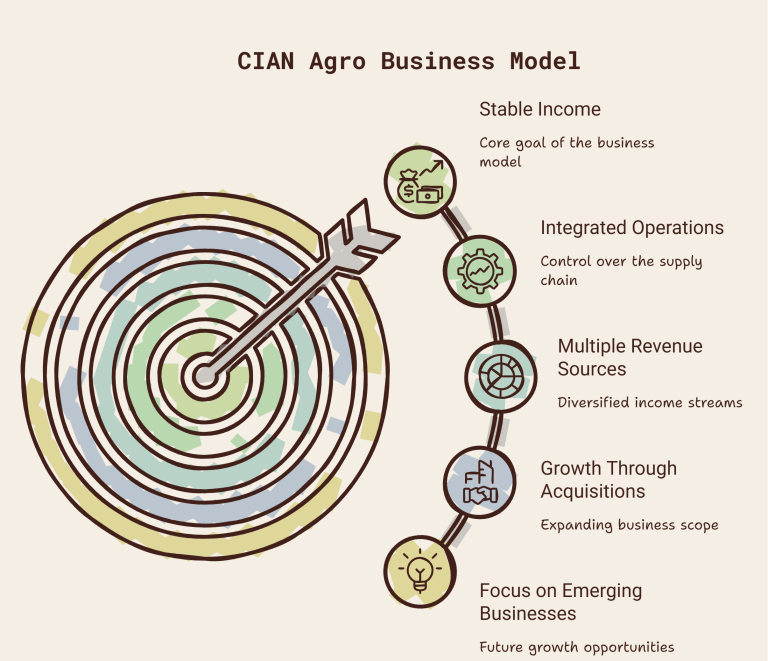
    CIAN Agro’s business model is built on generating stable income from diverse business segments and expanding in line with emerging opportunities.
    CIAN Agro Business Model
    • Integrated Operations: The company is involved in the entire process, ranging from the processing of raw agricultural produce to the manufacturing of value-added products. This ensures better control over the supply chain and strengthens operational efficiency.
    • Multiple Revenue Sources: CIAN Agro’s earnings are not dependent on a single business. Its operations across the agro, distillery, power, infrastructure, and other sectors collectively generate diverse revenue streams for the company.
    • Growth Through Acquisitions: In recent years, the company has expanded its business scope by incorporating new subsidiaries into the group. This has facilitated entry into new sectors and increased the overall scale of the business.
    • Focus on Emerging Businesses: The company is also focusing on sectors where demand is expected to rise in the coming years. Ethanol and energy-related businesses are part of this strategy and are poised to play a crucial role in future growth.
    • Balanced Business Strategy: CIAN Agro aims not only to add new businesses but also to maintain a balance across different industries. Consequently, the company is moving forward with a diversified business portfolio rather than relying on a single sector.

    Understanding CIAN Agro Ethanol Business 

    CIAN Agro recently branched out into the ethanol market. In the 2024-25 fiscal year, they bought a distillery business and added it to their group. This move got them into the energy sector alongside their regular agro-processing work.

    • Expansion Through Acquisitions: They entered the ethanol and distillery space by taking over new subsidiaries. This setup is perfectly timed since ethanol demand in the country is rising steadily.
    • CO₂ to Ethanol Project: In January 2024, CIAN Agro signed an MoU with Ram Charan Group to make ethanol using CO₂. If this tech works out commercially, it opens up a huge new door for them.
    • Government Support: India is already pushing the 20% Ethanol Blending Programme (E20). Plus, Union Minister Nitin Gadkari talked about mixing 15% isobutanol into diesel. These steps have boosted hopes for the biofuel market’s growth.
    • Why It Matters: Right now, ethanol is just a fresh segment for CIAN Agro. But with great government backing and growing demand, it could easily turn into their main business later on.

    Read Also: Hero FinCorp Case Study

    India Ethanol Policy and Its Impact on CIAN Agro

    The way the Indian government is pushing ethanol has totally flipped the industry on its head lately. For companies like CIAN Agro, these policy updates are everything they directly decides their demand, how much they can make, and how they can grow.

    • The Big E20 Push: India managed to hit its 20% ethanol blending goal way earlier than planned. On top of that, E20 petrol became available all over the country on April 1, 2026, creating a super solid ground for ethanol demand.
    • The Biofuel Plan: Government focus has shifted from just sugarcane to other things like corn, broken rice, and different farm leftovers. They just want to scale up production and make sure they aren’t relying on one single crop.
    • More Distillery setups: To get more ethanol into the market, the government is helping out with money and giving interest discounts to set up new distilleries. This keeps the country’s overall capacity moving up.
    • What’s Next After E20: They aren’t stopping at 20%. The government is already drawing up plans for higher blends like E22, E25, E30, and even E85 down the road, plus they are pushing hard for flex-fuel cars.
    • Mixing Isobutanol into Diesel: Just now in July 2026, Nitin Gadkari dropped a big update saying they want to allow 15% isobutanol blending in diesel. This is a massive new window for anyone in the biofuel space.
    • How this hits CIAN Agro: Since CIAN Agro has been putting a lot of effort into their distillery and ethanol business lately, these aggressive government plans are going to fetch them some massive new business opportunities very soon.

    CIAN Agro Financial Analysis 

    Financial Statements Analysis 

    Particulars202620252024
    Total Income2,2791,053182
    Total Expenses1,865933159
    EBIT41311922
    Net Profit222414
    (All values are in INR crores and the data is as of March 2026)

    Balance Sheet Comparison 

    Particulars202620252024
    Current Liabilities1,1161,153297
    Current Assets1,027931313
    Reserves & Surplus2,1261,95361
    (All values are in INR crores and the data is as of March 2026)

    Cash Flow Statement Comparison 

    Particulars202620252024
    Cash Flow from Operating Activities37528165
    Cash Flow from Investing Activities-86-150-3
    Cash Flow from Financing Activities-283-140-50
    (All values are in INR crores and the data is as of March 2026)

    Key Performance Ratios (KPIs) 

    Particulars202620252024
    Operating Profit Margin (%)18.5211.6413.31
    Net Profit Margin (%)9.964.002.86
    ROE (%)10.332.1316.92
    ROCE (%)13.223.9515.12
    Debt to Equity (x)0.560.673.69
    (Data as of March 2026)

    CIAN Agro Shareholding Pattern Analysis 

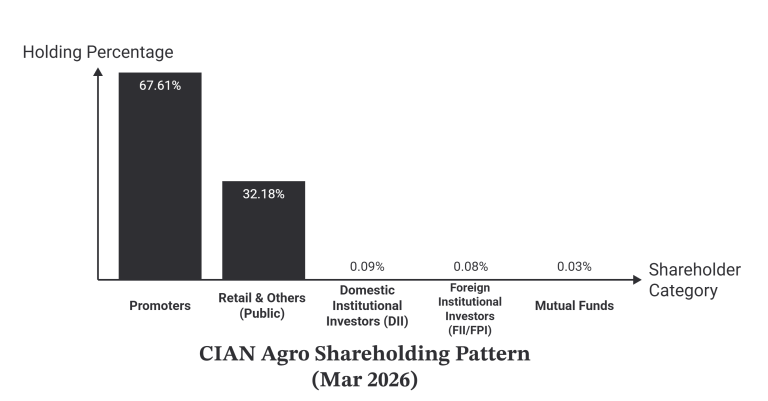
    Promoter holding in CIAN Agro remains strong, reflecting their control over the company. Meanwhile, the stake held by institutional investors (FII/DII) remains limited.

    Shareholder CategoryHolding (Mar 2026)
    Promoters67.61%
    Retail & Others (Public)32.18%
    Domestic Institutional Investors (DII)0.09%
    Foreign Institutional Investors (FII/FPI)0.08%
    Mutual Funds0.03%
    (Data as of 30 June 2026)
    CIAN Agro Shareholding Pattern

    Nitin Gadkari Family and CIAN Agro – What Is the Connection? 

    Nikhil Gadkari’s Role

    Nikhil Gadkari works as the Managing Director for CIAN Agro Industries & Infrastructure Ltd. His job is mostly about leading the company’s new projects, choosing how the business will expand, and taking all the main strategic decisions. 

    What Is the Connection?

    Talking about the connection, Union Minister Nitin Gadkari is actually Nikhil Gadkari’s father. Since it involves such a well-known political family, the media and politicians talk about this company a lot.

    Why Has the Company Been in the News?

    Allegations were raised by the opposition that companies linked to the Gadkari family benefited from the ethanol policy. Conversely, the government and Nitin Gadkari have dismissed these allegations. To date, no competent court or investigative agency has confirmed that CIAN Agro received any undue advantage through the policy.

    SWOT Analysis of CIAN Agro 

    Strengths

    • Not Just About Farming: The company handles more than just agro products. They are actively working in distillery, power, infrastructure, and other fields.
    • Strong Backing by Promoters: Promoters hold a solid 67.61% stake here, which shows they have massive trust in their own business.
    • Fast Growth via Buying Businesses: Their recent step to acquire new subsidiaries has helped them quickly scale up their overall assets and operations.
    • Entering In-Demand Sectors: Being present in hot industries like ethanol and clean energy is a huge plus point for their long-term future.

    Weaknesses

    • Less Interest from Big Funds: Big institutional investors like FIIs and DIIs have a very tiny shareholding in this company right now.
    • Too Dependent on Mergers: Buying out other companies for growth means they need to spend a lot of time and money to mix those new setups into their system.
    • Needs Big Money Continuously: Running plants like power stations and distilleries takes a constant flow of heavy investment.
    • Complex Network of Firms: Because a lot of their new work happens through smaller subsidiaries, managing the daily operations can get a bit messy.

    Opportunities

    • Biofuel Boom in India: The demand for ethanol and alternative biofuels is climbing fast across the country.
    • New Plant Setups: Boosting their distillery capacity can seriously increase the size and reach of their business down the road.
    • Focus on Clean Energy: With everyone investing heavily in green fuels, this sector could bring in massive growth paths for them.
    • New Ways to Earn: Spreading out into different industrial setups means they will likely create new income streams.

    Threats

    • Risk of Policy Changes: Any sudden tweak in government laws or biofuel rules could directly hit how they do business.
    • Price Shifts in Materials: If crop prices go up, their total production cost will jump too.
    • Stiff Competition: Big sugar mills and top ethanol firms are pushing hard, making the market really tough.
    • Project Delay Risks: If new setups finish late or go over budget, it will directly hit their profits.

    Key Risks Every Investor Should Consider 

    Every growth phase entails certain risks that investors should not overlook.

    • Execution Risk: The company has added several new business lines in recent years. If these are not managed effectively and on schedule, the realization of expected results could be delayed.
    • Debt Risk: Large-scale projects require substantial capital. Any future increase in debt could lead to an interest burden that impacts the company’s profitability.
    • Demand Risk: If demand in the ethanol or energy sectors does not grow as projected, it may take longer to achieve the expected returns on new investments.
    • Risks with Demand: If the market for energy or ethanol doesn’t grow like people are hoping, getting a good return on those new investments is going to take much longer than planned.
    • Government Rules: Any sudden changes in official laws regarding biofuels or the environment can straight up ruin the company’s future strategy.

    Read Also: Shiprocket Case Study

    What Makes CIAN Agro Different From Other Ethanol Companies? 

    Comparison FactorCIAN Agro Industries & Infrastructure LtdTypical Ethanol Company
    Business FocusPresence in power, distillery, infrastructure, and other businesses alongside agro.Primarily dependent on the sugar and ethanol business.
    Growth StrategyExpansion through new acquisitions and the addition of diverse businesses.Expansion primarily through new distilleries or by increasing production capacity.
    Revenue MixReduced dependence on a single sector due to income from multiple businesses.A significant portion of the revenue comes from the ethanol and sugar businesses.
    Business StructureOperations through several subsidiaries.Generally limited to one or two major business verticals.
    Growth DriversPotential for expansion into energy and other industries alongside ethanol.Growth primarily depends on the demand for ethanol and production capacity.
    Business RiskHaving diverse businesses keeps the risk distributed to some extent.A downturn in a single industry can have a relatively greater impact.

    Who is Sarang Gadkari, and which company does he manage?

    Sarang Gadkari is Union Minister Nitin Gadkari’s younger son. He runs Manas Agro Industries & Infrastructure Ltd., which used to be under the Purti Group. After a corporate shuffle, Manas Agro and CIAN Agro became independent firms. Today, Nikhil Gadkari handles CIAN Agro, while Sarang Gadkari takes care of Manas Agro.

    In which sectors does Manas Agro operate?

    • Sugar
    • Ethanol
    • Power Generation
    • Bio-Fertilizer
    • Green energy-related businesses

    The company’s ethanol production is linked to its sugar unit located at Bela (Nagpur), Maharashtra. Additionally, Manas Agro has expanded into fuel distribution and other energy projects.

    Conclusion

    CIAN Agro Industries & Infrastructure Ltd has definitely grown its business big time in a short period. But just looking at this fast growth isn’t enough to make a safe investment. Before putting in your money, you really need to sit down and check their actual financial numbers, how they plan to handle debt, their management quality, and the risks involved. In the end, only the decisions backed by your own deep research will actually pay off. 

    S.NO.Check Out These Interesting Posts You Might Enjoy!
    1Netflix Case Study
    2Meesho Case Study
    3Reliance Jio Case Study
    4Burger King Case Study
    5Zara Case Study
    6NSE Case Study
    7Blinkit Case Study
    8OYO Case Study
    9CultFit Case Study
    10Flipkart Case Study

    Frequently Asked Questions (FAQs)

    1. What does CIAN Agro Industries & Infrastructure Ltd do?

      CIAN Agro operates in agro processing, distillery, power, infrastructure, and other industrial businesses.

    2. Why is CIAN Agro in the news?

      The company has been in the news due to its business expansion, entry into the ethanol sector, and recent acquisitions.

    3. Who is the Managing Director of CIAN Agro?

      The Managing Director of CIAN Agro is Nikhil Gadkari.

    4. Is CIAN Agro involved in the ethanol business?

      Yes, the company has expanded into the distillery and ethanol businesses in recent years.

    5. What is the promoter holding in CIAN Agro?

      As of March 2026, the promoters’ stake in the company is 67.61%.
  • Hero FinCorp Case Study: Business Model, Financial Analysis & Growth Strategy

    Hero FinCorp Case Study: Business Model, Financial Analysis & Growth Strategy

    India’s credit market has quietly become one of the most contested spaces in the economy. The rising number of buyers who are looking for short-term, small amount loans is the key reason behind this. 

    Hero FinCorp has built its entire identity around delivering these loans. It is backed by the Hero Group. Recently, the company has grown to be one of the top non-banking financial companies (NBFCs).

    This case study looks at how Hero FinCorp works and what makes it one of the finest companies in the country. Read this to get the details needed.

    Hero FinCorp Company Overview

    Hero FinCorp was started in December 1991. It is headquartered in Gurugram. It was incorporated as Hero Honda FinLease Limited. The aim with which it was started was to extend working capital and medium-term finance to the component suppliers and dealers of Hero Honda Motors.

    But over time, the company was restructured as Hero MotoCorp. This was when the financing sector was named Hero FinCorp in July 2011 to make it more brand-related and focused.

    What started as a single-purpose lending desk for two-wheeler dealers has since grown into a full-spectrum NBFC. The company is now serving a range of credit seekers like:

    • Retail borrowers
    • MSMEs
    • Large Corporations

    There is also one subsidiary, which is Hero Housing Finance Limited (HHFL). It has been disbursing home loans since 2018. The spectrum and range offer diversification, which supports growth.

    Leadership at Hero FinCorp

    NameDesignationRole
    Abhimanyu MunjalJoint Managing Director & CEOLeads the company and focuses on developing plans for growth.
    Sajin Purushothaman MangalathuCFO, COO & CIOManages finance, operations, technology, and risk systems.
    Priya KashyapCOO & Chief of StaffWorks with the marketing, HR, analytics, and business transformation.
    Ajay SahasrabuddheChief Revenue OfficerLeads the lending business and revenue growth.

    The ownership table is fairly concentrated. Beyond Hero MotoCorp’s stake, the Munjal family (directly and through Bahadur Chand Investments) holds a significant block, while private equity names such as Apollo Global Management, ChrysCapital, Credit Suisse, and Apis Partners hold the rest through various funding rounds dating back to 2016.

    Rise of NBFCs in India and Hero FinCorp’s Role

    Bank credit in India has historically skewed toward salaried, urban, and credit-tested borrowers. That left a vast pool of first-time earners, gig workers, and small business owners outside the formal credit net. 

    This is the segment the industry now calls “Aspiring India.” These are the households earning between roughly ₹2 lakh and ₹10 lakh annually. NBFCs are helping these people.

    Because nearly every Hero MotoCorp two-wheeler buyer needs financing, the company focused on building around the same. It is now sourcing close to 99% of its vehicle loans directly through Hero dealerships. From there, it expanded into used-car loans, personal loans, loans against property, and MSME credit, turning a single-product captive lender into a diversified retail and business finance company with a footprint across more than 18,000+ pin codes.

    Business Model of Hero FinCorp

    Unlike asset-light marketplaces, an NBFC’s business model runs on the spread between what it pays to borrow and what it charges to lend. This is commonly called net interest margin (NIM). Hero FinCorp’s model rests on a few pillars:

    • Borrowing strategically: The company raises funds through bank loans, non-convertible debentures, and commercial paper, helped by healthy credit ratings “AA+ with a stable outlook” from CRISIL, ICRA, and CARE, and “A1+” on its commercial paper.
    • Lending across segments: Interest income, drawn from retail two-wheeler loans, used-car financing, personal loans, MSME credit, and corporate/institutional finance (CIF), forms the bulk of revenue. Interest income alone makes up roughly 87% of operating income.
    • Fee-based and ancillary income: Loan processing fees, insurance commissions on policies bundled with loans, and treasury income round out the rest, and these fee-based lines have been growing faster than the core lending book.
    • Risk-adjusted underwriting: A meaningful share of borrowers are “new-to-credit,” meaning they have no prior loan history. Hero FinCorp leans on data analytics and its dealership relationships to underwrite this riskier segment, though it comes at the cost of higher provisioning in tougher years.
    • Cross-subsidiary monetisation: Hero Housing Finance Limited lets the parent capture home-loan and loan-against-property demand from the same customer base without diluting the core NBFC’s balance sheet.

    Read Also: Hero MotoCorp Case Study

    Product Portfolio of Hero FinCorp

    The company’s offerings have widened well beyond two-wheeler loans:

    Business SegmentDescription
    Vehicle LoansLoans for new Hero MotoCorp two-wheelers, select electric two-wheelers, and used cars.
    Personal LoansInstant personal loans through the app, website, and partner platforms.
    MSME FinanceSecured and unsecured loans for businesses, including working capital finance.
    Corporate & Institutional FinanceLarge secured loans for corporates, promoters, and holding companies.
    Hero Housing FinanceHome loans and loans against property through its housing finance subsidiary.
    Electric Vehicle FinancingLoans for electric vehicles, introduced in 2023.

    Marketing Strategy of Hero FinCorp

    Hero FinCorp’s marketing playbook leans heavily on the equity of the “Hero” name itself. This is worked out with a proper planned approach to make the company feel like a consumer-facing financial brand in its own right. Some of the key plans approached are:

    • Brand Repositioning Around “Windows of Opportunity: In March 2024, the company worked on a refreshed visual identity. This was a window motif. It meant to symbolise unlocking potential for customers, employees, and partners. The tagline “Confidence to Make it Happen” was the key. The campaigns are aimed at what the company calls “Aspiring Bharat.”  This was the next wave of credit-hungry Indians in smaller towns and cities.
    • Captive Distribution as a Marketing Channel: There are more than 11,000 Hero MotoCorp dealer touchpoints and thousands of direct sales agents and digital partners around the world. The dealership floor itself doubles as a sales and marketing surface. This lets the company convert two-wheeler footfall into loan customers without heavy customer-acquisition spend.
    • Content Marketing and SEO: In its earlier growth phase, the company invested in search-optimised content, social media activity, and shareable brand content specifically to shed its “captive financier” image and present itself as a customer-centric, digitally savvy lender that younger, first-time borrowers would trust.
    • Digital-first Acquisition: The HIPL app and website push instant personal loans directly to consumers, reducing dependence on physical branches and widening the funnel beyond two-wheeler buyers.
    • Segment-specific Messaging: Campaigns are tailored differently for MSME owners (emphasising working-capital speed and flexibility) versus retail borrowers (emphasising simplicity and “EMI made easy”), reflecting the company’s long-standing internal motto, “Finance Made Easy.”

    Business and Growth Strategy

    Hero FinCorp’s growth roadmap rests on a handful of deliberate bets:

    • Diversification beyond two-wheelers: Retail and MSME loans together made up over 85% of its loan book by FY24. This is a sign of how far the company has moved from its single-product origins.
    • Tier-2/Tier-3 and rural penetration: A large share of its borrower base sits outside metro India. This aligns well with “Aspiring India” thesis.
    • Capital markets access: The company filed its Draft Red Herring Prospectus (DRHP). It was with SEBI in mid-2024. This was for an IPO sized at roughly ₹3,668 crore. SEBI cleared the issue in mid-2025. It was for a pre-IPO placement of ₹260 crore in June 2025. The final date has not been announced.
    • Technology and analytics: It has been investing in digital lending infrastructure. The company focused on credit-risk models and IT systems as well. This is to speed up underwriting and reduce the cost of acquiring new-to-credit customers.
    • Selective new verticals: Electric-vehicle financing and an expanding housing-finance subsidiary give the company exposure to two of India’s faster-growing credit categories.

    Market Data of Hero FinCorp

    Market Data MetricApproximate Value
    Assets Under Management (AUM), FY25Over ₹57,700 Crore
    Customer BaseOver 1.2 Crore (12 Million+)
    Serviceable Pin Codes18,600 Plus
    Touchpoints / Branches4,600 Plus
    Employees15,000 Plus
    Two-Wheeler Loan Sourcing via Hero DealershipsAround 99%
    Retail + MSME Share of Total AUMOver 85%

    Financial Analysis of Hero FinCorp

    The numbers below are drawn from official reports on the website. The idea is to help understand the performance and growth.

    Revenue and Profit Trend (₹ Crore)

    ParticularsFY24 FY25 FY26
    Revenue from Operations7,755.24 9,110.058,740.15
    Interest Earned6,977.30 7,930.287,505.40
    Other Income49.4542.8011.41
    Profit After Tax (PAT)601.92 57.84(306.56)

    Balance Sheet (₹ Crore)

    IndicatorFY24FY25FY26
    Total Assets48,565.2754,123.2253,829.86
    Total liabilities42,789.7248,410.8248,054.72
    Total equity5,775.555,712.405,775.14

    Cash Flow Statement (₹ Crore)

    IndicatorFY24FY25FY26
    Net cash used in operating activities(8,012.68)(2,729.06)454.88
    Net cash used in investing activities(96.59)(435.61)(513.14)
    Net cash generated from financing activities7,506.995,099.82(1,535.11)
    Cash and cash equivalents at the end of the year28.341,963.49370.12

    Key Performance Indicators

    IndicatorFY24FY25FY26
    Debt to Equity Ratio (No. of times)7.228.278.08
    Total debts to total assets (%)85.8687.2686.74
    Net profit margin (%)12.184.262.64
    Net worth (₹ in Crore)8,386.798,596.769,136.71
    Liquidity Coverage Ratio (%)138.16165.37N.A.
    Capital to risk-weighted assets ratio (%)16.2816.8816.80
    Data as of 27 June 2026

    SWOT Analysis of Hero FinCorp

    SWOT FactorKey Points
    StrengthsStrong customer pipeline through Hero MotoCorp dealerships.Trusted Hero brand with a strong presence across India.Diversified loan portfolio across retail, MSME, and corporate lending.AA+ credit ratings help keep borrowing costs competitive.
    WeaknessesHeavy dependence on Hero MotoCorp’s vehicle sales.Profitability affected by provisioning and asset quality.Higher credit risk due to many first-time borrowers.High debt-to-equity ratio requires careful liquidity management.
    OpportunitiesGrowing demand for electric vehicle financing.Expanding MSME lending opportunities.Cross-selling through Hero Housing Finance.IPO can strengthen capital and support future growth.
    ThreatsStrong competition from major NBFCs.Stricter RBI regulations may increase compliance costs.Economic slowdown could reduce loan demand.Rising NPAs may impact overall financial performance.

    Read Also: Grasim Industries Case Study

    Conclusion

    Hero FinCorp’s story is really the story of a captive financing desk. It is one of the companies that grew into a full-fledged, diversified NBFC while maintaining the edge and advantage. It shows the efficient use of the Hero MotoCorp dealership network, which was its biggest strength. 

    The company has done well to widen its book across MSME and corporate lending. The analysis displays a steady growth in the performance, which is also backed by the numbers and profit history. Also, the use of capital across sectors makes it a pioneer. 

    While the IPO date is still to be announced, it is a strong option for those who are seeking steady growth with investment in the finance sector. But at the same time, it will require even a deeper analysis at later stages. So, if you are seeking the same, register with Pocketful and keep details handy.

    S.NO.Check Out These Interesting Posts You Might Enjoy!
    1Sun Pharma Case Study
    2LTIMindtree Case Study
    3Ola Electric Case Study
    4Varun Beverages Case Study
    5IRCTC Case Study

    Frequently Asked Questions (FAQs)

    1. How does Hero FinCorp make money? 

      The company earns primarily through the spread between its cost of borrowing and the interest it charges on loans across two-wheeler, personal, MSME, and corporate lending, supplemented by fee income from loan processing and insurance commissions.

    2. Is Hero FinCorp profitable? 

      Yes. The profitability has been volatile over the years, but the overall performance has shown strong insights, growth, and promising delivery. 

    3. Who owns Hero FinCorp? 

      Hero MotoCorp holds roughly 40%. This is with the Munjal family holding a further significant stake, alongside private equity investors including Apollo Global Management, ChrysCapital, Credit Suisse, and Apis Partners.

    4. Is Hero FinCorp listed on the stock market? 

      Not yet as of mid-2026. The approval from the SEBI has been there as of 2025 but the IPO date is still to be confirmed.

    5. What is Hero Housing Finance Limited? 

      It is a wholly owned subsidiary of Hero FinCorp that focuses on home loans and loans against property, operational since 2018.

  • OYO Case Study: Business Model, Revenue, SWOT Analysis & Growth Strategy

    OYO Case Study: Business Model, Revenue, SWOT Analysis & Growth Strategy

    OYO is one of the most famous hospitality brands in India. This brand partners with the existing budget hotels and provides customers with clean and affordable rooms for their stay. The company started very small but quickly grew into a large global business. The brand solved a huge problem for everyday travelers. It fixed the broken budget hotel market using smart technology and simple standardisation. This amazing growth makes the company a favorite topic for business experts and students alike.

    Reading a detailed OYO case study reveals how a simple idea can change an entire industry. This report will look closely at the OYO Business Model to see exactly how the company makes money. It will also cover the smart marketing strategy of OYO that won over millions of customers. Further sections will provide a deep Financials analysis of OYO to understand its recent profits. Finally, a complete swot analysis of OYO will highlight its future chances in the market.

    The Origin Story of OYO

    The company’s founder is a young entrepreneur named Ritesh Agarwal. He began his entrepreneurial journey at the age of 17 years. He personally used to travel across India with a very tight budget. Due to which he used to stay at cheap hotels and guest houses. These cheap hotels were very unpredictable and usually lacked basic hygiene as there was no standardisation. That is when he thought travelers need a brand that they can fully rely on. 

    The company was started in the year 2013 with just this simple idea. The aim was just to provide affordable and hygienic hotel rooms to every traveler. The company started its process with just one hotel located in Gurgaon & later expanded all over the country. 

    The early challenges faced by the company were massive. Traditional hotel owners did not want to change their old ways of working. Earning the trust of both old hotel owners and new customers took a lot of hard work. However, the dedication of the founder slowly changed the entire market.

    Understanding the Indian Hotel Industry Before OYO

    Before the brand entered the market, the budget hotel segment in India was highly unorganized. Travelers faced many daily problems when booking cheap rooms. The market was filled with independent guest houses that had no proper quality checks.

    The biggest customer pain point was the absolute lack of predictability. A traveler could never be sure if the room would have clean bed sheets. Working air conditioning and clean washrooms were also rare luxuries. Finding a reliable budget hotel was mostly based on pure luck.

    The market gap identified by OYO was massive. The company realized that travelers did not necessarily want expensive luxury. They simply wanted basic comforts, strict cleanliness, and fair prices. The Indian hotel industry desperately needed a brand that could guarantee this basic standardisation.

    OYO’s Business Model Explained

    • How OYO Works: The company does not have its own physical infrastructure. Instead, it ties up with existing budget hotels that lack in standardisation. It helps the owners upgrade their rooms to meet strict quality standards before listing them online.
    • Revenue Sources of OYO: The company mainly uses a franchise model and a revenue sharing model. It charges a commission fee on every single room booked through its platform. This fee is usually between 20 percent and 30 percent depending on the services provided to the partner.
    • Value Proposition for Hotel Owners: Hotel owners benefit greatly from this partnership. They get access to smart technology tools like the CO-OYO app, which helps them manage daily bookings easily. They also see a big increase in the number of regular guests because of the strong brand visibility.
    • Benefits for Customers: Travelers get a guarantee that they will get cleaner hygienic rooms at affordable prices. Along with this people get basic amenities like wi-fi, clean washrooms and comfortable sleeping beds. The booking process is completely safe and can be done within some Simple steps online.

    OYO’s Rapid Growth Strategy

    The brand did not stop after succeeding in its home country. The company followed an aggressive plan to grow quickly.

    First, the expansion across India was incredibly fast. The brand expanded rapidly across major Indian cities and even small towns. Soon, it became a household name for budget stays everywhere in the country.

    Second, entering international markets became a major goal. After capturing the Indian market, the company launched large operations in countries like Malaysia, China, and Europe. Recently, the company acquired the famous Motel 6 brand in the United States for $525 million in December 2024.

    Third, this massive growth relied heavily on technology driven operations. The company used advanced software to manage thousands of properties at the exact same time. This made scaling the business very fast and highly efficient.

    Lastly, the brand used aggressive customer acquisition techniques. It offered deep discounts and easy booking options to attract millions of new users. It also created different sub brands like Townhouse and Collection O to target different types of customers.

    Read Also: Shiprocket Case Study

    Funding and Investment Journey

    The massive expansion of the brand required a huge amount of financial capital. The overall funding and investment journey of the company is highly impressive.

    There have been many major funding rounds over the years. Since the start of OYO it has successfully raised a total capital of over $3.4 billion in 21 different funding rounds. 

    Some of the biggest names in global finance like SoftBank, Peak XV Partners, Lightspeed, Microsoft, and Airbnb are the key investors of this brand. Due to the investment fueled by the Venture capitalists the brand has expanded across various countries rapidly. This has also led the company to acquire smaller hotel chains and invest heavily in new modern technologies.

    They have also made a number of major acquisitions including Leisure Group, DanCenter, Direct Booker and G6 Hospitality, the parent company of Motel 6 and Studio 6, which has expanded their international presence further.

    The valuation milestones of the company have seen many ups and downs. The company was at its absolute peak in 2019 and achieved a massive valuation of about 10 billion dollars. The valuation got affected and dropped around during the COVI-D 19 pandemic, but recent funding rounds have stabilized its private valuation at around 3.8 billion dollars.

    OYO’s Marketing and Branding Strategy

    • Building Trust in Budget Hospitality: The brand focused entirely on the simple promise of standardized rooms. This clear promise solved a major fear for travelers and built immense public trust quickly.
    • Digital Marketing Campaigns: The company used SEO and social media marketing aggressively to target the young audience, college students and working professionals. 
    • App-Based Booking Experience: The mobile application is also very user friendly and booking can be easily done using their app. This smooth experience became an attraction for new people to join.
    • Customer Loyalty Programs: The brand introduced a special loyalty program called OYO Wizard. This program offered special flat discounts and extra benefits to members. It successfully encouraged customers to book repeatedly with the same brand.

    Technology Behind OYO’s Success

    • Role of Data Analytics: The company uses data to carefully understand customer preferences and local travel habits. This helps in predicting local demand and improving the overall guest experience across different cities.
    • Property Management Systems: The brand provides its hotel partners with a dedicated software system called OYO OS. This helpful software handles room inventory, daily guest check ins, and local staff management seamlessly.
    • Dynamic Pricing Strategy: The company uses smart algorithms to change room prices in real time. Prices naturally go up during high demand and drop during low demand to ensure rooms are always full. The pricing engine can update room rates multiple times a single day.
    • Mobile App and Customer Experience: The consumer application is fast and highly reliable. It offers simple features like easy cancellations, digital check ins, and secure digital payments.

    Challenges and Controversies Faced by OYO

    The company faced several big challenges and public controversies along the way. First, there were major disputes with hotel partners. Many partners complained about hidden fees and unfair business contract terms. This led to several protests by hotel owners in different cities.

    Second, legal issues became a major headache. The company faced a long legal battle with a competitor named Zostel over an unfinished business merger. The company eventually won a major victory in the Delhi High Court regarding this dispute.

    Third, maintaining quality control issues across thousands of hotels proved very difficult. As the company grew too fast, ensuring every room was perfectly clean became a big operational issue.

    This rapid growth naturally led to customer complaints and negative online reviews. Guests sometimes arrived to find their rooms already booked or in bad condition. The heavy impact of negative publicity forced the management to slow down, fix their core operations, and remove bad hotels from their network.

    OYO’s Financial Performance

    • Yearly Revenue: The company has shown strong growth despite facing several challenges. In 2025 the company’s total revenue reached Rs.6,253 Cr. 
    • Profitability Challenges: The company had been focusing on growth over profits for years, resulting in massive losses, especially during the COVID-19 pandemic. But in recent years the company has changed its focus to sustainable growth and operational efficiency.
    • Cost Structure Analysis: To survive, the company completely changed its cost structure. The management reduced employee costs by a massive 51 percent, cut down unnecessary marketing spends, and closed unprofitable international operations.
    • Recent Financial Improvements: These recent financial improvements have paid off wonderfully. In 2024 the company recorded a net profit of Rs.229 Cr. This positive trend continued in the year 2025 where the net profit was Rs.245 Cr. rupees.
    Financial YearRevenue from OperationsTotal Expenses Net profit / Loss
    FY 20213,961 Cr.5,984 Cr.– 3,943 Cr.
    FY 20224,781 Cr.5,260 Cr.– 1,941 Cr.
    FY 20235,463 Cr.5,207 Cr.-1,286 Cr.
    FY 20245,388 Cr.4,500 Cr.      229 Cr. 
    FY 20256,253 Cr.6,659 Cr.      245 Cr. 

    SWOT Analysis of OYO

    Strengths

    OYO’s main strength lies in its widespread global reach and strong brand identity, the company manages a huge inventory of over 21,000 hotels and approximately 1,20,000 vacation homes that are operational in more than 35 different countries. With its core idea of asset-light, multi-vertical hospitality platform, the company leverages proprietary technology, artificial intelligence, and dynamic pricing algorithms to optimize revenue per available room (RevPAR). The prominent usage of tech in hospitality has led to superior occupancy rates frequently reaching 75–78% compared to the industry average of less than 50% for unorganized budget stays providing a massive competitive edge.

    Weaknesses

    Despite its automated quality-control mechanisms, ensuring localized operational consistency across thousands of deeply fragmented, franchised properties remains a structural challenge. This inconsistency can lead to volatile guest experiences and fragmented online reviews. Furthermore, while OYO has successfully pivoted to profitability recording positive EBITDA for over 12 consecutive quarters and crossing Rs.1,000 crore in EBITDA for FY25 the company has historically suffered from high cash burn and heavily relied on complex debt restructuring and external funding rounds to sustain global scaling.

    Opportunities

    The company has a huge potential in expanding its business internationally with main focus on high-margin premiumization. The company has boosted its expansion in the US by playing some strategic moves like the acquisition of G6 Hospitality (Motel 6 and Studio 6), opening access to the multi-billion-dollar US economy lodging market. Domestically, through its dedicated real estate and property acquisition arm (Sunday PropTech), the company is aggressively expanding its upscale, company-serviced portfolio under premium brands like Palette and Sunday Hotels. These premium segments capture significantly higher average daily rates (ADR) between Rs.4,000 to Rs.5,400, directly driving robust cash flows.

    Threats

    There is very high competition in the travel tech and hospitality sector. The company needs to give affordable stay, but competition with the dominant Online Travel Agencies (OTAs) like Booking.com and Expedia, along with local budget aggregators and vacation rental substitutes like Airbnb are turning out to be a challenge. Additionally, the industry is highly cyclical in nature as it depends on seasons and holidays but factors like macro-economic downturns, inflationary pressures, and sudden shifts in global tourism policies pose immediate risks to consumer discretionary spending, which can sharply contract overall booking volumes.

    Read Also: CultFit Case Study

    Conclusion

    The business journey of this Indian startup is a remarkable example of modern innovation. The company started with a simple vision to provide clean and affordable rooms. Today, it stands as a massive technology driven hospitality network.

    While the business faced serious operational challenges, its recent shift towards profitability shows strong maturity. The deep focus on technology and standardized service continues to drive its success forward in the global market. The future looks bright as the company continues to expand responsibly.

    For more market news and insights, download Pocketful – offering users zero brokerage on delivery trades and an easy to use platform designed for both beginners and experienced investors. 

    S.NO.Check Out These Interesting Posts You Might Enjoy!
    1Netflix Case Study
    2Meesho Case Study
    3GSK Pharma Case Study
    4Burger King Case Study
    5Zara Case Study

    Frequently Asked Questions (FAQs)

    1. What is OYO? 

      OYO is a tech based hospitality brand that partners with local hotels and home stays to transform them into standardized, budget friendly stays for travelers. 

    2. How does OYO make money? 

      The company charges a commission fee on every room booked using the company’s platform and also it gets fees from its franchise model from various hotel partnerships. 

    3. OYO was founded by whom? 

      The founder of the company is Ritesh Agarwal, he started OYO’s journey in the year 2013. 

    4. Is it profit making company? 

      The company faced huge losses for several years but eventually in the year 2024 the company became profitable and it continued even in the year 2025. 

    5. What is the main business model of OYO? 

      The company does not invest in physical assets rather it makes money using its franchise model. Here the company ties up with existing hotels and upgrades them as per company standards. 

  • Shiprocket Case Study: Business Model, Revenue & Growth Strategy

    Shiprocket Case Study: Business Model, Revenue & Growth Strategy

    E-commerce sector in India is expanding its roots very fast. Small businesses now sell their products online to reach more buyers. However, these small businesses need reliable shipping services to succeed. This detailed Shiprocket case study explores how one company solved this major problem. The Shiprocket Business Model brings top courier companies onto a single platform. This step makes shipping cheaper and faster for small sellers.

    The platform acts as a bridge between online stores and delivery agents. Readers will discover how technology helps deliver packages to every corner of India. The logistics industry has many challenges, but this startup found a way to simplify the entire process.

    Shiprocket Company Overview

    The company was initially founded to solve the problems of sellers and help them to build their website. They started something called KartRocket through a company named BigFoot Retail Solutions in the year 2012. BigFoot Retail Solutions was the company name and KartRocket was the platform they used. However, the team soon realized that shipping was the real problem.

    Small businesses struggled to send items safely and affordably. Therefore, the company shifted its focus and became Shiprocket in 2017. Today, the company connects small sellers with large courier companies. The platform is now a recognized unicorn in India with a high valuation. It powers nearly five percent of all online shipments in the country.

    About Founders of Shiprocket Company

    Founders are the key managerial person of an entity. below are mentioned detail about the founders of shiprocket 

    • Saahil Goel (CEO): He was working as a Business Analyst at Max Life Insurance. In shiprocket his focus is on tech development and product growth
    • Gautam Kapoor (Co-Founder and COO): He takes care of the daily logistics operations and business execution. He holds a BBA from Western International University. He brings rich experience from his family business in industrial products and from working with top engineering brands like Bosch and Sick.
    • Vishesh Khurana (Co-Founder): His focus area is to add new sellers to the platform He completed his BBA in Marketing from Amity Business School.
    • Akshay Ghulati (Co-Founder): He focuses on new business partnerships and global expansion. A wharton business school grad and holds an MBA from Harvard Business School. He has strong professional experience from working with massive companies like Amazon, AT Kearney, and Parthenon Group.

    Together, these founders built a massive business from the ground up. Their leadership choices will be explored later in the swot analysis of Shiprocket.

    Rise of E commerce shipping industry in india and Role of Shiprocket

    People from small towns now buy things online daily. This trend creates a huge demand for fast and safe delivery. However, small sellers often struggle with high shipping costs. They do not ship in large volumes like big corporations.

    Shiprocket fixed this major problem in the market. The company partnered with top logistics providers to get bulk discounts. The platform passes these large discounts to small sellers.The company handles over 200 million transactions every year. It successfully bridges the gap between small sellers and nationwide delivery networks.

    Read Also: PharmaEasy Case Study

    Business Model of Shiprocket

    The company operates on a smart and asset-light model. This means it relies on technology rather than owning physical assets. The operations run in the following ways:

    • Aggregation of courier: The company does not own delivery trucks or vans. It uses the networks of other big courier companies like Blue Dart and Delhivery.
    • Wholesale Pricing Power: The platform buys shipping space in huge amounts at low prices. It then sells this space to small merchants at a slightly higher retail rate.
    • Software Subscriptions: Sellers pay a monthly fee for premium tools. These software tools help track orders and manage returns easily.
    • Value-Added Services: The company charges fees for extra services. These services include safe packaging, early payments, and storage space.
    • Data Intelligence: The platform uses smart data to predict delivery failures. This helps sellers save money on returned orders.

    Product portfolio of Shiprocket

    The company offers a wide range of services to help online sellers. The platform has evolved into a complete business support system. The main products include:

    • Shiprocket Checkout: This tool creates a simple payment page for buyers. It helps sellers get more successful orders and reduces abandoned carts.
    • ShiprocketX Cross-Border: This is mainly an exporter oriented service helps Indian sellers export goods safely. 
    • Shiprocket Shipping: It is a software that connects sellers with over 25 courier partners. It simplifies the entire delivery process.
    • Shiprocket Capital: This financial tool provides loans and working capital to small online brands. It helps merchants expand their business quickly.
    • Shiprocket Quick: This is a fast delivery service for local areas. It helps in sending items within an hour in big cities.

    Business strategy of Shiprocket

    The company uses smart plans to stay ahead of the competition. The logistics market is crowded, so having a clear strategy is very important. Key strategies include:

    • Smart Acquisitions: The company bought other small startups like Pickrr and Wigzo. The Pickrr acquisition cost around $200 million and boosted tech capabilities.
    • Focus on Small Towns: The platform targets buyers in tier 2 and tier 3 cities. Over 66 percent of its deliveries go to these smaller towns.
    • Reducing Return Rates: Cash on delivery orders often get returned. The company uses artificial intelligence to predict if a buyer will reject a package.
    • Global Expansion: The company focuses heavily on the export market. It supports local Indian sellers to reach international buyers easily.
    • Ecosystem Building: The platform partners with systems like ONDC and India Post. This gives sellers access to a massive buyer network across the country.

    Market Data of Shiprocket

    Marketing strategy of ShipRocket is always on the point and help them to grow in the market.The table below shows the key market data. This information helps understand the true scale of the business.

    Market Data MetricCurrent Value
    Active SellersOver 1.45 Lakh
    Annual gross merchandise Value Over $5 Billion
    Courier Partners Integrated17 Plus
    Number of Transactions200 Million Annually
    Countries Served (Exports)220 Plus
    Servicable Pincodes19000 plus
    Daily Shipments220000 plus

    Financial Analysis of Shiprocket

    The financial health of the company shows strong growth in revenue. The company is working hard to reduce its losses over time. The data below is taken from official financial reports and draft filings.

    Profit and Loss Statement (In Rs. Crores)

    ParticularsFY23FY24FY25
    Revenue from Operations1,088.831,315.981,632.01
    Other Income41.8542.80
    Profit after tax (PAT)-359.31-595.18-74.45
    (Data is 22 June 2026)

    Balance Sheet (In Rs. Crores)

    ParticularsFY23FY24FY25
    Total Assets2,386.782,051.222,308.62
    Total Current Assets2,386.78702.161,254.26
    Total Current Liabilities680.13675.16735.65
    Share Capital0.040.050.06
    (Data is 22 June 2026)

    Cash Flow Statement (In Rs. Crores)

    ParticularsFY23FY24FY25
    Net Cash from Operating Activities-137.96-215.991.90
    Net Cash from Investing Activities-92.21175.67-143.97
    Net Cash from Financing Activities109.64-2.45152.83
    (Data is 22 June 2026)

    Key Performance Indicators

    Key Performance IndicatorFY24FY25
    Revenue growth rate21%24%
    Operating Cash BurnRs. 100 CroreRs. 7 Crore (Positive EBITDA)
    Core Business EBITDA MarginNegativeApprox 12%
    (Data is 22 June 2026)

    Read Also: Amazon Case Study

    SWOT analysis of Shiprocket

    A detailed SWOT analysis provides a clear picture of the business position. This helps in understanding future risks and rewards.

    Strengths

    • Market Leader: The company is the largest new-age shipping platform in India. It controls a large portion of the logistics technology market.
    • Asset-Light Operations: The company does not spend money buying trucks or large delivery vans. This keeps business risks and capital investments very low.
    • Strong Revenue Growth: Its operating revenue reached Rs. 1,632 crores in FY25.

    Weaknesses

    • Net Losses: The company is still reporting net losses. It reported a loss of Rs. 74 crores in FY25, even though this is a big improvement from FY24.
    • High Dependency: The entire business depends completely on third-party couriers. If a partner faces a strike or delay, the platform suffers directly.
    • High Return Rates: Cash on delivery orders see high return rates in India. This costs a lot of money for both the seller and the platform.

    Opportunities

    • Cross-Border Exports: The international shipping market is growing fast. The company can make higher profits by helping Indian sellers export goods globally.
    • Quick Commerce: Fast delivery within hours is very popular now. The company can grow its quick delivery segment to capture local market demand.
    • B2B Shipping: Expanding into heavy cargo and bulk business shipping offers a massive new market. The B2B market is much larger than the small parcel market.

    Threats

    • Intense Competition: The logistics software market is very crowded. Many new players are entering the space with heavy funding.
    • Courier Disintermediation: Big courier companies might try to approach sellers directly. This action could bypass the platform entirely.
    • Economic Slowdown: A weak economy can reduce online shopping. This would directly harm the total number of shipments handled by the platform.

    Conclusion

    Shiprocket has completely changed how small businesses operate in India. By solving complex logistics problems, it allows sellers to focus only on their products. The company has moved from being just a shipping tool to a complete business support system. The shift towards positive cash-flow operations proves the strength of its core business. With a planned public listing on the horizon, the company appears ready for a bright and profitable future. The platform is well-positioned to lead the digital commerce revolution in India.

    S.NO.Check Out These Interesting Posts You Might Enjoy!
    1Netflix Case Study
    2Astrotalk Case Study
    3PhonePe Case Study
    4Burger King Case Study
    5Zara Case Study
    6Kalyan Jewellers Case Study
    7Blinkit Case Study
    8NSE Case Study
    9PharmaEasy Case Study
    10Flipkart Case Study

    Frequently Asked Questions (FAQs)

    1. How does Shiprocket make money?

      The company buys shipping capacity in large volumes at a wholesale price. It then charges small sellers a slightly higher retail price per shipment. 

    2. Is Shiprocket a profitable company? 

      The core logistics business of the company is profitable. However, at a total company level, it reported a small net loss of Rs. 74 crores in FY25. 

    3. What is Shiprocket Cross-Border? 

      It simply means sending products to international buyers. The service currently supports deliveries to over 220 countries across the world.

    4. Does Shiprocket own its delivery trucks?

       No, It does not own any delivery fleets or transport vehicles. Instead, it uses the existing delivery networks of over 17 courier partners like Blue Dart and Delhivery.

    5. Where is the Corporate office of ShipRocket located?

      The Shiprocket Corporate Office is located at 416, Udyog Vihar Phase III, Sector 20, Gurugram, Haryana 122008. 


  • CultFit Case Study: Business Model, Revenue, Founders & Growth Strategy

    CultFit Case Study: Business Model, Revenue, Founders & Growth Strategy

    Fitness industry in India has seen rapid growth recently. People want to stay active and live better lives. We can see how this brand totally changed the way Indians view daily exercise. They combined modern technology with physical gyms to create a highly engaging platform for everyone.

    The CultFit Business Model focuses on making workouts fun, flexible, and accessible. You do not have to stick to boring machines anymore. In this blog, we will explore the complete journey of this famous startup. We will look at their operations, founders, and overall market impact. Read on to discover how a simple idea transformed into a giant health empire.

    Company Overview

    The Company established in 2016 with the brand name CureFit. In a very small period it gains the trust of indian users and became a famous brand in fitness industry specially amongst working professionals and youngsters. The brand operates as a complete health platform that mixes online services with offline physical centres.

    CultFit has reached a milestone to became a unicorn in November 2021 and getting a valuation of 1.5 billion dollars. Investors like zomato, Tata Digital, and Temasek invested in the company’s speedy growth.With a presence in 60+ cities and a network of 700+ gyms, Cult.fit has established itself as a leading fitness platform in India. 

    About Founders of CultFit Company

    Mukesh Bansal and Ankit Nagori have excellent experience of the Indian startup ecosystem, they started the company in Bangalore. They previously worked together at the famous e-commerce company Flipkart.

    Mukesh Bansal is also a founder of fashion platform Myntra. His experience of  consumer habits played a crucial role to grow the brand. Ankiti has strong business skills and a sharp operational focus to the team. Recently, Naresh krishnaswamy was promoted to the role of CEO. Mukesh Bansal now serves as the executive chairman to guide the future vision.

    Fitness Industry in India and Contribution of CultFit

    The fitness industry in india is getting the most of the attraction after covid which help the industry to grow at a rapid pace in India is expanding at a very fast pace. As per Deloitte, the value of the Indian fitness industry is ₹16,200 crores in 2024 and is estimated to reach ₹37,700 crore by 2030 on account of increased health consciousness. 

    Here is how the company contributed to this massive industry growth:

    • Making fitness fun: The brand replaced boring gym machines with exciting group workouts. They introduced formats like Zumba, boxing, and yoga to keep things fresh.
    • Using technology: They launched a simple mobile app for all users which help user to book their classes and track fitness goal on their phones.
    • Improving access: The company opened standard and high quality gyms across multiple cities. This made premium fitness available to a much larger audience.
    • Building a community: The brand encouraged people to work out together in groups. This greatly improved member motivation and built a strong fitness culture.

    Business Model of CultFit

    The company operates on a smart hybrid model that connects physical gyms with digital health solutions. This approach helps them earn money from multiple sources.

    • Subscription services: The main revenue source is the subscription plan called Cultpass. This pass allows members to use different gyms and attend various classes across the country.
    • Franchise operations: They used franchise model to expand business. by partnering with local gym owners to increase their physical presence without spending huge amounts.
    • Online classes: Cultfit app offers live and recorded workout sessions. This is perfect for users where company is not present physically.
    • Product sales: The company also sells fitness equipment, health food, and sportswear.
    • Omnichannel integration: They acquired Gold’s Gym in India to boost their offline presence. This gave them access to many Tier 2 and Tier 3 cities instantly.

    Read Also: PharmaEasy Case Study

    Product Portfolio of CultFit

    The company offers a wide range of products to cover all basic health needs. They aim to be a single stop for everything related to your wellness.

    • Cult.fit: This is their core fitness service. It offers dynamic group classes, personal training, and premium gym access.
    • Eat.fit: This offers healthy meals to the consumer. which also helps thier members to maintain a strict calorie deficit diet while working out.
    • Mind.fit: This segment focuses entirely on mental wellness. It provides guided yoga and meditation sessions to help users reduce stress.
    • Care.fit: This is a healthcare branch providing doctor consultations and routine health checkups. It offers primary healthcare solutions to complete the wellness circle.
    • Cultsport: This brand sells premium sportswear, athletic shoes, and home gym equipment. You can buy smart treadmills and performance clothing directly from their app.

    Marketing Strategy of CultFit

    The company uses very smart marketing tactics to attract and keep customers. Their focus is always on digital presence and building a high brand value.

    • Celebrity partnership: Famous bollywood actor Hrithik Roshan helped build strong brand trust his HRX brand integration was a massive success for the company.
    • Free trials and discounts: Offering free trial classes encourages new users to join. It allows them to experience the premium service without any financial risk.
    • App gamification: The app uses fun features like an energy meter and workout streaks. This keeps users highly motivated to exercise daily and reduces dropouts.
    • Digital advertising: Currently Businesses focus on social media platforms like Instagram and YouTube. This helps them perfectly target young urban professionals.
    • Community events: Regular regional events and outdoor meetups deepen social bonds among members. This builds a loyal tribe around the brand.

    Market Data of CultFit

    Understanding the market environment is very important. The following table gives you a clear look at the market presence and industry data for the brand.

    Market MetricCurrent Status
    Indian Industry Size  (2025)Rs. 16,200 crore
    Expected Market Size (2030)Rs. 37,700 crore
    Expected Industry Growth15% annual growth
    Target AudienceUrban millennials and working professionals
    Core Age Group22 to 40 years old

    Financial Analysis of CultFit

    The financial performance shows a company that is growing its revenue while trying hard to reduce its losses. The company makes most of its money from core fitness subscriptions. This accounts for over 72 percent of their total revenue.

    Below is the summary of the financial statements based on recent company reports.

    Profit & Loss Statement (P&L)FY’2024 FY’2025
    Operating Revenue (In crore)Rs. 927 Rs. 1,215.5
    Total Income (In crore)Rs. 1,027 Rs. 1,272
    Total Expenses (In crore)Rs. 1,563Rs. 1,751.6
    EBITDA Margin-22.8%-15.54%
    Net Loss (In crore)Rs. 535Rs. 481

    Key Performance Indicators

    The data below is the key performance indicators for the success of a company.

    Key Performance IndicatorData Figure
    Active SubscribersOver 1.5 Million
    Physical CentresOver 600 Centres
    App UsersOver 5 Million
    Current Valuation1.5 Billion Dollars

    SWOT Analysis of CultFit

    A detailed evaluation provides a clear picture of the market position of the brand. Here are the main points.

    Strengths

    • Strong Brand image: CultFit is one of the most famous modern fitness brand in India.
    • Huge data advantage: data is the new king of market and having precise data of the consumer in fitness industry gives them edge over its competitor.
    • Diverse offerings: They offers various services like gyms, sportswear and healthy food, they cover the entire wellness.

    Weaknesses

    • High operating costs: Running physical gyms, paying trainers, and developing technology increase the operating cost.
    • Consistent financial losses: Despite high revenue growth, the company still reports net losses every single year.
    • Premium pricing: The high cost of subscriptions makes it hard to attract lower income groups in smaller towns.

    Opportunities

    • Expansion to smaller cities: Tier 2 and Tier 3 cities offer huge untapped markets for modern fitness centres.
    • Corporate wellness programs: Partnering with companies for employee health presents a great and steady revenue stream.
    • Growing health awareness: More Indians are focusing on preventive healthcare after the recent pandemic.

    Threats

    • Intense competition: Nowadays even local gyms are getting modernised and started using their own mobile apps to grab the market share.
    • Economic slowdowns: Fitness subscriptions are considered as a luxury. Whenever inflation hits the pocket of user in India they cut this expense during tough financial times.
    • Retail competition: Selling sportswear is difficult because of massive global retail giants like Decathlon.

    Read Also: Phonepe Case Study

    Conclusion

    The journey of this fitness brand is truly inspiring for everyone. They took a completely disorganized gym sector and turned it into a smooth and tech driven experience.While financial losses remain a challenge, the consistent growth in yearly revenue shows strong customer demand. With solid plans for future expansion into smaller cities, the company is moving in the right direction. The future looks very bright as more Indians embrace an active and healthy lifestyle.

    If you are interested in tracking such financial statements, analyzing stocks, or applying for upcoming IPOs, Pocketful is a great platform for you. It offers a zero AMC Demat account and advanced charting tools to make your investment journey smooth.

    S.NO.Check Out These Interesting Posts You Might Enjoy!
    1TCS Case Study
    2Vedanta Case Study
    3Reliance Power Case Study
    4BPCL Case Study
    5Apollo Hospitals Case Study
    6Astro Talk Case Study
    7NSE Case Study
    8Reliance Jio Case Study
    9Urban Company Case Study
    10Zara Case Study

    Frequently asked questions (FAQs)

    1. What is the core Business Model of CultFit? 

      The companies main focus is to earn money through subscription model called Cultpass and by selling fitness products.

    2. Who are the founders of CultFit?

      Mukesh Bansal and Ankit Nagori founded the company in the year 2016.

    3. Is CultFit a profitable company?

      No, Currently, It reported a net loss of Rs 481 crore in FY25. However, its operating revenue is growing rapidly every year.

    4. What products does the cultfit offer?

      The companies mainline of products are physical gym, sportswear brand food delivery platform and online workout classes

    5. Does cultfit have physical sportswear stores?

      Yes, Cult.fit operates physical sportswear and fitness equipment stores under the Cult Store banner. 

  • PharmaEasy Case Study: Business Model, Revenue Model & Growth Story

    PharmaEasy Case Study: Business Model, Revenue Model & Growth Story

    Earlier, if you were in need of some medicines, you needed to visit multiple chemist stores to identify which pharmacy has it in stock. Now, due to digital evolution, healthcare services are easily available with a few taps of your mobile phone. And this was made possible by the “PharmaEasy”.

    In this case study, we will give you an overview of PharmaEasy and how it evolved as one of the leading digital healthcare platforms in India.

    PharmaEasy Company Overview

    PharmaEasy is a health tech platform developed in India offering medicine delivery, diagnostic tests, and other healthcare products. The company was founded in 2015 by Dharmil Sheth, Dhaval Shah, and Hardik Dedhia. The parent company of PharmaEasy is API Holdings. PharmaEasy offers users the ability to upload their doctor’s prescription and order medicines online. They can also book lab tests and purchase other healthcare products. It offers its services through a mobile app and website and simplifies healthcare for Indians. The company has acquired Thyrocare Technologies Limited to expand their reach. PharmaEasy has its headquarters situated in Mumbai.

    Key Metric of Pharmaeasy

    ParticularsDetails
    Company NamePharmaEasy
    Founded In2015
    Founded ByDharmil Sheth, Dhaval Shah, and Hardik Dedhia
    Parent CompanyAPI Holdings
    HeadofficeMumbai
    Sector/IndustryOnline Medicine
    Available PlatformMobile App & Website

    PharmaEasy Business Model

    The business model of PharmaEasy can be divided into three different categories:

    • Medicine Delivery: The core business of the company is to deliver medicines online to its customers. And the process to get the medicine is very simple; the customer just needs to upload their prescription on the application and order medicine from it. The company manages order processing, inventory management, and logistics. It offers doorstep delivery convenience for their customer and offers a discount through these services, which attracts a large number of customers.
    • Lab Tests: A user can, along with the medicines, also book diagnostic or lab tests at their home. The lab directly sends its executive to the customer’s address to collect samples, and the reports of the test are generally sent to the customer’s email and mobile number within the same day, and reports are also available on the mobile app. This segment of the business gained significant popularity during the COVID period and increased the overall revenue of the company.
    • Healthcare Products: Along with the medicines and lab tests, PharmaEasy sells various healthcare and wellness products such as vitamins, personal care products, medical equipment, healthcare drinks, etc. These healthcare products increase the average order value, and along with this it also encourages repeat purchases.
    • Acquisition: The company has acquired Thyrocare Technologies, which has strengthened its position in the diagnosis business. It has created a more comprehensive platform, including both medicine delivery and diagnostic services under one roof.
    • B2B Business Model: The company also has a B2B division through which it offers to sell medicines and consumables directly to hospitals, nursing homes, and chemists. In this model, they primarily work on the lower margins and the bulk orders. In the B2B segment, PharmaEasy also offers credit cycles to the consumer.

    Revenue Model of PharmaEasy

    The company gets their revenue from different sources, which are mentioned below:

    • Sale of Medicines: The company gets its primary source of revenue from selling medicines online. The company gets recurring demand for medicine related to chronic diseases such as diabetes, blood pressure, and heart-related ailments, etc.
    • Diagnostic: A major source of a company’s revenue comes from lab and diagnostic services offered by the pharmaeasy. The diagnostic segment offers higher margins than the sales of medicines. Also, the preventive healthcare checkups are increasing in India, which acts as a long-term growth potential for the company.
    • Wellness Products: Pharameasy also sells various healthcare products, including medical devices, health monitoring equipment, etc. These products generally have higher profit margins when compared to prescription medicines.
    • Convenience Charges: Although the company offers free delivery on certain products and on orders of a minimum value. But if the user’s order value is less than the minimum limit, a delivery charge and the convenience fee are also applicable to the order.
    • Advertisement Revenue: Millions of users come on the PharmaEasy platform every month is search of healthcare products. Hence, the company charges a sponsorship fee from the companies who wishes to feature their listing. It also launches a promotional campaign and in-app advertisement.
    • Subscription: The company also charges a subscription fee from their customers and offers them priority services, exclusive discounts, etc. Although it cannot be considered a major source of revenue. 

    Read Also: Astro Talk Case Study

    PharmaEasy Marketing Strategy

    The customer-focused marketing strategy of PharmaEasy is the key reason behind the success of the application:

    • Discount Focused Marketing: The healthcare expenses are increasing regularly, and the company identified it as an opportunity and focused on acquiring customers by offering them a discount on medicines.
    • Digital Marketing: The company is mainly dependent on digital marketing channels such as Google Ads, social media marketing, SEO, etc., to acquire customers.
    • Trust: PharmaEasy gained the trust of the users by offering them prescription verification, genuine medicines, timely delivery, etc. This helps in gaining customer confidence and building credibility.
    • Brand Awareness: The company is spreading their brand awareness through celebrity marketing. It has collaborated with various celebrities to enhance their brand awareness. 

    Financial Metrics of PharmaEasy

    The key financial metrics of PharmaEasy are as follows:

    ParticularsFY 25
    Operating RevenueINR 5,872 Crores
    Total ExpensesINR 7,208.5 Crores
    Net LossINR 1,572.3 Crores
    Employee Benefit ExpenseINR 908.4 Crores
    Finance CostsINR 506 Crores
    Depreciation & AmortizationINR 168.9 Crores
    EBITDA LossINR 553.5 Crores
    EBITDA Margin-15.71%
    ROCE-13.91%
    ( Above data is sourced from Entrakr.com as on 31st March 2025)

    The company has reported a revenue of INR 5872 crores for FY 25; despite this much revenue, the company has posted a net loss of INR 1572.3 crores. This happens because of ongoing challenges in the online PharmaEasy sector. The total expenses of the company stood at around 7208.5 crore INR. Employee benefit cost is around 908.4 crore INR, whereas its finance cost is INR 506 crore. As the company’s EBITDA margin is around -15.71%, this indicates that the company is facing challenges in managing its operations. However, the company is making continuous efforts to reduce its losses

    Market Data of PharmaEasy

    ParticularsMetric
    Number of EmployeesMore than 4000
    Operating InIndia Only
    Key Institutional Investors360 One and Claypond Capital, Prosus, Ranjan Pai MEMG Family Office.
    Total Application Download10 Million (Google Play)

    The Rise of PharmaEasy in the Healthcare Sector

    The healthcare industry of India has evolved over time exponentially overtime. This evolution is led by various factors such as changing consumer behaviour, digital innovation, increasing technological innovation, etc. In this transformation, PharmaEasy has emerged as a key player in the healthcare sector and is making healthcare services such as diagnostic, medicines, etc., easily accessible to consumers. The key focus of the company is on providing affordable services to its users.

    The key contribution to the company’s growth is made by the COVID pandemic, as people tend to be more aware of health. On the journey of becoming a major player, it has acquired Thyrocare Technologies. This strategic move makes the company an established player in the healthcare sector. 

    SWOT Analysis of PharmaEasy

    Strengths

    • Diversified Revenue Source: The company has a diversified revenue source. This helps the company have a stable source of revenue. The company’s revenue source is from B2C pharmacy, B2B distribution (Retallio), and diagnostic services from Thyrocare.
    • Vast Distribution Network: The company has a vast distribution network of more than 100000 partner pharmacies that help the company serve customers across the country.
    • Large Customer Base: PharmaEasy has a large customer base of around 25 million registered users on its platform. This helps the company in securing repetitive orders from such customers.

    Weakness

    • Consistent Loss: Over the last several years, the company has consistently posted losses. Hence, they are facing operational issues in achieving profit.
    • Regulatory Compliance: The company is operating in a sector which has very strict compliance. Therefore, any unfavourable changes in the regulation by the government can significantly impact the company’s profitability.
    • Dependency on Domestic Market: The company has to face higher dependency on the domestic market for revenue, because they do not have any international operations. Therefore, due to limited geographical presence, it has to face challenges in expanding its revenue source.

    Opportunities

    • Growing Sector: The company is operating in a sector which can be considered one of the fastest-growing sectors of the economy. The Indian healthcare market is in an expansion phase due to an increase in internet penetration.
    • Cost-Efficient Business Model: The company is primarily operating through a mobile application, which is an asset-light business model. Therefore, it can help the company in reducing costs and increase their profit margins.
    • Cross-selling: The company has a vast opportunity in cross-selling other products. They can leverage this as it has a large customer base, and they can easily promote diagnostics, insurance products, and other wellness solutions.

    Threat

    • Competition: The healthcare industry is facing intense competition from other established players. The company’s rivals, such as 1mg, Netmeds, etc., are using aggressive pricing techniques to stay ahead in the competition.
    • Loss of Investor: Due to continuous losses posted by the company, the investors might lose interest in this company. This can limit the infusion of fresh capital and can impact the company’s valuation.
    • Margin: PharmaEasy operates on a very thin profit margin. The increasing cost related to employee expenses, warehousing, logistics, etc., can further impact the profit margin of the company. 

    Read Also: Reliance Jio Case Study

    Conclusion

    On a concluding note, PharmaEasy started with a small idea to make healthcare services more accessible. Generally, people tend to buy medicines from the local medical stores and for a healthcare checkup, they need to visit the diagnostic centres. Now this can be done easily through a few taps on a mobile phone using the PharmaEasy app. The app allows you to buy medicines, book diagnostic tests, and purchase other healthcare products. However, the company is facing certain challenges related to its financial performance. It has posted continuous losses despite a rise in revenue. However, with the rise of the healthcare sector in India, PharmaEasy has a strong potential for growth in the near future.

    S.NO.Check Out These Interesting Posts You Might Enjoy!
    1TCS Case Study
    2Vedanta Case Study
    3Reliance Power Case Study
    4BPCL Case Study
    5Apollo Hospitals Case Study

    Frequently Asked Questions (FAQs)

    1. PharmaEasy was founded in which year?

      Phramaeasy was founded in 2015 by three individuals named Dharmil Sheth, Dhaval Shah, and Hardik Dedhia.

    2. How does PharmaEasy earn money?

      PharmaEasy has different sources of revenue, which include the sale of medicines and healthcare products, diagnostic tests, and revenue in the form of commission from partnered pharmacies.

    3. Is PharmaEasy a profitable company?

      No, PharmaEasy is not a profitable company; it has posted a total revenue of INR 5872 Crores. Despite this, the company has incurred a loss of 1516.8 Crores INR in FY 2025.

    4. When did PharmaEasy acquire Thyrocare Technologies?

      Thyrocare Technologies was acquired by PharmaEasy in June 2021 for INR 4546 Crores. This acquisition was made with the objective of strengthening its market position in the diagnostic sector.

    5. Is PharmaEasy is a listed company?

      No, PhamraEasy is not a listed company. However, the company is expected to come up with an IPO in the next few years. However, it filed for IPO in 2021 but later withdrew its application.

  • PhonePe Case Study: How India’s Largest UPI App Makes Money

    PhonePe Case Study: How India’s Largest UPI App Makes Money

    It’s impossible to talk about digital payments in India without bringing up PhonePe. What started as a basic UPI app has now grown into one of the biggest fintech powerhouses in the country. Backed by a massive user base, millions of merchants, and the lion’s share of the UPI market, they didn’t just stop at money transfers they’ve successfully broken into insurance, investments, and wealth management. In this PhonePe case study, we’ll break down the PhonePe business model, look at the marketing strategy of PhonePe, dive into the financials analysis of PhonePe, and map out a SWOT analysis of PhonePe to see what really drives their massive success. 

    PhonePe Company Overview 

    Today, whenever someone has to send cash or scan a QR code to pay, PhonePe is usually the very first app they think of. Sameer Nigam, Rahul Chari, and Burzin Engineer started the company back in December 2015, and they rolled out their signature UPI platform just a few months later in August 2016.

    At the start, the whole setup was just meant for basic digital transactions. But now, you can use the app for pretty much everything mobile recharges, utility bills, buying insurance, or putting money into investments. Because of this massive expansion, it has turned from a simple payment tool into a daily financial necessity for millions of users.

    PhonePe at a Glance

    ParticularsDetails
    Founded December 2015
    Founders Sameer Nigam, Rahul Chari, Burzin Engineer
    Headquarters Bengaluru, Karnataka, India
    Parent CompanyWalmart
    Registered Users700+ Million (as on April 29, 2025)
    Merchant Partners50+ Million (as on April 28, 2026)
    UPI Market ShareApproximately 45%-48%
    Core ServicesUPI Payments, Bill Payments, Insurance, Lending, Investments, Wealth Management
    Daily Transactions330+ Million Transactions as of early 2025
    Business TypeFintech & Digital Financial Services

    The Story Behind PhonePe 

    PhonePe’s massive growth wasn’t just luck; it came down to playing the right cards at the right moment. This is exactly how a tiny startup pushed its way up to dominate India’s entire fintech market.

    • The idea originated at Flipkart: The core team was actually pulling shifts at Flipkart when they saw how messy and broken digital checkouts were for normal shoppers. PhonePe came to life because they just wanted to clear up that exact headache.
    • A major bet on UPI: Back then, almost every tech company was busy burning cash on digital wallets. PhonePe did something different; they skipped wallets entirely and put all their chips on UPI. That single gamble became their ultimate superpower.
    • Acquisition by Flipkart: Flipkart bought out PhonePe back in 2016. This single move gave the small startup the huge cash flow and ready-made user base they desperately needed to scale up instantly.
    • Benefiting from demonetization: When the note ban hit late in 2016, hard cash disappeared and online payments just went crazy. Since PhonePe already had a working app live, they easily captured millions of stuck users looking for an alternative.
    • Gradual business expansion: They never wanted to just stick to simple money transfers. Slowly, they rolled out insurance, mutual funds, and other wealth tools, completely turning a basic payment app into a massive, full-scale financial hub.

    PhonePe Growth Journey Timeline of Key Milestones

    Year Key Milestone
    2015 Sameer Nigam, Rahul Chari, and Burzin Engineer team up to start PhonePe. 
    2016 Flipkart acquired PhonePe in April 2016. The UPI-based digital payments app was officially launched in August 2016, following the acquisition.  
    2017 The number of app downloads has crossed the 10 million mark, driven by a massive surge in usage.
    2018 The team starts pushing hard into offline markets with QR codes for local merchants. 
    2019 Expansion begins with new launches in insurance, gold buying, and micro-investments. 
    2020 PhonePe cements its spot at the top, leading India in total UPI transaction volumes. 
    2021 The platform hits a massive milestone, crossing 300 million registered users. 
    2022 A major corporate reshuffle takes place as they move their official base from Singapore back to India. 
    2023 They launched Share.Market to seriously scale up their wealth and investment ecosystem. 
    2024 Financials look strong with a massive jump in revenue and heavy cuts in overall losses. 
    2025 Total revenue cruises past ₹7,000 crore while internal talks for an upcoming IPO pick up steam. 
    2026 The focus officially shifts beyond just payments into high-growth areas like lending, insurance, and wealth management.

    Industry Overview India’s Digital Payments Revolution 

    To really get why PhonePe is so huge, you have to look at India’s digital payments space. Over the last few years, UPI has completely flipped the script on how everyday people handle cash and make daily transactions. From tea stalls to large showrooms, payments via QR codes are being made almost everywhere.

    • UPI Changed the Landscape: By the end of 2025, UPI was processing over 18 billion transactions per month. This demonstrates that UPI has evolved from a mere payment option into an everyday necessity.
    • Rapidly Growing Digital Market: Affordable internet and the increasing accessibility of smartphones have taken digital payments to villages and small towns. This is why India has emerged as one of the world’s largest digital payment markets.

    Read Also: NSE Case Study

    UPI Market Share Analysis

    Platform Market Share
    PhonePe 45% 
    Google Pay37% 
    Paytm8% 
    Others10%

    PhonePe Business Model Explained

    Leveraging its massive user base, PhonePe has built an ecosystem where multiple financial services are accessible through a single app. Consequently, the company’s revenue is not solely dependent on payments.

    • Merchant Solutions: The company provides services such as QR codes, Soundboxes, and payment gateways to merchants and businesses. This constitutes one of PhonePe’s key revenue streams.
    • Insurance Distribution: PhonePe offers policies for health, vehicle, and travel insurance on its platform, earning commissions on the sale of these products.
    • Lending Services: By partnering with various financial institutions, the company offers personal loans and other credit products, generating additional revenue.
    • Wealth & Investments: PhonePe has also expanded its presence in the investment sector. Through platforms like Share.Market and other investment services, the company is attracting new customers.
    • Business Technology Services: PhonePe also generates revenue from the B2B segment by providing payment processing and digital payment infrastructure to large enterprises.
    • Diversified Revenue Model: A key strength of PhonePe is that it has evolved beyond being just a payment app to establish multiple revenue streams. This is why its business model appears robust for the long term.

    Marketing Strategy of PhonePe 

    From the very beginning, PhonePe did not limit its marketing efforts to mere advertising. The company’s key strategy was to ensure PhonePe was visible wherever payments took place; consequently, it invested heavily in building an offline merchant network alongside its online campaigns.

    • UPI-First Approach: While Paytm was focusing on the wallet model, PhonePe made UPI its core product. Later, the company reaped the biggest benefits from the massive surge in UPI adoption.
    • The Flipkart Advantage: New startups often spend years marketing just to acquire users, but PhonePe benefited from the support of Flipkart’s existing customer ecosystem. This facilitated easier initial adoption for the company.
    • QR Code Visibility: Today, PhonePe’s QR codes are visible everywhere, from local grocery stores to restaurants. These served not just as payment tools but also as a means of free brand promotion for the company.
    • Bharat-Focused Expansion: The company realized early on that the next phase of growth would come from smaller towns rather than metro cities. As a result, significant emphasis was placed on regional languages ​​and onboarding local merchants.
    • Beyond Payments: PhonePe’s strategy went beyond merely increasing transaction volumes. Once the user base had grown, the company began generating additional revenue from that same audience by launching products such as insurance, investment services, and Share.Market.

    Financial Analysis of PhonePe

    A look at PhonePe’s numbers shows a clear shift in strategy: they are moving away from just chasing new users and are now focused on making real money and cutting down their losses. FY24 turned out to be a massive year for the company, showing a huge jump in revenue and a much healthier financial balance sheet.

    1. Revenue Crossed ₹5,000 Crore

    PhonePe’s consolidated revenue stood at ₹5,064 crore in FY24, marking an increase of approximately 74% compared to ₹2,914 crore in FY23. This represented one of the strongest annual growth figures in the company’s history.

    Financial YearRevenue (₹ Crore)
    FY21689.6
    FY22 1,646
    FY232,914
    FY245,064
    FY257,115

    2. Losses Are Narrowing 

    While PhonePe hasn’t fully crossed into the green yet, they are successfully plugging the leaks. Their consolidated net loss dropped significantly to ₹1,996 crore in FY24, down from a heavy ₹2,795 crore loss the year before.

    3. Adjusted Profit Turned Positive 

    The biggest highlight of FY24 was their adjusted PAT (Profit After Tax). Once you take out the one-time ESOP (employee stock options) costs, the company actually made a profit of ₹197 crore. To put that in perspective, they lost ₹738 crore on the same basis in FY23.

    4. Revenue Sources Are Expanding

    PhonePe used to rely almost entirely on money transfers and basic payments to make a buck. Today, they have diversified heavily. Money is now rolling in from brand-new avenues like app advertisements, insurance sales, mutual funds, digital lending, and subscriptions from those soundboxes and merchant devices you see at shops.

    5. Strong Long-Term Growth

    If you look at the bigger picture, PhonePe’s operational revenue has exploded from just ₹184 crore to ₹5,064 crore in a five-year span. That works out to a mind-boggling CAGR of around 94% a growth speed that almost no other major player in the Indian fintech space has managed to match.

    SWOT Analysis of PhonePe 

    PhonePe has built a massive footprint in India’s digital payment space, but its journey ahead is a mix of massive growth opportunities and complex challenges.

    Strengths

    • UPI Market Leader: PhonePe has held the crown as India’s top player for UPI transaction volumes for a long time, giving it a massive network advantage that is hard to beat.
    • Large User Base: With hundreds of millions of registered users on the app, the company has a ready-made audience whenever it wants to launch a new financial product.
    • Strong Merchant Network: Their QR code network covers everyone from local neighborhood shopkeepers to massive retail chains, giving them a rock-solid offline presence.
    • Diversified Ecosystem: They aren’t just a payment app anymore; they have built a sprawling ecosystem that covers insurance, digital lending, wealth management, and stock trading via Share.Market.

    Weaknesses

    • Profitability Challenge: Even though their revenue numbers are shooting up, crossing the finish line into consistent net profitability remains a tough nut to crack.
    • UPI Dependency: A massive chunk of the app’s daily user traffic relies entirely on UPI transactions, making the core business heavily dependent on just this one segment.
    • High Operating Costs: Running this massive setup costs a bomb. Huge money flows out continuously just to upgrade backend tech, support heavy infrastructure, and kickstart entirely new market divisions.
    • Regulatory Exposure: Standing out as a top-tier fintech firm means surviving under constant scrutiny, which demands endless pivoting to match the frequently shifting rulebooks from RBI and NPCI.

    Opportunities

    • Financial Services Expansion: There is still a massive, untapped market in India for digital loans, insurance products, and retail investments that PhonePe can capitalize on.
    • IPO Opportunity: Going public with an IPO in the near future could unlock massive amounts of fresh capital and significantly boost the company’s market profile.
    • Growth in the Indian Market: Digital payment adoption is finally exploding in smaller tier-3 towns and rural areas, offering a whole new wave of user acquisition.
    • International UPI Adoption: As more countries begin to accept Indian UPI, it opens up a golden opportunity for PhonePe to take its services onto the global stage.

    Threats

    • Intense Competition: Rivals like Google Pay, a recovering Paytm, and emerging fintech startups are constantly fighting tooth and nail to grab a bigger slice of the market.
    • Regulatory Changes: Any sudden policy shifts regarding UPI transaction caps or digital payment guidelines could directly hit their core business model.
    • Margin Pressure: Processing core payments brings in incredibly thin profit margins, which makes relying on transactions alone a constant, uphill battle when you’re trying to build a sustainable, long-term business.
    • Cybersecurity Risks: With digital transactions skyrocketing across the country, the platform is always operating with a target on its back, forcing them to constantly defend against fraud, data leaks, and highly sophisticated cyberattacks.

    Read Also: Reliance Jio Case Study

    Conclusion

    PhonePe’s journey has been quite interesting. Starting as a simple payment app, the company has now established a presence in sectors such as insurance, investing, and lending, alongside payments. This case study illustrates that having a good idea is not enough; proper execution and an understanding of market needs are equally crucial. It is for this reason that PhonePe is counted among India’s leading fintech brands today.

    S.NO.Check Out These Interesting Posts You Might Enjoy!
    1TCS Case Study
    2Vedanta Case Study
    3Reliance Power Case Study
    4BPCL Case Study
    5Apollo Hospitals Case Study

    Frequently Asked Questions (FAQs)

    1. Who founded PhonePe?

      It was started by Sameer Nigam, Rahul Chari, and Burzin Engineer.

    2. When was PhonePe launched?

      The platform went live in August 2016.

    3. Is PhonePe owned by Flipkart?

      Flipkart bought it back in 2016, but PhonePe now operates as an entirely separate company, Walmart is the current majority owner since 2022 separation

    4. What is the business model of PhonePe?

      They make money through digital payments, insurance, investments, lending, and merchant services.

    5. How does PhonePe earn money?

      Mainly through commissions, advertisements, merchant fees, and selling financial products.

  • Astrotalk Case Study: Complete Business Model and Financial Analysis

    Astrotalk Case Study: Complete Business Model and Financial Analysis

    In this case study, we will give you an overview of Astrotalk along with its business and revenue model.

    Company Overview

    Key Metric at a Glance

    ParticularsDetails
    Company NameAstro Talk
    Founded In2017
    Founded ByPuneet Gupta
    HeadofficeNoida
    Sector/IndustryAstro Tech
    ServicesAstrology, Horoscope, Numerology.
    Available PlatformMobile App & Website
    Revenue SourcesConsultation Fee, Commission

    Astro Talk Business Model

    The astro talk business model focuses on connecting people who seek professional advice from astrologers. 

    • Core Business Model: The company operates on the marketplace model, which connects customers to astrologers, tarot readers, and numerologists. It hosts various practitioners with their profiles, ratings, and specialisations. The price of the host will also be reflected, which is based on pay-per-minute. In this setup, the user pays the charges, a part of which is given to the consultant, while the other part is kept by the company. It benefits both the astrologers and the company, as astrologers get the customer base without marketing themselves.
    • Other Revenue Stream: In addition to the consultation, the other source of revenue of the company comes from its additional services, such as subscription, premium reports, etc. In this revenue model, a user can pay for a subscription in which they get ongoing access to certain features of the application. Along with his, it also offers a premium report related to birth chart, kundli matching, etc.
    • Product Selling: Astrotalk offers certain products, such as gemstones, rudraksha malas, etc., to its users. A user can directly order the product from the application and get it delivered directly to their doorstep. This converts the conversation with the astrologers into a small e-commerce transaction, providing an additional revenue source.
    • Puja Model: Astrotalk platform also offers various rituals and puja online. Users can also book personalised pujas by priests for specific purposes such as growth, marriage, health, etc. Through this, it provide end to end services to its customers.

    Customer Acquisition Model

    Customers generally avoid paying for any services online because of hesitation and trust issues. The platform built by Astrotalk revolves around overcoming such hesitation. It uses free trial minutes as a low-risk entry point as a free trick to attract customers. Their logic is simple; it first offers free conversation if the consumer feels it is meaningful, and they need to pay for it.

    The Rise of Astrotalk in the Astrology Industry

    • Resolved Traditional Problem: The company resolved the traditional problem which a user had been facing for a long time, as to get astrological advice, people had to visit the astrologer in person, wait for appointments, and did not have an expert and experienced astrologer.
    • Online Accessible: Astrotalk has created a platform through which a user can directly connect with a verified astrologer through voice calls, video and text. Also, they can access the astrologers anytime from the convenience of their home.
    • Affordability: Earlier, the local astrologers did not have any defined fees, which was a major concern for the users. This problem was resolved by the application, as they have standard rates for every astrologer based on their experience.

    Read Also: NSE Case Study

    Astro Talk Marketing Strategy

    The Astrotalk marketing strategy revolves around free trial, influencer and performance marketing.

    • Free Trial: The growth strategy of the company removes the risk for first-time users by providing free consultation. The free trial lasts for only 5 minutes, and during such period the user interacts with the chosen astrologer. This allows the user to experience the platform without paying anything. This generally contributes to a 15% increase in new user signups in 2024. And out of such free users, a roughly 5 – 10% user converts into a paid user.
    • Celebrity Marketing: The app has collaborated with more than 40 celebrities who promote their services. Recently, this year, the company has launched a digital campaign that was directed by filmmaker Nitesh Tiwari. This campaign was focused on using slice-of-life stories where a protagonist works through love or career. This helps the company in expanding their reach.
    • Performance Marketing: A major share of the company’s revenue goes directly into the paid campaigns and has acquired approx 2,20,000 customers monthly through paid campaigns. As per 2025 data released by the company, it has spent around 40% of its operating spending on digital ads on Meta, Google, etc.

    How Astro Talk Works

    The astrotalk works in the following manner:

    • Registration of User: The first step for the user is to download the application or visit the website and create an account.
    • Selection of Astrologer: After login into the application, you need to select the astrologer of your choice based on their ranking, experience, language, etc.
    • Free Consultation: The initial 5 minutes on the application is free of cost. You can connect with the chosen astrologer for the first 5 minutes, also for free.
    • Payment: Once the 5 minutes are over, the user is required to pay a certain amount based on the duration of the consultation and the rate of the astrologer.
    • Report Download: If you have paid for any report, you can download the same by paying the charges.

    Financial Metrics of Astro Talk

    Particulars FY24(₹ Cr.)FY25(₹ Cr.)YoY Change
    Total Revenue / Income6661214.582.40%
    Revenue from Operations643.51176.5+82.8%
    Other Income12.538+204.0%
    Total Expenses542.51129.2+108.1%
    Employee Benefit Expenses30143+376.7%
    Marketing Expenses156.8331.2+111.2%
    Net Profit85.533-61.4%

    The company has reported an outstanding revenue growth for FY 2025 as their revenue increased from 666 crore INR to 1214 crore INR, indicating a 82.4% growth on a YoY basis. Their revenue from operations also increased to 1176 crore INR. Apart from it their non-operating income has also more than tripled to 38 crore INR, indicating its non-operating income generation capacity.

    Whereas, on the other side, their expenses also increased to INR 1129 crore INR, indicating a significant rise in employee benefit expenses. The company’s marketing expenses have also increased significantly this year and stood at around 331 crore INR. Profitability of the company has suffered during this year, but its investment in marketing and talent acquisition will benefit the company in the long-run.

    Market Data of Astro Talk

    ParticularsMetric
    Total Subscriber Base4.3+ Crore
    Active Astrologer on App20000+
    Domestic Revenue Share80%
    International Revenue Share20%
    Repeated Users25-30%
    Employees250+
    Institutional InvestorsLeft Lane Capital, Elev8 Venture Partners, and Kunal Shah.

    SWOT Analysis of Astrotalk

    Strength

    • Strong Brand Image: Since the establishment of Astrotalk, it has established itself as a brand in the industry of astrology. They have established the brand through various digital marketing campaigns, influencer marketing, referrals, etc. Astrotalk is not only a known name in India, but it is also famous in different countries across the world.
    • Large Network of Astrologers: The key strength of Astrotalk is that they have a strong network of astrologers. They have experts in every field, including Vedic astrology, palmistry, vastu consultation, numerology, etc., in different languages. This allows a user to choose from different options.
    • Asset Light Business: The offers their services only through their mobile and website; they do not need to have any physical consultation centre. Through this, they can easily scale their business without affecting cost.

    Weakness

    • Quality Control: To expand their reach, Astrotalk continues to onboard astrologers from different areas of the country. Maintaining the same quality and consistency becomes difficult for them.
    • Expenses on Digital Marketing: The company needs to spend a huge amount on promoting its application through digital marketing. Their customer acquisition depends on the various digital marketing campaigns, such as Google Ads, social media campaigns, etc.
    • Reputation: If there is any prediction made by the astrologers on the app that is inaccurate, it can lead to dissatisfaction among consumers, leading to a significant loss to the company.

    Opportunities

    • International Expansion: The company has significant growth opportunities not only in India but also in other countries of the world. Various people living abroad seek cultural and spiritual guidance through astrology.
    • AI Integration: With the rise in the usage of AI, the opportunity for the company to grow has also increased. Through AI, the company can offer personalised horoscope recommendations, customer behaviour analysis, etc.
    • Regional Language: India is a country where the language changes every 100 km. This offers an opportunity for the company to introduce regional languages into their platform so that it can penetrate Tier-2 and Tier-3 cities.

    Threat

    • Competition: With the introduction of Astrotalk, the company has attracted competition in this sector. Various startups and other established players are entering the segment and offering similar or better services at a lower cost.
    • Negative Perception: In India, astrology faces immense criticism from different communities, such as scientists, etc. Any negative publicity and debate can significantly impact the company’s performance.
    • Dependence on IT: Astrotalk heavily rely on technology such as mobile applications, cloud infrastructure, the internet, payment gateways, etc. Any technical failure can impact the company’s revenue and profitability.

    Read Also: Reliance Jio Case Study

    Conclusion

    Astrotalk started its journey from a simple idea to provide astrology services to the public through its platform. They had created a user-friendly platform with a scalable business model that connects various users with astrologers. The company is expanding its reach through digital marketing, ad campaigns, etc. However, it is facing certain challenges, such as intense competition, maintaining the quality of service, etc. If the company continues to maintain the standard of service, it will become a dominant player in the industry.

    S.NO.Check Out These Interesting Posts You Might Enjoy!
    1Polycab Case Study: Business Model, Financials, Competitors, and Growth Outlook
    2Bajaj Finance Case Study: Business Model, Financials, Competitors, and KPIs
    3Hindustan Unilever Case Study: Business Model, Financials, and SWOT Analysis
    4Infosys Case Study: Business Model and SWOT Analysis
    5Eicher Motors Case Study: Business Model & SWOT Analysis

    Frequently Asked Questions (FAQs)

    1. Who founded Astrotalk?

      Astrotalk was founded by an engineer named Puneet Gupta in the year 2017.

    2. What are the revenue sources of Astrotalk?

      The key source of astrotalk revenue is the subscription charged from customers for online consultation, commission from astrologers, reports, and the sale of other spiritual products products, etc.

    3. Is Astrotalk a profitable company?

      Yes, Astrotalk is a profitable company; it has posted a net profit of around 33 crore for FY 2025. Along with the profitability, the company’s revenue is also increasing.

    4. In how many countries does Astrotalk operate?

      Astrotalk operates in more than 60+ countries, including the USA, UK, Canada, the Middle East, etc.

    5. What are the services offered by Astrotalk?

      The key services that are offered by Astrotalk include astrology, tarot reading, numerology, palmistry, and vastu, along with this it Astrotalk also offers online puja and rituals. They also send products such as gemstones, rudraksha, etc. 

  • NSE Case Study: History, IPO, Business Model & Co-Location Scam

    NSE Case Study: History, IPO, Business Model & Co-Location Scam

    If you have ever placed a trade on Pocketful, or any other broker and seen the order execute in milliseconds, you have already experienced the NSE at work. If you are curious to have an idea about the stock markets, it is important to know the journey of NSE from being a paper-based and chaotic trading platform in the early 1990s to being the world’s largest derivatives exchange by the number of contracts. 

    Let’s learn what NSE created, how it has developed, what it failed to do and its importance for retail investors now.

    What is NSE ?

    The National Stock Exchange (NSE) is the largest stock exchange in India and one of the world’s largest derivatives exchanges. Established in 1992, it introduced electronic trading, making stock market participation more transparent and accessible across India.  NSE facilitates Trading in Equities, Derivatives, Currency, Debt Instruments & ETFs. It is owned by a wide range of institutional investors such as LIC, SBI, SBI Capital Markets, Stock Holding Corporation of India, insurance companies and other financial institutions ensuring broad based ownership and governance.

    Why Was NSE Launched?

    1. An Outdated System

    The Bombay Stock Exchange (BSE) had been the leading stock exchange in India earlier. It had been in existence since 1875, which may seem a long time given that one knows what trading was like. 

    Brokers crying out bids and offers in a trading ring. It was opaque, hard to manipulate and was geographically restricted to Mumbai only.

    2. The 1992 Scam  – A Turning Point

    The 1992 Harshad Mehta scam was a wake-up call. He had exploited weak settlement systems and poor market oversight to pull off one of India’s biggest financial frauds. 

    3. The Involvement of the Government

    The entire episode exposed how broken the market’s system was. The government responded by setting up a committee under M.J. Pherwani, who recommended building an entirely new exchange, one that was electronic, transparent, and accessible from anywhere in the country.

    4. The Birth of NSE

    NSE was then incorporated in 1992. Ravi Narain, Raghavan Puthran, K. Kumar, Chitra Ramkrishna, and Ashishkumar Chauhan, along with IDBI’s R.H. Patil and S.S. Nadkarni, drew up the blueprint. NSE was recognised by SEBI as a stock exchange in 1993 and began operations on 30 June 1994 with the Wholesale Debt Market (WDM) segment. Equity trading started on 3 November 1994.

    Within one year of launching equity trading, NSE’s daily turnover had already crossed BSE’s.

    What Made NSE Different?

    The single biggest thing NSE did differently was its technology-first approach. In 1995, it launched a fully automated electronic trading system called NEAT (National Exchange for Automated Trading). 

    Manual trading was completely phased out by 1999. NSE was the first Indian exchange to go fully electronic.

    Electronic trading meant a retail investor sitting in a small town could access the same prices as a big institution in Mumbai. The information advantage that insiders had for decades was suddenly gone.

    The reach expanded further through a network of VSATs (satellite-based terminals) and leased lines. Brokers across the country could connect to NSE’s central servers without needing to be physically present in Mumbai. 

    This decentralisation of trading access was genuinely transformative for Indian capital markets.

    The Product Line of NSE: How does NSE build the Market?

    1. NIFTY 50

    This index began on 22 April 1996 with a base value of 1,000, set to 3 November 1995. Today, the Nifty 50 is the benchmark followed by all investors. People who say the market went up today almost invariably mean the Nifty went up.

    2. Equity Derivatives

    Derivatives trading started on 12 June 2000. Firstly, it has introduced Index futures, then options, then single-stock F&O. This was important as derivatives allowed traders to hedge their portfolios and make speculations on the direction of the market without purchasing the underlying stocks.

    3. Currency Derivatives

    These were launched in August 2008, which allowed market participants to hedge foreign exchange exposure, useful for importers, exporters, and increasingly for retail traders who wanted exposure to currency movements.

    4. NSE Emerge Platform

    NSE launched NSE EMERGE in 2012, a platform for small and medium enterprises to list and raise capital. Many of the multi-bagger stories from smaller companies in recent years trace back to this platform.

    5. NSE IX

    NSE also set up NSE International Exchange (NSE IX) at GIFT City in June 2017, which is India’s second international exchange and handles trading in global instruments for foreign and Indian participants.

    The Co-Location Scam & Why NSE IPO was Delayed? 

    No case study of NSE is complete without the co-location scam. This is the part you will not see much in press releases, but it is a must-know story.

    The case started in January 2015. Singapore-based whistleblower, writing under the name of “Ken Fong”, had sent a complaint to SEBI alleging irregularities in the co-location facility of NSE.

    Now, what is Co-location? 

    In case you are not aware, co-location is when a broker pays NSE to physically place their servers inside NSE’s data centre. The idea is to reduce the distance data has to travel, allowing algo traders to get to price feeds faster. 

    The whistleblower said some brokers were getting preferential treatment and were connecting first to NSE’s secondary server, giving them market data a fraction of a second before others. A few milliseconds is a fortune in high-frequency trading. Some reports estimated these companies were earning ₹50-100 crore cumulatively every day.

    The ensuing investigation revealed far more than just unfair server access. SEBI found that dark fibre, unauthorized fibre-optic cables, had been laid on NSE premises to give select brokers even lower latency. 

    OPG Securities, run by Sanjay Gupta, was a major beneficiary. His Delhi residence was raided by the Income Tax department, which is said to have seized ₹11 crore in cash.

    The SEBI started an investigation into NSE’s then-CEO Chitra Ramkrishna and found evidence that she was sharing confidential business information, including NSE’s financial performance, regulatory strategies and HR decisions, with an unknown “Himalayan Yogi” through email. 

    The yogi, it turned out, was none other than Anand Subramanian, whom Ramkrishna had appointed as NSE’s Group Operating Officer, a job for which he had no obvious qualifications. His salary at NSE rose from around ₹15 lakh a year to ₹4.21 crore.

    In December 2016, Ramkrishna resigned. In 2019, SEBI had fined NSE ₹624.89 crore and barred it from accessing the market for funds for six months. 

    The CBI stepped in, and Sanjay Gupta was arrested in June 2022, and Ramkrishna earlier this year. The legal process has been going on for years. The CBI has filed a final chargesheet in the case naming 43 accused, including broking firms, which allegedly benefited from the scheme. SEBI in September 2024 dropped several charges against the institution NSE, allowing the exchange to proceed with its long-delayed IPO process.

    Read Also: NSE Algo Trading Rules for Retail Traders in India

    Table of Differences: NSE vs. BSE 

    S. NoParameterNSEBSE
    1Full NameNational Stock Exchange of IndiaBombay Stock Exchange
    2Founded19921875
    3HeadquartersMumbaiMumbai (Dalal Street)
    4Benchmark IndexNifty 50Sensex 30
    5Listed Companies2,600+5,600+
    6Global Ranking5th largest by market cap6th largest by market cap
    7Listing StatusUnlisted (IPO filed June 2026)Listed on NSE since 2017
    8Cash Market Share93%7%
    9Settlement CycleT+1T+1
    10Trading SystemNEAT (National Exchange for Automated Trading)BOLT (BSE Online Trading)
    11Clearing CorporationNSE Clearing Limited (NSCCL)BSE Clearing Limited (formerly ICCL)
    12SME PlatformNSE EMERGE (587 companies)BSE SME
    13Key F&O ProductsNifty 50, Bank Nifty, Midcap NiftySensex, Bankex
    14Regulatory StatusSEBI regulatedSEBI regulated

    Business Model of NSE

    One of India’s biggest financial market infrastructures is the National Stock Exchange (NSE). This is an exchange that works using a business model based on transaction volume, technology, and market ecosystem.

    • Transaction charges: This is a revenue stream where NSE gets transaction fees on all transactions made in the equity, derivative, currency, and debt market segments. Transactions in larger volume result in more earnings.
    • Listing services: These are listings charged by companies to be listed on the exchange for capital raising and getting their securities traded. This results in constant revenue flow for NSE.
    • Market data and index licensing: Another way NSE makes money is from offering its market data, analytics, and licensing of its indices such as Nifty 50.
    • Technology and co-location services: This involves NSE providing co-location and trading infrastructures to the brokerages and other institutions.

    NSE IPO: Where Things Stand Right Now 

    After nearly ten years of waiting, the NSE IPO is finally looking real. The most immediate update is the DRHP filing. NSE has filed its Draft Red Herring Prospectus with SEBI, 

    What finally broke the Pause on the IPO?

    • The short answer is SEBI’s NOC. SEBI issued a No Objection Certificate to NSE, giving the exchange a green light to proceed with the listing. This was the single clearance that had been missing for years on January 30, 2026.
    • NSE’s board met on February 6 and formally approved the IPO plan. Then, on February 16, the Delhi High Court dismissed a petition that had tried to challenge the NOC itself. 
    • On June 17, 2026, the NSE finally gave wings to its long-held idea of listing itself by submitting the Draft Red Herring Prospectus (DRHP) to SEBI.

    IPO Type

    • It is a pure OFS, Offer for Sale. That means NSE itself is not raising any fresh money. Shareholders who already have the holdings are selling a portion of their stake. The total offer for sale is expected to be around ₹23,000 crore.
    • NSE is not allowed to list itself in its own market for reasons of conflict of interest. In case the IPO takes place, the exchange is likely to list itself at the BSE, as the latter is listed at the NSE.

    What NSE Built Beyond Trading?

    One part of NSE that often gets ignored is its financial education infrastructure. 

    NSE Academy runs certification programmes in financial markets through its NCFM (NSE Certified in Financial Markets) system, with certifications available in different modules. These cover everything from derivatives to mutual funds to technical analysis, at both beginner and advanced levels.

    NSE also developed a mock trading simulation called NSE Learn to Trade (NLT), used by business schools,  including partnerships with various institutions. The idea was to give students a realistic trading environment before they risk real money 

    Market data of NSE

    Market MetricData Point (FY2026)
    Unique Registered Investors 12.91 Crore
    Market Capitalisation of Listed Companies ₹411.25 lakh Crore
    Passive Fund AUM Linked to Nifty Indices ₹8.14 lakh Crore
    Listed Entities 2,978
    Global Share in Equity Derivatives Trading 51.18%
    Mainboard IPOs Listed 108

    Financial Statements of NSE

    Balance Sheet 

    ParticularsMar 2026Mar 2025Mar 2024
    Total Non-Current Assets18,822.6022,243.9022,052.20
    Total Current Assets68,825.7046,984.3042,559.30
    Cash & Cash Equivalents32,261.2017,297.9023,176.40
    Total Equity32,113.5030,353.3023,973.90
    Total Non-Current Liabilities901.3845.6551.8
    Total Current Liabilities35,566.9020,757.6025,953.40

    Profit & Loss 

    ParticularsFY 2026FY 2025FY 2024
    Revenue from Operations16,601.3017,140.7014,780.00
    Other Income2,112.102,036.201,572.10
    Total Income18,713.4019,176.8016,352.00
    Total Expenses6,000.004,806.303,608.90
    Profit Before Tax (PBT)13,896.6016,474.8011,184.20
    PAT (Total)10,302.1012,187.608,305.70

    SWOT Analysis of NSE

    Strengths

    • A Market Share That’s Almost Impossible to Compete With Let us start with the obvious, NSE is not just big, it is dominant. It controls roughly 93% of cash equity trading in India and close to 100% of the equity futures market. When Indians trade, they trade on the NSE. That kind of market share is almost impossible to create.
    • The World’s Biggest Derivatives Exchange NSE has been the world’s largest derivatives exchange by number of contracts traded for five consecutive years now. Its share in global equity derivatives jumped from 15.3% in 2014 to 82.3% in the first nine months of 2024. No other exchange comes even close to NSE.
    • One Platform, Every Instrument You Can Think Of The product range is wide too. Equities, F&O, currency derivatives, debt instruments, ETFs, REITs, InvITs, SME listings, Social Stock Exchange, and, as of May 2026, Electronic Gold Receipts. NSE keeps adding instruments, which means more reasons for more participants to stay on the platform.

    Weaknesses

    • The Co-Location Shadow That Has not Fully Lifted The co-location scam is the one that does not fully go away. Even though SEBI cleared the path for the IPO, the governance failures from that era leave a mark on institutional reputation. Investors considering the IPO will have to weigh this history.
    • SEBI Proceedings Are Still Running in the Background Regulatory proceedings are still running in the background. NSE disclosed in its 2026 DRHP that it has received show-cause notices, warning letters, and advisory communications from SEBI on governance, technology, and compliance matters. Co-location and dark fibre cases are not fully closed. And the settlement costs are also very high.
    • Cybersecurity is another soft spot. NSE’s website suffered a high-volume attack in May 2025. A few years earlier, a three-hour technical glitch forced NSE to halt trading entirely. For infrastructure that handles crores of trades daily, even a short outage is a significant event.

    Opportunities

    • The Next Crore Investors Are Coming From Smaller Towns India’s retail investor story is far from over. The next wave of investors from smaller towns, people who are just starting to open demat accounts,  will largely flow through NSE’s infrastructure. That is a long path of organic growth without NSE having to do much.
    • GIFT City is a great opportunity. In March 2026, NSE International Exchange launched a platform giving retail investors and NRIs access to nearly 30 global markets. Budget 2026 doubled the tax holiday for IFSC units from 10 to 20 years, which makes GIFT City a significantly more attractive destination for global fund managers. 
    • Going Public Could Actually Fix the Reputation Problem The IPO itself is an opportunity in a different sense. Once listed, NSE gains better governance accountability and public market visibility that could help rebuild some of the reputational damage
    • Beyond Equities New asset classes are opening up, too. Fixed income benchmarking, Electronic Gold Receipts, Social Stock Exchange listings. NSE is steadily broadening what it offers beyond equities and F&O. Each new segment adds a revenue line.

    Threats

    • SEBI Can Move Against NSE SEBI remains NSE’s most significant external risk. The regulator has historically not hesitated to penalise NSE, and the relationship between the two has had its rough patches. Any fresh governance lapse, technology failure, or compliance gap could invite scrutiny.
    • BSE is also working in Derivatives BSE has quietly been gaining ground in derivatives. Sensex and Bankex options contracts have grown in popularity. NSE’s near-monopoly in derivatives is not as certain as it was three or four years ago.
    • A Serious Cyber Breach Could Shake Investor Trust Permanently Cybersecurity threats are escalating across the financial sector broadly, not just at NSE. In May 2025, both NSE and BSE issued urgent cybersecurity directives to all market participants. A serious breach would be devastating for an exchange whose entire value proposition rests on trust and system integrity.
    • Global Situations Are Outside NSE’s Control Finally, global macro risks are real. Prolonged FPI outflows, geopolitical tensions, a sharp economic slowdown can compress trading volumes across all segments. Exchange revenues are inherently volume-dependent, and NSE cannot do much when external conditions turn unfavourable.

    Read Also: How Many Companies Are Listed on NSE & BSE?

    Conclusion 

    To conclude, the exchange turned 30 years old in 2024. It transformed into one of the most important financial institutions in Asia in three decades. The controversies that happened in the past show that no institution is immune to governance failures.

    But the market NSE built was liquid, electronic, widely accessible, with deep F&O markets and growing equity participation. It currently serves millions of Indian investors. 

    S.NO.Check Out These Interesting Posts You Might Enjoy!
    1Polycab Case Study: Business Model, Financials, Competitors, and Growth Outlook
    2Bajaj Finance Case Study: Business Model, Financials, Competitors, and KPIs
    3Hindustan Unilever Case Study: Business Model, Financials, and SWOT Analysis
    4Infosys Case Study: Business Model and SWOT Analysis
    5Eicher Motors Case Study: Business Model & SWOT Analysis

    Frequently Asked Questions (FAQs)

    1. What is the Nifty 50? 

      It is an index that tracks India’s top 50 companies. 

    2. What was the co-location scam? 

      Certain brokers were allegedly getting faster access to NSE’s price data by placing their servers inside the exchange’s data centre and using unauthorised cables. 

    3. Who was Chitra Ramkrishna?

      She was NSE’s CEO who resigned in 2016. SEBI later found she had been sharing confidential exchange data.

    4. What is the current status of the National Stock Exchange’s IPO?

      NSE has filed its DRHP with SEBI on 17 June 2026

    5. Is NSE bigger than BSE?

      NSE is larger in terms of trading volumes and is a leader in equity and derivatives markets in India. BSE has more listed companies.

    6. What is the difference between NSE and BSE? 

      NSE is known for Nifty 50 and higher liquidity, while BSE is India’s oldest exchange and tracks the Sensex.

    7. Why is NSE IPO delayed? 

      NSE’s IPO was delayed due to regulatory concerns over the co-location case and governance-related investigations.

    8. How does NSE earn money? 

      NSE makes money from transaction fees, listing charges, market data subscriptions, index licensing and technology services.

    9. When is NSE IPO expected?

      NSE had filed its DRHP in June 2026. The IPO is expected after getting final SEBI nod.

  • Reliance Jio Case Study: Business Model, Financials, SWOT Analysis

    Reliance Jio Case Study: Business Model, Financials, SWOT Analysis

    The telecommunications market in India has seen massive changes recently. Before 2016, accessing the internet on a mobile phone was very expensive for the average citizen. This completely changed with the launch of a new telecom service that made high speed data affordable. This Reliance Jio case study explores how a single company transformed the digital landscape of an entire country.

    Understanding the Reliance Jio Business Model helps readers see how large companies capture a massive market. The company did not just sell mobile connections. It built an entire digital world for its users.

    Company Overview

    Reliance Jio Infocomm Limited is a major part of Reliance Industries Limited. It is the largest mobile network operator in India today. The marketing strategy of Reliance Jio focused on giving free services initially to build trust and digital habits.

    A proper Financials analysis of Reliance Jio shows how the company balances its massive network expenses with its daily revenue. Finally, a swot analysis of Reliance Jio will reveal the internal strengths and external threats the business faces today.The company runs a huge network of 4G and 5G across India. which makes its network very modern and efficient. By early 2026, the company crossed 524 million telecom subscribers.

    The Rise of Jio in Telecom Sector

    Let’s see how Jio changed the telecommunication industry of India with its cheap and affordable offerings.

    • Resolving the core problem: The company’s arrival in the Indian telecom sector brought a significant change to the market. Before it launched its services, users were charged separately for voice calls, SMS, and mobile data. Internet access was particularly expensive, with 1 GB of data often costing around ₹250.
    • Provided freebies: The company then offered a welcome plan with totally free voice calls and free unlimited data for several months. This bold move attracted millions of customers almost overnight. In just 83 days, the network gained 50 million subscribers.
    • Disrupt telecom industry: This rapid rise forced other telecom companies to drop their prices to survive. Many smaller companies could not handle the competition and had to shut down. Larger companies had to merge their businesses to stay alive. Voice calls became free, and companies started making money mostly from internet data.

    Business Model of Reliance Jio

    This telecom giant relies on volume, advanced technology, and bundled services. Here are the three main points of the business model.

    • Data-Centric and Free Voice Services: The company uses an all-IP network. This means voice calls travel as data over the internet. The cost of connecting a call is almost zero, so the company gives voice calls for free and charges only for data usage.
    • The Digital Ecosystem Approach: The business does not stop at selling SIM cards. It offers a huge family of free digital apps like JioCinema and JioSaavn. By keeping users engaged within these apps, the company ensures that customers consume more data on their network.
    • Affordable Hardware Solutions: To get more people to use the internet, the company launched low-cost 4G phones. These affordable devices help lower-income citizens connect to the internet. This brings more paying customers to the telecom network.

    Read Also: Jio Financial Services: Business Model And SWOT Analysis

    Product Portfolio of Reliance JIO

    Here are some main product reliance jio deals in:

    • Mobile Telephony (4G and 5G): The company provides high-speed wireless internet and voice services to smartphones.
    • JioFiber and JioAirFiber: These are home broadband services. JioFiber uses physical cables to provide internet. JioAirFiber uses wireless 5G technology to provide the same service without physical wires.
    • Jio Devices: With the brand name jio company sells low cost laptop and affordable smart phones Jio tag and internet routers.
    • Digital Applications: The company has apps for entertainment, health, and news. JioCinema gained massive popularity by streaming live sports for free.

    Business Strategy of Reliance Jio

    The business strategy is built around mass adoption and deep market penetration. Initially, the company used a loss leader strategy. This means a company offers a product at a loss to attract a massive number of customers. The goal is to build a huge customer base and make profits later.

    In their next phase company started focusing to citizens who could not afford expensive smartphones. By launching internet-enabled feature phones, the company brought millions of rural Indians online.

    The company also targets premium users today. By introducing latest 5G networks faster than competitors, it attracts customers who want the best internet speed. 

    Top 3 Deals of Reliance Jio Which Made Them Tech Giant

    When we look at how this telecom operator became a global tech giant, you cannot ignore the massive investments it attracted in 2020. Large global companies saw the potential of the digital revolution in India and decided to partner with the brand. Here are the top three deals that changed everything:

    1. The Meta Deal: Mark Zuckerberg’s meta acquired a 10% stake in Jio for ₹43,574 crore. The investment aimed to support small businesses across India by helping them reach and communicate with customers through platforms such as WhatsApp. .
    2. The Google Deal: after Google invested 33,737 crore rupees for a 7.73 percent stake. This helped make smartphones affordable for people in India giving them easy access to the internet.
    3. The Silver Lake Deal: Silver Lake, an investment firm in the United States put in,over 10,000 crore rupees. They bought 2 percent of Jio.

    These partnerships helped the company clear its debt and build a stronger foundation for future technologies like artificial intelligence.

    Market Data of Reliance JIO

    To understand the sheer size of the company, looking at market data is very helpful. This data shows how many people use the service and the company’s position in the industry. The data below uses figures reported by the Telecom Regulatory Authority of India and financial platforms like Moneycontrol.

    Market MetricData Points (Q4 FY 2026) 
    Total Subscriber Base524 million users
    Broadband Subscribers523.44 million users
    Market share (Wireless)Approximately 40%
    5G Subscriber Base268 million users
    (Data is sourced from the transcript of reliance industries ltd as on 24 april 2026)

    Financial Statement extract of Reliance Jio

    Financial statements act like a report card for a business. They show the money coming in, the money going out, and what the company owns. The standalone financial results for the year ended March 31, 2026, provide a clear picture of the company’s health.

    P&L Particulars (Standalone FY26)Amount (in Rs Crore)
    Revenue From Operations1,46,885
    EBITDA76,255
    EBITDA Margin52%
    Profit After tax30,000
    (Data is sourced from the transcript of reliance industries ltd as on 24 april 2026)

    Key Performance Indicators

    For a telecom company, the most important indicators relate to users and their data habits.

    Key Performance IndicatorMetric Value
    Average Revenue Per User (ARPU)Rs 214 per month
    Monthly Churn Rate1.7 percent
    Data Consumption Per User42.1 – 42.8 GB  per month
    Total Data Traffic Growth35 percent year-on-year
    Fixed Broadband Base27.1 million users
    (Data is sourced from the transcript of reliance industries ltd as on 24 april 2026)

    SWOT Analysis of Reliance JIO

    A SWOT analysis breaks down internal strengths and weaknesses, along with external opportunities and threats. This tool is very helpful for understanding the current position of the business.

    Strengths

    • Largest Customer Base: The company has over 524 million users. This massive scale provides a strong and steady stream of revenue every single month.
    • Strong Parent company: Finance is the crucial part of every new company but being a part of Reliance Industries provides immense financial security. 
    • Modern Infrastructure: The company built a modern network from scratch. It does not have to maintain old 2G or 3G networks, making operations much cheaper.

    Weaknesses

    • High Debt Levels: Building a nationwide 4G and 5G network requires borrowing money. The company carries significant debt from buying spectrum and laying fiber cables.
    • Low Prices Squeeze Margins: Because the strategy relies on affordable pricing, the profit made per user is lower compared to telecom companies in Western countries.
    • Dependence on Telecom Services: Most of the company revenue comes from basic telecom recharges. Other digital services like movies or music bring in very little direct revenue.

    Opportunities

    • 5G Monetization: As millions of users shift to 5G, the company can introduce premium plans. High speed 5G can also power smart homes and advanced business tools in the future.
    • Enterprise Digital Solutions: There is a huge opportunity to sell technology services to other businesses. The company can offer cloud storage, cybersecurity, and private networks to large corporations.
    • Expansion of JioAirFiber: Connecting rural homes with physical wires is tough. Using wireless 5G broadband to deliver home internet is a massive growth area with millions of potential customers.

    Threats

    • Fierce Competition: Competitors like Bharti Airtel are constantly fighting back. Airtel also has a strong 5G network and targets high paying premium customers.
    • Regulatory Changes: The telecom sector is heavily controlled by the government. Any new taxes, rules, or spectrum pricing changes by the telecom authorities can negatively impact profits.
    • Rapid Technological Shifts: Technology changes very fast. The company must constantly spend thousands of crores to upgrade from 4G to 5G to stay relevant.

    Read Also: Reliance Industries Case Study

    Conclusion

    The journey of this telecom giant has completely rewritten the story of digital India. From using limited data and slow internet speed to providing unlimited data with high speed internet at their initial phase gives them place in the market. Providing the best services to the customer and value for money is the main unique strategy for the company which helps them to grow rapidly Despite challenges like high debt and fierce competition,the future looks very bright for this market leader.

    S.NO.Check Out These Interesting Posts You Might Enjoy!
    1TCS Case Study
    2Vedanta Case Study
    3Reliance Power Case Study
    4BPCL Case Study
    5Apollo Hospitals Case Study

    Frequently Asked Questions (FAQs)

    1. Where is Reliance jio’s head office located?

      The companies headquarter is located in in 5th Floor, Maker Chambers IV, 222, Nariman Point, Mumbai – 400 021 Maharashtra India

    2. Who is the chairman of Reliance Jio infocomm Ltd?

      Currently akash ambani is the chairman of reliance jio infocomm Ltd company. 

    3. What is the meaning of key performance indicators?

      KPI are special indicator like EBITDA, ARPU and churn rate

    4. Why is ARPU important in a telecom case study?

      ARPU stands for Average Revenue Per user. it shows exactly how much money the company earns from an individual customer each month.

    5. How did the Jio marketing strategy benefit the common citizen? 

      The marketing strategy focused on giving affordable access to the internet. This benefited the common citizen by making digital payments and online education.

  • Open Free Demat Account

    Join Pocketful Now

    You have successfully subscribed to the newsletter

    There was an error while trying to send your request. Please try again.

    Pocketful blog will use the information you provide on this form to be in touch with you and to provide updates and marketing.