Category: IPO

  • Aadhar Housing Finance: IPO And Key Insights

    Aadhar Housing Finance: IPO And Key Insights

    If you want to buy a house but don’t have enough money, you’ll go to a bank and ask for a loan. But what if they say no? Is there another way to secure a loan and buy the house of your dreams? Indeed, some businesses offer housing loans to individuals and are governed by the Reserve Bank of India.

    In this blog, we will introduce you to Aadhar Housing Finance, a company that plans to go public this May 2024.

    Company Overview

    India’s largest housing finance company is Aadhar Housing Finance Limited, founded in 2010 by the Dewan Housing Finance Corporation Limited (DHFL). The company targets consumers with monthly incomes of INR 5,000 to INR 50,000 and higher. Its primary goal is to provide inexpensive solutions to the lower and middle classes. It offers house loans for various purposes, including home improvements, purchases, and extensions.

    The company joined forces with DHFL Vysya in 2017, and on 4 December 2017, the combined entity was rebranded as Aadhar Housing Finance. This merger expanded the company’s reach throughout India.

    A prominent investment business with an AUM of $991 billion, Blackstone, also known as BCP Topco VII Pte. Ltd., promotes Adhar Housing Finance Limited. They own around 98.72% of the company’s stock, and ICICI Bank holds 1.18%.

    Aadhar Housing in Numbers (As per Prospectus)

    1. Total loan disbursement by the company is nearly INR 5,903 crores, with a total AUM of INR 17,233 crores.
    2. The company is present across 20 states and union territories and has more than 479 offices and branches.
    3. It has more than 2,33,000 active loan accounts.
    4. The company has 4700+ channel partners and 11600+ Aadhar Mitras, to whom they offer referral fees for sourcing customers.
    5. As of September 2023, the company had 3,695 employees, and its subsidiary, Aadhar Sales and Services Private Limited (ASSPL), had 1,851 employees.

    Details of IPO

    An initial public offering (IPO) of Aadhar Housing Finance will comprise an INR 2,000 crore offer for sale and an INR 1,000 crore new issue. The IPO price range is INR 300 to 315 per share, with a minimum lot size of 47 shares. The proceeds from the IPO issue will be used for general corporate purposes, lending, and future capital requirements.

    Key Details

    Face Value of ShareINR 10
    Price BandINR 300 to INR 315 per share
    Employee DiscountINR 23 per share
    Market Lot47 Shares
    Total Fresh Issue Size (INR)1,000 crores
    Total offer for sale (INR)2,000 crores

    Timeline

    IPO Open Date8th May 2024
    IPO Close Date10th May 2024
    Finalization of Allotment13th May 2024
    Refund and credit of shares14th May 2024
    Listing Date15th May 2024

    Reservation

    Investor CategoryShares Offered
    QIB Shares OfferedNot more than 50% of the issue
    NII SharesNot less than 15% of the issue
    Retail Shares OfferedNot less than 35% of the issue
    Total Shares Offered95,238,095

    Financial Highlights

    Let’s have a look at the financials of the company:

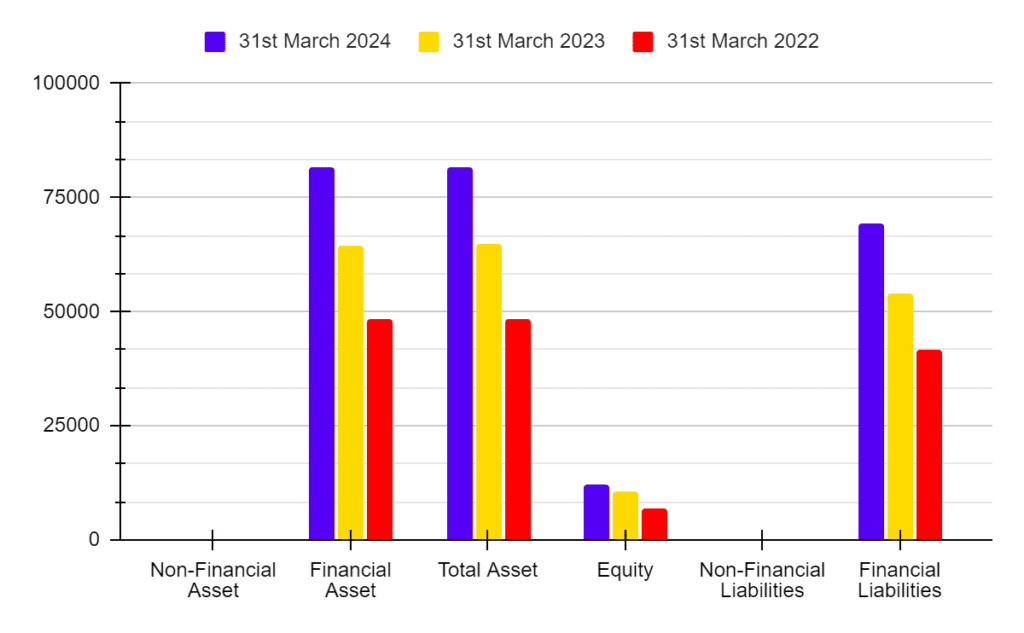
    Balance Sheet (INR crore)

    Particulars31st March 202331st March 202231st March 2021
    Fixed Asset122.2116.76130.66
    Current Asset16,495.6714,259.0513,499.67
    Total Asset16,617.8714,375.8113,630.33
    Share Capital3,697.663,146.692,692.82
    Current Liability12,872.4211,180.7910,890.64
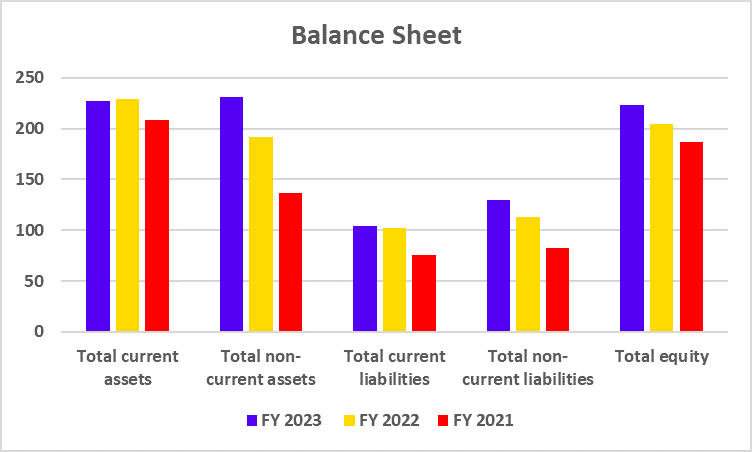
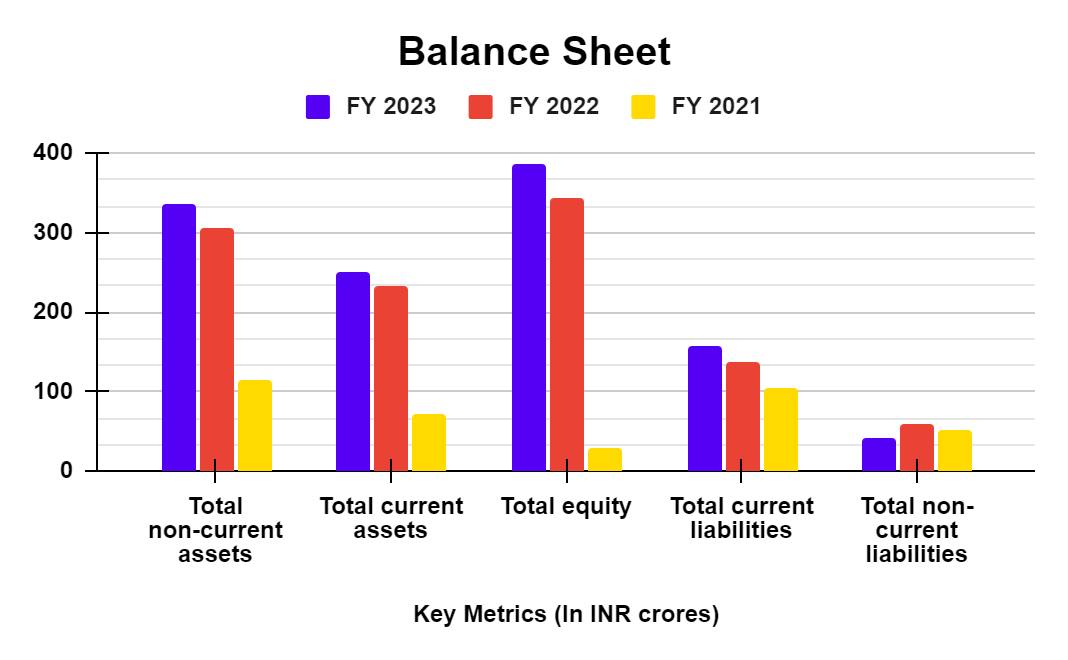
    Balance Sheet of Aadhar Housing Finance

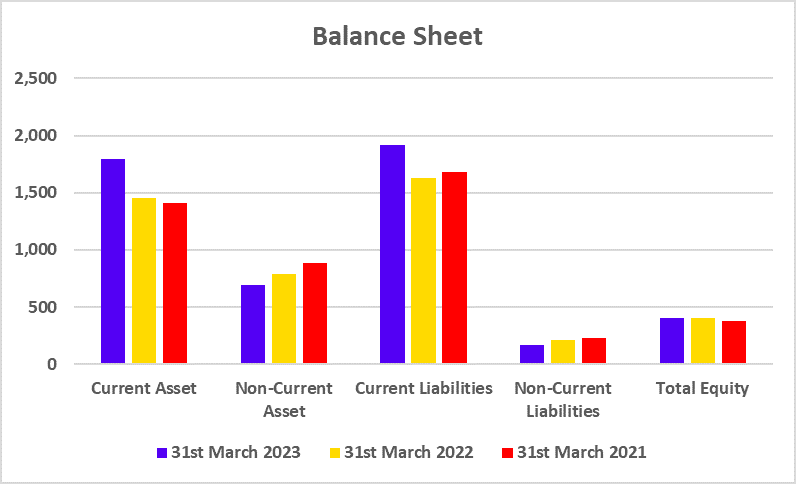
    The above chart shows that while the company’s current liabilities are increasing at a rate of 15% on a year-over-year basis, its current assets are expanding. They were INR 14,259 crores in FY 2022 and climbed to INR 16,495 crores in FY 2023.

    Income Statement (INR crore)

    Particulars31st March 202331st March 202231st March 2021
    Total Income2,043.521,728.561,575.55
    Total Expenses1,322.701,161.201,143.04
    Profit before tax695.82567.36432.51
    Profit after tax544.76444.85340.13
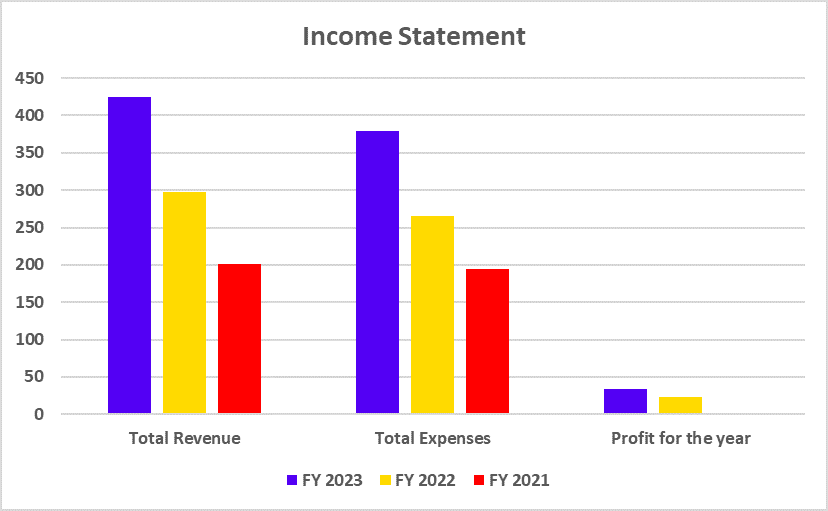
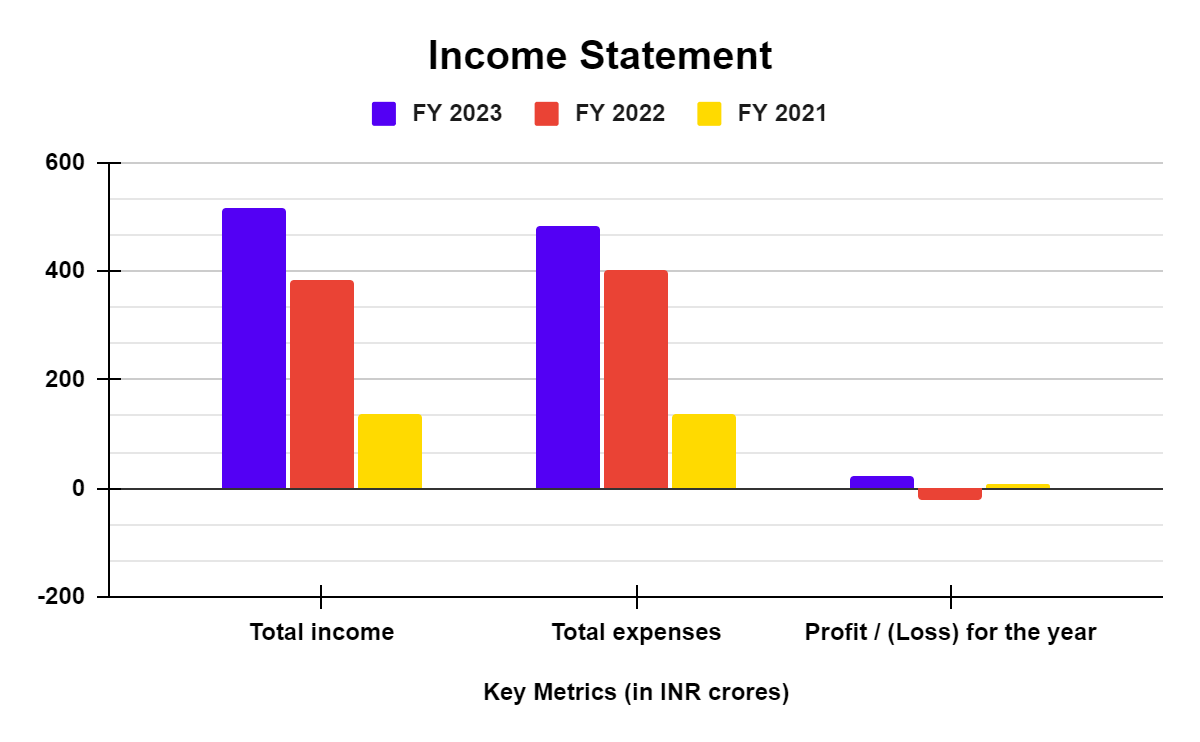
    Income Statement of Aadhar Housing Finance

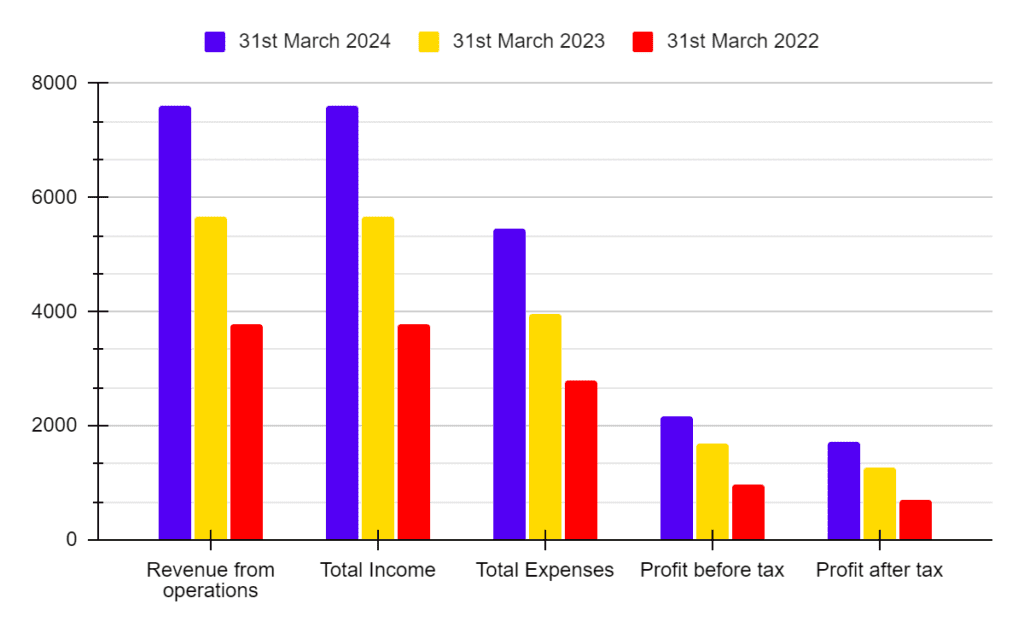
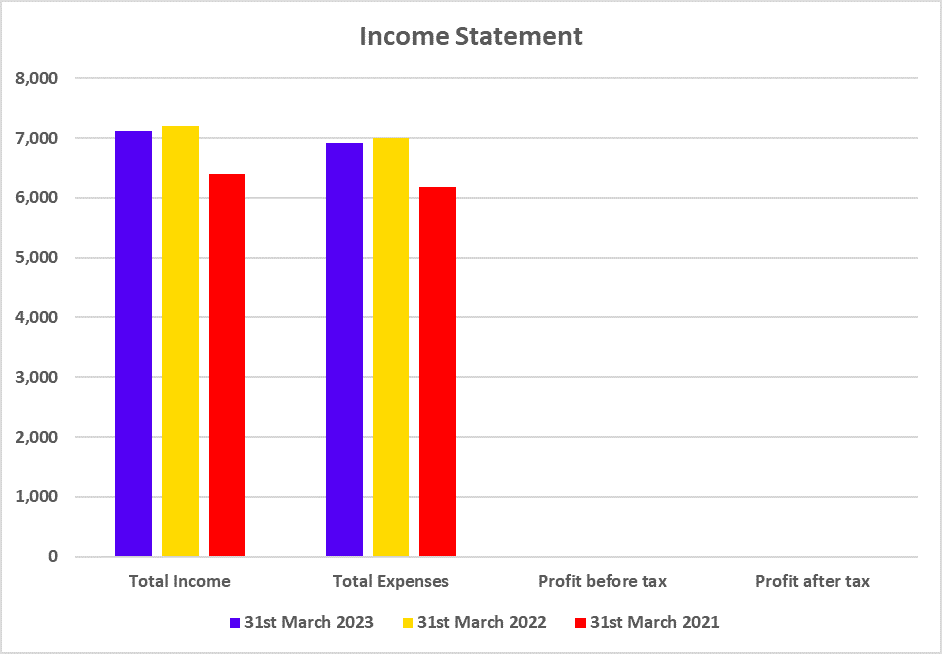
    The company’s overall income went from INR 1,728 crores in FY 2022 to INR 2,043 crores in FY 2023. In contrast, the company’s profit after taxes climbed at an average rate of 22% in FY 2023 and 30% in FY 2022 relative to their prior years.

    Cash Flow Statement (INR crore)

    Particulars31st March 202331st March 202231st March 2021
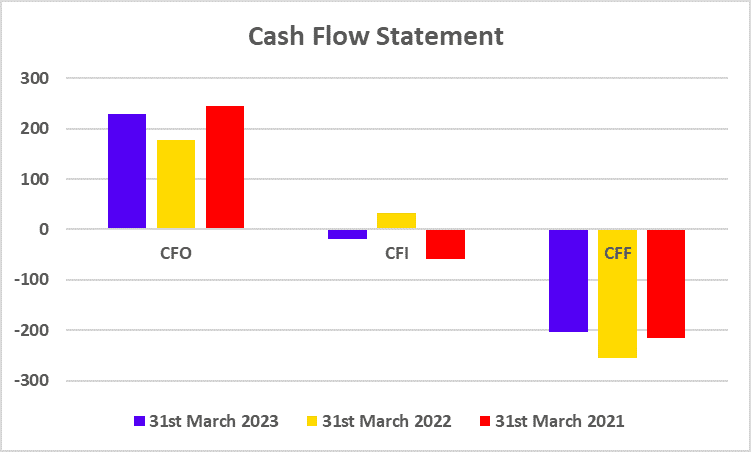
    Net Cash flow from operating activities-1,155.69-906.75-1,202.29
    Cash flow from investing activities-476.53822.57-480.48
    Cash flow from financing activities1,463.19274.85701.39
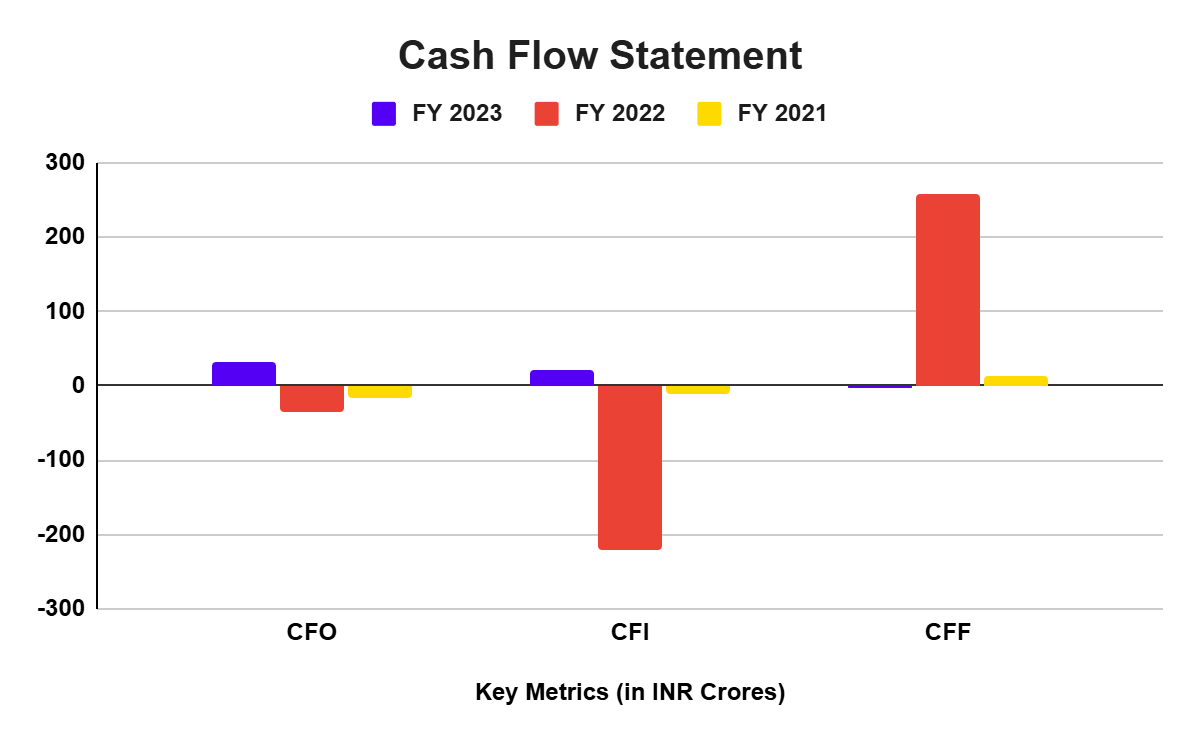
    Cash flow Statement of Aadhar Housing Finance

    Strength and Weakness of the Company

    Strength

    1. The company has a solid and comprehensive process to track the underwriting, collections, and asset quality.
    2. A vast network of branches and sales channels also helps the company increase its loan growth rate.
    3. The company’s profit after tax has been increasing for the last three years, which indicates that the company has been performing well.

    Weakness

    1. Any unfavourable change in interest rates by the regulator, i.e., RBI, can significantly impact their profit margin.
    2. If the company fails to effectively mitigate the risks associated with the loans it extends to the public, non-performing assets will rise, thus compromising the quality of its loan portfolio.
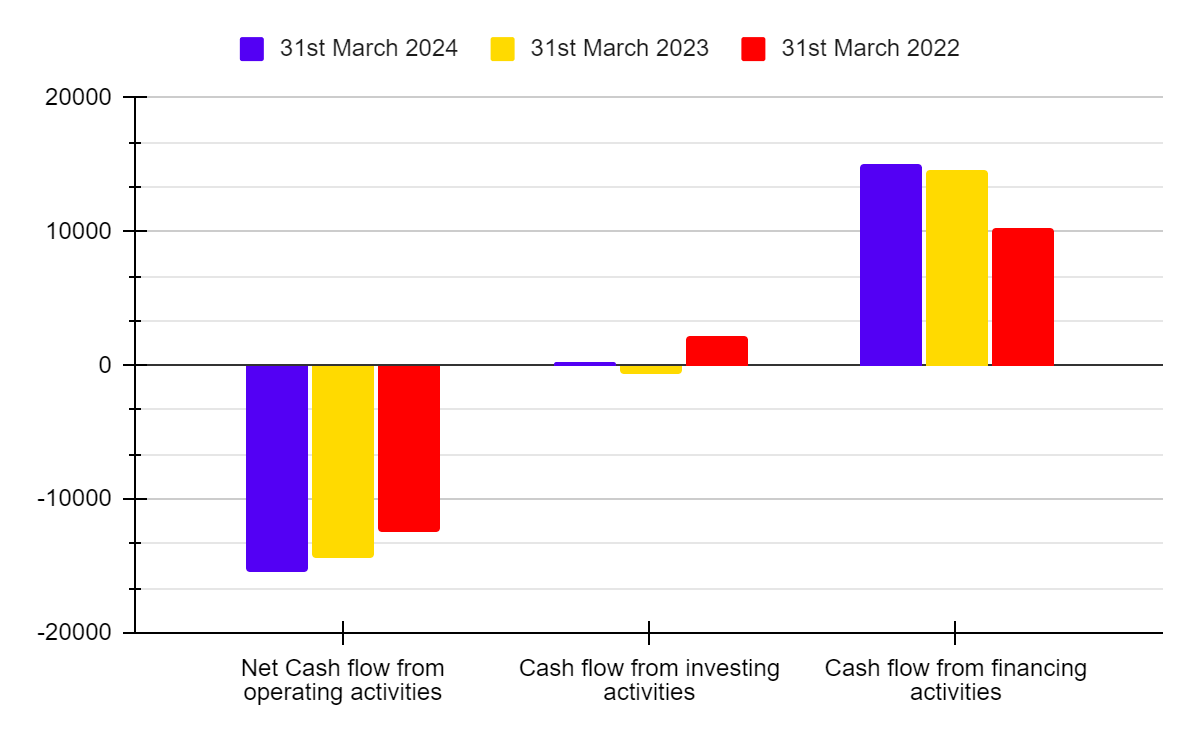
    3. The company has had negative cash flow from operating activities for the past three years. However, remember that most companies operating in the lending business have a negative operating cash flow because lending is the operational activity of such companies.

    Awards and Recognitions

    1. The company has been awarded “Pradhan Mantri Awas Yojana – Empowering India 2022” for its significant contribution towards housing for all initiatives.
    2. It has also won the “Best Data Transformation” award by Elets Technomedia for being a data-driven organization.
    3. The Economic Times recognized Aadhar Housing Finance as one of the best brands of 2022.
    4. Synex Group awarded the company “Resilient Organisation of the Year” at the India Credit Risk Management Summit 2023.

    Read Also: What is the IPO Cycle – Meaning, Processes and Different Stages

    Conclusion

    Aadhar Housing Finance, one of India’s biggest housing finance companies, is coming with an IPO. Along with its income, the company’s profitability is rising yearly, even though its net interest margin decreased in FY 2023 compared to FY 2022. If you are planning to apply for the IPO of this company, then you must go through all the risk factors and consult your investment advisor before making any investment decision.

    S.NO.Check Out These Interesting Posts You Might Enjoy!
    1Anchor Investors in IPOs – Meaning, Role & Benefits
    2How to Cancel an IPO Application?
    3Why Invest in an Key Difference Between IPO and FPOIPO and its Benefits?
    4What is Face What is the IPO Cycle
    5What is NII in IPO?
    6What Is An IPO Mutual Fund? Should You Invest?
    7ASBA Meaning, Benefits, and Process
    8What is a Confidential IPO Filing?
    9What is the IPO Allotment Process?
    10Best Apps for IPO Investment in India

    Frequently Asked Questions (FAQs)

    1. When will the Aadhar Housing Finance IPO open?

      Aadhar Housing Finance IPO will open from May 8th, 2024, to May 10th, 2024, and an investor within these three days can apply for it.

    2. When was Aadhar Housing Finance established?

      The company was founded in 2010 by the Dewan Housing Finance Corporation Limited (DHFL).

    3. Is Aadhar Housing Finance a profit-making company?

      Indeed, the company has reported a profit for the previous three years. In FY 2023, it reported a profit of INR 544.76 crores, a 22% YoY increase.

    4. What is the minimum lot size that retail investors can subscribe to?

      A retail investor is required to subscribe to a minimum of 1 lot of 47 shares amounting to INR 14,805.

    5. What is the tagline of Aadhar Housing Finance?

      The tagline of the company is “Ghar Banega, Toh Desh Banega”.

  • From Private to Public: Decoding the IPO Journey

    From Private to Public: Decoding the IPO Journey

    Visualize this – your once close-knit company, fostered in privacy, is about to step into the arena of the stock exchange. But the path from privacy haven to public spectacle is filled with complex steps and informed decisions.

    In today’s blog, we will discover a company’s journey from private to public. This blog will serve as a roadmap to your guide to the IPO procedure.

    What is an IPO?

    IPO stands for Initial Public Offering. It refers to the process when a private company first sells its shares to the public on the stock exchange. This transforms the company from being privately owned to publicly owned.

    Going public through an IPO can be a transformative affair for the company. However, the journey is complex and demands careful planning and execution.

    Let’s delve into the key stages of the exciting voyage.

    When the company makes its first IPO to the public, the money flows to the company as its share capital and the new shareholders become owners of the company. However, these company shareholders are free to exit their investment anytime.

    But before investing in an IPO an investor should keep in mind that not all companies that go public are successful. Some IPOs flop and the company’s stock price might fall after listing.

    IPOs can be either SME or Mainboard. Let us have a brief overview.

    SME IPO

    An SME IPO is a process through which small and medium-sized enterprises (SMEs) can raise funds from the public by issuing shares. SME IPOs are listed on a stock exchange such as BSE, SME, or NSE Emerge.

    Eligibility Criteria for an SME IPO

    1. The company should be a Small and Medium Enterprise as defined by the Ministry of Micro, Small and Medium Enterprises (MSME).
    2. The company should have a minimum post-issue paid-up capital of INR 1 crore and a maximum of INR 25 crore.
    3. The company should have a good track record of profits for the last 3 years.
    4. All SME IPOs should be 100% underwritten* and merchant bankers must underwrite at least 15% of the shares of the SME IPO company.

    Note – An underwriter is a professional or institution who analyses and assumes another party’s risk for a fee. Underwriting is a process through which an individual or institution determines and evaluates the risk of a financial agreement.

    Mainboard IPO

    A mainboard IPO is also known as a mainline IPO. As the name suggests, it is the process by which a large and established company offers its shares to the public for the first time.

    Eligibility Criteria for Mainboard IPO

    1. The company should have a minimum post-issue-paid-up capital of INR 10 crore.
    2. The company should have a good financial track record with profitable business operations.
    3. Underwriting is not necessary for a mainboard IPO. However, at least 50% of shares must be subscribed by the qualified institutional buyers (QIB).

    Note – QIB or Qualified Institutional Investors are a class of investors with a higher level of financial resources and expertise that meet specific criteria decided by the Securities and Exchange Board of India.

    Steps to take a company public

    1. The company evaluates its willingness to go public and considers factors like financial statements, growth potential, regulatory compliance and market conditions
    2. The company needs to partner with experienced advisors that include merchant/investment bankers, lawyers, chartered accountants and public relations specialists.
    3. The next step is filing the IPO with SEBI, the company drafts the prospectus, a detailed document that is subject to regulatory analysis and outlines the company’s financials, business model, risks, management and promoter details, objects of the issue, capital structure, and dispute, if any.
    4. The company starts a series of presentations for investors showing its value proposition and growth outlook which is also known as a roadshow.
    5. A method called Price discovery is used to find the stock’s price based on demand of the IPO. There are two modes of price discovery, which are explained later.
    6. Your company then officially hits the stock exchange.

    Price Discovery

    Fixed Price Issue 

    In the case of a fixed price, the issue price is already selected by the company along with the merchant banker and printed in the offer document before the IPO, and no price discovery mechanism is used.

    Note – A merchant banker is a financial institution or an individual who provides a range of services including advisory, capital raising etc. to corporations and governments.

    Stages of Fixed Price Issue

    • The issuer company collaborates with SEBI-registered intermediaries except for an underwriter.
    • The lead manager then files a draft red herring prospectus (DRHP) with the SEBI/Stock Exchange.
    • After the successful approval from the SEBI and stock exchange, the issue price and issue period are determined.
    • The prospectus is then filed with the Registrar of Companies (ROC).
    • Once the issue opens, the investor submits an application form to the intermediary for uploading on the stock exchange platform.
    • The issue closes and all the important compliances related to the issue are completed. Securities are finally allocated to the investors at the fixed offer price.

    Book-Building Issue 

    Book Building Process is the more common mode of IPO. Book-building is a process to determine the final price at which the securities will be offered to the public.

    Stages in Book-Building

    • Company planning to go public appoints the lead merchant bankers as Book Runners. These banks play an important role in the book-building and ensuring a successful offering.
    • Investors give their bids to underwriters specifying the quantity of shares.
    • Underwriters then input the orders in the electronic book through bidding. The book normally remains open for 5 days.
    • The book-running lead managers (BRLM) analyse the bids received and determine the demand at multiple price levels to find the price at which the maximum number of shares can be sold.

    Note – BRLM or book-running lead managers play a pivotal role in the IPO procedure. BRLMs conducts due diligence on behalf of the company which involves in-depth analysis of company financials, operations and legal compliance and also helps in setting the offer price.

    • The issuer company with the help of book-running lead managers decides on a price band in which investors can bid. The minimum price at which bids can be made is known as the floor price
    • Once the bidding period ends, the book is closed and no more bids are accepted.
    • Depending on the bids received and the price discovered the lead managers allocate shares after determining the final price.

    Benefits of IPO

    An IPO can offer various benefits to both the company and the investor.

    For Companies

    • Helps in raising capital to fund growth initiatives, capital expenditures, acquire other companies, loan repayment and brand awareness.
    • Going public allows the shareholders to trade shares on the stock exchange providing liquidity and gains.
    • A successful IPO listing can boost a company’s reputation and credibility which will eventually attract new customers.

    For Investors

    • Adding IPOs to an investment portfolio will help in diversification.
    • IPOs offer the opportunity to invest in companies with promising growth potential before they are widely available in the stock market.

    IPO v.s. Private Funding

    Private funding refers to raising capital for a company from non-public sources, in exchange for equity in the company. It is completely in contrast to public funding which comes from selling shares of the company to the general public through an IPO.

    Sources of private funding include firms that invest in early-stage companies with the potential for high returns.

    1. Angel investors or wealthy investors who invest in companies at their nascent stage.
    2. Private equity firms, debt financing such as bank loans, crowdfunding i.e., raising smaller amounts of capital online from many individual investors.

    Private funding is a suitable option for companies seeking moderate capital for initial growth or specific projects or partnerships with investors who share their vision.

    However, the ideal option depends on the company’s goals and stage of development. If the company needs substantial capital for immediate expansion and is comfortable with public analysis, an IPO might be suitable and if a company emphasises flexibility and control, private funding can be a better fit.

    Key Considerations for IPO

    Launching an IPO is a thrilling journey and demands careful consideration of several factors.

    Some of the key considerations are listed below.

    1. Ensure that the company has a strong financial track record with audited statements. Investors will analyse the financial performance, revenue, and other financial metrics before investing.
    2. Analysis of ongoing market conditions such as the industry trends and the other upcoming IPOs. Favourable market conditions can increase the chances of a successful debut.
    3. Clearly express the company’s business model because the investor seeks companies with a compelling story and clear path to future growth.
    4. Ensure compliance with all relevant legal and regulatory requirements including corporate governance standards, working with legal advisors, etc.
    5. Investors evaluate the leadership team’s track record. Hence, the companies should have a capable and experienced management team.
    6. Develop a comprehensive investor relations strategy which includes communication plans, investor education and fostering positive relationships with the investment committee.
    7. Choose underwriters with good reputations and expertise. Underwriters play an important role in smoothing the IPO procedure.
    8. Conduct a thorough risk analysis and disclose the potential risks to the investors. Transparent communication about risks will validate a commitment.

    Read Also: What is Grey Market Premium (GMP) in IPOs?

    Conclusion

    The journey from a private company to a public company through an IPO is indeed fascinating, and filled with zeal and strategic decisions. By carefully considering the various aspects and seeking professional supervision, the IPO procedure can influence the power of public markets because an IPO is just the beginning, sustainable growth, and value creation are important for long-term success in the public eye.

    S.NO.Check Out These Interesting Posts You Might Enjoy!
    1Anchor Investors in IPOs – Meaning, Role & Benefits
    2How to Cancel an IPO Application?
    3Why Invest in anKey Difference Between IPO and FPOIPO and its Benefits?
    4What is Face What is the IPO Cycle
    5What is NII in IPO?
    6What Is An IPO Mutual Fund? Should You Invest?
    7Why Invest in an IPO and its Benefits?
    8IPO Application Eligibility Criteria
    9What is the IPO Allotment Process?
    10ASBA Meaning, Benefits, and Process

    Frequently Asked Questions (FAQs)

    1. How long does an IPO generally take?

      The average timeline for an IPO is generally 6 to 12 months. Although it can vary depending on company size and complexity.

    2. What are the major costs involved in an IPO?

      Investment banking fees, legal fees, accounting and auditing fees, filing and exchange listing fees, and advertising expenses.

    3. How can I invest in an IPO?

      Participate in retail allotments by the company through your bank or buy shares on the open market listing.

    4. What happens to employees’ shares after an IPO?

      It depends upon agreements and company policies. Some employees may receive restricted stock units or employee stock options.

    5. What happens to the money raised in an IPO?

      The company may use the fund for debt repayment, capital expenditure, or research and development.  

  • IPO Alert: Jana Small Finance Bank

    IPO Alert: Jana Small Finance Bank

    If you are someone who is curious about investing in IPOs, fasten your seat belt because we are back again with another IPO study!

    In this blog, we will explore the details of Jana Small Finance Bank IPO, which is all set to hit the Indian stock exchange on 14th February 2024.

    Jana Small Finance Bank Overview

    Before its establishment in 2006, Jana Small Finance Bank Limited was known as Janalakshmi Financial Services. It offered Micro, Small and Medium Enterprises (MSME) loans, affordable housing loans, term loans, fixed deposit loans, two-wheeler loans, and gold loans.

    In 2017, the Reserve Bank of India (RBI) granted Janalakshmi Financial Services a license to become a Small Finance Bank (SFB), enabling it to provide a broader range of financial products.

    SFBs are a new entrant into the banking system established to provide essential banking services to MSMEs, Shopkeepers, Farmers, etc. Recently, SFBs have witnessed a rapid growth in terms of deposits and branches.

    In terms of AUM and deposit size, Jana Small Finance Bank ranks as the fourth-largest small finance bank. Additionally, it has 771 banking outlets including 278 in unbanked rural centers. Thus serving more than 4.87 million active clients. The company is run by 18,184 permanent employees.

    Promoters

    The promoters of Jana Small Finance Bank are Jana Holdings Limited, Jana Capital Limited, and Jana Urban Foundation (which was previously known as Jana Social Services).

    Details of the IPO

    Jana Small Finance Bank IPO’s issue size is INR 570 crore, through a book-building issue. The IPO is a combination of a fresh issue and an offer for sale; the fresh issue consists of about INR 462 crores whereas, the offer for sale consists of INR 108 crores.

    The IPO’s subscription period will begin on February 7th, 2024, and will end on February 9th, 2024.

    Timeline of the IPO

    IPO Open Date7th Feb 2024
    IPO Close Date9th Feb 2024
    Finalisation of Allotment12th Feb 2024
    Initiation of Refund (in case of no allotment)13th Feb 2024
    The credit of shares into Demat Account (in case of allotment)13th Feb 2024
    Listing Date on NSE & BSE (tentative)14th Feb 2024

    The objective of the Issue

    The goal of Jana Small Finance Bank’s IPO is to use the proceeds to cover the bank’s anticipated future capital needs. The raised capital can also be used to cover the cost of the issue.

    Key details of the IPO

    Face Value of ShareRs. 10
    Price BandRs. 393 – Rs. 414 per share
    Market Lot36 Shares
    Total Issue SizeRs. 570 Crores
    Total Number of Shares13,768,049 shares
    Fresh Issue SizeRs. 462 Crore
    Offer for SaleRs. 108 Crore
    Listing ExchangeNSE & BSE

    Allotment Size

    The market lot of Jana Small Finance Bank IPO is 36 Shares. The minimum and maximum number of shares that an investor can apply for are shown in the table below.

    ApplicantMarket Lot(s)SharesAmount (Rs.)
    Retailer (Min)13614,904
    Retailer (Max)134681,93,752
    Small High Net Worth Individual (Min)145042,08,656
    Small High Net Worth Individual (Max)6724129,98,568
    Ultra-High Net Worth Individual (Min)68244810,13,172

    The figures above showcase that a retail investor can invest as little as INR 14,904 rupees and as much as INR 1,93,752 at maximum.

    Read Also: Small Finance Bank Share List in India 2025

    Financial Highlights of Jana Small Finance Bank

    Have a look at the key Financial metrics of the company (in Crores, unless stated otherwise).

    ParticularsFY 2023FY 2022FY 2021
    Total Assets25,64420,18919,079
    Revenue3,7003,0622,721
    Profit After Tax (PAT)25617.4772
    Net Worth1,7771,1851,101
    Reserves & Surplus1,472999914
    Total Borrowings6,2774,5094,815
    Total Capital Ratio (CRAR) (%)15.57%15.26%15.51%
    Tier 1 Capital Ratio (%)13.02%11.83%11.75%
    Net Non-Performing Assets (NPA) (%)2.64%3.95%5.33%
    Net Interest Margin (NIM) (%)7.73%7.32%8.36%
    CASA Ratio# (%)20.21%22.52%16.29%
    Source – Prospectus

    # – CASA Ratio is the ratio of current and savings account deposits to total deposits. It tells us the percentage of deposits that are low-cost access to banks as interest in these accounts is lower than in other deposits such as Fixed Deposits.

    The financial data makes it evident that profit after taxes has improved over the years, and NPAs have reduced substantially. Both assets and borrowings have increased with a significant increase in revenue. It is indicative of sound fundamentals.

    But, the NIM and CASA ratios tell a different story. The NIM of small finance banks are generally higher than other banks, and Jana SFB’s competitor, Ujjivan SFB, is averaging 9% NIM in these markets. The CASA ratio also does not paint a rosy picture of the bank’s operations. The industry standard ranges at north of 25%, but Jana SFB is unable to achieve these ratios. Also, the CRAR has a trend of barely meeting the guideline of 15% for small finance banks.

    Additional Ratios

    ROAE – ROAE or Return on Average Equity is calculated as the net profit for the relevant period to Average Net Worth for the relevant period, expressed as a percentage.

    Jana SFB’s ROAE as now is 16.78%.

    P/BV – Price to book value represents the price divided by book value or how much an investor is willing to pay for the company over book value.

    Price to book value or P/BV ratio is 1.28 for Jana Small Finance Bank.

    EPS – Earnings per share, or EPS, is the total earnings a shareholder has earned. It is computed by dividing the business’s profit after tax by the number of outstanding shares.

    Jana Small Finance Bank’s Basic EPS stands at 47.47.

    P/E Ratio – The relationship between the stock price and earnings per share is known as the company’s price-to-earnings ratio.

    According to the price range of IPO, Jana Small Finance Bank would have a PE Ratio of 8.28 – 8.72.

    Read Also: IPO Alert – Capital Small Finance Bank

    Conclusion

    The growing network of Jana Small Finance Bank may pose a threat to the current small financing banks. The Jana Small Finance Bank’s primary goal is to empower individuals and small businesses.

    Before taking into consideration the above-mentioned IPO of Jana Small Finance Bank, remember to consult your financial advisor. Keep in mind that the suitability of investment in IPOs completely depends on your investment horizon and risk profile.

    S.NO.Check Out These Interesting Posts You Might Enjoy!
    1Anchor Investors in IPOs – Meaning, Role & Benefits
    2How to Cancel an IPO Application?
    3Why Invest in anKey Difference Between IPO and FPOIPO and its Benefits?
    4What is Face What is the IPO Cycle
    5What is NII in IPO?
    6What Is An IPO Mutual Fund? Should You Invest?
    7ASBA Meaning, Benefits, and Process
    8What is a Confidential IPO Filing?
    9What is the IPO Allotment Process?
    10Best Apps for IPO Investment in India

    Frequently Asked Questions (FAQs)

    1. What is the issue price of Jana Small Finance Bank IPO?

      The price band of Jana Small Finance Bank IPO is INR 393 to 414.

    2. What will be the issue size of the Jana Small Finance Bank IPO?

      The issue size of Jana Small Finance Bank IPO is 570 crore.

    3. What is the minimum investment amount for retail investors?

      The minimum investment amount for a retail investor to invest in Jana Small Finance Bank IPO is INR 14,148 (at the lower end of the price range).

    4. Can Jana Small Finance Bank successfully expand its operations?

      With rural areas exhibiting lower financial inclusion rates than urban areas and facing less competition in banking services, it seems Jana Small Finance Bank has promising growth prospects ahead.

    5. Does Jana Small Finance Bank have any regulatory penalties?

      No, the management has remained clear of any major regulatory penalties as of Feb 2024.

  • Rashi Peripherals Limited: IPO Analysis

    Rashi Peripherals Limited: IPO Analysis

    The Indian tech giant Rashi Peripherals Limited (RPL) is all set to tap the public market with its much-anticipated INR 600 crore IPO! Are you excited to own a piece of this company in the Information and Communication Technology (ICT) distribution landscape?

    In today’s blog, we will share the key details about the IPO and a brief overview of the company. 

    Key details of the IPO

    1. Rashi Peripherals IPO is a book-built issue of INR 600 crores. The issue is completely fresh and will be opening for subscription from February 7, 2024, to February 9, 2024.
    2. Rashi Peripherals IPO is a main-board IPO, which means the post-issue capital is more than 10 crores.
    3. The price band of IPO is INR 295 to INR 311 per share.
    4. The listing date for Rashi Peripherals IPO is fixed at February 14, 2024.
    5. JM Financial Limited and ICICI Securities Limited are the book-running lead managers of the Rashi Peripherals IPO, whereas Link Intime India Private Ltd is the registrar for the issue.
    6. The fund’s return process is scheduled for Tuesday, February 13, 2024.
    7. The company will be listed on both the exchanges, i.e., NSE & BSE.
    8. The company promoters are as follows – Krishna Kumar Choudhary, Sureshkumar Pansari, Kapal Suresh Pansari, Keshav Krishna Kumar Choudhary, Chaman Pansari, Krishna Kumar Choudhary (HUF), and Suresh M Pansari HUF.
    9. Rashi Peripherals IPO’s objective is to raise capital from the market is to fund working capital requirements and prepayments and repayments of borrowings.
    Category of InvestorsAllocation of shares
    EmployeesNo employee quota
    Anchor AllocationCarved out of the QIB Portion
    QIB Shares Offered96,46,302 shares (50% of the net IPO offer size)
    NII (HNI) Shares Offered28,93,891 shares (15% of the net IPO offer size)
    Retail Shares Offered67,52,411 shares (35% of the net IPO offer size)
    Total Shares Offered1,92,92,604 shares (100.00% of IPO size)
    Source – RHP

    Read Also: IPO Alert – Capital Small Finance Bank

    Company Overview

    Company Overview

    Rashi Peripherals was incorporated in the year 1989 and carries experience of more than 33 years. The company took its time in rising to glory, and now it is one of the leading national distributors of global technology brands in India for Information and Communications Technology (ICT) products. It also offers end-to-end value-added services such as pre-sale activities, solutions design, technical support, marketing services, credit solutions, and warranty management services.

    The company also operates in Singapore. It has two subsidiaries – Znet Technologies Private Limited in India and Rashi Peripherals Pte Limited in Singapore.

    Business Model

    Rashi Peripherals operates in the following two business verticals:

    • PES (Personal Computing, Enterprise, and Cloud Solutions) – Under this vertical, the company distributes personal computing devices, enterprise solutions, embedded designs/ products, and cloud computing. These include Laptops, Desktops, Routers, and Switches.
    • LIT (Lifestyle and IT essentials)– LIT includes the distribution of products such as graphic cards, CPUs, motherboards, storage and memory devices, lifestyle peripherals, and accessories that include keyboards, mouse, web cameras, monitors, wearables, casting devices, fitness trackers and gaming accessories, power equipment such as UPS and inverters, and networking and mobility devices.

    Rashi Peripherals holds 50 branches that operate for sales and service centres, and 63 warehouses as of September 30, 2022. The company has a direct presence in 680 locations in India and 53 global technology brands, with 9,996 customers in FY23.

    Distribution Channel

    Rashi Peripherals has a vision of being a multi-channel pan-India distributor and leader with an emphasis on general trade, modern trade and e-commerce channels.

    • General trade includes hybrid resellers who sell to online marketplaces and retail channels, regional distributors, retailers, brand stores, original equipment manufacturers, etc., which are collectively known as ‘Channel Partners’.
    • Modern trade includes large-format retail, multi-format retail, and small-format retail chains.
    • E-commerce includes some of India’s leading online marketplaces.

    Over the years, Rashi Peripherals has consistently added new global technology brands to its portfolio and worked with them to distribute products across categories. Some of the top brands distributed by the company are: Asus, Fitbit, HP, Intel, Lenovo, LG, Philips, Samsung, Logitech, and Luminous.

    Key Strengths

    Strengths of Rashi Tech
    1. RPL ranks among the fastest-growing distribution partners in India’s ICT distribution market and offers a well-established channel across India.
    2. The Indian tech sector is expected to witness growth, which will eventually benefit the Rashi Peripherals distribution business.
    3. Return on Equity (RoE) stands at a comfortable 19.33%.  
    4. The industry is low capital-intensive, thus RPL does not manufacture any of its products, which indicates that the requirement to take further debt is substantially low.
    5. Repeat customers bring in almost 92% of revenue while maintaining a 6.3% growth in total customers. This indicates the company’s strong ability to retain and satisfy customers.
    6. The company has a high trade receivable turnover ratio, indicating that it is very efficient in collecting receivables from its clients.

    Weak Points

    1. The Information and Communication Technology (ICT) industry in India is highly competitive (Indian competitors include Savex Technologies Private Limited, Ingram Micro India Private Limited, and Redington (India) Limited). Both domestic and foreign players can significantly affect the top-line figures of the company.
    2. The company’s net profit margin stands at 1.3%, but the industry generates profit from volume rather than margins.
    3. The top 8 suppliers account for almost 83% of the total purchases. Any changes in the contracts with these suppliers could cause significant damage to the company’s financials as RPL does not manufacture any of its products.
    4. RPL’s Inventory turnover ratio decreased significantly in FY23, this may indicate the company’s inability to manage inventory well.

    Awards & Recognitions

    • Digital Terminal Most Preferred National Distributor 2023
    • VAR India VAD Award 2022
    • Samsung MSP Solutions Champion 2023
    • Digital Terminal Best ICT National Distributor in India 2023
    • LG Most Dynamic National Distributor in 2022
    • Intel Partner of the Year Award 2022,
    • HP Most Trusted and Preferred Distributor Award 2022
    • Samsung Top Distributor Partner in B2B Business in 2022

    Highlights of Financial Statements

    ParticularsFY 2023FY 2022
    Revenue/Total IncomeINR 9,469 croreINR 9,322 crore
    Profit-after-TaxINR 123.34 croreINR 182.51 crore
    Return on Equity Ratio19.33%37.56%
    Debt to Equity Ratio1.531.52
    Inventory Turnover Ratio6.629.93
    Trade Receivables Turnover Ratio9.349.58
    Trade Payables Turnover Ratio8.8310.52
    Debt Service Coverage Ratio (DSCR)0.20.26
    Source – RHP

    Read Also: IPO Alert: Entero Healthcare Solutions Limited (EHSL)

    We can say that the company experienced a minor growth in its revenue in FY 2023 as compared to the previous financial year. However, profit margins were decreased due to a larger decrease in profits.

    Conclusion

    To wrap it up, Rashi Peripherals Limited IPO is a mainboard and medium-risk investment. Although the company holds a strong track record and a wide network of distributors and operates in a competitive industry. It is suggested that investors carefully assess the risks and other factors before investing in the IPO.

    S.NO.Check Out These Interesting Posts You Might Enjoy!
    1IPO Alert: Vibhor Steel Tubes Limited
    2Platinum Industries IPO: Business Model, Key Details, KPIs, and SWOT Analysis
    3Mukka Protein IPO: Business Model, Key Details, Financial Statements, and SWOT Analysis
    4Bharat Highways InvIT IPO: Business Model, Financials, Key Details, and SWOT Analysis
    5Pune E-Stock Broking Limited IPO: Key Details, Business Model, Financials, Strengths, and Weaknesses

    Frequently Asked Questions (FAQs)

    1. What is the minimum investment amount in Rashi Peripherals IPO?

      The minimum lot size for the IPO is 48 shares, with an estimated cost of INR 14,928 at the lower end of the price band.

    2. What does Rashi Peripherals do?

      Rashi Peripherals is a large distributor of ICT products and offers several IT hardware and software solutions.

    3. Who are the book running lead managers for the IPO?

      J.M. Financials and ICICI Securities.

    4. What is the listing date?

      14th February, 2024.

    5. How can I apply for the IPO?

      You can apply for the IPO either through your broker or the ASBA facility available with the banks.

  • Open Free Demat Account

    Join Pocketful Now

    You have successfully subscribed to the newsletter

    There was an error while trying to send your request. Please try again.

    Pocketful blog will use the information you provide on this form to be in touch with you and to provide updates and marketing.