Category: IPO

  • What is a Book Running Lead Manager (BRLM) in IPO?

    What is a Book Running Lead Manager (BRLM) in IPO?

    Whenever you invest in any IPO, you might have gone through a term commonly known as the Book Running Lead Manager. BRLMs are institutions responsible for managing and ensuring the successful listing of an IPO. They handle pricing, regulatory compliance, and investor coordination throughout the IPO process. Understanding their role can help investors make better IPO investment decisions. 

    In today’s blog post, we will give you an overview of Book Running Lead Manager, along with their importance in the IPO listing process.

    What is a Book Running Lead Manager?

    A book-running lead manager is often known by various names in the financial industry, such as investment banks and merchant bankers, who are primarily engaged in launching an Initial Public Offer (IPO) or Follow-On Public Offer (FPO) for a company. The Book Running Lead Manager manages the entire process, including preparing the IPO document, filing the draft red herring prospectus, and obtaining SEBI approval.

    Key Features of Book Running Lead Manager

    The features of the book running lead manager are as follows:

    • IPO Process: The book running lead manager manages the entire IPO process for a company, which includes preparing documents, coordinating with the regulating authorities, etc.
    • Pricing of IPO: Deciding the IPO price is one of the key roles of the book-running lead manager. The BRLM analyses the market conditions, valuation of the company, and sector performance and then decides the price at which the IPO can be issued.
    • Book Building Process: BRLM handles the entire book-building process. In which the investor places the bids within the defined price band, and based on which it determines the price.
    • Intermediary: The book-running lead managers act as a middleman between the company that is issuing shares, investors, regulating authorities, etc.

    Why Is a Book Running Lead Manager Important in an IPO?

    The key importance of a book-running lead manager is as follows:

    • Easy Execution: Whenever the company decides to launch an IPO, it has to go through several steps, such as documentation, approvals, marketing, pricing, etc. A book-running lead manager helps a company in all such steps so that the company can launch its IPO efficiently.
    • Regulatory Compliance: Several regulatory authorities, such as SEBI, exchanges, etc., have laid down various compliances that need to be followed by a company that wants to list themself on the exchange. BRLM helps companies in following those compliances.
    • Managing Subscription: BRLM manages the IPO issue in a way that it reaches the potential investors. BRLM’s marketing strategies help in increasing the participation of investors and the chances of subscription.
    • Increase Investor Confidence: If a company hires an experienced book-running lead manager, it increases the credibility of the IPO. And investors feel more confident about the company issuing an IPO.

    Read Also: What is the Book-Building Process in an IPO?

    Responsibilities of a Book Running Lead Manager

    The key responsibilities of a book running lead manager are as follows:

    • Initiating IPO Process: Once the company decides to go public, it appoints a book-running lead manager to handle the entire process. The BRLM manages the entire IPO process, prepares the timeline, coordinates with intermediaries, etc.
    • IPO Documents: The key importance of BRLM is to prepare the important documents related to IPOs, such as DRHP, RHP, offer documents, etc. They evaluate the company’s financial performance, and based on this, they prepare such data.
    • Regulatory Compliance: The BRML ensures that the IPO complies with all the regulatory guidelines laid down by the different authorities, such as the Securities and Exchange Board of India and stock exchanges.
    • Underwriting the IPO: There are a few cases in which the book-running lead manager underwrites the IPO by agreeing that if the shares are undersubscribed by the public, they will subscribe to make the IPO a successful issue.
    • Marketing IPO: Once the IPO approval is given by the SEBI, after the finalisation of the price band. The book-running lead managers start marketing the IPO through investor presentations, electronic media, etc.
    • Managing Allotment Process: After the closure of the IPO issue date, the book-running lead manager completes the process of IPO allotment by allotting the shares to the successful bidder, and the refund process.
    • Listing: Once the refund and allotment process is completed successfully, the book running lead manager coordinates with the exchanges and gets the formalities done related to listing, and gets the share listed on the final date.

    BRLM vs Other IPO Intermediaries

    The key difference between BRLM and other IPO intermediaries is as follows:

    ParticularsBRLMOther IPO Intermediaries
    Key RoleThe book running lead manager manages the entire IPO prices.While other IPO intermediaries performs specific tasks related to an IPO.
    ResponsibilitiesBRLM acts as an coordinator between company, SEBI, and investor.They are only responsible for the specific IPO process.
    PricingIt helps in deciding the price band of the IPO.Other IPO intermediaries are not involved in pricing decision.
    MarketingBRLM conducts the entire marketing of the IPO and ensures that it reaches to every potential investor.IPO intermediaries do not focus on the marketing or have a limited role in marketing of the IPO.
    DocumentingBRLM prepares different types of documents such as DRHP, RHP, etc.Whereas, other IPO intermediaries prepares documents related to specific tasks.
    Interaction with Institutional InvestorsBRLM directly interacts with the institutional investors to manage the subscription.They do not interact with investors; they interact only with operational teams.
    CoordinationBRLM works with various intermediaries, such as registrars, underwriters, and advisors.They consist of the registrar, bankers, auditors, etc.

    How Companies Select a Book Running Lead Manager

    There are various factors based on which a company selects a book running lead manager, a few of which are mentioned below:

    • Experience: Most of the companies choose the book running lead manager based on their experience in handling IPOs and FPOs. They check their track records and how they manage the entire IPO process. This is a key factor in selecting an IPO book-running lead manager.
    • Expertise: There are certain book-running lead managers who are experts in managing the IPOs of a particular sector or industry. Hence, companies choose BRLM that understands their industry, business model, etc.
    • Network: The book-running lead managers’ network plays a key role in their selection for an IPO. BRLMs that have strong connections with the institutional, foreign, and anchor investors are chosen by the companies to manage their IPOs.
    • Fees and Services: The fees charged by the book-running lead managers are generally high; companies must evaluate and compare the fees and services offered by the book-running lead managers before choosing them for the IPO process.
    • Understanding Valuations: The valuation of the companies plays a key role in deciding the company’s IPO success. Therefore, companies are required to choose the book running lead managers that can accurately calculate the company’s valuation, price band, etc. 

    Conclusion

    On a concluding note, a book-running lead manager plays a role in the success of an IPO. They take sole responsibility for managing the entire IPO process, including determining the valuation and price band of the issue till the final step of listing shares on the exchange. Companies select the book running lead managers based on their experience, expertise, etc. The marketing and networking of the BRLMs increases the investors’ confidence in the company and the successful listing of the IPO. However, only reputed BRLMs do not always guarantee the success of an IPO; it is advisable to consult your investment advisor before making any investment in an IPO. Invest in IPOs with Zero Brokerage on Pocketful – an easy-to-use platform built for seamless investing and trading.

    S.NO.Check Out These Interesting Posts You Might Enjoy!
    1Anchor Investors in IPOs – Meaning, Role & Benefits
    2How to Cancel an IPO Application?
    3Why Invest in anKey Difference Between IPO and FPOIPO and its Benefits?
    4What is Face What is the IPO Cycle
    5What is NII in IPO?
    6What Is An IPO Mutual Fund? Should You Invest?
    7Why Invest in an IPO and its Benefits?
    8IPO Application Eligibility Criteria
    9What is the IPO Allotment Process?
    10ASBA Meaning, Benefits, and Process

    Frequently Asked Questions (FAQs)

    1. Who is the Book Running Lead Manager?

      A book-running lead manager is the financial institution that manages the entire IPO and FPO process for a company. The process includes calculating the valuation of the company, the price band of the IPO, and getting the regulatory approval done, etc.

    2. Is it mandatory for a company to appoint a BRLM?

      Yes, in most of the book-building IPOs, the appointment of the book-running lead manager is mandatory.

    3. Does the appointment of a reputed BRLM by a company guarantee the success of the IPO?

      No, the appointment of a reputed BRLM by a company does not guarantee the success of an IPO. The success of an IPO depends only on the participation of investors, the price band of the IPO, and the company’s valuation, etc.

    4. What is the difference between a lead manager and BRLM?

      No, the appointment of a reputed BRLM by a company does not guarantee the success of an IPO. The success of an IPO depends only on the participation of investors, the price band of the IPO, and the company’s valuation, etc.

    5. What is the difference between a lead manager and BRLM?

      Yes, a book-running lead manager can also underwrite the IPO of a company. 

  • What Is a Hot IPO?

    What Is a Hot IPO?

    Every few months, something happens in the Indian stock market that gets everyone talking: your colleague mentions it at lunch, your family WhatsApp group suddenly fills up with forwarded messages, and even people who have never opened a Demat account start asking questions. More often than not, the reason behind all this noise is a Hot IPO.

    Now, excitement is not always a bad thing. It brings new investors into the market, creates liquidity, and sometimes delivers good returns. 

    People have rushed into IPOs simply because everyone else seemed to be doing it, only to watch the stock fall below its issue price within weeks of listing.

    In this blog, we will walk you through what makes an IPO hot, who is driving that demand, and most importantly, whether all that excitement is actually backed by something real.

    What is a Hot IPO?

    An IPO, or Initial Public Offering, is when a company opens its doors to the general public for the first time and invites people to become part-owners by buying its shares. Think of it like a new restaurant opening in your city; if the excitement is strong enough before it even opens, people are already lining up outside.

    A Hot IPO is exactly that. It is an IPO that generates so much craze and interest among investors, even before the shares are listed on BSE or NSE, that people rush to apply in huge numbers.

    Why Does an IPO Become Hot?

    Not every IPO gets this kind of attention. A company earns this tag when investors genuinely believe it has something special going for it. This could be because of the following reasons:

    • The company is a household name, like when Zomato or LIC came out with their IPOs, practically every Indian investor was talking about it
    • It belongs to a sector that is booming at that time, whether it is fintech, defence, EVs, or renewable energy. 
    • The company has shown strong and consistent revenue growth over the past few years
    • Big institutional players like mutual funds and foreign investors have already shown interest
    • The promoters or founders have a proven track record that people trust

    Who Drives the Demand?

    The frenzy around a hot IPO is not just from one type of investor. It builds up from multiple sides at once:

    • Retail Investors: Everyday people like you and me, applying through platforms like Zerodha, Groww, or Upstox. The minimum application is usually one lot, and millions of people apply hoping to get an allotment.
    • High Net Worth Individuals (HNIs): Apply under the Non-Institutional Investor (NII) category. These are people investing above ₹2 lakhs. In hot IPOs, they often borrow money, called IPO financing, just to increase their chances of allotment.
    • Qualified Institutional Buyer (QIB): Mutual Funds and Insurance Companies fall under this category. When big institutions put in large bids, it signals to retail investors that the IPO is worth taking seriously.
    • Foreign Institutional Investors (FIIs): They also participate, and their interest often adds an extra layer of confidence among domestic investors.

    Does a Hot IPO Always Mean a Profitable IPO? 

    • A hot IPO creates a lot of listing day excitement, and many investors chase what the listing gains, the profit made on the very first day of trading if the share opens above its issue price. But listing day performance and long-term performance are two very different things. 
    • For Example, Paytm’s IPO in 2021 was one of India’s biggest ever and generated massive interest, yet it listed at a sharp discount and took years to recover. On the other hand, companies like Tata Technologies are listed at a strong premium and continue to perform reasonably well.
    • So while a hot IPO can absolutely give you quick gains, it can also burn you if you apply without understanding the business fundamentals. The heat of an IPO does not always reflect the health of a company.

    Read Also: What is the IPO Cycle

    Advantages of Hot IPO

    • Chance of Listing Gains: Many investors apply for hot IPOs, hoping the stock will list at a higher price than the issue price. If that happens, investors may earn quick gains on listing day, and if not they will eventually end up losing their initial investment amount also.
    • Invest Early in a Growing Company: An IPO gives investors an opportunity to become part of a company at an early stage of its listed journey. If the company grows well in the future, it may benefit long-term investors.
    • Exposure to Growing Sectors: Many popular IPOs come from industries that are growing quickly, such as technology, finance, renewable energy, or consumer businesses.

    Risks of Hot IPO

    • Strong Subscription Does Not Guarantee Returns: An IPO getting heavily subscribed does not always mean it will give profits in the future. Market conditions and the company’s financial performance still matter.
    • Limited Track Record: Some companies may not have a long history of profits or stable business performance, making it harder to judge their future growth.
    • Hype Can Influence Decisions: Many people apply for hot IPOs just because everyone else is talking about them. Investing without understanding the business can become risky.

    How to Evaluate the Hot IPO

    1. Understand the Company’s Business

    First, try to understand what the company does and how it earns money, its future growth potential, business model, and the ongoing demand. A strong and growing business usually attracts long-term investors.

    2. Check the Financial Performance

    Look at the company’s financial performance over the last few years. Important things that we need to check include:

    • Revenue growth
    • Profit growth
    • Debt levels
    • Cash flow
    • Overall financial stability

    Companies with consistent growth and healthy financials are generally considered stronger.

    3. Know Why the Company is Raising Money

    Read the purpose of the IPO carefully. Companies may raise funds for their business expansion, repaying debt, new projects or working capital needs. 

    If most of the money is going to existing shareholders instead of the business, investors should study the IPO more carefully.

    4. Look at Subscription Numbers

    Strong subscription numbers usually show investor interest in the IPO. Investors often track retail subscription, institutional subscription, and HNI subscription.

    But remember, high subscription alone does not guarantee good returns.

    5. Check the Grey Market Premium (GMP)

    GMP gives an idea about market sentiment before listing. A strong GMP may indicate positive demand, but it is unofficial and can change quickly. It should not be the only factor while making an investment decision.

    Read Also: What is the IPO Allotment Process?

    Conclusion 

    At the end of the day, a hot IPO is not just a financial event, it becomes almost a cultural moment in the Indian market. Hot IPOs have a way of pulling people into the market who would otherwise never have opened a Demat account.

    Undoubtedly, it brings energy, liquidity, and participation into the market. But excitement alone has never made anyone wealthy in the long run. Applying for an IPO because your colleague did, or because the GMP shot up overnight, is not investing. It is gambling with extra steps.

    So the next time a hot IPO lands in your social media feed, check the DRHP. Look at the valuation. Invest in IPOs with Pocketful and enjoy zero brokerage on delivery trades through an easy-to-use investing platform.

    S.NO.Check Out These Interesting Posts You Might Enjoy!
    1Anchor Investors in IPOs – Meaning, Role & Benefits
    2How to Cancel an IPO Application?
    3Why Invest in anKey Difference Between IPO and FPOIPO and its Benefits?
    4What is Face What is the IPO Cycle
    5What is NII in IPO?
    6What Is An IPO Mutual Fund? Should You Invest?
    7Why Invest in an IPO and its Benefits?
    8IPO Application Eligibility Criteria
    9ASBA Meaning, Benefits, and Process
    10Strategies To Boost Your IPO Allotment Chances

    Frequently Asked Questions (FAQs)

    1. What does oversubscription mean? 

      It means far more people applied than there are shares available. If an IPO is subscribed 80 times, it means investors applied for 80 times the number of shares on offer. 

    2. Can hot IPOs give good returns? 

      They certainly can, but there are no guarantees. The ultimate truth is that hype and reality do not always match.

    3. What is GMP in an IPO? 

      GMP stands for Grey Market Premium. It is the unofficial price at which IPO shares are being traded before they officially list. If an IPO has a GMP of ₹80 over an issue price of ₹500, it suggests people expect it to list around ₹580. 

    4. Can a hot IPO fall after listing? 

      Yes. Once the subscription excitement dies down and institutional investors begin booking profits, the price can correct sharply. 

    5. How can I check whether an IPO is good or not? 

      Start with the DRHP filed with SEBI, it is publicly available and contains everything from financial statements to business risks. 

  • Difference Between RII, NII, QIB and Anchor Investor in IPO

    Difference Between RII, NII, QIB and Anchor Investor in IPO

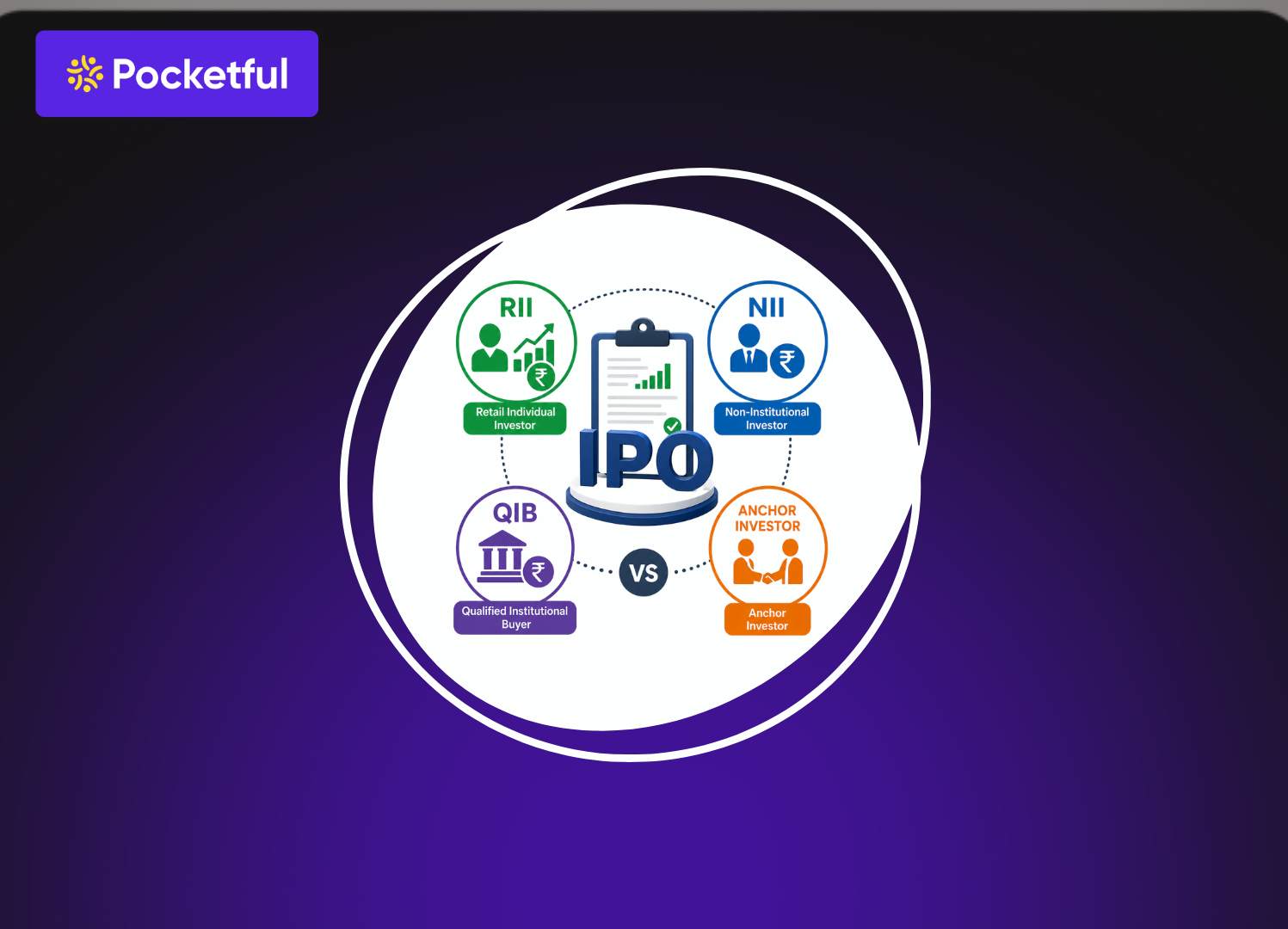
    Whenever you subscribe to an IPO, you must have come across different categories of investors, such as RIIs, NIIs, QIBs, Anchor investors, etc. Understanding these categories of investors is important to understanding how IPO allotment works and which category is suitable for you.

    In today’s blog post, we will give you an overview of the difference between RII, NII, QIB, and Anchor investors of IPO.

    What is RII (Retail Individual Investor)?

    Retail individual investors are those individual investors who invest in IPO by using their personal funds up to a specific limit of 2 Lakh INR. These individuals are generally salaried individuals, business owners, or students who wish to invest in an IPO but have a limited amount of capital. These investors play a key role in the capital market by increasing liquidity and investment activities. The number of retail participants has increased significantly in the past few years.

    • Investment Limit: Retail individual investors are only allowed to invest up to INR 2 Lakh into an IPO.
    • Reservation: A minimum of 35% of the total issue size of an IPO is set aside for Retail Individual Investors.
    • Basis of Allotment: In case the IPO is oversubscribed, the allotment is based on the lottery system.
    • Cut-Off Price: Retail individual investors can bid at the cut-off price.

    What is NII (Non-Institutional Investor)?

    Non-individual investor is a category of investor that includes individuals, companies, trusts, etc. They generally invest an amount larger than that of retail investors, but they are not classified as non-individual investors. Non-institutional investors invest more than 2 Lakh in an IPO; therefore, they are often known as High-networth individuals. This category of non-individual investors generally receives a separate allocation in the IPO issue size.

    • Investment Amount: Non-institutional investors will have to apply for more than INR 2 Lakh if they wish to invest in this category.
    • Reservation: A minimum of 15% of the total IPO issue size is to be kept in reserve for this category.
    • Cut Off Price: Unlike retail individual investors, non-individual investors are not able to bid at the cut-off pricing.
    • Sub-category: The NIIs are also divided into subcategories as Small NIIs investing from 2 Lakhs to 10 Lakhs, whereas Big NIIs need to bid for more than 10 Lakhs INR.

    What is QIB (Qualified Institutional Buyer)?

    Qualified institutional buyers are a category of large institutional investors who have a large amount of capital and have experience in investing in the financial market. Qualified Institutional Buyers are generally included organisations such as mutual funds, banks, insurance companies, foreign institutional investors and pension funds. In IPO issue size allocation, they have been allotted a separate allocation based on their knowledge, financial expertise and investment amount. They play a major role in maintaining the liquidity in the capital market. This category of investors is regulated by regulators such as the SEBI, etc.

    • Reservation: Qualified Institutional Buyers are generally allotted a quota of half of the total issue size.
    • Eligibility: Only SEBI-registered institutions are eligible to apply in this category.
    • Allotment: They have a guaranteed share in oversubscribed IPOs.
    • Withdrawal of Bid: QIBs are not allowed to withdraw their bids once the IPO is closed.

    Who is an Anchor Investor?

    An anchor investor is considered a large institutional investor who invests in an IPO before the IPO is made available for public subscription. The key reason why anchor investors are important is that they create confidence in IPO among other investors. These investors are usually Qualified Institutional Buyers, such as mutual funds, insurance companies, etc. They generally allot shares a day in advance before the IPO is opened for subscription for the general public. They typically need to go through a lock-in period as they cannot sell the allotted shares immediately after listing.

    • Minimum Investment: Anchor investors are required to invest a minimum of 10 Crore INR in an IPO.
    • Reservation: Anchor investors can reserve a maximum upto 60% of the QIB share.
    • CutOff Price: Anchor investors cannot bid at the cutoff price.

    Read Also: Difference Between Mainboard IPO and SME IPO

    Difference between RII, NII, QIB, and Anchor Investor

    The key difference between RII, NII, QIB, and anchor investor is as follows:

    ParticularsRIINIIQIBAnchor Investor
    Common NameRetail Individual InvestorNon-Institutional InvestorQualified Institutional BuyersAnchor Investor
    OverviewRII are the individual investors.These are high-value investors who invest more than retail investors.They are called large institutional investors.These are institutional investors who invest in IPO before their public issue date.
    Investment LimitRIIs can invest a maximum of upto INR 2 Lakhs.They need to invest more than 2 Lakhs.There is no fixed upper investment limit.Anchor investors are required to invest a minimum of 10 Crore INR.
    Risk AppetiteThey have a moderate risk profile.Their risk appetite is higher than the RIIs.They have professionally managed risk.They manage their risk through professionals.
    Lock-in PeriodThey do not have any lock-in period.There is no lock-in after IPO listing.Lock-ins are subject to regulations.A mandatory lock-in period for the anchor investors.
    IPO ReservationRIIs have an IPO reservation of 35%.NIIs have a reservation of atleast 15%.QIBs have a reservation of atleast 50% of the issue size.The reservation for the anchor investor is equal to the QIB quota.
    ExamplesRIIs include salaried individuals and small investors.It includes HNIs and wealthy investors.This generally includes mutual fund companies, pension funds, insurance funds, etc.Large domestic and foreign institutions consist of an anchor investor.

    Conclusion

    On a concluding note, RIIs, NIIs, QIBs and anchor investors consist of different categories of IPO investors. These investors are categorised based on their investment size and participation. Each of these investors plays an important role in the success of an IPO. Understanding these categories of investors helps you in analysing IPO subscription figures in a better manner. High participation of QIBs and anchor investors shows a positive momentum for the IPO. However, only the subscription figures do not always guarantee a successful IPO; along with this, there are other factors which one should consider, such as the company’s fundamentals, etc. Apply for IPOs directly through Pocketful and enjoy zero brokerage on delivery trades along with a seamless investing experience. And it is advisable to consult your investment advisor before making any investment in an IPO.

    S.NO.Check Out These Interesting Posts You Might Enjoy!
    1Why Invest in an IPO and its Benefits?
    2What is Grey Market, and How Are IPO Shares Traded?
    3Why Does a Company Go Public & Launch IPO?
    4Performance Of IPOs Launched
    5OFS vs IPO: Key Differences and Benefits
    6Apply in IPO Through ASBA- IPO Application Method
    7What Is An IPO Mutual Fund? Should You Invest?
    8What is IPO Listing Time?
    9Strategies To Boost Your IPO Allotment Chances
    10From Private to Public: Decoding the IPO Journey
    11Why Invest in an IPO and its Benefits?

    Frequently Asked Questions (FAQs)

    1. What is the maximum investment limit for a retail investor in an IPO?

      A retail investor can invest a maximum of up to INR 2 Lakh in an IPO as they fall under the retail investor category.

    2. Which category of investor gets the highest reservation in an IPO?

      The QIB or Qualified Institutional Buyers get the highest 50% reservation in the total IPO issue size.

    3. Can a person apply in both the NII and RII categories of IPO?

      No, a person cannot apply in both the NII and RII categories of IPO. If the retail investor’s application amount is beyond 2 Lakh, it automatically falls under the NII category.

    4. Can a company launch an IPO without an anchor investor?

      Yes, a company launch its IPO without an anchor investor.

    5. Is there any lock-in period for investors applying in the retail category?

      No, there is no lock-in period for retail investors applying for an IPO.

  • What Are the Different Types of IPO Investors

    What Are the Different Types of IPO Investors

    IPO investing in India has witnessed rapid growth over the past few years; however, even today, many investors apply for IPOs without fully understanding the various investor categories. Yet, factors such as allotment chances, investment limits, and IPO reservations depend entirely on the investor category. In this blog, we will explain all the key IPO categories – such as Retail, HNI, QIB, and Anchor Investors in simple language, enabling you to select the category best suited to your investment profile.

    What Are Investor Categories in IPO? 

    In an IPO, investors are categorized into different groups to ensure that the allotment process remains fair and that every type of investor gets an opportunity to participate. SEBI established this structure to enable the formulation of distinct reservations and rules for everyone ranging from retail investors to large institutions.

    Why SEBI Created IPO Categories?

    Purpose of IPO CategoriesBenefit to Market
    Fair AllocationAll investors get an opportunity to participate.
    Institutional ParticipationThe credibility of an IPO increases.
    Retail ReservationSmall investors remain protected.
    Better Demand AnalysisIPO pricing is more efficient.

    Main Types of Investors in IPO 

    In the IPO market, investors are categorized into different groups based on their investment amount and profile. Each category is assigned specific allotment rules, reservation quotas, and bidding processes.

    1. Retail Individual Investors (RII)

    Retail Individual Investors (RIIs) are investors who apply for shares worth up to ₹2 lakh in an IPO. This category includes Resident Indian Individuals, NRIs, and Hindu Undivided Families (HUFs). In Mainboard IPOs, typically at least 35% of the shares are reserved for retail investors. Retail investors also have the option to bid at the Cut-Off Price, which can improve their chances of allotment. If an IPO is oversubscribed, the allotment is typically carried out through a lottery system.

    Key Features of Retail Investors

    Feature Retail Investors
    Investment LimitUp to ₹2 lakh
    Allotment MethodLottery System
    Cut-Off Price OptionAvailable
    Reservation in IPOAround 35%
    Eligible InvestorsIndividuals, NRIs, HUFs

    2. Non-Institutional Investors (NII/HNI)

    This category is intended for investors who place bids exceeding ₹2 lakh in an IPO. Such investors are typically referred to as HNIs or NIIs. Compared to the Retail category, the investment amount here is significantly larger; consequently, the method of allotment also differs. SEBI has now bifurcated this category into two sub-segments. Investors applying for amounts ranging from ₹2 lakh to ₹10 lakh fall under the Small HNI (sNII) category, while those applying for amounts exceeding ₹10 lakh are placed in the Big HNI (bNII) category. In Mainboard IPOs, approximately 15% of the total allocation is reserved for this specific category.

    Key Features of NII/HNI Category

    Feature NII/HNI Investors
    Investment LimitAbove ₹2 lakh
    Allotment TypeProportionate Basis
    Cut-Off BiddingNot Available
    IPO ReservationAround 15%
    Suitable ForHigh Capital Investors

    3. Qualified Institutional Buyers (QIBs)

    Qualified Institutional Buyers (QIBs) are large financial institutions authorized by SEBI to make investments. This category includes entities such as Mutual Funds, Banks, Insurance Companies, Pension Funds, and Foreign Portfolio Investors (FPIs). These investors are considered highly significant in the IPO market, as their investment decisions influence overall market sentiment.

    In Mainboard IPOs, approximately 50% of the allocation is reserved for the QIB category. These investors make investment decisions only after conducting a detailed analysis of the company’s financial position, valuation, and growth potential. For this very reason, many retail investors also closely track QIB subscription data before applying for an IPO.

    Key Features of QIB Category

    Feature QIB Investors
    Investor TypeInstitutional Investors
    IPO ReservationAround 50%
    Investment SizeVery Large
    Market InfluenceHigh
    Suitable ForInstitutions

    4. Anchor Investors

    Anchor investors are major financial investors who invest capital in a company even before its IPO opens. This group primarily comprises mutual funds, insurance companies, and foreign investment firms. When large institutions invest in an IPO, it often draws the attention of numerous smaller investors as well. Anchor investors are allotted shares prior to the public opening and are required to hold them for a specific period. However, applying for an IPO solely based on the names of major investors is not considered a prudent decision; understanding the company’s business model and valuation is equally essential.

    Key Features of Anchor Investors

    FeatureAnchor Investors
    Investor TypeInstitutional Investors
    Investment TimingBefore IPO Opening
    CategoryPart of QIB
    Lock-In PeriodApplicable
    Main PurposeBuild Market Confidence

    5. Employee Reservation Category

    In certain IPOs, companies reserve a portion of shares specifically for their employees. This is referred to as the Employee Reservation Category. The objective behind this is to provide employees with an opportunity to participate in the company’s growth. This category is predominantly observed in large corporate IPOs and startup IPOs.Many companies also offer a discount on the issue price to their employees, enabling them to acquire shares at a comparatively lower cost. Competition within the Employee category is typically lower; consequently, the chances of allotment may be higher.

    Key Features of Employee Category

    Feature QIB Investors
    Eligibility Company Employees
    Reservation Separate Quota
    Discount Available in Some IPOs
    Competition Usually Lower
    Best BenefitBetter Allotment Chances

    6. Shareholder Reservation Category

    Some companies reserve a portion of shares in their IPOs specifically for existing shareholders. This is referred to as the Shareholder Reservation Category. Investors who already hold shares of the company’s parent or group company prior to the IPO launch are eligible to benefit from this category.

    To apply under the Shareholder Category, the eligible shares must be held in one’s account prior to the record date. Competition within this quota is often lower compared to the retail category; consequently, the likelihood of receiving an allotment may be higher.

    Key Features of Shareholder Category

    Feature QIB Investors
    EligibilityExisting Shareholders
    Reservation TypeSeparate Quota
    CompetitionUsually Lower
    Main BenefitBetter Allotment Chances
    Suitable ForLong-Term Investors

    Read Also: Mainboard & SME IPO Eligibility Criteria

    Difference Between RII, HNI, QIB & Anchor Investors 

    In an IPO, the investment size, allotment process, and participation differ for each investor category.

    Basis of DifferenceRetail Investors (RII)HNI/NII InvestorsQIB InvestorsAnchor Investors
    Investment LimitUp to ₹2 LakhsMore than ₹2 lakhA massive investmentLarge Investment Before IPO
    Investor TypeIndividual InvestorsHigh Net-worth InvestorsFinancial InstitutionsInstitutional Investors
    Allotment ProcessLottery BasisProportionate BasisInstitutional AllocationPre-IPO Allocation
    Cut-Off Price OptionAvailableNot availableNot availableNot available
    IPO ReservationApproximately 35%Approximately 15%Approximately 50%Part of the QIB category
    Risk LevelModerate High Professional LevelProfessional Level
    Competition LevelToo muchModerate to HighLimited InstitutionsSelected Institutions
    Investment GoalListing Gains & Long-Term InvestmentHigher AllocationStrategic InvestmentBuilding Market Confidence

    Which IPO Investor Category is Best for Beginners? 

    If you are investing in an IPO for the first time, the Retail Investor category is considered the most suitable option. Under this category, one can apply for an amount of up to ₹2 lakhs; thus, IPO investing can be initiated even with limited capital. Furthermore, the availability of an option to bid at the Cut-Off Price simplifies the application process. In contrast, the HNI category requires the investment of a substantial amount, and the associated risk is comparatively higher. Therefore, for beginners, the Retail category is considered a more practical and manageable option to start with.

    Investor ProfileSuitable IPO Category
    Beginner InvestorsRetail Category
    Moderate Capital InvestorsRetail + Shareholder Category
    Experienced InvestorsHNI/NII Category
    Institutional ParticipantsQIB Category

    Common Mistakes IPO Investors Make 

    Many investors, in their pursuit of quick profits from IPOs, make certain common mistakes that increase the risk of financial loss. It is crucial to understand these errors before applying for an IPO.

    • Applying Solely Based on GMP: While the Grey Market Premium (GMP) can be a useful indicator, investing in an IPO based solely on this factor is not considered a sound strategy.
    • Ignoring Company Valuation: Often, a company’s valuation is already quite expensive, yet investors frequently overlook this critical aspect.
    • Neglecting QIB Subscription Data: Institutional demand plays a key role in gauging the overall sentiment surrounding an IPO; therefore, QIB subscription data should not be ignored.
    • Applying with Borrowed Funds: Applying for an IPO using loans or borrowed capital can be risky, particularly if the listing performance turns out to be weak.
    • Applying for Every IPO: Not every IPO presents a good investment opportunity. It is essential to thoroughly evaluate the company’s fundamentals and the quality of its business operations.
    • Important Point: In IPO investing, maintaining discipline and conducting proper research often yield far better results than chasing short-term hype.

    Read Also: Different Types of IPO in India

    Important IPO Terms Investors Should Know

    Many investors, in their pursuit of quick profits from IPOs, make certain common mistakes that increase the risk of financial loss. It is crucial to understand these errors before applying for an IPO.

    • Applying Solely Based on GMP: While the Grey Market Premium (GMP) can be a useful indicator, investing in an IPO based solely on this factor is not considered a sound strategy.
    • Ignoring Company Valuation: Often, a company’s valuation is already quite expensive, yet investors frequently overlook this critical aspect.
    • Neglecting QIB Subscription Data: Institutional demand plays a key role in gauging the overall sentiment surrounding an IPO; therefore, QIB subscription data should not be ignored.
    • Applying with Borrowed Funds: Applying for an IPO using loans or borrowed capital can be risky, particularly if the listing performance turns out to be weak.
    • Applying for Every IPO: Not every IPO presents a good investment opportunity. It is essential to thoroughly evaluate the company’s fundamentals and the quality of its business operations.
    • Important Point: In IPO investing, maintaining discipline and conducting proper research often yield far better results than chasing short-term hype.

    Conclusion 

    In an IPO, each investor category has a distinct role and allotment process. The retail category is generally considered more suitable for beginners, whereas the HNI and QIB categories are better suited for large-scale investors. Before applying for an IPO, it is essential to understand not only the market hype but also the specific category rules and the company’s fundamentals. Invest in IPOs with zero brokerage on Pocketful. Open your Demat account with Zero AMC charges and enjoy a seamless investing experience with advanced trading tools and smart market insights. 

    S.NO.Check Out These Interesting Posts You Might Enjoy!
    1Why Invest in an IPO and its Benefits?
    2What is Grey Market, and How Are IPO Shares Traded?
    3Why Does a Company Go Public & Launch IPO?
    4Performance Of IPOs Launched
    5OFS vs IPO: Key Differences and Benefits
    6Apply in IPO Through ASBA- IPO Application Method
    7What Is An IPO Mutual Fund? Should You Invest?
    8What is IPO Listing Time?
    9Strategies To Boost Your IPO Allotment Chances
    10From Private to Public: Decoding the IPO Journey
    11Why Invest in an IPO and its Benefits?

    Frequently Asked Questions (FAQs)

    1. What is the Retail Investor category in an IPO?

      The Retail category includes those who invest up to ₹2 lakh in an IPO.

    2. What is the HNI category in an IPO?

      The HNI category is for investors who apply for more than ₹2 lakh in an IPO.

    3. What is a QIB in an IPO?

      QIBs are large institutions, such as mutual funds, banks, and insurance companies.

    4. What is the role of Anchor Investors in an IPO?

      Anchor investors work to increase market confidence by investing before the IPO opens.

    5. Can I apply above ₹2 lakh in the Retail category?

      No, if you apply for more than ₹2 lakh, your application falls into the HNI category.

  • Mainboard & SME IPO Eligibility Criteria

    Mainboard & SME IPO Eligibility Criteria

    Over the past few years, the IPO market in India has witnessed rapid growth, particularly within the SME IPO segment. Consequently, an increasing number of companies are now opting for the stock market route to facilitate business expansion and raise capital. However, not every company can launch an IPO, as doing so requires fulfilling specific mandatory regulations and financial criteria established by SEBI, the NSE, and the BSE. In this blog, we will explain in simple language the eligibility criteria for Mainboard and SME IPOs, covering aspects such as company age, minimum net worth, profitability, and other essential requirements.

    What Is an IPO? 

    An IPO (Initial Public Offering) is the process through which a private company issues its shares to the general public in the stock market for the very first time. Following an IPO, the company gets listed on a stock exchange, such as the NSE or BSE. Companies raise funds through an IPO to finance business expansion, launch new projects, reduce debt, and enhance their brand value.

    Main Types of IPOs in India

    IPO TypeSuitable ForListing Platform
    Mainboard IPOLarge CompaniesNSE / BSE Mainboard
    SME IPOSmall & Medium BusinessesNSE Emerge / BSE SME

    Why SEBI Has IPO Eligibility Rules?

    Before investing in an IPO, it is essential for investors to have confidence in the company. To uphold this trust and ensure that only credible companies enter the market, SEBI has established a set of eligibility rules.

    • To Safeguard Investors: If a company’s financial health is weak or its track record is questionable, investors’ capital could be put at risk. Therefore, SEBI conducts a thorough scrutiny of the company beforehand.
    • To Provide Opportunities Exclusively to Robust Companies: Not every company is permitted to launch an IPO directly. It is mandatory for a company to possess a sound business track record, profitability, and regulatory compliance to ensure that only trustworthy entities are listed on the market.
    • To Ensure Accurate Information Reaches Investors: Prior to an IPO, companies are required to publicly disclose details regarding their income, debt, risk factors, and business operations. This enables investors to gain a comprehensive understanding of the company before making an investment decision.
    • To Maintain Confidence in the IPO Market: When market regulations are robust, it fosters increased confidence among both retail and institutional investors. This is precisely why India’s IPO market continues to expand steadily.
    • SME IPO Regulations Are Now Stricter Than Ever: Over the past few years, SEBI has updated several regulations pertaining to SME IPOs. The focus has now shifted beyond mere revenue generation to place greater emphasis on profitability, cash flow, and corporate governance.

    Read Also: Difference Between Mainboard IPO and SME IPO

    Mainboard IPO Eligibility Criteria in India 

    To launch a Mainboard IPO, companies must fulfill several financial and compliance rules prescribed by SEBI.

    1. Minimum Company Track Record

    A company is generally required to possess a business track record of at least three years. Additionally, audited financial statements for the preceding years are mandatory. If the entity previously operated as an LLP or Partnership firm and subsequently converted into a company, its prior track record may, in certain instances, be taken into consideration. 

    2. Minimum Net Worth Requirement

    For a Mainboard IPO, the company’s Net Worth must have been at least ₹1 crore during each of the preceding three years. Net Worth is defined as the residual value obtained by deducting the company’s total liabilities from its total assets. This metric serves as an indicator of the company’s financial strength.

    RequirementMainboard IPO Criteria
    Minimum Net Worth₹1 Crore
    Track Record3 Years
    Financial StatementsAudited Required

    3. Net Tangible Assets Requirement

    The company’s Net Tangible Assets must amount to at least ₹3 crore over the preceding three years. This includes land, machinery, and other physical assets. Intangible assets such as goodwill or brand value are not included in this calculation.

    4. Profitability Requirement

    According to SEBI’s Profitability Route, the company’s Average Pre-Tax Operating Profit must be at least ₹15 crore; this profitability must be demonstrated in at least three out of the preceding five years. For this reason, many loss-making startups are unable to launch an IPO through this route.

    5. Paid-Up Capital & Market Capitalisation

    For a Mainboard IPO, the company’s post-issue Paid-Up Capital is generally required to be ₹10 crore or more. Furthermore, the company’s Market Capitalisation must not fall below approximately ₹25 crore.

    Financial CriteriaRequirement 
    Post-Issue Paid-Up Capital₹10 Crore+
    Market Capitalisation₹25 Crore+
    Issue Size LimitUp to 5x Net Worth

    6. QIB Route for Loss-Making Companies:

    Some startups and tech companies are unable to meet profitability criteria. In such cases, they can utilize the QIB route. Under this mechanism, the IPO is launched through the book-building process, and it is mandatory to allot at least 75% of the issue to Qualified Institutional Buyers (QIBs).

    SME IPO Eligibility Criteria in India 

    To conduct an SME IPO, companies are required to fulfill certain essential financial and compliance regulations established by NSE Emerge and BSE SME. These regulations serve to determine whether or not a company is prepared for a public listing.

    1. Minimum Net Worth & Capital Requirement:

    For an SME IPO, a company’s Paid-Up Capital must generally be ₹1 crore or more. Additionally, its Net Tangible Assets must amount to at least ₹3 crore. These criteria serve as indicators of the company’s financial stability and asset strength.

    Requirement SME IPO Criteria
    Minimum Paid-Up Capital₹1 Crore+
    Net Tangible Assets₹3 Crore+
    Post-Issue Paid-Up CapitalUp to ₹25 Crore

    2. Minimum Business Track Record:

    It is considered essential for the company to possess an operational track record spanning at least three years. Furthermore, the company must have maintained a positive net worth over the preceding two years, thereby demonstrating that the business has been operating on a consistently stable basis.

    3. Clean Financial & Compliance Record:

    The company’s audit record must be unblemished. Additionally, there should be no instances of major loan defaults, serious legal disputes, or regulatory actions against the company. This serves to bolster investor confidence.

    4. Stock Exchange Listing Requirements:

    In addition to SEBI regulations, platforms such as NSE Emerge and BSE SME have their own specific listing norms. These include requirements regarding minimum offer size, mandatory disclosures, and compliance obligations, all designed to ensure that the IPO process remains highly transparent.

    5. Mandatory Market Making:

    In the context of an SME IPO, the appointment of a Market Maker is mandatory. The primary objective of this requirement is to maintain liquidity in the shares following their listing, thereby facilitating ease of trading both buying and selling for investors.

    Read Also: IPO Application Eligibility Criteria

    Mainboard & SME IPO Listing Requirements

    Merely possessing profits and a substantial net worth is not sufficient to launch an IPO. A company must also fulfill specific mandatory listing regulations stipulated by the Stock Exchange and SEBI.

    • Minimum Share Capital: For a Mainboard IPO, a company’s Paid-Up Share Capital is typically required to be ₹10 crore or higher. This serves as an indicator that the company possesses a robust business and financial foundation.
    • Minimum Shareholder Requirement: Prior to an IPO, it is considered mandatory for the company to have a minimum of 7 shareholders. This constitutes one of the fundamental prerequisites for a Public Limited Company.
    • Audited Financial Reports: The company’s financial statements for the preceding three years must be duly audited. Furthermore, the Audit Report should not contain any material irregularities or significant adverse remarks.
    • DRHP Filing: Before launching an IPO, the company is required to submit a DRHP (Draft Red Herring Prospectus) to SEBI. This document provides comprehensive details regarding the company’s business operations, financials, risk factors, and the IPO itself, thereby ensuring that investors have access to accurate and complete information.

    Mainboard & SME IPO Filing Process in India

    Launching an IPO is a lengthy and regulatory-intensive process for any company. It involves several critical stages, ranging from documentation to obtaining SEBI approval and listing.

    • Appointment of Merchant Banker: Before initiating an IPO, the company selects a Merchant Banker or Lead Manager. These entities manage the planning, valuation, documentation, and the entire listing process of the IPO.
    • DRHP Submission: Subsequently, the company submits the Draft Red Herring Prospectus (DRHP) to SEBI. This document outlines the company’s business operations, financial performance, risk factors, and the objectives of the IPO.
    • SEBI Verification: SEBI scrutinizes all submitted documents and financial details. If any information is found to be deficient, the company may be required to provide clarifications or submit additional documentation.
    • IPO Opening & Listing: Once approval is granted, the IPO opens for investors. Upon the completion of the share allotment process, the company’s shares are listed on the stock exchange, and trading commences.

    Conclusion 

    Both Mainboard and SME IPOs have their own distinct rules and eligibility criteria. For any company, possessing a strong financial record, ensuring proper compliance, and maintaining a clean business history are considered essential prerequisites before launching an IPO. If a company undertakes adequate preparation in advance, the IPO process can facilitate rapid business expansion and help build trust within the market. Invest in IPOs with zero brokerage on Pocketful. Open your Demat account with Zero AMC charges and enjoy a seamless investing experience with advanced trading tools and smart market insights.

    S.NO.Check Out These Interesting Posts You Might Enjoy!
    1What is Pre-IPO Investing?
    2What is the IPO Cycle – Meaning, Processes and Different Stages
    3What are the Different Types of IPO in India?
    4Why Invest in an IPO and its Benefits?
    5Best Apps for IPO Investment in India

    Frequently Asked Questions (FAQs)

    1. What is the minimum company age for an IPO?

      Generally, to launch an IPO, a company must have a business track record of at least 3 years.

    2. What is the minimum net worth required for an SME IPO?

      For an SME IPO, a company’s Net Worth is generally required to be positive; in many cases, a figure of ₹1 crore or more is observed.

    3. What is the difference between a Mainboard IPO and an SME IPO?

      A Mainboard IPO is intended for large companies, whereas an SME IPO is designed for small and mid-sized businesses.

    4. Is profitability necessary for an IPO?

      Yes, under several IPO routes, a company’s track record of Profit or EBITDA is considered a mandatory requirement.

    5. What is a DRHP in the context of an IPO?

      A DRHP is a crucial document that provides detailed financial and business information about the company.

  • Difference Between Mainboard IPO and SME IPO

    Difference Between Mainboard IPO and SME IPO

    Imagine you are out to buy vegetables and you have two choices to buy apples. First is a big supermarket like Reliance Smart or Big Bazaar where everything is packaged, checked for quality, and sold in small quantities. You can buy limited products only though it is a safer and easy option. 

    Second is a wholesale market or Mandi where you can get cheaper prices and also you may find great deals, but here you cannot buy limited products you must have to buy a whole sack of products here. Also the crowd here is different and you need to be an expert to pick the right sack.

    In the stock market, Mainboard IPOs are like the supermarket and SME IPOs are like the wholesale market. Both are ways for companies to sell shares to the public. But the rules, the risks, and the money you need are completely different.

    If you are thinking of investing, you must know the difference between ipo and SME ipo. Investing in the wrong one without knowledge can trap your money. In this blog, we will explain the difference between SME IPO vs mainboard IPO. We will also cover the new rules from 2025 and help you decide which one is right for you.

    What is a Mainboard IPO?

    The Mainboard is the game of big league in the stock market. When you listen to different news or hear people talking about the stock market on TV, they are usually talking about Mainboard companies. These are large, famous companies with a long history.

    Key Features of Mainboard IPO

    • Big Companies: These are large companies that are in the market and doing business for many years and usually make good profits.
    • Strict Checking: Before any Mainboard IPO comes the Securities and Exchange Board of India (SEBI) crossverifies the company’s papers very strictly, as everything about their business needs to reach the public. 
    • Small Investment: In Mainboard IPOs investment can be started with a very small amount which is the best part for the small investors. The minimum amount to invest starts between Rs.14,000 to Rs.15,000.
    • High Liquidity: Once the shares are listed on the stock exchange, you can buy or sell even one single share of the company. If you need money, you can sell your shares instantly as these shares are highly liquid.

    Example: Companies like Zomato, LIC, or Reliance are on the Mainboard.

    Read Also: From Private to Public: Decoding the IPO Journey

    What is an SME IPO?

    SME IPO stands for Small and Medium Enterprises. These are smaller companies, often young startups or family businesses that are growing at a fast pace. As they are small in size they cannot comply with strict and expensive rules of the Mainboard. So there is a special platform created for these SME companies by the stock exchange. This platform is NSE Emerge or BSE SME.

    Key Features of SME IPO

    • Small Companies: These companies are still in the growing phase. You can imagine these companies as a local factory, a small IT company, or a chain of restaurants.
    • Less Strict Rules: These companies require lesser documents as compared to mainboard companies. The verification is mostly done by the Stock Exchange, not SEBI directly.
    • Big Investment: Here minimum investment is not Rs.15,000, these SME companies have a very high minimum entry. With the new rules effective from July 2025, you need more than Rs.2 Lakhs to apply.
    • Hard to Sell: One of the major problems here is the risk of selling these shares as you cannot trade 1 share, you need to trade in “Lots.” 

    Example: These are often smaller, unknown brands that operate in specific regions or industries. Generally they are not famous companies in the market. 

    “Lot Size” and “Liquidity” of Mainboard and SME IPOs

    FeatureMainboard IPOSME IPO
    Share TradingShares are individually tradedShares are traded in fixed bundles called “Lots”
    Liquidity High liquidityVery low liquidity
    Risk Low risk of capital getting stuckHigh risk of capital getting stuck
    Entry & ExitEasy entry and exitDifficult exit due to lot size and liquidity

    Difference Between Mainboard IPO and SME IPO

    FeatureMainboard IPOSME IPO
    Company SizeLarge and established companiesSmall and growing companies
    Regulatory Authorities SEBI is the regulatory authorityStock Exchange regulates these companies
    Minimum Investment Rs.14,000 to Rs.15,000Above Rs.2,00,000 (2 lots)
    Applied ByAnyone can apply in this (small & big investors)Only big investors (HNIs)
    Trading Unit Can start trading from 1 Share onwards1 Lot (eg: 1,000 shares)
    Ease of Selling Very Easy due to high liquidity Difficulty in selling due to low liquidity 
    Listing TimelineTakes around 6 to 12 monthsTakes 2 to 3 months 

    New Rules for 2025

    In the last few years, many people blindly invested in SME IPOs to make quick money. This was making the market a dangerous place, so SEBI introduced strict new rules that started in 2025 to keep small investors safe.

    1. Minimum Amount Increased

    Earlier, an investor can invest typically around Rs.1 Lakh in an SME IPO, but now, as per the new rules the minimum application size is 2 Lots. This means the minimum investment is now often above Rs.2 Lakhs. This effectively removes very small retail investors from this risky market.

    2. No “Retail” Category

    In Mainboard IPOs, there is a special quota for Retail investors. In SME IPOs, this category has been removed or renamed to “Individual Investors”. You are now competing with bigger players like HNI or non-institutional investors

    3. Strict Monitoring

    SEBI has asked stock exchanges to watch SME stocks closely. If a stock price jumps too high without any reason or the volatility spikes or abnormal trading patterns, they will put it under a “Surveillance Measure” (ASM or GSM). This restricts trading to protect investors from manipulation. 

    Read Also: Top 10 Most Highest Subscribed IPOs in India

    Eligibility Criteria for Mainboard and SME IPOs

    Mainboard IPOSME IPO
    The company needs to have an operating profit track record of Rs.15 Crores in 3 out of the last 5 years.Under new rules, the company must have an operating profit of at least Rs.1 Crore in 2 out of the last 3 years.
    It should have assets (like land or machines) worth at least Rs.3 Crores.The post issue capital must be less than Rs.25 Crores
    The company’s paid-up capital must be at least Rs.10 Crores for eligiblility of Mainboard IPOThe company must be running for at least 3 years.

    Advantages of Mainboard and SME IPOs

    Advantages of Mainboard IPO

    • Safety: These companies are big and strictly regulated by authorities. There is less chance of the company conducting any fraudulent activities, delisting or sudden business failure.
    • Transparency: You get detailed financial reports every 3 months of these companies making you aware about the company.
    • Small Ticket: Investment can be started with a small amount of money.

    Advantages of SME IPO

    • High Growth: Small companies can grow at a very fast pace. A small company can double its size in just a year, which is not possible in big companies like Reliance, Tata Motors, etc.
    • Multibagger Returns: If you pick the right SME stock, your money can grow 5 times or 10 times in just a few years.
    • Early Entry: You select these companies when they are at the start of their growth phase. If they perform well these SME can be shifted to Mainboard later on. The migration improves visibility and liquidity of the share which can positively impact valuation.

    Risks Included in Mainboard and SME IPOs

    Risks in Mainboard IPO

    • Slow Growth: Large companies are stable, but grow at a very slow pace and you might not see your money double quickly.
    • Market Risk: If the whole market gets unstable and it starts to falls, these stocks will also fall.

    Risks in SME IPO

    • Liquidity Trap: You might not find a buyer for your “Lot” when you want to sell.
    • Lack of Information: These companies are not tracked by big news channels. You might not get enough information or news about what is going wrong inside the company.
    • Price Manipulation: Because the company is small, a few rich people can manipulate the stock price easily. They can pump the price up and then sell, leaving small investors with a loss.

    Conclusion

    If you are a new investor or have limited capital, you shall prefer Mainboard IPOs. stick to Mainboard IPOs. They are safer, easier to understand, and you can exit anytime. 

    If you are an experienced investor and have spare money to invest (more than Rs.2 Lakhs) then you can afford to risk and can look for some SME IPOs. They offer higher rewards but there is very high risk attached with them. It is just like hunting for treasure, you might find gold, or you might get lost.

    You should always remember that return of capital is more important than return on capital, meaning you should first look for safety rather than returns. 

    S.NO.Check Out These Interesting Posts You Might Enjoy!
    1What is Pre-IPO Investing?
    2What is the IPO Cycle – Meaning, Processes and Different Stages
    3What are the Different Types of IPO in India?
    4Why Invest in an IPO and its Benefits?
    5Best Apps for IPO Investment in India

    Frequently Asked Questions (FAQs)

    1. Can investors buy a single share of an SME IPO?  

      Investors cannot buy or sell 1 share in an SME IPO. You have to trade in “Lots” and one unit can have 100, 500, or even 1,000 shares depending on the price.

    2. Why is the minimum investment for SME IPO Rs.2 Lakhs now?

      To keep the small and new investors away from high risk, SEBI has increased the limit. They want only investors who have high risk-taking capacity to enter this market. 

    3. Can an SME company move to the Mainboard?

      If an SME company grows big and reaches a market value of over Rs.100 Crores (and meets other profit rules), it can migrate to the Mainboard. 

    4. What is a Market Maker in an SME IPO?

      Since SME stocks are hard to sell, the company hires a broker called a “Market Maker.” Their job is to stay in the market and offer to buy or sell shares so that investors are not stuck. 

    5. Is it safe to invest in SME IPOs?

      It is riskier than Mainboard IPOs, while many SMEs give great returns, some can lose value or get suspended.

  • Natural Gas Price Predictions for Next 5 Years in India

    Natural Gas Price Predictions for Next 5 Years in India

    In India, discussions surrounding natural gas have intensified recently. Whether it’s the rising demand for CNG and PNG or the increased use of gas in industries, the impact is directly visible in prices. This is why people are now keen to know what the natural gas price predictions for the next 5 years suggest. This blog attempts to explain, in simple terms, the direction in which gas prices might move in the coming years due to increasing demand and dependence on imports.

    Natural Gas Price Trend in India: Last 5 Years

    YearPrice Range (₹)Market Trend
    2021182 – 485Recovery phase, improvement in demand
    2022277 – 801Rapid rebound from the global crisis
    2023372 – 376Market stability
    2024210 – 355Prices are softening.
    2025305 – 494Increased demand leads to strength.

    Natural Gas Price Predictions Next 5 Years

    YearExpected Price Range (₹)Key Reason
    2026₹340 – ₹420Global supply tightness continues, demand remains strong; LNG imports in India are likely to remain expensive.
    2027₹350 – ₹440India’s gas consumption is increasing, driven by infrastructure expansion and government policy support.
    2028₹360 – ₹460Increased LNG capacity will help with supply, but demand pressure will remain.
    2029₹370 – ₹480Long-term demand growth and import dependency could push prices higher.
    2030₹380 – ₹500India’s gas consumption could increase by approximately 60% by 2030, providing long-term price support.
    • Impact on CNG and PNG Prices : When natural gas becomes more expensive, it directly impacts the prices of CNG and PNG. Since a large portion of the gas supplied to cities comes from imported LNG, an increase in international market prices can lead to higher rates for transportation and domestic gas. This affects the monthly expenses of ordinary consumers.
    • Impact on Power Generation and Industry : Power plants and industries such as fertilizers, steel, and chemicals are heavily reliant on natural gas. Rising prices increase production costs, which can lead to higher electricity prices and reduced profits for companies.
    • Cost Pressure on Businesses and Households : High gas prices can make transportation, electricity, and everyday necessities more expensive. This impacts both the budgets of ordinary families and the operating costs of small businesses.

    Current Natural Gas Price Scenario (2026)

    • Present Price Levels (MCX & Domestic) : Currently, Natural Gas Futures prices on India’s MCX are trading at approximately ₹290 – ₹300 per mmBtu, based on data for January-February 2026. This range is market-linked and influenced by international gas prices, supply-demand balance, and seasonal demand. The domestic natural gas ceiling price set by the Indian government is also regularly updated (e.g., the rate issued by PPAC for January 2026).
    • Demand From Key Sectors (Energy, Industry, CNG/PNG) : Natural gas consumption in India is showing a steady annual growth of 3-4% in early 2026, particularly from sectors such as refining, fertilizers, and city gas distribution. This supports domestic demand. Demand for gas in the City Gas Distribution (CNG/PNG) sector also remains stable, especially during the winter months, which creates seasonal pressure on prices.
    • Price Compared With Historical Averages (Trend) : The recent MCX price range of ₹290-₹300 for the early months of 2026 is slightly lower or stable compared to the last few months, while significantly lower than the highs of 2022-23. This indicates that current gas prices are at a mid-cycle level and reflect a normal market sentiment without any major shocks.

    What Investors and Businesses Should Watch

    • Key Price Signals : Investors and companies should regularly monitor MCX Natural Gas futures, international LNG prices (such as Henry Hub and Asian spot rates), and India’s monthly domestic gas price (released by PPAC). These three indicators together provide insights into market direction and whether prices are likely to rise or fall.
    • Long-Term Contracts vs. Spot Purchases : For companies that use gas continuously (such as power plants or industries), long-term LNG contracts offer greater price stability by reducing price uncertainty. Spot market purchases, on the other hand, are advantageous when international prices are low. Finding the right balance is crucial.
    • Risk Management and Planning : Companies can use MCX futures and hedging tools to lock in their costs in advance. This reduces the risk of sudden price increases and facilitates budget planning.

    How to Invest in Natural Gas 

    • Trading on MCX : If you’re looking for short-term opportunities, you can trade natural gas contracts on MCX. Prices fluctuate daily, and people try to profit from these movements. However, entering the market without understanding it is not advisable; it’s essential to observe the trends first.
    • Investing in gas-related companies : If trading commodities directly seems difficult, you can buy shares of companies involved in gas extraction, supply, or pipeline operations. This approach is suitable for those who want to invest for the long term.
    • The mutual fund route : If you don’t have the time to select individual stocks, you can consider energy sector mutual funds. In these funds, professionals manage your investments, which helps to balance the risk.

    Risk of Investing in Natural Gas

    • High Price Volatility : Natural gas prices fluctuate very rapidly. Weather, supply, and international news can directly impact its price.
    • Risk of Leverage : Futures trading involves large transactions with relatively small capital, which can lead to significant losses.
    • Dependence on Global Factors : India is dependent on LNG imports, so fluctuations in the international market directly affect prices here.
    • Risk of Poor Timing : Entering the market without proper research and planning increases the likelihood of losses.

    Conclusion

    Overall, natural gas prices in India will depend on several factors in the coming years – such as global markets, rising domestic demand, and LNG imports. Past trends show that gas prices are not static. Therefore, understanding market dynamics and avoiding hasty decisions will be crucial before making any investment choices.

    S.NO.Check Out These Interesting Posts You Might Enjoy!
    1Steel Price Predictions for the Next 5 Years in India
    2Copper Price Predictions for the Next 5 Years in India
    3Gold Rate Prediction for Next 5 Years in India (2026–2030)
    4Zinc Price Predictions for Next 5 Years in India
    5Silver Rate Prediction for the Next 5 Years in India
    6Aluminium Price Predictions for Next 5 Years in India
    7Best Sectors to Invest in Next 10 Years in India
    8Best Growth Stocks in India
    9Future Industry in India
    10Best Investment Options in India

    Frequently Asked Questions (FAQs)

    1. What are the natural gas price predictions for the next 5 years in India?

      Prices over the next 5 years may fluctuate depending on the global market and India’s growing demand.

    2. Will natural gas prices go up in the future?

      Yes, a gradual increase is possible, but there may also be intermittent declines.

    3. What mainly affects natural gas prices?

      LNG imports, supply and demand, weather, and international news have the biggest impact.

    4. Is investing in natural gas safe?

      It’s a risky market, so investing without understanding it is not advisable.

    5. How should beginners invest in natural gas?

      Start with a small amount and understand the market first before investing.

    Disclaimer

    The commodity price predictions and outlook presented in this article are based on research and analysis of historical price trends, market movements, economic indicators, global developments, demand and supply dynamics, and other publicly available information. The purpose of this content is to provide educational insights and help readers understand the factors that may influence commodity markets.

    The projections shared are indicative in nature and should not be interpreted as investment advice or recommendations by any investment advisor, nor should they be considered guarantees of future prices, returns, or market performance. Commodity markets are subject to volatility and changing conditions. Readers should conduct independent research and evaluate their financial objectives before making investment decisions.
  • Bharat Coking Coal IPO Allotment Status Check Online: GMP, Subscription, Price, and & Key Highlights

    Bharat Coking Coal IPO Allotment Status Check Online: GMP, Subscription, Price, and & Key Highlights

    Bharat Coking Coal Ltd (BCCL), a wholly owned subsidiary of Maharatna-status Coal India Ltd and India’s largest producer of coking coal, is launching an initial public offering (IPO) to raise approximately ₹1,071.11 crore. The issue opens for subscription on January 9, 2026, and will close on January 13, 2026, with the price band fixed at ₹21 to ₹23 per share. The IPO is a book-built issue comprising entirely an offer for sale (OFS) of 46.57 crore equity shares aggregating up to ₹1,071.11 crore, with no fresh issue component. The shares are proposed to be listed on both the Bombay Stock Exchange (BSE) and the National Stock Exchange of India (NSE), with a tentative listing date of January 16, 2026, subject to allotment and regulatory approvals.

    Bharat Coking Coal IPO Day 3 Subscription Status

    On Day 3, the Bharat Coking Coal IPO witnessed an extraordinary surge in demand, with overall subscription soaring to 146.38 times, underscoring overwhelming investor enthusiasm. The QIB segment saw a dramatic jump to 310.81 times, reflecting strong institutional conviction. Non-Institutional Investors (NII) remained highly aggressive at 257.74 times, led by bNII at 275.64 times and sNII at 221.93 times. Retail Individual Investors (RII) subscribed the issue 48.52 times, while Employees and Shareholders recorded subscriptions of 5.12 times and 86.61 times, respectively. In total, the IPO attracted 89,83,388 applications with bids amounting to approximately ₹1,16,804 crore, marking one of the most emphatic IPO responses in recent times and signaling exceptionally strong market confidence.

    Investor CategorySubscription (x)
    Qualified Institutional Buyers (QIB)310.81
    Non-Institutional Investors (NII)257.74
    bNII (above ₹10 lakh)275.64
    sNII (less than ₹10 lakh)221.93
    Retail Individual Investors (RII)48.52
    Employees5.12
    Shareholders86.61
    Total Subscriptions146.38

    Total Applications: 89,83,388

    Total Bid Amount (₹ Crores): ₹1,16,804

    How to Check Bharat Coking Coal IPO Allotment Status

    Bharat Coking Coal IPO allotment can be easily checked online in two ways: from the Registrar’s website and from the BSE or NSE website. This IPO will be listed on both the exchanges – BSE and NSE, so the allotment status will be available to all investors on both platforms.

    Method 1: Registrar’s website (Kfin Technologies Ltd.)

    The most reliable way is to check the allotment from Kfin Technologies Limited’s  website.

    How to do:

    • Visit Kfin Technologies Ltd.’s official website
    • Select “Bharat Coking Coal” from the IPO list
    • Enter your details PAN number, Application number, or DP/Client ID
    • Click on Submit
    • You will see the allotment status on the screen.

    Method 2: Check from BSE or NSE’s website

    If there is more traffic on the registrar’s website, allotment status can also be checked from BSE or NSE.

    How to do:

    • Visit BSE or NSE’s official website
    • Select ‘Equity’ segment
    • Select “Bharat Coking Coal” from the IPO list
    • Enter PAN number and Application number
    • Click on Search

    Objective of the Bharat Coking Coal IPO

    Since the Bharat Coking Coal IPO is a 100% Offer for Sale (OFS), the company will not receive any proceeds from the issue. The entire IPO proceeds will be received by the selling shareholders, and no funds will be utilized by Bharat Coking Coal for business expansion, capital expenditure, or other corporate purposes. 

    Bharat Coking Coal IPO GMP – Day 3 Update

    The grey market premium (GMP) of Bharat Coking Coal IPO is ₹10.30 of 5:00 PM on January 13, 2026. The upper limit of the price band is ₹23, and based on the current GMP, the estimated listing price is ₹33.30, indicating a potential gain of approximately 44.78% per share.

    DateGMPEst. Listing Price Gain 
    13-01-2026 (Day 3)10.3033.3044.78%

    Disclaimer: The above GMP (Grey Market Premium) is just unofficial market information, which is not officially confirmed. These figures are shared for informational purposes only and investment decisions based on these should be based on the investor’s own research and discretion. We do not conduct, recommend or support any kind of transaction in the grey market.

    Bharat Coking CoalIPO – Key Details

    ParticularsDetails
    IPO Opening DateJanuary 09, 2025
    IPO Closing DateJanuary 13, 2025
    Issue Price Band₹21 to ₹23 per share
    Total Issue Size46,57,00,000 shares(agg. up to ₹1,071 Cr)
    Listing PlatformBSE, NSE
    RegistrarKFin Technologies Ltd.
    Bharat Coking CoalIPO RHPBharat Coking Coal RHP

    Important Dates for Bharat Coking CoalIPO Allotment

    EventDate
    Tentative AllotmentJanuary 14, 2025
    Refunds InitiationJanuary 15, 2025
    Credit of Shares to DematJanuary 15, 2025
    Listing Date January 16, 2025

    Bharat Coking Coal Overview

    Bharat Coking Coal Limited (BCCL) is India’s largest coking coal producer, accounting for 58.50% of domestic coking coal production in FY25, as per CRISIL. Its primary product is coking coal, with estimated reserves of about 7,910 million tonnes as of April 1, 2024, making it one of the largest reserve holders in the country. BCCL produces multiple grades of coking coal, non-coking coal, and washed coal, mainly supplying the steel and power sectors. A wholly owned subsidiary of Coal India Limited, BCCL was incorporated in 1972 and received Mini Ratna status in 2014. Its operations are concentrated in the Jharia coalfield (Jharkhand) and Raniganj coalfield (West Bengal), spanning 288.31 sq. km. Coal production grew from 30.51 million tonnes in FY22 to 40.50 million tonnes in FY25, reflecting strong operational expansion driven by capacity addition, advanced mining practices, and efficient use of heavy earth-moving machinery.

    Frequently Asked Questions (FAQs)

    1. What is the opening and closing date of the Bharat Coking Coal IPO?

      Bharat Coking Coal IPO is open on January 09, 2025  and will close on January 13, 2025.

    2. What is the price band of the Bharat Coking Coal IPO?

      Its price band is fixed from ₹21 to ₹23 per share.

    3. What is the GMP (Grey Market Premium) of the Bharat Coking Coal IPO today?

      The GMP on January 13, 2025 is ₹10.30, which leads to a possible listing price of ₹33.30

    4. What is the total issue size of the Bharat Coking CoalIPO?

      The total issue size of the Bharat Coking CoalIPO is ₹1017 crore, structured entirely as an Offer for Sale (OFS) by existing shareholders, with no fresh issue component.

    5. What is the expected listing date of the Bharat Coking CoalIPO?

      This IPO is expected to be listed on BSE and NSE on January 16, 2025.

  • Bharat Coking Coal IPO Day 2: Subscription at 33x, GMP Jumps to ₹10.85

    Bharat Coking Coal IPO Day 2: Subscription at 33x, GMP Jumps to ₹10.85

    Bharat Coking Coal Ltd (BCCL), a wholly owned subsidiary of Maharatna-status Coal India Ltd and India’s largest producer of coking coal, is launching an initial public offering (IPO) to raise approximately ₹1,071.11 crore. The issue opens for subscription on January 9, 2026, and will close on January 13, 2026, with the price band fixed at ₹21 to ₹23 per share. The IPO is a book-built issue comprising entirely an offer for sale (OFS) of 46.57 crore equity shares aggregating up to ₹1,071.11 crore, with no fresh issue component. The shares are proposed to be listed on both the Bombay Stock Exchange (BSE) and the National Stock Exchange of India (NSE), with a tentative listing date of January 16, 2026, subject to allotment and regulatory approvals.

    Bharat Coking Coal IPO,IPO Day 2 Subscription Status

    On Day 2, the Bharat Coking Coal IPO saw a phenomenal response, with overall subscription reaching 33.72 times. The QIB segment was subscribed 1.44 times, while Non-Institutional Investors (NII) showed exceptional interest at 96.41 times, led by sNII at 103.27 times and bNII at 92.98 times. The Retail Individual Investors (RII) category was subscribed 27.05 times. The Employee and Shareholder portions were subscribed 2.62 times and 44.07 times, respectively. In total, the issue received 48,57,418 applications with bids worth around ₹26,907.66 crore, reflecting very strong investor confidence.

    Investor CategorySubscription (x)
    Qualified Institutional Buyers (QIB)1.44
    Non-Institutional Investors (NII)96.41
    bNII (above ₹10 lakh)92.98
    sNII (less than ₹10 lakh)103.27
    Retail Individual Investors (RII)27.05
    Employees2.62
    Shareholders44.07
    Total Subscriptions33.72

    Total Applications: 48,57,418

    Total Bid Amount (₹ Crores): ₹26,907.66

    Objective of the Bharat Coking CoalIPO

    Since the Bharat Coking Coal IPO is a 100% Offer for Sale (OFS), the company will not receive any proceeds from the issue. The entire IPO proceeds will be received by the selling shareholders, and no funds will be utilized by Bharat Coking Coal for business expansion, capital expenditure, or other corporate purposes. 

    Bharat Coking Coal IPO GMP – Day 2 Update

    The grey market premium (GMP) of the Bharat Coking Coal IPO stands at ₹10.85 as of January 12, 2025 (Day 2). Considering the upper end of the price band at ₹23 per share, the estimated listing price is around ₹33.85, reflecting a potential gain of approximately 47.17% per share in the grey market.

    DateGMPEst. Listing Price Gain 
    12-01-2025 (Day 2)₹10.85₹33.8547.17%

    Disclaimer: The above GMP (Grey Market Premium) is just unofficial market information, which is not officially confirmed. These figures are shared for informational purposes only and investment decisions based on these should be based on the investor’s own research and discretion. We do not conduct, recommend or support any kind of transaction in the grey market.

    Bharat Coking CoalIPO – Key Details

    ParticularsDetails
    IPO Opening DateJanuary 09, 2025
    IPO Closing DateJanuary 13, 2025
    Issue Price Band₹21 to ₹23 per share
    Total Issue Size46,57,00,000 shares(agg. up to ₹1,071 Cr)
    Listing PlatformBSE, NSE
    RegistrarKFin Technologies Ltd.
    Bharat Coking CoalIPO RHPBharat Coking Coal RHP

    Important Dates for Bharat Coking CoalIPO Allotment

    EventDate
    Tentative AllotmentJanuary 14, 2025
    Refunds InitiationJanuary 15, 2025
    Credit of Shares to DematJanuary 15, 2025
    Listing Date January 16, 2025

    Overview Of  Bharat Coking Coal IPO

    Bharat Coking Coal Limited (BCCL) is India’s largest coking coal producer, accounting for 58.50% of domestic coking coal production in FY25, as per CRISIL. Its primary product is coking coal, with estimated reserves of about 7,910 million tonnes as of April 1, 2024, making it one of the largest reserve holders in the country. BCCL produces multiple grades of coking coal, non-coking coal, and washed coal, mainly supplying the steel and power sectors. A wholly owned subsidiary of Coal India Limited, BCCL was incorporated in 1972 and received Mini Ratna status in 2014. Its operations are concentrated in the Jharia coalfield (Jharkhand) and Raniganj coalfield (West Bengal), spanning 288.31 sq. km. Coal production grew from 30.51 million tonnes in FY22 to 40.50 million tonnes in FY25, reflecting strong operational expansion driven by capacity addition, advanced mining practices, and efficient use of heavy earth-moving machinery.

    Frequently Asked Questions (FAQs)

    1. What is the opening and closing date of the Bharat Coking Coal IPO?

      Bharat Coking Coal IPO is open on January 09, 2025  and will close on January 13, 2025.

    2. What is the price band of the Bharat Coking Coal IPO?

      Its price band is fixed from ₹21 to ₹23 per share.

    3. What is the GMP (Grey Market Premium) of the Bharat Coking Coal IPO today?

      The GMP on January 12, 2025 is ₹10.85, which leads to a possible listing price of ₹33.85

    4. What is the total issue size of the Bharat Coking CoalIPO?

      The total issue size of the Bharat Coking CoalIPO is ₹1017 crore, structured entirely as an Offer for Sale (OFS) by existing shareholders, with no fresh issue component.

    5. What is the expected listing date of the Bharat Coking CoalIPO?

      This IPO is expected to be listed on BSE and NSE on January 16, 2025.

  • What is Pre-IPO Investing?

    What is Pre-IPO Investing?

    India’s IPO market continues to dominate the headlines in 2025 companies have raised well over ₹1.6 lakh crore across Mainboard and SME-IPOs so far this year, sparking renewed investor enthusiasm. In this environment, pre-IPO investing is emerging as an interesting opportunity, where you buy a company’s shares before they go public. Many investors see this as a potential for better value and strong future returns. But every opportunity comes with risks. That’s why, in this blog, we’ll explain, in simple terms, what pre-IPO investing is and what it truly means in 2025.

    What is Pre-IPO Investing?

    Pre-IPO investing is the process by which investors purchase shares of a company before it is listed on the stock market. This stage opens up opportunities for investors who want to participate in the company before it is publicly listed, often at a better valuation. Pre-IPO Investing in India is largely done in secondary share purchases from existing shareholders, not through direct share issuance by the company to retail investors.

    The Journey from Private to IPO

    A company’s growth stages typically follow this sequence:

    Private → Late-Stage Private → Pre-IPO Stage → IPO Stage → Listed Company on Exchanges

    Pre-IPO is the time when a company finalizes its funding and capital structure to achieve a better value during the IPO.

    Why do companies seek pre-IPO investments?

    The purpose of a pre-IPO round isn’t just to raise money. Many companies use this to:

    • Stabilize valuation
    • Strengthen balance sheets
    • Build relationships with institutional investors
    • Provide an opportunity to sell ESOPs to provide liquidity before an IPO

    How Pre-IPO Investing Actually Works

    1. Companies Decide to Raise Pre-IPO Capital

    When a company wants to strengthen its financial position before an IPO such as increasing working capital, debt reduction, or valuation stabilization it opens a pre-IPO round. This round typically occurs in late-stage companies that already have revenue and a stable business.

    2. Shares Are Offered Through Verified Sources

    Pre-IPO shares are not sold directly to the public. They are only available through a few channels:

    • Secondary sale by VC/Private Equity funds
    • Employees sell their ESOPs
    • Early investors sell a portion of their shares
    • SEBI-registered unlisted share platforms (verified sellers only)

    The most important thing here is cap-table verification, to ensure that the shares are genuine and coming from the right source.

    3. Investor Completes Due Diligence

    Financial details in a pre-IPO are not public like those in listed companies. Therefore, investors need to pay attention to:

    • Company’s revenue performance
    • Growth prospects
    • Valuations from previous funding rounds
    • How close the company is to an IPO
    • Risk factors (competition, cash burn, regulatory issues)

    4. Purchase Agreement & Allotment

    If an investor wants to proceed, they must complete several necessary steps:

    • KYC verification
    • Signing a Share Purchase Agreement (SPA)
    • Fund transfer (usually via bank transfer)
    • After allotment, shares are credited to your Demat account. In some deals, shares remain in escrow until the transaction is completed or ISIN activation.

    5. SEBI Lock-In Rule Applies After Listing

    Pre-IPO investors cannot sell shares immediately.  According to SEBI regulations, Pre-IPO shares have a 6-month lock-in after the IPO. This means that profit-booking isn’t possible on listing day; instead, you have to wait for the lock-in period to expire.

    6. Exit Happens After IPO

    Exit in a pre-IPO investment occurs only when:

    • The company launches the IPO
    • The lock-in period ends
    • After that, you can sell your shares in the secondary market.
    • If the company delays the IPO, exit will also be delayed—this is the biggest risk in this category.

    Read Also: What is the IPO Cycle – Meaning, Processes and Different Stages

    Why Do Investors Prefer Pre-IPO Investing?

    1. Lower Valuation Entry : Pre-IPO companies often offer shares at their final private valuation, which is typically lower than the IPO price. This allows investors to benefit from early entry, especially if the company’s fundamentals are strong and demand is high at the time of listing.
    2. High Growth Potential : Investing in late-stage companies gives investors a stake in businesses that are already revenue-positive or near-profitability. Therefore, their potential for value appreciation after the IPO is better provided market sentiment is favorable.
    3. Portfolio Diversification : Pre-IPO investing gives investors exposure to fast-growing sectors such as fintech, SaaS, EV, biotech, D2C, etc. These sectors are less available in the public market, increasing portfolio diversification and long-term growth potential.
    4. Access to Mature Startups : Most companies at the pre-IPO stage come with stable revenue, a clear business model, and a strong governance structure. Such mature startups often prefer investors with long-term convictions, rather than short-term traders who sell on listing day.

    Pre-IPO vs. IPO vs. Post-IPO

    CategoryPre-IPOIPOPost-IPO
    Stage of CompanyThe company is currently private, late-stageThe company sells shares to the public for the first time.The company is fully listed and public.
    Price LevelUsually lower than the IPO price, but higher-riskFixed price / within price bandThe price moves according to market demand.
    Risk LevelThe biggest risk is limited data and liquidity.Moderate risk disclosures availableRelatively lower risk full transparency
    LiquidityNo liquidity, exit only after IPOLimited liquidity after listingHigh liquidity easy to buy/sell
    Information AvailabilityVery little private financials and limited reportsGood information from DRHP and SEBI filingsQuarterly results, conferences, full transparency
    Lock-In Rules6 months SEBI lock-in (mandatory)No lock-in on retail investorsNo lock-in free trading
    Investor TypeThose with a high-risk appetite and a long-term mindsetRetail + Institutional AllAll types of investors
    Return PotentialHigh valuation may be lowModerate listing gains possibleStable long-term compounding

    Risks & Challenges of Pre-IPO Investing

    1. Liquidity Risk : Pre-IPO shares don’t have an open market, so you can only sell them once the company is listed. If the IPO is delayed for two to three years, money may be locked up for a long time. This is a major setback for new investors.
    2. Valuation Risk : Many late-stage startups demand high valuations. In the past few years, names like BYJU’S, Ola, and Udaan have seen valuation cuts. In such situations, investor returns may fall because the price doesn’t match actual performance.
    3. Regulatory & Compliance Risk : Pre-IPO shares require a six-month lock-in period after listing. KYC, share transfer, and documentation are also very strict. If shares are not acquired from a verified source, legal issues may arise later.
    4. Information Gap : The company is not public, so quarterly results, audited reports, or business updates are not openly available. Investors often make significant decisions based on limited data, which can lead to miscalculations.
    5. IPO Uncertainty : This is the biggest risk. If the market is weak, the company is incurring losses, or the internal strategy changes, the IPO could be delayed for years or even canceled altogether. In such a situation, the exit timeline depends entirely on the company.

    Read Also: What are the Different Types of IPO in India?

    Who Should Consider Pre-IPO Investing?

    1. High-Risk Appetite Investors : Pre-IPO investing is best for those with a high risk-taking capacity. Because liquidity is low and the IPO timeline is uncertain, these investors are willing to lock in their funds for a longer period.
    2. Medium to Long-Term Horizon : Pre-IPO returns are never immediate. Due to the SEBI lock-in and IPO delays, actual exit can take 2-5 years. Therefore, this investment is for those with patience and a long-term perspective.
    3. Investors With a Stable Core Portfolio : You should only venture into high-risk assets like pre-IPOs if you already have a strong core portfolio of equity, debt, and an emergency fund. This should be an add-on investment, not your primary wealth-building strategy.
    4. Those Seeking Diversification : For investors seeking exposure to high-growth private companies such as fintech, EV, SaaS, or consumer brands, pre-IPOs can be a good diversification tool. Such opportunities are limited in the public market.
    5. Smart Allocation Mindset : Experienced investors typically invest only 5-10% of their high-risk capital in pre-IPO deals. This approach is considered a balanced way to capitalize on potential upside while keeping risk under control.

    Final Checklist Before Investing

    1. Cap-Table & Share Class Verification : Always check the source of the shares employee ESOP, early investor, or secondary sale. Purchasing shares from the wrong source can lead to legal trouble later.
    2. Previous Funding Valuation Review : Look at the company’s last three funding rounds. This shows whether the valuation is consistently rising or falling. Down-rounds can be a red flag.
    3. Lock-In Period Clarity : As per SEBI rules, pre-IPO investors are subject to a six-month lock-in period after listing. Do not invest without understanding this.
    4. Stay Away from Hype Look at Fundamentals : Don’t invest solely based on popular sectors (such as EV, fintech, AI). Always consider the revenue model, profitability path, and cash flow.
    5. Invest Only What You Can Lock for 2-5 Years : Money is not withdrawn immediately in a pre-IPO. Therefore, invest only funds that you can hold for a long period of time.
    6. IPO Readiness Check : Check the company’s compliance status, auditor reports, and recent investor updates. This helps gauge how realistic the IPO is.
    7. Governance & Legal Track Record : Companies with strong governance, clear disclosures, and zero legal disputes are considered safe in the long term. Weak compliance increases future risk.

    Read Also: Why Invest in an IPO and its Benefits?

    Conclusion

    Pre-IPO investing offers an interesting opportunity, but it’s not for everyone. The real benefits come only if the company is right, the valuation is reasonable, and the IPO is imminent. Otherwise, your money could be stuck for years. Therefore, always consider this a calculated, long-term bet, not a way to make a quick profit. Consider this type of investment only if your portfolio is strong and you have the capacity to take risks. Invest only enough money that you can afford to forget for a short time.

    S.NO.Check Out These Interesting Posts You Might Enjoy!
    1Anchor Investors in IPOs – Meaning, Role & Benefits
    2How to Cancel an IPO Application?
    3Why Invest in anKey Difference Between IPO and FPOIPO and its Benefits?
    4What is Face What is the IPO Cycle
    5What is NII in IPO?
    6What Is An IPO Mutual Fund? Should You Invest?
    7ASBA Meaning, Benefits, and Process
    8What is a Confidential IPO Filing?
    9What is the IPO Allotment Process?
    10Best Apps for IPO Investment in India

    Frequently Asked Questions (FAQs)

    1. What is Pre-IPO investing?

      Pre-IPO investing means buying a company’s shares before it goes public—that is, entering before the IPO.

    2. Is Pre-IPO investing risky?

      Yes, it is a bit risky because liquidity is low and information is limited.

    3. How long is the lock-in period?

      Pre-IPO investors typically have a 6-month lock-in after the IPO.

    4. Can normal retail investors buy Pre-IPO shares?

      Yes, many verified unlisted share platforms today also provide access to retail investors.

    5. What is the minimum investment amount?

      On many platforms, The minimum amount typically ranges around ₹50,000-₹1,00,000.

  • Open Free Demat Account

    Join Pocketful Now

    You have successfully subscribed to the newsletter

    There was an error while trying to send your request. Please try again.

    Pocketful blog will use the information you provide on this form to be in touch with you and to provide updates and marketing.