Category: Personal Finance

  • Sectoral Funds Decoded: Riding the Investment Roller-Coaster

    Sectoral Funds Decoded: Riding the Investment Roller-Coaster

    Imagine sitting on a steep roller-coaster ride, coupled with the fear of a crash. That is the world of sectoral funds!

    If you do not want to end up stranded in the financial cosmos, read today’s blog, in which we will uncover the secrets of sectoral funds and whether they deserve a place in your investment portfolio.

    Overview of Sectoral Funds Decoded

    Sectoral Funds are a type of equity mutual fund that only invests in companies operating within a specific sector or industry of the economy.

    These funds allow the investor to gain concentrated exposure to a particular sector and amplify their returns if that sector outperforms the broader index. However, sectoral funds have increased risks due to a lack of diversification.

    These funds focus on various sectors and industries such as technology, healthcare, consumer staples, financial services, energy, and infrastructure.

    Benefits of Sectoral Funds Decoded

    Sectoral funds can offer tempting advantages to investors. Let us have a look at the benefits of sectoral funds:

    1. When a chosen sector experiences a boom, sectoral funds can outperform diversified funds. Imagine the tech boom of the late 90s; any technology-focused fund would have given incredible returns to investors.
    2. Investing in such a fund offers the investor an opportunity to gain exposure to the sector without analysing each stock within the industry. 
    3. Sectoral funds can be used for tactical portfolio diversification, allowing you to capitalise on short-term trends and sector rotation.

    Risks

    1. Sectoral funds come with a high probability of losses. If the chosen sector underperforms, sectoral funds will suffer as fund managers will not have room for diversification and protecting the capital. 
    2. These funds are inherently more volatile than diversified funds. Therefore, sharp swings in prices/NAVs are more likely to occur.
    3. Understanding the sector dynamics and prospects is essential and complex at the same time before investing. Failure to interpret the sector’s trajectory during the investment horizon could lead to significant losses in the short term. 
    4. In the race to earn benchmark-beating returns, choosing the right sectoral fund, after considering the political, economic, and technological landscape, is highly crucial because making the wrong choice might lead to inadequate returns or even losses in the short and medium term.

    Different sectors

    Performance

    The Covid-19 pandemic sent shockwaves throughout the global economy, and many sectors were impacted differently. Sectoral funds felt the heat too.

    The Sunny Side

    Pharma Funds – As the pandemic raged, demand for healthcare products soared and pharma funds were riding the wave since they delivered consistent returns.

    Technology Funds – With the world shifting online, technology companies thrived. Tech-focused funds witnessed exponential growth because of increased dependence on remote work, communication and entertainment platforms.

    The Dark Side

    If you invested in these sectoral funds, you must have witnessed their consolidation in the past couple of years.

    Technology Funds – The initial sector boom, fuelled by the growth of online platforms and digital transformation, faded away when the economies reopened, and offline activities resumed.

    Compared to their respective benchmark, some top-performing sectoral funds that doubled their returns during the Covid-19 pandemic were not even at par post-Covid.

    As of 23rd February 2024, the broader Nifty 50 index has risen over 91% since November 2020, while the Nifty IT index has risen 82%.

    Pharma Funds – Something similar happened with pharma stocks. During the height of the pandemic, these stocks surged due to increased demand for vaccines, diagnostics, and other medical equipment, eventually leading to better pharma funds’ performance. The demand for medical products flattened once the initial panic subsided and vaccine rollouts progressed. This led to a massive correction in the stock prices of the pharma sector.

    As of 23 February 2024, the broader Nifty 50 index has risen 91% since November 2020, while Nifty Pharma has only given 64% returns.

    Read Also: Decoding Credit Risk Funds In India

    Returns Comparison

    The table below shows the performance of different sectoral funds in the past 4 years relative to their benchmark.

    Technology Sector

    Scheme2023202220212020
    ABSL Digital India Regular35.75-21.6470.4759.03
    SBI Technology Opportunities Regular24.82-15.4666.4347.45
    ICICI Prudential Technology Fund Regular27.45-23.2275.7470.59
    S&P BSE IT TRI28.28-22.7058.4560.05
    *(S&P BSE IT TRI is the benchmark index for technology funds)

    Pharma Sector

    Scheme2023202220212020
    Nippon India Pharma Fund Regular39.15-9.923.9366.44
    SBI HEALTHCARE Opportunities Regular38.24-6.0220.1565.83
    ABSL Pharma and Healthcare Regular37.67-12.6819.5453.84
    S&P BSE Healthcare TRI37.97-11.521.5462.61
    *(S&P BSE Healthcare TRI is the benchmark index for pharma funds) 

    Example

    Let us understand the cycle of sectoral funds with the help of the table.

    Suppose investor A invested in technology and pharma funds during Covid 19. Some of the top-performing funds gave massive returns and significantly outperformed their respective benchmark indices, affirming the beliefs of the investor. The table shows that S&P BSE IT TRI & S&P BSE Healthcare TRI gave a return of 58.45% and 21.54% respectively in the year 2021. 

    However, investor A stayed invested in these funds with the hope of getting more profits. But after the COVID wave subsided, the market witnessed a stark contrast in the performance of both the technology and pharma sector funds, and these funds gave returns of -22.7% & -11.5%, respectively. Thus leading to catastrophic losses.

    This example indicates that sectoral funds concentrate their investments in specific sectors. This concentration leads to their performance moving in tandem with the cyclical nature of the underlying sector. Therefore, the exposure of unsystematic (diversifiable) risk increases substantially.  

    *(The funds mentioned above are for educational purposes only and are not recommendations).

    Read Also: History of Mutual Funds in India

    Conclusion

    After analysing the pros and cons and the recent performance of sectoral funds, the million-dollar question remains: Should you invest? As with most investment decisions, the answer is not a simple ‘yes’ or ‘no’. It depends on your risk tolerance and investment goals. Consider sectoral funds if you are a long-term investor, have a high-risk tolerance, and have a firm conviction in a particular sector. Avoid sectoral funds if you are a short-term and risk-averse investor lacking sector expertise.

    Ultimately, the decision is yours. Sectoral funds can be a powerful tool to maximise wealth, but they also need a deep understanding of the sector-specific risks.

    Frequently Asked Questions (FAQs)

    1. Why should I invest in sectoral funds?

      Sectoral funds offer investors the potential for higher returns (with increased risk). Thus making them a lucrative investment vehicle for those who can take the risk. 

    2. Are sectoral funds right for me?

      The answer depends on your risk tolerance, investment goals, and knowledge of the chosen sector.

    3. Is there a magic formula for picking the right sectoral fund?

      No, there is no guaranteed recipe for success. So, one should evaluate all factors before investing.

    4. Can I time the market with sectoral funds?

      Predicting market trends can be tricky. Therefore, performing self analysis is of utmost importance. 

    5. Can sectoral funds help me get rich quickly?

      Sectoral funds do carry the potential to offer high returns but simultaneously come with amplified risks and volatility. Do not invest in these funds with a get-rich-quick objective!


  • NISM Certifications: An Easy Explainer

    NISM Certifications: An Easy Explainer

    Are you planning to build your career in financial markets? Well, if that is the case that you need to be certified. This is not just to make sure that you know the markets, but also to ensure that people can trust you. 

    This is where you need to know the NISM certificate benefits. Designed to help you start your career in the field of finance, these are perfect. But the question is what is NISM certification, and who should actually complete these? 

    In this blog, we will break everything down in a simple way. You will learn the NISM full form to the major NISM certification benefits that can help you with your career. So, let us get started without further delay.

    What Is NISM?

    The National Institute of Securities Markets is known as NISM. It is an educational institution. It was established by SEBI. The main aim of the NISM is:

    • To ensure right practices in the financial markets.
    • Guide people on the processes and help them gain expertise.
    • Offering certification to practice in the market.
    • Build trust and transparency.
    • Manage working and ensure no inefficiencies are there.

    NISM conducts certification exams. These are the exams that are mainly used to teach and allow people to trade or help others trade in various assets. These include stock markets, mutual funds, and investment advisory services. 

    A NISM certificate course confirms that a professional meets SEBI’s regulatory standards. This brings us to the main NISM certification benefits, which are:

    • Better credibility
    • Role eligibility
    • Stronger career building

    Eligibility for NISM Certification

    NISM certification is designed to be accessible and practical for anyone interested in the Indian securities market. There are no complex entry barriers, which makes it suitable for both beginners and working professionals.

    • There is no minimum educational qualification required for most NISM exams.
    • There is no age limit, so students, fresh graduates, and experienced professionals can apply.
    • Market professionals, distributors, advisers, and even individuals with a general interest in finance are eligible.
    • The only requirement is a basic understanding of financial markets relevant to the chosen exam.

    This open eligibility structure allows NISM certifications to support learning, compliance, and career growth at different stages.

    NISM Certification Benefits

    NISM certification offers practical value for anyone looking to build or grow a career in the securities market. It is not just about clearing an exam, but about meeting regulatory expectations and gaining professional credibility.

    1. Regulatory Eligibility for Market Roles

    Many positions in mutual funds, stockbroking, investment advisory, and portfolio management require a valid NISM certificate. Clearing the exam ensures you meet SEBI’s eligibility norms and can legally perform specific market functions.

    2. Strong Foundation in Financial Markets

    NISM exams focus on core concepts. These include topics such as market structure, products, compliance, and ethics. This helps you understand how the securities market works in practice. The focus is not on the theory alone, but also on how the market actually works.

    3. Improved Career Opportunities

    Holding a NISM certificate increases your chances of getting hired by AMCs, brokerage firms, banks, and advisory companies. Employers prefer certified professionals who already meet regulatory standards.

    4. Professional Credibility and Trust

    A NISM certification signals seriousness and discipline. It shows that you know about the market. It helps you to build credibility and ensure that people trust you. This is also an assurance for professional conduct.

    5. Flexibility for Career Growth

    NISM certifications are role-based and renewable. This allows you to upgrade your qualifications as your career progresses or as you move into more advanced roles.

    These NISM certification benefits make the certification relevant at every stage of a financial services career.

    NISM Courses List 2026

    NISM offers a wide range of certification exams in 2026. Each of these courses is aimed towards financial markets. Some of the courses focus on the stock market, while others might focus on mutual funds. It is based on your personal aim that you select the course for yourself.

    The NISM Certificate Exam list is as below:

    S. NoNISM Certification ExaminationMandating AuthorityDuration (mins)Max MarksPass Mark (%)Negative Marks (%)Certificate Validity (Years)Fees (₹)
    1NISM-Series-I: Currency DerivativesSEBI120100602531,500
    2NISM-Series-II-A: Registrars to an Issue and Share Transfer Agents – CorporateSEBI12010050NA31,500
    3NISM-Series-II-B: Registrars to an Issue and Share Transfer Agents – Mutual FundSEBI12010050NA31,500
    4NISM-Series-III-A: Securities Intermediaries Compliance (Non-Fund)SEBI120100602531,500
    5NISM-Series-III-C: Securities Intermediaries Compliance (Fund)SEBI120100602531,500
    6NISM-Series-IV: Interest Rate DerivativesSEBI120100602531,500
    7NISM-Series-V-A: Mutual Fund Distributors (English)SEBI12010050NA31,500
    8NISM-Series-V-A: Mutual Fund Distributors (Hindi)SEBI12010050NA31,500
    9NISM-Series-V-B: Mutual Fund FoundationSEBI1205050NA31,500
    10NISM-Series-VI: Depository OperationsSEBI120100602531,500
    11NISM-Series-VII: Securities Operations and Risk ManagementSEBI120100502531,500
    12NISM-Series-VIII: Equity DerivativesSEBI120100602531,500
    13NISM-Series-IX: Merchant BankingSEBI120100602531,500
    14NISM-Series-X-A: Investment Adviser (Level 1)SEBI180150602533,000
    15NISM-Series-X-B: Investment Adviser (Level 2)SEBI180150602533,000
    16NISM-Series-X-C: Investment Adviser Certification (Renewal)SEBI605050NA32,500
    17NISM-Series-XIII: Common DerivativesSEBI180150602533,000
    18NISM-Series-XV: Research AnalystSEBI120100602531,500
    19NISM-Series-XV-B: Research Analyst Certification (Renewal)SEBI605050NA32,500
    20NISM-Series-XVI: Commodity DerivativesSEBI120100602531,500
    21NISM-Series-XIX-C: Alternative Investment Fund ManagersSEBI180150602533,000
    22NISM-Series-XIX-D: Category I and II AIF ManagersSEBI120100602531,500
    23NISM-Series-XIX-E: Category III AIF ManagersSEBI120100602531,500
    24NISM-Series-XXI-A: Portfolio Management Services DistributorsSEBI120100601031,500
    25NISM-Series-XXI-B: Portfolio ManagersSEBI180150602533,000
    26NISM-Series-XVII: Retirement AdviserPFRDA120100602531,500
    27NISM-Series-XII: Securities Markets FoundationNon-Mandatory12010060NA31,770
    28NISM-Series-XIX-A: AIF Distributors (Category I and II)Non-Mandatory120100601031,770
    29NISM-Series-XIX-B: AIF Distributors (Category III)Non-Mandatory120100601031,770
    30NISM-Series-XXIII: Social Impact AssessorsNon-Mandatory120100602531,770
    31NISM-Series-XXIV: AML and CFT Provisions in Securities MarketsNon-Mandatory605050NA3885

    Subjects Covered in NISM Certification

    Before looking at roles or career paths, it helps to know what you actually study in a NISM exam. A NISM certificate course is built around real market knowledge. The focus is on how things work in practice, not academic theory.

    1. Basics of Financial Markets

    This subject explains how Indian financial markets function in real life. You learn about equities, debt instruments, derivatives, and the role of stock exchanges. This helps you to understand the market well. 

    2. Mutual Funds and Investment Products

    Many NISM exams spend a lot of time on mutual funds and investment products. You learn how different products are structured. This allows you to guide the investors and make sure that you help them in reaching their goals.

    3. Regulations and SEBI Guidelines

    Regulation is a core part of every NISM exam. You study SEBI rules, compliance requirements, and the responsibilities expected from market professionals. This subject explains the regulatory purpose behind what is NISM certification.

    4. Risk, Return, and Investor Protection

    This subject connects risk with returns in a practical way. It also covers investor rights, grievance redressal, and fair practices that professionals must follow while dealing with clients.

    5. Market Operations and Processes

    You will learn about the market and how the transactions work. This information is key to ensuring that all the trades are happening in the right manner. Also, this acts as a point of guidance for you to help your clients with better trades.

    6. Ethics and Professional Conduct

    NISM places strong emphasis on ethics. This subject focuses on responsible behaviour. This is where you would know what to tell and how. This is important to avoid sharing wrong information and mis-selling.

    Where to Find NISM Study Material and Information

    Now, if you are planning to get the NISM certificate, then you must know where to get the material. You must know the sources to find the information. Some of the sources which you can use to find the information on the NISM courses are:

    1. Official NISM Website

    The first and most reliable source is the official NISM portal. When you register here to complete a course, you will be able to access the materials as well. This will allow you to not just learn but gain better and factual insights.

    2. Workbook Provided During Registration

    For most exams, NISM provides a downloadable workbook after successful registration. This is the primary study material and is usually enough if you read it properly and revise it more than once.

    3. Practice Questions on NISM Portal

    NISM also offers sample questions and mock-style practice tests on its website. You can use these to ensure that you practise well and know the previous formats. 

    4. SEBI Circulars and Guidelines

    Some exams, especially compliance and advisory ones, require understanding SEBI regulations. If you go through the rulebooks, you will gain the insights needed.

    5. Simple Revision Notes and Self-Made Summaries

    Many candidates rely on their own short notes while revising. This works well because this helps you to revise and learn in a systematic manner.

    In most cases, official NISM material plus regular practice is enough. You do not need coaching unless you are completely new to financial markets or short on preparation time.

    Career Options After NISM Certification

    Once you clear a NISM exam, you do not automatically land a job. What it really gives you is eligibility. It allows you to work in roles where certification is mandatory and trust matters.

    1. Mutual Fund Distribution

    This is one of the most common paths after NISM certification. You help investors understand mutual funds and guide them based on their goals. It suits people who enjoy planning and building long-term relationships with the clients.

    2. Investment Advisory Support

    Some roles involve supporting investment advisers rather than directly advising clients. This includes basic positions but they are quite important. You will analyze the portfolios and companies which will make the difference.

    3. Research and Analysis Roles

    If you like studying companies and markets, research roles are a natural fit. The work involves analysing data, tracking trends, and supporting investment decisions. It is more desk-based and less client-facing.

    4. Trading and Market Operations

    These roles focus on how trades are placed, settled, and recorded. It includes derivatives, depository operations, and risk checks. This suits people who prefer structured work and defined processes.

    5. Compliance and Back-Office Roles

    Every financial firm needs people to handle compliance and reporting. NISM certification is often required here. The work is detail-oriented and suits those who prefer accuracy over sales.

    6. Wealth and Portfolio Support

    With experience, some professionals move into wealth-related roles. This includes tracking investments and helping the HNIs with their portfolios. This is quite an important and growing role.

    Conclusion

    NISM certification is not about chasing a certificate. It is about understanding how Indian financial markets actually work and becoming eligible for regulated roles. Whether you want to work with clients, support advisory teams, handle research, or manage compliance, NISM gives you a valid entry point. What you build after that depends on your effort, learning, and experience. Implement your NISM skills in real markets with Pocketful—easy to use, smart, and low brokerage.

    S.NO.Check Out These Interesting Posts You Might Enjoy!
    1RIAs vs MFDs: Who Is Better?
    2Bank of Baroda vs SBI Bank: Which is Better?
    3PNB Vs Bank of Baroda: Which is Better?
    4How to Improve Your Credit Score?
    5Check Free CRIF Credit Score Online

    Frequently Asked Questions (FAQs)

    1. What is NISM certification used for?

      NISM certification is used to become eligible for SEBI-regulated roles in financial markets such as mutual funds, advisory, research, trading, and compliance.

    2. Is NISM certification mandatory for jobs in finance?

      It is mandatory for many roles like mutual fund distributors, investment advisers, and research analysts. For other roles, it improves credibility and job readiness.

    3. Can beginners appear for NISM exams?

      Yes. There is no minimum educational qualification or age limit for most NISM exams. Beginners can start with foundation-level certifications.

    4. How long is a NISM certificate valid?

      Most NISM certificates are valid for 3 years. After that, you would need to gain a new certification either by training or exam.

    5. Does NISM certification guarantee a job?

      No. NISM certification does not guarantee a job. It helps you to gain knowledge and skills. But getting a job is not confirmed.

  • The Art of Value Investing: Meaning and Strategies

    The Art of Value Investing: Meaning and Strategies

    In the hustling world of finance, where trends shift and fortunes change quicker than ever, one strategy stands the test of time and is known as value investing.

    This approach has guided investors to discover gems in the rough for decades. But is value investing still relevant in an age of instant satisfaction and flashy IPOs?

    In today’s blog, we will be analysing the concept of value investing and how to assess a company’s true worth.

    Concept 

    Value investing is an investment philosophy based on buying stocks that are trading below their intrinsic value. Intrinsic value represents the true worth of the company estimated by analysing its fundamentals, such as financial statements, business models, and industry trends.

    The concept of value investing functions on the following principles,

    Undervaluation: 

    Value investors generally look for stocks that are trading less than their intrinsic value and offering a discount.

    Margin of Safety: 

    MoS is when an investor buys below intrinsic value, providing a buffer against unforeseen events and protecting against overpaying.

    Contrarian Approach:

    Value Investors are predisposed to buy stocks out of favour with the market, betting the market will eventually recognise the true value.

    Long-term Investing:

    Focusing on holding stocks for an extended period and waiting for the market to catch up with their intrinsic value.

    Read Also: Intrinsic Value vs Book Value

    Benefits

    1. The core advantage of value investing lies in its ability to control market inefficiencies. Recognising and buying undervalued stocks with a margin of safety can help investors achieve returns that exceed the market average over the long term.
    2. Value investing inherently emphasizes on buying stocks trading below their intrinsic value. This helps create a buffer against downturns, which means that even if the market price falls, it is less likely to fall below the intrinsic value.
    3. Value investors generally prefer companies with strong financial health, stable business models and consistent cash flows. This focus on fundamental strength helps preserve capital by investing in companies with a higher chance of fighting market storms and keeping themselves financially sound.
    4. Value investing encourages a disciplined and research-driven approach to investment in the market. The focus is on fundamental analysis, and emotional decisions based on market sentiments are avoided, eventually preventing investors from getting into impulsive trades.
    5. Additionally, value investors often adopt a contrarian approach, which can lead to significant gains if markets correct their mispricing.
    6. Value investing also offers emotional benefits. Investors can avoid the anxiety and stress linked with reactive trading decisions and short-term market noise by focusing on research and analysis.

    Risks 

    1. The success of value investing hinges on finding market inefficiencies. If the market is truly efficient, recognising undervalued stocks might be difficult.
    2. Value investing demands patience and discipline from the investors. It might take a long time for the market to identify a company’s true value.
    3. Going against the market sentiment and buying unpopular stocks can be emotionally challenging, and investors need to stick to their convictions.
    4. Not every cheap stock is a good investment. Some companies appear undervalued but may have legitimate reasons for low prices, such as poor management, structural decline or hidden liabilities. These value traps can lead to losses and destroy the investor’s confidence if not identified correctly.
    5. Broader economic trends such as regulatory shifts, recession or any industry-specific changes can also impact even the fundamentally strong companies.

    Key Metrics

    Some of the key metrics that an investor needs to look for are as follows.

    Price-to-Earnings Ratio (P/E Ratio)

    This ratio tells us how much an investor would have to pay to own a piece of a company based on how much profit the company makes. A lower P/E ratio indicates that a stock is undervalued as we would have to pay less to gain the profit. However, it is essential to analyse and compare the P/E to the company’s industry average and historical P/E ratios.

    For example, Consider two companies

    Company A

    Stock price – INR 50

    EPS – 5

    PE Ratio – INR 50/5 = 10

    Company B

    Stock Price – INR 100

    EPS – 20

    PE Ratio – INR 100/20 = 5

    Company A is trading at a higher multiple of their earnings. Thus, Company B is undervalued when compared to A. 

    Debt-to-Equity Ratio

    This ratio compares the company’s total debt to its equity. A lower debt-to-equity ratio shows that a company is less risky in financial terms as they don’t have to worry much during reduced margins. 

    For example, consider two companies

    Company A

    Debt – INR 1 lakhs

    Equity – INR 2 lakhs

    Debt-to-Equity Ratio – INR 1 lakhs/ INR 2 lakhs = 0.5

    Company B

    Debt – INR 3 lakhs

    Equity – INR 1 lakhs

    Debt-to-Equity Ratio – INR 3 lakh/INR 1 lakh = 3

    With a Debt-to-Equity ratio of 0.5, Company A has less debt relative to its equity, indicating a more conservative financial structure and low financial risk.

    On the other hand, Company B has a debt-to-equity ratio of 3, reflecting more debt than its equity, indicating a higher financial risk.

    Price-to-Book Ratio (P/B Ratio)

    This ratio compares a company’s stock price to its book value per share. A low P/B ratio indicates that the stock is undervalued.

    For example, consider two companies

    Company A

    Stock Price – INR 20

    Book Value per share – INR 10

    P/B ratio – 20/10 = 2

    Company B

    Stock price – INR 40

    Book value per share – INR 20

    P/B Ratio – 40/20 = 2

    While Company A trades at INR 20, Company B trades at INR 40. B is expensive and overvalued at a superficial level, but after calculating the P/B ratios, they both seem equally valued in the market. 

    Return on Equity (ROE)

    This metric measures a company’s ability to generate profit from the equity of shareholders. Higher ROE indicates a well-organized use of capital.

    Consider a company named ABC Technologies with an income of INR 10 Lakhs and shareholder equity of INR 50 Lakhs.

    ROE – Income/shareholder’s Equity = INR 10 lakhs/INR 50 lakhs = 0.2

    This shows that for every rupee provided by the shareholders, ABC Technologies generates 20% of profit.

    Discounted Cash Flow (DCF)

    This model helps estimate the present value of the company’s future cash flow, allowing investors to analyse the stock’s intrinsic value.

    For example, to estimate a company’s intrinsic value using a DCF model, an investor needs to forecast the future cash flows, which is the core part of the model, and to forecast the future cash flow, an investor first needs to.

    • Project financial statements by analysing historical track records.
    • Use applicable assumptions to predict Cash Flows for coming years and estimate the terminal value of the company using different methods.
    • Then, determine the appropriate discount rate to reflect the risk linked with the company and the projected cash flows.
    • Now, the investor can use the chosen discount rate to bring each year’s forecasted Cash Flows back to its present value (PV) and then add the PV of all the future cash flows to arrive at the present value of all future cash flows.
    • Add the present value of the terminal value to the present value of free cash flows to get the estimated intrinsic value.

    *(Remember that real-world DCF models involve complex adjustments and calculations).

    PEG Ratio

    This ratio compares the company’s P/E ratio to its expected earnings growth rate. A lower PEG ratio indicates that a stock is undervalued relative to its growth potential.

    For example, Consider 2 companies

    Company A

    P/E Ratio – 20

    Expected EPS growth rate – 10 %

    PEG Ratio – 20/10 = 2

    Company B

    P/E Ratio – 15

    Expected EPS growth rate – 5%

    PEG Ratio – 15/5 = 3

    A PEG ratio closer to 1 indicates undervaluation relative to the company’s growth potential (like company A).

    Additional Tips for Value Investing

    1. Do not choose cheap stocks, look for quality companies with strong financials that are trading at a discount.
    2. Understand and analyse the company’s business model and competitive landscape before investing.
    3. It may take time for the market to identify the worth of an undervalued company. So, patience and confidence in our choices are extremely important.

    Value Investing v.s. Growth Investing

    1. Value investing seeks stocks currently trading below their intrinsic value, whereas growth investing seeks stocks with high growth potential, irrespective of the current valuation.
    2. Value investing uses fundamental analysis, including metrics like P/E ratio, P/B ratio, etc., while growth investing uses growth metrics like revenue and sales growth, market share, etc.
    3. The former is used for longer time-frames and needs patience, while the latter can be used in medium timeframes.
    4. Features of value investing include reduced downside risk and capital preservation, whereas features of growth investing include the potential for significant returns with comparatively higher risk.

    Value Investing for Beginners

    1. Grasp the core principles and understand the philosophy of value investing along with the metrics used to identify them.
    2. Make financial statements a friend and analyse the industry trends carefully.
    3. Beginners should avoid making impulsive decisions and should stick to their investment goals.

    Read Also: Explainer on Cigar Butt Investing: Features, Advantages, Limitations, and Suitability Explained

    Conclusion

    To wrap it up, only invest money you can afford to lose because past returns do not guarantee future success, and not every cheap stock is a good investment. Value investing isn’t a get-rich-quick scheme fuelled by speculation. Instead, it is a research-driven approach built on patience and deep fundamental analysis.

    Frequently Asked Questions (FAQs)

    1. Why should I consider value investing?

      Value investing focuses on strong fundamentals and protects from market downtrends.

    2. Isn’t the concept of value investing outdated in the fast-paced market?

      No, because value investing helps you discover undervalued gems.

    3. Is value investing risky?

      Remember that every investment comes with a risk. Every investor needs to focus on thorough research and diversification of their portfolio.

    4. How do I get started with value investing?

      Practice fundamental analysis and gradually add individual stocks to your portfolio while analysing their trends.

    5. Is value investing right for me?

      It depends on your specific risk tolerance and investment goals.

  • From Private to Public: Decoding the IPO Journey

    From Private to Public: Decoding the IPO Journey

    Visualize this – your once close-knit company, fostered in privacy, is about to step into the arena of the stock exchange. But the path from privacy haven to public spectacle is filled with complex steps and informed decisions.

    In today’s blog, we will discover a company’s journey from private to public. This blog will serve as a roadmap to your guide to the IPO procedure.

    What is an IPO?

    IPO stands for Initial Public Offering. It refers to the process when a private company first sells its shares to the public on the stock exchange. This transforms the company from being privately owned to publicly owned.

    Going public through an IPO can be a transformative affair for the company. However, the journey is complex and demands careful planning and execution.

    Let’s delve into the key stages of the exciting voyage.

    When the company makes its first IPO to the public, the money flows to the company as its share capital and the new shareholders become owners of the company. However, these company shareholders are free to exit their investment anytime.

    But before investing in an IPO an investor should keep in mind that not all companies that go public are successful. Some IPOs flop and the company’s stock price might fall after listing.

    IPOs can be either SME or Mainboard. Let us have a brief overview.

    SME IPO

    An SME IPO is a process through which small and medium-sized enterprises (SMEs) can raise funds from the public by issuing shares. SME IPOs are listed on a stock exchange such as BSE, SME, or NSE Emerge.

    Eligibility Criteria for an SME IPO

    1. The company should be a Small and Medium Enterprise as defined by the Ministry of Micro, Small and Medium Enterprises (MSME).
    2. The company should have a minimum post-issue paid-up capital of INR 1 crore and a maximum of INR 25 crore.
    3. The company should have a good track record of profits for the last 3 years.
    4. All SME IPOs should be 100% underwritten* and merchant bankers must underwrite at least 15% of the shares of the SME IPO company.

    Note – An underwriter is a professional or institution who analyses and assumes another party’s risk for a fee. Underwriting is a process through which an individual or institution determines and evaluates the risk of a financial agreement.

    Mainboard IPO

    A mainboard IPO is also known as a mainline IPO. As the name suggests, it is the process by which a large and established company offers its shares to the public for the first time.

    Eligibility Criteria for Mainboard IPO

    1. The company should have a minimum post-issue-paid-up capital of INR 10 crore.
    2. The company should have a good financial track record with profitable business operations.
    3. Underwriting is not necessary for a mainboard IPO. However, at least 50% of shares must be subscribed by the qualified institutional buyers (QIB).

    Note – QIB or Qualified Institutional Investors are a class of investors with a higher level of financial resources and expertise that meet specific criteria decided by the Securities and Exchange Board of India.

    Read Also: Best Smallcap IT Stocks List in India

    Steps to take a company public

    1. The company evaluates its willingness to go public and considers factors like financial statements, growth potential, regulatory compliance and market conditions
    2. The company needs to partner with experienced advisors that include merchant/investment bankers, lawyers, chartered accountants and public relations specialists.
    3. The next step is filing the IPO with SEBI, the company drafts the prospectus, a detailed document that is subject to regulatory analysis and outlines the company’s financials, business model, risks, management and promoter details, objects of the issue, capital structure, and dispute, if any.
    4. The company starts a series of presentations for investors showing its value proposition and growth outlook which is also known as a roadshow.
    5. A method called Price discovery is used to find the stock’s price based on demand of the IPO. There are two modes of price discovery, which are explained later.
    6. Your company then officially hits the stock exchange.

    Price Discovery

    Fixed Price Issue 

    In the case of a fixed price, the issue price is already selected by the company along with the merchant banker and printed in the offer document before the IPO, and no price discovery mechanism is used.

    Note – A merchant banker is a financial institution or an individual who provides a range of services including advisory, capital raising etc. to corporations and governments.

    Stages of Fixed Price Issue

    • The issuer company collaborates with SEBI-registered intermediaries except for an underwriter.
    • The lead manager then files a draft red herring prospectus (DRHP) with the SEBI/Stock Exchange.
    • After the successful approval from the SEBI and stock exchange, the issue price and issue period are determined.
    • The prospectus is then filed with the Registrar of Companies (ROC).
    • Once the issue opens, the investor submits an application form to the intermediary for uploading on the stock exchange platform.
    • The issue closes and all the important compliances related to the issue are completed. Securities are finally allocated to the investors at the fixed offer price.

    Book-Building Issue 

    Book Building Process is the more common mode of IPO. Book-building is a process to determine the final price at which the securities will be offered to the public.

    Stages in Book-Building

    • Company planning to go public appoints the lead merchant bankers as Book Runners. These banks play an important role in the book-building and ensuring a successful offering.
    • Investors give their bids to underwriters specifying the quantity of shares.
    • Underwriters then input the orders in the electronic book through bidding. The book normally remains open for 5 days.
    • The book-running lead managers (BRLM) analyse the bids received and determine the demand at multiple price levels to find the price at which the maximum number of shares can be sold.

    Note – BRLM or book-running lead managers play a pivotal role in the IPO procedure. BRLMs conducts due diligence on behalf of the company which involves in-depth analysis of company financials, operations and legal compliance and also helps in setting the offer price.

    • The issuer company with the help of book-running lead managers decides on a price band in which investors can bid. The minimum price at which bids can be made is known as the floor price
    • Once the bidding period ends, the book is closed and no more bids are accepted.
    • Depending on the bids received and the price discovered the lead managers allocate shares after determining the final price.

    Benefits of IPO

    An IPO can offer various benefits to both the company and the investor.

    For Companies

    • Helps in raising capital to fund growth initiatives, capital expenditures, acquire other companies, loan repayment and brand awareness.
    • Going public allows the shareholders to trade shares on the stock exchange providing liquidity and gains.
    • A successful IPO listing can boost a company’s reputation and credibility which will eventually attract new customers.

    For Investors

    • Adding IPOs to an investment portfolio will help in diversification.
    • IPOs offer the opportunity to invest in companies with promising growth potential before they are widely available in the stock market.

    IPO v.s. Private Funding

    Private funding refers to raising capital for a company from non-public sources, in exchange for equity in the company. It is completely in contrast to public funding which comes from selling shares of the company to the general public through an IPO.

    Sources of private funding include firms that invest in early-stage companies with the potential for high returns.

    1. Angel investors or wealthy investors who invest in companies at their nascent stage.
    2. Private equity firms, debt financing such as bank loans, crowdfunding i.e., raising smaller amounts of capital online from many individual investors.

    Private funding is a suitable option for companies seeking moderate capital for initial growth or specific projects or partnerships with investors who share their vision.

    However, the ideal option depends on the company’s goals and stage of development. If the company needs substantial capital for immediate expansion and is comfortable with public analysis, an IPO might be suitable and if a company emphasises flexibility and control, private funding can be a better fit.

    Key Considerations for IPO

    Launching an IPO is a thrilling journey and demands careful consideration of several factors.

    Some of the key considerations are listed below.

    1. Ensure that the company has a strong financial track record with audited statements. Investors will analyse the financial performance, revenue, and other financial metrics before investing.
    2. Analysis of ongoing market conditions such as the industry trends and the other upcoming IPOs. Favourable market conditions can increase the chances of a successful debut.
    3. Clearly express the company’s business model because the investor seeks companies with a compelling story and clear path to future growth.
    4. Ensure compliance with all relevant legal and regulatory requirements including corporate governance standards, working with legal advisors, etc.
    5. Investors evaluate the leadership team’s track record. Hence, the companies should have a capable and experienced management team.
    6. Develop a comprehensive investor relations strategy which includes communication plans, investor education and fostering positive relationships with the investment committee.
    7. Choose underwriters with good reputations and expertise. Underwriters play an important role in smoothing the IPO procedure.
    8. Conduct a thorough risk analysis and disclose the potential risks to the investors. Transparent communication about risks will validate a commitment.

    Read Also: What is Grey Market Premium (GMP) in IPOs?

    Conclusion

    The journey from a private company to a public company through an IPO is indeed fascinating, and filled with zeal and strategic decisions. By carefully considering the various aspects and seeking professional supervision, the IPO procedure can influence the power of public markets because an IPO is just the beginning, sustainable growth, and value creation are important for long-term success in the public eye.

    Frequently Asked Questions (FAQs)

    1. How long does an IPO generally take?

      The average timeline for an IPO is generally 6 to 12 months. Although it can vary depending on company size and complexity.

    2. What are the major costs involved in an IPO?

      Investment banking fees, legal fees, accounting and auditing fees, filing and exchange listing fees, and advertising expenses.

    3. How can I invest in an IPO?

      Participate in retail allotments by the company through your bank or buy shares on the open market listing.

    4. What happens to employees’ shares after an IPO?

      It depends upon agreements and company policies. Some employees may receive restricted stock units or employee stock options.

    5. What happens to the money raised in an IPO?

      The company may use the fund for debt repayment, capital expenditure, or research and development.  

  • Unveiling the Budget 2024: Key Takeaways

    Unveiling the Budget 2024: Key Takeaways

    Budget 2024 highlights

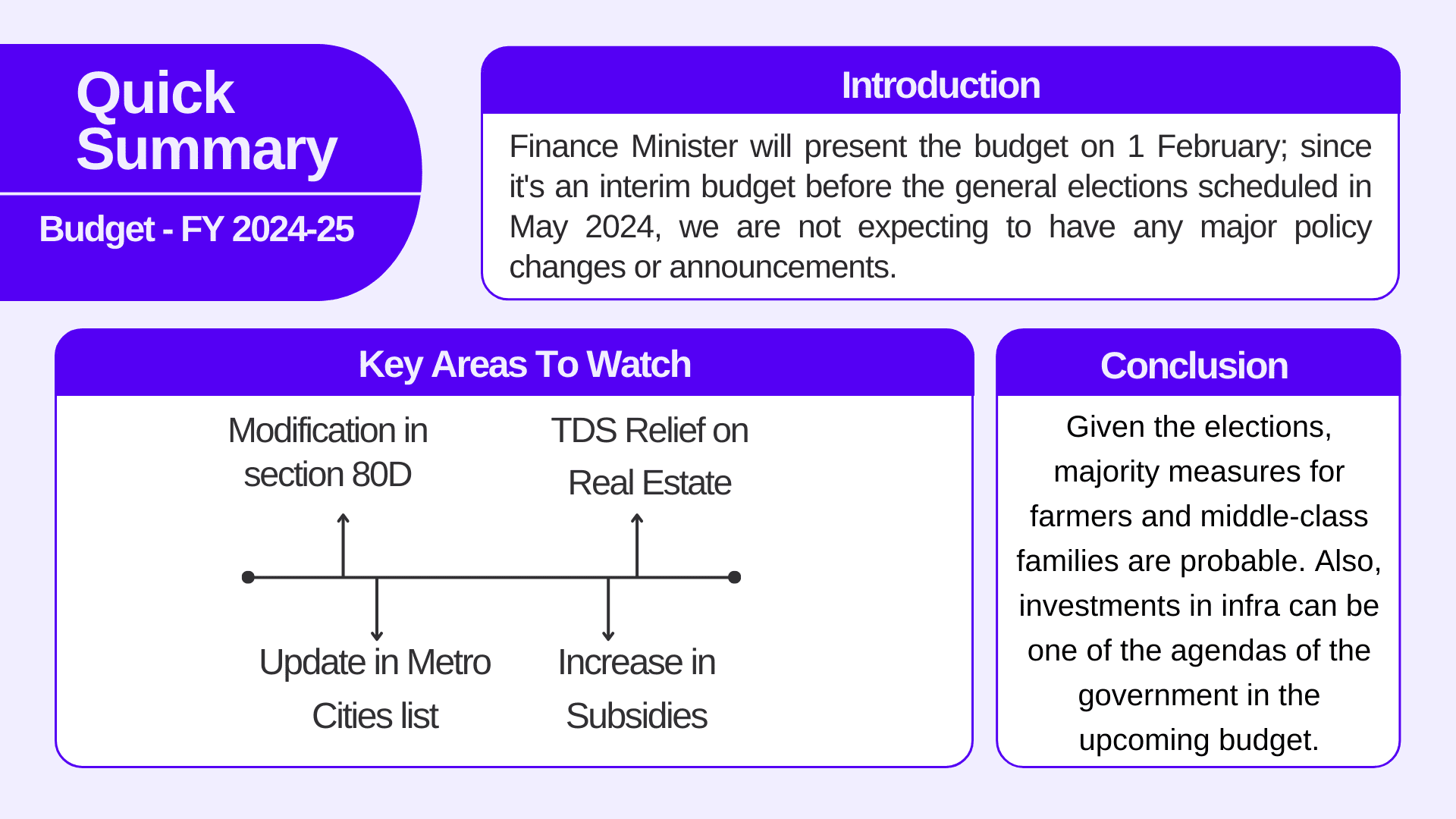
    Budget Day is considered one of the important days for many stakeholders, including the Individuals, Businesses, Markets, and what not! Today, i.e., 1 Feb 2024, our country’s Finance Minister, Nirmala Sitharaman, presented her 6th Union Government Budget for the Financial Year 2024-25.

    The Budget stands as a crucial point in the nation’s financial journey as it is a stepping stone for its economic landscape. However, this was the Interim Budget, which means temporary, or say, short-term budget presented by the current Government before the upcoming elections.

    The full or Regular budget will be announced by the new government in July 2024 after the general elections. Even if the same government comes back in power after the elections, the administration will change, which will announce the full budget. As of today, the dates for the upcoming general elections are yet to be announced by the Election Commission of India.

    Moving back to the Interim Budget, the finance minister completed her speech in almost an hour. Let’s delve into the key highlights:

    Budget 2024

    Infrastructure

    Infra spending increased

    A nation’s progress is often measured by its infrastructure development. The interim budget allocates significant resources to accelerate infrastructure projects across transportation and communication sectors.

    1) The Government has allocated substantial funds for the coming FY 24-25. It has allocated INR 11 lakh cr. for capital expenditure.

    2) Regarding the railways, 40,000 bogeys are to be transformed to Vande Bharat standards. Further, three major railway corridors were also announced:

    • Port connectivity corridor
    • Energy, mineral, and cement corridor
    • High traffic density corridor.

    3) FM applauded the current Infrastructure growth in our country and also mentioned in her speech that Indian carriers have placed orders for 1,000 new aircraft.

    Read Also: Budget 2024: Explainer On Changes In SIP Taxation

    Women Empowerment

    1)  The Govt. has reserved 1/3rd of the legislative seats for women of the nation.

    2) “Lakhpati Didi” Scheme – Aim to empower 2 crore women in villages, has reached 83 lakh self-help groups. It gained renowned success and benefited almost 9 crore women.

    3) FM also mentioned about the “Triple Talaq” in her speech, which is now illegal.

    Direct and Indirect Taxes

    1) FM started the Taxes part by applauding the GST collections, which touched a record high. Further, she stated that Industry leaders view the GST transition as a positive one.

    2) The IT filing processing will now take only 10 days, which is a considerable reduction in existing processing time.

    3) Regarding Direct and Indirect taxes, no such change was announced in the budget by FM. However, there was one good news amongst this; existing tax demands of up to INR 25,000 of previous years (up to FY 2009-10) are to be withdrawn by the IT department.

    Fiscal Deficit

    1) For the FY 2023-24, the revised estimate of fiscal deficit is 5.8% of GDP.

    2) Fiscal deficit for next year, i.e., 2024-25, is estimated at 5.1% of GDP.

    Other Key Announcements

    1) App. 25 crore people in the country got freedom from poverty. Further, govt. has provided financial assistance to app. 11.8 crore farmers under PM KISAN Yojana.

    2) 7 IITs, 16 IIITs, 7 IIMs, 15 AIIMS, and 390 Universities have been set up.

    3) FM emphasises focus on strengthening of domestic macro factors including Domestic Tourism and Infrastructure Investment.

    4) For the youth of the nation, Pradhan Mantri Mudra Yojana (PMMY) has sanctioned 43 crore loans amounting to INR 22.5 lakh crore.  A corpus of INR 1 lakh cr. will be established with a 50-year interest free loan. It will be for long-term financing or re-financing with low or nil interest rates.

    5) One crore households will get up to 300 units of electricity every month with rooftop solarisation.

    6) Girls in the age group of 9-14 will get free cervical cancer vaccination.

    7) The Defence budget is to be increased to INR 1,111,111 crore, which will be 3.4% of our country’s GDP.

    Market Reaction

    Market Reaction on Budget

    On Budget Day, the Market participants had a neutral reaction. The major indices, such as Nifty 50 and Sensex, remain flattish, and so do the major sectors. However, PSU banks and Auto stocks saw a minor rally. Let’s have a look at the top gainers and losers:

    Top Gainers

    Company NameSectorPercentage Change
    Maruti SuzukiAuto + 4.4%
    Bank of IndiaBanking + 4.1%
    Punjab National BankBanking + 3.88%

    Top Losers

    Company NameSectorPercentage Change
    Larsen and ToubroConstruction– 2.35%
    Ultratech CementManufacturing– 2.41%
    GrasimTextile– 2.13%

    India VIX

    There is one Index that saw the sharpest decline, i.e., India VIX. It is now trading at below 14, down almost 10%.  

    If you’re not familiar with the word VIX, it stands for Volatility Index. It represents the market perception for the next 30 days. The higher the VIX, the higher the volatility in the market. It is also known as the “Fear Index”.

    Historical Data

    Let’s see how markets reacted to the past budgets. As this was the Interim Budget, we have compiled data for the past Interim Budgets only and analysed how markets had reacted on those days. Have a look at the table below:          

    Interim Budget DateFinance MinisterSensexNifty Major Movement
    01-Feb-19Piyush Goyal+0.59%+0.58%Auto and Defence stocks were the biggest gainers.
    17-Feb-14P.Chidambaram+0.48%+0.41%Biggest Gainers: Tata Power +4.81%, Mahindra and Mahindra +2.83%
    16-Feb-09Pranab Mukherjee-3.42%-3.39%Realty and Hospitality stocks ended with heavy loss.
    03-Feb-04Jaswant Singh-1.31%-2.25%Almost all sectors were in red.

    Read Also: What To Expect In The Budget 2024?

    Conclusion

    The Union Interim Budget of 2024 addresses immediate challenges, prioritizing infrastructure related expenditures and current fiscal deficit. The government aims to propel the nation towards sustainable growth.

    As citizens like us and major stakeholders analyse the budget’s impact, the hope is that these strategic measures will lay the groundwork for a resilient and prosperous India.

    Frequently Asked Questions

    1. Is the 2024 budget an interim budget?

      Yes, the budget presented by the Finance Minister on 1 February 2024 was an interim budget before the General Elections.

    2. What are the major announcements in this Budget related to Individual Taxation?

      There were a lot of anticipations before the budget regarding the change in the tax slabs or increase in the Section 80C limit of the Income tax act. Unfortunately, no such announcement was made by the FM.

    3. How much capital the govt. allocated to Infrastructure spending in the budget?

      There were major announcements in the budget regarding the Infrastructure spending. The Govt. has increased the spending by 11.11% and allocated INR 11 lakh cr. for Capex.

    4. How did markets react on the budget day?

      Markets remained flattish on the budget day as market participants reacted neutrally.

    5. What is India VIX?

      India Volatility Index, also known as the “Fear Index” represents the market perception for the next 30 days. The higher the VIX, the higher the volatility in the market.

  • Mastering Your Finances: Beginner’s Guide To Tax Savings

    Mastering Your Finances: Beginner’s Guide To Tax Savings

    Mastering Your Finances Beginner's Guide To Tax Savings

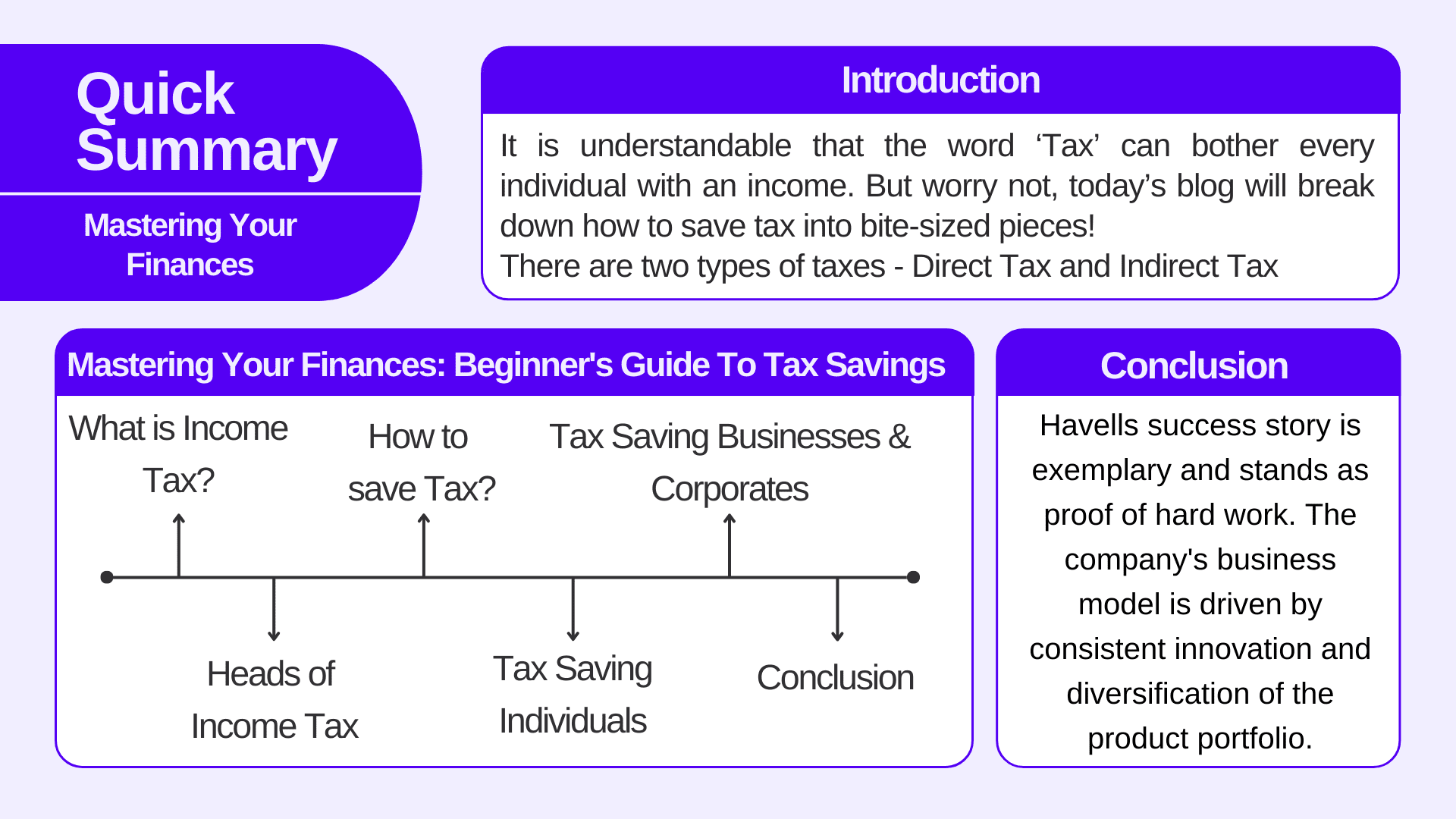
    It is understandable that the word ‘Tax’ can bother every individual with an income. But worry not, today’s blog will break down how to save tax into bite-sized pieces!

    Generally, there are two types of taxes:

    1. Direct Tax – A tax which is levied on individuals / businesses and cannot be transferred to anyone. For example, income tax and property tax.
    2. Indirect Tax – A tax which is levied on goods and services and is charged from the final consumer. Businesses collect these taxes from consumers and give it to the Government. For example, GST, Excise duty, Customs duty, etc.

    Learning how to save on income tax is an important part of personal finance. Here are some basics of income tax and a beginner’s guide on how you can reduce it.

    What is Income Tax?

    Meaning of Income Tax

    Income tax is the tax imposed by the government on the income of individuals and businesses. It is a mandatory financial contribution in most countries.

    The Income Tax Act in India was enacted in 1961 and outlines the rules and regulations for calculating and collecting income tax from individuals. The objective of the act was to limit tax disparities and foster economic growth.

    Below listed are some key features to know about income tax:

    • In the case of individuals, salary, wages, interest income, rental income, and capital gains are taxed, whereas businesses are taxed on profits earned from business operations.
    • Your taxable income is calculated by subtracting certain deductions and exemptions from your total income, and then individuals or corporations are taxed as per their income tax slab.
    • Income tax is structured in a progressive manner, i.e., the higher income is subject to the higher taxes.
    • Income tax is one of the primary sources of revenue for the government and is utilised to fund public services such as education, infrastructure, etc.
    • Individuals are required to file income tax returns with the government annually. The filing procedure involves reporting income, deductions, and other financial information. There are various Income Tax Return (ITR) forms such as ITR-1, ITR-2, etc. We will learn about these forms in another blog.

    Heads of Income Tax

    Now, let us delve deeper and learn about the heads under which your income is taxable. Heads are categories into which your income is classified for tax purposes. There are five main heads of income:

    1. Income from Salary

    This head includes wages, bonuses, allowances, gratuity and other employment income. The employer generally deducts tax deducted at source or TDS from the employee’s salary. Under this head, exemptions that can be availed include:

    HRA (house rent allowance), conveyance allowance, leave travel allowance (LTA), and medical allowance.

    Do remember that salary income is taxable on a due basis or receipt basis, whichever is earlier.

    2. Income from House Property

    The rental income that an individual earns from letting out a property they own is taxable under the head income from house property. The property can either be a self-occupied property or deemed-to-be-let-out property. That is, if you own two properties the second one is considered as deemed-to-be-let-out, and if you have taken a loan to purchase or construct the property, you can claim a deduction for the interest paid on the loan.

    3. Income from Profits & Gains of Business or Profession

    This head comprises the profits earned from the business’s operations that involve the sale of goods, manufacturing, etc. and the income earned by professionals such as doctors, lawyers, etc. All expenses that include rent, salaries, and office expenses for business are deductible.

    4. Income from Capital Gains

    Income from capital gains refers to the profits earned from selling capital assets such as real estate, stocks, bonds, etc.

    There are two types of capital gains:

    • Long-term capital gains (LTCG) – LTCG is subject to change as per the asset class. For example, gains from the sale of equity shares held for more than one year are taxed at a rate of 10% above INR 1 lakh.
    • Short-term Capital Gain (STCG) – Similar to LTCG, these are also subject to change as per the asset class. For example – gains from the sale of debt held for a short duration of less than a year are taxed at the rate of 15%.

    5. Income from other sources

    Income from other sources, also known as the residuary head of the income, includes all income that does not fall in the other four main heads. Any income you receive that is not covered in the above-mentioned heads fits into ‘Income from other sources’. This generally includes interest income, dividends income, gifts, lottery, etc.

    Read Also: What is Non-Tax Revenue – Sources and Components

    How to save Tax?

    How to save taxes

    Knowing the heads, let us discuss some strategies individuals and businesses can implement to save tax.

    Tax Saving – Individuals

    1. Know your tax basics and understand the tax brackets as applicable to your income.
    2. Be careful about the tax implications of your investments because long-term capital gains often have lower tax rates as compared to short-term capital gains.
    3. Utilise deductions under Section 80(C) of the Income Tax Act and invest up to INR 1.5 lakh in financial instruments like PPF, ELSS funds, NPS, ULIPs, etc. These investments not only offer you fascinating returns but also tax benefits.
    1. Utilise the exemption provided for HRA (house rent allowance) if you receive HRA as a part of your salary. For example, if you live in a rented house, you can claim HRA to reduce your taxable income.
    2. Consider investing in tax-saving bonds that are issued by the government.
    3. You can also claim deductions for expenses like tuition fees for the education of your child, principal repayment on home loans, and contributions to certain retirement funds.
    4. Donate to charitable institutions since these donations qualify for deductions under section 80(G).
    5. Premiums paid for health insurance policies for your spouse, children, or oneself are eligible for deductions under section 80(D).
    6. Keep in mind to maintain all the essential documents, receipts, and proofs of your investments and expenses that you claim for deductions.

    Tax Saving – Businesses & Corporates

    1. Choosing a business structure (sole proprietorship, partnership, or LLC) can significantly affect the tax treatment.
    2. Businesses need to recognise the deductible expenses such as rent, utilities, office supplies, employee salaries, advertising, and other business-related expenses.
    3. Businesses can also claim deductions under Section 179 to expense the property purchase cost.
    4. It is suggested to provide employee benefits such as health insurance, retirement plans, etc. since these benefits provide tax advantages and aid in employees’ well-being and retention.
    5. Suppose the businesses have incurred losses in a given financial year. In that case, the net operating loss can be carried forward to offset the taxable income in other years, thereby providing the tax benefits.
    6. Deductible expenses for research and development (R&D) can reduce the taxable capital gains for businesses.
    7. Investing in tax-free infrastructure bonds issued by the government, such as REC & NHAI Bonds are qualified for deduction under section 54 EC of the Income Tax Act. Individuals can also claim deductions under section 54 EC by investing in tax-saving infrastructure bonds.
    1. Businesses can also claim tax deductions for machinery depreciation of up to 20% if acquiring new machinery in a year.

    Read Also: 5 Must-Read Best Swing Trading Books for Trader

    Conclusion

    Tax saving is not just about keeping your tax bill low; it is about making clever financial decisions to safeguard your present and future. Tax laws are complex to understand and are subject to changes. Do not forget to seek guidance from tax professionals for better understanding.

    Frequently Asked Questions (FAQs)

    1. When was the Income Tax Act of India was enacted?

      Income Tax Act of India was enacted in the year 1961.

    2. What are the 5 heads of the income tax in India?

      Income from Salary, Income from house property, Income from Profits and gains of Business or Profession, Income from capital gain, and Income from other sources.

    3. How can I reduce my taxable income?

      You can claim deductions for eligible expenses such as insurance premiums, home loan principal amount repayment, and investment in tax-saving financial instruments. Remember to consult with tax expert at the time of filing your tax return.

    4. Are there penalties for non-compliance with tax laws?

      Yes, there are certain penalties for non-compliance with tax laws. We will cover this topic in a separate blog.

    5. What is the maximum deduction limit in Section 80C?

      As of January 2023, you can claim deduction in Section 80C up to INR 1.5 lakh.

  • A Guide To Investing In Gold In India

    A Guide To Investing In Gold In India

    You must have seen ladies in your house wearing gold. Well, have you ever thought that gold can be a great source of diversification in your portfolio?

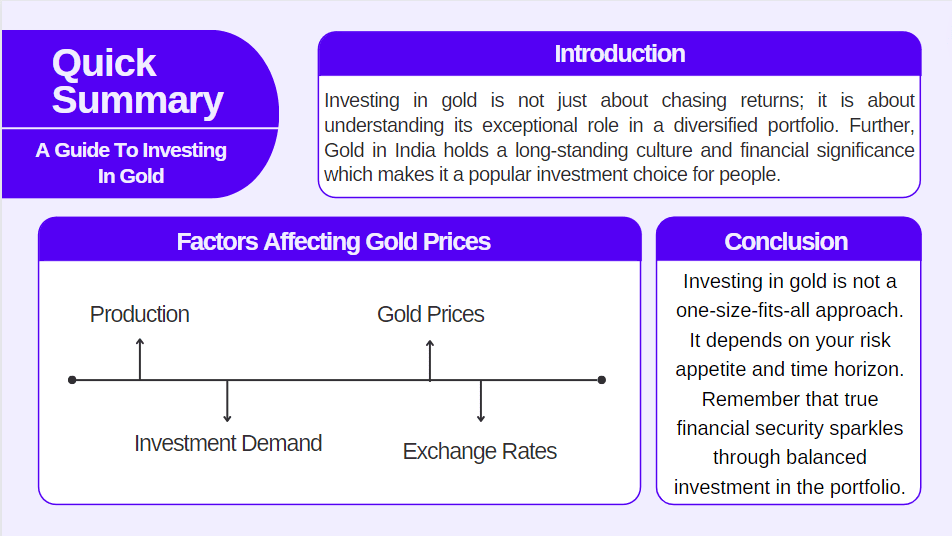
    Investing in gold is not just about chasing returns; it is about understanding its exceptional role in a diversified portfolio. In our today’s blog, we will help you understand the gold as an investment option in India.

    Gold in India holds a long-standing culture and financial significance, which makes it a popular investment choice for people.

    investing-in-gold

    Why Gold Matters?

    • Gold acts as a hedge against inflation and acts as a store of value since gold prices tend to rise when inflation increases, protecting your wealth.
    • Gold is often considered a haven asset for investment during economic or political uncertainties.
    • Gold can help you diversify your portfolio and reduce the overall risk because the price of gold is not positively correlated with the stock market, which means, it does not always move in the same direction as the price of securities in the stock market.
    • Gold is a liquid asset and can be bought and sold as and when required. You can convert your gold easily into cash if you need to.

    Did you know?

    Gold received from a relative as a gift during marriage is tax-free. However, gold received as a gift or inheritance from any other person over INR 50,000 is taxable.

    Factors Affecting Gold Prices

    Factors affecting gold prices

    There are certain factors globally and locally that affect the gold prices:

    Mine production

    The amount of gold mined each year has a significant impact on its price. If there is a decline in mine production, gold will become scarce, and its price will rise and vice versa.

    Gold Reserves

    Central Banks around the world hold large reserves of gold. When they buy or sell gold, it can affect gold prices. Say, if a central bank sells some of its gold reserves, it could flood the market and push the gold prices down.

    Investment Demand

    When there is a lot of uncertainty in the market, such as during a recession, the demand for gold can increase and hence the prices.

    Exchange Rates

    Gold is priced in US dollars. When the dollar is strong, it makes gold more expensive for investors who hold other currencies, which leads to a decrease in demand for Gold and a fall in its price. Conversely, when the US dollar is weak, it makes gold cheaper for investors.

    Read Also: Types of Investment in the Stock Market

    How to Invest in Gold in India

    There are multiple ways to invest in the gold. Some of the widely used options are mentioned below:

    Physical Gold

    • Gold Bullion – Investors can buy physical gold in the form of bars / coins. Bullion is valued based on its weight and purity.
    • Gold Jewellery – Jewellery is generally worn for adornment; it is often considered as a source of investment. However, the returns may be influenced by the craftsmanship and design of the ornament because of making charges and its related costs.

    Digital Gold

    Investment through Online Platforms – various online platforms help investors with buying and selling digital representations of gold without physical possession. These digital gold options offer a convenient way to invest in gold without the need for physical storage.

    Sovereign Gold Bonds (SGBs)

    SGBs are government-backed securities denominated in grams of gold. It is an alternative to holding physical gold. SGBs guarantee capital preservation and offer tax benefits. The minimum investment in the Bond shall be one gram with a maximum limit of subscription of 4 kg for individuals and 20 kg for trusts.

    Apart from capital gains arising from an increase in the value of the gold, SGBs also provide a 2.5% interest p.a. on the invested amount.

    Gold Mutual Funds

    • Gold ETFs – Gold ETF is an exchange-traded fund to track the domestic physical gold price. Gold ETFs are listed on the NSE and BSE and can be easily traded like a stock. Buying Gold ETF implies that you are holding gold in electronic form.
    • Gold Fund of Funds (FOFs) – Similar to gold ETFs, gold FOFs invest in a basket of other gold funds and offer further diversification but add another layer of fees.

    Taxation of Gold in India

    Taxation of Gold

    Sovereign Gold Bonds

    No capital gains tax on SGBs if you redeem at maturity, i.e., after 8 years, and if in case you wish to redeem early, you have to pay:

    • LTCG – If you redeem the investment after 3 years, then capital gains are taxed at a rate of 20% along with indexation benefit. Indexation means your gains are adjusted for inflation.
    • STCG  – If you redeem your investment within 3 years, then capital gains are taxed as per your income tax slab.

    Further, interest received on SGBs is taxed as per the investor’s tax slab.

    Gold ETFs

    Taxation of Gold ETFs is similar to that of debt taxation in India. Investors are eligible to pay both STCG and LTCG. Long-term capital gains tax is levied at 20% after indexation benefits on gold ETFs held for more than 3 years.

    For investment held up to 3 years will be considered a short-term capital gain (STCG) and will be levied according to the applicable tax slab of the investor. No security transaction tax (STT) is charged on Gold ETFs.

    Physical Gold

    Investors possessing physical gold in the form of jewellery, coins, etc., are liable to pay 3% GST on the total buy value. If held for less than 3 years, then capital gains are taxed as short-term capital gains, which is as per your tax slab, and if investment held for more than 3 years, then long- term capital gains will apply at 20% and additional 4% cess, means effectively LTCG is 20.8%.

    Risks of Investing in Gold

    1. Gold prices can fluctuate significantly, and short-term movements can be unpredictable.
    2. Rising interest rates may lead to a decline in the price of the gold.
    3. Physical Gold has low liquidity and high transaction costs compared to Gold ETFs, which makes it harder to sell.
    4. Physical gold also requires secure storage as there are chances of risks of theft or damage.
    5. Global financial markets and geopolitical events influence gold, and any kind of turbulence in gold-producing countries can impact its price.

    Read Also: What is a good rule for investing in stocks?

    Conclusion

    Gold’s charm in India is unquestionable, woven into cultural threads and paired with financial strategies. Unlike stocks and bonds, gold is a tangible asset. Adding gold to your portfolio can help you diversify your portfolio, reduce risk, and balance your financial landscape.

    To sum it up, investing in gold is not a one-size-fits-all approach. It depends on your risk appetite. Before taking a plunge into your investment in a gold basket, seek professional suggestions. Keep in mind that gold may glitter, but true financial security sparkles through balanced investment strategies.

    Frequently Asked Questions (FAQs)

    1. How much should I invest in Gold?

      The investment amount completely depends on individual circumstances and financial objectives. As per the experts, a 10-20% allocation to gold is ideal.

    2. What are the minimum and maximum limits for investing in SGBs?

      The SGBs in India are issued in the denomination of one gram of gold. The minimum investment is one gram and the maximum is 4 Kg for individuals.

    3. Which option is best to buy gold in India?

      It depends on your preference whether you want to buy physically or digitally, however, SGBs are considered an ideal option if you don’t need physical gold and are buying for a long tenure.

    4. Can I invest in Gold through my regular savings account?

      Yes, some banks offer gold-saving schemes where you can collect gold units based on your deposits. Further, many banks provide the facility for buying SGBs.

    5. Is TDS applicable to SGBs?

      No, TDS does not apply to SBGs.

    Disclaimer: The securities, funds, and strategies mentioned in this blog are purely for informational purposes and are not recommendations.

  • A Guide To Fixed Deposits: Exploring Types And Interest Rates

    A Guide To Fixed Deposits: Exploring Types And Interest Rates

    If you are someone who is looking for hassle-free and low risk investment options, then you have come to the right place. We will uncover the Fixed Deposits – types and factors affecting them in this blog.

    What is a Fixed Deposit?

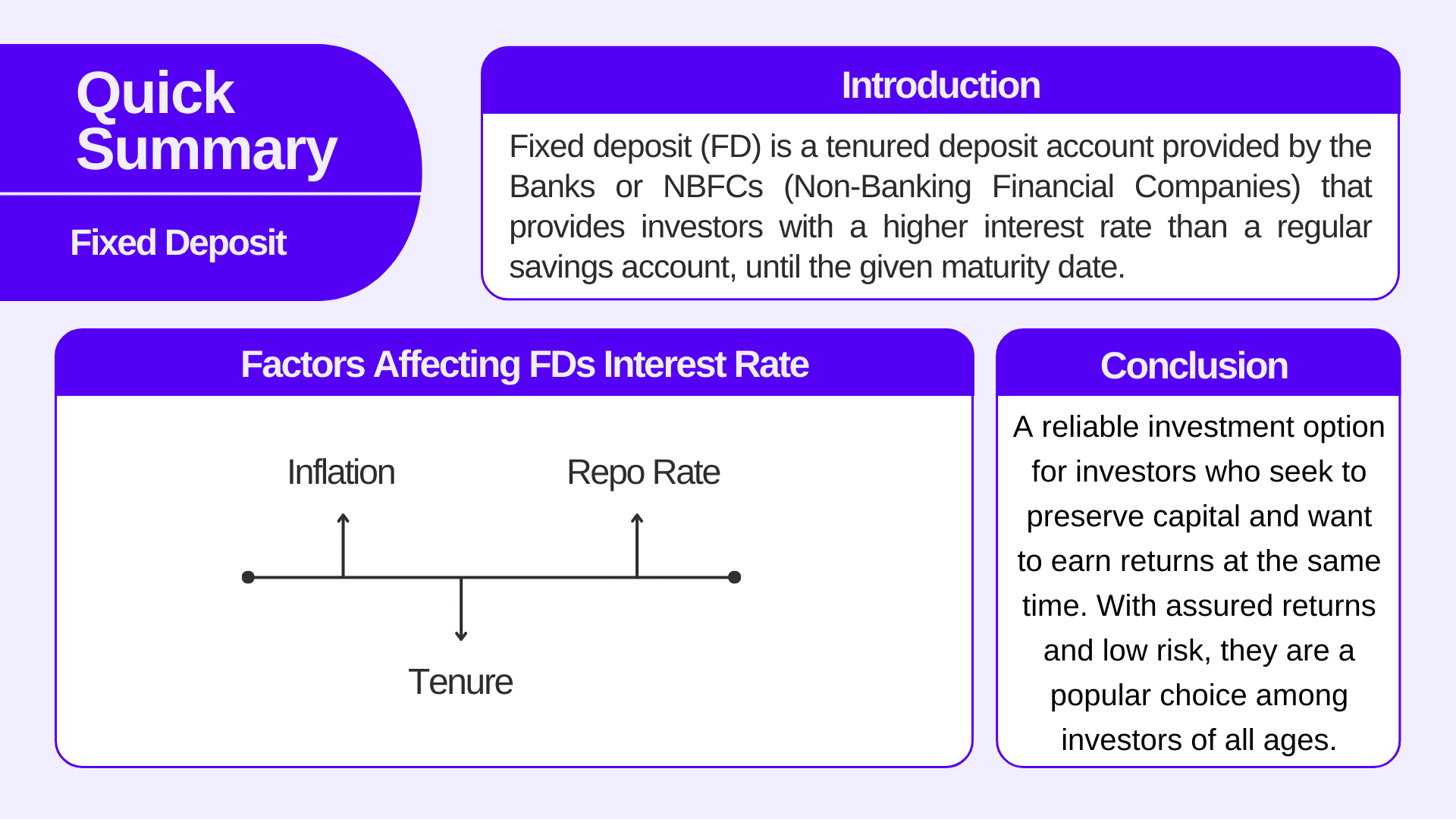
    Fixed deposit (FD) is a tenured deposit account provided by the Banks or NBFCs (Non-Banking Financial Companies) that provides investors with a higher interest rate than a regular savings account until the given maturity date. Most of the FDs offered by banks don’t allow premature withdrawal. However, some banks allow premature withdrawal under certain situations subject to penalties. Investment in fixed deposits is considered a risk-free investment.

    FDs Interest Rate

    Did you know?

    Your bank FD is secured up to 5 lakhs by DICGC* (Deposit Insurance and Credit Guarantee Corporation).

    DICGC is a specialised division of the Reserve Bank of India.

    Types of Fixed Deposits

    There are multiple types of Fixed Deposits available to invest:

    Types of FD

    Regular Fixed Deposits

    Regular FDs are the most basic fixed deposits. You deposit a lump sum for a fixed tenure, and earn an interest at a fixed rate. These are suitable for people who are not willing to take risks and looking for a safe and secure investment option.

    Senior Citizen Fixed Deposit

    It is a special type of fixed deposit account that offers 0.25% to 0.50% higher interest rate than regular FDs for individuals aged 60 and above. For a steady income, you have the option to receive the interest pay-out on a regular basis.

    Tax-saver Fixed Deposit

    Tax-saver fixed deposits allow you to save on taxes while you earn interest on your regular investments. It comes with a lock-in period of 5 years and provides you with a tax deduction of up to INR 1.5 lakh per year under Section 80 (C) of the Income Tax Act.

    Interest in tax-saver FD is paid out on regular intervals and is taxable as per your income tax slab. Tax-saver FDs can be a good option for individuals who want to save on taxes while earning a guaranteed return.

    Flexi Fixed Deposit

    A flexible fixed deposit is an account that offers you the features of both a savings account and an FD account. Unlike regular FDs, you can partially withdraw funds from your Flexi FD account without a penalty, but only up to a defined limit. However, this provision varies from bank to bank. You can also make additional deposits to your existing Flexi FD account to increase your returns. Flexi fixed deposits are suitable options for investors with short-term financial goals.

    Cumulative Fixed Deposit

    In a cumulative fixed deposit, the interest earned is not periodically paid out to the investor instead, it gets added to the principal amount. Also, the interest earned is compounded annually. Cumulative FDs offer a lump-sum payout on your maturity date.

    Non-Cumulative Fixed Deposits

    In a non-cumulative FD, interest is regularly paid out to the investor instead of being re-invested and compounded. This makes it a suitable option for investors who seek regular income from their investments.

    Corporate FD

    Corporations and Non-Banking Financial Companies (NBFCs) accumulate deposits for a fixed period from investors. These deposits, like Bank FDs, are collected at predetermined interest rates and are known as Corporate Deposits. Similar to Bank FDs, Corporate FDs offer varying investment periods and assured returns. Additionally, they offer higher interest rates as compared to Bank FDs.

    Interest rates in corporate FDs are primarily based on the credit quality of the issuer. The lower the rating, the higher the credit default risk; therefore, to compensate for this, they offer higher interest rates as compared to Corporate FDs having high credit ratings.

    Difference between Bank FD & Corporate FD      

    Difference between Corporate and Bank FD

    While investors can choose either of the FDs based on their needs, knowing the difference between the two is necessary to make an informed decision.

    Below are some key points based on which you can easily distinguish between Corporate FDs and Bank FDs.

    1. Unlike bank FDs, Corporate FDs offer a higher interest rate of 7% to 8.5%. Bank FDs offer lower interest rates depending upon the period chosen by the investor.
    2. It is a common practice among investors to withdraw their fixed deposit amount. If you do the same thing, keep in mind that corporate FDs levy additional charges on premature withdrawals, which is comparatively higher than regular Bank FDs.
    3. Corporate FDs are monitored by credit rating agencies like CRISIL, ICRA, etc., for compliance whereas Bank FDs are secured under the guidelines of the RBI.
    4. Bank FDs are a safer option to invest since they are backed by RBI while corporate FDs carry higher risk, and their safety depends upon the creditworthiness of the issuing company. Further, as discussed above, bank FDs are secured up to INR 5 lakhs by DICGC.

    Tips for maximising FD Returns

    1. Choose the right kind of FD depending on your financial needs and objectives.
    2. Compare the interest rates across banks and NBFCs to find the most competitive rates before you invest.
    3. If you do not need regular interest income, consider choosing cumulative FDs. As explained earlier, cumulative FDs provide you the benefit of compound interest, thus resulting in higher returns.
    4. Instead of investing your money in a single FD, consider creating a ladder by spreading your investments across FDs with different tenures and FDs mature, and reinvest them in other FDs with higher interest rates. This will help you maximise the returns generated.
    5. Be mindful of the penalties linked with the FDs before you withdraw your invested amount.
    6. Interest earned on FDs is taxable. Consider the tax implications and plan your investments to minimise your burden of the tax.

    Read Also: Why Debt Funds Are Better Than Fixed Deposits of Banks?

    Factors Affecting FD Interest Rates

    There are several factors that impact the Interest rate offered by Fixed Deposits. Some of the important factors are as follows:

    Inflation

      When inflation is high, banks generally offer high-interest rates on fixed deposits to compensate for the decline in the purchasing power of money.

      Repo Rate

        The repo rate is the rate at which the banks borrow money from the Reserve Bank of India (RBI). When the RBI increases the repo rate, the lending rates and fixed deposit rates of the banks also increase, and vice versa. In case of increasing interest rate scenario, consider investing in short-term investments.

        Tenure

          Generally, long-term FDs offer higher interest rates than short-term FDs because, in the case of long-term FDs, banks can use the FD amount invested with them for a longer horizon and can earn good returns on their investments.

          How to choose the right FD

          Choosing the right FD for your needs involves assessing several factors to ensure that you receive the best returns. Consider below mentioned points when choosing FD:

          1. Analyse your goals and compare the interest rates offered by different banks and NBFCs.
          2. Choose an investment tenure that best aligns with your financial goals.
          3. Go for FDs issued by recognised and well-established banks. In the case of Corporate FDs, check the credit rating of the issuer to ensure a margin of safety.

          Read Also: Best Alternatives To Fixed Deposits

          Conclusion

          Fixed deposits are considered a reliable investment option for investors who seek to preserve capital and want to earn returns at the same time. With assured returns and low risk, fixed deposits are a popular choice among investors of all ages.

          FAQs

          1. What is FD?

            Fixed deposit (FD) is a tenured deposit account provided by banks or NBFCs (non-banking financial companies), which provides investors with a fixed interest until the given maturity date.

          2. Are interest rates of FD similar in every bank?

            Interest rates of FDs vary from bank to bank. Generally, they are in a similar range.

          3. What is Repo Rate?

            The repo rate is the rate at which the banks borrow money from the RBI.

          4. Does the bank levy a penalty on pre-mature withdrawal of FDs?

            Yes, different banks have different penalty provisions.

          5. What is the lock-in period of Tax Saving FDs?

            Tax saving FDs come with a lock-in period of 5 years from the date of deposit.

          Disclaimer: The securities, funds, and strategies mentioned in this blog are purely for informational purposes and are not recommendations.

        1. What To Expect In The Budget 2024?

          What To Expect In The Budget 2024?

          Last year, on 1 February 2023, i.e., on the budget day, the govt. made significant announcements such as increased spending on infrastructure, several aids for agriculture and entrepreneurs, increase in tax rebate, etc., for the FY 2023-24.

          Now, the budget for the FY 2024-25 is yet to be presented. Finance Minister Nirmala Sitharaman will present the interim budget 2024-25 on February 1, 2024.

          In this blog, we will discuss what to expect in the upcoming budget and past year trends.

          Budget

          What is Interim Budget?

          An interim budget is a temporary financial plan presented by the government when the general elections are forthcoming. Compared to the regular budget, the interim budget is less comprehensive and does not introduce many policy changes.

          An interim budget generally includes a review of the previous year’s budget, i.e., the government’s income and expenditure for the previous financial year and an estimate for the upcoming financial year.

          What to expect in the upcoming Budget?

          What to expect

          Finance Minister Nirmala Sitharaman will present the budget on 1 February; since it’s an interim budget before the general elections scheduled in May 2024, we are not expecting to have any major policy changes or announcements. The major focus will likely be maintaining macroeconomic stability and continuing existing schemes.

          However, there are some expectations about what can be included in the Budget 2024.

          Below are some key areas to watch:

          1. Under section 80D, the deduction limit for medical insurance premiums can be increased from INR 25,000 to INR 50,000 in the case of individuals and from INR 50,000 to INR 75,000 in the case of senior citizens.
          2. Currently, TDS deducted on property acquisitions is 1% if the value of the property exceeds INR 50 Lakhs. The government is planning to ease TDS compliance for people who wish to invest in real estate.
          3. Bangalore is to be considered a metro city for the exemption of the house rent allowance for its residents, which means 50% of basic pay will be determined as HRA. As of now, Bangalore is not classified as a metro city for HRA deduction, means only 40% of basic pay is determined as HRA.
          4. The government’s subsidy* bill can see a slight increase in the upcoming financial year 2024-25 because of the expansion of the central government’s free food scheme.

          *If you’re not familiar with the word, Subsidy is a kind of financial aid the government provides to individuals, businesses, or institutions. It can include reductions or exemptions from taxes, loans at lower interest rates, cash transfers or grants.

          1. We can also expect a new reverse charge-based mechanism to improve GST compliance. This will avoid monthly tax payment obligations by small business vendors since buyers who are large taxpayers with turnovers above INR 100 crore will directly pay the tax to the government.

          Read Also: Unveiling the Budget 2024: Key Takeaways

          A quick look at FY 2023-24 allocation of Budget.

          Quick look

          Some of the major sectors accounted for 53% of total estimated expenditure in the previous financial year budget:

          1. Defence – the budget of the defence sector was about INR 593,000 crore and accounted for over 13% of the total expenditure of the central government. In 2023-24, its allocation is estimated to be marginally lower than 2% of GDP.

          In the interim budget, we can expect a marginal rise of 1-2% for the defence sector.

          1. Railways – In the FY 2023-24, the government has allocated a budget of around INR 240,000 crore for capex in the railway sector.

          We can expect a rise of 2% for capex in the railway sector in the forthcoming FY 2024-25 budget.

          1. Road Transport & Highways – A budget of INR 270,000 crore was allocated to the road & transport ministry in the FY 2022-23, which was 25% higher than the revised estimates for 2022-23.

          This year, we can expect an estimated rise of 30% in the upcoming interim budget.

          1. Agriculture – India, an agricultural country, had an allocation of INR 125,000 crore in the FY 2023-24, which was a 5% increase over the revised estimates of 2022-23.

          A rise of 5-7% for agriculture and farmer’s welfare can be expected in this financial year.

          1. Communication – the Indian government primarily focused on this sector with a budget of INR 1 lakh crore in the previous financial year of 2023-24.

          This year we can expect a rise of 30-35% in budget allocation of this sector.

          Subsidies for FY 2023-24

          Expenditure on subsidies accounts for a major portion of the government’s total budget, with an amount of INR 400,000 crore.

          The three major types of subsidies provided by the government were food subsidies, petrol subsidies and fertiliser subsidies, other subsidies such as assistance provided to state agencies, agricultural produce, price support schemes, etc.

          Chances are likely that subsidies will remain unchanged for FY 2024-25 as well.

          Disinvestment Target

          Disinvestment is the process of the government reducing its ownership stake in the public sector undertakings (PSUs). It can be done through selling shares of the PSU, merging PSUs, and liquidating PSUs.

          The disinvestment target of the government for FY 2023-24 was INR 51,000 crore, we can expect a decline in upcoming interim budget as the target of the previous financial year is unachieved.

          Tax Regimes

          We can expect the tax regimes to remain unchanged for the FY 2024-25 since last year there was a major relief in the new tax regime. And if we analyse the previous budgets where the tax structure was changed, it is highly unlikely that this year will bring any major change in the tax structure.

          For your reference, have a look at the old & new tax regimes:

          Old Tax Regime

          Income SlabIncome Tax Rate
          Up to INR 2,50,000Nil
          INR 250,000 to INR 5,00,0005% (tax rebate is available u/s 87A upto 5 lakhs)
          INR 500,001 to INR 10,00,00020%
          More than INR 10,00,00030%

          New Tax Regime

          Income SlabIncome Tax Rate
          Up to INR 3,00,000Nil
          INR 3,00,001 to INR 6,00,0005% (tax rebate is available u/s 87A upto 7 lakhs)
          INR 600,001 to INR 9,00,00010% (tax rebate is available u/s 87A upto 7 lakhs)
          INR 9,00,001 to INR 12,00,00015%
          INR 12,00,001 to INR 15,00,00020%
          More than INR 15,00,00030%

          Read Also: Budget 2024-25: How Will New Tax Slabs Benefit The Middle Class?

          Market’s reaction on the Budget Day

          Previous year budget trends

          Budget announcement day is considered a big event for the general public and particularly for the market participants. The market’s reaction on the budget day is quite volatile, with a history of both positive and negative swings.

          Different sectors react differently to the budget depending on the announcements affecting them. Ultimately, the market’s reaction on the day of the budget can be unpredictable.

          It is interesting to note that the Budget Day reaction hasn’t been too extreme, with gains and losses not exceeding 2% in 8 out of the last 10 years. An evaluation of market history since 2013, which includes ten regular budgets and two interim budgets, indicates that the Union Budget has been a 50-50 show so far. In the year 2021, Sensex saw its best budget day gain since 1999 and ended 5% higher. We can say that it’s been a bit of a hit-or-miss situation.

          Further, experts suggest not to take directional positions before budget announcement day as the budget can significantly impact the market movement, and if the market moves in opposite direction to your trade, that will result in significant losses.

          Conclusion

          After a successful FY 2023-24, leading institutions like World Bank and RBI estimated India’s growth in FY2024 -25 to be between 6.3% to 6.4%. However, global economic uncertainty and geopolitical scenarios can influence the conclusions of Budget 2024.

          Given the elections, majority measures for farmers and middle-class families are probable. Also, investments in infrastructure to boost India’s manufacturing competitiveness can be one of the main agenda of the government in the upcoming budget.

          Frequently Asked Questions (FAQs)

          1. Who presents the budget?

            Finance Minister of India.

          2. Are markets more volatile near the budget?

            Generally, markets are more volatile near the budget day as different investors have different expectations. However, this increased volatility cools off after the announcement of the budget.

          3. Which day will the government present the budget for FY 24-25?

            1st February, 2024.

          4. What is subsidy?

            A subsidy is a financial aid that the government provides to individuals, businesses, or institutions.

          5. Will the budget for 2024 affect taxes?

            Tax changes are possible, but major reforms are unlikely in the interim budget. However, we can expect some new tax exemptions.

          Disclaimer: The securities, funds, and strategies mentioned in this blog are purely for informational purposes and are not recommendations.

        2. Decoding Credit Risk Funds In India

          Decoding Credit Risk Funds In India

          Do you know there is a category of mutual funds which specifically invests in junk bonds? If you’re not familiar with the word, Junk bonds, as the name suggests, are low quality bonds which have a high risk of default. But wait, high risk means high returns? Yes! To compensate for the high default risk, these bonds provide greater returns than other highly rated bonds.

          If you’re new to the mutual fund world, check out our blog: Mutual Funds: Meaning, Types, Features, Benefits and How They Work.

          What are credit risk funds?

          Credit Risk Funds are a category of debt mutual funds that primarily invest a minimum of 65% only in AA and below-rated corporate bonds.

          Did you know?

          Credit Risk Funds are earlier known as “Credit Advantage Fund” or “Credit Opportunity Fund”.

          Credit Risk Funds

          How do Credit Risk Funds work?

          Fund managers seek out debt funds with credit ratings that generally range from BBB to C since these bonds offer higher interest rates to compensate for the risk of default.

          To diversify the risk, the fund manager will invest across multiple bonds of different companies to avoid overexposure in a single issue or company.

          Checkout our blog on debt mutual funds: What is Debt Mutual Funds: Invest in the Best Debt Funds in India

          Readc Also: Types of Mutual Funds in India

          Advantages of Credit Risk Funds

          Advantages of Credit Risk Funds
          1. High Yield

          Credit risk funds offer investors high yields as compared to other debt funds. This can fascinate investors who wish to seek relatively higher returns.

          1. Diversification

          Investors can get exposure to high-yield bonds, although with higher risk. Further, credit risk funds have investments across multiple companies and issues such that exposure to any sector or company is significantly reduced. For risk-seeker investors, this enhances the overall portfolio performance.

          1. Professionally Managed

          Credit risk funds are managed by professional fund managers having specialisation in credit risk assessment. Their expertise helps the fund in generating good returns considering the risk profile.

          Disadvantages of Credit Risk Funds

          1. Risk of Default

          Junk bonds carry a high possibility of default. The lower credit quality of the bonds increases the chance that the issuer may fail to repay the principal amount.

          1. Volatility

          Credit risk funds are highly volatile compared to other debt options, i.e., the fund’s net asset value (NAV) changes significantly which may not give positive returns to investors for a short period.

          1. Not Suitable for all Investors

          These funds are a fit for investors with a high-risk tolerance and long-term investment horizon.

          1. Management Costs

          Credit risk funds need active oversight and analysis. This leads to higher expense ratios and reduces the overall returns. Generally, the expense ratio of credit risk funds is more than other categories of debt mutual funds.

          Read Also: Decoding Hedge Funds In India – Types, Advantages And Distinctions

          Impact of Interest Rate Changes on Credit Risk Funds

          • When interest rate rises, the value of existing bonds declines, since bond prices and interest rates share an inverse relationship. However, credit risk funds invest in low-quality bonds that have high coupon rates to compensate for the increased risk of default, i.e., a decline in the value of bonds may be less visible, and the higher coupon rates can still provide good returns even if the interest rates are rising.
          • Credit risk funds are sensitive to changes in credit spreads. Credit spread is the additional yield that investors demand for holding riskier bonds over safe and secure government bonds.
          • There is a thing called “Duration” in the bond universe, which is the measure of the sensitivity of price change of a bond for a change in the interest rate. The higher the duration, the more sensitive the bond is to the changes in interest rates. Investors should keep in mind the duration of the credit risk funds before investing as it can significantly impact the performance of funds in a short period.

          Risks associated with Credit Risk Funds

          Risk of credit risk funds

          Credit Risk

          The primary risk that is involved in credit risk funds is “Credit Risk” or the “Risk of Default” by the bond issuers. Bonds with high coupon rates are more exposed to default risk and can lead to a decline in the fund’s value. 

          Liquidity Risk

          Credit risk funds are generally less liquid when compared to other debt funds because these funds hold bonds that are of low credit quality, making it difficult to buy or sell them in the market.

          Concentration Risk

          Several credit risk funds have concentrated exposure to specific sectors, which can increase the risks if those sectors face any kind of economic downturn or challenge.

          Interest Rate Risk

          As we discussed above, just like other fixed-income securities, credit risk funds are sensitive to changes in interest rates. When interest rates rise, the prices of existing bonds in the portfolio may fall, leading to potential capital losses.

          Credit Risk Funds vs. Other Mutual Funds

          • Credit risk funds carry high risk and potential of high returns since they invest in lower-rated corporate bonds, whereas the risk and returns of other mutual funds vary depending on the category of investment (equity, debt, balanced, etc.)
          • Compared to other mutual funds, credit risk funds are more volatile because of sensitivity to changes in credit ratings.
          • Credit risk funds are less liquid due to low demand than other debt mutual funds like liquid funds, low-duration funds, etc.
          • Credit risk funds are suitable for investors with high-risk tolerance and long-term investment horizons, and other mutual funds say liquid funds are suitable for a wide range of investors.

          Historical Performance of Credit Risk Funds

          Credit risk funds generally offer high returns as compared to other categories of debt funds, and annualised returns can range somewhere between 7% to 14% depending on the fund and the market conditions.

          As of January 2024, there are more than 15 credit risk funds available in India from different Asset Management Companies. The table below shows the annualized performance of a few credit risk funds that we selected on a random basis:

          Funds1 Year Return (%)3 Year Return (%)5 Year Return (%)7 Year Return (%)
          Aditya Birla Sun Life Credit Risk Fund – Direct Plan7.737.647.247.51
          Axis Credit Risk Fund – Direct Plan7.866.566.947.05
          HDFC Credit Risk Debt Fund – Direct Plan7.356.397.957.56
          ICICI Prudential Credit Risk Fund – Direct Plan8.036.868.258.06

          Are Credit risk funds suitable for you?

          Suitability of credit risk funds

          Investments in credit risk funds expose your portfolio to high risk, and if your main purpose is to preserve your capital (assuming you are a risk-averse investor), then chances are likely that credit risk funds may not align with your financial goals.

          However, if you are looking for diversification in your debt portfolio, can stay invested for a longer horizon, and are familiar with the risks involved, you can choose credit risk funds to diversify your portfolio and generate good returns.

          But remember to seek advice from a financial advisor. A professional advisor will analyse your investment goals and curate your portfolio accordingly.

          Read Also: What is Debt Mutual Funds: Invest in the Best Debt Funds in India

          Conclusion

          Credit risk funds are considered a double-edged sword. They offer high returns but at a cost of high risk. Although, the investor needs to analyse the credit quality of the bonds before investing in any credit risk fund and if in any case, the investors want to exit these funds, they need to assess and monitor the fund’s portfolio regularly.

          If you are curious to learn more about the taxation of mutual funds in India, check our blog: Decoding Mutual Funds Taxation In India

          Frequently Asked Questions (FAQs)

          1. What are credit risk funds?

            Credit Risk Funds are a category of debt mutual funds that primarily invest a minimum of 65% only in AA and below-rated corporate bonds.

          2. Do credit risk funds offer higher returns as compared to other debt mutual funds?

            Yes, they generally offer higher returns as compared to other categories of debt mutual funds such as liquid funds, money market funds, etc.

          3. Credit risk funds are suitable for what kind of investors?

            Credit risk funds are suitable for investors with a high-risk tolerance and long-term investment horizon.

          4. Should you seek professional help while investing in credit risk funds?

            It is recommended to seek professional advice before investing in Credit risk funds.

          5. Credit Risk Funds are previously known as?

            “Credit Opportunity Fund”  & “Credit Advantage Fund”.

        3. Open Free Demat Account

          Join Pocketful Now

          You have successfully subscribed to the newsletter

          There was an error while trying to send your request. Please try again.

          Pocketful blog will use the information you provide on this form to be in touch with you and to provide updates and marketing.