Category: Personal Finance

  • Best Alternatives To Fixed Deposits

    Best Alternatives To Fixed Deposits

    Best Alternatives To Fixed Deposits

    Tired of investing in FDs, and looking for another option to invest?

    FDs are the most preferred choice for risk-averse investors in India. They are convenient, simple to understand, and safe….wait, are they really safe? It may or may not.

    After the recent fiasco of Yes Bank and PMC Bank, it can be understood that FDs are not 100% safe. Further, there are a few drawbacks, such as penalty for premature withdrawal, not so-flexible tenure, etc.

    What is the safest investment then? What are the other options that provide more flexibility or tax efficiency than Fixed Deposits? In this blog, we will explore answers to all such questions.

    Best alternatives to fixed deposit

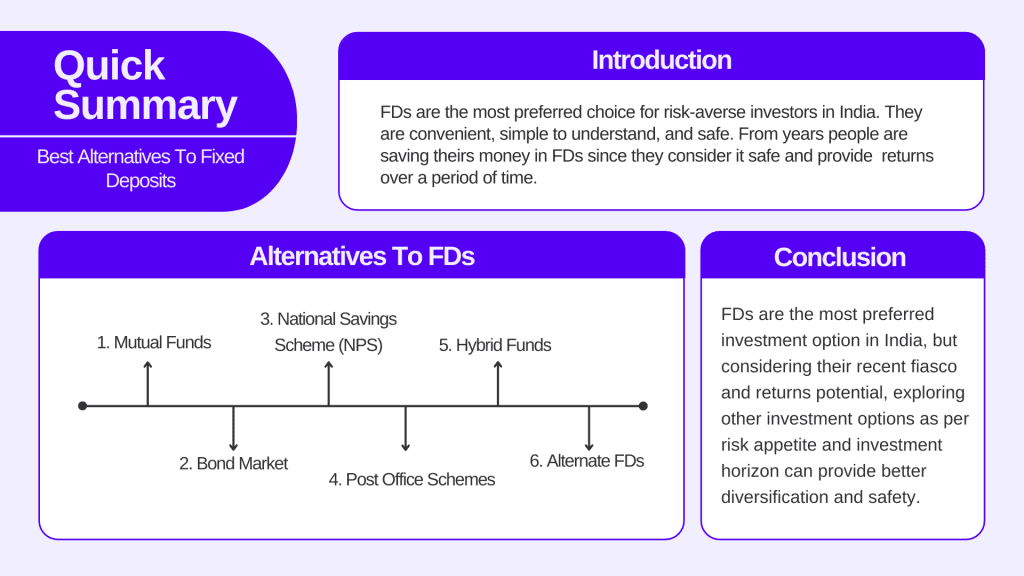
    Alternatives to FDs

    Let’s explore the options available to Investors:

    1. Mutual Funds

    These are pooled investments managed by a professional fund manager. There’s an entire universe of mutual funds.

    Check out our blog to learn more: Mutual Funds: Meaning, Types, Features, Benefits and How They Work.

    Broadly, there are Equity and Debt mutual funds. While equity mutual funds are riskier and more volatile, debt funds can be an alternative to fixed deposits. In finance, there’s one simple rule: The higher the returns, the higher the risk.

    Debt funds are classified on the basis of:

    1. Duration: The longer the duration, higher the sensitivity of change in price of the bond.

    2. Types of investment: Debt funds invest money in several instruments ranging from money market instruments to corporate bonds. Gilt funds carry less default risk than credit-risk funds.

    Check out our blog to learn more: What is Debt Mutual Funds: Invest in the Best Debt Funds in India

    2. Bond Market

    Another method to get exposure to bonds is to directly invest in bonds. There are several methods to do so. You can directly place bids for various new offerings via brokers. Further, RBI recently launched a Retail direct platform to facilitate investment in govt. securities – Treasury bills, Central / State govt. Bonds, etc. However, direct investing in bonds requires thorough research and carries more risks. For newbies, investing in debt funds is ideal.

    Fact: Government securities offer the maximum safety as they carry the Sovereign Guarantee.

    3. National Savings Scheme (NPS)

    It is a defined contribution voluntary pension scheme launched by Govt. of India. It is a low-cost product that can provide attractive market-linked returns. They invest in equity, bonds, and govt. securities and are managed by fund managers. Further, tax benefit upto INR 50,000 is available under this scheme. However, this is a pension scheme. Therefore, it comes with a lock-in period until the age of 60.

    3. Floating Rate Saving Bonds (FRSB)

    FRSBs are issued by the Reserve Bank of India (RBI) on behalf of Govt. of India. As the name suggests, coupon rate is not fixed in FRBs like bonds. The coupon is linked to the National Savings Certificate (NSC) + 35 bps spread. They have a maturity of 7 years and do not provide any tax benefit, but coupon rate is generally higher.

    4. Post Office Schemes

    There are multiple post office schemes available to investors:

    1. Public Provident Fund (PPF) – A long term tax-saving investment option where the lock-in period is 15 years.

    2. Sukanya Samriddhi Account (SSA) – A govt. of India initiative targeted to the parents of girl children.

    3. National Savings Certificate (NSC) – A government savings bond scheme targeted to investors looking for tax savings. NSC has a lock-in period of five years.

    5. Hybrid Funds

    As the name suggests, they are a mix of equity and debt. They are further classified in the Aggressive or Conservative approach. Aggressive invests more in equity and less in debt instruments, while Conservative hybrid funds take more exposure in debt. Taxation of it depends on the equity exposure of the fund.

    Check out our blog on taxation to learn more: Decoding Mutual Funds Taxation In India

    6. Alternate FDs

    There are multiple types of Fixed Deposits available to investors, however, only bank FDs are common. List of other FDs that one can consider investing in:

    1. Corporate FD – These FDs are issued by companies. Generally, they provide higher returns than Bank FDs. The interest rate of FDs can be significantly influenced by the credit rating of the FDs issued. The lower the rating, the higher the interest rate.

    However, direct investing in them is more-riskier, they are not insured by Deposit Insurance and Credit Guarantee Corporation (DICGC). Investing via debt funds is the ideal route.

    2. Senior Citizen FDs: Investors aged more than 60 years are eligible to invest in Senior citizen FDs. They carry higher interest than regular FDs.

    3. Tax Saving FDs: Unlike regular FDs, they provide tax benefit of up to INR 1,50,000 under section 80C but comes with a lock-in period of five years.

    Options for Senior Citizens

    Investment options for senior citizens

    1. Senior Citizen Savings Scheme (SCSS): SCSS is a post office scheme offered to senior citizens, i.e., 60 years and above. The interest rate in SCSS is higher as compared to other options, and also tax benefit under section 80C is there. However, a maximum of INR 30 lakhs can be invested in this, and they come with a lock-in period of five years.

    2. Bank FDs:  As the name suggests, senior Citizen FDs are targeted to senior citizens only. They offer higher interest rates and flexible tenure as compared to regular bank FDs. However, no tax benefit is available in such FDs.

    Read Also: A Guide To Fixed Deposits: Exploring Types And Interest Rates

    Why Alternate Options?

    why go for alternative options

    Now, you will ask why all this when one can simply invest in FDs, well there are multiple reasons:

    1. Taxation: Capital gains from fixed deposits are taxed as per your income slab rate. If you fall in the bracket of 30%, then it might not be efficient for you.

    2. Maturity: For long-term investment, FDs provide fewer options. In Bonds, you can even invest for 40 years.

    3. Safety: After recent cases of PMC and Yes Bank, we can say that FDs are not 100% safe and so are the other investment option. Generally, the central govt. issued securities like Treasury Bills, Bonds are the safest instrument to invest as they are backed by Sovereign Guarantee. If such securities give higher returns, then investment in these is preferred over regular FDs.

    Fact: Bonds issued by State Government / State Development Loans (SDLs) generally provide higher returns than regular bank FDs.

    4. Withdrawal: In case of premature withdrawal in FDs, one has to pay penalties. However, in the case of instruments like bonds, you can sell in open market as well, even before the maturity (considering enough liquidity is available). Further, if market conditions are in favour of you, then apart from fixed coupons, you can also get capital gains.

    Conclusion

    FDs are the most preferred investment option in India, but considering their recent fiasco and returns potential, exploring other investment options as per risk appetite and investment horizon can provide better diversification and safety. Few can give you better returns, and few instruments are more tax efficient.

    Consider the risk profile, investment horizon, and financial goal, then select the best available option that aligns with your goal and invest money there.

    S.NO.Check Out These Interesting Posts You Might Enjoy!
    1Best Places To Park Your Short Term Money
    2Which is Better: Fixed Deposit or Residential Property Investment
    3Why Debt Funds Are Better Than Fixed Deposits of Banks?
    4Best SIP Apps in India for Investment
    5Liquid Funds Vs Ultra Short Fund: Which One Should You Choose?

    Frequently Asked Questions (FAQs)

    1. Which is more liquid: Liquid funds or Short duration funds?

      Liquid funds.

    2. What is the maximum limit to invest in Senior Citizen Savings Scheme (SCSS)?

      One can invest up to INR 30,00,000 in SCSS.

    3. What are the investment options in which tax benefit under section 80C is available?

      Tax Savings FDs, National Savings Certificate (NSC), ELSS Funds, SCSS for Senior citizens, etc.

    4. Are Fixed Deposits insured in India?

      Fixed deposits in India are secured till INR 5,00,000 by Deposit Insurance and Credit Guarantee Corporation (DICGC).
  • What should you do if your stock portfolio is stuck in losses?

    What should you do if your stock portfolio is stuck in losses?

    What Should You Do If Your Stock Portfolio Is Stuck In Losses

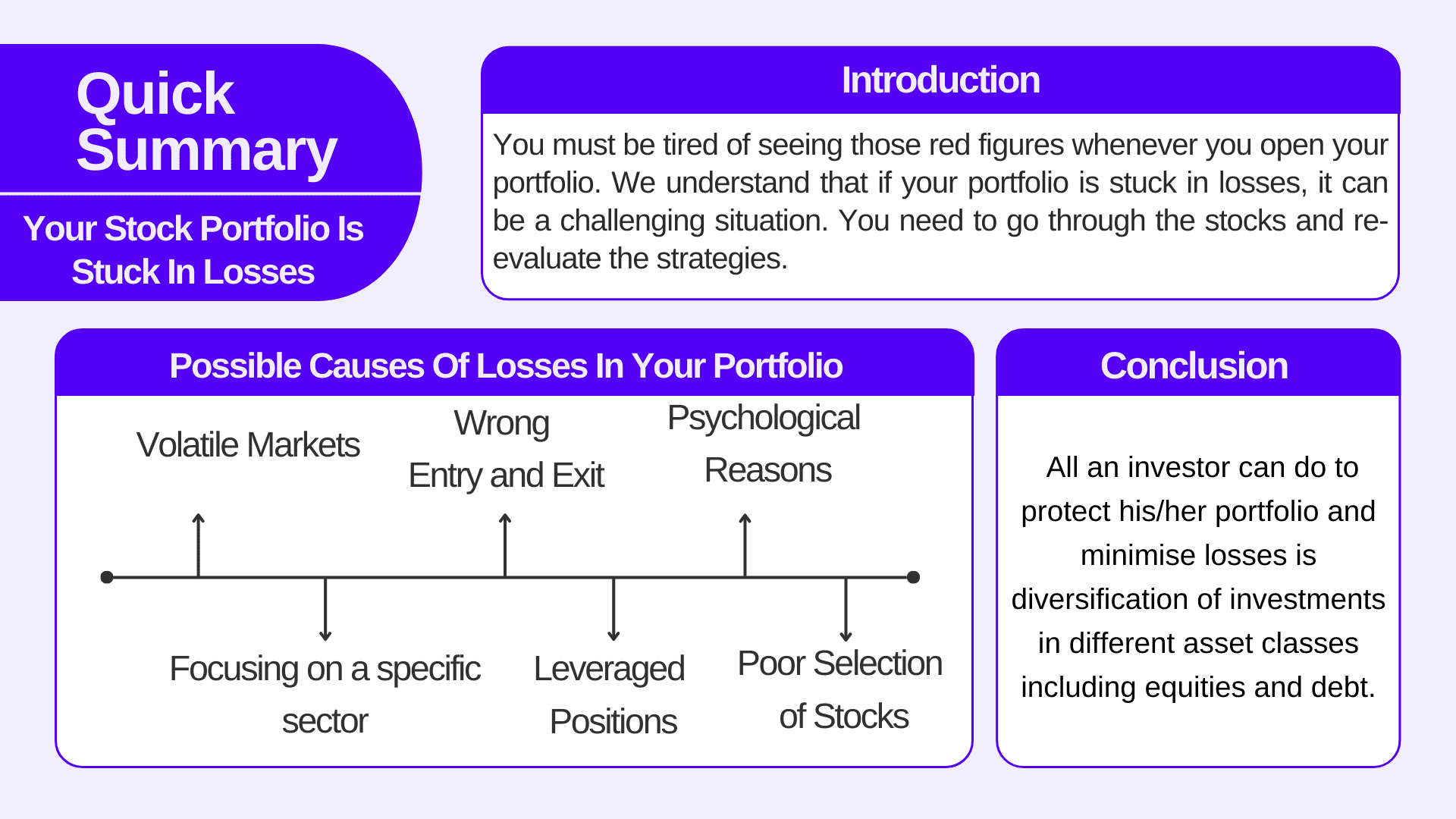
    You must be tired of seeing those red figures whenever you open your portfolio. We understand that if your portfolio is stuck in losses, it can be a challenging situation. You need to go through the stocks and re-evaluate the strategies. It is necessary to analyse your portfolio with a level-headed mindset and consider different factors before reaching any decision. You need not worry because we got you covered and in today’s blog, we will be exploring key steps to help you navigate the losses and work towards a more strategic approach.

    Possible causes of losses in your portfolio

    Possible causes of losses in your portfolio

    Below listed are some of the causes that can land you in losses.

    1. Volatile Markets
    2. Focusing on a specific sector
    3. Wrong Entry and Exit
    4. Leveraged Positions
    5. Psychological Reasons
    6. Poor Selection of Stocks

    Let’s understand above mentioned reasons in depth:

    Volatile Markets

    Stock market fluctuations are normal and any sort of volatility in the short-term can lead to unrealised losses. Economic uncertainties like global economic conditions and geo-political events can contribute to volatility in the market. Therefore, if you are a short-term investor you need to be careful about the economic activities and global events.

    Focus on a specific sector

    Warren Buffet once said, “Do not keep all your eggs in one basket”. Hence, concentrating on one sector can expose your portfolio to sector-specific risks. Any kind of challenge in that particular sector can impact the performance of the stocks of that particular sector.

    Wrong Entry and Exit

    A lack of technical analysis and bad trading decisions can lead to poor timing of entry in the market. Buying stocks when they are at their highs can affect the overall performance of your portfolio.

    Leveraged positions

    If you do margin trading chances are likely that you will end up amplifying your losses because any kind of trend reversal in the market can worsen your situation and you will be forced to liquidate your portfolio at unfavourable prices.

    Psychological Reasons

    Herd mentalities won’t work when trading in the stock market. If you are someone who frequently invests or trades on tips and bets on random stocks you will lose all your capital because people can have different financial goals and risk appetite.

    Poor selection of stocks

    It is important to analyse any stock technically and fundamentally before investing. Without proper study, stock selection can be tough and can impact your portfolio.

    Read Also: 10 Top Investors In India And Their Portfolios

    How to deal with red portfolio

    how to recover losses

    Let’s discuss the ways through which you can manage the losses and turn your portfolio into green.

    Revaluation

    Analyse the reason you initially invested in the losing stock. Are there any kind of fundamental changes since then? We say that candlestick charts are astrological graphs of any stock. Go through these charts and try to know the current trend of that stock. The initial reason for investment should still align with your long-term investment goals. If you find anything fishy then consider exiting the stock.

    Long-term perspective

    If you are a long-run investor and revisit your portfolio every now and then, it may lead to disappointments because those red figures might bother you. As company goes through several phases, it might be the case that your stock is in red now because of temporary reasons. If company’s philosophy is aligned and management is good then stocks often generate good returns to Investors but yes that takes patience. Since patience is the key to successful investing in the stock market you need to wait for the stock to recover from the losses.

    Some wise person once said “Checking your portfolio daily is like putting up a web-cam in the forest to see if the trees are growing.”

    Portfolio-review

    Review your portfolio periodically say once every quarter and keep a check on your investment strategies. Consider rebalancing your portfolio quarterly, half-yearly or annually according to your current financial situation and market conditions.

    Follow Stop-loss

    Strict stop-loss is a prudent decision. Learn to respect the stop loss. If there is a sudden fall in the margin or ratios of the stock, consider selling and reallocating the funds. Stop loss is designed to limit an investor’s loss in a position. There is no point of staying investing in a stock that has underperformed over the years and is no longer giving you returns.

    Invest practically and not emotionally.

    Risk-Appetite

    Reassess your risk tolerance. If the losses are causing significant stress or anxiety, it may be an indication that your risk tolerance needs adjustment. Your portfolio should match your comfort level and your goal of investments.

    Diversification

    Do not concentrate your investment amount on an individual stock or in stocks of the same sector. Diversify your portfolio in order to reduce stock specific and sector specific risks. This can help you in mitigating the losses because not all the stocks in your portfolio will give you losses.

    Exit your mistakes in Bull Market

    Go through the overall market trends including the global economy. Sometimes market gives golden opportunities to investors to exit their mistakes, as in Bull run, most of the stocks do well irrespective of their fundamentals.

    “No stock in an uptrend has ever gone bankrupt.” – Walter Deemer

    Advice from professionals and experience.

    If you are a newbie, you must understand the fact that a journey in the stock market is a roller coaster ride. If you are not able to navigate your losses and diversify your portfolio, go for professional advice. An experienced person can give market insights and help you make investment decisions as per your risk and financial goals

    Invest at regular intervals

    One of the best ways to avoid losses and reduce the risk is regular investment. We have already discussed about selling the investments if they are not generating returns, but we also want to make you aware of the art of averaging the stocks. Falling markets give us losses and we all know this. But instead of panic selling, you can choose take benefit of downtrend and average the stock if it’s fundamentally strong.

    Also, check out the blog on ATR.

    Note: Averaging of stocks is defined as buying more shares of that stock over time to lower the average buy price of the stock provided the price of the share is trading below your initial buy price.

    Conclusion

    conclusion

    It is important to be mindful of your investments because there is no guaranteed technique to escape losses in the stock market. All an investor can do to protect his/her portfolio and minimise losses is diversification of investments in different asset classes including equities and debt. You should know that only an optimistic approach will work well with your developed strategies throughout your investment journey. The stock market inherently carries risk and it’s unavoidable. Any investor should make decisions based on his/her own rationale. You just need to be consistent and patient and the market will surely reward you with profits.

    The decision is tough but will be worth it!

    Frequently Asked Questions (FAQs)

    1. If your portfolio is stuck in losses what should be the first step?

      The first step should be analysing the reasons for the losses – It can be either stock specific (e.g. Yes Bank) or market specific (e.g. Covid-19). Force selling in a market specific scenario is not ideal.


    2. Should an investor consider selling stock immediately once the portfolio turns red?

      No, by doing so s/he will be selling the stocks in a panic state. Sit back and analyze the technical and fundamentals of the stock. Always take the decision with a clear mind.

    3. How can diversification help you minimise your risk?

      Diversifying your portfolio can help you in eliminating the stock specific or sector specific risks.

    4. Can professional advice help you reduce losses?

      Yes, professionals can help you making an informed decision.

    5. How to control emotions when trading in the stock market?

      When trading in the stock market you should be disciplined. Further, educate yourself so that you can make better investment decisions and formulate profitable strategies. Always remember that Emotional biases are easier to understand but difficult to overcome.

  • How Interest Rate Changes Affect the Stock Market

    How Interest Rate Changes Affect the Stock Market

    What is Interest Rate?

    Interest rate is defined as the price that you pay when you borrow money from someone or it can also be known as income that you earn on your investments like bonds, FDs, and government securities. We will talk about interest rates in the context of lending and borrowing money. Interest rates in India are managed and regulated by RBI and play an important role in the economic growth of a country.

    How Interest Rate Changes Affect The Stock Market

    RBI manages various types of interest rates. Let’s have a glimpse at these rates.

    1. Repo Rate
      The rate at which the RBI lends money to commercial banks. Any kind of change in repo rate can affect the cost of borrowing for banks as well as retail consumers. The repo rate is considered a key tool to control inflation and stimulate economic growth.
    2. Reverse Repo rate
      The rate at which RBI borrows money from commercial banks. This rate is comparatively lower than the repo rate.
    3. Cash Reserve Ratio
      CRR, or cash reserve ratio, is the amount that commercial banks need to maintain with RBI in the form of cash. Banks do not receive any kind of interest on this from RBI.
    4. Statutory Liquid Ratio
      SLR is the minimum amount in percentage that a bank needs to keep either liquid or as investments in government securities.

    The RBI uses these interest rates and tools to manage monetary policy, control inflation, and maintain financial stability. Our major focus today will be on the repo rate and how even a slight change can have wide-ranging effects on the broader economy.

    Why interest rates are changed?

    why interst rate changes

    RBI changes these repo rates as a part of its monetary policy so that it can achieve its financial objectives. Now, what is monetary policy? Policy framed by the RBI to control and manage the supply of money in the economy. Monetary policy can either be contractionary or expansionary. When the money supply is increased and interest rates are reduced. This is known as the expansionary monetary policy. The vice-versa is known as the contractionary monetary policy. Coming back to our topic RBI changes the repo rate because of the following reasons,

    1. To control inflation in the economy.
    2. To focus on the economic growth of the economy.
    3. Situations prevailing in the global economy

    The decisions related to the repo rate are made during the RBI’s monetary policy meetings, which occur at regular intervals. Before moving further, we will give you some basic idea about the concept of inflation and deflation. Inflation is the general increase in the price level of goods and services in an economy. Consumers tend to pay more than the actual value of the good. The purchasing power of consumers decreases. In such a case under the monetary policy, the government of India increases the interest rate to fight inflation. This will decrease the flow of money in the economy.

    Deflation is the opposite concept of inflation. A general decrease in the price level of goods and services is called deflation. The purchasing power of the consumer is increased. RBI, in this situation, will lower the interest rate in order to increase the flow of money in the economy. We all know that the stock market of any economy is a true indicator that signals the pace of economic growth. So, we need to analyze the fact of how a change in repo rate can impact the markets.

    Read Also: How to Start Stock Market Trading With Low or Limited Capital

    Impact of rate change on the Indian stock market.

    The impact depends on the direction and magnitude of the interest rate changes, as well as the broader economic context.

    Interest rates can be changed in two ways

    • Interest rate hikes
    • Interest rate cuts

    When it comes to interest rate hikes, the cost of borrowing money increases which will make it difficult for the companies to avail loans and this will eventually reduce the profitability of the businesses. This will lead to lower earnings of the companies and decreased prices of the stock.

    Any sort of increase in the rate of interest can make other investment options more attractive. From the consumer’s point of view, there can be a significant change in his spending habits since there we be lesser disposable income in his hand thereby affecting his savings and investments. Interest Rate cuts, on the opposite side, lead to a decline in the cost of borrowing making it easier for the investor to grow which will lead to higher earnings and higher stock growth.

    The immediate impact of interest rate changes on the stock market may vary. Short-term interest rate changes might lead to short-term stock market volatility, while long-term rate trends can have a more lasting effect on the stock market.

    Impact of change in rate by the US Federal Reserve on the Indian stock market

    Impact of interest rate change

    Federal Reserve, since we all know is the central bank of the United States, can either increase or decrease the interest rate depending on the situation and needs of the economy. A change in the rate of the U.S. Federal Reserve affects the economy globally. The relationship between the actions of the Fed and the Indian stock market is influenced by several factors. Some of these factors are listed below.

    1.  If the Fed increases the rate of interest, foreign investors will find the U.S. markets more lucrative to invest in. They will withdraw their funds from the Indian stock market and deploy it in the U.S. so that they can enjoy higher returns.
    2. A slight change in the rate of interest by the Fed can have a significant impact on the exchange rates of currency. If the interest rate increases the U.S. dollar will strengthen and the Indian rupee will weaken.
    3. If U.S. rates rise substantially, it may lead to higher interest costs for Indian companies that have borrowed in U.S. dollars or have exposure to foreign currency debt.

    Read Also: Impact of Interest Rate Change on Financial Markets

    Conclusion

    To conclude interest rate and stock market share an inverse relationship. If you wish to receive consistent returns investing for a longer horizon is suggested. These short-term stances of rate change will create many complications. However, an investor should be well aware of the consequences of the rate change on the market so that he can make informed decisions. They should adopt a diversified investment strategy and take into account their own financial goals, and risk tolerance.

    S.NO.Check Out These Interesting Posts You Might Enjoy!
    1Mutual Fund vs PMS: Which is Better?
    210+ Best Investment Plan for Monthly Income in India
    3Hybrid Mutual Funds – Definition, Types and Taxation
    4What is an Open-Ended Mutual Fund & How to Invest in it?
    5Mutual Fund vs ETF. Are They Same Or Different?
    6Mutual Funds vs Direct Investing: Differences, Pros, Cons, and Suitability
    7How Interest Rates Impact Mutual Funds in India

    Frequently Answered Questions (FAQs)

    1. How does interest rate affect bond prices?

      Bond prices and interest rates have inverse relationships i.e., when the central bank increases the interest rates, bond prices decrease, and vice versa.

    2. Do all stocks react to interest rate changes in a similar way?

      No, stocks across sectors react differently to interest rate changes.  

    3. Who regulates and manages the interest rate in the stock market?

      Reserve Bank of India controls and manages the interest rates.

    4. Why does RBI increase the interest rate?

      RBI increases the interest rates in order to control inflation and for the overall growth of the economy.

    5. What happens to borrowing costs when RBI increases the interest rates?

      Borrowing cost for the companies increases if RBI increases the rates.

  • Which is Better: Fixed Deposit or Residential Property Investment

    Which is Better: Fixed Deposit or Residential Property Investment

    Fixed Deposit or Residential Property Investment

    What is Real Estate?

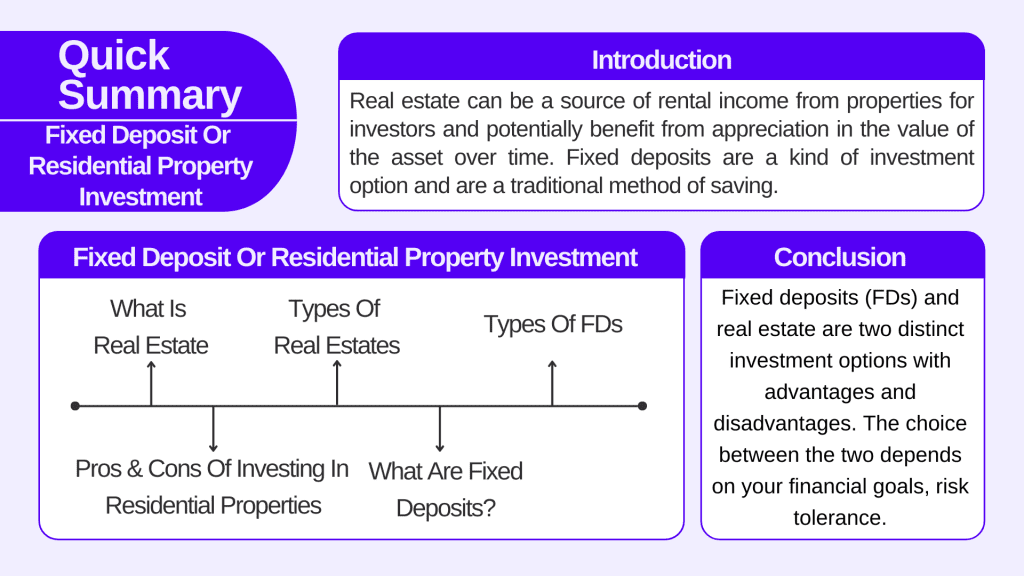
    Real Estate is considered as a long-term investment option. It is a kind of risky investment when compared to fixed deposits. Despite fluctuations in the prices of the property over the years, real estate carries great potential to appreciate your invested capital. It’s a broad and diverse asset class that encompasses various types of properties, ranging from residential homes and commercial buildings to undeveloped land and industrial facilities. Real estate is crucial in many aspects of our lives and the economy. Real Estate means a tangible property, including land and buildings.

    Real estate can be a source of rental income from properties for investors and potentially benefit from appreciation in the value of the asset over time. Real estate investment trusts (REITs) allow individuals to invest in real estate without owning physical properties directly. REITs are a source of indirect investment in Real Estate. Location is often considered one of the most critical factors that affect property values in the case of real estate.

    Types of Real Estates

    There are various types of real estate which you should be aware about

    • Residential
    • Commercial.
    • Industrial
    • Land
    • Special Purpose

    Let us go through each of them in detail.

    • Residential Real Estate
      Any property or area used for residential purposes, i.e., for living, e.g., Individual houses, apartments, etc.
    • Commercial Real Estate
      Properties used to carry out a business like office buildings, hotels, etc.
    • Industrial Real Estate
      This real estate comprises property used for manufacturing, production, storage, and distribution.
    • Land Real-Estate
      Any area that is vacant, raw, and underdeveloped that can be bought and sold is called Land real estate.
    • Special-purpose Real Estate
      Religious places like temples, schools, libraries, etc, serve a special purpose for the general public.

    After having an overview of the concept of real estate, in today’s blog, we will be analyzing closely the difference between residential property,  which is a type of real estate, and FDs as an investment option. Investment in residential properties involves buying houses, flats, or any kind of residential unit that can provide you with rental income. Though these properties are a good investment option, you should plan and do proper research before investing. Residential properties are a long-term investment option if you want a capital appreciation, and you should also have an exit strategy. Consider factors like when you might sell the property, how you’ll handle market downturns, and whether you’ll reinvest the proceeds. Consulting with a professional who deals in residential properties and financial advisors can be valuable and useful in the investment process.

    Real Also: Top Real Estate Stocks In India

    Pros of investing in Residential properties

    1. Generation of high returns over the long term.
    2. A significant increase in the invested capital.
    3. Rental income can also be a source of primary or alternative income after retirement.
    4. Real estate investment can provide investors with tax advantages, such as deductions for mortgage interest, property taxes, and depreciation. 

    Cons of Investing in Residential Properties

    • Initially, it would be best to have a lot of money when choosing residential properties as an investment option.
    • Lack of liquidity is one of the major disadvantages when investing in real estate because you cannot sell the property immediately. Certain legal procedures are followed while selling, which can be time-consuming.
    • Maintenance costs can be very high, like property taxes, renovation costs, repairs, and insurance.
    • A decline in the real estate market will affect property values.

    What are Fixed Deposits?

    fixed deposit

    Fixed deposits are a kind of investment option and are a traditional method of saving. Fixed deposits are offered by banks and NBFCs (Non-Banking Financial Institutions). Investment in FDs is a safe option since it gives a fixed return over the years. FDs also offer tax benefits, such as deducting interest income up to Rs. 50,000 per year under Section 80TTA of the Income Tax Act, 1961. FDs are a low-risk investment option with a fixed interest rate, which helps you preserve your capital. You can withdraw your capital whenever you want to, but after a lock-in period only. If capital is withdrawn before the maturity date, a certain penalty amount is charged.

    To invest in FDs, you just need to visit your nearest bank branch or apply online. The process takes a few minutes. Suppose you received an amount of Rs.20000 after winning a match, and instead of buying something expensive, you decided to go for a Fixed Deposit. Now, you will visit your nearest bank branch and deposit your money to earn some amount of interest and will just sit back for some years. You will reach out to the bank once again when your Fixed Deposit matures to get your principal amount as well as the interest that you have earned over the years.

    Types of FDs

    • Regular FDs
    • Cumulative FDs
    • Non-Cumulative FDs
    • Corporate FDs

    Let us explain each of them in detail.

    • Regular FDs
      FD, which offers you a fixed interest rate, and you get back your principal amount with interest at the time of maturity.
    • Cumulative FDs
      In the case of cumulative FDs, the investor gets a return in a lump sum at the time of maturity. Till then, the interest is accumulated and then added to your principal amount.
    • Non-Cumulative FDs
      Regarding non-cumulative FDs, interest is paid to the investor at regular intervals as he chooses.
    • Corporate FDs
      FDs are offered by private organizations and non-banking financial companies (NBFCs) that collect deposits for a fixed tenure and a pre-decided interest rate. The interest rate offered is high when compared to normal bank FDs.

    One of the major drawbacks that any investor can face while choosing FDs is that the investor won’t be getting the benefit of inflation-adjusted returns and can also get negative returns at times. How? Let us understand this with an example.

     Suppose your investment amount is 5 lakhs. Per the current interest rate (6.7%), interest received would be 33,500. If you lie in a tax slab of 30%, an amount of approximately 10,000 will be deducted from your interest amount, and you will receive a net amount of 23,000 as interest, which is 4.6% when expressed in percentage. Since current CPI, i.e., consumer price inflation, is 7.6%. So, the real interest received is 3% only.

    Now, let us come back to our better question. FDs or Residential Investments.

    Also, check out Fibonacci Retracement: Complete Guide On How To Use And Strategy.

    Conclusion

    conclusion

    Fixed deposits (FDs) and real estate are two distinct investment options with advantages and disadvantages. The choice between the two depends on your financial goals, risk tolerance, investment horizon, and circumstances. Choosing between both investment options can be a tough task. However, if you are willing to take on more risk to generate higher returns potentially, then real estate may be a better option for you.

    FAQ (Frequently Answered Questions)

    1. Which is the better investment option, Residential properties or FDs?

      Both investment options have their own merits and demerits. It would be best if you chose as per your financial goals.

    2. Are FDs tax-free?

      No, fixed deposits are not tax-free.

    3. What are cumulative fixed deposits?

      The investor gets a return in a lump sum at the time of maturity. Till then, the interest is accumulated and then added to your principal amount.

    4. Are FDs more risky than residential properties?

      No, FDs are less risky, whereas investments in residential properties are riskier.

    5. What kind of income can we earn from residential property?

      Rental income can be earned from residential property.

  • Why Debt Funds Are Better Than Fixed Deposits of Banks?

    Why Debt Funds Are Better Than Fixed Deposits of Banks?

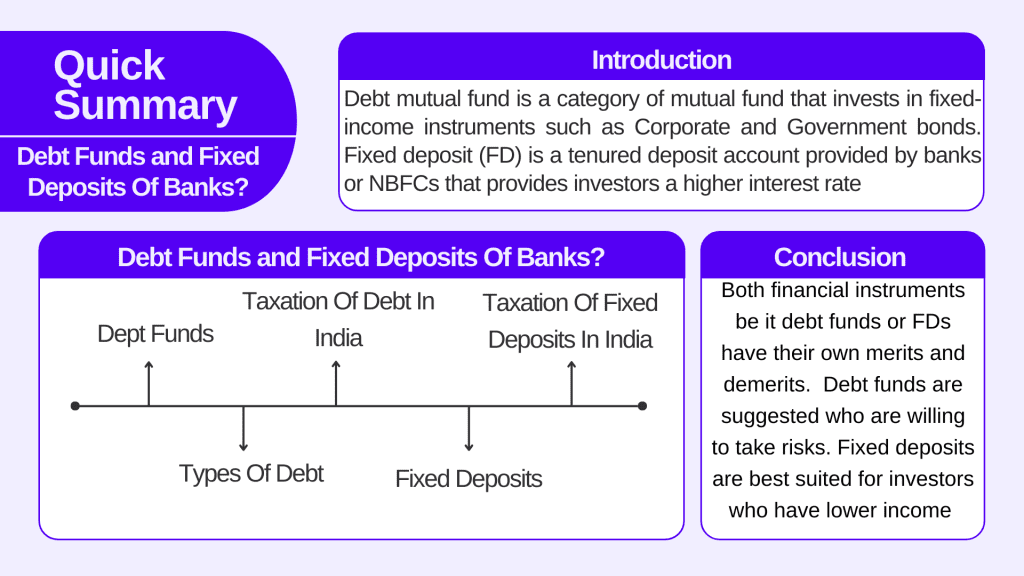
    Debt mutual fund is a category of mutual fund that invests in fixed-income instruments such as Corporate and Government bonds, commercial papers, treasury bills, state development bonds etc. The primary objective of debt mutual funds is to generate income for investors through interest payments while preserving the capital invested. Debt mutual funds diversify their holdings across various debt instruments to diversify the risk. This helps reduce the impact of poor performance by any single security. Debt mutual funds are open-ended funds, which means investors can buy or sell fund units on any business day at the fund’s net asset value (NAV). When considering debt mutual funds, it’s important to assess your investment goals, risk tolerance, and time horizon, and select funds that align with your financial objectives.

    Debt Funds and Fixed Deposits Of Banks

    Who should invest in Debt Funds?

    Who should invest in Debt Funds?

    Debt Funds are suggested for individuals who prefer capital preservation to higher returns because debt funds provide investors with consistent returns and are less volatile. Investors who want a regular income but are risk-averse i.e., they refrain from taking risks with their investments.

    Read Also: Debt Mutual Funds: Meaning, Types and Features

    How to invest in Debt funds

    How to invest in Debt funds

    You can invest in direct debt funds through Asset Management Companies (AMCs) and in the case of regular debt funds you need to contact mutual funds distributors (MFDs).

    Types of Debt Mutual Funds

    These categories of debt funds cater to different investor preferences and financial goals. 

    1. Liquid Funds

    Liquid funds invest in very short-term debt instruments like T-bills, Certificates of deposits, and commercial paper and have a maturity of 91 days to generate optimum returns.

    2. Short-term Funds

    These funds invest in money and debt market instruments and government securities. The investment duration of these funds is longer than that of Liquid Funds.

    3. Floating Rate Funds (FRFs)

    FRFs invest in instruments that offer a floating rate of interest on your investments in bonds, government securities and debentures.

    4. Gilt Funds

    Gilt in Gilt funds stands for government securities. This fund invests your capital in government securities that are issued by central and state governments. This fund offers you low credit risk and moderate returns.

    5. Dynamic Bond Funds

    These funds invest in debt securities that have a different maturity period

    and actively manage the fund’s interest rate risk. Returns vary based on market conditions.

    Above mentioned are some of the types of debt mutual funds. There are various other types which we shall discuss later.

    Taxation of Debt in India

    Taxation in debt is divided into 2 parts.

    Short-term gain and long-term gain where the duration of short-term is less than 3 years as per your income tax slab and for long-term it is more than 3 years at the rate of 20% with indexation benefit.

    (Indexation- means adjusting your purchase cost based on inflation)

    Now let us understand the concept of Fixed Deposits before jumping to any conclusion as to why to choose debt funds.

    What are fixed deposits?

    What are fixed deposits?

    Let’s make it easy, simplified and crisp with a short example.

    Suppose, you received a Diwali Bonus of Rs.50000 and instead of buying something expensive, you decided to go for a Fixed Deposit. Now you will visit your nearest bank branch and will deposit your money to earn some amount of interest and will just sit back for some years. You will reach out to the bank once again when your Fixed Deposit matures to get your principal amount as well as the interest that you have earned over the years.

    Therefore we can say that a fixed deposit (FD) is a tenured deposit account provided by banks or  NBFCs (Non-banking financial companies ) that provides investors a higher interest rate than a regular savings account, until the given maturity date. Investment in fixed deposits is considered a risk-free investment.   

    Merits of Investing in Fixed Deposit

    1.       Guaranteed Rate of Interest

    2.       Easy to Monitor

    3.       Tax Benefits

    4.       Loan Against FD

    5.       Flexible Period

    6.       Better option for senior citizens

    Taxation of Fixed Deposits in India (Example)

    Taxation of Fixed Deposits in India (Example)

    In India, the interest income earned from fixed deposits is subject to taxation under the Income Tax Act. Here’s a simplified example to explain how FD interest is taxed

    Suppose Mr A has a bank FD of Rs.1 lakh and as per the current rate he is earning an interest 6.5% per annum on his FD which amounts to 6500 (6.5% of 1 lakh). Now he is liable to pay tax on 6500 as per his income slab.

    After an in-depth analysis of debt funds and fixed deposits let us have an overview of why you should invest in debt funds and not in traditional saving methods like bank FDs.

    Read Also: A Guide To Fixed Deposits: Exploring Types And Interest Rates

    Why choose Debt Funds over Bank Fixed Deposits?

    1. The returns generated both on FDs and debt funds are fixed and assured but interest rates in debt funds can be repriced according to the movements in the markets. Portfolio rejig by the fund managers can also lead to fluctuations in returns of debt funds whereas when it comes to FDs, returns are fixed.
    2. In the case of FDs pre-mature withdrawals can lead to penalty whereas when it comes to debt funds only a minimal exit load is charged and that too only if withdrawal is done before the stipulated time period.  
    3. Bank FDs are generally considered risk-free or possess lower risk as they are insured to the extent of Rs 5 lakh for the principal and the interest by the Deposit Insurance and Credit Guarantee Corporation. Although Debt funds have more credit risk they offer higher yields unlike FDs and these funds are suggested for risk-averse investors.
    4. In bank FDs, at the time of investment, the rate of interest offered by banks depends on the tenure of the FD meanwhile in debt funds the fund manager uses his expertise to invest the capital into different papers or bonds according to the scheme objective which can lead to variation in returns generated per year.
    5. You can invest in Debt funds either through SIPs or in a lump sum. It entirely depends upon you whereas in the case of FDs, you can only invest in a lumpsum amount thereby making it difficult for the lower-income group to invest.

    Conclusion

    On parting ways, both financial instruments be it debt funds or FDs have their own set of merits and demerits. Depending upon the investors’ risk appetite debt funds are always suggested who are willing to take risks on their capital and are risk-averse. Unlike FDs, debt funds help the investor in the diversification of their portfolio and achieve their financial goals. Debt funds offer you more tax efficiency if your investment period is more than 3 years. Fixed deposits are best suited for investors who have lower income and have an investment horizon of less than 3 years otherwise debt funds are the best to opt for!

    FAQs (Frequently Asked Questions)

    1. What are Debt Funds?

      Debt mutual fund is a category of mutual fund that invests in fixed-income instruments such as Corporate and Government bonds, commercial papers, and treasury bills.

    2. Are debt mutual funds riskier than bank FDs?

      Yes, debt mutual funds are riskier as compared to bank FDs.

    3. Is debt fund good for the long term?

      If you have an investment horizon of more than 3 years and have a low-risk appetite, debt funds are a perfect investment option for you.

    4. Bank FDs or Debt, which provide better tax efficiency?

      Debt funds provide more tax efficiency.

    5. Does a debt fund provide a higher return than bank FDs?

      Yes, debt funds offer more returns than bank FDs.

  • Understanding the Difference Between Credit and Debt

    Understanding the Difference Between Credit and Debt

    Understanding the Difference Between Credit and Debt

    What is Debt?

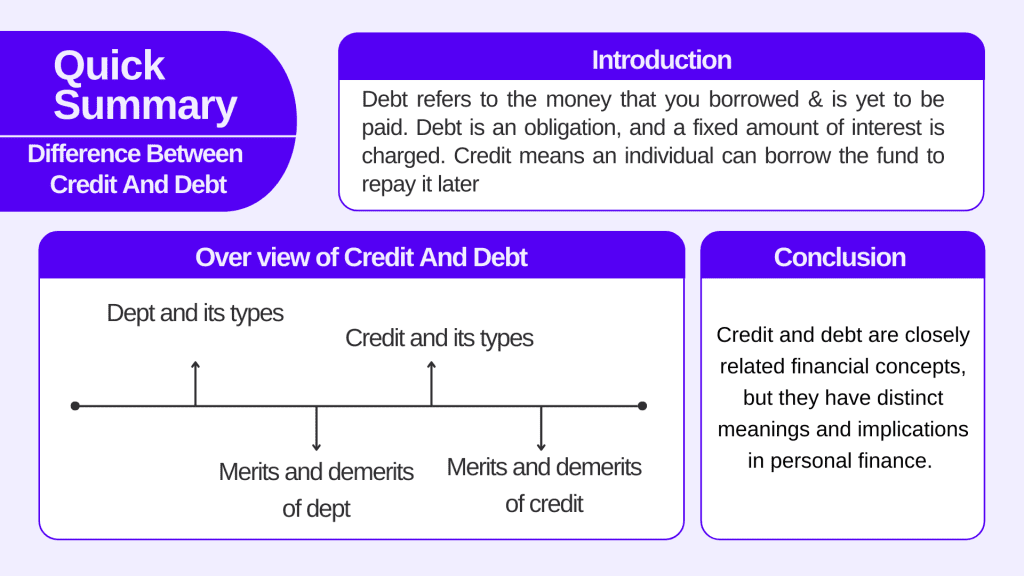
    Debt refers to the money that you borrowed & is yet to be paid. Debt is an obligation, and a fixed amount of interest is charged. It is suggested to avoid taking debts since later you may find it difficult to repay. Examples of debts are home loans, credit card bills, car loans, mortgages, personal loans, etc. Debt characterizes a financial burden.

    DEBT

    Types of Debt

    Debts can be categorized into the following types

    • Secured Debt
    • Unsecured Debt
    • Revolving Debt

    Let us go through each of the types in detail.

    Secured Debt

    Secured debts are backed by collateral such as assets, investments, or property. In this debt, if the borrower fails to repay the debt amount, the lenders seize the borrower’s collateral, and the debt is covered from the same.

    Unsecured Debt

    Unlike secured debts, unsecured debts are not covered by any collateral as security. These debts are granted to the borrower once the lender relies on him. The approval depends on the payment of the past debts. For example, education loans and automobile loans.

    Revolving Debt

    A debt that does not have a fixed payment amount every month is known as a revolving debt. The payment amount and interest rate depend upon the amount that you borrow. Once the borrower repays the existing debt amount, he can again borrow either the same or a different amount. It is like a line of credit. Credit card is an example of revolving debt.

    Merits Of Debt

    • Debt can help you achieve your financial goals by leveraging your current resources.
    • Debt can offer individuals, corporations, and governments immediate access to funds in case of emergency.
    • Paying your debts on time can help you improve your credit score.

    Demerits of Debt

    DISADVANTAGES
    • Borrowing money typically comes with interest costs. The interest payments can add up over time, making the overall cost of the debt higher than the initial borrowed amount.
    • Failing to make debt payments can lead to default, resulting in penalties, fees, and damage to credit score.
    • High debt can lead to anxiety and financial stress because monthly payments can be a burden.
    • Long-term debts can land you in a cash crunch, and your savings capacity will also be affected.
    • Debt can also lead to loss of collateral security that you must have given to the lender at the time of agreement.

    Having discussed the debt, let us understand the concept of credit.

    What is Credit?

    Credit means an individual can borrow the fund to repay it later. Let’s say that you have a credit limit of 2 lakhs and the amount that you used from this amount to 50 thousand; then 2 lakh is your credit, and 50 thousand is the amount you owe to the creditor. Creditors decide an individual’s eligibility for credit after analyzing their past debt repayments.

    CREDIT

    Read Also: Why Debt Funds Are Better Than Fixed Deposits of Banks?

    Types of Credit

    Credits can be majorly categorized into 3 types

    • Open credit
    • Revolving credit
    • Installment credit

    Open Credit

    Credits are like trade credits in which the goods can be exchanged between the buyer and the seller based on the buyer’s ability to repay it later on a pre-decided date.

    Revolving Credit

    Revolving credit allows borrowers to use credit continuously as long as they make minimum payments, including the interest charged.

    Instalment Credit

    When an amount is borrowed for a fixed period and fixed interest rate, you repay it monthly. EMIs (easy monthly installments) are an example of installment credit. Our readers should also know that when you pay your debt on time, you earn a credit score, which increases your creditworthiness.

    What is a Credit score?

    A credit score is several 3-digit, which lies somewhere between 300 to 850. The higher the credit score, the chances of you to avail a loan are more likely. A credit score of 700+ indicates that you make timely repayments of your debt amount. Some companies are known as credit rating agencies like CRISIL and ICRA that helps creditor generate a credit score.

    Merits of Credit

    Advanatges
    • Just like debt, credit also provides immediate access to the funds
    • Credit cards can offer the consumer financial flexibility or take advantage of time-sensitive opportunities.
    • Timely repayment of credit will help you secure your loans more easily and conveniently.

    Demerits of Credit

    DISADVANTAGES
    • Non-payment or late payments can lead to default and heavy interest expenses, reducing your credit score.
    • Credit availability can lead to overspending, as individuals may be tempted to make purchases they cannot afford.
    • If credit is used to cover recurring expenses and debt payments, it can lead to a cycle of increasing debt.
      Also, read the case study of Satyam Scam.

    Read Also: Credit Score: What Is It And How It Impacts You?

    Conclusion

    Credit and debt are closely related financial concepts, but they have distinct meanings and implications in personal finance. In summary, credit represents the ability to access resources or make purchases with the promise of future repayment. In contrast, debt represents the obligation to repay borrowed funds, goods, or services with interest, often over a specified period. Irresponsible use of credit can lead to debt accumulation, but not all credit usage necessarily results in debt if payments are made promptly.

    Frequently Answered Questions (FAQs)

    1. Are debt and credit the same?

      No debt and credit are not same.

    2. Name of credit rating agencies?

      CRISIL & ICRA are 2 credit rating agencies.

    3. Are home loans a debt or credit?

      Home loans are a kind of debt.

    4. Explain secured debt.

      Secured debts are backed by collateral such as assets, investments, or property if the borrower fails to repay the debt amount, the borrower’s collateral is seized by the lenders.

    5. Define Credit.

      Credit means an individual can borrow the fund to repay it later.

  • Why It Is Essential To Teach Your Children About Saving And Investing

    Why It Is Essential To Teach Your Children About Saving And Investing

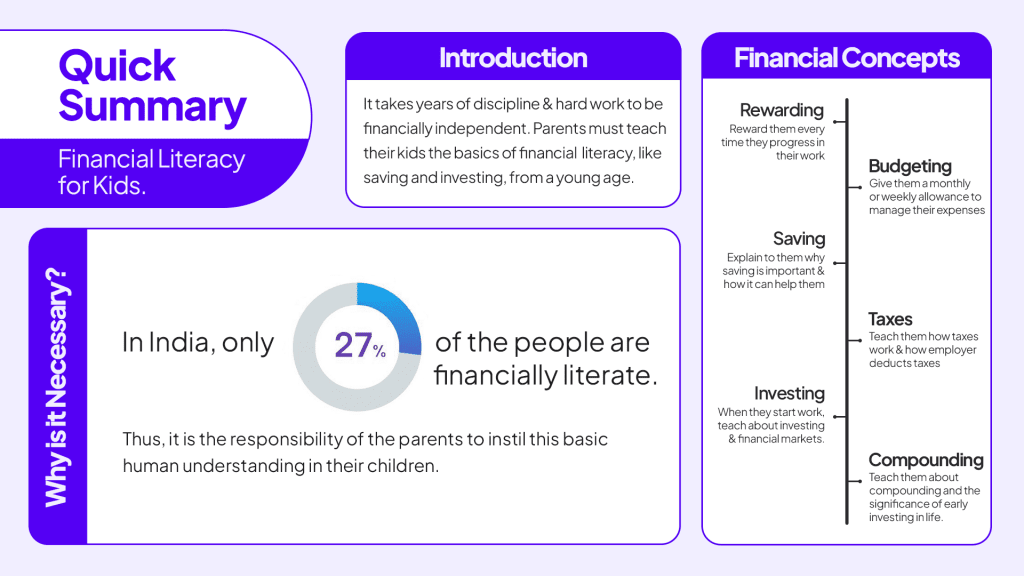
    According to the Pew Analyzed Census Bureau data, only 24% of adults are financially independent before age 22, to that of 32% in 1980. Most adults today complain that they were, never taught about financial independence in schools or at home. It is because of this reason, they struggled with their finances in the later years of life. Financial knowledge is not something that you can learn in one day, month or year. It takes years of discipline and hard work to be financially independent. Parents must teach their kids the basics of financial literacy, like saving and investing, from a young age. 

    Addressing the above problem. Today, we will discuss about the importance of teaching your children about saving and investing.

    Why Do We Need To Teach Financial Literacy To Our Kids?

    quick summary of the Need To Teach Financial Literacy To Our Kids

    Have you ever seen the construction of a building? Laying a strong foundation for the building is important, to make it last for years. Similarly, to achieve financial independence, it is necessary to give financial literacy to children from a young age. 

    But, what exactly is financial literacy?

    Financial literacy

    financial literacy

    Financial literacy is understanding the behaviour and working of money to make sound financial decisions like budgeting, asset building, loan financing and debt repayment. Having financial knowledge helps a person to feel empowered. Moreover, people with better financial education are less likely to be financially vulnerable in future. According to research in India, only 27% of the people are financially literate. It means only 1 out of 5 Indians are capable of making their crucial money decisions by themselves. The numbers are bizarre because dealing with money is one of the most customary aspects of human well-being. 

    Thus, it is the responsibility of the parents to instil this basic human understanding in their children. 

    Why Build a Strong Financial Foundation?

    • To build a strong financial foundation, children should be made familiar with basic concepts like saving and investing from a young age. 
    • Saving is that part of your income that is left, after spending upon your consumption. Any person who has just started earning spends a prominent chunk of their income on consumption and saves little to no amount. 
    • But, as they grow professionally, they start saving more for their future & the people dependent on them. Saving helps to build a cushion to rely on during uncertain times.
    • Investing is putting your money to work. Heard this famous quote, “Rich doesn’t work for Money, Money works for them” Weird right? But true.
    •  By putting your money into Assets, you can make your money work for you even when you are not working. For example, investing in real estate could earn you a rental income and give you capital appreciation in the long run.

    Parents should focus on securing their children’s future financially but also focus on building and developing their characters. So that, in case of future uncertainties, they can fight through. 

    Preparing for Future Financial Challenges

    The majority of the people feel anxious when asked about their financial situations. As we grew, we realised that we weren’t ever, taught about financial education in our schools or colleges on which we’re supposed to make real-life decisions. How many of you have learned about finances in your schools or colleges? 

    I could confidently say that none. Our educational curriculum was never designed in a way to help us with our day-to-day problems. Most adults even today, don’t even know that there are options other than FD and mutual funds to invest in the markets. 

    Providing your children with early financial knowledge could help them to have a better future. 

    Introducing Financial Concepts to Children As They Grow

    First, introduce them to the notion of money at a young age. Its importance, how it works, why it is necessary & other things related to it

    • Rewarding- Reward them every time they progress in their work, like for every book they read. Give them a certain amount of money as a reward or when they complete their homework on time.
    Rewarding
    • Budgeting- Give them a monthly or weekly allowance and tell them to manage their expenses in that fixed amount. Explain how they should allocate their money towards their needs, wants and savings. 
    Budgeting
    • Savings- explain to your kids why saving is important and how it can help them. Encourage them to Save a portion of their allowances or paychecks (when they start working). 
    savings
    • Taxes- When they grew a little old and started doing part-time work. Teach them how taxes work and how employer deducts taxes from their paycheck. 
    taxes
    • Investing- When they start to work, teach them about investing and financial markets. Explain to them how they should build assets. 
    investing
    • Compounding- Teach them about compounding and the significance of early investing in life. Financial literacy is something that everyone should learn about. No matter your profession or field of interest, money is something that we all deal with daily. 
    compounding

    Therefore, every person needs to be financially independent & financially literate in life because life is very uncertain. 

    Conclusion 

    If you are a parent or a guardian to any child, now you know why you must teach them about finances. No parent wants to see their child. Therefore, they must teach kids about money, which they were never taught about by their parents. It is easy to instil good habits in children at a young age as they are growing. Apart from just giving financial learning, parents should also start to save and invest early to give their children a more secure future. 

    FAQs (Frequently Asked Questions)

    1. Why financial literacy is necessary?

      Financial literacy is necessary to make sound financial decisions in life. Money is something that we all deal with on a day-to-day basis.

    2. How to improve financial literacy?

      To improve financial literacy you can read finance books like ‘Rich Dad, Poor Dad, ‘Think and Grow Rich’, ‘And Intelligent Investor’ to learn about the stock market. 

    3. Why financial literacy is essential for students?

      Financial literacy is essential for students as it helps them understand how to make real-life money-related decisions once they start earning.

    4. Is it necessary for children to learn how to wisely spend their money?

      Yes, children need to learn to wisely spend their money.

    5. How to explain investing to a beginner?

      You can learn investing by understanding the basic technical jargon like return, risk, portfolio etc. After that, you consume content from different sources like books, online platforms & courses. 

  • What are ETFs? Are ETFs good for beginner investors?

    What are ETFs? Are ETFs good for beginner investors?

    Recently, Exchange Traded Funds abbreviated as ETFs have gained popularity among investors. For the various benefits they offer. ETFs are a good investment option for beginner investors as they offer a collection of stocks with similar characteristics in one place. Investing in ETFs enables investors to have a diversified portfolio without doing research for individual stocks. ETF helps to minimise the risk of the investor & maximise his return on his portfolio.
    By the time you finish reading this article. You will have a clear idea of whether you should invest in ETFs or not.

    quick summary of ETF

    What are ETFs or Exchange- Traded Funds?

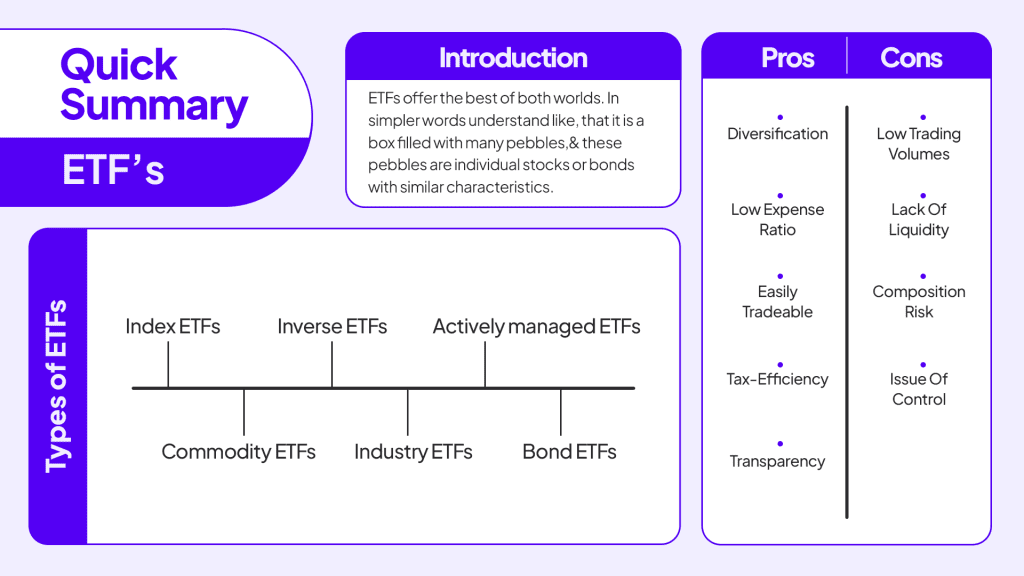
    In simpler words understand like, that it is a box filled with many pebbles,& these pebbles are individual stocks or bonds with similar characteristics. An interesting fact is that specific ETFs track the movement of indices like NIFTY50, SENSEX, etc. So, you expect the same returns on your investment as the index’s annual CAGR.

    Exchnage Traded Funds

    Looking into the history of ETFs in India, we see that. The first ETF in India was launched in 2002 by Nippon India Mutual Fund (erstwhile Benchmark Asset Management Company Ltd). Listed on January 8th 2002, it witnessed a trading of 1.30 crores on the first day. The journey to listing of the 100th ETF on NSE took more than 19 years. The last one-year period has seen a lot of activity in the ETF space, with 21 ETFs getting listed on the NSE. The assets under management of ETFs in India are now at Rs. 3.16 lakh crores (end of May 2021), witnessing more than 13.8 times increase in five years,  compared to Rs. 23,000 crores (end of April 2016).

    ETFs offer the best of both worlds, like Mutual Funds, ETFs represent professionally managed collections or baskets of stocks or bonds. And just like individual stocks, they trade on the stock exchanges, which means you can buy and sell them like individual stocks.

    Types of ETFs in India

    There are different types of exchange-traded funds (ETFs) available in India, offering investors a variety of options to choose from according to their financial goals and risk tolerance.

    • Equity ETFs : Equity ETFs track stock market indices such as Nifty 50, Sensex, or Nifty Next 50. They provide investors with broad market exposure and are suitable for the long term. 
    • Debt ETFs : Debt ETFs invest in government or corporate bonds, such as Bharat Bond ETFs. These are known for stable income and low risk and are suitable for retirement or capital preservation. Investments in them can generate regular interest income.
    • Gold ETFs : Gold ETFs track gold prices and give investors an opportunity to invest in gold without buying physical gold. They are suitable for inflation protection and portfolio diversification.
    • International ETFs : International ETFs track stocks or indexes from foreign markets such as the US, China, etc. They offer global diversification and the opportunity to invest in foreign markets but also carry certain risks.
    • Smart Beta ETFs : Smart Beta ETFs move away from traditional index tracking and focus on tracking smart beta indices focused on value, growth, etc. They provide investors with an opportunity to earn better risk-adjusted returns.

    Investors should consider their investment goals, risk tolerance, and time horizon when choosing among these different types of ETFs. Choosing the right ETF can improve portfolio performance and help achieve financial goals.

    What are the pros of investing in ETF?

    Investing in ETF has several benefits, some of which are listed below.

    1. Diversification:

    ETFs enable the investor to diversify their portfolio without the hassle of individually picking out each stock. Investors seeking to invest in a specific type of sector or industry. ETFs are a go-to option for people who do not want to spend their time researching each company individually. They cover most of the asset classes and sectors for the most part.

    2. Low expense ratio:

    The expense ratio is the operating expense of the Security, divided by the value of that security. In other words, it is the expense that the investor has to bear for the Security. An expense ratio below 1 is good. And ETFs offer an expense ratio below 1.

    3. Easily tradeable:

    Investors can trade ETFs just like individual stocks, which makes them highly liquid, meaning you can sell and buy them anytime during market hours.

    4. Tax-efficiency:

    Due to its low turnover, ETF offers tax relief to investors. The investors are charged 15% on short-term equity gains. And 10% on long-term equity hains after the exemption of the first 1 lakh rupees.

    5. Transparency:

    ETFs typically have the same securities as the index or the benchmark they track. Some ETFs disclose their holdings regularly, while others disclose them on a monthly, or quarterly basis.

    What are the cons of investing in ETFs?

    Investing in ETF has several disadvantages, some of which are listed below.

    1. Low trading volumes:

    Even though ETFs have become popular lately, their trading volume is considerably low compared to the other securities listed. Volume is the total buying and selling of a specific security over the trading exchange.

    2. Lack of liquidity:

    Due to low trading volume, sometimes it becomes hard to sell the ETFs because there is no one willing in the market to buy them at the price you are offering at that time. Therefore, ETFs are not the most liquid asset to hold.

    3. Composition risk:

    Since ETFs are already tailored-made investment options. Sometimes, they may have some securities in the group that you do not want to hold. Therefore, you do not have a choice for customisation.

    4. Issue of control:

    ETFs offer less control as the investor does not choose the securities in the ETF by his own will. Also, the portfolio manager swaps or churns the portfolio depending on his expertise.

    ETFs vs. Stocks vs. Mutual Funds: Which is Better?

    Before starting to invest, it’s important to understand the difference between ETFs, stocks, and mutual funds and which option is suitable for whom.

    FeatureETF (Exchange Traded Fund)StocksMutual Funds
    RiskModerate (Diversified portfolio)High (Investment in a single company)Low to High (Depends on type of fund)
    ReturnsIndex-based, relatively stableCan be very high or very lowDepends on fund manager’s performance
    CostLow (Lower expense ratio)Brokerage chargesSlightly higher (Includes fund management fee)
    LiquidityHigh (Traded throughout the day)HighLower (Redeemed at NAV, once daily)
    DiversificationYes (Index-based spread across many stocks)No (Single stock exposure)Yes (Diversified portfolio by fund manager)
    ManagementPassive (Tracks an index, no active manager)Self-managed (Investor makes decisions)Actively managed (By professional managers)
    OwnershipIndirect (Holds a basket of underlying assets)Direct (Ownership of shares in a company)Indirect (Units of pooled fund investments)
    • ETFs are a better choice for those who want low costs and good diversification and are comfortable trading on their own.
    • Stocks are suitable for active traders and high risk takers. 
    • Mutual funds are for investors who like the convenience of professional management and prefer regular SIPs.

    Points to keep in mind before investing in ETFs

    • First, determine the assets, in which you want to invest. Choose the best possible ETF according to your risk appetite and availability of funds.
    • Go for those ETFs that offer a low expense ratio. So, you can save on your operating costs.
    • Invest in ETFs with high liquidity so you can sell them without any hassle whenever you want. Otherwise, it would be a hectic task.
    • Check the ETF disclosure reports to ensure that your financial goals align with the objectives of that particular ETF.
    • Lastly, regularly check the performance of the ETFs and take the required measures according.

    Read Also: What is Nifty BeES ETF? Features, Benefits & How to Invest?

    Conclusion

    From the above article, we can conclude that, as a beginner investor, ETFs could be an adequate option to start your investing journey. Keep in mind that everything has pros and cons & the same applies to ETFs. Keeping a check on a few things and investing with patience and discipline can yield lofty returns for investors.

    S.NO.Check Out These Interesting Posts You Might Enjoy!
    1Mutual Fund vs ETF. Are They Same Or Different?
    2Best ETFs in India to Invest
    3ETF vs Stock – Which One is the Better Investment Option?
    4Gold ETF vs Gold Mutual Fund: Differences and Similarities
    5ETF vs Index Fund: Key Differences You Must Know

    FAQs (Frequently Asked Questions)

    1. What are ETFs in the stock market?

      ETFs or exchange-traded funds are financial securities that resemble the characteristics of both Mutual Funds and Stocks. In simpler words, a collection of different stocks to track the performance of a specified index.

    2. How do ETFs work?

      ETFs are like common stocks on the stock exchanges. They track the movement of the underlying asset and perform accordingly.

    3. What are the types of ETFs?

      Different types of ETFs are present in the market like index ETFs, sector ETFs, and commodity ETFs.

    4. Which are the best-performing ETFs in India?

      Kotak PSU Bank ETF, CPSE Exchange Traded Fund, UTI S&P BSE Sensex ETFETF are the top-performing ETF funds for the past year.

    5. What are CPSE ETFs?

      CPSE ETF (Central Public Sector Enterprises Exchange-Traded Fund). An investment instrument that allows you to invest in Central Government public sector enterprise.

  • Top 10 personal finance lessons for self-learning

    Top 10 personal finance lessons for self-learning

    In a world where money navigates the flow of your life, it is very important to learn about Personal Finance. This article is not only for young individuals who have just started earning but for every person who wants to take charge of their financial decisions and future. We all know that our traditional education system does not teach us about the real financial world. For example, how to file your taxes, how to do retirement planning, what is a credit score, how credit cards work, and more. Once you enter the real world you have to decide on the things that you were never taught about. 

    Here are 10 personal finance lessons for self-learning –

    quick summary of top 10 personal finance rules.

    Read Also: P2P Lending: Definition, Benefits, And Limitations

    1. Setting up financial goals

    Having clarity about your financial aspiration Lays a strong foundation for your financial future setting up short-term and long-term goals helps to form a road map to achieve them. The financial goal varies from person to person depending on their situation. Setting up financial goals that are realistic, attainable, and measurable is very important.

    Some financial goals could be:

    • Buying a house in the next 10 years
    • Buying a car in the next two years

    2. Have a budget

    Pen down all your income and expenses on a piece of paper, and see where your money is going. Analyze how could you allocate your income in a better way, so that the utility derived from your income could be maximized. Try to eliminate necessary expenses, fix the budget for every expense and try to stick with it.

    3. Pay yourself first

    The first thing you should do when you get your paycheck is to pay yourself first. It means that you should keep a fixed amount aside every month for your future depending upon your financial aspirations. It is important to save for your future because we live in a world full of uncertainties, and believe it or not money may not be the most important thing in life but it affects everything that is.

    4. Start investing early

    Investing work on the principle of compounding. Interesting fact that Albert Einstein famously referred to compound interest as the 8th wonder of the world. Compounding is accumulating wealth by allowing returns to generate more returns amplifying the benefits of saving and investing. 

    Let’s try to understand the benefit of early investing through an example:

    Suppose Mr Sam is 30 years old and starts investing 25000 rupees Every month at the rate of 12% p.a. for the next 25 years.
    At the age of 55 years, the value of his investment would be 4,70,000 rupees.
    But, if Mr Sam had started investing just 5 years ago, i.e. when he was 25 years old then.
    At the same age of 55 years, the value of his investment would be roughly around 8,80,000 rupees.

     5. Automate your saving

    Saving your money is very important, if you save money in your good time your money will save you in your bad times. Set up automatic Transfer from your paycheck account to a separate savings account. Then slowly and gradually increase the amount you will be stunned to see how rapidly your savings will compound. Automating your savings gives you peace of mind because you know that you are building and saving your funds.

    6. Learn about credit cards

    Credit cards can be both a boon and a bane. It just depends on the person and how they use them. If you are someone who can pay their bills on time then believe it, credit cards are a blessing for you. 

    There are various advantages of using a credit card such as

    •  Helps in building credit history.
    •  Helps you in tracking your expenses.
    •  Used as an emergency fund.
    •  Comes with a lot of rewards.
    •  Convenient pay method.

    7. Retirement planning

    It is never too early to plan for your retirement since who doesn’t want a comfortable and hassle-free life in their Golden years? so it’s better to start planning for your retirement as soon as possible. First, create a retirement budget and figure out an amount that you think will be enough for you to have your desired lifestyle in your retirement age. Then look for retirement accounts like IRAs or retirement pension plans to start your savings, Apart from this you can also figure out different sources of generating passive sources of income.
    For example, invest in real estate by taking a loan from a Bank in your working year and then enjoy the rental income and capital appreciation in the following years.

    8. How taxes work

    Learn and have a fair understanding of how taxes work. Learn about Income Tax, wealth tax, rebates, deductions, and credit scores. Identify your tax slabs and understand how to file taxes. ITR is very important if you are looking forward to taking a loan. When you approach the bank for the same they ask you for your tax return filing. Apart from this the government also give various types of relief if you fulfil certain financial obligations. These reliefs can sometimes help you to save a lot of money while making big purchases.

    9. Lifestyle inflation

    Lifestyle inflation is a situation when a person starts spending more on their lifestyle than average because their income has increased. As your income grows it is normal to upgrade your lifestyle. But you should be mindful of where your money is going. It is important to distinguish between your needs and wants. However, being mindful of lifestyle inflation and saving a significant portion of increased income can accelerate your progress towards your financial goals.

    10. Kept learning

    Understand that learning is a continuous and never-ending process. Everyone at some point in their lives has taken wrong financial decisions. But it is okay because everybody makes mistakes. What matters is how much you have learned from those mistakes. Financial missteps are a part of the learning journey. Cherish your mistakes as learning opportunities. Analyze what went wrong and accordingly adjust your strategy.

    Conclusion

    Remember that learning about financial independence is a lifelong endeavour. Which takes time. Being disciplined and having patience over the longer term makes achieving your financial goals more easy. 
    So educate yourself, set your goals, and take productive steps to make your future financially secure. By doing so, you are not just saving your money but investing in a more fulfilling and secure future. 

    S.NO.Check Out These Interesting Posts You Might Enjoy!
    1China Plus One Strategy
    2Debentures: Meaning, Features, Types, Benefits and Risks
    3Explainer On Geopolitical Tensions
    4Intrinsic Value vs Book Value
    5What are Treasury Bills: Meaning, Benefits and How to Buy?
    6Best Education Loan in India
    7Best Car Loan Banks in India

    FAQs (Frequently Asked Questions)

    1. What is personal finance?

      Personal finance is the management of monetary resources in such a way that you can maximize its utility. And planning to spend your money in such a way that you can fulfil your present needs and also save for your future.

    2. How to save money wisely?

      To save your money wisely first identify where your money is going or where you are spending your money. Then distinguish between your needs and wants and accordingly cut your unnecessary expenses.

    3. What is the PYF rule?

      According to the PYF pay yourself first rule you first pay yourself out of your paycheck i.e. you keep an amount aside to invest or save for your future. By following this rule you are creating a safety cushion on which you can rely in your hard times.

  • How to find and identify undervalued stocks

    How to find and identify undervalued stocks

    Undervalued stocks are stocks that are trading at a lower price than their actual fair price. At times the stock price does not fairly represent the true worth of the company. Sometimes small companies get ignored by analysts who are experiencing increased sales and better profit margins and have undervalued share prices. Investors look forward to investing in undervalued stocks because the possibilities are very high that the price of these stocks will increase in future. But, the question that arises here is how to identify these undervalued stocks.

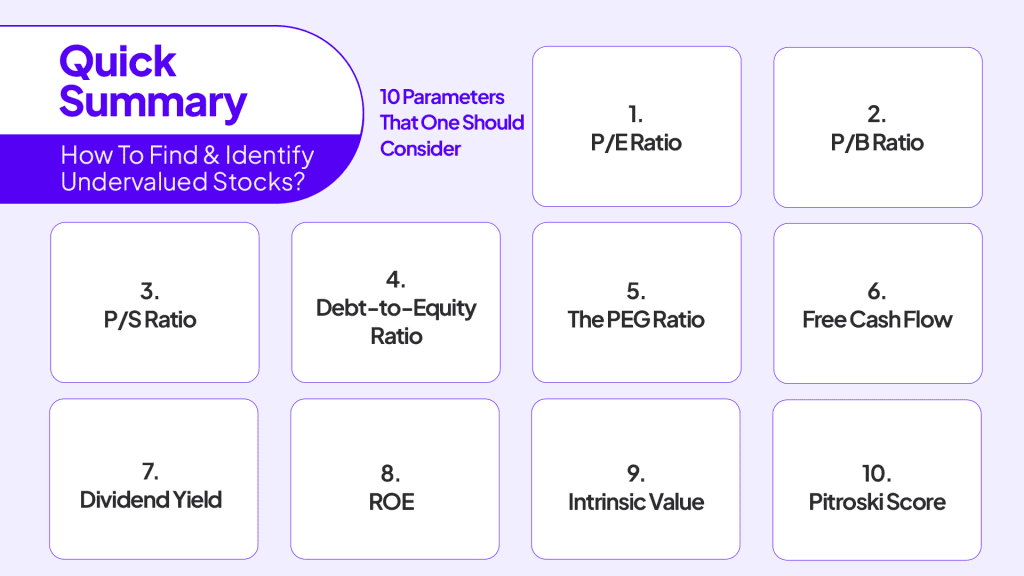
    10 parameters that one should consider to decide whether the stock is fairly priced or not –

    quick summary of 10 paramters that one should consider to decide whether the stock is fairly priced or not

    Read Also: Semiconductor Industry in India

    1. P/E ratio

    The P/E ratio shows the relation between the stock price and the company’s earnings. It is calculated by dividing the current market price of the stock by the earnings per share.

    The ratio can be used to determine whether the stock is undervalued, overvalued or fairly valued.

    • If the stock P/E is more than the industry P/E we can say that the stock is overvalued.
    • If the stock P/E is less than the industry P/E we can say that the stock is undervalued.

    And lastly, if the stock P/E is nearly equal to the industry P/E then the stock is fairly priced. The P/E ratio is important when determining the true worth of the company.

    2. P/B ratio

    The P/B ratio shows the relationship between the current stock price and its book value.

    There are 3 main steps for computing the P/B ratio of any company.

    • Step 1- Calculate the book value(company assets minus liabilities ) = assets – liability = book value.
    • Step 2- Calculate the book value per share = book value. of outstanding shares.
    • Step 3- Calculate the P/B ratio = current market of the share book value per share.

    Any value below 1 is considered desirable by value investors indicating that the stock is undervalued. And a value above 3 is considered that the share is overvalued.

    3. P/S Ratio

    The P/S ratio or price-to-sales ratio is a financial ratio that shows the relationship between the price of the share and the sales of the company.

    P/S ratio = market capitalisationnet annual sales

    • An ideal P/S ratio can vary from industry to industry or sector to sector. But still, a P/S ratio between 1-2 is considered a good ratio for value investors.
    • A high P/S ratio may indicate the inefficiency of the management in using the shareholder’s funds to drive more revenue.

    Whereas a lower P/S ratio as compared to the industry standards may indicate that the stock is undervalued.

    4. Debt-to-equity ratio

    The debt-to-equity ratio is a financial ratio that is used to assess how much proportion of debt to equity a company is using to finance its assets. Debt is the creditor or debt holders’ money that is invested in the company against which they receive a payment in the form of interest regularly. Whereas equity funds are the money of the shareholders that is invested in the business.

    Having a high debt-to-equity ratio can be a big red flag for any company if the free cash flow of the company is not good. Because then the company will not be able to meet its short debt financing obligations which is not good. This does not mean that having a high debt-to-equity ratio is a bad thing. It generally depends from sector to sector. A sector that requires heavy fixed assets (like automobile or construction) might have a high debt-to-equity ratio as compared to a company that does not require so many fixed assets (like the IT sector).

    5. The PEG ratio

    The PEG ratio is a financial ratio that shows the relationship between the price and the earnings to the growth of the company. It can be defined as an advanced version of the P/E ratio. Since the P/E ratio does not tell about the price of the stock being fairly valued taking into account only the current earnings of the company and not the forecasted future earnings.

    That’s where the PEG ratio comes to the rescue it tells whether the share is being fairly valued or not at the stock exchange taking into consideration the growth rate of the company.

    PEG ratio = price/EPS growth

    • A PEG ratio of more than 1 is considered that the stock may be overvalued and not considered for investing by value investors.
    • A PEG ratio of less than 1 indicates that the stock is undervalued than its true worth and might be a good option to invest in by value investors.

    6. Free cash flow 

    Free cash flow is the cash left with the company after paying for its operating expenses and capital expenditures. The formula for finding the free cash flow for any company is given below.

    Free cash flow cash flow from operations – (operating expenses + capital expenditure).

    Having a positive FCF is a major green flag for the company because a positive FCF indicates that earnings are expected to increase in future. Which is a good sign for any value investor. Showing that either the company is experiencing sales growth or better net profit margins and that the company is effectively using their resources.

    7. Dividend yield

    The dividend yield is a financial ratio that shows what percentage of the share price the company is giving out as dividends to its shareholders.

    Dividend yield =annual dividend paid/market price

    If a company is giving out high dividends it is a green flag for any value investor and might indicate that the company is undervalued. Because generally in a company with a high dividend payout the shareholders are not only benefited from the capital appreciation but also the dividend payments give them a good annual return on their investment.

    8. ROE

    Return on equity is a financial ratio expressed in percentage terms indicating a relationship between the company’s net earnings and the shareholder’s equity.

    ROE=(Net earnings/ shareholders equity)*100

    • A 15-20% ROE is considered very good for any company as it shows how effectively the company is using the shareholder’s funds to make more money. 
    • An ROE higher than 20% might indicate that the management is taking a high risk on shareholders’ money to get more business. 

    9. Intrinsic value 

    Intrinsic value is the anticipated value of any stock. Based on certain parameters the IV of any stock is calculated. Taking into consideration both tangible and intangible factors. 

    Intrinsic value = Future cash flows(1+ discount rate)^no. of periods

    It is very complicated to calculate the intrinsic value of any stock manually, and individuals can use the stock screeners available online to get the correct IV for any stock.

    • If IV>current market price then the share is considered to be undervalued.
    • If IV<current market price then the share is considered to be overvalued.
    • If IV is almost equal to the market price then we can say that the stock is fairly valued.

    10. Pitroski score

    Pitroski f- score is a no. between 0-9 which is used to assess the strength of the company’s financials. It is taken into account to decide whether the stock is suitable for investing or not with 9 being the best and 0 being the worst.

    The calculation of the Pitroski score is quite complicated if done by hand, there are many stock screeners available online that automatically calculate the Pitroski score for you.

    • A Pitroski score below 3 is not considered good.
    • A score between 3-6 is considered good.
    • And a score above 6 is excellent for investing.

    Conclusion

    Thus we can conclude that identifying undervalued stocks is not even that hard. You just need to keep a few points in mind before starting your research. 

    Investing in stocks that you can hold for the long term is a good way to build a strong portfolio. Also, it is important to regularly churn your portfolio on a regular basis so that you can maximize the returns and minimise the risk in your overall portfolio.

    S.NO.Check Out These Interesting Posts You Might Enjoy!
    1LTP in Stock Market: Meaning, Full Form, Strategy and Calculation
    2How to find and identify undervalued stocks
    3Types of ITR: Which One Should You Choose?
    4What is FIRE in Finance? Full Form, Features, Types, and Formula Explained
    5Best Places To Park Your Short Term Money

    FAQs (Frequently Asked Questions)

    1. What are undervalued stocks?

      Stocks are trading at a lower price in the stock exchanges as compared to their actual fair price. There are various accounting financial ratios that you can use to assess the true value of the stock.

    2. How to find undervalued stocks?

      There are different financial ratios you can consider to decide whether the stock is undervalued, overvalued or fairly valued.

    3. Fundamentally strong stocks that are undervalued in 2022 India.

      You can check out any stock screener to find the top fundamentally strong stocks that are undervalued in 2022 India.

    Selection Methodology and Important Disclaimer

    The stocks included in this list are selected primarily on the basis of their market capitalisation, which represents the total market value of a company’s outstanding shares. The companies are arranged in descending order of market capitalisation, with larger companies appearing first, followed by relatively smaller companies. This methodology is intended to provide a structured approach for identifying companies based on their market size and overall presence within a sector.

    However, market capitalisation should not be considered the sole factor while evaluating investment opportunities, as it does not guarantee future performance, profitability, or returns. Investors should also assess other important factors such as financial health, business fundamentals, management quality, valuation metrics, industry outlook, and market conditions before making investment decisions.

    The information provided is for educational and informational purposes only and should not be construed as investment advice, recommendation, solicitation, or an offer to buy or sell any securities by Pocketful Fintech Capital Private Limited.
  • Open Free Demat Account

    Join Pocketful Now

    You have successfully subscribed to the newsletter

    There was an error while trying to send your request. Please try again.

    Pocketful blog will use the information you provide on this form to be in touch with you and to provide updates and marketing.