Category: Uncategorized

  • What Is SWP in Mutual Funds?

    What Is SWP in Mutual Funds?

    Most investors are familiar with SIP, and this is one which is a key part of the portfolio as well. This is where you invest a fixed amount every month into a mutual fund. SWP works the other way around. 

    Instead of putting money in regularly, you take money out regularly. But the best part is that the rest of your investment continues to stay invested and grow. For anyone nearing retirement, looking for a steady monthly income, or simply wanting a disciplined way to withdraw from their mutual fund portfolio, understanding SWP is essential. 

    This guide covers the SWP full form, how a systematic withdrawal plan works, its types, tax treatment, and how you can set one up.

    SWP Full Form and Meaning

    SWP full form is Systematic Withdrawal Plan. It is a facility offered by mutual funds where you can withdraw from the fund. It allows an investor to withdraw a fixed or variable amount. This is from their investment at regular intervals, which they did in the past.

    The remaining units stay invested in the fund. This is where the fund will continue to earn returns based on market performance. In simple terms, an SWP plan converts your mutual fund investment into a source of regular income, without requiring you to sell your entire holding at once.

    What Is SWP in Mutual Fund, Explained Simply

    SWP investment is essentially the reverse of a SIP:

    • It is the process where money moves out of the fund instead of into it.
    • You choose the amount and frequency of withdrawal.
    • Each withdrawal is processed by redeeming a certain number of units based on the fund’s current NAV.
    • The remaining units continue to remain invested and are exposed to market movement.
    • You can modify, pause, or stop an SWP mutual fund plan at almost any time.

    How Does an SWP Plan Work

    When you start an SWP, you are not withdrawing a lump sum from your fund. Instead, the fund house sells a portion of your units. The process is as follows:

    1. You Set a Fixed Withdrawal Amount

    You decide how much money you want to withdraw and how often. You can choose monthly, quarterly, or any other available frequency. This is based on your financial needs.

    2. Units Are Redeemed on Every Withdrawal Date

    Instead of withdrawing your entire investment, the mutual fund redeems only the required number of units to match your chosen withdrawal amount. The redeemed amount is then credited directly to your registered bank account.

    3. NAV Determines the Number of Units Sold

    The number of units redeemed depends on the fund’s Net Asset Value (NAV) on the withdrawal date. If the NAV is higher, fewer units are sold. If the NAV is lower, more units need to be redeemed to generate the same withdrawal amount.

    4. Your Remaining Investment Continues to Stay Invested

    After each withdrawal, the remaining units continue to be invested in the mutual fund. This allows the balance of your investment to keep participating in market movements and potential long-term growth.

    Example of How an SWP Works

    Suppose you invest ₹10,00,000 in a mutual fund and set up a monthly SWP of ₹10,000. Every month, the fund redeems units worth ₹10,000. These will be transferred to your account.

    Now, here are two things to know:

    • Say, the fund delivers returns above your withdrawal rate. Then the remaining investment can continue to grow.
    • Another is when the returns are lower, the corpus will gradually decline. This will make it important to choose a sustainable withdrawal amount.

    Read Also: SWP vs FD: Which is Better?

    Types of SWP in Mutual Funds

    • Fixed Withdrawal SWP: You withdraw a fixed amount at every interval, regardless of how the fund performs.
    • Appreciation Only SWP: You withdraw only the gains generated by the fund, leaving your original investment untouched.
    • Flexible SWP: You can change the withdrawal amount periodically based on your financial needs.
    • Capital Plus Growth SWP: A mix where both a portion of capital and gains are withdrawn together over time.

    Choosing the right type depends on whether your priority is preserving your original capital or generating a specific level of regular income.

    SWP vs SIP vs Lump Sum Withdrawal

    FeatureSWPSIPLump Sum Withdrawal
    PurposeRegular income from investmentRegular investment into a fundOne-time exit from a fund
    Cash FlowMoney moves out at intervalsMoney moves in at intervalsEntire amount withdrawn at once
    Ideal ForRetirees, income seekersLong-term wealth buildingImmediate lump sum need
    Market Timing RiskReduced through staggered exitsReduced through staggered entriesFully exposed to a single day’s NAV
    Tax ImpactSpread across multiple transactionsNot applicable on investmentConcentrated in a single year

    An SWP essentially applies the same rupee cost averaging logic as a SIP, but in reverse, since withdrawals are staggered across different NAV levels rather than exiting the entire investment at one price point.

    Benefits of a Systematic Withdrawal Plan

    SWP is a great plan when you execute it in the proper manner. The key benefits are as follows:

    • Provides a predictable and regular income stream without disturbing the entire investment.
    • Reduces the risk of withdrawing your full corpus at a market low, since withdrawals are spread out.
    • Offers more flexibility than fixed deposits, since you can change or stop withdrawals anytime.
    • Keeps the remaining investment working in the market, which can help the corpus last longer.
    • Can be more tax efficient than a lump sum withdrawal, since gains are realised gradually rather than all at once.

    Taxation on SWP in Mutual Funds

    Each SWP withdrawal is treated as a redemption of mutual fund units. So, you must know the taxation aspects as well as below:

    1. For equity mutual funds

    Gains on units held for more than one year are treated as long-term capital gains. But the units held for a shorter period attract short-term capital gains tax.

    2. For debt mutual funds

    Gains are taxed as per the investor’s income tax slab, regardless of the holding period, under current tax rules.

    • Only the gain portion of each withdrawal is taxed, not the entire withdrawal amount, since part of every instalment is a return of your original capital.
    • Since withdrawals happen periodically, the tax liability also gets spread across financial years instead of being concentrated in one go.

    Because tax rules can change and vary based on individual circumstances, it is a good idea to check the latest provisions or consult a tax advisor before planning large withdrawals through SWP. Keeping a record of the purchase date and NAV for each tranche of units can also make it easier to calculate the correct tax liability at the time of filing returns.

    Who Should Consider an SWP Investment

    SWP is not for all, and this is the thing that you should understand. The key people who should consider the same are as follows:

    • Retirees looking for a steady monthly income from their accumulated mutual fund corpus.
    • Investors who want to supplement their salary or business income without a full-time job.
    • Anyone transitioning out of a large lump sum, such as from a maturity payout or bonus, into a regular income stream.
    • Investors who want to keep a portion of their money invested in the market while still meeting regular expenses.

    How to Start an SWP with Pocketful

    Setting up an SWP is a straightforward process when you invest through a platform like Pocketful.

    • Open a free demat and trading account with Pocketful. This is a complete paperless KYC process.
    • Choose a mutual fund based on your risk appetite and investment goal. This can be equity, debt, or hybrid.
    • Invest a lump sum or build a corpus over time through SIP. You would need to do this before starting your withdrawal plan.
    • Select the SWP option. Now, set your preferred withdrawal amount and frequency, monthly, quarterly, or annually.
    • Track your remaining investment value and withdrawals directly from your Pocketful account dashboard.

    Since the entire process is managed digitally, you can start, pause, or modify your SWP mutual fund plan whenever your financial needs change.

    Read Also: Best SWP for Monthly Income in India

    Things to Keep in Mind Before Starting an SWP

    • Ensure your withdrawal rate does not consistently exceed the fund’s average returns.
    • Review your SWP periodically, especially after major market movements, to check if the withdrawal amount still makes sense.
    • Factor in exit loads, if any, that may apply to units redeemed within a short period from purchase.
    • Keep your overall asset allocation in mind and based on that work on your plan.

    Conclusion

    SWP is a practical way to turn your mutual fund investment into a source of regular income. This is all possible while keeping the rest of your money invested and working in the market. 

    Whether you are planning for retirement or simply want a steady monthly payout, an SWP plan offers flexibility that a lump sum withdrawal cannot match. Open a free demat account with Pocketful today and start building or withdrawing from your mutual fund investments with ease.

    S.NO.Check Out These Interesting Posts You Might Enjoy!
    1Mutual Fund vs PMS: Which is Better?
    2What is Solution Oriented Mutual Funds?
    3Hybrid Mutual Funds – Definition, Types and Taxation
    4What is an Open-Ended Mutual Fund & How to Invest in it?
    5Mutual Fund vs ETF. Are They Same Or Different?

    Frequently Asked Questions (FAQs)

    1. What is the SWP full form in mutual funds? 

      SWP full form is Systematic Withdrawal Plan. It allows investors to withdraw a fixed or flexible amount from their mutual fund investment at regular intervals.

    2. How is SWP different from SIP? 

      SIP involves investing a fixed amount into a mutual fund regularly, while SWP involves withdrawing a fixed or flexible amount from an existing investment regularly. They work in opposite directions.

    3. Is SWP a good option for retirement income? 

      Yes, SWP is commonly used by retirees to generate a predictable monthly income from their mutual fund corpus, while the remaining investment continues to stay invested and grow.

    4. Does SWP guarantee returns?

      No, SWP does not guarantee returns. The performance of the underlying mutual fund still depends on market conditions, and if withdrawals exceed returns over time, the total corpus can be reduced.

    5. Can I stop or change my SWP anytime? 

      Yes, most mutual funds allow investors to stop, pause, or modify the withdrawal amount and frequency of an SWP at any time without any long-term lock-in.

  • Best Packaging Stocks in India 2026

    Best Packaging Stocks in India 2026

    Whenever you are visiting any supermarket, you identify the products based on the packaging. The companies engaged in packaging started gaining importance among the investors because of rising consumption, e-commerce, etc.

    In today’s blog post, we will give you an overview of the best packaging stocks in India, along with the key benefits of investing in them.

    What are packaging stocks?

    The packaging stocks are the shares of those companies which manufacture packaging material primarily used by stores, transport, market products, etc. The packaging material used by these companies is an essential element across different industries such as FMCG, food and beverage, pharmaceuticals, e-commerce, etc.

    Top Packaging Stocks in India

    1. EPL Limited
    2. AGI Greenpac Limited
    3. Uflex Limited
    4. Balmer Lawrie & Company Limited
    5. TCPL Packaging Limited
    6. Polyplex Corporation Limited
    7. Huhtamaki India Limited
    CompanyCurrent Market Price (INR)Market Capitalisation (in INR crore)52-Week High52-Week Low
    EPL Limited2116768267175
    AGI Greenpac Limited74047911089599
    Uflex Limited4883520686438
    Balmer Lawrie & Company Limited1843144238147
    TCPL Packaging Limited2991273549102864
    Polyplex Corporation Limited84326501411774
    Huhtamaki India Limited2071558273170
    (Data as of 6th Jan 2026)

    Overview of Best Packaging Stock in India

    The overview of the best packaging stock in India is as follows:

    1. EPL Limited

    The company was founded in 1982; previously, it was known as Essel Propack Limited. This company is a part of the Essel group. Initially, the company was engaged in the manufacturing of laminated tubes, and later it started supplying packaging material to various FMCG brands, including Colgate-Palmolive, Unilever and Dabur etc. In the 2000s, the company started establishing manufacturing plants in Europe, the USA, and other countries. In 2020, the company changed its name to EPL Limited. The company’s head office is situated in Mumbai.

    2. AGI Greenpac Limited

    AGI Greenpac Limited company was incorporated in Kolkata and was initially known as Hindustan Twyfords Limited. And later in 1969, it was renamed to Hindustan Sanitaryware and Industries Limited. In 2011, it started expanding into PET packaging and acquired Garden Polymers Private Limited. In 2022, the company changed its name to AGI Greenpac Limited to reflect its packaging business. The headquarters of this company is situated in Gurugram. 

    3. Uflex Limited

    Uflex is one of the largest packaging companies in India, founded in 1985 by Mr Ashok. It also offers packaging products like pouches, sachets, etc. Later in the 2000s, the company expanded into printing cylinders, chemicals, holography, etc. The company has supplies to over 150 countries. Its head office is situated in Noida. 

    4. Balmer Lawrie & Company Limited

    Balmer Lawrie & Company Limited company was founded in 1867 by a Scottish businessman. Later, the company converted into a private limited and public limited in 1924 and 1936, respectively. Later in 1997, the company achieved the status of Miniratna by the government of India. The company provides industrial packaging solutions such as steel barrels, drums, etc. The headquarters of the company is situated in West Bengal.

    5. TCPL Packaging Limited

    The company is one of India’s largest manufacturers of folding cartons. The company was founded in 1987 and primarily engaged in providing paperboard products. Later in 2008, the company was renamed to TCPL Packaging Limited. It has recently launched a new greenfield manufacturing plant in Chennai. The company’s headquarters is situated in Mumbai.

    6. Polyplex Corporation Limited

    Polyplex Corporation Limited company was incorporated in 1984 and was engaged in manufacturing polyester film in India. In 2000, the company expanded its manufacturing units in Thailand, the USA, Indonesia and Turkey. It also diversified into BOPP, CPP, and blown films. It has a manufacturing unit in Uttarakhand. The company’s head office is situated in Noida. 

    7. Huhtamaki India Limited

    The company was established in 1935 in Lahore (now Pakistan) as The Paper Products Limited and relocated to India in 1947. Its initial focus is on consumer packaging. In 1950, it was listed on the Bombay Stock Exchange. In 1999, a Finnish company named Huhtamaki Oyj acquired majority stakes in the company. The company renamed itself to Huhtamaki India Limited in 2020. The company’s headquarters is situated in Mumbai.

    Read Also: Best Paper Stocks in India

    Key Performance Indicators (KPIs)

    CompanyROE (%)ROCE (%)Operating Profit Margin (%)Net Profit Margin (%)
    EPL Limited15.2418.8012.748.58
    AGI Greenpac Limited15.3718.5820.2212.75
    Uflex Limited1.928.787.571.04
    Balmer Lawrie & Company Limited13.5012.9012.017.74
    TCPL Packaging Limited22.2123.0113.108.07
    Polyplex Corporation Limited5.557.347.135.19
    Huhtamaki India Limited7.377.614.103.48
    (Data as of 31st  March 2025)

    Benefits of Investing in Packaging Stocks

    The key benefits of investing in Packaging stocks are as follows:

    1. Increased Demand: There are various products, such as food, medicines, personal care, etc., which require packaging, ensuring consistent demand for packaging.
    2. Eco-friendly: Consumers are shifting their preferences towards recyclable packaging. Therefore, the companies which are investing in green packaging technologies will gain market share in future.
    3. Client Base: In the packaging industry, companies tend to have long-term contracts with their clients and have repeat orders, which increases the chance of getting consistent revenue.

    Factors to Consider before Investing in Packaging Stocks

    There are various factors which one should consider before investing in packaging stocks:

    1. Financial Performance: Before considering investment in packaging stocks, one is required to check the financial performance of the company to determine whether the company is profitable and has consistent revenue or not.
    2. Technology: Companies which adopt advanced technologies and have research and development capabilities must be given priority over other packaging companies.
    3. Client Concentration: If the company has limited clients, then it may be risky for the company in case they lose any clients. Investors should check Top 5 or Top 10 customer Contribution in revenue and select the company with least concentrated revenue distribution.

    Future of Packaging Stocks

    The future of the packaging industry is very bright because of the increasing demand for packaging material from different industries such as FMCG, pharma, etc. As of 2025, the industry is currently valued at around 7.36 lakh crores and is expected to reach 12.5 lakh crores by 2029. Considering increasing consumption in the economy, the demand will still be on a higher side for packaging material. Hence, one can invest in packaging companies’ stocks for the long term. 

    Read Also: Best Plastic Stocks in India

    Conclusion

    On a concluding note, the Indian packaging industry is positioned for strong growth because of increasing consumption, etc. Also, the e-commerce industry helps the packaging industry grow in the long run. Various companies are operating in this sector. However, it is advisable to conduct a deep research and consult your investment advisor before making any investment in the packaging industry. To invest in packaging sector stocks, one is required to open a demat and trading account with Pocketful, as it also offers free brokerage on delivery trades.

    S.NO.Check Out These Interesting Posts You Might Enjoy!
    1Best Specialty Chemicals Stocks in India
    2List of Aviation Stocks in India
    3Top Hospital Stocks to Buy in India
    4Best Shipping Stocks in India
    5Top 10 Most Expensive Stocks in India
    6Best Healthcare Stocks in India
    7List of Best Cement Stocks in India
    810 Best Agro Chemicals Sector Stocks
    9List of Best Railway Stocks in India
    10List Of Best PSU Stocks in India

    Frequently Asked Questions (FAQs)

    1. Name packaging companies in India?

      The packaging companies in India include EPL Limited, Uflex Limited, AGI Greenpac Limited, etc.

    2. What are the factors to be considered before investing in packaging stocks?

      The key factors which an investor is required to consider before investing in packaging stocks include regulatory risk, client concentration, etc.

    3. Is it a good time to invest in packaging stocks?

      Yes, it is a good time to invest in packaging stocks because the demand for everyday consumption products is increasing, along with the growth of e-commerce, etc.

    4. How can I invest in packaging companies?

      To invest in packaging companies, one is required to have a demat and trading account. Pocketful offers you an opportunity to open a lifetime free trading and demat account with Pocketful, and it also offers free brokerage on delivery trading, along with advanced trading tools.

    Selection Methodology and Important Disclaimer

    The stocks included in this list are selected primarily on the basis of their market capitalisation, which represents the total market value of a company’s outstanding shares. The companies are arranged in descending order of market capitalisation, with larger companies appearing first, followed by relatively smaller companies. This methodology is intended to provide a structured approach for identifying companies based on their market size and overall presence within a sector.

    However, market capitalisation should not be considered the sole factor while evaluating investment opportunities, as it does not guarantee future performance, profitability, or returns. Investors should also assess other important factors such as financial health, business fundamentals, management quality, valuation metrics, industry outlook, and market conditions before making investment decisions.

    The information provided is for educational and informational purposes only and should not be construed as investment advice, recommendation, solicitation, or an offer to buy or sell any securities by Pocketful Fintech Capital Private Limited.
  • Apollo Tyres Ltd. vs Ceat Ltd. – Which is better?

    Apollo Tyres Ltd. vs Ceat Ltd. – Which is better?

    Along with the automobile industry in India, the tyre sector is also growing rapidly, especially as the demand for electric vehicles and smart mobility solutions is increasing. In such a situation, it becomes important for investors to know which tyre company can prove to be a good investment in the long run.

    Apollo Tyres Ltd. and Ceat Ltd. are both well-known companies in the Indian market, whose business operations are spread across the country and abroad. Their different business strategies, focus on technology and future direction make them different from each other.

    In this blog, we will analyze both these companies in-depth including their business model, financial health, expansion plans and market performance to help you understand which company is a better investment option.

    Company Overview – Apollo Tyres Ltd

    Apollo Tyres Ltd. was established in 1972 and today it is counted among the leading tyre companies in India. The company’s headquarters is located in Gurugram, Haryana. Over the past five decades, Apollo has established a strong presence in the domestic market as well as the global market. Its growth can be gauged from the fact that its products are now sold in more than 100 countries.

    • Manufacturing and International Network : Apollo has several modern manufacturing facilities in India, such as plants located in Chennai, Limbda (Gujarat), and Andhra Pradesh. Apart from this, the company also has manufacturing units in the Netherlands and Hungary. Thus, this Indian company has now become a global tyre manufacturer. The company’s strong supply chain and technology innovation help it in its global competitiveness.
    • Product Portfolio and Segments : Apollo Tyres manufactures tyres for passenger cars, SUVs, trucks, buses, light commercial vehicles and two-wheelers. In India, it operates under the brand name “Apollo”, while in Europe it has its presence under the name “Vredestein”. The company maintains a balanced focus on mileage, performance, and safety.
    • Business Model and Partnerships : Apollo Tyres’ business model is based on three major channels – OEM (such as Tata, Mahindra, and Ashok Leyland), replacement market, and international exports. The company is also continuously working on tyres for EVs and high performance vehicles.

    Apollo Tyres Ltd. has established itself as an innovative and globally competitive brand in the Indian automobile industry. Its strong manufacturing capabilities, international expansion, and product diversity allow it to grow even stronger in the years to come.

    Company Overview – Ceat Ltd.

    Ceat Ltd. was founded in 1958 with roots in Italy but was later established in India and is now part of the RPG Group. The company initially manufactured tyres for commercial vehicles but over time also started manufacturing tyres for two-wheelers, passenger vehicles, agricultural and industrial vehicles. Today, Ceat is among the top tyre companies in India and is constantly expanding its portfolio.

    • Global Positioning and Production Capacity : Ceat tyres operations are no longer limited to India. The company exports its products to over 110 countries. Its major manufacturing plants in India are located in Nashik, Halol, Nagpur and Chennai. In recent years, the company has prioritised EV tyre manufacturing at the Nagpur unit, reflecting its future-focused vision.
    • Key Businesses and Services : Ceat manufactures tyres across various segments such as two-wheelers, cars, SUVs, trucks, buses and three-wheelers. Apart from this, the company also designs tyres for farm equipment and off-road vehicles. The brand identity is based on the balance of mileage, safety and performance. The company actively operates in both OEM and replacement markets.
    • Business Model and Market Approach : Ceat sells its tyres through three main channels: OEM (to auto companies), replacement (to customers), and export. It is also a supplier to prominent automobile companies like Bajaj Auto, Hero MotoCorp, Tata Motors and Mahindra. The company is now focusing on tyre technology for EV vehicles as well.

    Ceat Ltd. has built an image of a trusted tyre brand keeping in mind the needs of Indian roads and consumers. Its production capacity, investment in technology and diversified product range make it ready for future demands.

    Read Also: Mahindra & Mahindra vs Tata Motors: Which is Better?

    Comparative Analysis: Apollo Tyres Ltd. vs Ceat Ltd

    ParticularsApollo Tyres LtdCeat Ltd
    Current Price (₹)4703,792
    Market Cap (₹ Crores)29,85015,339
    52-W High (₹)5854,044
    52-W Low (₹)3682,322
    FII Holdings as of March 202513.43%15.27%
    DII Holdings (as of March 2025)28.09%21.52%
    Book Value (₹)2321,080
    PE Ratio2431.1
    (Data as of 9 June 2025)

    Financial Statements Analysis

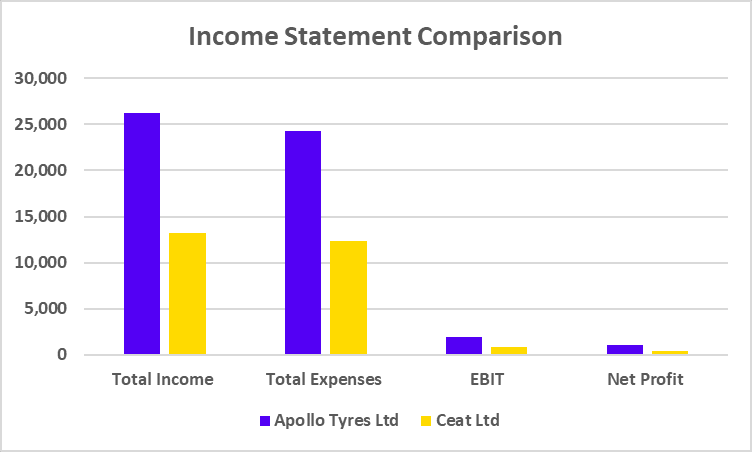
    Income Statement Comparison

    ParticularsApollo Tyres LtdCeat Ltd
    Total Income26,21113,235
    Total Expenses24,21812,336
    EBIT1,992899
    Net Profit1,120449
    (All values are in INR crores and the data is as of March 2025)

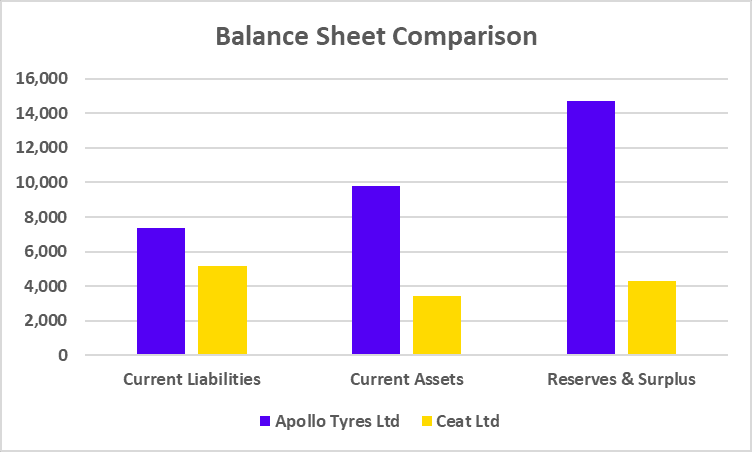
    Balance Sheet Comparison 

    ParticularsApollo Tyres LtdCeat Ltd
    Current Liabilities7,3605,164
    Current Assets9,8153,432
    Reserves & Surplus14,7024,328
    (All values are in INR crores and the data is as of March 2025)

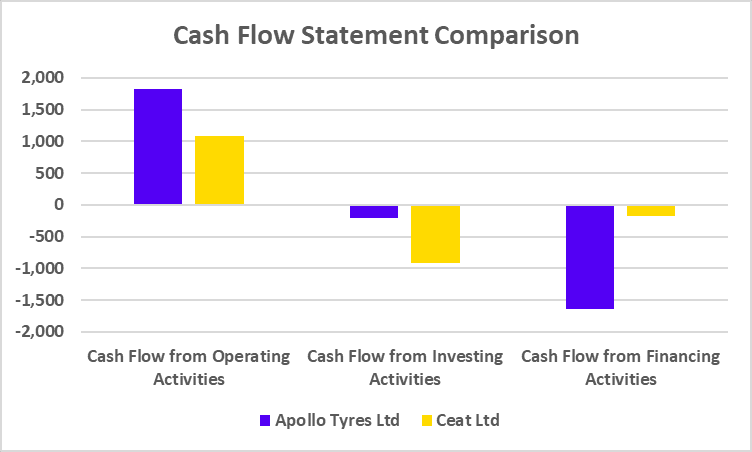
    Cash Flow Statement Comparison

    ParticularsApollo Tyres LtdCeat Ltd
    Cash Flow from Operating Activities1,8231,091
    Cash Flow from Investing Activities-202-922
    Cash Flow from Financing Activities-1,646-176
    (All values are in INR crores and the data is as of March 2025)

    Key Performance Ratios (KPIs)

    ParticularsApollo Tyres LtdCeat Ltd
    Operating Profit Margin (%)8.277.02
    Net Profit Margin (%)4.283.40
    ROE (%)7.5910.81
    ROCE (%)10.8315.36
    Debt to Equity (x)0.230.44
    (Data as of March 2025)

    Read Also: MRF vs Apollo Tyres: Which is Better?

    Future Plans – Apollo Tyres Ltd. vs Ceat Ltd.

    Apollo Tyres Ltd.

    • Target of $5 billion revenue and 15%+ EBITDA margin by FY26 : Apollo Tyres aims to achieve $5 billion (approximately ₹41,500 crores) revenue and over 15% EBITDA margin by FY 2025-26. For this, the company has focused on five key areas: sustainable growth, digitalization, technology innovation, human resource development, and brand building.
    • Target to use 40% sustainable materials by 2030 : Apollo Tyres has set a target to use 40% sustainable materials in its tyres by 2030. The company has recently developed tyres made from 75% sustainable materials, which are now in the testing phase.
    • Improving production efficiency through digital innovation centers : Apollo Tyres has set up digital innovation centers in Hyderabad and London, which are improving production efficiency using technologies such as AI, machine learning, IoT, and cloud computing.
    • Targeting $500 million sales in the US : Apollo Tyres is currently doing sales of $120-130 million in the US and plans to increase this to $500 million.

    Ceat Ltd.

    • Target to double export revenue to ₹4,000 crore by FY26 : Ceat Ltd. aims to double its export revenue to ₹4,000 crore by FY 2025-26, with a special focus on expansion in the car and truck tyre segment.
    • Leading position in the EV two-wheeler tyre segment : Ceat Ltd. has partnered with companies like Ather Energy in the EV two-wheeler tyre segment, giving it a strong presence in EV segment.
    • Capital expenditure of ₹1,000 crore in FY25 : Ceat Ltd. has set aside ₹1,000 crore for capital expenditure in FY 25, focused on capacity expansion at its Chennai and Ambarnath plants.
    • ₹72.67 crore investment for EPR compliance in FY24 : Ceat Ltd. has invested ₹72.67 crore in FY 2023-24 under EPR (Extended Producer Responsibility) compliance and introduced eco-friendly tyres.

    Who is better: Apollo Tyres or Ceat Ltd.?

    Apollo Tyres and Ceat Ltd.both have their own strengths. Apollo is currently focused on innovation, sustainability and international growth. The company is working rapidly on strengthening its foothold in the US and adopting the latest technology.

    On the other hand, Ceat is focused on the EV tyre segment, where it is already a leading supplier to EV manufacturers Ather. Also, the company is preparing to double its exports and is also increasing production capacity.

    Both companies are moving in slightly different directions, and are adopting different strategies to solidify their market position. It is hard to say which one is better and you must thoroughly analyze both companies or consult a financial advisor before investing.

    Conclusion 

    Apollo Tyres and Ceat Ltd. have both established themselves as a strong player in the tyre industry in their own ways. Apollo is expanding itself in the international market, while Ceat is focusing on electric vehicles and exports. Each company has a different business strategy, however both are trying to gain a better foothold in the tyre market. It is advised to consult a financial advisor before investing.

    S.NO.Check Out These Interesting Posts You Might Enjoy!
    1Bajaj Finserv and Bajaj Finance: Which is Better?
    2BHEL vs BEL -Best Defence and Manufacturing Sector Stocks
    3Asian Paints vs Berger Paints – Which is Better?
    4Maruti Suzuki India Vs Hyundai: Which Car Stock is Better?
    5Devyani International Vs Sapphire Foods – Which is Better?

    Frequently Asked Questions (FAQs)

    1. Which company is older: Apollo Tyres or Ceat Ltd.?

      Ceat Ltd. was established in 1958 while Apollo Tyres was started in 1972.

    2. Is Apollo Tyres a global brand?

      Yes, Apollo Tyres products are present in many countries including Europe and the USA.

    3. Does Ceat make tyres for electric vehicles?

      Yes, Ceat manufactures tyres especially designed for EV two-wheelers and supplies to many big companies.

    4. Which company has a higher export focus?

      Both the companies have export operations, but currently Ceat has set an ambitious target to double its export revenues.

    5. Is Apollo Tyres investing in sustainability?

      Yes, Apollo plans to use 40% sustainable materials in its tyres by 2030.

  • Open Free Demat Account

    Join Pocketful Now

    You have successfully subscribed to the newsletter

    There was an error while trying to send your request. Please try again.

    Pocketful blog will use the information you provide on this form to be in touch with you and to provide updates and marketing.