Imagine while reading a newspaper you came to know that the mutual fund industry currently has around 68,00,000 crores of assets under management (AUM), delivering impressive returns to investors. But did you know there are some companies that manage these funds that are also listed on the Indian stock market?
In this blog, we will give you an overview of the stock of top asset management companies stocks in India.
What are Asset Management Companies?
Asset management companies (AMC) are those financial institutions which manage the funds or investments of different categories of investors such as individuals, institutions, businesses, etc. Their main objective is to earn a profit for their investors, and for their services, they charge a certain amount of fees depending on the Asset Under Management or AUM. The asset management company stocks are the shares issued by the companies managing the mutual funds.
List of AMC Stocks in India
Below mention are the listed Asset Management Companies (AMC) in India:
HDFC Asset Management Company Limited
Nippon Life India Asset Management Limited
Aditya Birla Sun Life AMC Limited
UTI Asset Management Company Limited
Shriram Asset Management Company Limited
Company
Current Market Price (INR)
Market Capitalisation (In Crore)
52-Week High
52-Week Low
HDFC Asset Management Company Limited
3,865
82,583
4,864
3,255
Nippon Life India Asset Management Limited
638
40,378
816
430
Aditya Birla Sun Life AMC Limited
738
21,296
912
450
UTI Asset Management Company Limited
1,186
15,231
1,408
802
Shriram Asset Management Company Limited
485
631
697
226
(As of 16th January 2025)
Overview of AMC Stocks
1. HDFC Asset Management Company Limited
The HDFC Asset Management Company Limited was incorporated in 1999 as a joint venture between HDFC Limited and Standard Life Investments Limited. In 2003, it acquired Zurich Mutual Fund and Morgan Stanley Mutual Fund in 2014. The company launched its IPO in 2018 and became a publicly listed company.
Key Highlights:
As of 30th September 2024, the company manages an AUM of more than ₹7.5 Lakh crores.
The company has more than 90,000 distributors empanelled with them.
It has 255 branches and more than 1,597 employees.
The company’s headquarters is situated in Mumbai.
Know the Returns:
1Y Return (%)
3Y Return (%)
5Y Return (%)
16.37%
64.64%
26.95%
(As of 16th January 2025)
2. Nippon Life India Asset Management Limited
The company was incorporated in 1995 under the sponsorship of Reliance Capital Limited. Initially, it was known as Reliance Mutual Fund. Nippon Life Insurance acquired a 26% stake in Reliance Mutual Fund, and by this, it entered into the asset management sector. In 2017, the company got itself listed on the Indian Stock Exchange and rebranded itself as Reliance Nippon Life Asset Management Limited. After that, in 2019, Nippon Life Insurance acquired 75% of the total equity in the company and renamed it Nippon Life India Asset Management Company.
Key Highlights:
The company’s AUM is around 5.49 lakh crores.
The total number of folios managed by the company is 287.77 lakhs.
As of 31st March 2024, the company has 263 branch offices across India.
The company’s headquarters is situated in Mumbai.
Know the Returns:
1Y Return (%)
3Y Return (%)
5Y Return (%)
34.02%
83.13%
95.01%
(As of 16th January 2025)
3. Aditya Birla Sun Life AMC Limited
Aditya Birla Sunlife Mutual Fund was incorporated in 1994, and it was a joint venture between Aditya Birla Group and Sun Life Financial Incorporation. In 2017, the company changed its name to Aditya Birla Sun Life Asset Management Company. The company launched an IPO in 2021 and got itself listed on the Indian Stock Exchange.
Key Highlights
The company has more than 1.02 crore folios managed under its brand.
The company has a presence across 300 locations.
The total amount of assets managed by the company is around 4 Lakh crores.
The company’s headquarters is situated in Mumbai.
Know the Returns:
1Y Return (%)
3Y Return (%)
5Y Return (%)
52.38%
30.60%
7.48%
(As of 16th January 2025)
4. UTI Asset Management Company Limited:
UTI Mutual Fund is India’s oldest mutual fund and played an important role in channeling the savings of the Indian people into equity investments. Unit Trust of India was established in 1963, and later, in 2003, after the restructuring of Unit Trust of India, UTI Mutual Fund was made a separate entity and registered with the Securities and Exchange Board of India. The company launched its IPO in 2020, and with this, it became a publicly listed company.
Key Highlights
The total number of folios managed by the company is 1.22 crore.
The company has a presence across 210 locations.
The total amount of assets managed by the company is around 2.83 Lakh crores.
The company’s headquarters is situated in Mumbai.
Know the Returns:
1Y Return (%)
3Y Return (%)
5Y Return (%)
40.59%
15.90%
150.59%
(As of 16th January 2025)
5. Shriram Asset Management Company Limited
Shriram Asset Management Company was incorporated in 1994 with the aim of managing investor funds. It is a part of the Shriram Group, which was incorporated in 1974. The company launched its first mutual fund scheme in 1995 and is currently focusing on improving its investment platform using innovative technologies.
Key Highlights
The company is currently managing an AUM of around 876 crores.
The company’s headquarters is situated in Mumbai.
Know the Returns:
1Y Return (%)
3Y Return (%)
5Y Return (%)
43.47%
388.40%
402.92%
(As of 16th January 2025)
Key Performance Indicators (KPIs)
Company
Operating Profit Margin (%)
Net Profit Margin (%)
Return on Equity (%)
ROCE (%)
Current Ratio
HDFC Asset Management Company Limited
96.12
75.17
27.45
33.99
29.79
Nippon Life India Asset Management Limited
82.68
67.32
27.87
32.75
17.32
Aditya Birla Sun Life AMC Limited
74.91
57.66
24.62
30.73
16.04
UTI Asset Management Company Limited
57.46
46.17
17.44
19.69
17.83
Shriram Asset Management Company Limited
-70.08
-86.37
-8.84
-7.08
48.15
(All of the above data is from the year ended March 2025)
Advantages of Investing in the Finance Asset Management Sector Stocks
The advantages of investing in Finance Asset Management Companies stocks are as follows:
Revenue Source: Asset management companies’ revenue source is very steady as they charge fees from their customers based on the assets they manage.
Growth potential: With the growing penetration of the Indian mutual fund industry, asset management companies have high growth potential. With an increasing AUM, the companies are expected to perform well in the future.
Low capital requirement: Asset management companies require less capital expenditure than other industries, which eventually increases their profit margin.
Diversification: One can diversify their portfolio by investing in asset management companies and protecting their portfolio from stock-specific or sector-specific risks.
Risk Involved while Investing in Finance Asset Management Sector Stocks
There are certain risks involved while investing in asset management companies, a few of which are mentioned below:
Competition: The finance asset management sector is highly competitive since there are established players in this sector. Companies with strong brand recognition tend to have a competitive advantage over others.
Regulation: In India, the mutual industry is regulated by the Securities and Exchange Board of India, and any new regulation introduced by the regulatory authority could impact the profit of these companies.
Economic Downturn: Asset management companies are dependent upon the investments made by the investor; any economic slowdown will reduce the company’s AUM and directly impact its revenues.
Key Person Risk: The performance of asset management companies depends on the fund manager who manages the AUM. If their investment approach generates significant profits for the investor, then other companies might try to convince that particular fund manager to work for them.
Future of Asset Management Sector Stocks
This sector will benefit from the rise of the Mutual Fund Industry. The industry has a significant growth potential in the long run due to the constant rise in the assets under management. With the rise in SIP amounts and retail participation, the mutual fund industry has grown at a compounded annual growth rate of more than 17.5% in the past five years. As of November 2024, the AUM of the mutual fund industry stood around ₹68 lakh crores and is expected to cross ₹100 lakh crores in the next five years. Due to the reasons mentioned above, the companies engaged in this sector are likely to perform well in the coming years as they are the direct beneficiaries of it.
Conclusion
On a concluding note, financial asset management companies have high growth potential in the long run, especially during the bullish market trends. Their revenue sources are based on fee structures and will increase with the increasing participation of investors. However, it is crucial to analyze the investment opportunities in this sector as asset management companies work in a highly regulated environment, and the industry is highly competitive. One can diversify its investment portfolio by including a few stocks of listed asset management companies (AMC). However, before making any investment decision, you must consult your investment advisor.
You can open a free Demat account with Pocketful to start investing in finance asset management companies.
S.NO.
Check Out These Interesting Posts You Might Enjoy!
AMC stands for Asset Management Company. AMCs are financial institutions that manage and invest funds on their client’s behalf through pooled investments such as mutual funds, ETFs or other financial instruments.
Does AMC charge fees from investors?
Yes.
Who regulates AMCs?
Securities & Exchange Board of India.
How many registered AMCs are there in India?
As of December 2023, there are 44 registered AMCs.
What is Assets Under Management (AUM)?
It is the total value of the investments managed by the AMC.
Which are the top asset management companies in India?
Based on the market capitalization, the top asset management companies in India are HDFC Asset Management Company, Nippon Life India Asset Management Company, Aditya Birla Sun Life Asset Management Company, UTI Asset Management Company, and Shriram Asset Management Company.
What is the major revenue source of asset management companies?
A major source of revenue for asset management companies is the fees they charge from their investors based on the assets managed by them.
What are the factors which can impact the performance of an asset management company?
The major factors that can influence the performance of asset management companies include the fees they charge, their investment strategies, the market dynamics and the regulations.
How do you invest in the stocks of asset management companies?
One can easily invest in an asset management company’s stock by opening a demat account with a broker. You can open an online free demat account with Pocketful and begin your investment journey.
Selection Methodology and Important Disclaimer
The stocks included in this list are selected primarily on the basis of their market capitalisation, which represents the total market value of a company’s outstanding shares. The companies are arranged in descending order of market capitalisation, with larger companies appearing first, followed by relatively smaller companies. This methodology is intended to provide a structured approach for identifying companies based on their market size and overall presence within a sector.
However, market capitalisation should not be considered the sole factor while evaluating investment opportunities, as it does not guarantee future performance, profitability, or returns. Investors should also assess other important factors such as financial health, business fundamentals, management quality, valuation metrics, industry outlook, and market conditions before making investment decisions.
The information provided is for educational and informational purposes only and should not be construed as investment advice, recommendation, solicitation, or an offer to buy or sell any securities by Pocketful Fintech Capital Private Limited.
If you’re searching for the best demat account in India, don’t begin by staring only at the annual maintenance charges (AMC). The account with the cheapest AMC might not match how you really plan to invest or what you will need later on.
For a first-time investor, or anyone switching brokers, it helps to glance at a bunch of things at once: the cost to open the account, AMC, DP (depository participant) charges, how smooth onboarding feels, which depository the broker is using, nomination and how corporate actions are handled, plus the research or investment tools that come bundled with the account.
In this comparison, we looked at the top 10 demat account in India, namely Pocketful, Zerodha, Groww, Angel One, ICICI Direct, Kotak Securities, Upstox, SBI Securities, Axis Direct, and Paytm Money. We not only judged them using the factors above, but also thought about how each broker supports day to day investing.
The key thing is that there is no single best demat account for every person. What is “right” depends on what you want to hold inside it, how long you expect to keep those holdings, and what level of handholding you want along the way.
Quick answer: If you’re aiming for ₹0 account opening and ₹0 AMC, Pocketful and Groww are worth a look. Zerodha works well for investors who like an established platform that’s very well explained. If you prefer bank-backed brokers, Kotak Securities, ICICI Direct, SBI Securities and Axis Direct may fit nicely since they tend to feel more integrated. Also remember, charges and features can shift. Always confirm the most recent pricing and product details on the broker’s official website before you actually open the account.
Top 10 Demat Accounts in India: Quick Comparison
Compare the complete charge structure before opening a demat account.
Broker
Account Opening Fee
Annual Maintenance Fee (AMC)
Equity Delivery Brokerage
Equity MTF
Intraday Brokerage
Futures Brokerage
Options Brokerage
Commodities F&O Brokerage
Unique Features
Groww
₹ 0
₹ 0
₹20 or 0.01% per orderWhich ever is lower Minimum ₹5
0.041% (or 14.95% annually)
Flat ₹20 per order
Flat ₹20 per order
Flat ₹20 per order
Flat ₹20 per order
Zero AMC, a user-friendly platform
Zerodha
₹ 0
₹300 + GST
₹20 or 0.03% per executed order, whichever lower
0.04% per day
0.03% or Rs. 20/executed order whichever is lower
0.03% or Rs. 20/executed order whichever is lower
Flat Rs. 20 per executed order
0.03% or Rs. 20/executed order whichever is lower
User-friendly platform, educational tools
Pocketful
₹ 0
₹ 0
₹ 0 delivery charges.
0.1% of turnover per order
₹20 per executed order or 0.03% of turnover, whichever is lower
₹20 or 0.03% per executed order, whichever is lower
₹20 per executed order
₹20 per executed order
Innovative technology lets you invest in different asset classes in one place.
Angel One
₹ 0
₹240 (1st year free)
₹20 or 0.1% per executed order
0.041% per day
₹20 or 0.03%
₹20 per executed order
₹20 per executed order
₹20 per executed order
Comprehensive research, versatile mobile app
ICICI Direct
₹ 0
₹ 700
0.07% for equity delivery
0.0265% daily (9.65% p.a.)
Flat Brokerage per order of ₹20
Flat Brokerage per order of ₹20
Flat Brokerage per order of ₹20
Flat Brokerage per order of ₹20
3-in-1 account, extensive research
Kotak Neo
₹ 0
₹99 Account Opening Fee
0.49% for equity delivery
0.041% per day (approx. 14.99% p.a.)
Flat Brokerage per order of ₹10
Flat Brokerage per order of ₹10
Flat Brokerage per order of ₹10
–
Advanced trading tools, personalized advisory
Upstox
₹ 0
₹ 0
₹20 or 0.05% per order
₹20/day for every ₹40,000 borrowed
0.01% or Rs. 20/executed order whichever is lower
0.05% or Rs. 20/executed order whichever is lower
Flat Rs. 20 per executed order
0.05% or Rs. 20/executed order whichever is lower
Low brokerage fees, intuitive platform
SBI Securities
₹ 0
₹ 750 (1st year free)
0.5% for equity delivery
0.04% per day
Flat ₹20 per order
Flat 0.05 % per order
Flat ₹50 per order
–
3-in-1 account, strong banking integration
Axis Direct
₹ 0
₹ 750
0.5% for equity delivery
9.99% to 10.99% p.a. (or ~0.03% daily)
0.5% for equity Intraday
0.5% for equity Futures
Flat ₹20 per order
0.03% for Futures & ₹50 per orderFor Options
Seamless fund transfers, advanced research tools
Paytm Money
₹ 0
₹ 0
₹20 per executed order or 2.5% whichever is low
0.022% per day & 7.99% p.a.
₹20 per executed order or 0.05% whichever is low
₹20 per executed order or0.01% whichever is low
₹20 per executed order
–
Integrated with the Paytm ecosystem, low transaction costs
Note: Figures as of August 2026. Brokers revise pricing periodically, so confirm current rates on the broker’s official pricing page before opening an account.
Important: AMC is not the same as the total cost of holding a demat account. DP charges (on selling), pledge charges, physical statement charges (if requested), and statutory charges may also apply depending on your activity.
Which Demat Account is Best for You?
Before comparing all top 10 demat accounts in India, identify which type of investor you are.
If you are…
Look for…
Good picks
Buying stocks for the long term
Low/zero AMC, simple holdings view
Pocketful, Zerodha, Groww
Completely new to investing
Simple onboarding, minimal paperwork
Pocketful, Groww, Zerodha
Holding stocks and mutual funds together
Consolidated statements, single app
Pocketful, Groww, Zerodha, Paytm Money
Looking for research support
Research reports and market insights
Pocketful, Angel One
Wanting banking integration
3-in-1 accounts, easy fund transfer
ICICI Direct, Kotak Securities, SBI Securities, Axis Direct
Planning to also trade actively
A demat account tightly linked to a capable trading app
Pocketful, Zerodha, Upstox
Wanting advisory/PMS alongside
Dedicated research desks, relationship managers
SBI Securities
Cost-conscious across the board
Zero opening fee, zero or low AMC, transparent DP charges
Pocketful, Groww
Note: This split matters a lot, because it completely depends as per different scenarios. A demat account that feels perfect for a buy-and-hold style investor may not be the best match for someone who wants a relationship manager, or the option to walk into a branch and talk to people in person.
It’s SEBI-registered and a member of NSE, BSE and MCX, and the account opening flow is designed so you finish it in just five minutes, through a fully online, paperless process.
Pocketful’s demat account also plugs into its investment baskets, stock screening tools, IPO access, and mutual fund investing (2,000+ funds). So you can hold and research a bigger mix of assets, without constantly jumping between multiple platforms. On top of that, nomination, e-DIS for selling shares, and corporate actions like bonus shares, rights issues, and dividends are handled inside the same account.
Best suited for the cost-conscious investor who is after a simple no-AMC starting point, yet still wants access to research and investment tools as their holdings start to grow.
Beginner tip: Do check the linked trading account brokerage separately before assuming that the “free” account is your total cost.
Pro tip: Use Pocketful’s curated “Pockets” as a research starting point, but always peek at what’s inside a pocket before you invest.
2. Zerodha
Zerodha is India’s biggest broker by client count, and it pairs your demat account with the popular Kite platform. For resident individual accounts opened on or after 1 June 2026, you get the first year of AMC free, after that ₹300 + GST kicks in, this depends on your account type, and BSDA eligibility too.
Console, which is Zerodha’s portfolio and reporting dashboard, gives a single consolidated view of your demat holdings, and then there’s Varsity, its free education site, that goes through depository ideas like DP charges, pledging, and corporate actions in a straightforward, plain spoken way.
Why investors may consider Zerodha
It’s established and handles high volume
Console for a consolidated holdings view and reporting
Varsity covers demat basics and related terms
Coin for direct mutual fund holdings in the same account
First year AMC free for new eligible resident accounts
Best suited for the learning oriented investor who wants to really get how a demat account works, not just open one and then stop thinking about it.
Beginner tip: Take a look at DP charges before your first sell order. They’re separate from brokerage and AMC, and kind of easy to miss.
Pro tip: The console lets you review holdings, ledger, and P&L all in one place , so it’s worth bookmarking as soon as your account becomes active.
3. Groww
Groww shows ₹0 account opening and ₹0 AMC, and they’ve built the whole thing around one simple, combined screen for stocks, mutual funds and ETFs.
But beginners should look past “₹0 AMC” while comparing overall costs. DP charges can show up when you sell shares, plus there are statutory and regulatory charges that feel the same across pretty much every broker.
Why investors may consider Groww
₹0 account opening
₹0 AMC
Stocks plus mutual funds inside one account
IPO access
Best suited for the simplicity-first investor who wants to keep stocks and mutual funds without a tangled interface.
Beginner tip: An interface that looks simple doesn’t magically remove DP charges, STT, or the other statutory stuff, so confirm the full charge list, not only the AMC line.
Pro tip: Groww’s consolidated portfolio view is pretty handy for monitoring SIP-based mutual fund positions alongside your direct stock holdings, without jumping between tabs.
4. Angel One
Angel One links the demat account with research, market updates, and some advisory-oriented tools. The AMC on the Angel One’s website is listed as zero for the first year, and after that, non-BSDA clients are shown at ₹240/year, though it can differ a bit by plan or from what source you check.
Why investors may consider Groww
You get research and market insights right alongside your holdings
Zero AMC in year one
Onboarding feels digital, yet there is also an offline branch presence which can be a relief
You can track corporate actions and dividends inside the app
Best suited for the investor who wants a demat account plus a steady stream of research-market context, and also likes that Angel One has a wider offline presence across the country.
Beginner tip: Research reports can help you grasp a stock, but they should not replace knowing what you actually hold in your demat account.
Pro tip: Match Angel One’s research pieces with your own reading, rather than depending on only one source.
5. ICICI Direct
ICICI Direct is a subsidiary of ICICI Bank, it brings a 3-in-1 account that connects your savings, trading and demat, so you can shift money without doing separate transfers each time. The AMC is currently around ₹700 per year, which is on the higher side compared to the other options in this list.
Why investors may consider ICICI Direct
3-in-1 account that ties the bank side with trading and demat
Solid local branch network, useful when you want in-person help
Research, commentary and advisory services are available
Best suited for existing ICICI Bank customers, or those who want branch level support and are not too focused on AMC
Beginner tip: the ease of a 3-in-1 account sounds great, but it usually comes with higher AMC, so it’s worth checking how often you’ll actually rely on branch help.
Pro tip: if you already use ICICI for banking, the linked fund-transfer convenience can truly save time, even if the listed AMC looks steep at first glance.
6. Kotak Securities (Kotak Neo)
Kotak Securities is backed by Kotak Mahindra Bank and links easily to a Kotak bank account. Its Kotak Neo app and KEAT Pro X desktop terminal offer real-time market data, alongside a ₹99 account opening charge (varies by current offer).
Why investors may consider Kotak Securities
Real-time data via Kotak Neo (web/mobile) and KEAT Pro X (desktop)
Strong bank-backed reliability
Educational initiatives for newer investors
Best suited for investors who want a bank-integrated account and don’t mind a modest opening charge for real-time tools.
Beginner tip: Check current opening-charge offers, these are periodically waived or discounted.
Pro tip: KEAT Pro X is worth exploring if you plan to track markets from a desktop rather than only mobile.
7. Upstox
Upstox is trading-oriented in its product design, and its demat account is built to work closely with its charting and order-management tools. New customers currently get zero AMC for the first year; ₹300+ GST applies for non-BSDA users thereafter.
Why investors may consider Upstox
Zero AMC in year one
Fast online onboarding
Holdings view tightly integrated with the trading interface
Watchlists and portfolio tracking
Best suited for the investor who expects frequent account activity and wants a demat account that stays closely linked to execution tools.
Beginner tip: An account built for active trading doesn’t mean you should trade actively as a beginner, learn settlement and corporate-action mechanics first.
Pro tip: Check the current AMC rate directly on Upstox’s charges page before opening an account, since year-two pricing applies once the free period ends.
8. SBI Securities
SBI Securities is a wholly-owned subsidiary of the State Bank of India, India’s largest public-sector bank. AMC is currently listed at ₹750/year (first year free), among the higher charges on this list.
Why investors may consider SBI Securities
Backed by India’s largest public-sector bank
Personalised relationship managers for HNI clients
Extensive branch network
Best suited for investors whether new or experienced who prioritise institutional trust and branch access over the lowest possible AMC.
Beginner tip: The higher AMC reflects the branch network and support layer, worth it only if you’ll actually use that support.
Pro tip: If you already have an SBI savings account, ask about linked fund-transfer convenience before comparing AMC in isolation.
9. Axis Direct
Axis Direct is a subsidiary of Axis Securities Limited, itself part of Axis Bank. AMC is currently listed at ₹750/year, and the platform offers margin funding to investors.
Why investors may consider Axis Direct
Smooth fund transfers for Axis Bank customers
In-depth fundamental research reports
Margin funding facility
Best suited for existing Axis Bank customers who want an integrated account and access to margin funding.
Beginner tip: Margin funding increases exposure, understand the interest cost and risk before using it, even if it’s conveniently available.
Pro tip: Axis Direct’s sector and stock research reports are worth reviewing even if you don’t use margin funding.
10. Paytm Money
Paytm Money launched in 2017 as a direct mutual fund platform before adding stock trading in 2019. It’s backed by One97 Communications and currently lists ₹0 AMC.
Why investors may consider Paytm Money
₹0 AMC
Direct mutual fund investing to save on costs
SIP, lumpsum and other calculators built into the app
Familiar interface for existing Paytm users
Best suited for investors focused on low-cost mutual fund investing who also want occasional stock trading in the same app.
Beginner tip: Direct mutual fund plans save on distributor commissions over time, worth understanding the difference from regular plans before you start SIPs.
Pro tip: Use the built-in SIP and lumpsum calculators to plan contributions before committing to a fixed monthly amount.
We evaluated the providers across six factors that matter to investors:
Account opening charges
AMC and other account-related costs (including DP charges)
Ease of onboarding and use
Depository and corporate-action handling (nomination, e-DIS, bonus/rights/dividends)
Learning, research and advisory resources
Suitability for different investor profiles
Pricing and product information were checked against the brokers’ official websites and publicly available rate cards. Since charges and features can change, readers should verify the latest information before opening an account.
7 Things You Should Check Before Choosing a Demat Account
1. Is the broker SEBI-registered and a depository participant? This should be your first check. SEBI maintains a database of recognised intermediaries, and every demat account sits with a depository, NSDL or CDSL, through a registered depository participant (DP). Check this rather than relying only on an app’s marketing claims.
2. What will you actually pay? Don’t stop at “₹0 AMC.” Your actual cost can include:
Account opening charges (usually ₹0 now)
AMC
DP charges (charged when you sell shares)
Pledge charges (if you use MTF or pledge holdings)
Physical statement charges, if requested
Charges for account closure or transfer-out, in some cases
3. Are you holding for the long term or trading actively? If you plan to buy and hold for years, AMC and ease of tracking matter more. If you plan to trade frequently, how tightly the demat account integrates with the trading platform becomes more important.
4. How does the account handle corporate actions? Bonus shares, stock splits, rights issues, and dividends should reflect in your holdings automatically and be visible without you having to chase the broker.
5. Is nomination easy to set up? Nomination lets your holdings pass to someone you choose without a lengthy legal process. Check that the broker’s app makes this simple to add or update.
6. What happens when markets or account activity spike? Check user feedback on how the app performs when there’s high trading or account activity, delayed holdings updates or ledger mismatches are a bigger red flag than a slightly higher AMC.
7. Check the latest charges before opening the account. Pricing plans change. The comparison above reflects information available from the brokers’ current pricing pages, but verifies the official pricing page immediately before opening an account.
Don’t Choose a Demat Account Based Only on AMC
Consider two investors.
Investor A buys ₹50,000 worth of stocks every few months and holds them for years, rarely selling.
Investor B holds a mix of stocks and mutual funds and also trades intraday and F&O occasionally.
They should not necessarily choose the same account. Investor A may care more about AMC, ease of tracking, and corporate-action handling: DP charges matter less since they rarely sell. Investor B may care more about how tightly the demat account links to the trading platform, and should pay closer attention to DP charges given more frequent selling.
That’s why asking “Which demat account is best?” without first defining your holding behaviour can lead to the wrong answer.
Are Demat Accounts Safe?
A demat account itself does not make an investment safe, it only holds your securities electronically. Your first check should be the regulatory status of the depository participant. SEBI provides a searchable database of registered intermediaries, and you can independently verify your holdings through NSDL’s or CDSL’s own portals, not just the broker’s app.
You should also:
Download the official app from the authorised app store.
Check the broker’s SEBI registration and depository participant details.
Set up and periodically review your nomination.
Never share your OTP, PIN, or trading password.
Enable available security features (biometric login, 2FA).
Read the applicable AMC and DP charges before opening the account.
Avoid acting on unsolicited tips or guaranteed-return claims tied to “free” demat accounts.
A regulated depository participant can safely hold your securities electronically. It cannot remove market risk on what you choose to buy.
How to Open Demat Account: A Step-by-Step Guide
Opening a Demat account with a broker is quick, fully digital, and hassle-free. Follow the simple steps below to get started with your investment journey.
Step 1: Download and Register: Download the broker app from the Google Play Store or Apple App Store and click on ‘Register’ to begin.
Step 2: Enter Personal Details: Fill in your name, mobile number, date of birth, PAN number, and address to start your application.
Step 3: Upload KYC Documents: Upload your Aadhaar card, PAN card, and a recent bank statement to complete the KYC process.
Step 4: Complete eSign & Submit: Verify your information and eSign the application using your Aadhaar-linked mobile number.
Step 5: Verification & Account Activation: Broker verifies your details, and once approved, your Demat account is activated. You’ll receive your Client ID and login credentials to start investing.
Ready to choose? Before opening a demat account, compare the current opening fee, AMC, DP charges, and other applicable costs on the broker’s official website. If ₹0 account opening, ₹0 AMC, and access to research and investment tools in one account are your priorities, you can explore Pocketful’s current offering and pricing before making your decision.
Frequently Asked Questions
Which demat account is best for beginners in India?
There is no single best demat account for everyone. Pocketful, Zerodha, Groww, and others each have different strengths. Your choice should depend on whether you plan to hold for the long term, trade actively, want research support, or simply want the lowest ongoing cost.
Which demat account has the lowest AMC?
Pocketful, Groww and Paytm Money currently list ₹0 AMC. Several other brokers offer a first-year-free AMC with charges applying from year two. Always confirm current terms on the broker’s website.
What is a demat account?
A demat (dematerialized) account holds financial securities: stocks, mutual funds, ETFs, bonds in electronic form instead of physical certificates.
Is there a difference between a demat account and a trading account?
Yes. A trading account is used to buy and sell securities; a demat account holds them electronically after the trade settles.
Can I open a demat account online?
Yes. Major brokers offer online account opening and electronic KYC, subject to their applicable eligibility and verification requirements.
Can I open a trading and demat account with the same broker?
Yes, most brokers, including Pocketful, Zerodha and Groww, offer integrated trading-and-demat accounts.
Who can open a demat account?
Any resident or non-resident individual, corporate entity, or minor can open one; for minors, a legal guardian manages the account.
What is the minimum amount required to open a demat account?
Typically none. Most brokers charge no account-opening fee, and there’s no minimum balance requirement for a demat account itself.
What are DP charges, and do all demat accounts have them?
DP (depository participant) charges are levied when you sell shares, separate from brokerage and AMC. Most brokers apply some form of DP charge on sell transactions regardless of AMC policy.
Which demat account is good for beginners specifically?
Pocketful, Groww and Zerodha are commonly considered beginner-friendly due to simple onboarding and low or zero AMC but check current charges before deciding.
Is Zerodha better than Groww?
Zerodha offers deeper charting, research documentation (Varsity) and reporting tools (Console); Groww is generally considered simpler for first-time users. The better fit depends on your experience level.
Is an ICICI demat account good for investors?
Yes, its 3-in-1 account structure, research tools and branch support make it a solid pick for investors who value integrated banking, though its AMC is on the higher side.
What services does SBI Securities provide?
Equity trading, derivatives, mutual funds, research, and relationship-manager support for HNI clients.
Is Angel One a good choice?
Yes, it combines a capable app with research support and a strong offline branch network, making it suitable for both new and experienced investors.
Can I have more than one demat account?
Yes, an investor can hold multiple demat accounts across different brokers, subject to standard KYC and regulatory requirements.
Should I choose a demat account based on its app store rating alone?
No. A rating reflects user experience but doesn’t tell you whether the AMC, DP charges, depository, or corporate-action handling actually suit your needs.
Final Disclaimer
This article helps you decide the best demat account in India for yourself. Please know it is for educational and informational purposes only and should not be construed as investment advice, a recommendation, solicitation or an offer to buy or sell any security or financial product. Account opening charges, AMC, DP charges, statutory charges, product availability and other terms may change. Please refer to the respective broker’s official website and applicable regulatory disclosures for the latest information before opening an account. Investing involves market risks, including the possible loss of capital.
S.NO.
Check Out These Interesting Posts You Might Enjoy!
Commodity trading is a dynamic sector that requires speed, reliability, and accuracy; hence, before starting commodity trading, choosing the best commodity trading platforms is essential. A new trader who wishes to start their commodity trading journey is generally confused about which trading platform is suitable for them.
To clear your confusion, Pocketful is here with another blog explaining the key features of the top 10 commodities platforms in India.
What Makes a Good Online Commodity Trading Platform?
A commodity trading platform is a place where sellers and buyers come together to buy and sell different commodities such as crude oil, gold, etc. In India, there are various brokers offering trading services to investors, but choosing the best trading platform among them requires knowledge about their key features.
A good commodity trading platform plays an important role in commodity trading avenues; the major factors that make the best commodity trading brokers in India are as follows:
User Interface: The interface of the commodity trading app provided by the broker must be user-friendly and easy to use.
Reliability: The real-time data provided by the commodity trading platforms must be accurate and reliable
Analytical Tools: The platform which you choose to trade in commodities should be equipped with advanced analytical tools.
Support: The support system of the commodity trading platforms must be available 24/7 to resolve investors’ queries.
Top 10 Commodity Trading Platforms – Comparison Table
Platform
Account Opening Charges
Brokerage Fees
Annual Maintenance Charges (AMC)
Key Features
Angel One
₹0
₹20 per executed order or 0.25% of transaction value (whichever is lower)
₹240 per year
Robust advisory services, strong offline presence
Zerodha
₹0
Futures: ₹20 or 0.03% per executed order, whichever is lower Options: ₹20 per executed order
Integrated 3-in-1 account (banking, trading, demat), comprehensive research
Kotak Securities Limited
₹0–₹499
₹20 per executed order for delivery trades
₹0–₹600 per year
Trusted brand, extensive educational support
Motilal Oswal Financial Services Limited
₹0
0.02% for commodity futures; ₹200 per lot for options
₹400 per year
Portfolio management services, in-depth research reports
IIFL
₹0
0.25% of transaction value for commodity futures; ₹25 per lot for options
₹250 per year
Robust research and advisory services, user-friendly platform
5Paisa
₹0
₹20 per executed order
₹300 per year
Flat-fee trading across segments, cost-effective solutions
Sharekhan
₹0
₹20 per order
₹400 per year
Comprehensive training programs, powerful trading terminal
Disclaimer:This content is for informational purposes only and does not constitute financial advice. Platform features and charges may change—please verify details directly with the service providers before making any decisions.
1. Angel One
Angel One is among the leading full-time brokers in India. The company was incorporated in 1996, offering a wide range of services, ranging from stock to commodity trading. It also offers investment advisory services. Their innovative platform focuses on customer needs and wants.
Key Features:
Good customer support is considered the key benefit of opening a demat account with Angel One.
It also provides technical analysis tools in their app.
Angel One has a strong offline presence across the nation.
Best For: This platform is appropriate for individuals who rely on a broker for investing advice.
2. Zerodha
Zerodha is a prominent player in the Indian Stock broking industry. It offers trading facilities in commodity and other investment options. It was founded by the Kamath Brothers in 2010 with a focus on using advanced technology to develop a unique trading platform. Zerodha introduced a new pricing scheme, which was a flat brokerage for trading.
Key Features:
Zerodha is known for its cutting-edge technology and easy-to-use trading interface.
They also have a dedicated customer support team, which helps the investor to resolve their queries.
Zerodha offers a platform known as Varsity, which is an open and free market education platform.
Best For: This platform is suitable for investors who wish to trade in a stock market, with the broker offering low brokerage fees.
3. Pocketful – Free Commodity Trading Apps
It is an emerging stock broking firm offering investment opportunities in various asset classes at low fees. The mobile app is easy to use and has a user-friendly interface. Pocketful was launched in 2024 and is a subsidiary of Pace Stock Broking Services. Pocketful has been developed by professionals with more than 27 years of experience. Pocketful is different from other discount brokers as it offers zero delivery and account opening fees, making it the best option for both traders and investors.
Key Features:
Pocketful offers a free commodity trading platform, as there are no account opening fees.
The account opening process is completely online and can be completed without any paperwork.
Pocketful offers APIs to code your trading strategy and automate the trading process.
Best For: The Pocketful platform is suitable for all kinds of investors and traders as it provides a user-friendly interface offering zero brokerage on equity delivery and zero annual maintenance charges for the first year. It also provides advanced trading tools to analyze the market. Hence, one can consider opening a Demat account with Pocketful.
4. Upstox
This platform offers a user-friendly trading platform. They have advanced technical tools that help an investor identify the trend of a commodity and execute a trade based on it. They also offer an option chain with a strategy mode in which you can build your strategy and execute the trade.
Key Features:
Through the Upstock app, one can easily execute the trades.
On the platform, you can make multiple watchlists and keep track of various commodities.
The company charges zero AMC to maintain an account with them.
Best For: Traders who want to use technical analysis as a tool to take intraday and swing trades.
5. ICICI Direct Securities
ICICI Direct Securities is one of India’s leading stockbrokers and is a subsidiary of ICICI Bank, a major player in India’s private-sector bank. ICICI Direct offers a three-in-one account, which is a combination of savings, trading, and Demat accounts. Through their three-in-one account, an investor can easily transfer money from their savings account to their trading account.
Key Features:
The company has a strong presence across the nation through its local offices, which helps its investors resolve their queries quickly.
The company offers research and advisory services to their customers.
It also offers personalized wealth management solutions to its investors.
Best For: Investors who wish to have support through local branch offices can opt for ICICI Direct Securities.
6. Kotak Securities Limited
Kotak Securities is a subsidiary of one of India’s biggest private sector banks called Kotak Mahindra Bank. Kotak Securities offers a wide range of products to its investors, including stocks, commodities, derivatives, etc. The web-friendly Kotak Stock Trader or the desktop-centric KEAT Pro X, for example, both cater to active traders with live data from the markets.
Key Features:
In addition to commodity trading, Kotak Securities provides a variety of investment opportunities, including stocks, mutual funds, etc.
Kotak Securities runs various programs to educate investors.
The company has a strong brand reputation as it is backed by Kotak Bank.
Best For: Kotak Securities is suitable for investors who wish to access the learning material and tutorials about the stock market.
7. Motilal Oswal Financial Services Limited
Motilal is considered a prominent player in the Indian broking industry and was established in 1987. It offers various investment options, portfolio management services, advisory services, etc. They provide modern trading platforms, including a desktop terminal and a mobile app. The company has over 30 years of experience and provides research and advisory services.
Key Features:
Motilal Oswal Financial Services Limited offers customized financial solutions to its customers.
Motilal Oswal’s trading app is considered some of the best in the industry due to its user-friendly interface.
Loan against securities facility is offered by Motilal, allowing an investor to pledge their securities and get the loan.
Best For: Suitable for an investor who wants other customized financial products in one place such as portfolio management services.
8. IIFL
IIFL was founded in 1985 as a part of the India Infoline Group. Initially, it was established as an advisory firm and focused on research and its related services. It was listed on the Indian Stock Exchange in the year 2005 and rebranded itself as India Infoline. Through their research reports, the company ensures that their investors make sound investment decisions, and they also offer an advanced commodity trading platform
Key Features:
The company offers research and advisory services to their customers.
The company offers a user-friendly commodity trading platform.
IIFL provides various free educational sessions to help its clients enhance their knowledge.
Best For: Investors who want research and advisory services along with a good trading platform.
9. 5Paisa
5Paisa is one of the top discount brokers in India, providing commodity trading and other services. It was established in 2016 with the primary objective of offering affordable financial services. They are also acknowledged by AMFI as a mutual fund distributor.
Key Features:
They offer a user-friendly web platform and a mobile trading platform to investors, offering them a seamless trading experience.
5Paisa offers investment in mutual funds through its platform.
Their FnO 360 platform offers advanced tools so that investors can make informed trading decisions.
Best For: Investors looking to learn about the stock market through interactive sessions can opt for 5Paisa.
10. Sharekhan
Sharekhan was founded in 2000, and it is one of the first broking firms in India to offer retail investors access to online trading platforms. It exponentially grows its business by offering franchisees throughout the country. It is known for its offline presence and customer support.
Key Features:
They offer a desktop-based trading terminal known as Trade Tiger, which is equipped with advanced trading tools.
Sharekhan offers an advanced training programme for its investors through its online courses, which is known as Sharekhan Classroom.
It has a dedicated customer support team to address its customers’ queries.
Best For: Sharekhan is best suited for those who wish to learn something new about technical and fundamental analysis.
How to Choose the Right Commodity Trading Platform App?
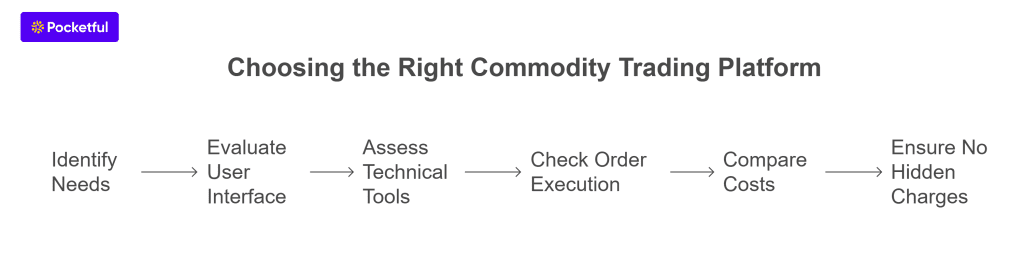
There are various parameters that one should consider before choosing an online commodity trading platform; a few of such key features are mentioned below:
Understanding Needs: Make sure the platform that you are opting for meets all of your needs.
User Interface: The user interface of the application must be easy to understand and reliable to enhance the user experience.
Technical Tools: There are various types of advanced trading tools that traders require to trade efficiently in the commodity market.
Execution: The commodity trading platform must execute orders instantly and efficiently.
Charges: The trading platform that you are opting for must offer its trade execution services at a low cost.
Hidden Charges: There must be no hidden charges in the commodity trading platform that you are opting for.
To sum up, in this blog, we have given you an overview of the best commodity trading platforms in India. Trading in commodities gives you a chance to gain significant profit with knowledge and expertise. Although many brokers are offering online commodity trading platforms, it is advised that you evaluate brokers based on their fees, the trading platform, etc., offered by them and then select the one suitable for you.
Pocketful also offers you an online commodity trading platform with no account opening charges, and it is among the best commodity trading apps in India.
Have you ever wanted to invest in gold but felt daunted by the idea of storing it in physical form? Enter Paper Gold—a modern, hassle-free alternative for both traders looking to bet on short-term price moves and investors wishing to invest in gold in a secure manner. Be it for executing speculative trades or portfolio diversification; paper gold has become the preferred way to invest or trade in gold.
In this blog, we will describe paper gold, its different types and investing mechanisms in detail. We will also describe the benefits and limitations of investing in paper gold and compare the features of paper gold with those of physical gold.
What is Paper Gold?
Unlike traditional gold investments, paper gold is a financial instrument that allows investors to gain exposure to gold’s price movement without the burden of physical possession. These are instruments like ETFs, futures contracts, or options that track the gold price, existing purely in paper or digital form. While physical gold offers a tangible security, paper gold is highly liquid, mirrors pricing movement instantly and can be easily traded.
How Different Types of Paper Gold Work?
Now, we are going to discuss the types of paper gold available in the market and how they work. There are basically four main types of paper gold:
1. Gold ETFs
ETFs or exchange-traded funds are investment funds that invest in gold whose shares trade on the stock market. These funds aim to track the price movements of gold either through physical ownership of gold or through derivatives linked to gold. The share price of the gold ETF moves according to the price changes in physical gold and thus provides market participants with a way to invest or trade in gold. Moreover, investors with small investment amounts can invest in gold ETFs as they have a very low share price.
2. Gold Futures
Gold futures is a financial contract between a buyer and a seller where the buyer agrees to buy a specific amount of gold at a predetermined price on a future date. Buying a gold futures contract doesn’t mean you actually take immediate possession of the physical asset. Rather, a futures contract gives a buyer the right to purchase the precious metal at a future date at a price set today. Gold futures trade on MCX in India.
3. Digital Gold
Digital gold provides a virtual investment option for buying, selling, or holding gold without any physical ownership. One can buy electronically through an authorized online platform. The digital gold that you buy is backed by physical gold in safe custody and stored by the issuer. Your investment can be redeemed either in cash or gold, hence giving you the flexibility of transactions with no worry of storage or security.
4. Sovereign Gold Bond
SGB, a government-backed security issued by the Reserve Bank of India, represents ownership of gold. Instead of purchasing physical gold, investors buy these bonds with a fixed interest rate per annum. At the time of maturity, the bonds can be redeemed at a price based on the market price of gold. By investing in SGBs, one does not have to worry about storage and can take advantage of tax benefits and capital gains due to gold price appreciation.
Benefits of Investing in Paper Gold
The upsides of investing in paper gold are:
Liquidity – Paper gold, such as gold ETFs, can be bought and sold in seconds on stock exchanges during trading hours. Money can be withdrawn easily, unlike physical gold, where finding a buyer and seller can take days.
No risk of theft – Paper gold does not need any locker or insurance and hence has eliminated the risk of theft.
Affordability – With paper gold, one can begin investing in gold with small amounts of money.
Limitations of Investing in Paper Gold
The limitations of investing in paper gold are:
No tangible ownership – Paper gold doesn’t provide the comfort or utility of having the actual gold that gives a sense of ownership and can be worn as jewelry or displayed.
Default risk – Though such incidences would have been rare, there is still a possibility of default when the issuer of gold bonds or certificates goes bankrupt. There is no such risk when dealing with physical gold.
Price Volatility – Paper gold prices can fluctuate considerably due to volatile price movements in gold prices. Investors may suffer losses if paper gold instruments such as gold ETFs perform poorly in the short term.
Comparison: Paper Gold vs Physical Gold
Particulars
Paper Gold
Physical Gold
Definition
Paper Gold is a certificate or digital ownership of gold that proves that you have invested in gold.
Physical Gold is real gold. The kind of gold that you can melt and shape into jewelry.
Ownership
Investing in paper gold doesn’t give you physical possession of gold.
Investing in physical gold provides ownership.
3rd Party Management
Since the investor doesn’t hold the gold physically, he/she has to rely on intermediaries to store and manage it. This creates 3rd party risk or credit risk.
Since the investor has possession of gold, he/she doesn’t have to face any 3rd party risk.
Paper gold is best suited for investors who would rather have exposure to gold than take on the hassles of storing physical gold and bearing associated costs. Individuals wanting to diversify their investment portfolios can also consider investing in paper gold. Moreover, people with a small capital to invest would also benefit, as paper gold allows you to invest small amounts.
Investors can invest in SGBs as they pay a consistent stream of interest income and are eligible for capital gain exemption upon maturity. This is likely not to appeal to traditional investors, though, who might want a sense of ownership of gold and want to own gold in physical form.
How to Invest in Paper Gold?
1. Gold ETFs: To invest in Gold ETFs, open a Demat and trading account with a stockbroker, search for gold ETFs on the stock exchange, and buy the required number of units.
2.Sovereign Gold Bonds: SGBs can be bought from banks and post offices or through online platforms.
3. Gold Mutual Funds: Investing in Gold Mutual Funds can be done through asset management companies or brokers. These funds are invested directly in gold and other gold derivative instruments.
Conclusion
Paper gold is a way for investors to realize the benefits of investing in gold without the drawbacks of physical ownership. Paper gold can be in the form of ETFs, SGBs, gold futures, etc. Gold ETFs and gold futures are quite liquid, allowing investors an easy and quick way to invest in gold. SGBs provide a consistent income stream and tax exemptions. These factors make it an attractive investment proposition to modern investors. But like every other financial product, this one also has its disadvantages as many consider holding gold in physical form auspicious or for making jewelry. The choice between paper gold and physical gold will ultimately depend on your investment goals and risk profile. It is advised to consult a financial advisor before investing.
Frequently Asked Questions (FAQs)
What is paper gold?
Paper gold refers to financial instruments like gold ETFs, gold futures, and sovereign gold bonds that represent gold ownership without holding the metal in physical form. It offers exposure to gold’s price movements in a more convenient form.
What are the benefits of investing in paper gold?
Advantages of investing in paper gold include liquidity, relative affordability, absence of storage costs, etc.
What are some other risks involved with paper gold?
Risks of investing in paper gold are price volatility and third-party or default risk of the issuing entity.
Is paper gold a safe investment?
Paper gold is relatively safe if bought through trusted platforms. SGBs are also safe as they are backed by the government. Still, it has risks, such as price volatility and third-party default risks in some cases.
What is the lowest amount of investment in paper gold?
The minimum investment amount for paper gold differs from one issuer to another. There are some issuers who allow a minimum investment of Rs.1, while Sovereign Gold Bonds would require a much higher investment amount.
Commodity Trading is important for the global economy as it allows the trading of vital resources like crude, metals, and agricultural goods. But, there’s a catch – it’s not without risks as the market features volatile price shifts. The regulatory body has enforced strict rules to ensure safe and fair trading practices.
In this blog, we will examine commodity trading regulations and their impact on market participants.
What is Commodity Trading Regulation?
Commodity trading regulations refer to the framework of the laws and rules that govern the trading of physical goods and their associated derivative contracts. These commodities include agricultural products, energy resources, and metals. The commodity trading regulations safeguard participants from manipulation and insider trading by reducing excessive speculation that can cause extreme price volatility.
Regulatory Body in Commodity Trading
The Securities and Exchange Board of India (SEBI) regulates the commodity derivatives market in India. However, before September 28, 2015, the Forward Markets Commission (FMC) regulated the commodity futures market in India.
The FMC was merged with SEBI to improve regulation of the commodity futures market. SEBI now oversees commodity derivatives trading in India. Commodity exchanges that are regulated by SEBI are as follows,
Multi Community Exchange of India (MCX)
National Commodity and Derivatives Exchange (NCDEX)
Additionally, the Warehousing Development and Regulatory Authority (WDRA) collaborates with SEBI to oversee the storage of the physical commodities tied to derivative contracts.
Below are some of the key points from the SEBI guidelines for the commodity derivatives market.
Trading Hours
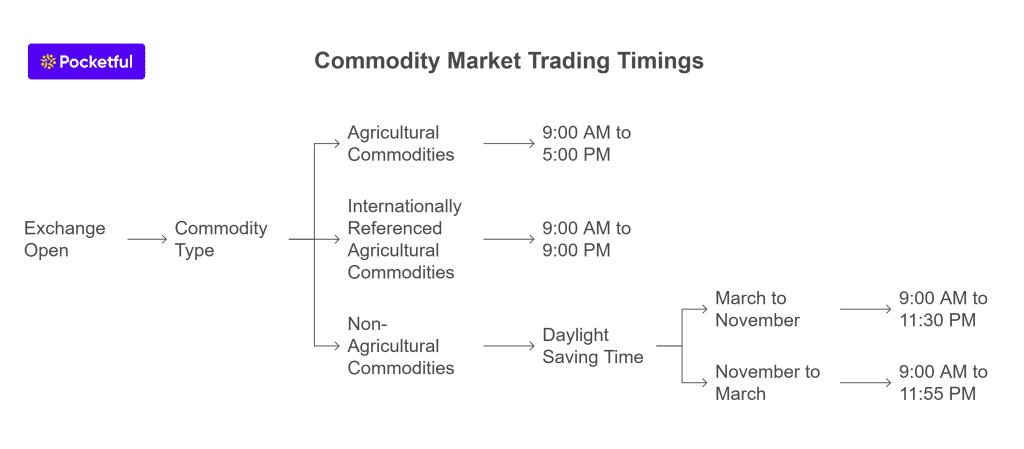
Trading hours are standardized for both agricultural and non-agricultural commodities. Trading shall be permitted only from Monday to Friday, and trading hours are fixed by the exchanges.
For non-agricultural commodities, the trade start time is 9:00 AM, and the trade end time is 11:30 PM (after the start of the US daylight savings in the spring season) and 11:55 PM (after the end of US daylight savings in the fall season). For agricultural and agri-processed commodities with international reference linkages, the trade start time is 9:00 AM, and the trade end time is 9:00 PM. The trade end time is 5:00 PM for agricultural and agri-processed commodities without international reference linkages.
Trading Holidays
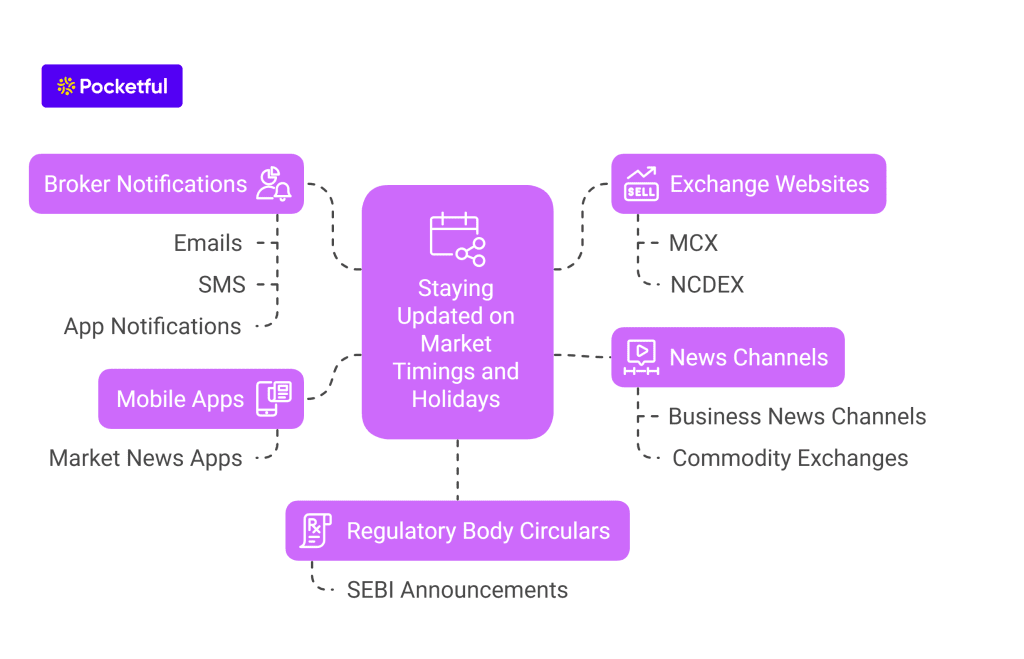
The commodity market remains closed on weekends, i.e., Saturdays and Sundays and on all notified public and national holidays. However, there are a few public holidays on which the commodity market is open for trading for one session.
UCC & PAN
Unique client codes (UCC) are required for executing transactions on the exchange to ensure traceability and compliance with regulations, and brokers must disclose their proprietary trading to clients to improve transparency. Members of the exchange must upload UCC details before executing trades in the commodity derivatives segment. Furthermore, the PAN will be the only required identification number for anyone wishing to trade on a commodity derivatives exchange.
Warehouse Accreditation and Delivery Processes
Accredited warehouses are essential for the safe storage of the delivered commodities. Warehouse Service Providers (WSP) provide safe storage facilities for storing underlying goods related to a commodity derivatives contract. Standards regarding infrastructure, insurance, financial stability and corporate governance are set, and regular audits and inspections ensure compliance with quality and operational standards.
Transparency Measures and Disclosure Norms
Commodity exchanges should publicly report daily open interest, put call ratio, bhav copy and other market data to provide insights into market activities. Moreover, in the stock market, companies provide information related to commodity price risks and hedging strategies in their annual reports to help stakeholders evaluate their exposure.
Spot Price Polling
Commodity exchanges use Spot Price Polling Mechanism to determine current spot prices. Transparent spot price discovery is crucial for the smooth operation of the derivatives market, as these prices serve as reference points for contract settlements on the exchange. Commodity exchanges determine current spot prices by inviting price quotes from a panel of polling participants.
Support for Farmers and FPOs
SEBI has lowered regulatory fees on stock exchanges for agricultural commodity derivatives to encourage participation from farmers and Farmer-Producer Organizations (FPOs). The goal is to lessen the financial burdens on farmers by increasing savings from reduced regulatory fees by the exchanges. Farmers can get reimbursed a certain percentage or fixed amount of options premiums, which encourages them to participate in the derivatives market. Reimbursement of Mandi tax and clearing corporation fees are some other measures introduced to increase the participation of farmers and FPOs.
Investor Protection Mechanism
The IPF, or the investor protection fund, will be managed by a separate Trust, which will have a maximum of 5 trustees. The trust will include three public interest directors, one representative from the investor’s association, and the exchange’s chief compliance officer or chief regulatory officer. The objective behind establishing this fund is to protect investors by providing compensation to those who have been impacted by a defaulting trading member. IPF gets its money from penalties and regulatory fees.
Investor Grievance Redressal System
The stock exchange must create an Investor Grievance Redressal Committee (IGRC) to address investor complaints. Investors can submit their complaints through SCORES 2.0 (SEBI Complaint Redress System), which is a centralized grievance redressal system of SEBI. The complaint is first reviewed by the exchange and is then reviewed by SEBI.
Liquidity Enhancement Scheme (LES)
LES aims to boost trading in less active markets. The exchange’s board must approve the scheme after due diligence, review its effectiveness every six months, and provide SEBI with biannual reports. Exchanges must ensure the scheme is fair, transparent, and reviewed quarterly by their boards. Incentives like fee discounts or cash payments are designed to attract market makers. The scheme for a specific product lasts up to 3 years, aiming to boost liquidity without causing long-term dependence.
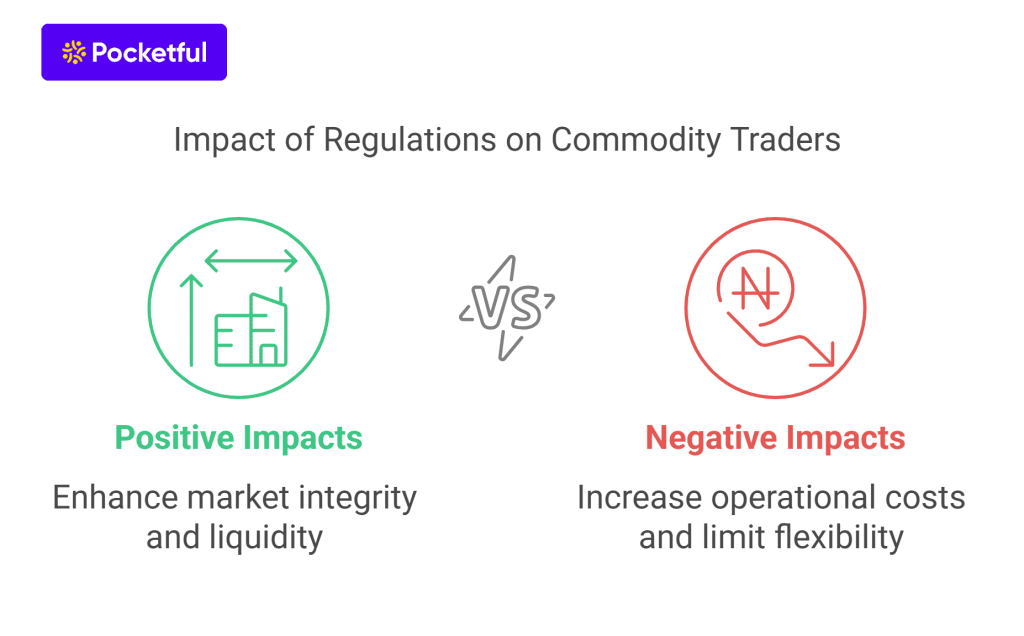
Regulations and commodity trading greatly affect market participants. These impacts can be both beneficial (promoting stability and fairness) and challenging (creating constraints and operational burdens). Let us have a quick overview of the impact of regulations.
Positive Impacts
Enhanced market integrity: Regulations ensure a transparent and fair marketplace by reducing fraud and unethical practices. Traders can feel more confident about the legitimacy of the trading environment due to the presence of strict regulations.
Risk management: Regulations like margin requirements and position limits play an important role in reducing risk.
Increased Liquidity and Participation: Strong regulatory oversight increases participation from institutional and retail investors, thus enhancing liquidity.
Price transparency: Reporting and disclosure requirements improve price discovery, which helps traders and other market participants. Price information and other market data obtained from reliable sources such as the exchange website promote the development of competitive strategies.
Investor Protection: Grievance redressal mechanisms protect small traders and investors.
Negative Impacts
Operational Costs: Complex regulatory frameworks demand substantial resources and experienced professionals for reporting and audit purposes. Smaller trading members may find it difficult to compete because of the high cost of complying with strict regulations.
Limited flexibility: Position limits, margin requirements, and contract specifications limit aggressive trading strategies. The restrictions may limit the profit potential for speculative traders.
Increased oversight: Continuous oversight by regulatory bodies can lead to extra administrative work.
Adapting To Dynamic Rules: Frequent regulatory updates require traders to stay informed and adaptable, which can be resource-intensive. Non-compliance, even if unintentional, can cause penalties or loss of trading rights.
SEBI’s regulations aim to establish a strong and transparent commodity trading system. SEBI promotes market stability and inclusivity, especially for farmers and small traders, by enforcing strict trading risk management systems and participant responsibility guidelines. These regulations protect investors and enhance India’s status as a growing hub for commodity trading Plateform. It is advised to consult a financial advisor before trading in commodities.
Artificial Intelligence (AI) has been an emerging trend for quite some time due to its applications in healthcare, finance and other industries. This technological revolution has a huge potential to shape the future of the finance industry, which is why investors are always seeking investment opportunities in the AI sector. You would be surprised to know that there are some small-cap AI stocks that have the potential to grow way faster than their large-cap peers.
In this blog, we will discuss some of the best small-cap AI stocks in India, as well as their potential, risks and the future of the AI industry.
What are AI Smallcap Stocks?
AI small-cap shares are stocks issued by smaller IT corporations developing innovative AI solutions. These companies are using AI to develop superior software, data analytics tools, robots, or machine learning techniques that have a lot of applications in other sectors. Small-cap AI stocks are very different from big companies as they are high-risk, but if they achieve success in developing superior products and services compared to their peers, then they have the potential to deliver huge returns in the future.
Why Invest in Small-Cap AI Stocks?
Small-cap AI companiesare usually at the forefront of innovation and bring the most important contributions to machine learning, data analytics, and automation. The companies profit through the following ways as the following:
High Growth Potential: Small-cap AI stockshave the potential to achieve exponential growth as the AI adoption rate accelerates.
Undervalued Opportunities: A good number of companies in this category are undervalued, making them quite affordable for the stockholders to get in at very low prices.
Diverse Applications: AI Applications are complex and show different tendencies in e-commerce, travel, health care, and IT services.
Overview of the Top Artificial Intelligence Small-Cap Stocks in India
An overview of the best AI small-cap stocks to invest in 2025 are listed below:
1. Saksoft Ltd
Incorporated in 1999, Saksoft is one of the leading companies in India that has expertise in AI and digital transformation. It deals with data management, business intelligence, and analytics. The company has made great acquisitions, such as DreamOrbit, to diversify its operations in the IoT and logistics space, and the acquisition of Faichi Solutions marked its entry into the health tech sector.
Saksoft Ltd employs generative AI for performance monitoring & optimization, software engineering, strategy development, etc., that increases operational efficiency in very high-growth environments such as fintech, health care, and logistics. Utilizing data engineering and nurturing innovation, Saksoft enables businesses to achieve higher growth through data-driven insights.
Know the Returns:
1Y Return (%)
3Y Return (%)
5Y Return (%)
-22.89%
140.30%
868.22%
(Data as of 20 January 2026)
2. Zensar Technologies Ltd
Zensar Technologies Ltd, is a global IT service company established in 1991 that employs AI & innovative solutions in cloud computing, data analytics, and digital transformation. It is headquartered in Pune, India, with offices in the UK, US, South Africa and Singapore.
Zensar is actively developing the latest AI technologies to help businesses harness the power of AI and increase their efficiency. The company has developed multi-modal generative AI solutions to effectively model text, images, audio and video. VISCA tool integrates AI and large language models to improve search experiences for B2B and B2C sectors by careful analysis of images, text and voice inputs. Other AI solutions developed by the company include enterprise AI engineering, Responsible AI and Enterprise Cognitive Hyper-Automated Operations (ECHO).
Know the Returns:
1Y Return (%)
3Y Return (%)
5Y Return (%)
-0.68%
233.41%
357.78%
(Data as of 20 January 2026)
3. Happiest Minds Technologies Ltd
Happiest Minds Technologies Ltd, is one of the most well-known digital transformation companies around the world. Most of their solutions are AI-enabled, such as cloud computing, IoT, and cybersecurity. The Bangalore-based company was founded in 2011 by Ashok Soota. It has achieved some really impressive milestones since then and was listed on the Indian stock market in 2020.
Happiest Minds has acquired several companies in the past years, such as Pimcore Global Services, in 2021 to strengthen its capabilities in digital experience management and data management. The organization also received many awards, ranking it among India’s top IT service providers when it comes to innovation and employee satisfaction. Being equipped with AI-based offerings, Happiest Minds is improving customer experience through business operations, enhancement in security mechanisms, and operational efficiency, thereby positioning the organization as a leader in AI-driven digital revolution.
Know the Returns:
1Y Return (%)
3Y Return (%)
5Y Return (%)
-29.80%
– 45.78%
60.46%
(Data as of 20 January 2026)
4. Cyient Ltd
Cyient Ltd, incorporated in 1991 and headquartered in Hyderabad, India, is among the world’s leading companies in the technology sector. Key milestones include the early adoption of digital transformation technologies and support to the biggest aerospace, defense, and infrastructure projects around the world.
Cyient develops solutions for the aerospace, automotive, mining, energy, and semiconductor sectors. With its AI-based offerings, such as predictive maintenance analytics, intelligent transportation systems, and advanced digital engineering, Cyient allows its clients to optimize their operations and minimize downtime. Through its AI solutions, Cyient continues to push boundaries for efficiency and competitiveness across industries.
Know the Returns:
1Y Return (%)
3Y Return (%)
5Y Return (%)
-31.95%
35.01%
140.16%
(Data as of 20 January 2026)
5. Kellton Tech Solutions Ltd
Established in 1993, Kellton Tech Solutions Ltd is an IT company that provides end-to-end digital transformation solutions across the globe using cutting-edge technologies such as AI, IoT, and blockchain. The company has enjoyed multiple milestones over the years: its strategic acquisition of ProSoft Group Inc. in 2014 and the acquisition of PlanetPro in 2015 expanded its capabilities to develop end-to-end enterprise IT solutions and customer engagement.
Kellton Tech has developed utilitarian AI that helps you transform your data into insights and actions. It helps businesses track customer behavior and enhance customer experience with personalized interactions and tailored recommendations. Its core competency for integrating technology with traditional processes strengthens the operations of manufacturers and retailers, helping them leverage the power of AI.
Know the Returns:
1Y Return (%)
3Y Return (%)
5Y Return (%)
-50.56%
32.96%
8.77%
(Data as of 20 January 2026)
6. Affle 3i Limited
Affle 3i Limited, was founded in 2005 as a leader in mobile marketing and now offers AI-driven advertising and consumer engagement solutions. Appnext, a proprietary platform built by the company, uses user data for personalized app recommendations. The result is higher conversion rates and, thus, improved campaign performance.
Important acquisitions include the Vizury Commerce Business in 2018, which enhanced its retargeting media capabilities and MediaSmart in 2020, which helped to create programmatic advertisements and sync advertising campaigns across screens. These strategic moves expanded its global footprint and diversified its offerings.
Affle 3i Limited continues to optimize mobile advertising performance by using AI insights, thereby maximizing marketing ROI for brands and effectively reaching the right audience. Its innovative approach and stronghold on AI technology will help it maintain its position as the leader in the competitive mobile advertising industry.
The benefits of investing in smallcap AI stocks are:
State-of-the-Art Technology: Smallcap AI companies have the expertise to help businesses streamline their operations with the help of technology.
Market Disruption: AI technology has the potential to disrupt conventional industries, which will give investors an option to earn extraordinary returns.
Agility: Small-cap companiesare able to adapt to market changes and customer demands quicker than bigger companies.
Risks of Investing in Smallcap AI Stocks
The risks of investing in smallcap AI stocks are:
Volatility: These smallcap AI stocks can be volatile due to adverse market trends, speculative trading, etc.
Intense competition: The fierce competition from established IT companies will likely be the main barrier to the success of smallcap AI stocks.
Limited resources: Small companies may face issues in their business operations, such as scaling up due to the lack of sufficient resources.
Regulatory challenges: The adoption of AI technologies can be much slower than expected if the regulatory policies are not favorable.
Future of the AI Industry in India
The future of AI looks promising due to the reasons mentioned below:
Wide-scale Applications: Companies developing AI solutions can witness an increase in their revenues as their products and services have applications in many industries.
International Collaboration: International collaboration with some big tech giants is leading innovation and funding for AI-focused start-ups.
Expanding Talent Pool: The talent pool is growing in India, which will ensure that the country will have a steady supply of skilled professionals for the AI industry.
Conclusion
Artificial intelligence small-cap stocks have the potential to be an excellent investment for those who would like to benefit from the adoption of AI technologies. The future of industries will be defined by solutions and innovations from companies like Saksoft, Happiest Minds, Affle 3i Limited, etc. These are some of the best small cap AI stocks that will drive your portfolio performance in the near future.
The companies mentioned in this blog have a promising future but do not forget to consider your risk tolerance and diversify your investments to achieve a balance of risks and rewards. AI is the future, and investing in small-cap AI stocks can be one of the best ways to be a part of this digital transformation.
S.NO.
Check Out These Interesting Posts You Might Enjoy!
Saksoft, Happiest Minds Technologies, Affle 3i Limited, and Cyient are some of India’s best AI stocks. However, you should consult a financial advisor before investing in these stocks.
What is the fastest-growing small-cap AI stock?
Saksoft has been the fastest-growing smallcap AI stock as it has generated a return of 1,143.16% in the past five years.
Are small-cap AI stocks risky?
Yes, investing in small-cap AI stocks can be risky due to high volatility due to adverse market trends and speculative trading activities.
How do you evaluate small-cap AI stocks?
Consider factors such as revenue growth, market position, innovation in AI, and industry trends to identify AI stocks with the best future growth potential.
Which sectors are getting the most benefit from AI small-cap companies?
Healthcare, finance and marketing sectors are some of the key beneficiaries of AI-driven solutions offered by small-cap AI firms.
Selection Methodology and Important Disclaimer
The stocks included in this list are selected primarily on the basis of their market capitalisation, which represents the total market value of a company’s outstanding shares. The companies are arranged in descending order of market capitalisation, with larger companies appearing first, followed by relatively smaller companies. This methodology is intended to provide a structured approach for identifying companies based on their market size and overall presence within a sector.
However, market capitalisation should not be considered the sole factor while evaluating investment opportunities, as it does not guarantee future performance, profitability, or returns. Investors should also assess other important factors such as financial health, business fundamentals, management quality, valuation metrics, industry outlook, and market conditions before making investment decisions.
The information provided is for educational and informational purposes only and should not be construed as investment advice, recommendation, solicitation, or an offer to buy or sell any securities by Pocketful Fintech Capital Private Limited.
In recent times, the commodity market for goods like precious metals, energy and crops has drawn attention from traders, investors, and hedgers. This market provides an opportunity for the market participants to buy and sell commodities. Yet, knowing the market’s opening and closing times is critical.
Commodity trading in India mainly takes place on MCX and NCDEX. These exchanges have specific trading hours based on domestic and international regulations. This blog covers the trading hours for commodities in India and gives tips for traders on how to enhance their efficiency during these hours.
What is the Commodity Market?
A commodity market is a place for the purchase and sale of commodities and related derivatives contracts. These commodities include metals, energy, agricultural products, etc. The market makes it possible to trade commodities in real form as well as through derivatives like options and futures.
Types of Commodity Market
Spot Market: In the spot market, commodities are traded for immediate delivery and prices are determined by current supply and demand.
Derivatives Market: In the derivatives market, commodities are traded via futures and options contracts that outline the delivery date and quantity.
Furthermore, major commodities traded are as follows,
Agricultural commodities include wheat, rice, turmeric, cotton, sugar, etc.
Energy commodities include crude oil and natural gas.
Metals include gold, silver, copper, aluminium, zinc, etc.
Commodity Market Trading Timings
The commodity exchange is open every day except Saturdays, Sundays and holidays designated by the exchange. The exchange provides a list of holiday dates for each year in advance. The exchange holds trading sessions for various commodities from Monday to Friday as follows:
Agricultural commodities: The trading starts at 9:00 AM and continues till 5:00 PM.
Internationally Referenced Agricultural commodities: Trade starts at 9:00 AM and ends at 9:00 PM.
Non-Agricultural Commodities: The trading hours of non-Agri commodities vary according to the concept of Daylight Saving Time, which is explained below. The trading hours are mentioned below:
Trading starts at 9:00 AM and ends at 11:30 PM from March till November.
Trading starts at 9:00 AM and ends at 11:55 PM from November to March during Daylight Savings Time.
(Internationally referenced commodities are those commodities whose prices and trading are guided by global markets and indices. These commodities are traded globally, with their prices influenced by international demand and supply, geopolitical events, and macroeconomic factors).
Did You Know?
After Daylight Saving Time (DST) begins in the spring in the U.S., India’s commodity trading end time is adjusted to match international commodity market hours. The concept of daylight savings time in the US involves moving clocks forward in the spring season months to extend evening daylight and save energy.
At the start of DST, clocks are set forward by one hour on the 2nd Sunday in March and at the end of DST, clocks are set back by 1 hour on the first Sunday in November, which is also known as ‘falling back’. During daylight saving time (DST), time zones include daylight in their names, for example, Eastern Daylight Time (EDT) instead of Eastern Standard Time EST.
In spring, usually starting on the second Sunday of March, the US moves the clock forward by 1 hour for daylight saving time (DST). This creates a one-hour time difference between the US and India. Commodity trading Plateform in India, especially on platforms like MCX, aligns with the trading hours of global benchmarks like NYMEX. To keep trading in sync, India adjusts its trading end time.
This synchronization gives Indian traders access to the latest price trends and market movements until the end of the major global commodity market.
In a nutshell,
Commodity
Trade Start Time
Trade End Time
After the start of US Day Light Saving in the Spring Season
After the End Time of US Day Light Savings in the Fall Season
The holidays mentioned below represent the days when both the morning session and evening session will not be held for trading.
Day
Date
Holiday
Friday
18 Apr 2025
Good Friday
Friday
15 Aug 2025
Independence Day
Thursday
02 Oct 2025
Mahatma Gandhi Jayanti
Tuesday
21 Oct 2025
Diwali-Laxmi Pujan (Muhurat trading session)
Thursday
25 Dec 2025
Christmas
Trading Hours for Major Commodity Exchanges
The trading hours of major commodity exchanges are:
Multi Commodity Exchange of India Ltd.
The morning session starts at 9:00 AM and ends at 5:00 PM IST, and the evening session starts at 5:00 PM and ends at 11:30 PM. The trading end time shifts to 11:55 PM during US Daylight Saving Time for non-agricultural commodities. On the other hand, the trading session for agricultural commodities ends at 5:00 PM.
National Commodity & Derivatives Exchange (NCDEX)
The trading session for the commodities derivatives segment starts at 10:00 AM and ends at 5:00 PM IST.
The best times to trade in the commodities market are when the following conditions are met:
High Liquidity: Liquidity is important for effective trading and accurate price discovery. Indian exchanges like MCX experience high trading activity during opening hours as traders respond to overnight trends in international markets.
Volatility Timing: Volatility presents profit opportunities but also increases the risks. The post-afternoon session in the Indian commodity market coincides with the global markets, which is from 3:00 PM to 5:00 PM. European markets influence global commodity prices significantly. In the evening, the US markets are active, which impacts international commodities like crude oil, gold, and natural gas, resulting in greater volatility.
Avoid Flat Periods: Avoid trading during lunch hours, i.e., from 1:00 PM to 3:00 PM, where liquidity tends to drop as traders take breaks or near market close as the market activity slows, decreasing the chances of profitable trades.
Monitor News and Economic Data Releases: Trading around key events can be profitable but also risky. Significant events include crude oil inventory reports, US Federal Reserve announcements, and economic data such as employment figures or inflation reports.
Based on Commodities: Trade in precious metals like gold and silver trade during US market hours (evening in India) between 7:00 PM to 11:55 PM as these commodities have increased liquidity during these hours.
If you are trading in energy commodities like crude oil and natural gas, the best time to trade is between 6:00 PM and 11:55 PM, as these commodities are considered highly responsive to New York Mercantile Exchange (NYMEX) activity.
Lastly, if you are trading in agricultural commodities, then domestic trading hours are the most active ones, and these are less influenced by international markets. The best time to trade is between 10:00 AM to 2:00 PM.
How to Stay Updated on Market Timings and Holidays?
Keeping track of market timings and holidays is essential for a seamless trading experience in the commodity markets. You can keep yourself updated using the following resources:
Exchange Website: Indian commodity exchanges such as MCX and NCDEX provide updates on market timings, holiday schedules, and special trading sessions on their websites. Regularly check these websites to keep yourself updated on changes in trading hours, public holidays, etc.
Mobile Apps: Market news applications also provide updates on market timing and related events.
Circular from Regulatory Body: Circulars released by the SEBI also provide updates on market events. Keep an eye on their official announcements. You can find these circulars on their website.
Notification from Brokers: Most brokers send regular updates through emails, SMS, or mobile app notifications regarding changes in market trading hours or holidays and other settlement schedules, so make sure to enable notifications in your broker’s app.
Follow News: Additionally, you can also follow the social media handles of major business news channels and commodity exchanges to keep yourself updated about the upcoming holidays.
Tips for Trading Around Holidays
Trading around holidays offers unique trading opportunities and risks because of lower liquidity due to a reduction in market participants and possible volatility. Below mentioned are some tips to consider for effective trading around holidays.
Check the holiday list, as the financial market may be closed for a particular session or be closed entirely on certain holidays. Take time to understand the holiday schedules of the exchanges and plan your trades accordingly.
When trading in internationally referenced commodities, be aware of holidays in other countries as they can impact the liquidity and price movements. Many traders take a break during holidays, which lowers trading activity. This can cause wider bid-ask spreads and increased slippage.
Be cautious of sudden price changes in thinly traded markets, especially when using high-leverage strategies. Market closures can lead to price gaps when trading resumes, especially after major news events.
Be aware of scheduled announcements, as key economic reports and earnings releases around holidays can affect the market. Additionally, it is also necessary to keep yourself updated about news, as unscheduled geopolitical or economic events can cause significant price changes in commodities.
Markets often show distinct patterns during holidays, such as the “Santa Claus rally,” which is a year-end market rise where some sectors may perform well while others may slow down.
Conclusion
India’s commodity market provides a strong platform for trading various commodities. Knowledge about trading hours can greatly improve a trader’s ability to plan your trades and profitability. Staying informed is essential for both morning sessions focused on domestic markets and evening sessions influenced by international factors. In the commodity market, traders can increase their chances of success by adopting different tactics for each trading session. Winning at commodity trading relies not just on getting the timing right; it’s also about how well you’re prepared and how disciplined you are. However, commodity trading can be extremely risky, so it is advised to consult a financial advisor before trading.
How often do market timings change due to daylight saving time or DST?
Market timings for the Indian commodity market change twice a year when the US begins the Daylight Savings Time mechanism in March and again in November.
Do commodities trade on Indian public holidays?
Some commodities linked to global markets may continue to trade even on Indian public holidays.
How do I know if there is a special trading session?
Exchanges announce special trading sessions in advance through circlers on their websites.
What happens if a holiday falls on the last settlement date?
The settlement is preponed, and exchanges will notify traders about the revised date.
What commodities are traded during evening and morning sessions?
Commodities like crude oil, silver, and natural gas are traded in the morning and evening sessions, while agricultural commodities are generally traded only during the morning session.
Have you ever thought about the apps on your phone, the games you play, the social media you use, the music you stream, the smartphones, the laptops, and even the self-driving cars you use; how all of these are made and what is the magic behind this- all of these are made from complex software and created by the brilliant minds from IT companies. They prepare the code, design the systems, and build the platforms that power our digital world.
Investing in IT software stocks is like investing in these brilliant minds who are behind this magic. It is all about believing in the power of innovation and the potential of these companies to grow and generate a better return on those investments.
In this blog will explore the best IT sector penny stocks and their insights. Whether you are a professional investor or trader or just starting your investment journey, this blog will provide you with valuable insights into IT Software stocks.
What are IT Software Penny Stocks
The IT software Penny stocks are shares of the companies that provide Information technology services such as software development, hardware manufacturing, IT consulting, cloud or server services, telecommunications, internet-related services, and tech support. These penny stocks are typically traded at a lower price, which attracts investors from their potential to grow from ongoing innovations in this sector and provide magnificent returns in the long run. However, these stocks are subject to high volatility and sometimes with low liquidity, so investors should consult their financial advisors before investing in them.
Infibeam Avenues Ltd. is a financial technology company incorporated in 2017; it is involved in the business of software development services, maintenance, web development, payment gateway services, e-commerce and other IT services.
The company leads in the business of SaaS-based ( software as a service) platforms and provides software platforms for merchants. The company is aiming to be a key player in AI fraud detection and prevention, by creating a new AI Hub from the investment of one billion rupees.
2. PCS Technology Ltd.
PCS Technology Ltd., established in 1983, is a well-known Indian IT solutions provider, delivering cutting-edge and innovative solutions to clients. With a global presence in over 20 offices, 30 service centres and along with its 200+ direct points of presence across India, it is helping to enhance business performances by leveraging proven processes and technological solutions.
3. Saven Technologies Ltd.
Saven Technologies Ltd. is the fastest-growing software development and technology consulting firm with a specialization in the development, delivery, and implementation of technology-driven business solutions.
Saven Technologies Ltd offers more than 60 companies around the world a comprehensive variety of services to overcome their new and existing IT-related challenges.
4. Accel Ltd.
Accel Ltd was established in 1991 as a vendor-independent IT services company headquartered in Chennai, India. Over the years, a passion for excellence and great customer service helped this start-up to grow into a successful technology service company.
Accel Ltd shows its strong presence in the domestic and international markets by offering a wide range of IT Services, such as IT Infrastructure Management Services, Warranty Management Services, Managed Print Services, Cyber Security, and Software Services.
5. Rolta India Ltd.
Rolta India Ltd is a leading provider of innovative IT solutions for many vertical segments, including Federal and State Governments, Defence and Homeland security, Utilities, Process, Power, Financial Services, Manufacturing, Retail, and Healthcare.
Rolta, by using its expertise in IT, engineering, and geospatial fields, develops advanced digital solutions. These solutions, built with Rolta’s unique technology, focus on cloud computing, mobile technology, IoT, business intelligence, and big data analytics.
6. DigiSpice Technologies Ltd.
Digispice Technologies Limited is an Indian company that offers telecom software, value-added services, and mobile content to domestic and global telecom operators. It operates in two segments; the first one is DiGiSPICE- which is focused on telecom and digital technology services, and the second one is Spice Money- which provides financial tech services like money transfer through Domestic Money Transfer(DMT) services, Aadhar-Enabled Payment Services (AEPS), and bill payment services through Bharat Bill Payment System (BBPS).
7. 3i Infotech Ltd.
3i Infotech Ltd is a global IT company headquartered in Mumbai, India. It offers a wide range of IT services, such as developing and managing software, IT infrastructure management, testing, analytics, consulting, and business process outsourcing.
Company through its wide range of IT services serving over 1000+ clients in more than 50 countries, and showing its significant presence in geographies like North America, India, Asia Pacific, Middle East and Africa, Saudi Arabia, and South Asia. The Company is contributing to India’s digital transformation through its expertise in BFSI, Healthcare, Manufacturing, and Retail.
8. HCL Infosystems Ltd.
HCL Infosystems Ltd. was incorporated in 1986 and headquartered in Noida, India. It is engaged in the distribution of technology, mobility, and consumer electronic products. HCL group holds 63% of the total shares in the HCL Infosystem and provides support in financial and operational obligations.
The company operates in Hardware products and solutions, Distribution and Learning. The company generates most of its revenue from hardware products. Its Hardware Products & Solutions division manages large system integration projects for government clients.
9. GVP Infotech Ltd.
GVP Infotech Ltd was established as Fourth Dimension Solutions Private Ltd in 2011 in Delhi. The company is an Information Technology Infrastructure company and also provides technical support services. The company also operates in e-governance services, offering Aadhar enrollment and corrections, citizen service centers, and customer service centers. The company also provides quality manpower deployments for the Government, PSU and Corporate center.
10. FCS Software Solutions Ltd.
FCS Software Solutions Ltd was incorporated in 1993. It offers a variety of IT and IT-enabled services such as software development, marketing and support for corporate firms in BPO, software development, e-learning, and related IT-enabled services. The Company also operates overseas and has subsidiaries in the US, Germany, UAE, and China.
While analyzing IT sector penny stocks, it is always necessary to consider their key performance indicators (KPIs) that could give an idea about the potential of the stock.
Company
Net Profit Margin (in %)
ROE (in %)
ROCE (in %)
P/E
Infibeam Avenues Ltd.
4.98
4.57
5.68
59.82
PCS Technology Ltd.
298.28
2.31
3.70
72.49
Saven Technologies Ltd.
18.93
13.50
17.99
27.73
Accel Ltd.
1.83
7.89
9.61
33.05
Rolta India Ltd.
0.00
0.00
0.40
-0.07
DigiSpice Technologies Ltd.
2.68
4.75
13.06
48.90
3i Infotech Ltd.
-36.64
-101.64
-10.77
-2.23
HCL Infosystems Ltd.
-49.33
0.00
10.25
-35.21
GVP Infotech Ltd.
8.53
1.67
1.71
63.24
FCS Software Solutions Ltd.
-32.80
-4.01
2.88
-52.14
(Data as of March 2025)
Advantages of Investing in IT Software Penny Stocks
Investing in the IT sector penny stocks can offer significant advantages due to their potential for growth and the broad level of adaptation of innovation, which can lead to outstanding returns on investment.
High Growth Potential: The IT sector is outperforming due to rapid innovation and evolving technologies. Penny stocks in this sector are the companies that are at the forefront of this trend and can offer explosive growth and substantial returns.
Low Entry Cost: The low price of penny stocks enables them to be accessible for investors with limited capital. This allows them to diversify their portfolio from investing in high-growth IT sectors.
Policy Support: The Government is supporting this sector through their union policies, in the union budget 2024-25, the allocation of the IT sector and telecom sector stood at Rs 1,16,342 crore.
Investing in IT sector penny stocks carries some risks despite their potential of high growth, which are:
High Volatility: Penny stocks are subject to high volatility due to high price swings and are highly influenced by market sentiment and news.
Low Liquidity: These stocks have very low volume so it is difficult to buy and sell in high quantities or execute trade on specific price.
Speculative Nature: Investing in penny stocks is based on speculation, not on fundamental analysis, which leads to higher risk.
Lack of Fundamental Strength: Many penny stocks are companies which have weak fundamentals, such as low revenues, high debt, and uncertain profitability. These companies may not be able to sustain long term growth, and increase the risk of unpredictable losses.
Conclusion
Investing in IT sector penny stocks gives better opportunity to investors to capitalize their money from investing in them due to their high growth potential and low entry cost. However, investing in penny stocks carries several risks, and it can wipe out your investment. So, before investing in IT sector penny stocks it is essential to consult with your financial advisor and understand the company’s financials thoroughly.
S.NO.
Check Out These Interesting Posts You Might Enjoy!
The IT software Penny stocks are shares of the companies that provide Information technology services such as software development, hardware manufacturing, IT consulting, cloud or server services, telecommunications, internet-related services, and tech support.
Which are the top IT sector penny stocks in India as per market capitalization?
The top IT sector penny stocks as per market capitalization are Infibeam Avenues Ltd., DigiSpice Technologies Ltd., FCS Software Solutions Ltd., HCL Infosystems Ltd., and 3i Infotech Ltd.
What Factors can influence the IT software penny stocks?
The price of IT Software penny stocks can be influenced by various factors such as company earnings, industry trends, new rules, technological updates, market sentiment, and the overall economy.
Are there IT penny stocks in India priced below ₹1?
Yes, Avance Technologies Ltd. trading at the price of ₹0.86 per share, and many more IT stocks are available, which trades below ₹1.
Are there IT penny stocks in India priced below ₹10?
Yes, Rolta India Ltd. and FCS Solutions Ltd. are trading below ₹10.
Selection Methodology and Important Disclaimer
The stocks included in this list are selected primarily on the basis of their market capitalisation, which represents the total market value of a company’s outstanding shares. The companies are arranged in descending order of market capitalisation, with larger companies appearing first, followed by relatively smaller companies. This methodology is intended to provide a structured approach for identifying companies based on their market size and overall presence within a sector.
However, market capitalisation should not be considered the sole factor while evaluating investment opportunities, as it does not guarantee future performance, profitability, or returns. Investors should also assess other important factors such as financial health, business fundamentals, management quality, valuation metrics, industry outlook, and market conditions before making investment decisions.
The information provided is for educational and informational purposes only and should not be construed as investment advice, recommendation, solicitation, or an offer to buy or sell any securities by Pocketful Fintech Capital Private Limited.
Investment is one of the most crucial routes to the creation of wealth and to financial growth. Two of the most sought-after markets in this arena are the stock market and the commodity market. While both offer attractive investing and trading opportunities, their nature of assets, workings, and objectives are quite different in essence. The differences must be understood by investors to make informed investment decisions.
In this blog, we look at the difference between equity and commodity markets, their features, advantages, and suitability so you can decide which market is right for your financial needs.
What is the Stock Market?
The stock market, which is also called the equity market, is where people can buy and sell shares of listed companies. Investors buying shares make them a partial owner of that firm and give them the right to vote on issues affecting the company.
How the Stock Market Works?
The buying and selling of equity shares in the Indian stock market occurs on two exchanges, i.e. the National Stock Exchange and the Bombay Stock Exchange in India. It offers a structured and regulated platform for trading stocks and other securities.
Financial Instruments: Stocks, exchange-traded funds (ETFs), and derivatives like options and futures are common instruments.
Participants: Those engaging in the Indian stock market are retail investors, institutional investors, mutual funds, and hedge funds.
Regulatory Body: In India, the stock market is governed by the rules and regulations governed by the Securities and Exchange Board of India to ensure transparency and fairness.
Primary Market: This market features a company issuing new shares to the public through an IPO process. The investors buy newly issued shares directly from the company.
Secondary Market: The shares issued in the primary market are traded among various investors in the secondary market.
Key Features of the Stock Market
Liquidity: Shares of well-known companies can be easily bought and sold due to high liquidity.
Long-term Growth Potential: The returns from equity investments, when held for a long period, can be substantial.
Risk and Volatility: The prices of the shares fluctuate due to market trends, economic factors, and company performance.
Ownership Rights: Shareholders are the partial owners of the company and are entitled to dividend income or to participate through voting in any significant decisions.
The commodity market is the market for trading raw materials and natural resources. Resources which are traded here are: agricultural products, energy sources, and precious metals. This marketplace provides opportunities to producers, consumers, as well as speculators to hedge as well as profit from short term price movements.
How the Commodity Market Works?
Commodities are physical assets and are traded as spot contracts or futures contracts.
Trading Instruments: Commodities such as gold, silver, crude oil, wheat, and coffee are traded in the form of either spot contracts or derivatives.
Participants: Some of the key players involved in the commodity market are the producers-farmers or miners-and consumers-industries, along with speculators and traders.
Regulation: The commodity markets in India are regulated by SEBI and function through some of the following platforms- Multi Commodity Exchange, National Commodity and Derivatives Exchange.
Types of Commodities
Hard Commodities: These include all naturally occurring resources which come directly from the earth such as crude oil, gold and silver.
Soft Commodities: These consist of agricultural products, which would include wheat, coffee, cotton, etc.
Important Features of the Commodity Market
Hedging Opportunities:Commodity trading Plateform is used by market participants to hedge against adverse price movements.
High Volatility: Commodity prices are greatly influenced by global supply and demand, geopolitical issues, and natural catastrophes.
Speculative Opportunities: High volatility attracts speculative traders looking to benefit from massive price movements.
The advantages and disadvantages of the commodity market are:
Advantages
Diversification: Commodities act as an inflation hedge and allow for the diversification of portfolios.
Hedging Opportunities: Businesses dealing in commodities as an end product or raw material can hedge risks through futures contracts.
High Returns: Speculators can achieve high returns during volatile market conditions if they correctly predict the market direction.
Disadvantages
High Volatility: The price of commodities can be severely impacted by unexpected events such as natural disasters and geopolitical actions.
Complex Market Dynamics: Global trends and commodity-specific factors require expertise to understand.
No Recurring Income: Commodity investments do not provide a recurring income, unlike equities that offer dividends.
Which Market is Right for You?
It largely depends on your financial goals, risk tolerance, and expertise level for you to determine whether you should invest in equity or commodity markets.
Stock Market is Right for You If:
You are willing to invest for long-term wealth creation.
You wish to invest in growing businesses.
You have a moderate to high-risk appetite and can tolerate market fluctuations.
Commodity Market is Right for You If:
You want to hedge against inflation or adverse price movement in the commodity prices.
You are an expert in analyzing the global commodity market trends and supply-demand factors.
You are interested in short-term speculative trading opportunities.
For instance, a person looking for steady wealth accumulation over time may prefer the stock market. A trader who wants to capitalize on price fluctuations may find the commodity market more suitable.
The stock market and the commodity market represent two different avenues through which wealth can be created. The difference between equity and commodity is based on the underlying assets, the kind of market participants involved, the financial objectives of individuals, and the inherent risks. While the former features shares that represent ownership in companies and individuals investing with the goal of long-term growth, the commodity market is for people looking for short-term trading opportunities, hedging and diversification.
The choice between the two would basically depend on your financial goals concerning investments, risk tolerance level, and knowledge of each market. It is advised to consult a financial advisor before investing.
What is the difference between equity and commodity markets?
Their underlying assets are one of the key differences between the two, as the equity market deals with company shares, whereas a commodity market focuses on raw materials and natural resources.
Which is relatively riskier: equity or commodity?
Commodity markets tend to be slightly more volatile than the equity market as they mainly feature derivative contracts and due to other factors like global tensions, natural disasters, etc.
Can I invest in both equity and commodity markets at the same time?
Yes, many investors diversify their portfolios by participating in both equity and commodity markets to balance risk and returns.
Is commodity trading profitable in India?
Commodity trading can be profitable for those who understand market dynamics and employ effective risk management strategies.
How do I choose between equity and commodity investments?
Consider your financial goals, risk, and market knowledge. An individual looking for long-term growth can participate in equity markets, whereas commodities markets are ideal for those looking for short-term trading and hedging.
The commodity market is a world where raw materials meet investment opportunities. Think gold, oil, and wheat. These aren’t just abstract items—they’re things you see, use, or hear about daily. Trading them? It’s about more than money; it’s about understanding how the world ticks.
But let’s be real: getting into it can feel overwhelming. Charts, terms, margins—it’s like learning a new language. The good news? You don’t need to be a financial wizard to succeed. You just need the right guide. That’s what this is—a roadmap for how to trade in the commodity market, simplified, straightforward, and full of tips that actually work.
What is a Commodity Market?
Let’s start with the basics. The commodity market is where raw goods are bought, sold, and traded. The players? Farmers, manufacturers, traders, and investors like you. The products? Two main types:
Hard Commodities: Think of metals like gold and silver or resources like oil.
Soft Commodities: Crops like coffee, sugar, or wheat—goods that are grown, not mined.
Unlike stocks, where you invest in a company’s future, here you’re dealing with tangible items. A barrel of oil. A sack of sugar. The value of these goods depends on real-world factors like weather, politics, and global demand. If you’ve wondered how to invest in commodities in India, this is where it starts: knowing what you’re trading and why.
How the Commodity Market Works
At its heart, commodity trading in India is about predicting price changes. Will crude oil cost more tomorrow than today? Is gold going up or down?
Here’s how it plays out:
Spot Market: Goods are bought and sold for immediate delivery. Simple, straightforward.
Futures Market: You agree to buy or sell a commodity at a set price on a future date. It’s less about owning the item and more about betting on price movement.
Let’s say you expect wheat prices to rise due to poor harvests. You buy a futures contract. If your prediction is right, you profit. If not? You lose. This constant push-and-pull makes commodity trading dynamic—and risky. Knowing the ins and outs of this system is key to mastering how to trade in commodities effectively.
Steps to Start Trading in the Commodity Market
You don’t need a fortune to get started. Here’s how:
1. Open a Demat and Trading Account
Find a broker. They’re your entry ticket to the commodity market. You’ll need to Open a Demat and Trading Account with a reputable firm. Make sure they’re authorized for commodities and offer user-friendly platforms.
2. Pick Your Commodity
Start simple. Gold and crude oil are popular choices for beginners. They’re easier to track and less unpredictable than, say, soybeans or coffee.
3. Do Your Homework
Research is everything. Check historical price patterns, follow the news, and use trading apps to stay updated.
4. Start Small
Don’t throw your life savings into your first trade. Begin with an amount you’re okay losing. The goal is to learn the ropes, not strike gold on Day 1.
With these steps, you’re not just learning how to invest in the commodity market; you’re setting a foundation for long-term success.
It is essential to have a robust strategy before investing in the commodity market. However, you must bear in mind that a strategy that works for one trader does not necessarily mean that it would work for all traders. So, it is crucial to have a plan depending on your risk appetite, knowledge, profit target and commodity types in the Indian market. Here are the key strategies to help you succeed in commodity trading in India.
Willing to Learn
It is important to have a complete understanding of the trading domain before you step into it. Similarly, you must get a better knowledge of commodity trading, futures and options while understanding how they trade. It is also crucial to understand the support and resistance level as well as margins to ensure a successful trading journey.
Treat Leverage Cautiously
Commodity trading, unlike stock trading, often involves high leverage. You must be wondering what is leverage. Leverage allows you to create a trading position worth much more than the funds deposited. The margin needed to place a trade ranges from 6% to 35% in India.
Investors looking to trade in commodity markets are often drawn to leverage and enter the market with the goal of making large gains with a small investment. However, leverage can be a double-edged sword if not used with caution. While leverage can multiply your earnings, it can also compound your losses (if the market moves in the opposite direction).
As a result, it is prudent to weigh the benefits and drawbacks of leverage before trading in the commodity market.
Choose the Best Broker
A broker plays an important part in deciding the benefits of commodity trading. For example, if the broker’s platform is slow, order execution may be delayed. Furthermore, if the brokerage fees are too high, your actual profit may be reduced.
Fortunately, many online brokers allow you to register a free account and trade at low fees. Furthermore, they offer an app for conducting online transactions on the go. Pocketful is one of the best commodity trading apps as it offers a fast and easy-to-use mobile application and a web platform at very low fees.
Make Volatility Your Best Friend
Volatility is an inherent characteristic of traders. Perhaps the finest commodities market trading ideas are those that help you comprehend and capitalize on volatility.
Some commodities are extremely volatile (such as copper or agricultural commodities), whereas others are less volatile (such as gold, crude oil, etc.). Low-volatile commodities tend to maintain a consistent trajectory within a larger long-term trend. For example, during the peak of the COVID-19 epidemic, oil prices fell precipitously and remained low for a long period. And, for an investor, such periods might be ideal for profiting from commodities market trading.
To make volatility your friend, you must first grasp the overall trend and price range of the commodity you intend to trade. In addition, while trading a commodity, you must select a lot size.
For novices, it is best to begin with low-volatile commodities before progressing to high-volatile commodities. Once you understand price movement, the commodities market suggestions you receive from your broker will make more sense to you.
These strategies aren’t just for experts. They’re practical tools anyone can use when learning how to trade in the commodity market.
Here’s the truth: trading commodities isn’t a walk in the park. Prices can swing wildly, and leverage (borrowing money to trade) can magnify losses.
The Big Risks
Market Volatility: A geopolitical situation in the Middle East could send oil prices soaring. A bumper crop season could cause wheat prices to drop significantly.
Liquidity Issues: Not every commodity has enough buyers and sellers, making it hard to trade at times.
Emotional Decisions: Fear and greed are your worst enemies. They lead to impulsive trades and unnecessary losses.
The key? Keep emotions in check. Set stop-loss limits. And never trade more than you can afford to lose.
Tips for Beginners
Starting your journey in commodity trading can be exciting yet challenging, so here are some essential tips to help you navigate the market with confidence.
Learn Before You Leap: Watch videos, read articles, and join forums. Knowing the basics makes a huge difference.
Use the Best Commodity Trading App: A good app can provide real-time updates and analysis, making trades easier.
Practice First: Many platforms offer demo accounts. Use them to test strategies without risking real money.
Stay Disciplined: Set a plan for each trade—when to enter, when to exit, and how much to risk. Stick to it.
Remember, it’s okay to make mistakes. Every trader has lost money at some point. What matters is that you learn and keep going.
Commodity trading is part art, part science. It’s about timing, strategy, and a bit of gut instinct. Whether you’re figuring out how to invest in commodities in India or anywhere else, the process is the same: start small, stay informed, and grow step by step.
The rewards? They’re not just financial. It’s the thrill of making a call and being right. The satisfaction of understanding something most people don’t. And the sense that you’re playing a small but real role in the global economy. However, it is advised to consult a financial advisor before investing.
What is the minimum amount required to start commodity trading?
There is no fixed minimum amount required to start commodity trading. However, you can start with as little as Rs 10,000, depending on the broker. Some commodities may require higher margins.
Can beginners trade in commodities successfully?
Yes. Start with less volatile commodities, educate yourself, and focus on small, consistent wins.
Are commodity markets open 24/7?
No. In India, commodity markets do not operate 24/7. These markets allow commodity trading from Monday to Saturday. There are fixed market hours, such as 10 am to 5 pm, which is the morning session. The evening session starts from 5 pm to 11.30 pm or 11:55 pm.
What is the minimum amount required to trade in commodities?
There is no fixed amount as it varies. The margin required depends on the commodity and your broker. ₹5,000 to ₹10,000 is common for smaller trades.
How do I calculate my profit or loss in commodity trading?
Subtract your buying price from the selling price, then multiply by the lot size. Don’t forget to account for brokerage and taxes.
Open Free Demat Account
Join Pocketful Now
You have successfully subscribed to the newsletter
There was an error while trying to send your request. Please try again.