Blog

  • What Is Common Stocks?

    What Is Common Stocks?

    Common Stocks refers to a kind of security that signifies a proportion of ownership of a corporation. When you purchase common stocks of Reliance, TCS, or HDFC Bank, you’re not actually placing a bet on an intangible figure rising rather you’re buying a portion of that business.

    But you must be thinking about what you can get from these common stocks. You’re getting a share of the profits, and a say in how the firm will shape up in the future. This is the main driver of wealth creation in India.

    This blog will break down exactly how a common stock offering (IPO) works to give life to these shares and the distinction between common stock and preferred stock, and how you can incorporate them into your portfolio.

    What Is Common Stock?

    Common stock, on the other hand, is equity. It is a common form of ownership in a corporation, meaning they are stocks that give equity to the investors in the company. Here the investor owns a stake by buying the company’s share. As opposed to being a loan, where you get interest, you own a stake. Instead of a loan, where you have an agreement stating “we will pay you back,” you have an agreement stating “we will give you a share of what we build.”

    Here you get your share in two ways: 

    Dividends: If the company makes a massive profit, the Board of Directors might decide to share that cash with you. This is your reward for trusting them.

    Capital Gains: If the company grows, the value of your slice grows. This is where the real wealth is made, when the stock price jumps from Rs.100 to Rs.500 over a few years.

    Common Stock Offering 

    Common stock offering, commonly known as Initial Public Offering or IPO, where a company lists for the very first time on the stock exchange to raise funds from the public. Thereafter, the stock begins to exist in the secondary market, where you are free to trade with that stock.

    Key Features of Common Stock

    Ownership & Voting Rights

    In India according to section 47 of the Companies Act, you have the legal right to vote on major matters through your equity share. We get to vote on whether the Board of Directors consists of the right people or whether the company should merge with its rival. With the help of e-voting, voting on these major matters using your smartphone becomes easy and convenient.

    Dividends 

    Dividends on common stock are not guaranteed. The company’s board decides every year if they want to pay you or put that money back into building a new factory. Dividends can disappear overnight, if profits dips.

    Capital Appreciation Potential 

    This is the most beneficial aspect and the reason why we invest. If you lend money to a bank (FD), the return is capped (say 7%). But if you own common stocks, there is no cap. Suppose they discover something revolutionary and their growth multiplies 100 times, the return multiplies 100 times. 

    Residual Claim on Assets 

    As a common shareholder, you are placed absolutely last in line because you only receive the remains of profits after everyone else has been paid off. Unfortunately, this means that after the government (taxes and dues), banks (lender/borrowers), and preferred shareholders (preference investors) have been settled, the remaining amount is for the common shareholders.

    Read Also: Types of Investment in the Stock Market

    What Is Preferred Stock?

    Fixed Dividends

    The preferred stock generally has a fixed dividend rate (for instance, 9% a year). This doesn’t matter if the company makes a rupees one billion profit or breaks even; they have to pay you this dividend prior to paying even a rupees one penny to common stock holders.

    No Voting Rights

    The preferred stockholders are often silent partners. They look forward to fixed returns and do not interfere in the management of the company. There is, however, a safety valve. If the company fails to pay their dividends for two years or more, the preferred stockholders surprisingly obtain the voting rights regarding all resolutions.

    Liquidation Priority

    If liquidation occurs, preferred stockholders reclaim their life capital prior to common stockholders. This gives preferred stock a lower risk profile compared with common stock, but higher than that for a deposit in a bank.

    Common Stock vs. Preferred Stock

    FeatureCommon StockPreferred Stock
    GoalYou want your money to multiply over time, looking for growth. You want a steady paycheck (dividend), meaning you get regular payments.
    VotingYou are an active owner with a say in the business.You are a passive investor, so you don’t have voting rights.
    RiskYou are the last to get paid in a crisis, which means it has risk.You have priority over common shareholders, giving you moderate risk.
    ReturnsCan be massive or zero.Returns are Fixed, as you are capped at a specific percentage.
    LiquidityYou can buy/sell instantly on apps, as these are highly traded.Hard to find buyers/sellers in the Indian market.

    Advantages of Common Stocks

    • Beating Inflation: Common stocks are the best asset class to beat inflation over the long term. A fixed deposit might barely keep up with rising prices, but a good business can grow much faster.
    • Liquidity: Money in real estate is “stuck” for months. Money in common stocks is available in T+1 days. You can sell your shares on an app like Pocketful and have the cash in your bank account almost immediately.
    • Limited Liability: Even if the company you invested in goes bankrupt with massive debts, creditors cannot come after your personal assets. You can only lose the amount you invested, nothing more.

    Read Also: What are Shares – Definition, Example, and Benefits

     Disadvantages of Common Stocks

    • Volatility: Prices fluctuate wildly, a 20% drop in a month is normal. If you need the money next month, do not put it in common stocks. You need a strong stomach to ride out the waves.
    • Uncertainty: There is no guaranteed income. You cannot plan your monthly household expenses based on common stock dividends, because the company might decide to cut them to zero.
    • Capital Risk: In a worst-case scenario, the value of your investment can go to zero. There is no safety net or insurance for poor stock performance.

    What’s Happening in 2026?

    Foreign Institutional Investors (FIIs) have not stopped selling stocks in the Indian market. In fact, they have been selling assets to the tune of nearly Rs.152 crores every trading hour. It would have ruined our market once upon a time. But in 2025, the retail investor in the Indian market was like a wall in front of this tsunami. The SIP inflows have remained above a massive figure of Rs.29,000 crores every month.

    The normalization of interest rates, adhering to a monetary policy, brought a boost in growth, which is now expected to reach a level of 6.5%. Although this is a positive development, it is likely that a change in trend is imminent. As a result of rate cuts initiated by the RBI in 2025, aiming to reach a level of 5.25% by the end of the year, the cost of doing business will decrease.

    How to Invest in Common Stock With Pocketful

    • Instant KYC: No more couriering paper forms. You can open an account with Pocketful in a few minutes using just your Aadhaar and PAN.
    • Zero Brokerage on Delivery: If you buy shares to hold (delivery), you pay Rs.0 brokerage. This is massive for long-term investors, as fees can eat into your profits over time.
    • Pockets: It is a carefully curated basket of stocks, designed around themes such as ‘Electric Vehicles’ or ‘Top IT Stocks‘. The advantage is that you get to invest in the entire thematic basket in one click.

    Direct Purchase vs. Mutual Funds

    • Direct Purchase: You invest in shares of particular companies like Reliance. You should do your own analysis about the particular company.
    • Mutual Funds: A fund manager will charge you to manage your investment. It is safer but with a little higher cost. You can use Pocketful App to invest in both shares and mutual funds.

    How to Invest in Preferred Stock

    The Alternatives

    1. Corporate Bonds / NCDs: They offer fixed interest and are easier to trade on the market.
    2. Debt Mutual Funds: These funds invest in various safe, interest-paying options, giving you expert help and better trading than buying individual preferred shares.

    Conclusion

    The best way to make money, and owning stock is like getting on board. It lets you team up with the brightest business minds. You don’t need to create the next big thing, just be wise enough to buy a piece of it, though there are risks and the market will fluctuate. But as we’re seeing in 2026, the Indian market is growing up. Local investors aren’t just watching anymore, rather they’re leading the way.

    Whether you’re starting small or going big, the rules are the same, you should know what you’re buying, think about the future, and get the right resources. Platforms like Pocketful are making it simpler and cheaper than before to get started.

    S.NO.Check Out These Interesting Posts You Might Enjoy!
    1What is Commodity Valuation?
    2What is Auction Market?
    3What is MIS in Share Market?
    4What is Right Issue of Shares: Meaning, Examples, Features
    5What is Earnings Per Share (EPS)?
    6Top 20 Basic Stock Market Terminology for Beginners
    7What is Margin Money?
    8What is Pledging of Shares?
    9What is Intraday Margin Trading?
    10What is Operating Profit Margin?

    Frequently Asked Questions (FAQs)

    1. What is the main difference between common stock and preferred stock?

      Common stock is for growth (voting rights, variable profit). Preferred stock is for income (fixed dividends, no voting rights, priority payment).

    2. Can I lose all my money in common stocks?

      Yes. If a company goes bankrupt, common shareholders are the last to get paid. If the company has no assets left after paying debts, your share value becomes zero. Diversification (buying multiple stocks) is your safety net.

    3. Do I have to pay a monthly fee to keep a Demat account?

      It depends on the broker. Apps like Pocketful give Zero Annual Maintenance Charges (AMC) for the first year, and hence the maintenance of your accounts is free.

    4. What is a “Pocket” in the Pocketful app?

      This is a pre-made basket of stocks. You don’t have to research different companies for a strategy, but simply invest into a “Pocket” portfolio, which will include them all for you.

    5. How do I get dividends?

      If you own common stock and the company declares a dividend, the money is directly credited to your primary bank account linked to your Demat account, nothing else is needed.

  • Best Low-Risk Stocks in India 2026

    Best Low-Risk Stocks in India 2026

    The stock market presents different paths through which one can make money. These paths range from highly volatile trading avenues to long-term investment options. Although highly volatile stock prices tend to lure people into speculation, making money through such activities is not always successful. One can easily find low-risk stocks in the large-cap market. Such stocks help people preserve their money and enable them to make steady profits. These corporations deal in commodities that are in high demand all the time.

    In this Blog, we’ll focus on the most stable stocks in the Indian market, and the criteria we’ll follow will be based on stocks that possess a sound business model and a healthy financial position. 

    Overview of Low Risk Stock in India

    Low-risk stocks, which are also known as defensive stocks, are stocks of companies which provide a steady return on stocks, as well as a stable market price for stocks, no matter what condition the market is in. They differ from ‘high-flyers’ growth stocks because, while growth stocks could soar to heights one day and plummet the next, low-risk stocks come from established and financially solid companies which supply services or goods that people need even when the economy is down.

    List of Best Low-Risk Stocks in 2026

    Company NameStock Price Rs.Market Cap Rs.Cr. ROE(%)ROCE(%)Dividend Yield (%)
    Hindustan Unilever Ltd (HUL)2.2935,38,78421.2629.292.30
    Tata Consultancy Services (TCS)3,31012,02,88746.4656.043.79
    ITC Ltd4025,10,74328.8737.913.52
    HDFC Bank1,00115,32,91914.4013.111.10
    Asian Paints2,8052,69,32319.2926.910.89
    Coal India4032,48,94338.8348.576.54
    Infosys 1,6066,51,24328.837.52.68
    Reliance Industries Ltd. 1,57821,35,3588.409.690.35
    Larsen & Turbo4,1505,70,99016.614.50.82
    Kotak Mahindra Bank2,1914,35,79215.48.170.11
    (Data as of 5 Jan, 2026)

    Read Also: Most Undervalued Stocks in India

    Overview of Top 10 Best Low-Risk Stocks in 2026

    1. Hindustan Unilever Ltd (HUL)

    Hindustan Unilever Ltd, or HUL, is the benchmark for many as it is the largest FMCG company in India and is represented in most households in the country. The strengths of its business operations are its unparallelled distribution network that touches so many retail outlets with its products, including even the remotest of rural areas. The company financially is almost debt-free and has high return on investment ratios and return on equity ratios. As of end-2025, its dividend yield stands at approximately 1.9%-2.3%. The company’s stability is also proved by its low beta of about 0.43.

    2. Tata Consultancy Services (TCS)

    Tata Consultancy Services (TCS) is the cash-rich giant in the Indian IT services sector and the largest company globally. The company’s strength lies in its close and enduring ties with Fortune 500 companies across the globe. TCS is debt-free with an Interest Coverage Ratio of over 70 times and has been distributing excess profits in the form of buybacks and dividend yields of approximately 3.8%. The stock’s beta level remains low at around 0.40.

    4. ITC Ltd

    ITC Ltd. is essentially a diversified cash flow giant, acting as a conglomerate with a leading market in cigarettes and an emerging market in FMCG, hotels, and agri-business. The diversified business strengths of its cigarettes business segment result in a huge free cash flow that sustains the fast-growing other FMCG brands. The company also sports a strong balance sheet with no debt and a mind-boggling Interest Coverage Ratio of over 400 times. 

    5. HDFC Bank

    HDFC Bank has emerged as the toughest rival in private banking, being the largest private sector bank in India, famous for having a robust balance sheet. After the acquisition of HDFC Ltd, the strength of the business lies in the large customer base and large share of low-cost deposits, also known as CASA. On the financial front, the company’s capital adequacy and Non-Performing Assets (NPAs) ratio keeps on remaining at a comfortable level compared to others in the industry. Despite the cyclic nature of the industry, HDFC Bank turns out to be the safest bet in terms of financial stability.

    6. Asian Paints

    In the Indian paint market, Asian Paints sustains its un-contested market position in the decorations business. The group leverages an enterprise strength that rivals are unable to measure up to easily, due to its extremely efficient supply chain and dealership network. It has a debt equity ratio of approximately 0.04, as it operates on an extremely conservative debt level. Although this company usually commands a high stock price, the periodic nature of the house painting business ensures a flow of revenues.

    7. Coal India

    Coal India company being the largest producer of coal in the international market, it ranks as the best high-dividend investment for a PSU. Since it is a close monopoly regarding coal production in the Indian market, which is a crucial part of the country’s electricity production, is the key to its commercial viability. It is a well-recognized company, famous for its high dividend yields, which usually vary from 6% to 7% per annum, which is quite impressive, along with its less debt capital structure. 

    8. Infosys

    Infosys is a debt free technological power house which acts as a cash generating machine for the investors. It is a global leader which provides next generation digital services, having a very high liquidity allowing investors to buy or sell anytime. Huge funds allow Infosys to withstand any economic storm that arises and the investors are confident that continuous wealth can be generated from Infosys through buybacks and dividends. This low risk tag is possible due to the long term contracts signed with the world’s largest Fortune 500 companies. 

    9. Reliance Industries Ltd. 

    Reliance Industries can be seen as a diversified economic system which dominates India’s energy, retail and telecom sectors. The main stream of income comes from Oil-to-Chemical (O2C) business acting as a fuel for the continuous income. Reliance has a goal of becoming net-debt free and has a good command over market share in digital and physical goods and services. Investors get stability and reliability on future growth prospects of this tech giant. 

    9. Larsen & Turbo (L&T)

    L&T is one of the biggest companies that has its hands in India’s growing infrastructure with multiple contracts signed for the coming future years revenue. It has gained the monopoly in complex engineering projects making it challenging for other companies of this sector to compete. L&T has a diversified presence in construction, defense, and even IT services. 

    10. Kotak Mahindra Bank

    Kotak is a major brand name in the Indian banking sector having its core focus on risk management and customer protection rather than just focusing on reckless growth. It has the highest capital adequacy ratio in the market which is even above the market regulatory requirements, acting as a safety buffer during the worsening market scenarios. The brand has a clean loan book and a very low non performing assets making it a reliable choice for the investors. 

     Key Performance Indicators (KPIs)

    NameNet Profit Margin (%)PE Ratio (x)ROCE (in %)ROE (in %)Debt to Equity
    Hindustan Unilever Ltd (HUL)16.9149.8422.9121.550
    Tata Consultancy Services (TCS)19.1126.8762.0151.240
    ITC Ltd46.3814.7436.4149.610
    HDFC Bank21.839.852.6213.56
    Asian Paints10.5261.1924.9718.900.04
    Coal India24.306.9424.2435.670.09
    Infosys 16.4124.3535.8527.870
    Reliance Industries Ltd. 8.3724.778.708.250.41
    Larsen & Turbo6.9131.9314.8915.391.33
    Kotak Mahindra Bank4.2519.513.9314.04
    (Data as of 5 Jan, 2026)

    Read Also: Best Gold Stocks in India

    Low-Risk Stock Evaluation KPIs

    Low Beta (Sensitivity to Market Movements)

    Beta is a statistical measurement of the relative volatility or risk-adjusted return characteristic of a stock in comparison to the market as a whole. If the beta of any security is less than 1.0, it implies that the security has lower volatility in comparison to the market index. The beta value of less volatile stocks usually falls between 0.4 and 0.8. For example, the beta values of TCS and HUL are usually less, implying that the stocks are less influenced by market fluctuations.

    Dominant Market Share (Moat)

    A “Moat” is a sustainable advantage over the competition. This may be in the form of high brand equity, a wide distribution network, or high consumer switching costs. Firms like Asian Paints, which have strong market share, have strong positions in the industries they operate, making it difficult for new industries to enter. The future cash flows are, therefore, tied up because of this.

    Robust and Transparent Corporate Governance

    An essential part of low-risk investment is trust in the management of the organization. Such firms are marked by strong corporate business environments, including honest financial reporting, virtuous business practices, and just treatment of minority shareholders. This is evident in organizations such as Tata and HDFC.

    High Interest Coverage Ratio and Cash Reserves

    The Interest Coverage Ratio calculates a company’s ability to pay the interest of its debt outstanding. A higher ratio indicates that the business earns sufficient income to service its debt comfortably. One would not expect companies with good interest coverage ratios, like ITC or TCS, to fall into a financial crisis. Ample cash can provide capital for future growth and a cushion in case of contingencies.

    Advantages of Low-Risk Stock Investing

    Consistent Dividend Income Streams

    One of the major benefits of low-risk stocks can be the possibility of earning regular income in the form of dividends. Successful and mature corporations usually pay some percentage of their profits to the shareholders. 

    Capital Protection during Volatile Cycles

    The basic objective behind defensive stocks is that they help in reducing the chances of loss of capital. Low-risk businesses usually involve companies which possess strong cash reserves and relatively lower debt. This is because such corporations can easily counter difficult market conditions without hampering their ability to function.

    Psychological Peace of Mind for Conservative Investors

    Investment in firms that have shown steadiness in their business evokes less fear related to the volatility of the market. This is due to the knowledge of partnering with firms in the industry that have passed the test of times, surviving various economic cycles and therefore instilling confidence in the investor.

    Long-Term Wealth Compounding with Lower Drawdowns

    The best time for compounding would be when the base remains intact. The bigger the loss, the bigger the gains required for recovery. Non-risky stocks thus ensure that there is less risk of loss or ‘drawdown’ when the market ‘dips.’ For the 10-15 year time period, there would have surely been enough wealth accumulation through the compound effect.

    Read Also: Best Copper Stocks in India

    Things to Consider Before Buying

    Debt-to-Equity Ratio Assessment

    Investors must look for a Debt-to-Equity ratio less than 0.5, which should be near zero. High levels of debt boost financial risk, particularly under a high-interest-rate environment. Companies like HUL and ITC are excellent examples of strength imparted by a debt-free balance sheet.

    Valuation Check (P/E Ratio vs. Historical Average)

    Stability cannot justify valuation for infinity. Investors need to check the price-to-earning ratios relative to its historic average and peer group. Buying at inflated valuations even for a sound operational performance yields stagnant returns for the investor.

    Promoter Holding and Institutional Interest

    A high percentage of promoter holding indicates that the owners are confident in the business. Besides, high holdings by Foreign Institutional Investors and Domestic Institutional Investors provide a level of due diligence and endorsement. For instance, TCS has a promoter holding of more than 71%.

    Current Economic/Sectoral Inflation Impact

    Inflation affects sectors in different ways. FMCG firms have the ability to transfer inflation to their products, while industrial firms could see their margins being squeezed. Recognizing the dynamics of current inflation of 0.71% CPI in November 2025 while selecting sectors to sustain their margins helps.

    Conclusion

    Essentially, the concept of investing in low-risk stocks can be viewed as placing more importance on the safety of investment than the growth component. Mainly, investors can protect their portfolios from the whims of the stock market if they identify market leaders that have wide “moats,” no debt, and also steadily distributed dividends. This signifies that ownership of the company becomes more important than the stock price.

    S.NO.Check Out These Interesting Posts You Might Enjoy!
    1Best Jewelry Stocks in India
    2List of Best Monopoly Stocks in India
    3Top 10 Best Summer Stocks in India
    4List of Top 10 Blue Chip Stocks in India with Price
    5List Of Best Logistics Stocks in India
    6Best Silver Stocks in India
    7Best Metal Stocks in India
    8Best Recycling Stocks in India
    9Best Cement Stocks in India
    10List of Aviation Stocks in India

    Frequently Asked Questions (FAQs)

    1. Is it possible for a low-risk stock to lose value?

       Yes, market sentiment might drive down even the best companies’ prices in the short run. Low-risk stocks generally recover faster and show lower drawdowns compared to high-beta stocks.

    2. How many low-risk stocks should I hold?

       A concentrated portfolio of 10 to 15 high-quality stocks is, in most instances, enough to give one very nice diversification without diluting the returns or making the portfolio cumbersome to track.

    3. Is high dividend yield indicative of low risk?

       Not necessarily. Sometimes, the high yield is a function of a sharp drop in stock price for fundamental problems. Investors must verify the sustainability of the dividend payout and stability in earnings of the firm.

    4. Should I invest via SIP or Lump Sum?

      SIP is better to invest as far as risk management is concerned because it averages out the purchase cost. Lump sum investments are riskier if the market is at an all-time high, though they can be deployed during significant market corrections.

    5. Are these stocks suitable for retirement planning?

      Yes, definitely, these stocks are suited for a retirement portfolio where the priority is the preservation of capital along with regular income due to their stability and dividend income.

  • What Is MMID in Banking? Meaning, Features, Uses & Benefits

    What Is MMID in Banking? Meaning, Features, Uses & Benefits

    Earlier, whenever you tried to send money to someone, you were required to ask for their bank details and IFSC codes, etc. If any account number mismatches, the money can be transferred to another bank account. But with the evolution of the digital economy, transferring money is very easy because of the MMID or Mobile Money Identifier.

    In today’s blog post, we will give you an overview of MMID, along with the benefits of using it.

    What is MMID?

    MMID means Mobile Money Identifier, which is a seven-digit unique code issued by your bank to identify your bank account details. It acts as a link between your mobile and your bank account. The MMID code is used to transfer funds instantly. Generally, to transfer funds, people use a long account number and the IFSC Code;  users can simply rely on MMID in bank systems along with their mobile number to transfer money instantly.

    Features of MMID

    The key features of MMID are as follows:

    1. Unique Code: MMID is a unique 7-digit code issued by your bank to identify your account for IMPS transactions.
    2. One MMID: In case you have multiple bank accounts, you will receive a unique MMID for each account.
    3. Mobile Base Transfers: It allows easy fund transfer using only a mobile number and MMID.
    4. Availability: MMID through IMPS works on a real-time basis; it is always available even on the bank’s holidays.
    5. All Banks: MMID works in all the Indian banks which offer IMPS services.

    How Does MMID Work

    The steps of how MMID works are as follows:

    1. Mobile Number Linking: The first step is to link the mobile number with the bank account.
    2. Creation of MMID Number: Once the bank account is linked with the mobile number, you need to create an MMID number.
    3. Sending Money: To send money, one is required to open their mobile banking app and enter the recipient’s MMID and the amount to transfer.
    4. Approving the Payment: The recipient’s mobile banking app receives a notification for approval. 
    5. Transferring Payment: If the payment details are approved by the recipient, the funds are instantly transferred.
    6. Confirmation: Both the receiver and the sender of the money receive a confirmation message or notification for a successful transfer.

    Advantages of MMID

    The key advantages of using MMID are as follows:

    1. Convenience: One can easily transfer money using a mobile number and MMID, without sharing bank account details.
    2. Instant Transfer: MMID allows real-time transfer of money between the sender and receiver. The amount sent by the sender is transferred to the receiver’s account within minutes.
    3. Secure Mode: Transferring funds using MMID is safe and secure. It only identifies your bank account, and you are not required to share any other details, such as account number and IFSC code.
    4. No internet required: Using MMID does not require any internet connection; it can work on all mobile phones with SMS or USSD.
    5. Economical: Transactions based on MMID involve a much lower cost than other modes of transferring payments, making it more affordable for users.

    Disadvantages of MMID

    The key disadvantages of MMID are as follows:

    1. Only for Mobile Banking: Customers who use mobile banking services can only use the MMID to transfer funds.
    2. International Unacceptance: The MMID is not widely accepted in other countries; it is only used in regions where mobile banking services are available.
    3. Fraud Risk: Various frauds have been reported related to the misuse of MMID services; therefore, one must be careful while using MMID services for transferring funds.
    4. Approval of Recipient: Transferring money through MMID requires approval of the recipient; therefore, if the recipient is not available or does not approve the approval request, money cannot be transferred. 
    5. Low Awareness: The awareness regarding the MMID mode of transferring payment is very limited. 

    How to Generate MMID

    There are various methods through which one can generate MMID. A few of such methods are mentioned below:

    Internet Banking

    1. To generate an MMID using NetBanking, you are required to visit the official website of your bank.
    2. Then you need to log in to your NetBanking account using your password and user ID.
    3. After which, you are required to navigate to the fund transfer section and choose IMPS.
    4. There you will find an option to generate MMID, click on it then your MMID will be sent to your registered mobile number via SMS.

    Mobile Banking

    1. First, you need to log in to your mobile application.
    2. Navigate to the IMPS section.
    3. Click on the generate or view MMID.

    Phone Banking

    1. This step requires calling your bank’s customer care.
    2. Confirm the bank details with the representative.
    3. Ask them to generate the MMID.
    4. Once the request is successful, the MMID will be sent to your registered mobile number.

    Conclusion

    On a concluding note, the Mobile Money Identifier (MMID) is one of the simplest ways to transfer or receive money from another individual. It just requires your mobile number and an MMID. It acts as a key element of the digital economy or financial inclusion, as money can be transferred using feature phones. The usage of MMID is secured through different layers of authentication. However, it is advisable to be cautious while sending or receiving money using MMID.

    S.NO.Check Out These Interesting Posts You Might Enjoy!
    120 Things to Know Before the Stock Market Opens
    2What is Commodity Market in India?
    3Difference Between Trading and Investing
    4Types of Investment in the Stock Market
    5How to Start Stock Market Trading With Low or Limited Capital

    Frequently Asked Questions (FAQs)

    1. What is MMID Number?

      MMID refers to Mobile Money Identifier, which is used by a user to transfer money to another individual. 

    2. What is MMID full form in Banking?

      The full form of MMID in banking is Mobile Money Identifier.

    3. What is the MMID number?

      MMID is a seven-digit number generated by your bank. It is linked to your mobile number, used for IMPS fund transfer. 

    4. Can I have more than one MMID?

      Yes, you can have more than one MMID, as each bank provides a separate MMID.

    5. Is it safe to share MMID?

      Yes, it is absolutely safe to share MMID as no one can use it to withdraw money from your account.

  • Top Assets by Market Cap Worldwide

    Top Assets by Market Cap Worldwide

    When planning to invest, you need to compare the options before you. This comparison should be based on your goals, risk appetite, and return expectations. Doing this helps you choose the right asset, instead of following market noise.

    But here is a question many investors miss. Do you know which assets stand out at a global level? Many of them fall under stocks, but not all stocks carry the same weight. This is where understanding the top assets by market cap becomes important. It shows which assets dominate globally and why investors continue to trust them.

    So, if you are looking to start your investment journey with the right information, read this guide. Find the assets that are at the top of the charts and have been heavily invested in the market for years. So, let us explore the details now.

    Top 10 Assets by Market Cap Worldwide

    When you start comparing investment options, numbers bring clarity. Market cap is one such number that tells you how big an asset truly is in the global market. It reflects total value, investor confidence, and long-term demand. 

    Looking at the top assets by market cap helps you understand which assets dominate globally and why they continue to attract large pools of capital. This view puts stocks, commodities, and digital assets on the same scale for easy comparison.

    Asset NameAsset Price (USD)Market Cap (USD Trillion)
    Gold$4,608 per oz32.04
    Silver$85.58 per oz4.82
    NVIDIA185.004.50
    Alphabet333.004.02
    Apple260.003.85
    Microsoft477.003.55
    Amazon246.002.63
    Bitcoin91,768.001.84
    TSMC332.001.72
    Broadcom352.001.67

    Note: The data shared above is as of 13 January 2026. This is for information only. Market prices and market capitalisation change frequently. It is important to check all the details well before investing.

    1. Gold

    Gold sits at the top of the global asset list for a reason. It is widely used as a hedge during inflation, currency stress, and geopolitical uncertainty. Central banks continue to increase their gold reserves to reduce reliance on paper currencies. It is one with a long history, limited supply, and universal acceptance. This makes it a core anchor asset in global portfolios.

    2. Silver

    Silver is not just a precious metal to invest in. It is also one of the major raw materials for industries. It is a metal whose demand is generated from sectors like renewable energy, electronics, and electric vehicles. This dual role makes silver more precious in nature. This also makes it more sensitive to economic cycles than gold. At the same time, limited supply and rising industrial use have helped silver maintain a strong position among the top global assets.

    3. NVIDIA

    NVIDIA has become one of the most influential companies in the world due to its role in artificial intelligence infrastructure. It manufactures chips that power data centres, AI models, and high-performance computing systems. Investors view NVIDIA as a long-term beneficiary. This is one of the companies that is seen to stay agile during the rapid global shift. Its contribution towards automation, AI-driven services, and advanced computing across industries makes it a leader.

    4. Alphabet (Google)

    Alphabet controls platforms that billions of users rely on every day. Search, video, and digital advertising form the backbone of its business. Its ability to monetise user intent at scale gives it a strong competitive edge. It is a company that has a great investment in artificial intelligence and cloud services. All these support its position as one of the most valuable global assets.

    5. Apple

    Apple is known for its innovation. It is a trendsetter in the market. It is one of the brands whose products and services are known for quality. This creates stable revenue and high margins. Beyond hardware, services like subscriptions and payments add predictable income. Investors value Apple for its consistency and brand trust. At the same time, its ability to generate cash even in slower economic phases makes it a great choice for investors. 

    6. Microsoft

    Microsoft plays a critical role in both personal and enterprise computing. Its software products are deeply embedded in workplaces worldwide. Cloud services have become a major growth driver for the company. This is mainly because all the companies are now moving workloads online. Strategic focus on artificial intelligence has further strengthened its relevance. This makes it a key pillar of the global technology landscape.

    7. Amazon

    Amazon operates at the intersection of retail, logistics, and cloud computing. While online shopping built its brand, cloud services drive much of its profitability. Many businesses rely on Amazon’s Cloud infrastructure. This is one of the reasons why Amazon’s cloud platform is becoming more central. Its scale, efficiency, and ability to reinvest profits support its long-term global valuation.

    8. Bitcoin

    Bitcoin has moved beyond being a niche digital asset. It is now tracked and held by institutions as an alternative store of value. Its fixed supply and decentralised nature attract investors looking for protection against currency dilution. Though volatile, Bitcoin’s growing acceptance has secured its place among the world’s top assets.

    9. TSMC

    TSMC sits at the core of the global semiconductor supply chain. Many leading technology companies depend on it. This is mainly because of its advanced chip manufacturing. So, as the demand for AI, smartphones, and data centres increases, there will be more demand for this company. Hence, TSMC’s importance continues to grow. Its technical expertise and scale make it one of the most critical companies in modern technology.

    10. Broadcom

    Broadcom focuses on the infrastructure that is the base for many businesses. It is a company that connects and powers data centres. Its products enable high-speed communication between servers and networks. As cloud computing and AI workloads expand, this connectivity becomes essential. Broadcom’s valuation reflects its behind-the-scenes role in supporting the digital systems that global businesses rely on every day.

    Read Also: What is an Underlying Asset?

    Why Market Cap Matters When Choosing an Asset

    Market cap is more than a ranking metric. It helps you understand how an asset behaves, how much confidence it commands, and where it fits in your portfolio. When you look at market cap alongside risk and return, decision-making becomes more grounded.

    1. Shows the True Size of an Asset

    Market cap tells you the total value of an asset in the market. This prevents confusion caused by high or low unit prices and gives a realistic view of scale.

    2. Reflects Long-Term Investor Confidence

    Assets with larger market caps usually attract institutional money. This indicates sustained trust rather than short-term speculation.

    3. Helps Assess Volatility and Risk

    Larger market cap assets tend to move more steadily. Smaller ones may offer higher returns but usually come with sharper price swings.

    4. Enables Fair Comparison Across Asset Classes

    Market cap places stocks, metals, and digital assets on one scale. This makes cross-asset comparison simpler and more meaningful.

    5. Supports Smarter Portfolio Allocation

    Understanding market cap helps balance stability and growth. It allows you to combine safer assets with selective risk based on your goals.

    How to Select Assets While Investing

    Choosing the right asset is not about following what is popular. But it is about making a choice that is better for you and your portfolio. So, here are some of the steps that you should consider when you select an asset for your portfolio:

    1. Define Your Investment Goal

    Find and understand what your investment goal is. Know whether it is a short-term or long-term goal that you are trying to meet. It can be wealth creation or meeting some expenses in short run.

    2. Understand Your Risk Tolerance

    Every asset carries risk. Assess the amount of fluctuation and volatility. Once you know this, you will be able to understand the risk you are taking. Match it with your capacity, and you can find the right asset.

    3. Evaluate Return Expectations

    Set realistic return expectations. It will ensure that you plan as per the returns you expect. Also, setting the right expectations will avoid any kind of speculation, which is all you need for better planning.

    4. Consider Time Horizon

    Short-term and long-term investing need different assets. Longer horizons allow you to absorb market swings more easily.

    5. Use Market Cap as a Filter

    Market cap helps you judge stability and scale. Combine it with other factors to build a well-balanced portfolio.

    Conclusion

    Understanding the top assets by market cap helps you see where global capital is concentrated and why certain assets hold long-term importance. But it is important to note that rankings alone are not enough. You must consider various other aspects as well. This will help you to create the right portfolio.

    And if you are looking for some support and guidance, register on Pocketful. It is the perfect platform to compare assets, track market data, and build a portfolio that fits your risk and return expectations before committing your capital.

    S.NO.Check Out These Interesting Posts You Might Enjoy!
    1What Is the National Commodity and Derivatives Exchange (NCDEX)?
    2MCX Trading: What is it? MCX Meaning, Features & More
    3Top Tips for Successful Margin Trading in India
    4What is Commodity Market in India?
    5What is Intraday Trading? 

    Frequently Asked Questions (FAQs)

    1. What are the top assets by market cap worldwide?

      The top assets by market cap include a mix of commodities, large global companies, and digital assets. These assets stand out due to their size, long-term demand, and strong investor participation across global markets.

    2. Why is market cap important while comparing assets?

      Market cap shows the overall value and scale of an asset. It helps investors judge stability, market acceptance, and relative importance beyond just the asset price.

    3. Do high market cap assets always give better returns?

      Not always. High market cap assets are usually more stable, but returns depend on timing, market conditions, and investment horizon.

    4. Can beginners use market cap to select investments?

      Yes. Market cap is a useful starting point for beginners as it provides clarity on asset size and risk. It should be used along with goals and risk assessment.

    5. How can Pocketful help while analysing assets?

      Pocketful helps you compare assets, track market movements, and review key metrics in one place. This makes it easier to evaluate options before investing.

  • What Is Sensex?

    What Is Sensex?

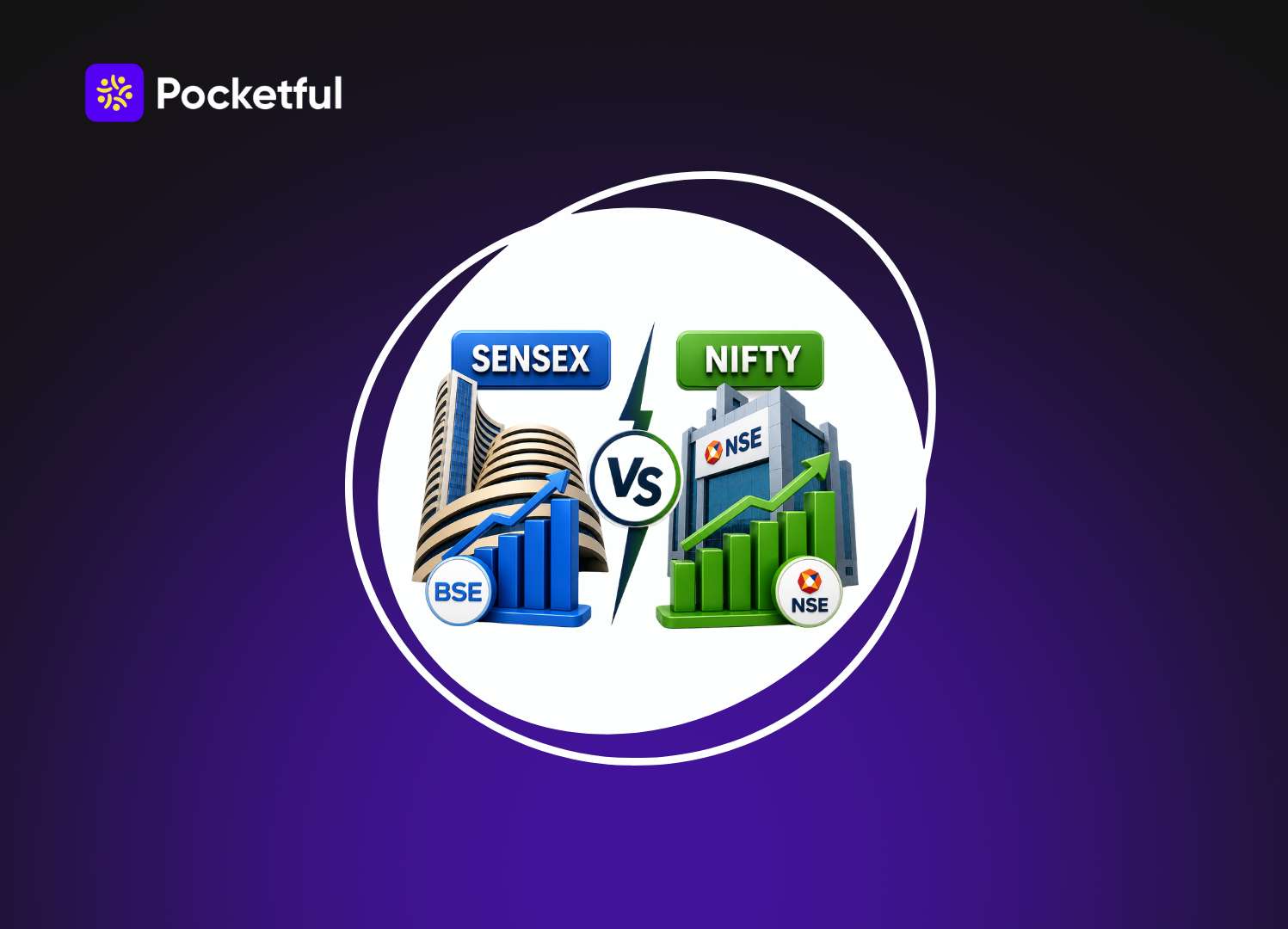
    When you read the business news or monitor the market, you tend to hear statements such as Sensex up today or Sensex down sharply, and beginners may wonder what any of this means: What is Sensex, sensex kya hai? Sensex is no more than an index of the main stock market in India. 

    It is the performance of the 30 strongest and experienced companies that are listed on the Bombay Stock Exchange. The rise in prices of these companies increases the Sensex and vice versa. To put it in the simplest words, Sensex is like a report card that would demonstrate the state of the Indian stock market, whether it is healthy, strong, or weak at any particular time. In this blog we will explore how Sensex works and why it influences investor decisions.

    What Companies Make Up the Sensex

    The Sensex is composed of 30 large, consistent, and highly traded companies that are the largest in India. Such firms work in the banking sector, IT, energy, fast-moving consumer goods, cars, and manufacturing. Collectively, they demonstrate the performance of the Indian economy.

    The list is regularly updated, therefore, leaving only the most significant and powerful companies in the index.

    CompanySector
    Reliance IndustriesEnergy & Conglomerate
    HDFC BankBanking & Finance
    ICICI BankBanking & Finance
    State Bank of IndiaBanking & Finance
    InfosysInformation Technology
    TCS (Tata Consultancy Services)Information Technology
    HCL TechnologiesInformation Technology
    ITCFMCG & Diversified
    Hindustan UnileverFMCG
    Larsen & Toubro (L&T)Engineering & Construction
    Axis BankBanking & Finance
    Kotak Mahindra BankBanking & Finance
    Bharti AirtelTelecom
    Maruti SuzukiAutomobiles
    Mahindra & MahindraAutomobiles
    Tata SteelMetals
    JSW SteelMetals
    UltraTech CementCement
    Titan CompanyConsumer Goods & Retail
    Bharat Electronics (BEL)Defence & Aerospace
    Bajaj FinanceNBFC
    Bajaj FinservFinancial Services
    Power Grid CorporationPower & Utilities
    NTPCPower & Utilities
    Sun PharmaPharmaceuticals
    WiproInformation Technology
    Tech MahindraInformation Technology
    Tata Motors Passenger VehiclesAutomobiles
    Trent Ltd.Retail / Consumer Retail

    How to Invest in Sensex?

    The investment in the Sensex is easy and user-friendly. You cannot purchase the Sensex, although you can purchase index funds or ETFs that track the Sensex. There are several basic steps to be followed before you start:

    1. Open a Demat Account

    You require a Demat account so that you can store your investments in digital form. It has the units of the funds or ETFs that you purchase, and you can easily open your Demat account with Pocketful for a fast and seamless investing experience.

    2. Open a Trading Account

    An online purchase of Sensex funds requires you to have a trading account, as well. The BSE does not allow people to directly sell or purchase securities.

    3. Maintain a Bank Account

    You require a bank account in which your trading and Demat accounts are connected. KYC is also required to complete with the help of a PAN card to begin investing.

    As soon as you are ready with these three accounts, you can start investing in the Sensex by:

    • Sensex Index Funds
    • Sensex Exchange-Traded Funds (ETFs)

    Both alternatives allow you to invest in the 30 companies that comprise the Sensex in a very easy and diversified manner.

    Read Also: BSE Sensex vs BSE All Cap? A Comparative Study

    How Sensex Moves and How Its Value Is Calculated

    The BSE periodically revises and updates the list of companies that comprise the Sensex in order to ensure that the index always reflects the actual, up-to-date performance of the Indian market. Initially, the Sensex employed a full market-cap approach. It was later altered in 2003 to a free-float market-cap system, which is the global standard today.

    Using the free-float method, only the shares that people can purchase and sell in the market are taken into consideration. Stocks owned by the promoters, insiders, or the government, known as restricted shares, are excluded since they are generally not traded.

    The calculation uses this formula:

    Free-Float Market Capitalisation = Market Capitalisation x Free-Float Factor.

    • Market Capitalisation refers to the total of all the shares of the company in the market.
    • Free-Float Factor: The proportion of the total shares that are freely traded in the market.

    Why Sensex Goes Up or Down

    The index is a 30-stock index that the Sensex tracks. When the majority of them increase, then the Sensex increases. If they drop, the Sensex falls. These actions are influenced by a number of key factors:

    1. Company Performance

    As soon as a company demonstrates positive quarterly performance, earns more money, presents a new product, or expands its business, the shares increase. In case it does not work well or makes losses, shares decline.

    2. Economic Conditions

    Issues such as GDP growth, inflation, interest rates, and job data have an influence on the sentiments of the investors. When the economy is strong, the Sensex tends to be pushed up, and when it is weak, the Sensex will be pulled down.

    3. Global Markets

    In India markets, market crashes, financial crises, or high growth, experienced in the US, Europe, or other large economies, can alter and cause the Sensex to behave similarly.

    4. Government Policies and Budget Announcements

    When the government alters the tax regulations, expenditure on infrastructure, reforms, or other regulations this has a direct impact on the companies, which causes the index to either decrease or increase.

    5. Foreign Investment

    The Sensex increases when foreign investors purchase Indian stocks. Once they sell the stocks and go, the index is likely to drop.

    6. Market Sentiment

    Markets are also moved by how the investors feel, scared, confident, hopeful, or panicked. Good news drives up the prices, whilst bad news or uncertainty drives down the prices.

    When major industries like banks, IT companies, energy companies, and car makers perform well, then the Sensex goes up. When these large sectors perform poorly, the index drops.

    Read Also: BSE Case Study

    Milestones of Sensex India

    Sensex has been on a steady rise over the last 30 years, and this has demonstrated how the Indian economy has expanded. Since its initial large hardships in the 1990s to record highs today, every era can be tracked on how it expanded, hit its problems, and emerged.

    Key Highlights

    TimelineKey Events & Milestones
    Early 1990s – 2000In July 1990, the Sensex was approximated to be at 1001 points.  It hit 2000 points in 1992 for the first time.  Then the index hit a milestone of 5000 points in 1999.
    2000 – Mid-2000sThe Sensex shot towards 6006 points in the early 2000s as a result of the IT boom.  On January 2, 2004, it reached 6026.59 points.  The index surpassed 7000 points after the settlement of the Ambani family, which boosted the Reliance Group stocks.  Since June through to December 2005, it has increased beyond 9000 points, owing to strong buying by foreign and domestic investors.
    Mid-2000s – 2010The Sensex was as high as 10, 003 in the middle of the day on Feb 7, 2006.  By Dec 2007, it surpassed 20,000 points, since a lot of funds were buying.  There was a crash and recovery of the market between 2008 and 2010.
    2013 – 2015The Sensex performed better than the Hang Seng Index in 2014 and was the largest index of stock markets in Asia.  In 2014, the index increased at a rapid rate to 28,000 points.  It was closed at 29,278 points on 23 January 2015, a new high.  Since the RBI reduced its repo rate, it had passed 30,000 points for the first time.
    2017 – 2019The Sensex continued to increase between 2017 and 2018.It hit above 38,000 points.

    The Sensex has fluctuated over the last 3 decades with an upward trend. Although it may fluctuate a lot in the short run, the index has increased significantly on average. This demonstrates that it is worth long-term investing in the stock market of India.

    When the Sensex Fell: Key Market Plunge Events

    Sensex has experienced numerous swift declines in the years, typically due to global financial issues, corporate scandals, or panic attacks within the market. In 2008, the world witnessed a massive crash in the global financial crisis, which hit markets in all parts of the globe.

    The world economy took a huge hit in January 2008 when the Dow Jones plunged. This hurt India right away. On 21 January, Sensex had gone down by 1408 points in a single day, the largest ever run-down in the history of the index. The next day, the Sensex continued to go down, and it was halted for an hour to prevent panic selling.

    The fall went on all through 2008. Between January and November, the index was falling, indicating the level of uncertainty that existed in world markets as well as local markets. In October 2008, the Sensex closed at 8509.56, one of its lowest points in nearly a decade.

    The other major shock occurred in 2009 when a major company in India, Satyam fraud was involved in fraud. The announcement caused the Sensex to fall by approximately 750 points, provoking investor panic once again and shaking the market.

    Read Also: How Does the Stock Market Work in India?

    Conclusion

    Sensex is not merely a figure on the screen, but it is the heartbeat of the Indian stock market. It is used to indicate the level of strength or weakness of the market through the tracking of the performance of 30 major companies. 

    For beginners, understanding Sensex meaning helps build confidence and gives a clear picture of market direction. By tracking Sensex changes, one can get to know the way the economy responds to news, events, and global trends. 

    You can invest in the near future or just wish to know how Sensex works; either way, knowing the working mechanism of Sensex makes you a better and wiser player in the world of finance. And for more such information and details, follow Pocketful today.

    S.NO.Check Out These Interesting Posts You Might Enjoy!
    120 Things to Know Before the Stock Market Opens
    2What is Commodity Market in India?
    3Difference Between Trading and Investing
    4Types of Investment in the Stock Market
    5How to Start Stock Market Trading With Low or Limited Capital

    Frequently Asked Questions (FAQs)

    1. Sensex full form kya hai?

      Sensex full form is the Sensitive Index. It is used to show the overall movement in the market.

    2. Why does Sensex go up and down?

      Sensex is volatile since the prices of its 30 companies are constantly varying as a result of news, global markets, investor mood, and economic events.

    3. Can beginners invest in the Sensex?

      Yes, beginners can invest in the index with the help of mutual funds or ETFs. Also, now there are options to trade directly as well.

    4. Is Sensex a good indicator of market health?

      Yes, Sensex can be called one of the most reliable indicators, as the biggest companies are represented, and the direction of the market can be seen clearly.

  • Best Banking Stocks in India 2026

    Best Banking Stocks in India 2026

    Today, every street corner has an ATM and digital payment systems are seamlessly woven into everyday transactions. Not only do banks provide a safe space to store your money, but they also offer a wide range of services to help you grow your wealth. From savings accounts and fixed deposits to loans and investment opportunities, they are the cornerstone of the Indian Financial system. 

    But with so many banking stocks available to invest in, how should an investor sort out the leading players in the banking industry? In this blog, we will discuss the best Indian banking stocks based on market capitalization and 1-year returns.

    Overview of the Banking Sector in India

    India’s banking sector is crucial for the economy and plays a vital role in financial inclusion and economic growth. The industry has experienced substantial transformation throughout the years. India has a large banking network that includes several types of banks, such as the public sector, private sector, and foreign banks. It is one of the world’s largest banking markets, serving a massive population. According to RBI, total deposits with banks as of September,2025 are approximately $ 2,655 billion. Public sector banks have always held a significant share of the banking industry, although private sector banks have gained prominence in recent years.

    The Indian banking sector is classified into:

    • Scheduled Banks:  These banks are included in the Second Schedule of the Reserve Bank of India Act, 1934. They are further categorized into Public Sector Banks, Private Sector Banks, Foreign Banks, Regional Rural Banks, and Co-operative Banks.
    • Non-Scheduled Banks: These banks are not included in the Second Schedule of the RBI Act and operate under different regulations than the scheduled banks.

    Best Banking Stocks Based on Market Capitalization

    The top banking stocks in 2026 are:

    S.No.Banking Stocks
    1HDFC Bank
    2ICICI Bank
    3State Bank of India
    4Kotak Mahindra Bank
    5Axis Bank
    6Bank of Baroda
    7Punjab National Bank
    8Union Bank of India
    9Canara Bank
    10IDBI Bank

    The top banking stocks have been listed in descending order based on their market capitalization in the table below:

    BankMarket Cap(in INR crore)CMP (in INR)52-Week High52-Week Low
    HDFC Bank Ltd.14,24,612925.451,020813
    ICICI Bank Ltd.10,14,2871,4181,5001,186
    State Bank of India9,49,1841,0281,030680
    Kotak Mahindra Bank Ltd.4,18,705421460345
    Axis Bank4,03,2441,2991,308933
    Bank of Baroda1,59,123307312191
    Punjab National Bank1,47,91412812985
    Canara Bank1,39,64315415878
    Union Bank Of India1,37,023179180102
    IDBI Bank1,12,73910511866
    (Data as of 14 January 2026)

    Read Also: Government Bank Stocks/Share in India

    Best Banking Stocks Based on Market Capitalisation – An Overview

    The best banking stocks in India are given below, along with a brief overview:

    1. HDFC Bank

    HDFC Bank was among the first financial institutions in India to receive an ‘in principle’ approval from the Reserve Bank of India in 1994. The HDFC bank started its operations as a scheduled commercial bank in January 1995.  The bank’s business philosophy is based on five core values: Operational Excellence, Customer Focus, Product Leadership, People, and Sustainability.

    HDFC Ltd. or Housing Development Finance Corporation Ltd. was merged with HDFC Bank in 2022 in India’s largest-ever M&A deal. The bank provides a wide range of financial products and services, such as retail banking, wholesale banking, loans, credit cards, savings accounts, current accounts, investment products, etc. 

    2. ICICI Bank

    ICICI Bank stands for Industrial Credit and Investment Corporation of India and is regarded as India’s second-largest private sector bank. The World Bank, Indian public-sector banks, and public-sector insurance companies initiated the establishment of ICICI through a joint venture with other businesses in 1955 as a part of their initiative to accelerate the economy’s industrial growth by providing them with long and medium-term financing. ICICI became the first Indian company and Asian bank other than Japanese Banks to be listed on the New York Stock Exchange (NYSE). In October 2001, the directors of ICICI and ICICI Bank approved the merger of its subsidiary businesses named ICICI Personal Financial Services Limited and ICICI Capital Services Limited with ICICI Bank.

    3. State Bank of India (SBI)

    SBI is India’s largest public sector bank, with a 23% market share. SBI is headquartered in Mumbai and holds a rich heritage of over 200 years.

    The roots of SBI trace back to 1806 when the Bank of Calcutta was established, the first joint stock bank in British India. Bank of Calcutta was later renamed as Bank of Bengal. Three separate presidency banks, Bank of Bengal, Bank of Bombay, and Bank of Madras, emerged across British India during this period, which were later merged to form the Imperial Bank of India in 1921.

    In 1955, the Reserve Bank of India acquired a controlling stake in the Imperial Bank of India and renamed it the State Bank of India. SBI later acquired various state-associated banks and commercial banks.

    SBI has played an important role in bringing banking services to rural areas. Core values of the Bank – Service, Transparency, Ethics, Politeness and Sustainability.

    4. Kotak Mahindra Bank

    Kotak Mahindra Bank is a leading Indian banking and financial services company headquartered in Mumbai. It offers a wide range of banking products and financial services for corporate and retail customers. It is India’s third-largest private sector bank by market capitalization.

    Kotak Mahindra Financial Services was founded in 1985 by Uday Kotak. In 1986, Anand Mahindra and his father, Harish Mahindra, invested in the company, which was subsequently renamed Kotak Mahindra Bank. The company was initially engaged in bill discounting and lease and hire-purchase activities. In 2003, Kotak Mahindra Bank became India’s first non-banking finance company to convert into a commercial bank.

    5. Axis Bank

    Axis Bank was initially established as UTI Bank by a joint venture between the Life Insurance Corporation of India, the Government of India, and other business houses. UTI Bank’s operations started in 1994 when the first branch in Ahmedabad was opened. In 2007, UTI Bank was renamed “Axis Bank”. It soon became a well-established and recognized bank in the Indian Banking sector. This was a turning point in the history of Axis Bank because it became an aggressive player with a focus on branch expansion and innovation. Additionally, Axis Bank consistently made an effort to diversify its product portfolio. The bank now offers a variety of financial products, including credit cards, savings accounts, current accounts, brokerage facilities, and retail banking.

    6. Bank of Baroda

    Established in 1908, Bank of Baroda stands as a premier public sector bank in India, boasting a solid presence both domestically and overseas. Nationalized in 1969, the institution has since held an important function in the progress of India’s banking and finance sectors. Bank of Baroda adheres to a client-focused operational outlook centered on reliance, creativity, and widespread expansion. After integrating with Dena Bank and Vijaya Bank in 2019, the bank notably grew in size and scope. It provides a full suite of financial offerings and provisions, encompassing personal banking, business banking, financing for small and medium enterprises (MSME), treasury activities, credit facilities, savings options, electronic banking, and global banking support.

    7. Punjab National Bank

    Established in 1894, Punjab National Bank stands as one of India’s most historical public sector financial institutions. Following its nationalization in 1969, the institution boasts a considerable heritage of serving varied client bases nationwide. Punjab National Bank expanded its operational reach significantly post-amalgamation with Oriental Bank of Commerce and United Bank of India in 2020. The core tenets of the bank’s business approach involve promoting financial inclusion, practicing sound credit allocation, and embracing digital advancement. PNB provides a broad spectrum of financial offerings and services, including personal and business banking, credit for small and medium enterprises (MSMEs), farm financing, savings instruments, international trade support, and modern digital finance options.

    8. Canara Bank

    Established in 1906, Canara Bank has developed into a leading and highly reputable Indian public sector financial institution, boasting a history exceeding one hundred years. Its takeover by the government in 1969 signified a key moment, prompting the bank to actively work on broadening access to conventional banking and offering credit to less-served populations. The 2020 amalgamation with Syndicate Bank enhanced its footprint and network nationally.

    Presently, Canara Bank operates guided by a distinct dedication to its clientele. It prioritizes streamlined procedures, robust digital platforms, and continuous enhancement of its asset health. The institution provides a broad array of monetary goods and supports, encompassing everything from personal banking and business lending to financing for small and medium enterprises, savings plans, credit facilities, treasury activities, and global banking services.

    9. Union Bank of India

    Established in 1919, Union Bank of India transitioned into a state-owned public sector bank following its nationalization in 1969. The institution broadened its presence considerably after integrating with Andhra Bank and Corporation Bank in 2020. Union Bank’s core operating belief centers on fostering environmentally sound expansion, ensuring client contentment, and employing careful handling of potential risks. It delivers a full suite of financial and banking provisions such as personal banking, business credit facilities, financing for small and medium enterprises, agricultural credit, savings schemes, electronic banking, and global banking services, serving various clients from individuals to corporations and institutions throughout India.

    10.  IDBI Bank

    Established in 1964 as the Industrial Development Bank of India, IDBI Bank transitioned into a commercial bank in 2004. A controlling interest in the bank is jointly held by the Government of India and the Life Insurance Corporation of India. IDBI Bank’s operating ethos centers on revitalization, soundness, and a focus on client needs. The institution has bolstered its financial position over time via enhanced asset quality and procedural enhancements. Its extensive array of banking offerings encompasses retail services, corporate finance, loans for MSMEs, deposit services, digital platforms, and government-related business.

    Read Also: Small Finance Bank Share List in India

    Best Banking Stocks Based on 1-Year Return

    S.No.Bank1-Year Return 
    1AU Small Finance Bank70%
    2Indian Bank67.31%
    3Canara Bank63.45%
    4State Bank Of India 36.54%
    5IDFC First Bank34%
    (Data as of 15 January 2025)

    Best Banking Stocks Based on 1-Year Return – An Overview

    The best banking stocks according to 1-year return are given below, along with a brief overview:

    1. AU Small Finance Bank

    AU Small Finance financial institution, based in 1996 and converted right into a small finance financial institution in 2017, operates with ~1,000 branches across India. The bank has a growing retail and msme-focused mortgage ebook and serves numerous million customers. Its commercial enterprise model is centred on secured lending, granular deposits, and enhancing casa, making it one of the more potent players among small finance banks.

    2. Indian Bank

    Founded in 1907, Indian Bank is a state-owned public sector financial institution boasting nearly 5,700 outlets across the country. Following its 2020 amalgamation with Allahabad Bank, the institution’s combined operations now exceed ₹10 lakh crore, underpinned by consistent expansion in deposits and enhancement of asset quality. Indian Bank maintains a broad presence encompassing retail, MSME, corporate, and global banking areas.

    3. Canara Bank

    Founded in 1906, Canara Bank is recognized as a premier public sector bank in India, operating around 9,700 branches across local and global locations. The organization manages total operations exceeding ₹20 lakh crore and holds a significant presence in consumer credit, small and medium-sized businesses, and commercial lending. In recent times, its financial health has been strengthened through continuous improvements in asset quality and capital adequacy.

    4. State Bank of India

    Founded in 1955, the State Bank of India is recognized as India’s foremost bank, featuring upwards of 23,000 outlets and over 60,000 cash dispensers. With combined operations exceeding ₹85 lakh crore, SBI holds a dominant place in the country’s financial system. Its significance spanning deposits, advances, and digital transactions confirms SBI’s status as a core component of India’s monetary scene.

    5. IDFC First Bank

    Emerging in 2018 from the combination of IDFC Bank and Capital First, IDFC First Bank maintains roughly 900 locations nationwide. The institution boasts total business surpassing ₹4 lakh crore, largely fueled by consumer credit and enhanced deposit gathering. Its commitment to client-focused offerings, service driven by technology, and growth in the retail sector underpins its sustained expansion plan.

    Key Performance Indicators (KPIs)

    BankNet Interest Margin (%)CASA (%)Capital Adequacy Ratios (%)P/E (x)P/B (x)
    HDFC Bank Ltd.3.4734.7419.559.852.68
    ICICI Bank3.6841.5316.5518.623.10
    State Bank of India2.5938.7614.258.881.50
    Kotak Mahindra Bank Ltd.4.2542.9823.303.902.74
    Axis Bank Ltd.3.4040.7517.0712.151.82
    Bank of Baroda2.6637.7117.195.700.81
    Punjab National Bank2.3336.5117.055.850.89
    Union Bank Of India2.4932.4718.025.340.89
    Canara Bank2.2428.4616.334.600.82
    IDBI Bank3.5546.5625.0510.941.63
    (all the above data is of the year ended March 2025 except P/E and P/B)

    Read Also: Best Growth Stocks in India

    Benefits of Investing in Banking Stocks

    The benefits of investing in banking stocks are:

    • Dividend Income – Banks often pay regular dividends to shareholders. This offers a stable income stream, which makes it particularly appealing to long-term investors.
    • Hedge against Inflation – Bank stocks have been seen as protection against inflation. When inflation increases, banks can raise interest rates on loans and make more profit.
    • Diversification – Adding banking stocks to your portfolio helps you reduce overall portfolio risk. 

    Factors to Consider Before Investing in Banking Stocks

    An investor must consider the following factors before investing in banking stocks:

    • Financial Performance – Analyze important financial ratios such as net interest margin, CASA, etc.
    • Valuation – Investors should compare the bank’s valuation to its peers and judge its intrinsic value.
    • Interest Rate – Rising interest rates generally benefit banks’ net interest margins, while falling rates can reduce profitability.
    • Inflation – High inflation can erode the buying power and increase loan defaults, impacting the bank’s profitability.

    Future of the Banking Industry

    The banking industry is undergoing significant changes due to technological advancements and the evolving regulatory landscape. Banks use data analytics and artificial intelligence to offer customized financial products and services. These technological advancements have the potential to enhance fraud detection and prevention mechanisms, ultimately creating a more secure financial environment. More AI-powered chatbots and virtual assistants are being used for customer support and process automation. The RBI’s IFTAS cloud platform is also expected to strengthen the banking sector by enhancing the security, integrity and privacy of financial data.

    Conclusion

    To summarize, investors must thoroughly analyze banking stocks to ensure profitability. While these investments can give you lucrative returns, it is important to have a careful and well-thought-out investment plan. A thorough analysis of market trends and fundamental research can help investors make better decisions. It is advised to consult a financial advisor before investing. 

    S.NO.Check Out These Interesting Posts You Might Enjoy!
    110 Most Undervalued Stocks in India
    2List of Best Monopoly Stocks in India
    3Top 10 Best Summer Stocks in India
    4List of Top 10 Blue Chip Stocks in India with Price
    5List Of Best Logistics Stocks in India
    6Best Copper Stocks in India
    7Best Jewelry Stocks in India
    8Best Metal Stocks in India
    9Best Semiconductor Stocks in India
    10Best Chemical Stocks in India

    Frequently Asked Questions (FAQs)

    1. Is it good to invest in banking stocks in India?

      While the future of the Indian banking sector is promising, the short-term performance is affected by the regulations and other market variables. Hence, it is important to consult a financial advisor before investing.

    2. How can I identify good banking stocks?

      Investors can analyze the financial performance, past returns, growth prospects and industry trends to identify banking stocks for investment purposes.

    3. Should I invest in public or private sector banks?

      Both the private and public sector banks offer good investment opportunities. Public sector banks may be more stable, while private sector banks offer high growth potential.

    4. How much should I invest in banking stocks?

      Diversification is important to reduce portfolio risk, and investors should allocate a suitable amount to banking stocks depending on the investor’s risk tolerance and investment goals.

    5. What are the risks involved when investing in banking stocks?

      Economic downturns, NPAs, interest rate fluctuations, and regulatory changes are major risks that an investor should be aware of before investing in banking stocks.

  • Best Growth Stocks in India 2026

    Best Growth Stocks in India 2026

    If you are willing to create wealth in the long run, you can participate in the growing economy of India by investing in Growth Stocks. These stocks belong to different sectors such as IT, banking, energy, etc.

    In today’s blog post, we will give you an overview of the top growth stocks in India, along with the benefits and key factors to consider before investing in them.

    What are Growth Stocks?

    Growth stocks refer to the stock of companies that are likely to grow more than other companies and have a considerable possibility of growing in terms of revenue, profits and other important indicators. Growth companies generally do not pay dividends to their shareholders, but instead use the profits to expand the business.

    Top Growth Stocks to Buy in India

    1. Reliance Industries Limited
    2. HDFC Bank Limited
    3. Bharti Airtel Limited
    4. TCS Limited
    5. ICICI Bank Limited
    6. SBI Limited
    7. Infosys Limited
    8. Bajaj Finance Limited
    9. L&T Limited
    10. Hindustan Unilever Limited
    CompanyCurrent Market Price (INR)Market Capitalisation (in INR crore)52-Week High52-Week Low
    CompanyCurrent Market Price (INR)Market Capitalisation (in INR crore)52-Week High52-Week Low
    Reliance Industries Limited148520,35,42016111115
    HDFC Bank Limited95014,60,3001020812
    Bharti Airtel Limited208012,54,00021751560
    TCS Limited319511,91,00043232867
    ICICI Bank Limited143510,21,00015001186
    SBI Limited10009,27,5401024680
    Infosys Limited16306,65,25019831307
    Bajaj Finance Limited9706,03,1751102711
    L&T Limited41635,72,85041732965
    Hindustan Unilever Limited24105,63,00027052101
    (Data as of 08th Jan 2026)

    Read Also: 10 Fastest Growing Penny Stocks in India

    Overview of Best Growth Stock to Buy in India

    The overview of the best growth stocks to buy in India is as follows:

    1. Reliance Industries Limited

    Reliance Industries Limited, Mr Dhirubhai Ambani founded the company in 1966 as a textile company and it went public in 1977. It started to expand into the oil and gas sector later in 1980. Anil and Mukesh, Dhirubhai Ambani’s two sons, divided the business in 2005. Under Mukesh Ambani’s leadership, the business has expanded into multiple sectors, including communications and retail, and achieved record success. The company is also investing heavily in the field of renewable energy. The company has its headquarters in Mumbai. Jio and Reliance Retail are their current growth engines.

    2. HDFC Bank Limited

    HDFC Bank was established in 1994 and is headquartered in Mumbai. It received a banking licence from the Reserve Bank of India in 1994 and began operations in January 1995. The bank was listed on the Bombay Stock Exchange as well as the National Stock Exchange after launching its Initial Public Offering (IPO) in March 1995. Times Bank and HDFC Bank merged in 1999. To expand its branch network and client base, HDFC Bank acquired Centurion Bank of Punjab. Sashidhar Jagdishan took over as the bank’s managing director and CEO from Aditya Puri. HDFC Bank is among early adopters of digital-first banking innovations and provided services like missed call banking and instant account opening through e-KYC.

    3. Bharti Airtel Limited

    Sunil Bharti Mittal founded the company, which initially focused on producing telecom equipment manufacturing. It later introduced mobile services under the Airtel brand in 1995. In 2002, the company was listed on the Indian stock exchange. It acquired Zain’s mobile operator in African countries. Bharti Airtel is focusing on 4G and 5G services, digital platforms, cloud solutions, etc. The company has its headquarters in New Delhi.

    TCS Limited

    The company was founded in 1968 by Tata Sons Limited to provide punch card services to its related company, Tata Steel. In order to expand its global reach, the company started operations in Europe and the UK in 1993 after establishing India’s first software research and development centre in Pune in 1981. The company went public on the Indian Stock Exchange in 2004. The company has been expanding into additional cloud computing, AI, and other services. The company’s headquarters is situated in Mumbai.

    ICICI Bank Limited

    CICI Bank is one of the largest in the private sector in India. In 1955, the Industrial Credit and Investment Corporation of India (ICICI) was founded by the Indian government. ICICI Bank was established in 1994 as a subsidiary of ICICI Limited. Being the first Indian bank and company to float on the New York Stock Exchange outside of Japan, it created history. In order to enhance company efficiency, ICICI and ICICI Bank merged to form a new bank. Following accusations against Chanda Kochhar, the managing director of ICICI Bank, in 2018 about illegal lending practices, Sandeep Bakhshi took the job as a MD and CEO. This bank was the first to provide contactless credit and debit cards. The bank’s head office is in Mumbai.

    SBI Limited

    SBI is the largest Indian public sector bank and a major competitor in the Indian banking industry with the highest market share. In 1955, the Indian government nationalised the Imperial Bank of India and changed its name to the State Bank of India. SBI later acquired several state-owned and commercial banks. State Bank of India- State Bank of Bikaner and Jaipur, State Bank of Hyderabad, State Bank of Mysore, State Bank of Patiala, State Bank of Travancore and Bhartiya Mahila Bank- To make them more efficient, the five affiliated banks merged in 2017. SBI was a key player in offering financial services to rural people. SBI Head Office is located in Mumbai.

    Infosys Limited

    Infosys Limited, Mr N.R. Narayana Murthy founded Infosys in 1981. The company decided to go public in 1993 to expand its operations. In 1999, it was the first Indian company to be listed on the NASDAQ Stock Exchange. Over 500 customers are served by the company, some of whom are Fortune 500. It is headquartered in Bangalore, India.

    Bajaj Finance Limited

    When Bajaj Finance was first established in 1987 as Bajaj Auto Finance Limited, it focused primarily on financing two-wheelers and three-wheelers. It was later renamed Bajaj Finance Limited in 2010 and expanded into other financial services models. During the 2008-2014 it aggressively expanded itself through EMI financing at the point of sale. In recent years, Bajaj Finance started lending through digital platforms. The headquarters of the company is situated in Pune, Maharashtra.

    L&T Limited

    The company was founded in Mumbai by two engineers in 1938. Initially, importing machinery from European nations was its primary objective. Eventually, during World War II, L&T began producing various types of equipment and technology. Currently, the company is in the production of roads, bridges, buildings, dams, and other infrastructure and it is India’s largest EPC player. The business entered the banking and finance industry to expand its range of products. Additionally, government infrastructure investment rises at the end of the fiscal year, which makes it favourable for investors. Mumbai is home to the company’s headquarters.  

    Hindustan Unilever Limited

    HUL was initially established in 1931 and was initially known as Hindustan Vanaspati Manufacturing Company. Lever Brothers India Limited made its official entry in India in 1933. In 2007, the company was renamed to Hindustan Unilever Limited in order to align with its parent company Unilever. And over time, it has become a household name in India and has become one of the largest FMCG companies. The company’s head office is situated in Mumbai.

    Key Performance Indicators (KPIs)

    The key performance indicators of the best growth stocks to buy in India are as follows:

    CompanyROE (%)ROCE (%)Operating Profit Margin (%)Net Profit Margin (%)
    Reliance Industries Limited8.258.7013.508.37
    HDFC Bank Limited13.562.6225.5821.83
    Bharti Airtel Limited25.5814.7228.4219.52
    TCS Limited51.2462.0125.8919.11
    ICICI Bank Limited16.453.1326.4729.20
    SBI Limited16.871.9121.8016.09
    Infosys Limited27.8735.8523.3216.41
    Bajaj Finance Limited17.2046.7967.2024.05
    L&T Limited15.3914.8910.336.91
    Hindustan Unilever Limited21.5522.9122.9916.91
    (Data as of March 2025)

    Read Also: Best Material Stocks in India

    Benefits of Investing in Growth Stocks

    The key benefits of investing in growth stocks are as follows:

    1. Growth Potential: Investing in growth companies offers the opportunity to create wealth in the long run. Their stock price rise helps in capital appreciation. 
    2. Higher Growth: These companies generally reinvest their profit back into the company for expansion. This helps companies in maintaining consistent growth over time.
    3. Competitive Advantage: As growth companies are market leaders therefore they enjoy a competitive advantage over other companies and have pricing power along with a scalable business model.

    Factors to Consider Before Investing in Growth Stocks

    The key factors to consider before investing in growth stocks are as follows:

    1. Financial Performance: Before investing in growth stocks, one should check their financial performance and choose the company with high growth potential. 
    2. Business Model: One should select the companies with a scalable business model. It allows a company to increase its profit without increasing costs.
    3. Management: A company’s management plays an important role in the company’s growth. Ethical management is required for the long-term growth of the company.  

    Future of Growth Stocks

    Growth stocks in India have a very bright future due to various reasons such as increased disposable income, adoption of digital, economic reforms, etc. All industries, including the renewable energy industry, the financial sector, and infrastructure, have greatly helped in the development of the country. Nevertheless, such companies may be volatile in the short run, yet their growth prospects are high. Therefore, it is possible to invest in growth companies to generate long-term wealth. 

    To invest in the growing companies in India, one can open a free demat account at Pocketful, which also provides free brokerage on the delivery trades.

    Read Also: Best Manufacturing Stocks in India

    Conclusion

    On a concluding note, growth companies play a significant role in the development of the Indian economy. They primarily benefited from the economic expansion, increasing consumer demand, digitalisation, etc. In this case, a capable company with stable management can perform better in the long run. However, these companies have strong growth potential, but it can be volatile in the short run; therefore, it is advisable to consult your investment advisor before making any investment decision.

    S.NO.Check Out These Interesting Posts You Might Enjoy!
    110 Most Undervalued Stocks in India
    2List of Best Monopoly Stocks in India
    3Top 10 Best Summer Stocks in India
    4List of Top 10 Blue Chip Stocks in India with Price
    5List Of Best Logistics Stocks in India
    6Best Copper Stocks in India
    7Best Jewelry Stocks in India
    8Best Metal Stocks in India
    9Best Semiconductor Stocks in India
    10Best Chemical Stocks in India

    Frequently Asked Questions (FAQs)

    1. What are growth stocks?

      Growth stocks are the shares of companies that primarily reinvest their profit back in the company instead of distributing them to their shareholders and have high growth potential in the long run. They generally tend to perform better than other companies.  

    2. Are dividends paid by growth stocks?

      Growth stocks pay low dividends as they generally reinvest their profits in the company for expansion. 

    3. What are the risks involved while investing in growth stocks?

      The risks that come with investing in growth stocks include competition, higher valuations, and lower earnings.

    4. Name a few Indian stocks with high-growth potential?

      Reliance Industries Limited, HDFC Bank Limited, Bharti Airtel Limited, TCS Limited, ICICI Bank Limited, and other companies are examples of high-growth stocks.

    5. Is it the right time to invest in growth stocks?

      Yes, it is the right time to invest in growth stocks to create wealth in the long run. To invest in growth stocks, you can open a lifetime free demat account with Pocketful, as it also offers zero brokerage on delivery trades.

  • Bharat Coking Coal IPO Allotment Status Check Online: GMP, Subscription, Price, and & Key Highlights

    Bharat Coking Coal IPO Allotment Status Check Online: GMP, Subscription, Price, and & Key Highlights

    Bharat Coking Coal Ltd (BCCL), a wholly owned subsidiary of Maharatna-status Coal India Ltd and India’s largest producer of coking coal, is launching an initial public offering (IPO) to raise approximately ₹1,071.11 crore. The issue opens for subscription on January 9, 2026, and will close on January 13, 2026, with the price band fixed at ₹21 to ₹23 per share. The IPO is a book-built issue comprising entirely an offer for sale (OFS) of 46.57 crore equity shares aggregating up to ₹1,071.11 crore, with no fresh issue component. The shares are proposed to be listed on both the Bombay Stock Exchange (BSE) and the National Stock Exchange of India (NSE), with a tentative listing date of January 16, 2026, subject to allotment and regulatory approvals.

    Bharat Coking Coal IPO Day 3 Subscription Status

    On Day 3, the Bharat Coking Coal IPO witnessed an extraordinary surge in demand, with overall subscription soaring to 146.38 times, underscoring overwhelming investor enthusiasm. The QIB segment saw a dramatic jump to 310.81 times, reflecting strong institutional conviction. Non-Institutional Investors (NII) remained highly aggressive at 257.74 times, led by bNII at 275.64 times and sNII at 221.93 times. Retail Individual Investors (RII) subscribed the issue 48.52 times, while Employees and Shareholders recorded subscriptions of 5.12 times and 86.61 times, respectively. In total, the IPO attracted 89,83,388 applications with bids amounting to approximately ₹1,16,804 crore, marking one of the most emphatic IPO responses in recent times and signaling exceptionally strong market confidence.

    Investor CategorySubscription (x)
    Qualified Institutional Buyers (QIB)310.81
    Non-Institutional Investors (NII)257.74
    bNII (above ₹10 lakh)275.64
    sNII (less than ₹10 lakh)221.93
    Retail Individual Investors (RII)48.52
    Employees5.12
    Shareholders86.61
    Total Subscriptions146.38

    Total Applications: 89,83,388

    Total Bid Amount (₹ Crores): ₹1,16,804

    How to Check Bharat Coking Coal IPO Allotment Status

    Bharat Coking Coal IPO allotment can be easily checked online in two ways: from the Registrar’s website and from the BSE or NSE website. This IPO will be listed on both the exchanges – BSE and NSE, so the allotment status will be available to all investors on both platforms.

    Method 1: Registrar’s website (Kfin Technologies Ltd.)

    The most reliable way is to check the allotment from Kfin Technologies Limited’s  website.

    How to do:

    • Visit Kfin Technologies Ltd.’s official website
    • Select “Bharat Coking Coal” from the IPO list
    • Enter your details PAN number, Application number, or DP/Client ID
    • Click on Submit
    • You will see the allotment status on the screen.

    Method 2: Check from BSE or NSE’s website

    If there is more traffic on the registrar’s website, allotment status can also be checked from BSE or NSE.

    How to do:

    • Visit BSE or NSE’s official website
    • Select ‘Equity’ segment
    • Select “Bharat Coking Coal” from the IPO list
    • Enter PAN number and Application number
    • Click on Search

    Objective of the Bharat Coking Coal IPO

    Since the Bharat Coking Coal IPO is a 100% Offer for Sale (OFS), the company will not receive any proceeds from the issue. The entire IPO proceeds will be received by the selling shareholders, and no funds will be utilized by Bharat Coking Coal for business expansion, capital expenditure, or other corporate purposes. 

    Bharat Coking Coal IPO GMP – Day 3 Update

    The grey market premium (GMP) of Bharat Coking Coal IPO is ₹10.30 of 5:00 PM on January 13, 2026. The upper limit of the price band is ₹23, and based on the current GMP, the estimated listing price is ₹33.30, indicating a potential gain of approximately 44.78% per share.

    DateGMPEst. Listing Price Gain 
    13-01-2026 (Day 3)10.3033.3044.78%

    Disclaimer: The above GMP (Grey Market Premium) is just unofficial market information, which is not officially confirmed. These figures are shared for informational purposes only and investment decisions based on these should be based on the investor’s own research and discretion. We do not conduct, recommend or support any kind of transaction in the grey market.

    Bharat Coking CoalIPO – Key Details

    ParticularsDetails
    IPO Opening DateJanuary 09, 2025
    IPO Closing DateJanuary 13, 2025
    Issue Price Band₹21 to ₹23 per share
    Total Issue Size46,57,00,000 shares(agg. up to ₹1,071 Cr)
    Listing PlatformBSE, NSE
    RegistrarKFin Technologies Ltd.
    Bharat Coking CoalIPO RHPBharat Coking Coal RHP

    Important Dates for Bharat Coking CoalIPO Allotment

    EventDate
    Tentative AllotmentJanuary 14, 2025
    Refunds InitiationJanuary 15, 2025
    Credit of Shares to DematJanuary 15, 2025
    Listing Date January 16, 2025

    Bharat Coking Coal Overview

    Bharat Coking Coal Limited (BCCL) is India’s largest coking coal producer, accounting for 58.50% of domestic coking coal production in FY25, as per CRISIL. Its primary product is coking coal, with estimated reserves of about 7,910 million tonnes as of April 1, 2024, making it one of the largest reserve holders in the country. BCCL produces multiple grades of coking coal, non-coking coal, and washed coal, mainly supplying the steel and power sectors. A wholly owned subsidiary of Coal India Limited, BCCL was incorporated in 1972 and received Mini Ratna status in 2014. Its operations are concentrated in the Jharia coalfield (Jharkhand) and Raniganj coalfield (West Bengal), spanning 288.31 sq. km. Coal production grew from 30.51 million tonnes in FY22 to 40.50 million tonnes in FY25, reflecting strong operational expansion driven by capacity addition, advanced mining practices, and efficient use of heavy earth-moving machinery.

    Frequently Asked Questions (FAQs)

    1. What is the opening and closing date of the Bharat Coking Coal IPO?

      Bharat Coking Coal IPO is open on January 09, 2025  and will close on January 13, 2025.

    2. What is the price band of the Bharat Coking Coal IPO?

      Its price band is fixed from ₹21 to ₹23 per share.

    3. What is the GMP (Grey Market Premium) of the Bharat Coking Coal IPO today?

      The GMP on January 13, 2025 is ₹10.30, which leads to a possible listing price of ₹33.30

    4. What is the total issue size of the Bharat Coking CoalIPO?

      The total issue size of the Bharat Coking CoalIPO is ₹1017 crore, structured entirely as an Offer for Sale (OFS) by existing shareholders, with no fresh issue component.

    5. What is the expected listing date of the Bharat Coking CoalIPO?

      This IPO is expected to be listed on BSE and NSE on January 16, 2025.

  • What is Expense Ratio in Mutual Funds?

    What is Expense Ratio in Mutual Funds?

    When two people invest in the same mutual fund but get different returns, the reason is often not immediately obvious. This reason is the expense ratio. It’s a fee in mutual funds that is deducted silently every day. In this blog, you will understand what an expense ratio is in a mutual fund, how it is charged, and why the expense ratio in mutual funds affects your returns in the long run.

    What Is Expense Ratio in Mutual Funds?

    The total cost of managing a mutual fund is called the expense ratio. The fund house charges this fee for various services, including deciding where to invest your money, when to buy and sell, conducting research, and maintaining records. This cost, expressed as a percentage, is the expense ratio.

    For example, if you invest ₹1,00,000 in a mutual fund with an expense ratio of 1%, approximately ₹1,000 will be deducted annually as management fees. This deduction happens gradually and is reflected in the NAV. This is why, over the long term, the expense ratio impacts your overall returns, even if it seems small in percentage terms.

    What Does the Expense Ratio Actually Pay For?

    1. Fund Manager and Research Team Expenses : Investment decisions in mutual funds are made by the fund manager and their research team. The costs associated with company analysis, portfolio review, and market tracking are included in the expense ratio.
    2. Portfolio Management and Technology Costs : Managing a fund requires data systems, analytics tools, and trading infrastructure. The expenses incurred on these technical resources are also part of the expense ratio.
    3. Record Keeping and Regulatory Compliance : Maintaining investor records, calculating NAV, conducting audits, and complying with SEBI regulations are essential. These administrative costs are also included in the expense ratio.
    4. Distribution and Marketing Costs (Regular Plans) : In regular mutual fund plans, commissions are paid to distributors and advisors. This is why the expense ratio of regular plans is higher than that of direct plans.

    Read Also: How to Compare Mutual Funds in India?

    How Expense Ratio Is Charged ? 

    The expense ratio is not deducted by the mutual fund all at once at the end of the year. This expense is deducted daily in small increments from the fund’s value throughout the year. This is why investors never see a separate charge.

    DescriptionStatistics
    Your investmentRs 1,00,000
    Fund’s Expense Ratio1% annually
    Total annual expensesRs 1,000
    Daily expensesApproximately Rs 2.74

    This means that the mutual fund adjusts its Net Asset Value (NAV) by approximately ₹2–3 every day. This amount is so small that it’s not noticeable on a daily basis, but by the end of the year, this expense adds up to ₹1,000.

    Now imagine if this investment continues for 10–15 years. Then this expense is not limited to just ₹1,000; due to compounding, it also reduces your potential returns.

    This is why, even though the expense ratio may seem small, its impact can be quite significant in the long run.

    Direct Plan vs Regular Plan: Expense Ratio 

    PointDirect PlanRegular Plan
    Expense RatioIt is lessIt is higher than direct plan
    CommissionNo commissionCommission to Distributor/advisor
    How does investing work?Directly from AMCThrough a broker or advisor or distributor
    Right for whom?Those who have an understanding of investing themselvesNew investors who need guidance

    How Expense Ratio Impacts Long-Term Returns ? 

    For example, there are two mutual funds. Both have an annual gross return of 12%, the only difference being the expense ratio.

    DescriptionFund AFund B
    Annual Return (before expenses)12%12%
    Expense Ratio0.5%1.5%
    Net Return11.5%10.5%
    Initial investment1,00,0001,00,000

    Estimated value after 10 years:

    • Fund A: Approximately ₹2.97 lakh
    • Fund B: Approximately ₹2.72 lakh

    Estimated value after 20 years:

    • Fund A: Approximately ₹8.73 lakh
    • Fund B: Approximately ₹7.33 lakh

    The difference here is only a 1% expense ratio, but over 20 years, it amounts to a difference of approximately ₹1.4 lakh.

    Read Also: Mutual Fund Fees & Charges in India

    Common Myths About Expense Ratio

    Myth 1: Low Expense Ratio = Best Fund

    A low expense ratio can be a good sign, but choosing a fund solely based on this is not advisable. Sometimes, a fund with a slightly higher expense ratio can deliver better returns in the long run due to a superior strategy and disciplined management. 

    Myth 2: If the Returns are Good, the Expense Ratio Doesn’t Matter

    This is a common misconception. The expense ratio is deducted from your returns every year. While the returns might look good today, if the expenses are high, those expenses will slow down your compounding over the long term.

    Myth 3: The Impact of Expense Ratio is Less on One-Time Investments

    Whether it’s a Systematic Investment Plan (SIP) or a lump sum investment, the expense ratio applies to both. The longer the investment is held, the more pronounced its impact will be. Therefore, the expense ratio should not be taken lightly even in the case of a one-time investment.

    Conclusion

    The expense ratio seems small, so people often don’t take it seriously. The difference isn’t noticeable at first, but over time, these expenses gradually reduce your returns. Therefore, when choosing a mutual fund, don’t just focus on high returns; understand how much you’re paying for those returns. That’s the smart approach.

    S.NO.Check Out These Interesting Posts You Might Enjoy!
    1Types of Mutual Funds in India
    2Mutual Fund Factsheet: Definition And Importance
    3Equity Mutual Funds: Meaning, Types & Features
    4What Is An IPO Mutual Fund? Should You Invest?
    5Who Regulates Mutual Funds in India?

    Frequently Asked Questions (FAQs)

    1. What is the expense ratio in a mutual fund?

      It’s the cost of running the fund, which is adjusted from your investment.

    2. Does the expense ratio get deducted from my bank account?

      No, it’s gradually included within the NAV (Net Asset Value).

    3. Is a low expense ratio always good?

      Often yes, but it’s also important to consider the fund’s performance and management.

    4. Does the expense ratio really matter in the long term?

      Yes, its impact becomes clearly visible over time.

    5. Why is the expense ratio higher in regular plans?

      Because it includes the advisor’s or broker’s commission.

  • Future Industry in India 2026

    Future Industry in India 2026

    India has been a country of transition. From the era of agricultural development to the manufacturing sector, and later to services, each decade has transformed how the economy functions. The change that we are experiencing now is different. India is not only increasing in size, but also changing more than ever, as we near 2026. New industries are being built quietly, old industries are being reinvented, and opportunities are being created in places that were hardly there ten years ago.  

    So, which industries will define India’s future by 2026? Let us understand them in this blog. 

    Why 2026 is a Turning Point

    India’s growth story is not changing because of a single reform. It is changing because several things are finally lining up at the same time.

    We have a young population that is growing up with smartphones and digital payments. Internet access has moved well beyond metros into smaller towns and semi-urban India. Paying bills, transferring money, ordering goods, or accessing services now feels almost effortless. On the global front, companies are rethinking where they manufacture. Depending on one country is no longer seen as safe, and India is gradually becoming an alternative. On top of that, Government policies encourage domestic manufacturing, clean energy, and infrastructure creation.

    List of Future Industries in India 2026

     1. Clean Energy and Green Technology

    1. Clean energy is no longer an idea discussed only at global climate events. Solar parks, wind farms, and renewable power projects are now part of India’s growth story
    2. What is interesting is that the opportunity is not limited to power generation alone. Entire ecosystems are emerging around it, battery storage, smart grids, energy-efficient equipment, and green hydrogen. 
    3. For India, this shift matters on multiple levels. Lower energy costs improve industrial competitiveness, reduce dependence on imports, and help in creating employment. 

    Read Also: Fastest Growing Industries in India

    List of Companies Relevant to the Industry based on Market Capitalisation

    Company NameMarket Capitalisation (in INR cr.)
    Adani Green Energy1,67,905
    Tata Power 1,23,500 
    JSW Energy89,984
    NHPC83,946 
    NTPC Green Energy 79,165 
    (As of 6 January, 2026)

    2. Electric Vehicles 

    1. Changes have occurred rapidly in the transportation industry over the last few years. It is no longer exclusively for premium buyers. Electric two-wheeler and three-wheeler motorcycles, delivery fleets, and public transportation buses have all become common in the Indian market.
    2. Infrastructure for charging stations, battery production plants, battery recycling, fleet management software, and new supply chains is also rapidly growing in tandem with the other trends in the industry.
    3. Established automotive manufacturers are rethinking their approaches toward electric vehicles. A number of new electric vehicle startups are entering markets that did not even exist for electric vehicles only a few years ago.
    4. The evolution of electric vehicles in India will most likely have a great impact on the country by 2026.

    List of Companies Relevant to the Industry based on Market Capitalisation

    Company NameMarket Capitalisation (in INR cr.)
    Maruti Suzuki India5,43,693 
    Mahindra & Mahindra 4,70,595 
    TVS Motor Company1,83,738 
    Tata Motors PV1,35,859 
    Hero MotoCorp1,20,020 
    (As of 6 January, 2026)

    3. Artificial Intelligence 

    1. Loan approvals, fraud alerts, medical diagnostics, customer support, and AI are now embedded in systems we use without thinking about it.
    2. With a large pool of engineers, analysts, and tech professionals, the country is well placed to build AI solutions. By 2026, the focus will be on developing systems designed for Indian use cases and exporting them globally.
    3. Work itself will evolve. Routine tasks will increasingly be automated, while roles that involve judgement, analysis, and system design will become more valuable. 
    4. The employees will not only be technically skilled, instead they will also be people who understand actual problems and know how to solve them using technology.

    List of Companies Relevant to the Industry based on Market Capitalisation

    Company NameMarket Capitalisation (in INR cr.)
    TCS11,78,490 
    Infosys 6,53,694 
    HCL Technologies 4,38,746 
    Wipro2,78,477 
    Persistent Systems 98,660 
    (As of 6 January, 2026)

    4. Healthcare, HealthTech, and Biotechnology

    1. Healthcare is no longer restricted to hospitals and clinics. Teleconsultations, electronic medical records, remote consultations, and fast diagnostics are becoming common these days. 
    2. At the same time, the development of the industry is also being driven by the growing knowledge and requirement for high-quality healthcare.  
    3. Pharmaceutical, biotechnology, and medical innovation research are becoming important, not only to the needs of the domestic markets but also in the international markets.  
    4. Healthcare will be among the most balanced growth sectors in India by 2026 due to the need, innovation, and long-term demand.

    List of Companies Relevant to the Industry based on Market Capitalisation

    Company NameMarket Capitalisation (in INR cr.)
    Sun Pharma 4,22,026 
    Divi’s Laboratories 1,76,351 
    Torrent Pharmaceuticals 1,33,251 
    Cipla 1,23,694 
    Apollo Hospitals 1,05,677 
    (As of 6 January, 2026)

    5. Manufacturing 

    1. For a long time, manufacturing was seen as India’s weak link. That perception is changing slowly. 
    2. Electronics, semiconductors, defence equipment, and precision engineering are areas where capacity is being built step by step.
    3. Modern manufacturing is not only about scale or low-cost labour. It is about automation, quality control, resilient supply chains, and meeting global standards. Concepts like smart factories and real-time data monitoring are no longer experimental, but they are becoming standard practice.
    4. By 2026, manufacturing is likely to play a much larger role in defining India’s economic identity than it did a decade ago.

    List of Companies Relevant to the Industry based on Market Capitalisation

    Company NameMarket Capitalisation (in INR cr.)
    Reliance Industries 20,40,996 
    Larsen & Toubro 5,69,786 
    Hindustan Aeronautics Ltd3,01,962
    Bharat Electronics Ltd3,01,894
    Dixon Technologies71,227
    (As of 6 January, 2026)

    6. FinTech and Financial Services

    1. Digital payments are now routine, even in small towns. Lending, investing, and insurance have moved from paperwork to online platforms. You can now buy insurance, pay lakhs, and take loans in just a few simple clicks.
    2. The next phase of growth is not about reach anymore. Better credit assessment, customised financial products, and smarter risk management are becoming the focus. 
    3. Technology is making finance not just more inclusive, but more efficient.
    4. For professionals, this sector is the combination of finance, technology, and human behaviour, making it one of the most versatile career paths as we move toward 2026.

    List of Companies Relevant to the Industry based on Market Capitalisation

    Company NameMarket Capitalisation (in INR cr.)
    HDFC Bank14,80,001 
    ICICI Bank10,09,162 
    State Bank of India9,40,695 
    Bajaj Finance 6,08,216 
    Kotak Mahindra Bank4,26,940
    (As of 6 January, 2026)

    7. Consumer, Media, and Experience-Driven Businesses

    1. Consumption patterns change as incomes grow. People are increasingly investing in convenience, experience, and personalized services. 
    2. The fruits of this shift are being enjoyed by e-commerce, quick-delivery services, online entertainment, online gaming, and online travel services. 
    3. Companies that understand the customer preferences and act promptly are usually the winners.

    List of Companies Relevant to the Industry based on Market Capitalisation

    Company NameMarket Capitalisation (in INR cr.)
    Hindustan Unilever Ltd5,69,789 
    ITC 4,29,054 
    Asian Paints 2,73,075 
    Nestle India2,54,596 
    Zomato2,70,000
    (As of 6 January, 2026)

    Read Also: Best Sectors to Invest in Next 10 Years in India

    Challenges 

    Of course, every coin comes with two faces, and so the future of these industries because the picture is not without challenges. Skill gaps, regulatory delays, infrastructure constraints, and global economic uncertainty can slow progress. Not every sector will grow at the same pace, and not every startup will survive. But transitions are rarely smooth. The difference this time is that India is not betting on just one sector. Multiple industries are evolving together, making the overall ecosystem more resilient.

    Conclusion 

    No single trend or policy is defining the evolution of future industries in India, but they are developing through a combined impact of technological innovation driving change, changing demographic dynamics. Most importantly, by 2026, India is expected to have the most diverse and interconnected economy.

    If you want to identify opportunities as an investor on a longer-term horizon, or you’re a student who is deciding your career path, or you’re a working professional looking for your next career move, understanding where India is headed in the future is no longer complex. It is already taking shape. 

    Additionally, for a seamless investing experience and to participate in the growth story of these future-oriented industries in India, you can start your investment journey with Pocketful today.

    S.NO.Check Out These Interesting Posts You Might Enjoy!
    1Best Material Stocks in India
    2Top 10 Sectors in the Indian Stock Market
    3Best 5G Stocks in India to Invest
    4Semiconductor Industry in India
    5Fastest Growing Penny Stocks in India
    6Mixed Economy in India: Key Facts & Overview
    7Best Jewelry Stocks in India
    8Best Consumption Stocks in India
    9Best Battery Stocks in India
    10Consumer Staples Stocks in India

    Frequently Asked Questions (FAQs)

    1. What are the future industries in India?

      Future Industries are sectors that will be booming rapidly in the upcoming years because of technological advancement, government policies, and changing consumer demands. 

    2. Are future industries suitable for long-term investors? 

      Future industries often suit long-term investors who are willing to handle short-term volatility, becoming more competitive and expert-focused. 

    3. Why is 2026 important for India’s growth? 

      By 2026, many government initiatives, digital reforms, and infrastructure investments are expected to show real economic impact. 

    4. Which industries will grow the fastest in India by 2026?

      Clean energy, electric vehicles, healthcare, artificial intelligence, manufacturing, and fintech are among the fastest-growing sectors. 

    5. Will AI create jobs in India or reduce them?

      While AI may replace some routine tasks, it is expected to create more skilled jobs in technology, analytics and decision-making. 

  • Open Free Demat Account

    Join Pocketful Now

    You have successfully subscribed to the newsletter

    There was an error while trying to send your request. Please try again.

    Pocketful blog will use the information you provide on this form to be in touch with you and to provide updates and marketing.