Blog

  • What is the Book-Building Process in an IPO?

    What is the Book-Building Process in an IPO?

    If you are a stock market investor, you have probably heard of the Initial Public Offering (IPO), which is the procedure by which a business makes its shares available to the general public for the first time. However, have you ever thought about how the share price is determined? A business determines the price of its share by using a procedure known as the Book Building Process.

    In this blog, we will describe the book-building process, its advantages and how it differs from the fixed price issues.

    What is the Book Building Process in an IPO?

    Businesses that want to go public and list their shares on the stock market use the book-building process as a price discovery technique. It is the most popular approach businesses use to set the price of the shares offered in an IPO, as it is the most effective and transparent way to determine the share price based on market demand. The Book Running Lead Manager is responsible for establishing the cut-off price by using a weighted average method. 

    Example:-

    Assume ABC Limited chooses to issue shares to the public to raise money. This is known as an initial public offering. To determine the issue price, they chose to use a book-building process and hired an underwriter. The corporation chose to issue 10,000 shares in total, with a price range of INR 100 to INR 110. Below is the tabular representation of investor bids:

    Investor NumberNumber of Shares AppliedBid Price
    Investor 11000100 INR
    Investor 22000105 INR
    Investor 35000108 INR
    Investor 47000104 INR

    The underwriter determines a weighted average price based on the above data, and we’ll assume that the corporation ultimately decides on a cut-off price of 105. Shares may be allotted to investors who bid on or above the cut-off price; investors who applied for the IPO with a bid below the cut-off price will not get any shares. Only Investors 2 and 3 are eligible to receive an allotment, whereas the IPO applications of Investors 1 and 4 will be rejected in the above scenario.  

    How does the Book Building Process Work?

    The steps which involve the book-building process are as follows-

    1. Investment Banks – The first step is to select an investment bank as an underwriter for the Initial Public Offering (IPO). They assist the company in determining the issue size and establishing the share price range.

    2. Price Band – The next stage would be to determine the minimum and maximum price of the shares offered in the IPO. 

    3. Drafting Prospectus – A prospectus is prepared by the underwriter and contains details about the financials, business model, the objective of the issue, the shareholding pattern of the company, etc.

    4. Approval of Prospectus – Once the prospectus is drafted, it will be sent to the Securities and Exchange Board of India. SEBI thoroughly analyzes and approves the document.

    5. Bidding – Investors can apply for the IPO during the bidding period specified by the company, which typically lasts for 3 days.

    6. Compiling Bids – Once all the bids are received, the lead manager compiles them and analyzes the quantity of shares applied by the investors at different price levels.

    7. Cut-Off Price – Based on the bidding data, the lead managers determine the cut-off price. The investors who have applied for shares at or above the cut-off price may receive shares, but those who have applied below the cut-off price will not get any shares.

    8. Allocation – Successful bidders will receive shares in their demat account.

    Types of Book Building

    There are generally two types of book-building process-

    1. Accelerated Book Building – Accelerated Book-Building process is used when businesses want to raise funds quickly. The process is completed within one to two days because the underwriters approach institutional investors due to their ability to invest large amounts quickly.

    2. Partial Book Building – In this process, the issuer reserves a limited number of shares for the Book-Building process, and the rest of the shares are offered at a fixed price.

    Why do Companies Opt for the Book Building Process?

    For several reasons listed below, the majority of Indian businesses choose to use a book-building process to determine the share price for their initial public offering.-

    1. Market Price – The price of the IPO share is decided by the market participants, which generally reflects the actual market value based on the sentiments of the investors.

    2. Increased Participation – Due to the market-driven pricing mechanism, investor confidence increases, which encourages more participation by the investors.

    3. Fair Value – The shares may be overpriced or underpriced if a company chooses to issue at a predetermined price; however, the fair value of the issue will be determined if the company chooses to use the book-building process to determine the issue price. 

    4. Regulations – The Securities and Exchange Board of India has issued certain guidelines for the book-building process, which ensures fairness and transparency in price discovery.

    5. Allocation of Shares – Determining price through a book-building process ensures a more efficient allocation of shares. 

    Advantages of Book Building in IPOs

    The major advantages of the building process in IPO are as follows-

    1. Flexibility – The book-building process allows the company to adjust the share price within the price range, which helps maximize investor participation. 

    2. Reflects Demand – Book-building issues help companies determine the demand for shares among investors.

    3. Maximizes Capital Raised– This method can help the company raise more capital as it determines the fair value of shares based on investor demand. 

    Difference between Fixed Price Issue and Book Building

    The major differences between fixed price and book-building issues are as follows-

    ParticularsFixed Price IssueBook Building
    MechanismIn this method, the price is determined by the underwriters.The price of the issue is determined by the investors through the bidding process.
    Price DiscoveryFixed Pricing doesn’t allow price discovery as the price is fixed by the company.Book-building process allows for price discovery with the help of investor bidding. 
    FlexibilityThe investor doesn’t have the flexibility to choose the price and must accept the price set by the company.Investors can place bids within the price range specified by the company.
    RiskThere might be some risk related to underpricing and overpricing of the share price.The pricing risk is much lower in the book-building issue.
    UsageThis method is generally used by smaller companies with smaller issue sizes.The book-building process is widely used by the company with large IPO issue sizes.

    Read Also: From Private to Public: Decoding the IPO Journey

    Conclusion

    Determining the share price of an IPO is an important task in the Initial Public Offering (IPO) process. The company may miss out on raising the maximum capital possible funding if the offer is underpriced. Conversely, investors may decide not to subscribe if the issue is overpriced. Therefore, before investing in any initial public offering (IPO), investors should determine whether the issue is reasonably priced and speak with their investment advisor. 

    Frequently Asked Questions (FAQs)

    1. Can I change my bid price after submitting an IPO application?

      No, investors cannot modify their bids after submitting an IPO application. However, investors can cancel the existing IPO application and apply again before the share allotment happens.

    2. What will happen if I submit the IPO application below the cut-off price?

      If you submit your IPO application’s bid price is below the cut-off price, you will not be eligible for any allotment.

    3. What is the meaning of the 100% book-built issue?

      The 100% book-built issue refers to the IPO in which all the shares are offered through bids or a book-building process.

    4. What is the floor price in an IPO?

      It is the minimum price at which investors can place bids in an IPO.

    5. What is the bid price in an IPO?

      It is the price at which an investor wishes to buy the securities that are being offered during the book-building process of IPO.

  • Intraday Trading Rules and New SEBI Regulations

    Intraday Trading Rules and New SEBI Regulations

    Intraday trading has become popular in India, particularly among retail investors looking to earn profits by taking advantage of frequent market fluctuations. While the opportunity for substantial profit exists, it is accompanied by the risk of considerable losses, which can be worsened by leverage and excessive speculative trading practices. The SEBI has introduced new regulations to protect retail investors, focusing on margin requirements, reduction in weekly expiries, etc. These regulations demonstrate SEBI’s dedication to fostering a balanced marketplace that allows both experienced traders and newcomers to engage with minimum exposure to high risks. SEBI is implementing these measures to mitigate excessive speculation and foster responsible trading practices.

    In this blog, we will learn about intraday trading and the rules new traders can follow to succeed. Moreover, we will discuss the new regulations implemented by the SEBI.

    What is Intraday Trading?

    Intraday trading is a trading approach in which securities, such as stocks, currencies, commodities, etc., are bought and sold within the same trading day. Intra-day traders aim to earn profits from short-term price fluctuations in the market and do not carry their positions overnight.

    Key facts about Intraday trading

    • Intraday trading is carried out in short time frames, such as 1 minute, 5 minutes, 15 minutes, 1 hour, and 4 hours.
    • Day traders develop a strategy based on technical analysis and get an opportunity to leverage their trading position, enabling them to buy more stocks with a lesser amount of capital. However, the availability of leverage varies based on asset class.
    • Intraday traders tend to be prompt decision-makers to capture frequent price fluctuations executions.

    7 Important Rules for Successful Intraday Trading

    Here are seven essential rules for successful intraday trading:

    1. Create a Plan for Trading

    Establish a clear plan for your entry and exit points, stop-loss measures, and profit targets. Stay true to your plan and avoid hasty choices because of short-lived price movements. Set the risk-reward ratio of at least 1:2 to remain profitable over the long run.

    2. Use Stop-Loss

    Utilize stop-loss orders to protect your capital by limiting the maximum loss when a trade goes unfavorably. A stop-loss is essential for risk management, especially in a highly volatile market.

    3. Don’t Let Emotions Dominate

    Your judgment and trading decisions can be affected by fear, greed, or impatience. Stay calm, and do not trade on emotions. Focus on technical signals rather than on revenge trading or trying to recover losses. Being patient and maintaining objectivity will help you achieve success in the long term.

    4. Follow-up With Market Events and News

    Stay informed about economic reports, earnings, company announcements, and market trends that could sway your investment decisions. Mark out important events that could lead to wide price swings.

    5. Trade Liquid Stocks

    Small bid-ask spreads reflect high liquidity, which, in turn, leads to quick execution of orders alongside minimal price movement. A quick entry and exit from a position is critical for an intraday trader, which makes liquidity important. Search for stocks with high daily trading volume for smoother transactions.

    6. Set Realistic Profit Targets and Manage Expectations

    Consistent, incremental gains lead to superior outcomes than pursuing substantial profits from a single trade. Set realistic targets and stick to your exit strategy when you reach them. Resist the urge to hold investments beyond targets in the hope of earning greater returns, as this can ultimately result in losses.

    7. Review and learn from trades regularly

    Keep a trading journal, noting the logic behind each trade, outcomes, and lessons learned. Analyze both successful and unsuccessful trades to uncover patterns and learn from mistakes. Regular evaluation helps identify mistakes, improve strategies, and enhance future trading decisions.

    New SEBI Rules for Intraday Trading

    The SEBI has implemented a series of new regulations for intraday and derivatives trading designed to reduce risks and deter speculative trading practices.

    1. Increased Contract Sizes: According to SEBI’s new regulations, the contract size of index derivatives would increase from INR 5-10 lakh to INR 15 Lakh from 20 November 2024, with a maximum contract value of INR 20 lakh. The restriction would protect small traders and reduce speculative activities.

    2. Weekly Expiry Limitations: SEBI has announced a significant reduction in the number of weekly expiry contracts from 20 November 2024, i.e. weekly derivative contracts would only be available on one benchmark index for each exchange. Only the Nifty and Sensex indices will have weekly expiries.

    3. Upfront Collection of Premiums: Starting 1 February 2025, brokers will be required to collect entire option premiums in advance. This will prevent traders from using too much leverage and ensure they have enough funds or collateral for their positions.

    4. Intraday Monitoring: Beginning on 1 April 2025, exchanges will implement intraday monitoring of position limits for index derivatives. This step will ensure that traders remain compliant with the permitted limits, as their positions will be assessed multiple times throughout the trading day.

    5. Elimination of Calendar Spread Benefits on Expiry Days: SEBI has officially removed the calendar spread benefits, i.e. traders will no longer be allowed to create offsetting positions across different expiries on the expiry day from 1 February 2025.

    6. Additional Margins on Expiry Days: An Extreme Loss Margin (ELM) of 2% will be applicable for short positions in options on expiry days from 20 November 2024. This step is aimed to protect against increased volatility.

    Practical Tips and Strategies for Intraday Success

    Below are some practical tips and strategies a trader can follow to increase their chances of success in intraday trading.

    • Select the right stocks: Choose stocks with significant daily price fluctuations, as they present greater chances of profit.
    • Seek out Liquid Stocks: High-volume stocks enable traders to quickly buy and sell shares without significantly affecting the price, which is important for successful intraday trading.
    • Use Chart and Indicators: Utilize charts and indicators such as moving averages, MACD, RSI, etc., to identify trends and make well-informed decisions. Identify patterns such as double tops, head and shoulders, triangles, etc., to predict price reversals or breakouts.
    • Timeframes are Crucial: Traders usually focus on shorter intervals, like the 5-minute or 15-minute charts, while monitoring longer trends to grasp the overall market sentiment.
    • Master Timing with the Right Entry and Exit Points: Individuals should avoid trading until the market stabilizes post-opening bell, as the first 15-20 minutes can be marked by volatility and unpredictability. Traders can try scalping for quick trades and small profits. Alternatively, individuals can do momentum trading, where you hold positions as long as the price trend is favorable.
    • Stay Disciplined: Avoid impulsive trades and follow a structured plan with pre-determined entry, exit, and stop-loss levels. Stick to a set number of trades per day and focus on quality rather than on quantity of trades.
    • Paper Trade: You traders can do paper trading to practice new strategies without risking real money until you are more confident. It helps you assess strategies success rate and how well it aligns with your trading style. Refine your risk management skills and familiarize yourself with various market situations.
    • Use News-Based Trading Strategies: Keep track of news and announcements, like earnings reports and economic updates, that could affect stock prices. Identify gap-and-go trading opportunities, i.e., stocks that open with a gap from news events usually keep trending in that direction during the early trading session.

    Read Also: Difference Between Intraday Trading and Delivery Trading

    Conclusion

    The recent updates to SEBI’s intraday trading regulations highlight the board’s commitment to cultivating a stable and secure market atmosphere. SEBI is taking these measures for retail investors who may be more vulnerable to losses in volatile market conditions. These new regulations will force traders to adopt more cautious strategies, focusing on thoughtful decision-making over high-frequency, speculative trading. Tightened regulations may seem restrictive, but they protect investors and support long-term market health. To successfully adapt to these changes, embracing flexibility and focusing on quality over quantity in trading practices is essential.

    Frequently Asked Questions (FAQs)

    1. What is the upfront collection of premiums?

      Traders must now deposit entire option premiums before entering an intraday trade. Brokers can no longer extend leverage, assuring trades are fully covered by the trader’s capital.

    2. Can I use intraday profits immediately for further trading?

      Intraday profits cannot be used by the trader on the same day, i.e. gains made on a particular day can only be used the next day for trading or settlement after settlement.

    3. Why did SEBI impose additional margin requirements on expiry day

      SEBI has increased margin requirements on expiry days to reduce excessive speculation and promote cautious trading practices.

    4. What are the benefits of paper trading?

      New traders can analyze the performance of their trading strategy and refine their risk management practices through paper trading, which helps them improve their strategy before investing real capital.

    5. What are the benefits of SEBI’s new regulations?

      SEBI’s regulations aim to protect retail traders by limiting leverage, preventing speculative trades, and encouraging long-term careful trading practices for a more efficient financial market. 

  • Top Brokers Offering Lifetime Free Demat Accounts (AMC Free)

    Top Brokers Offering Lifetime Free Demat Accounts (AMC Free)

    Individuals invest their hard-earned money to maximize profits. A dematerialized account helps investors hold and manage securities electronically. However, there are numerous charges that one must pay brokers while investing, which makes the selection of an appropriate demat account a necessity in today’s financial markets. A lifetime free demat account is a type of Demat account that provides all the benefits of a Demat account at zero Annual Maintenance Charges (AMCs).

    This blog aims to outline the concept of Annual Maintenance Charges (AMCs) and how zero AMCs can help you save money. Moreover, we will discuss the advantages of a lifetime-free demat account and the factors an individual should consider when selecting the right demat account. 

    What is AMC?

    Annual Maintenance Charges (AMC) for a Demat account are fees charged by a depository participant (DP), like a bank or brokerage, to keep the account active. This account is used to hold and manage securities electronically, with AMCs typically charged on an annual or quarterly basis. However, some DPs may offer reduced fees for a specific duration, after which regular demat account charges may be applied.

    AMCs can vary based on the type of account or DP. Additionally, many DPs waive the AMC for the first year. When selecting your depository participant, comparing AMCs is important to avoid high charges.  

    Top 10 Brokers Offering Lifetime Zero AMC in India

    1. Pocketful
    2. m.stock
    3. Dhan
    4. Fyers
    5. Groww
    6. Pro Stocks
    7. Paytm Money
    8. Ventura
    9. Firstock
    10. IND Money

    Overview of Top 10 Brokers Offering a Lifetime Zero AMC in India

    1. Pocketful

    Pocketful is an emerging new-age discount broker by two brothers, Sarvam and Rishabh Goel. It is a subsidiary company of Pace Stock Broking. The founders have experience of more than 30 years. The company offers various services such as broking services in stocks and commodities etc. The company offers free account opening and annual maintenance charges, along with zero delivery fees. 

    2. m.Stock

    m.Stock is a discount broking wing of Mirae Asset Capital Market. This was launched in the year 2022. Mirae Asset Capital Market is a subsidiary of a South Korean financial firm known as Mirae Asset Financial Group. It offers a wide range of products, including equity, futures and options, ETFs, etc. 

    3. Dhan

    Dhan is a tech-driven discount broking platform founded in 2021. The company offers a margin for trading. Along with this, the company offers various advanced trading tools. It also offers investment in a direct mutual fund through its application. Dhan does not charge any fees for opening a demat account.

    4. Fyers

    This broking firm was founded in the year 2016 and has its headquarters in Bengaluru. It offers a special account for NRIs. The company name refers to “Focus Your Energy and Reform the Self” It indicates the value of the company. Both the web and the trading platform offered by the company have a unified interface. 

    5. Groww

    The company was founded in 2016. This is a Bengaluru-based firm founded by ex-Flipkart employees. In 2017, the company launched its direct mutual fund investment platform. The company is expected to launch its IPO in the coming year.

    6. Pro Stocks

    The company is a discount broking vertical of Sunlight Broking Limited Liability Partnership. The founders of the company had experience of more than 25 years. The company reduces its cost of operation by reducing its branches.  The company offers web and desktop-based trading software.

    7. Paytm Money

    It is a subsidiary company of One 97 Communication Limited, founded in 2017. The company first launched its direct mutual fund platform in 2018, and later entered into the discount broking business. The company launched its IPO in 2021. The company has its headquarters situated in Noida.

    8. Ventura

    Ventura Securities was founded in 1994 by two students who were studying Chartered Accountancy. Initially, it was a small setup; later, as time went on it expanded exponentially. Initially, the company was focusing on providing advisory services to HNI clients and later entered into equity broking. The company has its headquarters in Mumbai.

    9. Firstock

    Initially, the company was known as NCO Securities and Share Broking Private Limited, and it was rebranded as Firstock Broking in 2021. Recently, in June 2025, the company relaunched its new trading platform. The company also has a self-clearing status via the Indian Clearing Corporation Limited. The company offers its services through the CDSL depository.

    10. IND Money

    The company was founded in 2021 by an ex-employee of Goibibo named Ashish Kashyap. Initially the company was offering only a wealth tracking application. Later, it started offering services including brokering to loan offering, etc. Through this application, one can invest in U.S. Stocks. The company raised funding from various Venture capitalists. The headquarters of the company is situated in Gurugram.

    Benefits of a Lifetime Zero AMC Demat Account

    The key benefits of a Lifetime Zero AMC Demat Account are as follows:

    • Cost-effective: As one is not required to pay any annual maintenance charges, it can help one save money over a period of time.
    • Long-term investor: The investors who prefer to invest for a longer period of time can consider opening a lifetime zero AMC Demat account. 
    •  Simplified Structure: A beginner investor can easily understand the lifetime zero AMC cost structure.
    • No Penalty: In case of no activity in the demat account, an investor is not required to pay any penalty or any additional expenses.

    Why are Annual Maintenance Charges Charged?

    Below is the breakdown of why these charges are applied.

    DPs use advanced technology and secure systems to manage and store digital investment records. This includes costs for data storage, transaction processing, and cybersecurity. Regular system upgrades, software maintenance, and server expenses are important for maintaining the platform’s smooth and secure operations.

    DPs are also required to adhere to the regulatory standards established by major depositories such as the NSDL and CDSL. These standards involve KYC compliance, security protocols, etc., all of which incur operating costs. Meeting these obligations requires dedicated compliance teams, which increases operational costs.

    AMC is used by DPs to hire people for customer support teams, enabling them to effectively assist account holders with their inquiries. Delivering prompt customer service demands considerable resources.

    For brokers and DPs, annual maintenance charges provide a steady income that covers the costs of maintaining demat accounts, particularly for customers who trade rarely and produce little brokerage. AMC helps DPs provide Demat account services without depending only on brokerage fees.

    How can Zero AMC Help You Save Money?

    A Demat account with zero AMC can be a substantial money saver, particularly for long-term investors or individuals managing smaller portfolios. Here is how it can help you save money.

    Annual maintenance charges (AMCs) generally range from INR 300 to INR 1,000, depending on the DP. Over time, this can add up, eating into investment returns. Eliminating the AMC allows investors to save on fees annually, resulting in enhanced compounding of returns.

    For long-term investors who rarely trade, asset management companies or DPs impose a fixed cost that does not correspond with their minimal transaction activity. Zero AMC lets them keep their investments with no maintenance fees, maximizing long-term growth. An individual who trades frequently pays brokerage for each transaction but eliminates extra costs due to zero AMC.

    Note: A Lifetime Free Demat account is certainly beneficial, but the investors must review other charges that may be applicable to open a Lifetime Free Demat account. Usually, the brokers offering such accounts charge customers an account opening fee or have higher transaction charges than competitors with nominal AMCs but lower transaction fees. Investors must thoroughly compare the services of different DPs before opening a Lifetime Free Demat account.

    Why Open a Demat Account with Pocketful?

    Below are some of the compelling reasons why one should open a demat account with Pocketful:

    • User-friendly Design: Pocketful’s platform prioritizes simplicity, ensuring effortless navigation for both novice and seasoned investors alike.
    • Seamless Experience: Users have access to a wide range of analytical tools and resources to enhance their trading strategies.
    • Cost-effective Trading: Pocketful offers competitive brokerage fees, enabling users to reduce the impact of fees on returns.
    • Dedicated Support Team: Pocketful provides excellent customer support through a dedicated support team, which helps the customer get timely guidance from experienced professionals.

    Documents Required to Open a Demat Account

    The documents needed to open a Demat account are as follows:

    Proof Of Identity

    • PAN (Permanent Account Number) – Mandatory
    • Voter ID
    • Driving License
    • Passport
    • Any other valid identity card issued by Central or State Government

    Proof of Address

    • Voter ID Card
    • Driving License
    • Passport
    • Ration Card
    • Aadhaar Card
    • Utility bills, e.g., electricity bill or gas bill.

    Proof of Income: (For investors who wish to trade in Derivatives – F&O/ Commodities/ Currency)

    • Bank account statement for the last 6 months
    • Latest Salary Slips/ Form 16 in case of salaried person
    • Copy of ITR Acknowledgement
    • Passport
    • Copy of Net-worth Certificate issued by a Chartered Accountant
    • Canceled Cheque

    Advantages of Lifetime Free Demat Account

    Lifetime free Demat accounts offer a host of benefits that appeal to novice and advanced investors alike. Some of the advantages are as follows:

    1. By waiving off annual maintenance charges, these accounts allow investors to save hundreds or possibly even thousands of rupees per year. For long-term investors, this cost-saving strategy leads to increased compounded returns, as it releases them from the burden of recurring fees annually for a lifetime.
    2. Lifetime free Demat accounts perfectly suit beginners and small investors. New investors can enter the stock market with small investing amounts without worrying about the annual maintenance charges.
    3. Lifetime free demat accounts provide an easy solution for investors who believe in passive buy-and-hold investing since they will incur the least amount of expenses. By getting rid of the annual maintenance charges, they can allow their investments to grow without recurring fees. 

    Tips for Choosing the Right Demat Account

    Selecting the right demat account is important for efficiently managing your investments. Here are some valuable tips to help you choose the perfect demat account that suits your needs.

    Tips for Choosing the Right Demat Account
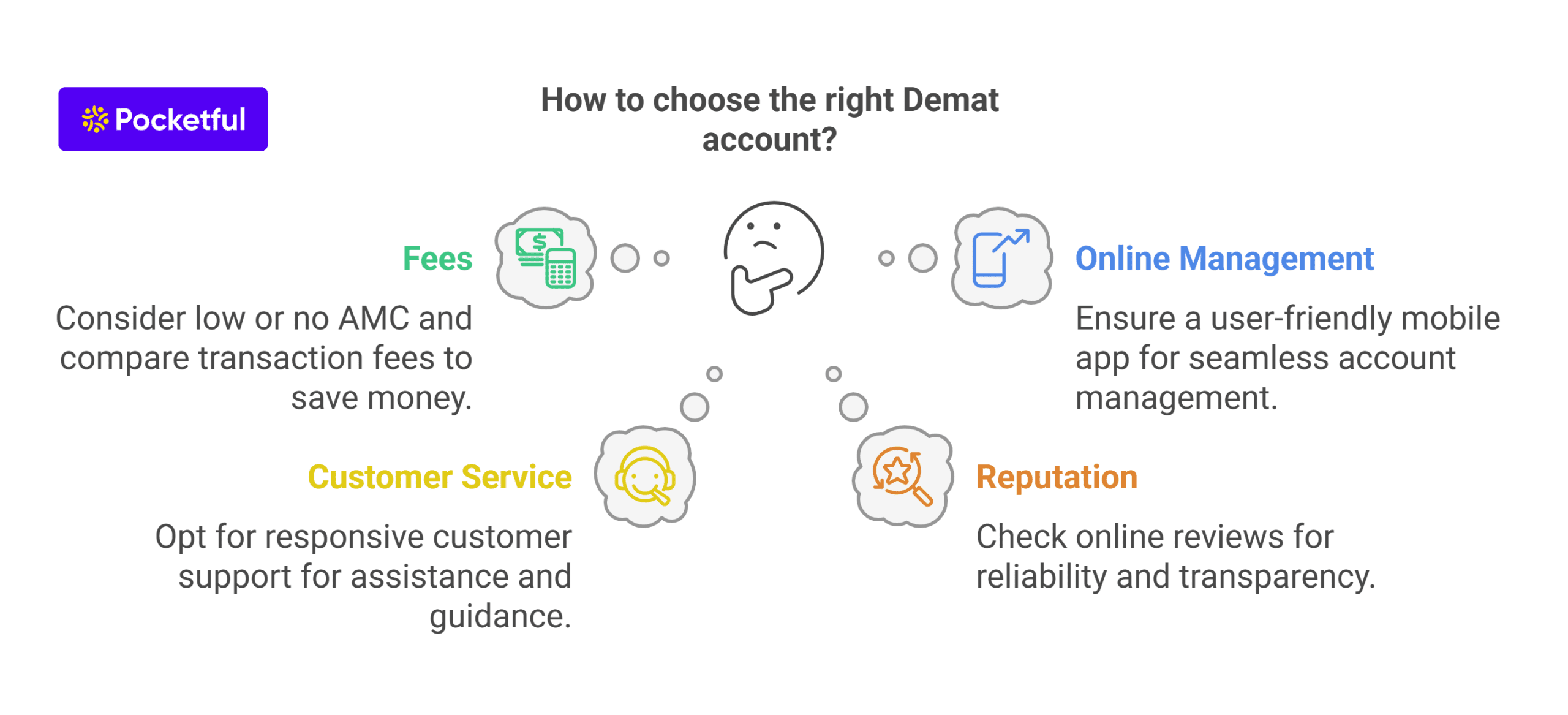
    • Consider AMC and Other Fees: Choose brokers with low or no AMC, especially if you are a beginner or have a small portfolio. Compare transaction fees across brokers if you trade frequently, as these costs apply to every trade. Additionally, brokers may have hidden fees, such as custodian fees or extra charges.
    • Ease of Online Account Management: Check whether the broker provides a user-friendly mobile application for managing your Demat account. Seek out essential features such as real-time updates, tracking of your investments, and quick execution of transactions for a seamless experience.
    • Quality of Customer Service: Choose a broker that offers responsive customer support via phone, email, chat, etc., particularly if you are a beginner in need of assistance and guidance.
    • Reputation and Reviews: Assess the broker’s reputation by exploring online reviews and ratings, with a focus on their reliability and transparency. Examine any grievances or concerns about service quality or undisclosed charges.
    • Account Opening Process: Choose brokers with an easy and quick account opening process that includes digital onboarding and KYC verification.

    Read Also: How to Open a Demat Account Online?

    Conclusion

    In today’s financial environment, selecting an ideal Demat account is essential for both novice and experienced investors alike. A lifetime free demat account is appealing because it lets your investments grow without ongoing Annual Maintenance Charges (AMCs). This cost-effective approach not only maximizes your investment returns but also provides an accessible entry point for those looking to begin their financial journey. When selecting a broker offering lifetime free Demat accounts, consider their transaction fees, customer support, and trading tools. Making the right choice can truly empower you to invest with confidence and clarity, bringing your financial goals well within reach. As the Indian economy continues to grow, there are numerous investing opportunities available to investors today. The use of a lifetime free demat account can help investors create a pathway to a more sustainable and rewarding investment journey.

    Frequently Asked Questions (FAQs)

    1. What is a lifetime free demat account?

      A lifetime free demat account is a demat account that does not charge any annual maintenance charges (AMCs) for as long as the account is active.

    2. Are there any hidden fees with a lifetime free demat account?

      While AMCs may be waived, brokers can still charge transaction fees, pledging fees, etc. Always review the fee structure of the Depository Participant (DP) before opening an account.

    3. Can I open multiple Zero AMC accounts with various brokers?

      Yes, an investor can open multiple zero AMC Demat accounts.

    4. Do lifetime zero AMC demat accounts provide all the benefits of a regular account?

      Yes, a lifetime zero AMC demat account provides all the benefits, such as IPO application, trading, and other value-added services like a regular account.

    5. How can a broker earn by offering a zero AMC demat account to its investors?

      Zero AMC demat account broker earns revenue from brokerage charges, margin facility, along with fees for other value-added services offered by them.

    6. Do all brokers offer a Lifetime free demat account?

      No, not all brokers offer a lifetime free demat account to their investors. They generally charge a fixed fee at the end of each year or quarter for maintaining a demat account with them.

    7. Can I hold all types of securities in a lifetime free demat account?

      You can hold stocks, mutual funds, bonds, and other financial instruments in a Demat account.

    8. Can I close my lifetime free demat account at any time?

      Yes, you can close your account whenever you choose.

    9. Why do the brokers charge AMCs?

      Brokers charge AMCs to cover their operational costs, such as maintaining technological infrastructure, providing customer support, etc.

  • What is DRHP (Draft Red Herring Prospectus)?

    What is DRHP (Draft Red Herring Prospectus)?

    For any company seeking to go public, submitting a Draft Red Herring Prospectus represents a pivotal milestone in the Initial Public Offering (IPO) process. This document is submitted to regulators and offers an overview of the company’s operations, finances, management, and possible risks. DRHP offers investors comprehensive insights that determine their interest in an upcoming IPO. Understanding the intricacies of this document is essential for anyone looking to invest in an upcoming IPO.

    In this blog, we will discuss the Draft Red Herring Prospectus (DRHP), how it is prepared, its importance and the difference between RHP (Red Herring Prospectus) and DRHP.

    What is a Draft Red Herring Prospectus?

    A Draft Red Herring Prospectus is a preliminary document submitted to the Securities and Exchange Board of India (SEBI), a regulatory body in India when a company plans to launch an Initial Public Offering (IPO). It offers vital insights into the company’s business operations, financials, risks, and goals for raising capital. It does not specify the number of shares offered or the price, as these details are decided later.

    IPO stands for Initial Public Offering. It refers to the process a private company follows when it first sells its shares to the public on the stock exchange. This transforms the company from being privately owned to publicly owned.

    Launching an IPO and getting listed on the stock exchange can be a significant event for any company. However, this journey demands meticulous planning, due diligence and execution.

    How is a DRHP prepared?

    Preparing a DRHP is a lengthy process, starting with the company appointing merchant bankers to determine the IPO details and ensure everything complies with the regulatory needs. The legal advisors ensure that all disclosures and anything else mentioned by the company will not lead to any litigation.

    Significant due diligence is performed on the operations, financial statements, assets, liabilities, history of litigation, and dealing with the regulatory framework of the concerned company. Conducting due diligence is vital to ascertain that what is stated in the DRHP stands true for accuracy and comprehensiveness.

    This phase consists of assessing the company’s business model, sources of income, market placement, and competition against other players. The company presents its financial statements for the past three years, which are then audited by an independent auditor. This part of the DRHP contains profit and loss statements, balance sheets, cash flow statements, and financial ratios. 

    An essential element of the DRHP is the risk factors section, which details the various risks that could affect the company’s operations or stock performance. This includes market competition, regulatory challenges, operational uncertainties and external influences. The document also includes an analysis of the industry landscape, trends, growth prospects, and the company’s position.

    Legal advisors create documents to ensure the prospectus meets regulations and follows guidelines set by the regulatory authority. This involves preparing disclosures on shareholding patterns, promoter details, the board of directors, and corporate governance structure. The DRHP is usually available for the public on the regulatory authority’s website, allowing investors and analysts to review and analyze new IPOs.

    The draft document is subsequently submitted for review to regulatory authorities such as the SEBI in India or the SEC in the United States. Regulatory authorities verify the details mentioned in the DRHP and may request changes or clarifications. The company changes the document based on the feedback from the regulatory body.

    Once the regulatory body approves the DRHP, it is finalized into an RHP (Red Herring Prospectus). The RHP document includes information about the price range, issue size, etc. 

    Read Also: What is a Confidential IPO Filing?

    Benefits and Importance of a Draft Red Herring Prospectus

    The benefits of a DRHP are:

    • Helps in Investment Decisions: The DRHP offers a detailed look at the company’s operations, finances, and risks, helping investors evaluate its financial health and make informed investment decisions.
    • Compliance with Regulatory Standards: Regulatory bodies like the SEBI in India require companies to submit a DRHP document to ensure that they meet disclosure requirements and that the IPO process stays transparent. It allows regulators to review company disclosures, reduce fraud risk and protect investors.
    • Establishing Credibility and Market Confidence: A well-prepared DRHP enhances the company’s credibility by demonstrating its commitment to transparency and regulatory compliance. This boosts investor confidence, attracting more interest in the IPO.
    • Opportunity to Showcase the Company’s Potential: The DRHP offers companies a chance to showcase their growth potential, strengths, competitive advantages, and unique position within the industry. It allows them to present a compelling narrative about their future prospects.
    • Gauging Investor Interest and Feedback: The DRHP is usually posted on the regulatory authority’s website for the public. This lets potential investors, analysts and market participants review the document and share the comments and concerns.
    • Legal Protection and Reduced Liability: By providing clear and complete information in the DRHP, the company reduces the risk of lawsuits and regulatory penalties for non-disclosure of important information. This protects the company and shows that it is acting in good faith by keeping the investors informed.

    DRHP Vs. RHP

    CriteriaDRHPRHP
    DefinitionThe DRHP is a document submitted to the SEBI by the company, which marks the first step in the IPO process.The RHP is the final document issued after the SEBI approves the DRHP.
    TimingFiled before the IPO to allow SEBI and the public to review and provide feedback.After incorporating the feedback of the SEBI, the DRHP is approved and finalized into an RHP.
    PurposeDRHP is prepared to seek SEBI approval and public feedback.To provide complete, final details to investors before the IPO opens.
    ContentThe DRHP includes most of the details needed, such as the business overview, financials, risks, strengths etc.The RHP has the complete information, including the price range, total shares being offered, and the IPO dates.

    Read Also: What is Face Value in an IPO?

    Conclusion

    Submitting DRHP to the regulator is an important event for companies and investors during the IPO process. For businesses, it guarantees transparency and adherence to regulations, allowing them to effectively showcase their strengths and future potential to investors. The DRHP helps companies maintain accountability and provides investors with tools to evaluate whether to invest in the IPO. The document increases market transparency and builds trust between companies and investors, paving the way for a successful IPO and long-term growth.

    S.NO.Check Out These Interesting Posts You Might Enjoy!
    1Anchor Investors in IPOs – Meaning, Role & Benefits
    2How to Cancel an IPO Application?
    3Why Invest in anKey Difference Between IPO and FPOIPO and its Benefits?
    4From Private to Public: Decoding the IPO Journey
    5What is NII in IPO?
    6What Is An IPO Mutual Fund? Should You Invest?
    7Why Invest in an IPO and its Benefits?
    8IPO Application Eligibility Criteria
    9What is the IPO Allotment Process?
    10ASBA Meaning, Benefits, and Process

    Frequently Asked Questions (FAQs)

    1. Why is DRHP important?

      A Draft Red Herring Prospectus (DRHP) is important because it helps investors make informed investment decisions and ensures regulatory compliance for companies going public.

    2. Is a DRHP the same as a RHP?

      No, the DRHP is a preliminary document. After regulatory review and finalization, it becomes RHP with full IPO details.

    3. Who reviews the DRHP?

      Regulatory authorities, such as SEBI in India, review the DRHP to ensure compliance.

    4. What is the validity of DRHP?

      A DRHP is valid for 12 months from the date of receiving the SEBI’s Observation letter. SEBI reviews and issues an observation report within 30 days of submission of DRHP.

    5. How is a DRHP different from a shelf prospectus?

      A DRHP is a document related to IPOs, while a shelf prospectus is a document when a company wants to issue bonds. 

  • BSDA – What is a Basic Service Demat Account?

    BSDA – What is a Basic Service Demat Account?

    A Basic Service Demat Account (BSDA) is a more affordable version of a regular demat account as it is designed for investors with limited trading activity. It also allows individuals to hold and manage their securities, such as stocks, mutual funds, and in electronic form. BSDA accounts have a lower annual maintenance, which makes them cost-effective for small investors. 

    To be classified as a BSDA, the value of securities held in the account must be below INR 10 lakhs. The limit was increased to INR 10 lakhs from INR 2 lakhs by SEBI on 28 June 2024. This account is ideal for new investors who want to start their journey in the stock market without incurring high fees while still enjoying the essential dematerialization services. In this blog, we will provide information about the BSDA Account, its features, associated charges, and the eligibility criteria for opening one.

    What is a BSDA?

    BSDA full form is Basic Service Demat Account, and it is a specialized type of demat account aimed at promoting the equity market participation among small investors. The BSDA was introduced in 2012  to allow individuals to hold their securities in an electronic format while keeping costs low. The BSDA focuses on providing basic services without the high fees associated with regular demat accounts.

    One of the key features of a BSDA demat account is its low annual maintenance fee, which makes it ideal for new investors or those who trade infrequently. To qualify for this account, the investors must maintain a maximum balance of up to INR 10 lakhs in their demat account. The limit was set to ensure that the benefits of the BSDA scheme reach the target audience.

    This account provides essential services such as holding the shares, mutual funds, and other securities and facilitates easy transfers. For those who are interested in opening a BSDA account, choosing the best stock broker is crucial. A reliable broker will offer user friendly platforms, competitive pricing, quality customer support and ensure a seamless investing experience for investors. Overall, the BSDA account encourages individuals to invest in the stock market while minimizing the costs. 

    Read Also: Demat Account Charges Comparison 2025

    Features Of Basic Service Demat Account

    The Basic Service Demat Account (BSDA) is designed to facilitate low-cost investment for small investors in the stock market. The BSDA account offers the several attractive features under the BSDA scheme, making it an appealing choice for the new investors.

    • One of the primary features of a BSDA is its low annual maintenance, which is significantly lower than regular demat accounts. The investors don’t have to pay any charges if the holdings are worth less than INR 4,00,000 and are charged INR 100 + 18% GST if the holdings value is between INR 4,00,000 and INR 10,00,000. The BSDA encourages small investors by providing basic Demat services without excessive charges.
    • Moreover, a BSDA account enables investors to enjoy essential services such as the transfer and pledge of securities and provides a secure and efficient way to manage investments.

    For individuals looking to open a BSDA account, selecting the best stock broker is essential. A top broker will offer a user friendly platform, effective customer support, and reliable services to enhance the overall investing experience. 

    Who is eligible to open a BSDA?

    To open a Basic Service Demat Account (BSDA), individuals must meet specific eligibility criteria. 

    1. The applicant should be a resident of India and at least 18 years old.
    2. The BSDA scheme is designed for small investors, so to qualify, the total market value of securities held in the account should not exceed Rs 10 lakhs at any time.
    3. Additionally, an individual can open only one BSDA across all depositories. Moreover, the investor must not have any other Demat account.

    What are the limitations of a BSDA?

    The Basic Service Demat Account (BSDA) has specific limitations such as: 

    1. To qualify for a BSDA account, the total market value of securities held should not exceed Rs 10 lakhs at any point in time. This limit ensures that the benefits of the BSDA scheme reach its intended audience and new small investors.
    2. Additionally, an individual can maintain only one BSDA account.
    3. If the market value of securities exceeds Rs 10 lakh, the account will be converted into a regular demat account and will be subject to standard fees and charges. 

    What are the Charges levied on BSDA?

    The charges levied on a Basic Service Demat Account (BSDA) are generally lower than those on a regular demat account. This fee structure is as per the circular released by SEBI on 28 June 2024. The fee structure is as follows:

    Value of Holdings held in Demat AccountMaximum Annual Maintenance Charges (AMC)
    Up to INR 4,00,000Nil
    INR 4,00,001 to INR 10,00,000INR 100 + GST
    More than INR 10,00,000Regular Demat Account charges

    Read Also: How to Use a Demat Account?

    How to Open a Basic Service Demat Account?

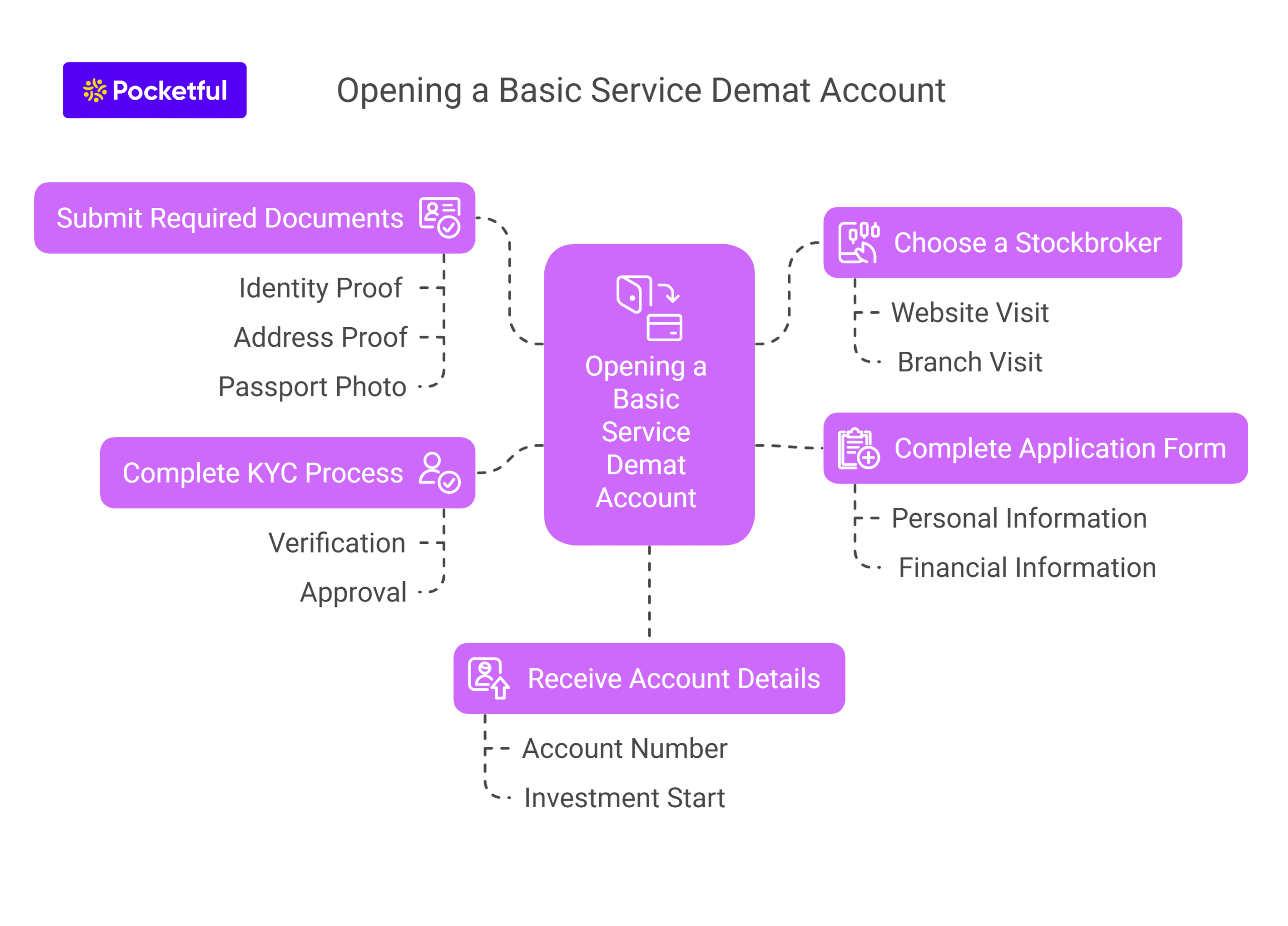
    Opening a Basic Service Demat Account (BSDA) is a straightforward process, as mentioned below:

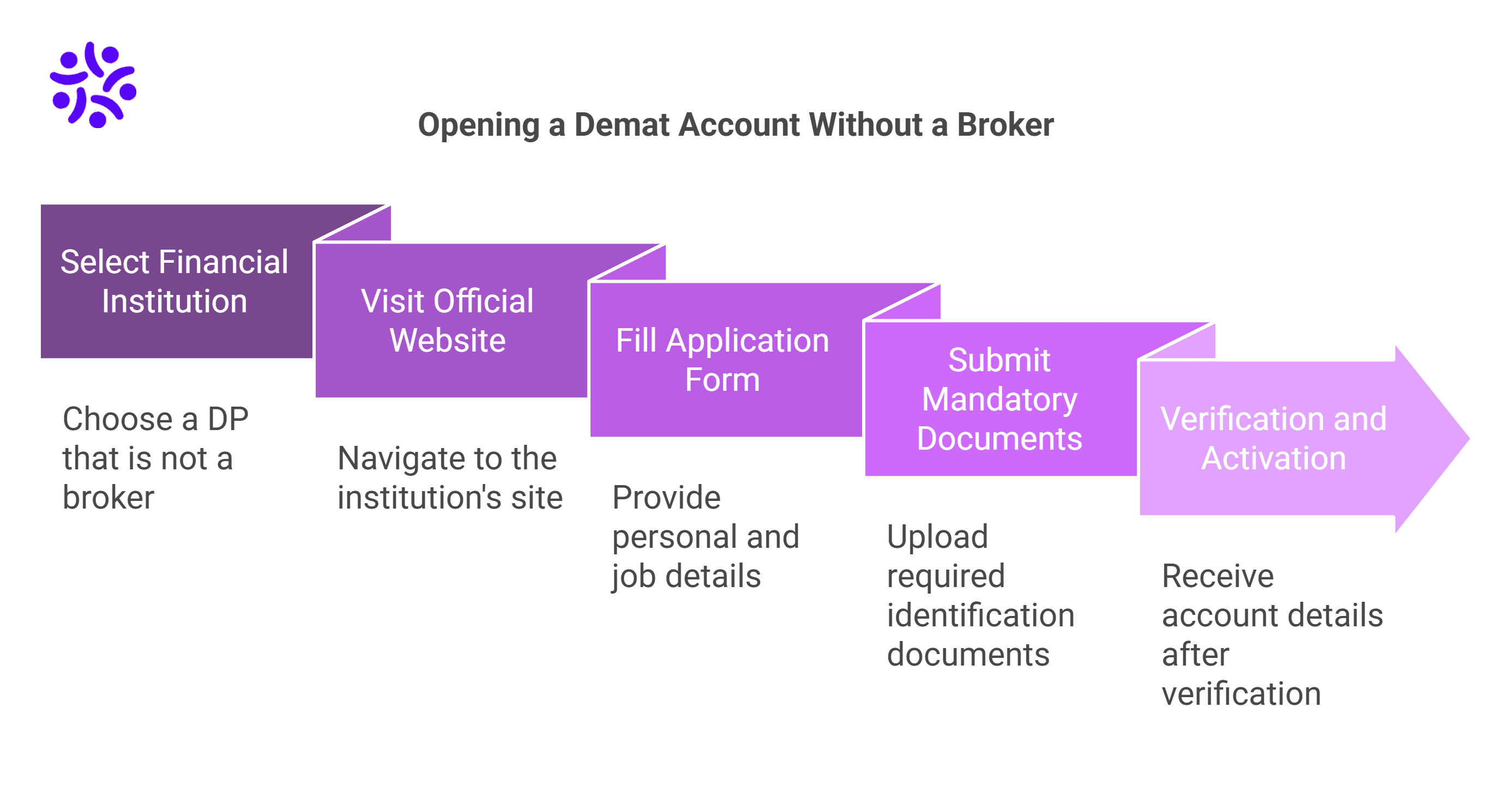
    1. Choose a reliable stockbroker that offers BSDA services and visit their website or branch to obtain the application form. 
    2. Complete the form with the necessary details, including personal and financial information. 
    3. Along with the application, submit the required documents such as identity proof (Aadhar and PAN card), address proof, and a recent passport sized photograph.
    1. After submission, complete the Know Your Customer (KYC) process.
    2. Once approved, you will receive your BSDA account details, enabling you to start your investing journey. 
    Opening a Basic Service Demat Account

    How do I convert my Demat Account to a BSDA?

    To convert your existing Demat Account to a Basic Service Demat Account (BSDA), follow the simple steps mentioned below. 

    1. Check if your account meets the BSDA eligibility criteria, i.e., whether the total market value of your securities does not exceed Rs 10 lakhs. 
    2. Contact your Depository Participant (DP) to understand the conversion process.
    3. You may need to fill out a conversion form provided by them. Provide necessary documents, such as a request letter, a declaration, and details of your existing Demat Account.
    4. Once your request is processed and approved, then your account will be converted to a BSDA. The investor receives a confirmation from the DP stating that the account has been successfully converted. 

    Read Also: Types of Demat Accounts in India

    Conclusion

    Converting your Demat Account to a Basic Service Demat Account (BSDA) is a beneficial step for small investors who are seeking to minimize costs while enjoying the essential dematerialization services. You can minimize costs by meeting the eligibility criteria and following the conversion process. The BSDA offers low annual maintenance fees, and it is designed to encourage participation in the stock market. As you transition to a BSDA, ensure you monitor your account’s market value to maintain compliance. This conversion to a BSDA can pave the way for a more cost-effective and efficient investment journey. 

    Frequently Asked Questions (FAQs)

    1. What is a Basic Service Demat Account (BSDA)?

      A BSDA is a specialized type of Demat account that is designed for small investors. It allows the individuals to hold securities in an electronic format with lower fees as compared to regular demat accounts and promotes participation in the stock market.

    2. What are the eligibility criteria for opening a BSDA?

      To open a BSDA, the investor must be a resident Indian, at least 18 years old, and the total market value of securities held should not exceed Rs 10 lakhs at any time. Additionally, an individual can maintain only one BSDA.

    3. What charges are associated with a BSDA?

      BSDA accounts generally have the lowest charges, with a maximum annual maintenance fee of Rs 100.

    4. How can I convert my existing Demat Account to a BSDA?

      To convert your Demat Account to a BSDA, contact your stockbroker and follow the conversion process. Ensure your account meets the eligibility criteria, fill out the required forms and submit any necessary documentation. The broker verifies and approves the request if the applicant meets the eligibility criteria.

    5. Can I hold multiple BSDA accounts?

      Individuals can only have one Basic Service Demat Account. 

  • How to Find Demat Account Number from PAN?

    How to Find Demat Account Number from PAN?

    Are you an investor in the Indian equity market and are trying to find your demat account number? A Demat account number is a unique 16-digit code assigned to each Demat account. It is a combination of DP ID and Client ID.

    In this blog, we will discuss how to find the Demat account number using the PAN card and the significance of having a PAN Card in your Demat account.

    What is the Demat Account Number?

    The Depository Participant or DP, working with Central Depository Services (India) Limited (CDSL) or National Securities Depository Limited (NSDL), assigns a unique identifier to each demat account when you open one. The Demat Account number can uniquely identify the Demat account holding stocks, bonds, and other securities kept in electronic form. 

    The significant features of the demat account number are as follows –

    1. Unique Number – The demat account number is a unique 16-digit number that guarantees accurate tracking of securities. 

    2. Access – You will need this number to get access to your Demat account.

    3. Issuing Authority– The depository participants partner with NSDL and CDSL and issue the Demat Account number.

    4. Role – A Demat account number is used for accurate settlement of buy, sell, and transfer transactions.

    How to Create a Demat Account Online?

    The procedure for opening a Demat account online is easy and quick. The steps to do so are as follows: 

    1. Choosing a Broker – Choosing the right broker for you is the first step, which can be accomplished by comparing the services provided by different brokers. 

    2. Visiting the Website – Visit the depository participant’s website and click “Open an Account Online” or “Open a Demat Account” on the webpage. 

    4. Entering your Details – Enter your email address, mobile number, and PAN card information. 

    5. Verification – To confirm the information, an OTP will be sent to the email address and mobile number.

    6. Filling the Form – Fill the form with the information mentioned below.

    • Personal Details – Enter personal information, like your name, address, phone number, etc. 
    • Financial Details – You will be prompted to provide your financial information, including your occupation and income bracket. ‘
    • Nominee Details – Submit the nominee’s information. Nominees will receive securities held in the Demat account in the event of an investor’s untimely death.
    • Bank Details – You must upload the bank’s details to transfer money, receive dividends, and receive payouts from your demat account. 
    • Uploading Documents –  An essential stage in opening a Demat account online is uploading supporting documentation, such as proof of identity, proof of address, bank account information, etc. 
    • Preview of Application – Check your completed application before moving on to the last step. If you discover any errors, fix them before continuing. 
    • E-sign – You must e-sign the application using the Aadhaar OTP you will receive on your mobile phone. 
    • Login Details – You will receive your Demat account details after all procedures have been completed and the DP verifies the information.  

    Read Also: How to Check Demat Account Status or Balance?

    How to Find a Demat Account Number?

    There are several ways to locate one’s Demat account number, which are listed below.-

    1. Trading Account – You may quickly check your demat account number by going to the profile section of your trading account. 

    2. Depository Website – The depository participant’s website allows users to log in with their credentials, access their Demat account, and locate their Demat account number. 

    3. Welcome Letter – Your demat account number is included in a welcome letter sent to you via email or postal mail by your broker or depository participant once you open a demat account. 

    4. Statements – Depository participants send monthly or quarterly statements of your demat account’s holdings and transactions. These statements contain your Demat Account Number.

    5. Customer Support – You can get your demat account number by contacting the DP’s customer service. 

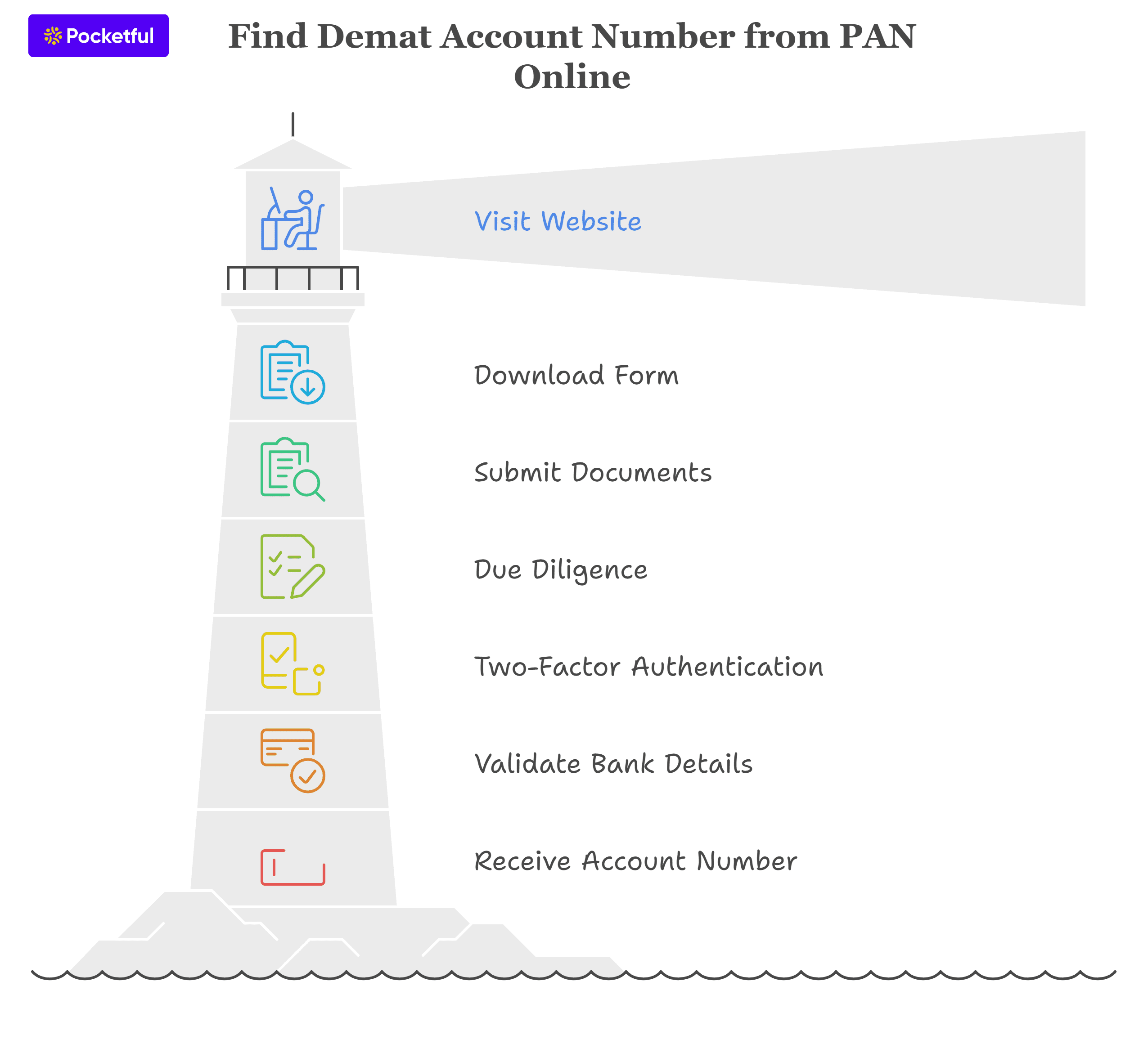
    How to Check a Demat Account Number from PAN?

    The following are the fundamental procedures to verify a demat account number from a PAN: 

    1. Visit the depository participant’s website.
    2. Download the application form, fill it out, and provide your PAN as verification.
    3. After finishing this procedure, you must submit a scanned copy of your identity and residence proofs and finish the KYC process.
    4. The brokerage firm will conduct due diligence at their end.
    5. After filling in your details, complete the two-factor authentication process to confirm your phone number and email address.
    6. Then, you will be required to validate your bank account details and ECS payment methods.
    7. After completing all the steps mentioned above, you will receive an email with your Demat Account number on your registered email ID.
    Check a Demat Account Number from PAN

    Importance of a PAN Card in a Demat Account

    A PAN Card is mandatory to open a demat account in India. It is of significant importance due to the points mentioned below-

    • Simplifies Tax Filings – Through a PAN Card, all your transactions related to securities can be easily tracked, simplifying the process of calculating gains and filing income taxes.
    • No Duplication – If your PAN Card is linked to your Demat Account it ensures that no duplicate accounts are opened in your name and prevents fraud.
    • Consolidate Account Statement – A PAN Card is generally used to generate a Consolidated Account Statement (CAS), which provides you with a detailed overview of your holdings across different Demat accounts.
    • IPOs & Corporate Actions– Having a PAN Card linked to your demat account is essential to apply for an IPO and corporate actions such as dividends, right issues, etc.

    Advantages of PAN Card linked with a Demat Account

    The major advantages of having a PAN Card linked with a Demat Account are as follows-

    • Authorization – The transactions can easily be authorized as a PAN Card serves as an identity proof of the account holder.
    • Validation of Tax Return– Generally, a bank account, Aadhar card, or digital key is used to validate your tax returns. This is only feasible if you have a demat account linked with your PAN Card.
    • Bond Purchases – Investors can purchase gold bonds and other government bonds directly in a demat account by providing both PAN card number and demat account number.
    • Loan against Securities – If your PAN Card is linked with your demat account, you can easily take loans on behalf of your holdings.
    • Transparency – A PAN Card linked with your Demat Account makes your investment activities transparent and ensures proper reporting to tax authorities.

    Read Also: How to Download Your Demat Holding Statement?

    Conclusion

    Keeping a record of your Demat Account number is crucial, but you can retrieve it easily with the help of your PAN card. A PAN Card is crucial if you want to invest in the Indian Securities Market because it offers a range of advantages for investors, such as easier tax filings, bond purchases, loans against securities, etc. 

    Frequently Asked Questions (FAQs)

    1. Can a person hold two demat accounts with the same PAN?

      Yes, a person can have two demat accounts with the same PAN Card.

    2. How do you check the number of demat accounts a person has?

      Visit the depository’s website, select the CAS option, and request a CAS by entering all the required details. CAS includes details of all your demat accounts.

    3. Can Income Tax authorities help me identify the demat account number?

      No, Income Tax authorities cannot help you identify the demat account number.

    4. How many digits does a Demat Account Number contain?

      A demat account number consists of 16 digits. In NSDL, the number begins with “IN,” followed by a 14-digit number, while in CDSL, it is a 16-digit number.

    5. Is it safe to share the Demat Account Number?

      Sharing your Demat Account number with someone other than your DP, CDSL, or NSDL is not advised.

  • Tax Implications of Holding Securities in a Demat Account

    Tax Implications of Holding Securities in a Demat Account

    Since the introduction of Demat Accounts, investors have been enjoying its various benefits, such as protection against theft, reduced paperwork and easy settlement of transactions. However, there are several tax implications of holding securities in a Demat account.

    Understanding the tax implications of demat accounts in India is crucial for identifying the tax liabilities and remaining tax-compliant when holding securities in demat accounts. Knowledge about how the investments will be taxed helps investors make better investment decisions. In this blog, we will discuss the tax implications of holding securities in a Demat account in detail.

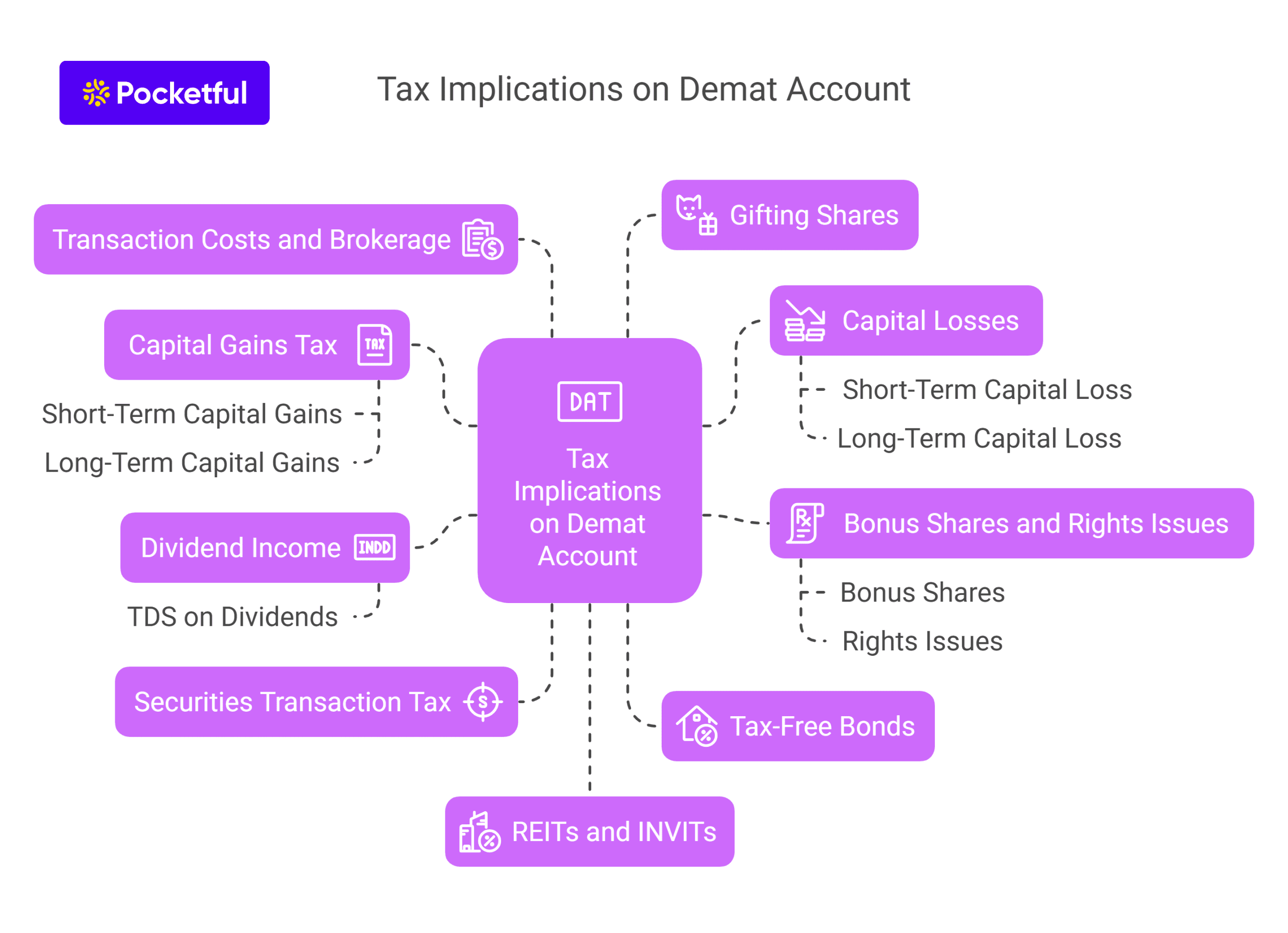
    What are the Tax Implications on a Demat Account?

    Tax Implications on Demat Account

    The tax implications of a demat account are the applicable taxes on short and long-term capital gains, dividend income, and other transaction costs related to securities held in a Demat account. These are applicable when you buy or sell equities, mutual funds, bonds, or other financial instruments kept in your Demat account. Here’s a detailed overview of the tax implications:

    1. Capital Gains Tax

    Capital gains are classified as either short-term or long-term, depending on the holding period. According to the Budget 2024, there will be only two holding periods: 12 months for listed securities and 24 months for unlisted securities

    A. Short-Term Capital Gains (STCG)

    • Listed Equity Shares & Equity-Oriented Mutual Funds: The gains are considered short-term if security is sold within 12 months of the purchase. STCG is taxed at a flat rate of 20%, regardless of your income tax slab.  
    • Other Assets: For other assets such as real estate, unlisted equity shares, specified mutual funds, etc., the gains are taxed at your income tax slab rate. Specified mutual funds are more than 65% of assets invested in debt and money market securities, and the gains realized are categorized as STCG.

    B. Long-Term Capital Gains (LTCG)

    • Listed Equity Shares & Equity-Oriented Mutual Funds: Gains from shares or equity mutual funds held for more than 12 months are classified as long-term. LTCG is exempt from taxes up to 1.25 lakh per financial year. Gains exceeding 1.25 lakh are taxed at 12.5%.
    • Other Assets: For other assets, LTCG is taxed at 12.5% without indexation benefit for transfers made on or after 23 July 2024.

    2. Dividend Income

    • From FY 2020-21 onwards, dividends received from shares and mutual funds are added to your total income and taxed according to your income tax slab.
      • TDS on Dividends: A 10% TDS is deducted if the dividend income exceeds ₹5,000 in a financial year. For NRIs, the TDS on dividends is 20%.

    3. Securities Transaction Tax (STT)

    • STT is a tax levied on the purchase and sale of securities. On the sale and purchase of equity shares, STT is 0.1% of the transaction value, and on the purchases or sale of equity-oriented mutual funds, STT is 0.001%.
    • STT is not deductible from the sale price.

    4. Tax-Free Bonds

    • The interest earned from these bonds is fully exempt from tax, making them a good option for tax-saving investments.

    5. Capital Losses

    • Short-Term Capital Loss (STCL): These can be set off against both short-term and long-term capital gains in the same year.
    • Long-Term Capital Loss (LTCL): These can only be set off against long-term capital gains.
    • Carry Forward: If capital losses cannot be fully utilized in the current year, they can be carried forward for up to 8 years to offset future gains.

    6. Transaction Costs and Brokerage

    • Brokerage fees and other transaction costs incurred while buying or selling shares can be deducted from the sale price when calculating capital gains. However, annual Demat account maintenance fees are not deductible.

    7. Bonus Shares and Rights Issues

    • Bonus Shares: When bonus shares are sold, their cost of acquisition is considered zero, and the sale proceeds are fully taxed as capital gains (either short-term or long-term, based on the holding period).
    • Rights Issues: When shares are purchased through a rights issue and sold within 1 year, the gains are subject to short-term capital gains tax (15%).

    8. Gifting Shares

    • Gifting shares or securities is not taxed. However, if the recipient sells the shares, they will be liable to pay tax on the capital gains. For capital gains calculation, the original purchase price and holding period of the person who gifted the shares are considered.

    9. REITs and INVITs

    • If you hold Real Estate Investment Trusts (REITs) or Infrastructure Investment Trusts (InvITs) in your Demat account, dividends may be tax-exempt under certain conditions.
    • Capital gains from the sale of REIT or InvIT units are taxed just like shares: short-term gains at 20% and long-term gains at 12.5% after holding for over 1 year.

    Understanding these tax implications is important to plan your investments more effectively and minimize tax liability when using a Demat account.

    Tax on Gains Made over a Longer Term

    Type of InvestmentHoldingPeriod (Long-Term)Tax on Long-Term Gains
    Equity Shares & Equity Mutual FundsMore than 1 year12.5% on gains exceeding ₹1.25 lakh (₹1.25 lakh exemption per year)
    Debt Mutual FundsMore than 3 yearsIncome Tax slab rate
    Non-Equity AssetsMore than 3 years12.5%
    DividendsN/ATaxed at applicable income slab rate; TDS of 10% on dividend income > ₹5,000

    In summary, long-term holding of investments through a Demat account can provide substantial tax benefits, especially when taking advantage of LTCG exemptions and indexation benefits for non-equity investments. One can Plan and time the investments to maximize exemptions and offset capital losses, further minimizing your tax liability.

    Summary of Short-Term Tax Implications

    Type of InvestmentHolding Period (Short-Term)Tax on Short-Term Gains
    Equity Shares & Equity Mutual FundsLess than 1 year20% flat tax rate, irrespective of income tax slab.
    Non-Equity (Debt Funds, Gold ETFs, etc.)Less than 3 yearsTaxed at your income tax slab rate 
    DividendsN/ATaxed at your applicable income tax slab rate; TDS of 10% on dividend income > ₹5,000/year.
    Bonus Shares (sold within 1 year)Less than 1 yearEntire sale proceeds taxed as STCG at 20% (since the acquisition cost is zero).
    Rights Issues (sold within 1 year)Less than 1 yearGains taxed as STCG at 20%.
    Offset Short-Term LossesN/ACan be set off against both STCG and LTCG; carried forward for up to 8 years.

    Read Also: How to Download Your Demat Holding Statement?

    How to Save Tax using a Demat account?

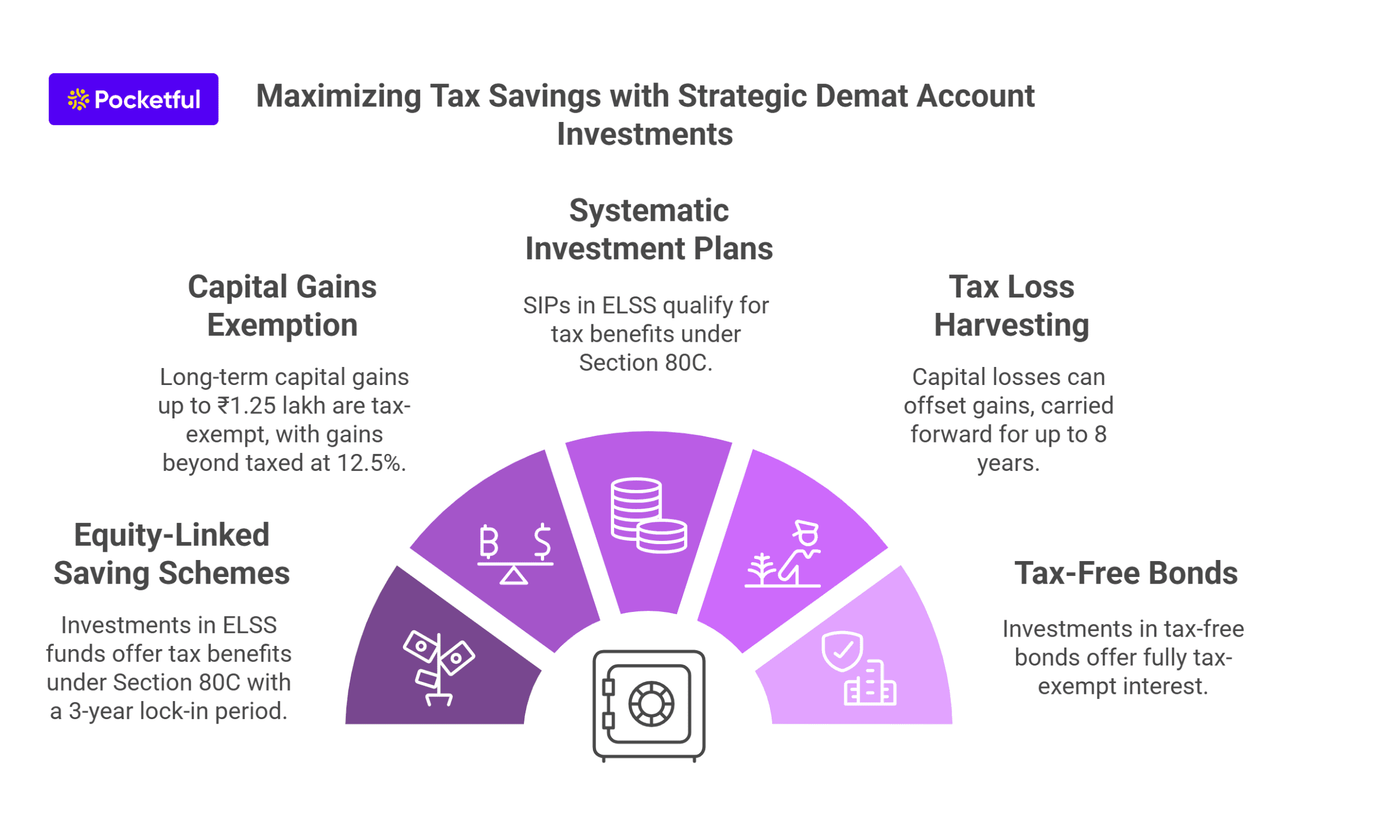
    Maximizing Tax Savings with Strategic Demat Account Investments

    Using a Demat account in India can indirectly help save taxes by facilitating investments in tax-saving instruments. Here’s how you can leverage a Demat account to reduce your tax liability:

    1. Investing in Equity-Linked Saving Schemes (ELSS)

    • ELSS funds are mutual funds that invest in equities and offer tax benefits under Section 80C of the Income Tax Act. Investments up to ₹1.5 lakh per financial year are eligible for deduction, but ELSS has a lock-in period of 3 years, which is the shortest among all tax-saving instruments under Section 80C.

    2. Capital Gains Exemption

    • Long-Term Capital Gains (LTCG) on equities and equity mutual funds (held for more than 1 year) are exempt from tax up to ₹1.25 lakh per year. Any gain beyond ₹1.25 lakh is taxed at 12.5%.
    • Short-Term Capital Gains (STCG) on equities are taxed at 20% if the holding period is less than 1 year.

    3. Tax Benefits through Systematic Investment Plans (SIP)

    • One can enjoy tax benefits under section 80 C on SIPs in ELSS.

    4. Dividend Income

    • Earlier, it was tax-free, but since FY 2020-21, dividends have been taxable as per the investor’s income tax slab.

    5. Tax Loss Harvesting

    • Short-term capital losses can be set off against both short-term and long-term capital gains, whereas long-term capital losses can be set off only against long-term capital gains. These losses can be carried forward for up to 8 years to offset future gains.

    6. Investing in Tax-Free Bonds

    • You can use your Demat account to invest in tax-free bonds issued by government entities. The interest earned on these bonds is fully exempt from tax.

    7. Avoid Frequent Trading

    • Avoid frequent trading, as short-term capital gains are taxed at 20%. By holding investments for the long term (more than 1 year), you can qualify for lower tax rates on long-term capital gains.

    8.  Tax Deductions on Brokerage and Transaction Costs

    • Brokerage fees and other transaction costs can be used to reduce the overall capital gains liability.

    You can optimize your tax savings by strategically using your Demat account for tax-saving investments and planning capital gains.

    Tax Planning and Strategies for Demat Account Holders

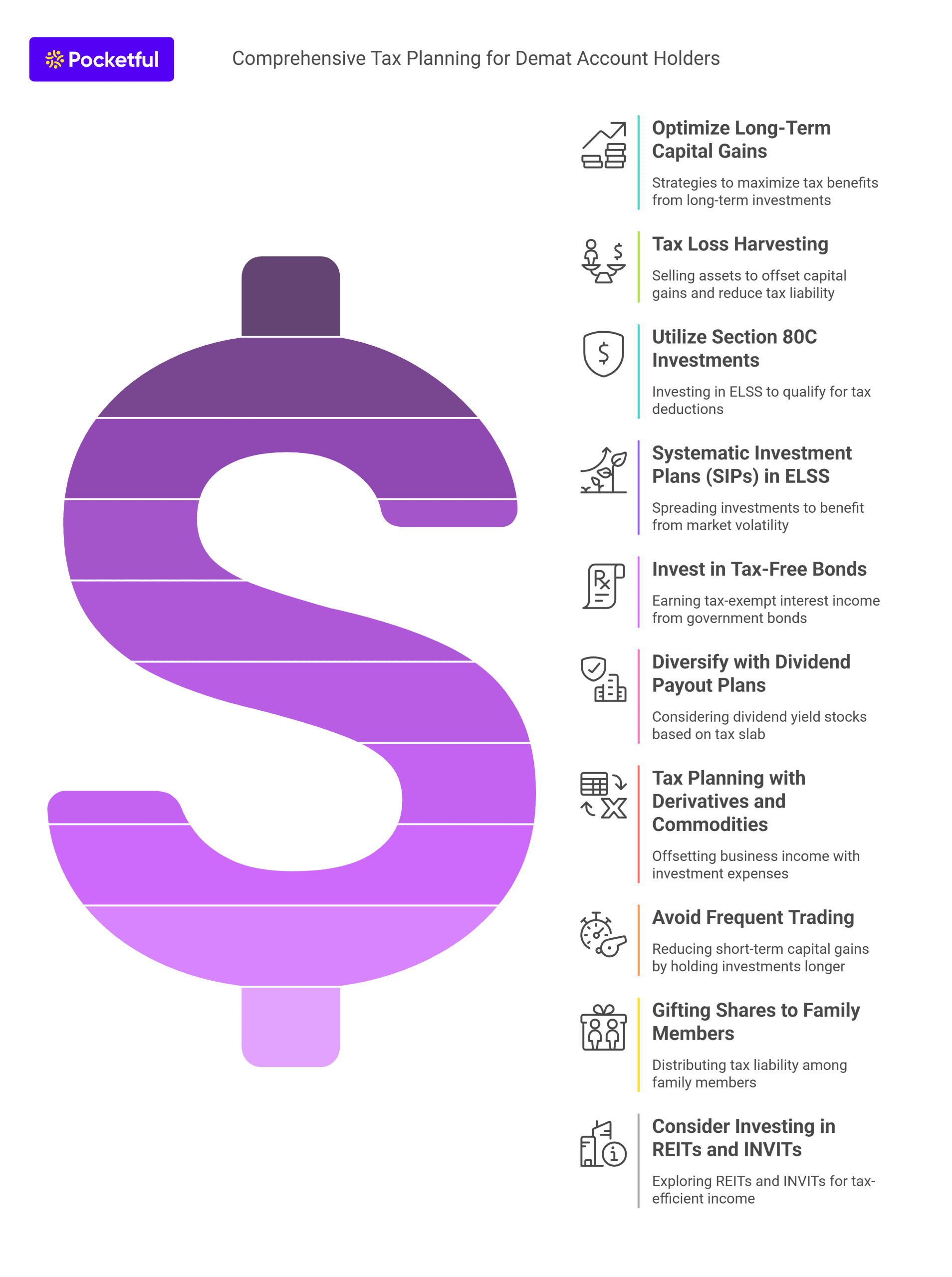
    Comprehensive Tax Planning for Demat Account Holders

    Tax planning for Demat account holders in India involves utilizing available exemptions and deductions to minimize tax liabilities. Here’s a breakdown of effective tax planning and strategies for Demat account holders:

    1. Optimize Long-Term Capital Gains (LTCG)

    • LTCG on Equity: When you sell shares or equity / mutual funds after holding them for more than 1 year, you qualify for long-term capital gains (LTCG). LTCG up to ₹1.25 lakh is exempt from tax in a financial year. Beyond that, LTCG is taxed at 12.5%. Avoid short-term trading (holding for less than 1 year) as short-term capital gains (STCG) are taxed at 20%.

    2. Tax Loss Harvesting

    • Tax loss harvesting is the strategy of selling assets in your Demat account that have incurred losses. These losses can be used to offset capital gains, reducing your taxable gains; they can also be carried forward for up to 8 years to offset future capital gains.
    • Set-off rules:
      • Short-term capital losses (STCL) can be set off against both short-term and long-term capital gains.
      • Long-term capital losses (LTCL) can only be set off against long-term capital gains.

    3. Utilize Section 80C Investments

    • Invest in Equity-Linked Saving Schemes (ELSS) to qualify for a deduction of up to ₹1.5 lakh under Section 80C of the Income Tax Act.
    • ELSS funds have a lock-in period of 3 years but provide both tax benefits and potential equity market returns.

    4. Systematic Investment Plans (SIPs) in ELSS

    • Spread your investment in ELSS funds throughout the year by using a Systematic Investment Plan (SIP). This allows you to take advantage of market volatility and gain Section 80C benefits while accumulating wealth over time.

    5. Invest in Tax-Free Bonds

    • You can buy tax-free bonds (issued by government-backed entities) through your Demat account. The interest income earned from these bonds is fully exempt from tax.

    6. Diversify with Dividend Payout Plans

    • Dividend income is taxable as per the individual’s tax slab. One should consider dividend yield stocks if your tax slab is lower.

    7. Tax Planning with Derivatives and Commodities

    • If you invest in derivatives (futures and options) or commodities, the gains are considered business income rather than capital gains. This can provide tax benefits as you have expenses (such as brokerage fees, Demat charges, etc.) to offset against the income.

    8. Avoid Frequent Trading (Minimize STCG)

    • Engaging in frequent buying and selling of shares leads to short-term capital gains (STCG), taxed at 20%, which is higher than the 12.5% on LTCG.
    • Strategy:
      • Hold your investments for the long term to reduce tax liability.
      • If frequent trading is your strategy, plan your trades carefully with a higher risk-reward ratio to offset the higher tax rate for the short term.

    9.  Gifting Shares to Family Members

    • Gifting shares to family members (e.g., spouse/ and children) can help distribute tax liability, especially if they fall in lower tax brackets or have no other significant income.

    10.  Consider Investing in REITs and INVITs

    • Real Estate Investment Trusts (REITs) and Infrastructure Investment Trusts (INVITs) can provide income in the form of interest, dividends, and capital gains. Dividends from REITs and INVITs are exempt from tax in certain cases, while interest income is taxed as per the individual’s tax slab.

    Reporting Demat Account in ITR

    Here is a table format outlining how to report a Demat account in ITR in India, the applicable forms, exemptions, credits, and other related details:

    Type of Income/TransactionWhere to Report in ITRApplicable ITR FormExemptions AvailableCredits/Deductions Available
    Short-Term Capital Gains (STCG)Schedule CG (Capital Gains)ITR-2 / ITR-3No exemptionsSet off short-term capital losses (STCL)
    Long-Term Capital Gains (LTCG)Schedule CG (Capital Gains)ITR-2 / ITR-3₹1.25 lakh LTCG exemption (on equity shares & mutual funds)Set off long-term capital losses (LTCL)
    Dividend IncomeSchedule OS (Other Sources)ITR-1 / ITR-2 / ITR-3No exemption; fully taxable at slab rateTDS credit if 10% TDS deducted for dividends
    Interest from Tax-Free BondsSchedule EI (Exempt Income)ITR-2 / ITR-3Fully exemptNot applicable
    Bonus SharesSchedule CG (Capital Gains)ITR-2 / ITR-3No exemptionsNot applicable (Zero acquisition cost)
    Rights IssuesSchedule CG (Capital Gains)ITR-2 / ITR-3No exemptionsDeduct the cost of purchase of rights shares
    Capital LossesSchedule CFL (Carry Forward Losses)ITR-2 / ITR-3Not applicableCarry forward losses up to 8 years
    REIT/InvIT DividendsSchedule OS (Other Sources) or EI (Exempt Income)ITR-2 / ITR-3Exempt if eligibleNot applicable
    Securities Transaction Tax (STT)Not Reported Separately (Impacts CG)ITR-2 / ITR-3Not applicableNot deductible, but required for claiming concessional rates (20% STCG, 12.5% LTCG)
    Demat Account Maintenance FeesNot applicableAll FormsNot exemptNo deduction allowed.

    By reporting capital gains, dividends, and other related incomes accurately in the relevant schedules and forms, you ensure compliance and can claim appropriate exemptions and deductions.

    Conclusion

    In summary, long-term holding of investments through a Demat account can provide substantial tax benefits, especially when taking advantage of LTCG exemptions and tax-free bond income. One can plan and time the investments to maximize exemptions and offset capital losses, which can further minimize your tax liability. In conclusion, short-term investments through a Demat account are subject to a higher tax rate, and careful planning around capital gains, dividends, and transaction costs can help minimize tax liabilities.

    Frequently Asked Questions (FAQs)

    1. What are the tax implications of bonus shares or rights issues?

      For bonus shares, the cost of acquisition is considered zero. When it is sold, all proceeds are taxed as capital gains. For rights issues, the cost of acquisition is the amount paid to purchase the shares. The tax treatment depends on the holding period (short-term or long-term capital gains).

    2. Can capital losses be adjusted or carried forward to reduce tax liability?

      Yes, capital losses can be used to offset gains. Short-term losses can be set off against both short-term and long-term capital gains. On the other hand, long-term losses can only be set off against long-term capital gains. Unadjusted losses can be carried forward for up to 8 years.

    3. Are the annual maintenance charges of a Demat account tax-deductible?

      No, these charges are not tax-deductible.

    4. What are the changes introduced in Budget 2024 related to LTCG?

      According to Budget 2024, long-term capital gains will be taxed at 12.5%, and the exemption limit has been increased to INR 1.25 lakhs.

    5. What are the changes introduced in Budget 2024 related to STCG?

      According to Budget 2024, the tax rate on short-term capital gains has been increased from 15% to 20%.

  • Eligibility Criteria to Open a Demat Account

    Eligibility Criteria to Open a Demat Account

    India’s economy has expanded rapidly in recent years and is on track to reach $5 trillion. If you want to participate in the nation’s development, you must invest in Indian companies listed on the Indian stock market. A Demat account is a necessity for investing in the Indian stock market. However, having knowledge about the eligibility criteria for opening a demat account is crucial.

    In this blog, we will provide an overview of the eligibility criteria and other requirements for opening a demat account.

    Who is Eligible to Open a Demat Account?

    A complete list of those eligible to open a Demat account is provided below:

    • Resident individuals
    • NRI or Non-Resident Individuals
    • Private Companies
    • Hindu Undivided Families
    • Trusts
    • Minors who are below 18 years of age

    Read Also: How to Open a Demat Account Online?

    Documents Required to Open the Demat Account

    Documents Required to Open the Demat Account

    The basic documents required for opening a demat account are as follows;

    1. PAN Card – A PAN card is a mandatory document to open a Demat account.

    2. The Identity Proof– To open a demat account, the depository participant (DP) requires identity proof such as a driver’s license, passport, voter ID card, Aadhar card, or other Indian government-authorized IDs.

    3. Address Proof – Submit documents with your residential address for address verification, such as an Aadhaar card.

    4. Bank Details – To transfer money from your bank account to your demat account, you must attach your bank account to your demat account. Provide a canceled check or a recent bank statement that includes your name, account number, and IFSC Code. 

    5. Income Proof – To trade in the derivatives market, you must provide proof of income. Your ITR, salary slip, and bank statement can be used as proof of income.

    Read Also: Documents Required to Open a Demat Account

    Who Can Hold a Demat Account?

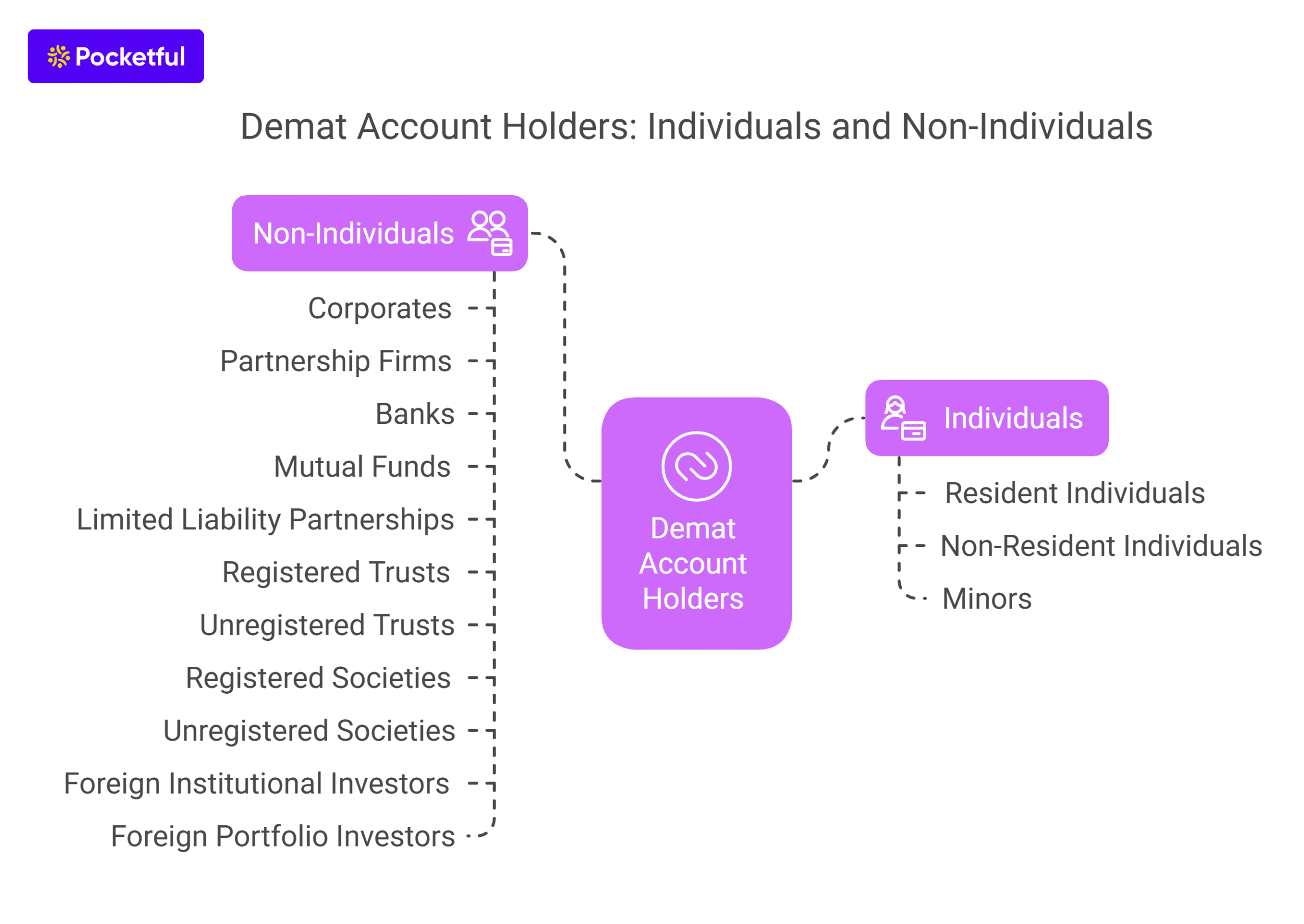
    Demat Account Holders Individuals and Non-Individuals

    Both individuals and non-individuals can hold a Demat account according to the regulations specified by the Securities and Exchange Board of India. A list is mentioned below:

    1. Individual – The individual category will include.

    • Resident Individuals.
    • Non-Resident Individuals
    • Minors

    2. Non-Individuals – The non-individual category will include.

    • Corporates
    • Partnership Firms
    • Banks
    • Mutual Funds
    • Limited Liability Partnerships
    • Registered Trusts
    • Unregistered Trusts
    • Registered Societies
    • Unregistered Societies
    • Foreign Institutional Investors or Foreign Portfolio Investors

    Read Also: Types of Demat Accounts in India

    Benefits of a Demat Account

    A Demat account has several advantages, some of which are listed below.-

    • Safety of Securities – Since a demat account enables us to hold securities digitally, there is no longer any chance of theft, physical damage, or fraud.
    • Efficient Transactions – A Demat account allows an individual to quickly buy and sell securities held in their account.
    • Convenience – A Demat account allows an investor to easily access their securities at any time, anywhere.
    • Monitoring of Investments – Holding assets in a demat account makes it simple to monitor the investment performance.
    • Less Paperwork – A demat account reduces the need for extensive paperwork.
    • Nomination – Investors can appoint a nominee in a demat account, which ensures that the assets can be easily transferred to the nominee in the case of the unfortunate death of the account holder.
    • Corporate Actions – Companies declare dividends, bonuses, rights issues, and other corporate actions, which are updated automatically in the Demat account.
    • Consolidation of Investment – A demat account helps consolidate all your investments, such as stocks, bonds, mutual funds, ETFs, etc., in one place.
    • Loan Against Securities – If you have securities, such as mutual funds, stocks, etc., in your demat account, you can easily pledge them and take out loans against them.

    Read Also: How to Find Demat Account Number from PAN?

    Conclusion

    In conclusion, having a demat account offers several advantages, making it a valuable tool for Indian citizens, corporations, trusts, minors, etc., looking to invest in the Indian stock market. However, the documents required can vary for different investor categories. You can invest from the comfort of your home by opening a Demat account with Pocketful.

    Frequently Asked Questions (FAQs)

    1. What is the minimum amount required to open a demat account?

      There is no minimum amount required to open a Demat account. However, some brokers charge account opening fees.

    2. Who can open a trading and demat account?

      Any resident or non-resident person, corporate entity, or minor can open a Demat account.

    3. Can I open a demat account without providing proof of income?

      If you simply want to invest in stocks, ETFs, etc., you can open a demat account without providing proof of income. However, you must provide proof of income if you want to trade in the derivatives market. 

    4. How many joint holders can be added to a demat account?

      A joint demat account can be opened by a maximum of three account holders. 

    5. Can I open multiple demat accounts with the same broker?

      Opening more than one Demat account with the same broker is prohibited. 

  • Elcid Investments – India’s Costliest Stock: From INR 3 to INR 2,36,250 – Share Price History

    Elcid Investments – India’s Costliest Stock: From INR 3 to INR 2,36,250 – Share Price History

    If you are an investor who regularly participates in the stock market, you probably might have heard of scenarios of if someone had invested INR 10,000 twenty years back in a particular stock, then the investor would have been a multi-millionaire by now. But what if we tell you that recently, a stock turned an investment of INR 10,000 into more than INR 70 crores, not gradually but overnight?

    In this blog, we will provide an overview of Elcid Investments Ltd. and explain the reasons behind the recent price increase.

    Elcid Investments Overview

    In 1981, Elcid Investments Ltd. was established and registered with the Reserve Bank of India as a non-banking financial company. The company’s main business is investing in a range of securities, including mutual funds, shares, and debentures. The business is listed on the Bombay Stock Exchange. It has two subsidiaries, Suptaswar Investment & Trading Company Ltd. and Murahar Investments & Trading Company Ltd., both of which are registered with the RBI as non-banking financial corporations. The company’s main office is located in Mumbai. 

    Due to the firm’s significant dividends and the restricted supply of shares on the market, the stock price experienced a significant upward trend in early 2020, making the company a hidden gem for investors. The company’s promoters have made attempts to delist or repurchase shares at a base price of INR 1,61,203, but they were unsuccessful since they did not have public shareholder’s approval. 

    Latest News About Elcid Investments

    When Elcid Investments’ share price surpassed that of MRF Limited, it became the most expensive stock on the Indian equity market and made headlines. The share’s price has jumped over 75,000 times overnight, which made the stock a topic of discussion among investors. The company was last traded on 21 June 2024 and closed at INR 3.55. The next time it was traded was on 29 October 2024, and the stock price closed at INR 2,36,250. 

    Elcid– Penny Stock to Most Expensive Stock

    The story began when SEBI published a circular in June mentioning the use of a price mechanism called the Special Call Auction of Investment Holding Companies and Investment Companies to determine the companies’ fair prices. This circular aimed to lessen the price gap between holding companies’ book values and current market prices. There won’t be price bands in this auction.

    The company consistently pays large dividends to its owners, which attracts investors. Since the company paid out a dividend of INR 25 in August 2024 despite its share price being only INR 3, no investor was prepared to sell their holdings. 

    Back in 2013, when the share’s current market price was below 2.73 INR, the company’s promoters chose to delist the security and offered an alluring price of INR 11,455. However, according to SEBI laws, 90% of the public shareholders must approve of the offer to delist, and in this instance, the shareholders rejected it. The company recently made a delisting offer of INR 1,61,203 per share, but the investors also rejected this offer. 

    The company owns approximately 2.83% stake in Asian Paints, which is valued at 8,500 crores. The stock is still trading at a 45% discount to its intrinsic value of INR 4.25 lakh per share based on its position in Asian Paints. 

    Did You Know – Other than Elcid Investments Limited, only 30 stocks in India have share prices above INR 10,000. These businesses include MRF, Page Industries, Honeywell Automation India, and Shree Cement. 

    Market Details of Elcid Investments Ltd.

    Current Market PriceINR 2,36,250
    Market Capitalization (In INR Crores)4,725
    Book ValueINR 5,84,225
    52 Week HighINR 2,36,250
    52 Week LowINR 3.37
    Face Value of ShareINR 10
    P/E Ratio (x)22.1
    (Above data as of 30 October 2024)

    Read Also: Case Study of Petrol & Diesel Price History in India

    Financial Statements of Elcid Investments

    Income Statement

    ParticularsMarch 2024March 2023March 2022
    Total Income235108134
    Total Expenditure463
    EBIT231101131
    Net Profit 17573100
    (The figures mentioned above are in INR crores unless mentioned otherwise)
    Income Statement of Elcid Investments

    Balance Sheet

    ParticularsMarch 2024March 2023March 2022
    Non-Current Assets11,69511,19112,342
    Current Assets95.7173.2021.47
    Non-Current Liabilities786744835
    Current Liabilities10671.7634.94
    Total Shareholder Funds11,68511,19212,329
    (The figures mentioned above are in INR crores unless mentioned otherwise)
    Balance Sheet of Elcid Investments

    Cash Flow Statement

    ParticularsMarch 2024March 2023March 2022
    Cash Flow from Operating activities773761
    Cash Flow from Investing activities-87-27-68
    Cash Flow from Financing activities000
    (The figures mentioned above are in INR crores unless mentioned otherwise)
    Cash Flow Statement of Elcid Investments

    Key Performance Indicators (KPIs)

    ParticularsMarch 2024March 2023March 2022
    Operating Profit Margin (%)98.4393.6897.24
    Net Profit Margin (%)74.6967.4374.22
    Return on Net Worth/Equity (%)1.50.650.81
    ROCE (%)1.850.850.99
    Return on Asset (%)1.400.610.75

    Read Also: Hyundai Motor India Case Study: Business Model, Financial Statements, And SWOT Analysis

    Conclusion

    Elcid Investments has experienced exponential growth in recent years because it owns a 2.83% stake in Asian Paints. However, because of the market’s limited liquidity, the share prices do not reflect the company’s fair value. As a result, even after the call auction, the company is still trading below its fair value. Investors may find it challenging to buy this stock because of its low liquidity. However, investors must consult their investment advisor before making any investment.

    Frequently Asked Questions (FAQs)

    1. Where is the headquarters of Elcid Investment Limited?

      The headquarters of Elcid Investment Limited is situated in Mumbai.

    2. What caused the increase in the share price of Elcid Investments?

      The BSE’s unique call auction mechanism, which enables firms to find a reasonable price without a price band, caused the share price of Elcid Investment Ltd. to soar on 29 October 2024.  

    3. Why does Elcid Investment Ltd. share have low liquidity?

      The company’s share price has low liquidity as it declares high dividends and trades below its fair value, which is why investors are not willing to sell their holdings.

    4. Is Elcid Investment the costliest stock in India?

      Elcid Investment Ltd.’s share price is valued at INR 2,36,250, making it the costliest stock in India as of 29 October 2024.

    5. Who are the major investors in Elcid Investment Ltd.?

      The promoters of Asian Paints hold around 75% stakes in Elcid Investments Limited, and other shareholders, such as Hydra Trading Pvt. Ltd., hold around 9.04% stake.

  • Open Free Demat Account

    Join Pocketful Now

    You have successfully subscribed to the newsletter

    There was an error while trying to send your request. Please try again.

    Pocketful blog will use the information you provide on this form to be in touch with you and to provide updates and marketing.