India is one of the world’s fastest-growing economies and is facing substantial challenges in managing its energy requirements. With a population of over 140 crore, the Government of India is making all the necessary efforts to meet the country’s rising energy needs. Two government-owned businesses, NHPC and NTPC, are responsible for energy production in India.
In today’s blog post, we’ll compare NTPC and NHPC.
NHPC Overview
The NHPC was established in 1975 by the Government of India as a division of the Ministry of Power. The company’s primary goal is to increase the nation’s hydropower output. The company has operations in Jammu & Kashmir, Uttarakhand, Arunachal Pradesh, Sikkim, etc. The corporation uses wind energy and solar energy, among other sources, to generate electricity.
In 2008, the company went public on the Indian Stock Exchange. With a hydro share of 6971.20 MW as of March 2024, the corporation has a total capacity of 7144.20 MW or 14.85% of the nation’s hydro capacity. The organization is always concentrating on using renewable energy sources to generate electricity. It also develops several infrastructure types, including tunnels, dams, and powerhouses. The company’s main office is located in Faridabad.
NTPC Overview
In response to the country’s growing need for power, the Indian government established the firm in 1975 as a public-sector corporation. The company used coal to produce electricity and is now focusing on utilizing renewable energy sources. Due to its substantial contribution to the nation’s electricity consumption, the business became India’s largest power utility in 1990. The company launched an initial public offering (IPO) in 2004 and became listed on the Indian Stock Exchange.
The corporation is diversifying its sources of electricity generation, including nuclear, solar, wind, and hydroelectric power. The firm has 94 facilities with a combined capacity of 76,134 MW, of which 52 are owned and run by NTPC, and 43 are in joint ventures or subsidiaries. The company plans to achieve a 130 GW capacity by 2032. The business produced 400 billion units of power in 2023–2024. The organization’s headquarters is in New Delhi.
In conclusion, both businesses produce power, but their methods vary: NHPC primarily draws its energy from hydroelectric sources, while NTPC draws its energy from more traditional sources like coal, gas, etc. In the fiscal year ending in 2024, both businesses reported profits and are expanding their operations in the renewable energy market. Given their bright futures, an investor should take into account the risk profile of these companies or consult a financial advisor before making any investment decisions.
S.NO.
Check Out These Interesting Posts You Might Enjoy!
Which firm, NHPC or NTPC, has a higher market capitalization?
The market capitalization of NTPC is more than that of NHPC.
What is the full form of NTPC and NHPC?
National Hydroelectric Power Corporation is abbreviated as NHPC, and the full name of NTPC is National Thermal Power Corporation Limited.
Which company is more profitable: NTPC or NHPC?
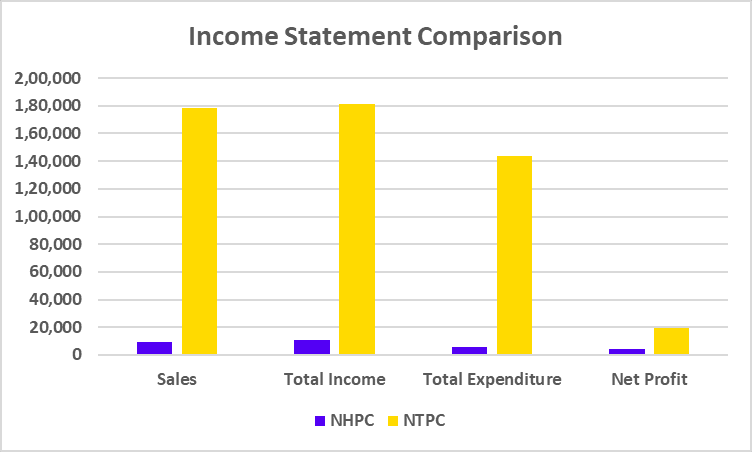
For FY 2024, NTPC generated a net profit of 19,696 crores, while NHPC reported a net profit of 4,023 crores, demonstrating that NTPC is more profitable.
What are NTPC and NHPC’s primary business activities?
While NTPC is a well-known player in the thermal power (oil, gas, and coal) generation industry, NHPC is primarily focused on hydroelectric power generation and is regarded as a major player in this area.
Which company has a more diversified business model among NTPC and NHPC?
Compared to NHPC, which mostly concentrates on hydroelectric power, NTPC has a more diverse business strategy because it generates power from various sources, including coal, gas, hydroelectric, solar, wind, etc.
Miniratna companies are a group of public sector enterprises in India that are considered relatively small but still important in terms of their operations and contributions to the economy. The Government of India categorizes these companies under the “Miniratna” status to recognize their performance and to provide them with certain financial and operational autonomy.
In this blog, we will discuss the significance of “Miniratna” status, the criteria for earning it, and an overview of the top Miniratna companies.
Overview of Miniratna Companies
The Indian government grants Miniratna status to a group of public sector companies based on their historical revenue and profit figures. These businesses are given the ability to make decisions by the government, which helps them operate more effectively in their respective industries. These enterprises work under the jurisdiction of the Government of India yet enjoy a great degree of decision-making power in terms of everyday operations, which includes investments, joint ventures, and other commercial decisions.
The Miniratna companies are divided into two different categories based on the financial position of the companies –
Miniratna Category I
The company must satisfy the following conditions to earn a Miniratna Category-I status:
A company must have continuously made a profit for the last three years.
A pre-tax profit of at least 30 crores in one of the previous three years.
The company must have a positive net worth.
Miniratna Category II
The company must satisfy the following conditions to earn a Miniratna Category-II status:
A company must have continuously made a profit for the last three years.
The company must have a positive net worth.
Moreover, to become a Miniratna company, the company should not have defaulted in the repayment of loans or interest payments and shall not depend upon budgetary support or Government guarantees.
Top Miniratna Companies in India Based on Market Capitalization
A brief overview of Miniratna companies is given below:
1. Indian Railway Finance Corporation Ltd.
Indian Railway Finance Corporation Ltd. was established in 1986 as the financial arm of the Indian Railway. The IRFC is governed by the Ministry of Railways. The company’s main goal is to raise capital through various means, such as issuing bonds, etc. The international capital market is another source of funding for the company. In 2021, the company launched its initial public offering (IPO) and was listed on the Indian stock exchanges. The company’s main office is located in New Delhi.
2. Indian Railways Catering and Tourism Corporation Ltd.
The Ministry of Railways formed the Indian Railway Catering and Tourism Corporation of India (IRCTC), a public sector organization. To modernize Indian Railways’ tourist and online ticketing operations, IRCTC was founded in 1999.
In 2002, they introduced irctc.co.in, an online ticketing platform. With this website, customers may make online reservations for tickets. Subsequently, they began providing more services, such as catering services for Indian Railways. The IRCTC mobile application was introduced in response to the growth in smartphone usage and technical advancements. It provides users with a quick way to order tickets, check train schedules, and access other services.
3. Cochin Shipyard Ltd.
Cochin Shipyard was established by the Indian government in 1972, and the company’s shipyard is located in Kochi, Kerala. The business delivered the MV Rani Padmini, a bulk carrier, as its maiden vessel in 1981. The business constructed the INS Vikrant, India’s first aircraft carrier. The company went public in 2017 to raise funds to modernize its infrastructure. Its main office is located in Kochi, Kerala.
4. Bharat Dynamics Ltd.
The Indian government formed Bharat Dynamics Ltd. in 1970 as a public-sector undertaking under the Ministry of Defence. The business was founded with the primary goal of producing guided weaponry. The company has created the Prithvi, Akash, and Nag Missiles in partnership with the Defence Research and Development Organization (DRDO). 2018 saw the company’s listing on the Indian Stock Exchange. The company’s headquarters is in Hyderabad.
5. Hindustan Copper Ltd.
Hindustan Copper was established by the Indian government in 1967 as a central public sector undertaking under the Ministry of Mines. The company’s primary goal is to explore the nation’s copper mining potential. The business took over the mines from NMDC Limited in 1967. The corporation is currently engaged in exploring new mines to boost production. The company’s main office is located in Kolkata.
6. KIOCL Ltd.
The Indian government established KIOCL, formerly known as Kudremukh Iron Ore Company Limited, in 1976. It is a department of the Ministry of Steel. According to a Supreme Court ruling, the company’s mines were shut down in 2005. Following this, the company began importing iron ore from various suppliers, including Brazil. The company is searching for a new mining lease to guarantee a steady supply of iron ore. The organization’s headquarters is in Bangalore.
Performance of the Miniratna Companies
Company
1-Year Return
3-Year Return
5-Year Return
Indian Railway Finance Corporation Ltd.
-24.52%
439.11%
363.98%
Indian Railway Catering & Tourism Corporation Ltd.
-30.29%
-14.29%
81.54%
Cochin Shipyard Ltd.
45.39%
776.17%
628.70%
Bharat Dynamics Ltd.
2.14%
360.40%
575.58%
Hindustan Copper Ltd.
-19.44%
80.48%
529.77%
KIOCL Ltd.
-52.28%
11.45%
126.62%
(As of 28th February 2025)
Key Performance Indicators (KPIs)
Company
ROE (in %)
ROCE(in %)
Debt to Equity (x)
P/E
P/B
Indian Railway Finance Corporation Ltd.
13.03
53.32
8.38
36.50
4.79
Indian Railway Catering & Tourism Corporation Ltd.
34.40
45.47
0
62.24
22.87
Cochin Shipyard Ltd.
15.65
19.98
0
59.87
10.28
Bharat Dynamics Ltd.
16.84
11.33
0
82.35
14.12
Hindustan Copper Ltd.
12.92
15.74
0.10
87.86
13.91
KIOCL Ltd.
-4.34
-2.31
0.03
-326.56
12.93
(All the above data is of the year ended March 2024)
In conclusion, Miniratna Companies of India significantly contribute to the nation’s economic growth. These businesses demonstrate consistent financial performance, effective operational efficiency, and the ability to strike a balance between profitability and social welfare. These businesses are regarded as excellent investment options, but before making investment decisions, it’s wise to consider your risk tolerance and speak with an investing professional.
S.NO.
Check Out These Interesting Posts You Might Enjoy!
There are 76 Miniratna companies in India, of which 64 are under Category I, and 12 are under Category II.
How many Miniratna companies are there in Category 1?
There are 64 Miniratna companies in Category-I as of 2024. These companies have demonstrated consistent profitability and operational efficiency.
How many Miniratna companies are there in Category 1?
There are 12 Miniratna companies in Category-II as of 2024. These companies have met basic profitability and financial stability criteria.
Which department gives Miniratna status to the companies?
The Department of Public Enterprises gives the Miniratna status to eligible companies.
Is it compulsory for Miniratna companies to get listed on the Indian Stock Exchange?
Miniratna companies are not required to list on the Indian Stock Exchange.
What is the full form of CPSE?
CPSE stands for Central Public Sector Enterprises.
Can a Miniratna company be upgraded to Maharatna status?
If a Miniratna company satisfies the requirements to be a Maharatna status, it can be granted a Maharatna status.
Where can I find the list of Miniratna companies?
The official and updated list of Miniratna companies is usually published on government websites, such as the Department of Public Enterprises (DPE) or other reliable sources like financial news platforms.
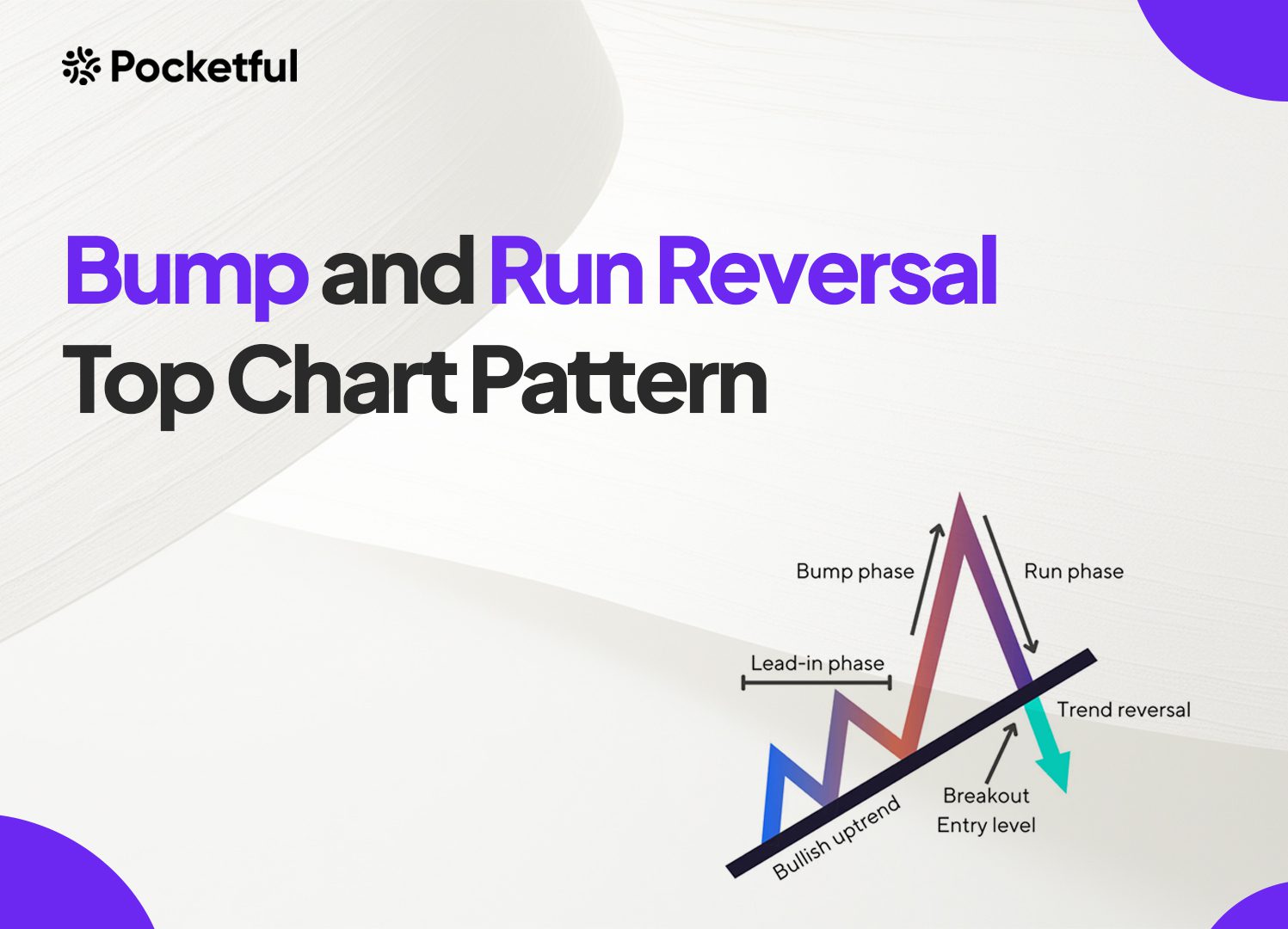
From a steady climb to a sharp decline, the Bump and Run Reversal Top pattern indicates the “End of the Bull Run.”
The Bump and Run Reversal Top Chart pattern is a bearish reversal pattern. It forms when the market is in an overly bullish trend, and prices suddenly advance to higher levels in a frantic manner. Once the pattern is confirmed, it suggests that the market trend is expected to reverse from bullish to bearish. In today’s blog, we will discuss the Bump and Run Reversal Top chart pattern, trading setup, advantages, and disadvantages.
What is the Bump and Run Reversal Top Chart Pattern?
The Bump and Run Reversal Top is a chart pattern that forms after a bull run or excessive uptrend in the stock price, which is too fast. The pattern generally indicates a change of trend from bullish to bearish. The pattern was first identified by Thomas Bulkowski and was introduced in the June 1997 issue of a journal called “Technical Analysis of Stocks and Commodities.” It was also included in his book, the “Encyclopedia of Chart Patterns.”
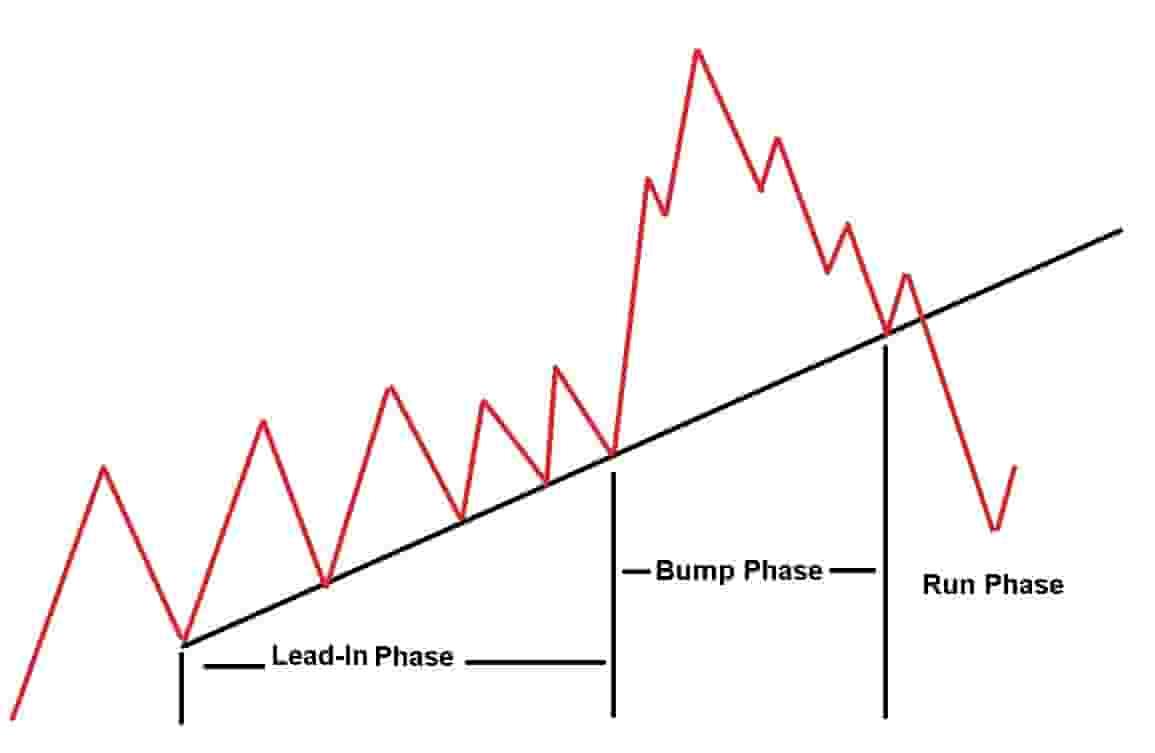
The three main phases of the pattern are explained below:
Lead-in Phase: The lead-in phase is characterized by a steady upward trend with a moderate slope. The asset price trends higher in this phase, roughly at an angle of 30 degrees to 45 degrees on the chart.
Bump Phase: In this phase, the price of an asset sharply increases and deviates significantly from the initial trendline, often due to excessive speculation. The asset price starts to trend even higher with a steeper angle, typically between 45 degrees and 60 degrees.
Run Phase: The price peaks, then reverses sharply, breaking below the original trendline, signaling the start of a bearish trend. The pattern is complete once the asset price moves below the original trendline, acting as a support.
This pattern helps traders recognize when a bullish trend may come to an end, offering opportunities to exit long positions or to enter short positions.
How to Find the Bump and Run Reversal Top Chart Pattern?
The methods for finding a Bump and Run Reversal Top pattern in the market are:
Use a percentage scanner: Use a percentage gainer stock scanner or tool to scan for trading opportunities and find the stocks that have appreciated significantly. Then, glance through the charts to find stocks about to enter the bump phase.
Manually browse the price charts: Manually check the price charts to find the Bump and Run Reversal Top pattern.
Trading Setup
A trading setup consists of a precise plan for entry, stop-loss, and target levels, which are discussed as follows:
Entry Point: The entry point should be when the price breaks below the trendline formed during the Lead-in phase. Create a short position once the price moves below the trendline. An increase in volume during the breakdown can be used as a confirmation signal.
Stop-loss: A stop-loss should be placed ideally just above the bump peak or above the most recent high before the breakdown to manage risk.
Target: Measure the vertical distance between the bump’s peak and the trendline. Find the breakdown point where the price first breaks the support and then subtract the distance from the breakdown price to get the target price.
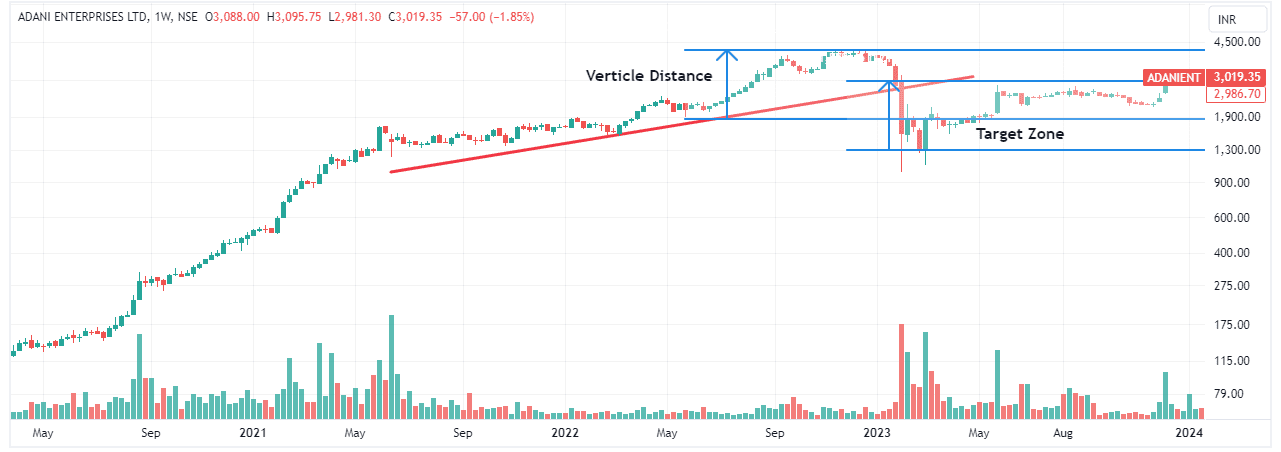
Example: Bump and Run Reversal Top Chart Pattern of Adani Enterprises Ltd.
The above image shows Adani Enterprises’ weekly chart. The stock was in an uptrend for some time, and then it started making a Bump and Run Reversal Top chart pattern when the stock price was in the Lead-in phase from June 2021 to May 2022. The stock price witnessed a sharp uptrend between May 2022 and November 2022 and went from a low of 1900 to a high of 4,096 in a speculative uptrend during the Bump phase. The stock price started falling with big volumes and gave a breakdown below the initial trend line in January 2023. The height of the bump is approximately 2,200, which is subtracted from the breakdown point of INR 3,019 to get an approximate target of INR 819. The stock almost achieves the target price in a couple of weeks after the breakdown. Stop-loss should ideally be placed just above the peak of the bump. A more conservative stop-loss should be placed just above the most recent high before the breakdown.
Advantages of Bump and Run Reversal Top Chart Pattern
The advantages of the Bump and Run Reversal Top chart pattern are:
It works in any market, such as equity, currency, or commodity markets.
It works in any time frame, but a pattern formation on a bigger time frame means a strong trend reversal is expected.
The pattern can be used as a reversal indicator.
The pattern can be used to capture large price movements.
The pattern provides a logical understanding of price action.
The pattern can be used to identify opportunities to short an asset in the market.
This pattern gives quite accurate results if the breakdown occurs with strong volumes.
Limitations of Bump and Run Reversal Top Chart Pattern
The limitations of the Bump and Run Reversal Top chart pattern are:
It is a complicated pattern and needs some expertise to trade.
Pattern interpretation can be subjective, as it is one of the confusing and complex patterns.
It is a time-consuming pattern.
The pattern could give a false breakdown, which can result in losses.
The pattern could be affected by various market factors such as volatility, news, policy change, political instability, or any other factor.
The Bump and Run Reversal Top chart pattern is a powerful technical tool for investors and traders. Though it is a time-consuming pattern, once breakdown occurs after a strong trend with good volume, it offers a potential for significant gains. The pattern is divided into three phases: Lead-in phase, Bump Phase, and Run Phase. It is important to understand the pattern’s characteristics, trade setup, and risk management strategies before using this pattern to make informed decisions and improve the chances of success in the markets.
Frequently Asked Questions (FAQs)
How does the Bump and Run Reversal Top pattern differ from other reversal patterns?
Other reversal patterns, such as Head and Shoulders or Double Top, have specific formations, but the Bump and Run Reversal Top pattern follows a trendline formed during the Lead-in phase. Furthermore, it is difficult to estimate the duration of each phase.
Can the Bump and Run Reversal Top pattern lead to a long-term trend reversal?
Yes, it can signal the start of a long-term bearish trend on a longer timeframe (e.g., weekly or monthly). However, in a short timeframe, it may only indicate a temporary correction.
What are the risks of trading the Bump and Run Reversal Top pattern?
The primary risk associated with the Bump and Run Reversal Top pattern is a false breakdown when the price temporarily moves below the trendline but then resumes the uptrend. To lower this risk, traders should check volumes for confirmation or use additional indicators to validate the reversal.
Is the Bump and Run Reversal Top pattern reliable?
The Bump and Run Reversal Top pattern can be reliable, especially when confirmed by volume and other technical indicators.
Navratna Companies are a group of government-owned enterprises whose legacy of excellence and contribution to the Indian economy is widely recognized and appreciated. These companies play a crucial role in driving India’s economic growth and development across various sectors.
In today’s blog, we will explore the key features of Navratna companies, how they have evolved, and their past financial track record.
What is a Navratna company?
Navratna Companies are a special group of public sector undertakings (PSUs) in India. These PSUs are the top performers, enjoying enhanced financial autonomy and operational flexibility granted by the government. The term ‘Navratna’ means nine gems in Sanskrit.
Key Characteristics of Navratna Companies
They can invest up to INR 1,000 crores without government approval.
They have more freedom to make decisions and can compete better in the market.
The Navratna status brings increased recognition and credibility.
Additionally, these companies play an important role in the Indian economy and are widely regarded as industry leaders.
Eligibility Criteria for Becoming a Navratna Company
A company must satisfy the following criteria to become a Maharatna company:
Miniratna Category 1 Status – For a PSU to qualify for ‘Navratna status’, it must have held ‘Miniratna’ Category 1 status for at least three years.
Profits – The company must have consistently generated profits over the past three years.
Net Worth – To ensure financial stability, the company needs to maintain a positive net worth consistently over the past three years.
Corporate Governance – The PSU must have a track record of exemplary performance and demonstrate sound corporate governance practices.
Global Presence – the company must establish a substantial global presence and engage in international operations.
Furthermore, Miniratna Category 1 and Schedule ‘A’ CPSEs, which have achieved an ‘excellent’ or ‘very good’ rating under the Memorandum of Understanding system in at least three out of the past five years and have a composite score of 60 or higher in the six specifically chose parameters viz.,
Net profit to net worth,
Manpower cost to total cost of production/services,
Profit before depreciation, interest, and taxes to capital employed,
Profit before interest and taxes to turnover,
Earnings per share
Inter-sectoral performance
All Navratna Companies List Based on Market Capitalization
The top Navratna stocks in 2026 are:
S.No.
Navratna Stocks
1
Bharat Electronics Ltd.
2
Rail Vikas Nigam Ltd.
3
Mazagon Dock Shipbuilders Ltd.
4
Indian Renewable Energy Development Agency Ltd.
5
NMDC Ltd.
6
Container Corporation of India Ltd.
7
Engineers India Ltd.
8
Mahanagar Telephone Nigam Ltd.
9
National Aluminium Company Ltd.
10
National Buildings Construction Corporation Ltd.
11
Neyveli Lignite Corporation Ltd.
12
Rashtriya Ispat Nigam Ltd.
13
Shipping Corporation of India Ltd.
14
Indian Railway Catering & Tourism Corporation Ltd.
A brief overview of Navratna companies is given below:
1. Hindustan Aeronautics Ltd.
Hindustan Aeronautics Ltd.(HAL) is India’s biggest aerospace company and plays a major role in the country’s defense industry. Founded in 1940, HAL has a rich history of designing, manufacturing, and maintaining aircraft, helicopters, etc. In the 1970s and 1980s, India made significant strides in developing indigenous aircraft, such as the HF-24 Marut and the HAL Cheetah Helicopter. HAL is a versatile aerospace company involved in a wide range of activities, which includes the design, development, and production of fighter jets, trainers, and transport aircraft, the production of military and civilian helicopters, and overhauling and repairing aircraft for both domestic and international customers.
2. Bharat Electronics Ltd.
Established in 1954, the company manufactures a wide range of advanced electronic products for Indian defense forces. This forms the major part of their revenue. It plays an important role in India’s defense sector by providing several crucial electronic equipments to the Indian Armed Forces. Bharat Electronics Ltd. (BEL) is a Navratna Public Sector Undertaking (PSU) under India’s Ministry of Defence. Products include communication equipment, electronic warfare systems, avionics, and night vision devices. The company also ventured into the civilian market and is trying to capture new growth opportunities. Their non-defense products include homeland security solutions, telecom & broadcast systems, medical electronics, etc.
3. Rail Vikas Nigam Ltd.
Rail Vikas Nigam Ltd. (RVNL) is a public sector undertaking under the Ministry of Railways, Government of India. It was established in 2003 with the main goal of quickly carrying out railway infrastructure projects. It is involved in the development and implementation of railway infrastructure projects in India. RVNL plays an important role in enhancing the efficiency and capacity of the Indian railway network. The company is responsible for the planning, designing, constructing, and maintaining various railway infra projects, which include new railway lines, doubling of existing lines, gauge conversion, electrification of railway lines, railway bridges, and tunnels. It offers complete project management services to ensure projects are completed on time and meet quality standards. RVNL actively participates in PPP projects with private companies to finance and execute railway infra projects.
4. Mazagon Dock Shipbuilders Ltd.
Mazagon Dock Shipbuilders Ltd. is a leading shipbuilding and repair yard in India. Established in 1849, the company has a rich history of constructing and repairing naval vessels, commercial ships, and offshore structures. In 1849, it was established as the Bombay Dockyard. During the 1990s and 2000s, the company started building commercial ships such as tankers, bulk carriers, and offshore platforms. The 2010s were marked by a sustained dedication to both naval and commercial shipbuilding, placing a strong emphasis on advanced technologies and high-quality standards. The company is an advanced shipbuilding facility for naval shipbuilding, commercial shipbuilding, ship repair, etc.
5. Indian Renewable Energy Development Agency Ltd.
Indian Renewable Energy Development Agency Ltd. (IREDA) is a financial institution that operates under the Ministry of New and Renewable Energy, which is part of the Government of India. Created in 1987, IREDA aims to support and fund renewable energy projects in India. It provides financial assistance to various renewable energy projects, including solar power, wind power, biomass power, small hydropower, and geothermal power. It plays an important role in promoting sustainable energy development in India. IREDA supports policies that encourage the development of renewable energy in India.
6. National Mineral Development Corporation Ltd.
National Mineral Development Corporation Ltd. (NMDC) is the biggest iron ore producer in India, playing a significant role in the country’s steel industry. It was founded in 1958 as the National Mineral Development Corporation and has played a leading role in India’s mining industry. The company is the primary supplier of iron ore to India’s steel industry, ensuring a steady supply of raw materials. It has played an important role in developing infrastructure in mining regions, including roads, railways, and power plants. NMDC operates numerous iron ore mines in India, such as Bailadila in Chhattisgarh, Donimalai in Karnataka, and Kumaram Bheem in Telangana. It is also looking for new mining opportunities and expanding its operations.
6. Container Corporation of India Ltd
Container Corporation of India Ltd. (CONCOR), founded in 1988 under the Ministry of Railways, is India’s largest container logistics and supply chain company. It provides end-to-end multimodal transport services combining rail, road, and port logistics. CONCOR plays a vital role in facilitating EXIM trade and strengthening India’s freight infrastructure network.
7. Engineers India Ltd. (EIL)
Engineers India Ltd. (EIL), incorporated in 1965, is a premier public sector engineering consultancy and EPC firm under the Ministry of Petroleum and Natural Gas. It provides design, project management, and turnkey solutions for refineries, petrochemicals, pipelines, and infrastructure. EIL has delivered landmark industrial and energy projects across India and abroad.
8. Mahanagar Telephone Nigam Ltd. (MTNL)
Mahanagar Telephone Nigam Ltd. (MTNL), established in 1986, provides telecom services in Delhi and Mumbai. Once a dominant player in India’s telecom market, MTNL now focuses on broadband, mobile, and enterprise connectivity. The company is working closely with BSNL toward network modernization and integration to enhance nationwide telecom infrastructure.
9. National Aluminium Company Ltd. (NALCO)
National Aluminium Company Ltd. (NALCO), founded in 1981, is one of Asia’s largest integrated aluminium producers, operating across mining, refining, smelting, and power generation. Headquartered in Bhubaneswar, NALCO exports aluminium and alumina to global markets. The company focuses on energy efficiency, sustainable mining, and expansion into renewable energy projects.
10. National Buildings Construction Corporation Ltd. (NBCC)
National Buildings Construction Corporation Ltd. (NBCC), incorporated in 1960, is a Navratna PSU under the Ministry of Housing and Urban Affairs. It provides project management consultancy, real estate development, and EPC contracting. NBCC has executed key government projects, including redevelopment of Delhi’s Central Vista and other major urban infrastructure works.
11. Neyveli Lignite Corporation Ltd. (NLC India Ltd.)
NLC India Ltd., established in 1956 under the Ministry of Coal, is a leading lignite mining and power generation company. Operating in Tamil Nadu and other states, it produces thermal and renewable energy. NLC is expanding into solar and wind energy projects, reinforcing India’s push toward cleaner power generation.
12. Rashtriya Ispat Nigam Ltd. (RINL)
Rashtriya Ispat Nigam Ltd. (RINL), known as Vizag Steel, was incorporated in 1982 and operates the Visakhapatnam Steel Plant. It specializes in long steel products for construction and infrastructure industries. As one of India’s leading steel producers, RINL contributes to national development through efficient operations, exports, and modernization initiatives.
13. Shipping Corporation of India Ltd. (SCI)
Shipping Corporation of India Ltd. (SCI), founded in 1961, is India’s largest shipping company offering maritime transport for crude oil, coal, fertilizers, and bulk cargo. It operates tankers, bulk carriers, passenger ships, and offshore vessels. SCI plays a crucial role in facilitating India’s seaborne trade and energy logistics network.
14. Indian Railway Catering & Tourism Corporation Ltd. (IRCTC)
Indian Railway Catering & Tourism Corporation Ltd. (IRCTC), established in 1999, manages online railway ticketing, catering, and tourism for Indian Railways. It operates India’s largest e-ticketing platform, serves millions daily, and manages premium trains like the Maharajas’ Express. IRCTC is expanding into hospitality, packaged drinking water, and tourism services.
15. Rashtriya Chemicals & Fertilisers Ltd. (RCF)
Rashtriya Chemicals & Fertilisers Ltd. (RCF), formed in 1978, is a leading producer of fertilizers and industrial chemicals. It manufactures urea, complex fertilizers, and chemicals like methanol and ammonium nitrate. RCF supports Indian agriculture with efficient fertilizer supply chains and sustainability-focused initiatives aimed at improving soil health and productivity.
16. IRCON International Ltd.
IRCON International Ltd., incorporated in 1976, is a public sector construction company under the Ministry of Railways. It executes railway, highway, and bridge infrastructure projects across India and internationally. Known for technical excellence and timely delivery, IRCON has built major infrastructure in difficult terrains and several foreign countries.
17. RITES Ltd.
RITES Ltd., founded in 1974, is a leading transport infrastructure consultancy and engineering company under the Ministry of Railways. It offers project management, turnkey solutions, and export of rolling stock. RITES operates in over 55 countries and is a key contributor to India’s railway modernization and international infrastructure presence.
18. National Fertilisers Ltd. (NFL)
National Fertilisers Ltd. (NFL), incorporated in 1974, is India’s second-largest urea producer and a major supplier of nitrogenous fertilizers. It operates five gas-based plants and provides agrochemicals, seeds, and soil health solutions. NFL plays a key role in supporting Indian agriculture through efficient production and farmer engagement programs.
19. ONGC Videsh Ltd. (OVL)
ONGC Videsh Ltd. (OVL) is the international arm of ONGC, engaged in oil and gas exploration and production overseas. Operating in over 30 countries, OVL contributes to India’s energy security by acquiring hydrocarbon assets abroad. Its global portfolio spans Asia, Africa, and Latin America across multiple upstream projects.
20. Housing & Urban Development Corporation Ltd. (HUDCO)
Housing & Urban Development Corporation Ltd. (HUDCO), founded in 1970, provides long-term finance for housing and infrastructure projects. It supports affordable housing, water supply, roads, and sanitation initiatives. HUDCO plays a critical role in India’s urban development mission and promotes inclusive growth through sustainable financing solutions.
21. RailTel Corporation of India Ltd.
RailTel Corporation of India Ltd., established in 2000, is a telecom infrastructure provider under Indian Railways. It manages an extensive nationwide optic fiber network and offers broadband, data center, and cloud services. RailTel also supports the government’s Digital India mission by enabling connectivity in rural and remote areas.
22. Indian Railway Finance Corporation Ltd. (IRFC)
Indian Railway Finance Corporation Ltd. (IRFC), founded in 1986, is the dedicated financial arm of Indian Railways. It mobilizes funds from domestic and international markets to support railway expansion, electrification, and modernization projects. IRFC plays a pivotal role in funding India’s growing transportation and logistics infrastructure.
23. NHPC Ltd.
NHPC Ltd., formerly National Hydroelectric Power Corporation, was established in 1975. It is India’s leading hydropower company engaged in the design, construction, and operation of hydroelectric projects. NHPC is expanding into solar and wind power, supporting India’s renewable energy goals and sustainable development agenda.
24. SJVN Ltd.
SJVN Ltd., earlier Satluj Jal Vidyut Nigam Ltd., was incorporated in 1988 as a joint venture between the Government of India and Himachal Pradesh. It operates in hydro, solar, and wind energy sectors. SJVN’s flagship project, the Nathpa Jhakri Power Station, is India’s largest hydroelectric plant.
25. Bharat Sanchar Nigam Ltd. (BSNL)
Bharat Sanchar Nigam Ltd. (BSNL), founded in 2000, is India’s largest government-owned telecom company. It provides mobile, broadband, and enterprise communication services across urban and rural India. BSNL plays a crucial role in digital connectivity and is expanding its 4G and 5G infrastructure under the government’s telecom revival plan.
Performance of the Navratna Companies
Company
1-Year Returns
3-Year Returns
5-Year Returns
Bharat Electronics Ltd.
46.79%
282.84%
1,307.69%
Rail Vikas Nigam Ltd.
-26.84%
608.90%
1,703.59%
Mazagon Dock Shipbuilders Ltd.
34.03%
591.09%
3,154.52%
Indian Renewable Energy Development Agency Ltd.
-26.13%
–
–
NMDC Ltd.
-1.56%
99.62%
161.23%
Container Corporation of India Ltd
-19.07%
-14.78%
70.47%
Engineers India Ltd
2.57%
172.37%
208.40%
Mahanagar Telephone Nigam Ltd.
-12.15%
97.65%
360.77%
National Aluminium Company Ltd.
0.51%
216.29%
664.42%
National Buildings Construction Corporation Ltd.
16.86%
405.75%
663.53%
Neyveli Lignite Corporation Ltd.
2.99%
235.68%
440.21%
Shipping Corporation of India Ltd.
17.83%
80.79%
403.10%
Indian Railway Catering & Tourism Corporation Ltd.
-12.01%
-5.31%
176.11%
Rashtriya Chemicals & Fertilisers Ltd.
-3.69%
49.91%
251.98%
IRCON International Ltd.
-19.97%
246.06%
346.24%
RITES Ltd.
-19.97%
246.06%
346.24%
National Fertilisers Ltd.
-12.95%
84.94%
201.08%
Housing & Urban Development Corporation Ltd.
5.77%
485.86%
656.10%
RailTel Corporation of India Ltd.
-10.17%
194.18%
–
Indian Railway Finance Corporation Ltd.
-20.20%
415.95%
390.92%
NHPC Ltd
0.84%
91.78%
315.84%
SJVN Ltd
-21.57%
142.05%
295.38%
(As of 03 November 2025)
Key Performance Indicators
Company
ROE (in %)
ROCE (in %)
Debt-to-Equity
P/E (x)
P/B (x)
Bharat Electronics Ltd.
24.4
30.13
0
51.67
13.42
Rail Vikas Nigam Ltd.
18
16.74
0.68
82.8
13.78
Mazagon Dock Shipbuilders Ltd.
31.02
35.65
0
39.22
15.68
Indian Renewable Energy Development Agency Ltd.
14.62
42.69
5.80
50.93
7.98
NMDC Ltd.
21.71
30.49
0.13
11.26
2.59
Container Corporation of India Ltd
10.40
13.49
0
26.1
3.4
Engineers India Ltd
21.7
23.4
0
15.5
3.3
Mahanagar Telephone Nigam Ltd.
0
14.88
-1.20
-0.8
-0.10
National Aluminium Company Ltd.
-21.5
-15.6
0.93
-22
4.79
National Buildings Construction Corporation Ltd.
21.82
29.96
0
40.95
8.92
Neyveli Lignite Corporation Ltd.
14.00
9.92
1.20
12.5
1.81
Shipping Corporation of India Ltd.
10.14
10
0.23
9.13
0.93
Indian Railway Catering & Tourism Corporation Ltd.
35.88
43.18
0
44.28
15.88
Rashtriya Chemicals & Fertilisers Ltd.
5.10
9.21
0.58
28.59
1.46
IRCON International Ltd.
11.49
8.93
0.67
20.24
2.32
RITES Ltd.
14.57
19.06
0
27.89
4.07
National Fertilisers Ltd.
6.77
7.49
0.73
21.43
1.45
Housing & Urban Development Corporation Ltd.
15.07
52.29
5.97
14.74
2.22
RailTel Corporation of India Ltd.
14.99
19.20
0
32.39
4.86
Indian Railway Finance Corporation Ltd.
12.34
49.98
7.83
24.98
3.09
NHPC Ltd
7.57
6.21
0.99
30.22
2.08
SJVN Ltd
5.78
4.45
1.90
44.03
2.54
(All the above data is for the year ended March 2025)
To summarize, Navratna companies are a valuable asset to India’s economy. These companies generate revenue and create job opportunities, making them instrumental in driving India’s growth. Their performance and contributions have made them leading players in their respective sectors. These companies have exhibited a remarkable track record of innovation and resilience, which will serve as a strong foundation for their future endeavors. With their extensive resources, talented workforce, and commitment to excellence, the Navratna companies are well-positioned to drive their growth and contribute to the overall development of the nation.
S.NO.
Check Out These Interesting Posts You Might Enjoy!
The Indian economy is driven by many companies contributing to its growth and development. These companies vary in size, ownership, control, and access to capital, reflecting the country’s diverse corporate landscape. However, companies must be categorized to promote effective corporate governance.
In this blog, we will discuss the types of companies based on size, number of members, control, liability, and access to capital.
What is a Company?
A company is a legal entity formed by a group of individuals to engage in and operate a business or enterprise. It is a separate legal entity from its owners, meaning it can own assets, incur liabilities, enter into contracts, sue, and be sued. It has perpetual succession, a common seal, and is subject to statutory compliance. The purpose of the companies is generally to generate profit for their owners, although some, like Section 8 Companies, may be formed for charitable or social purposes.
List of Different Types of Companies in India
Category
Type
Definition/Act
Categorization Based on Size
Micro Enterprise
MSMED Act, 2006
Small Enterprise
MSMED Act, 2006
Medium Enterprise
MSMED Act, 2006
Categorization Based on Number of Members
One Person Company (OPC)
Section 2(62) of Companies Act, 2013
Private Limited Company
Section 2(68) of Companies Act, 2013
Public Limited Company
Section 2(71) of Companies Act, 2013
Categorization Based on Control
Sole Proprietorship
Recognized under Income Tax Act
Private Limited Company
Companies Act, 2013
Public Limited Company
Companies Act, 2013
Government-Owned Company (PSU)
Section 2(45) of Companies Act, 2013
Categorization Based on Liability
Sole Proprietorship
Not defined under Companies Act
Partnership Firm
Indian Partnership Act, 1932
Limited Liability Partnership (LLP)
LLP Act, 2008
Private Limited Company
Companies Act, 2013
Public Limited Company
Companies Act, 2013
Categorization Based on Access to Capital
Sole Proprietorship
Not defined under Companies Act
Partnership Firm
Indian Partnership Act, 1932
Private Limited Company
Companies Act, 2013
Public Limited Company
Companies Act, 2013
Section 8 Company
Section 8 of Companies Act, 2013
Here’s a detailed categorization of Indian companies based on size, number of members, control, liability, and access to capital, as per the Companies Act, 2013:
The MSME Act classifies companies based on their size to give benefits the government provides for MSMEs.
1. Categorization Based on Size
Based on the size, companies can be categorized as:
Micro, Small, and Medium Enterprises (MSMEs):
Companies are categorized based on size under the Micro, Small, and Medium Enterprises Development (MSMED) Act, 2006, but often referenced in the context of companies under the Companies Act.
Micro Enterprises:
Investment: Up to ₹1 crore.
Annual Turnover: Up to ₹5 crore.
Small Enterprises:
Investment: Between ₹1 crore and ₹10 crore.
Annual Turnover: Between ₹5 crore and ₹50 crore.
Medium Enterprises:
Investment: Between ₹10 crore and ₹50 crore.
Annual Turnover: Between ₹50 crore and ₹250 crore.
2. Categorization Based on Number of Members
Based on the number of members, companies can be categorized as:
One Person Company (OPC):
Definition: Under Section 2(62) of the Companies Act, 2013.
Members: One individual is the sole member.
Characteristics: The OPC allows a single entrepreneur to start and manage a company with limited liability, with provisions for a nominee in case of the sole member’s death or incapacity.
Private Limited Company:
Definition: Under Section 2(68) of the Companies Act, 2013.
Members: Minimum of 2 members, maximum of 200.
Characteristics: Shares are not freely transferable, and the company cannot invite the public to subscribe to its shares.
Public Limited Company:
Definition: Under Section 2(71) of the Companies Act, 2013.
Members: Minimum of 7 members, no maximum limit.
Characteristics: Can issue shares to the public, and shares are freely transferable. These companies are usually listed on stock exchanges.
3. Categorization Based on Control
Based on control, companies can be categorized as:
Sole Proprietorship:
Definition: It is not defined under the Companies Act but is recognized under various laws, such as the Income Tax Act.
Control: Controlled by a single individual.
Characteristics: The owner has full control over business operations, and there is no distinction between personal and business assets.
Private Limited Company:
Control: Controlled by directors, often with significant influence from shareholders.
Characteristics: Decisions are made by the board of directors, with major shareholders often having significant influence.
Public Limited Company:
Control: Controlled by a board of directors elected by the shareholders.
Characteristics: Ownership and management are separate, with control exercised by the elected board.
Government-Owned Companies (PSUs):
Definition: Under Section 2(45) of the Companies Act, 2013.
Control: Controlled by the government, which holds a majority stake.
Characteristics: Operates in sectors deemed crucial by the government, such as defense, energy, and infrastructure.
4. Categorization Based on Liability
Based on liability, companies can be categorized as:
Sole Proprietorship:
Liability: Unlimited liability.
Characteristics: The owner is personally responsible for all debts, and there is no legal distinction between personal and business assets.
Partnership Firm:
Liability: Unlimited liability for all partners.
Characteristics: Every partner is liable, jointly with all the other partners, for all acts of the firm.
Limited Liability Partnership (LLP):
Definition: Under the Limited Liability Partnership Act, 2008.
Liability: Limited liability for partners.
Characteristics: Partners’ liability is limited to their contribution, and the LLP has a separate legal existence. No partner is liable on account of the independent or unauthorized acts of other partners.
Private Limited Company:
Liability: Limited liability.
Characteristics: Shareholders are liable only up to the value of their shares, which means shareholders are not liable to sell their personal assets in case of a loss.
Public Limited Company:
Liability: Limited liability.
Characteristics: Shareholders are not personally liable for the company’s debts beyond the amounts of their investments.
5. Categorization Based on Access to Capital
Based on access to capital, companies can be categorized as:
Sole Proprietorship:
Access to Capital: Limited.
Characteristics: Funding is typically from personal savings, small loans, or family resources.
Partnership Firm:
Access to Capital: Moderate.
Characteristics: Partners pool their resources with additional funding from loans based on the firm’s credit.
Private Limited Company:
Access to Capital: Moderate to high.
Characteristics: Can raise capital through private placements, venture capital, or loans but cannot raise capital from the public.
Public Limited Company:
Access to Capital: High.
Characteristics: Can raise capital by issuing shares and debentures to the public, listing on stock exchanges, and other financial instruments.
Section 8 Company:
Definition: Under Section 8 of the Companies Act, 2013.
Access to Capital: Limited to donations, grants, and philanthropic funding.
Characteristics: Cannot distribute profits to members; profits are reinvested in the company’s objectives.
Each of these categories presents a different aspect of how companies in India are structured and operate, from the scale of their operations to their financial and legal framework.
There are different types of companies in India, so different stakeholders, like entrepreneurs, investors, and businesses, can operate efficiently within a legal framework. Every company serves a different purpose, from small startups to large multinational corporations, providing flexibility in terms of ownership, control, liability, and access to capital, as there are different regulations for different types of companies. Understanding these different types of companies is important for anyone looking to start, manage, or invest in a business in India.
S.NO.
Check Out These Interesting Posts You Might Enjoy!
An OPC, or a One Person Company, is a type of company in India where a single individual can own and manage the business with limited liability protection. It is ideal for entrepreneurs who want to maintain full control while enjoying the benefits of a corporate structure.
What is the difference between a Partnership Firm and a Limited Liability Partnership?
A Partnership Firm is a business owned by two or more individuals with unlimited liability, where partners are personally liable for the business’s debts and liabilities. On the other hand, an LLP provides limited liability protection to its partners, meaning they are only liable to the extent of their investment.
What is a Section 8 Company?
It is a non-profit organization in India that promotes social welfare activities such as education, arts, environment preservation, sports, charity, etc. These companies reinvest their profits and enjoy tax benefits and other exemptions.
Can a foreign company establish a business in India?
A foreign company can establish a business in India through various routes, including a joint venture with an Indian partner or establishing a branch office, liaison office, or project office. India’s Foreign Direct Investment (FDI) policy controls these processes.
What are the criteria for qualifying as a Micro Enterprise?
Investment in the plant and machinery can’t exceed INR 1 crore, and annual turnover must not exceed INR 5 crore for a company to qualify as a Micro Enterprise.
Ever wondered how traders manage to find precise buying and selling points in an uptrending market? The answer usually refers to recognizing patterns, such as the ascending channel. This powerful chart pattern portrays an ongoing uptrend by displaying a series of higher highs and higher lows, making it one of the favorite chart patterns of traders who want to surf the wave of market momentum.
In this blog, we will discuss how mastering the ascending channel sharpens your trading edge.
What is the Ascending Channel Pattern?
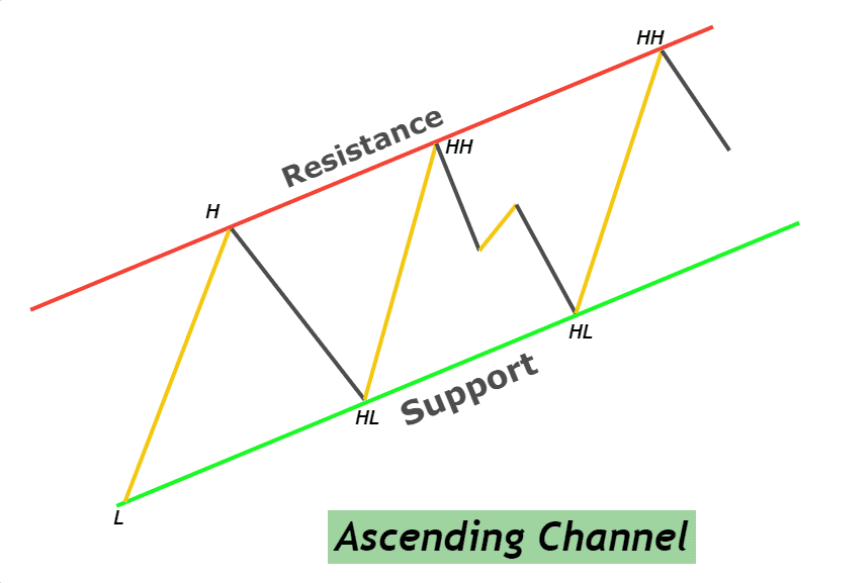
The ascending channel pattern is a bullish chart pattern in which two parallel upward-sloping trend lines contain all the price fluctuations. One trend line connects the higher highs, while the other trend line connects the higher lows, reflecting a consistent uptrend. This pattern signals that the buyers are in control, driving prices steadily higher while establishing predictable support and resistance areas.
It is also used by traders for the ascending channel to determine buying points near the lower trend line and selling points near the upper trend line. A breakout above the upper trendline indicates an accelerated trend continuation. A breakdown below the lower trend line indicates a potential trend reversal. Hence, it is very crucial to pay close attention to other confirmation signals.
Interpretation of Ascending Channel Pattern
The ascending channel pattern is generally viewed as a solid and steady uptrend, showing the market’s bullish sentiment. Herein lies the interpretation:
Trend Continuation: The pattern often indicates a continuation of the prevailing bullish trend. If the price remains in the channel, this reflects sustained upward buying pressure, wherein traders can expect bullish movement.
Support and Resistance Zones: The lower trendline then acts like a support level where buying pressure tends to increase, while the upper trendline serves as a resistance level where selling pressure builds. This creates predictable zones for making long and short positions.
Possible Breakouts: A breakout above the higher trend line would indicate a probable acceleration in the uptrend and can be a buying opportunity. In contrast, a breakdown below the lower trend line could hint at the reversal of the trend, thus signaling to traders that they should create short positions.
Indicator of Market Sentiment: The upward slope of the channel indicates positive market sentiment. The slope of the channel defines how aggressive the buying interest is, thus informing the traders about the trend’s sustainability.
An individual can use the following steps to trade using an Ascending Channel Pattern:
Step 1. Identification of Ascending Channel:
An ascending channel is created by drawing two parallel trend lines connecting higher highs, acting as a resistance, and higher lows, acting as a support.
At least three points must be connected by upper and lower trendlines to confirm the channel.
The price fluctuates between these two trend lines, forming an upward channel.
Step 2. Confirm the Trend:
Generally speaking, this pattern will occur under an uptrend.
Indicators like moving averages help further confirm the uptrend. The price will be above a 50-day and 200-day moving average.
Step 3. Entry Points:
Buy at Support: Create a long position whenever the price touches the lower trendline (support line). Confirm its rebound with the hammer or engulfing candlestick pattern.
Sell at Resistance: Create a short position whenever the price touches the upper trendline (resistance line). Confirm its rebound with the inverted hammer or engulfing candlestick pattern.
Wait for Breakout Confirmation: A breakout above the upper trendline (resistance line) could confirm a continued uptrend. A breakdown below the lower trendline (support line) could confirm a bearish trend. If the breakout or breakdown occurs with high volumes, it will increase the chances of a bullish or bearish trend.
Step 4. Set Stop-Loss:
Below Resistance Line: Place a stop-loss slightly below the upper trendline – the resistance line – to protect against a false breakout. In case of a false breakdown, place the stop-loss slightly above the lower trend line to avoid losses.
Below Recent Swing Low: Alternatively, place the stop-loss below the most recent swing low outside the channel.
Step 5. Define Take-Profit Levels:
Near Trend Line: Take partial profit near the trend lines and wait for a breakout or breakdown with reduced quantity.
Based on Breakout: If it’s a breakout trade, project the target price based on either channel height or use Fibonacci extensions to estimate probable take-profit levels.
Step 6. Continuation or Reversal Signals through the Channel:
Monitor changes in volume, price action, or technical indicators such as RSI or MACD. These can be used to identify a weakening trend or an upcoming reversal.
The breakdown below the lower trendline could be a potential indication to start considering short positions.
Step 7. Adjust Stop-Loss and Take-Profit Orders:
Move your stop-loss to lock in profits as the price moves in your favor. This could be done by moving the stop-loss to your breakeven point.
Continuously monitor the trade and book profit after analyzing market conditions and channel development.
Key takeaways
Volume confirmation: Always look for entry and breakout confirmation using volume data. Greater volume at breakout points decreases the possibility of a false breakout or breakdown.
Risk Management: Traders must trade based on a good risk-reward ratio.
Avoid overtrading: Do not chase trades when the price moves away from the lower trendline. Only enter if prices are near the trend lines or wait for a breakout or breakdown.
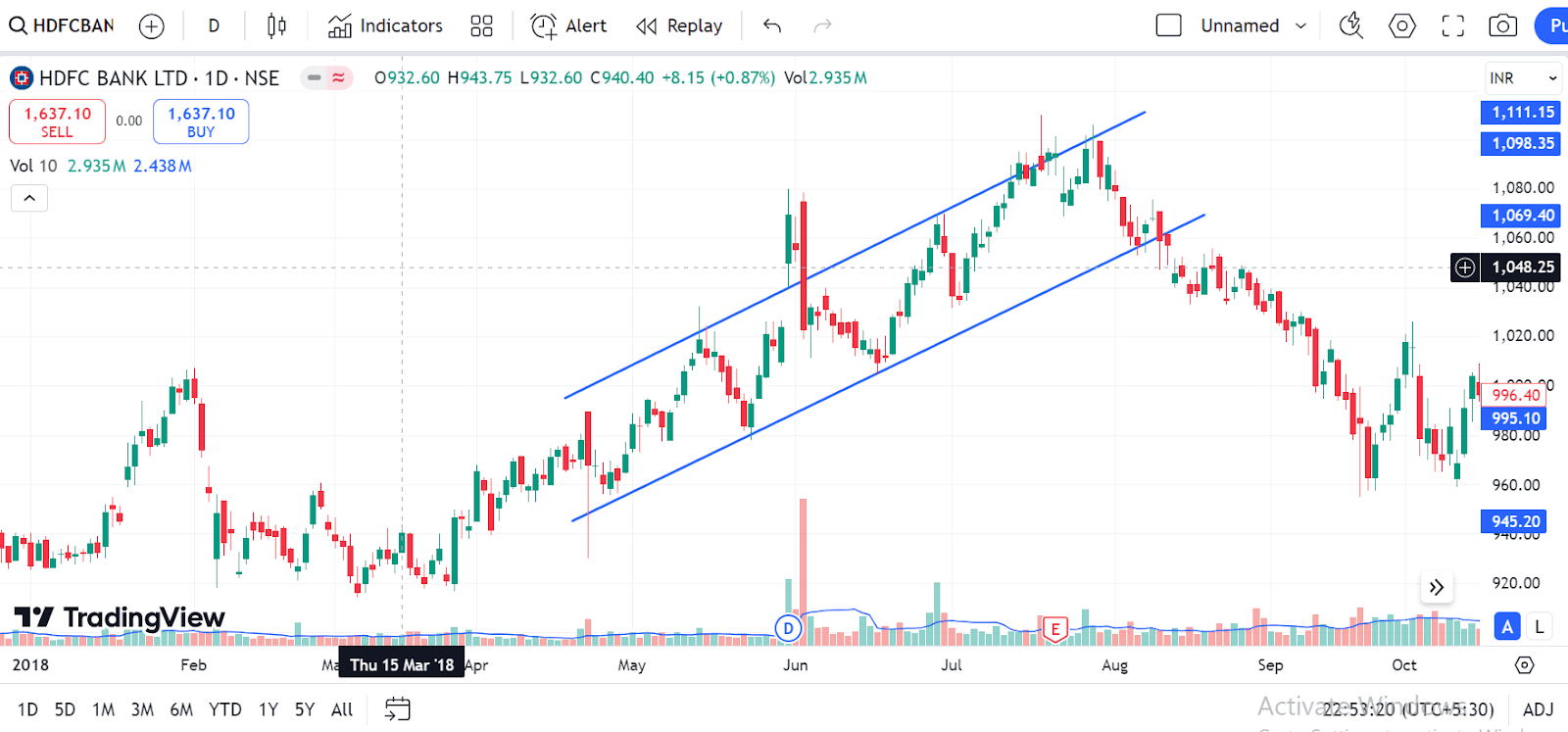
Below is the chart of HDFC Bank Ltd. for a one-day time frame. The chart below shows the upper and lower trend lines in the ascending channel pattern, which can also be viewed as resistance and support lines. Likewise, the higher and lower low points touching this resistance and support can also be considered resistance and support points, respectively.
Advantages of Ascending Channel Pattern
The advantages of the Ascending Channel pattern are:
Definitive Identification of Trend: The ascending channel pattern indicates an ongoing uptrend. It is easy to recognize, and an individual can easily use it.
Predictable Entry and Exit Points: Another key feature of this pattern is its predictable entry and exit points. One can buy near the lower trendline, acting as support, and sell near the upper trendline, acting as resistance. Thus, the profit will be maximized while minimizing risk.
Timeframe Diversity: It can be applied to numerous timeframes, making the ascending channel helpful for short-term and long-term traders. Whether you are day trading or swing trading, this pattern can be used.
Limitations of Ascending Channel Pattern
The limitations of the Ascending Channel pattern are:
Risks of false breakout: The pattern is susceptible to false breakouts when the price breaks the upper or lower trendline and then reverses. This can result in early trade entries and stop-loss order execution, causing possible losses.
Inability to determine when the pattern will terminate: It is difficult to determine when an Ascending Channel will end. Sometimes, the price breaks out or breaks down unexpectedly and surprises traders, resulting in a missed opportunity to trade or can result in potential losses.
Over-reliance can be hazardous: One should not overly depend on an ascending channel pattern and neglect other indicators or market conditions. The accuracy of the pattern decreases in volatile market conditions.
The Ascending Channel pattern is an exceptional technique traders utilize to identify bullish trends and take long and short positions. Once identified, the trader can see a pattern of higher highs and higher lows, forming inside parallel trendlines. This pattern provides a roadmap for the trader to buy near support, sell near resistance, or wait for breakouts. Risk management techniques, such as stop-loss and take-profit orders, can be used to manage risks. However, it is advised to consult a financial advisor before investing.
Frequently Asked Questions (FAQs)
What is a false breakout in an Ascending Channel Pattern?
A false breakout occurs when the asset price briefly exits the channel and then abruptly enters the channel again.
How can traders use the Ascending Channel Pattern to identify target levels?
It enables traders to set target levels near the trendlines if the asset price fluctuates inside the channel. If the price moves outside the channel, the target price can be calculated using the channel width or other technical indicators.
What risks are involved in trading with an Ascending Channel Pattern?
The risks are false breakouts and sudden reversals that might catch the trader off guard, especially when traded without using other indicators.
How is volume important in the Ascending Channel Pattern?
Volume can be used for confirmation, as higher volumes during breakouts or breakdowns can decrease the probability of a false signal.
Can an Ascending Channel Pattern reverse into a downtrend?
A downtrend can occur after an Ascending Channel pattern if the price breaks below the lower trendline with strong volume.
Are you interested in elevating your proficiency in technical analysis? Descending Channel pattern provides a structured approach for identifying downtrends and presents profit opportunities in financial markets.
In today’s blog, we will learn about the intricacies of the descending channel pattern and how a trader can interpret it.
What is a Descending Channel Pattern?
The descending channel pattern is a technical analysis chart pattern that indicates a possible reversal towards a bearish trend. It can be observed as a sequence of declining peaks and troughs, creating a channel exhibiting a downward slope.
When a clear breakdown occurs, it is advisable to enter a short position to capitalize on the ongoing downward trend and maximize profits.
Remember that a narrower channel often showcases a stronger trend and a higher probability of a breakout.
Interpretation Of Descending Channel Pattern
A Descending channel chart pattern has the following phases:
Downward Slope – The upper and lower trend lines move parallel to each other in a downward direction, creating a narrow channel.
Price Action – The price should repeatedly rebound from both the upper and lower trendlines.
Lower Highs and Lower Lows – Each new high is lower than the previous one, and each new low is also lower than the previous one.
Breakdown Alert – This pattern is generally considered to have given a breakdown when the price falls below the lower trendline, which signals the continuation of the bearish trend.
Additionally, it is suggested to be cautious of false breakdowns, where the price briefly breaks below the lower trendline but then reverses.
How to Determine Target & Stop Loss?
Extend the lower trendline to project a possible target price. This is based on the premise that the price will continue to decrease and remain within the channel.
You can also search for previous support and resistance levels within the channel that could serve as targets. These levels can be identified using horizontal lines or technical indicators.
In case of a breakdown, set a stop-loss above the most recent high within the channel. This ensures the trade is closed if the price reverses and moves above the upper trendline.
Furthermore, assess your risk tolerance and establish an appropriate stop-loss level. For instance, if you are willing to risk 2% of your account balance on a trade, adjust your stop-loss accordingly or decrease your position size.
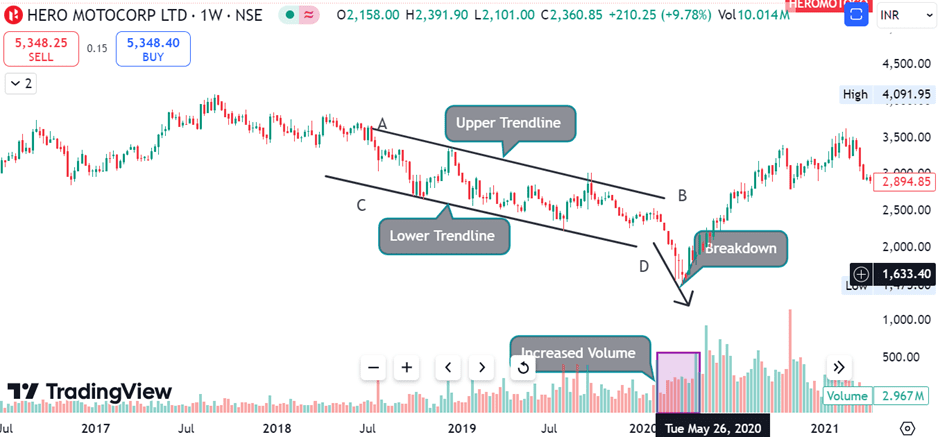
The image above is the weekly chart of ‘Hero MotoCorp Limited.’
It is evident from the chart that the price has been declining over the past few weeks, forming a series of lower highs and lower lows. Upon closer inspection, you can see two downward-sloping trend lines: the Upper Trendline, where the price has repeatedly been rejected, depicting resistance, and the Lower Trendline, where the price has found support several times, preventing further declines.
The price oscillates between these two trendlines, creating a descending wedge or channel shape. As soon as it breaks below the lower trendline with increased volume, traders will enter a short position, considering it a bearish breakdown.
Advantages of Descending Channel Pattern
The advantages of the Descending Channel pattern are:
Clear Indication of a Trend – It offers a visually distinct representation of a bearish trend. This makes it easier for traders to recognize the ongoing trend and make better trading decisions.
Risk Management – Traders can limit potential losses by using stop-loss orders based on the upper trendline if the price reverses unexpectedly after giving a breakdown below the lower trendline.
Simple – This pattern is relatively easy to use and implement.
Limitations of Descending Channel Pattern
The limitations of the Descending Channel pattern are:
False Breakdowns – At times, prices may temporarily breach the lower trendline but swiftly rebound, causing a false breakdown. This situation can result in losses for traders who enter short positions too early.
Subjectivity – Different traders may draw trend lines with slight variations, resulting in different interpretations of the pattern.
Need for Confirmation – Confirmation is required before entering a trade when there is a breakdown below the lower trendline. You may need to wait for a retest of the lower trendline or look at other technical indicators for better accuracy.
To summarize, the descending channel pattern is an incredibly powerful tool in technical analysis. It provides traders a reliable method to identify bearish trends and possible reversal points. Understanding the formation of this pattern can help traders enhance their ability to navigate markets effectively. However, it may still produce false signals, especially in volatile markets where price fluctuations can be erratic and unpredictable. Traders should always use additional analysis and risk management strategies to validate their trading decisions. Eventually, a trader should always remember that patience and discipline are integral components to succeed in trading. It is advisable to consult a financial advisor before trading.
Frequently Asked Questions (FAQs)
What is the difference between a Descending Channel and a Triangle pattern?
Both patterns are bearish, but a triangle has converging trend lines that meet at a point, and the channel has parallel trendlines.
Can a Descending Channel pattern give a bullish reversal?
A bullish breakout above the upper trendline can hint at a possible reversal of the bearish trend.
What role does volume play in a Descending Channel pattern?
Decreasing volume within the channel shows weakening momentum, and a spike in volume during the breakout can confirm the move.
Is the Descending Channel pattern applicable to all time frames?
The pattern can be used in different timeframes, including daily, weekly, monthly, etc.
How can I improve my accuracy in trading the Descending Channel pattern?
A trader can increase accuracy by using other technical indicators with the Descending Channel pattern.
Several trading chart patterns are available in the field of technical analysis that can make a trader profitable. To better understand a stock’s price momentum, traders typically use many chart patterns, either separately or in combination with other technical indicators.
In today’s blog, we will explain the “Rising Wedge Chart Pattern” and how it can be used.
Overview of Rising Wedge Pattern
Often referred to as an ascending wedge pattern, the rising wedge chart pattern is a technical analysis tool that occurs after a downtrend, followed by a wedge-shaped formation. Typically, this pattern appears in bearish markets. The lower trendline of this pattern has a more steep slope compared to the slope of the upper trendline, giving the appearance of an upward-sloping wedge.
Features of Rising Wedge Chart Pattern
The features of rising wedge chart patterns are mentioned below:
This pattern is characterized by two trend lines connecting higher highs and higher lows.
At the time of formation of the pattern, if the volume decreases, it suggests a weakening of bullish momentum.
The breakout often occurs in the downward direction with an increase in volume.
Interpretation of Rising Wedge Chart Pattern
A bearish reversal is indicated by the rising wedge pattern, which is interpreted when the stock price crosses below the lower trend line. In addition, a thorough analysis of the volume is necessary because any drop in volume during breakout can signal a possible fake breakout. Two trend lines that slope upward and converge as they stretch generate this pattern. This pattern receives a wedge shape from this convergence of the two trendlines. Along with a decline in trading volume, the price range narrows, which suggests a possible loss of upward momentum. When all these factors are taken into consideration, there may be a possibility that the stock price will swing from rising to falling.
The following points must be kept in mind when trading:
Entry Point: When the price breaks below the lower trend line with increased volumes, a trader can create a short position in the asset.
Stop-Loss: The highest point of the wedge or a point just above the upper trendline can be used as a stop-loss.
Target: Measure the height of the pattern at its widest point and subtract it from the breakout point to get the target price.
A trader should use other technical tools to confirm the bearish movement.
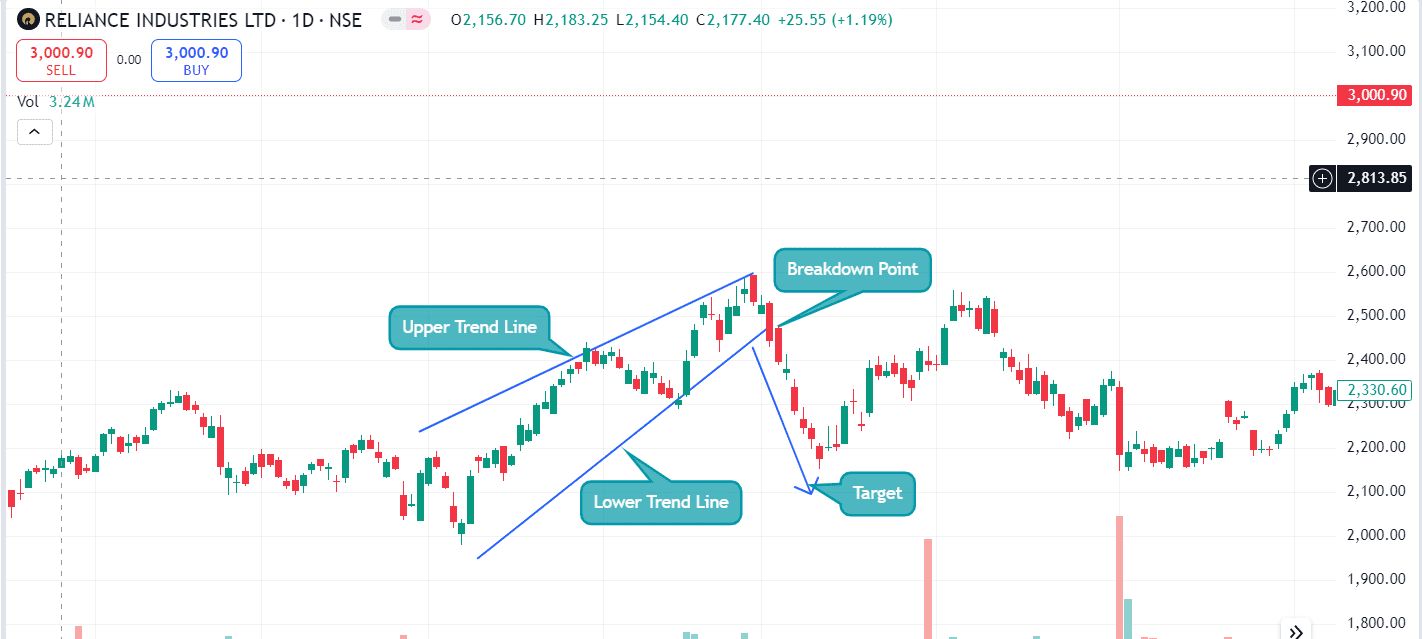
Example of Rising Wedge Pattern
The above image shows a Rising Wedge chart pattern for Reliance Industries over a daily time frame. The chart shows two trend lines converge, and the stock price fluctuates between them. Eventually, the price breaks below the lower trend line, indicating a downward trend in the stock price. The target is determined by the pattern’s height at its widest point.
Advantages of Rising Wedge Chart Pattern
The advantages of a rising wedge pattern are as follows:
Signal TIming – This pattern provides an early sign of trend reversal, which helps traders to enter and exit timely.
Common Pattern – This pattern can be easily identified.
Target and Stop loss – A rising wedge pattern has clearly defined target and stop loss levels.
Disadvantages of Rising Wedge Chart Pattern
The disadvantages of the Rising Wedge pattern are as follows-
False signals – Sometimes, the Rising Wedge pattern gives false signals, which might cause a trader to make incorrect trade decisions.
Confirmation – The pattern requires confirmation from other indicators, which makes this a complex pattern to use in trading.
Market Conditions – The pattern could be affected by various market factors, such as volatility, news, policy change, political instability, etc.
In summary, the Rising Wedge pattern is a valuable tool in technical analysis that suggests a possible bearish reversal signal. Investors rely on this pattern because it is easy to interpret and has clearly defined entry and exit levels. This pattern can be combined with other technical tools to get confirmation and increase your chances of success. However, it is advised to consult a financial advisor before investing.
Frequently Asked Questions (FAQs)
Is the Rising Wedge a bullish or bearish pattern?
The Rising Wedge chart pattern is a bearish pattern.
Is there any difference between a Rising Wedge and a Rising Triangle pattern?
A rising triangle is a continuation pattern in technical analysis, while a rising wedge is a bearish reversal pattern.
Is a Rising Wedge an accurate pattern?
The Rising Wedge pattern can be quite accurate when used with other technical indicators. However, no pattern can be 100% accurate.
How do we calculate the stop loss level for the Rising Wedge pattern chart pattern?
A stop-loss for a rising wedge pattern can be placed just above the upper trend line, or a trader can use a trailing stop-loss to lock in profits.
What is the target when the Rising Wedge pattern forms?
Measuring the pattern’s height at its widest point and subtracting it from the breakout price gives us the target price.
With its robust regulatory framework and growing investor confidence, India’s capital market offers exciting prospects for domestic and international investors. These exchanges are essential platforms for trading securities, and their presence contributes to the overall liquidity and efficiency of the market.
In this blog, we will provide a brief overview of some of India’s recognised stock exchanges and the role and significance an exchange holds in the economy.
What is a Stock Exchange?
A stock exchange is a marketplace where individuals and institutions engage in the buying and selling of securities, such as stocks, bonds, commodities, currencies, ETFs etc. It serves as a hub of opportunity, facilitating the transactions that drive the global economy and empowering investors to make better decisions. Stock exchanges operate on the principles of supply and demand, with price fluctuations depending on the market conditions. Stock exchanges are subject to strict regulations aimed at safeguarding investors and ensuring the integrity of the market.
List of Top 7 Stock Exchanges in India
An overview of stock exchanges in India is given below:
1. BSE Ltd.
BSE is a stock exchange located in Mumbai, India. It is the oldest stock exchange in Asia and the tenth oldest in the world, established in 1875. It is one of India’s leading exchange groups and is known as the ‘Dalal Street’, often regarded as the Wall Street of India. The story starts under a banyan tree near Mumbai Town Hall, where a handful of stockbrokers would gather to trade cotton in the 1850s. Premchand Roychand, a cotton merchant, is credited with formalising these informal gatherings by establishing the ‘Native Share and Stock Brokers Association in 1875. This is the official founding year of the BSE. The trading venue relocated multiple times within Mumbai before eventually establishing its permanent residence on Dalal Street, owing to the proliferation of brokers. The Indian government officially recognised it as the country’s first stock exchange in 1957, granting it official trading rights. Since then, BSE has continuously evolved to keep pace with the times.
2. National Stock Exchange of India Ltd.
The NSE is one of the two leading stock exchanges in India. It was established in 1992 and is located in Mumbai. It is known for its electronic trading platform and is considered the largest stock exchange in India in terms of daily trading volume. It lists a wide range of financial instruments, including equities, derivatives, exchange-traded funds (ETFs), and more. Also, NSE was the first exchange in India to implement electronic or screen-based trading, starting its operations in 1994. NSE has ensured the reliability and performance of its systems through a culture of innovation and substantial investment in technology. NSE has led the way in technological advancements in the Indian capital market by introducing innovative trading systems and products.
3. Metropolitan Stock Exchange of India Ltd.
The Metropolitan Stock Exchange of India (MSEI) was founded in 2008. It is based in Mumbai and aims to provide a platform for trading a variety of securities, including equities, derivatives and debt instruments. The MSEI is approved by the SEBI under the Securities Contracts (Regulation) Act, 1956. The Ministry of Corporate Affairs, Government of India, also designated the MSE as a ‘recognised stock exchange’ in 2012. The Metropolitan Stock Exchange has two subsidiaries.
Metropolitan Clearing Corporation of India Limited (MCCIL) – MSEI owns 86.94% of MCCIL, which deals in various asset classes on the MSEI. MCCIL also has an agreement with ICEX to provide clearing and settlement services for trades in ICEX’s commodities and derivatives segments.
MCX SX KYC Registration Agency Limited (MRAL) – Maintains a comprehensive database for exchange participants and other relevant individuals following the guidelines outlined by the KYC regulations.
4. Multi Commodity Exchange of India Ltd.
With headquarters in Bombay, MCX offers trading in various commodities such as metals, energy, agriculture, and bullion. Its robust trading platform and extensive network make it a preferred choice for investors and traders alike. Established in 2003, it has become a prominent platform for trading various commodities. Some commodities traded on MCX include gold, silver, crude oil, natural gas, etc. With its advanced trading technology and robust risk management systems. Over the years, the MCX has achieved significant growth, drawing in a large number of participants, including traders, brokers, and institutional investors.
5. National Commodity & Derivatives Exchange Ltd
NCDEX was established in 2003 and is regulated by the SEBI. It offers futures trading in agricultural commodities, metals and energy products. The main objective of NCDEX is to function as a highly efficient platform for price discovery and risk management. This commitment has been consistently proven over the last two decades. NCDEX prices are widely recognised as benchmarks in both domestic and international commodities markets. NCDEX and its subsidiaries offer a complete market infrastructure that includes Clearing & Settlement services, Repository services and an e-auction Platform. The exchange is dedicated to uplifting and developing farmers and the agricultural sector.
6. Indian Commodity Exchange Limited
ICEX is a new commodity exchange in India that was established in 2017. Its goal is to offer a competitive and transparent platform for trading a wide range of commodities. It is regulated by the SEBI. Prominent shareholders of the company include MMTC Ltd. Central Warehousing Corporation, Indian Potash Limited, KRIBHCO, Punjab National Bank, IDFC Bank Ltd., Gujarat Agro Industries Corporation, Reliance Exchangenext Limited, Bajaj Holdings & Investment Limited, Gujarat State Agricultural Marketing Board, NAFED, and Indiabulls Housing Finance Limited. The exchange mission is to become the most preferred platform for price discovery and hedging.
7. Calcutta Stock Exchange Ltd.
The Calcutta Stock Exchange Limited (CSE) is not only one of the oldest stock exchanges in India but also a true pioneer, having been established in 1908. It has played an important role in India’s financial landscape for many years, but its prominence declined in recent decades, and it was finally shut down. The NSE terminated its trading agreement with the CSE on July 18, 2023. However, on November 17, 2023, a division bench lifted the stay. The CSE was instructed to close all open transactions by November 28, 2024. In the late 20th century, the CSE faced growing competition from other stock exchanges like BSE and NSE. The CSE’s market share and trading volume declined as a consequence of this competition. Today, it mainly serves the eastern region of India, with a focus on Kolkata and its surrounding areas.
A stock exchange performs the following functions:
Primary Market Function – Stock exchanges enable companies to raise capital by issuing shares to the public through an Initial Public Offering (IPO). The capital raised can be used for further business expansion and general corporate purposes.
Price Discovery – The stock market allows people to buy and sell stocks, making it easy for investors to turn their investments into cash. This helps ensure that securities are priced fairly based on market conditions. Buyers and sellers interact to determine the price of a company that reflects its perceived value.
Economic Indicator – The stock market’s performance often acts as a key indicator of the overall economic health, and this is impossible without an efficient stock exchange. A rising market shows confidence and growth, while a falling market may showcase economic uncertainty.
Corporate Governance – Publicly traded companies must follow strict disclosure requirements, which enhances corporate governance and accountability.
Promotion of Savings and Investments – The stock exchange helps people save and invest by offering a way to earn money from their investments.
Conclusion
The stock exchanges in India have played a pivotal role in the country’s economic growth and development. From the historic Bombay Stock Exchange to the more recent National Commodity & Derivatives Exchange, these exchanges have provided a platform for capital formation, price discovery, and efficient trading. As the Indian economy expands, it is anticipated that the stock exchanges will assume an increasingly substantial role in the upcoming years. Their ability to facilitate investment, promote transparency, and support economic growth will be imperative for India’s ongoing prosperity.
You can invest in the Indian stock market through a registered broker. They can help you open a demat account through which you can execute your buy and sell orders.
What are some popular indices in India?
Some popular indices in India include the Nifty 50 and the Sensex.
Are foreign investors allowed to invest in the Indian stock market?
Foreign investors can invest in the Indian stock market through the Foreign Portfolio Investment (FPI) route.
How are stock exchanges regulated in India?
The Securities and Exchange Board of India (SEBI) is the regulatory body for the Indian securities market, overseeing stock exchanges and their operations.
What is the listing process for a company on the stock exchange in India?
Companies that want to get listed must meet specific criteria related to corporate governance practices and other regulations. They also need to submit documentation to the stock exchange and go through a review process.
Have you ever seen a market stuck in a range, neither rising nor falling? Indecision among market participants can result in the formation of a symmetrical triangle on a chart. This pattern is well-known for its unique shape and adaptability across different markets and time frames.
In today’s blog, we will explore the symmetrical triangle chart pattern, including key characteristics, advantages, and limitations. Understanding this pattern can provide valuable insights and improve your trading skills.
What is a Symmetrical Triangle pattern?
A symmetrical triangle pattern shows a period of consolidation in the market. It is characterized by two converging trend lines, one connecting lower highs and the other connecting higher lows, creating a triangular shape on the chart. This pattern means that the market is indecisive, where neither buyers nor sellers have an advantage.
Interpretation
When trend lines converge, price swings become smaller, indicating a decrease in volatility. The pattern typically ends with a breakout, either upwards or downwards. The breakout direction usually shows the future trend of the asset price. The pattern does not show a bullish or bearish trend. The breakout’s direction decides if the following trend is bullish or bearish.
How to Determine the Target & Stop-Loss?
A common way to predict the target for a breakout or breakdown from a symmetrical triangle is to use its height. Find the vertical difference between the top and bottom of the triangle. Adjust the height of the breakout point to get target levels by either adding or subtracting from the target.
For example, in case of a bullish breakout, if the height of the triangle is INR 10, and the price breaks out to the upside at INR 50, the possible target would be INR 50 + INR 10 = INR 60.
If the price increases, place a stop-loss just below the breakout point. A trailing stop loss can also be used to lock in profits as the price moves in your favor.
The above chart of Infosys shows a clear symmetrical triangle formation. The two converging trend lines are visible, along with a series of lower highs and higher lows. We can interpret the chart by understanding the following phases:
Initial Formation – The pattern started with a period of price fluctuations that established the initial high and low points of the triangle.
Market consolidation – As the trend lines converged, the market entered a phase of uncertainty characterized by decreasing price movements.
Breakdown – The price broke below the lower trend line, confirming the pattern and suggesting that the downtrend may continue.
Advantages of Symmetrical Triangle chart pattern
The advantages of the Symmetrical Triangle chart pattern are:
Clear Formation – The pattern is easy to recognize, so new traders can also use it.
Reduced Volatility – The converging trend lines indicate a decrease in volatility, which can help manage risk.
Objective – This pattern is based on price movements and does not rely on personal opinions.
Volume Confirmation – Decreasing volume during consolidation and a volume spike during the breakout confirms the pattern and increases the chances of a successful trade.
Limitations of Symmetrical Triangle Chart Pattern
Limitations of the Symmetrical Triangle chart pattern are:
Indecision – The pattern often indicates market indecision and can result in extended sideways trading.
Time-Consuming – Waiting for a signal of breakout or breakdown from a symmetrical triangle chart pattern can take a lot of time.
Lack of Direction—The pattern does not predict whether the next trend will be bullish or bearish. The direction of the breakout determines the trend.
Late Entry – If you wait for a confirmation of the breakout, you may enter a trade later and miss out on part of the movement or enter at a less favorable price.
The Symmetrical Triangle pattern is a precious tool for technical analysts, offering insight into market consolidation and potential future price movements. By comprehending its characteristics, interpretation, calculation of target, placement of stop-loss, advantages, and limitations, traders can enhance their decision-making process and make informed decisions. However, these patterns should be used in combination with other technical and fundamental analysis techniques. However, it is always advisable to consult a financial advisor.
Frequently Asked Questions (FAQs)
How is a Symmetrical triangle pattern formed?
It is formed by a series of lower highs and higher lows, creating a triangular shape on the chart.
What is the importance of converging trend lines?
Converging trend lines show decreasing volatility as the price swings become smaller.
Is the symmetrical triangle chart pattern reliable?
While it can be a useful tool, its reliability increases when combined with other technical indicators like volume, RSI, etc.
How can I manage risk when trading this pattern?
You can use a stop-loss to minimize the capital loss in case of a false breakout.
What time frames does the symmetrical triangle pattern work best on?
It can be used in several timeframes, from intraday charts to weekly charts, depending on the trader’s strategy.
Open Free Demat Account
Join Pocketful Now
You have successfully subscribed to the newsletter
There was an error while trying to send your request. Please try again.