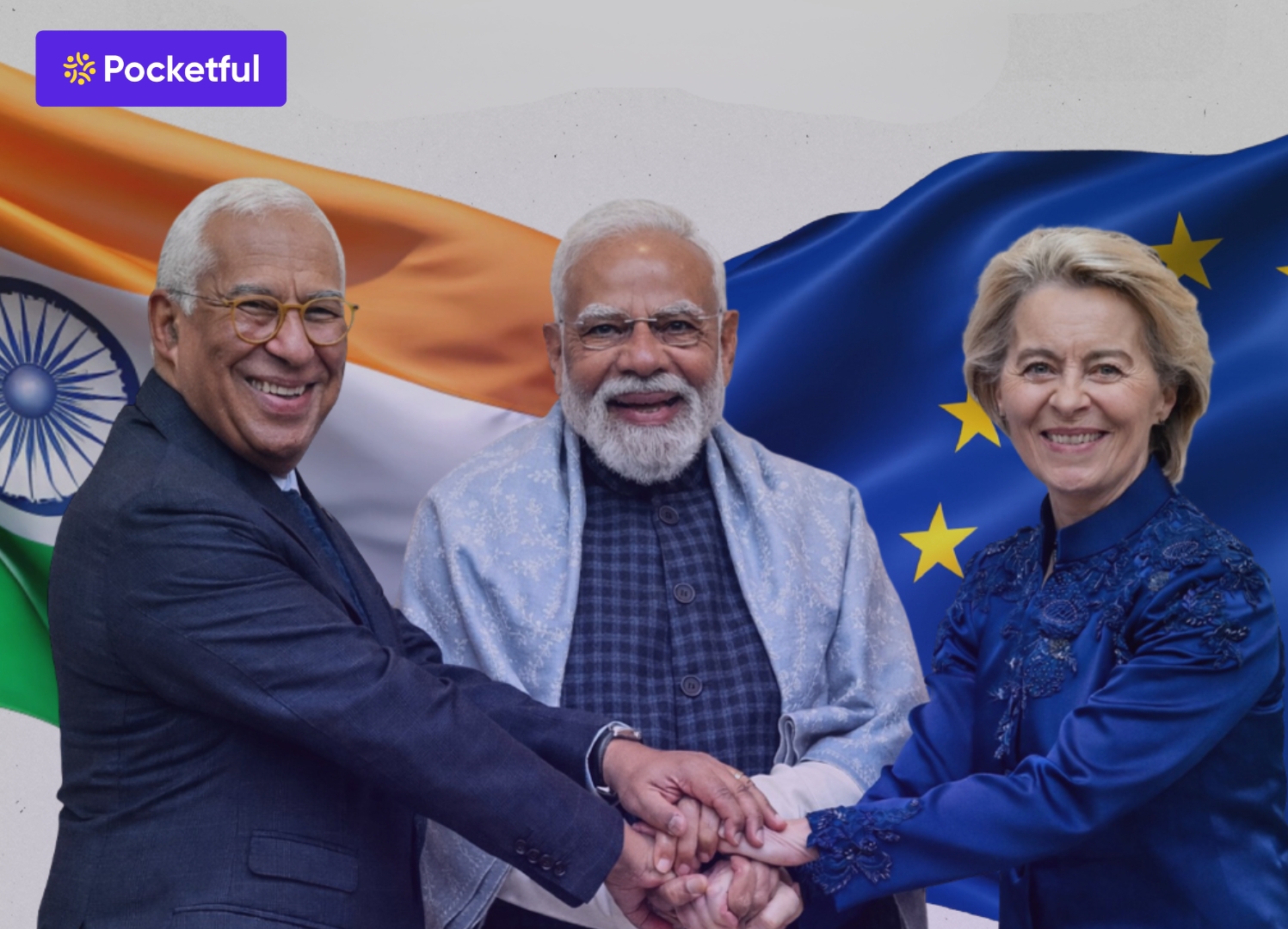
The long-running negotiations between India and the European Union have finally culminated in a historic Free Trade Agreement. This agreement, reached after nearly 20 years of talks, is considered one of the world’s largest trade deals. It connects a market of approximately two billion people and has the potential to significantly impact global trade. At a time when high tariffs imposed by the US and global tensions are affecting trade, the India-EU agreement offers both new opportunities and a new direction.
What is the India–EU Free Trade Agreement (FTA)?
This Free Trade Agreement between India and the European Union is intended to give a new impetus to trade between the two. The agreement was finalized in January 2026 after nearly 20 years of negotiations. It is considered India’s largest trade agreement to date with the 27 countries of the EU. This deal will provide easier access to the European market for Indian sectors such as textiles, gems and jewelry, and marine products, while opening up the Indian market to European car and machinery companies. Overall, this agreement is a significant step towards strengthening India-EU economic relations for the long term.
India-EU Trade Deal: At a glance (Key Facts)
Trade Overview
| Point | Information |
|---|---|
| Total market size | Approximately USD 24 trillion |
| The population associated with this | Approximately 2 billion people |
| India’s exports to the EU (2024–25) | Approximately USD 76 billion |
| Total merchandise trade | Approximately USD 137 billion |
| Trade in services | Approximately USD 83 billion |
| India’s access to the EU market | Almost all of the business (99.5%) |
How did the EU reduce taxes on Indian goods?
The European Union has decided to gradually remove import duties on most Indian products.
EU Tariff Changes – for Indian Exports
| Method | Meaning |
|---|---|
| Instant discount on most items | More than 90% of India’s exports will benefit. |
| Discounts are offered on some products every 3-5 years. | Limited category |
| In some cases, a quota system | Selected products |
| overall | Almost the entire business is covered. |
What decision did India make regarding EU products?
India will also reduce taxes on goods coming from Europe, but this process will be gradual.
India Tariff Changes – for EU Exports –
| Point | Situation |
|---|---|
| How many products are included? | Approximately 92% |
| Products with instant discounts | About half |
| Phased exemption (5–10 years) | Approximately 40% |
| Fruits such as apples, kiwis | Allowed in limited quantities. |
Which Indian sectors will benefit the most?
This agreement will particularly strengthen industries that generate a large number of jobs.
| Sector | Tax now | What will happen next? |
|---|---|---|
| Textiles and garments | Up to 12% | Complete freedom |
| Leather and shoes | Up to 17% | Zero tax |
| Seafood | Up to 26% | Almost complete exemption |
| Medical equipment | 6–7% | Almost finished |
| Gems and Jewelry | 4% | complete exemption |
| Chemicals | Up to 12% | Discounts on most items. |
| Furniture/Decor | up to 10 | Low tax |
European Export Winners: Cars, Wine and Spirit
This agreement will provide significant relief to Europe’s automobile and wine industries in the Indian market. The high import duties currently levied on cars will be gradually reduced. This will make premium European cars relatively cheaper in India, likely leading to increased sales.
| Category | Current situation | After the agreement |
|---|---|---|
| Tariffs on cars | Approximately 110% | Reduced to 10% (limited number available) |
| Annual car import limit | – | 2.5 lakh vehicles |
| Cars cheaper than €15,000 | General rules | The tariff will be higher. |
| Electric vehicles (EVs) | – | 5-year grace period |
| Tariffs on wine | 150% | 20–30% |
| Spirits (alcohol) | 150% | 40% |
CBAM: Carbon Border Adjustment Mechanism and Its Impact
CBAM is a new European Union policy that will impose additional charges on highly polluting products. This rule will come into effect on January 1, 2026. The goal is to ensure that all goods sold in Europe, whether imported or domestically produced, bear the same cost in terms of carbon emissions.Despite the India-EU Free Trade Agreement, India has not been granted any significant exemptions under CBAM. This means that even though tariffs may be reduced on many Indian products, goods such as steel, cement, and aluminum will still be subject to a carbon tax. This could increase costs for some Indian companies, particularly small and medium-sized enterprises.
The impact of CBAM
| Who will be affected? | What will change? |
|---|---|
| Large companies | It is possible to adopt the rules. |
| Small industries (MSME) | Reporting and expenses will increase. |
| Small Industries (MSME) | The price could be expensive in Europe. |
| European industry | Domestic companies will benefit. |
How Can India Respond to CBAM?
Europe’s new carbon regulations will not be easy for Indian industries. Companies will now have to disclose the carbon footprint of their products. Large industries may be able to manage this, but for small businesses, it will mean new costs and added complications. This is why India is now working to refine its carbon credit system and encourage industries to adopt cleaner technologies. In the future, only companies that produce goods with minimal pollution will be able to compete in the European market.
India’s preparation :
| Step | Objective |
|---|---|
| CCTS | Promoting carbon trading |
| MRV System | Measuring and recording emissions |
| MSME Support | Reducing the burden on small industries |
| Green investment | Strengthening long-term competitiveness |
Why India–EU Deal Took Nearly 20 Years (Background)
Trade negotiations between India and the European Union began in 2007, but several issues remained unresolved. India wanted to protect its domestic industries, particularly in the agriculture and automobile sectors. The EU, on the other hand, insisted on the strict inclusion of environmental regulations and labor laws in the agreement.
Differences also persisted regarding trade in services and regulatory standards. The negotiations stalled for a considerable period. However, in 2022, due to changing global circumstances and trade pressures, both sides returned to the negotiating table, and an agreement was finally reached in January 2026.
India-EU FTA negotiation timeline
| Year | Main event |
|---|---|
| 2007 | The conversation begins. |
| 2013–2021 | The talks were interrupted several times. |
| 2022 | The conversation resumed. |
| January 2026 | The agreement is complete. |
Global Trade and Geopolitical Impact
- US Tariffs and the Need for New Markets : High US tariffs have forced both India and Europe to seek new trade routes. This is why the India-EU agreement has progressed rapidly, allowing both sides to access a large and reliable market.
- Reducing Dependence on China : Many countries today do not want their trade to be solely dependent on China. The India-EU deal aims to diversify supply chains, shifting business towards stable partners like India and Europe.
- Renewed Trust in India-EU Relations : This agreement is not limited to the buying and selling of goods. It demonstrates that India and Europe now view each other as long-term trading and strategic partners.
- Promoting Rules-Based Trade : This deal sends a message that trade should be based on established rules and agreements, not political pressure. This increases both trust and stability in global trade.
Implementation Timeline
Legal Drafting and Technical Review
After reaching an agreement, both parties will now finalize the legal draft. This will involve reviewing the clarity of the language, the interpretation of the clauses, and the technical aspects to prevent any future confusion or disputes.
Approval by the Indian Parliament
In India, the agreement will be presented to Parliament. The process of officially implementing it can only proceed after it receives parliamentary approval.
Approval by the European Parliament and EU Member States
In the European Union, the agreement will be approved by the European Parliament and all member states. This process may take time as each country will review it at its own level.
When will the agreement come into effect?
If all legal and political approvals are obtained on time, the India-EU Free Trade Agreement is expected to come into effect by the end of 2026 or the beginning of 2027. Following this, tariff reductions and trade benefits will be implemented in a phased manner.
Conclusion
The India-EU Free Trade Agreement is not just an agreement to reduce tariffs, but a turning point in India’s global trade policy. It will open up significant export opportunities, but will also require industries to adapt to environmental and quality standards. Its true success will depend on how intelligently it is implemented on the ground and how effectively small businesses are supported in the process.
Download Pocketful for the latest market news and insights, offering a seamless investing experience with zero delivery charges and advanced trading features.
| S.NO. | Check Out These Interesting Posts You Might Enjoy! |
|---|---|
| 1 | What Is Contract Note and Its Significance |
| 2 | What Is an Option Contract? |
| 3 | Cost of Carry in Futures Contract |
| 4 | What is Future Trading and How Does It Work? |
| 5 | Physical Settlement in Futures and Options |
Frequently Asked Questions (FAQs)
What is the India-EU FTA?
This is a trade agreement between India and the European Union to facilitate trade and increase imports and exports between the two.
Why is this deal called the “Mother of All Deals”?
Because it is the largest trade agreement ever between India and the EU.
Which Indian industries will gain the most?
The textile, gems and jewelry, marine products, and leather sectors will benefit the most.
Will foreign products become cheaper in India?
Some goods may become cheaper, but the price will depend on GST and market conditions.
What is CBAM in simple words?
It is Europe’s carbon tax regulation, which will apply to goods with high carbon emissions.