The stock market often operates on simple rules. If an asset moves up by a single point, the profit increases by a single point. Derivatives operate on an entirely different engine. They have a hidden gear that accelerates returns at a rapid pace. Mastering this hidden mechanism separates average market participants from highly successful professionals. Understanding this unique pricing behavior unlocks a new level of strategic thinking in the financial markets. It helps participants navigate uncertain events with absolute clarity.
What is Convexity in Options
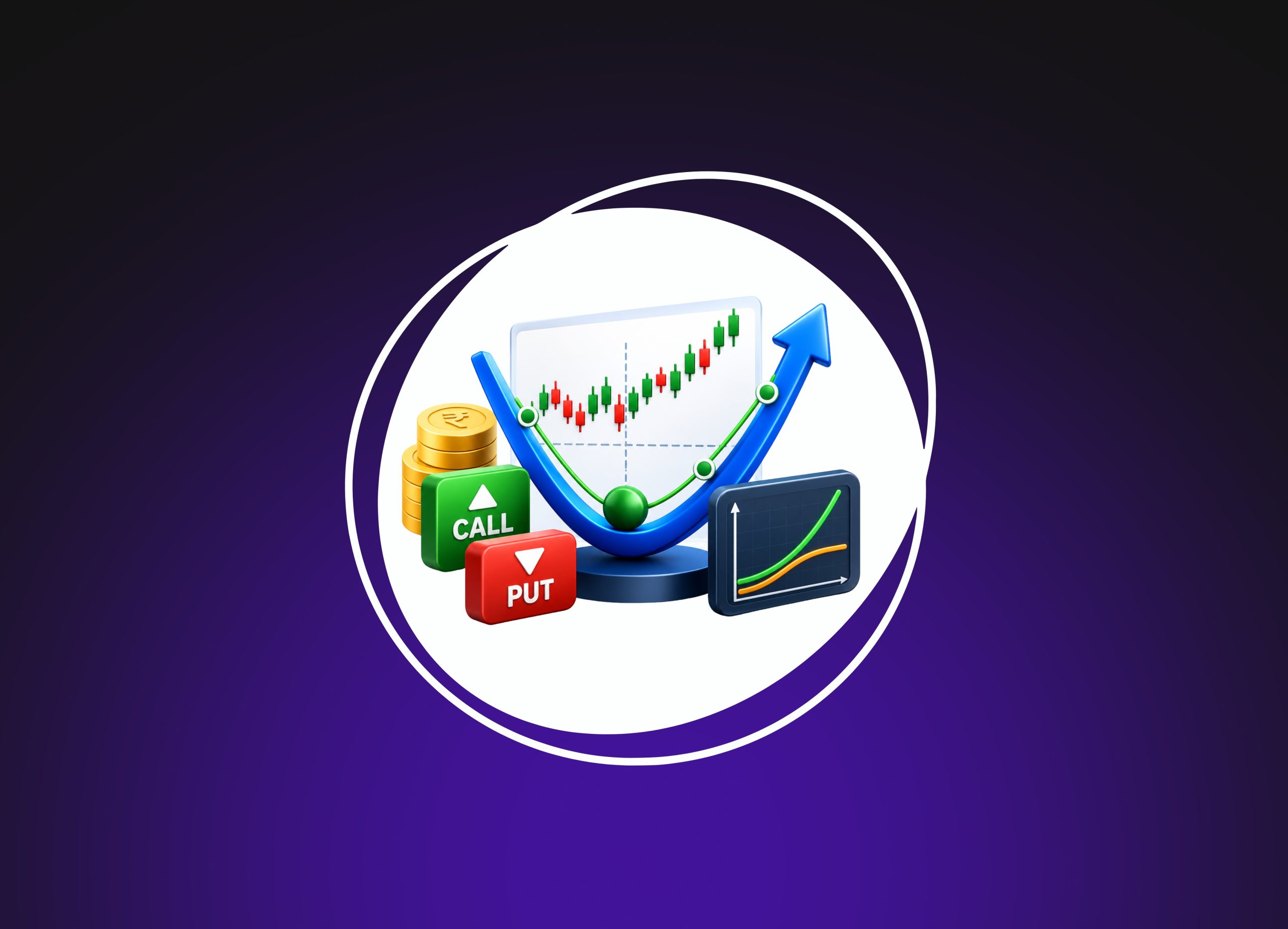
When investors buy a regular stock, the profit structure is a straight line. If the stock goes up by ten points, the profit is exactly ten points. This simple ratio is called a linear payoff.The derivatives market operates quite differently. The profit and loss curve is not a straight line at all. Instead, as the underlying asset moves in a favorable direction, the profit starts to grow at a much faster rate.
This accelerating and curved relationship between price movement and profit is known as option convexity. To put it simply, small favorable price moves might bring very small gains. However, large favorable price moves can generate massive gains that multiply rapidly.
This powerful acceleration is what makes convexity options highly attractive to many market participants. It acts like a multiplier effect on returns. As the underlying stock gains momentum, the financial reward increases non-linearly. The more the market moves, the faster the profits can grow. This concept is very closely tied to a metric called gamma.
Why Convexity is Important
Understanding this concept is crucial for anyone stepping into the derivatives segment. It completely changes how market participants calculate their potential returns. Without this knowledge, traders are simply guessing the market direction.
Here is why options convexity holds so much importance in modern trading:
- Unmatched Risk to Reward Ratio: For buyers, the maximum possible loss is strictly limited to the premium paid on day one. However, if the market moves fast, the potential reward expands rapidly.
- Benefit from Speed and Timing: In regular stock trading, getting the direction right is enough to make a profit. In derivatives, the speed of the movement matters just as much. Fast movements make the profits multiply quickly.
- Advantage of Volatility: When market uncertainty rises, contract premiums naturally increase. Buyers benefit heavily from this expanding volatility because it directly fuels the acceleration of their profits.
- Protection During Reversals: If a trade goes wrong, the curve flattens out on the losing side for buyers. The losses slow down as the market moves further away. This mathematical advantage provides peace of mind.
- Strategic Edge with Technology: Market participants can use advanced tools on platforms like Pocketful to analyze data carefully. This allows them to select the best strike prices and capture the maximum benefit without guesswork.
Impact on the Trader’s Psychology
Trading with a non-linear instrument completely shifts how a person thinks and reacts. A traditional stock investor only worries about the direction the stock will go. They simply want to know if the asset will go up or down.
This concept impacts market psychology in the following specific ways:
- Multi-Dimensional Thinking: Traders stop asking just if the market will go up. They analyze how far it will go, how fast it will move, and how volatility is currently priced.
- Focus on Probabilities: Instead of making rigid predictions, professionals think in terms of probability distributions. They look at all possible outcomes rather than guessing a single future price.
- Patience for the Right Setup: Because timing and speed are so important, market participants learn to wait for explosive setups. They avoid trading in quiet and slow-moving markets that slowly drain their funds.
- Managing Expectations: Traders learn that being right about the market direction is not always enough. If the price move is too slow, profits might not materialize at all. This teaches them to deeply respect the element of time.
- Emotional Stability: Understanding the mathematical curve reduces panic. Traders know exactly how much they can lose and how fast they can win. This clarity removes emotional decision-making from the process.
Read Also: What is Commodity Pool Operator (CPO)?
Risk Management and Convexity
Proper risk management is the lifeline of a successful financial journey. Because the payoff is curved, the risk profile looks very different depending on the chosen side of the trade.
Platforms such as Pocketful provide advanced option chains and real-time data. These tools help users manage these exact risks seamlessly without complicated calculations.
| Market Role | Impact of the Curved Payoff | Risk Management Approach |
|---|---|---|
| Option Buyers | Experience positive convexity. Upside is theoretically unlimited as profits accelerate with fast market moves. | Risk is naturally limited to the premium paid upfront. Focus remains on picking the right timing and capturing volatility expansion. |
| Option Sellers | Experience negative convexity. Maximum profit is capped at the premium collected, while losses can multiply rapidly. | Must obsessively protect accounts against rare extreme movements. Focus shifts to strict stop-loss orders, position sizing, and managing tail risk. |
For buyers, the strategy revolves around finding cheap premiums before a major event. They accept small regular losses in exchange for the chance of a massive accelerating gain.
For sellers, the game is entirely different. They win small amounts very frequently. However, a single massive price movement can wipe out months of hard work.
They must use strict hedging techniques to survive. They cannot rely on hope when the market starts moving fast against them. Both sides require absolute discipline. The mathematical curve punishes those who ignore basic risk management rules.
Convexity in Market Shocks
Extreme market events highlight the true power of non-linear pricing. During massive global shocks like the recent pandemic crash, regular stock portfolios saw steady declines. However, the derivatives market experienced violent, unprecedented swings. Buyers holding long put contracts saw their investments multiply enormously in just a few days. The curved payoff structure turned small premiums into massive fortunes due to the sheer speed of the market fall. Conversely, unprepared sellers faced catastrophic, accelerating losses that wiped out trading accounts overnight. Proper preparation, strict position sizing, and volatility tracking remain the only solid defenses during a sudden market shock.
Conclusion
Understanding non-linear payoffs adds a fascinating layer of strategy to the financial markets. It requires a mental shift from simple directional guessing to a more mature analysis of speed and volatility.
Neither buying nor selling is universally better than the other. Each approach offers unique advantages and demands very specific risk management skills. The market provides opportunities for both styles depending on the current economic conditions.
With modern platforms like Pocketful, tracking essential data of options convexity and executing strategies is highly efficient. They provide the exact tools needed to measure these complex market forces in real-time.
Frequently Asked Questions (FAQs)
What is convexity in options?
It is the non-linear relationship between price movement and profit. Favorable rapid moves cause profits to accelerate quickly.
What are the main benefits of convexity?
Buyers get a strictly defined maximum loss combined with an accelerating, theoretically unlimited profit potential if the market moves fast.
How convexity is it used in trading?
Traders buy contracts before expected high-volatility events to capture accelerating profits from sudden and explosive price movements.
Why does convexity matter for risk?
It defines tail exposure. Sellers face capped profits but rapid losses, requiring strict stop-losses during unexpected market shocks.
Which tools help track this data?
Platforms like Pocketful provide real-time advanced chains and data, allowing users to accurately measure and manage their market exposure.