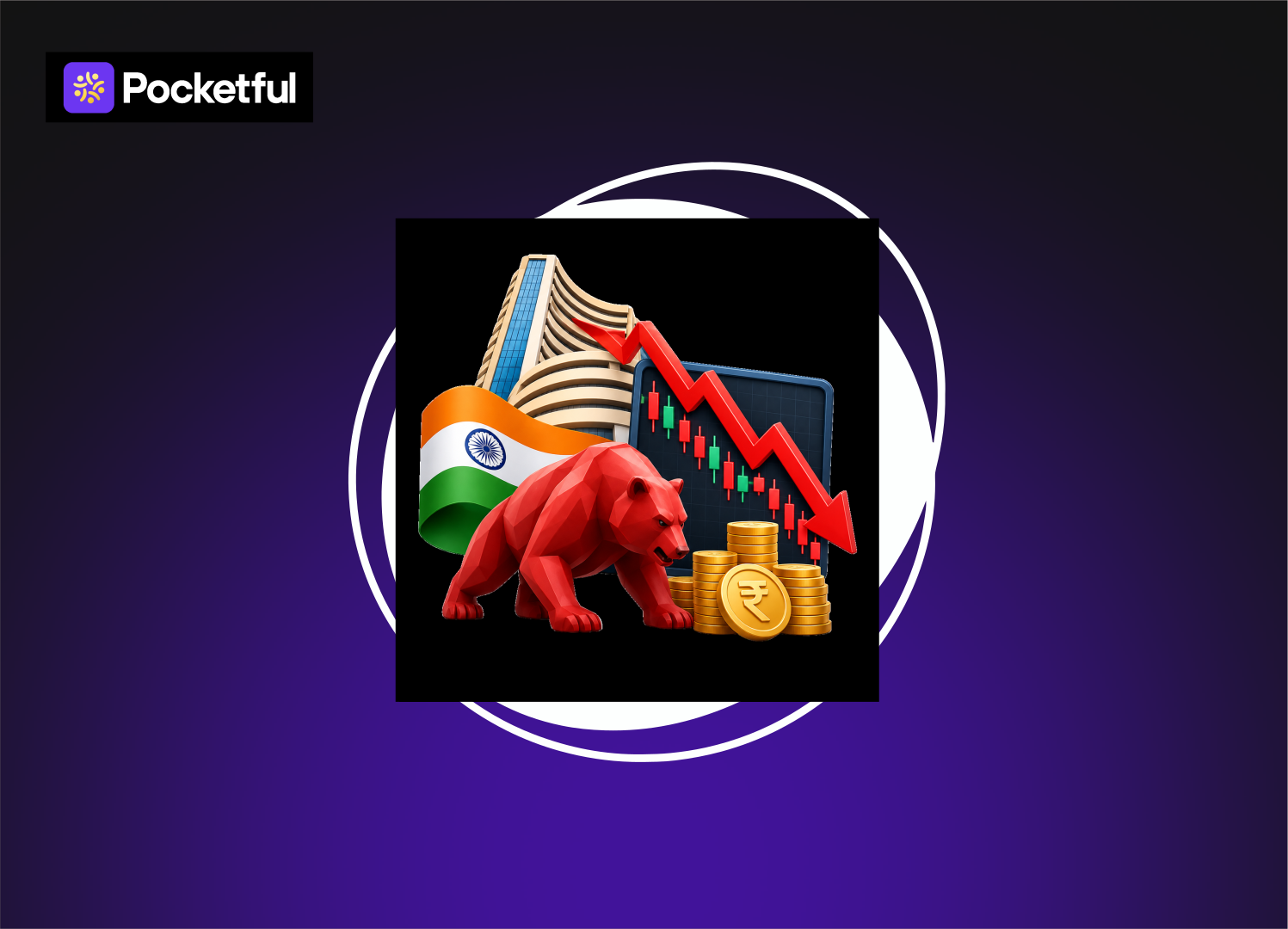
When the stock market suddenly crashes, it’s hard to tell why things went downhill so fast. The Indian market has seen this happen plenty of times, and there’s always a different reason behind it. So, let’s go over past market crashes, why they actually happen, and what you should do with your money when prices start falling.
What Is a Stock Market Crash?
Imagine the market opens, and shortly thereafter, the Nifty and Sensex begin to plummet. A sell-off in the shares of major companies ensues, and within a few hours, the value of your portfolio drops significantly. Such a rapid and widespread decline is generally referred to as a stock market crash. There isn’t necessarily a single cause behind this; factors ranging from global crises and economic slowdowns to investor panic can suddenly drag the market down.
However, not every market decline is a crash. Often, after a period of gains, investors book profits, causing the market to dip temporarily; this is known as a correction. If the market’s weakness persists over an extended period, it is termed a bear market.
Difference between Stock Market Crash, Correction, and Bear Market
These three terms are often considered the same, but there is a difference between them.
| Term | Meaning in simple language |
|---|---|
| Correction | A moderate or limited decline in the market following a rally. |
| Stock Market Crash | A very rapid and widespread market decline in a short period. |
| Bear Market | Prolonged weakness in the market |
There is no fixed percentage threshold defined for a stock market crash in India. Therefore, simply looking at the percentage drop in the Nifty or Sensex does not reveal the full picture. It is essential to consider the speed of the decline, its impact on the market, and the underlying causes—all together.
Stock Market Crash History in India
1. 1992: The Harshad Mehta Scam
To really get what happened in 1992, you have to look at how loose the banking and stock market rules were back then. Harshad Mehta basically found loopholes in the banking system and routed huge amounts of money right into stocks. That artificially pumped up share prices, creating massive excitement across the market.
By April 1992, the Sensex had climbed all the way from nearly 1,000 up to 4,467. But once news of the scam hit the market, panic set in and massive selling followed. In fact, on April 28 alone, the Sensex fell by 12.77% in one session, eventually settling near 2,529.
It was a reality check when stock prices rise on fake money and speculation instead of actual company profits, the crash is brutal the moment trust breaks.
2. 2001: Ketan Parekh and the Dot-Com Crash
By 2001, the Indian market was already struggling. Reports were coming in about heavy price manipulation in specific stocks tied to Ketan Parekh, which wrecked market confidence. On top of that, the global dot-com bubble was bursting, taking Indian tech stocks down with it.
The Sensex crashed nearly 38%, falling from around 4,200 down to 2,594. Almost overnight, the tech stocks people were hyping up suddenly faced massive selling.
The takeaway? Just because a stock is flying high doesn’t mean the price makes sense. If a huge gap builds up between actual profits and hype, the market corrects itself fast.
3. 2008: The Global Financial Crisis
The 2008 crash originated outside India, starting with the US subprime housing crisis. As major foreign banks hit trouble and Lehman Brothers collapsed, overseas funds began withdrawing capital from markets worldwide, including India.
The market impact was severe. The Sensex fell 58% between January and October 2008, moving from 20,645 down to 8,701. A single session on January 21 saw the index drop nearly 1,408 points. The decline was driven by global liquidity drying up rather than weak performance from domestic companies.
It highlighted how closely Indian stock valuations align with global cash flows, regardless of local economic strength.
4. 2020: The COVID-19 Crash
Unlike earlier crashes, 2020 had nothing to do with scams or bad loans. The pandemic triggered sudden nationwide lockdowns, shutting businesses down and leaving investors completely blind about future company earnings.
That sheer panic dragged the Sensex down from 42,273 to 25,981. On March 23 alone, it took a massive 3,935-point hit roughly 13% down with Nifty following the exact same pattern.
Once lockdowns eased and central banks poured in liquidity, markets rebounded quickly. It showed how fast market fear can pull stock prices below real business value during a short-term crisis.
5. 2026: US-Iran Conflict, Crude Oil, and Foreign Selling
The 2026 market fall didn’t happen because of just one trigger. A mix of global tensions, expensive crude oil, foreign investors pulling out money, and a sliding rupee kept the market under stress all through the year. Pain increased after the US-Iran conflict escalated in late February, pushing oil prices up. India imports a huge chunk of its oil, so expensive crude instantly raised inflation fears and hit company profits.
On March 19, 2026, the Sensex took a 2,497-point hit (3.26%), taking Nifty down to 23,002. Foreign investors kept dumping shares, which stopped any quick recovery.
Unlike the full-blown crashes of 2008 or 2020, 2026 was more about back-to-back sell-offs and high volatility coming from several global risks hitting together.
Why Does the Indian Stock Market Crash?
There can be several reasons behind a sudden drop in the stock market. Sometimes it is triggered by major news, sometimes by economic weakness, and at other times, investors themselves panic and increase selling.
- Impact of Global Events: The Indian market does not operate in isolation from the rest of the world. News such as a major market slump in the US, geopolitical tensions, war, or global financial issues can impact the market here as well. During such times, foreign investors may withdraw funds from Indian shares, leading to increased selling.
- Overvaluation of Shares: Often, a stock’s price rises far beyond the company’s actual profitability. In such scenarios, even a minor piece of negative news can prompt investors to sell. Therefore, simply noting that a stock has risen significantly is not enough to base an investment decision on.
- Interest Rates and Inflation: Higher interest rates mean borrowing costs go up for companies. Inflation pushes up operational expenses at the same time. If profits get hit because of this, stock valuations adjust downwards quickly.
- Weak Corporate Results: When a company reports lower sales or profits than expected, its stock usually takes a hit. The drop is even worse if investors were expecting solid numbers.
- Selling by Foreign Investors: Heavy selling by FIIs (Foreign Institutional Investors) and FPIs (Foreign Portfolio Investors) can exert pressure on the market. However, their selling should not be viewed as the sole cause of a market crash; they often withdraw funds due to significant global or domestic concerns.
- Investor Panic: As soon as the market falls, some people begin selling their shares without much thought. Seeing the declining prices, other investors may also start selling. This fear can often turn a minor dip into a major market crash.
Read Also: Top 10 Biggest Stock Market Crashes in India
How a Stock Market Crash Affects Indian Investors
When the market falls, the immediate impact is a drop in the portfolio’s visible value, but the actual consequence depends on the type of investment and the associated risk.
- Impact on Equity Portfolios: If your ₹1 lakh portfolio drops to ₹80,000 in a crash, you haven’t actually lost ₹20,000 until you hit sell. It’s just an unrealized loss. That said, if the underlying business itself is breaking down, holding on just hoping it recovers usually backfires.
- Impact on Mutual Funds and ETFs: When the market drops, equity mutual funds and ETFs naturally go down too since they hold stocks. The difference is diversification. Because a fund splits money across dozens of companies, a huge fall in one individual stock doesn’t ruin your whole investment.
- Impact on Small-Cap and Mid-Cap Stocks: During periods of heavy selling, small-cap and mid-cap stocks can experience sharper declines. Prices can drop rapidly especially in stocks with low trading volumes due to a scarcity of buyers. Therefore, buying a falling small-cap stock simply because it has become “cheaper” is not a sound strategy.
- Impact of Margin and Borrowed Money: If you have invested using margin or borrowed funds, a market fall can prove far more damaging. A drop in share prices can trigger margin requirement issues, potentially forcing you to infuse additional capital. Consequently, it is essential to fully understand the risks involved in such investments beforehand.
What Should You Do When the Indian Stock Market Falls?
When the market falls, the most important thing is to make decisions based on an assessment of your investments rather than acting out of panic.
1. First, understand why the market is falling.
No two market crashes are identical. Sometimes a global crisis pulls everything down, while other times it’s just bad economic news or trouble in a single sector. The underlying cause usually shows if the drop is a short-term reaction or a deeper structural issue.
2. Re-evaluate your investments.
Suppose you bought a stock at ₹500 and its price dropped to ₹400. Do not decide whether or not it will return to ₹500 based solely on that price movement. Instead, check for any significant changes in the company’s sales, profits, debt, or business operations.
3. Avoid excessive concentration in your portfolio.
If a large portion of the portfolio is invested in a single stock or sector, the losses could be significant if the market falls.
| What to see | Questions to ask oneself |
|---|---|
| One stock | Is too much money invested in a single stock? |
| One sector | Is the portfolio dependent on a single sector? |
| Equity exposure | Is the investment aligned with your risk profile? |
| Short-term need | Is the money you need soon invested in the market? |
4. Avoid selling solely out of fear
Selling immediately when the market falls isn’t always the right move. If the reasons behind your investment and the company’s fundamentals remain unchanged, there is no need to make a decision based purely on fear. However, if the business has developed genuine issues, simply waiting to recover your losses is not the right approach either.
5. Be careful with “Buying the Dip”
If a stock falls from ₹1,000 to ₹700, don’t automatically assume it’s cheap. You need to look at the company’s actual profits and future plans first to see if that price even makes sense.
Read Also: Stock Market Bubble: Meaning, Causes, Stages & Risks
Conclusion
Stock market crashes are an inherent part of the market, and the reasons behind them can vary each time. During such times, rather than making decisions out of panic, it is crucial to examine the reasons for the decline, as well as your investments and risk exposure. History shows us that markets do fall, but making the right decision requires both patience and understanding.
| S.NO. | Check Out These Interesting Posts You Might Enjoy! |
|---|---|
| 1 | Fake Payment Screenshot Scam: How to Identify and Avoid It |
| 2 | Explainer on UPI Scams |
| 3 | Financial Scams in India |
| 4 | BluSmart Shutdown & Gensol Scam |
| 5 | Indian Stock Market Scams: Biggest StockMarket Frauds in India |
Frequently Asked Questions (FAQs)
What is a stock market crash?
It’s when stock prices across the market drop sharply in a short time.
Which was the worst stock market crash in India’s history?
The 2008 Global Crisis, where the Sensex wiped out nearly 58% from its peak.
What actually causes a market crash?
Big shocks like global crises, wars, inflation, rising interest rates, or panic selling by investors.
Should I panic and sell my stocks when markets fall?
No. Selling in fear turns temporary losses into permanent ones. Check company quality first.
What should investors do during a crash?
Stay calm, hold good quality stocks, and look for buying opportunities if you have spare capital.