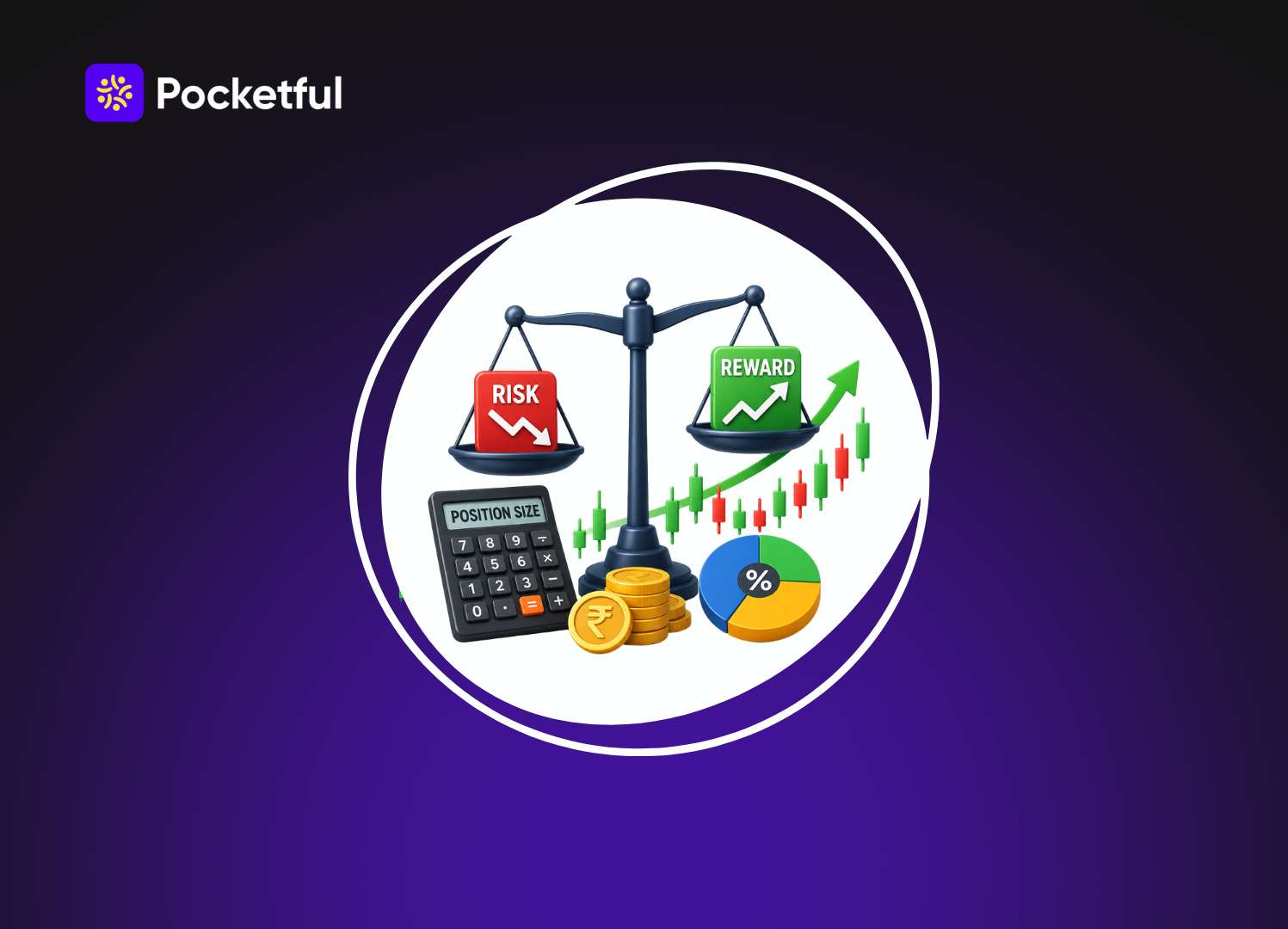
Talk to ten traders about what went wrong with their last blown-up account, and nine of them will blame the stock, the news, or market manipulation. Almost none of them will blame the two things that matter how much they risked on that one trade, and whether the potential reward even justified taking it in the first place.
That is the risk-reward ratio and position sizing for you. Nobody posts a screenshot on Twitter saying “I sized my position correctly today.” But talk to any trader who has survived in the Indian markets, and they will tell you how important these two concepts are than any indicator or strategy.
Let us break both down properly in today’s blog.
What is Risk-Reward Ratio
In simple terms, risk-reward ratio compares how much you can afford to lose on a trade against how much you gain, if it goes your way.
Say you buy ABC shares at ₹950, put your stop-loss at ₹930, and you are targeting ₹1,010.
Your risk here is ₹20 per share. Your reward is ₹60 per share. That is a risk-reward ratio of 1:3, which implies that for every rupee you are risking, you are chasing three rupees in return.
You are risking ₹30 to make ₹15. That is a 2:1 ratio, which means you are risking double what you hope to earn. Even if this trade feels right, the calculation is already working against you.
Importance of Risk-Reward Ratio
1. Tells you the Basic Comparison:
Risk-reward ratio is just a comparison. How much are you willing to lose on a trade versus how much you are hoping to gain?
Buy Y share at ₹1,850, stop-loss at ₹1,820, target at ₹1,940, and you are risking ₹30 to make ₹90.
That is a 1:3 ratio, and it means the trade has room to be wrong more often than it is right.
A good risk-reward ratio does not always mean you will win. It means you do not need to win as often to stay profitable.
2. It Forces Discipline You Did Not Know You Needed
The other underrated benefit is that checking your risk-reward ratio before entering a trade forces you to actually plan the trade. Where is your stop-loss? Where is your target? If you cannot answer those two questions with real price levels, you are not trading, you are gambling with extra steps.
3. Acts as a Filter Against Emotional Decisions
Markets test your patience constantly, especially in F&O where prices move fast, and emotions move faster. A good risk-reward ratio acts like a filter between your rational trading plan and your emotional in-the-moment decisions.
When you have already decided your risk and reward before entering, there is less room for panic-selling at the first red candle.
Read Also: What is Central Pivot Range (CPR) In Trading?
What is Position Sizing
Risk-reward ratio tells you if a trade is worth taking. Position sizing tells you how much of your capital to put behind it.
Let us say you have got ₹5,00,000 in your trading account.
At 2% risk per trade, you are willing to lose ₹10,000 max on any single position.
If you are trading and your stop-loss is ₹40 away from your entry, your position size works out like this:
Position Size = Risk Amount / Stop-Loss Distance = ₹10,000 / ₹40 = 250 shares
This your entire position, regardless of how confident you feel.
Compare this to what most retail traders in India actually do: they see a stock they like, decide “I’ll put ₹2 lakh into this,” and only then figure out their stop-loss.
That is position sizing backwards. You should always calculate your risk first, then size your position to match it, and never the other way round.
Combining Both: Risk-Reward & Position Sizing
They work together as a system.
A trade with excellent risk-reward but sized too large can still wipe out your account.
A trade with perfect position sizing but poor risk-reward will just slowly bleed your capital over time
The traders who build wealth in Indian equities and F&O over the long run are usually doing three boring things consistently:
- Only taking trades where the reward is at least 1.5 to 2 times the risk
- Never risking more than 1-2% of capital on any single trade
- Sticking to both rules even when they are sure about a trade
Common Mistakes People Make
- Moving the stop-loss: Trade goes against you, and instead of accepting the ₹1,000 loss you already planned for, you shift the stop-loss lower. Now that ₹1,000 loss turns into ₹3,000, and the risk-reward ratio you calculated at the start does not mean anything anymore.
- Averaging down on losers: Stock falls below your stop, but instead of exiting, you buy more to bring down the average price. This is not position sizing anymore; it is adding risk to a trade that already told you it was wrong.
- Revenge trading: After a loss, there is this urge to jump straight into another trade. Position sizing usually goes out the window here. People end up taking oversized positions on setups they have not even properly evaluated,
- Exiting winners too early: Target was ₹100 but the moment price touches ₹60, fear kicks in, and you book profit. Do this often enough, and your actual risk-reward ratio ends up nowhere close to what you planned on paper.
What SEBI’s Data Says About This
This is not just theory. SEBI’s own study on individual traders in the equity F&O segment found that 93% of individual retail participants ended up in losses in FY 2022-24 studied, and weak risk management was one of the recurring reasons behind it.
It is not that people were picking bad trades every single time. A lot of it came down to oversized positions and poor risk-reward planning turning small, manageable losses into much bigger ones.
Read Also: Why Option Buyers Lose Money in Trading
Conclusion
The risk-reward ratio and position sizing are two important concepts of trading. There is no adrenaline in calculating 2% of your capital or checking if your target is at least double your stop-loss distance. But this calculation is exactly what separates traders who last from traders who have one good month, which is followed by a month that wipes out their entire capital.
Before your next trade, whether it is a cash market swing trade or a Nifty options bet, ask yourself two questions.
Is the reward worth the risk I am taking? And is my position sized so that being wrong does not cost me more than I can afford to lose?
| S.NO. | Check Out These Interesting Posts You Might Enjoy! |
|---|---|
| 1 | Best Option Selling Strategy in India |
| 2 | Trade Breakouts with Options Without Overpaying IV |
| 3 | Option Buying vs Option Selling: Key Differences |
| 4 | Risk-Reward Ratio & Position Sizing in Trading |
| 5 | Supply and Demand Trading Strategy |
Frequently Asked Questions (FAQs)
How much of my capital should I risk on one trade?
Most experienced traders stick to 1-2% of total capital per trade.
Why do most retail traders get position sizing wrong?
They decide the investment amount first, like “I will put ₹2 lakh into this stock”, and only figure out the stop-loss after.
Why do I keep losing money even with good risk-reward setups?
Usually it is execution, not the ratio itself. People plan a 1:3 trade on paper, then panic-exit at breakeven or shift their stop-loss mid-trade. The ratio only works if you actually stick to it.
Should my risk-reward ratio change based on market conditions?
It is worth changing in choppy, sideways markets since targets are less likely to hit. In trending markets, you can afford to stretch your ratio a bit since there are high chances that price will move in your favour.
Is there a tool to calculate position size quickly?
Yes, most broking platforms in India, including Pocketful, now have built-in position-size calculators, and it is worth using every single time.
