Along with the news about the conflict between the countries of the Middle East and the USA, the news related to the cancellation of flights and rising flight costs is also spreading very fast. So you must be thinking about how it will impact the tourism sector across the globe.
In today’s blog post, we will give you a brief about how the Iran War is impacting travel, airlines and the global tourism industry.
What is the 2026 Middle East Tourism Crisis?
A tension is escalating between the various countries of the Middle East and the USA. This situation has erupted into a tourism crisis, which is disrupting the tourism of different countries. Various travel hubs, such as Dubai, etc. have seen reduced passenger traffic. Air space of Iran has been shut down, so the airlines are rerouting the flights, which eventually increases fuel cost and fare. This has not only slowed down tourism in the Middle East but also impacted global travel and tourism.
How the Iran War is Impacting Travel Demand
The Iran War is impacting travel demand in the following manner:
Reducing Tourist Confidence: The Iran war is reducing the confidence of investors as fear and uncertainties are rising among tourists. Hence, tourists are postponing and cancelling their travels to the Middle East.
Drop in the arrival of tourists: The travel to Middle East countries is reducing day by day. And it is expected that tourism will fall by 11 to 27% in 2026.
Air Space Restriction: The airspace of Iran has been shut down, which are forcing airlines to take longer routes, which makes travelling more time-consuming and inconvenient.
Uncertain Travel Plan: As the travel advisory and flight schedules across the world are changing very frequently, this is making it difficult for travellers to plan their trips.
Impact on Airlines and the Aviation Industry
The war between Iran, Israel and the USA is negatively impacting the airlines and aviation industry in the following manner:
Cancellation of Flights: The airlines are temporarily suspending or cancelling their flights on several routes to ensure the safety of passengers.
Increasing Operating Cost: The operating cost is increasing due to higher fuel consumption and a rise in crude oil prices.
Low Occupancy: There is a constant fear among the passengers in the conflict-affected area, which has led to lower seat occupancy.
Affecting Global Connectivity: The major tourist places like Dubai and Doha, etc., are seen to have limited connectivity because of a reduced number of flights in these regions.
Impact on the Global Tourism Industry
The global tourism industry is significantly impacted by the war between Iran, the USA and Israel in the following manner:
Decline in International Travel: International travel has seen a significant reduction as the tourists are becoming more cautious about visiting any country.
Change in Destination: Arab countries like Dubai, Doha, etc., are considered a preferred destination by tourists. However, after the current geopolitical tension, there is a structural shift in travel destinations.
Related Industries: Along with the tourism industry, there is a significant impact on other related sectors such as hotel, retail, aviation, etc.
Increasing Cost: Due to the limited supply of crude oil by the arab countries and diversion in travel routes, the cost of travelling has increased significantly.
Key Factors to Consider Before Planning a Trip
There are various key factors which a tourist is required to consider before planning a trip in the current geopolitical conditions:
Checking Travel Advisory: The travel advisories are continuously announced by the governments of various countries. Hence, it is advisable to check travel advisories before making any trip booking.
Flexible Booking: One should opt for the hotel and flights with free cancellation and rescheduling options to avoid any financial loss in case of delay or rescheduling.
Change Destinations: As the conflict is increasing between Iran, the US and Israel, it is advisable to change the travel destination and opt for some other location.
Higher Travel Cost: The travel cost has increased significantly due to additional surcharges by the airlines due to the shortage of crude oil. Hence, revaluation of the trip cost is necessary before making any bookings.
Buy Travel Insurance: It is advisable that one should purchase a travel insurance policy so that in case of any delay, cancellation of the trip, or medical emergencies, the cost will be borne by the insurance company.
Conclusion
On a concluding note, the middle east crises between Iran, Israel and the USA is affecting various sectors of the economy around the globe. It has not only affected the regional travel to Iran but also includes the global tourism sector. Its ripple effect can be seen across airlines, the hospitality sector, etc. Closure of airspace, regular travel advisories from countries have created a panic situation among the travellers. Along with this, the rising cost of oil has increased the cost of travelling. However, historically, it has been seen that once stability returns, travel demand will rebound again. Hence, before making any investment in the tourism and aviation sector, it is advisable to consult your investment advisor.
S.NO.
Check Out These Interesting Posts You Might Enjoy!
How is the conflict between Iran, Israel and the USA affecting international travel?
As the conflict has resulted in restricted airspaces along with the rising fuel cost, and airlines are bound to take longer routes, this has affected international travel negatively.
Which sector is most affected by the Middle East crisis?
The sectors which are mostly affected by the Middle East crisis are airlines, tourism, and hospitality.
How much time will it take to end the Middle East crisis?
The situations are continuously evolving and are expected to end quickly, depending on the intent of Iran and the USA.
Why are flight tickets getting expensive?
The flight tickets are getting expensive because of rising fuel costs, and the rerouting of flights, etc.
What is the Middle East crisis of 2026?
A major war-like situation is going on currently in the middle east region between Iran, Israel and the USA. This situation is affecting various industries across the globe.
Many investors closely follow the portfolios of well-known market veterans to understand emerging investment themes. This allows them to understand the right ways to analyse and select stocks that can help build a strong portfolio.
One such person who has attracted various investors is Madhusudan Kela. He is known for his work in the country’s finance sector. At the same time, Madhusudan Kela portfolio reflects a perfect mix of varied sectors that have helped him to create a good wealth.
But the question over here is, what are the top Madhusudan Kela stock picks in 2026 that you should know? Read this guide to get the answers.
Who Is Madhusudan Kela?
When it comes to the equity investors and fund managers, Madhusudan Kela stands out. He is often known as Madhu Kela. He was born in a small town in Chhattisgarh known as Kurud. If you see his background, he came from a simple family. His father worked for a bank.
He completed his school education in his hometown at a Hindi-medium school. Then he moved to Mumbai. He completed his Master’s in Management Studies from K. J. Somaiya Institute of Management Studies and Research in 1991.
He has worked for over 3 decades with different companies. His work in the Indian capital market is what actually stands out. He is a member of the Venture Capital Investment Committee of SIDBI for the Fund of Funds for Startups initiative.
Additionally, he is also associated with the Confederation of Indian Industry and the Federation of Indian Chambers of Commerce and Industry. He has worked for major companies such as CICO, UBS, and Reliance Capital Limited.
Focusing on education, he founded Plaksha University. He is a trustee of the same as well. He won several wards including the Business Standard Equity Fund Manager of the Year Award in 2004.
He is known for sharing his views with others through media platforms. As of now, he is working as the Managing Director of MK Ventures Capital Limited.
Madhusudan Kela Latest Portfolio 2026
Knowing the portfolio starts with understanding the strategy. This will help you understand the basic psychology behind his investing and which sectors he preferred over others. So, here is a quick view of the portfolio.
Stocks
Holding Value
Qty Held
Dec 2025 Holding %
Sep 2025 %
Choice International
1,220.2 Cr
1,60,54,833
7.20%
8.90%
Mkventures Capital
287.5 Cr
28,58,027
74.40%
74.40%
Windsor Machines
169.3 Cr
65,15,506
7.50%
7.70%
Prataap Snacks
119.2 Cr
11,00,000
4.60%
4.60%
Sangam
103.2 Cr
24,40,699
4.90%
4.90%
Indostar Capital
75.3 Cr
33,79,834
2.10%
2.50%
Rashi Peripherals
54.3 Cr
16,07,717
2.40%
2.40%
Bombay Dyeing
36.4 Cr
32,75,739
1.60%
1.70%
SG Finserve
35.8 Cr
9,51,773
1.70%
1.70%
IRIS RegTech
29.0 Cr
10,72,000
5.20%
5.20%
Niyogin Fintech
23.2 Cr
50,20,000
4.50%
4.50%
Unicommerce eSolutions
19.6 Cr
18,34,301
1.68%
1.70%
Repro
18.3 Cr
4,75,000
3.29%
3.30%
Kopran
9.2 Cr
7,04,593
1.50%
1.50%
Emkay Global
8.1 Cr
2,89,243
1.10%
–
Nazara Technologies
–
–
–
1.20%
NOTE: All the information in the table is based on the external public sources. They are bound to change. The details shared here are only for informational and educational purposes.
Company Overviews
Now that you know Madhusudan Kela stocks, it is crucial that we know a little about these companies as well. Here is a brief overview of what these companies are all about.
1. Choice International
Choice International is a financial services company offering stockbroking, wealth management, investment banking, and advisory services. It focuses on retail investors, SMEs, and institutions seeking capital market access and financial solutions.
2. MK Ventures Capital
MK Ventures Capital is the company founded by Madhusudan Kela. The company works in the equity market and portfolio management. It focuses on identifying high-growth companies across emerging sectors in India.
3. Windsor Machines
Windsor Machines is a company that manufactures plastic processing machinery. The company provides machines to various other companies, including packaging and automotive. Its models support modern manufacturing and industrial production.
4. Prataap Snacks
Prataap Snacks must have heard of the Yellow Diamond Chips. This is the company that produces them. The company offers a wide variety of snacks and focuses on large-scale retail distribution.
5. Sangam
Sangam produces yarn, fabrics, and ready-to-stitch garments. The company supplies domestic and export markets. It focuses on the production and the inegtarted services as well. This is a prime reason for faster growth.
6. Indostar Capital
Indostar Capital Finance is a non-banking financial company that provides vehicle finance, SME lending, and corporate loans. It mainly serves small businesses and transport operators across India’s growing credit market.
7. Rashi Peripherals
Rashi Peripherals distributes technology products, including laptops, smartphones, and IT accessories. The company connects global technology brands with retailers and enterprises. It has a wide network.
8. Bombay Dyeing
Bombay Dyeing is a well-known textile brand that needs no introduction. It is known for its quality and range of home textile products, such as bed linen and towels. It also develops the residential and commercial projects.
9. SG Finserve
SG Finserve is a financial services company providing lending and investment solutions. It focuses on credit opportunities, structured finance, and capital markets activities to support businesses and financial growth.
10. IRIS RegTech
IRIS RegTech develops regulatory technology solutions. These are the ones that help organisations manage compliance, reporting, and financial disclosures. Its software supports businesses and regulators in efficiently handling complex regulatory requirements.
11. Niyogin Fintech
Niyogin Fintech company provides digital financial services. It partners with fintech platforms and financial institutions to expand access to financial products.
12. Unicommerce eSolutions
Unicommerce eSolutions offers supply chain and warehouse management software for e-commerce businesses. Its technology helps brands and marketplaces manage their working end-to-end.
13. Repro
Repro India provides print-on-demand publishing and content distribution services. It works with publishers and educational institutions to deliver books and learning materials through digital printing and supply chain solutions.
14. Kopran
Kopran is a pharmaceutical company. It manufactures active pharmaceutical ingredients and formulations. It supplies medicines to domestic and international markets.
15. Emkay Global
Emkay Global provides brokerage, investment banking, research, and wealth management services. It serves institutional investors, corporations, and high-net-worth clients in Indian capital markets.
16. Nazara Technologies
Nazara Technologies is a gaming and esports company. It works on mobile games, interactive entertainment, and sports media platforms. It operates across India and international markets.
There is no doubt that Madhusudan Kela’s portfolio shows a perfect balance of multiple sectors. The mix is important for helping you manage risk and ensure that no single situation negatively impacts your portfolio. Here are the key insights.
Financial Services and Fintech: It is one of the most prominent sectors in the portfolio. There are fintech, equity, and other companies that exert significant influence. As more individuals gain insights into building financial security, the sector’s growth potential is high.
Technology and Digital Platforms: Businesses need better technology to manage their daily operations. This is where the technology-driven businesses are gaining importance. The companies involved in operational and tech support are growing fast due to a proactive rise in demand.
Consumer Businesses: The demand for better consumer products is always there. But a few companies, like the ones selling good snacks, stay ahead of the rest. Adding such companies to the portfolio offers stability even when the market is volatile in nature.
Manufacturing and Industrial Sector: This is the backbone of the economy. Every industry needs manufacturing tools and machines to complete its processing. Investing in capital goods offers long-term growth potential. But mind that these are not companies that can offer high returns in the short run.
Healthcare and Pharmaceuticals: There is no doubt that this is one of the sectors growing rapidly, and nothing actually impacts it widely. The research, the need for better medical facilities, and support are boosting the sector to new heights.
Digital Entertainment and Gaming: The digital education, gaming, and entertainment have grown multifold in the past few years. The demand for apps and gaming is supported across every sector, making this a high-growth sector in the future.
Publishing and Content Services: Publishing and content services support the education and knowledge ecosystem. Even with the digital ear, there is a high demand for these services, and this is to support the visibility. This is a reason for consistent growth here.
Investment Strategy
The Madhusudan Kela portfolio reflects a clear investment style built around conviction and deep understanding. The companies in the portfolio are selected based on their background and sector. A simple analysis for you is here.
Focus on Emerging Growth Businesses: He often invests in companies that are still developing their full potential. These businesses may not yet be market favourites. But if you actually analyse these, these are ones with improving fundamentals and expanding demand. This gives them the ability to grow steadily over time.
Preference for Mid-Sized Companies: Many companies in the Madhusudan Kela stocks list fall in the mid-cap space. These firms usually have established operations but still have enough room to expand, making them attractive to investors seeking long-term value creation.
Long-Term Holding Approach: His portfolio shows patience rather than frequent buying and selling. Once conviction is built around a business, he tends to stay invested through cycles and allows the company’s growth to reflect gradually in its valuation.
Sector Diversification: The portfolio spreads across financial services, technology, manufacturing, consumer businesses, and pharmaceuticals. This diversification makes the portfolio stable. This allows it to work well even when there is turmoil in one of the sectors.
Strong Focus on Business Fundamentals: Investment decisions usually revolve around business quality, demand outlook, management capability, and balance sheet strength. Rather than reacting to short term price movements, the emphasis remains on long term business performance.
Looking at the structure of the Madhusudan Kela portfolio offers useful insight into his investment thinking. The companies chosen reflect both established sectors and emerging themes shaping India’s economic growth.
Clear Tilt Toward Financial Services: A noticeable portion of the portfolio sits in financial and fintech businesses. This shows confidence in India’s expanding credit ecosystem and markets. This is a sign that knowing the market trends can help greatly.
Increasing Exposure to Technology Platforms: If you see, the portfolio focuses on upcoming and new technologies as well. The idea here is simple. The businesses are changing and adoption of the same in your portfolio can be really helpful.
Selective Consumer Exposure: Consumer-oriented companies provide stability within the portfolio. This can be simple food or even the household supplies. Adding some of these companies can help a great deal.
Participation in Industrial Growth: Exposure to manufacturing and industrial companies is a sign of belief that the economy is growing. Also, these are the companies that serve as the baseline for many other sectors.
Inclusion of Niche and Emerging Segments: Some holdings belong to specialised or niche industries that are still evolving. This is key as these are rge industries with speedy growth potential but needs caution as well.
Key Insights for Investors
The Madhusudan Kela stocks portfolio offers several useful lessons for investors who want to build a thoughtful and disciplined investment approach.
Focus on finding the companies that are in their developing stage.
Create a good portfolio with patience and a proper balance.
Have exposure to multiple sectors.
Be keen to know the fundamentals and past history.
Have proper plans for entry and exit.
Analyse and update every 3-6 months to avoid losses.
Conclusion
The Madhusudan Kela portfolio reflects an investment style centred on patience, conviction, and careful sector selection. All the companies in his portfolio are selected based on deep analysis of the market.
For investors who wish to follow his plan, it is important to understand market well. Diversification is key here and should focus on a deeper approach. And if you are looking for more such insights on the stocks, then register with Pocketful and start investing right.
S.NO.
Check Out These Interesting Posts You Might Enjoy!
What type of companies does Madhusudan Kela prefer?
Most of the companies in Madhusudan Kela portfolio are mid-sized with strong fundamentals. These companies are on their growing stage and support the economy.
Does Madhusudan Kela frequently change his portfolio?
No. His portfolio usually shows stability across quarters. This gradual change in the portfolio allows tracking and avoids impulse actions that can impact negatively.
Why does he invest in mid-cap companies?
Mid-cap companies often offer higher growth potential. These companies are still in a stage where they carry good potential for future. So, this offers better results.
Which sectors appear most often in his portfolio?
Financial services, technology platforms, manufacturing businesses, consumer companies, and healthcare-related firms are among the sectors that frequently appear in his investments.
What can investors learn from his strategy?
The key lessons include staying patient and focusing on the business fundamentals. This is followed by proper management, deeper analysis, and also identifying companies that are still growing rather than chasing already popular stocks.
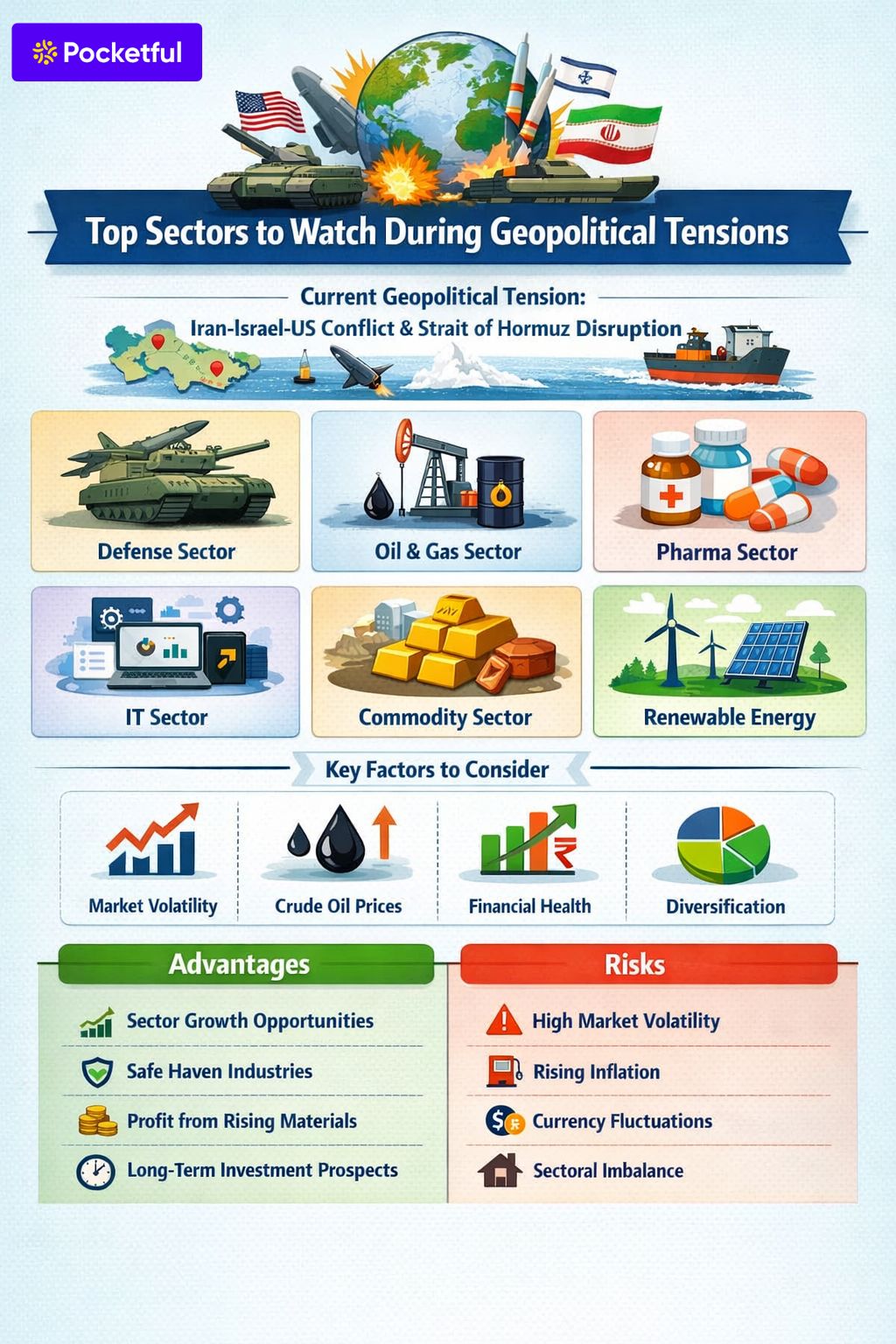
Whenever the geopolitical tension rises, the stock market tends to become volatile and unpredictable. But not all the sectors need to be negatively impacted by such events; there are a few industries which perform well during such periods.
In today’s blog post, we will give you an overview of the top sectors to watch during geopolitical tension. along with the key factors to consider before investing in it.
Current Geopolitical Tension
Currently, geopolitical tension is escalating across the world. This geopolitical crisis involves Iran, Israel, and the US. This conflict escalated when the USA and Israel launched various missiles at Iran, and this conflict involved various countries. This conflict has disrupted the global supply chain related to crude oil, gas, etc. As a region known as the Strait of Hormuz, which is a crucial oil transportation route, has been captured by Iran.
Top Sectors to Watch During Geopolitical Tensions
The top sectors to watch during geopolitical tension is a follows:
Defense Sector
Oil and Gas Sector
Pharma Sector
Information and Technology Sector
Commodity Sector
Renewable Energy
Overview of Top Sectors to Watch During Geopolitical Tensions
1. Defence Sector
The defence sector is one sector that tends to be in the spotlight during geopolitical tensions since the government usually increases military expenditure to enhance national security. In India, the government has been focusing on domestic defence production and decreasing the dependence on imports. This has provided a high growth potential to companies that deal with aircraft manufacturing, defence electronics, missiles and surveillance systems. In the event of increased geopolitical risks, the defence companies might get increased orders from the government, which can increase their revenues and future growth potential. Due to this, defence stocks are usually closely monitored by investors in times of global uncertainty.
2. Oil and Gas Sector
The oil and gas industry is among the most sensitive industries where geopolitical tensions rise. War in oil-producing countries, particularly the Middle East, can cut supply chains and cause abrupt rises in crude oil prices. In the case of India, where much of the crude oil is imported, the developments can have major effects on the economy and energy markets. The oil exploration companies, which are upstream companies, might gain, and refining and marketing companies might be adversely affected by increased prices in the oil market. Due to the fact that energy is a key factor in economic activity, the sector becomes highly sensitive when it comes to conflicts across the globe.
3. Pharma Sector
The pharmaceutical industry can be regarded as a defensive industry since demand for medicine and healthcare products is consistent despite political and economic factors experienced in the world. This is because people still require basic medicines, vaccines, and medical care even when geopolitical crises strike. India is a major manufacturer of generic drugs in the world, which exports drugs to numerous foreign markets. This well-established international base makes pharmaceutical firms stable. Pharma stocks are sometimes considered a comparatively safer investment option during uncertain periods since the industry is likely to experience steady demand and sound financial results.
4. Information and Technology Sector
Information technology (IT) is an important sector in India’s economy and tends to be stable during geopolitical problems. Most Indian IT firms make much of their income out of international clients, especially in the United States and Europe. The currency fluctuations resulting from geopolitical tensions can be favourable to the Indian IT exporters when the US dollar is strong. Moreover, cybersecurity, digital infrastructure, and technology solutions are usually required more during global conflicts, which also contributes to the demand for IT services. The IT sector is still a preferred investment option by investors due to its high export levels and digital growth patterns.
5. Commodity Sector
Geopolitical developments have a significant impact on the commodity sector, which covers metals, minerals, and other raw materials. Global supply chains can be interrupted by conflicts, sanctions and trade restrictions, leading to commodity prices fluctuating. For example, when there is tension between countries that produce huge amounts of resources, then the price of metals such as steel, copper, or aluminium may increase. Companies manufacturing metals and other firms in the mining industry are directly affected by these price fluctuations. During the geopolitical tensions, commodity companies in India would have the advantage of increased world prices. Subsequently, this industry has become a key area of interest to most investors who are keen on knowing how the world is affecting supply and demand.
6. Renewable Energy
The renewable energy industry is acquiring more importance in the midst of geopolitical tension, particularly when international oil and gas supply is disrupted by conflicts. It has boosted investment in renewable energy sources like solar, wind and green hydrogen. India has also been on a mission to increase its renewable energy capacity as part of its long-term sustainability and energy independence objectives. With geopolitical uncertainties pointing to the dangers of over-dependence on conventional energy sources, renewable energy companies are likely to be an important part of future energy consumption.
Key Factors to Consider before Investing during Geopolitical Tensions
There are various key factors to consider before investing in the geopolitical tensions:
Volatility: Due to geopolitical events the market suddenly fluctuates which can lead to significant volatility in the short-run making impulsive decisions based on it.
Crude Oil Prices: Conflict in the oil-producing countries can push the oil prices higher. And India is heavily dependent on the import of crude oil, so it is advisable to analyse the overall market sentiment before making any investment.
Financial Performance: The financial performance of the individual company needs to be analysed, and one should only invest in companies with a higher profit margin, consistent revenue, etc.
Diversification of Investment: The investment during the volatile market conditions should not be made in one stock or sector. Therefore, one must diversify their investment portfolio across different industries to reduce risk.
Advantages of Investing During Geopolitical Tensions
Sector-Focused Expansion Possibilities: Industries such as aerospace/military suppliers, energy resources, and raw materials frequently see uplift from heightened need and elevated costs when international friction arises.
Steadiness Through Protected Industries: Fields like healthcare and technology tend to hold up well because of steady consumer needs and broad international reach, assisting in lowering portfolio vulnerability.
Profit from Rising Material Valuations: Interruptions in worldwide product flows can propel costs for petroleum, base metals, and natural fuels upwards, favorably impacting associated enterprises.
Appealing Extended Horizon Acquisition Moments: Share price dips during periods of unpredictability can present chances to purchase shares with solid underlying value at more favorable prices.
Risks of Investing During Geopolitical Tensions
Increased Market Volatility: Global political occurrences have the potential to spark swift and erratic shifts in the markets, leading to greater near-term hazards.
Rising Inflation Due to Oil Prices: Elevated petroleum rates may fuel inflation, adversely affecting numerous industries and the broader economic expansion.
Currency Fluctuations: Instability in exchange rates can influence corporate profits, particularly for firms reliant on imports or those with international exposure.
Sectoral Imbalance: Certain industries may see gains, yet others such as construction, property, and consumer spending might experience deceleration during these times
Conclusion
On a concluding note, increasing geopolitical tension in the region creates uncertainty in the market, making it highly volatile. Different sectors or industries respond in a different manner during such conditions. Some industries, such as pharma, oil, IT, etc., can perform well, whereas industries like infrastructure, real estate, etc., tend to show a significant correction. For more market news and insights, download Pocketful – offering users zero brokerage on delivery trades and an easy to use platform designed for both beginners and experienced investors Therefore, one must consult their investment advisor before making any investment during the geopolitical uncertainties.
S.NO.
Check Out These Interesting Posts You Might Enjoy!
Which are the sectors that can perform well during the current geopolitical tensions?
There are various sectors, such as defence, pharma, oil and gas, IT, renewable energy, etc., that can perform well during geopolitical tensions.
Is it safe to invest during geopolitical crises?
Yes, it is safe to invest during geopolitical crises. One should invest for a longer duration as markets tend to be volatile in the short-term. Also, it is advisable to consider your risk profile and consult your investment advisor.
Why do crude oil prices increase during the war?
As the war in the Middle East region can significantly disrupt the global supply chain, eventually increase the prices of crude oil.
Which industry is mostly affected by rising crude oil prices?
Industries like aviation, logistics, etc., are significantly impacted by the rising crude oil prices.
How to invest in stocks during geopolitical crises?
To invest in stocks during geopolitical crises, one must open a demat and trading account and select the stocks of sectors which can perform well during such conditions. Pocketful also offers you an opportunity to open a lifetime free demat and trading account, as it also offers free brokerage on delivery trades.
As the war between Iran, the US and Israel is going on, the global prices of oil and gas are rising, because Iran produces a large amount of the world’s total consumption of crude oil. Hence, investors are curious about the impact of rising crude oil prices on Indian Stocks.
In today’s blog post, we will give you an overview of the best oil and gas stocks to watch as global prices surge.
Why Global Oil Prices Impact the Indian Oil and Gas Sector
India imports a larger portion of its crude oil and gas from different countries to complete its requirements. Hence, any changes in global crude oil and gas prices can significantly impact the Indian crude oil prices. As in the current scenario, global crude oil prices are rising because of the war between Iran, the USA and Israel and the global crude oil supply chain is disrupted, leading to a rise in crude oil prices globally. This price rise will benefit the companies engaged in exploration, selling and marketing of oil and gas in India.
Best Oil and Gas Stocks to Watch in India
The best oil and gas stocks to watch in India are as follows:
Reliance Industries Limited
Oil and Natural Gas Corporation Limited
Bharat Petroleum Corporation Limited
GAIL Limited
Oil India Limited
Hindustan Petroleum Corporation Limited
Adani Total Gas Limited
Petronet LNG Limited
Chennai Petro Limited
Mahanagar Gas Limited
Company
Current Market Price (INR)
Market Capitalisation (in INR crore)
52-Week High
52-Week Low
Reliance Industries Limited
1394
1886426
1612
1115
Oil and Natural Gas Corporation Limited
265
333818
293
205
Bharat Petroleum Corporation Limited
300
130155
392
260
GAIL Limited
147
96917
203
144
Oil India Limited
473
76898
524
322
Hindustan Petroleum Corporation Limited
346
73729
508
320
Adani Total Gas Limited
515
56640
798
454
Petronet LNG Limited
289
43290
326
264
Chennai Petroleum Corporation Limited
1054
15695
1103
516
Mahanagar Gas Limited
1013
10010
1587
989
(As of 17th March 2026)
Overview of Best Oil and Gas Stocks
1. Reliance Industries Limited
Reliance Industries Limited company was incorporated in 1966 by Dhirubhai Ambani. After the death of Dhirubhai Ambani, his son Mukesh Ambani took over the company. And later expanded the company’s operations into various sectors, such as retail and communication. The company’s headquarters is in Mumbai.
1 Year Return (%)
3 Years Return (%)
5 Years Return (%)
12.58
25.63
35.9
(As of 17th March 2026)
2. Oil and Natural Gas Corporation Limited
This company was founded in 1956 and is one of the largest public sector energy companies in India. It works under the Ministry of Petroleum and Natural Gas. ONGC is primarily engaged in the exploration, production, and distribution of crude oil and natural gas. Its headquarters are situated in New Delhi.
1 Year Return (%)
3 Years Return (%)
5 Years Return (%)
15.21
72.89
141.96
(As of 17th March 2026)
3. Bharat Petroleum Corporation Limited
The company was founded in 1952 as a result of a joint venture between the Indian Government and Burmah Shell. Later, when the government acquired the Burmah Shell, BPCL converted into a fully owned government company. The company is engaged in the marketing and distribution of petroleum and its related products to retail users. The company’s headquarters is situated in Mumbai.
1 Year Return (%)
3 Years Return (%)
5 Years Return (%)
14.66
70.66
38.87
(As of 17th March 2026)
4. GAIL Limited
GAIL Limited company was established in 1984 as a public sector undertaking to develop a natural gas transmission network in India. The company was listed on the Indian Stock Exchange in 1997. The company is expanding its natural gas pipeline network across the country. The company’s headquarters is in New Delhi.
1 Year Return (%)
3 Years Return (%)
5 Years Return (%)
(5.9)
33.76
59.81
(As of 17th March 2026)
5. Oil India Limited
Oil India Limited company was founded in 1959 and works under the Ministry of Petroleum and Natural Gas. The company mainly operates in the North-East region of India. It became a publicly listed company in 2009. The company has exploration facilities in other countries. Its headquarters are situated in Assam.
1 Year Return (%)
3 Years Return (%)
5 Years Return (%)
25.07
176.19
448.22
(As of 17th March 2026)
6. Hindustan Petroleum Corporation Limited
The company was incorporated in 1974 and was initially known as Esso India, and later, after nationalisation, it was renamed as Hindustan Petroleum Corporation Limited. Later in 2018, it was acquired by ONGC Limited. The company got itself listed on the stock exchange in 1977. The company’s headquarter is situated in Mumbai.
1 Year Return (%)
3 Years Return (%)
5 Years Return (%)
6.38
113.97
119.48
(As of 17th March 2026)
7. Adani Total Gas Limited
Adani Total Gas Limited is one of the leading players in the gas distribution space. The company was incorporated in 2005, and over time, it has expanded its presence in supplying piped natural gas to households, industries, etc. It became a publicly listed company in 2018. The headquarters of the company is situated in Ahmedabad.
1 Year Return (%)
3 Years Return (%)
5 Years Return (%)
(14.29)
(42.44)
(30.52)
(As of 17th March 2026)
8. Petronet LNG Limited
The company was incorporated in 1998 to develop Liquid Natural Gas and distribute it among the citizens of the country. The company was listed on the Indian Stock Exchange in 2004. Over the years, the company has expanded its operations and developed infrastructure to supply LNG. The headquarters of the company is situated in New Delhi.
1 Year Return (%)
3 Years Return (%)
5 Years Return (%)
1.55
23.94
26.14
(As of 17th March 2026)
9. Chennai Petroleum Corporation Limited
Chennai Petroleum Corporation Limited company was incorporated in 1965 and was initially known as Madras Refineries Limited. It was established as a joint venture between the Government of India, AMOCO, and the National Iranian Oil Company. Later in 2001, after the IOCL increased its stake in the company, it was renamed as Chennai Petroleum Corporation Limited. The headquarters of the company is situated in Chennai.
1 Year Return (%)
3 Years Return (%)
5 Years Return (%)
89.72
316.26
855.34
(As of 17th March 2026)
10. Mahanagar Gas Limited
Mahanagar Gas Limited company was established in 1995 as a result of a joint venture between GAIL and BG Group. The objective of the company is to provide a strong network of gas distribution in urban areas and to promote the use of cleaner fuels. It offers CNG along with PNG. The company became a publicly listed company in July 2016. The headquarters of the company is located in Mumbai.
1 Year Return (%)
3 Years Return (%)
5 Years Return (%)
(22.72)
2.96
(11.57)
(As of 17th March 2026)
Key Factors to Consider Before Investing in Oil and Gas Stocks
The key factors which one can consider before investing in oil and gas stocks are as follows:
Global Oil Prices: This is one of the key factors that one should consider before making any investment in oil and gas stocks. The companies engaged in the exploration of oil and gas may see fluctuation in their profit margins.
Government Regulations: The performance of the oil and gas sector is directly influenced by the government policies and regulations. Different types of subsidies and windfall taxes can significantly impact the company’s performance.
Financial Performance: The company’s performance is directly linked with their financial performance. Their profit margins, debt levels, cash flows, etc., can impact a company’s performance.
Demand: The global demand for oil and gas is influenced by economic and industrial activities. A growing economy generally has higher demand, which can help oil and gas companies.
Future Outlook of the Indian Oil and Gas Sector
The future outlook of the Indian oil and gas sector is very strong due to increasing demand for energy. The companies in India engaged in exploration, marketing and distribution of oil and gas are expected to grow in future. Along with this, the government is also subsidising the companies by promoting the usage of natural gas. However, these companies are diversifying into renewable energy but still have strong growth potential in the long run.
Conclusion
On a concluding note, due to the war between Iran, Israel and the USA, the global crude oil prices are rising, and there are various countries, such as India, which are significantly dependent on the import of oil from Arab countries. This will impact the profitability of the Indian companies engaged in the selling and distribution of oil and gas. One can invest in these companies for the medium to long term to earn a profit. But it is advisable to consult your investment advisor before making any investment decision. For more market news and insights, download Pocketful – offering users zero brokerage on delivery trades and an easy to use platform designed for both beginners and experienced investors.
S.NO.
Check Out These Interesting Posts You Might Enjoy!
Why global rise in prices affecting Indian oil and gas stocks?
India imports a large portion of its crude oil from different countries. And if the global crude oil price rises, it can affect the profit margins of Indian oil and gas stocks.
Which factors should an investor consider before investing in oil and gas stocks?
There are various factors, such as the prices of global crude oil, government policies and regulations, and company profitability.
How to invest in oil and gas stocks?
To invest in crude oil and gas stocks, one must open a demat and trading account. Pocketful offers you an opportunity to invest in oil and gas stocks by opening a lifetime free demat account with zero brokerage on delivery.
How can geopolitical tension impact crude oil prices?
Due to geopolitical tensions, the global supply chain has been disrupted, pushing crude oil prices upward and making crude oil expensive in India.
Name the best Oil and Gas Stocks to purchase due to the Global Oil Price Surge?
The best oil and gas stocks to purchase amid the global oil price surge include Reliance Industries, ONGC, Oil India Limited, IOCL, BPCL, etc.
India now sees a sharp rise in orders for induction cooktops – sudden swings in LPG price and worry about reliable supply push homes and small eateries to switch to electric heat. Data show that some online shops sold twenty to thirty times more induction units than before. Forecasts place the yearly growth of the domestic induction market at about 11.7 percent through 2030 – extra openings appear for firms that serve this area.
What Are Induction Stove Stocks?
Induction stove stocks represent shares of companies that manufacture or sell induction cooktops, electric cooking appliances, and other kitchen appliances. As the adoption of electric cooking in households continues to rise, these companies are likely to witness growth in their business operations.
Best Induction Stove Stocks in India
S.No
Company
Current Market Price (INR)
Market Capitalisation (in INR crore)
52-Week High
52-Week Low
1
Havells India Ltd
1,308
82,026
1,674
1,250
2
Crompton Greaves
249
16,014
368
217
3
V-Guard Industries Ltd
321
14,020
413
290
4
TTK Prestige Ltd
490
6,715
773
442
5
Bajaj Electricals Ltd
368
4,246
711
342
6
Hawkins Cookers Ltd
7,492
3,963
9,900
7,026
7
Orient Electric Ltd
168
3,592
255
155
8
HPL Electric
275
1,770
640
266
9
Stove Kraft Ltd
482
1,594
823
452
10
Butterfly Gandhimathi Appliances Ltd
600
1,073
844
555
(Data as of 17 March 2026)
A brief overview of the Best Induction Stove Stocks in India is given below:
1. Havells India Ltd
Havells India Ltd was established in 1958, and its headquarters are located in Noida. The company primarily manufactures electrical products such as wires, switches, and lighting as well as various home appliances. Over time, Havells has built a very strong brand value, particularly among urban households. Today, the company sells its products not only within India but also in international markets, having established itself as a trusted name.
Know the Returns:
1Y Return (%)
3Y Return (%)
5Y Return (%)
-14.30%
10.36%
24.62%
(Data as of 17 March 2026)
2. Crompton Greaves Consumer Electricals
Crompton Greaves Consumer Electricals began in 1937 and keeps its main office in Mumbai. The firm builds fans, lighting equipment plus small appliances that people use every day. For many years, the Crompton label has appeared in Indian homes. Buyers respect the brand because its products last long and handle routine tasks without trouble – therefore, the company holds a trusted position.
Know the Returns:
1Y Return (%)
3Y Return (%)
5Y Return (%)
-29.84%
-15.92%
-37.77%
(Data as of 17 March 2026)
3. V-Guard Industries Ltd
V-Guard Industries Ltd began its journey in Kerala in 1977. Today, its head office is located in Kochi. Initially, the company manufactured stabilizers; however, its operations have since expanded significantly. It now also manufactures wires, pumps, water heaters, and various kitchen appliances. While its presence was previously concentrated in South India, its products are now gradually becoming available across the entire country.
Know the Returns:
1Y Return (%)
3Y Return (%)
5Y Return (%)
-4.74%
27.84%
39.46%
(Data as of 17 March 2026)
4. TTK Prestige Ltd
TTK Prestige Ltd was established in 1955 and operates out of Bengaluru. As a long-standing brand in the kitchenware sector, it enjoys high brand recognition among the public. The company manufactures a wide range of daily-use products, spanning everything from pressure cookers to induction cooktops. Over time, it has evolved its product offerings, thereby maintaining a strong presence in the market to this day.
Know the Returns:
1Y Return (%)
3Y Return (%)
5Y Return (%)
-15.85%
-28.34%
-31.07%
(Data as of 17 March 2026)
5. Bajaj Electricals Ltd
Bajaj Electricals began in 1938 and has its main office in Mumbai. The firm produces electrical goods for households – lamps, fans plus kitchen devices. The public already recognises the Bajaj brand – a solid base of trust exists. Through the years the range of goods grew and the company now holds a large share of the kitchen appliance market.
Know the Returns:
1Y Return (%)
3Y Return (%)
5Y Return (%)
-35.77%
-64.08%
-60.47%
(Data as of 17 March 2026)
6. Hawkins Cookers Ltd
Hawkins Cookers was founded in 1959 and operates out of Mumbai. The company is particularly renowned for its pressure cookers and cookware. Given that its products have been in use in India for a considerable period, the brand has successfully carved out a distinct identity for itself. Rather than venturing into numerous diverse categories, Hawkins has chosen to focus primarily on its core products, a strategy that has enabled it to maintain its enduring position within its specific market segment to this day.
Know the Returns:
1Y Return (%)
3Y Return (%)
5Y Return (%)
2.17%
21.18%
38.14%
(Data as of 17 March 2026)
7. Orient Electric Ltd
Orient Electric was established in 1954, and its head office is located in Delhi. Initially, it was primarily known for its fans; however, it now also manufactures lighting solutions and various home appliances. Over time, the company has progressively upgraded its product range. Even today, its fans and appliances are a common sight in many households, thereby maintaining its distinct brand identity.
Know the Returns:
1Y Return (%)
3Y Return (%)
5Y Return (%)
-22.10%
-37.95%
-49.21%
(Data as of 17 March 2026)
8. HPL Electric & Power Ltd
HPL Electric was founded in 1992, and its headquarters are situated in Gurugram. The company manufactures electrical equipment such as meters, switches, and lighting products. While its operations lean more towards the technical side, it also produces a range of consumer products. The company maintains a significant presence within India’s power and electrical sectors.
Know the Returns:
1Y Return (%)
3Y Return (%)
5Y Return (%)
-25.74%
243.01%
421.63%
(Data as of 17 March 2026)
9. Stove Kraft Ltd
Stove Kraft Ltd was established in 1999 and operates out of Bengaluru. The company manufactures kitchen-related products such as cookware, gas stoves, and induction cooktops. Today, its products are available both online and in local markets. The pricing has been kept affordable, which has led to increased usage in average households. Over time, the company has successfully established a strong reputation in the market.
Know the Returns:
1Y Return (%)
3Y Return (%)
5Y Return (%)
-37.32%
27.54%
5.82%
(Data as of 17 March 2026)
10. Butterfly Gandhimathi Appliances Ltd
Butterfly Gandhimathi Appliances Ltd was established in 1986 and operates out of Chennai. The company manufactures mixer grinders, cooktops, and various other kitchen appliances. It holds a long-standing reputation in South India, where its products have been used by consumers for generations. The company is now expanding its product presence into other states as well; consequently, its products are becoming visible in a much wider geographical area than before.
The key performance metrics of the Best Induction Stove Stocks in India are mentioned below:
Company
Operating Margin (%)
Net Profit Margin (%)
ROE (%)
ROCE (%)
P/E (x)
Havells India Ltd
9.33
6.75
17.68
22.51
65.09
Crompton Greaves
10.22
7.17
16.39
19.22
40.97
V-Guard Industries Ltd
7.86
5.62
14.95
18.93
49.59
TTK Prestige Ltd
9.63
3.97
5.99
12.71
72.75
Bajaj Electricals Ltd
4.51
2.76
7.73
11.05
47.02
Hawkins Cookers Ltd
14.14
10.27
29.92
38.61
33.26
Orient Electric Ltd
4.41
2.68
11.98
17.73
53.35
HPL Electric
12.78
5.52
10.27
22.47
28.32
Stove Kraft Ltd
5.50
2.65
8.17
12.32
60.48
Butterfly Gandhimathi Appliances Ltd
5.68
3.76
10.02
14.47
32.88
(Data as of March 2025)
Key Trends Driving the Induction Stove Market in India
LPG Supply Concerns Due to Middle East Conflict : In recent times, rising tensions between Iran and the US, as well as within the broader Middle East region, have heightened concerns regarding the global supply of LPG. According to reports, whenever uncertainty arises regarding the availability or pricing of LPG, many households and small businesses increasingly turn to electric cooking alternatives, such as induction cooktops.
Backup Cooking Option : Many urban households have now begun keeping an induction cooktop as a backup cooking solution. Since it can be utilized instantly in the event of a gas run-out or delays in supply, the demand for this appliance is on the rise.
Growing Use in Urban Homes : Portable cooking appliances prove particularly useful in small apartments, rental homes, and hostels. For this very reason, the usage of induction cooktops is expanding rapidly across urban areas.
Growth in Online Sales : Sales of kitchen appliances on e-commerce platforms have been consistently increasing. Factors such as online availability and attractive discounts also appear to be driving the growing demand for induction cooktops.
India’s induction cooktop market reached approximately $736 million in 2024.
Future Growth
It is estimated that this market could reach approximately $1.5 billion by 2033.
Growth Rate
The induction cooktop market in India is estimated to grow at a CAGR of approximately 11.7% by 2030.
Market Drivers
Due to urbanization, rising incomes, and online retail, the demand for kitchen appliances is growing rapidly.
Recent Demand Spike
Due to the shortage of LPG, sales of induction cooktops have increased by up to 25 times in several cities.
Risks of Investing in Induction Stove Stocks
Competition Risk : This sector is home to numerous established and new brands. Intense competition can exert pressure on companies’ profit margins and market share.
Commodity Price Risk : The operating costs of these companies are dependent on steel, copper, and electronic components. Any increase in the prices of these commodities can directly impact profitability.
Demand Cycle Risk : Kitchen appliances are not essential necessities but rather discretionary products. During an economic slowdown, demand for these products may decline, thereby impacting sales.
Technology Change Risk : The emergence of smart kitchen technologies and innovative cooking solutions could gradually alter the demand landscape for traditional induction products.
Induction cooking is gradually becoming more common in India, particularly as uncertainty surrounding LPG continues to rise. Consequently, companies associated with this sector have begun to attract attention. While this theme is currently nascent, it remains crucial to observe how demand evolves in the future. If you have an understanding of the consumer sector, overlooking this space would likely not be a prudent move. For more market news and insights, download Pocketful – offering users zero brokerage on delivery trades and an easy to use platform designed for both beginners and experienced investors.
S.NO.
Check Out These Interesting Posts You Might Enjoy!
Induction stove stocks refer to the shares of companies that manufacture induction cooktops and kitchen appliances.
Why are induction stove stocks trending in 2026?
These stocks are currently a topic of discussion because people are shifting towards electric cooking due to issues regarding the pricing and supply of LPG gas.
Is induction cooking popular in India?
Yes, its usage is growing rapidly, particularly in urban areas and smaller households.
Is this a long-term investment theme?
While this is currently a nascent trend, if demand continues to rise, it could present a long-term investment opportunity.
What drives demand for induction cooktops?
Factors such as LPG-related issues, faster cooking speeds, and ease of use are the primary drivers behind the demand for induction cooktops.
The Iran-US War that started in 2026 has now reached the oil market. After the latest rise in hostilities, traders fear that exports from the Gulf will stop or slow – the price of a barrel of crude jumped about forty percent on world exchanges. Because every sector of the global economy uses petroleum, a sharp increase in its cost spreads quickly. This raises a direct question – why does the price of oil leap so fast as soon as war begins?
Why the Middle East Controls Global Oil Prices
Major Share in Global Oil Production : The Middle East accounts for approximately 29-30% of the world’s total oil production. Countries in this region have long played a pivotal role in the global energy supply.
Extensive Oil Reserves : More than 60% of the world’s total proven oil reserves are located within this region, thereby significantly enhancing its importance to the energy market.
Key Exporter Nations : Countries such as Saudi Arabia, Iraq, the UAE, and Kuwait export millions of barrels of oil daily, thereby fulfilling the energy requirements of numerous nations across Asia and Europe.
Vital Maritime Route : The Strait of Hormuz, situated in the Middle East, is considered the most critical conduit for oil trade. Approximately 20% of the global oil supply passes through this route; consequently, any form of tension in this region has an immediate impact on the market.
The Significance of the Middle East in the Global Oil Market
Region
Global Oil Production Share
Middle East
29-30%
United States
20%
Russia
12%
Rest of the world
38%
Iran-US War – What Took Place
In 2026, the Middle East changed quickly when the United States besides Israel attacked Iranian military sites. Iran then fired back and tension spread through the whole Gulf area. The fight hit the oil market directly, because danger grew along key shipping lanes like the Persian Gulf plus the Strait of Hormuz.
Timeline
28 February 2026 : The United States or Israel launched large air raids against Iranian bases and the conflict grew fast.
Start of March 2026 : Iran answered with missiles but also drones aimed at US bases and other targets around the Gulf.
Early March 2026 : Ships in the Persian Gulf faced greater danger as well as multiple oil tankers had to stop or change course.
First week of March 2026 : Risk to world oil supply rose as tension increased in the Strait of Hormuz.
Mid-March 2026 : Global crude oil prices climbed almost 40 percent on fear that supply would be cut.
Strait of Hormuz: The Most Important Oil Chokepoint in the World
The Strait of Hormuz is a narrow maritime passage situated between Iran and the Arabian Peninsula. Every day, approximately 20 million barrels of crude oil pass through this strait. This volume accounts for one-fifth of the total oil consumed globally. An equivalent share of the world’s liquefied natural gas also traverses this same route. When political or military tensions escalate in the vicinity of this passage, crude oil prices fluctuate within a matter of hours, as refiners, traders, and shipowners become alarmed by the fear of a sudden closure of the route.
Metric
Data
Global oil flow through Hormuz
Approximately 20 million barrels per day
Global oil share
Approximately 20% of the global oil supply
LNG trade share
About 20% of global LNG trade
Major Oil-Exporting Countries
Saudi Arabia, Iraq, UAE, Iran, Kuwait
Largest Importers
China, India, Japan, South Korea
Oil Bound for Asia
More than approximately 80%
The Economics of War: Why Crude Oil Prices Rise
Disruptions in Supply : When a war breaks out in an oil-producing region, the immediate impact is felt on supply. Often, oil wells, pipelines, or refineries are damaged or compromised. Consequently, production or exports may slow down for a period of time. The moment the market anticipates a potential shortage in supply, prices begin to rise.
Difficulties in Shipping Operations : Navigating oil tankers through conflict zones becomes a challenging task. Shipping companies tend to avoid high-risk routes, while insurance providers demand higher premiums. This increases the cost of transporting oil from one location to another, a cost that is ultimately reflected in market prices.
Nations Stockpiling Oil : During times of instability, many nations begin to augment their strategic oil reserves in anticipation of future requirements. This entails purchasing and storing additional quantities of oil. Such actions trigger a sudden surge in demand, which can drive market prices upward.
Trader Reactions : The oil market is driven not solely by actual supply levels, but also by market expectations. The moment news of war or geopolitical tension emerges, many traders anticipate a potential rise in future prices. They begin preemptive buying, thereby exerting further upward pressure on prices.
Threats to Critical Maritime Routes : Certain maritime routes serve as vital conduits through which a significant portion of the world’s oil supply passes, the Strait of Hormuz being a prime example. If threats to such routes escalate, or if the movement of vessels slows down, the market reacts instantaneously, potentially triggering a sharp surge in prices.
Historical Examples: When Wars Drove Oil Prices Higher
History has repeatedly shown that when major geopolitical conflicts occur, they have a direct impact on crude oil prices.
Event / War
Year
Oil Price Before
Peak During Conflict
Price Change
Arab Oil Embargo
1973
$3
$12
Approximately +300%
Iranian Revolution
1979
$14
$39
Approximately +178%
Iran-Iraq War
1980
$35
$42
Approximately +20%
Gulf War
1990
$17
$36
Approximately +112%
Iraq War
2003
$25
$40
Approximately +60%
Russia-Ukraine War
2022
$75
$120+
Approximately +60%
Global Economic Impact of Rising Oil Prices
The impact of rising oil prices is not limited solely to energy companies; gradually, its effects begin to manifest across various other sectors as well.
Rising Fuel Prices : When crude oil becomes more expensive in the international market, it exerts upward pressure on the prices of petrol and diesel. In many countries, this impact is passed directly on to consumers.
Increased Transportation Costs : The transportation of goods relies heavily on fuel. Consequently, when oil prices rise, the operating costs for trucking, shipping, and airline industries increase.
Rising Industrial Costs : Many industries such as chemicals, plastics, and manufacturing—utilize raw materials derived from oil. Therefore, when oil becomes more expensive, their production costs also rise.
Impact on Food Prices : When transportation and fertilizer costs increase, it can have repercussions for agriculture and the food supply chain. This, in turn, leads to a rise in the prices of food items.
Inflationary Pressure : As energy and transportation costs climb, the prices of a wide range of commodities gradually trend upward. This is why rising oil prices often heighten concerns regarding inflation in many countries.
Impact of the Iran-US War on India
Sector
Impact
Fuel prices
Rising international crude oil prices could exert upward pressure on petrol and diesel prices.
Inflation
Rising fuel and transportation costs could impact inflation.
Trade & Shipping
Tensions in the Gulf region heighten risks to oil tankers and shipping routes.
Stock Market
Volatility in shares across the energy, aviation, and logistics sectors could increase.
Import Bill
India’s total import bill could rise if oil prices increase.
Which Sectors Gain and Lose When Oil Prices Rise
When crude oil prices rise, their impact manifests differently across various sectors of the stock market. Some companies benefit from this, while several sectors come under pressure due to increased costs.
Sector
Impact
Oil Exploration Companies
Oil-extracting companies (such as upstream oil firms) typically benefit, as their revenue can increase at higher prices.
Aviation
Fuel is the largest expense for airlines; therefore, their costs rise when oil prices increase.
Logistics & Transport
The operating costs of trucking, shipping, and delivery companies rise because they are dependent on fuel.
Chemical & Plastic Industry
Many chemical and plastic products are manufactured from petrochemicals; therefore, production costs rise when crude oil becomes expensive.
Renewable Energy
When oil becomes expensive, the attention of many countries and investors begins to shift toward alternatives such as solar and wind energy.
Conclusion
History and recent episodes show that war disturbs the oil market within days. When tension flares, as in the Iran – United States clash, traders fear a cut in supply plus bid crude prices higher. Oil feeds every sector of the world economy – a price jump pushes up the cost of fuel, transport and a wide range of goods. On that account, political shocks often set the direction of the oil market. Stay ahead with the latest market trends, Download Pocketful – enjoy ₹0 brokerage on delivery & ETFs, powerful F&O trading tools, and a simple, user-friendly trading platform.
S.NO.
Check Out These Interesting Posts You Might Enjoy!
Geopolitical conflicts rarely stay confined to politics. They tend to move quickly into energy markets, commodity prices, and financial systems. The ongoing Iran war is already showing these economic ripple effects.
The closure or the restriction of the Strait of Hormuz has impacted the transport of the oil and gas shipments that normally pass through this narrow route. This has directly impacted industries and households globally, leading to shortages or even the closure of certain businesses.
The rising tension has inflated the prices of oil, LPG, and other energy inputs, which are not being shifted from a global dispute to household concerns. But the question is: on a large scale, what kinds of reactions can people expect?
So, let us explore the details in the guide here to understand how the Iran war is shaping the global markets for Oil, LPG, gold, and others.
Impact on the Global Oil Markets
Global Oil markets reacted immediately to the escalation of the conflict. The start saw a rise in crude prices, as traders factored in the risk of disrupted supply from the Middle East. However, the market has also remained highly volatile. The actual value of the change is hard to determine.
The Reuters report suggested that Brent crude was at $102.22 per barrel and WTI at $95.26 per barrel. This shows that the key story is not just the headline price but the intensity of the volatility triggered by the war.
The conflict has impacted the oil prices beyond this as well. There has been a significant impact on the physical oil trade, affecting roughly 20% of global oil and LNG flows. These disruptions have raised freight, insurance, and supply risks across the region.
Some of the key impacts of the current situation that you should know are:
The rising price of crude oil is impacting global demand and supply confidence.
The cost of insurance and transport is rising for oil tankers moving through the Gulf region.
Rising fuel prices for petrol, diesel, and other energy products in importing countries.
Increased pressure on oil-importing economies such as India, Japan, and South Korea.
The need to develop strategic oil reserves is now more than ever.
Volatility in trading is impacting oil companies and traders.
Higher transportation and logistics costs across industries.
Increased inflationary pressure due to rising energy input costs.
Status of LPG in the Global Market
LPG markets have also been affected by the conflict. This is again for the same reason that the majority of global LPG exports originate in the Middle East. Supply chain issues are significantly impacting end-user supply.
The changes in the LPG market can be seen through the following developments:
Reduced availability of LPG shipments from Middle Eastern exporters.
Delay in delivery due to transport can impact the domestic conditions.
Higher freight and insurance costs for LPG transportation.
Increased pressure on LPG prices in major importing markets across Asia.
Potential supply concerns for countries where LPG is widely used for household cooking.
Greater volatility in the global LPG trade due to shifting supply patterns.
Impact on Gold Markets
Gold has traditionally acted as a safe-haven asset during geopolitical conflicts. The Iran war initially pushed investors toward the metal. The increasing tension made gold a perfect option to combat the volatility.
Gold prices briefly rose to near $5,400 per ounce in early March 2026. However, the rally did not continue in a straight line. The prices started to decline sharply. This was mainly due to disruptions to dispatch routes, especially from Dubai. Flight suspensions and supply chain delays are now increasing concerns as prices are expected to fall low below the past rate trends.
As a result, gold is now attracting global attention, with the safe-haven tag under pressure.
Impact on Global Inflation
When the price of energy and manufacturing rise, there is an increase expected in prices of other sectors, causing inflation. Economists estimate that the conflict could add roughly 0.3 to 0.9% points to global inflation
This rise is more linked to the changes in the energy prices and the supply conditions, which are expected to stay for long. The further rise in transport and manufacturing costs will also affect food and household expenses.
In the United States, inflation had been moderating earlier in 2026. But the current situation is expected to push the inflation to around 3.3% by late 2026. This is valid if the war situation continues. Also, it is estimated that the Eurozone will experience around 0.5% rise in this case.
Overall, the Iran war has increased the risk that inflation will stay higher for longer, forcing central banks to remain cautious about cutting interest rates.
Conclusion
The Iran war has already begun reshaping global markets. The rise in oil and energy prices, combined with a fall in gold, is among the major global concerns. The manufacturing and household sectors are both equally impacted.
This is one of the reasons for the inflation as well. Infact, currently the volatility in the stock market is unpredictable as well.
So, if you are an investor, keeping an eye on the market, these details are key. Also, you can explore more detailed insights like these on Pocketful. Use the right information and tools to ensure that you are moving in the right direction.
S.NO.
Check Out These Interesting Posts You Might Enjoy!
Yes. The ongoing US-Iran war has a great impact on the energy prices. The restriction on the movement of fuel and oil is the key reason behind this rise. This will, in turn, increase the cost of other necessities, impacting consumers greatly.
How does war affect the airline industry?
The major impact of the war on the transport industry is the price increases and disruptions. While travel may be impacted, rising fuel prices increase ticket prices. This can add to overall inflation and can make linked services expensive.
Why do oil prices rise during geopolitical conflicts?
Oil prices often increase during conflicts because markets fear supply disruptions. In other words, when production or supply routes are disrupted, prices tend to increase naturally.
Will the Iran war increase global inflation?
Yes. Rising oil and energy prices increase transportation and production costs. So, when the basic costs of production increase for industries, they raise prices to consumers, leading to inflation.
Why do investors buy gold during wars?
The main reason why people buy more gold during wars is to have liquidity and safety. This is an asset that can be sold anywhere, which helps with better finances.
Tension has increased in West Asia during recent weeks and events that involve Iran have started to influence the worldwide market for crude oil and natural gas. Those effects now show up in the price of liquefied petroleum gas inside India.During March 2026 the retail price of a fourteen kilogram household LPG cylinder in India moved upward by roughly sixty rupees – a refill in Delhi now costs about nine hundred thirteen rupees. Because of this change, many consumers ask whether the fuel used for cooking will carry an even higher price if the present geopolitical climate continues. The next section examines that question.
Latest LPG Cylinder Prices in India (March 2026)
City
Price of a 14.2 kg LPG Cylinder (Approximate)
Delhi
₹913
Mumbai
₹912-₹915
Kolkata
₹939
Chennai
₹929
Recent Price Hike : At the beginning of March, oil companies raised the prices of domestic LPG. This hike amounted to approximately ₹60 per cylinder. Prior to this, the same cylinder was available in Delhi for around ₹853; consequently, this recent adjustment is being viewed as a significant price increase.
Commercial Cylinders : It is not just domestic gas that has become more expensive; the 19 kg commercial LPG cylinder has also seen a price hike. Its current price in Delhi stands at approximately ₹1,880.
Why the Iran-Us War Is Affecting LPG Prices Globally
Impact on the Energy Supply Chain : Rising conflict in West Asia has placed increased pressure on oil and gas supply chains. Since a significant volume of energy is exported from this region, escalating tensions often lead to volatility in global oil and gas prices. Recent reports also indicate that this conflict has disrupted energy supplies, consequently impacting gas prices.
India’s Reliance on LPG Imports : India imports approximately 60% of its total LPG requirements, with roughly 85-90% of these imports originating from the Middle East.
Consequently, any form of tension in West Asia can directly impact India’s gas supplies and pricing.
Why the Impact on LPG Becomes Apparent So Quickly : LPG is primarily transported via tanker shipments. If threats to shipping routes intensify or if insurance and freight costs rise imports become more expensive. The impact of such factors on LPG prices becomes apparent much sooner than it does on the prices of petrol and diesel.
India’s Heavy Dependence on LPG Imports
India has to import a significant portion of its LPG from abroad. Therefore, if tensions escalate in the Middle East or if shipping faces disruptions, it could impact India’s gas supply and prices.
Information
Estimated Status
Annual LPG Consumption in India
Approximately 32–33 million tons
Share of imports in total requirement
Approximately 60–65%
Imports from the Middle East
Approximately 85–90%
Main Supplying Countries
Qatar, Saudi Arabia, UAE
Early Signs of LPG Shortage in India
Signs of Supply Strain in Certain Areas : In recent days, reports from several states indicate that LPG supply has slowed down compared to normal levels. Complaints regarding increased bookings and delays in delivery have surfaced at gas agencies across numerous cities. In some locations, consumers are experiencing longer wait times to receive their cylinders.
Greater Impact on the Commercial Sector : The impact is being felt most immediately by the hotel, restaurant, and catering industries. The rising cost of commercial LPG, coupled with slower supply, has led to increased operational expenses for many small restaurants. Business owners in certain areas have also reported a significant rise in their gas-related costs.
Prioritizing Domestic Supply : The government is striving to ensure that gas supplies to domestic consumers remain unaffected. Consequently, whenever necessary, priority is given to ensuring LPG availability for households over the commercial sector, in order to minimize the impact on the kitchens of the general public.
How Much LPG Prices Could Rise if the War Escalates
If Tensions Subside Quickly : If the situation in West Asia returns to normalcy swiftly, significant fluctuations in LPG prices may not be observed. Recently, the price of domestic LPG cylinders in India rose by approximately ₹60. Provided that supply remains stable, future price movements are likely to be limited to only minor fluctuations.
If the Conflict Persists : If these tensions persist over an extended period, pressure on the international energy market could intensify. In such a scenario, the prices of crude oil and natural gas could rise. Since India imports a substantial portion of its LPG requirements, an increase in import costs could lead to a corresponding hike in cylinder prices.
If the Strait of Hormuz is Affected : The Strait of Hormuz is considered the most sensitive choke point for the energy market. A significant portion of the LPG destined for India passes through this very route. If shipping operations along this route face disruptions, supplies could slow down, potentially exerting upward pressure on prices.
What the Indian Government Is Doing to Prevent a Crisis
Refineries Directed to Boost LPG Production : In the wake of the Middle East crisis, the government has taken emergency measures, directing oil refineries to increase their production of LPG. Companies have been instructed to utilize their available stocks of propane and butane to maximize LPG output, thereby ensuring there is no shortage of domestic gas.
Priority to Domestic Consumers : The government has directed oil companies to prioritize the supply of LPG to households. If necessary, supplies to the industrial and commercial sectors may be curtailed to maintain the distribution of domestic gas.
Priority for Ports and Shipments : To expedite the delivery of LPG tankers, priority is being accorded to LPG vessels at Indian ports, ensuring that the gas reaches the country swiftly and that there are no delays in supply.
Appeal Against Panic Booking : The government has also advised consumers to refrain from panic booking and to utilize piped gas (PNG) wherever possible, in order to alleviate pressure on the supply chain.
The situation is currently unclear. If conditions in the Middle East stabilize quickly, LPG prices will not be significantly affected. However, if tensions persist, gas prices could rise. India imports a substantial portion of its LPG; consequently, events in that region could have repercussions here. The trajectory of prices in the coming days will be determined by how the situation evolves. Stay updated with the latest market news. Download Pocketful – offering zero brokerage on delivery and advanced tools for F&O trading on an easy-to-use platform.
Frequently Asked Questions (FAQs)
Is LPG likely to become expensive in India?
If the situation outside worsens, prices may rise.
Why are people talking about LPG prices right now?
Because tensions have increased in the Middle East, and this could impact gas.
Does India make all its LPG?
No, India buys a lot of LPG from abroad.
Are LPG cylinders available normally right now?
Yes, the supply is normal right now.
Should people worry about LPG supply?
There is no need to panic right now, but the situation is being monitored.
Day trading attracts many investors who want to take advantage of short-term market movements. But trading within a single day requires you to have a strong understanding of the market and quick decision-making ability.
This is why it becomes important for the day traders to learn the skill well. By doing so, they can reduce the chances of losses and complete the trades in a more structured and defined manner. So, if you are planning to do the same, you need to start with a well-designed day trading course.
This helps you understand how markets move and identify better opportunities while managing risk. For beginners, learning through day trading courses can be a great start point. So, here are the top courses that you should consider.
Top 10 Day Trading Courses in India (2026)
Many traders start with free resources and then move ahead to the paid ones in a proper, structured manner. This allows them to get some key insights before they actually make an investment.
Below is a comparison of some well-known programs that traders often consider when searching for the best day trading course.
Live Support
Key Intraday Tools
Certification
Language
Price (₹)
Best for Capital
GTF – Trading in the Zone
Lifetime community
Demand-supply zones, GTF indicator
ISO
English
25k–35k
Elearnmarkets Mentorship
12-month support
Multi-asset trading tools
Yes
English
30k–50k
Nifty Trading Academy – Timing the Trade
Live batches
Sangam entry setups
ISO
English/Hindi
15k–30k
LearnApp – Systematic Trading
Cohort sessions
Algorithmic rules and systems
Yes
English
15k–25k
Avadhut Sathe – GEO+ Program
WhatsApp groups
Technical analysis strategies
Yes
English
20k–35k
Trendy Traders – Trade Like a Pro
Workshops
Scenario-based trading
Yes
English
20k–40k
Rachana Ranade – Technical Analysis
Monthly Q&A sessions
Candlestick and chart patterns
Yes
English
10k–20k
NIFM – Advance Intraday Trading Technique
Live classes
Gap trading, scalping setups
Yes
Hindi/English
8k–20k
BSE Academy – Practical Trading Programs
Interactive sessions
Market structure analysis
Yes
English
15k–25k
Zerodha Varsity – Trading Modules
Self-paced
Technical indicators and F&O basics
No
English
Free
Overview ofTop 10 Day Trading Courses in India (2026)
1. GTF – Trading in the Zone
This day trading course focuses on price action and demand-supply trading concepts. The program teaches traders how to identify institutional trading zones and understand intraday price movement using multi-timeframe analysis.
The course includes around 20 live sessions along with lifetime access to recordings and private mentorship groups. Traders also learn sector rotation, gap trading strategies, market traps, and risk management rules that typically limit losses to about 1–2% per trade.
2. Elearnmarkets – Multi-Asset Trading Mentorship
This day trading training program focuses on long-term mentorship and practical trading exposure. The course runs for about a year and covers everything. You will learn equity, derivatives, and commodity intraday trading strategies.
Participants attend live sessions, receive feedback from multiple mentors, and practise strategies through real-time market discussions. The extended mentorship structure helps traders build discipline and improve strategy execution over time3. Nifty Trading Academy – Timing the Trade
This day trading course focuses specifically on intraday trading in indices like Nifty and Bank Nifty. The program introduces proprietary setups such as Sangam entries, which combine multiple indicators to confirm trading opportunities.
Students learn how to identify breakouts, avoid false market moves, and confirm trades using volume and timing signals. The course also includes practical chart drills that help traders apply strategies during live market sessions.
4. LearnApp – Program in Systematic Trading
LearnApp offers a structured day trading training program based on systematic trading principles. The focus in this is not on discretionary decision-making, but traders learn how to follow rule-based systems.
The program includes cohort sessions, strategy backtesting exercises, and peer discussions. Participants also study position sizing techniques, drawdown control, and how algorithm-like trading systems can improve consistency.
5. Avadhut Sathe – GEO+ Program
The GEO+ program focuses on technical analysis combined with community-based learning. This day trading course includes live sessions, recorded lessons, and discussion groups. In all these, the traders review real market setups.
Participants learn intraday trend analysis, emotional control, and disciplined execution during volatile market conditions.
6. Trendy Traders Academy – Trade Like a Pro
This best day trading course contender focuses on professional trading scenarios. It helps you to learn advanced market analysis. Students learn through case studies, simulated trading environments, and live workshops.
The program also emphasises risk management practices. This also teaches traders how to analyse different market conditions before executing trades.
7. Rachana Ranade – Technical Analysis Course
This program is often recommended among day trading courses for beginners. The main reason is that it focuses on building strong technical analysis fundamentals. The course explains candlestick patterns, support and resistance levels. You will also be able to learn the chart-based trading setups.
Students typically receive recorded lessons, quizzes, and access to periodic live sessions where they can clarify concepts and discuss market behaviour.
8. NIFM – Advance Intraday Trading Technique
This day trading training program focuses on advanced intraday strategies. You will be able to learn plans such as gap trading, scalping, and momentum reversal setups. Classes are conducted in both Hindi and English to make the course accessible to a wide audience.
Participants also learn how to interpret volume spikes, options time decay, and price patterns that often appear during active trading sessions.
9. BSE Academy – Practical Trading Programs
BSE Academy provides structured day trading courses designed around real market conditions. The programs combine theory with practical exercises to help traders understand how trading strategies are applied in real markets.
Because the program is associated with the Bombay Stock Exchange, many learners find it useful for gaining structured market education.
10. Zerodha Varsity – Trading and Technical Analysis Modules
Zerodha Varsity is a widely used free resource for traders who want to start learning before joining a paid day trading course. The platform offers self-paced modules covering technical analysis, derivatives, and trading psychology.
The course is known to offer structured chapters and quizzes. This makes it one of the most popular starting points for people exploring day trading courses for beginners.
Things to Consider When Selecting a Day Trading Course
Choosing the right day trading course can make a big difference. It can help you understand the points and details that can guide you to make the right trading calls. But at the same time, you need to select a course that addresses most of your needs.
Some of the things that you should consider while selecting a course are as follows:
See what all things are covered in the course.
Look for a course that helps you with the fundamental and technical analysis as well.
If the course offers you live sessions and practical examples, then it is the best choice.
Ensure that you have access to mentors and the community to connect and discuss.
Pricing, plan, time, and offerings all should match your learning needs.
Transparent sharing of all the details will make it easier for you to understand.
Certification may not guarantee trading success, but it can add credibility.
Flexibility in learning can be a great help.
A review of past students can help you see the outcomes offered.
Learning intraday trading requires more than watching charts or following random market tips. A structured day trading course can help you with the correct setup that you need. It can guide you on how to select the trades and work in the market that is accurate.
And if you are new to trading and looking for a platform that can help you while learning, then register with Pocketful. Get access to the tools, insights, and support you need to ensure you trade better.
S.NO.
Check Out These Interesting Posts You Might Enjoy!
The best day trading course depends on your experience level and learning preference. Some traders prefer mentorship-based programs, while others choose structured online modules. The choice will be based on what your aim is exactly.
Are day trading courses worth it for beginners?
Yes, many day trading courses for beginners focus on building fundamental knowledge. You will start from the basics of the market and then move to analysis. Once you do, you can slowly practice in real life. This makes them effective.
How long does it take to learn day trading?
The learning timeline varies for each trader. Some basic concepts can be understood within a few weeks, but mastering day trading often requires months of practice and experience with real market conditions.
Do day trading courses guarantee profits?
No, a day trading course cannot guarantee profits. Trading always involves market risk. This means there is always a chance that your trade might end in a loss. But with the right skills and knowledge, you can manage well and ensure risk is minimal.
Can I learn day trading for free?
Yes, there are free resources available for day trading training. The choice will be based on what you need to learn.
In case you have some extra money and want to invest for the short term with an objective to maintain liquidity and get some return. There are various options available in the debt category of mutual funds. Among them, the most preferred investment options to park idle money are overnight and liquid funds.
In today’s blog post, we will give you an overview of overnight funds and liquid funds, along with their key differences.
What are Overnight Funds?
Overnight funds are a category of debt mutual funds that primarily invest money in fixed-income instruments with a maturity of just one day. As investments are made in very short-term debt instruments, the investor considers them the safest option to park their money.
Features of Overnight Funds
The key features of overnight funds are as follows:
One-Day Maturity: The overnight fund invests its money in securities that mature within one day.
Low Return: The returns are low because the maturity of the instrument is extremely short i.e. 1 day only and the amount gets reinvested daily.
Low Interest Rate Risk: The interest rate risk in the overnight fund is very low, as the funds are least affected by changes in interest rates.
Very Low Credit Risk: Overnight funds generally invest in high-quality debt instruments, reducing the risk of default.
What are Liquid Funds?
A liquid fund is a debt mutual fund offered by an asset management company which invests the money collected from the investor in fixed-income securities having a maturity of up to 91 days. The objective of these funds is to provide liquidity along with returns. It invests the money in instruments such as commercial papers, treasury bills, certificates of deposits, etc. A liquid fund offers a slightly better return than a savings account.
Features of Liquid Fund
The key features of a liquid fund are as follows:
Liquidity: Investment in a liquid fund is highly liquid. One can easily redeem their money, and the amount is credited to their bank account within one working day.
Better Returns: Liquid funds often yield higher returns than savings accounts. This makes it attractive for investors who keep their money idle in their bank accounts.
No Lock-in: Liquid funds do not come with any lock-in period. It allows investors to withdraw their money at any time.
Professional Management: Investments in liquid funds are managed by the asset management companies’ professional, experienced fund managers.
The key difference between overnight and liquid funds is as follows:
Particulars
Overnight Funds
Liquid Funds
Duration of Investment
The overnight funds invest in securities having a maturity of 1 day.
A liquid fund invests the money in debt securities having a maturity of up to 91 days.
Risk
These funds have the lowest risk among all other debt mutual funds.
A liquid fund also carries lower risk, but has higher risk than overnight mutual funds.
Volatility due to Interest Rates
There are no or low risks related to changes in interest rates on overnight funds.
Liquid funds generally have slightly higher interest rate risk than overnight funds due to longer maturity.
Returns
Overnight funds have the lowest returns.
Liquid funds post higher returns than overnight funds.
Default Risk
These funds have almost zero default risk.
As the securities have a slightly higher maturity, they carry a higher default risk.
Ideal Investment Duration
The investment in overnight funds is suitable for 1 to 7 days.
Investment in a liquid fund is suggested for 3 to 6 months.
Suitability
Investment in overnight funds is suitable for big institutions.
Liquid funds are suitable for retail or individual investors to park their money.
Expense Ratio
Overnight funds have a lower expense ratio.
Liquid funds have a slightly higher expense ratio than overnight funds.
Portfolio Turnover Ratio
Overnight funds have a higher portfolio turnover ratio as the money is reinvested every day.
Liquid funds have a moderate portfolio turnover ratio as the securities in the portfolio are held for a few periods.
Where should you invest your money: Overnight or Liquid Fund
The decision of whether to invest in the Overnight Funds or Liquid Funds largely depends on how long you want to invest and your preference for risk. When you want to invest for a very short time, say a few days, and you want to have maximum safety with almost no interest rate risk, then overnight funds may be an appropriate choice since they invest in securities that mature after only a single day. Alternatively, when you are looking at a period of a few weeks or up to a few months and aiming at relatively higher returns, and the risk is also not that high, liquid funds can be a better option. Overnight funds are mostly suitable for overnight parking of money, in simple terms, whereas liquid funds are best for short-term investments and emergency funds.
On a concluding note, both overnight funds and liquid funds are suitable options for investors who want to park their money for the short term with an objective to earn a return with liquidity. These two funds are low risk and offer high liquidity, which typically means you can easily withdraw your money as needed. Overnight funds invest in securities that have a maturity of just one day, while liquid funds invest money in securities that have a maturity of up to 91 days. However, choosing among them depends on the investor’s risk profile and investment horizon; therefore, it is advisable to consult your investment advisor before making any investment decision.
S.NO.
Check Out These Interesting Posts You Might Enjoy!
Both liquid funds and overnight funds are safer investment options. But overnight funds are slightly safer than liquid funds as they invest in fixed income securities that have a maturity of one day.
Which offers higher returns among overnight funds and liquid funds?
Liquid funds offer slightly higher returns than overnight funds, because liquid funds invest in fixed income securities with longer maturity and higher coupons.
Do liquid funds have any lock-in period?
No, liquid funds do not have any lock-in period, but some liquid funds have an exit load.
Do overnight funds and liquid funds offer guaranteed returns?
No, neither overnight nor liquid funds offer guaranteed returns. As the returns of these funds are market-linked.
Can I start SIP in overnight and liquid funds?
Yes, you can easily start a SIP in overnight and liquid mutual funds.
Open Free Demat Account
Join Pocketful Now
You have successfully subscribed to the newsletter
There was an error while trying to send your request. Please try again.