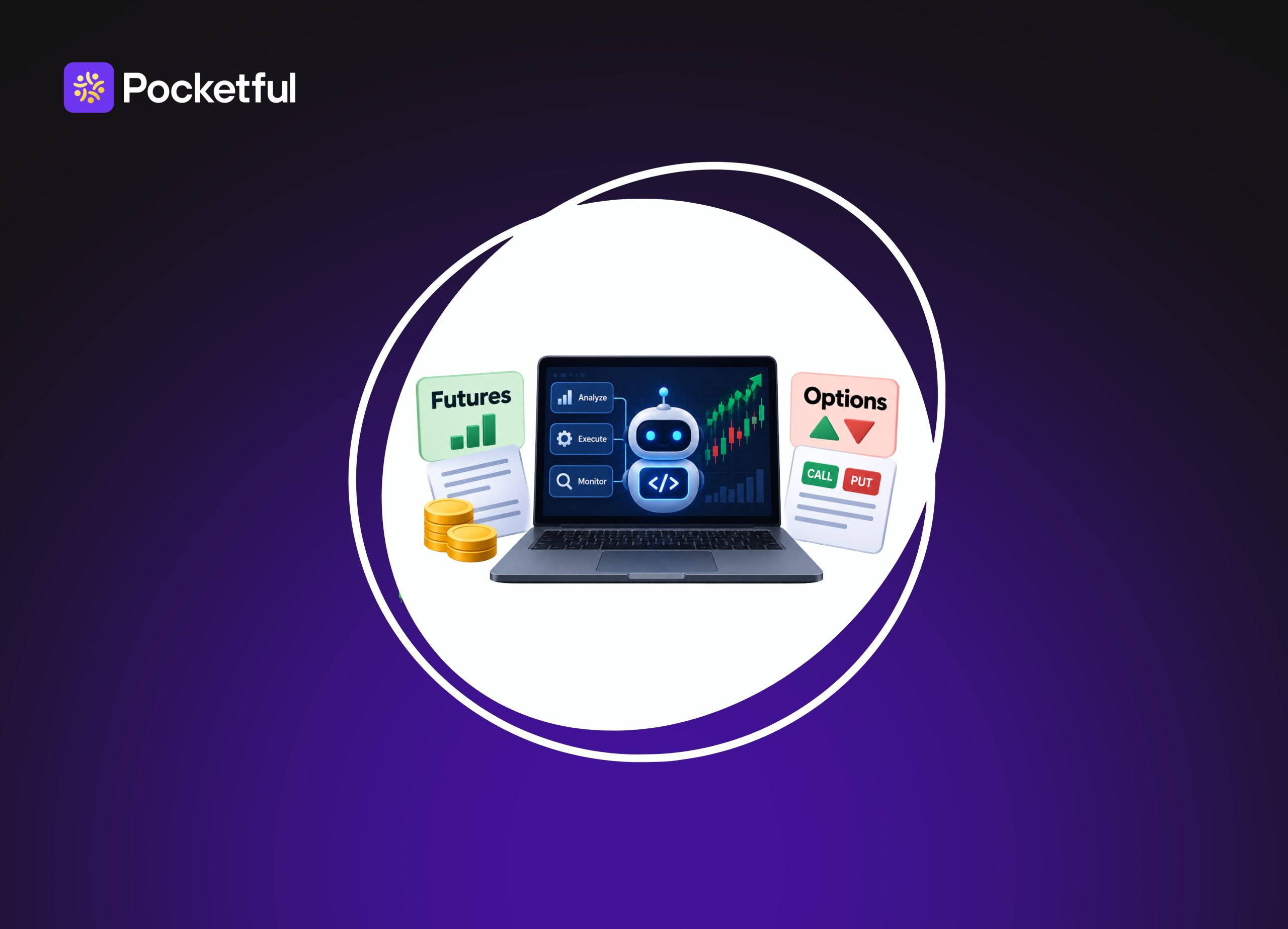
In case you have identified a trading opportunity in the futures and options segment, but by the time you confirm the trend, check the price, confirm the signal, and place the order, the market has already moved in the expected direction. This may lead to a loss of opportunity, as F&O prices are highly volatile. In this case, Algo Trading comes in.
In today’s blog post, we will give you an overview of algo trading their importance with an example.
What is Algo Trading?
Algorithmic trading, also known as Algo Trading, is a method of buying and selling financial instruments like equities, commodities, and derivatives using a predefined computer program that executes predefined trading rules, rather than manually watching the market. Traders are also not required to decide when to place buy and sell orders through algorithmic trading. This is determined by the system based on factors such as price movement, technical indicators, and trading volume.
Why is Algo Trading Important for Futures and Options?
The key importance of algo trading for futures and options is as follows:
- Faster Execution: Algo trading setups can monitor the market continuously, and the system can place orders as the predefined conditions are met. This significantly reduces the delay in execution of orders.
- Emotional Trading: Algo trading executes trades on a predefined set of rules and regulations. This reduces the impact of greed, fear, and hesitation in trading decisions.
- Complex Strategies: Option trading involves the use of complex strategies, and managing them manually can be challenging. Algo trading helps in the execution of complex trading strategies in an efficient manner.
- Backtesting: Using algo trading tools, one can backtest their trading strategies against the historical data. This reduces the overall risk and helps in analysing how the strategies performed in different market conditions.
- No Need for Constant Monitoring: Traders are required to regularly monitor the market and its movements, which takes time. An algorithm can continuously track the market and take appropriate action whenever required.
- High-Frequency Trading: There are various futures and options strategies that are dependent on quick market movements, but it is difficult in case of manual execution. Algo trading follows an automated system and can send orders much faster than a human system.
- Consistent: Algo trading works on a specific set of rules and applies the same rules without any changes that may be possible in case of emotional trading. Therefore, this consistency is useful for futures and options trading.
- Analysis of Various Parameters: Trading in futures and options requires analysis of various factors such as price, volume, open interest, etc., which may not be possible for an individual investor to track. But an algo trading strategy can monitor all these factors and execute trades efficiently.
How Does Algo Trading Work in Futures and Options?
Algo trading works in the following manner in futures and options:
- Define the Strategy: The first step towards algo trading in futures and options is to define the trading strategy based on a predefined set of rules and regulations. The algo uses these rules as instructions.
- Conversion of Strategy: After the strategies are defined, the rules are converted into code that can be read by computers. The algo is programmed in a manner to identify the rules based on market conditions and execute the trades.
- Integration: The next step is to integrate the algo into the trading platform. This can be done through the API. This connection allows the algorithm to receive the market data and execute predefined strategies accordingly.
- Monitoring of Data: Once the system is activated, the algorithm continuously monitors the market data based on the parameters.
- Initiating Trading Signal: When the conditions defined by the traders are met, the algo generates a trading signal depending on the buy or sell conditions.
- Executing Trade: As soon as the conditions are satisfied, the system automatically places the buy or sell order in the system. This automated execution is important while trading in futures and options, as prices move very quickly.
- Monitoring: The algo trading system does not stop after the order is placed. It continuously monitors the open position and exits the trade when the stop-loss is triggered, or the target is achieved.
Read Also: Benefits of Algo Trading in India
Example of Algo Trading in Futures and Options
Let’s understand how algo trading works in futures and options through an example:
Suppose a trader, Mr A, has a predefined strategy in which he wishes to buy Nifty Futures when it crosses 24000. He wants to place a stop-loss of 23900 and set the target as 24200. He does not want to take another trade if this trade ends in a loss.
He defines this in the strategy and integrates it with his trading setup. Now, the algo trading strategy is working. The system continuously monitors the market and Nifty price. As soon as the Nifty crosses 24000, the system instantly places a buy order into the exchange. Once the order is executed, it automatically places the stop-loss at 23900 and the target at 24200. And after a few hours, when Nifty moves to 24200, the algorithm automatically exits the position.
In this trade, Mr A is not required to monitor the market; the algo works on his behalf and executes a profitable trade.
Risks of Algo Trading in Futures and Options
The risks of algo trading in futures and options are as follows:
- Technical Errors: There can be various technical errors that can cause orders to be placed in the system. These errors include API failures, server issues, etc.
- Programming Errors: If there is any error in the logic of the algorithm, it can lead to incorrect orders, wrong quantities, etc.
- Volatility: The prices of futures and options contracts move very rapidly, especially when news comes out or during periods of economic uncertainty.
- Leverage Positions: Various futures and options contracts involve leverage, which can increase both profit and loss. If the market moves against it, it can cause quick losses.
- Lack of Human Intervention: An algorithm is not capable of monitoring unexpected market events that may cause sudden volatility in the market. An algo may continue trading even when the market conditions have changed significantly.
Things to Consider Before Using Algo Trading for F&O
The key things that an investor should consider before using algo trading in futures and options are:
- Strategy: One must make sure that the strategy they are using has defined entry and exit, stop-loss, etc. The logic given to the system must be accurate.
- Backtesting: The strategy given to the algo must be backtested before implementing any real-world trade. This may help a trader in understanding the potential performance, drawdowns, and behaviour during different market conditions.
- Risk: The maximum position size, stop-loss, etc. must be clearly defined before implementing any strategy. This helps in minimising the loss due to adverse market conditions.
- Monitoring: Monitoring the algo regularly is necessary, especially related to orders, positions, and system performance. Implementing an algo does not mean that you can completely switch off your attention.
Read Also: How to Do Algo Trading in India?
Conclusion
On a concluding note, algo trading has reshaped the options and futures traders’ world. It executes trades more efficiently and systematically. Algo trades are simply executed based on market data such as volume, technical indicators, etc. It does not involve any human emotions. However, one must understand that using algo trading is not a shortcut to profit; it may also cause losses in case of any technical failure, leverage, etc. Therefore, one must focus on implementing a well-defined strategy and backtest it in real-world data. Also, it is advisable to consult your investment advisor before any trade using algo trading in futures and options.
| S.NO. | Check Out These Interesting Posts You Might Enjoy! |
|---|---|
| 1 | Top Algorithmic Trading Strategies |
| 2 | Is Algorithmic Trading Legal and Profitable in India? |
| 3 | What Is High-Frequency Trading (HFT)? |
| 4 | Best Artificial Intelligence (AI) Stocks In India |
| 5 | What is Quantitative Trading? |
Frequently Asked Questions (FAQs)
What is the meaning of backtesting in algo-trading?
Backtesting refers to testing an algorithmic strategy on the historical market data to check how the strategy might have performed in the past. This may help in identifying the potential strengths and weaknesses of the strategy.
Am I required to have knowledge of coding for algo-trading?
No, it is not necessary to have coding knowledge. Various platforms offer no-code or low-code algo trading tools. Only a basic understanding of trading logic, APIs, and programming can be useful to create algo trading strategies.
Can algo trading lower the trading cost?
No, algo trading does not lower the trading cost; brokerage charges, STT, etc. are not eliminated by an algo trading setup. It only improves the efficiency of order execution.
Are there any charges for implementing APIs with the trading terminal?
No, most brokers offer free integration of APIs with the trading terminal.
After activating algo trade, do I still need to monitor it?
Yes, regular monitoring of algo trade is necessary, as market conditions and technical problems may arise at any time and can affect algorithm performance.