Category: Case Study

  • CAMS Case Study: Business Model, KPIs, and SWOT Analysis

    CAMS Case Study: Business Model, KPIs, and SWOT Analysis

    While investing money may seem like a simple task, it’s more complex than you may think.

    We will introduce you to a company in today’s article that manages the backend operations of practically all investments made through mutual funds. It’s a highly laborious operation!

    Overview of CAMS

    When V Shankar launched CAMS in 1988, the company was primarily focused on software development.

    The company later obtained a significant investment in 2000 from the HDFC Group, and in 2014, it obtained more funds from the National Stock Exchange (NSE). The business rose to the industry’s top by offering registrar and transfer services to the mutual fund sector.

    Subsequently, the corporation added other services to its list of offerings, including electronic payment services, KYC, insurance repository, and account aggregation.

    By working with more than 750 institutions, the company expanded significantly and was able to secure a market share of more than 70% in the mutual fund transfer industry.

    Data storing

    Do you know what RTA is?

    The entity that manages a company’s ownership records of shareholders and bondholders is known as the Registrar and Transferer (RTA). It makes it easier for units to be transferred between holders.

    Awards and Recognitions

    2023 – Economic Times Datacon Award

    2023 – Technoviti Awards 2023

    2020 – Excellence Awards in BFSI – Technology by ASSOCHAM

    2019 – Business World Top 1000 companies

    2018 – Emerging Company Award by Economic Times

    Awards

    Quick facts

    1. CAMS maintains a record of roughly 17 million investors.

    2. Out of the 48 trillion assets in the business, they represent 33 trillion assets.

    3. They hold a market share of roughly 69% of the assets in the mutual fund sector. 

    Market Capitalization

    As of 11 February 2024, the current market capitalization of CAMS is 14,955 Crores.

    Current Share Price

    As of 11 February 2024, the share price of CAMS is 2905.

    Shareholding Pattern

    In the most recent quarter, promoters saw a fall in their stake from 19.87 to 0, while FIIs and DIIs increased their holdings from 38.61% to 47.69% and 16.06% to 23.08%, respectively.

    Read Also: BSE Case Study: Business Model And SWOT Analysis

    Business Model and Marketing Strategy

    CAMS offers services to mutual funds, banks, insurance companies, and other financial institutions, including account opening, account maintenance, transaction processing, dividend distribution, and all forms of investor communication.

    Transaction fees, which they charge for each account opening, transaction processed, dividend payout, etc., are their primary source of income. In addition, they impose fixed account charges based on the quantity of accounts they administer. Additionally, they also collect monthly fees for their add-on services.

    Financial Highlights of CAMS

    Let’s examine its annual income statement to gain further insight into the company’s financial performance.

    Particular31st March 202331st March 202231st March 2021
    Total Revenue972910706
    Total Expenses551486409
    Profit before tax380383274
    Profit after tax285287205
    (In crores)

    Based on the financial statistics presented above, it is evident that the company’s finances are growing steadily. Both revenue and profit are consistently rising.

    Let’s now examine the balance sheet of CAMS to see its financial situation.

    Particular31st March 202331st March 202231st March 2021
    Non-Current Assets367339309
    Current Assets730618533
    Non-Current Liabilities147135139
    Current Liabilities168173186
    (In crores)

    We will now require you to review the company’s cash flow statement.

    Particular31st March 202331st March 202231st March 2021
    Cash flow from operating activities319321264
    Cash flow from investing activities(102)(131)2.16
    Cash flow from financing activities(205)(203)(272)
    Net Increase/Decrease in Cash Activities12(12)(.58)
    (In crores)

    The statistics above make it evident that net cash flow is now positive after two years of negative figures.

    Key Ratios

    Particular31st March 202331st March 202231st March 2021
    Net Profit Margin (%)28.63131
    ROCE (%)43.5252.3747.70
    Y-o-Y Sales Growth (%)18.4915.165.45

    Net Profit Margin – This ratio indicates the profit margin as a percentage of revenue.

    ROCE – It refers to the financial ratio that defines a company’s profitability from the capital that it uses.

    Y-o-Y Sales growth – This defines the increase in company’s sales over a year.

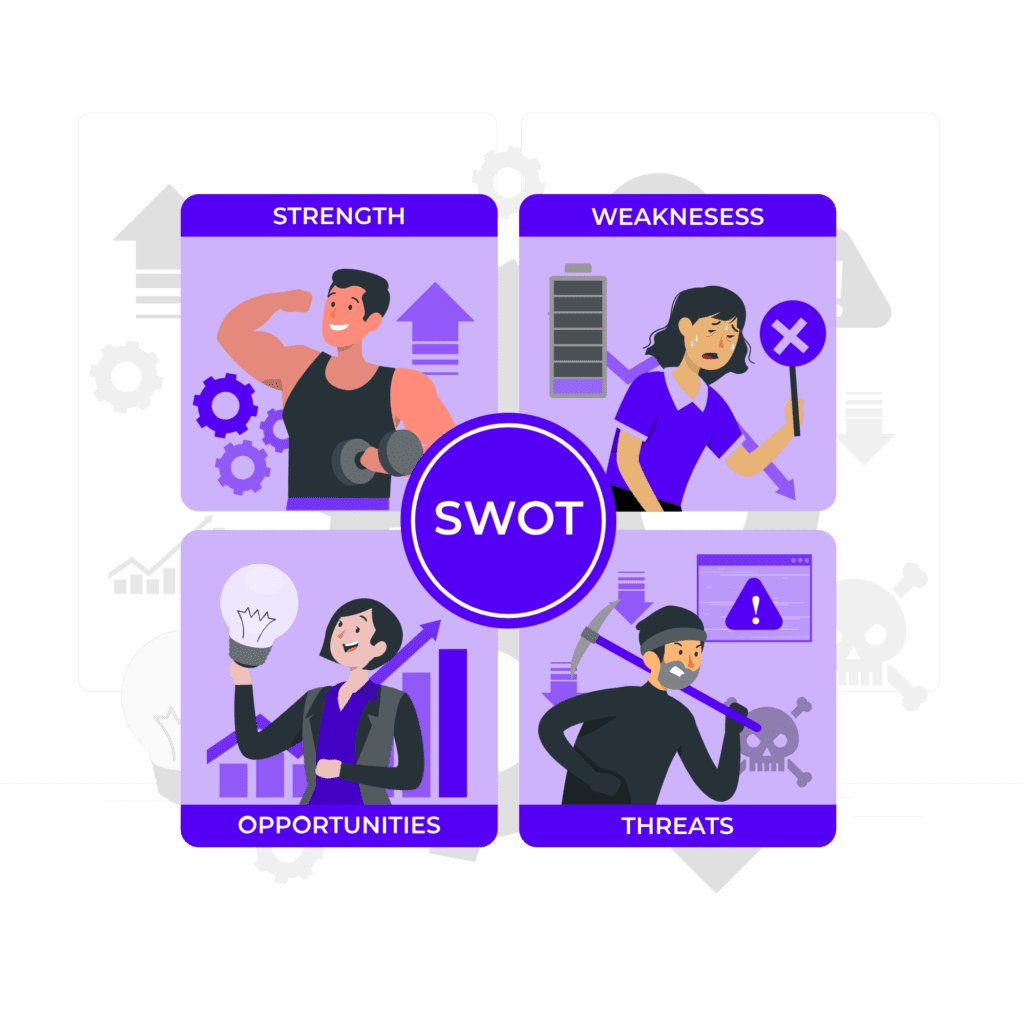
    SWOT Analysis

    SWOT Analysis

    Strengths

    1. The business has a long history of great brand recognition and is well-known in the sector for its inventiveness, security, and dependability.
    2. They have excellent stability options and can manage big data, both advantageous for expanding businesses.
    3. Millions of investors’ sensitive data is protected from cyberattacks and unwanted access by CAMS’s highly advanced security system.

    Weaknesses

    1. The Indian market accounts for most of CAMS’s revenue; nevertheless, their performance may be impacted due to the company’s restricted geographical coverage and related regulatory risk.
    2. Any downturn in this sector could affect CAMS’s performance, as the Indian mutual fund business provided the majority of its revenue.
    3. Due to its strong market position in India, any new competitors will affect its market share.

    Opportunities

    1. As the population grows, so does the financial sector in India, and this expansion of the financial industry will help drive corporate growth.
    2. In the upcoming years, the corporation can broaden its global reach to reduce the risk of becoming overly dependent on the Indian market.
    3. Due to its strong market position in India, any new competitors will affect its market share.

    Threats

    1. Since their reliance on technology grows daily, any cyber risk could hurt their business operations and reputation.
    2. The company works in the financial industry. Therefore any changes to government regulations will affect its operating and compliance costs, which will ultimately affect its profit margins.
    3. Any economic downturn can potentially affect investors’ investment decisions and, in turn, their businesses.

    Read Also: IRFC Case Study: Business Model, KPIs, Financials, and SWOT Analysis

    Conclusion

    CAMS’s market position in the Indian mutual fund industry is approximately 70%, thus undeniably limited in scope. Nevertheless, the company is growing by diversifying its range of products. It’s also important to keep an eye out for the company’s declining promoter holdings, even though revenue and profit are rising.

    We have covered every facet of the company in this CAMS case study, from its strengths to its weaknesses. Still, before we wrap up, we would like to encourage you to always think about your risk tolerance and time horizon before making any kind of investment.

    S.NO.Check Out These Interesting Posts You Might Enjoy!
    1Polycab Case Study: Business Model, Financials, Competitors, and Growth Outlook
    2Bajaj Finance Case Study: Business Model, Financials, Competitors, and KPIs
    3Hindustan Unilever Case Study: Business Model, Financials, and SWOT Analysis
    4Infosys Case Study: Business Model and SWOT Analysis
    5Eicher Motors Case Study: Business Model & SWOT Analysis

    Frequently Asked Questions (FAQs)

    1. Who is the owner of CAMS?

      HDFC Group and the National Stock Exchange own CAMS.

    2. Can I track my mutual fund investment through CAMS?

      Yes, you can track your mutual fund investment under CAMS; they provide a platform called CAMS online to check your mutual fund portfolio.

    3. Do CAMS have a bright future?

      Yes, the mutual fund business has a bright future based on its growth and the fact that CAMS holds approximately 70% of the market share.

    4. Is CAMS an Indian company?

      Yes, CAMS is an Indian company founded in the year 1988 by V Shankar.

    5. Have FIIs increased their stake in CAMS?

      Due to their strong optimism over CAMS’s future, FIIs have grown their share from 38.61% to 47.69% during the past month.

  • Bharat Petroleum vs Hindustan Petroleum: A Comparative Analysis of Oil Stocks

    Bharat Petroleum vs Hindustan Petroleum: A Comparative Analysis of Oil Stocks

    All vehicle owners have to fill up their fuel tanks to use the vehicles, but have you ever thought about which petroleum companies have better operations? 

    If yes, you’ve come to the right place, as we will compare Bharat Petroleum with Hindustan Petroleum.

    Bharat Petroleum Corporation Limited – An Overview

    Established in 1952 as a joint venture between the Indian government and Burmah Shell, BPCL became a completely owned government enterprise after the government acquired Burmah Shell in 1976. The company’s activities include petroleum exploration, refining, marketing, distribution, and retail sales. The first drive-through gas station in India opened its doors in 1928. The corporation operates over 18,622 fuel stations nationwide, fueling approximately one crore automobiles daily. This company’s market share is about 22% and is also a Maharatna company.

    It is run by the Indian government’s Ministry of Petroleum and Natural Gas. The corporation debuted its emblem on November 18, 1977, and is widely recognized as a golden drop of oil.

    Hindustan Petroleum Corporation Limited – An Overview

    In 1974, HPCL was established by the merger of Esso Standard and Lube India Limited. It became the first public sector company to list on the Bombay Stock Exchange 1992.

    Afterwards, in 1997, HPCL was bestowed the title of a Navratna company. The corporation was granted the title of Maharatna in 2019, and in 2021, it made its most significant profit of 10,644 crore.

    Currently, the corporation has a network of 17,000 retail petroleum locations, of which 40% are located in cities and the remainder on highways and rural areas.

    Oil refinery of BPCL

    Comparative Analysis

    We’ll provide you with a comparative analysis of the two petroleum titans based on several characteristics so you can make an informed investment decision before choosing one over the other.

    Promoters 

    The promoters of BPCL are the Government of India and own 52.98% of equity in it.

    The promoter of HPCL is Oil and Natural Gas Corporation (ONGC) which holds about 54.9% stakes.

    Refining Capacity

    BPCL has a refining capacity of 38.3 MTPA*

    HPCL has a refining capacity of 24.5 MTPA*

    MTPA – Million Ton Per Annum

    Market Capitalization

    BPCL – 15.22 Billion Dollar

    HPCL – 8.57 Billion Dollar

    BPCL has a bigger market capitalization than HPCL, as can be seen from the figures above.

    HPCL is a mid-cap stock, whereas BPCL is a large-cap firm that is included in the Nifty 50 index.

    (Data as of 13th Feb 2024)

    Share Price

    BPCL – 584

    HPCL – 502

    (Data as of 13th Feb 2024)

    52 Week Low & High

    The 52-week low for BPCL was 314 on February 28, 2023, and the 52-week high was 635 on February 8, 2024.

    The 52-week low for HPCL was 211 on February 27, 2023, and the 52-week high was 549 on February 14, 2024.

    Oil refinery of HPCL

    Financial Statement Analysis

    Let’s take a look at the company’s finances before going into any further information.

    Total Income – While BPCL’s total income is 5,35,651 crores and HPCL’s is 4,68,261 crores, both companies have had year-over-year increases of roughly 24%.

    Net Profit – In the fiscal year that concluded on 31 March 2023, HPCL recorded a net loss of 6,980 crores, but BPCL recorded a profit of 2,131 crores within the same time frame.

    Total Asset – HPCL’s total asset value is approximately 1,54,485, while BPCL’s total asset value was 1,60,803. While BPCL’s assets fell by 2%, HPCL’s overall assets increased by 2.8%.

    Operating Cash Flow – While BPCL’s cash from operating activities remained at 12,446 crores, a 38% decline on a YoY basis, HPCL’s operating cash flow is -3,466 crores, indicating a decrease of 121% year over year.

    Key Ratios

    To have a better understanding, let us now turn our attention to these oil and marketing firm’s primary rations.

    Operating profit margin ratio – A performance ratio shows how much of a company’s earnings come from its operations. Operating profit margins for HPCL and BPCL were -2.54% and 0.26%, respectively.

    Inventory turnover ratio describes the frequency with which a business sells and restocks its inventory. The inventory turnover ratio for HPCL is 14.37, whereas the inventory turnover ratio for BPCL was 13.26.

    Current ratio describes the relationship between a company’s assets and liabilities. A greater ratio indicates that the organization has more assets than liabilities. HPCL has a current ratio of 0.59, while BPCL has a current ratio of 0.77.

    Debt to equity ratio – The leverage ratio, which expresses the whole weight of liabilities and debt relative to total shareholder equity, is another name for it. BPCL had a debt-to-equity ratio of 0.69 while HPCL had a debt-to-equity ratio of 2.33.

    Note – Above mentioned data points are as of March 2023.

    Read Also: BPCL Case Study: Business Model, Product Portfolio and SWOT Analysis

    Conclusion 

    Both HPCL and BPCL are strong competitors in the Indian oil marketing sector with robust operations, extensive distribution networks, and government support. But, the nature of government intervention faced by each company is different. 

    Although HPCL concentrates more on renewable energy initiatives, you could choose HPCL if you prefer renewable energy more strongly. If you are looking for a larger corporation in terms of financial performance and refining capacity, BPCL might be a better choice.

    However, the choice of winner will eventually depend on your investment goals and risk appetite. 

    S.NO.Check Out These Interesting Posts You Might Enjoy!
    1Flair Vs DOMS
    2NHPC vs NTPC
    3Bharat Petroleum vs Hindustan Petroleum
    4MRF vs Apollo Tyres
    5ITC vs HUL

    Frequently Asked Questions (FAQs)

    1. Who are the CEOs of BPCL and HPCL?

      At the moment, Shri Gopalan Krishnakumar is the CEO of BPCL, and Dr. Pushp Kumar Joshi is the CEO of HPCL.

    2. Who is the brand ambassador of BPCL?

      Rahul Dravid is the brand ambassador of BPCL.

    3. Which companies compete with HPCL and BPCL?

      Reliance Industries, Indian Oil Corporation, and Mangalore Refinery and Petrochemical are popular competitors of HPCL and BPCL.

    4. Is HPCL a private company?

      HPCL is not a private company; it is a Government of India enterprise.

    5. Which company has a larger market capitalization: BPCL or HPCL?

      BPCL is larger than HPCL based on market capitalization. 

    Disclaimer: The securities, funds, and strategies mentioned in this blog are purely for informational purposes and are not recommendations.

  • Hindustan Unilever Case Study: Business Model, Financials, and SWOT Analysis

    Hindustan Unilever Case Study: Business Model, Financials, and SWOT Analysis

    Hindustan Unilever is a household name; almost every product in your bathroom was made by HUL. Today, we’ll explore its business model to understand its operations.

    About Hindustan Unilever Limited (HUL)

    Hindustan Unilever was founded in the latter part of the 1980s. The Lever brothers, established by William Hesketh Lever, first entered the Indian market in 1888 with a product known as sunlight soap. However, the soap was marked with the phrase “Made in England by Lever Brothers”.

    Hindustan Vanaspati Manufacturing Company, Unilever’s first Indian affiliate, was founded in 1931. Lever Brothers India Limited followed in 1933, and United Traders Limited followed in 1935. In 1956, these companies amalgamated to establish Hindustan Unilever Limited.

    The company’s headquarters is located in Mumbai. Rohit Jawa took over as CEO of Hindustan Unilever Limited in June 2023, replacing Sanjeev Mehta.

    After Hindustan Unilever Limited was founded, its primary focus was on acquiring Indian brands that were already well-established.

    Key Acquisitions

    1984 – Brooke Bond, a tea brand.

    1972 – Lipton, a national tea product manufacturer.

    2015-16 – Indulekha, a premium hair oil brand.

    2019-20 – GSK, a healthcare product manufacturer.

    2019-20 – Vwash, a female intimate hygiene product manufacturer

    Awards and Recognition

    2023 – Winner of the KPMG ESG Excellence award across India’s consumer market sector.

    2022- Outstanding Company of the Year by CNBC –TV18

    2021 – Best Governed Company Award

    2021- Sustainable Factory of the Year award.

    2020 – Top performer in the FMCG Category

    Read Also: ITC vs HUL: Comparison of India’s FMCG Giants

    Products OF HUL

    Whether a food and beverage product or a healthcare item, Hindustan Unilever is used by nine out of ten Indian households!

    Products OF HUL

    The products of Hindustan Unilever are as follows

    • Home care products – Laundry detergents, fabric conditioners, dishwashing liquids, and toilet cleaners. (Surf Excel, Rin, Wheel)
    • Personal care products – Soaps, shampoos, skin care products, hair care products, deodorants, oral care products. (Lux, Sunsilk, fair & lovely, Tresemme, axe and closeup, etc.
    • Beverages – Tea. (Lipton, brooke bond)
    • Foods – Packaged foods.
    • Water Purifier – Pureit water purifier.
    • Healthcare products – Health drinks. (Boost, Horlicks)
    • Baby care products – Baby soaps, shampoos, and body lotions. (Dove, Johnson’s Baby)
    • Cosmetic – Cosmetic and beauty products. (Lakme) 

    Market Information of HUL

    Current Market Price ₹2,259
    Market Capitalization (in ₹ Crores)5,30,737
    52 Week High₹3,035
    52 Week Low₹2,136
    Dividend Yield1.86%
    Book Value₹216
    (Data as of 29 March 2025)

    SWOT Analysis of HUL

    Hindustan Unilever SWOT Analysis highlights the company’s strengths, weaknesses, opportunities, and threats, offering valuable insights into its market position and growth potential.

    SWOT Analysis of HUL

    Strengths

    • The company’s primary strength is its widespread presence in India, with more than 8 million locations where customers can purchase its product. Its supply chain is excellent, well-managed, and efficient.
    • HUL has a long history, which they can preserve because of the money they currently spend on product development and research.
    • The company’s financial outcomes demonstrate the impact of its excellent performance.

    Weaknesses

    • A company’s market share might be reduced by any business that focuses on a certain product.
    • Since more and more consumers are turning to herbal items, the corporation may suffer from the lack of any Ayurvedic or natural products in its product line.
    • Due to its extensive product portfolio, HUL may encounter difficulties in effectively managing and allocating resources to it.

    Opportunities

    • The country’s population is likely to have more disposable income in the next few years, which will cause the FMCG sector to grow significantly.
    • The business can quickly buy out companies that manufacture goods outside of its current product line, which will aid in product diversification.
    • They can expand their customer base and increase revenue by utilizing e-commerce platforms.

    Threats

    • The business operates in a highly competitive market, and with the advent of globalization, numerous international brands have established themselves in the country.
    • Their margins may be impacted by regulatory changes made by the Indian government on food packaging ingredients, labeling, etc.
    • A downturn in the nation’s economy may affect consumer buying habits, affecting a company’s profitability.

    Read Also: Polycab Case Study: Business Model, Financials, Competitors, and Growth Outlook

    Business Model and Marketing Strategy of HUL

    The company’s wide range of products enables it to hold the top spot in the market for industrial consumer goods. They have well-known brands in several areas, and their revenue is greatly influenced by consumer recognition of their brands.

    Its primary focus is innovation; a sizable amount of its revenue is allocated to creating new items and enhancing its existing line of products.

    HUL has an extensive distribution network that reaches both rural and urban locations. Additionally, they invest heavily in all forms of promotion, including print, digital, and sponsorship.

    They typically focus on comprehending customer demands and needs because this enables them to develop product lines that cater to consumer preferences

    Branding Strategy of HUL

    What’s in the name? Though everyone has heard this saying at some point in their lives, it is essential to remember that reputation and brand are everything. The company employs various graphics and logos for its many products, but its distinctive logo is printed on each one, making it easy for the general public to recognize them.

    Financials of HUL

    Income Statement 

    ParticularsMarch 2024March 2023March 2022
    Total Income62,70761,09252,704
    Total Expenses48,44347,63240,724
    EBIT14,26413,46011,980
    Net Profit10,28610,1458,887
    (The figures mentioned above are in INR crores unless mentioned otherwise)

    Balance Sheet

    ParticularsMarch 2024March 2023March 2022
    Non-Current Assets57,17556,08954,995
    Current Assets21,32416,99815,522
    Non-Current Liabilities14,20010,53710,150
    Current Liabilities12,87612,02811,280
    Total Shareholder Funds51,21850,30449,061
    (The figures mentioned above are in INR crores unless mentioned otherwise)

    Cash Flow Statement

    ParticularsMarch 2024March 2023March 2022
    Cash Flow From Operations (CFO)15,4699,9919,048
    Cash Flow From Investing (CFI)-5,234-1,494-1,728
    Cash Flow From Financing (CFF)-10,034-8,953-8,015
    (The figures mentioned above are in INR crores unless mentioned otherwise)

    Key Performance Indicators

    ParticularsMarch 2024 March 2023 March 2022
    Operating Margin (%)23.0322.3222.92
    Net Profit Margin (%)16.6116.7416.95
    ROE (%)20.0620.1118.09
    ROCE (%)21.7222.1420.29
    Current Ratio1.661.411.38
    Debt to Equity Ratio000

    Shareholding Pattern

    As of December 2024, the company’s promoters own 61.9% of the company’s shares, while Domestic Institutional Investors hold about 14.73%, Foreign Institutional Investors (FIIs) account for roughly 11.43%, and the public owns 10.34% of the company’s shares.

    Read Also: Netflix Case Study: Marketing Strategy, Product Portfolio and Pricing Strategy

    Conclusion

    The organization has achieved global recognition through its strategic planning and marketing approach. The economy’s overall performance determines HUL’s success, as does the population’s disposable income, which increases company profits.

    We have tried to clarify every statistic and data about HUL in this case study, covering everything from their financials, history, and shareholding patterns.

    However, always consider your risk tolerance and time horizon before making any investing decisions.

    S.NO.Check Out These Interesting Posts You Might Enjoy!
    1Zara Case Study: Business Model and Pricing Strategies
    2CAMS Case Study: Business Model, KPIs, and SWOT Analysis
    3TCS Case Study: Business Model, Financial Statement, SWOT Analysis
    4Nestle India Case Study: Business Model, Financial Statement, SWOT Analysis
    5Vedanta Case Study: Business Model, Financial Statement, SWOT Analysis

    Frequently Asked Questions (FAQs)

    1. Where is the headquarters of Hindustan Unilever located?

      The headquarters of Hindustan Unilever is located in Mumbai, Maharashtra, India.

    2. What was Hindustan Unilever’s former name?

      Hindustan Vanaspati Manufacturing Company was the former name of Hindustan Unilever Ltd.

    3. How many factories of HUL are there in India?

      HUL currently has 29 factories nationwide.

    4. How many businesses are part of Hindustan Unilever?

      There are more than 50 brands connected with Hindustan Unilever.

    5. What is HUL’s market capitalization ranking in the FMCG sector?

      Hindustan Unilever ranked at the top among FMCG companies, having a market capitalization of around 5.3 Lakh Crore INR as of 29 March 2025.

  • Bharat Highways InvIT IPO: Business Model, Financials, Key Details, and SWOT Analysis

    Bharat Highways InvIT IPO: Business Model, Financials, Key Details, and SWOT Analysis

    The Indian infrastructure sector, particularly the road network, is rapidly growing. Bharat Highways InvIT, a novel investment opportunity in the Indian infrastructure sector is new to the scene but carries an ability to generate stable income and offers a chance to invest in a portfolio of operational toll roads across India.

    Today’s blog aims to provide a comprehensive overview of the Bharat Highways InvIT IPO, including its strengths, risks, and key considerations. 

    Business Model

    Bharat Highways InvIT is an infrastructure investment trust established in India to acquire, manage, and invest in a portfolio of infrastructure assets, majorly focusing on roads across the country. It operates under a Hybrid Annuity Model (HAM), where it receives fixed and variable payments depending on the performance of the project it holds.

    The HAM model is used by the Government of India to finance and execute infrastructure projects. It was introduced in January 2016 to encourage investment in road infrastructure projects.

    It combines elements of two other models.

    • EPC Model – The Engineering, Procurement, and Construction Model is the model in which the government pays the private developer for constructing the road but then owns and maintains it themselves.
    • BOT Model – The Build, Operate, and Transfer model is the model in which a private developer builds, operates and collects tolls on the road for a fixed period before transferring the ownership back to the government.

    Under the HAM Model, the government provides 40% of the project cost as construction spend in equidistant instalments, and the private developer arranges for 60% of the funding through a combination of equity and debt. 

    The company was registered with SEBI on August 3, 2022, and was settled through the Original Trust Deed by GRIL.

    GRIL or GR Infraprojects Limited is a private company and a flagship entity of GR group. It is involved in integrated road engineering, procurement, and construction with an experience over 25 years of in the design of several road/highway projects across 16 states in India.

    Did You Know?

    GRIL has executed more than 100 road construction projects since 2006.

    The portfolio assets consist of seven road assets, all operating on the HAM model, in the states of Punjab, Gujarat, Andhra Pradesh, Maharashtra, and Uttar Pradesh. These roads are maintained as per the rights granted by NHAI and are owned and operated by the Project SPVs, which GRIL wholly owns.

    The seven projects are as follows:

    1. GR Phagwara Expressway Limited
    2. Porbandar Dwarka Expressway Private Limited
    3. GR Gundugolanu Devarapalli Highway Private Limited
    4. GR Akkalkot Solapur Highway Private Limited
    5. Varanasi Sangam Expressway Private Limited
    6. GR Sangli Solapur Highway Private Limited
    7. GR Dwarka Devariya Highway Private Limited

    Additionally, the InvIT has also proposed to enter into a Right Of First Offer (ROFO) agreement with GRIL, which means that GRIL will grant a right of first offer to the InvIT to acquire certain assets owned and developed by GRIL.

    Highways

    Key IPO Details

    1. Bharat Highways InvIT is a book-built issue of INR 2500 crore. The issue is entirely a fresh issue of 25 crore shares.
    2. The IPO will open for subscription on February 28, 2024, and will close on March 1, 2024.
    3. The allotment for the same is expected to be finalised on March 4, 2024.
    4. The temporary listing date is fixed as Wednesday, March 6, 2024.
    5. The price band for the IPO is set at INR 98 to INR 100 per share.
    6. ICICI Securities Limited, Axis Bank Limited, HDFC Bank Limited and IIFL Securities are the book-running lead managers, while K-fin Technologies is the registrar for the IPO issue.

    Objectives of the Issue

    Providing loans to the Project SPVs for repayment/ prepayment, in part or in full, of their respective outstanding loans (including any accrued interest and prepayment penalty); and other general purposes.  

    IPO DateFebruary 28, 2024 to March 1, 2024
    Listing DateWednesday, March 6, 2024
    Price BandINR 98 to INR 100 per share
    Lot Size150 Shares
    Fresh Issue250,000,000 shares
    Issue TypeBook Built Issue InvIT
    IPO TypeMain-board InvIT
    Initiation of RefundTuesday, March 5, 2024
    Basis of AllotmentMonday, March 4, 2024

    Read Also: IPO Alert: Entero Healthcare Solutions Limited (EHSL)

    Financial Highlights

    Key MetricsFY 2023FY 2022FY 2021
    Total income1,537.471,600.182170.39
    Total expenses816.481,515.681,936.07
    Net profit527.0462.76139.44
    Total Assets6,056.275,536.394,943.94
    Total Liabilities4,939.024,946.194,416.61
    *(The figures above are in INR crore)

    Strengths

    1. Bharat Highways InvIT owns a portfolio of seven operational toll roads located across five states in India. These roads generate regular revenue in the form of toll collections, providing a stable income stream for the InvIT.
    2. The Indian government is committed to developing and expanding its highway network, which is expected to benefit toll road operators like Bharat Highways InvIT. The growing demand for road transportation in India is also a positive factor for the industry.
    3. Diversification of assets across different regions in India helps mitigate the risk of dependence on any single geographic location.

    Risks

    1. Due to the InvIT’s recent establishment, its future growth potential remains unclear, hindering accurate assessment and analysis.
    2. The success of the InvIT relies on finding new infrastructure assets that deliver similar financial performance. Failure to do so could harm the business, finances and ability to distribute returns.
    3. Early termination of InvIT assets could significantly impact the financial health due to non-receipt of payments.
    4. Failure to meet contractual road maintenance standards could lead to penalties, contract termination and harm the reputation, finances and business operations.

    Read Also: Popular Vehicle and Services IPO: Key Details, Financials, Strengths, and Weaknesses

    Conclusion

    Bharat Highways InvIT presents a new investment opportunity in the Indian infrastructure sector and is backed by India’s growing road network and government support. However, investors should carefully consider the challenges linked with its business before making any investment decision.

    Frequently Asked Questions (FAQs)

    1. What is the price band of the Bharat Highways InvIT IPO?

      The price band for the IPO is fixed at INR 98 to INR 100 per share.

    2. When will the allotment and listing of shares occur?

      Allotment of shares is expected to be finalised on March 4, 2024, and shares are expected to be listed on BSE and NSE on March 6, 2024

    3. What is the objective of the IPO?

      The objective of the IPO is to raise funds for further expansion.

    4. What risk can I face while investing in this IPO?

      The InvIT is new with a limited track record, uncertain future growth and contractual risks.

    5. Should I prefer investing in Bharat Highways InvIt IPO?

      We suggest you conduct thorough research and consider your risk tolerance before making any investment decision.

  • Mukka Protein IPO: Business Model, Key Details, Financial Statements, and SWOT Analysis

    Mukka Protein IPO: Business Model, Key Details, Financial Statements, and SWOT Analysis

    Embark on an exciting journey into the aqua-culture sector with the initial public offering (IPO) of Mukka Protein Limited, a leading player in the sustainable seafood industry. 

    In today’s blog, we’ll cover the company’s business model, key details, financial statements, and SWOT analysis. 

    Company Overview

    Established in 2003 as a partnership firm by K. Abdul Razak, the company was renamed Mukka Protein Limited and became a private limited company in 2010. 

    The company’s corporate headquarters is located in Mangalore, Karnataka, India.

    The company mainly focuses on producing fish meal, fish oil, and fish soluble paste, which are used to make aqua food for fish and shrimp, pet foods for dogs and cats, and poultry feed for broilers and layers.

    The company has established production facilities around India’s prominent coastlines, with ten global fishmeal factories — four in Karnataka, four in Gujarat, and two in Oman. Each of their units has a technician for quality control management and dedicated in-house laboratories.

    fish meal

    Awards and Accreditations

    1.  India’s growth champion award by Economic Times.

    2.  Star exporter awards, by Federation of Karnataka Chamber of Commerce and Industry.

    3.  State export excellence award by the commissioner for industrial development and director of industries and commerce.

    4.  Certificate of FT High–Growth Companies Asia Pacific 2023 by financial times and statista.

    Promoters

    The company’s promoters are Kalandan Mohammed Arif, Kalandan Mohammed Haris, and Kalandan Mohammed Althaf; they own 100% of the shares.

    Details of the Issue

    The company wants to issue 8 crore new shares to raise a total of 224 crore. With a market lot of 535 shares, the IPO’s lower price band is set at 26 INR, while the higher price band is set at 28 INR per share. 

    Major details

    Face Value of Share1 INR
    Price Band26 – 28 INR
    Market Lot535 Shares
    Total Fresh Issue Size224 Crore
    Total Number of Shares8 Crore

    Timeline of IPO

    IPO Open Date29th Feb 2024
    IPO Close Date4th March 2024
    Finalization of Allotment5th March 2024
    Initiation of Refund & Credit of shares into demat account6th March 2024
    Listing Date on NSE & BSE7th March

    IPO Allotment Size

    ApplicantMarket LotShareAmount (INR)
    Retailer (Min)153514980
    Retailer (Max)136955194740
    Small High Net Worth Individual (Min)147490209720
    Small High Net Worth Individual (Max)6635130988680
    Big High Net Worth Individual (Min)67358451003660

    Objective of the Issue

    The IPO proceeds will cover the working capital requirements of the company’s associate, Ento Protein Private Limited.

    Read Also: IXIGO IPO Case Study: Business Model, Key Details, and Financials

    Key Financials of the Company

    Balance Sheet

    Particulars31st March 202331st March 202231st March 2021
    Non-Current Asset111.122105.91197.415
    Current Asset464.042286.385256.513
    Total Asset575.164392.296353.928
    Equity155.845103.07869.058
    Long Term Liability16.52012.80617.737
    Current Liability402.800276.412267.134
    (All the above-mentioned figures are in crores, unless stated otherwise) 

    Income Statement

    Particulars31st March 202331st March 202231st March 2021
    Revenue from operations1177.122770.503603.834
    Total Revenue1183.804776.145609.952
    Total Expenses1119.322741.177598.317
    Profit after tax47.52525.81911.010
    (All the above-mentioned figures are in crores, unless stated otherwise) 

    Cash Flow Statement

    Particulars31st March 202331st March 202231st March 2021
    Net Cash flow from operating activities(54.395)4.8085.949
    Cash flow from investing activities(5.258)(12.284)(13.611)
    Cash flow from financing activities74.66415.8589.324
    (All the above-mentioned figures are in crores, unless stated otherwise) 

    KPIs

    Particulars31st March 202331st March 202231st March 2021
    EBITDA Margin8.01%7.04%5.27%
    Return on Equity36.71%30%17.37%
    Debt Equity Ratio1.641.682.31
    Profit after Tax Margin4.04%3.35%1.82%
    Return on Capital Employed17.62%13.86%5.86%

    Based on the company’s EPS, the PE ratio on the lower price band will be approximately 13x, and on the upper price band, it will be 14x.

    SWOT Analysis

    Strengths

    1.  The industry in which the company works has a high barrier to entry; no new businesses can easily establish themselves in this market.

    2.  The company has a long history with many of its customers.

    3.   The business is one of India’s top producers of fish protein products.

    4.   The company’s management team has extensive business operations expertise.

    Risks

    1.  In FY23, the company’s cash flow from operations was negative. This might come across as a red flag to many investors.

    2.  The company offers a non-diversified range of products. This exposes the company to the possibility of decreased profitability during unforeseen events. 

    3.  Since the corporation sells goods to multiple nations, it may be exposed to the risk of volatility in exchange rates.

    4.  Top 10 customers provide the company with 72% of the revenue. Thus, any changes in their contracts could significantly affect their profitability.

    Read Also: Rashi Peripherals Limited: IPO Analysis

    Conclusion

    We have covered nearly every pertinent aspect regarding Mukka Protein in this IPO blog, including its background and corporate finances. The corporation may see an increase in its market share in the upcoming years due to its expansion ambitions.

    If you intend to invest in this firm, please ensure that you have carefully reviewed all of the company’s parameters and considered your risk profile.

    S.NO.Check Out These Interesting Posts You Might Enjoy!
    1IPO Alert: Vibhor Steel Tubes Limited
    2Platinum Industries IPO: Business Model, Key Details, KPIs, and SWOT Analysis
    3IPO Alert: Entero Healthcare Solutions Limited (EHSL)
    4Bharat Highways InvIT IPO: Business Model, Financials, Key Details, and SWOT Analysis
    5Pune E-Stock Broking Limited IPO: Key Details, Business Model, Financials, Strengths, and Weaknesses

    Frequently Asked Questions (FAQs)

    1. When will the Mukka Proteins IPO be listed?

      The listing date of the IPO is March 7, 2024.

    2. Is Mukka Proteins a profitable company?

      Mukka Protein Ltd. is a profitable business that has consistently reported profits.

    3. Is revenue concentration a major risk for Mukka Protein?

      Yes, 72% of the revenue is derived from the top 10 customers. This exposes the company to the possibility of incurring losses if these customers alter their contracts. 

    4. How much did the revenue from operations grow for Mukka Proteins?

      Mukka Protein’s revenue from operations grew 95% in 2 years. This massive jump in top line figures indicates the company’s strive for growth. 

  • Platinum Industries IPO: Business Model, Key Details, KPIs, and SWOT Analysis

    Platinum Industries IPO: Business Model, Key Details, KPIs, and SWOT Analysis

    Platinum Industries is entering the IPO frenzy and is raising a total of INR 235.32 Crores. Today’s blog will cover the company’s business model, KPIs, and SWOT analysis.

    Company Overview

    Platinum Industries was founded in 2016 and initially adopted a limited liability partnership status and later transformed into a public limited company.

    The company operates in the speciality chemical business and produces lubricants, CPVC additives, and PVC stabilizers.

    According to a CRISIL assessment done in 2022–2023, the company boasts a 13% market share in the domestic PVC stabilizer industry. The company’s 21,000-square-foot production facility is located in Palghar, Maharashtra.

    As of December 31, 2023, it employed 97 people and served over 273 clients for the fiscal year 2023. 

    Company Promoters

    The company’s founders are Parul Krishna Rana, who holds the executive director position, and Krishna Dushyant Rana, who has the chairman and managing director positions. 

    Approximately 94.74% of the company is owned by the promoters.

    Details of the Issue

    Through a new share offering of 1.38 crore, the company hopes to raise INR 235.32 crore. With a market lot of 87 shares, the issue price’s lower price band is 162 INR, while the upper price band is 171 INR per share.

    Timeline of IPO

    Let’s have a look at the timeline of the IPO

    IPO Open Date27th Feb 2024
    IPO Close Date29th Feb 2024
    Finalization of Allotment1st March 2024
    Initiation of Refund4th March 2024
    The credit of Shares into a Demat Account4th March 2024
    Listing Date on NSE & BSE5th March 2024

    Details of IPO

    Face Value of Share10 INR per share
    Price Band162 to 171 INR per share
    Market Lot87 Shares
    Total Fresh Issue Size235.32 Crore
    Total Number of Shares1,37,61,225 Shares

    IPO Allotment Size

    ApplicantMarket LotShareAmount
    Retailer (Min)18714,877
    Retailer (Max)1311311,93,401
    Small High Net Worth Individual (Min)1412182,08,278
    Small High Net Worth Individual (Max)6758299,96,759
    Big High Net Worth Individual (Min)68591610,11,636

    A retail consumer can invest a minimum of 14,877 INR and a maximum of 1,93,401 INR, as indicated by the above table.

    Objective of the Issue

    The business plans to use the proceeds from the issuance to finance the working capital requirements of its Indian units and establish Platinum Stabilizers Egypt LLP, a PVC stabilizer production plant in Egypt.

    Read Also: Rashi Peripherals Limited: IPO Analysis

    Key Financials of the Company

    Balance Sheet

    Particulars31st March 202331st March 202231st March 2021
    Non-Current Asset38.947.756.09
    Current Asset82.22176.72126.163
    Total Asset121.16884.47932.256
    Equity71.55922.3384.47
    Long Term Liability5.5242.5092.528
    Current Liability44.08659.63225.256

    The above financial statement shows that the company’s assets have expanded greatly in the last three years. Still, its current liabilities have dropped in the most recent year compared to the FY ending in 2022.

    Income Statement

    Particulars31st March 202331st March 202231st March 2021
    Revenue from operations231.481188.15689.269
    Total Income232.555189.23889.530
    Total Expenses181.619165.27882.835
    Profit before tax50.93623.9606.695
    Profit after tax37.58417.7484.815
    (In crores)

    The revenue statement shows that the company’s profit after taxes increased nearly seven times, from 4.8 crores in 2021 to 37.58 crores at the end of the fiscal year 2023. This increase is also evident in the company’s revenue.

    Increasing profitability

    KPIs

    Particulars31st March 202331st March 202231st March 2021
    Current Ratio1.871.291.04
    Return on Equity90.02%132.39%138.63%
    Inventory Turnover Ratio10.8817.5315.33
    Net Profit Ratio16.24%9.43%5.39%
    Return on Capital Employed56.85%52.51%74.28%

    The company’s major metrics are listed above, and they show that, in contrast to 2021, net profit increased significantly in 2023. The return on capital employed also increased during the previous two years, while the return on equity decreased.

    Cash Flow Analysis

    Particulars31st March 202331st March 202231st March 2021
    Net Cash Flow from Operating activities38.35514.8933.276
    Cash Flow from Investing activities(36.731)(4.954)(1.309)
    Cash Flow from Financing activities0.47419.001(1.173)
    (In crores) 

    Based on the company’s EPS from the previous year, the P/E ratio is calculated to be 17.19x on the lower price band of 161 INR and 18x on the upper price band of 171 INR. 

    SWOT analysis

    Strengths

    1.  According to a CRISIL report, the speciality chemical sector in the Indian economy is predicted to increase by 8.3% C.A.G.R.

    2.  The company ranked third in India in domestic sales of PVC stabilizers.

    4.  Due to the substantial entry barriers in this industry, the risk associated with competition is minimal.

    5.  The company has more than 400 grades of products specifically designed for PVC applications, which indicates that the company is aiming for a massive increase in the market share. 

    Risks

    1.  The company presently operates a single manufacturing facility in Palghar, Maharashtra, and any disruption there will affect its profitability.

    3.  Their ability to obtain raw materials or pay more for them will affect their profitability in the future.

    4.  Sales will be impacted by the difficulties a firm faces while expanding into a new area.

    5.  Few clients account for a sizable amount of the company’s revenue; disagreements among them could cause revenue volatility.

    Read Also: IndusInd Bank Case Study: Business Model, Product Portfolio, and SWOT Analysis

    Conclusion

    While the company has a strong financial history and plans to expand into other nations strategically, its clientele is relatively small which may worry some investors. Since establishing itself in 2016 and emerging as a major force in India’s stabilizer manufacturing sector, the company has had a lengthy growth narrative.

    S.NO.Check Out These Interesting Posts You Might Enjoy!
    1Hindustan Unilever Case Study
    2Case Study on Apple Marketing Strategy
    3Reliance Power Case Study
    4Burger King Case Study
    5D Mart Case Study

    Frequently Asked Questions (FAQs)

    1. What is the minimum amount required to participate in the IPO of Platinum Industries?

      The minimum investment for the Platinum Industries IPO will be 14877 INR, with a minimum market lot size of 87 shares in the upper price range of 171 INR.

    2. What is the reason behind the Platinum Industries’ IPO?

      The company intends to build a manufacturing facility in Egypt. Thus, they want to obtain money through an initial public offering (IPO) to expand its operations.

    3. What is the Platinum Industries IPO pricing range?

      The price band of the company ranges from 162 on the lower side to 171 on the upper side.

    4. Is Platinum Industries a profit-making company?

      Yes, Platinum Industries has made a substantial profit over the last three years, thus making it a profitable business.

    5. What does the cash flow statement indicate about the company’s operations?

      The company’s cash flow statement shows that the management can maintain consistent efficiency while investing the proceeds to expand further.

  • Exicom Tele-Systems IPO: Business Model, KPIs, SWOT Analysis, and FAQs

    Exicom Tele-Systems IPO: Business Model, KPIs, SWOT Analysis, and FAQs

    A pioneer in the EV charging space is leaping forward with its IPO. This marks a pivotal moment for the company and India’s existing and evolving EV landscape.

    Today’s blog will explore Exicom’s journey toward clean and sustainable transportation.

    Exicom Tele-Systems IPO Company Overview

    Exicom was founded in 1994 as Himachal Exicom Communications Limited for manufacturing DC Power Systems, and since then, it has carved out a niche for itself in the Indian market.

    Exicom Tele-Systems Limited is a company based in India that provides solutions for powering digital communication infrastructure. The company is headquartered in Gurgaon, India and has a presence in over 50 countries. They are a leading provider of power solutions for the telecom industry.

    The company faces tough competition from Amaraja Raja Batteries, Exide Industries, HBL Power Systems, Coslight India, and many others. 

    Exicom Tele-Systems IPO Business Model

    Exicom Tele-systems functions under two business verticals

    Electric Vehicle Charger Business 

    In this segment, the company offers smart charging systems with innovative technology in India for residential, business and public charging use.

    The EV Charger Business started in 2019 and provides slow, fast, and Automatic Original Equipment Manufacturer (OEM) solutions. All these products fulfil the Indian certification requirements and global standards.

    Additionally, the company aims to accelerate India’s transition to electric mobility by designing and building EV chargers for homes and businesses and laying the groundwork for widespread EV ownership.

    The customers of EV Charger Business include Reliance BP Mobility Limited and Fortum Charge & Drive India Private Limited, fleet aggregators such as BluSmart Mobility and Lithium Urban Technologies, and established automotive OEMs like Mahindra & Mahindra Limited, MG Motors Limited, and JBM Limited.

    EV (Electric Vehicle) Charger

    Did You Know?

    Exicom has deployed over 35,000 EV chargers across 400 locations in India.

    Critical Power Solutions Business

    The company designs, manufactures, and services critical digital infrastructure technology in this segment to deliver overall energy management at telecommunications sites and enterprise environments in India and foreign countries. Exicom holds a market share of 16% in the DC Power Systems under Critical Power business and is identified as a leading player in the Li-ion Batteries market.

    Furthermore, under this segment, the company offers a diversified portfolio of DC power conversion systems and Li-on-based energy storage solutions to provide backup power during grid interruptions. In this regard, Exicom is deployed in India, Southeast Asia, and Africa. These DC power systems are specially designed and customised according to customers’ preferences for use at telecommunications sites like large offices, renewable hybrid sites, base station sites, and wi-fi sites.

    Apart from the business verticals discussed above, Exicom has also established three subsidiaries outside India to capture a share of the global market.

    1. Exicom Tele-Systems Pte. Ltd. in Singapore
    2. Horizon Power Solutions DMCC in U.A.E
    3. Horizon Tele-System SDN BHD in Malaysia

    The company holds two dedicated research and development centres and three manufacturing facilities in India with a capacity to manufacture 12,000 DC Power Systems, 44,000 AC Chargers and DC fast chargers.

    The business is supported by an employee base of 1,124 in India and 43 employees at the company’s subsidiaries.

    Did you Know?

    Exicom has deployed 450,000 Li-ion batteries for use in the telecommunications sector.

    Telecom Power Supplier

    IPO Details

    1. Exicom Tele-Systems IPO is a book-built issue of INR 429 crores. The issue is a fresh issue of INR 329 crore and an OFS of 100 crore.
    2. The IPO will open for subscription on February 27, 2024, and will close on February 29, 2024.
    3. The allotment date for the IPO is fixed on Friday, March 1, 2024.
    4. The tentative listing date of the company on the stock exchange is Tuesday, March 5, 2024.
    5. The price band for the IPO is fixed at INR 135 to INR 142 per share. The minimum lot size for the application of the IPO is 100 shares.
    6. The minimum amount of investment for retail investors is INR 14,200.
    7. Monarch Networth Capital Limited, Unistone Capital Private Limited, and Systematix Corporate Services Limited are the book-running lead managers.

    Objective of the Issue 

    • Repay/prepay the borrowings either in part or in full.
    • Investment in research & development and general corporate purposes.
    • Partial funding for the needs of working capital.
    IPO DateFebruary 27, 2024 to February 29, 2024
    Price BandINR 135 to INR 142 per share
    Lot Size100 Shares
    Fresh Issue23,169,014 shares
    OFS7,042,200 shares 
    Issue TypeBook Built Issue IPO
    IPO TypeMain-Board IPO
    Allotment DateFriday, March 1, 2024
    Initiation of RefundsMonday, March 4, 2024
    Listing DateTuesday, March 5, 2024

    Financial Summary & KPIs

    Financial statement highlights of the company (Y-o-Y basis)

    ParticularsFY 2023FY 2022FY 2021
    Revenue From Operations707.9842.8512.9
    Total Expenses690.9809.2511.5
    Net Profit6.45.13.4
    Borrowings117.9107.7101.7
    Total Current Assets574.5433.2528.1
    Total Current Liabilities369.1277.4368.4
    EBIT Margin (in %)5.1%6.2%3%
    Basic EPS (in INR)0.690.56 0.38
    *(Above-mentioned figures in INR crores, except EPS and EBIT Margin)

    Read Also: Enfuse Solutions Limited: IPO, Business Model, And SWOT Analysis

    Key Performance Indicators (KPIs)

    KPIsFY 2023FY 2022FY 2021
    Gross profit (in INR crore)175.22179.11116.24
    Gross profit margin (%)24.75%21.25%22.66%
    EBITDA (in INR crore)52.4367.4229.51
    EBITDA Margin (%)7.41%8.00%5.75%
    Profit after Tax from continuing operations31.0230.3912.67
    PAT Margin (%)4.38%3.61%2.47%
    ROCE (in %)10.92%17.66%5.33%

    Strengths

    1. Exicom is a market leader with an early-mover advantage in the Indian EV market, with a market share of 60% and 25% in the residential and public charging domains.
    2. Exicom’s in-house R&D facilities and manufacturing units allow them to control the entire product development process, ensuring quality, efficiency and customisation capabilities.
    3. With over two decades of experience in the power solutions sector, Exicom enjoys established relationships with institutional and corporate clients, showcasing their expertise in timely delivering projects.
    4. The company has a strong track record of financials, and its recent IPO aims to raise capital for further expansion and development, indicating a positive outlook for the company.
    5. As the EV market in India continues to increase, Exicom’s diverse product portfolio catering to the diverse needs of customers positions them to capitalise on the growing demand.

    Weaknesses

    Besides its strengths, Exicom Tele-Systems also faces several risks that investors should consider before making investment decisions.

    1. The Indian EV charging market is rapidly increasing and becoming increasingly competitive, with established players from the power and automotive industries entering the segment. New startups are also eyeing for market share, thus forcing Exicom to maintain its competitive edge.
    2. The EV technology is consistently evolving with new standards and functionalities emerging. Exicom needs to continuously invest in R&D to ensure its products remain relevant and competitive in the long run.
    3. The company’s recent revenue decline and relatively low-profit margins can be points of concern. However, the company’s ability to manage debt will be crucial for future growth.
    4. The Indian government plays a significant role in shaping the EV Industry through policy decisions and subsidies. Any substantial regulation change could impact Exicom’s business model and profit margins.

    Read Also: Apply in IPO Through ASBA- IPO Application Method

    Conclusion

    Exicom possesses a firm foundation with an early mover advantage, vertical integration, and domain expertise. In the future, their diversified product portfolio and recent IPO position will help them to capitalise on the growing EV market in India. 

    Exicom Tele-Systems can be a good option for investors interested in the future of the Indian EV landscape. The company’s ability to mitigate risks and capitalise on its strengths will decide its success in the coming years.

    Frequently Asked Questions (FAQs)

    1. What does Exicom Tele-Systems do?

      The company provides power solutions and EV charging to a diversified customer base.

    2. Exicom witnessed a decline in revenue in FY23; is this a red flag in the IPO?

      The company saw a decline in revenue in FY23;. At the same time, this may seem like a major weakness of the management, the decision to invest should be taken after a thorough analysis of the company. 

    3. Why is the company going public?

      Exicom is going public to raise funds to expand its business operations and repay the borrowings.

    4. What makes the company special?

      Exicom got a head start in the EV race. They design and build their chargers through an in-house manufacturing facility and have a proven track record of being a market leader.

    5. Is Exicom Tele Systems a main-board IPO?

      Yes, Exicom Tele-systems IPO is raising INR 429 Crores, thus making it a mainboard IPO.

  • Infosys vs TCS: A Comparative Analysis of IT Giants

    Infosys vs TCS: A Comparative Analysis of IT Giants

    In the changing era of the IT sector, TCS and Infosys stand as rocks and are each other’s biggest competitors. Let’s look at how these companies are growing in the market.

    Infosys

    As of 20th February 2024, Infosys is the second largest IT company, established in 1981 in India by Narayana Murthy. In 2023, the company served 56 countries in over 234 locations. The company boasts a market capitalization of Rs 6.99 trillion (as on 20th February 2024) and has ranked second to the largest IT company in the nation, TCS.

    Infosys serves various industries, like consulting, IT service, maintenance, etc. The company invests in emerging technologies and startups for strategic solutions that will benefit its clients.

    The company’s important statistical data is represented below:

    Market Cap₹ 6,99,469 Cr.
    TTM P/E28.68
    ROCE44.60%
    Current Price₹ 1,685
    Book Value₹ 181.7
    ROE31.90%
    52 Week High₹ 1,733
    52 Week Low₹ 1,185
    Dividend Yield2.04%
    Face Value₹ 5.00
    (As on 20th February 2024)
    Digital transformation

    Tata Consultancy Services (TCS) 

    Tata Consultancy Services, or TCS, is the largest IT company in India and was founded in 1968 in Mumbai, Maharashtra. It is one of the top 10 IT companies in the world. TCS has a global presence where it provides IT services, consulting, business solutions, network solutions, data & analytics, etc. The organization serves more than 46 countries and operates in 150 locations.

    The company’s essential statistics for 2024 are shown below:

    Market Cap₹ 14,58,324 Cr.
    TTM P/E32.51
    ROCE64.40%
    Current Price₹ 4,030
    Book Value₹249.9
    ROE46.60%
    52 Week High₹ 4,185
    52 Week Low₹ 3,070
    Dividend Yield2.85%
    Face Value₹ 1.00
    (As on 20th February 2024)

    Read Also: Infosys Case Study: Business Model and SWOT Analysis

    Overview of the IT sector

    These companies are asset-light and cash-rich because they provide IT related services, such as cloud management, cybersecurity, consulting, software services, and network setup, which do not require a an extensive infrastructure network.

    As of 20th February 2024, the weightage of the IT sector in Nifty50 is 14.18%, and the average contribution of IT to the GDP of India stands at approximately 7.4%. The IT and Business Process Management (BPM) also account for 56% of the global outsourcing market.

    There are two major groups within the IT industry: software and services and technology hardware and equipment. The Indian IT business service market is expected to reach ₹34.9 lakhs crore by 2029. TCS and Infosys are not the only players who will push this number in the coming years; there are other companies also who will be playing a major role, such as L&T Infotech Ltd., HCL Technologies, Wipro, Tech Mahindra, Mphasis Ltd, and many more.

    Information technology

    Read Also: TCS vs Wipro: Comparison Of Two IT Giants

    Comparative Analysis of Infosys vs TCS

    Financial Statement Analysis

    ParticularsInfosysTCS
    Q3 – FY 2024Q3 – FY 2024
    Revenue (₹ Crores)38,82160,583
    Change in Revenue (YoY)1.30%4%
    Change in Revenue (QoQ)-0.40%1.50%
    Change in Revenue in Constant Currency (YoY)-1%1.70%
    Net Profit (₹ Crores)6,11311,097
    Change in Net Profit (YoY)-7.20%1.96%
    Change in Net Profit (QoQ)-1.70%-2.48%
    Employee Count3,22,6636,03,305
    Change in Employee-6,101-5,680

    Artificial Intelligence

    Both of the companies are extensively focused on driving the growth of AI. Infosys Topaz is an AI-first set of services, solutions and the platforms using generative AI technologies. While Infosys Cobalt is a combination of services, solutions and platforms for enterprises to enhance their cloud journey.

    According to TCS’ website, AI and Cloud led the demand across the Service line, with solid momentum sustaining Cloud migration and increasing customer interest for AI and Generative AI.

    Robotics and Artificial intelligence

    Conclusion

    The comparative analysis reveals the strengths of Infosys and TCS. While Infosys demonstrates a focus on emerging technologies and client-centric solutions, TCS maintains a dominant position (in terms of revenue and market cap) with a broad spectrum of services and a more substantial global presence. Despite facing challenges in growing net profit, both companies exhibit robust financial metrics and a commitment to AI-driven innovation.

    As the IT sector evolves, Infosys and TCS are well-positioned to navigate future trends and sustain their leadership in the competitive market.

    S.NO.Check Out These Interesting Posts You Might Enjoy!
    1Polycab Case Study: Business Model, Financials, Competitors, and Growth Outlook
    2CAMS Case Study: Business Model, KPIs, and SWOT Analysis
    3Hindustan Unilever Case Study: Business Model, Financials, and SWOT Analysis
    4Bajaj Finance Case Study: Business Model, Financials, Competitors, and KPIs
    5Eicher Motors Case Study: Business Model & SWOT Analysis

    Frequently Asked Questions (FAQs)

    1. How many employees work at TCS and Infosys?

      While Infosys ended the December quarter with 3,22,663 employees, TCS ended the third quarter with an employee base of 6,03,305.

    2. Who is the parent company of TCS?

      Tata Consultancy Services (TCS) is a subsidiary of Tata 

    3. How big is TCS in comparison to Infosys?

      TCS has a market cap of Rs. 14.6 lakh Crores, while Infosys has a market cap of Rs. 6.99 lakh Crores. 

    4. When did TCS and Infosys start?

      TCS started in 1968 and Infosys started in 1981.

    5. What are the top 5 IT companies in India?

      The top 5 IT companies (in terms of market cap) in India are – TCS, Infosys, HCL Technologies, Wipro, and LTIMindtree. 

  • Infosys Case Study: Business Model and SWOT Analysis

    Infosys Case Study: Business Model and SWOT Analysis

    Infosys is one of the leading global technology companies and has consistently demonstrated its prowess in the consulting space and information technology (IT). Founded in 1981 by Narayana Murthy with a team of six members in Pune and an initial capital of $250, Infosys began its journey as Infosys Consultants Private Limited before relocating to Bengaluru, Karnataka, in 1983. In this blog, we will delve into the Infosys Case Study, exploring its business model and conducting a comprehensive SWOT analysis of this tech giant.

    The Birth of Infosys

    Infosys was founded by seven engineers, who are listed as founding members: N.R. Narayana Murthy, Nandan Nilekani, S. Gopalakrishnan, S.D. Shibulal, K. Dinesh, Ashok Arora, and N.S. Raghavan, who had a vision of shaping a world-class IT service company capable of competing with the best. Later, Infosys became the nation’s first company to be listed on the NASDAQ. 

    Infosys was started with an initial amount of $250, which was lent by the founders’ spouses. After that, the company faced numerous challenges in their early stage, including lack of funds, supportive regulatory environment, and many more.

    Talking about Infosys’s annual revenue, it surpassed US$10 million in FY 1995, US$100 million in FY 1999, US$1 billion in FY 2004, and US$18.2 billion in FY 2023.

    Here is a quick overview of the company:

    Type of companyPublic
    Industry Global consulting and IT services
    Area servedWorldwide
    Key position holders Nandan Nilekani – Chairman
    Salil Parekh- MD & CEO
    Revenue₹146,767 crore in FY 2023
    Operating income₹33,606 crore in FY 2023
    Net income₹24,108 crore in FY 2023
    Total equity₹74,529 crore in FY 2023
    Number of employees343,234 in FY 2023

    Did you know? 

    Infosys, an IT company, operated without a computer until the year of 1983.

    Growth of Infosys

    Growth of Infosys

    From a small scale organization to a leading multinational company, let’s have a look at how Infosys survived and thrived in the market. 

    Initial days of the company

    During the initial decades of its establishment, Infosys mainly focused on the US and Europe for business purposes because their markets were stable. During the initial days, Infosys focused on two major points: First was Banking and Financial services, where Infosys provides manufacturing, package implementation, and application development; another sector was ADM (Application Development and Maintenance).

    The one factor that helped Infosys become a pioneer in the IT sector was that they charged a lesser premium compared to the global IT service providers such as Accenture and IBM.

    Continuous Growth

    Infosys started operations in India in the year of 1993 and the growth of Infosys was in a linear manner, which was visible in the business in terms of per capita revenue, strategic investment, attracting good clients, and many more.

    Converting their clients into partners

    Infosys adopted a unique tactic of converting clients into partners; this helps them get quality partners for their business. This tactic helped Infosys sustain in the market for the long run and gain a large profit due to the remarkable investments made by their partners. 

    Worldwide Diversification

    Infosys has spread its branches all over the globe. It has an impressive presence in the United States, India, China, Australia, Middle East, Europe, and Japan. In 2017, Infosys had 116 development centers, 84 sales and marketing offices, and 18 international offices.

    Product and Services segments

    Infosys provides services in the fields of finance, insurance, manufacturing, and many other domains. One of their key products, “Finacle” has become popular and is used as universal banking solutions. There are some more products and services that are offered by Infosys, and stated below:

    1. Next Generation Integrated AI Platform. 
    2. Infosys Consulting 
    3. Infosys Analytics Platform 
    4. Cloud Suite
    5. Engineering Services, and many more.

    Sustainable Acquisition

    One of the key factors behind the company’s rise is its strategy of sustainable acquisition, which helped the company grow and succeed. Some of the major acquisitions are: Expert Information Services in 2003, McCamish Systems in 2009, Portland Group in 2012, Panaya in 2015, Skava in 2015, and Brilliant Basics in 2017.

    Read Also: Infosys vs TCS: A Comparative Analysis of IT Giants

    SWOT Analysis of Infosys

    SWOT Analysis of Infosys

    The SWOT analysis of Infosys highlights its global brand identity, diverse client base, and innovative delivery model, while addressing weaknesses like geographic dependency and high attrition, alongside opportunities in emerging technologies and threats from intense industry competition.

    Strengths

    • Infosys has a wonderful brand identity and is also recognized globally as a leading provider of IT services and consulting. The company built a great brand reputation by delivering excellence in every aspect of its operations.
    • Infosys enjoys a diverse and strong client base, providing services in different industries like finance, healthcare, retail, manufacturing, and more. 
    • Infosys knows the psychology of its clients while meeting their needs, which helps the firm retain them.
    • Infosys Global Delivery model covers many delivery options, including onsite, offsite, nearshore, offshore delivery, etc. It is based on a solid foundation of global presence and local expertise.

    Weaknesses

    • Infosys also noticed some challenges like dependency on specific geographic regions that may limit their growth.
    • Infosys faced cultural dis-alignment due to cultural diversification and unique values because different companies have their ways of running the business. 
    • Many employees of Infosys used to leave the company because of better career opportunities, high-paying jobs, and other perspectives. This high attrition then became a norm in the IT industry in India. 

    Opportunities

    • Infosys has opportunities for new technologies such as artificial intelligence (AI), machine learning, blockchain, Internet of Things (IoT), and augmented reality (AR).
    • Infosys could upskill their employees and thus create a talent pool proficient in cutting-edge technologies and industry best practices while reducing the high attrition rate.

    Threats

    • Infosys is in the IT services business, which is very competitive and complex, with established firms and emerging startups contending for market dominance.
    • Infosys faces tough competition, which leads to a contraction in margins and a forced investment in the latest technologies.

    Read Also: Zomato Case Study: Business Model, SWOT Analysis, and Financials Explained

    Conclusion 

    Infosys’ success factors include its workforce, quality services, and global delivery model. Infosys’ growth strategy was price penetration and focus on customer acquisition for the first few years. Overall, Infosys has established itself as a reputable brand with a diverse client base and a focus on delivering excellence in its operations.

    S.NO.Check Out These Interesting Posts You Might Enjoy!
    1Polycab Case Study: Business Model, Financials, Competitors, and Growth Outlook
    2CAMS Case Study: Business Model, KPIs, and SWOT Analysis
    3Hindustan Unilever Case Study: Business Model, Financials, and SWOT Analysis
    4Bajaj Finance Case Study: Business Model, Financials, Competitors, and KPIs
    5Eicher Motors Case Study: Business Model & SWOT Analysis

    Frequently Asked Questions (FAQs)

    1. What is the full form of Infosys?

      Infosys is a combination of two words: Information and System.

    2. Who are the seven founders of Infosys?

      The 7 founders are Narayana Murthy, Nandan Nilekani, S. Gopalakrishnan, S.D. Shibulal, K. Dinesh, N.S. Raghavan, and Ashok Arora.

    3. What is the business model of Infosys?

      The company focuses on finance, healthcare, business consulting, technology, and outsourcing services.

    4. What is Infosys’ employee attrition rate?

      At the end of the June 2023 quarter, the company’s attrition stood at 17.3%

    5. When was Infosys listed?

      It was listed on the Indian stock exchange (BSE and NSE) on June 14, 1993. It was also listed on the NASDAQ stock exchange on March 11, 1999.

    6. When was Infosys listed?

      It was listed on the Indian stock exchange (BSE and NSE) on June 14, 1993. It was also listed on the NASDAQ stock exchange on March 11, 1999.

  • Eicher Motors Case Study: Business Model & SWOT Analysis

    Eicher Motors Case Study: Business Model & SWOT Analysis

    The untold story of transformation into a powerhouse of iconic motorcycles and then venturing into the world of robust commercial vehicles. Shift your gears as we delve into the captivating case study of Eicher Motors, a name synonymous with innovation, brand loyalty and strategic partnerships.

    Eicher Motors Overview

    Eicher Motors is an Indian multinational automotive company with its headquarters in Delhi. The company was founded in the year 1948 as Good-earth Company, which imported and sold tractors in India. In the year 1959, the company partnered with German tractor manufacturer Eicher Tractor. The company has since then grown into a diversified automotive leader with a strong focus on innovation and brand building. The company was renamed Eicher Motors in the year 1982. 5,002 permanent employees

    Eicher Motors is listed on the BSE & NSE and has been part of the NSE’s benchmark Nifty 50 Index since April 1, 2016.

    Did you Know?

    Eicher Tractors Ltd. was selected as ‘Company of the Year’ for 1990-91 in the four-wheeler category comprising commercial vehicles, passenger cars, jeeps, and tractors.

    Eicher Motors Business Model

    The Company operates two major manufacturing plants in Oragadam and Vallam Vadagal and one additional establishment in Thiruvottiyur (all 3 located in Chennai) and 69% procurement of the company for raw materials is from local vendors.

    Eicher Motors Limited (EML) has subsidiaries in North America, Brazil, Thailand, United Kingdom, and Canada with a strong global sales network with accelerated customer service through dealership collaborations.

    It is a parent company of two successful businesses.

    1. Royal Enfield

    The world’s oldest motorcycle brand in consistent production, dating back to 1901. It is a global leader in the mid-size motorcycle segment with a strong brand presence in India, over 60 countries. Royal Enfield’s motorcycles are sizzling than ever, with demand exploding by 17% annually for the past 5 years. Their Chennai plant is the key to keeping up, ensuring this growth trajectory continues.

    Royal Enfield’s premium bikes include the stylish Hunter 350, the timeless Classic 350, the Meteor 350 cruiser, the 650 parallel twin motorcycles – Interceptor 650, Continental GT 650 and the all-new Super Meteor 650, the adventure motorcycles – Himalayan adventure tourer and the Scram 411 ADV Crossover, and the Iconic Bullet 350.

    Additionally, it actively engages in organising and endorsing several motorcycling events and rides on a global scale notably including Rider Mania, an annual congregation that draws the attention of Royal Enfield enthusiasts from around the world to the scenic beaches of Goa.

    From bustling Indian cities to iconic American highways, Royal Enfield’s motorcycles are seen crossing diverse terrains. With 18 company-owned stores and more than 850 dealers in India, it caters to its domestic crowd, while its presence in over 60 countries, including well-established markets like the U.S., UK, regions of Europe and Latin America, Middle East, and Southeast Asia, showcases its global appeal.

    Did You Know?

    In 1901, the First Royal Enfield motorcycle was produced which was designed by R. W. Smith and Frenchman Jules Gotiet.

    2. VECV (Volvo Eicher Commercial Vehicle)

    In operation since July 2008, VECV has been a joint venture with Sweden’s AB Volvo and is a leading manufacturer of commercial vehicles in India.

    It includes the complete range of Eicher branded trucks and buses, VE Powertrain, Eicher’s components and engineering design services businesses, the sales and distribution business of Volvo Trucks as well as aftermarket services for Volvo Buses in India.

    In the financial year 2022-23, VECV saw a 40% growth over the previous year and outperformed the Industry recording sales of 79,623 units. The growth has been robust and consistent during the year.

    Financial Statements

    Let us have a dive into the Eicher’s financial health.

    Key MetricsFY 2022-2023FY 2021-22FY 2020-21
    EBITDA3,393.502,113.561,786.51
    Profit After Tax (PAT)2,622.591,586.221,329.70
    Operating Cash Flows2,807.111,570.001,674.31
    Net Worth12,886.9010,794.579,705.00
    Net Revenue14,44210,2988,720
    *(the figures mentioned above are in INR crores).

    Read Also: Havells Case Study: Business Model and SWOT Analysis

    Both revenue and profits have witnessed an impressive growth of 40% Y-o-Y, reflecting strong demand for both bikes and commercial vehicles, indicating financial stability and efficient operations.

    Financial Ratio Analysis

    Key RatiosFY 2022-2023 (%)FY 2021-22 (%)FY 2020-21(%)
    ROCE22.716.815.1
    Returns on Equity21.213.812.9
    Profit Margin16.316.315.4
    EBITDA Margin24.120.920.7

    An ROE of 21.2 indicates good profitability and efficient use of shareholders’ funds along with a healthy profit margin over the years, demonstrating effective cost management and pricing strategies.

    Interesting Facts

    Performance in FY 2022-23

    • 8,24,066 Motorcycles sold
    • 88.2% Market share in India’s mid-size (250cc – 750cc) motorcycles segment
    • 79,623 Commercial vehicles sold.
    • Strong presence in the Bus segment with a 24.1% market share and 31.5% Market share in India’s light & medium duty (5 – 18.5 tonnes) CV segment.

    Read Also: Paytm Case Study: Business Model and Marketing Strategy

    SWOT Analysis

    Strengths

    1. EML established itself as one of the finest brands in India, with an extensive distribution network.
    2. Focussed approach for international expansion and embarking on global launch of products in international destinations.
    3. Operating in two different segments of motorcycles and commercial vehicles reduces the company’s dependence on any single product and helps mitigate risks.
    4. Eicher Motors consistently invests in research and development, which keeps the company competitive and leads to technological advancements.
    5. The company boasts a strong and healthy financial position with consistent revenue growth and profitability.

    Weakness

    1. Royal Enfield caters mainly to the mid-size motorcycle segment, which limits the market reach when compared to other strong players.
    2. A significant portion of the company’s revenue comes from India, making the company vulnerable to economic fluctuations.
    3. Both segments of the company face intense competition from domestic as well as international players, requiring constant innovation and brand differentiation.

    Opportunities

    1. Royal Enfield could explore larger and smaller motorcycle segments to fulfil the needs of broader consumers, while VECV could tap into newer vehicle categories.
    2. Leveraging digital platforms for sales, marketing, and customer service can enhance the market reach and efficiency.
    3. Investing in electric vehicle technology could open new markets and cater to growing environmental concerns.
    4. Deepening collaboration with other brands could lead to further expansion of business operations and joint product development.

    Threats

    1. Supply chain disruptions such as shortage of semiconductors and parts can delay production and increase input costs, which will eventually impact profitability.
    2. The Company faces the threat of the brand becoming outdated, and any change in consumer sentiment and market segmentation can impact the sales.
    3. Stringent emission regulations or shifts towards electric vehicles could lead to necessary adaptations for both the commercial and bike segments.
    4. New entrants in the automotive industry could pose unforeseen challenges.
    5. Environmental and legal regulations in India and International markets can impact the business and sales.

    Read Also: Zepto Case Study: Business Model, Financials, and SWOT Analysis

    Conclusion

    From its humble beginnings as an agricultural equipment importer to its current position as a leading player in the Indian automotive industry, Eicher Motors’ journey provides a compelling study of successful business transformation and sustained growth.

    The company has capitalised on opportunities and navigated challenges. Furthermore, it is well-positioned to continue its growth trajectory and intensify its position as a leader in the global landscape.

    S.NO.Check Out These Interesting Posts You Might Enjoy!
    1D Mart Case Study: Business Model and Marketing Strategy
    2Maruti Suzuki Case Study: Business Model and Marketing Strategy
    3Nykaa Case Study: SWOT Analysis, Business Model and Marketing Strategy
    4Wipro Case Study and Marketing Strategy
    5Coca-Cola Case Study and Marketing Strategy

    Frequently Asked Questions (FAQs)

    1. How did Eicher Motors start?

      EML began its operations in the year 1948 as Goodearth Company. A partnership in the year 1959 with Eicher Tractor Company marked their shift to the automobile.

    2. What is EML’s secret sauce?

      The company holds a strong brand identity and continuous diversification through partnerships.

    3. How many awards did EML win in the FY 22-23?

      The company got 18 awards in the FY 22-23 for the new product launched.

    4. How do you see EML evolving in the future?

      The company has immense potential to lead the Indian automotive industry with a growing global presence and embracing new technologies.

    5. Is Eicher Motor going electric?

      They are levelling up for the future! Eicher is actively investing in EV technology with the intention of capturing the market.

  • Open Free Demat Account

    Join Pocketful Now

    You have successfully subscribed to the newsletter

    There was an error while trying to send your request. Please try again.

    Pocketful blog will use the information you provide on this form to be in touch with you and to provide updates and marketing.