Category: Investing

  • Mutual Funds: Meaning, Types, Features, Benefits and How They Work.

    Mutual Funds: Meaning, Types, Features, Benefits and How They Work.

    In the last 10 years, the mutual fund industry in India has experienced a growth of ₹ 40,00,000 crore in the value of AUM (Assets Under Management). It implies that India is unleashing the full potential of mutual funds to grow their money. Investing directly in the stock market can be an overwhelming task. Thus, investing in mutual funds offers a more straightforward way to create long-term wealth.
    quick summary of mutual funds

    Understanding What are Mutual Funds

    As stated earlier, mutual funds pool the money from small investors and invest them in the securities of other companies listed on the stock exchange. Investment holders share the income earned through these investments of interest and dividends with the capital gains benefits. Thus, a  mutual fund is the most suitable form of investment for the common man, as it allows them to diversify and invest in a more professionally managed security basket, without them being actively involved.

    Mutual Funds as a concept first originated in Britain in the 19th century but developed in the U.S. in the late 19th and early 20th century at the principal money centres of the North-East. These funds were primarily close-ended and used to finance growth in the U.S.A. after the Civil War. However, the crash of stock markets in 1929 led to the demise of these close-ended funds. In 1940, the U.S. had about 68 funds; currently, there are several thousands of schemes. More significantly, in the year 1965 only 2 to 3% of U.S. households, owned fund shares. Nearly one-fourth of all U.S. households invest today in Mutual Funds.

    The Indian mutual fund industry began with the formation of Unit Trust of India (UTI) in 1963 with the introduction of its first biggest scheme ‘Unit Scheme ’64’. The UTI then introduced several schemes for different sections of people. The public sector monolith operated under monopoly conditions and in an over-regulated economy till the mid-eighties. In 1987, commercial banks and insurance companies were also permitted to launch schemes.

    Read Also: Types of Mutual Funds in India

    Features of Mutual Funds

    Professional management

    Mutual funds are managed by professional experts, who are experienced in their respective fields. It gives the investor a sense of satisfaction that their hard-earned money is in good hands. These professionals are highly skilled and know when to enter and exit the market and accordingly churn the portfolio depending on the market dynamics.

    Diversification

    Mutual Funds let you invest in a more diversified portfolio without setting in much time. The main idea behind diversification is the simple reason given by the investor Mr. Warren Buffet, that never put all your eggs in one basket. Diversification helps to lower the risk of the investor. Diversification in mutual funds is done based on the objectives of the investors.

    Liquidity

    The liquidity of any asset shows how quickly it can be converted into cash. Assets that take less time to convert are highly liquid and the assets which take more time to convert into cash are less liquid. Mutual funds allow the investors to withdraw their money anytime until there are some restrictions by selling them at the current NPV.

    Time-Saving

    People who want to grow their money but do not have time to be actively indulged in the financial markets invest in mutual funds. Since mutual funds are managed by professionals investors do not have to spend their time researching every single company they want to invest in.

    Types of Mutual Funds

    There are various types of mutual funds present in the market. A person can invest in diverse mutual funds depending upon their needs. Mutual Funds could be differentiated based on their structure, choice of asset class and financial goals. Let’s try to understand each one of them one by one.

    Based on the choice of the asset class

    1. Equity Mutual Funds

    Equity Mutual Funds are the one wherein the pooled money of the investors are invested in different companies listed on the stock exchange. They are expected to yield more returns as compared to debt and hybrid funds. Therefore, the risk associated with them is also higher. The investment holders earn through dividends and capital gains in Equity mutual funds.

    2. Debt Mutual Funds

    When the pooled money of the investors is invested in the debt securities of the company they are called debt mutual funds. Debt mutual funds are suitable for investors who do not want to bear high risk and want consistent returns. Investors earn an interest income on them and also capital gains.

    3. Hybrid Mutual Funds

    Hybrid mutual funds are a mix of both debt and equity funds. The money of the investors is invested in such a way that they could earn higher returns compared to debt funds & the risk involved is less than the equity funds.

    Based on the Financial Goal 

    1. Growth Mutual Funds

    When the majority amount of the investor’s money is invested in growth companies or equity funds, they are called growth mutual funds. The investor should have a high-risk tolerance to invest in growth mutual funds.

    2. Income Mutual Funds

    People who want a consistent stream of passive income generally invest in Income mutual funds. Funds that fall under this category generally invest in securities like bonds, corporate debentures and Government securities. 

    3. Balance Mutual Funds

    Investing in balanced mutual funds provides the best of both worlds. The basic objective of the portfolio manager handling balanced Mutual funds is to provide the investors with a steady income flow along with growth. 

    Based on their structure

    1. Open-ended Mutual funds

    Open-ended mutual funds do not have any kind of restrictions over them. Restrictions could be the number of units sold, or having a maturity date. Open-ended funds are very flexible and allow the investors to exit anytime at the given NPV. 

    2. Close-ended Mutual Funds

    Close-ended mutual funds have some restrictions over them like no repurchase facility and a pre-defined maturity period. With all the restrictions they have lost their significance among the investors and now are hardly in any use.

    Benefits of investing in Mutual Funds

    Convenience

    Mutual funds are a convenient form of investing. You can start investing in mutual funds with as little as Rs.500 per month through an SIP investment. You can invest in mutual funds depending upon your convenience. Investing in mutual funds can be done through either SIP or lumpsum investment. 

    Financial discipline

    It is very important to have financial discipline nowadays. Because today life is more unpredictable than ever before. Everyone wants to give a secure future to their loved ones and investing in mutual funds is one way of doing it. Doing early financial planning not only helps oneself but also ensures a secure future for the people who are dependent on you.

    Low-cost

    Since so many investors pool their money to invest in mutual funds, therefore, the cost of mutual funds per investor comes out to be less. The expense ratio of managing mutual funds is also less as compared to when an investor invests his money directly into the markets.

    Reliability

    Mutual funds are very reliable as they are watched by the regulatory body SEBI (Security Exchange Board of India). There are various mutual funds present in the market like the ICICI prudential mutual fund, SBI mutual fund, HDFC mutual fund etc. 

    How do Mutual Funds work?

    • First, many small investors come together who share a common financial objective. The objective could be, investing in growth funds or having a regular source of passive income.
    • Then, these small investors pool their funds together.
    • After that, these funds are transferred to the portfolio manager who will manage these funds.
    • He will then invest these funds in various financial securities depending upon the financial expectations of the investors.
    • After investing, the portfolio manager analyses how the investments are performing and accordingly sells and buys the new and existing mutual fund units.
    • Then, the returns generated on investments are returned to the investors.
    • Bonus tip mutual fund units are deposited in the investor’s Demat account. Open your Demat account today with Pocketful.

    Read Also: Debt Mutual Funds: Meaning, Types and Features

    Conclusion

    Thus, after reading the above article, you must be clear that investing in mutual funds is a simple and easy way to invest your money in the stock market. Investing in mutual funds lets you experience the massive potential of the stock market without devoting much time to it. But one thing that you should keep in mind is that investing in mutual funds is subject to market risk so invest accordingly. As stock market is highly volatile and reacts aggressively to market news. 

    S.NO.Check Out These Interesting Posts You Might Enjoy!
    1Types of Demat Accounts in India
    2Features and Benefits of Demat Account
    3Can I Have Multiple Demat Accounts in India?
    4How to Open a Demat Account Online?
    5Small-Cap ETFs to Invest in India
    6Best Sip Apps in India for Investment

    FAQs (Frequently Asked Questions)

    1. How to invest in mutual funds?

      To invest in a mutual fund, you need to have a demat account. Open your Demat account today using Pocketful.

    2. What is NAV in mutual funds?

      NAV stands for Net Asset Value in mutual funds. It tells about the performance of the mutual funds.

    3. What is SIP in Mutual Fund?

      SIP in mutual funds is a way of investing in mutual funds. Wherein you invest a small amount regularly in mutual funds.

    4. Can I invest Rs. 2000 in mutual funds?

      Yes, you can invest Rs.2000 in mutual funds using SIP.

    5. What are Tax-saving mutual funds?

      ELSS is an example of a Tax-saving mutual fund. Tax saving mutual fund is like any other regular mutual fund with added tax advantage.

  • What are ETFs? Are ETFs good for beginner investors?

    What are ETFs? Are ETFs good for beginner investors?

    Recently, Exchange Traded Funds abbreviated as ETFs have gained popularity among investors. For the various benefits they offer. ETFs are a good investment option for beginner investors as they offer a collection of stocks with similar characteristics in one place. Investing in ETFs enables investors to have a diversified portfolio without doing research for individual stocks. ETF helps to minimise the risk of the investor & maximise his return on his portfolio.
    By the time you finish reading this article. You will have a clear idea of whether you should invest in ETFs or not.

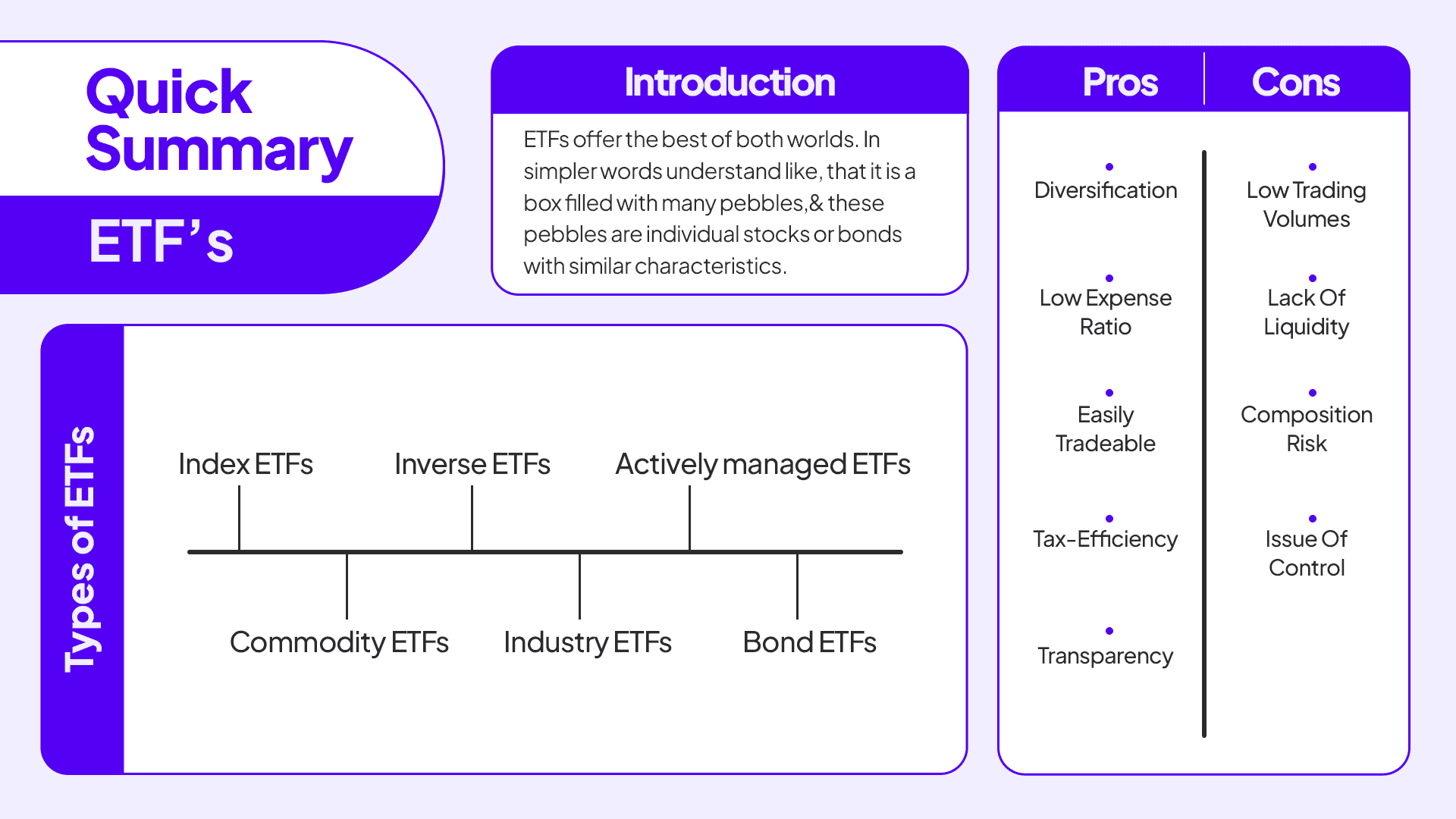
    quick summary of ETF

    What are ETFs or Exchange- Traded Funds?

    In simpler words understand like, that it is a box filled with many pebbles,& these pebbles are individual stocks or bonds with similar characteristics. An interesting fact is that specific ETFs track the movement of indices like NIFTY50, SENSEX, etc. So, you expect the same returns on your investment as the index’s annual CAGR.

    Exchnage Traded Funds

    Looking into the history of ETFs in India, we see that. The first ETF in India was launched in 2002 by Nippon India Mutual Fund (erstwhile Benchmark Asset Management Company Ltd). Listed on January 8th 2002, it witnessed a trading of 1.30 crores on the first day. The journey to listing of the 100th ETF on NSE took more than 19 years. The last one-year period has seen a lot of activity in the ETF space, with 21 ETFs getting listed on the NSE. The assets under management of ETFs in India are now at Rs. 3.16 lakh crores (end of May 2021), witnessing more than 13.8 times increase in five years,  compared to Rs. 23,000 crores (end of April 2016).

    ETFs offer the best of both worlds, like Mutual Funds, ETFs represent professionally managed collections or baskets of stocks or bonds. And just like individual stocks, they trade on the stock exchanges, which means you can buy and sell them like individual stocks.

    Types of ETFs in India

    There are different types of exchange-traded funds (ETFs) available in India, offering investors a variety of options to choose from according to their financial goals and risk tolerance.

    • Equity ETFs : Equity ETFs track stock market indices such as Nifty 50, Sensex, or Nifty Next 50. They provide investors with broad market exposure and are suitable for the long term. 
    • Debt ETFs : Debt ETFs invest in government or corporate bonds, such as Bharat Bond ETFs. These are known for stable income and low risk and are suitable for retirement or capital preservation. Investments in them can generate regular interest income.
    • Gold ETFs : Gold ETFs track gold prices and give investors an opportunity to invest in gold without buying physical gold. They are suitable for inflation protection and portfolio diversification.
    • International ETFs : International ETFs track stocks or indexes from foreign markets such as the US, China, etc. They offer global diversification and the opportunity to invest in foreign markets but also carry certain risks.
    • Smart Beta ETFs : Smart Beta ETFs move away from traditional index tracking and focus on tracking smart beta indices focused on value, growth, etc. They provide investors with an opportunity to earn better risk-adjusted returns.

    Investors should consider their investment goals, risk tolerance, and time horizon when choosing among these different types of ETFs. Choosing the right ETF can improve portfolio performance and help achieve financial goals.

    What are the pros of investing in ETF?

    Investing in ETF has several benefits, some of which are listed below.

    1. Diversification:

    ETFs enable the investor to diversify their portfolio without the hassle of individually picking out each stock. Investors seeking to invest in a specific type of sector or industry. ETFs are a go-to option for people who do not want to spend their time researching each company individually. They cover most of the asset classes and sectors for the most part.

    2. Low expense ratio:

    The expense ratio is the operating expense of the Security, divided by the value of that security. In other words, it is the expense that the investor has to bear for the Security. An expense ratio below 1 is good. And ETFs offer an expense ratio below 1.

    3. Easily tradeable:

    Investors can trade ETFs just like individual stocks, which makes them highly liquid, meaning you can sell and buy them anytime during market hours.

    4. Tax-efficiency:

    Due to its low turnover, ETF offers tax relief to investors. The investors are charged 15% on short-term equity gains. And 10% on long-term equity hains after the exemption of the first 1 lakh rupees.

    5. Transparency:

    ETFs typically have the same securities as the index or the benchmark they track. Some ETFs disclose their holdings regularly, while others disclose them on a monthly, or quarterly basis.

    What are the cons of investing in ETFs?

    Investing in ETF has several disadvantages, some of which are listed below.

    1. Low trading volumes:

    Even though ETFs have become popular lately, their trading volume is considerably low compared to the other securities listed. Volume is the total buying and selling of a specific security over the trading exchange.

    2. Lack of liquidity:

    Due to low trading volume, sometimes it becomes hard to sell the ETFs because there is no one willing in the market to buy them at the price you are offering at that time. Therefore, ETFs are not the most liquid asset to hold.

    3. Composition risk:

    Since ETFs are already tailored-made investment options. Sometimes, they may have some securities in the group that you do not want to hold. Therefore, you do not have a choice for customisation.

    4. Issue of control:

    ETFs offer less control as the investor does not choose the securities in the ETF by his own will. Also, the portfolio manager swaps or churns the portfolio depending on his expertise.

    ETFs vs. Stocks vs. Mutual Funds: Which is Better?

    Before starting to invest, it’s important to understand the difference between ETFs, stocks, and mutual funds and which option is suitable for whom.

    FeatureETF (Exchange Traded Fund)StocksMutual Funds
    RiskModerate (Diversified portfolio)High (Investment in a single company)Low to High (Depends on type of fund)
    ReturnsIndex-based, relatively stableCan be very high or very lowDepends on fund manager’s performance
    CostLow (Lower expense ratio)Brokerage chargesSlightly higher (Includes fund management fee)
    LiquidityHigh (Traded throughout the day)HighLower (Redeemed at NAV, once daily)
    DiversificationYes (Index-based spread across many stocks)No (Single stock exposure)Yes (Diversified portfolio by fund manager)
    ManagementPassive (Tracks an index, no active manager)Self-managed (Investor makes decisions)Actively managed (By professional managers)
    OwnershipIndirect (Holds a basket of underlying assets)Direct (Ownership of shares in a company)Indirect (Units of pooled fund investments)
    • ETFs are a better choice for those who want low costs and good diversification and are comfortable trading on their own.
    • Stocks are suitable for active traders and high risk takers. 
    • Mutual funds are for investors who like the convenience of professional management and prefer regular SIPs.

    Points to keep in mind before investing in ETFs

    • First, determine the assets, in which you want to invest. Choose the best possible ETF according to your risk appetite and availability of funds.
    • Go for those ETFs that offer a low expense ratio. So, you can save on your operating costs.
    • Invest in ETFs with high liquidity so you can sell them without any hassle whenever you want. Otherwise, it would be a hectic task.
    • Check the ETF disclosure reports to ensure that your financial goals align with the objectives of that particular ETF.
    • Lastly, regularly check the performance of the ETFs and take the required measures according.

    Read Also: What is Nifty BeES ETF? Features, Benefits & How to Invest?

    Conclusion

    From the above article, we can conclude that, as a beginner investor, ETFs could be an adequate option to start your investing journey. Keep in mind that everything has pros and cons & the same applies to ETFs. Keeping a check on a few things and investing with patience and discipline can yield lofty returns for investors.

    S.NO.Check Out These Interesting Posts You Might Enjoy!
    1Mutual Fund vs ETF. Are They Same Or Different?
    2Best ETFs in India to Invest
    3ETF vs Stock – Which One is the Better Investment Option?
    4Gold ETF vs Gold Mutual Fund: Differences and Similarities
    5ETF vs Index Fund: Key Differences You Must Know

    FAQs (Frequently Asked Questions)

    1. What are ETFs in the stock market?

      ETFs or exchange-traded funds are financial securities that resemble the characteristics of both Mutual Funds and Stocks. In simpler words, a collection of different stocks to track the performance of a specified index.

    2. How do ETFs work?

      ETFs are like common stocks on the stock exchanges. They track the movement of the underlying asset and perform accordingly.

    3. What are the types of ETFs?

      Different types of ETFs are present in the market like index ETFs, sector ETFs, and commodity ETFs.

    4. Which are the best-performing ETFs in India?

      Kotak PSU Bank ETF, CPSE Exchange Traded Fund, UTI S&P BSE Sensex ETFETF are the top-performing ETF funds for the past year.

    5. What are CPSE ETFs?

      CPSE ETF (Central Public Sector Enterprises Exchange-Traded Fund). An investment instrument that allows you to invest in Central Government public sector enterprise.

  • How to use technical analysis on charts

    How to use technical analysis on charts

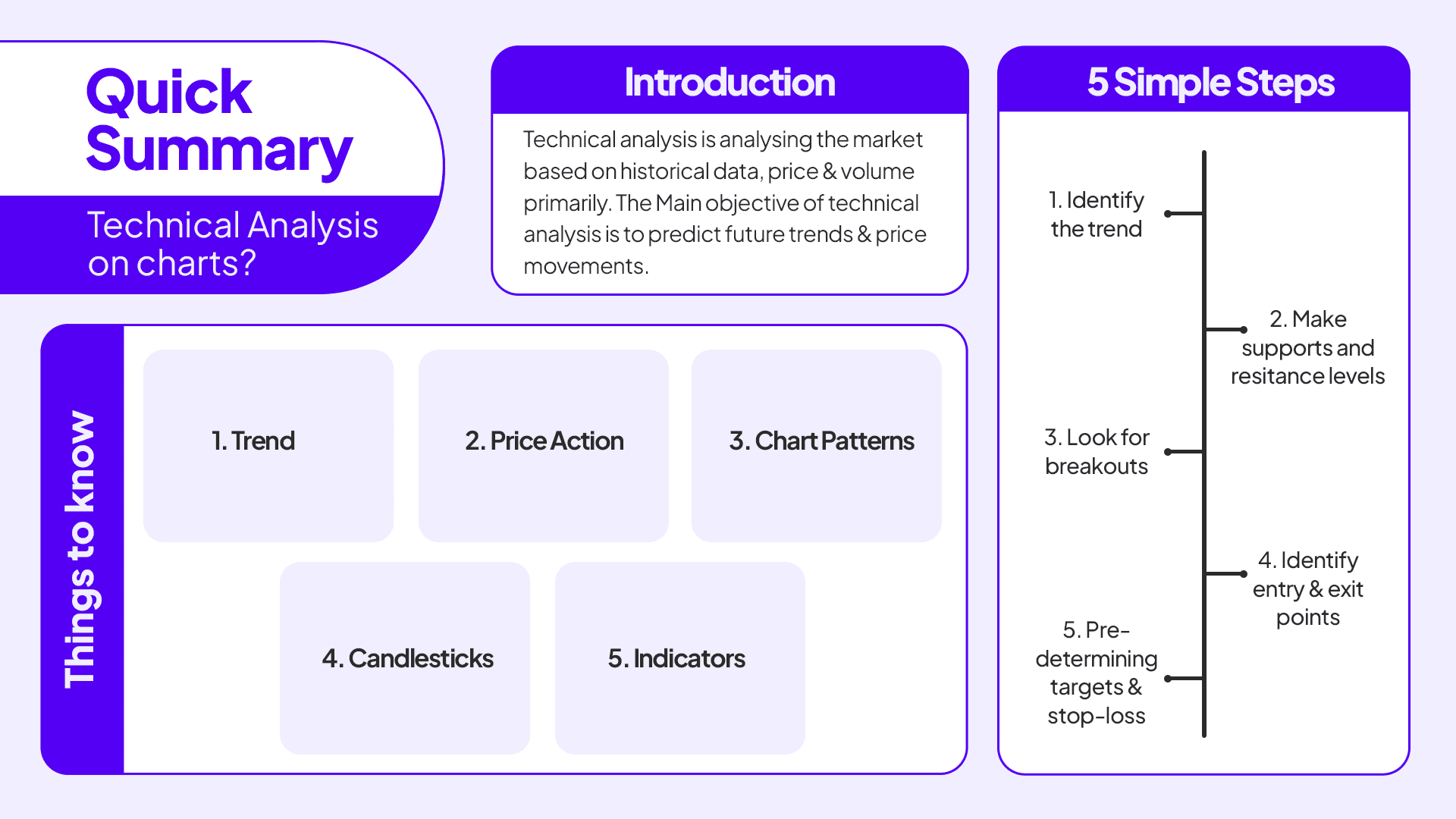
    If you are active in the stock market, you must have heard the term technical analysis quite often. Technical analysis is analysing the market movement and catching the trend. Technical analysis is used for short-term trading or investment. Wherein you gain by capturing the small price difference within a short period.

    quick summary of technical analysis

    What is technical analysis?

    Technical analysis is analysing the market based on historical data, price & volume primarily. The Main objective of technical analysis is to predict future trends & price movements. This objective goes against the past established theories. Like never trying to predict the markets, focusing on the long term, doing fundamental analysis and more, because for all these reasons Relevance of technical analysis gets questioned.

    What is technical analysis

    Technical analysis follows the ideology of history repeating itself. Following this principle, various techniques have been developed over the years. Like trading using price action, indicators, chart patterns and more. Patterns get identified using the past historical data of the companies and the indices present. To draw inferences for making the entry-exit decisions in a trade.

    Read Also: Best Options Trading Chart Patterns

    How to do technical analysis?

    There are a few things you should understand before starting to do a technical analysis which are:

    1. Trend:

    The direction in which the market moves is called a trend. In the stock market Trends can be of three types. Upward, Downward and Sideways. Let’s understand each one of them:

    market trend
    • Upward trend-
      The market is in an upward trend when it keeps making new higher highs. And when the market is in an upward trend we say that the market is bullish.
    • Downward trend- 
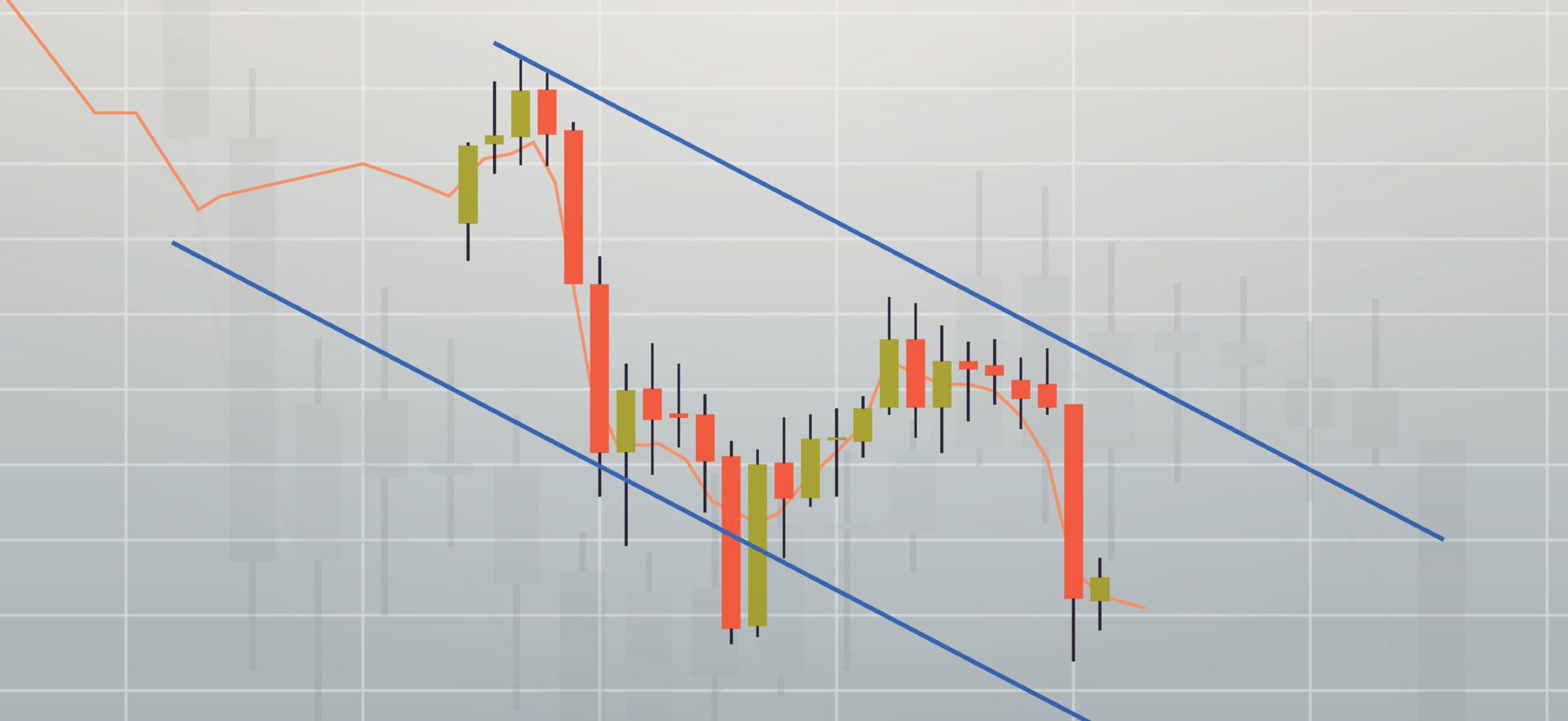
      The market is in a downward trend when it keeps making lower lows. When the market is in a downward trend and keeps falling we call it a bearish sentiment.
    • Sideways trend
      When the market moves in a fixed range for some duration it is said to be sideways. We often say that the market is consolidating when it moves like this.

    2. Price action:

    If you are active in the Stock Market you must have heard the term Price Action. So Price Action is the process of analysing the price movement of a security or asset and determining potential entry and exit points for a trade. While trading with Price Action, the main task is correctly identifying the support and resistance levels on the chart.

    price action

    Let’s  briefly understand what support and resistance levels are:

    • Support –
      Support is that level on the chart from where the price is likely to increase or reverse its trend. Support shows the minimum willingness of the buyers to buy the security. To make a support line on a chart you look for a common point from where the price is bouncing back. Support levels on the chart help to identify breakouts.
    • Resistance-
      Resistance is the price level zone on the chart from where the price is likely to decrease or change its trend. Mark the points on the chart, from where the price is reversing. This way, You will see the resistance levels on the chart.

    3. Chart patterns:

    Chart patterns are the Figures and patterns that form on the chart of an asset. These patterns have been developed over a while, using historical data from the past 100 years. Chart patterns show or predict the price movements considering how the price has redacted in the past. Broadly chart patterns fall into three main categories that are listed below:

    chart pattern
    • A continuous pattern indicates that a trend will continue for some time.
    • A reversal pattern indicates that the price may change its movement & there will be a price reversal.
    • A bilateral pattern may show that the market is highly volatile & the price could go either way.

    4. Candlesticks:

    Candlesticks are a type of price chart used in technical analysis. It is the most popular type of charts used by traders. It shows the High, Low, Open and Close prices.

    candlestick pattern
    • A green candlestick depicts that the price is moving in an upward direction. The wick shows the maximum price level it had touched in that period. The upper part of the green body shows the closing. The lower part of the green body shows the opening of the price.
    • A red candlestick depicts that the price is moving in a downward direction. The wick shows the highs and lows it had made. The upper body part of the red candle indicates the price opening & the lower body part shows the closing price.

    5. Indicators:

    Indicators in the stock market are mathematical tools developed using advanced algorithms and historical data to predict price movements. Different charting platforms provide their users with several indicators to use. Some famous indicators are listed below:

    indicator
    • RSI (Relative Strenght Index):
      RSI is one of the most popular indicators among traders. It helps in identifying the overbought and oversold stocks. After reaching a saturation point potential exits and entries are forming in the trade.
    • MACD (Moving average divergence Convergence):
      MACD was developed by ‘Gerald Appel’ in the late 1970s. It was designed to reveal changes in the strength, direction, momentum, and duration of a trend in a stock’s price.
    • VWAP ( Volume Weighted Average Price):
      Vwap is a technical indicator that indicates the price movement based on the volume of the security. Volume is the total buying and selling of the financial asset. In case of high buying volume, the price falls. On the other hand higher buying volume, the price increases. 

    After understanding all these terms like Trend, Price Action, Indicators, and Chart patterns, it depends on the personal preference of the trader and which tools they use for technical analysis.

    Five simple steps of technical analysis for any beginner or a seasoned trader

    1. Identify the trend:

    The first thing in doing technical analysis is to identify the trend in the market. You can use trendlines to identify the Trend. To draw a Trendline join the higher highs or, the lower lows of the candles. Another way of identifying the trend in the market is by using indicators. Many indicators help to capture the Trend. Analyse if the market is in a downtrend. Up trend or sideways.

    2. Make support and resistance levels:

    After identifying the Trend in the market, make support and resistance levels. Look for the points from where the price is reversing its movement. Again, you can identify the support and resistance level by yourself or with indicators.

    3. Look for breakouts:

    A breakout indicates a trend movement in the price after breaking the support or the resistance levels. For example, if the resistance breaks, the price may move in a bullish trend for some time. However, if the support breaks, the price may move in a Downward Trend.

    4. Identify entry and exit points:

    After identifying a Breakout it’s important to determine your entry & exit prices. Sometimes, the markets are so volatile that you can’t get an entry in the trade at the desired price. In that case, you should not run after the Trade but look for another entry.

    5. Pre-determining targets and stop loss:

    The last and most crucial step is to pre-define your targets and stop loss even before entering the trade. When you enter a Trade & it’s going in your desired direction. It makes you overwhelmed and without a definitive target. You keep on trailing the trade and end up making a loss.

    Read Also: Chart Patterns All Traders Should Know

    Conclusion

    Thus, summarising the above read, we can conclude that Technical Analysis is also an important branch of investing. It helps us to invest and trade in the market in the short-term and medium-term. Doing technical analysis requires precision, perseverance and practice. While investing or trading one must keep their emotions under control to be successful in the market.

    FAQs (Frequently Asked Questions)

    1. What is technical analysis in the stock market?
      Technical analysis in the stock market is the process of identifying the trends and predicting the price direction.
    1. What are the best books for technical analysis?
      There are so many good books in the market for technical analysis. Example Encyclopedia of Chart Patterns, Technical Analysis of the Financial Markets: and many more.
    2. What is the difference between fundamental analysis and technical analysis?
      Fundamental analysis assesses the financial health of the company. Technical analysis analyses the share price movement.
    1. What is the Dow Theory of technical analysis?
      Dow’s theory was taken from the editorials of Charles H. Dow. According to this theory, a shift in the bullish or bearish trend is confirmed by multiple indices.
  • 5 points to be considered before buying or selling any stocks

    5 points to be considered before buying or selling any stocks

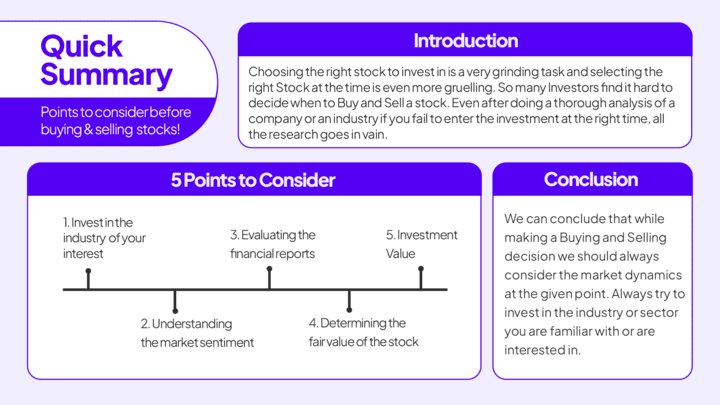
    Choosing the right stock to invest in is a very grinding task and selecting the right Stock at the time is even more gruelling. So many Investors find it hard to decide when to Buy and Sell a stock. Even after doing a thorough analysis of a company or an industry if you fail to enter the investment at the right time, all the research goes in vain. Similarly, not exiting from the Stock at the right time can also result in losses. So, what to do in that case?

    5 Points to Consider Before Buying and Selling

    Below We have mentioned five such points that could help you to make Buying and Selling decisions timely. So that you could invest in the stock market with ease.

    QUICK SUMMARY of 5 Points to Consider Before Buying and Selling

    1. Invest in the industry of your interest:

    • The first step for anybody, when they start investing in the stock market, is choosing the right industry. Choosing the right industry, sector or business is the core foundation for building a strong portfolio.
    • Legends like Warren Buffet always suggest investing in companies in which you have an interest or you are familiar with their business. It encourages you to regularly update yourself on the company’s performance. 
    • To make an appropriate Buy or Sell decision it is very important to be updated with the company’s performance. When you are familiar with a company, or industry and know how the price reacts to market dynamics, it becomes simple to ignore unnecessary news and stick to your target.
      Therefore, it is always suggested to invest in companies that you know well. Who’s business model excites you and you are willing to hold the stock for a longer period?

    2. Understanding the Market sentiment:


    For example,

    We have seen that during COVID-19 the markets were affected badly because of fear among the people. At that time the market had a bearish sentiment, the stocks of so many companies were at a price lower than their actual value. Which was a very good buying opportunity in certain specific sectors like FMCG, Healthcare, etc. 


    3. Evaluating the financial reports:

    Understanding and interpreting the company’s financial reports helps you to have a clear viewpoint on Buying and Selling decisions. The financial reports of the company consist of the balance sheet, profit and loss statement and the cash flow statement.

    • A Balance Sheet is a concise summary of the company’s current market standing. Showing what all the company’s assets and liabilities are and how are they financing their operations.
    • The Profit and Loss Statement depicts the performance of the company during a financial year. It shows how effectively the company is using their resources to generate revenue and how much expense they are incurring.
    • Cash is considered to be the lifeline of any business. Having a positive cash flow is a big green flag for any company. The Cash Flow Statement shows the net flow of cash in the business during a financial year, from the operating, financing and investing activities of the business.
      Being able to read and understand the financial reports of the company helps the individual to make optimum buying and selling decisions.

      Financial reports provide you with insight into the sales growth, gross and net margins, and profitability of the company which helps you to determine whether the company is making any progress or not.

    4. Determining the fair value of the stock:

    Evaluating the fair price of the share is very important before buying or selling it. Many financial ratios help you assess that if the share is fairly valued or not, on the stock exchange.

    Three Important ratios that you can look at

    • P/E Ratio
    • Debt to Equity Ratio
    • Intrinsic value

    Let’s briefly understand each one of them-

    • P/E Ratio:
      The P/E ratio shows the relation between the stock price and the company’s earnings. It is calculated by dividing the current market price of the stock by the earnings per share.
    • Debt to Equity Ratio:
      The debt-to-equity ratio is a financial ratio that is used to assess how much proportion of debt to equity a company is using to finance its assets.
      Debt is the creditor or debt holders’ money that is invested in the company against which they receive a payment in the form of interest regularly. 
    • Intrinsic value:
      Intrinsic value is the anticipated value of any stock. Based on specific parameters the IV of any stock is calculated. Taking into consideration both tangible and intangible factors. 

    Intrinsic value = Future cash flows(1+ discount rate)#of periods

    5. Investment goal

    While investing in the stock market or building your portfolio it is very important to set your financial investment goals. Some Goals are short-term, and some are long-term. It is very important for an individual to correctly pre-define them to make the buy and sell decision at the right time.
    Various factors determine one’s investment goals like the need for money in the coming years. A person who might not need his money for a decade can invest in more riskier assets. On the other hand, a person who might need his money in the coming years will invest in more liquid assets. 

    Read Also: What is a good rule for investing in stocks?

    Conclusion

    Summarising the above article We can conclude that while making a Buying and Selling decision we should always consider the market dynamics at the given point. Always try to invest in the industry or sector you are familiar with or are interested in. We have also seen that even at Rs.1000 a stock could be undervalued. Whereas, a stock trading at Rs.50 could be overpriced for what the company is offering.  

    And remember at the end of the day, investing in the stock market is a very whelming experience and you should always have control over your emotions. Often people get carried away with their emotions and end up making rash decisions and having to bear the consequences over the years. 

    FAQs (Frequently Asked Questions)

    1. How to start buying and selling stocks?

      To start buying and selling stocks, you first need to have a Demat account. There are several brokers present online, so it becomes complicated to choose the right one. Now. you can open a Demat account using Pocketful’s app within a few seconds.

    2. Which are the best apps for buying and selling stocks?

      There are many applications present online which facilitate the buying and selling of stocks. It depends on the use case and preference of the customer. Pocketful offers a trading platform for both your investing and trading needs. Simple interface combined with modern technology to make your finance journey smooth.

    3. What are the buying and selling of stocks?

      When you buy a stock you are not buying it with the company but the shareholder. Similarly, when you sell a stock the company is not buying it but some other investor.

    4. What points should one consider before buying and selling stocks?

      In the above article, five key points are mentioned that you should consider before buying and selling stocks. Never buy a stock in a company or industry, you do not know about. Analyze what the market dynamics are and how other investors are reacting.

  • How to invest like Warren Buffett and Charlie Munger?

    How to invest like Warren Buffett and Charlie Munger?

    Investing in the stock market can be a daunting task. People who do not understand investing or the stock markets associate investing in the stock market with gambling. But having the insights of legends like Warren Buffet and Charlie Munger could be a relief. Warren Buffet and Charlie Munger are the iconic duo behind the success of Berkshire Hathway. Both are famous for their unique yet simple style of investing which has resulted in remarkable success.
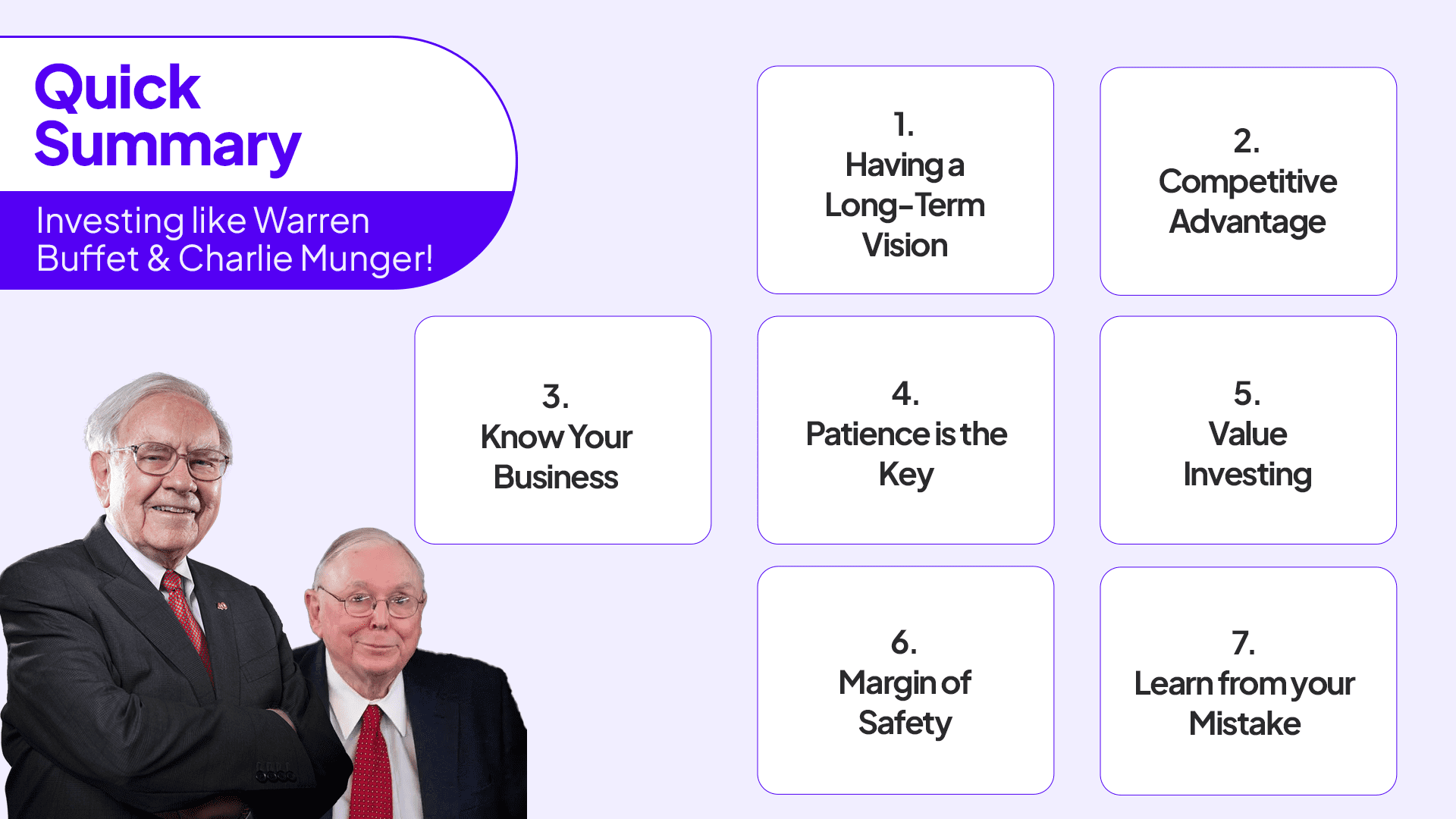
    So we have listed down seven tips or the ideologies followed by these legendary investors.

    quick summary of How to invest like Warren Buffett and Charlie Munger

    1. Having a long-term vision:

    Warren Buffet always used to say that never invest in companies whose business you do not understand. There is this famous quote that goes like, “Invest in a wonderful company at a fair price than in a fair company at a wonderful price”.
    It means that you should not buy the stock of a company just because you are getting it for cheap. Rather invest in a company that you believe in, understand its business, and has strong fundamentals with competitive management.
    They say that think like a business owner and not a stakeholder. This mindset encourages you to focus on long-term value creation, aligning your interest with the company’s success. It also discourages short-term trading which often results in losses.

    2. Competitive advantage:

    The Buffet and Munger duo stresses investing in companies that have a competitive advantage in the market. Identify the company that stands out of the crowd. It could be anything, be it their business model, marketing strategies or technological proprietary. A company with a durable competitive advantage often results in consistent profits, making it an attractive investment opportunity.


    Let’s try to understand this with the help of a real-world example. The differentiating factor for the retail giant Walmart is the lowest possible prices of the products they offer, which they have achieved through economies of scale. This is the competitive advantage in the case of Walmart that sets it aside from its competitors in the retail and wholesale business segments.


    3. Know your business:

    Warren Buffet always used to say that never invest in companies whose business you do not understand. There is this famous quote that goes like, “Invest in a wonderful company at a fair price than in a fair company at a wonderful price”.
    It means that you should not buy the stock of a company just because you are getting it for cheap. Rather invest in a company that you believe in, understand its business, and has strong fundamentals with competitive management.
    They say that think like a business owner and not a stakeholder. This mindset encourages you to focus on long-term value creation, aligning your interest with the company’s success. It also discourages short-term trading which often results in losses.

    4. Patience is the key:

    Patience is the most important ingredient in the recipe for investing. Trust me there is nothing called as overnight success or the get-quick-rich scheme. To see exceptional results in the stock market you need to have patience because great things are not built in one night. 
    Legendary investors like Warren Buffet and Charlie Munger are known for their patience and waiting for the right investment opportunities.

    5. Value Investing:

    Value investing refers to investing in the stock market when others are leaving. Buying the stocks of Underappreciated companies with strong fundamentals, and a simple enough business model for you to understand. The same strategy that helped Warren Buffet accumulate such great wealth. 
    Always try to invest in businesses and companies in your competence circle. Investing in companies whose business you do not understand or you are unfamiliar with can result in horrendous decision-making.

    6. Margin of Safety:

    This is a principle of investing wherein an investor purchases securities only when their market price is significantly below their intrinsic value. Intrinsic value is the anticipated value of any stock. Based on certain parameters the IV of any stock is computed. Taking into consideration both tangible and intangible factors. 

    Intrinsic value= Future cash flows(1+ discount rate)#of periods

    It is very complicated to calculate the intrinsic value of any stock manually, and individuals can use the stock screeners available online to get the correct IV for any stock.

    • If IV>current market price then the share is considered to be undervalued.
    • If IV<current market price then the share is considered to be overvalued.
    • If IV is almost equal to the market price of the share then we can say that the stock is fairly valued.

    Remember, the market swings wildly from day to day and presents large changes in valuation over periods of euphoria and pessimism.

    7. Learn from your mistake:

    It is not like, that great investors like Warren Buffet and Charlie Munger do not lose money in the market. But the only thing that sets them apart from other investors is that they learn from their mistakes. They acknowledge their errors and view them as learning opportunities. Understand that learning is a continuous and never-ending process and there is no bigger fool than a person who thinks that they know it all.

    Read Also: How to invest in dividend stocks in India?

    Conclusion

    So, concluding the above article we can say that reciprocating the investing style of Warren Buffet and Charlie Munger requires great discipline and patience. Having a long-term vision, and investing in the companies whose business you understand within the circle of your competence can fetch you the same results that you want. 

    FAQs (Frequently Asked Questions)

    1. What is the stock market?

      The stock market also known as the equity or the financial markets is an aggregation of buyers and sellers of financial securities. A person putting his/her money in the stock market could be a trader or an investor. There is no hard and fast rule to distinguish between the two. An investor is a person who generally holds their holding for more than a period of six months, on the other hand, a trader is someone who does not hold the securities for long.

    2. How did Warren Buffet accumulate his wealth?

      Warren Buffet has made a massive fortune by investing in the stock market. He has told in one of his interviews that he started his investing journey at the age of 11. Also, Warren Buffet owns the company Berkshire Hathaway which is an American multinational conglomerate holding company.

    3. Are Warren Buffet and Charlie Munger related?

      Charles Thomas Munger is the vice chairman of the American conglomerate Berkshire Hathaway. Whereas, Buffet is the chairman of the company and also the largest stakeholder. Buffet has described Munger as one of his closest friends. 

  • How to invest in dividend stocks in India?

    How to invest in dividend stocks in India?

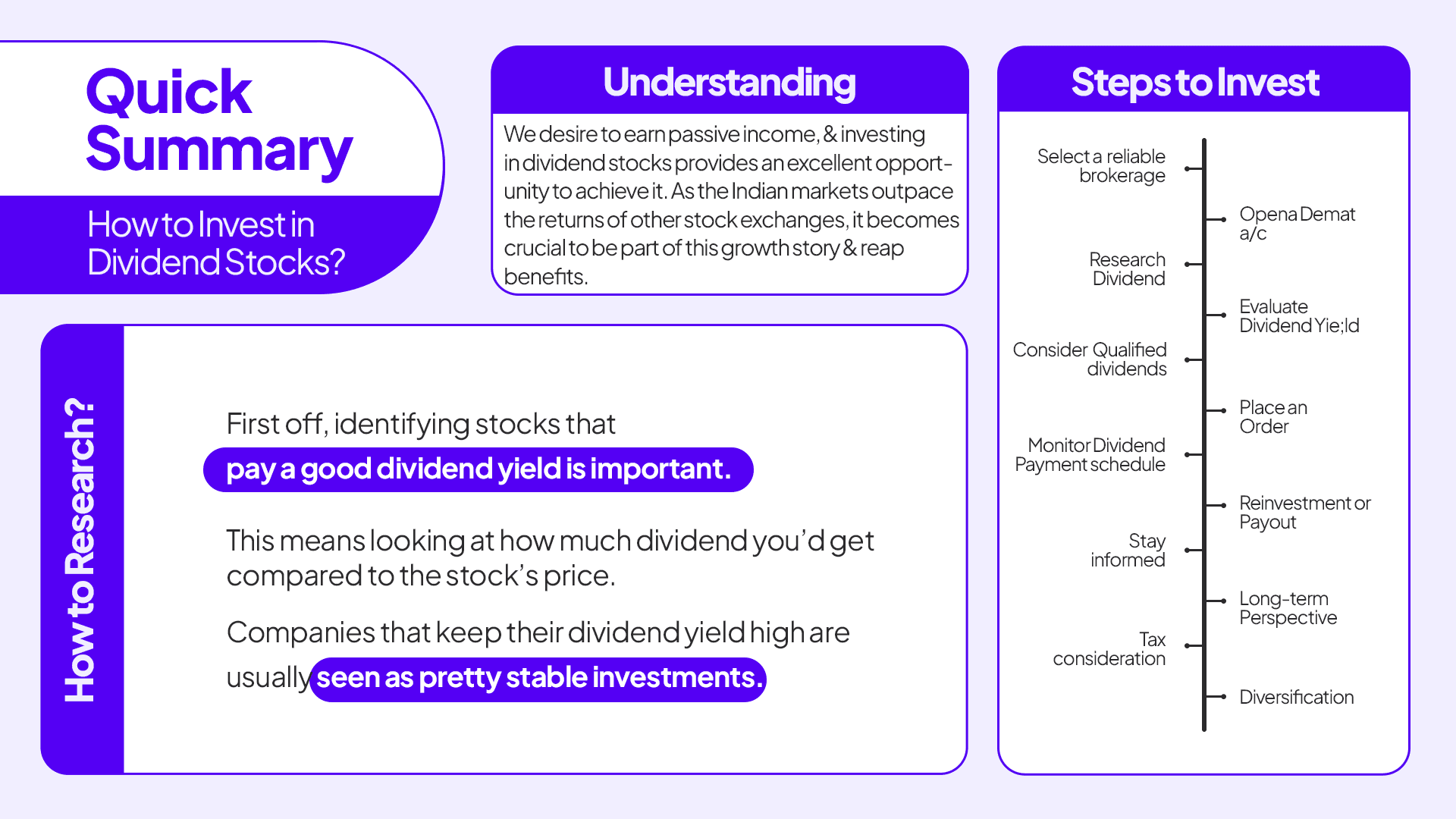
    We all desire to earn passive income, and investing in dividend stocks provides an excellent opportunity to achieve it. As the Indian markets outpace the returns of other stock exchanges, it becomes crucial to be part of this growth story and reap its benefits. Investing in dividend stocks in India offers a steady income stream & holds the potential for long-term growth. These stocks, often called “cash cows,” allocate a portion of their earnings as dividends to shareholders. 

    Investing in dividend stocks is as simple as your usual stock investments –

    quick summary of how to invest in dividend stocks.

    1. Select a Reliable Brokerage: Choose a reputable brokerage firm with the necessary tools and resources for stock trading.

    2. Open a Demat AccountSign up for a trading and Demat account with the chosen brokerage. Provide the required documents and complete the account setup process.

    3. Research Dividend: Paying Companies: Identify companies listed on Indian stock exchanges that have a history of paying dividends consistently. Look for stable companies with good financial standing. We’ll be discussing this point in detail.

    4. Evaluate Dividend Yield: Review the dividend yield of potential stocks. It can be calculated by dividing the annual dividend per share by the current stock price. This helps gauge the potential income.

    5. Consider Qualified Dividends: Understand the concept of qualified dividends and their tax implications. Qualified dividends are usually subject to lower tax rates, making them a tax-efficient choice for investors.

    Read Also: What is a Dividend? 

    6. Place an Order: Once you’ve identified a suitable dividend stock, place an order through your brokerage’s trading platform. Choose between market orders (immediate execution) and limit orders (set a specific price).

    7. Monitor Dividend Payment Schedule: Keep track of the company’s dividend payment schedule. Dividends are often paid out quarterly, but the timing can vary. Stay informed to ensure you receive your dividend income.

    8. Reinvestment or Payout: Decide whether you want to reinvest your income or receive them as cash payouts. Reinvestment can lead to compounding returns over time.

    9. Stay Informed: Continuously monitor the performance and news related to the companies you’ve invested in. Stay informed about any changes in the company’s financial health or dividend policies.

    10. Long-Term Perspective: Approach dividend stock investing with a long-term perspective. The goal is to build a portfolio that generates a steady stream of income over time, while potentially benefiting from capital appreciation.

    11. Tax Considerations: Be aware of the tax implications of dividend income in India. Understand the applicable tax rates and reporting requirements for dividends received.

    12. Diversification: With any investment strategy, diversification is the key. Avoid putting all your funds into a single dividend stock; consider building a diversified portfolio across different sectors.

    Now, you’ll be all set to start your journey of investing in dividend stocks in India. The goal is to create a steady income stream and see your investments grow over the long haul.

    Read Also: 5 Highest Dividend Paying Stocks in India

    Factors to see for identifying dividend-paying companies –

    1. Financial Performance: Examine the company’s financial statements, including revenue growth, profitability, and cash flow. A strong financial foundation is essential for consistent dividend payments.

    2. Dividend History: Check the company’s track record of dividend payments. Look for a history of regular and stable dividends over several years.

    3. Dividend Yield: Evaluate the dividend yield, which is the ratio of annual dividends to the current stock price. Compare this yield with industry averages to gauge competitiveness.

    4. Payout Ratio: Calculate the payout ratio by dividing dividends per share by earnings. A sustainable payout ratio indicates the company can comfortably afford its dividend commitments.

    5. Earnings Growth: Assess the company’s earnings growth trajectory. Companies with steady and increasing earnings are more likely to maintain dividend payments.

    6. Debt Levels: Analyze the company’s debt levels and debt-to-equity ratio. Excessive debt could impact its ability to sustain dividend payments during economic downturns.

    7. Industry Trends: Consider the industry the company operates. Research industry trends and forecasts to ensure the company’s position is strong and its market share is sustainable.

    8. Management and Governance– Evaluate the quality of the company’s management team. Transparent governance practices and a history of shareholder-friendly policies are positive indicators.

    9. Competitive Landscape: Compare the company’s performance, dividends, and strategies with its competitors. A company that outperforms its peers is more likely to provide stable dividends.

    10. Market Capitalization: Consider the company’s market capitalization. Larger, well-established companies often have the resources to maintain consistent dividends.

    11. Future Prospects: Research the company’s growth potential and expansion plans. A company with a clear roadmap for growth is more likely to continue rewarding shareholders.

    12. Dividend Growth: Assess the company’s history of increasing dividends over time. Consistent dividend growth demonstrates management’s commitment to shareholders.

    13. Analyst Recommendations: Review recommendations from financial analysts and experts. While not definitive, these insights can offer valuable perspectives on the company’s prospects.

    14. Industry Regulations: Be aware of any industry-specific regulations that could impact the company’s ability to maintain dividends.

    15. News and Developments: Stay updated on recent news, events, and developments related to the company. Changes in leadership, acquisitions, or strategic shifts can influence dividend sustainability.

    By following these steps, you can navigate the world of dividend stocks with confidence and make informed investment decisions.

    Investment principles to swear by –

    1. Focus on Regular Payouts: Look for companies that give out dividends often. They’re like your paycheck but from your investments!

    2. Don’t Chase Just High Yields: Sure, big payouts are tempting, but make sure they’re sustainable. Sometimes a struggling company offers high yields, but that might not last.

    3. Stability Matters: Pick companies that are strong and steady. You want them to keep making money so they can keep giving you dividends.

    4. Diversify: Don’t put all your eggs in one basket. Invest in different companies and industries. If one isn’t doing well, others might make up for it.

    5. Long-Term Thinking: Dividend stocks are like slow-cooking investments. Think long-term. Over time, your money can grow nicely.

    6. Reinvest or Enjoy: Set your goals beforehand in terms of the yield you are targeting. Decide if you want to buy more shares with your dividends (like planting seeds) or just enjoy the extra cash.

    7. Keep Learning: Keep an eye on the news about the companies you invested in. If there are big changes, it could affect your dividends.

    8. Know the Tax Rules: Remember, dividends are taxed. Know how much you might need to give back to the government.

    9. Look at Dividend Growth: Companies that increase their dividends over time are a good sign. It means they’re getting better at making money.

    10. Stay Calm: Don’t freak out if the stock price goes up and down. Focus on the dividends and the company’s overall health.

    11. Patience Pays: Think of it like growing a garden. It takes time, but the rewards can be worth it. Hold on for the long haul.

    12. Expert Help: If you’re unsure, get advice from experts or professionals. They can guide you based on their experience.

    Remember, there’s no one-size-fits-all strategy. Your approach depends on your goals, risk tolerance, and how much you want to be involved. With the right strategy, dividend stocks can be a tasty addition to your investment plate!

    Read Also: Highest Dividend Paying Penny Stocks List

    How to research dividend-paying Companies?

    First off, identifying stocks that pay a good dividend yield is important. This means looking at how much dividend you’d get compared to the stock’s price. Companies that keep their dividend yield high are usually seen as pretty stable investments. The screener can be used for this purpose. When you’re picking these dividend-paying stocks, it’s smart to know about “qualified dividends.” These are dividends that meet certain tax criteria and are usually taxed at a lower rate, which is a good thing for your pocket.

    Now, when it comes to actually investing in these stocks, proper research needs to be undertaken. Look for companies that have a track record of sharing profits with their shareholders. They usually pay out dividends regularly, like every quarter. It’s a good idea to keep an eye on when they announce their dividend payouts.

    Here’s the deal though: this kind of investing is like the slow-cooking of investing strategies. You’ve got to be in it for the long haul. Even big shots like Warren Buffett say they like to hold onto stocks “forever.” It’s all about being patient and letting your money grow over time.

    Conclusion

    But hey, remember that dividends in India are taxed. The rate depends on how much you earn, so it’s good to know what you’re in for tax-wise. If you’re not super into picking stocks yourself, no worries. There are mutual funds that focus on these dividend-paying stocks. That way, the experts handle the hard work and you still get the benefits.
    The main goal here is to create a source of passive income. By choosing stocks that keep growing their dividends, you could have more cash coming in over the years. So there you go! Investing in dividend stocks in India is a smart way to get some cash flow going and let your investment bloom. Just remember to pick wisely, be patient, and let the magic of compounding do its thing.

    Calculate Dividend Yield – Dividend Yield Calculator

    FAQs (Frequently Asked Questions)

    1. What are dividend-paying stocks?

      The stocks of companies that pay a portion of their profits to their shareholders are called dividend-paying stocks. Investing in dividend-paying stocks acts as a passive source of income.

    2. Which are the best dividend-paying stocks in India?

      You can check out this link to find the top fundamentally strong stocks that dividend-paying in 2022 India. click here

    3. Is investing in dividend-paying stocks good?

      Yes, investing in dividend-paying stocks is good. Because it not only pays out dividends to its shareholders but the investor also benefits from capital appreciation.

  • How to find and identify undervalued stocks

    How to find and identify undervalued stocks

    Undervalued stocks are stocks that are trading at a lower price than their actual fair price. At times the stock price does not fairly represent the true worth of the company. Sometimes small companies get ignored by analysts who are experiencing increased sales and better profit margins and have undervalued share prices. Investors look forward to investing in undervalued stocks because the possibilities are very high that the price of these stocks will increase in future. But, the question that arises here is how to identify these undervalued stocks.

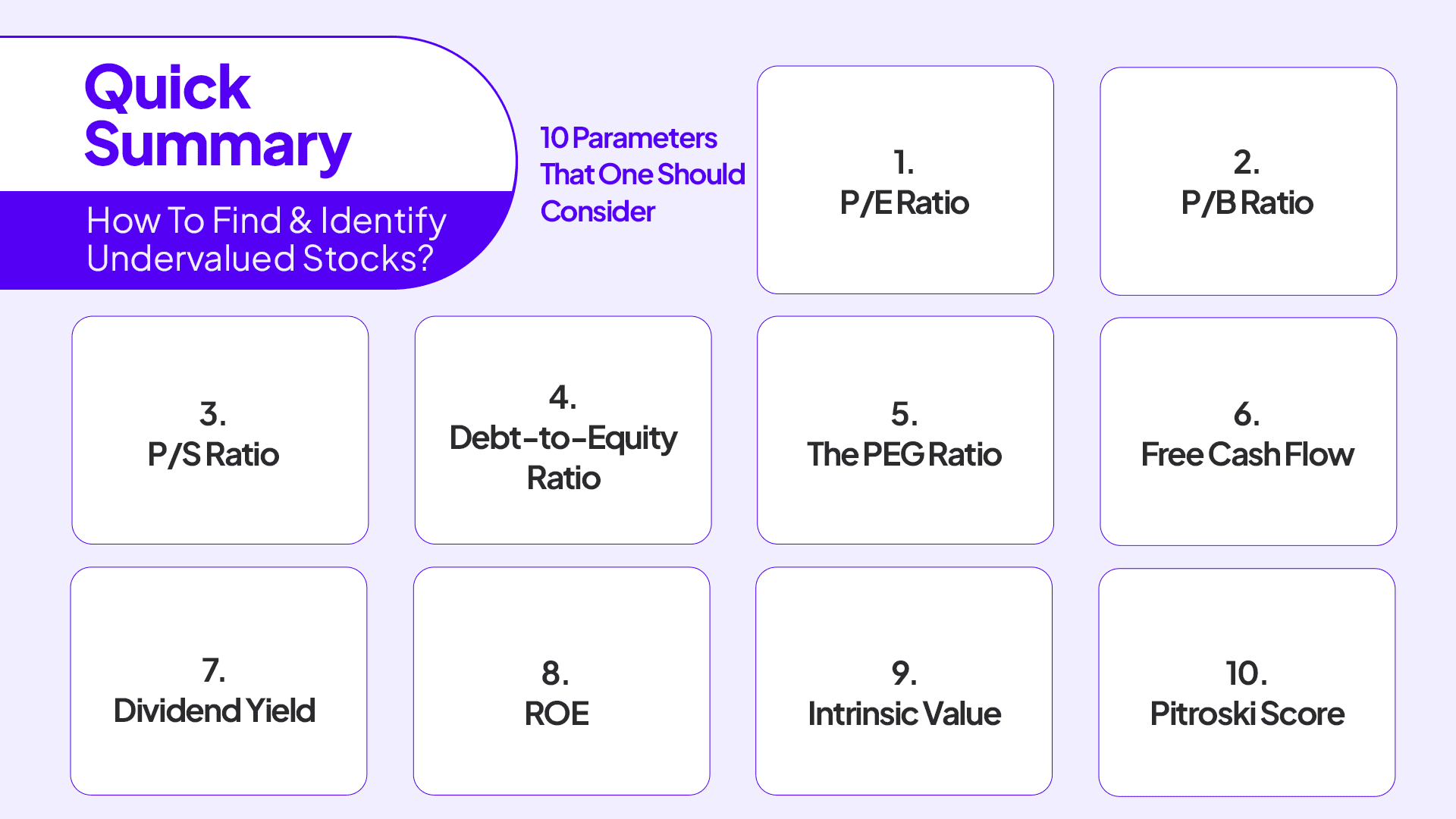
    10 parameters that one should consider to decide whether the stock is fairly priced or not –

    quick summary of 10 paramters that one should consider to decide whether the stock is fairly priced or not

    Read Also: Semiconductor Industry in India

    1. P/E ratio

    The P/E ratio shows the relation between the stock price and the company’s earnings. It is calculated by dividing the current market price of the stock by the earnings per share.

    The ratio can be used to determine whether the stock is undervalued, overvalued or fairly valued.

    • If the stock P/E is more than the industry P/E we can say that the stock is overvalued.
    • If the stock P/E is less than the industry P/E we can say that the stock is undervalued.

    And lastly, if the stock P/E is nearly equal to the industry P/E then the stock is fairly priced. The P/E ratio is important when determining the true worth of the company.

    2. P/B ratio

    The P/B ratio shows the relationship between the current stock price and its book value.

    There are 3 main steps for computing the P/B ratio of any company.

    • Step 1- Calculate the book value(company assets minus liabilities ) = assets – liability = book value.
    • Step 2- Calculate the book value per share = book value. of outstanding shares.
    • Step 3- Calculate the P/B ratio = current market of the share book value per share.

    Any value below 1 is considered desirable by value investors indicating that the stock is undervalued. And a value above 3 is considered that the share is overvalued.

    3. P/S Ratio

    The P/S ratio or price-to-sales ratio is a financial ratio that shows the relationship between the price of the share and the sales of the company.

    P/S ratio = market capitalisationnet annual sales

    • An ideal P/S ratio can vary from industry to industry or sector to sector. But still, a P/S ratio between 1-2 is considered a good ratio for value investors.
    • A high P/S ratio may indicate the inefficiency of the management in using the shareholder’s funds to drive more revenue.

    Whereas a lower P/S ratio as compared to the industry standards may indicate that the stock is undervalued.

    4. Debt-to-equity ratio

    The debt-to-equity ratio is a financial ratio that is used to assess how much proportion of debt to equity a company is using to finance its assets. Debt is the creditor or debt holders’ money that is invested in the company against which they receive a payment in the form of interest regularly. Whereas equity funds are the money of the shareholders that is invested in the business.

    Having a high debt-to-equity ratio can be a big red flag for any company if the free cash flow of the company is not good. Because then the company will not be able to meet its short debt financing obligations which is not good. This does not mean that having a high debt-to-equity ratio is a bad thing. It generally depends from sector to sector. A sector that requires heavy fixed assets (like automobile or construction) might have a high debt-to-equity ratio as compared to a company that does not require so many fixed assets (like the IT sector).

    5. The PEG ratio

    The PEG ratio is a financial ratio that shows the relationship between the price and the earnings to the growth of the company. It can be defined as an advanced version of the P/E ratio. Since the P/E ratio does not tell about the price of the stock being fairly valued taking into account only the current earnings of the company and not the forecasted future earnings.

    That’s where the PEG ratio comes to the rescue it tells whether the share is being fairly valued or not at the stock exchange taking into consideration the growth rate of the company.

    PEG ratio = price/EPS growth

    • A PEG ratio of more than 1 is considered that the stock may be overvalued and not considered for investing by value investors.
    • A PEG ratio of less than 1 indicates that the stock is undervalued than its true worth and might be a good option to invest in by value investors.

    6. Free cash flow 

    Free cash flow is the cash left with the company after paying for its operating expenses and capital expenditures. The formula for finding the free cash flow for any company is given below.

    Free cash flow cash flow from operations – (operating expenses + capital expenditure).

    Having a positive FCF is a major green flag for the company because a positive FCF indicates that earnings are expected to increase in future. Which is a good sign for any value investor. Showing that either the company is experiencing sales growth or better net profit margins and that the company is effectively using their resources.

    7. Dividend yield

    The dividend yield is a financial ratio that shows what percentage of the share price the company is giving out as dividends to its shareholders.

    Dividend yield =annual dividend paid/market price

    If a company is giving out high dividends it is a green flag for any value investor and might indicate that the company is undervalued. Because generally in a company with a high dividend payout the shareholders are not only benefited from the capital appreciation but also the dividend payments give them a good annual return on their investment.

    8. ROE

    Return on equity is a financial ratio expressed in percentage terms indicating a relationship between the company’s net earnings and the shareholder’s equity.

    ROE=(Net earnings/ shareholders equity)*100

    • A 15-20% ROE is considered very good for any company as it shows how effectively the company is using the shareholder’s funds to make more money. 
    • An ROE higher than 20% might indicate that the management is taking a high risk on shareholders’ money to get more business. 

    9. Intrinsic value 

    Intrinsic value is the anticipated value of any stock. Based on certain parameters the IV of any stock is calculated. Taking into consideration both tangible and intangible factors. 

    Intrinsic value = Future cash flows(1+ discount rate)^no. of periods

    It is very complicated to calculate the intrinsic value of any stock manually, and individuals can use the stock screeners available online to get the correct IV for any stock.

    • If IV>current market price then the share is considered to be undervalued.
    • If IV<current market price then the share is considered to be overvalued.
    • If IV is almost equal to the market price then we can say that the stock is fairly valued.

    10. Pitroski score

    Pitroski f- score is a no. between 0-9 which is used to assess the strength of the company’s financials. It is taken into account to decide whether the stock is suitable for investing or not with 9 being the best and 0 being the worst.

    The calculation of the Pitroski score is quite complicated if done by hand, there are many stock screeners available online that automatically calculate the Pitroski score for you.

    • A Pitroski score below 3 is not considered good.
    • A score between 3-6 is considered good.
    • And a score above 6 is excellent for investing.

    Conclusion

    Thus we can conclude that identifying undervalued stocks is not even that hard. You just need to keep a few points in mind before starting your research. 

    Investing in stocks that you can hold for the long term is a good way to build a strong portfolio. Also, it is important to regularly churn your portfolio on a regular basis so that you can maximize the returns and minimise the risk in your overall portfolio.

    S.NO.Check Out These Interesting Posts You Might Enjoy!
    1LTP in Stock Market: Meaning, Full Form, Strategy and Calculation
    2How to find and identify undervalued stocks
    3Types of ITR: Which One Should You Choose?
    4What is FIRE in Finance? Full Form, Features, Types, and Formula Explained
    5Best Places To Park Your Short Term Money

    FAQs (Frequently Asked Questions)

    1. What are undervalued stocks?

      Stocks are trading at a lower price in the stock exchanges as compared to their actual fair price. There are various accounting financial ratios that you can use to assess the true value of the stock.

    2. How to find undervalued stocks?

      There are different financial ratios you can consider to decide whether the stock is undervalued, overvalued or fairly valued.

    3. Fundamentally strong stocks that are undervalued in 2022 India.

      You can check out any stock screener to find the top fundamentally strong stocks that are undervalued in 2022 India.

  • What is a good rule for investing in stocks?

    What is a good rule for investing in stocks?

    When talking about investing nearly all of us know this simple and yet the most important rule of investing, i.e. ‘Buy low, sell high’. And yet it is not like we all are Warren Buffet.
    According to statistics, only 1% of people make money in stock markets. Did you ever wonder what this 1% of people have done right in the markets?
    After intensive research, we have shortlisted 10 such findings that were common among the top 1% of the investors. Which can be your ultimate guide to start your investing journey in the stock market.

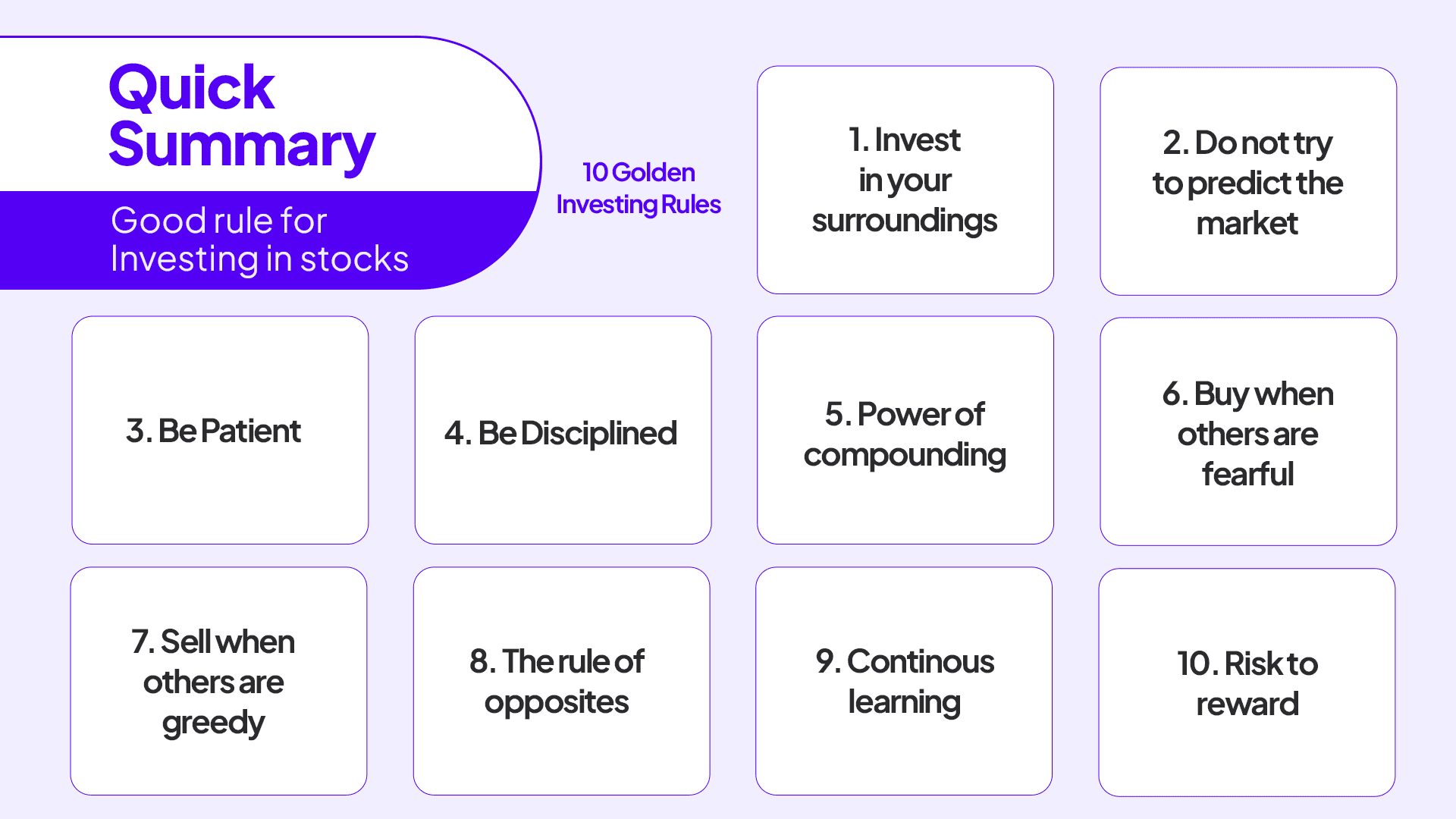
    10 golden investing rules that every investor should keep in mind:

    quick summary of 10 golden investing rules that every investor should keep in mind

    1. Invest in your surroundings- 

    The first and foremost rule in investing that every investor must abide by is, to invest in the companies they understand and know about their business. 
    Even coined by one of the most successful investors of all time Mr. Warren Buffet that one should only invest in companies that they understand and believe will have a sustainable competitive edge in the market over other companies.

    2. Do not try to predict the markets- 

    Never, try to time the markets because it is impossible to tell whether the market will go up or down in a certain period. Therefore, it is always advised to invest in the long run and not aim for short-term gains. People who do not understand the stock market often say that the stock market is equivalent to gambling. But that is not how the stock market works, it works on a cause-and-effect relationship. For every bull run or market crash there is a significant reason. 
    Stock markets are highly volatile and are affected by investor sentiments. Thus, one cannot predict the market.

    3. Be patient- 

    Stock markets are highly volatile. And at times you might end up losing money. But never sell your investments out of panic. If you have done your research correctly then have faith in yourself. If you have invested in good companies with thorough background checks, then the period of your investments will give you good returns. And the stock market is not a one-day game. To see desirable results you need to have patience.

    4. Be disciplined- 

    It is necessary to have discipline in the stock market to be profitable. Sometimes markets are volatile and perform against our expectations due to which we get carried away with our emotions and end up making rash decisions that we might regret later. So it is significant to have some investing rules and strategies that one should strictly follow. Invest in the market, check your investments regularly, make the timely necessary changes, have realistic expectations and be disciplined.

    5. Power of compounding – 

    The compounding effect is the gathering of big rewards from a series of small and intelligent choices. Small, seemingly insignificant steps completed with discipline over a longer period can show exceptional results. An interesting fact is that Warren Buffet’s net worth graph closely resembles the graph of a compounding series. To experience the power of the compounding effect yourself is to start investing early. Today with so much technological advancement anyone can start their investing journey with as little as 500 rupees per month. 

    6. Buy when others are fearful –

    When the stock market goes down for any reason most investors become fearful and start selling off their investments because of which the market becomes bearish and keeps on falling. 
    But someone who understands the stock market knows that it is the best time to buy because due to the overall market crash, the price of the shares of good companies also falls. Thus, they become undervalued. This offers an excellent opportunity for investors to enter the investment.

    7. Sell when others are greedy – 

    Taking the other case scenario when the markets go up people become greedy and start investing more money into the markets till the saturation point. Again the smart investor will exit the market before the saturation point. Whereas most people keep on buying, and when the market corrects itself most people will lose money. 

    8. The rule of opposites- 

    This rule was given by the author of the famous book,” The Intelligent Investor” by Benjamin Graham. The more enthusiastic investors and spectators become in the long run (of investing), the more certain they are to be proved wrong in the short run because the stock market is unpredictable. 

    9. Continuous learning – 

    It takes years of practice and hard work to understand how the stock market works. Learning is a never-ending process and the person who thinks ‘they know it all’ is the biggest fool. 
    The quality that differentiates a successful person from a not-so-successful person is their attitude. The attitude of how they perceive things. The ocean of knowledge is very vast and one can never get enough of it. 

    10. Risk to reward-

    In order to be a successful investor you should always pre-define your risks and rewards before entering into the markets. Because the greater the risk, the greater the reward. This is called the risk-return trade-off. The sole purpose of any investment is to minimize the risk and maximize the return. And it is advisable to never borrow money from others to invest in the stock market.

    Read Also: 5 points to be considered before buying or selling any stocks

    Conclusion

    So, the key takeaway that you can take from the above article is that invest in your surroundings. Never try to predict the markets because the stock market is a very volatile market. 
    If you try to time the market you will end up making huge losses. Control your emotions, have patience, and be disciplined to see extraordinary results in the long run. And if you stick with something for long enough you will eventually figure it out. Stock market is a zero-sum game i.e. one person’s gain is another person’s loss. So, always buy when others are fearful and sell when others are greedy. 

    Read Also: Top 10 Books for Beginners in Trading & Investing

    FAQs (Frequently Asked Questions)

    1. How to start investing in the stock market?

      In order to start investing in the stock market you need to open a demat account. There are various brokers present online where you can open a demat account for free and at the ease of your own comfort.

    2. How to start investing in mutual funds?

      There are various mutual funds present in the market where you can invest. You have to open a demat account before start investing in any kind of securities. There are various types of mutual funds present in the market. It depends on the preference of the investor in what kind of securities they want to invest in.

    3. How to learn to invest in the stock market?

      The first and foremost thing that is essential to learn when investing in the stock market is passion. One can only learn about investing in the stock market if they are passionate about the financial markets. Because understanding and learning about the stock market takes time.

  • What are T2T (Trade to trade) stocks?

    What are T2T (Trade to trade) stocks?

    There are various segments in the equity market (AKA the stock market) like the rolling settlement, institutional segment, etc. These segments are overseen by the Security Exchange Board of India (SEBI). One such segment is the Trade to Trade segment (t2t) which we will be discussing today. There are many segments in the equity market similarly there is a T2T segment. Stocks that are not available for intraday trading fall under this category. The delivery of T2T stocks cannot be taken on the same day. Settlement of t2t stock takes place on a t + 2-day basis.

    T2T Trade

    How to identify T2T stocks?

    Shares that fall under the category of T2T stock have a symbol of BE attached to them at the end. For instance, let’s take an example of the Vodafone idea. When the share is not in the T2T category the script name is given like IDEA. When the share is in the T2T category the script mane is given like IDEA BE. 

    T2T stocks

    Criteria for shifting stocks into the T2T segment.

    P/E ratio- 

    In the case of NSE if the p/e of the nifty50 index is 15-20 and the P/E of the share is above 30, then the stock may be considering moving into the T2T segment
    The P/E ratio is a price-to-earnings ratio that shows for every rupee that you are giving to the company how much earning they can make out of it.  Remember that the P/E ratio is a significant measure to analyse a stock and its fair value.
    However, the P/E ratio is not the only deciding factor in whether or not to move stock into the T2T segment.

    Price variation-

    When the price of a stock is very volatile i.e. the movement in the share price is very large. The price filter bands or the price circuit are fixed in the scope of positive and negative 5% of the share value for at least 22 trading days. 
    Also, T2T is not the set category group of shares that you can find in BSE.

    Market capitalisation-

    If the market capitalization of a company is under 500 Crore And the above criteria are also full filling then that share is likely to be moved into the t2t segment.
    The stocks are monitored on a fortnightly basis, or quarterly basis to decide whether to move them to/from the T2T segment.
    The reason these criteria have been set is that many times when the Market capitalisation is low, volume is high, and price variation is high there are high probabilities of manipulation in the stock so to protect the investor’s interest, these stocks are moved into the T2T segment.

    Need for creating a separate segment. 

    1. Avoid speculative trading-

    The ultimate aim behind the formation of a new segment was to avoid speculative trading in the market. Speculative trading is when the trader buys or sells the share to gain profit from the short-term price movement. Speculative trading is highly risky because the trader does not take into consideration the fundamentals of the underlying asset. He is only concerned with the change in the price movement in the short term.

    2. To safeguard the investor risk-

    The ultimate aim behind the formation of a new segment was to avoid speculative trading in the market. Speculative trading is when the trader buys or sells the share to gain profit from the short-term price movement. Speculative trading is highly risky because the trader does not take into consideration the fundamentals of the underlying asset. He is only concerned with the change in the price movement in the short term.

    3. To prevent high volatility

    Volatility is the degree of variation in the price movement. The stock market is very volatile, i.e. it reacts aggressively to certain news. And trading in such a market can sometimes be very risky especially when some stocks are being manipulated.
    Historic volatility measures a time series of past market prices. Apart from manipulation market volatility can be happened because of various other factors Which are discussed below –

    • Economic factors- These are generally controlled by the RBI and fall under this category namely interest rate, repo rate, CRR, SLR etc. 
    • Political factor– Changes in any kind of government policy, new laws, or a new type of tax issued by a government affect the stock market. 
    • Technical factors- Technical analysis is the study of historical price movements to identify patterns that can be used to predict future price movements.

    4. To prevent manipulation 

    The T2t segment was created so that manipulation of stock can be avoided. Whenever the regulator Security Exchange Board of India suspects that a stock is being manipulated it is shifted to the T2T segment. So that the manipulation can be avoided. For the record stock price manipulation is an illegal activity.

    5. Kind of surveillance mechanism-

    The decision to shift the stocks into the T2T segment, if any kind of manipulation is noticed, acts as a surveillance mechanism that ensures the smooth and uninterrupted functioning of the stock exchanges.

    How to trade T2T stocks?

    If any person wishes to trade in the T2T segment then they had to pay the full amount. The concept of margin is not applicable in the t2t segment.


    Let’s take an example

    If you want to buy 5000 shares of Yes Bank @15 each but it is in the T2T segment. 

    So you need to have 75000 rupees in your A/C to successfully execute the trade.

    • Take the trade as delivery, you cannot do intraday trading in the T2T segment i.e. buying and selling the shares on the same day but still if you put an intraday trade in stock that is in the T2T segment then the exchange will cancel your order. And you might even have to pay some penalty fees.
    • You can only place delivery orders for t2t segment stock and it takes t + 2 days for the settlement of the stock. It takes 2  trading days for the stock that you have purchased to be reflected in your Demat account.
    • While selling you have to check whether the delivery has come to your Demat account or not Without any delivery you cannot sell T2T shares. Also once the shares are sold you cannot buy them back on the same day.

    Who does it?

    • Stock exchanges do it with the market regulator SEBI.
    •  The process of identifying the security is moving to the treated segment is done on a fortnightly basis.
    • Security moving from flash to the t2t segment is done every quarter.

     What should investors do to trade in the T2T segment?

    • Ensure 100% payment-make sure that you have the entire amount if you want to place a purchase order in the segment.
    • To sell you should have delivery in your team at.
    • One cannot buy the shares again after selling them intraday.

    Conclusion 

    After reading this article you will be able to know everything that you need to in order to start trading or investing in t2t stocks. T2T stocks are not for intraday trading you can only place delivery orders in the T2T segment. The T2t segment was created to protect the investor’s interest as the stocks that show signs of price manipulation are moved to this segment. Because they have a market capitalization of below 500 cr. The P/E ratio is also higher as compared to the indexes. And the price variation is also very high. 
    So, an investor can trade into the t2t segment, they just need to be a little more careful and know that they should have the whole amount in their account before placing the order. Because the margin is not available for t2t stocks. Start trading T2T stocks today, open a demat account with Pocketful.

    FAQs (Frequently Asked Questions)

    1. What is t2t stock?

      Stocks that are not available for intraday trading and have BE symbols attached to them at the end are T2T stocks. You can only take delivery orders in the T2T segment.

    2. Is it legal to trade in T2T stocks?

      Yes, it is completely legal in India to trade in T2T stocks. They are a little different from normal equity stocks. A few characteristics that set them apart from other segments are.

    3. Where to find the T2T stock list?

      You can access the list of the T2T stocks through the NSE website. The link is available here list of t2t stocks.

  • Open Free Demat Account

    Join Pocketful Now

    You have successfully subscribed to the newsletter

    There was an error while trying to send your request. Please try again.

    Pocketful blog will use the information you provide on this form to be in touch with you and to provide updates and marketing.