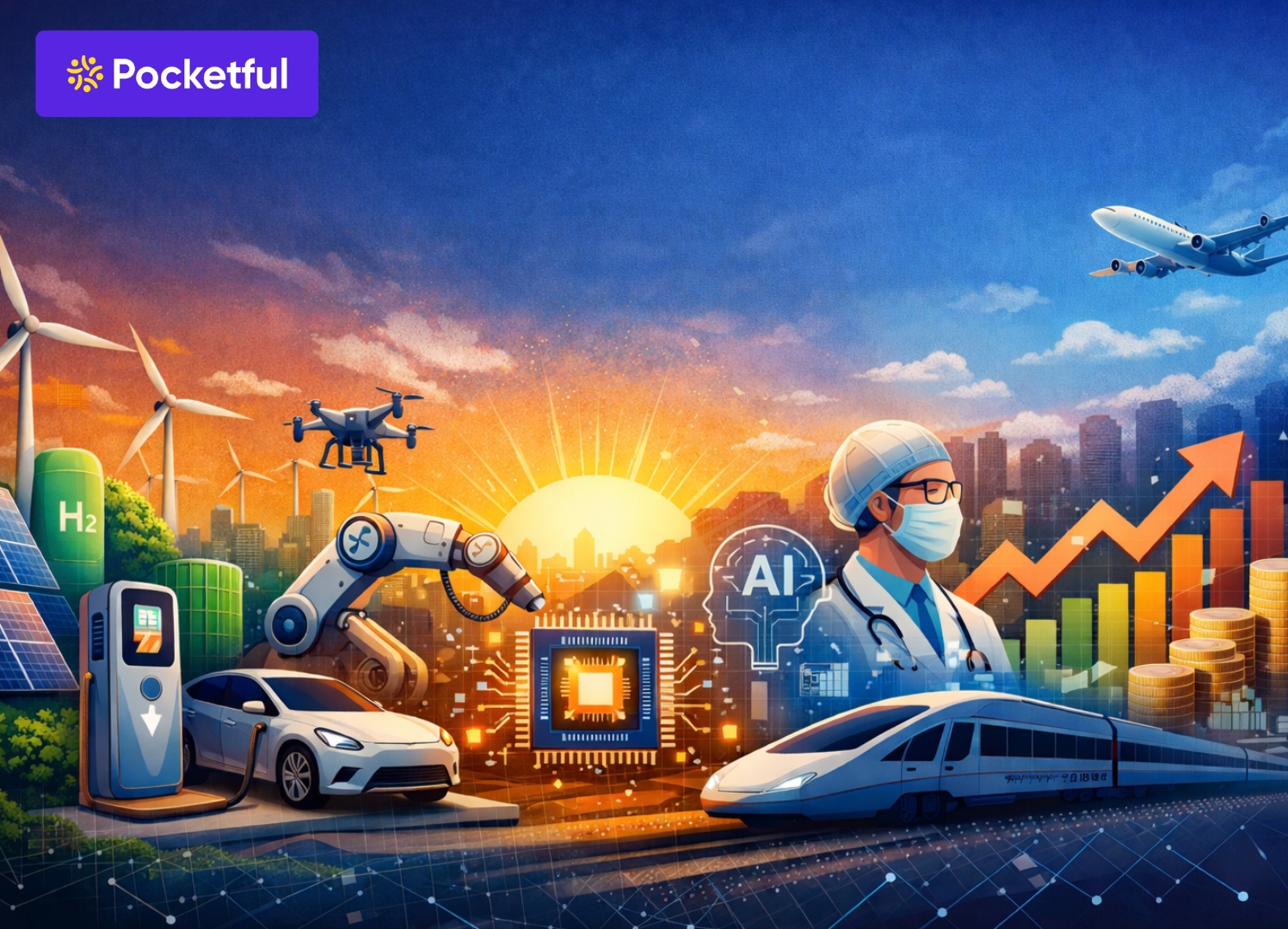
India has been a country of transition. From the era of agricultural development to the manufacturing sector, and later to services, each decade has transformed how the economy functions. The change that we are experiencing now is different. India is not only increasing in size, but also changing more than ever, as we near 2026. New industries are being built quietly, old industries are being reinvented, and opportunities are being created in places that were hardly there ten years ago.
So, which industries will define India’s future by 2026? Let us understand them in this blog.
Why 2026 is a Turning Point
India’s growth story is not changing because of a single reform. It is changing because several things are finally lining up at the same time.
We have a young population that is growing up with smartphones and digital payments. Internet access has moved well beyond metros into smaller towns and semi-urban India. Paying bills, transferring money, ordering goods, or accessing services now feels almost effortless. On the global front, companies are rethinking where they manufacture. Depending on one country is no longer seen as safe, and India is gradually becoming an alternative. On top of that, Government policies encourage domestic manufacturing, clean energy, and infrastructure creation.
List of Future Industries in India 2026
1. Clean Energy and Green Technology
- Clean energy is no longer an idea discussed only at global climate events. Solar parks, wind farms, and renewable power projects are now part of India’s growth story
- What is interesting is that the opportunity is not limited to power generation alone. Entire ecosystems are emerging around it, battery storage, smart grids, energy-efficient equipment, and green hydrogen.
- For India, this shift matters on multiple levels. Lower energy costs improve industrial competitiveness, reduce dependence on imports, and help in creating employment.
Read Also: Fastest Growing Industries in India
List of Companies Relevant to the Industry based on Market Capitalisation
| Company Name | Market Capitalisation (in INR cr.) |
|---|---|
| Adani Green Energy | 1,67,905 |
| Tata Power | 1,23,500 |
| JSW Energy | 89,984 |
| NHPC | 83,946 |
| NTPC Green Energy | 79,165 |
2. Electric Vehicles
- Changes have occurred rapidly in the transportation industry over the last few years. It is no longer exclusively for premium buyers. Electric two-wheeler and three-wheeler motorcycles, delivery fleets, and public transportation buses have all become common in the Indian market.
- Infrastructure for charging stations, battery production plants, battery recycling, fleet management software, and new supply chains is also rapidly growing in tandem with the other trends in the industry.
- Established automotive manufacturers are rethinking their approaches toward electric vehicles. A number of new electric vehicle startups are entering markets that did not even exist for electric vehicles only a few years ago.
- The evolution of electric vehicles in India will most likely have a great impact on the country by 2026.
List of Companies Relevant to the Industry based on Market Capitalisation
| Company Name | Market Capitalisation (in INR cr.) |
|---|---|
| Maruti Suzuki India | 5,43,693 |
| Mahindra & Mahindra | 4,70,595 |
| TVS Motor Company | 1,83,738 |
| Tata Motors PV | 1,35,859 |
| Hero MotoCorp | 1,20,020 |
3. Artificial Intelligence
- Loan approvals, fraud alerts, medical diagnostics, customer support, and AI are now embedded in systems we use without thinking about it.
- With a large pool of engineers, analysts, and tech professionals, the country is well placed to build AI solutions. By 2026, the focus will be on developing systems designed for Indian use cases and exporting them globally.
- Work itself will evolve. Routine tasks will increasingly be automated, while roles that involve judgement, analysis, and system design will become more valuable.
- The employees will not only be technically skilled, instead they will also be people who understand actual problems and know how to solve them using technology.
List of Companies Relevant to the Industry based on Market Capitalisation
| Company Name | Market Capitalisation (in INR cr.) |
|---|---|
| TCS | 11,78,490 |
| Infosys | 6,53,694 |
| HCL Technologies | 4,38,746 |
| Wipro | 2,78,477 |
| Persistent Systems | 98,660 |
4. Healthcare, HealthTech, and Biotechnology
- Healthcare is no longer restricted to hospitals and clinics. Teleconsultations, electronic medical records, remote consultations, and fast diagnostics are becoming common these days.
- At the same time, the development of the industry is also being driven by the growing knowledge and requirement for high-quality healthcare.
- Pharmaceutical, biotechnology, and medical innovation research are becoming important, not only to the needs of the domestic markets but also in the international markets.
- Healthcare will be among the most balanced growth sectors in India by 2026 due to the need, innovation, and long-term demand.
List of Companies Relevant to the Industry based on Market Capitalisation
| Company Name | Market Capitalisation (in INR cr.) |
|---|---|
| Sun Pharma | 4,22,026 |
| Divi’s Laboratories | 1,76,351 |
| Torrent Pharmaceuticals | 1,33,251 |
| Cipla | 1,23,694 |
| Apollo Hospitals | 1,05,677 |
5. Manufacturing
- For a long time, manufacturing was seen as India’s weak link. That perception is changing slowly.
- Electronics, semiconductors, defence equipment, and precision engineering are areas where capacity is being built step by step.
- Modern manufacturing is not only about scale or low-cost labour. It is about automation, quality control, resilient supply chains, and meeting global standards. Concepts like smart factories and real-time data monitoring are no longer experimental, but they are becoming standard practice.
- By 2026, manufacturing is likely to play a much larger role in defining India’s economic identity than it did a decade ago.
List of Companies Relevant to the Industry based on Market Capitalisation
| Company Name | Market Capitalisation (in INR cr.) |
|---|---|
| Reliance Industries | 20,40,996 |
| Larsen & Toubro | 5,69,786 |
| Hindustan Aeronautics Ltd | 3,01,962 |
| Bharat Electronics Ltd | 3,01,894 |
| Dixon Technologies | 71,227 |
6. FinTech and Financial Services
- Digital payments are now routine, even in small towns. Lending, investing, and insurance have moved from paperwork to online platforms. You can now buy insurance, pay lakhs, and take loans in just a few simple clicks.
- The next phase of growth is not about reach anymore. Better credit assessment, customised financial products, and smarter risk management are becoming the focus.
- Technology is making finance not just more inclusive, but more efficient.
- For professionals, this sector is the combination of finance, technology, and human behaviour, making it one of the most versatile career paths as we move toward 2026.
List of Companies Relevant to the Industry based on Market Capitalisation
| Company Name | Market Capitalisation (in INR cr.) |
|---|---|
| HDFC Bank | 14,80,001 |
| ICICI Bank | 10,09,162 |
| State Bank of India | 9,40,695 |
| Bajaj Finance | 6,08,216 |
| Kotak Mahindra Bank | 4,26,940 |
7. Consumer, Media, and Experience-Driven Businesses
- Consumption patterns change as incomes grow. People are increasingly investing in convenience, experience, and personalized services.
- The fruits of this shift are being enjoyed by e-commerce, quick-delivery services, online entertainment, online gaming, and online travel services.
- Companies that understand the customer preferences and act promptly are usually the winners.
List of Companies Relevant to the Industry based on Market Capitalisation
| Company Name | Market Capitalisation (in INR cr.) |
|---|---|
| Hindustan Unilever Ltd | 5,69,789 |
| ITC | 4,29,054 |
| Asian Paints | 2,73,075 |
| Nestle India | 2,54,596 |
| Zomato | 2,70,000 |
Read Also: Best Sectors to Invest in Next 10 Years in India
Challenges
Of course, every coin comes with two faces, and so the future of these industries because the picture is not without challenges. Skill gaps, regulatory delays, infrastructure constraints, and global economic uncertainty can slow progress. Not every sector will grow at the same pace, and not every startup will survive. But transitions are rarely smooth. The difference this time is that India is not betting on just one sector. Multiple industries are evolving together, making the overall ecosystem more resilient.
Conclusion
No single trend or policy is defining the evolution of future industries in India, but they are developing through a combined impact of technological innovation driving change, changing demographic dynamics. Most importantly, by 2026, India is expected to have the most diverse and interconnected economy.
If you want to identify opportunities as an investor on a longer-term horizon, or you’re a student who is deciding your career path, or you’re a working professional looking for your next career move, understanding where India is headed in the future is no longer complex. It is already taking shape.
Additionally, for a seamless investing experience and to participate in the growth story of these future-oriented industries in India, you can start your investment journey with Pocketful today.
Frequently Asked Questions (FAQs)
What are the future industries in India?
Future Industries are sectors that will be booming rapidly in the upcoming years because of technological advancement, government policies, and changing consumer demands.
Are future industries suitable for long-term investors?
Future industries often suit long-term investors who are willing to handle short-term volatility, becoming more competitive and expert-focused.
Why is 2026 important for India’s growth?
By 2026, many government initiatives, digital reforms, and infrastructure investments are expected to show real economic impact.
Which industries will grow the fastest in India by 2026?
Clean energy, electric vehicles, healthcare, artificial intelligence, manufacturing, and fintech are among the fastest-growing sectors.
Will AI create jobs in India or reduce them?
While AI may replace some routine tasks, it is expected to create more skilled jobs in technology, analytics and decision-making.