In the earlier times people used to rely on bank managers or local agents to buy mutual funds but times have changed now as digitization is taking place, in today’s time everybody is carrying a supercomputer in their pocket, and with just a few taps you can buy and become an investor.
Although access is no longer the problem, selecting the best app from dozens of apps to invest in mutual funds can be a challenge. Finding out the best place to invest in mutual funds is based on the charges, fees for features and even some hidden costs.
In this blog, we will analyse the best company to invest in mutual funds based on different factors. Whether you are a seasoned trader or a complete beginner, finding the best broker for mutual funds is the first step towards building your wealth. By the end of this blog you will get to know the best mutual fund brokers that can be aligned to your financial goals.
Direct Vs Regular Mutual funds plan
When you invest in mutual funds, you will notice two versions of the same scheme for example:
- HDFC Top 100 Fund – Regular Plan
- HDFC Top 100 Fund – Direct Plan
Here the investment is being done in the same funds with the same fund manager but there is one great difference that is The Expense Ratio.
Regular Plans: Here the fund is sold by various distributors like banks, agents, and some brokers. The mutual fund company gives these middlemen commission for selling the fund and this commission is deducted from your investment value every year.
Direct Plans: Here the funds are bought directly from the fund house or the mutual fund platforms. In this no middleman is involved meaning no commission is deducted.
Comparison Table for Best Brokers for Mutual Funds in India
| Broker | Plan Type | Commission | Platform/Account Fees | AMC | Holding Format | Suitable For |
|---|---|---|---|---|---|---|
| Zerodha Coin | Direct | Rs.0 | Free | Rs.300+GST/year | Demat | Active Traders who want stocks & MF in one place |
| Paytm Money | Direct | Rs.0 | Free | Rs.0 (lifetime free) | Demat | Mobile first investors looking for zero costs |
| ET Money | Direct | Rs.0 | Free (Genius is a paid plan) | Rs.0 (No Demat Required) | SOA | Investors who prefer “Statement of Account” |
| Kuvera | Direct | Rs.0 | Free | Rs.0 (No Demat Required) | SOA | Long term goal based investors & family account |
| IND Money | Direct | Rs.0 | Free | Rs.0 | Demat | Investors tracking US stocks & Indian MFs together |
| Pocketful | Direct | Rs.0 | Free | Rs.0 | Demat | Users looking for a simple, zero-AMC Demat app |
| Angel One | Direct | Rs.0 | Free | Rs.240+GST/year | Demat | Investors who already use Angel One for trading |
| 5paisa | Direct | Rs.0 | Free | Rs.300+GST/year | Demat | Existing 5 paisa traders |
| Fisdom | Direct | Rs.0 | Free | Rs.299+GST/year (1st year free) | Demat | Investors comfortable with standard broker fee structure |
| Scripbox | Direct/Regular | Rs.0 | Free for Regular, Paid for Direct | Rs.0 (No Demat required) | SOA | Beginners needing automated guidance (Regular Plan) |
Read Also: Top 10 Mutual Fund Distributors in India
Top 10 Mutual Fund Brokers in India
1. Zerodha Coin
This is one of the biggest broking platforms in India and their Coin platform is specifically dedicated for sale and purchase of mutual funds. Unlike most of the other platforms that use the “Statement of Account” (SoA) mechanism, Zerodha holds your mutual fund units Demat form, meaning the mutual funds sit in the same account where your stocks and bonds are placed.
Key Features:
Unified Portfolio: One place to view all your investments may be stocks, gold bonds, ETFs, and mutual funds.
Pledging for Margin: If you are F&O investors you can pledge your mutual fund holdings to get the margin limit.
Step-Up SIP: Here you can automate your wealth building process by instructing the app to increase the SIP amount by 10% depending upon when you want to increase it.
Costs:
Commission: Rs.0 (Direct Plan)
Platform Fee: Rs.0
Demat AMC: Zerodha charges Rs.300 + GST per year as Annual Maintenance Charge (AMC) for the Demat account.
2. Paytm Money
This brought “Direct Mutual Fund” for the masses, their main focus was to remove the jargon from finance.
Paytm Money operates as a registered Investment Advisor (RIA) and offers the public an Execution Only Platform (EOP) services. Here the SoA model is used meaning Demat account is not required to start investing, although now they offer Demat for stocks.
Key Features:
- Easy Entry: Paytm money pushed funds where investments as low as Rs.100 is accepted, making it friendly for students or first-time earners.
- Portfolio Switch: If you have old mutual funds bought via a bank or agent (Regular plans), using Paytm Money can help you switch them to Direct Plans in just a few clicks, showing the exact amount of money you will save.
- Voice Trading & Nudges: The app uses smart nudges to remind you of SIPs or alert if the fund rating is dropping.
Costs:
- Commission: Rs.0 (Direct Plans)
- Platform Fee: It is mostly free for mutual funds, though charges are there for brokerage of stocks.
3. ET Money
This is backed by the Times Group and has recently shifted its strategy from a transaction based app to a wealth management platform.
Earlier it was a free platform but now new users have to take the subscription for the premium model known as “ET Money Genius”.
Key Features:
Genius: This is the premium model where you not only get to know which fund you need to buy but also when you need to buy or sell. Here your money moves dynamically between equity, debt, and gold based on market valuations. It also helps you during the market downturn.
Portfolio Health Check: It is an analytical tool, scans your external portfolio and provides a report card highlighting high fees, poor diversification, or underperforming funds.
The “Free” Caveat: New users can access the Direct plans if they have the Genius membership or come with some restrictions. Free users get to access the Regular plans that have limited features.
Costs:
- Commission: Rs.0
- Fees: Rs.0 for mutual fund investing
4. Kuvera
Kuvera is a self using platform where you do things yourself, due to this it has zero conflict of interest and has built features that genuinely help the investors.
Kuvera has been recently acquired by CRED, but still it follows its core philosophy by providing Direct Plans only with zero commission fees and high end features for free.
Key Features:
Tax Harvesting: This is a feature that is specially created for High Net Worth Individuals (HNIs). The platform has an algorithm that alerts you to sell and rebuy your funds to utilise the Rs.1.25 lakh Long Term Capital Gains tax exemption, helping you to save the substantial taxes over decades.
Family Account: You get a family account in this where you can manage your account, your spouse’s, and even your parents account all under one login.
Trade Smart: It gives you the warning if a redemption will trigger an exit load or short-term capital gains tax.
Costs:
- Commission: Rs.0
- Fees: Rs.0 for mutual fund investing
5. 5paisa
5paisa is a discount broker which caters to the value conscious trader and investors. This platform charges a flat fee for trading services and a zero commission for mutual funds services.
Key Features:
All in One App: In this mutual funds are heavily integrated with stocks, commodities, and currency trading.
Research & Advisory: 5paisa helps the traders by recommending them stocks and funds.
Auto-Investor: This platform offers investors a robo-advisory tool that can help in building your portfolio according to the risk and goals of your profile.
Cost: Commission: Rs.0 on Direct Mutual Funds
Trading: A flat fee is charged for stock orders, that can be further less if you prefer the “Power Investor” packs.
6. Angel One
Angel One was a traditional broker earlier known as Angel Broking, has transitioned now by introducing digitization and becoming a digital fintech giant.
It has a low cost being a digital broker with an assurance of a massive offline network.
Key Features:
- ARQ Prime: This is a secure search engine tool where quantitative analysis (rule-based investing) is done recommending funds and stocks that can be bought by the investors.
- Offline Presence: It has thousands of offline brokers across India, if the user faces any issue you can connect with these offline brokers.
- Smart API: If you are a tech savvy user, this platform offers robust APIs to build custom investment platforms.
Cost:
- Commission: Rs.0 on Direct Mutual Funds
7. Pocketful
This is a rising star in the fintech space where aggressive targeting is done on things like cost and usability.
Pocketful is a modern day platform which helps in creating a tech savvy financial ecosystem for the investors. While most of the brokers focus only on the transaction, Pocketful focuses on the cost of holding and ease of selection.
Key Features:
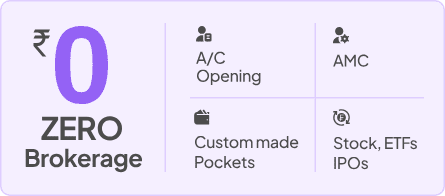
- Lifetime Zero AMC: Most of the brokers charge Rs.300-Rs.700 per year as the annual maintenance charge but Pocketful removes this entirely.
- Thematic “Pockets”: This platform offers a curated basket of stocks and ETFs known as “Pockets” (E.g.: Green Energy, EV, Digital India). Investors can start their SIP via “Pocket” just like the mutual funds.
- Direct Mutual Funds: Investors can execute Direct Mutual Funds without paying any commission.
- TradingView Integration: For investors who rely on data and charts, Pocketful helps in providing it with integrated premium charting tools.
Costs:
- Commission: Rs.0 on Mutual Funds
- AMC: Rs.0 (Lifetime Free)
- Delivery Brokerage: Rs.0 for stocks
8. IND Money
This was introduced in the market as a portfolio tracker and with time it has evolved as a “Super Finance App”.
It behaves like Google for your finances as it can track your credit card bills, EPF, PPF, insurance, and investments all in one dashboard.
Key Features:
- US Stocks: IND Money helps the investor with not only the domestic market but also the US markets where you can easily invest in stocks like Apple, Tesla, Microsoft etc. Here you can even manage both the stocks in the same platform.
- Family Office: It helps in tracking the family’s net worth across multiple platforms and brokers and gives you an auto update email to update your portfolio (though you need to give privacy permission).
- Switch to Direct: By this feature you can switch your regular plans to direct plans helping you to save on commissions.
Costs:
- Commission: Rs.0 on mutual funds.
- US Trading: Charges are applied as per forex transfer and US brokerage.
9. Fisdom
This is a platform that is less linked directly to the consumer brand and acts more like a Bank Partner. This platform is the power house for investment sections of many major banks like Indian Bank, UCO Bank, etc.
Key Features:
- Bank Integration: If you are investing using this platform, it often acts as an extension of your savings account.
- Pension Products: There is a strong focus on NPS (National Pension System) and retirement planning.
- Higher Touch: There is an intense focus on “solution-oriented” advice such as Children’s Education funds rather than giving users multiple schemes.
Costs:
- Commission: Rs.0
- Fees: Rs.0 for mutual fund investing
10. Scripbox
This is one of India’s first Robo-Advisors for the investors, here it focuses on lowering down the choices and giving users a more accurate product as per their financial plans.
Here the users can add filters of their own choice and rather than showing you thousands of funds it selects a basket of 2-4 funds for the investors.
Key Features:
- Algorithmic Selection: Here you get a “Scripbox Portfolio” where you can pick your goal like “Long Term Wealth” or “Emergency Fund” and accordingly this platform will curate a basket for your needs.
- Automated Review: The platform reviews your portfolio and if there are underperforming funds you get the advice to either exit or switch to a better option.
Costs:
- Hybrid Model: Regular plans investing is free of cost, although if you want to invest in Direct Plans, you need to have a subscription or advisory fee charged.
Key Factors to Select the Best Broker for Mutual Funds Investing
- Costs and Fees: Always look for the fees and charges like AMC, brokerage, etc, as this in the long term can eat up your profits.
- Options: Look what you want to invest in, is it just the mutual funds or stocks or global stocks or you want an all in one app.
- Ease of Use and Accessibility: The app should have a good interface with easy tracking and order placing. One such app is pocketful that is one of the best user friendly apps for new investors.
- Research and Analysis: If you are into data and analytics you need to look for an app that helps you with R&D on your behalf.
Read Also: Best Mobile Trading Apps in India
Conclusion
The Indian mutual fund market is evolving and now you don’t have to pay 1% commission to a bank agent. If you are a trader who wants to pledge mutual funds for margin then an app like Zerodha Coin can be helpful. If you are looking for a very low cost platform for a diversified portfolio (Stocks + Mutual Funds) even without paying extra charges and AMC then Pocketful can be a reliable option. Start investing today, complete your KYC, and start investing.
Frequently Asked Questions (FAQs)
Can an investor have multiple accounts with multiple brokers?
Yes, you can have multiple accounts for stocks you can rely on Zerodha, Kuvera for mutual funds and for ease of tracking and everything at one place then Pocketful is a trusted option.
Is it safe to invest through online platforms like Pocketful or Paytm Money?
Yes, these apps are SEBI-registered and your units are safely put with the mutual fund company or in your Demat account (CDSL/NSDL).
Is it advantageous to have a “Zero AMC” charging platform?
Most of the brokers charge Annual Maintenance Charge (AMC) which can collectively lower down your accumulated profits. But platforms like Pocketful help users to trade without any AMC.
Can I switch from a Regular Plan to a Direct Plan?
Yes, most of the apps have a “Switch” feature where you can directly switch to the direct plan.
Why do some apps charge a subscription fee for Direct Plans?
Platforms like ET Money (Genius) or Scripbox act as wealth managers. They charge a fee not for the transaction (which is free) but for the recommended services.