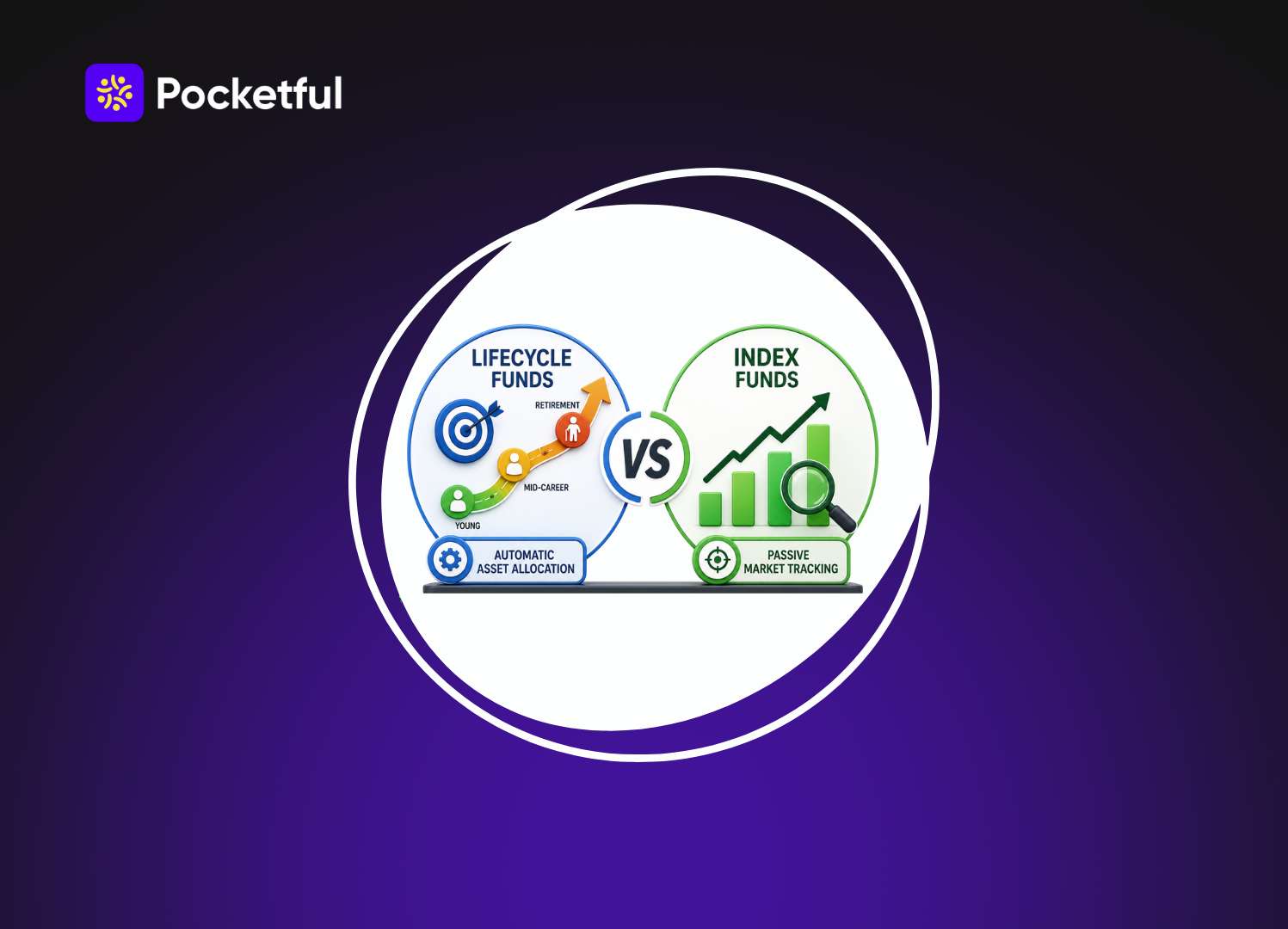
It is tough to decide between Lifecycle Funds vs Index Funds when both have the same goal of long-term growth. The real difference is in how they work. One shifts your investments automatically over time, while the other requires you to make the calls. This quick guide breaks down those differences simply to help you choose what fits your financial goals.
What Are Lifecycle Funds?
Lifecycle funds, also known as target-date funds, are mutual funds designed with a specific financial goal in mind such as retirement or a child’s education. Their most distinctive feature is that the asset allocation adjusts automatically over time. Initially, a significant portion of the fund is invested in equities to generate superior long-term returns. However, as the target date approaches, the equity exposure is reduced and the debt allocation is increased in an effort to lower risk.
This adjustment process is known as the “glide path.” Since the glide path can vary from one fund house to another, the investment strategies of different lifecycle funds are not identical.
Example: Suppose you are 30 years old and aim to retire at 60. In this scenario, a Lifecycle Fund might initially allocate the majority of your investment to equities. However, as retirement approaches, the fund automatically reduces equity exposure and increases investment in debt instruments. This eliminates the need for you to manually rebalance your portfolio every few years.
What Are Index Funds?
Index funds are mutual funds that invest based on a specific market index. Simply put, if a fund tracks the Nifty 50, it invests in the companies comprising that index in roughly the same proportions. Its objective is not to outperform the market, but rather to deliver performance that mirrors the tracked index as closely as possible.
These funds do not employ a strategy of frequent buying and selling of shares. If a company is added to or removed from the index, the fund adjusts its portfolio accordingly. This makes them relatively simple to manage and results in lower costs compared to many active funds.
Example: Suppose you have invested in a Nifty 50 Index Fund. If the Nifty 50 sees significant growth in the future, the value of your investment is likely to rise in roughly the same proportion. Conversely, if the market declines, the impact will be reflected in your fund as well, since it directly tracks that specific index.
Lifecycle Funds vs Index Funds
| Comparison Factor | Lifecycle Funds | Index Funds |
|---|---|---|
| Investment Objective | Investing according to a specific financial goal, such as retirement or education. | Tracking the performance of a market index |
| Asset Allocation | It changes on its own with time. | The investment ratio does not change unless the investor themselves makes a change. |
| Risk Level | Relatively higher initially, then gradually decreases. | The risk remains in line with the index being tracked. |
| Portfolio Rebalancing | Automatic as per fund strategy | The investor may need to rebalance the portfolio themselves if the need arises. |
| Fund Management | The equity-to-debt ratio is adjusted according to the target. | Only the selected index is followed. |
| Return Potential | Depends on asset allocation | Close to the performance of the relevant market index |
| Expense Ratio | It can generally be slightly higher than index funds. | It is often lower because it is a passive fund. |
| Role of the investor | Lower, because the fund itself carries out most of the changes. | More so, because the investor has to make the asset allocation decision. |
| Better for whom? | Investors focused on goal-based and retirement planning | Investors seeking long-term wealth creation and passive investing. |
Read Also: Index Funds vs Mutual Funds: Key Differences
How Lifecycle Funds Work
Lifecycle funds operate based on a pre-determined investment strategy. In these funds, the fund manager periodically adjusts the investment allocation to ensure the fund stays on track to meet its defined objective. The aim is not to react to every minor market fluctuation, but rather to maintain a balanced portfolio aligned with the investment horizon.
Note: The actual asset allocation may vary according to the strategy of each lifecycle fund and fund house.
| Investment Stage | Fund’s Approach |
|---|---|
| Early Stage | Greater focus on growth |
| Mid Stage | Balancing growth and stability |
| Near Goal | Greater focus on risk reduction |
| Target Year | An attempt to keep capital relatively stable. |
How Index Funds Work ?
When you invest in an index fund, your money is allocated directly in accordance with the composition of a specific benchmark index. The fund operates based on pre-determined rules, so there is no need for frequent decisions regarding stock selection or trading. Whenever the composition of the benchmark index changes, the fund incorporates that change into its portfolio. Due to this process, the index fund’s performance remains very close to that of its benchmark over the long term.
Index Funds Working Process
| Step | What Happens |
|---|---|
| 1 | A benchmark index is selected. |
| 2 | The portfolio is constructed in accordance with that index. |
| 3 | The portfolio is updated when changes occur in the index. |
| 4 | The fund’s performance attempts to track the benchmark. |
Pros and Cons of Lifecycle Funds
Lifecycle funds can be convenient for investors who wish to invest for the long term and prefer not to manage their portfolios frequently. However, like any investment, they come with both advantages and limitations.
| Advantages | Limitations |
|---|---|
| Investments are continuously adjusted over time in accordance with your goals. | Asset allocation follows a pre-determined strategy, so it is not easy to alter it according to one’s preference. |
| There is no need to rebalance the portfolio frequently. | The same glide path may not always be suitable for different investors. |
| They can be useful for long-term financial goals, such as retirement planning. | In some cases, the expense ratio can be higher than that of index funds. |
| The likelihood of emotional decisions in investment is reduced. | If the investment goal changes, you might need to switch funds. |
| The investment process becomes relatively easy for new investors. | Investors seeking greater control might find this less flexible. |
Pros and Cons of Index Funds
Index funds are quite popular due to their low costs and simple investment strategy. However, it is also important to understand their advantages and limitations before investing in them.
| Advantages | Limitations |
|---|---|
| Generally, the expense ratio is low. | The value of the fund may also decrease when the market falls. |
| The investment strategy is transparent because it follows a specific index. | The goal is not to deliver returns that outperform the market. |
| It is considered a good passive investment option for long-term investment. | The investor has to make the decision regarding asset allocation themselves. |
| There is no need to repeatedly select stocks. | Additional funds may be required for different financial goals. |
| Changes to the portfolio occur only when there are changes to the index. | Returns may differ slightly from the index due to tracking error. |
Who Should Choose Lifecycle Funds?
Every investor has unique needs. Lifecycle funds are considered particularly suitable for those who prefer to keep their investments simple and wish to avoid the hassle of managing their portfolio over time.
- Retirement Planning: If your primary goal is saving for retirement, this can be a suitable option.
- First-Time Investors: This is an easy option for those just starting their investment journey who lack experience with asset allocation.
- Busy Professionals: Lifecycle funds can be useful if you do not have the time to regularly track or rebalance your portfolio.
- Goal-Based Investors: These funds are suitable for investors saving for specific financial goals, such as children’s education or retirement.
- Investors Who Prefer Automatic Management: If you want your investments to automatically rebalance over time, lifecycle funds can be an excellent choice.
Who Should Choose Index Funds?
Index funds can be a great choice for investors looking for low-cost, long-term investments who are comfortable aligning with market performance.
- Long-Term Investors: If your investment horizon spans 10–15 years or more, index funds can be an excellent option.
- Cost-Conscious Investors: Index funds are suitable for investors who prefer funds with low expense ratios.
- Passive Investors: If you wish to avoid the hassle of frequent stock selection or active trading, index funds could be the right choice for you.
- DIY Investors: Individuals who prefer to personally determine the balance between equity and debt based on their specific needs can opt for index funds.
- Wealth Creation Seekers: If your primary goal is gradual wealth creation over the long term and you can handle market volatility, index funds can be a great option.
Read Also: ETF vs Index Fund: Key Differences
Start Investing in Lifecycle and Index Funds with Pocketful
If you want to start investing in Lifecycle Funds or Index Funds, Pocketful can be an easy and convenient platform.
Why Choose Pocketful?
- Free Demat Account Opening
- Lifetime Zero AMC
- Simple and User-Friendly App
- Quick Digital KYC Process
- Easy Access to Mutual Fund Investments
- Stocks, ETFs, and other investment options on a single platform
Conclusion
There is no single winner between Lifecycle Funds and Index Funds. If you prefer a hands-off approach where your money automatically rebalances over time, Lifecycle Funds fit perfectly. But if you want a low-cost way to track the market long-term, Index Funds are the way to go. Your choice simply comes down to your personal investment style and goals.
Frequently Asked Questions (FAQs)
What is the difference between Lifecycle Funds and Index Funds?
Lifecycle Funds adjust their asset allocation over time, whereas Index Funds track a specific market index.
Are Lifecycle Funds good for retirement planning?
Yes, they are specifically designed with long-term financial goals, such as retirement, in mind.
Do Index Funds give guaranteed returns?
No, their returns depend on market performance.
Which is better for beginners: Lifecycle Funds or Index Funds?
If you do not wish to manage your portfolio yourself, Lifecycle Funds can be a better option.
Are Index Funds low-cost investments?
Yes, most Index Funds have a lower expense ratio compared to active funds.