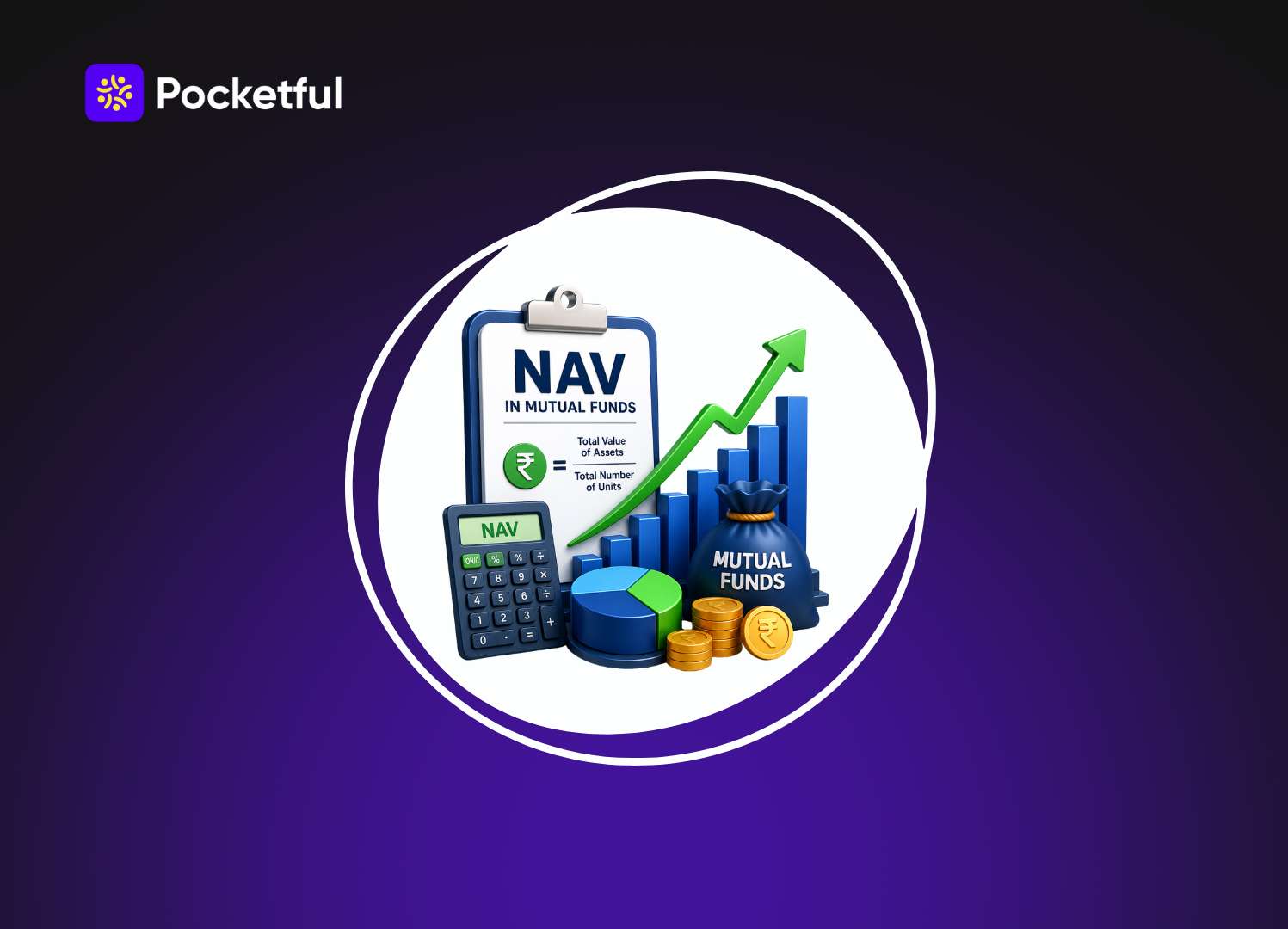
NAV is a key factor people look at when investing in mutual funds. It is assumed that a lower NAV is better. This will offer you good returns when the mutual fund grows. But even after this, it is wrong to assume that a good NAV is always one which is lower.
This is why you must know what is a good NAV for a mutual fund. By doing so, you can actually plan your investment better. But the question is how?
So, read this guide to know what a good NAV is. But before that, let us explore the meaning of NAV.
NAV Full Form and Meaning
The NAV full form is Net Asset Value. In the mutual funds, the value of one unit of the fund is shown after all the assets and liabilities are considered. This value is calculated at the end of every trading day.
So, when you buy or sell mutual funds, the value is calculated based on the NAV.
No matter whether you invest in a lump sum or SIP, the meaning of the NAV remains the same. But the benefit that you get is when you invest via SIP. The NAV keeps on changing. So, if the NAV is low, you will be allotted more units. This will give you benefits with long-term investing.
How Is NAV Calculated?
Mutual fund houses calculate NAV using a standard formula.
NAV = (Total Assets – Total Liabilities) ÷ Total Outstanding Units
Where:
- Total Assets include stocks, bonds, cash holdings, and other investments.
- Total Liabilities include operating expenses and other obligations.
- Outstanding Units represent the total units held by investors.
Example of NAV Calculation
Suppose a mutual fund has:
- Total assets worth ₹500 crore
- Liabilities worth ₹20 crore
- 24 crore outstanding units
To find NAV, let’s find the actual net value first.
₹500 crore – ₹20 crore = ₹480 crore
Now, let’s divide it by the units;
₹480 crore ÷ 24 crore units = ₹20
NAV = ₹20 per unit.
Does NAV Determine Mutual Fund Returns?
This is a common question that people ask. Many people think that lower NAV means better returns and profits.
But in real conditions, this is not. The returns are not based on the NAV of the mutual funds. To understand this, here is a quick example for you:
| Fund | NAV | Investment Amount | Units Purchased |
|---|---|---|---|
| Fund A | ₹20 | ₹10,000 | 500 |
| Fund B | ₹100 | ₹10,000 | 100 |
Now, from the comparison, one thing is clear: NAV has a direct impact on the units allotted.
Now, there are chances that both these grow by the same percentage, and so your returns will be the same. If Fund A has an annual return of 2% and Fund B has an annual return of 18%, the latter will provide higher returns irrespective of its NAV.
So, as an investor, you would need to focus on factors like market conditions, fund strategy, and portfolio quality.
What Is a Good NAV for a Mutual Fund?
The definition of good NAV is not linked to the amount in any way. It is all based on the mutual fund and management. Also, a good NAV will differ for every investor.
One who is looking to invest a low amount might look for a low NAV, so that more units can be allotted. A person looking for wealth creation might look for a fund with good returns even when the NAV is high. So, this is good for them.
So, some factors that might contribute to the same are:
- Historical performance
- Risk-adjusted returns
- Fund manager experience
- Portfolio diversification
- Expense ratio
- Investment objective
- Consistency across market cycles
These factors provide a clearer picture of a fund’s potential than its NAV.
Read Also: What Is iNAV in ETFs?
Why Some Funds Have Higher NAVs
Many investors wonder why certain mutual funds have NAVs of ₹300, ₹500, or even higher.
This usually happens because the fund has been operating successfully for a long period.
As the underlying investments appreciate over time, the NAV gradually increases.
For example:
A fund launched at ₹10 NAV may grow to:
- ₹25 after a few years
- ₹80 after a decade
- ₹300 or more over a longer period
A higher NAV often reflects growth accumulated over time rather than an expensive investment.
Why New Mutual Funds Usually Have Lower NAVs
New Fund Offers (NFOs) are generally launched at an NAV of ₹10. This is why many people think that the new funds are cheaper compared to those already existing in the market.
But if you evaluate this, you might find that there is no benefit for you in general.
Consider these two scenarios:
- Existing Fund: NAV ₹100
- New Fund: NAV ₹10
If both funds invest in similar stocks and generate identical returns, the investor’s percentage gain will be the same.
A lower NAV only means you receive more units. It does not mean you earn higher returns.
How Much NAV Is Good in Mutual Fund Investments?
When investors ask, how much NAV is good in mutual fund investing, the answer is simple.
The NAV itself is not a measure of quality.
Instead of looking for a specific NAV level, evaluate whether the fund:
- Meets your investment goals
- Has delivered consistent performance
- Maintains reasonable risk levels
- Has a strong portfolio
- Is managed by an experienced fund house
A fund with a ₹300 NAV may be a better investment than one with a ₹10 NAV if it has a stronger track record and better fundamentals.
Factors That Matter More Than NAV
When you are investing in mutual funds, you should focus on various factors. These are as follows:
1. Fund Performance
Start by checking the fund’s performance in the past years. Consider 1,3,5, or even 10 years history check. If there is stability in long-term, then it is better for you.
2. Risk Profile
A fund should align with your risk tolerance. This includes the following things to check for ease:
- Large-cap funds generally carry lower risk.
- Mid-cap funds carry moderate risk.
- Small-cap funds can be more volatile.
3. Expense Ratio
The expense ratio affects your net returns. So, if you are checking a fund, look for one with a lower expense ratio, as this will ensure the maximum amount gets invested. This is beneficial in longer run.
4. Fund Manager Track Record
The experience and investment approach of the fund manager can influence performance over time.
5. Portfolio Quality
Check the sectors, stocks, and assets held by the fund. If a fund is one with proper diversification, then the risk will be better managed, and so your returns will be good.
NAV in SIP Investments
Many investors starting a Systematic Investment Plan want to understand how NAV affects their investments.
In SIPs, your fixed investment amount purchases units based on the prevailing NAV.
For example:
| Month | Investment | NAV | Units Purchased |
|---|---|---|---|
| January | ₹5,000 | ₹20 | 250 |
| February | ₹5,000 | ₹25 | 200 |
| March | ₹5,000 | ₹18 | 277.78 |
- When NAV falls, you purchase more units.
- When NAV rises, you purchase fewer units.
This process helps average the purchase cost over time and is known as rupee cost averaging.
Because of this feature, SIP investors generally do not need to worry about finding the “perfect” NAV.
Common Myths About Mutual Fund NAV
As an investor, there are certain myths that you should be careful of. These are:
- Returns depend on portfolio performance, not the NAV level.
- A higher NAV often reflects long-term growth rather than overvaluation.
- A ₹10 NAV does not make an NFO superior to an established fund.
- Mutual fund NAV and stock prices operate differently.
How to Choose a Mutual Fund Instead of Looking at NAV
A practical approach is to compare funds based on meaningful parameters.
| Evaluation Factor | Importance |
|---|---|
| Long-term returns | High |
| Risk-adjusted performance | High |
| Expense ratio | High |
| Fund manager quality | High |
| Portfolio diversification | High |
| NAV value | Low |
This approach helps investors focus on factors that genuinely impact wealth creation.
Read Also: Practical Tips for Investing in Mutual Funds for Beginners in India
Conclusion
Knowing the NAV full form in a mutual fund or the NAV full form in SIP is very important. But at the same time, it is important to understand that there is no such thing as a good NAV. Also, the NAV has no direct impact on your returns.
So, as an investor, you need to analyse all the aspects before you invest. Assessing the options with the help of experts and through platforms like Pocketful can help you greatly. So, start investing right today.
Frequently Asked Questions (FAQs)
What is the best NAV for mutual funds?
There is no best NAV for a mutual fund. A lower or higher NAV does not indicate whether a fund is better. This is why you should consider factors like past performance, manager, and portfolio for insights.
Is a higher or lower NAV better?
Neither is inherently better. NAV impacts the units that are being allotted to you, but returns are based on management, market, portfolio, and other factors.
How to know if NAV is good or bad?
NAV itself is not good or bad. To evaluate a mutual fund, look at historical returns, risk levels, consistency, fund management quality, and portfolio composition rather than the NAV number.
Which NAV will I get for mutual fund?
You receive the applicable NAV based on the time your investment transaction is processed and accepted according to mutual fund cut-off timings and regulatory guidelines.
What is a normal NAV?
There is no normal NAV range. Mutual funds can have NAVs ranging from ₹10 to several hundred rupees. The NAV value alone does not determine the quality or attractiveness of the investment.