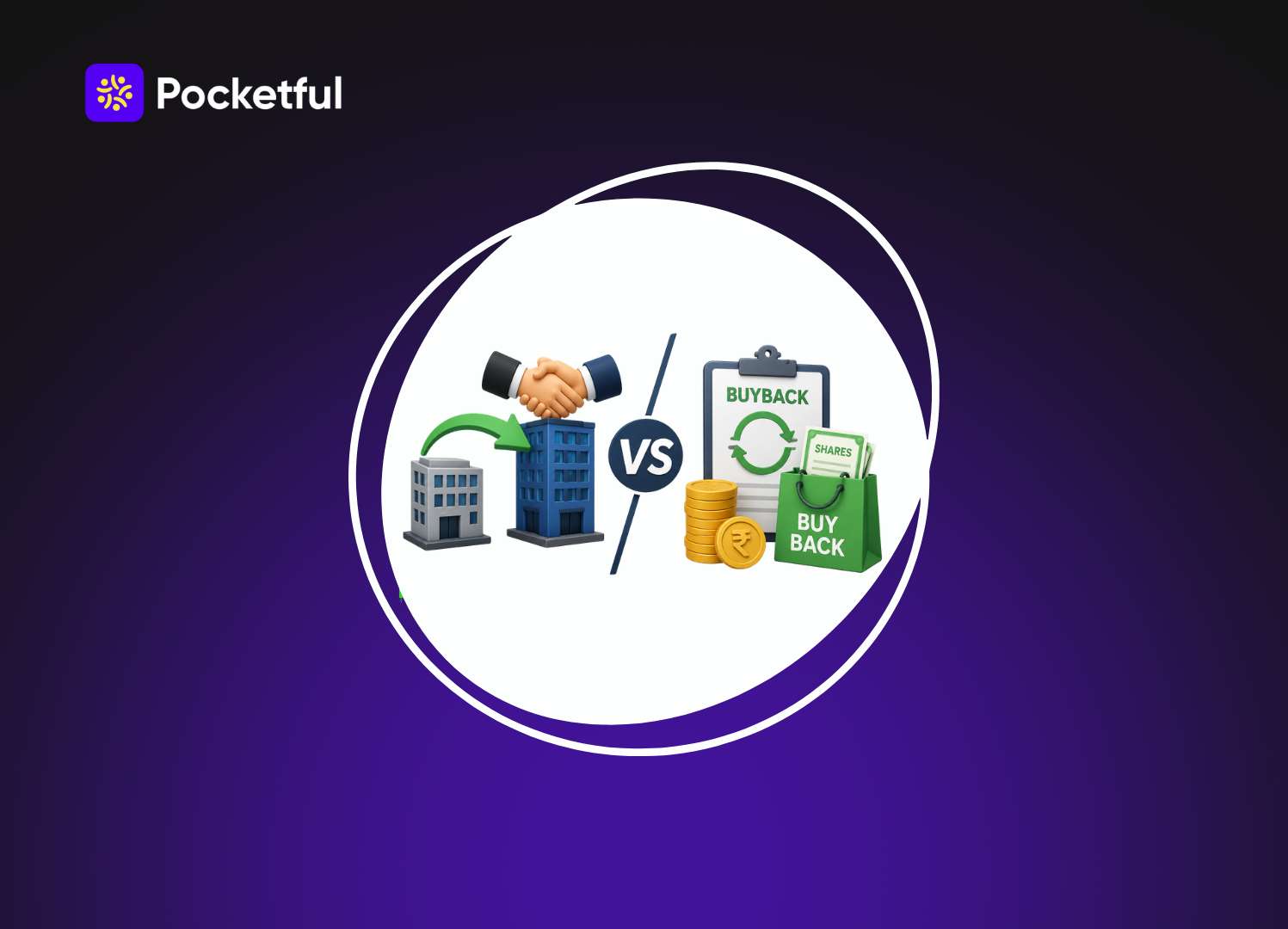
Investors often hear both words in the share market and get confused. Both are associated with the purchase of the shares, but the end impact is different. The takeover impacts the company, while the buyback impacts the shareholders mainly.
Understanding the difference between takeover and buyback is important. This will help you understand how your ownership will be impacted. It will guide you on how you should reach in both situations.
This guide explains what is takeover, what is buyback, how each process actually works in the Indian market, and how to read the two events when they show up in your holdings.
What Is Takeover
A takeover happens when one company, or an individual acquirer, gains control of another company. This is usually done by buying a controlling stake in its shares. Most of the time, when 25% or more voting rights are taken over as per the SEBI’s regulations, we call it a takeover.
Control can be acquired through various ways, such as:
- Open market purchases
- Negotiated deal with existing promoters
- Mandatory open offer to public shareholders
In India, takeovers are governed by the SEBI (Substantial Acquisition of Shares and Takeovers) Regulations, 2011. It is commonly called the Takeover Code. Once an acquirer crosses the 25% threshold or seeks to gain control regardless of shareholding, the code requires a public announcement.
Also, an open offer to buy at least 26% of the target company’s shares from public shareholders at a regulator-defined price needs to be made. This protects minority shareholders by giving them a chance to exit at a fair price rather than being left holding shares under a new, unknown management.
Types of Takeover
- Friendly takeovers is the one where the target company’s management and board support the acquisition. They all negotiate terms jointly, making the process simpler and quicker.
- Hostile takeovers are situations where the acquirer bypasses the target’s management. They directly make an appeal to the shareholders. This is often through an open offer at a premium to the market price.
- Reverse takeovers are situations where a smaller company acquires a larger one. It is often used to gain a stock exchange listing. This is done without going through a traditional IPO.
For shareholders, a takeover usually means one of two things:
- An open offer that lets you sell your shares at a set price.
- A change in company ownership and strategy.
What Is Buyback
A buyback is formally a share repurchase. It is when a company buys back its own shares from existing shareholders. The company does this to reduce the outstanding shares. It helps in the valuation as well.
The company uses its own cash reserves to do this. All the shares bought back are typically extinguished, permanently reducing the total share count. This is beneficial for those who have shares in the market already, as they get more control.
Buybacks in India are governed by the SEBI (Buy-Back of Securities) Regulations, 2018.
The companies can execute them through two routes:
1. Tender Offer Route
Here, the company announces a fixed price. It is usually at a premium to the market price. The shareholders can tender their shares proportionately based on their holdings
2. Open Market Route
The company buys back shares gradually through the stock exchange over a specified period. This is without a fixed price announced in advance.
Companies typically announce a buyback in the following situations:
- When management believes the stock is undervalued.
- If there is surplus cash sitting idle with no better investment opportunity.
- When the company wants to return value to shareholders in a more tax-efficient way.
A buyback also improves key ratios like earnings per share, since the same profit gets divided among fewer outstanding shares.
In buyback, there is no change in the company. Promoters and public shareholders continue to hold the company in roughly the same relative proportion, minus whichever shareholders chose to sell into the buyback.
Difference Between Takeover and Buyback: Side by Side
| Factor | Takeover | Buyback |
|---|---|---|
| Who initiates it | An external acquirer or another company | The company buying back its own shares |
| Effect on control | Ownership and control change hands | Control generally stays with existing promoters |
| Effect on share count | Usually unchanged | Reduces total outstanding shares |
| Governing regulation | SEBI Takeover Code, 2011 | SEBI Buy-Back Regulations, 2018 |
| Shareholder action | May need to respond to an open offer | Can choose to tender shares or stay invested |
| Typical market reaction | Price often jumps toward the open offer price | Price often rises on reduced supply and signal of confidence |
| Company’s cash position | Unaffected directly, since acquirer pays | Company cash reserves reduce |
| Frequency | Rare, event-driven, tied to a specific acquirer’s interest | More common, can recur across multiple years |
The difference between takeover and buyback comes down to one question: where is the money actually coming from or going to? A takeover is about a change of hands. A buyback is about a change of scale.
Why the Distinction Matters for Investors
Confusing the two events leads to two common mistakes.
The first mistake is assuming every corporate action that lifts the share price is the same kind of opportunity. A takeover open offer is usually a one-time exit price set by regulation, and once it closes, the stock’s future depends entirely on the acquirer’s plans, which may or may not benefit remaining shareholders. A buyback, by contrast, is management signaling confidence in the existing business using its own operating cash, and the company continues to run under the same leadership and strategy afterward.
The second mistake is misreading intent. A hostile takeover attempt can sometimes trigger a company to announce a defensive buyback, buying back shares specifically to reduce the number of shares available for the acquirer to purchase and to make the takeover more expensive. In this case, the two events appear together, but they are still fundamentally different tools serving different purposes, one changing control and the other defending it.
Reading quarterly filings, exchange announcements, and open offer documents carefully, rather than reacting to headlines alone, is the only reliable way to tell which of the two events you are actually looking at.
How to Track These Corporate Actions as a Trader
Both takeovers and buybacks move stock prices quickly once announced, so timing and information quality matter.
- Exchange filings on NSE and BSE websites carry the original public announcement for both events, well ahead of most news coverage.
- SEBI’s SAST disclosures list every substantial acquisition and takeover trigger as it crosses the regulatory threshold.
- Record dates and tender periods for buybacks are published in advance, giving existing shareholders a clear window to decide whether to tender shares.
- Open offer price versus market price is the number to track during a takeover, since the market price often converges toward the open offer price as the deadline approaches.
A trading platform with reliable corporate action alerts and a fast order execution system matters here, since the price gap between an announcement and the market’s full reaction can close within minutes of trading resuming. Traders using Pocketful can track these announcements alongside live price action and place orders through Scalper Mode when a corporate action creates a fast-moving opportunity, rather than relying on delayed news feeds.
Conclusion
The difference between takeover and buyback is really a difference in direction. In a takeover, an outsider is buying control, and shares typically stay in issue while ownership changes hands. In a buyback, the company itself is buying back its own shares, keeping control exactly where it was. Either way, both options have a direct impact on the company and the shareholders.
For traders, it is important to understand how these work. This will help them to know what impact it will have on their portfolio. This is where platforms like Pocketful can help. They can guide you through the process and share the insights as needed.
Frequently Asked Questions (FAQs)
What is a takeover in simple terms?
A takeover is when one company or investor gains control of another company. This is mainly by buying enough shares, usually 25% or more. This influences or directs its management and decisions, often triggering a mandatory open offer to public shareholders under SEBI’s Takeover Code.
What is a buyback in simple terms?
A buyback is a simple process of purchasing shares back. The company repurchases its own shares from existing shareholders. It does this by using its own cash. This reduces the total number of shares outstanding. It is done when company feels that shares are undervalued.
Does a buyback change who controls a company?
No, a buyback does not usually change control. Promoters and remaining shareholders continue to hold the company in roughly the same manner. Here, the company is simply reducing its own share count. There is no transfer of ownership to the new company. The company usually clears all the shares that they buy, making them null.
Is a takeover always good news for shareholders?
Not always. A takeover can bring a premium open offer price in the short term, but the stock’s longer-term outlook depends entirely on the new acquirer’s strategy, which may or may not align with what benefited shareholders under the previous management.
Can a company use a buyback to prevent a hostile takeover?
Yes, a company can announce a defensive buyback to reduce the number of shares available in the market. This can make it more expensive and difficult for a hostile acquirer to gain a controlling stake. But it is important to understand that both are different situations.