Choosing the right stocks in the stock market is a major challenge for many investors. Understanding how to use a stock screener for portfolio building can be very helpful. Using various filters, Pocketful Stock Screener helps you shortlist stocks according to your investment strategy. In this article, we’ll explain in simple terms how to use it correctly to build a well-balanced portfolio.
What Is a Stock Screener?
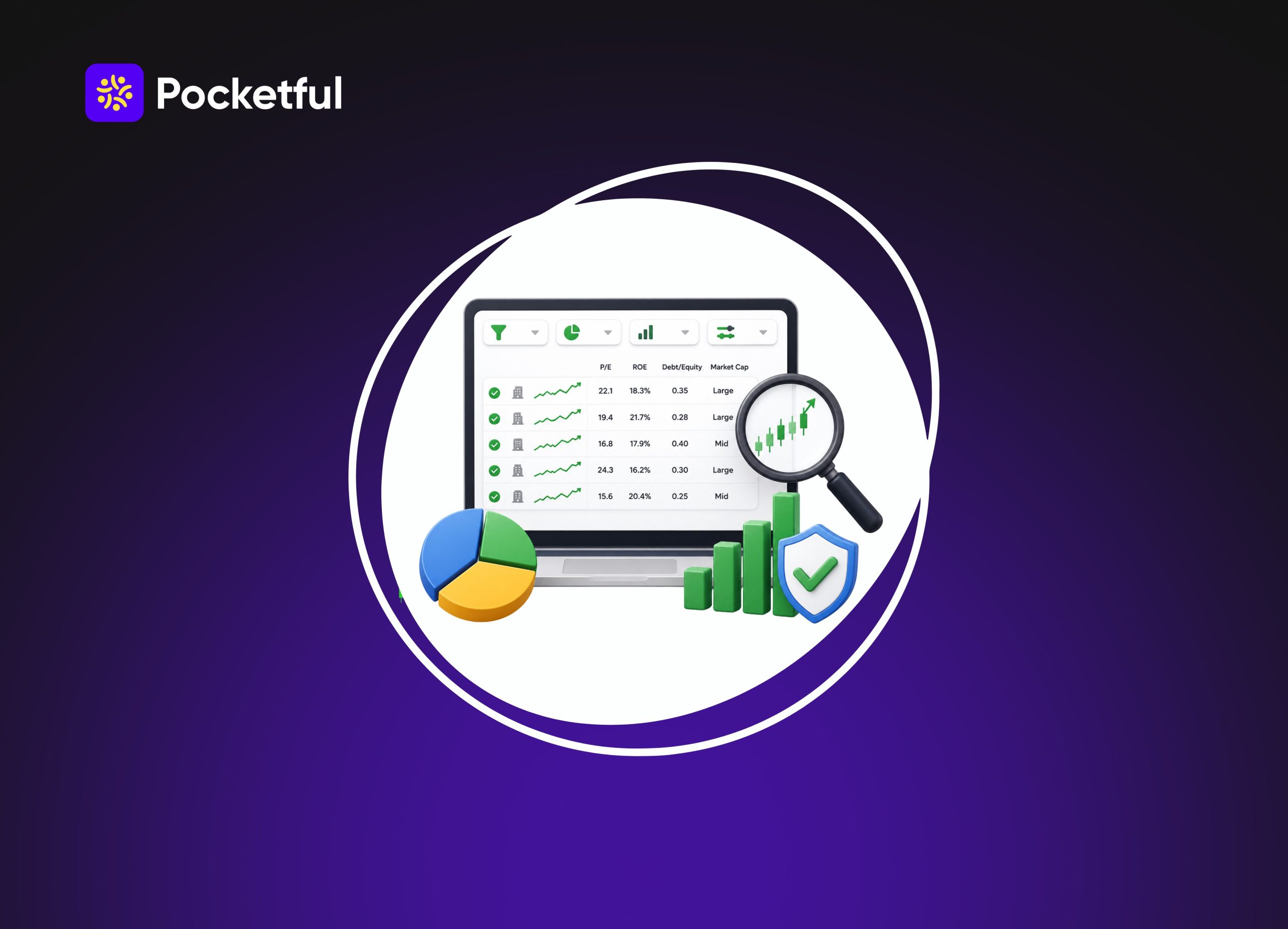
A stock screener is a tool that helps you quickly find stocks based on your specific needs. By applying various filters, you can view a list of stocks from among thousands of listed companies that align with your investment strategy. This simplifies the research process and saves time when shortlisting the right companies.
Example: If you wish to view companies with low debt and consistently rising profits, selecting the relevant filters will allow the screener to display only those stocks that meet these criteria. You can then conduct detailed research on these companies.
How to Use Stock Screener for Portfolio Building
To build the right portfolio, one should use a stock screener following a systematic process. This makes it easier to shortlist companies that align with your investment strategy.
- Start with the right screener category: First, select a category that suits your needs such as Large-Cap Stocks, High ROE Stocks, Debt-Free Stocks, or Undervalued Stocks. This generates an initial list for you.
- Narrow down the list using relevant filters: Now, apply available filters according to your strategy to retain only those companies that align with your investment criteria.
- Compare key company metrics: Compare returns, valuation, growth, and other available financial data for the shortlisted stocks. This makes it easier to select the best options.
- Select stocks from diverse sectors: Instead of relying on a single sector, include companies from various sectors. This leads to a more balanced portfolio.
- Conduct thorough research before investing: A stock screener only helps identify potential companies. Before making a final decision, be sure to examine the company’s business, financial performance, and recent updates.
Why a Stock Screener Is Useful for Portfolio Building
A stock screener reduces the time required to find suitable stocks aligned with your investment strategy from among thousands of listed companies. It makes the research process more organized and simplifies the task of shortlisting the right companies for your portfolio.
| Without a stock screener | With a stock screener |
|---|---|
| One has to examine thousands of stocks individually. | Key stocks get shortlisted in just a few minutes. |
| It is difficult to compare the right companies. | Comparing companies based on uniform standards becomes easier. |
| Research takes more time. | Initial research becomes faster and more systematic. |
| Many good opportunities could be missed. | Potential options aligned with your strategy are easily found. |
| There is no clear process for selecting stocks. | It provides a systematic start for investment. |
Explore Different Types of Stock Screeners
Every investor has a unique goal, so a single screener does not suit everyone. The Pocketful Stock Screener offers various categories that allow you to easily find the right stocks based on your investment strategy.
- Fundamental Screeners: This category is useful if your focus is on strong companies. It provides ready-made screeners for Large Cap Stocks, High ROE Stocks, Debt-Free Stocks, Undervalued Stocks, and High Dividend Yield Stocks, helping to accelerate your initial research.
- Technical Screeners: This category is beneficial for investors and traders who seek opportunities based on charts and price trends. It allows you to shortlist potential stocks based on technical indicators.
- Candlestick Screeners: This section is helpful if you plan your entry or exit points based on candlestick patterns. It enables you to quickly find stocks exhibiting specific chart patterns.
- Price and Volume Screeners: This screener helps identify stocks showing significant changes in price or trading volume. It can be useful for identifying active stocks during the initial screening stage.
- Sector, Group Stocks, and Indices Screeners: This category is useful if you wish to analyze companies within a specific sector, business group, or index. It makes it easier to compare stocks within the same category and diversify your portfolio.
Read Also: Best Free Stock Portfolio Tracker in India
How to Choose the Right Screener Based on Your Investment Goal
Choosing the right screener based on your investment objectives is the first step towards finding the right stocks.
| Investment objective | Suitable screener | When should you choose it? |
|---|---|---|
| Building wealth over the long term | High ROE Stocks, Consistent Compounding Stocks | When looking for companies with consistent, strong growth |
| Robust and low-risk portfolio | Large Cap Stocks, Debt Free Stocks | When investing in stable and established companies |
| Finding good opportunities at a low price | Undervalued Stocks | When you want to engage in value-based investing |
| Receiving regular dividends | High Dividend Yield Stocks | When the focus is on regular income from investments |
| View companies with recent outperformance | Best Quarterly Results | When analyzing companies based on recent financial performance |
Step-by-Step Process to Build a Portfolio Using a Stock Screener
Following the right process makes it easier to build a better portfolio using a stock screener.
Step 1: Choose the right screener
Start with a screener like Pocketful Stock Screener, suited to your investment goals such as those for Large-Cap, High-ROE, Debt-Free, or Undervalued stocks.
Step 2: View the list of stocks
Examine the stocks displayed by the chosen screener and shortlist potential companies based on your strategy.
Step 3: Analyze the company
Review the company profiles, financial performance, and other available information for the shortlisted stocks.
Step 4: Compare similar companies
Compare companies within the same sector to make it easier to select one with strong fundamentals and superior performance.
Step 5: Build a balanced portfolio
Create a balanced portfolio by combining selected stocks across different sectors and market capitalizations.
What to Check Before Adding a Stock to Your Portfolio
Understanding a few simple points before buying any stock helps in making better decisions down the line.
- Understand the company’s business: Before investing in a company, understand how it generates revenue. If the business model isn’t clear, it is unwise to invest simply by following others.
- Check the earnings track record: Prioritize companies that demonstrate consistent sales and profit growth over time. Avoid making decisions based solely on one or two good quarterly results.
- What is the debt burden: Having debt isn’t necessarily bad for a company, but excessive debt can create future financial strain. Therefore, it is essential to examine this aspect.
- What has changed recently: Events such as new announcements, major orders, management changes, or quarterly results can directly impact a company. It is advisable to check for such updates before investing.
- Price matters too: A good company shouldn’t necessarily be bought at any price. Always assess whether the current price is reasonable for your investment.
How to Keep Your Portfolio Diversified
A good portfolio is one where not every stock plays the same role.
- Avoid concentrating all your capital in a single theme: If most of your stocks belong to the same industry, adverse news regarding that sector could impact your entire portfolio. It is wiser to include companies operating in diverse business areas.
- Vary the size of the companies: Large companies often offer stability, whereas smaller companies may hold the potential for rapid growth. Combining both ensures your portfolio does not rely on a single direction.
- Limit stocks with similar business models: Two companies may have different names, yet their business operations could be nearly identical. Holding too many such stocks increases the number of holdings without actually enhancing diversification.
- Leave room for new opportunities: If all your capital is already invested, it may be difficult to capitalize on attractive opportunities that arise later. Therefore, it is advisable to set aside a portion of funds for future investments.
- Do not neglect your portfolio: Sometimes, a stock may appreciate beyond expectations, causing it to occupy a disproportionately large share of the portfolio. In such instances, rebalancing the portfolio is a prudent move.
Read Also: How to Build a Portfolio With Exchange-traded Funds (ETFs)
How to Get Started with Pocketful Stock Screener
Getting started with the Pocketful Stock Screener is simple. Follow these steps to find stocks that match your investment strategy:
Step 1: Start the Pocketful Stock Screener
Log into your Pocketful account and go to the Stock Screener page.
Step 2: Select a Pre-Built Screener
Select from pre-built screeners such as Large Cap Stocks, High ROE Stocks, Debt-Free Stocks, Undervalued Stocks or High Dividend Yield Stocks, depending on your investment objective.
Step 3 : Filter on relevance
Use filters like market cap, valuation, profitability, debt or technical indicators to refine your search and come up with a list of stocks that fit the bill.
Step 4: Compare and Analyze Stocks
Review key financial metrics, compare companies within the same sector, and evaluate their business performance before making a decision.
Step 5: Build and Monitor Your Portfolio
Shortlist your preferred stocks, create a diversified portfolio, and revisit the screener regularly to discover new investment opportunities.
Common Mistakes While Using a Stock Screener
Minor errors can turn even good stocks into poor investment choices.
- Applying all filters at once: Many people apply too many filters simultaneously. This can cause good companies to be excluded from the results. Start with fewer filters and add more as needed.
- Relying solely on screener results: A screener helps identify stocks but does not make the final decision for you. Before investing in any company, make sure to understand its business and recent performance.
- Comparing incompatible companies: Every company operates in a different sector and line of business. Therefore, instead of comparing a bank with an IT or FMCG company, base your decisions on comparisons between companies within the same industry.
- Ignoring current market conditions: Even good stocks can be affected by market conditions. So, alongside using a screener, keep an eye on current market trends and significant news.
- Changing screeners instead of the strategy: Stick to your investment strategy rather than trying out a new screener every few days. Constantly changing your approach can make it difficult to select the right stocks.
Conclusion
A stock screener helps you spot the right companies, but great investing always comes down to good judgment. When you combine a screener with your own strategy and do solid research first, building a strong, balanced portfolio gets a lot easier.
Frequently Asked Questions (FAQs)
What is a stock screener?
It’s a tool that helps you quickly shortlist stocks based on your preferences.
Can beginners use a stock screener?
Yes, even beginning investors can use it to find stocks better.
Does a stock screener guarantee profitable stocks?
No, it only helps you find stocks. Make investment decisions only after doing your research.
Which filters should I use for long-term investing?
You can start with filters like High ROE, Debt Free, and Large Cap.
How often should I use a stock screener?
Use it whenever you need to find new investment opportunities or review your portfolio.