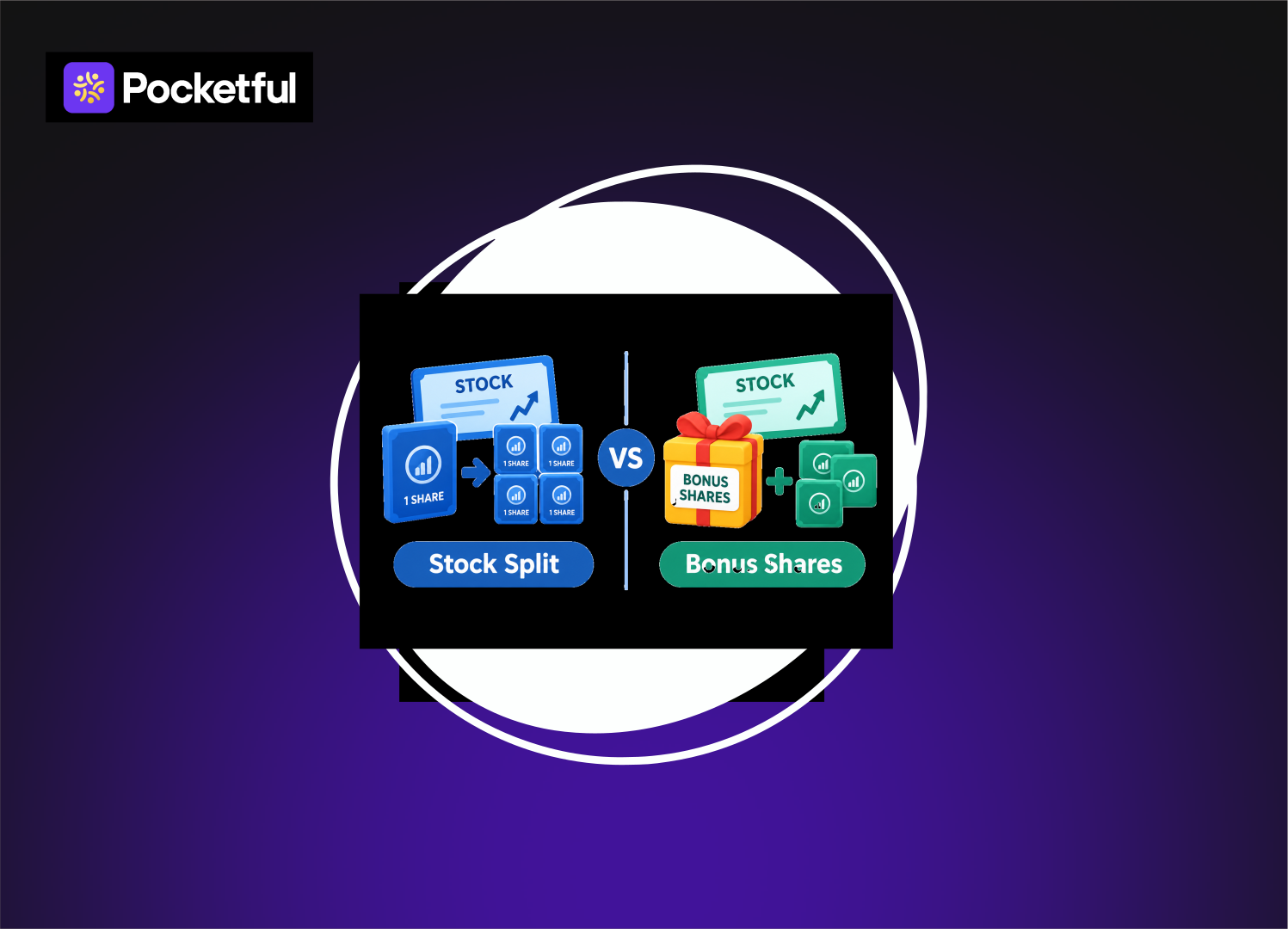
Your shareholding suddenly doubles, but your overall investment value remains the same. So, what actually happened? This can take place because of corporate actions such as bonus shares and stock splits. Understanding the bonus shares meaning, the face value of shares, and stock splits overall can help you understand how these developments affect your holdings.
In this guide, we will explain the difference between bonus shares and stock splits, along with how to calculate bonus shares. We will also cover stock split calculations to help you understand how these changes affect your share quantity, share price, and overall investment value.
What Is A Stock Split?
When a company segregates its stock into multiple shares, effectively reducing the price of each share without changing the company’s market value, it is known as a stock split. Stock split calculation involves dividing existing shares into smaller units. For instance, when a cake is cut into smaller pieces, you end up with more pieces, but the total amount remains unchanged.
This can increase liquidity (the capacity to trade a stock with ease) and trading volume. However, a company’s value is not affected by a stock split; rather, it simply redistributes ownership into smaller, more affordable units.
Why Do Companies Split Their Stocks?
In a well-functioning market, a stock split does not affect a company’s total market value or an investor’s wealth. The individual ownership stakes, the fundamental value of a company and the total market capitalization are unaffected. A stock split changes the face value of shares without directly changing the overall investment value.
A stock split calculation helps investors understand how the number of shares and the price per share change after a split.
According to research, stock splits often lead to short-term abnormal returns, with companies experiencing an average 2%-4% increase in value around the split announcement. In other words, subsequent to a stock split announcement, the stock to be split is likely to be overpriced compared to its actual value.
What Are Bonus Shares?
Bonus shares meaning can be understood as when a company gives present shareholders free additional shares, depending on the number of shares they already hold. Bonus shares are generally supplied to reward investors, increase the number of shares available for trading and demonstrate confidence.
Bonus shares calculation helps investors understand how many additional shares they will receive based on their existing holdings.
Investors can learn how to calculate bonus shares by using the announced bonus ratio and their existing shareholding. Although these types of shares do not bring about a change in the shareholder’s investment value, they can make shares more reasonable by reducing the stock price after the issue. They are provided out of a company’s accumulated reserves, free reserves or retained profits.
Firms use bonus share issuance to make their shares more appealing to retail shareholders, to serve as a substitute for cash dividends, and/or to reflect the status of their financial standing. The basic formula for bonus shares calculation explains how bonus shares impact the number of issued shares by the firm. In simpler terms, firms distribute bonus shares to attract investments and reward shareholders.
Stock Split vs Bonus Shares: Side-by-Side Comparison
In order to clearly understand the distinction between stock split meaning and bonus issue, consider these differences based on the given parameters.
| Parameter | Stock split | Bonus issue |
|---|---|---|
| Face value | Reduces proportionally to the split value | Stays unchanged |
| Number of shares | Increases | Increases |
| Share capital | Remains unaffected by the split | Increases because reserves are capital-funded. |
| Reserves | Remains the same (no capitalization of reserves) | Reduces as qualifying reserves (free reserves, securities premium) convert to share capital |
| Share price | Decreases in proportion to the split ratio. | Normally decreases in proportion to the bonus ratio. |
| Market cap | Normally remains unchanged after the split | Normally remains unchanged after the bonus issue. |
A stock split or bonus issue affects the number of shares held and alters the price per share after the ex-date. An ex-date in this case is the first day on which the stock begins trading at its newly adjusted split price. But the value of the investment does not change immediately after that, assuming there have been no movements in the stock market.
It can have an effect on earnings per share and dividend per share, as the same earnings or dividends are now distributed across a different number of shares. Ownership and voting ratio of the company do not normally change.
A close analysis of bonus shares, stock splits, and face value of shares is quite helpful in comprehending these changes and calculating bonus shares or stock splits as well.
Getting to know how to calculate bonus shares helps investors estimate how many additional shares they may receive after a bonus issue.
Read Also: What are the Different Types of Shares
Key Dates To Know
Investors need to know about some dates when a firm makes a stock split or bonus declaration. Announcement date is the date on which the company formally declares its corporate actions. The record date is the date on which the shareholder who will be eligible to get the benefit is recognized.
For bonus shares, the credit or allotment date is when the extra shares are allotted and credited to eligible investors’ demat accounts. These shares may take some days to appear, subject to the allotment and processing timelines. Once investors are aware of these dates, it can help them understand when they qualify and when they can expect the shares to appear in their accounts.
Tax Implications
In terms of tax considerations, bonus shares and stock splits vary; hence, investors must understand how each impacts the cost of acquisition and period of ownership. For bonus shares, the cost of acquisition is usually considered nil, and the holding period begins on the allotment date. However, in the case of a stock split, the original cost of acquisition is allocated to the higher number of shares available but with the same period of ownership. Upon disposal of the stocks, capital gains tax will be imposed based on the selling price and period of ownership.
Effect On Market Behavior
Stock splits, or stock bonuses, can influence the attitudes of the investor for a short while. The reduced price of the shares may make the stock seem cheap, hence more attractive to the investors. Nevertheless, such corporate moves cannot automatically improve the financial performance of the firm or generate any more value.
It is important for investors to look at many other things, like price adjustment and take into account components like the company’s earnings, financial health, and growth possibilities besides the stock price before investing.
Should You Buy A Stock Before A Split Or Bonus?
Long-term returns are subject to the company’s underlying business fundamentals, revenue growth and profit margins, not the number of shares it is divided into. Look for strong fundamentals, including the company’s debt levels, cash flow and return on equity.
Sometimes, announcements of splits or bonuses establish a psychological or liquidity boost, causing the stock price to rise prior to the record date because of increased retail participation. Nevertheless, this is speculative; prices can also scale down or sell the news once the action occurs.
Real-World Examples
Many renowned Indian companies have provided bonus shares or split their stocks. As an illustration, Infosys announced a two-for-one stock split in 2000, where it doubled the share count and reduced the face value from Rs.10 to Rs.5. In addition, Tata Consultancy Services announced a bonus share issuance in the ratio of 1:1 in 2018, where it issued one more share for every share held. Likewise, Reliance Industries has announced a bonus share issuance in the ratio of 1:1 in 2024. In a 1:1 bonus issuance, the share count is doubled while share prices become almost half of their previous price.
Common Myths
Two common misconceptions about stock splits and bonus shares are that receiving extra shares automatically increases an investor’s wealth and that a stock split indicates healthy company performance. In practice, bonus shares do not instantly increase the total value of your investment, as the share price usually adjusts after the bonus issue.
In the same manner, a stock split will make shares cheaper because of the reduction in the price per share, but this is not necessarily an indicator that the company is performing well financially. Investors need to analyze the earnings, financial position, and potential of the company instead of basing their analysis on bonuses or stock splits alone.
Read Also: What is Half Stock?
Conclusion
Stock splits and bonus shares increase the number of shares you hold, but they do not automatically increase your overall investment value. Understanding their differences, tax implications, and impact on share prices can help you make more informed investment decisions. Always evaluate a company’s financial health and growth prospects before investing. Download Pocketful for more market insights and visit the Updates section under any stock to stay informed about stock splits, bonus shares, and other important corporate announcements.
| S.NO. | Check Out These Interesting Posts You Might Enjoy! |
|---|---|
| 1 | Cyclical vs Defensive Stocks: Key Differences |
| 2 | ROE vs Valuation: Understand the Difference |
| 3 | Growth Investing: Meaning, Strategies, Risks & Key Metrics |
| 4 | GTD Order Meaning: Full Form, Example & How It Works |
| 5 | What is Purchasing Power? |
Frequently Asked Questions (FAQs)
Do I become richer when a company announces a stock split or bonus?
No, definitely not. A share split means that the number of shares that you own is increased by splitting the current stock holdings into smaller parts, whereas a stock bonus issue means that you will get more shares. The share price will be adjusted accordingly to maintain the same value of the portfolio.
What is the main difference between a stock split and a bonus issue?
A stock split entails increasing the number of outstanding shares by dividing them and decreasing their nominal value proportionally. On the other hand, a bonus issue includes granting additional shares to the shareholders from the equity reserves that are eligible for conversion to shares.
Do I need to buy the shares before a certain date to receive a split or bonus?
Yes. You must meet the company’s eligibility criteria, which are defined by the record date and applicable ex-date rules. In India, shares usually need to be bought before the ex-date to qualify. Before making a decision, it is important to look for the company’s official announcement and the applicable exchange dates.
How are split and bonus shares taxed when I sell them?
Tax on capital gains could be payable when one is selling bonus issue shares or split stocks. In the case of bonus shares, the acquisition cost is zero for shares allotted after 1 April 2001. In the case of split stocks, the initial purchase cost is spread to the additional number of shares issued as per the split ratio.
Is a split or bonus announcement a good reason to buy a stock?
Not on its own. A stock split or bonus issue is something that doesn’t automatically improve a company’s financial performance or increase the value of your investment. Consider the company’s profits, financial state, and potential for growth before you make an investment.