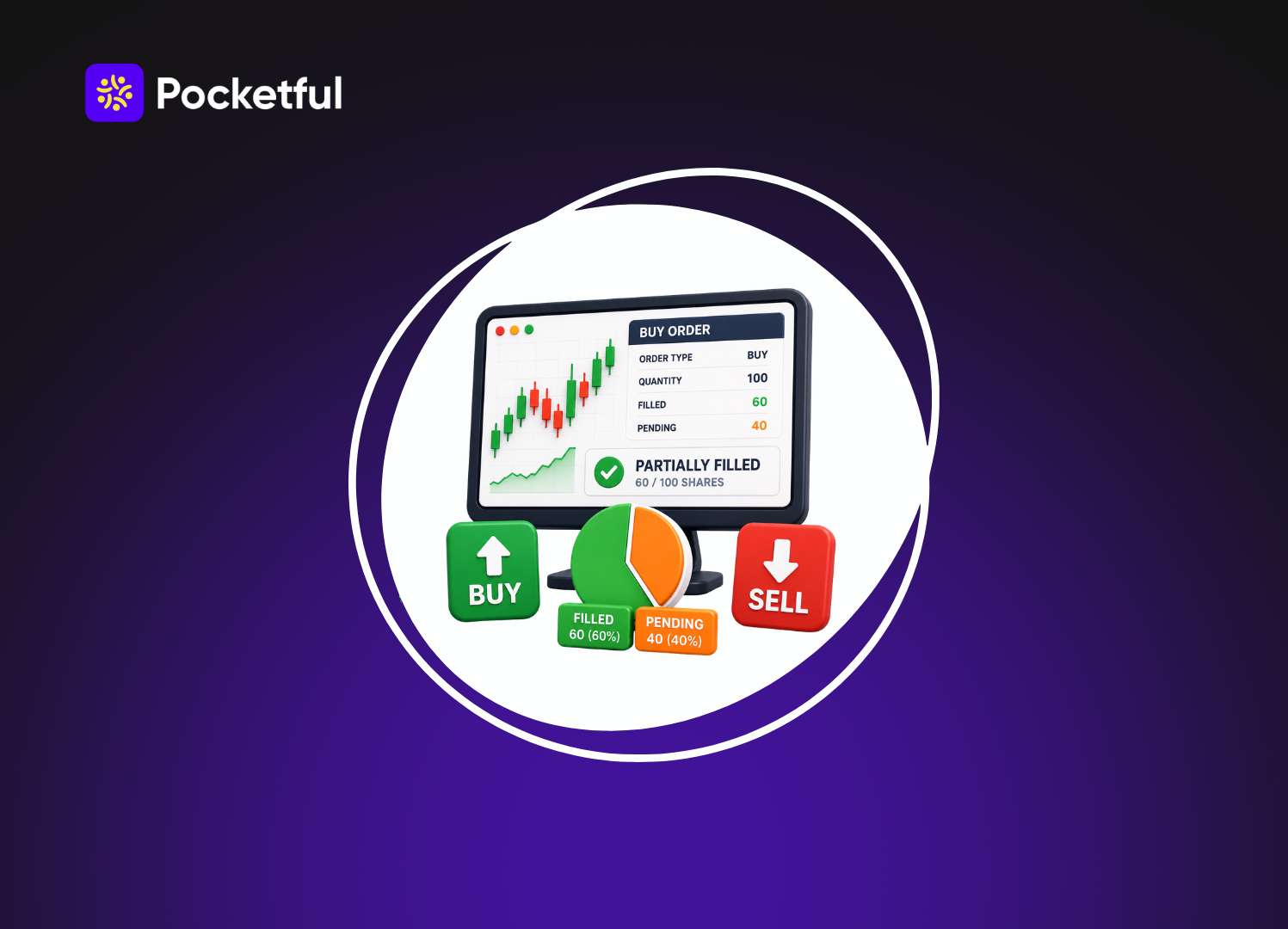
While trading, you may sometimes find that after placing an order, only a portion of the shares are executed instead of the entire quantity being bought or sold. This situation is known as being partially filled or partially executed. Understanding this concept is important if you wish to grasp the meaning of these terms. It is not an error but a standard market process. In this article, we will explain in simple language why this happens and how it impacts your trades.
What Does Partially Filled Mean in Trading?
During trading, it often happens that the total number of shares you placed an order to buy or sell is not available all at once. In such cases, the exchange executes the order for the available quantity first and leaves the remainder pending. This situation is known as being partially filled. It is a common occurrence in the stock market and does not mean that your order has failed or been rejected.
Meaning of Partially Filled
Partially filled means that only a portion of your order has been successfully executed, while the remaining quantity is still awaiting fulfillment. This often happens when there are not enough buyers or sellers available at your specified price. The remaining quantity can also be executed as soon as a matching order is found at that same price.
Meaning of Partially Executed
The meaning of partially executed is essentially the same as partially filled. Both terms indicate that only a portion of the order has been executed. Different trading platforms or brokers may use either of these status labels, but the meaning remains the same.
Example
| Order Details | Status |
|---|---|
| Buy Order 1,000 Shares @ ₹250 | Order Placed |
| Available at ₹250 | 400 Shares |
| Executed | 400 Shares |
| Remaining Pending | 600 Shares |
| Order Status | Partially Filled |
Types of Orders That Can Be Partially Filled
The likelihood of a partial fill is not the same for every order; it depends on the order type you have selected. Some orders may be executed partially, whereas others require the entire order to be executed at once.
| Order Type | Can Be Partially Filled? | Explanation |
|---|---|---|
| Limit Order | Yes | Only the available quantity is executed. |
| Market Order | Yes | A large quantity can be executed in multiple parts. |
| Stop-Loss Limit Order | Yes | After the trigger, execution takes place based on the available quantity. |
| IOC (Immediate or Cancel) | Yes | As much as can be executed immediately is executed; the rest is cancelled. |
| FOK (Fill or Kill) | Yes | The entire order must be executed; otherwise, it gets cancelled. |
How Does a Partially Filled Order Work?
When you place a buy or sell order in the stock market, its execution follows a specific process. If the full quantity is not available at your specified price at that moment, only the available portion of the order is executed, while the remaining quantity stays pending. Refer to the steps below to understand this better.
| Step | What happens? |
|---|---|
| Step 1 | You place a buy or sell order for a stock. |
| Step 2 | Your order reaches the exchange’s order book. |
| Step 3 | The exchange searches for matching buy or sell orders based on your price and quantity. |
| Step 4 | The quantity available at that price is executed immediately. |
| Step 5 | If the full quantity is not available, the remaining order stays pending and waits for a matching order. |
| Step 6 | The remaining quantity may also be executed later if a matching order is found. If that does not happen, you can modify or cancel the order. |
Let’s understand this with an example.
Suppose you placed a limit order to buy 1,000 shares of ABC Ltd. at ₹500 per share. At that moment, only 600 shares were available at the ₹500 price point. In this scenario, the exchange would first execute the trade for those 600 shares, while the remaining 400 shares would stay pending in the order book. If a seller subsequently becomes available to sell 400 shares at ₹500, the remainder of your order will also be executed automatically.
Read Also: What is Pyramid Trading?
Why Do Orders Become Partially Filled?
There can be several reasons why an order gets partially filled. This primarily depends on market liquidity, your chosen price, and the order quantity.
- Low Liquidity: If there are few buyers or sellers for a particular stock, your entire quantity may not find a match at once. Consequently, only a portion of the order gets executed.
- Large Order Size: It is not always possible to execute a large-quantity order in a single go; therefore, the order may be executed in multiple parts.
- Limit Price: With a limit order, if there aren’t enough shares available at your specified price, the order may get partially filled.
- High Market Volatility: In a rapidly changing market, prices fluctuate constantly. This can make it difficult to secure the entire quantity at a single price point.
- Wide Bid-Ask Spread: When there is a significant gap between the buy price and the sell price, order matching slows down, increasing the likelihood of a partial fill.
What Happens After an Order Is Partially Filled?
When your order is partially filled, the trade does not end there. The quantity that has already been executed becomes part of your trade, while the exchange continues to look for a matching order for the remaining quantity. What happens next depends on your trading strategy and market conditions.
- Remaining Order Continues to Wait: The quantity that has not yet been executed remains active until a matching order is found or the order’s validity expires.
- You Can Change Your Order: If you feel there is a low probability of the order being completed at the current price, you can modify its price or quantity. This may increase the likelihood of the order being executed.
- You Can Stop Waiting: If you are no longer interested in the trade, the remaining quantity can be cancelled. This removes only the pending portion; the part that has already been executed remains unaffected.
- It Depends on the Market: Sometimes, the remaining order gets filled within a few seconds, whereas in other cases, no matching order is found for a long time. Therefore, the process following a partial fill depends entirely on the orders available in the market.
Advantages of Partially Filled Orders
While many traders view partially filled orders as a problem, they can actually be beneficial in certain situations especially during periods of high market volatility or when trading in large quantities.
- Better Price Control: With a limit order, the available quantity is executed first at your specified price. This gives you the opportunity to trade at your desired price point.
- Higher Execution Opportunity: Even if the entire quantity isn’t available at once, a portion of the order still gets executed, ensuring you don’t miss out on the trade entirely.
- Useful for Large Orders: Executing large orders all at once isn’t always easy. Partial fills allow the order to be completed gradually, making the execution process smoother.
- Helpful in Volatile Markets: In a rapidly changing market, available quantities are executed immediately. This increases the likelihood of completing at least part of the trade before prices shift suddenly.
Read Also: What is Futures and Options Trading in India
Disadvantages of Partially Filled Orders
A partially filled order is not always advantageous. In some instances, it can complicate trading, particularly when you intend to trade a specific quantity.
- Incomplete Order Execution: Since only a portion of the order is executed, your entire trading plan cannot be implemented at once.
- Delay in Execution: It may take time for the remaining quantity to be executed, especially if there are insufficient buyers or sellers at the desired price.
- Price Movement Risk: If the market price moves away from your set price, the remainder of the order might not get executed, or you may need to modify the order.
- Portfolio Allocation May Change: If you had planned to invest a specific amount in a stock, a partial fill prevents that full investment from happening immediately, which can impact your portfolio planning.
How to Reduce the Chances of Partial Fill?
While it is not always possible to prevent partially filled orders, the likelihood can be significantly reduced by keeping a few simple points in mind.
- Trade in High-Liquidity Stocks: Select stocks that have high daily trading volumes. Since there are more buyers and sellers for these stocks, there is a greater chance of orders matching quickly.
- Avoid Very Large Orders: If the order quantity is very large, it is better to place the order in smaller chunks rather than all at once.
- Choose a Practical Limit Price: When placing a limit order, choose a price that is close to the current market price. This increases the chances of finding a matching order.
- Place Orders During Active Market Hours: Trading activity is generally higher during the opening and mid-session hours of the market. Orders are more likely to be executed quickly during these times.
- Check Market Depth Before Placing an Order: Check the market depth or order book before placing an order. This reveals the quantity available at your chosen price, enabling you to make a better decision.
Partial Fill vs Complete Fill
| Parameter | Partial Fill | Complete Fill |
|---|---|---|
| Execution Status | Only a part of the order is executed. | The entire order is executed at once. |
| Remaining Quantity | Some quantity remains pending. | No quantity remains pending. |
| Order Completion | It may take time to complete. | The order is fulfilled immediately. |
| Liquidity Requirement | It is not necessary for the entire quantity to be available. | It is essential for the entire quantity to be available. |
| Trader Action | The remaining order can be modified or cancelled if necessary. | No further action is required. |
Conclusion
Partially filled orders are a common aspect of trading, depending primarily on market liquidity and order matching. Understanding the meaning of “partially filled” or “partially executed” orders enables you to better comprehend order status and make informed trading decisions at the right time.
Frequently Asked Questions (FAQs)
What is partially filled in trading?
This means only a portion of the order is executed.
What does partially filled mean?
This means the entire order was not executed at once.
Is partially executed the same as partially filled?
Yes, both mean the same thing.
Why does an order become partially filled?
This happens when the full quantity is not available.
Can I cancel a partially filled order?
Yes, the remaining pending quantity can be cancelled.
