When you look at a stock chart, it might feel like prices move randomly. But in reality, there is always a reason behind every rise and fall, and that reason is supply and demand.
At its core, the market is nothing but a battle between buyers and sellers. When buyers are stronger, prices go up. When sellers dominate, prices fall.
Supply and demand trading is about understanding this battle and using it to make better trading decisions.
What is Supply & Demand Trading?
Supply and demand trading is a price-action-based strategy where traders identify key areas on a chart where buying or selling pressure is strong.
Instead of relying heavily on indicators, this method focuses on how the price behaves.
Demand indicates that buyers are strong, and the prices will move up, whereas supply indicates that sellers are strong and prices will move down.
Importance of Demand and Supply in Trading
1. It Helps You Understand the Current trends
A lot of traders just look at charts and try to guess what will happen next. But if you focus on demand and supply, you stop guessing, and you start asking better questions like, “Are buyers stronger right now? Or are sellers in control?
2. It Makes Entry Points Easier
One of the hardest parts of trading is knowing when to enter. This is where demand and supply really help.
You start noticing certain areas where price reacted strongly before, because places where price shot up were a strong demand zone and conversely, places where price dropped, strong supply zone.
3. It Teaches You Patience
This is something most traders struggle with. People enter trades because they are getting bored or they have FOMO.
But when you follow demand and supply, you naturally become more patient. You wait for the price to come to your level. You do not chase it, which alone can improve your trading a lot.
4. It Improves Your Timing
Timing can make or break a trade. If you enter too early, you end up losing money. Enter too late, you miss the move
Demand and supply help you enter closer to where the move starts, which means less risk with better reward, and less stress.
Read Also: How to Hedge with Commodity Trading
What are Demand & Supply Zones
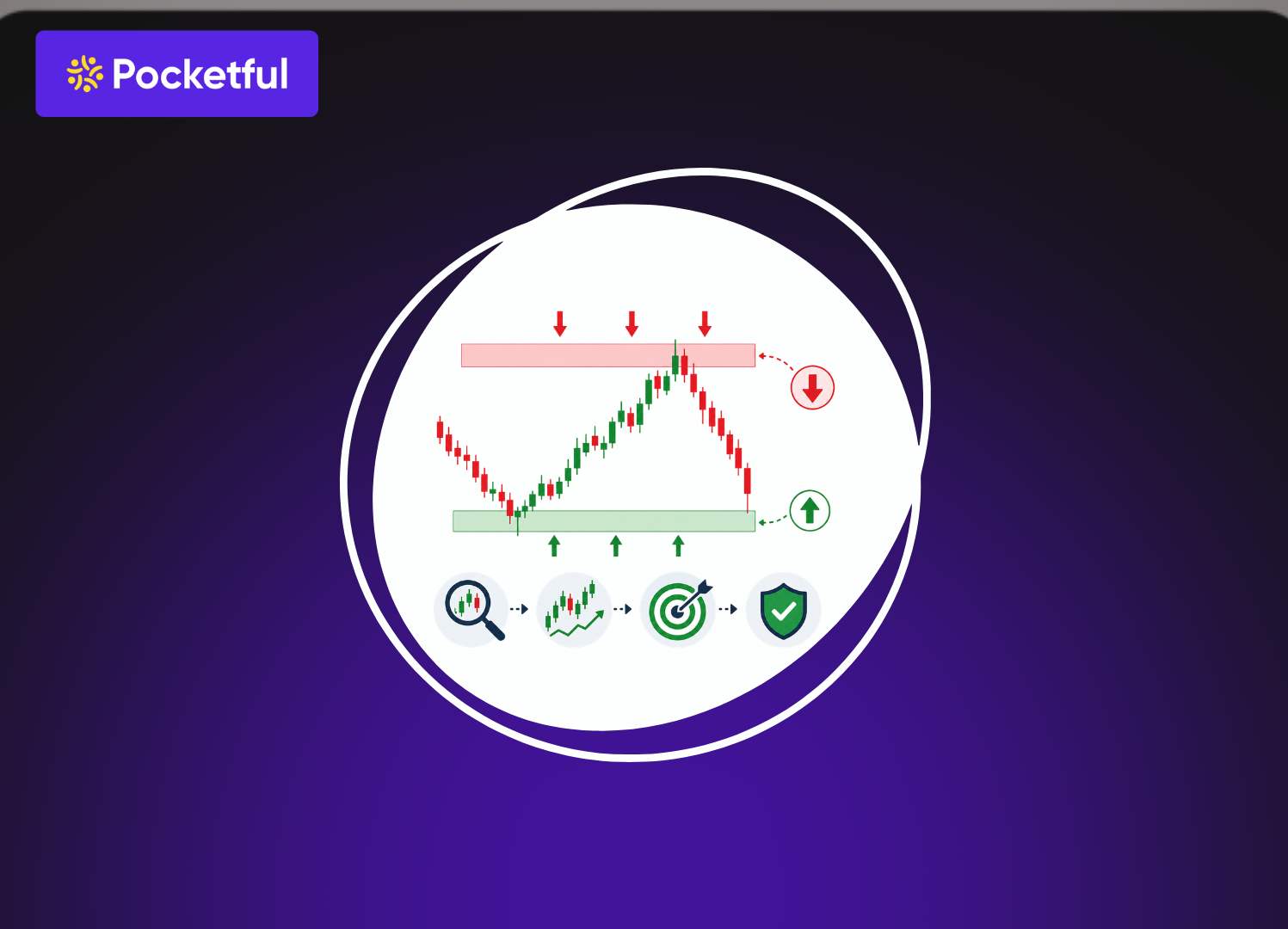
When you look at a stock chart, you will notice that the price does not just move randomly. It often reacts in certain areas again and again. Those areas are called demand and supply zones.
In simple words, these are spots on the chart where a lot of buying or selling happened earlier, which caused a strong move in price.
A demand zone is an area where buyers take control and push the price up quickly.
In this zone, you will usually see that the price moves slowly or sideways, and then suddenly shoots up. It matters because when the price comes back to that same area, buyers often step in again
A supply zone is the opposite. It is an area where sellers have become strong and pushed the price down fast.
In this zone, you will notice that the price moves up or sideways, then suddenly drops. That starting point of the fall becomes a supply zone.
When prices return there again, sellers may become active.
Example
Let us say a stock is around ₹300. It stays there for some time. Then suddenly jumps to ₹340.
That ₹300 area becomes a demand zone. Now, if the price comes back to ₹300 again, buyers will be active, and they might step in again from that level.
Supply & Demand vs. Support & Resistance
| S. No | Basis | Supply & Demand | Support & Resistance |
|---|---|---|---|
| 1 | Basic Idea | Focuses on areas where strong buying or selling has happened | Focuses on price levels where the price has reacted before |
| 2 | Form | Zones (a range or area) | Lines (specific price levels) |
| 3 | Concept | Based on the imbalance between buyers and sellers | Based on past price reactions |
| 4 | Formation | Created by strong, sudden moves in price | Formed by repeated rejection at a level |
| 5 | Approach | More price-action based | Often used with technical analysis tools |
| 6 | Risk Management | Easier to place stop-loss beyond the zone | Stop-loss placed slightly above/below the line |
| 7 | Reliability | Often considered more dynamic and realistic | Can sometimes give false signals if too rigid |
Supply & Demand Trading Strategy
1. Buying Strategy
- Identify a strong demand zone
- Wait for the price to return
- Look for confirmation (like bullish candles)
- Enter a buy trade
- Place stop-loss below the zone.
2. Selling Strategy
- Identify a strong supply zone
- Wait for the price to revisit
- Look for bearish confirmation
- Enter a sell trade
- Place a stop-loss above the zone
Risk Management in Supply & Demand Trading
1. Always Use a Stop-Loss
This is non-negotiable. When you take a trade based on a demand or supply zone, you should know where to place a stop loss. If you are buying at a demand zone, stop-loss below the zone, selling at a supply zone, stop-loss above the zone.
2. Risk Only a Small Amount Per Trade
Do not put a big chunk of your capital into one trade.
A simple rule many traders follow is to risk only 1-2% of their capital per trade. This way, even if a few trades go wrong, your overall capital stays safe.
3. Do not Trade Every Zone
Not every demand or supply zone is worth trading. Some zones are weak, some are already tested multiple times.
You can focus on fresh zones (not tested too many times), strong moves away from the zone, and zones that are aligned with the trend because quality matters more than quantity.
4. Wait for Confirmation
Do not blindly enter just because the price reached a zone. Wait for some sign of why buyers or sellers are stepping in. Look for
- Strong rejection candle
- Engulfing pattern
- Momentum shift
This extra patience can save you from many bad trades.
Advantages of Supply and Demand Trading
- Easy to Understand: Demand and supply trading does not involve the use of complex technical indicators. It mainly focuses on price action, which makes it a go-to strategy for traders.
- Works in all markets: You can trade using the demand and supply zones in all types of markets, like equity, forex, and crypto, because the concept remains the same.
- Helps you Trade with Market Logic: Instead of guessing, you are trading based on price behaviour and trying to follow the zones where buying and selling have already happened.
Read Also: What is Demand-Pull Inflation?
Disadvantages of Supply and Demand Trading
- Zones can be subjective: Two traders might draw different zones on the same chart. There is no single perfect way to mark them. It completely depends on the traders’ perspective.
- Not always accurate: Sometimes, price breaks a zone instead of reacting to it. No strategy works 100% of the time.
- Can be misused by beginners: Beginners often do not have much of an idea about trading. They mark too many zones, enter without confirmation, and ignore trend direction.
Conclusion
When you start looking at charts in combination with demand and supply zones, things become a lot clearer. You are no longer just reacting to price movements. You begin to understand why those moves are happening and where they are likely to happen again.
Demand and supply zones help you focus on the areas that actually matter. They teach you to wait patiently, take better entries, and manage your risk more effectively.
But like any trading approach, this also takes practice. What matters is staying consistent, learning from your trades, and improving step by step.
In the long run, trading is less about being right every time and more about being disciplined. Stay patient, keep your trading simple, and let consistency grow your capital over time – start trading with Pocketful.
Frequently Asked Questions (FAQs)
What is supply and demand trading in simple terms?
It is a trading method where you buy at demand zones and sell at supply zones.
Is supply and demand trading better than indicators?
It depends, but many traders prefer it because it focuses on real price action.
Can beginners use this strategy?
Yes, but it requires practice and patience.
Does it work in intraday trading?
Yes, it works in intraday, swing, and positional trading.
What timeframe is best?
Higher timeframes (like daily) are more reliable.