There are several ways to buy shares in the stock market, and cash trading is one of the simplest methods. In this process, investors typically purchase shares using their available funds. If you are wondering what cash trading is and how it differs from margin trading, it is important to understand the concept. In this blog, we will explore the meaning of cash trading, how it works, and key details associated with it.
What is Cash Trading?
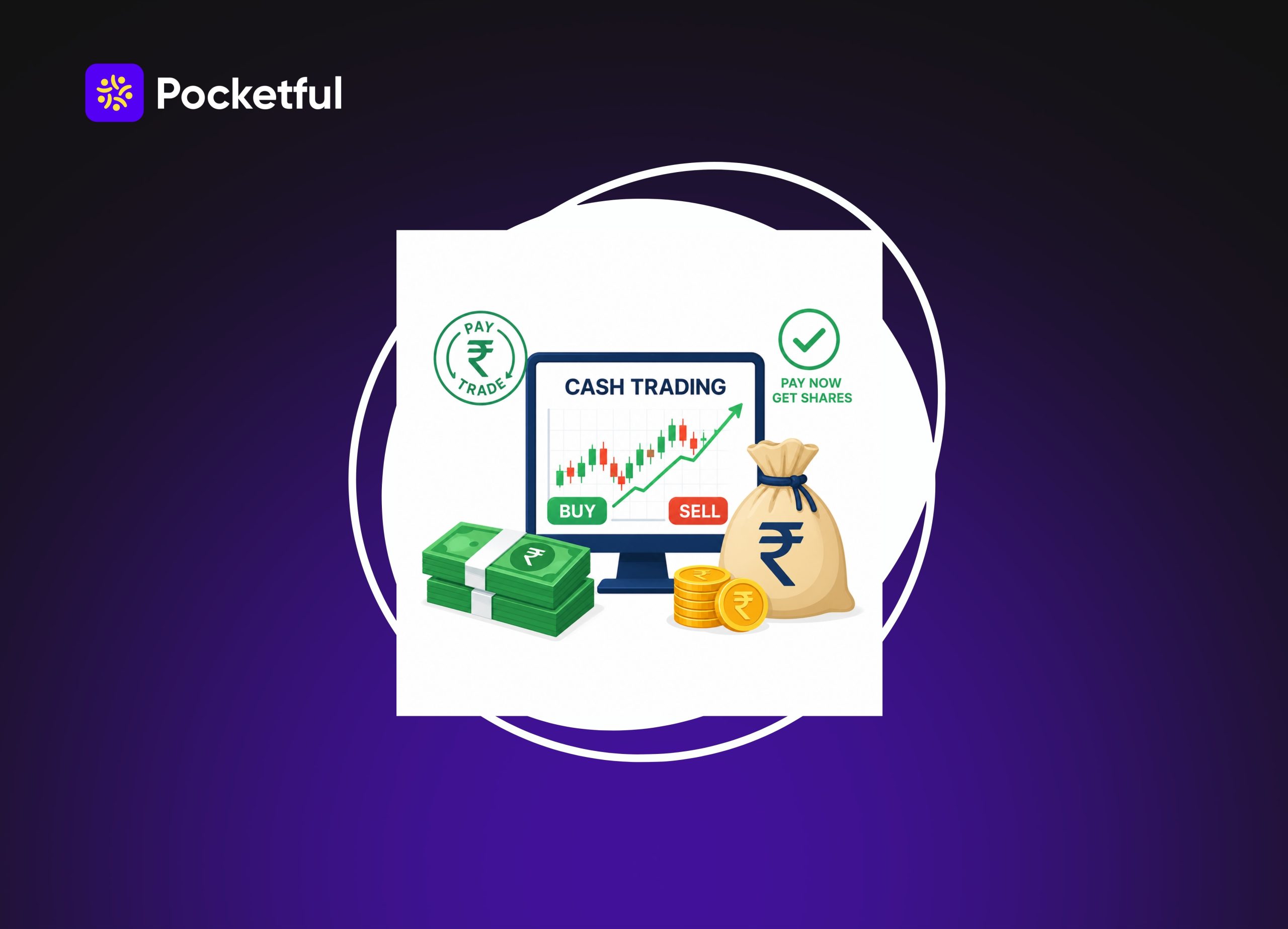
Cash trading meaning is buying and selling of shares in the equity cash segment of the stock market. When you use your available funds to purchase a cash stock, it constitutes a cash-based purchase; availing margin funding is not required. Following the trade, the settlement of shares and funds is completed in accordance with the applicable settlement process.
Example : Suppose you have ₹50,000 available in your trading account and you buy shares of a company at a price of ₹500 per share.
| Description | Amount/Quantity |
|---|---|
| Available Funds | ₹50,000 |
| Share Price | ₹500 |
| Purchased Shares | 50 |
| Total Purchase Value | ₹25,000 |
| Remaining amount* | ₹25,000 |
Brokerage and other applicable charges may affect the actual balance.
How Does Cash Trading Work in the Stock Market?
Step 1: Add Funds to Your Trading Account
Before purchasing shares, ensure your trading account has sufficient funds. It is important to account for applicable charges in addition to the purchase value.
Step 2: Select a Stock
Choose a stock by considering the company’s basic information, the price, and your investment objectives. Buying a share solely based on a low price is not the right approach.
Step 3: Place a Buy Order
Place a buy order by selecting the desired quantity of shares and the order type. The trade is executed when your order matches a corresponding sell order.
Step 4: Check Trade Confirmation
After the order is executed, verify the trade details, such as the quantity of shares purchased and the execution price.
Step 5: Clearing and Settlement
The clearing and settlement process takes place after the trade is executed. According to NSE Clearing, normal equity settlement follows the T+1 cycle, while T+0 settlement is also available for eligible securities.
Cash Trading vs Margin Trading: What is the Difference?
Shares can be purchased in both, but the costs, buying capacity, and charges applicable to the position differ.
| Base | Cash Trading | Margin Trading |
|---|---|---|
| Source of Funds | Using your available funds to purchase shares. | Using broker funding alongside your own funds/collateral |
| Additional Exposure | Based on available capital | Additional market exposure can be gained through funding. |
| Interest Cost | A standard fully funded purchase does not involve funding interest. | Interest may apply to the funded amount. |
| Eligible Securities | Securities available in the equity cash market | MTF is available only for eligible securities under the SEBI framework. |
| Margin Requirement | In accordance with the transaction and applicable market requirements. | Applicable initial and maintenance margin requirements must be met. |
| Risk Factor | The main risk is share price fluctuations. | Along with price risk, there is also the risk of leverage and margin shortfall. |
Benefits of Cash Based Trading
Cash-based trading can be useful for investors who wish to manage their investments simply and maintain a clear financial picture when taking a position.
- Better Cost Visibility: You have a better idea of the investment amount and applicable charges when taking a position. This can make calculating returns and tracking your portfolio easier.
- No Daily Funding Cost: If broker funding is not used for the trade, there is no daily interest charged on the funded amount. This can be particularly relevant for those holding shares for the long term.
- Greater Flexibility in Holding: Investors can hold shares purchased in the cash market according to their own strategy. They are not compelled to exit a position prematurely simply to avoid funding costs.
- Easier Portfolio Planning: Allocating funds across different stocks with a pre-determined investment amount can be easier. This helps in building a portfolio based on a structured plan.
- Fewer Leverage-Related Concerns: Unlike margin-funded positions, a standard fully funded purchase does not require constant monitoring of factors such as funding costs, collateral value, or margin shortfalls. SEBI also advises investors to make investment decisions after fully understanding transaction charges and market risks.
Read Also: Reverse Cash and Carry Arbitrage Explained
Risks and Limitations of Cash Trading
The biggest limitation of cash trading is that your available capital serves as the primary basis for investment. Therefore, certain practical aspects should be kept in mind.
- Limited Capital Growth: If you have limited funds for investment, you cannot take a position larger than your available capital, even when a good opportunity arises.
- Opportunity Cost: Once money is invested in a particular stock, it is not immediately available for another, potentially better opportunity. Therefore, rather than investing all your funds at once, it is important to focus on proper allocation.
- Impact of Time on Returns: In cash-based investing, returns depend entirely on share price performance and the holding period. It is not guaranteed that every investment will yield quick returns.
- Impact of Charges: Frequent buying and selling of shares can affect overall returns due to brokerage and other applicable charges. SEBI also advises investors to understand all applicable charges and fees.
Who Should Consider Cash Trading?
Cash trading can be a practical option for those who wish to invest in shares and tailor their strategy to their specific needs.
- Beginners: Those who are just starting to buy shares and understand the stock market can easily grasp the basic “buy and hold” process through cash trading.
- Long-Term Investors: This method can be useful for investors who want to invest in a company for the long term and gradually build a portfolio.
- Investors with a Defined Budget: If you have already set a specific amount for investment, cash trading can help you plan your investments within that budget.
- Investors Who Prefer Simplicity: Those who want to keep their investments straightforward without the need for additional funding arrangements might consider cash trading.
Common Mistakes Beginners Make in Cash Trading
When starting cash trading, mistakes often arise not from the choice of stock itself, but from the trading approach. Here are some common errors:
- Investing all funds at once: Some beginners deploy their entire investment capital into the market on a single day. Consequently, they have no cash left if a better opportunity arises later.
- Not reviewing details before placing an order: Selecting the wrong quantity or price in haste can prove costly. It is essential to verify the details before confirming the order.
- Ignoring the contract note: One should always check the contract note after a trade. SEBI advises investors to preserve transaction records and contract notes.
- Checking the portfolio daily: Constantly monitoring minor price fluctuations can lead to hasty or unnecessary decisions. It is better to review the portfolio based on your needs and a pre-determined schedule.
How to Start Cash Trading in India?
To start cash trading, all you need is the right platform, some basic research, and a simple account setup. If you start with Pocketful, the process looks like this:
Step 1: Open a Free Account
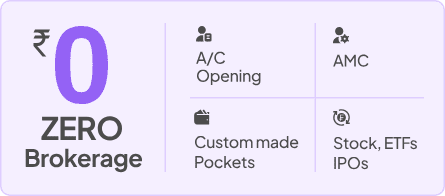
You can open a Demat and trading account on Pocketful with ₹0 account opening charges and ₹0 AMC.
Step 2: Complete Your KYC
Complete your KYC using your PAN, Aadhaar, and other necessary documents. Trading can begin once the account is activated.
Step 3: Add Funds to Your Account
Add funds for trading from your bank account. It is advisable to determine your budget before investing.
Step 4: Research the Stock
Before buying a stock, you can use Pocketful’s advanced stock screener to filter stocks based on fundamentals, technicals, price-volume, and other criteria.
Step 5: Use AI and Market Tools
On Pocketful, you can use Pocketful GPT and other market tools to better explore information regarding stocks, market trends, and your portfolio. Real-time insights and stock research tools are also available on the platform.
Step 6: Place Your Cash Delivery Order
After selecting a stock, check the quantity and order details, then place your order.
Read Also: What Is Day Trading and How to Start With It?
Conclusion
Cash trading can be a straightforward way to get started in the stock market. The most important aspects are selecting the right stocks and making decisions without haste. Understand the market, invest according to your needs, and ensure you check the necessary information before making any investment.
Frequently Asked Questions (FAQs)
What is cash trading in the stock market?
In cash trading, shares are bought and sold based on available funds.
What is the meaning of cash stock?
This term refers to shares traded in the equity cash segment.
Is cash trading the same as intraday trading?
No, in cash trading, shares can be held, whereas intraday positions are typically closed on the same trading day.
Can beginners start with cash trading?
Yes, beginners can start with cash trading to understand the basic buying process of the stock market.
Is cash trading risk-free?
No, losses can occur if share prices fall, even if the purchase was made using one’s own funds.