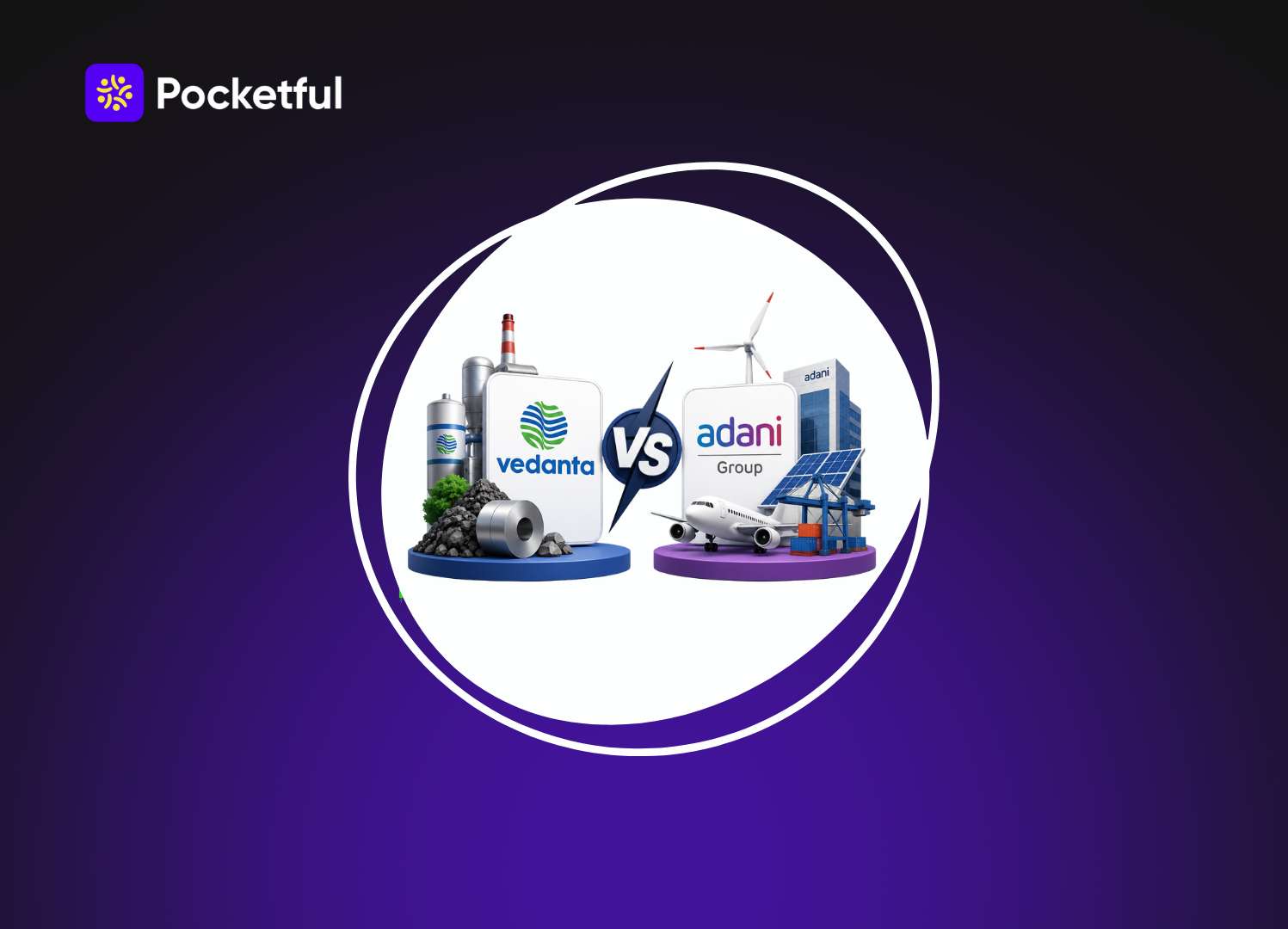
Two of India’s biggest business houses, built by two very different founders, chasing very different sectors. Vedanta digs metal out of the ground and pumps oil. Adani builds ports, airports, and power plants. So, both companies are really great.
But when you compare these two companies, you will find some great differences. The range of work they do and also how they operate, all these are some of the key aspects that you should be considering over here to understand the same.
This comparison walks through market cap, revenue, and founder net worth for Vedanta vs Adani Group, using the latest numbers available as of July 2026, and explains why the gap between them is as wide as it is.
The Quick Comparison Vedanta vs Adani Group
| Basis | Vedanta Group | Adani Group |
|---|---|---|
| Founded | 1976 | 1988 |
| Founder | Anil Agarwal | Gautam Adani |
| Headquarters | Mumbai | Ahmedabad |
| Core Business | Mining, metals, oil & gas, power | Ports, energy, airports, cement, utilities |
| Listed Entities | 6 after the demerger in 2026 | Around 10 |
| Market Cap as of July 2026 | Rs. 1,07,418 crore | Rs. 4,04,568 crore |
| FY26 Revenue | Rs. 1,74,075 crore | Rs. 2.2 lakh crore |
| Founder Net Worth | Roughly $4.6 billion | Roughly $89 to $90 billion |
Just from this table, Adani is roughly four times bigger by market cap and pulls in noticeably more revenue too. But the “why” behind that gap is more interesting than the numbers themselves.
Also, the comparison is as of July 2026. The data is bound to change with time and as the market moves.
Vedanta Group, in Brief
Anil Agarwal started Vedanta in 1976. Then, it grew into one of India’s biggest natural resources businesses. It is now working in the sector of aluminium, zinc, copper, iron ore, steel, oil and gas, and power. Basically, if it comes out of the ground and feeds into manufacturing or construction, there’s a decent chance Vedanta is the company that is working on it.
2026 brought a genuinely big structural shift. Vedanta Limited went through a five-way demerger. During this, the company separated all its operating units based on the material. These included the following:
- Aluminium
- Oil and gas
- Iron
- Power
- Steel
The business is now organized into several smaller business units under one umbrella, including:
- Vedanta Limited
- Vedanta Aluminium Limited
- Vedanta Oil & Gas Limited
- Vedanta Power Limited
- Vedanta Iron & Steel Limited
Even after all this, the parent company kept its stake in Hindustan Zinc.
The idea behind splitting things up like this is usually to let the market value each business on its own terms, rather than lumping everything into one conglomerate discount. Whether that plays out well over the next few years is still an open question, but it’s the single biggest thing that happened to Vedanta’s structure this year.
Read Also: Vedanta Case Study
Adani Group, in Brief
Gautam Adani started out in commodity trading back in 1988. Then, after 4 decades, the company is now operating in multiple sectors. Today the company operates in:
- Ports
- Logistics
- Airport
- Power generation and transmission
- Renewable energy
- Cement
- Data centers
- Defence
- City gas distribution
All these sit under the same umbrella now. The entire business is now spread across multiple smaller units like:
- Adani Enterprises
- Adani Ports & Special Economic Zone
- Adani Power
- Adani Green Energy
- Adani Energy Solutions
- Ambuja Cements
- ACC Ltd.
- NDTV
- Sanghi Industries Ltd.
That range is really the whole story. Adani didn’t just grow one business bigger. It kept adding new ones, often through acquisitions, and each new sector added a fresh revenue stream that doesn’t depend on the same commodity cycle as the others.
Market Cap: Comparison for Analysis
As of July 2026, Vedanta’s market cap on the NSE sits around Rs. 1,07,418 crore. Adani Group’s combined market cap of listed company comes in at roughly Rs. 4,04,568 crore. This is close to four times as much of the Adani Group.
Even after Vedanta’s demerger unlocked some additional value across its newly split businesses, the gap barely moved.
Part of this comes down to what investors are willing to pay for each type of business. Infrastructure companies tend to get valued higher because their cash flows are steadier and more predictable. Commodity businesses like Vedanta’s, on the other hand, rise and fall with global metal and oil prices, which makes investors price in more uncertainty. That difference in how the market treats the two sectors shows up directly in the market cap gap.
Revenue: Adani Is Ahead of Vedanta
Vedanta posted record FY26 revenue of Rs. 1,74,075 crore, driven by strong production across aluminium, zinc, silver, and its oil and gas business. Adani Group reported FY26 revenue of around Rs. 2.2 lakh crore, coming from its spread of infrastructure and utility businesses.
The revenue gap here is real but noticeably smaller than the market cap gap. That’s worth sitting with for a second. Vedanta earns a solid chunk of revenue relative to Adani, yet trades at a fraction of the market value. That’s the infrastructure premium at work again: the market simply pays more per rupee of revenue for a business it sees as more stable and diversified.
Founder Net Worth: Where the Real Gap Shows Up
This is where the comparison gets almost absurd. This is what you need to know:
| Billionaire | Estimated Net Worth (2026) |
|---|---|
| Gautam Adani | $89-90 billion |
| Anil Agarwal | $4.6 billion |
So, it is clear that the net worth of Adani is 20 times more than Agarwal’s.
Part of this comes down to ownership structure. How much of each group’s listed companies the founder’s family actually holds, and how many separate listed entities exist to hold stakes in, both matter a lot here. Adani’s family holds majority stakes across ten-odd companies with a combined value north of $190 billion. Vedanta’s ownership, spread differently across fewer entities and a smaller overall market cap, simply doesn’t scale to the same number, no matter how successful the underlying business has been.
Why Is Adani Bigger Than Vedanta?
A few things explain the gap, and none of them come down to one company simply “doing better” than the other.
- Sector spread: Adani operates across far more industries than Vedanta does. More sectors mean more independent revenue streams, and fewer eggs in any single basket.
- Valuation multiples: Infrastructure and utility businesses generally trade at higher multiples than commodity businesses, since their cash flows don’t swing as wildly with global prices.
- Growth approach: Vedanta has mostly focused on strengthening what it already owns. This can be seen with the 2026 demerger. Adani has spent the same years acquiring and building entirely new business lines, which compounds differently over time.
- Revenue diversification: Vedanta’s fortunes are tied closely to metal and oil prices. Adani earns from ports one quarter, energy the next, cement after that, which smooths out the bumps considerably.
Here is what you should know:
| Factor | Adani Group | Vedanta Group |
|---|---|---|
| Business | Diversified businesses | Mainly metals and mining |
| Revenue | Multiple income sources | Depends on commodity prices |
| Growth | Expands into new sectors | Focuses on core businesses |
| Valuation | Higher market valuation | Lower due to cyclical sectors |
| Stability | More diversified | More affected by commodity cycles |
What This Means If You’re Looking at Either Stock
Neither of these is automatically the “better” investment. It genuinely depends on what you’re trying to get exposure to. If you want a bet on commodity cycles and India’s metals and mining demand, Vedanta’s businesses, especially post-demerger, give you that in a more focused way than before. If you’d rather back India’s infrastructure buildout across ports, power, and utilities, Adani’s spread offers that diversification already baked in.
What matters more than picking a side here is actually digging into the individual listed entities under each group rather than treating “Vedanta” or “Adani” as a single stock. Both groups now have multiple separately listed companies with very different risk profiles, and lumping them together as one investment decision misses most of the nuance that actually determines returns.
If you’re tracking either group’s stocks, having your portfolio, watchlists, and research in one place makes this kind of sector comparison a lot easier to do properly. Platforms like Pocketful let you pull up sector-wise stock data and set alerts across multiple listed entities without switching between five different tabs to piece the picture together.
Final Thoughts
Adani Group is bigger than Vedanta by pretty much every financial measure that matters, market cap, revenue, and founder net worth alike, and the gap is wide enough that it’s not going to close overnight. But bigger doesn’t automatically mean better as an investment.
Vedanta’s 2026 demerger has genuinely reshaped how the market can value its individual businesses. But as an investor, it is important to compare them on your own terms, not just on the size of the number.
For the best analysis, you can find details with Pocketful. The right information and tools here can help you invest better.
Frequently Asked Questions (FAQs)
Which is bigger, Vedanta or Adani Group?
Adani Group is considerably larger. It is one with a market cap of Rs. 4,04,568 crore as of July 2026. On the other hand, Vedanta’s market cap is Rs. 1,07,418 crore.
Who has a higher net worth, Anil Agarwal or Gautam Adani?
Gautam Adani’s net worth is around $89 to $90 billion. Anil Agarwal’s net worth is around $4.6 billion. This shows that Adani’s net worth is more.
Why is there such a big gap between Vedanta and Adani’s market cap?
The gap comes down to sector spread and how the market values each type of business. Adani’s infrastructure and utility businesses tend to get a higher valuation. But the global swings impact the company greatly.
How does Vedanta’s FY26 revenue compare to Adani’s?
Vedanta reported record FY26 revenue of Rs. 1,74,075 crore, while Adani Group reported around Rs. 2.2 lakh crore. This is a smaller gap proportionally than the difference in their market caps.
Is Vedanta or Adani Group a better investment?
Neither is automatically better. It depends on whether you want commodity-cycle exposure through Vedanta’s post-demerger businesses or diversified infrastructure exposure through Adani’s spread across ports, energy, and utilities.