Category: Case Study

  • Boat Case Study: Business Model, Product Portfolio, Financials, and SWOT Analysis

    Boat Case Study: Business Model, Product Portfolio, Financials, and SWOT Analysis

    boAt has become a household name in less than a decade of operations, but very few know about its story. Today, we’ll be covering a very unique company called “boAt.” We’ll understand its business model, financials, and SWOT Analysis.

    Boat Company Overview

    boAt’s adventure began in 2014 when Sameer Mehta and Aman Gupta, the brand’s co-founders, decided to provide consumers with stylish, designer audio products at a fair price. The company saw a gap in the Indian wearable and audio markets and thus chose its target market as the youth of the nation.

    Business Model of Boat

    The boAt’s primary business is manufacturing and retailing audio gear. boAt offers a variety of products, such as wearable technology, speakers, headphones, earphones, cables, and chargers. The company designs its products while keeping in mind the tastes of the youth. The management appeals to customers who are on a tight budget by positioning itself as a value-for-money product in the market. In order to widen its distribution channel, the company sells its products on well-known e-commerce sites, including Amazon and Flipkart. 

    Product Portfolio of Boat

    boAt provides customers with a large selection of products. Some of them are:

    • Headphones and Earphones – The company manufactures both wired and wireless headphones and earphones.
    • Speakers – Boat offers a range of speakers, from portable Bluetooth speakers to home theatres, sound bars, and party speakers.
    • Wearable Devices – The company also offers smartwatches and fitness wearables, which offer facilities like heart rate monitoring, steps counter, and smartphone connectivity.
    • Chargers – They offer a wide range of charging cables, adapters, power banks, and other types of electronic devices.
    Product Portfolio of Boat

    Read Also: Boat Case Study: Business Model, Product Portfolio, Financials, and SWOT Analysis

    Marketing Strategy of BoAt

    1. Targeting the Millennial & Gen Z Audience

    • boAt designs products with a focus on millennial and Gen Z customers.
    • Its marketing is focused on selling its products to music, fitness, and gaming enthusiasts, making its products aspirational.

    2. Influencer & Celebrity Endorsements

    • boAt collaborates with Bollywood actors, musicians, and sports personalities (e.g., Hardik Pandya, Kartik Aaryan, Kiara Advani), helping its products gain popularity.
    • Strong partnerships with social media influencers and content creators help drive brand awareness.

    3. Sports & Event Sponsorships

    • Official audio partner for IPL teams, ensuring high visibility among cricket fans.
    • Sponsored esports tournaments, tapping into India’s growing gaming market.

    4. Digital-First Marketing Approach

    • boAt primarily operates on a D2C (Direct-to-Consumer) business model, leveraging Amazon, Flipkart, and its official website.
    • Innovative marketing campaigns on Instagram and YouTube that attract new customers.

    5. Affordable Pricing & Premium Aesthetic

    • Provides premium-looking products at budget-friendly prices.
    • Focuses on design innovation, making products stylish and trendy.

    6. Community Building & Engagement

    • Uses the term “boAtheads” to create a community-driven brand experience.
    • Encourages customers to share their experiences online, enhancing brand loyalty.

    Awards and Achievements

    1. As of 3Q23, boAt has become the 2nd largest wearable brand in the world and has surpassed tech giants such as Xiaomi and Samsung. 

    2. The company was growing at 76.6% on an annual basis in 2Q22, which was the fastest among the top 5

    3. In 2024, boAt unveiled “Nirvana Eutopia,” India’s first headphones with head-tracking 3D audio and spatial sound features. It alters the audio with the movement of your head, enhancing the overall audio experience.

    4. It served as an official audio partner for six Indian Premier League teams in 2021.

    5. In Q3 of FY 21, it became the Number 1 brand for truly wireless and earwear in India.

    6. Aman Gupta, the chief marketing officer and co-founder of boAt, was named the D2C Tycoon of the year 2023.

    7. Founder Aman Gupta received the Businessworld Young Entrepreneur Award in 2019.

    Read Also: Zaggle Case Study: Business Model, Financials, and SWOT Analysis

    Financial Highlights

    Balance Sheet

    Particulars31st March 202431st March 202331st March 2022
    Non-Current Assets4,951.304,455.422,801.54
    Current Assets12,103.0616,579.0315,940.47
    Total Assets17,054.3621,034.4518,742.01
    Equity4,715.475,129.786,101.50
    Non-Current Liabilities5,248.045,157.80100.64
    Current Liabilities7,090.8510,746.8712,539.87
    (Above mentioned figures are in ₹ million unless stated otherwise)

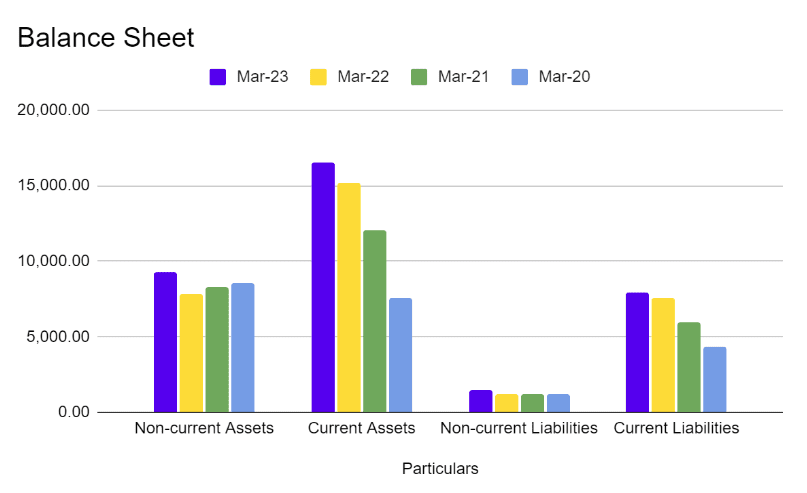
    As can be seen from the above table, the company’s non-current assets increased significantly in 2023 and increased further in 2024. It was ₹2,801.54 million in FY 2022 and increased to ₹4,951.30 million in 2024. In addition, the company’s current liabilities decreased year over year, indicating a strong financial position. 

    Income Statement

    Particulars31st March 202431st March 202331st March 2022
    Revenue from operations31,037.7832,584.0428,729.01
    Total Income31,216.0432,847.6228,864.08
    Total Expenses31,924.0434,206.4427,773.66
    Profit before tax(708)(1,358.82)1,090.42
    Profit after tax(535.93)(1,010.46)788.20
    (Above mentioned figures are in ₹ million unless stated otherwise)

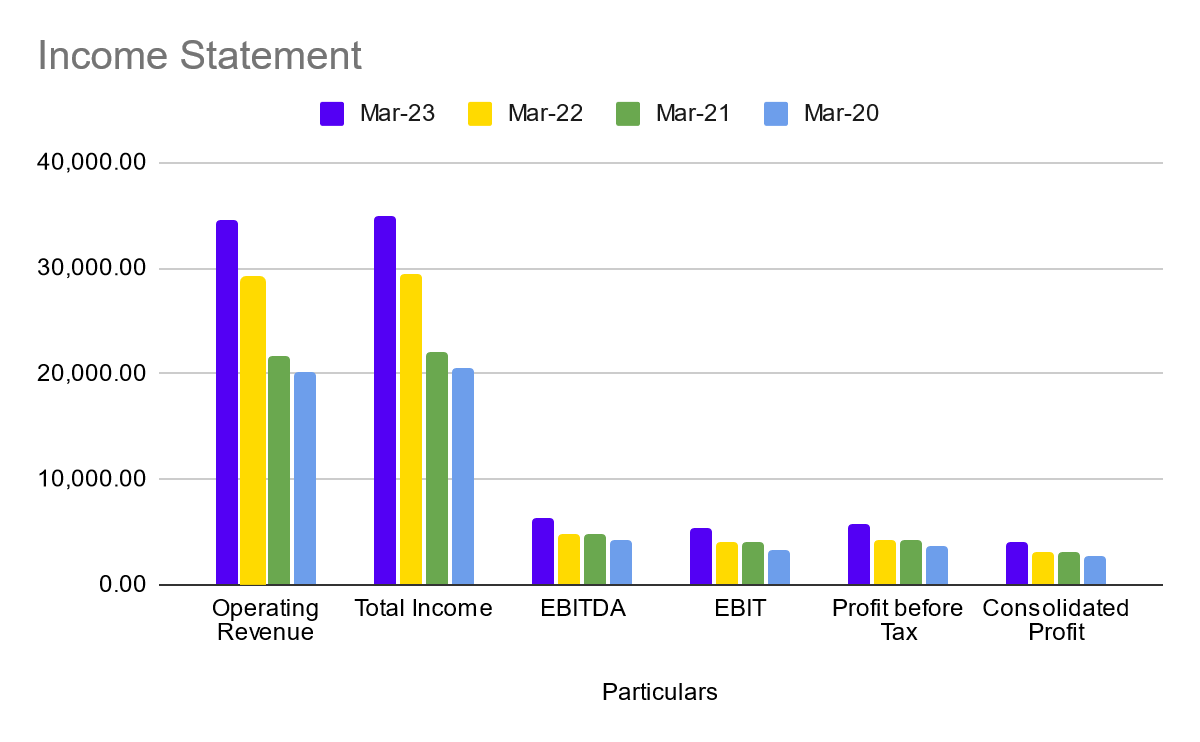
    Revenue for the company has climbed by about 8% between 2022 and 2024, while profit—both before and after taxes—has sharply declined. The company recorded a total net loss of ₹535.93 million, compared to a profit of ₹788.20 million for FY 2022. 

    Cash Flow Statement

    Particulars31st March 202431st March 202331st March 2022
    Cash flow from operating activities3,999(76.82)(6,097.69)
    Cash flow from investing activities(397.97)(1,181.69)(3,983.53)
    Cash flow from financing activities(4,460.66)2,348.568,939.51
    (Above mentioned figures are in million INR unless stated otherwise)

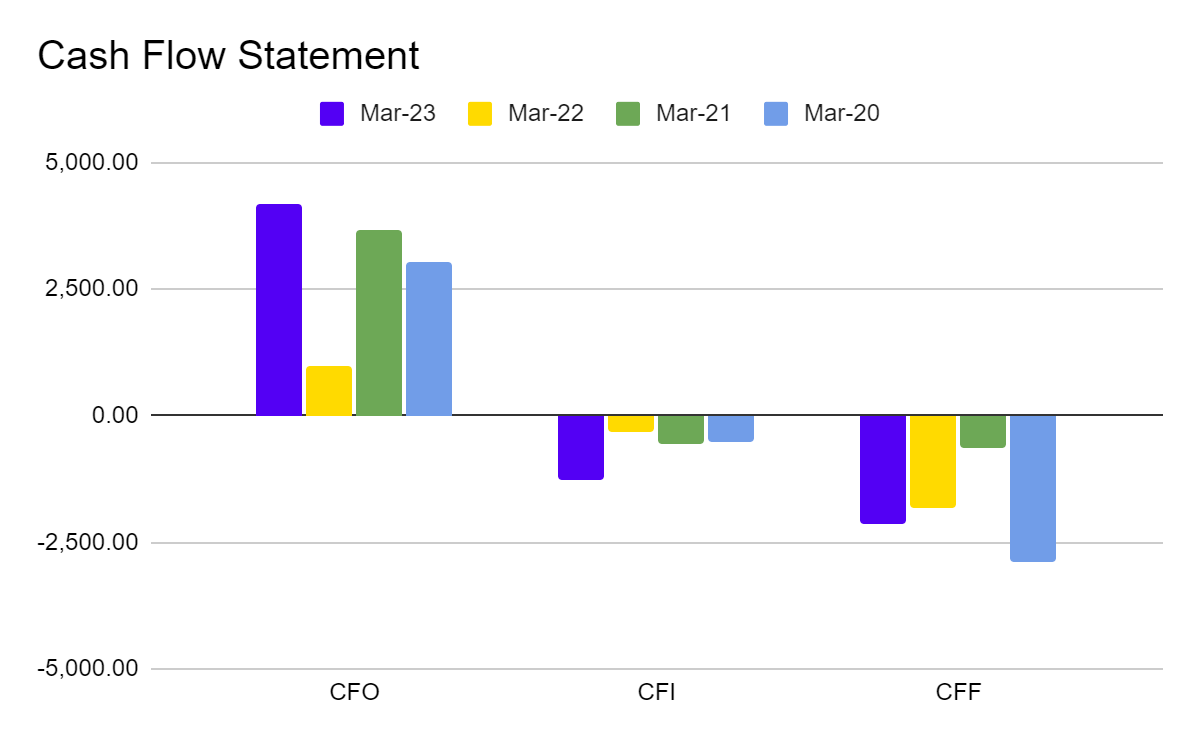
    boAt cash flow from operating activities has improved drastically between FY 2022 and FY 2024. However, cash flow from investing activities has decreased from ₹3,983.53 million to ₹397.97 million between FY 2022 and FY 2024, showing a declining trend over the years.

    Read Also: CAMS Case Study: Business Model, KPIs, and SWOT Analysis

    SWOT Analysis of boAt Company

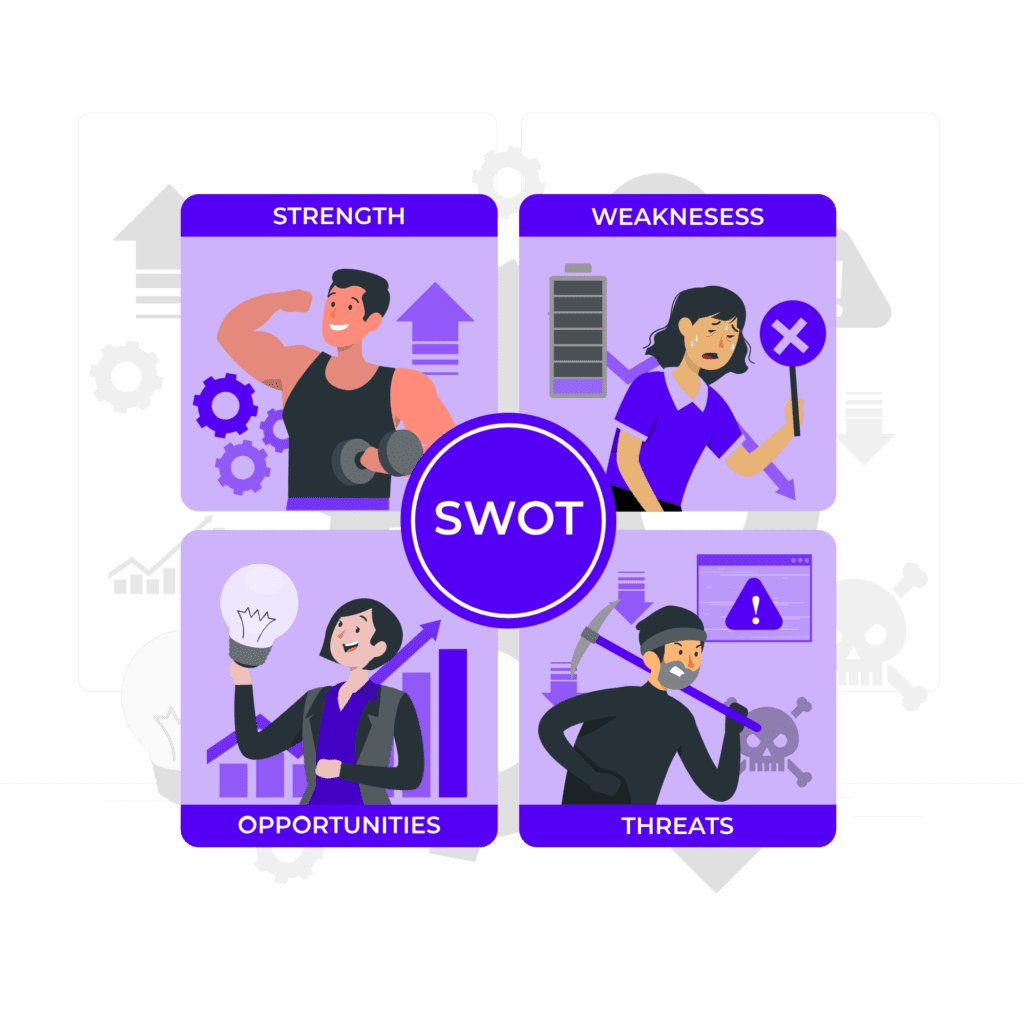
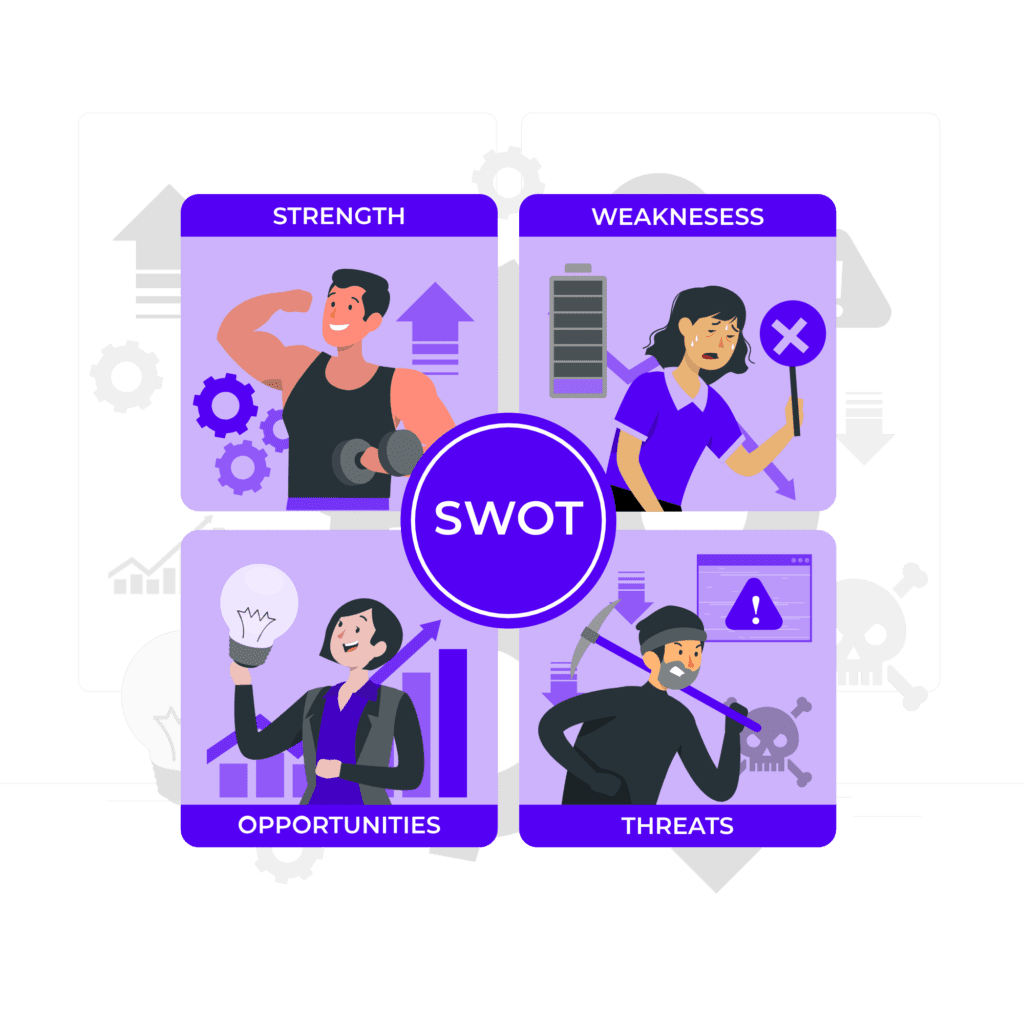
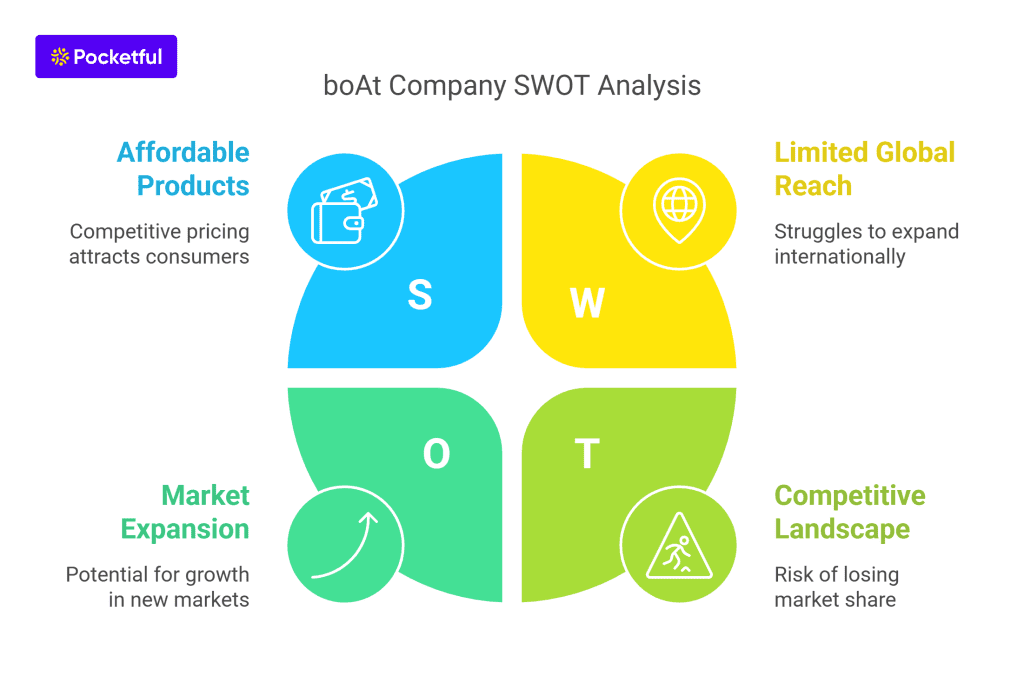
    This boAt SWOT analysis highlights the company’s strengths, weaknesses, opportunities, and threats, offering valuable insights into its market position and growth potential.

    swot analysis of boat company

    Strengths

    • When compared to other brands in the business, the items from boAt are comparatively less expensive, making them more affordable for consumers. 
    • Customers in the electronic markets have significant brand awareness for the corporation, particularly in the audio sector.
    • The company sells a variety of products, such as speakers, earbuds, headphones, and more. 
    • Their after-sales service brings consumer loyalty towards their brand, as they provide on-time service and have centers across the country.

    Weaknesses

    • boAt has captured the Indian market, but they were not able to expand its reach in other countries, which could be a hindrance to its growth potential.
    • boAt depends heavily on outside parties to supply the components needed to make their goods. 
    • The corporation is diversifying into more market categories, which could dilute its brand identity and confuse customers. 
    • The boAt does not have control over its relationships with customers because it sells its products on well-known platforms.

    Opportunities

    • The company’s growth may be aided by its overseas market expansion. 
    • boAt has recently ventured into the smart wearable industry, which has the potential to grow its revenue in the long run, given how popular wearables are right now. In addition, they can investigate various tech accessories. 
    • E-commerce platforms are becoming more and more popular, which presents a chance to expand their audience.
    • The company can sell its products by collaborating with well-known influencers and celebrities, which will raise awareness of the brand.  

    Threats

    • boAt may lose market share if they don’t pay attention to their pricing and business strategy in the face of competition from several new companies. 
    • There are many different fake goods in the market; they must cease as soon as possible since this will damage the brand’s reputation and reduce its income. 
    • Any economic crisis may affect consumers’ purchasing habits, which will reduce the market for electronic goods.

    Read Also: Best Trading Apps in India

    Future Outlook

    boAt’s future looks promising, driven by wearable tech expansion, global market entry, and product innovation. The brand is strengthening its D2C sales, offline presence, and premium audio segment to compete with global giants like JBL and Apple. Future products may feature AI integration, IoT connectivity, and eco-friendly materials. boAt also plans to launch an IPO for financial growth and expand beyond India into Southeast Asia and Europe. With a focus on affordability, technology, and marketing, boAt is well-positioned for sustained growth in the consumer electronics industry.

    Read Also: TCS Case Study: Business Model, Financial Statement, SWOT Analysis

    Conclusion

    In just eight years, boAt has become a leading brand in India and has taken control of the electronic audio gadget market. Their product quality, marketing tactics, and post-purchase assistance are all excellent. Due to their aggressive pricing, other industry titans like JBL and Bose are forced to cut their prices to make the products more accessible to consumers. 

    Given the dynamic nature of the consumer electronics market, the company ought to prioritize product innovation, international expansion, and distribution network optimization to sustain its growth pace. 

    S.NO.Check Out These Interesting Posts You Might Enjoy!
    1HDFC Bank Case Study: Business Model, Financial Highlights, and SWOT Analysis
    2Vedanta Case Study: Business Model, Financial Statement, SWOT Analysis
    3Nestle India Case Study: Business Model, Financial Statement, SWOT Analysis
    4BPCL Case Study: Business Model, Product Portfolio and SWOT Analysis
    5Apollo Hospitals Case Study : Business Model, Financial Statements, And SWOT Analysis

    Frequently Asked Questions (FAQs)

    1. What is the boAt’s parent company’s name?

      Imagine Marketing Ltd. is the parent company of the boAt.

    2. Is the boAt operating in losses?

      Despite reporting a profit in FY 22, the company recorded a net loss in FY 2023 and FY 2024.

    3. What is the valuation of boAt?

      As of December 2024, the valuation of boAt was around 10,500 crores.

    4. Is boAt listed on the stock exchange?

      boAt is not yet listed on any Indian exchange, although an initial public offering (IPO) is anticipated shortly.

    5. Where is the headquarters of boAt ?

      boAt has its headquarters in Mumbai, India.

  • BAT Stake Sale in ITC: Overview, Reasons, and Impact on Shareholders Explained

    BAT Stake Sale in ITC: Overview, Reasons, and Impact on Shareholders Explained

    Introduction

    British American Tobacco (BAT) is a major shareholder in ITC. But, recently, BAT released a statement indicating a major stake sale. Do you wonder what the future holds for BAT’s remaining stake in ITC?

    Buckle up! In today’s blog, we will dive deep into the recent sale of a portion of BAT’s stake in ITC and the reasons behind it.

    BAT – An Overview

    BAT stands for British American Tobacco, a multinational tobacco company and a leading consumer goods business. It was founded in the year 1902 by James Buchanan Duke and is now the world’s largest tobacco company by net sales. The company currently operates in 180 countries, and its brands include Dunhill, Kent, Lucy Strike, Pall Mall, and Rothmans. It is a listed company, and its ordinary shares are listed on the NYSE (New York Stock Exchange) in the form of American Depositary Shares (ADR). Additionally, the company also has a secondary listing on the Johannesburg Stock Exchange.  

    The company’s corporate purpose includes providing adult consumers with a range of enjoyable and less risky products and encouraging smokers to switch to scientifically-substantiated, reduced-risk alternatives.

    BAT overview

    ITC – An Overview

    ITC Limited is an Indian conglomerate headquartered in Kolkata, India. The company has a diversified presence across several industries such as FMCG, hotels, information technology, packaging, paperboards, and agribusiness. The company is a major player in the Indian economy and exports its products to over 90 countries.

    ITC holds a rich history that traces back to 1910 as the Imperial Tobacco Company of India Limited. The company initially focused on tobacco products and established its first cigarette factory in Bangalore in 1913. The name was later changed to India Tobacco Company in the year 1970. The company continues to innovate and expand its FMCG portfolio while focusing on sustainability initiatives.

    Read Also: ITC Case Study: Business Model, Financials, and SWOT Analysis

    Holding Pattern

    BAT currently owns 29% of ITC, the Indian Tobacco Company. On March 13, 2024, BAT sold 43.7 crore shares of ITC at INR 404 per share for a total of INR 17,491 crore, trimming its holding to 25.5%. The company plans to use the net proceeds of the block trades to buy back its shares over the period ending December 2025, starting with INR 7430 crore in 2024.

    BAT has said that a 25% stake in ITC should be sufficient to retain strategic influence, including veto rights. The stake sale was completed through a block deal. Block deals involve selling a large number of shares all at once, usually at a discounted price. This method ensures a quick and efficient sale of significant stakes without significantly impacting the overall market price.

    ITC Manufacturing tobacco

    Reasons for Stake Sale

    There are two main reasons why British American Tobacco (BAT) decided to sell a portion of its stake in ITC.

    1. Returning Cash to Shareholders

      BAT faced pressure from investors to receive a bigger share of the company’s profits. Selling a part of their ITC stake provided BAT with a significant amount of cash that they could use for stock buybacks and dividends.

      2. Strategic Shift

        The global cigarette industry is declining due to falling smoking rates and increasing government regulations. By selling some of its ITC holdings, BAT might be freeing up capital to invest in other areas or emerging technologies, which could include smokeless alternatives like vapes, heated tobacco products, or even exploring new ventures.

        Impact on Shareholders of ITC

        1. With BAT selling a portion of its stake, more ITC shares become available for trading in the open market. This increased liquidity can attract new investors and make it easier for existing shareholders to buy or sell their holdings.
        2. The initial announcement of the stake sale caused a temporary dip in the ITC’s share price. However, it quickly recovered and was up around 4%.
        3. Also, BAT’s long association with ITC might have provided strategic benefits in terms of knowledge sharing or market access. Reduced ownership can weaken this partnership and the investor’s interest as well. 
        4. Large block deals can cause temporary fluctuations in the share price, which can distract shareholders.
        5. The use of the proceeds is still uncertain. If they do not reinvest the funds strategically, it could raise concerns about BAT’s future direction, potentially impacting investor sentiment towards ITC.
        ITC Manufacturing line

        Future Outlook

        Predicting the future outlook of ITC is complex and depends on several internal and external factors. Some of these factors are listed below,

        1. With reduced foreign influence, ITC might get greater freedom to explore new business avenues beyond cigarettes. This will lead to diversification and higher growth in non-cigarette segments like FMCG.
        2. A more independent ITC can attract new investors seeking exposure to a broader portfolio.
        3. Also, the transition to a more independent structure could lead to a period of uncertainty for investors.

        Overall, the future outlook of the ITC stake sale is ambiguous. While the short-term impact might involve price fluctuations, the long-term directions hinge on market forces and BAT’s internal strategies. Even though a complete exit from ITC is less likely soon, it cannot be entirely ruled out in the long term.
        Successfully diversifying ITC’s product portfolio and navigating the regulatory environment will be important for long-term success.

        Read Also: What is a Bonus Issue? Meaning, Process, Key Dates, and Impact Explained

        Conclusion

        On a parting note, the sale in ITC marks a turning point for the Indian tobacco giant. While the future remains uncertain, there is a mix of benefits and challenges on the horizon. On the positive side, ITC gains greater autonomy to explore new ventures. Eventually, the company’s success will depend on its ability to adapt.
        Frequently Asked Questions (FAQs)

        1. Will BAT sell its entire stake in ITC eventually?

          This is uncertain; BAT has not indicated further stake sales, but the long-term strategy could change.

        2. Does this stake sale mean the end of cigarettes in India?

          No, but the cigarette market is declining, and ITC might need a strong non-cigarette strategy to survive in the long run.

        3. Why did BAT sell its stake in ITC?

          BAT had two broad reasons for its stake sale, which are returning cash to shareholders and a strategic shift.

        4. What is the overall outlook for ITC?

          The company’s future outlook is uncertain, but if they diversify effectively, the future can be promising.

        5. Will the stake sale impact ITC stock price?

          The stake sale may result in short-term uncertainty. However, the long-term impact depends on ITC’s future performance.

        Disclaimer: The securities, funds, and strategies mentioned in this blog are purely for informational purposes and are not recommendations.

      1. Punjab National Bank (PNB) Case Study: Overview, Financials, and SWOT Analysis

        Punjab National Bank (PNB) Case Study: Overview, Financials, and SWOT Analysis

        Do you also consider PSU banks to be safer than private banks? Most of India thinks along these lines, but very few perform extensive research before investing their hard-earned money in them. Therefore, today’s blog will focus on a popular PSU bank, PNB, and understand its KPIs, business segments, and financials.  

        Overview

        Punjab National Bank was established in New Delhi, India. The company’s offerings include retail and commercial banking, agricultural and international banking, and other services. Its retail and commercial banking portfolio provides debit and credit cards, corporate cash management,  retail loans, deposit services, and trade finance. Its international banking portfolio includes foreign currency accounts, money transfers, letters of guarantee, world travel cards, and solutions for non-resident Indians.

        Punjab National Bank also provides merchant banking services, mutual funds, depository services, insurance, and other services through the Internet. The bank is based in India but also operates in the United Kingdom, Bhutan, Myanmar, Bangladesh, Nepal, and the United Arab Emirates.

        Company TypePublic
        IndustryBanking and Financial services
        Founded1894
        Managing DirectorAtul Kumar Goel
        PNB deposit

        Awards and Recognition

        • 2016: Innovative Practices in Women’s Empowerment
        • 2020: Most Innovative Project using Technology for ‘PNBOne’ 
        • 2023: Iconic Brands of India by the Economic Times
        • 2023: Employee Happiness Award
        • 2023: Best CSR/Social Development Campaign for Rural India by Eggfirst Chalo 
        • 2023: CEO of the Year by Great Indian BFSI Awards 2023

        Products and Services

        1. Loans: Punjab National Bank offers various types of loans for retail customers, including students. They offer personal, home, car, and gold loans. 
        2. Credit Cards: The bank offers different types of credit cards designed to cater to the needs of its customers across categories such as traveling, dining, shopping, etc. 
        3. Debit cards: The bank offers debit cards to allow its customers access to instant and cashless transactions. 
        4. Insurance: The bank partners with leading insurance companies to provide a variety of insurance products, including life insurance, health insurance, and travel insurance, to its customers.
        5. Foreign exchange services: It offers foreign exchange services, including currency, remittances, exchange, and travel cards, to its customers who need to transact in foreign currencies.
        6. Digital banking:  It provides various digital banking services, including Internet banking, mobile banking, and UPI, to make it easier for its customers to access and manage their accounts and financial transactions.
        7. Investment Product: It provides various investment products, such as mutual funds, government securities, and fixed deposits, to assist its customers in growing their wealth.
        8. Account: The bank provides two different accounts, i.e. Savings and Current Accounts.
        • Saving Account: A basic savings account can be opened by any individual with an initial deposit of Rs 500. It also provides an ATM cum Debit Card and other advantages like free transfer of funds and free Internet banking.
        • Current Account: This account is suitable for customers who perform frequent banking transactions.

        Key Highlights of FY23-24

        • Savings deposits increased to ₹ 4,78,880 Crore as of December’23, from ₹ 4,51,945 Crore as of December’22, registering a growth of 6.0% on a YoY basis.
        • CASA ratio stands at 42.47% as of December’23.
        • Net Profit for Q3 FY’24 was at ₹ 2,223 Crore, increasing by 253.4% on a YoY basis.

        Market Data

        Let’s have a look at some essential market data of the company:

        Market Cap ₹ 136,977 Cr. 
        TTM P/E 17.95
        ROCE 5.86 % 
        Book Value 82.65
        ROE 3.32 % 
        High / Low 133 / 44.4
        Dividend Yield0.53 % 
        Face Value ₹ 2.00
        (As of 30th March 2024)

        Read Also: Hero MotoCorp Case Study: Business Model and SWOT Analysis

        Financial Highlights

        Income Statement

        ParticularsMar-23Mar-22Mar-21Mar-20
        Interest Earned 86,845.2976,241.8381,935.0354,918.48
        Other Income 12,239.5912,097.6612,234.919,387.65
        Total Income 99,084.8888,339.4994,169.9464,306.13
        Profit Before Tax 4,861.424,594.463,782.35827.00
        Consolidated Profit 3,348.453,860.742,561.97438.45
        (In Crores)

        Cash Flow Statement

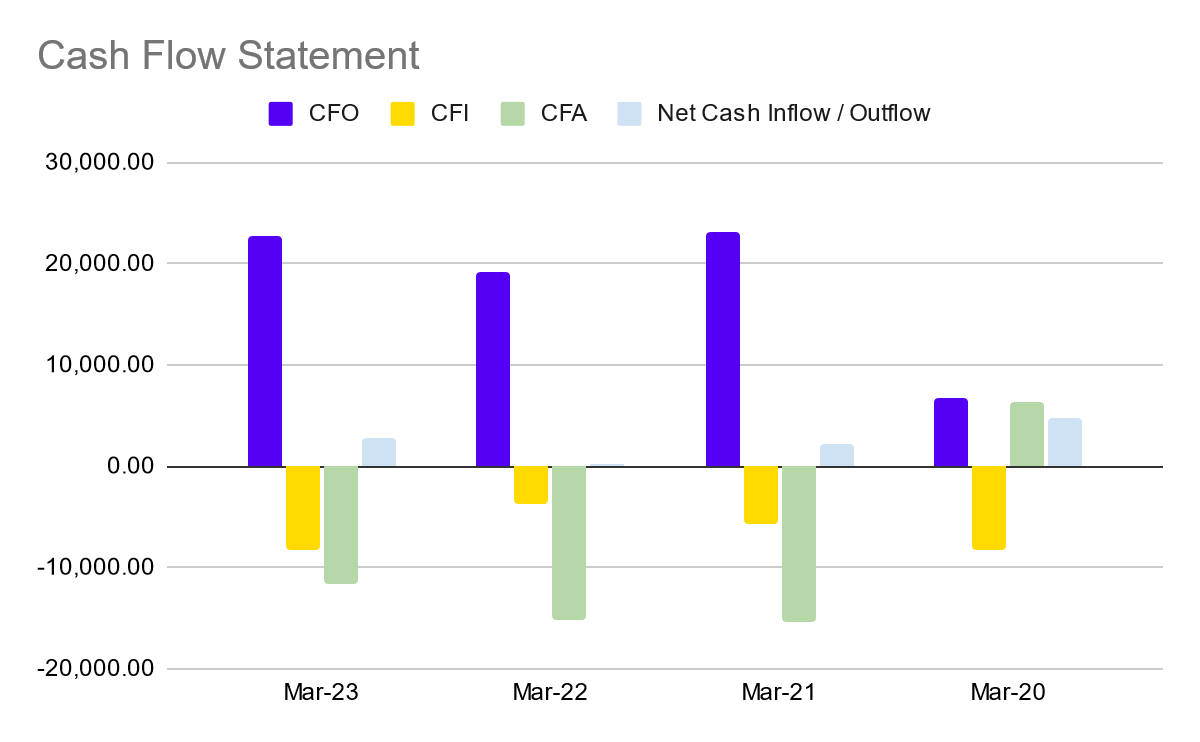
        ParticularsMar-23Mar-22Mar-21Mar-20
        Cash From Operating Activities 22,592.0920,032.331,239.53-12,793.04
        Cash Flow from Investing Activities -732.47-1,204.38-786.84-338.33
        Cash from Financing Activities 1,274.982,031.505,415.1713,591.15
        Net Cash Inflow / Outflow 23,134.6020,859.455,867.86459.78
        (In Crores)
        CFS of PNB

        Financial Ratios

        ParticularsMar-23Mar-22Mar-21Mar-20
        Adjusted EPS (₹) 3.043.512.450.65
        Cash EPS (₹)3.614.152.991.45
        Adjusted Book Value (₹) 85.7682.2281.4487.74
        Dividend per Share (₹) 0.650.640.170.05
        Cash Flow per Share (₹) 20.5218.191.18-18.99
        Free Cash Flow per Share (₹) -0.791.06-21.62-39.80

        KPIs

        ParticularsMar-23Mar-22Mar-21Mar-20
        NIM (%) 2.482.342.602.22
        ROE (%) 3.324.182.980.72
        ROA (%) 0.220.280.200.04
        KPIs of PNB

        Shareholding Pattern

        ParticularsDec-23Sep-23Jun-23Mar-23Dec-22
        Indian Promoter73.1573.1573.1573.1573.15
        DIIs13.7413.8013.4513.5212.98
        FIIs3.102.651.821.711.71
        Others10.0110.4011.5811.6212.16
        (In %)
        Shareholding Pattern of PNB

        The graph indicates a stagnancy in the shareholding pattern. This shows the trust of institutional investors. 

        Peer Comparison

        ParticularsPunjab National BankHDFC BankICICI BankState Bank Of IndiaKotak Mahindra Bank
        Market cap (₹ Cr)1,36,92211,00,1857,69,5446,71,6663,55,003
        Interest Income (₹ Cr)1,04,6882,51,7641,51,3484,19,80253,062
        Net Interest Income (₹ Cr)39,669.811,18,710.6883,184.211,77,258.8132,477.35
        RoA (%)0.473.092.101.062.79
        Price to Earnings17.8018.4617.9810.3720.15
        Price-To-Book1.362.493.191.752.82

        SWOT Analysis

        SWOT Analysis of PNB

        Strengths

        • It offers a wide range of banking services, catering to both urban and rural customers and international clients. The bank serves a diverse customer base and effectively meets their banking needs and requirements.
        • The bank has a long history of providing services of utmost quality
        • The bank has created a positive reputation that distinguishes it from its competitors.

        Weaknesses

        • Punjab National Bank exists in a highly competitive environment, with numerous players vying for market share. 
        • The bank must invest in advanced technological infrastructure and offer convenient and secure online banking services to meet changing customer requirements and expectations.

        Opportunities

        • Punjab National Bank must display an increase in net profit margin and favorable NIM (Net Interest Margin).
        • The bank should continuously monitor and evaluate its performance against established benchmarks and adjust its strategies as needed.

        Threats

        • In 2018, Punjab National Bank suffered from controversies such as the Nirav Modi scam, where fraudulent transactions worth $2 billion were conducted through PNB’s Mumbai branch without detection for a long time, tarnishing the bank’s reputation significantly.
        • New entrants can give tough competition to the Punjab National Bank. It can impact the bank’s profitability and financial stability.

        Read Also: LIC Case Study: Business Model and SWOT Analysis

        Conclusion

        Punjab National Bank is a public sector undertaking in India that offers a wide range of banking and financial services. It has a strong presence in various segments, including retail and commercial banking, international banking, and digital banking. The bank has experienced growth in its financial metrics and is expected to continue growing. Overall, Punjab National Bank is a reputable institution with a diverse customer base and a positive outlook.

        However, it is advised that you perform your own analysis before investing your hard-earned money. 

        S.NO.Check Out These Interesting Posts You Might Enjoy!
        1Gopal Snacks IPO: Segments, Financials, Key Details, Strengths, and Weaknesses
        2JG Chemicals IPO: Overview, Key Details, Financials, KPIs, Strengths, and Weaknesses
        3RK Swamy IPO: Business Model, Key Details, Financials, KPIs, Strengths, and Weaknesses
        4Krystal Integrated Services: IPO, Business Model and SWOT Analysis
        5Popular Vehicle and Services IPO: Key Details, Financials, Strengths, and Weaknesses

        Frequently Asked Questions (FAQs)

        1. Is PNB a private or government bank?

          Punjab National Bank is a government entity public sector bank.

        2. Who established the Punjab National Bank?

          Punjab National Bank is an Indian Public sector bank, established on 19th May 1894 by Sardar Dyal Singh Majithia.

        3. What is the book value of Punjab National Bank?

          As of 25th March 2024, the per share book value of PNB is ₹ 82.65.

        4. Who is the CEO of PNB?

          Atul Kumar Goel is the current Managing Director and Chief Executive Officer of Punjab National Bank.

        5. Which banks merged with PNB in 2020?

          The Oriental Bank of Commerce and the United Bank of India (UBI) merged with PNB in 2020.

      2. Patanjali Foods Case Study: Business Model, Financials, KPIs, and SWOT Analysis

        Patanjali Foods Case Study: Business Model, Financials, KPIs, and SWOT Analysis

        Patanjali, the name itself, evokes a sense of tradition and well-being. Over time, it has become a household name in India. Patanjali is a modern consumer goods company that provides everything from herbal remedies to healthy staples in India, and is known for its Ayurvedic and natural products. 

        In today’s blog, we will delve deeper into Patanjali Foods, a brand synonymous with a back-to-nature approach, and explore the company’s financials, SWOT analysis, and business model.

        Patanjali Overview

        Baba Ramdev and Acharya Balkrishna established Patanjali Ayurveda Limited in Haridwar in 2006. Patanjali Foods was initially founded as Ruchi Soya Industries Limited. The company initially concentrated on manufacturing herbal formulations and ayurvedic medications. They started producing food, household goods, and personal care items later in 2010 after entering the fast-moving consumer goods (FMCG) industry. 

        Ruchi Soya Industries declared bankruptcy in the year 2019 as a result of heavy debt. In June 2022, Ruchi Soya Industries Limited formally changed its name to Patanjali Foods Limited after Patanjali Foods purchased the bankrupt company in 2019. The company produces bakery fats, soy products, edible oil, and Vanaspati Ghee.

        The company grew tremendously between 2015 and 2017 due to aggressive marketing efforts and strong brand recall. 

        Patanjali Maggi

        Patanjali Business Model

        The business model of Patanjali Foods is built around a number of essential components

        1.  The company targets customers who like natural products and concentrates primarily on Ayurveda and natural ingredients in its products.

        2.  The company maintains standards and quality because it has direct control over many areas of the production process, including the supply chain and raw material purchases.

        3.  The company draws customers who are sensitive to price changes because they offer their items at very reasonable costs.

        4.  The company’s extensive distribution network, which consists of franchise stores, supermarkets, and its own retail locations, makes its products easily accessible to consumers.

        Market Details

        Current Market PriceINR 1372
        Book ValueINR 272
        52 Week HighINR 1713
        52 Week LowINR 864
        Face ValueINR 2
        PE Ratio59.51
        Market Capitalization49,587 Crores
        (As of 21st March 2024)

        Read Also: Colgate Palmolive India Case Study: Business Model, Product Portfolio, And SWOT Anlaysis

        Patanjali Financial Highlights

        Balance Sheet

        Particulars31st March 202331st March 202231st March 2021
        Non-Current Asset5415.13765124.77685320.7144
        Current Asset7824.77246351.35873688.1054
        Total Asset13243.585611480.21119008.8198
        Equity9846.56676170.84044062.4128
        Long Term Liability193.36533054.02673215.1662
        Current Liability3201.92362253.61401731.2408
        (In Crores)

        From the above table and graph, it is evident that the company’s total assets have increased over time. It was 11480 crore in the year 2022 and increased to 13243 crores in FY 2023. Still, their non-current assets remain constant, and their long-term liability has decreased drastically in FY 2023. It was 3054 crore in FY 2022 and decreased to 193 crores in FY 2023.

        Income Statement

        Particulars31st March 202331st March 202231st March 2021
        Revenue from operations31524.656024205.375116318.6330
        Total Income31821.454824284.382216382.9771
        Total Expenses30642.493523210.000715868.5769
        Profit before tax1178.96131074.3815514.4002
        Profit after tax886.4411806.3089680.7718
        (In Crores)

        The table above indicates that the business is growing, with operating revenue rising at an approximate rate of 35% CAGR and profit rising at an approximate rate of 10% YoY.

        Cash Flow Statement

        Particulars31st March 202331st March 202231st March 2021
        Net Cash flow from operating activities(339.3398)724.2141247.2654
        Cash flow from investing activities526.1229(1,384.47)(43.9808)
        Cash flow from financing activities241.3590988.94(310.8140)
        (In Crores)

        The above table indicates that the company’s primary source of earnings are its investing and financing activities, which have been erratic in the past. Given that a stable company’s primary source of earnings should come from operating activities, this could be cause for concern.

        KPIs

        Particulars31st March 202331st March 202231st March 2021
        Operating Profit Margin (%)4.495.905.42
        Net Profit Margin (%)2.813.334.17
        Return on Capital Employed (%)14.1215.4912.16
        Inventory Turnover7.197.367.53
        Current Ratio2.442.822.13
        Return on Net Worth (%)916.5116.75

        The company’s major performance metrics show that its net profit margin dropped to 2.81% in FY 2023 from 3.33% in 2022. 

        Patanjali SWOT Analysis

        The SWOT analysis of Patanjali reveals key strengths, weaknesses, opportunities, and threats shaping the company’s growth strategy:

        SWOT analysis of Patanjali Foods

        Strengths

        1.  The company incorporates natural ingredients in its products, which helps it gain the trust of its clients and establish a strong brand identity. 

        2.  To meet the demands of various clients, the company offers a varied product range spanning food, wellness, personal care, and other categories. 

        3.  The products of Patanjali are affordable for every segment of customers, through which they can position themselves easily in the market.

        4.  The company can reach every corner of the nation, whether in an urban or rural setting, thanks to its wide distribution network. 

        Weaknesses

        1.  The company has occasionally received complaints about the quality of its products. This can be a cause for concern since a persistent pattern of complaints will negatively impact the company’s reputation with customers. 

        2.  The company’s minimal exposure to the global market raises questions about how the firm can expand. 

        3.  Since the company only sells ayurvedic items, its target market is only health-conscious individuals; as a result, it might not be able to meet the needs of a larger customer base. 

        Opportunities

        1.  To satisfy the demands of changing consumers, the corporation must concentrate on diversifying its product line to include ready-to-eat meals, FMCG, functional beverages, etc. 

        2.  The company has yet to explore the foreign market, but doing so will help it grow as it will present new opportunities. 

        3.  They can access a larger spectrum of customers thanks to the rise of e-commerce platforms. 

        4.  The research and development team should concentrate on creating new items that will meet consumer wants, giving them an advantage over competitors. 

        Threats

        1.  Due to intense competition from both domestic and foreign brands, the company’s profitability will be severely damaged by any poor judgments the management makes regarding the quality of the product, price, and other concerns.  

        2.  Any interruption to the supply chain, a scarcity of raw materials, or a problem with transportation could have a detrimental effect on the company’s earnings. 

        3.  Nowadays, customer needs are changing quickly; as a result, businesses that are unable to adjust will likely experience a decline in sales. 

        4.  Any change in a regulation made by the government regarding food safety and labeling standards could adversely impact the margins of the company.

        Read Also: Gillette India Case Study: Business Model, SWOT Analysis, and Financial Overview

        Conclusion 

        Owing to its ayurvedic products, Patanjali has established a reputation as the Swadesi Company and has always been in the spotlight. The company is still surviving and is regarded as the fastest-growing FMCG company in India despite having suffered several problems in the past with the quality of its products. 

        If the organization cannot meet the evolving needs of its customers, it still has a long way to go. As we usually advise, think about your risk tolerance before making any investing decisions.

        S.NO.Check Out These Interesting Posts You Might Enjoy!
        1Hindustan Unilever Case Study
        2Elcid Investments – India’s Costliest Stock
        3Reliance Power Case Study
        4Burger King Case Study
        5Zara Case Study

        FAQs

        1. What is Patanjali Foods’ primary business? 

          The company processes oil seeds and refines oils for culinary use in India. It also works in the FMCG sector, producing cow ghee, spices, and herbal goods, among other things. 

        2. What does the company’s cash flow situation say?

          The company’s CFS indicates a very turbulent picture, where the majority of the net cash flow came from investing and financing activities.

        3. Is PATANJALI in FMCG company?

          Yes, Patanjali Ayurved Limited is an FMCG (Fast-Moving Consumer Goods) company. It offers a wide range of products, including food items, beverages, personal care products, and Ayurvedic medicines.

        4. Are Patanjali Foods and Ruchi Soya the same company?

          Yes, Patanjali Foods Limited is the new name of the company following Patanjali Ayurved’s acquisition of Ruchi Soya.

        5. Do Foreign Institutional Investors hold any stake in Patanjali Foods?

          As of December 2023, FII holds around 10.93% stake in Patanjali Foods.

        6. Who was the CEO of Patanjali?

          As of the latest information, the CEO of Patanjali Ayurved Limited is Acharya Balkrishna. He is a close associate of Baba Ramdev and has been instrumental in the company’s growth.

      3. SBI Cards and Payment Services Case Study: Products, Financials, and SWOT Analysis

        SBI Cards and Payment Services Case Study: Products, Financials, and SWOT Analysis

        1998 SBI entered the Indian credit card market with its Cards and Payment services arm. At the time, the industry was still picking up so SBI Cards had a lot of scope for growth. But a lot of time has passed, so let’s delve into the SBI Cards Case Study to understand their market, business segments, financials, and SWOT analysis.

        Overview of SBI Cards and Payment Services

        State Bank of India Cards was launched in 1998 by SBI and GE Capital as a Joint Venture. The company is headquartered in Gurugram, India. The company aims to offer Indian consumers access to a wide range of world-class, value-added payment products and services and, in doing so, simplify the lives of the customers.  

        In December 2017, the State Bank of India and The Carlyle Group acquired GE Capital’s stake in SBI Card. The company officially changed its name to SBI Cards and Payments Services Limited in August 2019. SBI Card then became the first pure-play credit card company to list on the stock exchanges in India in March 2020.

        With more than 1.68 crore cards issued as of March 31, 2023, SBI Cards and Payments Services Ltd. is the largest pure-play credit card issuer and the second-largest credit card player in the nation. The company also has the second-largest market share in credit cards with an 18.2% share as of March 31, 2023. Let’s have a quick summary of the company:

        IndustryPayment processing industry
        HeadquartersGurugram, India
        ProductsCredit cards
        Services Payments processing

        Products and Services Offered

        SBI Cards have different cards for the various needs of their customers. Some of the cards issued by the company are:

        SBI Card Elite

        SBI Card Elite is an all-rounder premium card that offers benefits across multiple categories, such as travel, movies, dining, and rewards. The cardholders can earn decent rewards on their everyday spending along with substantial milestone benefits. This card is suitable for high spenders.

        Features

        • Welcome e-Gift Voucher worth Rs. 5,000 
        • Get free movie tickets worth Rs. 6,000 every year
        • Earn up to 50,000 Bonus Reward Points worth Rs.12,500 per year
        • Complimentary membership is available to the members of Club Vistara and the Trident Privilege program.

        SBI Card Pulse

        SBI Card Pulse is a credit card specially tailored for people who are health-conscious and have an active lifestyle. The card offers several complimentary health memberships and benefits to the cardholders’ well-being.

        Features

        • Free Noise ColorFit Pulse 2 Max Smartwatch worth Rs. 5,999 on payment of joining fees
        • 12 Month Membership for FITPASS and Netmeds First Pass at the time of joining and card activation.  
        • 5X Reward Points on Chemist, Pharmacy, Dining, and Movie Spends.
        • 8 complimentary (2 per Quarter) domestic lounge access in a calendar year.
        SBI Cards

        Doctor’s SBI Card in Association with IMA

        This credit card is associated with the prestigious Indian Medical Association. The card is specially tailored to keep a doctor’s lifestyle in mind.

        Features

        • Professional Indemnity Insurance cover of Rs. 20 Lakhs.
        • E-Gift Voucher worth Rs. 1,500 on joining.
        • Users will receive 5X Reward Points on Medical Supplies, Travel Bookings, International Spends, and Doctors’ Day.
        • The e-Gift voucher is worth Rs. 5,000 in annual spending of Rs. 5 lakhs.
        • 35% off on Avis Car Rentals bookings.

        SBI Card ELITE Advantage

        This card is suitable for people who travel internationally. It offers one of the lowest foreign currency markup fees, travel benefits, along with lounge access. 

        Features

        • Welcome e-Gift Voucher worth Rs. 5,000 on joining.
        • Get free movie tickets worth Rs. 6,000 every year.
        • Earn up to 50,000 Bonus Reward Points worth Rs. 12,500 per year.
        • Complimentary membership is available to members or users of Club Vistara and the Trident Privilege program.
        • The age of salaried customers must be between 21 to 70 years.

        Awards and Recognitions

        • 2023 – Gold and Silvers Stevie Awards for Sales and Customer Services.
        • 2022 – Recognized as the Best Brand award by The Economic Times.
        • 2022 – Recognized as Reader’s Digest Trusted Brand.
        • 2023 – SBI Card won the Golden Peacock National Training Award for Excellence in Training and Development in the Financial Sector.

        Read Also: SBI Case Study: India’s Leading Public Sector Bank

        Market Data of SBI Cards and Payment Services

        Let’s have a look at the essential data of the company:

        Market Cap ₹ 64,908 Cr. 
        TTM P/E 27.71
        ROCE 14.83 % 
        Book Value ₹ 103.42
        ROE 25.8 % 
        52 Week High / Low ₹ 933 / 679
        Dividend Yield 0.36 % 
        Face Value ₹ 10.0
        (As on 28th March 2024)

        Financial Highlights of SBI Cards and Payment Services

        Income Statement

        ParticularsMar-23Mar-22Mar-21Mar-20
        Operating Income 13,666.6410,677.279,296.469,276.40
        Total Income 14,285.6711,857.779,713.589,752.29
        Operating Expenses 8,807.258,033.716,866.496,230.34
        Profit before Tax 3,030.572,172.161,323.731,729.64
        Consolidated Profit 2,258.471,616.14984.521,244.82
        (Figures in Crores)

        The company is able to grow the consolidated profit at a continuously increasing rate. This growth is driven primarily by growing total income while maintaining a steady but lower expense growth rate.  

        Cash Flow Statement

        ParticularsMar-23Mar-22Mar-21Mar-20
        Cash From Operating Activities -6,670.51-4,391.46692.32-4,062.93
        Cash Flow from Investing Activities -921.44-538.12-996.78-77.17
        Cash from Financing Activities 7,823.585,044.54431.753,922.51
        Net Cash Inflow / Outflow 231.63114.96127.29-217.59
        (Figures in Crores)
        CFS Of SBI Cards

        The company’s operating activities have produced negative figures for the past few years now. This can be considered as a major issue as it may come across as a reduction in operational capability of the management. 

        Shareholding Pattern

        Shareholder TypeDec-23Sep-23Jun-23Mar-23Dec-22
        Indian Promoter68.7568.9468.9669.0269.05
        DIIs16.2817.3017.1817.4716.72
        FIIs9.359.089.488.459.13
        Others5.624.684.385.065.10

        Peer Comparison

        ParticularsSBI Cards And  Payment ServicesBajaj FinservMuthoot FinanceAditya Birla CapitalL&T Finance Holdings
        Market cap (₹ Cr)64,9082,52,30353,19344,22636,612
        Revenue (₹ Cr)5,1601,01,9664,82218,2854,484
        Net Profit (₹ Cr)2,341.8414,838.954,294.582,561.572,181.04
        Net Margin (%)41.0714.5587.1013.9642.32
        RoE (%)25.816.0318.1411.9710.37
        Price to Earnings27.7132.3512.7916.3916.15
        Price-To-Book5.694.592.211.741.60
        (As of 28th March 2024)

        Read Also: Shriram Finance Case Study: Business Model, Financials, and SWOT Analysis

        SWOT Analysis of SBI Cards and Payment Services

        The SBI Cards and Payment Services SWOT Analysis highlights its strengths, weaknesses, opportunities, and threats, showcasing its market position and growth potential.

        SWOT Analysis of SBI Cards

        Strengths

        1. The company’s book value has improved over the last 2 years. Thus, reflecting a steady operational growth. 
        2. An increasing total income is a wonderful sign as it indicates high customer trust.
        3. Annual net profit has improved over the last 2 years. An increasing net profit reflects high management capability. 
        4. The company has a diversified product portfolio catering to different consumer segments.
        5. The company focusses on strong parentage and backing from State Bank of India, India’s largest commercial bank.

        Weaknesses

        1. The stock price has underperformed the industry growth. This reflects lower investor confidence. 
        2. The company’s revenue base is concentrated in India. This has led to an increased dependency on the Indian market for revenue generation.
        3. The company is vulnerable to economic downturns and fluctuations in interest rates.

        Opportunities

        1. The company must expand into new financial products and services in the marketplace. 
        2. The credit card industry has a lot of growth potential because of the increasing middle-income class. 

        Threats

        1. The company faces intense competition from domestic and international credit card issuers.
        2. The industry has witnessed substantial cybersecurity risks in the past year. These risks significantly impact customer loyalty. 

        Conclusion

        SBI Cards and Payment Services Ltd is the largest pure-play credit card issuer in India, offering a wide range of credit cards tailored to different customer needs, with a strong focus on providing value-added payment products and services. The company has experienced growth in Revenue and net profit. It has opportunities for expansion in new financial products and services. However, it faces competition from domestic and international credit card issuers and potential threats from economic downturns and cybersecurity risks. Therefore, it is advised that you perform a thorough analysis before making any investment decisions. 

        S.NO.Check Out These Interesting Posts You Might Enjoy!
        1ICICI Bank Case Study: Financials, KPIs, Growth Strategies, and SWOT Analysis
        2Vedanta Case Study: Business Model, Financial Statement, SWOT Analysis
        3Nestle India Case Study: Business Model, Financial Statement, SWOT Analysis
        4BPCL Case Study: Business Model, Product Portfolio and SWOT Analysis
        5Apollo Hospitals Case Study : Business Model, Financial Statements, And SWOT Analysis

        Frequently Asked Questions (FAQs)

        1. Is SBI Cards a joint venture company?

          It is a joint venture between the State Bank of India and GE Capital. 

        2. Who is the CEO of SBI Cards?

          MR. Abhijit Chakravorty is the current MD and CEO of SBI Cards.

        3. What is the Market Cap of SBI Cards?

          As of 19th March 2024, the market cap. of the company is 64,908 Cr. 

        4. What is one of the weaknesses of SBI Cards?

          The company’s operating activities have produced negative figures for the past few years now. This can be considered as one of the major weaknesses of SBI Cards. 

        5. Who are SBI cards’ major competitors?

          SBI Cards faces tough competition from established players like Bajaj Finserv, Muthoot Finance, and Aditya Birla Capital.

      4. AVP Infracon IPO: Overview, Key Details, Financials, Strengths, and Weaknesses

        AVP Infracon IPO: Overview, Key Details, Financials, Strengths, and Weaknesses

        Are you bullish on India’s infrastructure story? Today, we’ll be exploring a construction company’s IPO. Let’s understand its overview, clientele, and SWOT analysis.  

        AVP Infracon IPO Overview

        AVP Infracon Limited, earlier known as AVP Constructions Private Limited, was founded in 2009, and the founder was determined to make it India’s leading construction company. The company specializes in the construction of road projects and engineering, procurement, and construction methods.

        The company has partnered strategically as a joint venture with M/s Jawahar Constructions and M/s CDR & Co. Constructions. This will increase their efficiency in completing projects and strengthening their order book.

        Their projects generally include expressways, national highways, flyovers, bridges, irrigation projects, and urban development projects. As of December 2023, they have completed more than 40 projects, and the value of those projects is estimated to be around 313.21 crores.

        The company bids for projects mainly in Tamil Nadu and has its head office in Chennai.

        Clientele

        Their major clients include Greater Chennai Corporation, the National Highway Authority of India, the Tamil Nadu Public Works Department, the Tamil Nadu Highways Department, and the Ministry of Road Transport and Highways.

        Promoters

        The company’s promoters are Mr. B Venkateshwarlu and Mr. D Prasanna. They own about 86.5% of the business. The promoter’s pre-issue stake in the company is 86.5%, and their post-issue stake is expected to be 62.33%. 

        Details of the Issue

        AVP Infracon is planning an initial public offering (IPO) to sell 69.79 lakh shares and raise INR 52.34 crores. This is an entirely fresh issue. The initial public offering (IPO) price range is 71 to 75 INR per share. A minimum lot size of 1600 shares has been decided. 

        Key Details

        Face Value of ShareINR 10 Rs
        Price BandINR 71 to INR 75 per share
        Market Lot1600 Shares
        Total Fresh Issue Size52.34 Crores
        Total Number of Shares69.79 Lakh shares

        Timeline

        IPO Open Date13th March 2024
        IPO Close Date15th March 2024
        Finalization of Allotment18th March 2024
        Initiation of Refund & Credit of shares into Demat account19th March 2024
        Listing Date20th March 2024

        Allotment Size

        ApplicantMarket LotShareAmount (INR)
        Retailer (Min)11600INR 120000
        Retailer (Max)11600INR 120000
        High Net Worth Individual (Min)23200INR 240000

        Reservation

        Investor CategoryShares Offered% Offered
        Anchor Investor Shares Offered187040026.8
        Market Maker Shares Offered73120010.48
        QIB Shares Offered124800017.88
        NII Shares93920013.46
        Retail Shares Offered219040031.38
        Total Shares Offered6979200100

        Read Also: Exicom Tele-Systems IPO: Business Model, KPIs, SWOT Analysis, and FAQs

        Objective

        The proceeds from this issue will be utilized to purchase equipment, meet working capital requirements, and general corporate purposes.

        AVP Infracon IPO Financial Highlights

        Balance Sheet

        Particulars31st March 202331st March 202231st March 2021
        Non-Current Asset3314.951210.46831165.3077
        Current Asset11268.364681.82823752.0499
        Total Asset14583.335892.29654917.3579
        Total Shareholder’s Fund2496.141046.6482509.7684
        Long Term Liability3228.12002.74791769.1512
        Current Liability5972.652842.90042638.4384

        Income Statement

        Particulars31st March 202331st March 202231st March 2021
        Revenue from Operations11498.087094.90345080.8052
        Total Income11550.097174.20276362.1746
        Total Expenses10027.176785.86046120.3692
        Profit before tax1522.92388.3423241.8054
        Profit after tax1151.79276.8800170.0461

        Cash Flow Statement

        Particulars31st March 2023
        Cash flow from operating activities1339.85
        Cash flow from investing activities(1133.35)
        Cash flow from financing activities300.16

        Key Performance Indicators (KPIs)

        IndicatorsValues (2023)
        Return on Equity (ROE)25.05%
        Return on Capital Employed (ROCE)22.62%
        Debt-to-Equity Ratio1.96
        Return on Net Worth25.05%
        Price to Book Value (P/BV)3.96
        Profit after tax margin11.91

        Strengths

        1. The company has a great clientele, which also includes government agencies.

        2. The company has a solid revenue track record, as evidenced by the about 62% YoY increase in sales.

        3. The management has managed construction projects for more than 15 years, and thanks to their skills, they have become recognized as leaders in the field. 

        Weaknesses 

        1.  Since all of the company’s revenue originates from Tamil Nadu, any unfavorable government action could negatively impact business operations. 

        2.  Any delay in the project would increase the operating cost, impacting their profit margins.

        3.  A significant increase in the company’s current liability can be seen in FY 2023, which has increased by almost 110% on a YoY basis. 

        Risks of AVP Infracon

        Growth Potential

        The development of Indian roadways and highways is expected to have a cagr of 36% between 2016 to 2025. This is because the government focuses on infrastructural development by providing world-class roadways and highways in India. Since AVP Infracon has been a part of the industry for a considerable time, they have a huge opportunity. 

        Read Also: Enfuse Solutions Limited: IPO, Business Model, And SWOT Analysis

        Conclusion

        Infracon is a small and medium enterprise-scale company that is a dominant player in Tamil Nadu. The company’s profitability is increasing on a strong YoY basis with their revenue. However, it is important to know that before investing, you must understand the benefits and risks of investing in SME companies.

        Frequently Asked Questions (FAQs)

        1. What does AVP Infracon do?

          AVP Infracon is a Tamil Nadu-based construction company engaged in developing roads, bridges, flyovers, etc.

        2. Did AVP infracon give any listing gains?

          AVP Infracon gave a total of 5.33% of listing gains as it got listed at 79, more than the issue price of 75. 

        3. When was AVP Infracon IPO accepting applications?

          AVP Infracon’s IPO was open from 13th March to 15th March 2023, and an investor within these 3 days could apply for it.

        4. What was the minimum amount required to apply for an AVP Infracon IPO?

          To apply for one bid for the AVP Infracon IPO, a retail investor needs 1,20,000 INR.

        5. What does the company’s income statement say about the company?

          The topline figures have seen massive growth in the past 2 years, and expenses did not increase similarly. Hence, this led to a substantial increase in the company’s profitability. 

        Disclaimer: The securities, funds, and strategies mentioned in this blog are purely for informational purposes and are not recommendations.

      5. KP Green Engineering: IPO, Business Model, And SWOT Analysis

        KP Green Engineering: IPO, Business Model, And SWOT Analysis

        The Indian steel industry is brimming with potential, and steel plays a crucial role in construction, whether it is a cell phone tower or a mega sea bridge. KP Green Engineering Limited is not just a steel manufacturer; they are poised to take centre stage which is making strides towards exciting growth.

        Our blog explores KP Green’s promising opportunities, background, financials, and key IPO details.

        KP Green Engineering Overview

        KP Green Engineering Limited, formerly known as (KP Buildcon Private Limited) is an Indian company based in Vadodara, Gujarat. It was established by Dr. Farukhbhai Gulambhai Patel in 2001. The company initially focused on manufacturing hot-dip galvanized steel products.

        However, KP Green Engineering expanded its offerings over time to include a wider range of fabricated steel products. The company has experienced significant growth in recent years. With rising revenue and profits, it is a leading provider of steel structure manufacturing in India.

        Did you know?

        As of March 2024, KP Green Engineering IPO is the biggest SME issue in the history of Indian Stock Markets; the company raised app. INR 189.50 crore via this issue.

        Business Model

        Business model of KP Green Engineering

        The company generates revenue from the two major business verticals, i.e., Manufacturing and Services. Have a look at the detailed portfolio:

        Manufacturing Portfolio

        Under this vertical, the company offers fabrication and Hot-dip galvanised steel products to customers by their needs and requirements.

        1. Lattice Towers – These are a free-standing structure made of steel characterized by a web of intersecting metal bars that create a stable, geometric lattice pattern. These towers are used in various industries, including power transmission, telecommunications, and even as support structures for wind turbines.
        2. Substation Structure – This refers to a specialized infrastructure that manages electricity, which includes equipment for transforming voltage levels, distributing power, and controlling its flow. The company manufactures substation and switchyard structure which includes Gantries and Equipment support structure as per customer’s needs.
        3. Solar MMS Structures and Solar Tracker – Solar module mounting structures are the essential framework that secures solar panels and optimises their exposure to sunlight for efficient energy generation. These structures can be either ground-mounted or roof-mounted.
        4. Metal Beam Crash Barrier Structure – Crash Barriers act as a physical barrier, redirecting vehicles back onto the roadway and minimising the risk of dangerous run-off road incidents. The company manufactures crash barriers and vital safety features along highways, and bridges and offers high-risk roads.
        5. HV Disconnector Structure – High Voltage Disconnectors are essential components in power systems. They are used to isolate and disconnect sections of an electrical circuit for maintenance, repairs, or to ensure safety during equipment servicing.
        6. Cable Trays – Cable trays function as a support system specifically designed for managing and organising electrical cables and wires. They facilitate organised routing, act as overhead shelves and are used in places like offices, factories, and data centres.
        7. Roofing Channels – The company manufactures both types of C&Z purlins, which are also known as roll-formed structural steel sections, and are used for Pre-engineered Buildings as they provide structural support in the construction.

        Services Portfolio

        Services portfolio of Green Engineering

        Under this vertical, the company provides Fault Rectification Services w.r.t Optical Fiber Cables to various telecom service providers. Optical Fiber cables are crucial in ensuring telecommunication networks’ reliability and optimal performance.

        1. Fault Rectification Services – The company provides Fault rectification services concerning Optical Fibre Cables to various telecom service providers.
        2. Galvanizing Job Work – The company provides galvanising job work services to its clients.
        3. Comprehensive Repair Solutions – The skilled technicians of the company implement effective and durable repair solutions, which include splicing broken fibres, replacing damaged components, and addressing signal degradation.
        4. Solar Rooftop Installation Services – The company offers Solar Installation services and procures solar panels from manufacturers. Once installed, the company tests the entire solar system to ensure proper functionality and electrical connections.

        Key Customers

        The company boasts a diversified set of customers. Some of its key customers are:

        Siemens, SRF, Vodafone, Torrent Pharma, Wipro, ABB, Airtel, GMR, BSNL, etc.

        IPO Details

        IPO DateMarch 15, 2024 to March 19, 2024
        Price BandINR137 to INR144 per share
        Lot Size1000 Shares
        Total Issue Size13,160,000 shares
        Issue TypeBook Built Issue IPO
        IPO TypeSME IPO
        Basis of AllotmentWednesday, March 20, 2024
        Initiation of RefundsThursday, March 21, 2024
        Listing DateFriday, March 22, 2024

        Objectives of the Issue

        The following are the key reasons to raise capital via this IPO:

        1. To finance the capital expenditure towards setting up a new manufacturing unit to expand its current production capabilities.

        2. To expand the current product portfolio.

        3. General Corporate Purposes.

        Read Also: Pune E-Stock Broking Limited IPO: Key Details, Business Model, Financials, Strengths, and Weaknesses

        Financial Statement Analysis

        Have a look at the key metrics of the company (in INR crore):

        ParticularsFY 2023FY 2022
        Total Assets95.0683.48
        Total Borrowings18.0020.09
        Total Sales114.0278.42
        Total Expenses93.1768.08
        PAT12.394.46

        Cash Flow Statements

        ParticularsFY 2023FY 2022
        Net Cash from Operating Activities12.403.96
        Net Cash from Investing Activities(5.08)(1.63)
        Net Cash Flow in Financing Activities(5.56)(2.79)
        Cash & Cash Equivalent3.543.20

        SWOT Analysis of KP Green Engineering

        SWOT Analysis of Green Engineering

        Strengths

        1. KP Green Engineering benefits from the combined strengths of a passionate founder and a team of industry leaders, who deliver innovative solutions and exceptional customer service.
        2. The company can efficiently translate plans into actions. This execution advantage sets the company apart from its competitors. KP’s manufacturing facility in Dabhasa boasts an impressive annual production capacity of over 53,000 MT, which leads to smooth completion of projects and high-volume production.
        3. With a strong track record of financial success, KP Engineering has witnessed remarkable growth in Revenue, experiencing a CAGR of a staggering 71.98% over the past 3 years.

        Weakness

        1. The company’s market presence is limited outside the region of Gujarat, and this dependence on a single geographical area could pose a risk if economic conditions or industry trends in Gujarat take a negative turn.
        2. The observation of negative cash flows from operating activities in recent years showcases challenges in managing working capital or inefficient collection of payments from customers, which can limit their ability to invest in growth. 
        3. The company’s significant portion of its revenue comes from just a handful of clients, and if they lose a major contract, it could lead to financial difficulties.

        Opportunities

        1. The rising demand for solar energy solutions aligns perfectly with KP Green’s expertise in solar module mounting structures. They can leverage this trend to expand their market share and develop innovative new solar-related products.
        2. Government investment in infrastructure projects creates a demand for steel structures used in transmission lines, substations, and other infrastructure projects. The company can position itself as a reliable supplier for these projects.
        3. Moving beyond their current base to cater to a wider national market and exploring export opportunities for their products and services in other countries with growing infrastructure and renewable energy sectors can be lucrative avenues for expansion.

        Threats

        1. The company is currently involved in some ongoing legal disputes. The outcome of these is uncertain but can impact the business operations.
        2. Any changes in the Infrastructure Industry could adversely affect the business and financial conditions.
        3. Any kind of failure in the quality control processes can adversely affect the business and its further expansion.

        Read Also: AVP Infracon IPO: Overview, Key Details, Financials, Strengths, and Weaknesses

        Conclusion

        KP Green Engineering has established itself as a strong player in the steel infrastructure and fabrication industry. They boast a history of a history of innovation, a commitment to quality, and a proven track record of sound financial success.

        The company’s listing on the BSE SME platform signals an exciting new chapter for growth. The stock closed at INR 210 on the day of listing as opposed to the issue price of INR 144 (up almost 46%).

        Frequently Asked Questions (FAQs)

        1. What does KP Green Engineering do?

          KP Green manufactures steel structures, provides hot-dip galvanisation services and offers fault detection for OFC networks.

        2. When was KP Green Engineering founded?

          The company was founded in the year 2001.

        3. Is KP Green Engineering IPO a mainboard or SME IPO?

          The KP Green Engineering IPO was an SME IPO. The stock is listed on the BSE SME platform.

        4. How is KP Green performing financially?

          The company has experienced significant growth in recent years with rising revenue and profits.

        5. How did the company perform on the listing date?

          On the listing date, i.e., 22 March 2024, the company’s stock was listed at INR 200, almost 39% premium to its issue price of INR 144. The share opened at INR 200 and closed at INR 210, rising 5% further from the open price.

      6. Swiggy Case Study: Fundings, Business Model, Financials, and SWOT Analysis

        Swiggy Case Study: Fundings, Business Model, Financials, and SWOT Analysis

        If you are a foodie who enjoys placing online orders for meals, you have probably used Swiggy, but have you ever thought about the operations of this company, including its earnings, profits, etc.? 

        Worry not because today’s blog will cover details about Swiggy’s business model, financials, and SWOT Analysis. 

        Swiggy Company Overview

        Swiggy is an Indian food delivery platform that offers customers the ease of ordering from their preferred restaurants while sitting at home. In addition, they offer an instant package delivery service known as Swiggy Genie and an on-demand quick-grocery-delivery business under the name Instamart.  

        Swiggy was established in 2014 in Bangalore. The founders are – Sriharsha Majesty, Nandan Reddy, and Rahul Jaimini. In 2015, the company launched its mobile application after securing its first round of funding. 

        In the beginning, Swiggy had six delivery executives and 25 partner restaurants. Today, they operate in more than 500 Indian cities and have more than 3 lakh restaurant partners, 10 crore deliveries, and more than 2 lakh delivery partners. 

        Funding

        Swiggy has raised a total of $3.62 Billion over 17 funding rounds. Some of its most prominent ones are given below:

        Date of FundingFunding AmountRound NamePost Money ValuationInvestors
        Feb 06, 2015$970KSeries A$4.02MElevation Capital
        Dec 31, 2015$35MSeries C$134MHarmony Partners, RB Investments, Accel, Norwest Venture Partners, DST Global, Elevation Capital
        May 29, 2017$80MSeries E$399MNaspers, Accel, Bessemer Venture Partners, Harmony Partners, Norwest Venture Partners, Elevation Capital
        Dec 20, 2018$1BSeries H$3.2BNaspers, Tencent, DST Global, Hillhouse, Wellington, Meituan, Coatue
        Apr 05, 2021$1.25BSeries J$5.25BProsus, SoftBank Vision Fund, Alpha Wave, Amansa Capital, Accel, Qatar Investment Authority, GIC, Naspers, INQ Holdings, Alpha Wave, Lathe Investment, Wellington, Goldman Sachs Investment Partners, SoftBank, Carmignac, Goldman Sachs, Think Investments

        Read Also: Swiggy Vs Zomato: Business Model, Marketing Strategies, Strengths, and Financials Compared

        Business Model of Swiggy

        The company serves as a middleman between customers and restaurants through its smartphone application. They permit customers to browse restaurant menus and place direct orders.

        Most restaurants the organization works with are chain restaurants and local eateries. The restaurant also helps them reach a wider audience and increase their visibility.

        They also maintain a network of delivery partners known as Swiggy delivery executives. Partners pick up orders from the restaurant and drive them to customers’ locations.

        Swiggy food

        Revenue Model

        The company earns revenue through 4 broad segments:

        1. Commissions – Swiggy charges commissions from restaurants for each order placed through the platform. Typically, the commissions fall within the range of 15 % – 25% of the order value.  
        2. Digital Real-estate fee – Swiggy charges restaurants to give them more visibility on the platform.  
        3. Delivery Fee – In exchange for delivering the food quickly, Swiggy charges customers a delivery fee. 
        4. Subscription Fee – Swiggy offers a subscription service to customers that allows users to deliver food without paying a delivery fee, along with other benefits. 

        Note – The company is not listed on any stock exchanges, so the financials are not released in the public domain. Therefore, we have estimated these segments based on the services offered. 

        Read Also: Blinkit vs Zepto: Which is Better?

        Financial Highlights of Swiggy

        Below are the Swiggy Financials:

        Balance Sheet

        Particulars31st March 202331st March 202231st March 2021
        Non-Current Assets5,26,6403,18,0701,31,580
        Current Assets2,21,12011,02,5002,02,400
        Total Assets11,47,76014,20,5703,34,670
        Equity9,80,990.0112,59,949.92,21,009.25
        Long Term Liabilities22,01028,41046,500
        Current Liabilities1,44,7601,32,210.167,160.5
        (Figures are in lakhs unless stated otherwise) 

        According to the above graph, the company’s non-current assets increased in value from Rs. 31,070 in FY 2022 to Rs. 5,26,640 in FY 2023. However, its current assets decreased significantly in FY 2023 compared to FY 2022. 

        Income Statement

        Particulars31st March 202331st March 202231st March 2021
        Revenue from operations4,65,3303,55,7102,00,800
        Total Income5,36,1304,04,6202,14,500
        Total Expenses8,88,6006,74,0903,31,050
        Profit before tax(3,75,760)(3,76,810)(1,31,360)
        Profit after tax(3,75,760)(3,76,810)(1,31,360)
        (Figures are in lakhs unless stated otherwise)

        The preceding table makes it clear that although the company’s revenue is growing year over year, its expenses are growing at the same rate, which means the business is still losing money.  

        Cash Flow Statement

        Particulars31st March 202331st March 2022
        Net Cash flow from operating activities(38,633)(24,729)
        Cash flow from investing activities33,395(1,07,276)
        Cash flow from financing activities(604)1,36,703
        (Figures are in lakhs unless stated otherwise)

        It is clear from the cash flow statement that the company’s cash flow from investing activities increased, indicating that it had received income from the sale of property. In contrast, its cash flow from operating activities declined further. The cash flow from financing activities should not be given much weight as it reflects the funding received from institutional investors.

        Note – As of 23rd March 2024, we could only find the past 2 years’ data for the cash flow statement.

        KPIs

        Particulars31st March 202331st March 202231st March 2021
        Debt Equity Ratio0.090.060.32
        Net Profit Margin (%)-70.09-93.13-61.24
        Return on Capital Employed (%)-65.58-26.27-57.51
        Current Ratio4.298.343.01
        Return on Equity (%)-38.30-29.91-59.44

        The company’s debt-to-equity ratio decreased in 2022 compared to 2021. However, it increased slightly in 2023, indicating a rise in debt, but the number is still far too low and thus should not affect the company’s operations.

        The company’s loss margins narrowed but still showcased the huge losses.

        Read Also: Blinkit Case Study: Business Model, Financials, and SWOT Analysis

        SWOT Analysis of Swiggy

        The Swiggy SWOT Analysis highlights its strengths, weaknesses, opportunities, and threats, showcasing its market position and growth potential.

        SWOT Analysis of Swiggy

        Strengths

        • Due to its widespread clientele and high popularity, Swiggy is regarded as one of the sector’s top providers of food delivery services. 
        • The company offers its customers a wide selection of cuisines thanks to its partnerships with various restaurants. 
        • Swiggy always strives to incorporate cutting-edge features into its mobile app.     The company has strong investors supporting it, giving it the money it needs to grow.  

        Weaknesses

        • Swiggy’s business relies heavily on its delivery partners; it may affect its earnings if they are unavailable or on strike. 
        • The business invests a lot of money in marketing and advertising to attract new clients and retain its current clientele. 
        • Despite their efforts, the company is not able to generate a profit as it has been experiencing losses for the last 3 financial years.
        • The company faces intense competition from other players in the market, such as Zomato.

        Opportunities

        • Swiggy hasn’t penetrated the tier 2 and tier 3 cities; therefore, concentrating on them could bring in new clients. 
        • They can diversify their product line beyond food and grocery items. 
        • They can form strategic alliances with cloud kitchens and other businesses, which will increase their income.
        • The business can package food products using environmentally responsible methods, drawing in customers who share its values.

        Threats

        • Their operations may be impacted by any modifications in the policies regarding labor welfare or food safety rules. 
        • The fees charged by them from restaurants are extremely high and thus could lead to restaurants switching to competitors. Such loss of partnerships could lead to reduced margins. 

        Read Also: Zomato Case Study: Business Model, SWOT Analysis, and Financials Explained

        Conclusion

        Swiggy is one of the biggest online food delivery services in India. Although the company has expanded quickly since its founding, it has been experiencing financial difficulties for a considerable amount of time. Though the food delivery industry is popular for its cash burn, Swiggy must find ways to turn profitable before the funding tap runs dry. 

        S.NO.Check Out These Interesting Posts You Might Enjoy!
        1Zepto Case Study: Business Model, Financials, and SWOT Analysis
        2Boat Case Study: Business Model, Product Portfolio, Financials, and SWOT Analysis
        3Rupay Case Study: Features, Timeline, Types, Growth, and Comparison
        4Gift City Case Study: Timeline, Management, and Development
        5IRCTC Case Study: Business Model, Financials, and SWOT Analysis

        Frequently Asked Questions (FAQs)

        1. Is Swiggy an Indian company?

          Yes, Swiggy is an Indian company founded in the year 2014 and has its headquarters in Banglore.

        2. What is the original name of Swiggy?

          The original name of Swiggy is Bundle Technology Limited. 

        3. Is Swiggy a profit-making company?

          Unfortunately, Swiggy is a loss making company and has been operating on periodic fundings.

        4. Who is the CEO of Swiggy?

          Mr. Rohit Kapoor is the CEO of Swiggy.

        5. Is Swiggy listed on the Indian Stock Exchange?

          No, swiggy is not listed on the stock exchange.

      7. Enfuse Solutions Limited: IPO, Business Model, And SWOT Analysis

        Enfuse Solutions Limited: IPO, Business Model, And SWOT Analysis

        The country’s digital sector is constantly evolving, and businesses need cutting-edge solutions to stay ahead. Enfuse Solutions Limited is built on innovation and helping businesses across industries leverage data, analytics, and AI to achieve transformative results.

        In this blog, we will delve deeper into the SWOT analysis, business model, and key IPO details of Enfuse Solutions Limited.

        About the Company

        Business Model of Enfuse Solutions

        Enfuse Solutions Limited is an Indian company founded in 2017 that provides integrated digital solutions across various domains. The company works as a consultant for its clients.

        Business Model

        The company’s major source of revenue comes from providing digital services and integrated solutions. The company has a specialisation in:

        1. Data Management & Analytics

              The company helps businesses improve the quality and accuracy of their data to facilitate better decision-making. It ensures the highest standard of data integrity as well as availability with data management and data governance services.

              key components in Data Management & Governance that Enfuse Solutions offer are as follows: Master Data Management, Data Stewardship, Data Quality, Data Governance, Product Information Management (PIM)

              The company also partners with businesses to build and scale their analytics and AI capabilities, driving industry-wide transformation and analytics capabilities, including Product Analytics, Customer Analytics, Pricing Analytics, Campaign Analytics & Sales Analytics.

              2. E-commerce & Digital Services

                The company develops and manages custom e-commerce platforms to ensure a smooth online experience for businesses. E-commerce services cover a wide range of offerings designed to support and enhance online business activities, which include E-commerce Platform Management, Content Management, SEO and SEM Services, Digital Marketing, Web Analytics & Reporting, Customer Experience & Quality Assurance.

                3. Edtech & Solutions

                  Enfuse Solutions also provides solutions in the education technology sector and other tech-related areas. Within Edtech, various solutions include Live Proctoring, Record & Review, Auto Proctoring, and artificial intelligence algorithms.

                  4. Machine Learning (ML) & Artificial Intelligence (AI)

                    The company offers AI and ML-enabled services, such as data tagging to improve content searchability and fuel other AI applications.

                    Additionally, the company gets diversified revenue from multiple geographical locations across India and places outside India, including the USA, Ireland, Netherlands, Canada, etc. The company boasts around more than 150 clients and has successfully delivered 1000+ projects.

                    Read Also: Exicom Tele-Systems IPO: Business Model, KPIs, SWOT Analysis, and FAQs

                    Business Process

                    The first step in the business process of Enfuse Solutions is identifying customers or prospects depending on their needs. This is a consistent process for generating new business.

                    The incoming leads through websites or digital campaigns organised by the company. One thing to note is that customer references are considered the most important sources.

                    After the customer identification, a detailed process to understand the requirement of the IT service required by the prospects in terms of efficacy, efficiency, and user interface is carried out. Once the needs of the customers are identified, the man hours required to achieve the requirement of the Client are estimated.

                    The documentation and execution process with the client is completed and kept for record purposes. After end-to-end negotiation, the contract will be signed, carrying the terms and conditions agreed upon.

                    Enfuse Solutions faces tough competition from several competitors offering similar products and services: Vertexplus Technologies Limited, Systango Technologies Limited,  eClerx Services Limited, etc.

                    Key IPO Details

                    IPO DateMarch 15, 2024 to March 19, 2024
                    Price BandINR 91 to INR 96 per share
                    Lot Size1,200 Shares
                    Total Issue Size2,337,600 shares
                    Issue TypeBook Built Issue IPO
                    IPO TypeSME IPO
                    Basis of AllotmentWednesday, March 20, 2024
                    Initiation of RefundsThursday, March 21, 2024
                    Listing DateFriday, March 22, 2024  

                    Objectives of the Issue

                    1. Repayment of certain borrowings availed by the company.

                    2. To meet working capital requirements.

                    3. For general corporate purposes.

                    Enfuse Solutions Financial Statements

                    Have a look at the key metrics of the Enfuse Solutions Limited (in INR crore):

                    Key MetricsFY 2023FY 2022FY 2021
                    Total Assets11.658.894.61
                    Total Sales26.1025.5617.20
                    Total Expenditure22.1322.8715.11
                    PAT2.931.981.55

                    Cash Flow Statements

                     ParticularsFY 2023FY 2022FY 2021
                    Net cash flow from operating activities1.341.962.17
                    Net cash flow from investing activities(1.36)(4.18)(2.36)
                    Net cash flow from financing activities(0.10)2.28(0.04)
                    Cash equivalents at the end of the year0.130.250.19
                    *all figures are in INR crore

                    Read Also: AVP Infracon IPO: Overview, Key Details, Financials, Strengths, and Weaknesses

                    Enfuse Solutions SWOT Analysis

                    SWOT analysis of Enfuse Solutions

                    Strengths

                    1. The company’s global presence as an IT solutions provider helps in the expansion of client-base across diverse geographical markets. Further, this international footprint keeps the company at the forefront of the technological innovation.
                    2. A passionate leadership team and a highly skilled workforce have combined to drive impressive growth and a commitment to innovation.
                    3. The company delivers a broad range of IT solutions to diverse industries by partnering with established players through subcontracting agreements.

                    Weaknesses

                    1. High dependence on sub-contractors might limit control over project delivery and quality.
                    2. The company is relatively new and might have lower brand recognition than established competitors.
                    3. The IT solutions market is competitive in India and needs constant innovation and differentiation.

                    Opportunities

                    1. Expanding into new geographical locations with high growth potential can be a significant opportunity.
                    2. Emphasising on specific high-demand industry sectors can increase the company’s expertise and brand recognition.
                    3. Staying informed about and capitalising on new technologies can lead to new service offerings and attract new clients.

                    Threats

                    1. The current revenue streams are concentrated in the US and Netherlands, and any adverse developments in these markets can affect the business operations of the company.
                    2. A competitive market for technology services can put pressure on pricing, which can reduce the share of business from clients and can have a significant impact on revenues and profitability.
                    3. The business could also suffer substantial setbacks because of cyberattacks or security breaches within the company’s system, or of the clients can adversely affect the business. 

                    Read Also: Ullu Digital Case Study: Business Model, Financials, and SWOT Analysis

                    Conclusion

                    To sum it up, Enfuse Solutions is positioned for impressive growth in the ever-evolving IT landscape. Their global presence, focus on innovation, and skilled workforce empowers them to offer exceptional value to clients across diverse industries. By making an effort to stay ahead of the curve on emerging technologies and geographic markets, the company is well-equipped to transform businesses.

                    Frequently Asked Questions (FAQs)

                    1. What does Enfuse Solutions do?

                      Enfuse Solutions is a leading provider of integrated digital solutions, including data management, e-commerce, AI &ML, and education technology solutions.

                    2. In which year the company was founded?

                      The company was founded in the year 2017.

                    3. Is Enfuse Solutions a good investment option?

                      This depends on the investor’s risk tolerance and investment goals. It is a relatively new company, so do your research and consult financial advisor before investing. Further, it is an SME company; one can buy its shares in a lot only, and the lot size is 1200 shares (app. INR 1.35 lakhs).

                    4. Where is Enfuse Solutions located?

                      The company is headquartered in Bombay, India but functions across multiple geographies.

                    5. How did the company’s share price perform on the listing date?

                      On the listing date, i.e., 21 March 2024, the share price of Enfuse closed at around INR 115, which is almost 20% up from its issue price (INR 96).

                  1. Krystal Integrated Services: IPO, Business Model and SWOT Analysis

                    Krystal Integrated Services: IPO, Business Model and SWOT Analysis

                    Did you know there is an Indian company recently listed on NSE and BSE, which provides integrated facility management services (FMS) such as housekeeping, sanitation, gardening, plumbing services, pest control, etc?

                    The company is a nationwide provider of such services and offers a powerful combination of extensive geographic reach, exceptional service quality and unwavering expertise.

                    But what truly sets Krystal Integrated Services Limited apart? Let’s dive deep into the key IPO details, company overview, financial statements, and SWOT analysis.

                    Krystal Integrated Services Overview

                    Krystal Integrated Services Limited is a prominent player in India’s facility management segment with a major focus on sectors like healthcare, education, public administration, railways, airports, etc. offering a range of services across various industries. The company was established in the year 2000 and has grown into a leader with a strong track record of success. The national footprint allows them to cater for the diverse needs of customers.

                    Business Model

                    Business Model of Krystal Integrated

                    Krystal Integrated Limited offerings include soft services such as housekeeping, sanitation, landscaping and gardening, hard services such as mechanical, electrical and plumbing services, solid, liquid and biomedical waste management, pest control and façade cleaning and other services such as production support, warehouse management and airport management services (including multi-level parking and airport traffic management).

                    The company also provides staffing solutions and payroll management to its customers, as well as private security and manned guarding services and catering services.

                    Additionally, Krystal also offers solutions to the government sector has a track record of executing large contracts and is among select companies in India to qualify for and service large, multi-location government projects. Some of the company’s government customers include Maha Mumbai Metro Operation Corporation Limited and the Education Department, Brihanmumbai Municipal Corporation.

                    Furthermore, the company offers services in 14 states and operates 21 branch offices across India.

                    Key IPO Details

                    IPO DateMarch 14, 2024 to March 18, 2024
                    Price BandINR 680 to INR 715 per share
                    Lot Size20 Shares
                    Total Issue Size4,197,552 shares
                    Issue TypeBook Built Issue IPO
                    IPO TypeMainboard IPO
                    Basis of AllotmentTuesday, March 19, 2024
                    Initiation of RefundsWednesday, March 20, 2024
                    Listing DateThursday, March 21, 2024

                    Objectives of the Issue

                    There are three key objectives of the issue:

                    1. Repayment/prepayment, in full or part, of certain borrowings availed of by the company.

                    2. Funding working capital requirements and capital expenditure for the purchase of new machinery.

                    3. General corporate purposes.

                    The promoters of the Company are Prasad Minesh Lad, Neeta Prasad Lad, Saily Prasad Lad, Shubham Prasad Lad and Krystal Family Holdings Private Limited. The pre-issue shareholding of the promoters was at 99.99%. Currently, i.e., after listing, the shareholding of promoters stands at 69.96%.

                    Financial Statements Analysis

                    Have a look at the key metrics of the company (in INR crores):

                    Key MetricsFY 2023FY 2022FY 2021
                    Total Assets343.46404.38338.47
                    Total Borrowings51.0574.5368.39
                    Total Revenue703.96550.85468.30
                    Total Expenses641.94510.75447.88
                    PAT38.4426.2716.82
                    EBITDA66.5047.4531.10

                    Basic EPS of the company for the FY 2023, 2022, and 2021 stands at 33.33, 22.69, and 14.45, respectively.

                    Key metrics of Krystal Integrated Services

                    Cash Flow Statements

                    ParticularsFY 2023FY 2022FY 2021
                    Cash flows from operating activities71.7819.987.95
                    Cash flows from investing activities(32.00)(17.89)17.60
                    Cash flows from financing activities(30.89)(3.05)(26.77)
                    Cash and cash equivalents as of the end of the year9.370.491.45
                    *all the figures mentioned above are in INR crores
                    Cash flows of Krystal Integrated Services

                    Inferences from the above figures:

                    1. The revenue of the company has shown steady growth over the past few years, showcasing an increase in its market presence and operational scalability.
                    2. The PAT has also seen impressive growth, i.e., roughly a two-fold jump in the past three years which suggests effective management of expenses.
                    3. Positive operating cash flows signify the company’s ability to generate cash from its core operations, which is important for the financial health of the company.

                    Read Also: Gillette India Case Study: Business Model, SWOT Analysis, and Financial Overview

                    SWOT Analysis of Krystal Integrated Services

                    SWOT analysis of Krystal

                    Strengths

                    1. With a diverse portfolio and extensive reach, Krystal Integrated Services stands out as a top pan-India facility manager.
                    2. The company is a trusted partner for complex government projects, with a proven ability to handle large-scale contracts across multiple locations.
                    3. By combining unwavering quality with cutting-edge services, Krystal fosters strong and lasting partnerships with its key customers.
                    4. The company’s PAN India reach combined with expertly trained team, allows the company to tackle projects of any size.

                    Weaknesses

                    1. A significant portion of the company’s revenue comes from a limited number of clients, which makes them vulnerable and increases the concentration risk.
                    2. While government contracts offer stability, securing them can be unpredictable. Additionally, changes in government regulations could negatively impact the company.
                    3. The company relies heavily on a large workforce, which can be expensive and complex to maintain and any kind of labour shortages could hinder their ability to fulfil existing contracts.
                    4. Delivering services across diverse environments needs constant adaptation to local needs. This can lead to inefficiency in maintaining quality control across different project locations.

                    Opportunities

                    1. The Indian facility management sector is poised for growth which will eventually create a fertile ground for KIS Limited to expand their service offerings and client base.
                    2. By seeking new clients in several industries beyond government contracts, the company can reduce their dependence on a few customers. This would help them mitigate risks and open doors to new revenue streams.
                    3. Embracing technological advancements like automation and data analytics can improve the company’s efficiency and streamline business operations.
                    4. As environmental awareness grows, Krystal can develop eco-friendly facility management solutions that cater to businesses seeking sustainable practices.

                    Threats

                    1. The dependence on government contracts exposes the company to the volatility of the public bidding process, with no guarantee of future success.
                    2. The company’s revenue from operations is highly dependent upon a limited number of customers.
                    3. The diverse nature of the services across various segments requires constant adjustments, which can be disruptive and cause inefficiencies.
                    4. The manpower-intensive nature of the business can create a significant risk of stagnation and it will become difficult for the company to attract and retain enough qualified personnel to keep pace with evolving industry demands.

                    Read Also: AVP Infracon IPO: Overview, Key Details, Financials, Strengths, and Weaknesses

                    Conclusion

                    Krystal Integrated Services is well-positioned to capitalise on the burgeoning Indian facility management market. With their commitment to quality, adaptability, and a skilled workforce, they are poised for continued success.

                    As they recently navigated through their IPO in an increasingly competitive landscape, their focus on client diversification and innovative service offerings will be important to watch.

                    Frequently Asked Questions (FAQs)

                    1. What does Krystal’s integrated services do?

                      The company is a leading Indian management company offering a wide range of services like housekeeping, security, waste management, staffing, etc.

                    2. Does Krystal Integrated Services only work with the government?

                      No, while they have a strong presence in government contracts, the company also serves clients in several industries.

                    3. What are some key challenges that the company can face?

                      Retaining skilled workers and dependence on a limited number of clients are the challenges that the company may encounter.

                    4. When was Krystal Integrated Services established?

                      The company was established in the year 2000.

                    5. What was the performance of the company’s share on the listing date?

                      On the listing date, i.e., 21 March 2024, the stock was opened at INR 785 (almost 10% up). However, stock is closed at INR 713, slightly below its issue price.

                  2. Open Free Demat Account

                    Join Pocketful Now

                    You have successfully subscribed to the newsletter

                    There was an error while trying to send your request. Please try again.

                    Pocketful blog will use the information you provide on this form to be in touch with you and to provide updates and marketing.