Category: Commodities

  • Steel Price Predictions for the Next 5 Years in India

    Steel Price Predictions for the Next 5 Years in India

    Steel is a crucial raw material which drives the Indian economy. Steel is considered the backbone of major sectors such as construction, infrastructure, and the automobile etc. Understanding how the steel prices will behave next year is essential before making any investment in the Steel Industry.

    In today’s blog post, we will give you a prediction about the steel price for the next 5 years in India.

    Historical Trend of Steel Price in India

    The historical trend of steel prices in India can be divided into the following three different parts:

    • Pre-COVID period: During this period, the prices of steel tended to be stable and had seen cyclical fluctuations. Because government spending on infrastructure has increased, domestic steel prices have increased due to the demand in the automobile and capital goods, etc, which also acts as a catalyst. 
    • Pandemic and  Recovery: The steel prices have shown immense volatility during the COVID period. As the nationwide lockdown happened, there was a sharp decline in industrial and infrastructure activities. The steel prices have seen a decline in the prices. However, once the lockdown was lifted, economic activities started and the steel prices saw a sudden spike in price because of robust demand. Also, at the same time, the global supply chain was disrupted, leading to an increase in the price of steel.
    • Recent Scenario: Recently, in the last few years, the steel prices have been volatile because of inconsistent demand from different sectors and global tensions around the globe. However, various factors such as monsoon-related slowdown and cautious buying by the end user.

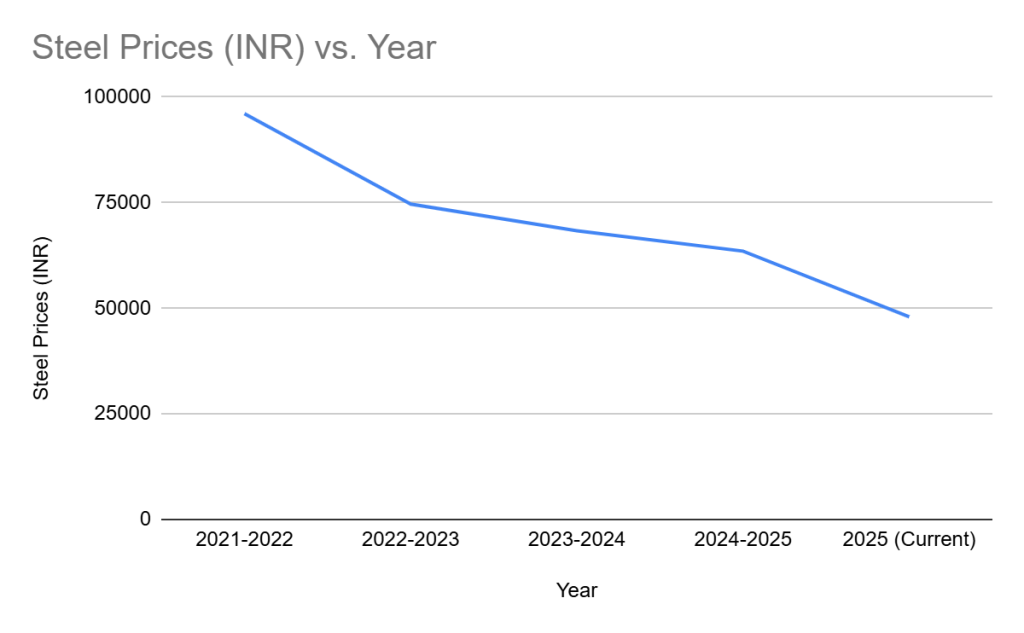
    Past 5 Year Steel Returns

    YearSteel Prices (INR)
    2021-202296079
    2022-202374665
    2023-202468365
    2024-202563541
    2025 (Current)48000
    Past 5 Year Steel Returns

    Steel Price Predictions for Next 5 Years in India

    The yearly outlook of steel prices is mentioned in the table below:

    YearPrice of Steel (INR/Kg)OutlookKey Factor
    202650Bottoming OutThe prices of steel traded at a 5-year low because of various factors such as weak global demand and high imports. And it is expected that due to government policies, the steel prices will bottom out.
    202752Cyclical MovementThe steel prices are expected to increase and will make a new high because of favourable policies and intensive infrastructure spending by the government.
    2028 – 202955CorrectionAs the steel companies increase production, it will increase the supply of steel, easing the supply constraints. Hence, the steel prices might see a small correction. 
    203060PremiumBecause of the introduction of carbon taxes and green steel regulations, the prices of high-grade steel will increase. The whole phenomenon will reflect the cyclical nature of steel prices.

    Current Steel Market Scenario

    India has been experiencing strong momentum in steel prices. Currently, steel prices are trending at higher levels when compared to the start of the year due to strong domestic demand and a gradually improving global mood. This has been mainly due to infrastructure spends, strong construction activities, and government Capex plans in India.

    Another factor supporting steel prices is the global supply situation. Production curbs in certain regions, higher raw material costs, and cautious output strategies by major producers have helped keep supply in check. At the same time, a relatively weaker rupee has made imports costlier, lending additional support to domestic prices.

    Read Also: Gold Rate Prediction for Next 5 Years in India (2026–2030)

    Importance of Steel Prices in the Economy

    Steel is one of the most important components in an economy, as it is considered a major raw material for various sectors of the economy, such as infrastructure, automobile, capital goods, etc. The rise in steel prices acts as a barometer of economic growth. A rise in steel prices in the economy will benefit the steel producers and companies engaged in producing steel. As steel is the crucial raw material for different sectors, one can easily invest in steel companies through Pocketful, as it offers free brokerage on delivery trades.

    Factors Affecting Steel Prices

    The factors which affect the steel prices are as follows:

    1. Cost of Raw Materials: The production of steel depends on various raw materials, including iron ore, coking coal, and limestone. Any disruption in the supply chain or raw material prices can significantly impact the price of steel.
    2. Demand: The second factor which impacts the prices of steel is the domestic demand. If the demand for steel in different sectors like infrastructure, automobile etc. is on the higher side, the prices will increase and vice versa.
    3. Cost of Energy and Power: Producing steel requires a lot of energy and power. Increasing fuel and power prices can lead to an increase in the operating cost of steel-producing companies, which eventually increases the price of steel.
    4. Exchange Rates: If India’s currency gets weaker against the US dollar or other currencies, then it will make the import of coking coal, etc., expensive, leading to an increase in steel prices.
    5. Transportation Cost: The rate of diesel, freight, etc., can directly impact the availability of raw material and steel in different parts of the country. Any increase in transportation cost will increase the price of steel.

    Should You Invest in Steel Companies

    One should invest in steel companies because of the following reasons:

    1. Domestic Demand: The consumption of steel in India is expected to increase in the coming years due to increasing infrastructure spending by the government. This will push the steel prices up.
    2. Government Policies: The government of India is taking numerous steps to protect the Indian steel industry from cheaper imports by introducing anti-dumping duties.
    3. Capital Expenditure: The Indian steel companies are spending heavily in capital expansion and technological upgradation. This expansion will provide them with benefits from the expected increase in demand.
    4. Dividend Income: Most steel companies often distribute dividends to their shareholders along with the benefit of capital appreciation. This dividend income is suitable for conservative investors seeking regular income. 

    Read Also: Silver Rate Prediction for the Next 5 Years in India

    Conclusion

    On a concluding note, India is focusing on infrastructure development, which increases the demand for steel in the coming years, along with the steel prices. And at the same time, domestic steel companies are expanding their production capacity. In the next five years, the steel prices are expected to remain stable with moderate price fluctuations. Therefore, one can invest in the companies engaged in the manufacturing of steel by opening a lifetime free demat account with Pocketful, as it also offers an advanced trading platform, but one should consult their investment advisor before making any investment.

    S.NO.Check Out These Interesting Posts You Might Enjoy!
    1Copper Price Predictions for the Next 5 Years in India
    2List of Best Metal Stocks in India
    3Top 10 Steel Penny Stocks in India
    4Ashish Kacholia Portfolio: Top Stocks & Strategy
    5Best Manufacturing Stocks in India

    Frequently Asked Questions (FAQs)

    1. What are the key factors which affect steel prices?

      The key factors which impact the steel prices include raw material cost, government spending on infrastructure, import duties, etc.

    2. How does infrastructure spending impact steel prices?

      Steel is the key component of infrastructure. Large-scale projects such as highways, railways, housing, etc., increase steel demand.

    3. How can I invest in steel companies?

      One can easily invest in steel companies by opening a lifetime free demat and trading account with Pocketful and then purchasing the stock of their choice.

    4. How can renewable energy impact the steel price?

      Transition toward green steel production can increase the cost due to capex in technology, hence increasing the steel price in the medium term.

    5. Can I invest in steel companies for the long term?

      Yes, one can invest in steel companies for the long term as the demand for steel in India is strong, and investors are required to invest in fundamentally strong companies only after consulting their investment advisor.

Disclaimer

The commodity price predictions and outlook presented in this article are based on research and analysis of historical price trends, market movements, economic indicators, global developments, demand and supply dynamics, and other publicly available information. The purpose of this content is to provide educational insights and help readers understand the factors that may influence commodity markets.

The projections shared are indicative in nature and should not be interpreted as investment advice or recommendations by any investment advisor, nor should they be considered guarantees of future prices, returns, or market performance. Commodity markets are subject to volatility and changing conditions. Readers should conduct independent research and evaluate their financial objectives before making investment decisions.
  • Silver Price Prediction (2026-2030)

    Silver Price Prediction (2026-2030)

    The presence of silver in Indian households is nothing new; we have always carried an affinity towards silver. However, in recent times, silver has attracted people by becoming more than just something that is traditionally owned. As silver continues to gain popularity, it’s now becoming one of the top choices for those wanting to invest in the future.

    In this blog, we will take a simple, easy look at silver’s journey so far, what is pushing its price right now, and what the next five years might look like.  

    Historical Trend of Silver Prices in India

    • In the 1980s and 1990s, silver prices in India were low and rose slowly. In 1981, it stood at about ₹2,700 per kg; however, by the early 1990s, it had risen to about ₹8,000 per kg. The 1990s were a mix of positive and negative developments.
    • In the early 2000s, things indeed started to improve. By 2004, prices had risen to over ₹11,000 per kilogram, and the metal started to adapt more to the declining rupee, the expansion of technology, and global demand.
    • The real action took place from 2006 to 2012. The price of silver increased dramatically, reaching ₹17,000 per kilogram in 2006 and then nearly ₹57,000 per kilogram in 2011. This was one of India’s major silver price increases. Following the peak, prices decreased and, by 2014, they were stable at ₹43,000 per kilogram.
    • Silver remained relatively stable between 2015 and 2019. Demand was steady but not particularly high.
    • In the 2020s, the momentum returned. By 2023, silver was trading at nearly ₹67,000 per kilogram, driven by the pandemic’s renewed interest in precious metals. Prices increased mainly because of rising consumption of solar panels, electronics, and electric vehicles.
    • Silver took off once more by 2024 and 2025. In 2024, prices exceeded ₹95,000 per kg. Even though silver has experienced enough instances of abrupt dips and sharp spikes over the years, the metal has generally trended upward.

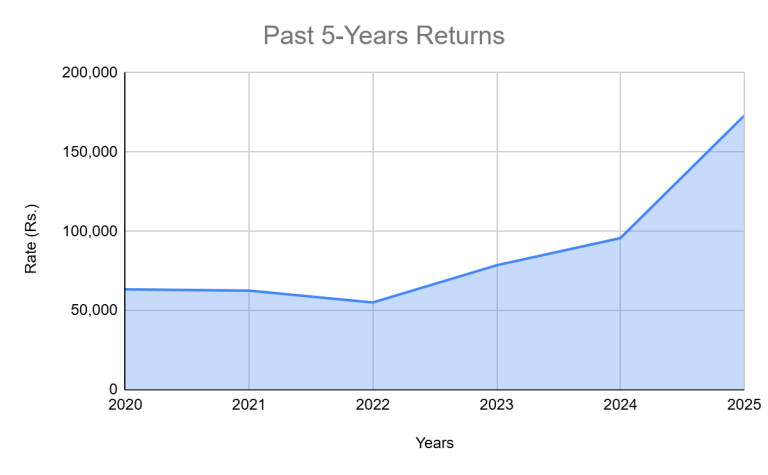
    Past 5-Year Silver Returns

    YearRate (Rs.)
    202063,435
    202162,572
    202255,100
    202378,600
    202495,700
    2025173,000
    Past 5-Year Silver Returns
    Past 5-Year Silver Returns

    Read Also: Gold Rate Prediction for Next 5 Years in India (2026–2030)

    Factors Affecting Silver Prices 

    1. An increasing use of technology – There is silver in phones, laptops, electric vehicles, solar panels, and even 5G towers. So, as these industries grow, so does the need for silver, which naturally drives up prices.
    2. People Buying Silver as Investments – People look for safer places to keep their money when the economy is weak or prices are going up. Silver becomes one of the preferred investment avenues, and prices usually go up when more people want to buy it.
    3. Rupee–Dollar Movement – Since silver is priced in US dollars, any change in how strong or weak the rupee is affects its price in India. If the rupee falls, silver becomes more expensive for all of us, even if global prices stay the same.
    4. Uncertainty in geopolitics – Wars, political tensions, and problems with the global economy make investors anxious. When things like this happen, people rush to buy precious metals, which drives up the price of silver.
    5. Taxes on Imports and Government Rules – Most of India’s silver comes from other countries. So, if taxes or import duties go up, the price of silver also rises. Alterations in policy can quickly change prices.

    Read Also: Steel Price Predictions for the Next 5 Years in India

    Current Silver Market Scenario 

    India has been experiencing a good rise in silver prices. Silver is currently worth approximately ₹1.67 lakh per kg, which is far greater than its position at the beginning of the year. The rise has been largely attributed to a combination of the international demand, a weaker rupee and increased industrial use.

    The other factor that is causing silver to perform well is the overall market mood. Investors have been seeking safer investments, and silver has taken advantage of this. Analysts on the global side are discussing a potential shortage of supply, and this is making it bullish.

    The market is not, however, entirely one-way. There are also reports that industrial demand might ease slightly, so the rally might decelerate. Nonetheless, on the whole, silver remains in a good position and has numerous positive aspects.

    Silver Price Prediction 

    According to a recent outlook, silver is entering a strong multi-year uptrend. It is believed the metal could touch ₹2,45,000 per kilo by 2026- 27 in India. This rise is not just because silver prices are rising globally; the weakening rupee also plays a big role in lifting prices here at home.

    The international silver prices are expected to head towards $75–77 per ounce by 2027, up from the $50-range right now. But the bigger story is the demand side. Silver is not just for jewellery anymore; it is used in electric vehicles, solar panels, batteries, and 5G technology is growing quickly. Since a lot of silver is produced as a by-product of mining other metals, supply cannot easily ramp up even when prices rise.

    On average, silver can swing almost 1.7 times more than gold, which means higher upside but more volatility too. But for now, the bigger trend is still positive.

    In simple words, if the rupee continues to weaken and global demand stays strong, silver prices in India could see some major highs over the next five years 

    Should You Invest in Silver 

    Silver can be a great addition to your investment mix, but it depends on the kind of investor you are. On the positive side, its demand is rising because of its industrial use. And during times when inflation is high, or the global economy is a bit off track, silver often behaves like a safety blanket, just like gold.

    But the truth is, silver is volatile. It moves faster than gold, so you will need a bit of patience. If sudden price swings make you anxious, you might find silver a little too unpredictable.

    If you are investing with a long-term mindset and you are fine with some bumps along the way, adding a small portion of silver to your portfolio can work well; even 5 -10% through silver ETFs, digital silver, or physical silver can help diversify your investments.

    Read Also: Copper Price Predictions for the Next 5 Years in India

    Conclusion 

    Silver’s price story has been full of twists. The outlook ahead looks positive, but it is still a market that can move quickly, both up and down. Just take it slow, stay informed, and invest in a way that suits your comfort level. Silver does have a bright future, but the best results come when you balance patience with good decisions.

    Frequently Asked Questions (FAQs)

    1. Will silver reach ₹2 lakh per kg?

      Silver may reach ₹2 lakh per kg in the future based on industrial demand, inflation, and global market trends.

    2. What will silver price be in 2030?

      The prices of silver in 2030 are uncertain, but increasing industrial and investment demand could lead to higher prices.

    3. Is silver a good investment for the next 5 years?

      Silver can be a good long-term investment because of its industrial uses and potential for price growth.

    4. Why is silver more volatile than gold?

      Silver has lower market liquidity and is more exposed to industrial demand, which causes its prices to fluctuate more than gold.

    5. Can silver outperform gold?

      Yes, silver can sometimes outperform gold during specific market cycles, especially when industrial demand rises sharply.

    6. What drives silver prices in India?

      In India, silver prices are affected by global rates, the rupee-dollar exchange rates, industrial demand, and investor sentiment.

    Disclaimer

    The commodity price predictions and outlook presented in this article are based on research and analysis of historical price trends, market movements, economic indicators, global developments, demand and supply dynamics, and other publicly available information. The purpose of this content is to provide educational insights and help readers understand the factors that may influence commodity markets.

    The projections shared are indicative in nature and should not be interpreted as investment advice or recommendations by any investment advisor, nor should they be considered guarantees of future prices, returns, or market performance. Commodity markets are subject to volatility and changing conditions. Readers should conduct independent research and evaluate their financial objectives before making investment decisions.
  • Gold Rate Prediction for Next 5 Years in India (2026–2030)

    Gold Rate Prediction for Next 5 Years in India (2026–2030)

    If you have ever checked gold prices and wondered where they are headed, you are not alone. Searches for gold rate prediction for next 5 years in India are rising because people want clarity before making long-term plans. 

    Gold has seen a robust surge across the last ten years,  investors are now keen to understand its next phase. This perspective can function as a helpful structure prior to finalizing investment choices. Projecting future movements may additionally assist in confirming your assets are pointed toward the proper trajectory.

    So, in this guide, we look at gold price predictions for next 5 years, global triggers, and what the expected gold rate in 2030 in India could look like based on current trends.

    What Drives Gold Prices in India?

    To understand gold rate prediction for the next 5 years in India, you first need to see why gold moves the way it does. Gold reacts to global events, currency pressure, and how people behave during market stress. These forces shape long-term trends and help explain why the metal may rise before 2030.

    1. Global Economic Conditions

    Gold becomes more valuable when the world economy slows. People move money away from risky assets and park it in gold. This shift increases demand and pushes prices up. Any talk of recession, slow growth, or banking stress usually supports higher gold levels.

    2. US Dollar Movement

    Gold is priced in dollars. So, there is a direct impact of the dollar value on the gold price. Like during the dollar weekend, the gold prices fall. When the dollar is strong, gold may stay range-bound. This link plays a big role in gold price predictions for the next 5 years.

    Inflation reduces the value of money. When the inflation is high, purchasing power is low, and so people buy less. This is why gold often sees strong demand during inflationary cycles. It acts as a cushion when daily costs rise.

    4. Interest Rate Changes

    When interest rates fall, returns from fixed income options drop. Gold becomes more appealing because the opportunity cost of holding it reduces. When rates rise sharply, gold may slow down for some time. This balance shapes long-term trends.

    5. Geopolitical Events

    There are wars and various conflicts that impact economies. These are times when people look for safer investments. Gold benefits the most in these periods. Even short-lived events create upward pressure as markets try to manage risk.

    6. Seasonal and Cultural Demand

    India is one of the largest buyers of gold. Festival and wedding seasons create huge demand. Even when global prices stay stable, local buying can lift domestic rates. This is why the market often sees sudden spikes around festive months.

    7. Rupee Exchange Rate

    India imports gold. A weak rupee makes every ounce more expensive. This alone can increase domestic prices even if global prices do not move. For long-term forecasts like the gold rate in 2030 in India, the rupee’s path is a major influence.

    This deeper understanding gives a stronger base for reading long-term trends. This will help you gain an idea of what the expected gold rate in 2030 in India and the broad direction that experts expect over the next few years.

    Read Also: Silver Rate Prediction for the Next 5 Years in India

    Historical Analysis of Gold Prices in India (2010 to 2025)

    Gold has moved through several economic cycles over the last fifteen years. Every major global shock, currency swing, and inflation phase left a clear impact on prices. This makes it important for investors to know how gold moved from 2010-2025.

    Here is how average prices have changed over the years.

    YearAverage Price (10g, 24K)
    2,010₹18,500
    2015₹26,343.50
    2020₹48,651
    2021₹48,720
    2022₹52,670
    2023₹65,330
    2024₹77,913
    2,025₹1,50,530

    Now that you know the prices, let us quickly have a simple analysis of the same based on timelines and events.

    1. Early Growth Phase (2010 to 2015)

    You must know about the 2008 crisis. The global economy crashed. There were losses everywhere, and housing was even impacted. By 2010, things were settling in, but not good enough. This was the time when the gold prices started at ₹18,500. The market was still fragile. People were more cautious about where and how much they invest.

    This was the time when gold felt like a stable investment with less risk. It was perfect to combat inflation while assuring people have reserves to manage their lives. 

    By 2015, the average price moved to around ₹26,343.50. The rise was slow but a good sign that the market was returning to normal.

    2. Build Up and the COVID Surge (2016 to 2020)

    The years after 2015 were again one of the risky times. There were trade tensions and low interest rates that were impacting the business everywhere. This was one of the prime reasons that quietly pushed prices upward. Then 2020 arrived, and everything changed. 

    COVID brought markets to a halt. It was one of the times that created fear around jobs, money, and the economy. In that panic, gold became the safe place to park whatever savings people had. 

    Prices jumped to an average of ₹48,651. This was the time when everyone felt that investing in gold was the best choice. 

    3. After COVID and New Global Shocks (2021 to 2023)

    Even when life slowly went back to normal, gold did not fall. Prices held near ₹48,720 in 2021. This was mainly due to the high level of uncertainty and the impacts of COVID, which were still there.

    Then the Russia–Ukraine war started. It is still going on, but this war has added another layer of stress. It affected energy costs, supply chains, and inflation across countries. 

    This again put pressure on the gold prices. This was the time when the prices moved from ₹52,670 in 2022 to ₹65,330 in 2023. People were not chasing returns here. They were simply trying to protect their money in a world that felt unpredictable again.

    4. Inflation, Weak Dollar and Record Highs (2024 to 2025)

    By 2024, high inflation and a softer US dollar had set the stage. This was a sign that another strong phase has started. Investors expected interest rates to fall. And now the gold picked up again, touching an average of ₹77,913. But this was just the start. 

    The real jump came in 2025. Global tensions and currency swings pushed the gold prices to an extreme. This was another rise, which made the gold a safe haven. This time, the buying pushed prices to around ₹1,35,350. 

    And this was the first time for such a high value, too. The MCX rates crossed ₹1,70,000 per 10 grams. It showed that no matter what happens, gold is one with a strong backing and need.

    Read Also: Best Gold Stocks in India

    One clear trend through this period was gold’s ability to gain value during stress. It acted as a cushion through all uncertain times. The ten-year CAGR from 2014 to 2024 stayed close to 10.66%, while the five-year CAGR from 2019 to 2024 went up to 17.2%. These numbers show that gold did not just protect wealth, but also competed closely with equity returns in many phases.

    Another trend was central bank behaviour. Many global central banks increased their gold reserves over these years. This added long-term support for prices and helped build confidence among retail investors, too.

    How Investor Strategies Evolved Over These Years

    Indians still invest in gold. It is not just one with tradition, but for them gold holds a special place. Also, gold is second to liquid cash. It can be bought and sold in the market very quickly. This is still the same and has not changed a bit.

    By 2024 and 2025, the picture looked different. More people started using digital platforms, Gold ETFs, and sovereign gold bonds. ETF inflows alone crossed ₹20.8 billion in June 2025, Gold ETFs saw a 600% surge in inflows. signalling a shift toward investment-focused gold rather than purely ornamental gold. Jewellery demand settled in the 600 to 700 tonne range, while long-term investment demand grew sharply.

    These changes show how gold moved from being a cultural purchase to a structured part of financial planning. This shift is important when we talk about long-term projections like the gold rate prediction for the next 5 years in India or how prices may behave by 2030.

    Read Also: Steel Price Predictions for the Next 5 Years in India

    Expected Gold Price Outlook (2026 to 2030)

    If you consider the current gold momentum, it is on a rising trend. But it is important to note that this is mainly because of the factors that are working in favor. This may or may not change with time.

    At the same time, various analysts suggest that gold is likely to settle into a higher price zone over the next five years. The metal has already broken past several historic levels. But the way prices behaved in 2024 and 2025 is unique. This is a sign that now the gold is entering a new price range band.

    Instead of short spikes, analysts expect a gradual climb supported by broader market behaviour. Here is a simple view of where prices may head.

    YearExpected Price Range (per 10g, 24K)
    2026₹1,10,000 – ₹1,75,000
    2027₹1,35,000 – ₹1,50,000
    2028₹1,40,000 – ₹1,75,000
    2029₹1,50,000 – ₹2,00,000
    2,030₹1,60,000 – ₹2,25,000

    Is Gold Likely to Stay a Strong Investment?

    Many investors who ignored gold earlier are now taking it seriously because of how it behaved during difficult times. The repeated policy shifts, unpredictable interest rate cycles, and economic slowdowns across countries have made gold more relevant. If the next five years bring more volatility, gold may again act as a stabiliser in portfolios.

    There is also a practical angle to consider. Gold supply grows slowly, but its demand is rising. It is now used in sectors and things such as electronics, renewable energy, and medical technology. This means there is a personal and commercial demand for gold. 

    This adds another layer of long-term support to prices. For someone who wants safety without giving up liquidity, gold still fits well for the coming years.

    Read Also: Copper Price Predictions for the Next 5 Years in India

    Things to Consider Before Looking at Long-Term Gold Forecasts

    Long-term gold projections can be helpful. But it is important to note that these are just estimations. You need to be very cautious when you invest based on the expected gold rate in 2030 in India. 

    Gold is based on various factors, and a change in any one can impact the entire gold price prediction 2030. While you may see that the broad factors are stable, there are simple minor factors too. For a better view, you need to actually look at all the aspects.

    And if you are planning to invest in gold based on the price predictions, there are certain cautions to follow. These tips can help you ensure that you take the right call and avoid the adverse impacts.

    • Price ranges can shift suddenly depending on global events
    • Short-term movements may not match the long-term trend
    • A weak rupee can lift domestic prices even if global rates stay flat
    • Forms like ETFs and SGBs often give better real returns than jewellery
    • Gold works well as part of a portfolio, not as the only investment

    Read Also: Historical Trend of Gold Rate

    Conclusion

    Gold has created a solid long-term base over the last several years. At the same time, the trend ahead points toward steadier movement rather than sudden spikes. 

    With time, the options to invest in gold have changed. You can now go for digital gold, ETFs, and other options to ensure that you get the benefits of gold but with no worry for investment. 

    Now, gold is slowly becoming a planned part of portfolios instead of an emotional purchase. It still works best as a long-term asset and should be paired with other investments for balance.

    For simple, clear guidance on how to plan your next steps, you can explore more such helpful insights through Pocketful.

    Frequently Asked Questions (FAQs)

    1. What will be the gold price in 2030 in India?

      Forecasting the price of gold in 2030 with Perfect accuracy is not possible, as it depends on factors such as inflation, global economic conditions, interest rates, and currency movements. but, a significant number of experts anticipate that gold will continue to serve as a vital safeguard of wealth in the extended future.

    2. Will gold reach ₹2 lakh per 10 gram?

      While it is possible for gold to reach ₹2 lakh per 10 grams in the future, there is no guarantee it will happen by a specific year. Gold prices are influenced by demand, inflation, geopolitical events, and central bank policies.

    3. Is gold a good investment for the next 5 years?

      Gold might prove a wise investment over the coming five years, offering portfolio diversification and serving as a safeguard against rising prices and market fluctuations. Nevertheless, individuals ought to tailor their gold holdings to their personal financial objectives and comfort level with risk.

    4. What factors affect gold prices in India?

      Gold prices in India are mainly influenced by global gold prices, the rupee-dollar exchange rate, inflation, interest rates, and economic uncertainty.

    5. Can gold prices fall in the future?

      Yes, gold prices can fall due to rising interest rates, a stronger US dollar, or lower demand for safe-haven assets during stable economic conditions.

    6. Is Gold Still a Good Investment in 2026?

      Yes, gold continues to be a good investment choice in 2026, given its longstanding role as protection against rising prices and economic instability.

    Gold Rate in Top Cities of IndiaSilver Rate in Top Cities of India
    Gold rate in AhmedabadSilver rate in Ahmedabad
    Gold rate in AyodhyaSilver rate in Ayodhya
    Gold rate in BangaloreSilver rate in Bangalore
    Gold rate in BhubaneswarSilver rate in Bhubaneswar
    Gold rate in ChandigarhSilver rate in Chandigarh
    Gold rate in ChennaiSilver rate in Chennai
    Gold rate in CoimbatoreSilver rate in Coimbatore
    Gold rate in DelhiSilver rate in Delhi
    Gold rate in HyderabadSilver rate in Hyderabad
    Gold rate in JaipurSilver rate in Jaipur
    Disclaimer

    The commodity price predictions and outlook presented in this article are based on research and analysis of historical price trends, market movements, economic indicators, global developments, demand and supply dynamics, and other publicly available information. The purpose of this content is to provide educational insights and help readers understand the factors that may influence commodity markets.

    The projections shared are indicative in nature and should not be interpreted as investment advice or recommendations by any investment advisor, nor should they be considered guarantees of future prices, returns, or market performance. Commodity markets are subject to volatility and changing conditions. Readers should conduct independent research and evaluate their financial objectives before making investment decisions.
  • What is Commodity Valuation?

    What is Commodity Valuation?

    When you start to trade in commodities, one of the major questions or challenges that you will face will be linked to the valuation. 

    Though it might sound like a very basic thing, in reality, understanding the key concepts linked to the valuation becomes very important. This will ensure that not just you know what you are paying for, but also whether you are paying right or wrong. 

    This is where the concept of commodity valuation comes into play. So, to help you understand this better, we have curated this guide. From definition to mechanisms and factors affecting commodity valuation, everything is covered here. So, read this to know everything easily.

    What is Commodity Valuation?

    Commodity valuation is the process of assessing the fair market price of raw materials. It is for products such as metals, energy products, and agricultural goods. These are the products that are highly dynamic in nature. Their prices fluctuate based on various factors, starting from global demand and supply to every economic event.

    The main aim of the commodity valuation is:

    • Provide clarity on the price
    • Ensure there is no case of overpricing or underpricing
    • Benefiting the traders with a transparent mechanism for price discovery

    For traders and investors, understanding valuation is crucial. It is the key factor that impacts the buying, selling, and hedging calls. Businesses also rely on accurate valuation to manage procurement costs and reduce financial risks.

    So, if we summarize this, commodity valuation is a simple act of creating a framework for the price discovery to ensure there is fairness and efficiency in the commodity market. This, in turn, helps the participants make informed choices instead of trading blindly.

    Features of Commodity Valuation

    To understand commodity valuation better, it is important to understand the key features of the same. Now, one important point to note here is that it is not like retail or wholesale price valuation. It is quite different. So, here are the features to know. 

    • Market-Driven Nature: Valuation is highly based on the demand and supply conditions. This makes it sensitive to the seasonal changes and global market conditions as well. Also, consumer demand is an important aspect that impacts the value.
    • Dynamic Pricing: Commodity prices change every day. The dynamic pricing makes it very important for the traders to stay updated on the market conditions and the changes happening around.
    • Standardisation and Benchmarks: Commodities are often valued against international benchmarks. These can be the key indices like WTI for crude oil or LBMA for gold. The idea of using these is to ensure transparency and uniformity.
    • Quality and Grade Sensitivity: Every commodity has different grades. The higher the grade, the more would be the price. This is directly linked to the quality and features available. So, be sure to check the same as well.
    • Global Interlinkages: Commodity valuation is affected by the global factors as well. Be it the policies or current values, everything impacts them, and so one should stay updated on the cross-border policies as well.

    Read Also: What is Commodity Market in India?

    Pricing Mechanisms of Commodity Transactions

    Commodity prices are discovered through different mechanisms, each suited for particular market needs. The major ones include:

    1. Fixed Price

    Buyer and seller lock in a price in advance, regardless of future market movements. It offers certainty but removes the chance to benefit from favourable price shifts.

    2. Floor and Ceiling Price

    A minimum (floor) and maximum (ceiling) price is set, usually by an exchange or authority. This prevents extreme losses or gains while keeping prices within a safe band.

    3. Variable Price

    The price is decided by current demand and supply conditions. Since these factors change constantly, this mechanism reflects real-time market dynamics.

    4. Floating Price

    Common in long-term contracts, the final price is determined by averaging market prices over a set period. It reduces the impact of sudden volatility, often used in oil or gas trades.

    5. Spot Pricing

    Reflects the immediate market value for instant delivery of a commodity. It is the most transparent but also the most volatile pricing method.

    6. Futures Pricing

    Prices are set for future delivery via exchange-traded contracts. This is mainly aimed at hedging and considers all the key aspects linked to the pricing factors. 

    7. Auction or Negotiated Pricing

    This is more in agricultural and niche commodities. The prices are decided through direct negotiations or auctions between buyers and sellers based on need and quality.

    Quick Comparison of Pricing Mechanisms

    MechanismWhat it isProsCons
    Fixed PriceBuyer and seller agree on a price in advance for delivery laterProvides certainty, protects from sudden price swingsNo benefit if market moves favourably after agreement
    Floor & CeilingSets minimum and maximum prices for a commodityControls extreme volatility, gives safe trading rangeLimits potential gains and flexibility
    Variable PricePrice is decided in real time based on demand and supplyReflects true market conditions, transparentHighly volatile, harder to plan budgets
    Floating PriceFinal price is averaged over a set period in long-term contractsReduces impact of short-term fluctuations, stable over timeMay not capture sudden favourable moves
    Spot PricingPrice for immediate purchase and deliveryTransparent, shows real market value instantlyVery volatile, risky for large buyers
    Futures PricingContracts set today for delivery in future at agreed priceUseful for hedging, helps forecast costsComplex, requires margin money and market knowledge
    Auction/NegotiatedPrice set using buyer-seller negotiationFlexible, often considers quality and local demandLess standardised and lack transparency

    Key Factors Affecting Commodity Valuation

    It is now clear that commodity valuation is based on various factors. But the question is, what are they? Well, here are the common ones to know:

    1. Demand and Supply

    The basic driver of all valuations. When demand is high or supply is low, prices rise. Likewise, when the demand is less and the supply is high, prices fall. Seasonal aspects and market needs will impact this. 

    2. Global Benchmarks

    International standards serve as the price benchmarks. These include Brent Crude for oil, LBMA for gold, or COMEX for metals. The local markets align with these for transparent and fair prices. 

    3. Government Regulations

    Any changes in the government policies linked to import and export will change the prices. Also, if there is a ban on a certain product, prices will change as well. 

    4. Currency Fluctuations

    Since commodities are largely priced in US dollars, exchange rate changes directly impact local valuation. A weaker local currency usually makes commodities more expensive.

    5. Geopolitical Events

    Wars, sanctions, and global conflicts can disrupt supply chains. This often impacts the supply and thereby the prices.

    Read Also: Understanding Commodity Market Analysis

    Why is Commodity Valuation Important?

    Commodity valuation guarantees fairness and transparency. But there are other reasons as well that make it very important. These are:

    • Traders can get assurance on the prices while buying and selling.
    • Investors can plan and manage risks better to avoid losses.
    • Businesses can get the raw materials at the right prices easily.
    • Farmers and exporters can negotiate prices in a fair manner.
    • Regulators can manage inflation and unwanted spikes to avoid chaos.
    • Local industries can stay ahead and match the global market.

    Commodity Valuation in India

    In India, commodities are mainly traded through the two platforms which are:

    Prices on these exchanges are influenced by various factors like global standards and domestic demand. So, if there is a change in any one of the factors, the prices will change on these exchanges. This will ensure that the traders and investors pay a fair price and earn better.

    Read Also: Types of Commodity Market in India

    Conclusion

    Investing in commodities is a great decision. But while you plan to do so, it is important that you understand the commodity valuation as well. This will ensure you pay fair prices and are earning profits too. 

    In India, where exchanges like MCX and NCDEX lead the market, knowing how valuation works can protect you from risk and open better opportunities. If you are planning to enter the commodity market, start your journey with Pocketful and trade with confidence.

    S.NO.Check Out These Interesting Posts You Might Enjoy!
    1How to Trade in the Commodity Market?
    2What is the Timing for Commodity Market Trading?
    3Risks in Commodity Trading and How to Manage Them
    45 Tips for Successful Commodity Trading
    5Stock Market vs Commodity Market
    6The Pros and Cons of Commodity Trading
    7Commodity vs Forex Trading: Key Differences, Pros & Cons
    8Best Online Commodity Trading Platforms in India
    9Commodity Trading Regulations in India: SEBI Guidelines & Impact
    10Commodity Arbitrage – Types & Strategies in India
    115 Tips for Successful Commodity Trading
    12Different Types of Trading in the Stock Market

    Frequently Asked Questions (FAQs)

    1. How are commodities valued in India?

      Commodities in India are valued based on various factors. From the demand and supply to the government policies, everything impacts the prices. 

    2. Which commodities are most traded in India?

      Gold, silver, crude oil, and natural gas are a few commonly traded commodities. Agricultural products like soybean, cotton, and wheat are a few others that are actively traded commodities on Indian exchanges.

    3. What is the role of MCX in commodity valuation?

      The Multi Commodity Exchange (MCX) provides a transparent platform. It is where buyers and sellers discover fair prices for commodities through real-time trading.

    4. How do global prices affect commodity valuation in India?

      Since many commodities are priced internationally in US dollars, global benchmarks are important. These directly impact Indian prices after adjusting for currency movements.

    5. Can commodity valuation impact inflation in India?

      Yes, the commodity valuation can impact the inflation in India. Hence, these are tracked by the policymakers very closely.

  • Exchange of Futures for Physical (EFP)

    Exchange of Futures for Physical (EFP)

    Exchange of Futures for Physical, or EFP, may sound like something reserved for seasoned traders, but at its core, it is a straightforward swap. One party hands over a futures contract, and the other delivers the actual commodity—be it oil, wheat, or gold. This method offers a smoother, more flexible alternative to the formal delivery process and is widely used in industries where physical delivery still matters. 

    In this blog we will break down how EFP works, why it is used, and where you will see it in action.

    Understanding EFP 

    Simply put, an Exchange of Futures for Physical (EFP) is a sort of transaction in which a futures contract holder exchanges it with a person or party who holds the actual physical commodity, such as gold, wheat, or crude oil.

    Think of it this way: your futures contract is like a coupon for a pizza, and your friend already has the pizza. Instead of waiting for the coupon to expire and going through the formal process to claim it, you simply swap the coupon for the pizza right away. Simple, quick, and no extra hassle.

    EFP works the same way for major market participants. Instead of going through the official delivery process via the exchange, it allows them to privately negotiate and swap a futures position for the actual physical asset.

    How Does it Work?

    An Exchange of Futures for Physical (EFP) is like a private trade. A futures contract is an agreement to buy or sell something at a later date. The two parties agree to trade directly with each other instead of waiting for the formal delivery process through the exchange.

    Here is what happens in order:

    1. One party has a long (buy) futures position and the other has a short (sell) position. One person wants to get rid of the contract, and the other person wants the goods.
    1. They talk about the amount, price, delivery terms, and other details in private, away from the trading floor of the exchange.
    1. Futures are traded for real goods: The futures positions are closed out, and the agreed-upon commodity is delivered.
    1. The deal is reported to the exchange. Even though it was made in private, the exchange still needs to be clear and record the deal to make sure everything is legal.

    Key Features 

    Now that we have discussed what an EFP is, what separates it from a standard futures trade? The following are some characteristics that set EFPs apart,

    1. Direct swap

    Fundamentally, an EFP is simply a transaction in which one party surrenders a futures contract and the other delivers the actual commodity, such as wheat, gold, or oil. 

    2. The Deal Is Private

    EFPs are negotiated privately between two parties, as opposed to standard trades that take place on a public exchange. They agree on terms privately.

    3. The Exchange must be notified

    The transaction is not confidential, despite taking place in the background. After everything has been decided upon, it is reported to the exchange, making it official.

    4. Customise the Deal

    What’s amazing about EFPs? Standard terms do not have to apply to you. Whatever works best, how much, where, when, and so forth, can be decided upon by the two parties.

    5. Usually carried out by the major players

    Casual traders are not the target audience for EFPs. Producers, manufacturers, and large organisations that need to move real goods or adjust their positions are more likely to use them.

    Why do Traders use EFP?

    You may be asking yourself, “Why put in all this work for a private swap when you can just continue trading futures normally?” EFP is simply much more convenient for many traders and businesses. They prefer it for the following reasons:

    1. Avoid formal delivery processes

    Futures traders occasionally do not wish to go through the entire formal delivery process through the exchange. They can get right to the point with an EFP, one party receives the goods, and the other party terminates the agreement.

    2. Convert futures into physical commodities when needed.

    Suppose a business used a futures contract to protect itself from fluctuations in wheat prices. EFP allows them to exchange that paper contract for the actual wheat now that they are in actual need of it. If they already have the wheat, they can also convert it into a futures position.

    3. Choose delivery time, place, and quantity.

    Where, when, and how much are all predetermined for standard exchange deliveries. EFP, however, gives both sides the opportunity to discuss what suits them best. Whatever works best for them, they can choose the delivery location, time, and amount.

    4. Adjust positions privately without impacting the market.

    EFPs are frequently used by large traders to adjust their positions or hedges without causing a stir in the open market. These transactions don’t affect prices or attract undue attention because they take place in private.

    5. Maintain discretion for large or sensitive trades.

    Not everyone wants the public trading screen to display their moves. EFPs provide some privacy because they are conducted behind the scenes, which is particularly helpful for large trades or delicate transactions.

    Where are EFPs commonly used? 

    People use EFPs most often in markets where physical delivery is still important, like:

    • The markets for crude oil and energy
    • Gold, Silver, and Copper
    • Agricultural Goods (Wheat, Corn, Soybean)
    • Money and Financial Futures

    Real World Examples 

    Let us look at an example from the market for crude oil.

    • A refinery has bought futures for crude oil, but it now needs the actual crude oil to process at its plant.
    • A producer or supplier with the opposite short futures position wants to get out of futures and deliver real oil.
    • They come to an agreement on an EFP deal, in which they trade and the other party exchanges their futures positions for the same amount of crude oil.
    • The oil is delivered to the refinery, and the futures positions are closed.
    • EFPs are often used by companies that make, refine, or trade commodities to manage their exposure to real-world supply and price changes.

    Regulatory & Exchange Needs 

    1. EFPs require that a futures contract be exchanged for actual goods. It must be a legitimate business transaction; you cannot simply act as though you are trading something for show.
    1. The transaction must be reported to the exchange (such as CME, ICE, or MCX in India) after both parties have approved the swap. In this manner, the exchange can resolve it and ensure that everything is legal.
    1. The quantity, quality, and product type of the physical goods being exchanged should match those specified in the futures contract. A futures contract for 1,000 barrels of oil cannot be exchanged for 700 barrels.
    1. In the event that regulators wish to review the transaction later, the parties involved must maintain accurate records of the transaction, including the terms, the person they traded with, and the proof of delivery.
    1. Not all contracts in the futures market qualify for an EFP. Specific guidelines govern which contracts, usually those that are physically settled.

    Conclusion 

    Exchange of Futures for Physical (EFP) may initially appear to be one of those jargon-heavy financial terms meant for experts. Once you know the basics, though, it is just a clever means for traders to exchange a futures contract for actual commodities such as wheat, gold, or oil.

    Big players who deal in tangible goods and want greater control over delivery schedules of assets are the ones who use it the most. They negotiate terms directly with the other party, bypass the formal process, and keep transactions smooth. 

    S.NO.Check Out These Interesting Posts You Might Enjoy!
    1What is Future Trading and How Does It Work?
    2Types of Futures and Futures Traders
    3Difference Between Options and Futures
    4Synthetic Futures – Definition, Risk, Advantages, Example
    5Difference Between Forward and Future Contracts Explained
    6Cost of Carry in Futures Contract
    7Silver Futures Trading – Meaning, Benefits and Risks

    Frequently Answered Questions (FAQs)

    1. Can I use EFP as a small investor?

      No. EFPs are mainly designed for large traders and organizations that deal in substantial futures positions or need the actual delivery of the underlying commodity.

    2. Is EFP secure and legal?

      Completely legal! All that is required to make it official is to report it to the exchange.

    3. What distinguishes EFP from standard futures delivery?

      EFP allows both parties to customise the deal according to their terms. Strict exchange regulations apply to regular futures deliveries.

    4. What is being traded in reality?

      The real commodity is delivered by one party while the other forfeits a futures contract.

    5. Where does an EFP transaction take place?

      Although it is a private agreement between two parties, the exchange is informed once it has been reached.

  • Commodity Arbitrage – Types & Strategies in India 

    Commodity Arbitrage – Types & Strategies in India 

    Commodity arbitrage is like playing a game of “buy low, sell high” — but across two markets at the same time. Usually, traders wait for a favorable price movement to exit their positions but this is not the case with commodity arbitrage. Traders spot price mismatches across different markets, strike fast, and turn price gaps into quick profit. 

    In this blog, we will explain the concept of commodity arbitrage in detail along with its types, advantages, risks, etc.

    What is Commodity Arbitrage?

    Commodity arbitrage is a method by which traders make profits by taking advantage of the difference in commodity prices in different markets. For example, if gold is available at a lower price in one place and at a higher price in other simultaneously, the trader buys gold from the market with lower price and sells it in the market with higher price. In this way, a good profit can be made without taking much risk.

    Key features of Commodity Arbitrage

    • Direct profit: When you get the goods at a lower price and sell them at a higher price, you can realize a quick profit.
    • Increases Market Efficiency: Arbitrage reduces the price gap between different markets, making the market more transparent.
    • Risk identification: A correct understanding of this helps traders avoid purchasing in overpriced markets and avoid potential losses.

    Check Out – Commodities Screener

    Types of Commodity Arbitrage

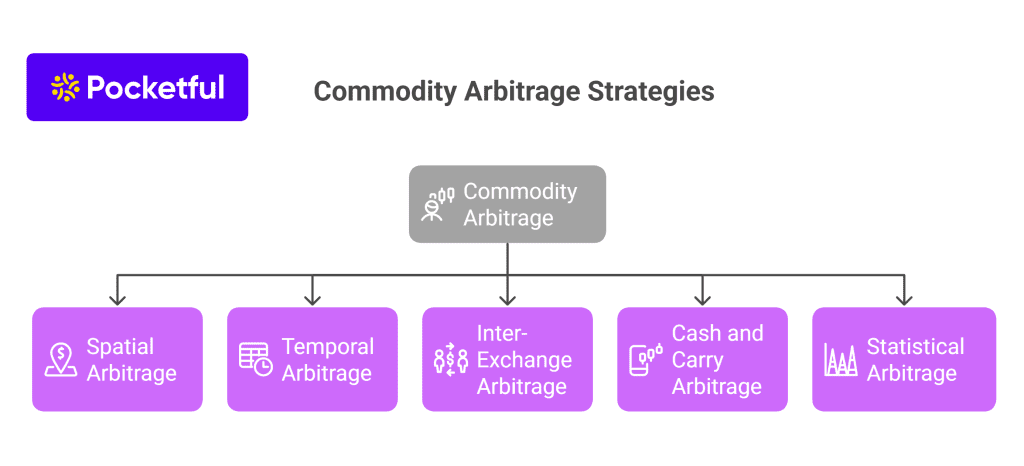
    Different types of commodity arbitrage are listed below:

    1. Spatial Arbitrage

    Spatial arbitrage is a situation when the price of the same commodity is in different markets at different geographical locations. In this situation, traders buy the commodity from a place where the price is low and sell it where the price is high. In a country like India, where there are regional differences in taxes, transportation costs and demand-supply, this strategy can be particularly effective.

    2. Temporal Arbitrage

    Temporal arbitrage is a strategy to take advantage of changes in prices based on time. In this, traders buy a commodity when its price is low and sell it in the future, when the price rises.

    For example, if the June contract of crude oil is cheap and the July one is expensive, then an experienced trader can make a profit from this price difference.

    3. Inter-Exchange Arbitrage

    Sometimes the price of the same commodity is different on two different exchanges such as MCX and NCDEX. By taking advantage of this price disparity, traders can make a profit by buying at a lower price on one exchange and selling at a higher price on the other. This strategy is usually more useful in agri commodities due to lower liquidity.

    4. Cash and Carry Arbitrage

    This strategy takes advantage of the difference in prices of the spot market and the futures market. In this, the trader buys the commodity in the spot market and sells (shorts) the same commodity in the futures market. It is effective only when the futures price is higher than the spot price. Make sure the difference between the spot and futures prices cover the carry cost (such as storage, financing).

    5. Statistical Arbitrage

    This is an advanced strategy in which traders take advantage of price imbalances using statistical and mathematical models. It often involves analysing the relationship between co-related commodities (such as copper and zinc) and trading in case of any divergence to make a profit. This strategy is more popular among quant traders using automated systems.

    Read Also: Tax on Commodity Trading in India

    Commodity Arbitrage Strategies in India

    Here is a simple and accurate description of the major commodity arbitrage strategies used in India:

    • Calendar Spread Arbitrage : This strategy seeks to profit from the price difference between two futures contracts of the same commodity with different expiry dates. Traders take a long position in one contract and a short position in the other.
    • Inter-Commodity Arbitrage : This is applicable when price divergence is observed between two related commodities, such as crude oil and natural gas, or gold and silver, based on a historical or statistical relationship. If this relationship breaks temporarily, traders can profit by taking long positions in one commodity and short in the other. 
    • Regulatory Arbitrage : In India, regulatory arbitrage opportunities arise due to differences in regulations, tax structures, and delivery policies of different states or exchanges. Traders analyze such regulations and buy and sell in different markets so that the overall regulatory burden or cost is less. However, this strategy is adopted only by experienced traders and dealers.
    • Algorithmic Trading : This is a modern technical strategy that uses programmed software and algorithms to spot arbitrage opportunities in the market in milliseconds. In this, traders automate their trades by using quantitative models, volume data, and price movements in real-time. This strategy can be extremely profitable in active commodity markets or exchanges such as MCX, provided the system’s speed is fast and transparent data feed. 

    All these strategies are designed keeping in mind the structure and trading behavior of the participants of the Indian commodity market. 

    Commodity Arbitrage Example

    Suppose an experienced trader noticed a slight difference in the spot price of gold and futures price of Gold on MCX. This small difference can also give good profits with the right strategy and timing.

    Gold Price in Spot Market: ₹97,000 per 10 grams

    Gold Futures Price in MCX: ₹97,800 per 10 grams

    Price difference: ₹800 per 10 grams i.e. ₹80,000 per kilogram

    Trading process 

    • Spot the opportunity: The trader caught this difference in price and immediately prepared a trading plan.
    • Purchase: He bought 1 kg of gold in the spot market at ₹97,000 per 10 grams for ₹97,00,000. 
    • Logistics and other expenses: Suppose the total cost including transport, insurance, GST etc. is about ₹10,000.
    • Sale: He also sold one Gold Futures contract trading at ₹97,800 per 10 grams. The underlying asset for Gold Futures contract is 1 kg of gold. The trading position is held onto until the contract expires.

    Profit calculation at Futures Contract Expiry:

    • Sale price = ₹97,80,000 

    At contract expiry, the trader can deliver 1 kg of gold in exchange for ₹97,80,000.

    • Total cost = ₹97,00,000 + ₹10,000 = ₹97,10,000 

    This was the initial outlay. 

    • Net profit = ₹97,80,000 – ₹97,10,000 = ₹70,000

    This is a simple yet effective commodity arbitrage strategy (cash and carry), where you can profit without taking too much risk. If you have real-time market data and knowledge about arbitrage strategies, such opportunities can yield good profits.

    Advantages of Commodity Arbitrage Trading

    The advantages of commodity arbitrage trading are:

    • Low Risk: This trading approach is relatively low risk, which can benefit both new and experienced traders.
    • Quick Profits: Using commodity arbitrage, quick profits can be made from the difference in market prices of the same commodity by buying in one market and selling in another market instantly.
    • Consistent Returns: With a little planning and data analysis, consistent good returns are possible.

    Read Also: How to Trade in the Commodity Market?

    Risks and Challenges in Commodity Arbitrage

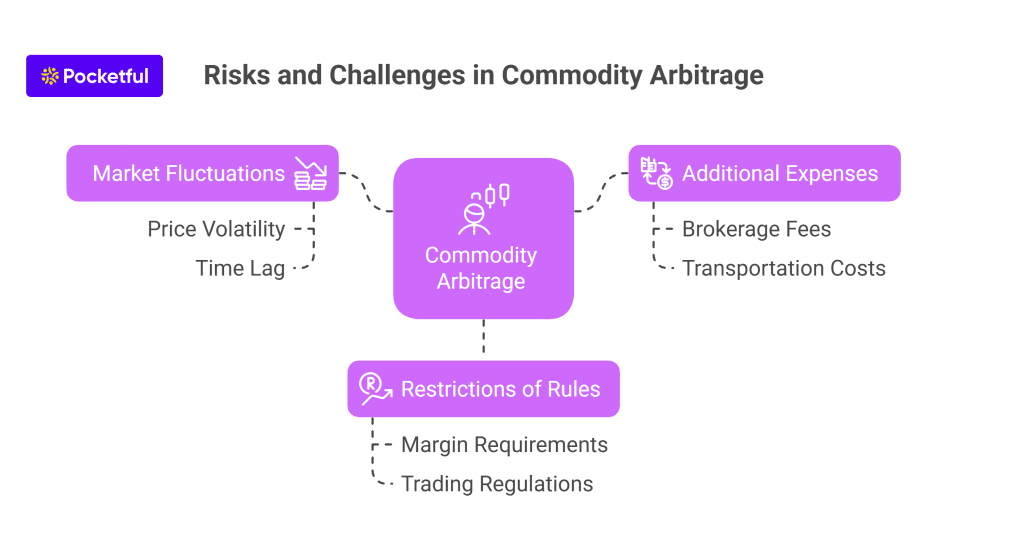
    Commodity arbitrage is often considered a safe trading strategy, but there are some risks and challenges that need to be taken care of. If these are ignored, losses can occur.

    • Market fluctuations : Commodity prices can change very quickly. From the time you spot a trading opportunity to the time you complete the trade, the prices can change. The profits due to time lag can either be reduced or completely eliminated.
    • Additional expenses : Transaction costs such as brokerage, taxes, transportation and other fees can reduce your profits to a great extent. Sometimes these expenses become so high that arbitrage is no longer profitable.
    • Restrictions of rules : SEBI and other organizations keep a strict watch on commodity trading on exchanges. Improper knowledge about margin requirements and other trading regulations can cause losses.

    Read Also: Commodity Trading Regulations in India: SEBI Guidelines & Impact

    Conclusion

    Commodity arbitrage is a trading technique that focuses on earning profits by taking advantage of price disparities of the same commodity across different markets or periods of time. There are several types prevalent in India such as Spatial Arbitrage, Inter-Exchange Arbitrage, Temporal Arbitrage, and Cash & Carry. Each arbitrage strategy comes with its own risks and rewards, and their correct evaluation is essential for successful trading.

    An effective arbitrage strategy requires deep market understanding, data-driven decision-making, and accurate execution. Also, transaction costs, regulatory guidelines, and market volatility must be taken into account. It is advised to consult a financial advisor before trading.

    S.NO.Check Out These Interesting Posts You Might Enjoy!
    1What is Commodity Market in India?
    2Best Online Commodity Trading Platforms in India: Top 10 Picks for Traders
    3Stock Market vs Commodity Market
    4Understanding Commodity Market Analysis
    5Top Major Commodity Exchanges in India

    FAQs

    1. What is commodity arbitrage?

      It is a trading strategy in which profits are made by taking advantage of the difference in prices of the same commodity at different markets or times.

    2. Is commodity arbitrage legal in India?

      Yes, it is a legitimate trading strategy as long as all the regulatory rules are followed.

    3. Which exchanges allow commodity arbitrage in India?

      Traders can use the MCX (Multi Commodity Exchange) and the spot market to execute commodity arbitrage strategies.

    4. What are the major types of commodity arbitrage?

      The main types are: spatial, cash and carry, temporal, inter-exchange, and statistical arbitrage.

    5. How much profit can one make through arbitrage trading?

      It completely depends on the price difference, transaction cost and timing. Usually the profit margins are limited due to high liquidity.

  • Top Major Commodity Exchanges in India

    Top Major Commodity Exchanges in India

    Commodity exchanges in India allow people to trade commodities such as gold, oil, and agricultural products conveniently and in an organized manner. These exchanges ensure transparency in commodity prices and promote fair trade practices. 

    Among the major commodity exchanges of India, the Multi Commodity Exchange (MCX) is the largest one as it deals with the majority of trades in the commodity segment. But did you know there are other exchanges that facilitate trading in commodities as well? In this blog, we will discuss the major commodity exchanges in India and the factors to consider before trading in commodities.

    What is a Commodity Exchange?

    A commodity exchange is a marketplace where standardized derivative contracts of various commodities are traded. These include oil, gold, and agricultural products, etc. These derivative contracts enable manufacturers, farmers, etc., to hedge their exposure, and speculative traders to take advantage of future price movements. 

    Physical delivery of the commodity occurs only after the contract has expired, and trading primarily involves commodity derivative contracts. The market value of global commodities is enormous and is projected to grow at a CAGR of 2.70%, reaching $163.21 billion by 2030. 

    Traders trade futures and options contracts on major commodity exchanges instead of physical commodities. Futures contracts are legally binding agreements between two parties to buy and sell the underlying at a predetermined date and price. Futures contracts for crude oil, natural gas, gold, etc., account for most transactions.

    Major Commodity Exchanges in India

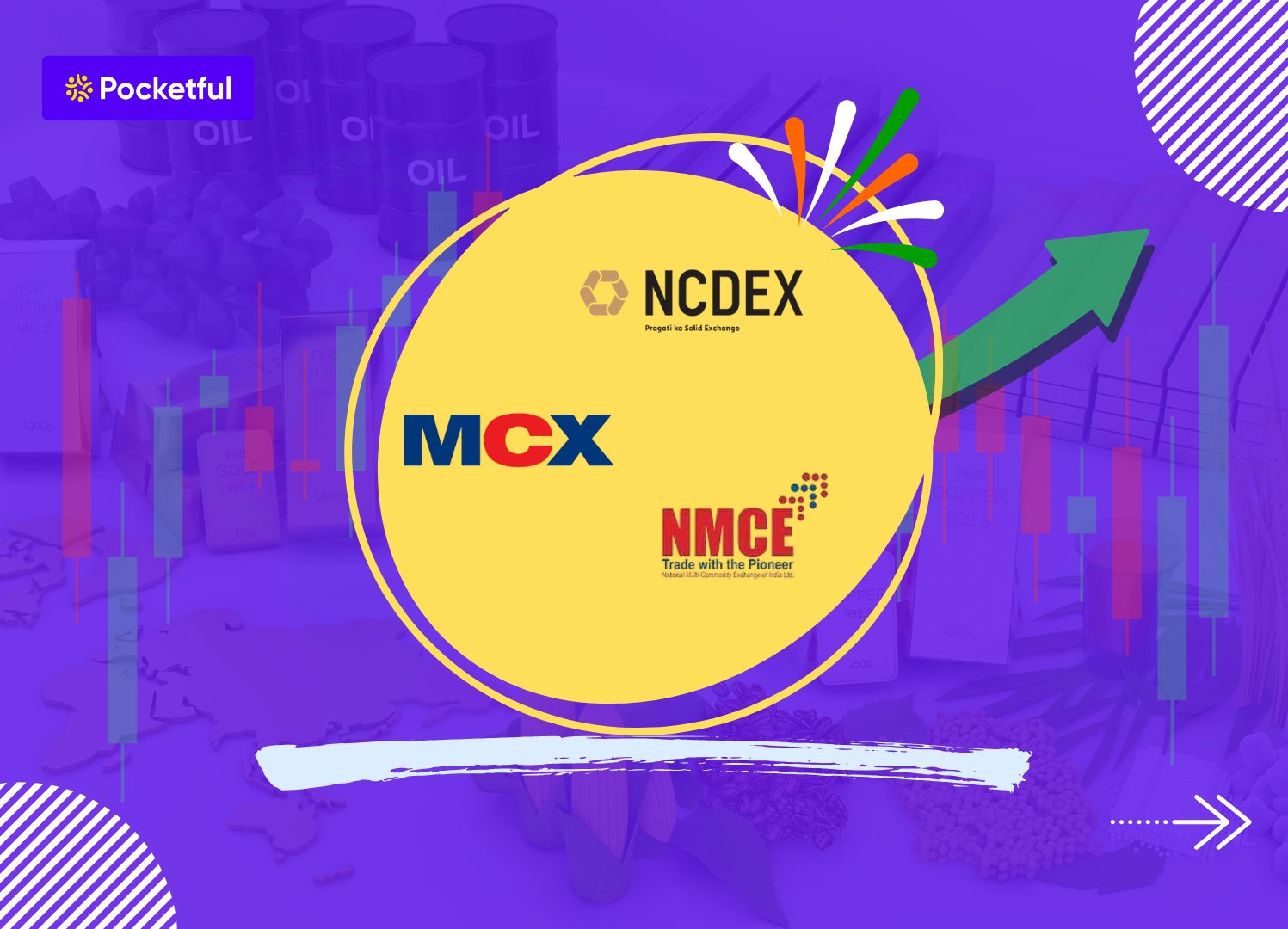
    Some of the most common major commodity exchanges in India include:

    1. Multi Commodity Exchange of India (MCX)

    MCX is one of India’s largest commodity exchanges with a huge trading volume. It came into existence in 2003. Metals such as gold, silver, and copper can be traded as futures and options contracts. They can also be used to trade crude oil and natural gas, as well as agricultural commodities like cotton. 

    Its high-tech trading platform enables price discovery with full transparency, enabling effective risk management. Traders can access the MCX platform through a huge network of brokers associated with it.

    Read Also: MCX Exchange Case Study: Evolution, Products, And Financials

    2. National Commodity and Derivatives Exchange (NCDEX)

    NCDEX was established in 2003, and it primarily deals with agricultural commodities. It enables farmers and traders to hedge items such as wheat, barley, spices, and oilseeds. 

    This commodity exchange enables stakeholders such as farmers and FMCG companies to hedge against price variations and obtain a stable income or control the costs of raw materials. Moreover, NCDEX also offers traders an opportunity to speculate on the price movement of commodities to generate profits.

    3. National Multi Commodity Exchange (NMCE)

    NMCE began as the first online commodities exchange in India in 2002. It offered trading in coffee, rubber, oil seeds, and spices through futures contracts. It merged with ICEX in 2017, and as a result, it became the third-largest commodities exchange in India. The merger enhanced market liquidity, ensuring seamless and transparent transactions. 

    Did you know?

    Some of the other commodity exchanges in India in the past were:

    1. Indian Commodity Exchange Ltd. (ICEX): In 2024, SEBI revoked ICEX recognition, allowing it to exit the commodity markets.
    2. ACE Derivatives and Commodity Exchange Ltd.: In 2019, SEBI allowed ACE Derivatives and Commodity Exchange to shut operations after the exchange failed to come up with a strategy to increase trading volumes. This decision was made after there was nearly a two-year trading suspension on the exchange.
    3. Universal Commodity Exchange (UCX): The exchange came into existence in 2012, but due to low trading volumes, SEBI allowed it to shut operations in 2014.

    Different Types of Commodity Trading

    Commodity trading can be done using futures, options, spot, spread, and derivative trading. Usually, such trades are conducted through commodity trading platforms. An overview of the different types of commodity trading are:

    1. Futures Trading: Futures trading features futures contracts of a commodity. The buyer of the futures contract agrees to purchase the underlying commodity at a specific date for a pre-determined price. Futures contracts are used by traders to generate profits by predicting price changes and by farmers and manufacturers to manage risks associated with changing commodities prices.
    1. Spot Trading: Spot trading involves purchasing or selling physical commodities immediately. Here, delivery takes place immediately after the purchase; without having to wait for future delivery dates, traders can swiftly close deals. This way, they can obtain commodities at a faster pace.
    1. Options Trading: Options trading involves options contracts, i.e. calls and puts. An option grants the holder the right but not an obligation to buy or sell the underlying commodity at a predetermined price on a specific date. These contracts allow traders to manage risks and profit from market changes. 
    1. Other Derivative Contracts: Other derivative contracts include financial instruments such as swaps and forward contracts. These derivative instruments are different from other derivative instruments as these can be customized according to the specific requirements of the parties involved. The payoff structure can be modified after mutual agreement between the parties.

    Check OutSearch and Filter Commodities

    Things To Consider Before Trading in Commodities 

    An individual should consider the below-mentioned factors before trading in commodities:

    • Regulation: Ensure that the commodity exchange you use is SEBI-regulated for a secure and transparent trading experience. This safeguards your assets and allows you to trade in a well-regulated environment with strict regulations in place. 
    • Broker Selection: Choose a reliable broker with low brokerage fees, excellent customer service, and a strong track record in commodity trading. A trustworthy broker streamlines the trading process, provides insightful analysis, and assists you in making wise judgments. 
    • Liquidity: When trading, choose commodities with high liquidity to facilitate quick buying and selling. Good liquidity facilitates quick transactions and lowers price impact, enabling you to initiate or exit trades with minimal delays or losses. 
    • Costs: Before you begin trading, be aware of the brokerage costs. Being aware of these costs upfront helps in efficient budgeting, profit maximization, and the avoidance of unforeseen charges that may affect your total returns. 

    Read Also: Pros and Cons of Commodity Trading

    Conclusion

    Major commodity exchanges, like MCX and NCDEX, support trading in a wide range of commodities. These primarily include metals, energy, agriculture, etc. These commodity trading platforms allow farmers, manufacturers, and FMCG companies to protect themselves from price fluctuations and contribute to India’s economic growth. These commodity exchanges have high trading volumes along with strict risk management systems in place, ensuring market stability. However, it is important to consult a financial advisor before trading in commodities.

    Gold Rate in Top Cities of IndiaSilver Rate in Top Cities of India
    Gold rate in AhmedabadSilver rate in Ahmedabad
    Gold rate in AyodhyaSilver rate in Ayodhya
    Gold rate in BangaloreSilver rate in Bangalore
    Gold rate in BhubaneswarSilver rate in Bhubaneswar
    Gold rate in ChandigarhSilver rate in Chandigarh
    Gold rate in ChennaiSilver rate in Chennai
    Gold rate in CoimbatoreSilver rate in Coimbatore
    Gold rate in DelhiSilver rate in Delhi
    Gold rate in HyderabadSilver rate in Hyderabad
    Gold rate in JaipurSilver rate in Jaipur

    Frequently Asked Questions (FAQs)

    1. What is a commodity exchange?

      A commodity exchange is a marketplace where traders buy and sell commodity derivative contracts, such as futures and options, for hedging and speculation.

    2. Which are the major commodity exchanges in India?

      The major commodity exchanges in India include the Multi Commodity Exchange (MCX), National Commodity and Derivatives Exchange (NCDEX), and National Multi Commodity Exchange (NMCE).

    3. What is the role of commodity exchanges in India?

      Commodity exchanges facilitate transparent and organized trading of commodity derivative contracts, providing platforms for price discovery, risk management, and hedging for manufacturers, farmers, and traders.

    4. What are futures contracts in commodity trading?

      Futures contracts are legally binding agreements between two parties to purchase or sell the underlying asset at a predetermined price and date. These are used for risk management and speculation.

    5. What factors should be considered before trading in commodities?

      Before trading in commodities, consider factors like regulation, broker reliability, liquidity, and costs. These ensure a secure and efficient trading experience.

  • The Pros and Cons of Commodity Trading

    The Pros and Cons of Commodity Trading

    Commodity trading is the process of buying and selling of commodities such as gold, crude oil, copper, etc., in spot markets or derivative markets. Commodity trading has numerous advantages as it helps market participants diversify their portfolios, speculate on future price movements, etc.

    However, commodity trading can result in significant losses as prices can change suddenly due to certain factors such as weather, global demand, political events, etc. This makes it difficult to predict how much profit or loss a trader might make. 

    In this blog, we will discuss the pros and cons of commodity trading, which will help you make smarter trading decisions. 

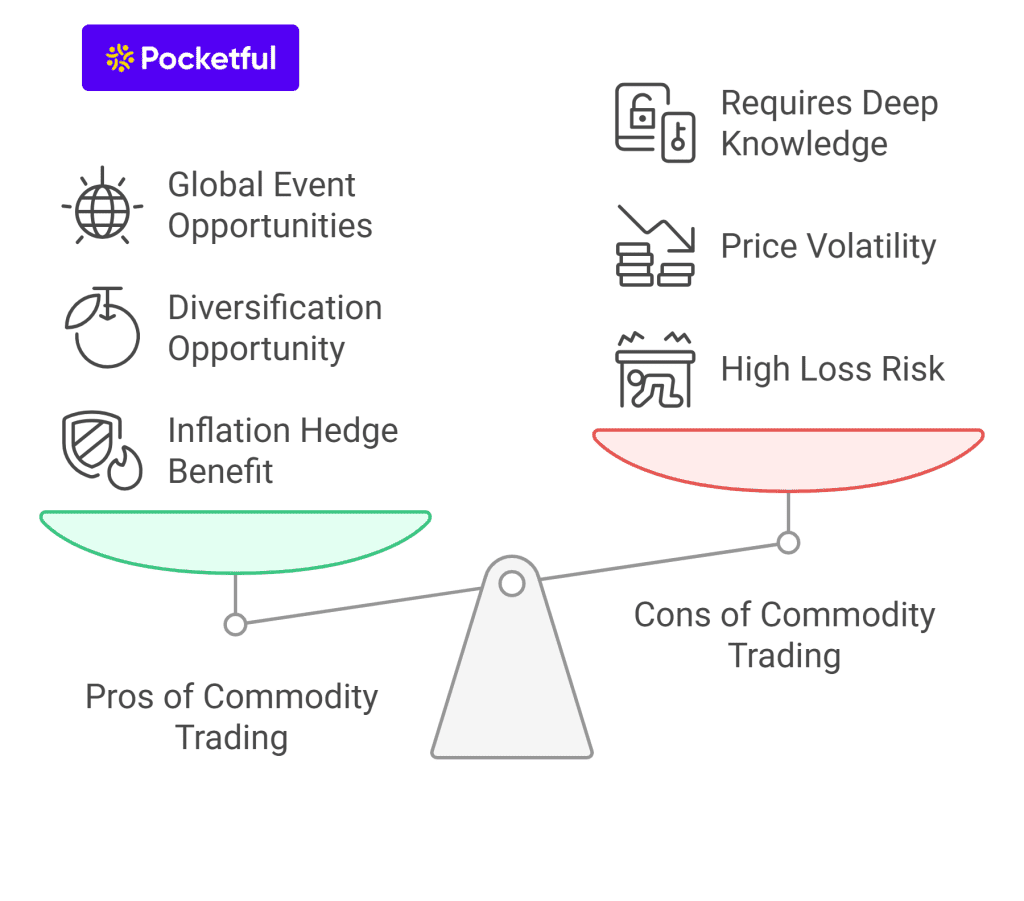
    Pros of Commodity Trading

    The pros of commodity trading are:

    1. Protection Against Inflation

    Commodity trading provides a powerful hedge against inflation. Market participants can use derivative contracts to protect their portfolios against inflation. Furthermore, futures contracts allow traders to lock in the price of a commodity for a transaction at a future date. This helps them fix the cost of raw materials and mitigate the impact of rising inflation.

    When inflation rises, the price of raw goods rises, and these can specifically include goods like oil, metals, and agricultural items. For example, for a business reliant on raw materials for its manufacturing activities, it is essential to control the input costs. If inflation is expected to rise, the company can buy the futures contracts of the specific raw material and basically fix their buying price for a transaction at a future date.

    2. Portfolio Diversification

    Commodities are usually traded through futures and options on platforms like MCX. These contracts are not strongly correlated with traditional assets, such as equities and bonds. For example, commodities like gold or oil often perform well when stock markets are underperforming, thus decreasing your portfolio’s overall risk. 

    3. Opportunity During Global Events

    Global events can cause significant price movements in commodities. Trading on exchanges like MCX provides the opportunity to profit from such volatility, as global crises frequently impact commodities prices.

    4. Higher Returns

    Commodity trading offers margin trading, which means traders can hold a large position with a small capital. If prices move favorably, the profits are significant. However, leverage is also associated with increased risk, as if prices move in the opposite direction, losses can be significant. 

    5. Transparent and Fair Pricing

    Commodity trading often occurs on regulated exchanges such as MCX, ensuring transparent pricing and no price manipulation. All trading takes place on electronic commodity trading platforms, which helps prevent price manipulation. This increases the market participant’s confidence and makes the market more transparent and trustworthy. 

    Gold Rate in Top Cities of IndiaSilver Rate in Top Cities of India
    Gold rate in AhmedabadSilver rate in Ahmedabad
    Gold rate in AyodhyaSilver rate in Ayodhya
    Gold rate in BangaloreSilver rate in Bangalore
    Gold rate in BhubaneswarSilver rate in Bhubaneswar
    Gold rate in ChandigarhSilver rate in Chandigarh
    Gold rate in ChennaiSilver rate in Chennai
    Gold rate in CoimbatoreSilver rate in Coimbatore
    Gold rate in DelhiSilver rate in Delhi
    Gold rate in HyderabadSilver rate in Hyderabad
    Gold rate in JaipurSilver rate in Jaipur

    Check OutFree Commodities Screener 

    Cons of Commodity Trading

    The cons of commodity trading are:

    1. High Risk of Loss

    Commodity trading involving futures and options can be risky. This is primarily because of the leverage involved, which is why even small price movements can result in big losses.

    2. Price Volatility

    Commodity prices can fluctuate rapidly. This can be due to a variety of factors, such as weather, regulatory changes and world events. Just for instance, a natural calamity can harm crops or halt oil production, which can increase prices.

    Similarly, a reduced demand for a specific commodity can cause price declines. These unexpected price swings are difficult to forecast. Even experienced traders sometimes struggle with these unpredictable price changes, making commodity trading dangerous and complex to manage.

    3. Requires Deep Knowledge

    Successful commodity trading requires a thorough grasp of market trends, supply and demand dynamics, etc. This helps you make wise trading decisions, particularly when trading in futures and options.

    For example, price swings can be induced by political upheaval in OPEC nations. Because of the turmoil, oil prices may rise or fall significantly, making wise trading decisions extremely tough.

    Pros and Cons of Commodity Trading

    Things to Keep in Mind Before Trading in Commodities

    You should remember the following points before trading in commodities:

    • A higher trading volume in a specific commodity means more market participants are actively buying and selling, which can lead to bigger price changes. It also results in more trading opportunities.
    • Know how much risk you’re willing to take. High-risk trades can give you more profit, but they also carry a higher chance of losing money.
    • Keep a close watch on the price trends of commodities. Prices of some commodities can go up fast and drop just as quickly, which makes them risky.
    • Don’t put all your money into one commodity. Spreading your trading positions across commodities reduces risk and increases your chances for profit.

    Read Also: How to Trade in the Commodity Market?

    Conclusion

    Commodity trading on platforms such as MCX can provide lucrative trading opportunities. However, trading in commodities also involves risks as commodity prices can be extremely volatile. This is due to variables such as weather, politics, and global demand, which make these markets unpredictable.

    Understanding how prices change is critical for success in commodities trading helps you stay on top of market trends. Knowing your financial objectives and the amount of risk you’re prepared to accept is critical.

    Choose which commodities to trade and look for strategies on how to take advantage of price fluctuations effectively. Understanding your risk tolerance is crucial. Diversifying your trading positions across many commodities reduces risk.

    Stay updated, monitor market movements, and alter your trading plan when necessary. With the appropriate strategy, you can make well-informed trading decisions, helping you achieve your financial goals. 

    S.NO.Check Out These Interesting Posts You Might Enjoy!
    1Understanding Commodity Market Analysis
    2What is the Timing for Commodity Market Trading?
    3Risks in Commodity Trading and How to Manage Them
    45 Tips for Successful Commodity Trading
    5Stock Market vs Commodity Market

    Frequently Asked Questions (FAQs)

    1. What is commodity trading?

      Commodity trading is the buying and selling of raw materials like gold, oil, and agricultural products in spot or derivative markets to profit from price fluctuations and hedge against risk.

    2. What are the key advantages of commodity trading?

      Commodity trading offers protection from inflation, portfolio diversification, and potential high returns. Futures contracts can be used to lock in prices, and market volatility during global events creates additional trading opportunities.

    3. What risks are involved in commodity trading?

      Commodity trading carries high risk due to leverage and unpredictable price volatility. Market price changes due to weather, global demand shifts, or political events can result in significant financial losses.

    4. How does commodity trading act as a hedge against inflation?

      Commodity trading, particularly through futures contracts, enables traders to lock in prices. This strategy protects against rising raw material costs during inflationary periods.

    5. What should traders consider before engaging in commodity trading?

      Traders should assess risk tolerance, monitor market trends, diversify positions, and gain deep market knowledge. Understanding supply and demand dynamics is crucial for making informed trading decisions.

  • What is the Commodity Index?

    What is the Commodity Index?

    A commodity Index tracks the price movements of a basket consisting of different kinds of underlying commodities. Commodity indices help traders and investors create benchmarks that reflect the overall performance of the commodity market. 

    In this blog, we will give information about the commodity index, its types, and major commodity indices in India.

    Commodity Index: An Overview

    A commodity index represents essentially a weighted index that gauges the price performance of a certain group of commodities. Commodity Indices are meant to expose traders to the wide world of commodities. Some of the most frequently traded commodities in the portfolio might include crude oil, natural gas, gold and silver.

    Commodity indexes are different from other indexes. This is because their returns usually depend only on the price changes of the commodities in the index. Unlike stocks or bonds, commodities don’t pay dividends or interest. As commodities don’t offer these payouts, the commodity index returns are solely based on the price performance of underlying commodities. 

    Types of Commodity Indices

    Here are some common types of commodity indices:

    1. Broad Commodity Indices

    These indices cover a broad commodity universe across different sectors. In India, the MCX iCOMDEX Composite index tracks the performance of crude oil, zinc, gold, etc., thereby covering energy, base metal, and precious metal sectors. The most prominent global broad commodity index is the S&P GSCI (Goldman Sachs Commodity Index). It encompasses 24 commodities, ranging from energy to agriculture to metals.

    2. Sector-Specific Commodity Indices

    These indices focus specifically on commodities of certain sectors such as energy, agriculture, and other products. In India, the MCX iCOMDEX Base Metal index tracks the performance of Aluminium, Copper, Lead and Zinc. Globally, the S&P GSCI Electric Vehicle Metals Index is a well-known index that tracks the performance of cobalt, copper, aluminium, nickel, and iron ore.

    3. Single Commodity Indices

    These indices show the price performance of a specific commodity, such as gold, crude oil, etc. For example, MCX iCOMDEX Gold tracks the performance of gold. Other examples of single commodity indices in India are MCX iCOMDEX Silver, MCX iCOMDEX Zinc, etc.

    Types of Commodity Indices

    Read Also: Understanding Commodity Market Analysis

    Benefits of Commodity Indices

    Some of the most common benefits of commodity indices include:

    1. Diversification

    Trading in commodity indices is an excellent way for portfolio diversification. By trading in a commodity index, a trader gains exposure to multiple commodities, reducing the risk of relying on the performance of a single asset class. For instance, the MCX iCOMDEX Base Metal index has futures contracts with a ticker symbol named MCX METLDEX, which consists of futures contracts of aluminum, copper, lead, nickel and zinc as its underlying.

    2. Inflation Hedge

    Commodities, particularly precious metals like gold and silver, have long been considered a hedge against inflation. When inflation rises, the price of commodities like gold and oil often increases. Trading in futures contracts of Indian commodity indices such as MCX iCOMDEX Bullion and MCX iCODMEX Base Metal can help traders safeguard their portfolios during inflationary periods.

    3. Economic Indicator

    Commodity indices also serve as indicators of economic health. Since commodities are essential for industries like manufacturing, construction, etc., their prices are often tied to the overall economic conditions. By monitoring commodity indices, traders can gain insights into global demand and supply trends.

    4. Access to Commodity Markets 

    While commodity trading can be capital-intensive, access to ETFs provides cost-effective options. By investing in ETFs of specific commodities such as gold and silver, you can gain exposure to commodity price movements without having to deal with the complexities of trading individual commodities or managing physical assets.

    Gold Rate in Top Cities of IndiaSilver Rate in Top Cities of India
    Gold rate in AhmedabadSilver rate in Ahmedabad
    Gold rate in AyodhyaSilver rate in Ayodhya
    Gold rate in BangaloreSilver rate in Bangalore
    Gold rate in BhubaneswarSilver rate in Bhubaneswar
    Gold rate in ChandigarhSilver rate in Chandigarh
    Gold rate in ChennaiSilver rate in Chennai
    Gold rate in CoimbatoreSilver rate in Coimbatore
    Gold rate in DelhiSilver rate in Delhi
    Gold rate in HyderabadSilver rate in Hyderabad
    Gold rate in JaipurSilver rate in Jaipur

    Check OutSearch and Filter Commodities

    Major Commodity Indexes: An Overview

    Multi Commodity Exchange (MCX) offers 12 commodity indices in total, consisting of composite indices, sectoral indices, and single commodity indices. Indices are given below:

    • Composite indices: MCX iCOMDEX Composite index
    • Sectoral Indices: MCX iCOMDEX Bullion index, MCX iCOMDEX Energy index and MCX iCOMDEX Base Metal index.
    • Single Commodity Indices: MCX iCOMDEX Gold index, MCX iCOMDEX Copper index, MCX iCOMDEX Crude Oil index, etc.

    Trading indexes allow you to avoid focusing on specific commodities. It’s an easy method to track the market while minimizing risk. Commodity indices, whether in metals, energy, or agriculture, are an excellent starting place for inexperienced traders. 

    How to Invest in a Commodity Market Index?

    You can invest in the commodity market index in the following ways:

    1. Mutual funds and ETFs can be used to invest or trade in commodities, such as gold and silver. 
    2. Another way of trading in commodity indices is through futures contracts. Futures contracts of MCX iCOMDEX Bullion and MCX iCODMEX Base Metal index are available for trading.
    3. Futures and options contracts of specific commodities, such as gold, silver, crude oil, copper, etc., are also available for trading.
    How to Invest in a Commodity Market Index

    Read Also: How to Trade in the Commodity Market?

    Conclusion

    Commodity indices help market participants track the performance of the underlying commodities Trading Platform and also provide a way to diversify their portfolio through investing and trading in ETFs, mutual funds, futures and options.  In India, MCX provides 12 commodity indices, which consist of composite indices, sectoral indices, and single commodity indices. However, it is advised to consult a financial advisor before investing or trading in commodities.

    S.NO.Check Out These Interesting Posts You Might Enjoy!
    1Best Commodity Trading Platforms in India: Top 10 Picks for Traders
    2What is the Timing for Commodity Market Trading?
    3Risks in Commodity Trading and How to Manage Them
    45 Tips for Successful Commodity Trading
    5Types of Commodity Market in India

    Frequently Asked Questions(FAQs)

    1. What is a commodity index?

      A commodity index tracks the price movements of a basket of commodities, helping traders and investors measure the overall performance of the commodity market.

    2. What are the types of commodity indices?

      Commodity indices are categorized into broad indices, sector-specific indices, and single commodity indices.

    3. How do commodity indices help in portfolio diversification?

      Commodity indices provide exposure to multiple commodities, reducing dependence on a single asset class and thereby enhancing risk management and diversification.

    4. Why are commodities considered an inflation hedge?

      Commodities like gold and oil tend to increase in value during inflationary periods, making them effective in preserving purchasing power.

    5. How can one invest in commodity indices?

      Investors can trade through mutual funds, ETFs, or futures and options contracts of sectoral indices like MCX iCOMDEX Bullion and MCX iCOMDEX Base Metal.

  • Types of Commodity Market in India

    Types of Commodity Market in India

    The commodity market plays a crucial role in the global economy. Here, derivative contracts of commodities are traded. It provides a platform for producers and consumers to manage risks and, at the same time, allows traders to take advantage of price movements. 

    Commodities are bulk-produced raw materials. These can be wheat, soybean, or precious metals. They must meet certain quality and quantity standards to be eligible as an underlying asset of the derivative contracts. These derivative contracts are traded widely among multiple buyers and sellers.

    In this blog, we will discuss the types of commodity markets in India.

    What is a Commodity Market?

    A commodity market is a platform where commodities such as gold, silver, crude oil, agricultural products, etc., are bought and sold. These transactions can happen either via spot transactions or through derivative contracts.

    These markets act as bridges between the sellers and buyers of commodities. This way, producers can sell their goods and also hedge against the volatility in the prices while consumers can get the commodities needed at the cheapest price possible. 

    Check OutFree Commodities Screener 

    Types of Commodity Market in India

    The commodity market in India can be broadly classified into different types. Some of the common types of commodity markets include:

    1. Spot Market

    The spot market, or cash market, is a marketplace where commodities are bought and sold for immediate delivery. This market is characterized by physical transactions. Here, buyers and sellers negotiate prices based on the prevailing market conditions. The buyers often take possession of the commodity immediately after the payment has been made.

    2. Derivatives Market 

    • Futures 

    Futures contracts allow you to trade, buy or sell commodities for delivery in the future. The market allows buyers and sellers to enter contracts to purchase or sell a particular commodity at a specified price at a predetermined date.

    • Options 

    An option is a type of financial instrument that gives the holder the right, but not the obligation, to buy or sell an underlying asset at a specified price, known as the strike price, on or before a set expiration date.

    Options are of two forms:

    • Call Options: Give the holder the right but not the obligation to buy the asset.
    • Put Options: Give the holder the right but not the obligation to sell the asset.

    Options can be traded before expiration. However, the actual transfer of the asset occurs only after the option is exercised.

    • Forwards

    Forwards contracts are similar to futures contracts but differ in one key aspect. Futures contracts are traded on organized exchanges and have a standardized contract size. On the other hand, forward contracts are over-the-counter (OTC) financial instruments, due to which these contracts are negotiated directly between buyers and sellers.

    Types of Commodity Markets in India
    Gold Rate in Top Cities of IndiaSilver Rate in Top Cities of India
    Gold rate in AhmedabadSilver rate in Ahmedabad
    Gold rate in AyodhyaSilver rate in Ayodhya
    Gold rate in BangaloreSilver rate in Bangalore
    Gold rate in BhubaneswarSilver rate in Bhubaneswar
    Gold rate in ChandigarhSilver rate in Chandigarh
    Gold rate in ChennaiSilver rate in Chennai
    Gold rate in CoimbatoreSilver rate in Coimbatore
    Gold rate in DelhiSilver rate in Delhi
    Gold rate in HyderabadSilver rate in Hyderabad
    Gold rate in JaipurSilver rate in Jaipur

    Types of Commodities in the Commodity Market

    The commodity market in India offers a wide range of commodities for trading. Here are the types of commodities in the commodity market: 

    1. Agricultural commodities: These include grains (e.g., wheat, chana), oil and oilseeds (e.g., soybeans, mustard seeds), spices (e.g., coriander, turmeric), etc.
    2. Energy commodities: These comprise crude oil and natural gas.
    3. Metal commodities: These are commodities made of metal, such as precious metals (gold, silver), base metals (copper, aluminium), etc.

    Commodity Trading Platforms

    In India, commodity trading is facilitated by various exchanges and platforms. Some of the commodity trading platforms include: 

    • National Commodity & Derivatives Exchange (NCDEX)
    • Multi Commodity Exchange of India (MCX)

    Benefits of Commodity Trading

    Commodity trading offers several benefits, including:

    1. Diversification

    Commodity trading provides access to numerous commodities, which allows traders to spread risks more effectively. They can trade commodities like metals, energy, and agriculture and reduce their reliance on a single sector as these commodities serve as raw materials for multiple sectors of the economy. Commodities are traded all over the globe, which makes them less susceptible to market manipulation. Commodities enable traders to pursue trading opportunities in multiple financial assets and thus limit exposure to a specific financial instrument or sector. 

    2. Hedging

    In commodity trading, hedging guards against unexpected price volatility. Through forward contracts, businesses can fix the cost of their raw materials, helping them maintain consistent financial performance. 

    Hedging helps traders lessen their exposure to unfavorable market movements. This tactic reduces the risk of adverse price fluctuations causing significant losses. 

    3. Liquidity

    Commodity markets are extremely liquid. This allows traders to execute transactions quickly with minimum price impact. High trading volumes ensure that trades are completed without delay. This liquidity makes it simple to buy and sell assets, which is of extreme importance when trading in large quantities. 

    4. Transparency

    The transparency of commodity markets is excellent. The commodity exchanges in India provide an easy-to-use platform and effective trading environment. Real-time price updates guarantee precision and reliability.

    Everybody has access to market data, thereby promoting well-informed decision-making. Transparency reduces the possibility of unfair practices and manipulation. It enables traders to confidently assess conditions and take decisive action.

    Read Also: How to Trade in the Commodity Market?

    Strategies for Successful Commodity Trading

    To succeed in commodity trading, it’s essential to develop a well-defined trading strategy. Here are some strategies to consider:

    • Fundamental analysis: This involves examining the core elements that influence commodity prices, i.e., the supply and demand dynamics, weather conditions, and international events.
    • Technical analysis: Charts and technical indicators can be utilized to recognize patterns and trends in commodity prices and get an idea of future price trends.
    • Risk management: Employ stop-loss orders and position sizing to manage risk and reduce possible losses.
    • Diversification: Engage in trading different commodities and apply a range of trading strategies to avoid concentration risk.

    Conclusion

    Commodities trading through spot transactions and derivative contracts offer a large number of businesses and traders an opportunity to buy, sell and trade commodities. Staying informed about the various types of commodity markets, types of commodities trading platforms opens up a lot of trading opportunities. 

    A well-defined trading strategy used with proper risk management can help you capitalize on trading opportunities offered by the commodity market in India. Consult a financial advisor before trading in commodities.

    S.NO.Check Out These Interesting Posts You Might Enjoy!
    1Understanding Commodity Market Analysis
    2What is the Timing for Commodity Market Trading?
    3Risks in Commodity Trading and How to Manage Them
    45 Tips for Successful Commodity Trading
    5Stock Market vs Commodity Market

    Frequently Asked Questions (FAQs)

    1. What are the main types of commodity markets in India?

      India has spot markets for immediate delivery and derivatives markets, including futures, options, and forwards, where commodities are traded as underlying assets of derivative instruments for future delivery.

    2. What types of commodities are traded in India?

      Commodities in India are classified into agricultural (wheat, soybeans, spices), energy (crude oil, natural gas), and metals (gold, silver, copper, aluminium), traded across different commodity exchanges.

    3. How do futures and forward contracts differ in commodity trading?

      Futures contracts are standardized and traded on regulated exchanges, while forward contracts are private, over-the-counter (OTC) agreements with customizable terms between buyers and sellers.

    4. What are the key benefits of commodity trading?

      Commodity trading offers diversification, hedging against price fluctuations, high liquidity, and market transparency, enabling traders to reduce risk and take advantage of price movements.

    5. What strategies can improve success in commodity trading?

      Successful traders use fundamental analysis (supply-demand, weather, global events), technical analysis (charts, indicators), risk management (stop-loss, position sizing), and diversification across multiple commodities and strategies to minimize losses.

  • Open Free Demat Account

    Join Pocketful Now

    You have successfully subscribed to the newsletter

    There was an error while trying to send your request. Please try again.

    Pocketful blog will use the information you provide on this form to be in touch with you and to provide updates and marketing.