Category: Investing

  • FD (Fixed Deposit) vs Stocks: Which is the better investment option?

    FD (Fixed Deposit) vs Stocks: Which is the better investment option?

    Where to invest? How much to invest? Should I go with investing in stocks, or should I go with bank fixed deposits?

    These questions commonly arise whenever you have an ample amount of money and you are economical. In this blog, we will explore the difference between investing in stocks and fixed deposits. Before we learn about the key differences between stocks and fixed deposits, let’s have some basic ideas about financial planning. What is financial planning, and why do we need financial planning?

    Financial Planning means channelling one’s income into consumption and savings, where consumption is defined as the unavoidable expenditure incurred by an individual on his basic needs, and the residual amount after spending is known as savings. The savings can be used to meet the financial goals.

    Types of Saving Instruments

    In a country like India, saving instruments can be divided into two parts

    1. Traditional Savings instrument
    2. Investments

    Most people in India generally opt for traditional savings instruments because there is a lack of financial literacy. Some of the most common traditional methods to save are listed below.

    • Fixed deposits
    • Recurring Deposits
    • Post Office

    Some of the most widely used new-age investment options apart from traditional saving instruments are

    • Stocks
    • Mutual Funds
    • Commodities  

    Now, let us dig deep into the concept of the most used methods of traditional and modern investing i.e., Fixed Deposits and Stocks.

    What are fixed deposits?

    FD

    Let’s make it easy, simplified and crisp with a short example.

    Suppose, you received a Diwali Bonus of Rs.50000, and instead of buying something expensive, you decided to go for a Fixed Deposit. Now you will visit your nearest bank branch and will deposit your money to earn some amount of interest and will just sit back for some years. You will reach out to the bank once again when your Fixed Deposit matures to get your principal amount as well as the interest that you have earned over the years.

    Therefore we can say that fixed deposit (FD) is a tenured deposit account provided by banks or NBFCs (Non-banking financial companies ) which provides investors with a higher interest rate than a regular savings account until the given maturity date. Investment in fixed deposits is considered a risk-free investment.   

    Merits & Demerits of Investing into FDs

    There are certain merits and demerits of saving your money in FDs

    Merits of Investing in Fixed Deposit

    1.     Guaranteed Rate of Interest

    2.     Easy to Monitor

    3.     Tax Benefits

    4.     Loan Against FD

    5.     Flexible Period

    6.     Better option for senior citizens

    Demerits of Fixed Deposits.

    1.     May not beat inflation

    2.     Lower rate of return

    3.     Penalty on pre-mature withdrawal.

    4.     Lack of re-investment opportunity.

    Taxation of Fixed Deposits in India (Example):

    In India, the interest income earned from fixed deposits is subject to taxation under the Income Tax Act. Here’s a simplified example to explain how FD interest is taxed. Suppose Mr. Y has a bank FD of Rs.1 lakh and as per the current rate he is earning an interest 6.5% per annum on his FD, which amounts to 6500 (6.5% of 1 lakh). Now he is liable to pay tax on 6500 as per his income slab. By now, you must have understood the basics of Fixed Deposits. Now let’s throw some light on the most discussed yet so undervalued concept of investing i.e., stocks

    What do you mean by investing in stocks?

    STOCK MARKET

    A stock, also known as equity, represents a part of an individual’s ownership in a corporate or government company. Investing in stocks carries a level of higher risk because the value of a stock can be influenced by various factors, including the company’s financial performance, economic conditions, and market sentiment. However, stocks have historically offered higher returns compared to other investment options. Many investors choose to build a diversified portfolio of stocks to spread their risk. Diversification involves owning a basket of stocks from different sectors to reduce the impact of poor performance in any one stock. Stocks can be diversified into large-cap, mid-cap and small-cap companies

    Large-cap 

    Companies are generally growth-oriented companies that are considered safer while investing. They are less risky and give lower returns than other companies since risk and reward in the stock market go hand in hand.

    Mid Cap 

    Companies possess higher risk when compared with large-cap companies and they are suggested for investors who are well-versed with the concept and idea of investing in stocks.

    Small cap 

    Companies carry higher risk since they are start-ups, having good potential to perform in longer investment horizon.

    Read Also: Which is Better: Fixed Deposit or Residential Property Investment

    From where can we buy or sell stocks?

    Stocks are bought and sold on stock exchanges, organized marketplaces where buyers and sellers join together to trade. Stock exchanges in India are NSE and BSE. If we talk about the returns of the stock market, they are highly volatile and are dependent on the performance of the market. If you are planning to invest in stocks from the point of view of the short term, then be ready for the volatility you might face. Still, if you stay invested for a longer horizon, the market will surely reward you for your patience with outstanding higher returns, which can fight inflation.

    Taxation of Equity in India

    Just like taxation on FDs, stocks are also subject to tax deductions. The taxation on equity is divided into two parts, the first being the short-term capital gain and the second being the long-term capital gain.

    1. Short-Term Capital Gain  

    The realized gain within 365 days of investing is considered short-term and taxable at 15%.

    1. Long-Term Capital Gain 

    The realized gain after 365 days of investing is considered long-term and is taxable at 10% over and above 1 Lakh.

    Merits & Demerits of Stocks

    How to become aware during Stock marketplace investment?

    Now, let’s discuss the merits and demerits of investing in stocks.

    Merits of investing in stocks

    1.     Inflation rate adjusted Returns

    2.     Dividend income

    3.     Liquidity

    4.     Tax benefits

    5.     Wealth creation

    Demerits of investing in stocks

    1.     Volatility of markets

    2.     Higher Risk of Loss

    3.     Brokerage

    In India, 3% of the current population is investing in stock markets and we hope that with our blogs we will be able to make our upcoming population financially more aware.

    After having an overview of the basics of Fixed Deposits and stocks.

    We can now easily create a table of differences between stocks and FDs.

    Basis of DifferenceFixed DepositStocks
    LiquidityIt has very little liquidity as compared to stocks.Stocks have high liquidity.
    RiskInvestment in Fixed Deposit is considered risk-free.Investment in stocks possesses higher risk.
    Investment HorizonPre-decided investment horizon.Suggested for individuals having high-risk appetites.
    Rate of Interest (Return)GuaranteedMarket Linked
    TaxationInterest is fully taxable.Long
    ExpensesNo expensesTransaction Cost
    Inflation RateReturns of FD may or may not beat inflation.It offers inflation-adjusted returns.
    Duration of investmentGenerally suggested for the shorter horizon.It is suggested for individuals having long-term investment horizons.

    Read Also: A Guide To Fixed Deposits: Exploring Types And Interest Rates

    Conclusion

    CONCLUSION

    Therefore, it is always suggested to select between the two as per your investment objective, financial goal and risk appetite. Eventually, there is no one-size-fits-all answer, and the optimal choice depends on your preferences. Do not forget to consult a financial planner to tailor your investment strategy if you are confused.

    Frequently Answered Questions (FAQs)

    1. Which is considered safer, Fixed deposits or stocks?

      Fixed deposits are generally considered safer as they provide a fixed return.

    2. Which investment option offers higher returns between stocks and FDs?

      Stocks offer higher returns than FDs.

    3. Who provides FDs?

      Banks and Non-Banking Financial Institutions provide FDs.

    4. What is STCG in stocks?

      STCG in stocks stands for short-term capital gains, which are 15% of your realized gains.

    5. Who decides the interest rate on FDs?

      Banks and NBFCs decide interest rates on FDs, which vary from bank to bank.

  • What is Asset Under Management (AUM) in Mutual Funds

    What is Asset Under Management (AUM) in Mutual Funds

    Before learning about AUM, let us know a little about AMCs.

    AMC stands for Asset Management Company and manages and operates the mutual funds. It pools money from retail and institutional investors and invests that fund in a diversified portfolio of stocks, bonds, and other financial instruments. AMCs have dedicated research teams and fund managers who make decisions on the allocation of assets and portfolio management. AMCs earn fees for managing mutual funds, a percentage of the fund’s AUM.

    What is AUM?

    AUM assets under managemnet

    AUM stands for asset under management. AUM in mutual funds refers to the total market value of all the assets a mutual fund manages on behalf of its customers. It is an essential metric in the financial markets. A larger AUM generally implies a larger fund with more investors. The respective mutual fund scheme AUMs can be found in the monthly fact sheet of the AMCs on their website or online mutual fund research platforms.

    Indian Mutual Funds Industry

    Before getting into the Indian mutual funds industry, let us know about the history of mutual funds. To make India financially stable, strong, and independent and encourage saving and investment, the first mutual fund was established in 1963, Unit Trust of India, by a combined initiative of the Government and the Reserve Bank of India by an act of Parliament. The mutual funds industry has grown significantly over the years. Unit Scheme 1964 was the first scheme that UTI launched.

    In 1993, the first set of SEBI Mutual Fund Regulations existed for all mutual funds except UTI. The former Kothari Pioneer (now merged with Franklin Templeton Mutual Fund) was the first private-sector mutual fund registered in July 1993.

    With the entry of private sector funds in 1993, a new age began in the Indian MF industry, giving Indian investors a wider and better choice of Mutual fund products.

    The MF Industry’s AUM has grown from ₹ 22.24 trillion as of October 31, 2018, to ₹46.72 trillion as of October 31, 2023, more than a 2-fold increase in 5 years (source- AMFI website). The Indian Mutual Funds industry has witnessed robust growth over the years. The sector provides investors with different mutual fund categories like equity, debt, and hybrid funds catering to their risk profiles and preferences. Not only this, the mutual fund industry in India has also undergone a digital transformation.

    Read Also: Mutual Funds: Meaning, Types, Features, Benefits and How They Work.

    Calculation of AUM

    calculation of AUM

    AUM in mutual funds is calculated by adding up the market value of all the securities, cash, and other assets mutual funds hold.

    The formula for the same is listed below

    AUM= Market Value of Securities + Cash & Cash equivalents + Other Assets

    For example, a mutual fund holds the following

    The market value of securities = Rs. 50 Crore

    Cash & Cash equivalents = Rs. 7 Crore

    Other Assets = Rs. 3 Crore

    Therefore, AUM = Rs. 50 Cr. + Rs. 7 Cr. + Rs. 3 Cr. amounts to Rs. 60 Crore.

    It’s important to note that the actual calculation may involve more detailed considerations, especially in a real-world scenario where the portfolio may consist of various types of securities, derivatives, and other financial instruments. Moreover, the market values of securities can fluctuate, affecting the AUM over time.

    Remember that the total value of AUM keeps changing depending on the performance of the assets.

    Significance of AUM in different Mutual Funds Categories

    What is a high AUM in mutual funds? It's Worth
    1. Larger AUM in equity funds, whether large or mid-cap, reflects a broader investor base and better scale of operations. However, a larger AUM while investing in small-cap companies can pose challenges. Therefore, small caps do not concentrate much on AUM.
    2. Smaller AUM in sectoral and thematic funds may indicate a more focused approach to investment since these funds often focus on specific sectors and themes.
    3. In the case of hybrid funds, a mixture of equity and debt, a larger AUM can provide better diversification benefits.
    4. Fixed-income funds like bonds also need a larger AUM for better diversification.

    Factors affecting AUM

    Does AUM impact Mutual Funds? What are the key factors?
    1. Performance of the Market

    When markets are performing and in a rising phase, investors are more likely to invest, resulting in increased inflows and higher AUM for investment companies. In falling markets, investors redeem the funds, resulting in a decline in AUM.

    1. Fees & Expenses

    The expenses charged by asset management companies can influence AUM. Lower fees can make the funds more eye-catching to investors.

    1. Advertisement & Distribution of Funds

    Effective marketing and distribution policies are vital in attracting new investors and growing a firm’s investor base. Successful marketing campaigns and a strong distribution network can help the MF house generate inflows and increase AUM.

    1.  Economic Conditions

    The global economic environment can also affect AUM. When a country is economically stable and in its growth phase, more investments will occur, leading to higher inflows.

    1. Past performance

    The historical show of a company plays a vital role in determining AUM. Funds generating consistent positive returns will eventually attract new investors.

    For this, first, we need to understand what is the expense ratio. The expense ratio is defined as the annual cost of managing and operating mutual funds. AMCs charge these expenses and are a percentage of AUM., for example, management fees, administrative expenses, and Distribution expenses. Formula for calculating Expense Ratio = (Total Fund Expenses / AUM) *100. Therefore, there is an inverse relationship between AUM and the expense ratio.

    As AUM increases, the overall percentage of expenses relative to assets decreases. Keep in mind that AUM influences the calculation of the expense ratio and plays a vital role in structuring the overall cost of the fund and

    Conclusion

    CONCLUSION

    To wrap it up, AUM is an important metric for investors when it comes to selecting mutual funds. It can only provide insight about the AMC but cannot be the sole factor when making investment decisions also, a higher AUM does not signify better returns and performance by the mutual funds. The significance of AUM can fluctuate across different fund categories.

    Read Also: History of Mutual Funds in India

    Frequently Answered Questions (FAQs)

    1. What is AUM?

      AUM stands for asset under management and is the total market value of all the assets that a mutual fund manages on behalf of its customers

    2. What is the formula for calculating AUM?

      The formula for calculating AUM isAUM= Market Value of Securities + Cash & Cash equivalents + Other Assets

    3. How is the expense ratio and AUM related?

      Expense ratio and AUM share an inverse relationship, i.e., an increase in AUM decreases the expense ratio.

    4. Who manages the mutual fund?

      Asset Management companies manage mutual funds.

    5. When was the first mutual fund in India established?

      1st mutual fund in India was established in the year 1963.

  • What is Debt Mutual Funds: Invest in the Best Debt Funds in India

    What is Debt Mutual Funds: Invest in the Best Debt Funds in India

    What are Debt Mutual Funds?

    What Is Debt Mutual Funds

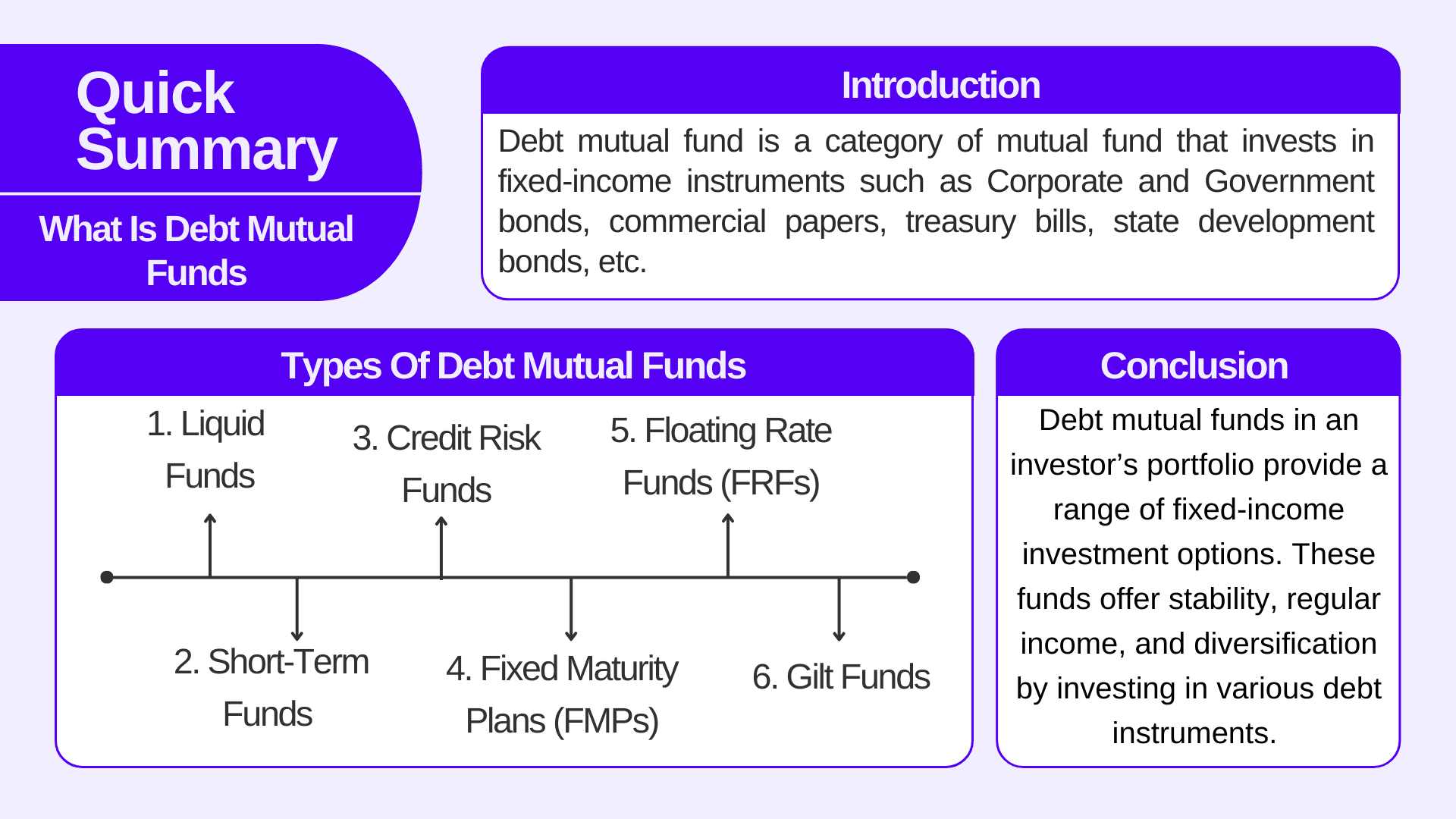
    Debt mutual fund is a category of mutual fund that invests in fixed-income instruments such as Corporate and Government bonds, commercial papers, treasury bills, state development bonds, etc. (T-bills are short-term debt instruments or money market instruments that the government of India issues. These are generally given for 91 days, 182 days, or 364 days. They are provided to fulfill the short-term financial needs of the government). 

    The primary objective of debt mutual funds is to generate income for investors through interest payments while preserving the capital invested. Debt mutual funds allocate their holdings across various debt instruments to diversify the risk. This helps the fund manager reduce the impact of poor performance by any single security.

    what are debt funds

    Debt funds invest in listed or unlisted securities, including corporate and government bonds. The NAV of the fund is calculated as the difference between the buy price and the sell price. Debt funds also receive regular interest from the underlying debt, which is added daily.

    A debt fund’s NAV also depends on the interest rate. Debt mutual funds are open-ended funds, which means investors can buy or sell fund units on any business day at the fund’s net asset value (NAV). When considering debt mutual funds, it’s essential to assess your investment goals, risk tolerance, and time horizon and select funds that align with your financial objectives.

    Who should invest in Debt Funds?

    ebt mutual funds

    Debt Funds are suggested for individuals who prefer capital preservation to higher returns because debt funds provide investors with consistent returns and are less volatile. Investors who want a regular income but are risk-averse i.e., refrain from taking risks with their investments.

    Read Also: Debt Mutual Funds: Meaning, Types and Features

    How to invest in Debt funds

    bank account deposits

    You can invest in direct debt funds through Asset Management Companies (AMCs), and in the case of regular debt funds, you need to contact mutual funds distributors (MFDs).

    Types of Debt Mutual Funds

    How To Choose Schemes In Debt Funds 

    These categories of debt funds cater to different investor preferences and financial goals. 

    1. Liquid Funds

    Liquid funds invest in very short-term debt instruments like T-bills, Certificates of deposits, and commercial paper and have a maturity of 91 days to generate optimum returns. Liquid fund invests in highly liquid money market instruments and debt securities. The best liquid funds to invest in India are ABSL Liquid Fund, Mahindra Manulife Liquid, PGIM India Liquid, SBI Liquid Fund, and Nippon Liquid Fund.

     2. Short-term Funds

    These funds invest in money and debt market instruments and government securities. The investment duration of these funds is longer than that of Liquid Funds. The best Short-term funds to invest in India are ICICI Prudential ST, UTI SD, HDFC ST Debt, Sundaram SD, and ABSL SD.

     3. Credit Risk Funds

    These funds invest in lower-rated corporate bonds and debt instruments to earn higher returns. The best Credit Rating Funds in India to invest in are DSP Credit Risk, Baroda BNP Paribas Credit Risk, Nippon India Credit Risk, and ABSL Credit Risk.

     4. Fixed Maturity Plans (FMPs)

    FMPs are close-ended mutual fund schemes, and the maturity dates in FMPs are decided beforehand. They invest in debt instruments with a specific date of maturity. FMPs are issued for a period ranging from 30 days to 60 months, and units of FMPs are listed on the stock exchange.

     5. Floating Rate Funds (FRFs)

    FRFs invest in instruments that offer a floating interest rate on your investments in bonds, government securities, and debentures. The best-floating Rate Funds to invest In India are ABSL Floating Rate, Franklin Ind Floating Rate, and HDFC Floating Rate.

     6. Gilt Funds

    Gilt in Gilt funds stands for government securities. This fund invests your capital in government securities issued by central and state governments. This fund offers you low credit risk and moderate returns. The best Gilt Funds to invest in India are ICICI Pru Gilt Fund, SBI Magnum Gilt Fund, DSP Govt. Securities Gilt Fund, and Kotak Gilt Investment.

    7.   Dynamic Bond Funds

    These funds invest in debt securities with different maturity periods and actively manage the fund’s interest rate risk. Returns vary based on market conditions. Above mentioned are some of the types of debt mutual funds. There are various other types, which we shall discuss later. The best Dynamic Bond funds to invest in India are ABSL Dynamic Bond Fund, ICICI All Seasons Bond Dir, HDFC Dynamic Debt, and 360 ONE Dynamic Bond.

    8. Monthly Income Plans (MIPs)

    MIPs are hybrid schemes that invest in a mixture of debt and equity. However, the allocation in equity is about 15-20% only. These funds offer regular income in the form of dividend payouts. However, you don’t need to receive dividend payments because it is at the discretion of the AMCs and depends on the surplus left from realized gains.

    Taxation of Debt in India

    Tax in debt is divided into two parts.

    Short-term gain and long-term gain where the short-term duration is less than three years as per your income tax slab, and for long-term, it is more than three years at the rate of 20% with indexation benefit. (Indexation- means adjusting your purchase cost based on inflation). Now let us go through the advantages and disadvantages of investing in debt funds before jumping to any conclusion as to why to choose debt funds.

    Advantages of Investing in Debt Funds

    1. Stability & Safety

    Debt Funds invest in fixed-income securities, which are stable and safe compared to other investment options like stocks.

    2. Regular Income

    Debt securities like MIPs and FMPs help the investor receive regular income through interest payments.

    3. Diversification

    With the help of debt funds, investors’ exposure to risk is reduced because debt funds generally have less exposure to equities, reducing the portfolio’s overall risk.

    4. Tax Efficiency

    If you want an escape from taxes, debt funds can be a solution because these funds carry more tax efficiency than any other traditional investment option like FDs and post office schemes. FMPs can offer investors tax advantages because of indexation benefits.

    5. Liquidity

    Debt funds are generally more liquid than FDs. Investors can buy or sell these funds on any business day, providing liquidity when needed, and these funds do not have any lock-in period. However, they do carry minimal exit load in some funds.

    Read Also: Why Debt Funds Are Better Than Fixed Deposits of Banks?

    Conclusion

    CONCLUSION

    Debt mutual funds play a vital role in an investor’s portfolio by providing a range of fixed-income investment options. These funds offer stability, regular income, and diversification by investing in various debt instruments. The choice of debt funds depends upon factors like risk appetite, investment horizon, and financial goals. But it would help if you remember that debt funds are not entirely risk-free. Investors should consider consulting a financial advisor for personalized advice.

    Frequently Answered Questions (FAQs)

    1. What are debt mutual Funds?

      Debt mutual fund is a category of mutual fund that invests in fixed-income instruments such as Corporate and Government bonds.

    2. What are the different types of debt funds?

      Different types of debt mutual funds include short-term funds, Fixed maturity period funds, gilt funds, credit risk funds, etc.

    3. What is the taxation rate on long-term capital gains in debt mutual funds?

      The tax rate on debt mutual funds for the long-term is more than 3 years at 20% with an indexation benefit.

    4. What are T-bills?

      T-bills are treasury bills that the Government of India issues to meet short-term financial needs.

    5. What is the complete form of MIPs?

      MIP stands for monthly income plan.

  • How does the Price of Oil affect the Stock Market?

    How does the Price of Oil affect the Stock Market?

    Oil prices can significantly impact the stock market and are closely inter-related. Oil is an important commodity that contributes to the growth or downfall of an economy and is extensively applied in various industries. Oil prices are defined by a complex interplay of supply and demand dynamics, geopolitical events, production decisions by major oil-producing countries, and changes in the global economy. When the price of oil rises or falls, it can cause various effects that leave footprints throughout the financial markets.

    How Does The Price Of Oil Affect The Stock Market

    In today’s blog, we will be discovering the ways in which changes in the price of oil can affect the stock market. Whether you’re an investor, or simply interested in knowing about the theories of the financial world, understanding the relationship between oil prices and the stock market is crucial for making sound trading decisions and analyzing the current economic trends that are prevailing in the market. The relationship between oil prices and the stock market is complex and intricate.

    How does the Price of Oil affect the Stock Market                                                                    

    Below listed are some of the key points which depict the relationship between the stock market and oil prices

    1. The direct impact of the change in oil prices is on the energy sector stocks which include oil producers and exploration companies. Increased oil prices will have a positive impact on the profitability of these companies. As a result, the stock prices of all the oil companies will soar high.
    2. Oil prices can have a noteworthy impact on inflation. An increase in the price of oil can lead to high production and transportation costs which will increase the general price level of the economy.
    3. Any kind of change in oil prices can also affect other sectors. For example, companies like manufacturing and chemicals that use oil as the key input can have negative effects on their production capacity and their profit margins will be reduced significantly.
    4. Changes in oil prices can also affect the spending capacity of consumers because they will have to pay more money for oil-related products and will be forced to think before buying.
    5. Geopolitical events in major oil-producing regions can disrupt oil supplies and lead to price spikes. These events can increase market uncertainty.
    6. Oil prices are generally denominated in foreign currency i.e., the U.S. dollar. Any kind of increase in the oil price will strengthen the dollar and weaken the Indian currency.

    Read Also: How Interest Rate Changes Affect the Stock Market

    Companies that are majorly affected by the change in oil prices

    Companies that are majorly affected by the change in oil prices

    1. Airlines & Transportation

    Fuel cost comprises one of the most important parts of the operating expenses of the aviation sector. If oil prices are low then the profit margin of these companies will automatically increase. Consumers, in such a case, may get a chance to enjoy lower airfares.

    2. Paint companies

    A fall in the price of oil can reduce the production costs of paint companies. Derivatives of crude oil are important in the production of paints.

    3. Automobile companies

    If there is a sustained increase in prices customers’ choice of fuel-efficient vehicles may change which in turn may affect the demand of some vehicles.

    4. Oil refineries & Marketing Companies

    Oil refineries are meant to convert crude oil into useful products like gasoline and diesel. A spike in oil prices can affect the input costs of these companies.

    5. Agriculture

    Geopolitical events in major oil-producing regions can disturb oil supplies and lead to an increase in prices of oil. These events can increase market uncertainty.

    Oil Crisis

    One of the most famous examples of oil crisis in history is the 1973 oil crisis. This had a deep impact on the global economy and energy policies. Here’s a brief overview of the 1973 oil crisis:

    The oil crisis of 1973 was the end result of some geo-political events. In the year 1973, Egypt and Syria attacked Israel. The U.S. provided military aid to Israel which Arab countries did not like. In reaction, the OPEC countries applied an Oil Embargo on the United States. An Oil Embargo is defined as an economic situation where the transportation of petroleum is limited by some entities to or from an area). This led to a reduction in the global supply of oil. Oil prices at that time were at sky-highs and this caused inflation and higher energy costs. The crisis resulted in increased investment in the development of alternative energy sources, such as nuclear, solar, and wind energy. The purpose of giving the reference to the oil crisis in today’s blog was to give a historical example of how geopolitical conflicts can impact the energy sector. For our readers’ knowledge let us have some basic ideas about OPEC countries.

    1. OPEC stands for the Organisation of the Petroleum Exporting Countries. This organization was formed in the year 1960
    2. OPEC countries are a group of countries that collaborate to coordinate and control the pricing policies of petroleum products.
    3. Currently, there are 13 OPEC countries.
    4. India imports 84% crude oil to fulfill its requirements from countries like Saudi Arabia, Iraq, Iran, and UAE.

    Read Also: How to Trade in the Commodity Market?

    Conclusion

    The relationship between oil prices and the stock market is not always the same and aligned. To conclude, some companies may take advantage of lower oil prices while others may suffer if their core business is dependent on the energy sector. The investor should take note of ongoing oil prices and news updates if any before investing in oil-related companies because chances are likely that oil prices may change and these fluctuations are unavoidable. By now you must have understood that oil prices do have a major impact on the stock market.

    FAQs (Frequently Answered Questions)

    1. How does the price of oil affect the stock market?

      Oil prices affect sectors across the stock market in different ways energy company benefits if the stock prices increase and other companies might suffer losses.

    2. What is the full form of OPEC?

      OPEC stands for the Organisation of the Petroleum Exporting Countries.

    3. From which country India imports maximum oil?

      India imports 84% oil from U.A.E.

    4. What affects the oil prices?

      Any kind of change in supply-demand dynamics and geopolitical events can lead to a change in the price of oil.

    5. How can investors navigate the impact of oil price changes?

      Investors can lower their risk of loss by diversifying their portfolios and concentrating their investments in oil-related stocks.

  • How Interest Rate Changes Affect the Stock Market

    How Interest Rate Changes Affect the Stock Market

    What is Interest Rate?

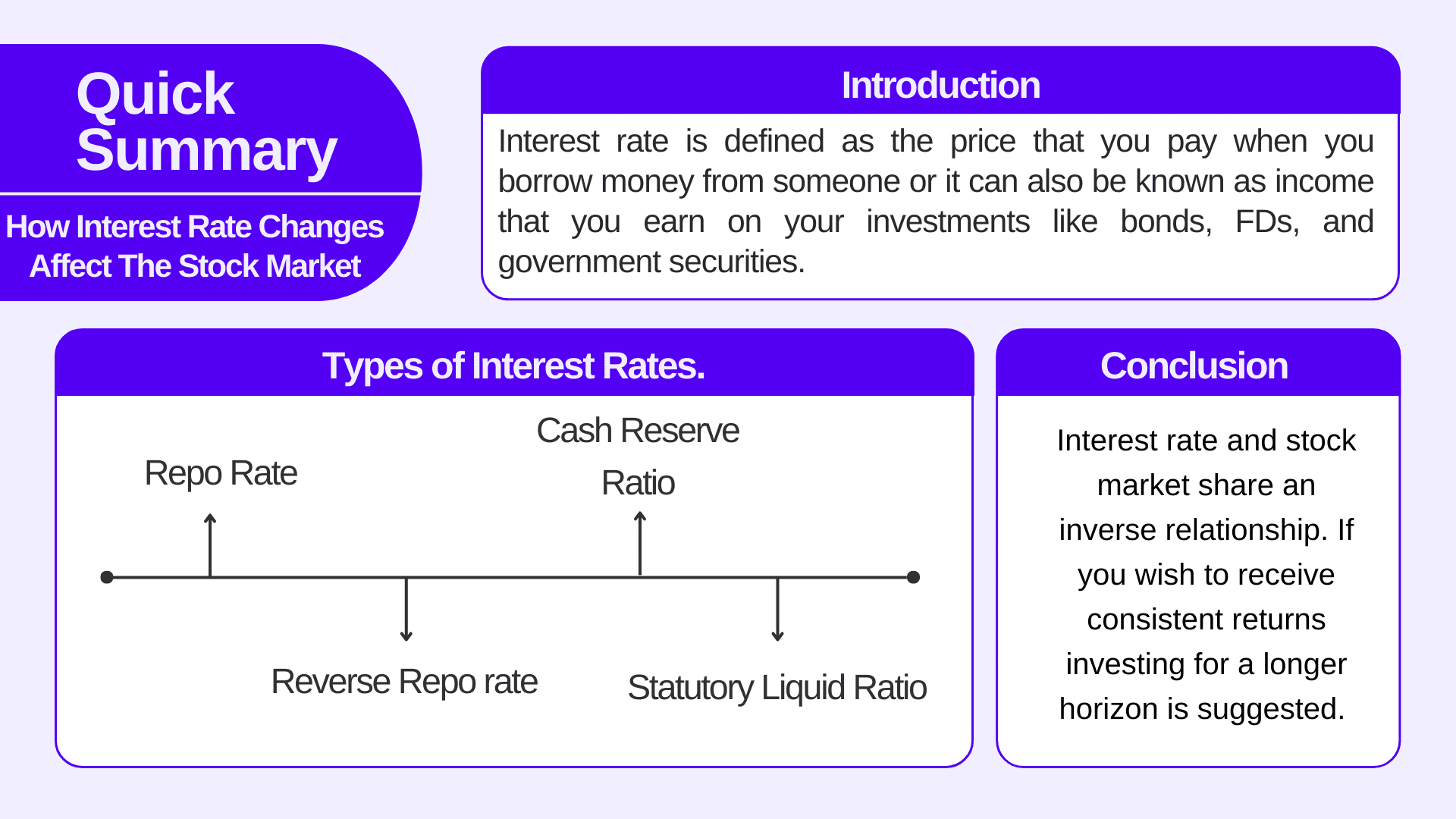
    Interest rate is defined as the price that you pay when you borrow money from someone or it can also be known as income that you earn on your investments like bonds, FDs, and government securities. We will talk about interest rates in the context of lending and borrowing money. Interest rates in India are managed and regulated by RBI and play an important role in the economic growth of a country.

    How Interest Rate Changes Affect The Stock Market

    RBI manages various types of interest rates. Let’s have a glimpse at these rates.

    1. Repo Rate
      The rate at which the RBI lends money to commercial banks. Any kind of change in repo rate can affect the cost of borrowing for banks as well as retail consumers. The repo rate is considered a key tool to control inflation and stimulate economic growth.
    2. Reverse Repo rate
      The rate at which RBI borrows money from commercial banks. This rate is comparatively lower than the repo rate.
    3. Cash Reserve Ratio
      CRR, or cash reserve ratio, is the amount that commercial banks need to maintain with RBI in the form of cash. Banks do not receive any kind of interest on this from RBI.
    4. Statutory Liquid Ratio
      SLR is the minimum amount in percentage that a bank needs to keep either liquid or as investments in government securities.

    The RBI uses these interest rates and tools to manage monetary policy, control inflation, and maintain financial stability. Our major focus today will be on the repo rate and how even a slight change can have wide-ranging effects on the broader economy.

    Why interest rates are changed?

    why interst rate changes

    RBI changes these repo rates as a part of its monetary policy so that it can achieve its financial objectives. Now, what is monetary policy? Policy framed by the RBI to control and manage the supply of money in the economy. Monetary policy can either be contractionary or expansionary. When the money supply is increased and interest rates are reduced. This is known as the expansionary monetary policy. The vice-versa is known as the contractionary monetary policy. Coming back to our topic RBI changes the repo rate because of the following reasons,

    1. To control inflation in the economy.
    2. To focus on the economic growth of the economy.
    3. Situations prevailing in the global economy

    The decisions related to the repo rate are made during the RBI’s monetary policy meetings, which occur at regular intervals. Before moving further, we will give you some basic idea about the concept of inflation and deflation. Inflation is the general increase in the price level of goods and services in an economy. Consumers tend to pay more than the actual value of the good. The purchasing power of consumers decreases. In such a case under the monetary policy, the government of India increases the interest rate to fight inflation. This will decrease the flow of money in the economy.

    Deflation is the opposite concept of inflation. A general decrease in the price level of goods and services is called deflation. The purchasing power of the consumer is increased. RBI, in this situation, will lower the interest rate in order to increase the flow of money in the economy. We all know that the stock market of any economy is a true indicator that signals the pace of economic growth. So, we need to analyze the fact of how a change in repo rate can impact the markets.

    Read Also: How to Start Stock Market Trading With Low or Limited Capital

    Impact of rate change on the Indian stock market.

    The impact depends on the direction and magnitude of the interest rate changes, as well as the broader economic context.

    Interest rates can be changed in two ways

    • Interest rate hikes
    • Interest rate cuts

    When it comes to interest rate hikes, the cost of borrowing money increases which will make it difficult for the companies to avail loans and this will eventually reduce the profitability of the businesses. This will lead to lower earnings of the companies and decreased prices of the stock.

    Any sort of increase in the rate of interest can make other investment options more attractive. From the consumer’s point of view, there can be a significant change in his spending habits since there we be lesser disposable income in his hand thereby affecting his savings and investments. Interest Rate cuts, on the opposite side, lead to a decline in the cost of borrowing making it easier for the investor to grow which will lead to higher earnings and higher stock growth.

    The immediate impact of interest rate changes on the stock market may vary. Short-term interest rate changes might lead to short-term stock market volatility, while long-term rate trends can have a more lasting effect on the stock market.

    Impact of change in rate by the US Federal Reserve on the Indian stock market

    Impact of interest rate change

    Federal Reserve, since we all know is the central bank of the United States, can either increase or decrease the interest rate depending on the situation and needs of the economy. A change in the rate of the U.S. Federal Reserve affects the economy globally. The relationship between the actions of the Fed and the Indian stock market is influenced by several factors. Some of these factors are listed below.

    1.  If the Fed increases the rate of interest, foreign investors will find the U.S. markets more lucrative to invest in. They will withdraw their funds from the Indian stock market and deploy it in the U.S. so that they can enjoy higher returns.
    2. A slight change in the rate of interest by the Fed can have a significant impact on the exchange rates of currency. If the interest rate increases the U.S. dollar will strengthen and the Indian rupee will weaken.
    3. If U.S. rates rise substantially, it may lead to higher interest costs for Indian companies that have borrowed in U.S. dollars or have exposure to foreign currency debt.

    Read Also: Impact of Interest Rate Change on Financial Markets

    Conclusion

    To conclude interest rate and stock market share an inverse relationship. If you wish to receive consistent returns investing for a longer horizon is suggested. These short-term stances of rate change will create many complications. However, an investor should be well aware of the consequences of the rate change on the market so that he can make informed decisions. They should adopt a diversified investment strategy and take into account their own financial goals, and risk tolerance.

    S.NO.Check Out These Interesting Posts You Might Enjoy!
    1Mutual Fund vs PMS: Which is Better?
    210+ Best Investment Plan for Monthly Income in India
    3Hybrid Mutual Funds – Definition, Types and Taxation
    4What is an Open-Ended Mutual Fund & How to Invest in it?
    5Mutual Fund vs ETF. Are They Same Or Different?
    6Mutual Funds vs Direct Investing: Differences, Pros, Cons, and Suitability
    7How Interest Rates Impact Mutual Funds in India

    Frequently Answered Questions (FAQs)

    1. How does interest rate affect bond prices?

      Bond prices and interest rates have inverse relationships i.e., when the central bank increases the interest rates, bond prices decrease, and vice versa.

    2. Do all stocks react to interest rate changes in a similar way?

      No, stocks across sectors react differently to interest rate changes.  

    3. Who regulates and manages the interest rate in the stock market?

      Reserve Bank of India controls and manages the interest rates.

    4. Why does RBI increase the interest rate?

      RBI increases the interest rates in order to control inflation and for the overall growth of the economy.

    5. What happens to borrowing costs when RBI increases the interest rates?

      Borrowing cost for the companies increases if RBI increases the rates.

  • Types of Investment in the Stock Market

    Types of Investment in the Stock Market

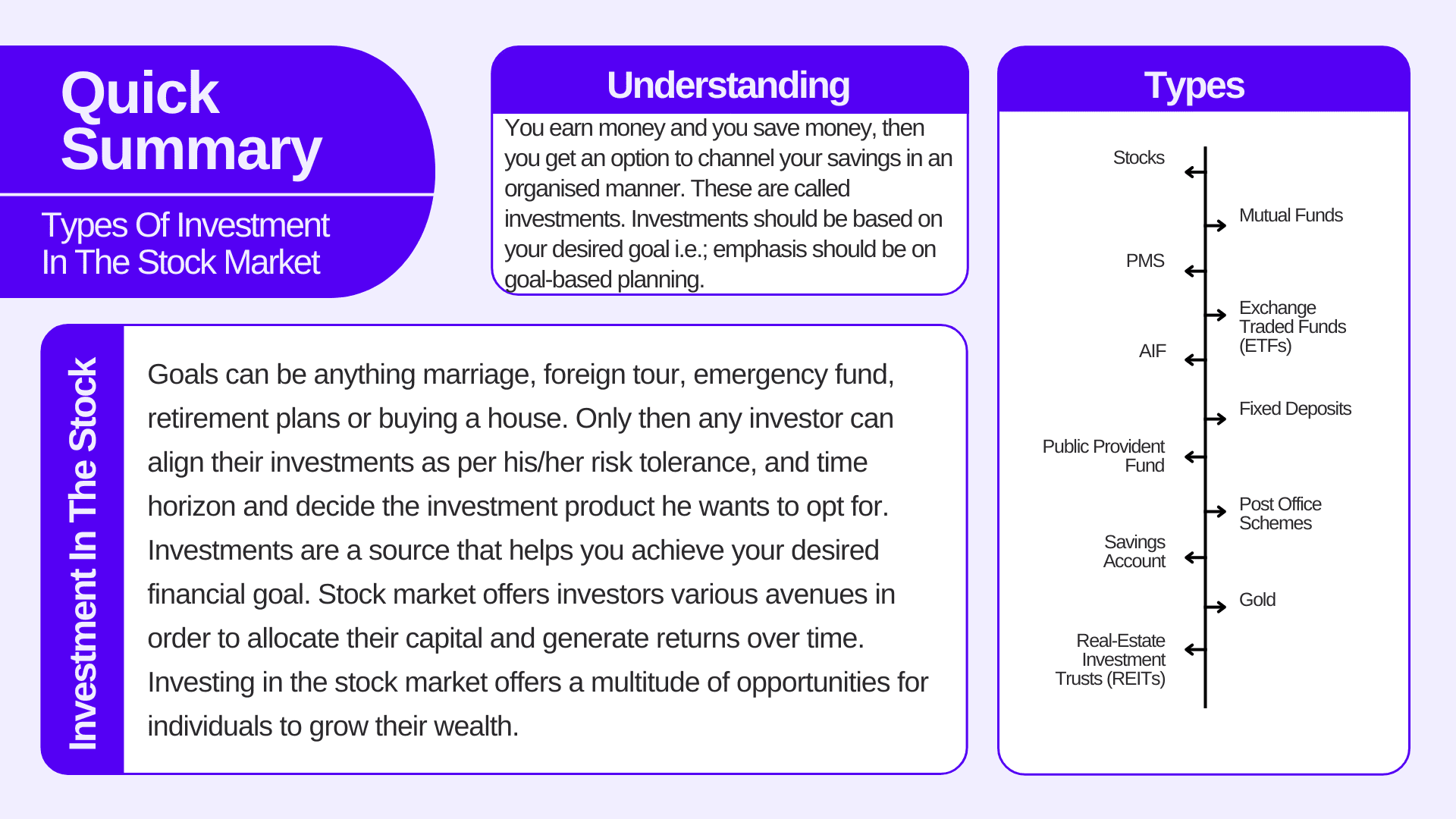
    You earn money and you save money, then you get an option to channel your savings in an organised manner. These are called investments. Investments should be based on your desired goal i.e.; emphasis should be on goal-based planning. Goals can be anything marriage, foreign tour, emergency fund, retirement plans or buying a house. Only then any investor can align their investments as per his/her risk tolerance, and time horizon and decide the investment product he wants to opt for. Investments are a source that helps you achieve your desired financial goal. Stock market offers investors various avenues in order to allocate their capital and generate returns over time. Investing in the stock market offers a multitude of opportunities for individuals to grow their wealth.

    Types Of Investment In The Stock Market

    In today’s blog, we will be classifying investments into three categories.

    1. Modern investment options or investment in the stock market
    2. Traditional investment options
    3. Other investment options

    Below is a detailed explanation of the types of investments that are widely used by investors.

    Modern Investment Options

    Stocks

    Stocks

    Stocks are the most chosen and common investment option. Buying shares of a specific company is known as investing in stocks. The investor becomes the partial owner of the company and can enjoy various advantages that include capital appreciation, dividend payouts and voting rights. Stocks are issued by various companies. The initial listing of the stocks is labelled as an IPO (Initial Public Offering) and is introduced in the primary market but is traded in the secondary market. Stocks are volatile and can be risky to invest in.

    Mutual Funds

    Mutual funds collect money from numerous investors to invest in a diversified portfolio of stocks, bonds, or other assets. These funds are managed and curated by professional fund managers and hence become suitable for investors who have less time and expertise to manage their portfolios. When you invest in mutual funds, NAV (Net asset Value) is allotted to you which reflects the net value of the assets that are chosen by the fund manager to invest your money in. Furthermore, SIP/STP/SWP are different ways through which we can invest in mutual funds.

     PMS

    PMS stands for Portfolio Management Services and is generally meant for HNIs (High net worth Individuals) and has a minimum ticket size of Rs 50 Lakhs. There are 2 types of PMS. Discretionary and non-discretionary PMS. PMS fund managers charge fees from their clients based on the asset under management. Individuals, NRIs, HUF, partnership firms, and proprietorship firms can invest in PMS.

    Bonds

    Bonds are fixed-income investments or debt instruments that are issued by the government. When you buy a bond, you are giving money to someone who issues the bond in exchange for interest or coupon, which is paid at regular intervals, and the return of the bond’s face value at maturity. Bonds are regarded as lower-risk investments when compared to stocks. There are generally three types of bonds.

    • Government Bonds/Securities-

    Tradeable bonds which are issued by the central and state governments. These bonds have a fixed coupon rate and maturity. For example, treasury bills.

    • Corporate Bonds

    These bonds are issued by private companies and NBFCs which carry a bit higher yield than government bonds.

    • Municipal Bonds

    These bonds are issued by state municipal corporations to fund projects.

    AIF

    Alternate Investments

    AIF stands for Alternative Investment Funds. It is a privately pooled investment that collects funds from high-class investors. These investors are institutions and high net-worth individuals who have an idea about the higher risk and complex investment arrangements.

    Exchange Traded Funds (ETFs)

    ETFs are investments that are traded on stock exchanges just like any individual stock and provide investors with a diversified portfolio of assets. ETFs have a very low expense ratio.

    Read Also: How Does the Stock Market Work in India?

    Traditional Investment Options

    Fixed deposits

    fixed deposit

    FDs are traditional methods of saving and investment and are good for investors with low or nil risk appetite. The fund is deposited in the bank account in a lump sum for a fixed period of time and at the time of maturity, the depositor gets back the principal amount along with the interest. Interest on FDs is fixed by the banks and offers you guaranteed returns.

    Public Provident Fund

    public provident fund

    PPFs are long-term saving schemes offered by the Indian government. PPFs generally have a lock-in period of almost 15 years. However, individuals can withdraw money partially after a tenure of 5 years is completed from the date they have opened the account.

    Post Office Schemes

    post office

    It is a fixed-income investment offered by the Post Offices. Investors are given monthly interest on their investment amount. This investment option comes with low to moderate risk.

    Savings Account

    A savings account is a basic, interest-bearing deposit account offered by banks. It provides a safe place to store money, and interest is earned on the balance. this account has low risk and high liquidity but has low returns.

    Other Investment options

    Gold

    Gold is considered a safe haven when it comes to investments. Gold is highly liquid and can be easily bought and sold. At times of volatility in the market, the best option to bet upon is gold. It is a popular investment option because of its historical significance. Gold has been a store of value for ages and is believed to be a symbol of wealth. It helps to diversify the risk of your portfolio. You can invest in physical gold, gold ETFs and sovereign gold bonds.  

    Real-estate investment Trusts (REITs)

    Real estate is a great source of rental income from properties because there is a significant growth in the value of the asset be it land or a building, over time. This increases the value of the invested capital which is considered as beneficial for the investor. Real estate investment trusts (REITs) allow investors to invest in real estate without owning physical properties directly. REITs are a source of indirect investment in Real Estate. REITs have emerged as a good option to enable investors to expose themselves to smaller outflow commitments.

    Read Also: How to Start Stock Market Trading With Low or Limited Capital

    Conclusion

    Every investment option has different attributes, returns and risk profile. It is always suggested to investors to conduct systematic research or seek advice from financial professionals before making investment decisions. Choosing the right option completely depends on your financial goals, risk tolerance, and investment horizon. Diversification of portfolios across different investment types can help you lower the risk and shape a well-balanced portfolio that aligns well with your financial goals.

    S.NO.Check Out These Interesting Posts You Might Enjoy!
    1Types of Demat Accounts in India
    2Features and Benefits of Demat Account
    3Can I Have Multiple Demat Accounts in India?
    4How to Open a Demat Account Online?
    5Small-Cap ETFs to Invest in India
    6Best Sip Apps in India for Investment

    FAQ (Frequently Answered Questions)

    1. How do ETFs differ from mutual funds?

      ETFs are traded on stock exchanges like individual stocks whereas asset management companies sell mutual funds.

    2. How to choose the right investment as per my financial objective?

      Pay attention to factors like your investment horizon, risk appetite and reason for investment and seek advice from a professional.

    3. Are FDs modern or traditional methods of investment?

      FDs are a traditional way of investing.

    4. What is the full form of REITs?

      REITs stand for real estate investment Trusts.

    5. Is gold highly liquid?

      Yes, gold is considered highly liquid and is used as a hedge against inflation.

  • Is It Better To Buy Stocks When The Market Is Up Or Down?

    Is It Better To Buy Stocks When The Market Is Up Or Down?

    It is technical to decide the right time as to when to buy a stock. Your investment’s chances to perform well depend on when you enter the market. Well, when we talk about stock buying, the first question that comes to our mind is whether to buy a stock in a bull run or a bearish trend. 

    No worries! We have got you covered. Below are a few points you could consider before buying stocks in the stock market to clarify when it is the right time to enter the market. In the following blog, the topics that we’ll be covering are:

    • Understanding the market trend
    • Buying stocks in a bull market
    • Buying stocks in a bear market
    • Causes of market correction
    • What to do when the market corrects
    • Conclusion

    Understanding the market trend

    What does it mean when we say the market is up or down? 

    Up trend

    So, when we say that the market is up, it is making higher highs continuously, and we can observe a bull run in the economy. The indexes and stock prices are constantly rising, giving tremendous returns to people who have invested in the favour of the market. For example, before the 1992 Harshad Mehta scam was exposed, we observed a bull run in the economy. 

    Downtrend

    On the other hand, when we say that the market is down, it implies that the market is constantly making lower lows. Thus, we can observe a bearish market movement in the economy. The market indexes and the stock prices of the company are continuously falling. A fun fact about the stock market is that you can make money even in declining markets. You can profit from the market if you short your positions and bet against the rising trend. 

    What moves the market?

    Now that we have understood the meaning of up and down in the market. Let’s discover the reasons for the up or down in the stock market. The stock market works on the simple economics concept of demand and supply. The market forces of demand and supply determine the prices of the stocks. One thing to remember is that the supply for the no. of stock in the stock market is limited as a listed company can only issue a countable number of shares. The demand depends upon the company’s financial performance and the news in the market surrounding it. Generally, we see a rally in share prices when the company declares good financial results. Apart from this, companies announcing dividends, mergers, or acquisitions also significantly impact the price movement. On the contrary, other legal, geopolitical, technological, global, and social factors also affect the markets holistically. 

    Buying stocks in an Up upmarket

    As we have discussed above, about the up trend in the stock market. The bull run generally occurs when the overall economy is strengthening, when the stock prices are up by 20% following a 20% previous decline in the share prices. We can observe a bull run with increased investor confidence in the market; companies will be more willing to launch IPOs, and the businesses will get higher valuations for their equity. 

    Buying stocks during a bull run is considered less risky because it doesn’t make sense for you to sit on the cash pile and ignore the ongoing rally in the market. Investing your money in the stock market when the market is up requires less research. But still, 

    Buying stocks in a down market

    Talking about the downtrend in the market. A downtrend is followed by the 20% fall in the stock prices from the recent highs amid widespread pessimism and negative investor sentiment. Generally, bear runs occur when the overall economy falls, and rising unemployment persists in the nation. Another definition of a bear market is when investors are more risk-averse than risk-seeking.

    Buying stocks when the overall market is down is a strategy opted by various big investors, as when the whole economy is down, you could get shares at a discounted price than their real worth.

    Causes of Market Correction

    Causes of Market Correction

    Market corrections are generally short-term in nature. However, chances are likely that corrections can be a call for the bearish market. But in the long run, markets and stocks manage to retrieve their original levels once the correction is over. A correction is generally a 10% to 20% drop in value from a recent peak. Corrections are seen on the stock indexes or even on the shares of your favourite company. Some of the causes of market correction are listed below.

    1. Not-so-favourable economic data like job reports, lower GDP, etc. 
    2. A change in interest rate by the central bank (RBI in India) eventually makes it difficult for consumers to get loans at a lower rate.
    3. Political instability, conflicts, trade tensions, or unexpected geopolitical events can create market uncertainty and fear.
    4. Lower earnings from the part of top-performing companies represent the benchmark for the performance of the indices.
    5. General profit booking at the market’s highs and some technical indications like a bearish candlestick pattern can also lead to market corrections.

    A market correction can be quite challenging, but you do not need to start liquidating your portfolio or selling your assets (unwanted selling during a market correction can lead to realizing losses); instead, consider it an opportunity to enter the market at lower valuations.

    Read Also: What Is The Gap Up And Gap Down Strategy?

    What to do when the market corrects?

    what to do when the market corrcts

    We have mentioned earlier that there are typically two types of participants in the market i.e., trader and investor. From the point of view of a trader, one needs to analyse the technical charts and patterns, book their unrealised gains and start looking for some other trading opportunity. But an investor needs to have a long-term mindset and he should have a well-thought-out plan in place to navigate market corrections. Investors generally consider market corrections as a fortunate action since it provides them with an opportunity to buy on dips or lows.

    Investors generally develop a curated portfolio with a dynamic allocation of assets. Our suggestion to the investor would be to stick to the investment strategy which they initially adopted and instead of realising your gains, average the stocks that you are holding in your portfolio.

    (Note- Averaging is buying more stocks when the price of the stock falls since it lowers the overall buy price of the stock that an investor holds.) Market corrections are like second chances for investors since they get an opportunity to re-evaluate their holdings analyse the stocks that have underperformed and adjust the holding as per their risk appetite. The market has historically recovered and continued to grow over the long term. Avoid making knee-jerk reactions based on short-term events. If you are an investor, you should have an ample amount of funds or sufficient cash in hand so that you can either average the existing stocks or buy any fresh stocks since portfolio readjustment is a part of happy investing.

    Read Also: What is a good rule for investing in stocks?

    Conclusion

    conclusion

    We all know that market corrections are inevitable, and one should keep their emotions in check while trading or investing in the market. When the market bottoms itself out, leave your holdings in isolation and do not try to time the markets because sometimes anticipating corrections creates more loss than the actual correction. Buying on dips will help you create wealth, and buying on lows will help you generate short-term profits.

    For example, if someone had invested in the market during the 2008 global financial crisis or COVID-19, the returns generated on his/her portfolio would have been phenomenal. This is the power of the stock market. To conclude, always invest or trade as per your risk appetite and financial goals. The market will always give you second chances to buy stocks at their highs or lows. Decisions and capital are all yours!

    Successful investing requires patience and discipline.

    FAQs (Frequently Asked Questions)

    1. What are the two categories of capital markets?

      Two categories of capital markets are primary market and secondary market.

    2. Define Correction.

      A correction is generally a 10% to 20% drop in value from a recent peak.

    3. Mention two causes of market correction.

      Two causes of market correction are stock earnings and changes in interest rates.

    4. What is the averaging of stocks?

      Averaging means buying more stocks when the market is down.

    5. When should we buy a stock while investing?

      While investing in the stock market, one should buy according to their risk tolerance, investment horizon and capital.  

  • Fibonacci Retracement: Complete Guide on How to Use and Strategy

    Fibonacci Retracement: Complete Guide on How to Use and Strategy

    The origin of the Fibonacci series can be traced back to the ancient Indian mathematic scripts. This series was first introduced by an Italian mathematician Leonardo of Pisa, who was also known as Fibonacci. He lived from the late 12th century to the 13th century. His seminal work, “Liber Abaci” (The Book of Calculation), which was published in 1202 helped him introduce the Fibonacci sequence to Europe. The Fibonacci sequence is a series of numbers in which each number is the sum of the two previous numbers, generally starting with 0 and 1. The Fibonacci series is a set of infinite numbers i.e., no matter how many numbers you add to the series, it never ends.  

    Fibonacci Retracement

    The Fibonacci series is as follows,

    (0, 1, 1, 2, 3, 5, 8, 13, 21, 34, 55, 89, 144, 233, 377)

    In the above set of numbers if you divide any number by the previous number; the ratio is always around 1.618. The Golden Ratio, approximately 1.618, also called Phi is a mathematical constant derived from the Fibonacci sequence. It has many applications in nature, art, and science. Our readers need to keep in mind that 0.618, when expressed in percentage is 61.8%. A number divided by the next highest number comes near to .6180

    (13/21=.6190, 21/34=.6176, 34/55=.6181, 55/89=.6179). The estimate nears 0.6180 as the numbers increase. This forms the base for the 61.8% retracement. A number divided by another two places higher comes near to .3820

    (13/34=.382, 21/55=.3818, 34/89=.3820, 55/=144=3819). This is the base for the 38.2% retracement

    A number divided by another three places higher comes near to .2360

    (13/55=.2363, 21/89=.2359, 34/144=.2361, 55/233=.2361).  

    What is Fibonacci Retracement?

    fibonacci retracemnet

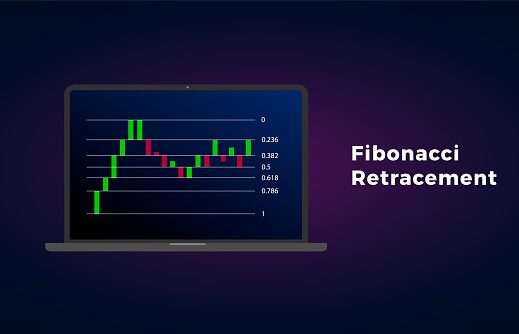
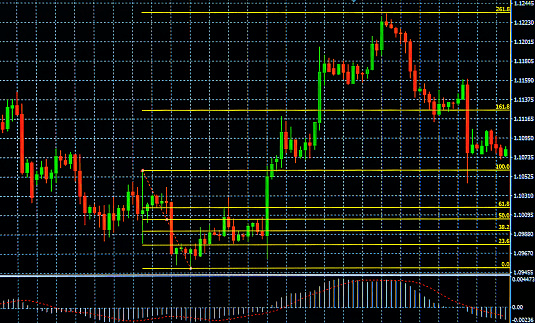
    Fibonacci retracement is an indicator of technical analysis that is used in the stock market. The purpose of this tool is to recognize potential support and resistance levels in a candlestick chart of different financial assets. It is constructed on the Fibonacci sequence and the Golden Ratio, and it is a well-known indicator among traders and technical analysts.

    Calculation Of Fibonacci Retracement

    Calculation Of Fibonacci Retracement

    The commonly used retracement levels by analysts are 23.6%, 38.2%, 50.0%, 61.8%, and 76.4%.

    Any trader needs to follow these steps to calculate the retracement levels of a particular stock.

    Step 1. You need to identify a significant price move on your chart. This move can be either an uptrend or a downtrend. The starting point that a trader marks on the chart after applying the indicator should be a significant swing high or swing low.

    Step 2. Determination of the Fibonacci Ratios

    23.6% (0.236): we calculate this level by taking 23.6% of the pre-decided price range and adding it to the low point of an uptrend or subtracting it from the high point for a downtrend.

    38.2% (0.382): To Calculate 38.2% of the price range the trader needs to follow the same addition or subtraction technique as above.

    61.8% (0.618): To Calculate 61.8% of the price range use the same addition or subtraction method as above.

    Other levels of the Fibonacci Retracements like 50% or 76.4% are also calculated similarly.

    Step 3. Once you are done with the calculation of retracement levels start drawing horizontal lines at the calculated Fibonacci retracement levels. These lines represent the support and resistance levels for future price action that is expected to happen.

    Now, start observing how the price of the asset reacts to these retracement levels. Any kind of bounce or reversal near these levels may provide buyers and sellers with some good trading opportunities.

    Example of Fibonacci Retracement:

    Let us understand Fibonacci Retracement with an easy and simplified example

    Suppose you have identified a swing low of Rs.1000 and a swing high of Rs.1500 in an uptrend of a stock.

    After determining these points, you need to calculate the price range by subtracting the swing low from the swing high

    which implies that the price range will be (Rs.1500 – Rs. 1000) which equals Rs. 500

    Having found the difference between the price ranges you can now calculate the retracement levels

    Firstly, calculate 23.6% of the price range and add it to the swing low i.e., 23.6%*500=118+1000=1118

    Then calculate 38.2% of the price range and add it to the swing low i.e., 38.2%*500=191+1000=1191

    Now for the retracement level of 50%, divide the price range by 2 and add it to the swing low i.e., 500/2=250+1000=1250.

    Similarly, calculate the 61.8% of the price range and add it to the swing low i.e., 61.8%*500=309+1000=1309

    The values so derived (1118, 1191, 1250 and 1250) are the expected retracement levels.

    Since we all know that Fibonacci retracement is a leading indicator as well as a widely used and famous tool in technical analysis applied by traders, it also has some advantages and limitations that traders should keep in mind before making any sort of trading decision.

    Advantages of Fibonacci Retracement

    Advantages of Fibonacci Retracement

    Traders commonly value the following advantages of Fibonacci retracement

    1. Fibonacci retracement can be applied to various financial markets, including stocks, commodities, forex, and cryptocurrencies, on different timeframes like hourly, daily, weekly, and monthly, making it a multipurpose indicator for technical analysts.
    2. Traders use Fibonacci retracement in combination with other technical analysis tools, such as trendlines, moving averages, or oscillators. When different indicators give the same indication, like Fibonacci, chances are that the stock will move in the desired direction.
    3. Fibonacci retracement is used by traders to identify stop-loss orders range as per their risk levels.
    4. Fibonacci retracement can be used to identify potential profit targets. Traders often use the levels as reference points for setting profit targets.
    5. Fibonacci retracement is particularly useful for swing traders who often look for short- to medium-term price movements to earn from the stock market.

    Disadvantages of Fibonacci Retracement

    Disadvantages of Fibonacci Retracement
    1. Selecting the starting and ending points for the Fibonacci retracement analysis can be a tough task. It depends from trader to trader on what point they are choosing, which can eventually lead to varying retracement levels and trading decisions. This can lead to unnecessary confusion.  
    2. Relying solely and completely on Fibonacci retracement may lead to false buy or sell signals or missed trading opportunities.
    3. Even though traders use this indicator widely, there is no assurance that the price will precisely bounce at the estimated Fibonacci retracement levels.
    4. Fibonacci retracement may be difficult for beginner traders to understand since it might be confusing for them to choose the swing high or swing low.  
    5. Different timeframes can yield different retracement levels. Traders may face variations in levels on daily, weekly, or intraday charts.

    Relation between Fibonacci Series and Fibonacci Retracement

    The Fibonacci series and the numbers derived from it, such as the Golden Ratio (1.618), are used in the construction of Fibonacci retracement levels.

    The important retracement levels in Fibonacci retracement are ratios that are derived from the Fibonacci series. For example, the 61.8% retracement level corresponds to the inverse of the Golden Ratio (1/1.618).

    Fibonacci retracement is a real-world application of the Fibonacci series in technical analysis. Traders use the Fibonacci series and its ratios to find levels of support and resistance in financial markets for making sound trading decisions.

    Read Also: 5 Must-Read Best Swing Trading Books for Trader

    Conclusion

    conclusion

    Remember that the effectiveness of Fibonacci retracement levels varies, and they should be used in combination with other technical analysis indicators and risk management strategies to make informed trading decisions. Additionally, the choice of starting and ending points can be somewhat subjective, so practice and experience are essential when applying Fibonacci retracement in real trading sessions.

    FAQs (Frequently Asked Questions)

    1. Which are the most popular Fibonacci retracement levels?

      The most popular Fibonacci levels are 0.236, 0.382, 0.618.

    2. Is Fibonacci a leading or lagging indicator?

      Fibonacci is a leading indicator.

    3. Can I use Fibonacci in intraday trades?

      Yes, Fibonacci can be used on various timeframes including intraday.

    4. Who discovered the Fibonacci series?

      Leonardo Pisano discovered the Fibonacci series in the 12th century.

    5. What is the Fibonacci Series?

      The Fibonacci sequence is a series of numbers in which each number is the sum of the two preceding ones, typically starting with 0 and 1.

  • What is ATR (Average True Range): Calculation, Advantages & Disadvantages Of ATR

    What is ATR (Average True Range): Calculation, Advantages & Disadvantages Of ATR

    In our previous blogs, we have discussed about stocks and technical analysis.

    For reference, here are some insights into technical analysis.  

    Technical Analysis

    Technical analysis is a method of analysing financial markets and making trading or investment decisions based on the historical price. It is primarily focused on studying past price movements and chart patterns to predict future price direction. Technical analysts identify support and resistance levels, which are price levels where an asset tends to find buying or selling pressure, respectively. Various technical indicators, including moving averages, Relative Strength Index (RSI) and Moving Average Convergence Divergence (MACD), provide quantitative measures of price momentum. The average true range is one such technical indicator. Let us go through an in-depth analysis of ATR.

    What Is ATR (Average True Range)

    What is ATR?

    ATR Average true range

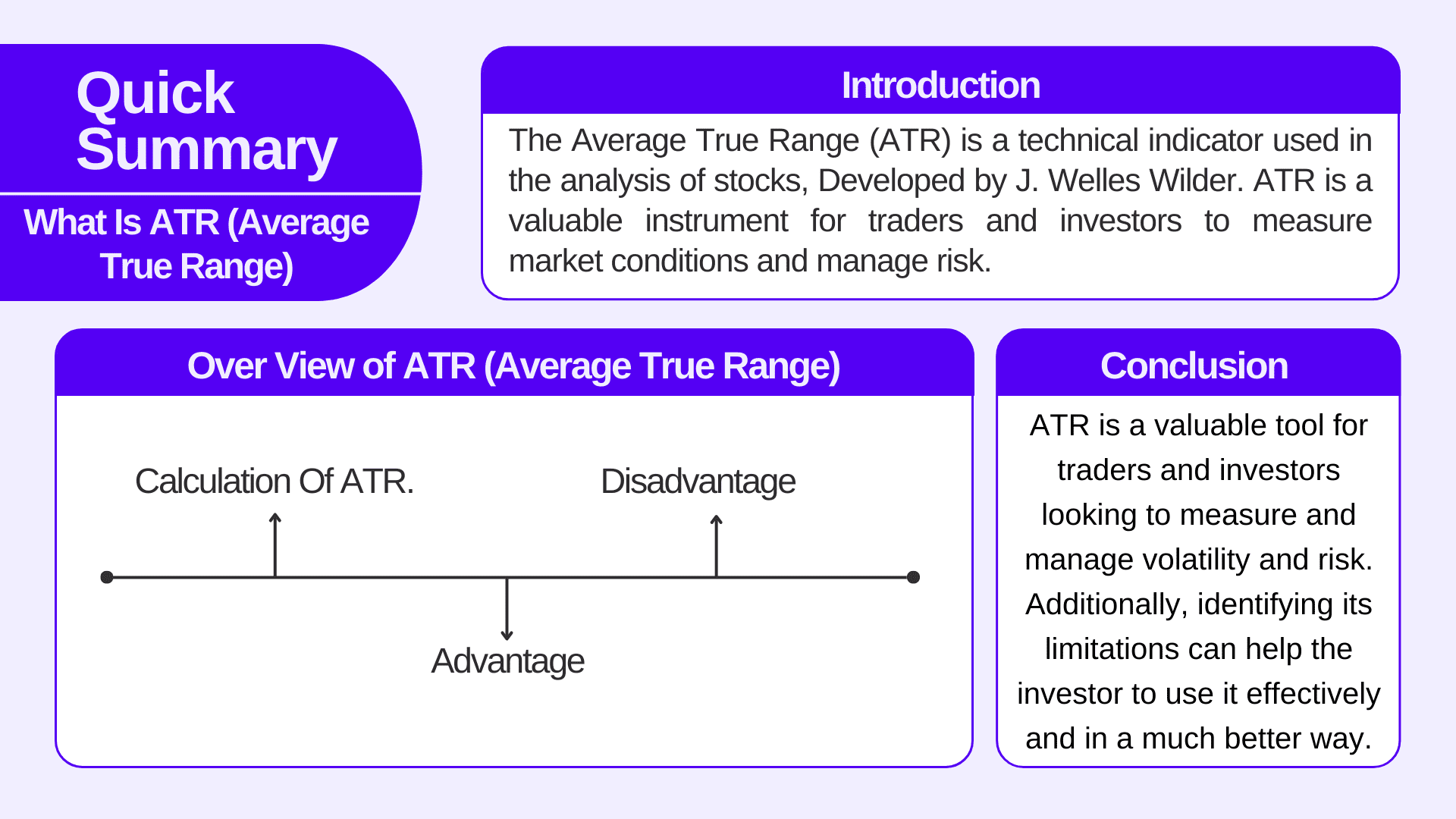
    The Average True Range (ATR) is a technical indicator used in the analysis of stocks, primarily for estimating the volatility and price range of an asset. Developed by J. Welles Wilder in his book “New Concepts in Technical Trading Systems.” ATR is a valuable instrument for traders and investors to measure market conditions and manage risk.

    Here are the key points about the Average True Range:

    1. The ATR is designed to measure the volatility of an asset, representing the average range between the daily high and low prices. A higher ATR value indicates greater volatility, while a lower value indicates lower volatility.
    2. The ATR is derived from the True Range, which is the greatest of the following three values:
    • The current day’s high minus the current day’s low.
    • The absolute value of the current day’s high minus the previous day’s close
    • The absolute value of the current day’s low minus the previous day’s close.
    1. To calculate the Average True Range, a moving average is taken of the True Range values over a specified period. The most commonly used period is 14 days, but traders can adjust this period as per their preferences.
    2. Higher ATR values imply that the asset is going through greater price fluctuations, which can be understood as increased uncertainty or risk. Lower ATR values indicate relatively stable or less volatile market conditions.
    3. A rising ATR can confirm the strength of a trend, especially when in combination with other technical indicators. It suggests that the market is experiencing strong price movement.
    4. The choice of the ATR’s look-back period depends on the trader’s goals and time period. Shorter periods provide more responsive values, while longer periods offer a smoother, more stable measure of volatility.

    The Average True Range is a multipurpose tool of technical analysis that when used in combination with other indicators and strategies can help in making informed trading decisions. It helps traders better analyse and manage the risks linked with market volatility, allowing for more precise stop-loss and position sizing.

    Read Also: Best Options Trading Chart Patterns

    Calculation of ATR.

    calcualtion of ATR

    The Average True Range (ATR) is calculated by following a specific formula. It involves several steps and the use of True Range values for a selected number of periods.

    Here’s the formula and a step-by-step explanation of how to calculate the ATR:

    Step 1:

    Calculate True Range (TR)

    True Range represents the greatest of the following three values for a given trading period.

    1. The difference between the current day’s high and the current day’s low.
      (Current Day’s High – Current Day’s Low)
    2. The absolute value of the difference between the current day’s high and the previous day’s close
      (Current Day’s High – Previous Close)
    3. The absolute value of the difference between the current day’s low and the previous day’s close. (Current Day’s Low – Previous Day’s Close)

    Step 2:

    Calculate the Average True Range (ATR)

    The ATR is calculated as a moving average of True Range values over a specified number of periods (usually 14 days is the default period).

    Here’s how to do it:

    1.   Select the number of periods (e.g., 14).

    2.   For the first True Range value (TR1), simply take the TR of the first period.

    3.  For the next ATR calculations, use the following formula:

    • ATR = [(Prior ATR x 13) + Current TR] / 14
    • Where “Prior ATR” is the ATR value calculated for the previous period, “Current TR” is the True Range value for the current period, and “14” represents the selected number of periods.

    The process is repetitive for each subsequent period. Then continue to calculate the ATR by using the prior ATR and the current True Range.

     Here’s an example to illustrate the calculation of the ATR:

    Let’s say we want to calculate the 14-day ATR of a stock:

    Day 1:

    ATR1 = 2 (True Range for the first day)

    Day 2:

    ATR2 = [(2 x 13) + 4] / 14 = 2.07

    Day 3:

    ATR3 = [(2.07 x 13) + 3] / 14 = 2.01

    Day 4:

    ATR4 = [(2.01 x 13) + 6] / 14 = 2.06

    The ATR value provides an indication of the average price range and volatility over the selected number of periods. Traders use it to assess the level of price volatility, set stop-loss levels, and determine position sizes based on their risk tolerance.

    Advantages & Disadvantages Of ATR

    Pros and cons ofusing ATR

    The Average True Range (ATR) is a widely used technical indicator in trading and investing. Like most tools, it comes with its own set of advantages and limitations.  

     Here are the advantages and disadvantages of using the ATR:

    Advantages of ATR:

    • ATR is a purely mathematical indicator, which means it provides objective data. It’s not influenced by subjective opinions or emotions, making it a reliable tool for risk management.
    • Traders can adjust the look-back period for the ATR to match their specific trading strategies and time horizons. Common periods include 14 days, but you can choose longer or shorter periods based on your needs.
    • A rising ATR often indicates increased price volatility, which can confirm the strength of a trend. This is especially useful for trend-following traders.

    Disadvantages of ATR:

    • ATR is based on historical price data, and it doesn’t predict future price movements. It provides information about past volatility, which may not always reflect current or future market conditions.
    • Like many technical indicators, the ATR is a lagging indicator, which means it reacts to price movements that have already occurred. This lag may limit its effectiveness in rapidly changing or highly volatile markets.
    • ATR can generate false signals, especially in choppy or sideways markets. Traders need to use it in conjunction with other indicators or tools to minimize false signals.
    • For beginners, the concept of ATR and its calculations can be complex. Understanding how to use ATR effectively may require some time and practice.
    • ATR provides information on volatility but doesn’t offer insights into other important factors like trend direction, market sentiment, or the potential impact of news events.

    Conclusion

    CONCLUSION

    To conclude, the ATR is a valuable tool for traders and investors looking to measure and manage volatility and risk. However, it’s essential to use it in combination with other indicators and analyse it carefully to create a comprehensive trading or investment strategy. Additionally, identifying its limitations can help the investor to use it effectively and in a much better way.

    Read Also: Rising Window Candlestick Pattern

    FAQs (Frequently Asked Questions)

    1. What is the full form of ATR?

      ATR stands for Average True Range.

    2. What is prior ATR?

      Prior ATR” is the ATR value calculated for the previous period.

    3. Who developed ATR?

       ATR was Developed by J. Welles Wilder in his book “New Concepts in Technical Trading Systems”.

    4. What is the default period of true range for calculating ATR?

      The default period of the true range for calculating ATR is 14 days.

    5. Is ATR a leading or lagging indicator?

      ATR is a lagging indicator.

  • Why It Is Essential To Teach Your Children About Saving And Investing

    Why It Is Essential To Teach Your Children About Saving And Investing

    According to the Pew Analyzed Census Bureau data, only 24% of adults are financially independent before age 22, to that of 32% in 1980. Most adults today complain that they were, never taught about financial independence in schools or at home. It is because of this reason, they struggled with their finances in the later years of life. Financial knowledge is not something that you can learn in one day, month or year. It takes years of discipline and hard work to be financially independent. Parents must teach their kids the basics of financial literacy, like saving and investing, from a young age. 

    Addressing the above problem. Today, we will discuss about the importance of teaching your children about saving and investing.

    Why Do We Need To Teach Financial Literacy To Our Kids?

    quick summary of the Need To Teach Financial Literacy To Our Kids

    Have you ever seen the construction of a building? Laying a strong foundation for the building is important, to make it last for years. Similarly, to achieve financial independence, it is necessary to give financial literacy to children from a young age. 

    But, what exactly is financial literacy?

    Financial literacy

    financial literacy

    Financial literacy is understanding the behaviour and working of money to make sound financial decisions like budgeting, asset building, loan financing and debt repayment. Having financial knowledge helps a person to feel empowered. Moreover, people with better financial education are less likely to be financially vulnerable in future. According to research in India, only 27% of the people are financially literate. It means only 1 out of 5 Indians are capable of making their crucial money decisions by themselves. The numbers are bizarre because dealing with money is one of the most customary aspects of human well-being. 

    Thus, it is the responsibility of the parents to instil this basic human understanding in their children. 

    Why Build a Strong Financial Foundation?

    • To build a strong financial foundation, children should be made familiar with basic concepts like saving and investing from a young age. 
    • Saving is that part of your income that is left, after spending upon your consumption. Any person who has just started earning spends a prominent chunk of their income on consumption and saves little to no amount. 
    • But, as they grow professionally, they start saving more for their future & the people dependent on them. Saving helps to build a cushion to rely on during uncertain times.
    • Investing is putting your money to work. Heard this famous quote, “Rich doesn’t work for Money, Money works for them” Weird right? But true.
    •  By putting your money into Assets, you can make your money work for you even when you are not working. For example, investing in real estate could earn you a rental income and give you capital appreciation in the long run.

    Parents should focus on securing their children’s future financially but also focus on building and developing their characters. So that, in case of future uncertainties, they can fight through. 

    Preparing for Future Financial Challenges

    The majority of the people feel anxious when asked about their financial situations. As we grew, we realised that we weren’t ever, taught about financial education in our schools or colleges on which we’re supposed to make real-life decisions. How many of you have learned about finances in your schools or colleges? 

    I could confidently say that none. Our educational curriculum was never designed in a way to help us with our day-to-day problems. Most adults even today, don’t even know that there are options other than FD and mutual funds to invest in the markets. 

    Providing your children with early financial knowledge could help them to have a better future. 

    Introducing Financial Concepts to Children As They Grow

    First, introduce them to the notion of money at a young age. Its importance, how it works, why it is necessary & other things related to it

    • Rewarding- Reward them every time they progress in their work, like for every book they read. Give them a certain amount of money as a reward or when they complete their homework on time.
    Rewarding
    • Budgeting- Give them a monthly or weekly allowance and tell them to manage their expenses in that fixed amount. Explain how they should allocate their money towards their needs, wants and savings. 
    Budgeting
    • Savings- explain to your kids why saving is important and how it can help them. Encourage them to Save a portion of their allowances or paychecks (when they start working). 
    savings
    • Taxes- When they grew a little old and started doing part-time work. Teach them how taxes work and how employer deducts taxes from their paycheck. 
    taxes
    • Investing- When they start to work, teach them about investing and financial markets. Explain to them how they should build assets. 
    investing
    • Compounding- Teach them about compounding and the significance of early investing in life. Financial literacy is something that everyone should learn about. No matter your profession or field of interest, money is something that we all deal with daily. 
    compounding

    Therefore, every person needs to be financially independent & financially literate in life because life is very uncertain. 

    Conclusion 

    If you are a parent or a guardian to any child, now you know why you must teach them about finances. No parent wants to see their child. Therefore, they must teach kids about money, which they were never taught about by their parents. It is easy to instil good habits in children at a young age as they are growing. Apart from just giving financial learning, parents should also start to save and invest early to give their children a more secure future. 

    FAQs (Frequently Asked Questions)

    1. Why financial literacy is necessary?

      Financial literacy is necessary to make sound financial decisions in life. Money is something that we all deal with on a day-to-day basis.

    2. How to improve financial literacy?

      To improve financial literacy you can read finance books like ‘Rich Dad, Poor Dad, ‘Think and Grow Rich’, ‘And Intelligent Investor’ to learn about the stock market. 

    3. Why financial literacy is essential for students?

      Financial literacy is essential for students as it helps them understand how to make real-life money-related decisions once they start earning.

    4. Is it necessary for children to learn how to wisely spend their money?

      Yes, children need to learn to wisely spend their money.

    5. How to explain investing to a beginner?

      You can learn investing by understanding the basic technical jargon like return, risk, portfolio etc. After that, you consume content from different sources like books, online platforms & courses. 

  • Open Free Demat Account

    Join Pocketful Now

    You have successfully subscribed to the newsletter

    There was an error while trying to send your request. Please try again.

    Pocketful blog will use the information you provide on this form to be in touch with you and to provide updates and marketing.