Every business wants to make money. However, finding out the real profit of a company can be tricky. Some hidden costs often mask the true performance of the core business operations. Investors required a clear number to see if a business model was actually working or just surviving on paper. Knowing the exact money a company earn from its daily work is the secret to smart investing. Clear financial numbers help us spot strong companies and avoid bad investments with confidence.
What is EBITDA Margin?
One of the most common terms is EBITDA in stock market . It stands for Earnings Before Interest, Taxes, Depreciation, and Amortization.To calculate this, financial experts take the net profit of a company. Then, they add back the interest, taxes, depreciation, and amortization. Let us break down why we add these four specific things back to the profit.
First, taxes and interest depend on government rules and the loan choices made by the management. They do not reflect how well the actual product or service is selling. By removing them, we can judge the core business purely on its own merits.
Second, depreciation and amortization are just accounting entries for asset wear and tear. No actual cash leaves the company bank account when equipment depreciates. Therefore, adding these back gives us a much better picture of the actual cash coming in.
What is Operating Margin?
Let us look at the other important financial metric that investors love to use. Operating margin focuses on the core business by measuring the percentage of profit a company keeps from its total sales after paying for all operating costs. This helps us see the real profitability of the daily business activities, showing exactly how much money is left after paying for essentials like raw materials, staff salaries, and rent. Unlike other metrics, it includes asset wear and tear. If a company buys heavy machinery, that machinery loses value over time, and this metric counts that depreciation and amortization as a very real business expense.
At the same time, this metric completely excludes external costs like interest on bank loans or government taxes. By ignoring these outside factors, it keeps the focus strictly on how well the management is running the business, providing a clean look at operational success.
Which Margin is more important for traders
Traders and investors often debate which metric is better for analyzing a stock. Both indicators offer unique clues about the financial strength of a business. We will break down why traders prefer each one based on different situations.
From the EBIDTA Margin Point of View
- Focuses on pure cash generation: It acts as a great substitute for operating cash flow in financial analysis. It shows the raw cash a business can generate to pay its daily bills. This helps traders see if the company is generating enough cash to survive.
- Useful for business valuations: Market experts frequently use this to value companies during mergers and acquisitions. It helps buyers see the core earning capacity of the target company before any financial restructuring. It simplifies complex buyout calculations greatly.
- Makes peer comparison easy: It completely ignores tax policies and debt structures of a company. This makes it extremely easy to compare companies operating in different states or countries with different tax laws. It levels the playing field for international analysis.
- Helps evaluate young start-ups: Modern tech companies often use adjusted versions of this metric to show their path to profitability. It helps investors see the underlying business strength before heavy marketing or non-cash costs are applied. This is very common in modern stock markets.
From the Operating Margin Point of View
- Provides a realistic view of profits: It provides a much more realistic view of profits for traditional companies. Heavy machinery eventually needs replacement in the future. Counting depreciation ensures the cost of using those assets is not completely ignored.
- Highlights management efficiency: It clearly highlights how well the management controls every single operational cost. A rising percentage over several years proves that the management is highly capable and efficient. Traders love to see consistent operational improvement.
- Safer for debt-heavy companies: This metric is much safer for evaluating companies that carry a lot of high debt. Relying solely on metrics that ignore certain costs can sometimes mask poor financial health. It acts as a strict reality check.
Read Also: Margin Trading vs Short Selling – Key Differences
Differences Between EBIDTA Vs Operating Margin?
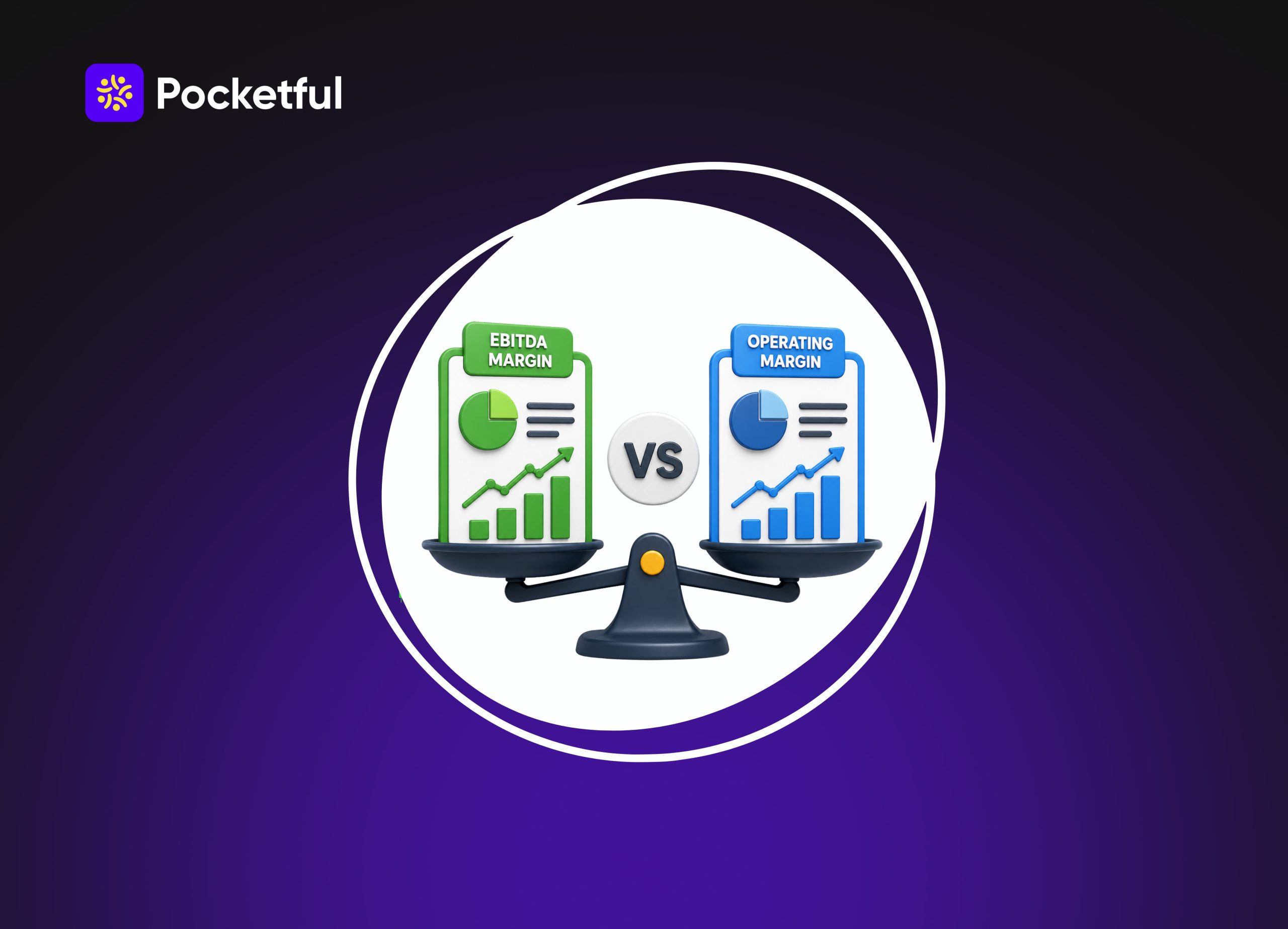
To make things crystal clear, we have created a direct comparison between the two financial indicators. This simple table will help you remember the key differences easily.
| Feature | EBIDTA Margin | Operating Margin |
|---|---|---|
| Basic Meaning | Profit before interest, taxes, depreciation, and amortization. | Profit after paying all daily business expenses including depreciation. |
| Calculation Formula | (EBITDA / Total Revenue) x 100. | (Operating Income / Net Sales) x 100. |
| Depreciation Treatment | Depreciation is strictly excluded from the calculation. | Depreciation is fully included as a necessary cost. |
| Primary Focus | Highlights the raw operating cash flow of the firm. | Highlights the total operational efficiency of the firm. |
| Best Suited Industries | Capital heavy sectors like steel, telecom, and real estate. | Expense heavy sectors like retail, IT services, and consulting. |
| Metric Size | Always equal to or higher than the other metric. | Usually lower because it subtracts asset wear and tear. |
| Standardization | It is a non-GAAP measure that companies can adjust. | It is a standard GAAP measure with strict rules. |
As you can see from the table, both metrics have their own special uses. You should use them based on the type of industry you are analyzing. Heavy industries need one metric, while service industries need the other.
By checking both numbers, you can easily avoid falling into valuation traps. A smart trader always looks at the complete picture before risking their hard-earned money. This balanced approach is the key to stock market success.
Conclusion
Both of these financial metrics serve a very important purpose in the stock market. Neither indicator is strictly better or worse than the other. They simply look at a company’s profits through completely different lenses.One shows the pure cash-generating ability, while the other shows the true cost of running the business. Smart investors look at both numbers together to get a complete picture of financial health. Want to understand company fundamentals better? Download the Pocketful app to analyse stocks, track key financial metrics like EBITDA and operating margins, and make more informed investment decisions.
Frequently Asked Questions (FAQs)
What is the meaning of EBITDA Margin?
It shows a company’s core cash profit as a percentage of its total revenue. It ignores taxes, interest, and asset depreciation.
What is the meaning of Operating Margin?
It measures the profit percentage left after paying all daily operating expenses. This includes the wear and tear of business assets.
What are the benefits of using these margins?
They help investors check if a company’s core business is actually profitable. They also make it very easy to compare competing companies.
How to use EBITDA Margin in trading?
Use it to evaluate companies in asset-heavy industries like telecom or manufacturing. In these sectors, huge machinery costs can hide daily cash profits.
How to use Operating Margin for investing?
Use it to track management efficiency over time. A rising percentage over a few years proves the company is controlling its expenses well.