Let us talk about growing your wealth safely in the financial markets. Every step you take toward investing brings a mix of exciting opportunities and unpredictable changes. We all want our hard earned money to grow steadily without losing sleep over market crashes.
Having a clear and visual safety gauge helps us navigate this financial journey with confidence. It acts like a guiding light for everyday investors entering the complex world of finance.
This ensures that every investment decision aligns perfectly with your personal comfort level. We will explore how to read and use this important tool to make smarter choices.
What is Riskometer?
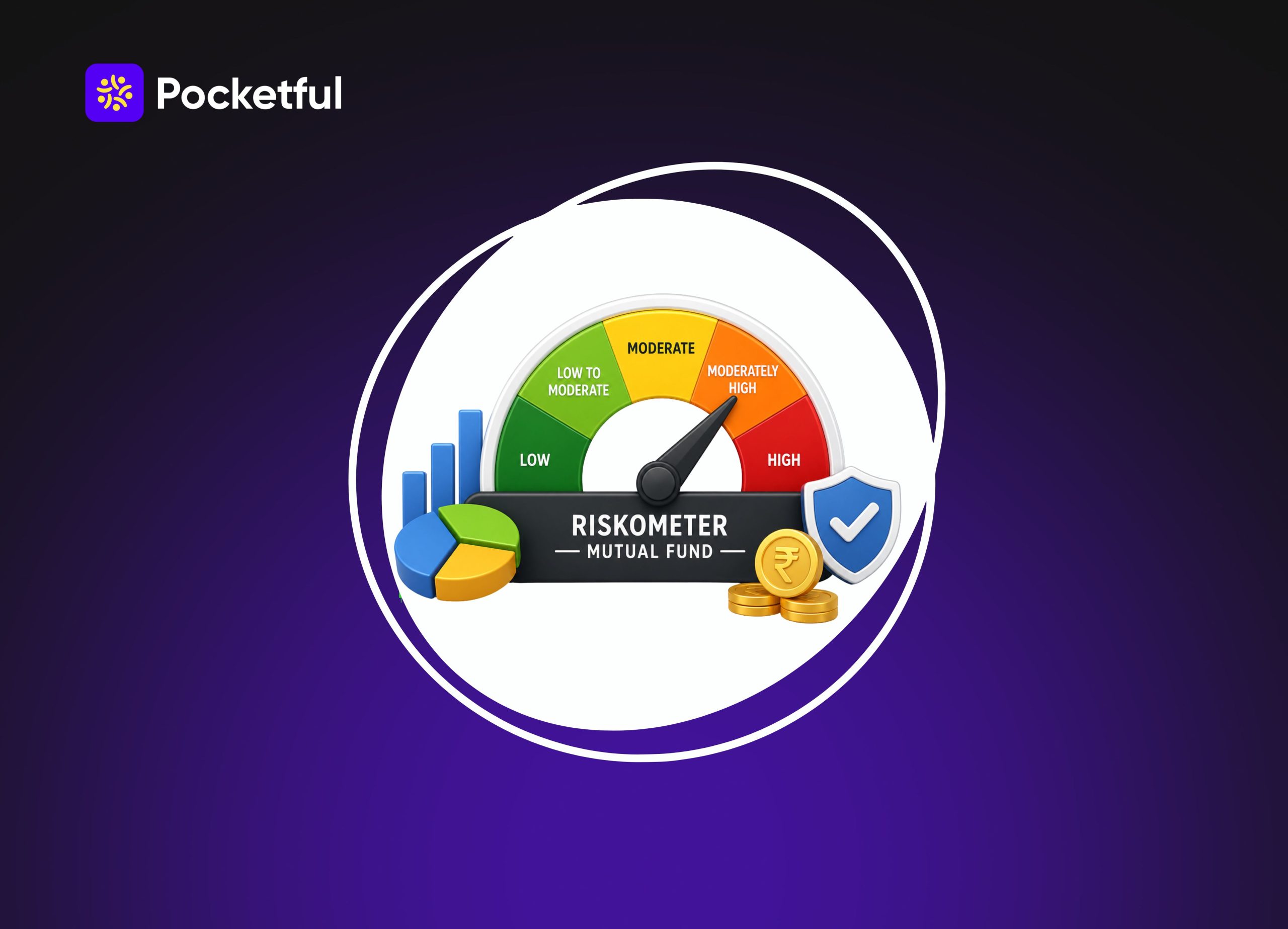
A Mutual Fund Riskometer is a standardized visual indicator mandated by the Securities and Exchange Board of India (SEBI). It is basically a graphic tool that shows the exact level of risk a specific investment scheme carries. You can think of it just like the speedometer on your car dashboard, this financial dial tells you how much risk your money is taking.
For example, let us say you want to invest your savings in a very safe debt scheme. In this case, the needle on the dial will point directly to the green zone.
On the other hand, if you choose a highly aggressive equity scheme, the needle will instantly point to the red zone. This makes it incredibly easy for regular investors to understand complex risk factors at a single glance.
History of Riskometer
The journey of this visual safety indicator shows a continuous effort by SEBI to simplify investing for everyone. The regulator constantly upgrades its rules to protect regular investors like us. The first version of this tool was introduced to the public back in March 2013.
However, this broad classification confused many people because very different schemes were grouped together.
To fix this issue, a major upgrade happened in July 2015. Then dial included low, moderately low, moderate, moderately high, and high risk categories.
Later, in October 2020, another significant revision was announced. A sixth category called very high risk was added to capture extreme market movements. Most recently in late 2024, official color codes were assigned to all six levels. The regulator also made it mandatory to display the scheme dial right next to its benchmark index dial. This allows you to easily compare your fund with the broader market.
Riskometer Risk Level
The current framework of mutual fund riskometer classifies investment schemes into six distinct categories. Each level represents a different degree of potential volatility and comes with a specific color code. We have outlined these details below to help you easily understand what each level means.
| Risk Level | Colour | Products under the category | Suitable for |
|---|---|---|---|
| Low | Green | Income funds, gilt funds, and fixed maturity plans with a maturity of less than 90 days come under this category as these carry the lowest risk. | Those who are risk averse and give priority to their investment safety. |
| Moderately low | Light green | Short and medium term bonds with a maturity period of 91 days to 3 years come under this category. These also bear minimal risk. | Those who prefer to take nominal risks but also prioritise the safety of their investment. |
| Moderate | Yellow | Hybrid debt oriented funds, monthly investment plans, and arbitrage funds come under this category as these are somewhat risky. These are ideal for medium to long term investing. | Those who prefer to invest longer than short term and would be ready to undertake a certain degree of risk for slightly lucrative returns. |
| Moderately high | Orange | Gold ETFs, index funds, diversified equity funds, and balanced equity oriented funds with an equity exposure of upto 20 percent of the portfolio come under this category. | Those who opt for long term investment and are ready to be exposed to some degree of risk. |
| High | Red | Micro cap funds, international funds, thematic funds, and sectoral funds are classified under this category. | These are ideal for high net worth individuals or aggressive investors who want to invest for long term and can handle losses. |
| Very High | Dark Red | Small cap funds, mid cap funds, and dynamic asset allocation schemes fall under this category. | Investors with a very high risk appetite and a highly extended investment horizon. |
Why SEBI Introduced Riskometer
The Securities and Exchange Board of India introduced this tool to bring complete transparency to the financial markets. Before this visual dial existed, investors often chose schemes based purely on past returns. They completely ignored the hidden dangers involved in those investments.
SEBI wanted to create a standardized language for risk that anyone could understand easily. This visual dial successfully prevents the mis selling of financial products by distributors.
An aggressive scheme can no longer be sold as a safe option because the dial will immediately expose the truth. It simply empowers ordinary people to make informed decisions without needing a finance degree.
Read Also: Mutual Fund Factsheet: Definition And Importance
Types of Risks in Mutual Fund Measured by Riskometer
The visual dial does not just guess the risk level randomly. It calculates a numerical score based on several underlying risk factors present in the portfolio. Here are the primary risks measured by this tool:
- Market Risk: This refers to the general ups and downs of the stock market. Economic changes can cause the value of equity investments to drop suddenly. The dial captures this volatility to warn you in advance.
- Liquidity Risk: This measures how quickly an investment can be sold in the market without facing a heavy loss. Some underlying securities are hard to sell during a sudden financial emergency. The tool accounts for this difficulty.
- Credit Risk: This applies mostly to debt schemes and fixed income assets. It indicates the chance that a bond issuer might fail to pay back the interest or the principal amount. A higher chance of default increases the risk score.
- Interest Rate Risk: Bond prices usually fall when overall interest rates in the economy rise. Schemes with long term bonds carry a much higher interest rate risk. The dial reflects this sensitivity to rate changes.
- Concentration Risk: This happens when a scheme invests too heavily in one single sector or a few specific companies. If that particular sector performs poorly, your entire investment suffers significantly. The risk score rises when investments are not properly diversified.
Use of Riskometer in Mutual Fund Investment
You can actively use this tool to build a healthier and more balanced financial portfolio. Here are the best ways to utilize it:
- Matching Personal Comfort: The dial helps you pick schemes that perfectly match your emotional ability to handle losses. A conservative investor can easily filter out high risk equity schemes right from the start. This prevents panic selling during market dips.
- Reviewing Portfolio Changes: Asset management companies are required to update the risk dial every single month. You can check these updates to ensure your chosen scheme has not quietly become riskier over time. It acts as a continuous health check for your money.
- Benchmarking Performance: The latest rules require schemes to display their risk dial alongside the market benchmark dial. This helps you see if a scheme manager is taking unnecessary risks compared to the general market. It makes performance comparison much more transparent.
- Goal Planning: Short term financial goals require strict stability, so you can choose schemes in the green zones. Long term goals can tolerate the red zones for better potential growth. Aligning your goals with the right color code simplifies planning.
Limitation of Riskometer
While the dial is a fantastic guide, it does have certain boundaries. You must keep these limitations in mind before making financial decisions.
- No Return Guarantees: A low risk label does not mean the investment is completely foolproof or guaranteed to give positive returns. It simply means the value will fluctuate less than an aggressive fund. You should never confuse low risk with guaranteed profits.
- Backward Looking Data: The monthly risk score is calculated based on the portfolio holdings of the previous month. It cannot predict future market crashes or sudden economic crises. Therefore, it is a reflection of recent history rather than a future prediction.
- Does Not Show Cost: The dial completely ignores the expenses and exit loads associated with a scheme. You must check these fee details separately before investing your money. High costs can eat into your returns regardless of the risk level.
- Frequent Changes: Since the dial is updated monthly, a scheme can shift from a moderate category to a high category very quickly. This requires you to monitor your investments regularly rather than forgetting about them. Passive tracking might lead to unwanted surprises.
Read Also: Mutual Fund Portfolio Tracking: A Complete Guide
Conclusion
Investing successfully is all about finding the right balance between long term growth and capital stability. The visual risk dial serves as a brilliant companion on your financial journey. It translates complicated market data into simple signals that anyone can easily interpret.
By checking this tool regularly on platforms like Pocketful, you can stay fully aware of where your money is going. An informed investor is always a confident investor. Taking a quick look at this safety gauge ensures a well planned path toward achieving your long term financial dreams.
| S.NO. | Check Out These Interesting Posts You Might Enjoy! |
|---|---|
| 1 | What Is An IPO Mutual Fund? Should You Invest? |
| 2 | Mutual Fund Taxation – How Mutual Funds Are Taxed? |
| 3 | Is Your Mutual Fund Investment Safe? |
| 4 | What is an Open-Ended Mutual Fund & How to Invest in it? |
| 5 | What is Annualised Returns in Mutual Funds? |
Frequently Asked Questions (FAQs)
What is the meaning of a mutual fund riskometer?
It is a visual tool created by SEBI showing the level of market risk involved in a specific scheme.
What are the benefits of using this tool?
It helps you choose schemes matching your risk tolerance and prevents mis selling. It also offers complete transparency by displaying current portfolio risks.
How will you use a riskometer for investing?
Simply look at the dial before investing your money. Select green zones for short term safety and orange or red zones for long term growth goals.
Does the risk level change over time?
Yes, the risk level can change. Asset management companies update the score every single month based on the latest portfolio holdings.
Are low risk schemes completely safe from losses?
No investment is entirely risk free. A low risk label merely indicates minimal price fluctuations, not a zero loss guarantee.