When it comes to giving our homes a fresh new look, Asian Paints and Berger Paints are usually the first names that come to mind. They’re not just paint companies; instead, they’re part of almost every Indian household’s renovation story.
But have you ever wondered how these two giants compare when it comes to business performance, product range, and market presence? While both offer vibrant colours and reliable quality, their journeys, strategies, and financials tell very different stories.
In this blog, we’re exploring a head-to-head comparison of Asian Paints and Berger Paints, looking at everything from history and financials to innovation and customer appeal. Whether you’re a curious homeowner, a student, or an investor, you’ll find some colourful insights here!
Asian Paints – Company Overview
Asian Paints isn’t just the biggest paint brand in India; it’s one of the most loved too. If you’ve ever thought about giving your walls a fresh coat or revamping your space, chances are you’ve come across their bold colours, smooth finishes, or that memorable line: “Har Ghar Kuch Kehta Hai.”
But there’s more to Asian Paints than just paint. Over the years, they’ve stepped into the world of home decor and design, offering everything from wallpapers and textured finishes to bathroom fittings and modular kitchens through their Sleek and Ess Ess brands.
History
It all started in 1942, in the middle of World War II, when four friends, Champaklal Choksey, Chimanlal Choksi, Suryakant Dani, and Arvind Vakil, decided to start a small paint company in Mumbai.
At a time when big foreign companies dominated the market, Asian Paints quickly stood out for its affordable pricing and strong dealer network.
During the 1950s, Asian Paints launched Gattu, which became their signature character and was designed by R. K. Laxman to make paint advertising engaging for Indian households.
Asian Paints became a market leader as it established itself with the help of innovative strategies and powerful branding alongside an extensive collection of paint finishes.
Asian Paints now operates as a global corporation that maintains production facilities in more than 25 locations across Asia and the Middle East while serving clients in over 15 countries.
Berger Paints India Ltd. is one of India’s most trusted paint manufacturers. Berger Paints stands out as a familiar household brand for wall paints, wood coatings, waterproofing solutions, and industrial finishing products.
They offer everything from simple whitewash options to high-end designer textures and eco-friendly paints. Whether you’re a homeowner, an interior designer, or a builder, Berger has something in its catalogue for everyone.
History
Started in 1760 in the UK by Lewis Berger, who originally made pigments for artists.
In 1923, a paint company named Hadfield’s (India) Ltd. was established, which was acquired by Berger in 1947 and renamed to British Paints (India) Ltd., marking the entry of Berger Paints in India.
The company changed hands a few times before becoming Berger Paints India Ltd., with its headquarters in Kolkata.
It was eventually acquired by the Dhingra family, who still run the business today.
Over the years, Berger has expanded both in India and internationally, with manufacturing units, R&D centres, and a growing presence in countries like Nepal, Bangladesh, and Poland.
Comparative Study of Asian and Berger Paints
Particulars
Asian Paints
Berger Paints
Current Price (₹)
2,352
574
Market Cap (₹ Crores)
2,25,594
66,957
52-W High (₹)
3,395
630
52-W Low (₹)
2,125
438
FII Holdings as of March 2025
12.22%
5.75%
DII Holdings (as of March 2025)
15.58%
10.11%
Book Value (₹)
202
52.8
PE Ratio
57.4
56.7
(Data as of 16 May 2025)
Financial Statements Comparison of Asian and Berger Paints
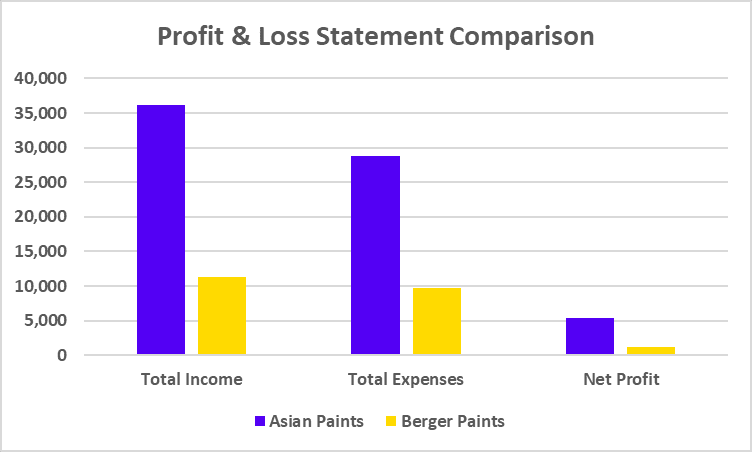
Profit & Loss Statement Comparison
Particulars
Asian Paints
Berger Paints
Total Income
36,182
11,262
Total Expenses
28,762
9,668
Net Profit
5,424
1,128
(All values are in INR crores and the data is as of March 2024)
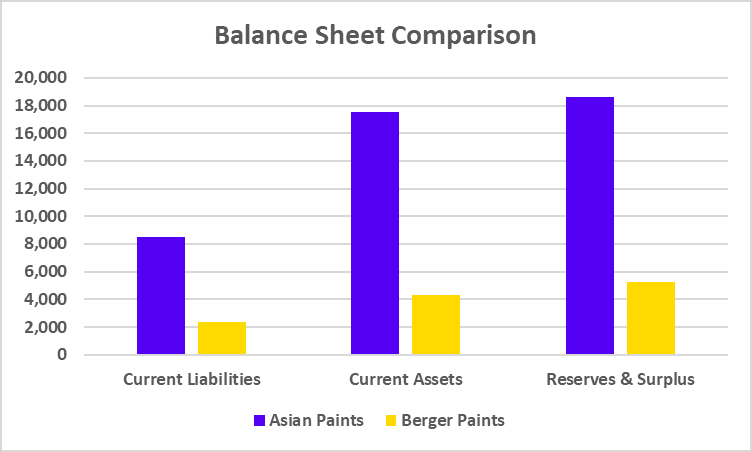
Balance Sheet Comparison
Particulars
Asian Paints
Berger Paints
Current Liabilities
8,500
2,362
Current Assets
17,537
4,318
Reserves & Surplus
18,632
5,262
(All values are in INR crores and the data is as of March 2024)
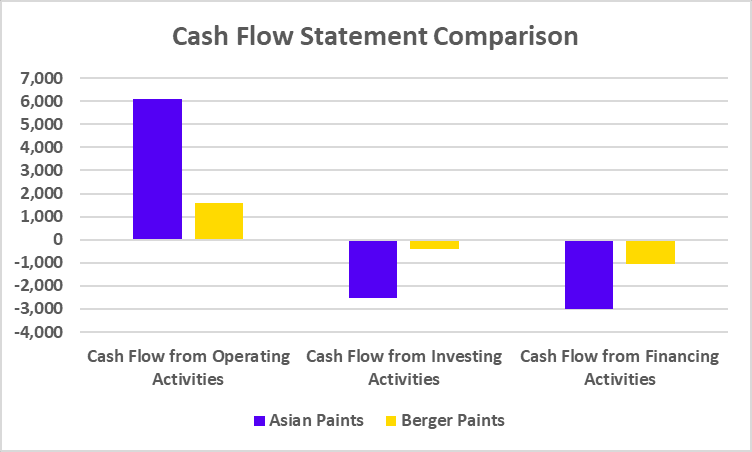
Cash Flow Statement Comparison
Particulars
Asian Paints
Berger Paints
Cash Flow from Operating Activities
6,103
1,591
Cash Flow from Investing Activities
-2,517
-398
Cash Flow from Financing Activities
-2,982
-1,068
(All values are in INR crores and the data is as of March 2024)
Inference
Asian Paints is the market leader as it brings in nearly 3x the revenue and over 5x the profit of Berger Paints.
Berger Paints, though smaller, is still a strong No. 2 in India’s paint industry and has been growing steadily year after year.
Asian Paints has a slightly better profit margin, which shows its efficiency and pricing power.
Both companies have solid pan-India and international presence, but Asian Paints leads in scale, innovation, and diversification.
Key Performance Indicators (KPIs)
Particulars
Asian Paints
Berger Paints
Basic EPS (₹)
56.95
10.02
Operating Profit Margin (%)
20.90
14.23
Net Profit Margin (%)
15.28
10.07
Return on Equity (%)
29.15
21.7
Return on Capital Employed (%)
34.63
26.54
Debt-to-Equity (x)
0.06
0.04
(Data as of March 2024)
Which Company Is Better?
It depends on what you’re looking for.
If we’re talking about scale, innovation, and brand power, Asian Paints is the winner. It’s bigger and more diversified and has built a strong emotional connection with Indian homeowners over the years.
But that doesn’t mean Berger Paints is far behind. It’s a strong, fast-growing player that holds a significant market share, especially in certain regions and categories. It’s more focused, lean, and steadily expanding.
So, while Asian Paints leads the race overall, Berger Paints is worth keeping an eye on.
When it comes to choosing between Asian Paints and Berger Paints, there’s no one-size-fits-all answer. Asian Paints leads the paint industry in innovation and has a strong brand presence. But Berger Paints has carved out its own space, growing steadily.
Whether you’re picking a reliable paint for your home or comparing the two as an investor, both brands bring something valuable to the table. Think of Asian Paints as the seasoned pro and Berger as the agile challenger—each with its own strengths.
In the end, it’s all about what matters most to you: consistency and scale, or potential and momentum. Investors are encouraged to carefully assess their investment goals and risk tolerance, and conduct thorough research, preferably with the guidance of a financial advisor, before considering an investment in Asian Paints or Berger Paints.
Frequently Asked Questions (FAQs)
Which company is bigger in terms of revenue, profits, etc.: Asian Paints or Berger Paints?
Ans. Asian Paints is the clear leader in terms of revenue, market share, and brand presence as compared to Berger Paints.
Who is the owner of Berger Paints (India)?
Ans. Berger Paints (India) is owned by the Dhingra brothers, Kuldip Singh Dhingra and Gurbachan Singh Dhingra.
Which paint brand has better profit margins?
Asian Paints generally has slightly higher profit and operating margins than Berger Paints.
Is Berger Paints a good brand?
Definitely. Berger is the second-largest paint company in India and is trusted by millions.
Who has a larger market share?
Asian Paints holds over 50% of India’s paint market, while Berger has a total market share of 20%.
The food industry is the backbone of the Indian economy as it is responsible for bringing food to our table from the farmfields. With the increasing population of the country and the changing consumption habits of the people, the industry provides a lucrative investment opportunity. The food stocks are also considered a defensive investment opportunity, as they do not belong to the cyclical industry.
In this blog, we will give you an overview of the food industry, the benefits and factors that can directly impact its performance, and the top stocks related to this sector.
What are Food Stocks?
Food stocks are publicly traded companies that are primarily engaged in the production, processing, distribution, marketing, and selling of food and beverage items. Investing in such companies provides you with an opportunity to be a part of the growing food industry. These companies specialize in beverages, packaged foods, restaurant chains, processing, etc.
7 Best Food Stocks in India Based on Market Capitalisation
Here’s a curated list of the top 10 Food stocks in India for 2026 based on market capitalization:
SO.N.
Company
Current Market Price (INR)
Market Capitalisation (in INR crore)
52-Week High
52-Week Low
1
Nestle India Limited
1,312
2,53,014
1,340
1,055
2
Britannia Industries Limited
5,902
1,42,153
6,337
4,506
3
Hatsun Agro Product Limited
899
20,030
1,179
817
4
Bikaji Foods International Limited
658
16,489
821
520
5
Godrej Agrovet Limited
555
10,674
876
506
6
The Bombay Burmah Trading Corporation Ltd
1,746
12,181
2,174
1,521
7
Avanti Feeds Limited
1,078
14,688
1,130
582
(As of 4 February 2026)
A brief overview of the best food stocks in India is given below:
1. Nestle India Limited
Nestle is the world’s largest food and beverage company. Its success is driven by a diverse portfolio including dairy products, health and nutrition products, sweets, and processed foods, catering to both urban and rural consumers. Nestle India operates 9 factories across states like Punjab, Haryana, Himachal Pradesh, Goa, Karnataka, and Gujarat. Its headquarters are situated in Gurugram.
Know the Returns:
1Y Return (%)
3Y Return (%)
5Y Return (%)
13.08%
38.32%
52.66%
(As of 4 February 2026)
2. Britannia Industries Limited
Britannia Industries is one of the oldest bakery product companies, founded in 1892. It is part of the Wadia Group. The company’s products include biscuits, dairy products, cakes, breads, croissants, etc. The company has more than 15 plants across India, and exports to more than 80 countries in Asia, Africa, and the Middle East. The company’s headquarters are situated in Kolkata.
Know the Returns:
1Y Return (%)
3Y Return (%)
5Y Return (%)
15.34%
28.18%
67.59%
(As of 4 February 2026)
3. Hatsun Agro Products Limited
Hatsun Agro Products Limited was founded in 1970, and soon it became one of India’s largest private dairy companies. The company primarily operates in the southern region of India. The products of the company include milk, curd, ice cream, dairy products, beverages, etc. The company operates 20+ plants across the country, and has more than 10,000 outlets across the nation. The headquarters of the company are situated in Chennai, Tamil Nadu.
Know the Returns:
1Y Return (%)
3Y Return (%)
5Y Return (%)
-12.45%
3.47%
28.36%
(As of 4 February 2026)
4. Bikaji Foods International Limited
Bikaji Foods International Ltd was founded in the year 1987 by Shiv Ratan Agarwal, who was a member of the Agarwal family behind the Haldiram’s. The company is known for Indian snacks and sweets. The company was established in Bikaner, which is the birthplace of bhujia. The products of the company include namkeen, bhujia, sweets, papad, frozen foods, etc. It has more than 6 lakh retail outlets across the country and operates in the USA, UK, and other countries.
Know the Returns:
1Y Return (%)
3Y Return (%)
5Y Return (%)
-10.37%
74.89%
103.66
(As of 4 February 2026)
5. Godrej Agrovet Limited
Godrej Agrovet Limited was incorporated in 1991 and is a part of Godrej Group’s venture into agribusiness. The company entered the food processing industry in 2000 and started an oil palm plantation in 2010. To expand their business, the company launched its IPO in 2017 and became a publicly listed company. It is one of the largest oil palm producers in India. The headquarters of the company are situated in Mumbai.
Know the Returns:
1Y Return (%)
3Y Return (%)
5Y Return (%)
27.06%
24.22%
4.25%
(As of 4 February 2026)
6. Bombay Burmah Trading Company Limited
Bombay Burmah Trading Corporation Ltd was founded in 1863 and is one of India’s oldest publicly traded companies. The group operates in various sectors, including plantation, dental products, healthcare, etc. It also made several significant investments in Wadia Group companies such as Britannia, as it holds around 51% stakes in Britannia Industries, which is a major contributor of revenue. The company’s headquarters is situated in Mumbai.
Know the Returns:
1Y Return (%)
3Y Return (%)
5Y Return (%)
-17.42%
89.97%
38.89%
(As of 4 February 2026)
7. Avanti Feeds Limited
Avanti Feeds Ltd was incorporated in 1993 by the Alluri family as a shrimp feed manufacturing company. Later in 2011, it entered into shrimp processing and exported it to various other countries through Avanti Frozen Foods. The company launched its IPO in 2015 and became a publicly listed company. The company faced financial difficulty during the COVID-19 outbreak. It is the largest shrimp feed producer in India. The company’s headquarters is situated in Hyderabad.
The key performance metrics of food companies are mentioned below:
Company
Operating Margin (%)
Net Profit Margin (%)
ROE (%)
ROCE (%)
Debt to Equity
Nestle India Limited
21.24
15.99
79.98
57.17
0.19
Britannia Industries Limited
17.28
12.19
50.01
59.40
0.28
Hatsun Agro Product Limited
6.42
3.20
16.23
18.25
1.22
Bikaji Foods International Limited
16.83
11.41
21.81
27.37
0.10
Godrej Agrovet Limited
6.75
3.72
18.04
19.12
0.54
Bombay Burmah Trading Limited
18.61
11.24
14.63
41.37
0.46
Avanti Feeds Limited
8.55
6.65
15.10
19.63
0.01
(As of March 2025 except Bikaji Foods and Avanti Feeds results are yet to be announced. Data of March 2024 is mentioned for these companies)
Benefits of Investing in Food Stocks
The significant benefits of investing in food stocks are as follows:
Growing Demand: With the rise in urbanisation and changing consumption patterns of people, the demand for packaged foods and beverages is increasing very rapidly. This will directly benefit the food-related companies.
Dividends: There are various food companies which regularly pay dividends to their investors. Hence, investors who are looking to invest in companies which declare dividends and wish to have a passive source of income can invest in food companies.
Export-Oriented Business: The food companies are also engaged in export activities. Hence, they are not only dependent on the domestic market for revenue.
Defensive Sector: The food industry is not cyclical in nature, like any other industry such as IT, Metal, etc. Therefore, having food stocks in your portfolio reduces the overall risk.
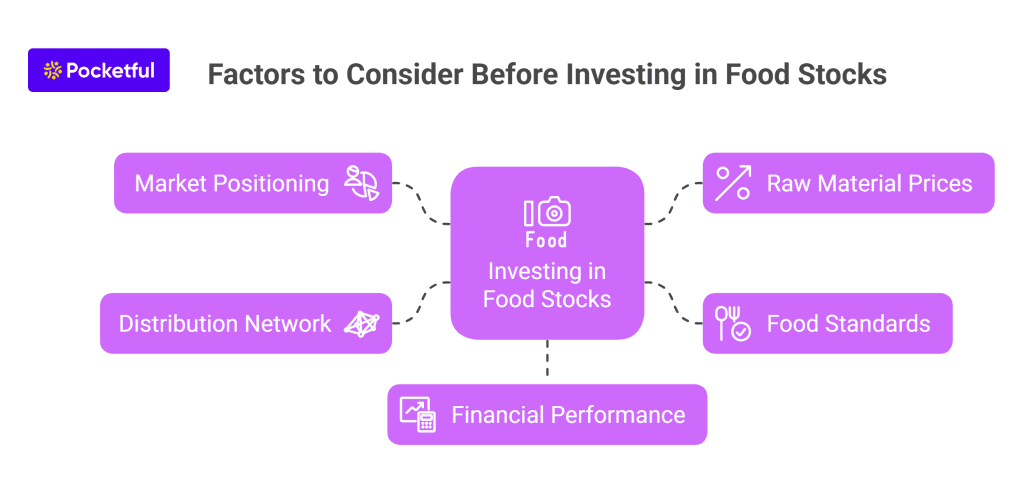
Factors to be Considered Before Investing in Food Stocks
The key factors which one should consider before investing in food stocks are as follows:
Market Positioning: The market share of the company plays an important role while choosing a food stock for investing. The company with a higher market share and serving the mass market will be beneficial for investment.
Prices of Raw Materials: The change in prices of raw materials used by the food companies such as wheat, sugar, etc. will impact their profit margins.
Food Standards: The food companies are required to maintain strict quality standards, which are issued by FSSAI or Food Safety and Standard Authority of India. If any company fails to maintain such standards, penalties will be levied on them.
Distribution Network: The companies which have a strong distribution network or retail outlets will be suitable for investment. Hence, before investing in food stocks, one should consider this as a key factor for the same.
Financial Performance: Checking the financial health is an important parameter that one should take into account. Companies with higher profit margins and revenue can be considered for investment.
The growth of the Indian Food Industry is very promising because of increasing per capita income and disposable income in both rural and urban areas. The demand for packaged and processed food items has increased significantly in recent years. The food processing industry in India is expected to reach $535 billion by the end of the current financial year and $1,100 billion by FY35. Hence, investing in food stocks provides a good growth opportunity.
Conclusion
On a concluding note, the dynamics of the Indian food industry are changing very rapidly. With the rise of per capita income and urbanisation, this sector has shown exponential growth in recent years. Due to this, various national and international companies are entering into this sector. From packaged food to beverages, this sector has immense growth potential. However, the food industry is highly competitive. Therefore, one is required to conduct due diligence about the company’s financial, brand value, market share, and management before investing in it, and also consult their investment advisor regarding the same.
One can invest in food sector stocks very easily by opening a free demat account with Pocketful. It allows you to invest without paying any brokerage on equity delivery, and its advanced trading platform is equipped with various technical tools.
S.NO.
Check Out These Interesting Posts You Might Enjoy!
You can easily invest in food stocks by opening a demat account with Pocketful as it offers you an opportunity to invest without paying any brokerage on equity delivery.
Which companies are the top food stocks in India?
The top food stocks based on the market capitalisation are Nestle India Limited, Britannia Industries Limited, Hatsun Agro Products Limited, Bikaji Foods Limited, Godrej Agrovet Limited, Bombay Burmah Trading Company Limited and Avanti Feeds Limited.
What are the major factors which can affect the performance of food stocks?
The major factors which can affect the performance of food stocks are the prices of raw materials, the financial performance of the company, product quality, the distribution network of the company, etc.
Are food stocks a defensive investment?
Yes, investment in food stocks is a defensive investment as the demand for food products is not directly influenced by changes in economic activities, and the demand remains stable even during economic downturns.
Do food stocks pay dividends?
Yes, various food companies, such as Nestle India and Britannia Industries Limited, regularly pay dividends to their investors.
Selection Methodology and Important Disclaimer
The stocks included in this list are selected primarily on the basis of their market capitalisation, which represents the total market value of a company’s outstanding shares. The companies are arranged in descending order of market capitalisation, with larger companies appearing first, followed by relatively smaller companies. This methodology is intended to provide a structured approach for identifying companies based on their market size and overall presence within a sector.
However, market capitalisation should not be considered the sole factor while evaluating investment opportunities, as it does not guarantee future performance, profitability, or returns. Investors should also assess other important factors such as financial health, business fundamentals, management quality, valuation metrics, industry outlook, and market conditions before making investment decisions.
The information provided is for educational and informational purposes only and should not be construed as investment advice, recommendation, solicitation, or an offer to buy or sell any securities by Pocketful Fintech Capital Private Limited.
जब कोई कंपनी अच्छा Profit कमाती है, तो वह अक्सर अपने उस मुनाफे का एक हिस्सा Shareholders के साथ बाँटती है। इसे ही dividend कहा जाता है। आसान भाषा में कहें तो अगर किसी Investors ने कंपनी के शेयर खरीदे हैं, तो कंपनी समय-समय पर उन्हें उनके Investment पर Cash या कभी-कभी Additional Shares के रूप में Dividend देती है।
इस तरह के Stocks Investors के लिए एक तरह का Passive Income Source बन जाते हैं और समय के साथ wealth creation में भी मदद करते हैं। ऐसे स्टॉक्स में निवेश करते समय केवल Dividend ही नहीं, बल्कि कंपनी की Financial Stability और Performance को भी ध्यान में रखना ज़रूरी होता है।
डिविडेंड यील्ड क्या होता है?
डिविडेंड यील्ड एक ऐसा अनुपात (Ratio) होता है जो यह दिखाता है कि किसी शेयर की मौजूदा कीमत (current share price) के मुकाबले कंपनी अपने निवेशकों को कितना रिटर्न (as dividend) दे रही है। इसे हम एक तरह से percentage return के रूप में समझ सकते हैं।
डिविडेंड यील्ड निकालने का फॉर्मूला होता है: डिविडेंड यील्ड = (प्रति शेयर डिविडेंड ÷ वर्तमान शेयर मूल्य) × 100
उदाहरण : अगर किसी कंपनी का शेयर ₹200 में मिल रहा है और वह हर साल ₹10 का dividend देती है ।
डिविडेंड यील्ड= (10 ÷ 200) × 100 = 5%
इसका मतलब है कि कंपनी ₹200 के शेयर पर हर साल ₹10 यानी 5% का रिटर्न Dividend के रूप में दे रही है।
Dividend कई तरह के हो सकते हैं। हर कंपनी अपनी Earnings और Policy के हिसाब से अलग-अलग type का dividend देती है। एक investor के लिए यह जानना ज़रूरी है कि कौन-सा Dividend क्या होता है और कैसे काम करता है।
Cash Dividend यह सबसे common type होता है, जिसमें company सीधे shareholders के bank account में cash transfer करती है। ज़्यादातर listed companies इसी format को follow करती हैं।
Stock Dividend: इस case में company cash देने की बजाय अपने ही additional shares issue करती है। इससे shareholders की total shareholding बढ़ जाती है, लेकिन कंपनी का cash balance unaffected रहता है।
Interim Dividend: यह dividend financial year के पूरा होने से पहले declare किया जाता है। यह दर्शाता है कि company ने उस specific period में अच्छा performance किया है और वो profit का एक हिस्सा early distribute कर रही है।
Final Dividend: Year-end के बाद, जब company की full-year financials finalize हो जाती हैं, तब Final Dividend declare किया जाता है। इसे Annual General Meeting (AGM) में board और shareholders की approval के बाद distribute किया जाता है।
Special Dividend: जब किसी company को एक-time exceptional profit होता है जैसे किसी asset की बिक्री या बड़ी deal से तब वो एक बार का Special Dividend declare कर सकती है। यह regular नहीं होता और specific situations में ही दिया जाता है।
Top 10 सबसे ज़्यादा Dividend देने वाले Stocks
इस लिस्ट में शामिल ज्यादातर कंपनियों का मार्केट कैप ₹1 लाख करोड़ से ज़्यादा है और ये फाइनेंशियली मज़बूत स्थिति में हैं।
वेदांता लिमिटेड की स्थापना 1979 में हुई थी और इसका मुख्यालय मुंबई में स्थित है। यह एक विविधीकृत प्राकृतिक संसाधन कंपनी है, जो जिंक, सीसा, चांदी, तेल और गैस, लौह अयस्क, स्टील और एल्युमिनियम में संलग्न है। वित्तीय वर्ष 2024-25 में, वेदांता ने ₹1,52,968 करोड़ की अब तक की सबसे अधिक समेकित राजस्व दर्ज की, जो पिछले वर्ष की तुलना में 10% अधिक है। कंपनी का EBIT ₹36,790 करोड़ रहा, जो 23% की वार्षिक वृद्धि को दर्शाता है। शुद्ध लाभ ₹20,534 करोड़ रहा, जिसमें 172% की वृद्धि हुई।
2. चेन्नई पेट्रोलियम कॉर्पोरेशन लिमिटेड
Chennai Petroleum Corporation Ltd (CPCL) की स्थापना 1965 में हुई थी और इसका मुख्यालय चेन्नई, तमिलनाडु में स्थित है। यह कंपनी इंडियन ऑयल कॉर्पोरेशन की सहायक कंपनी है और दो प्रमुख रिफाइनरियों का संचालन करती है: मैनाली रिफाइनरी (10.5 मिलियन मीट्रिक टन प्रति वर्ष) और नागपट्टिनम रिफाइनरी (1 मिलियन मीट्रिक टन प्रति वर्ष)। मार्च 2025 को समाप्त तिमाही में, CPCL ने ₹17,249.12 करोड़ की शुद्ध बिक्री दर्ज की, जो पिछले वर्ष की तुलना में 2.66% कम है।
3. इंडियन ऑयल कॉर्पोरेशन लिमिटेड
इंडियन ऑयल कॉर्पोरेशन लिमिटेड (IOC) की स्थापना 1959 में हुई थी और इसका मुख्यालय नई दिल्ली में स्थित है। यह भारत की सबसे बड़ी राज्य-स्वामित्व वाली तेल और गैस कंपनी है, जो रिफाइनिंग, पाइपलाइन ट्रांसपोर्टेशन और पेट्रोलियम उत्पादों के विपणन में संलग्न है। वित्तीय वर्ष 2024-25 में, IOC ने ₹12,028 करोड़ का समेकित शुद्ध लाभ दर्ज किया, जो पिछले वर्ष की तुलना में 71% कम है। कंपनी की समेकित संचालन से आय ₹7,61,621 करोड़ रही, जो पिछले वर्ष की तुलना में 2.4% कम है।
4. कोल इंडिया लिमिटेड
कोल इंडिया लिमिटेड (CIL) की स्थापना 1975 में हुई थी और इसका मुख्यालय कोलकाता, पश्चिम बंगाल में स्थित है। यह दुनिया की सबसे बड़ी कोयला उत्पादक कंपनी है और भारत की कुल कोयला उत्पादन का लगभग 82% योगदान देती है। वित्तीय वर्ष 2024-25 में, CIL ने ₹34,839 करोड़ का शुद्ध लाभ दर्ज किया, जो पिछले वर्ष की तुलना में 5.70% कम है।
5. भारत पेट्रोलियम कॉर्पोरेशन लिमिटेड
भारत पेट्रोलियम कॉर्पोरेशन लिमिटेड (BPCL) की स्थापना 1976 में हुई थी और इसका मुख्यालय मुंबई में स्थित है। यह भारत की दूसरी सबसे बड़ी राज्य-स्वामित्व वाली तेल रिफाइनिंग और विपणन कंपनी है। मार्च 2025 को समाप्त तिमाही में, BPCL का समेकित शुद्ध लाभ ₹4,034 करोड़ रहा, जो पिछले वर्ष की तुलना में 20% कम है। कंपनी की संचालन से आय ₹1.11 लाख करोड़ रही, जो 4.6% की गिरावट को दर्शाती है।
6. हिंदुस्तान पेट्रोलियम कॉर्पोरेशन लिमिटेड
हिंदुस्तान पेट्रोलियम कॉर्पोरेशन लिमिटेड (HPCL) की स्थापना 1952 में हुई थी और इसका मुख्यालय मुंबई में स्थित है। यह भारत की तीसरी सबसे बड़ी तेल विपणन कंपनी है, जो मुंबई और विशाखापत्तनम में दो प्रमुख रिफाइनरियों का संचालन करती है। मार्च 2025 को समाप्त तिमाही में, HPCL की शुद्ध बिक्री ₹1,10,206 करोड़ रही, जो पिछले वर्ष की तुलना में 4.3% कम है।
7. गुजरात पिपावाव पोर्ट लिमिटेड
गुजरात पिपावाव पोर्ट लिमिटेड (GPPL) की स्थापना 1992 में हुई थी और यह गुजरात में स्थित पिपावाव पोर्ट का संचालन करती है। यह भारत का पहला निजी क्षेत्र का बंदरगाह है, जो कंटेनर, बल्क और लिक्विड कार्गो को संभालता है। दिसंबर 2024 को समाप्त तिमाही में, GPPL की समेकित शुद्ध बिक्री ₹262.89 करोड़ रही, जो पिछले वर्ष की तुलना में 2.5% कम है।
8. ऑयल एंड नेचुरल गैस कॉर्पोरेशन लिमिटेड
ऑयल एंड नेचुरल गैस कॉर्पोरेशन लिमिटेड (ONGC) की स्थापना 1956 में हुई थी और इसका मुख्यालय नई दिल्ली में स्थित है। यह भारत की सबसे बड़ी सरकारी तेल और गैस अन्वेषण और उत्पादन कंपनी है, जो देश की लगभग 70% कच्चे तेल और 84% प्राकृतिक गैस का उत्पादन करती है। दिसंबर 2024 को समाप्त तिमाही में, ONGC की समेकित शुद्ध बिक्री ₹1,66,096 करोड़ रही, जो पिछले वर्ष की तुलना में 0.32% अधिक है।
9. कैस्ट्रोल इंडिया लिमिटेड
कैस्ट्रोल इंडिया लिमिटेड की स्थापना 1910 में हुई थी और इसका मुख्यालय मुंबई में स्थित है। यह कंपनी ऑटोमोटिव और इंडस्ट्रियल लुब्रिकेंट्स के निर्माण में अग्रणी है और BP की सहायक कंपनी है। वित्तीय वर्ष 2024 में, कैस्ट्रोल इंडिया ने ₹5,453 करोड़ की कुल संचालन से आय दर्ज की, जो पिछले वर्ष की तुलना में 5.7% अधिक है। कंपनी का शुद्ध लाभ ₹927 करोड़ रहा, जिसमें 7% की वृद्धि हुई। कंपनी ने पिछले एक साल में ₹13 प्रति शेयर का कुल लाभांश घोषित किया, जिसमें ₹4.5 का विशेष लाभांश शामिल है।
10. ग्रेट ईस्टर्न शिपिंग कंपनी लिमिटेड
ग्रेट ईस्टर्न शिपिंग कंपनी लिमिटेड की स्थापना 1948 में हुई थी और इसका मुख्यालय मुंबई में स्थित है। यह भारत की सबसे बड़ी निजी क्षेत्र की शिपिंग कंपनी है, जो कच्चे तेल, पेट्रोलियम उत्पादों, गैस और ड्राई बल्क कमोडिटीज के लिए शिपिंग सेवाएं प्रदान करती है। मार्च 2025 को समाप्त तिमाही में, कंपनी की समेकित शुद्ध बिक्री ₹1,373 करोड़ रही, जो पिछले वर्ष की तुलना में 20% कम है।
Key Performance Indicators
किसी भी कंपनी की परफॉर्मेंस को समझने के लिए कुछ अहम Key Performance Indicators (KPI) होते हैं। ये indicators निवेशकों को यह समझने में मदद करते हैं कि कंपनी का व्यवसाय कितना मजबूत है और उसका रिटर्न कितना स्थिर रह सकता है।
(All of the above data is of the year ended March 2025)
High Dividend Stocks में Invest करने से पहले किन बातों का ध्यान रखें?
ऐसे शेयर जो ज़्यादा dividend देते हैं, अक्सर निवेशकों को आकर्षित करते हैं। लेकिन केवल डिविडेंड यील्ड देखकर स्टॉक चुनना हमेशा सही फैसला नहीं होता। निवेश से पहले कुछ ज़रूरी बातों को समझना बहुत जरूरी होता है।
1. डिविडेंड यील्ड देखकर स्टॉक न चुनें
कई बार कंपनियां अधिक dividend देकर investors को attract करने की कोशिश करती हैं , लेकिन उसका असली बिज़नेस कमजोर हो सकता है। अगर कंपनी का बिज़नेस strong नहीं है, तो वह future में dividend देना बंद भी कर सकती है। इसलिए किसी भी शेयर में निवेश करने से पहले उसके fundamentals जैसे – उसका मुनाफा (profit), कमाई (revenue), और कर्ज़ (debt) को ज़रूर देखें।
2. डिविडेंड Payout Ratio को समझें show
Dividend payout ratio यह show करता है कि कंपनी अपने कुल Profits का कितना हिस्सा dividend के रूप में दे रही है। यदि कोई कंपनी अपनी पूरी या अधिकांश earnings dividend में खर्च कर रही है, तो इसका मतलब हो सकता है कि वह Future Growth में कम Invest कर रही है। कभी-कभी High Dividend Payout Ratio कंपनी के लिए Risky भी हो सकता है ।
3. Earning Stability और Cash Flow की जांच करें
Dividend sustainability को समझने के लिए कंपनी की Earning Stability और Free cash flow की स्थिति को भी परखना ज़रूरी है। क्या कंपनी हर साल consistent तरीके से लाभ अर्जित कर रही है? क्या उसके पास future में भी dividend देने की क्षमता है? ये सवाल long-term निवेशकों के लिए अहम हैं।
4. Dividend पर लगने वाला टैक्स (TDS)
Dividend पर कुछ प्रतिशत Tax पहले से ही कट जाता है जिसे TDS (Tax Deducted at Source) कहते हैं। इसलिए जो Amount आपको मिलता है, वो Declared Amount से कम हो सकता है। Invest करते समय इस बात को ध्यान में रखना चाहिए।
5. किन सेक्टर में dividend stocks ज़्यादा भरोसेमंद होते हैं
कुछ सेक्टर जैसे PSU (Public Sector Undertaking), Energy, और FMCG में काम करने वाली कंपनियाँ आमतौर पर Regular Dividend देती हैं। इनका Cash Flow Stable होता है और Performance भी consistent होती है। ऐसे सेक्टर्स को ज्यादा सुरक्षित माना जाता है, लेकिन फिर भी हर कंपनी का Individual Performance देखना जरूरी होता है।
निष्कर्ष
भारत में कई ऐसी कंपनियाँ हैं जो लगातार Dividend देती हैं और जिनका डिविडेंड यील्ड काफ़ी मजबूत होता है। ये कंपनियाँ आमतौर पर Mature बिज़नेस मॉडल और Stable Earnings वाली होती हैं, जो Regular Cash Flow जनरेट करती हैं। ऐसे Stocks उन Investors के लिए ज़्यादा उपयुक्त माने जाते हैं जो Consistent Returns की तलाश में रहते हैं। डिविडेंड यील्ड एक महत्वपूर्ण Indicator होता है, लेकिन इसके साथ-साथ कंपनी की Financial Health, Earning Consistency और Long-Term Performance को भी समझना जरूरी होता है। हर Stock का अपना Risk Level और Sector-Specific Background होता है, जो yield को प्रभावित कर सकता है।
अक्सर पूछे जाने वाले प्रश्नों
क्या सिर्फ डिविडेंड के आधार पर किसी कंपनी में निवेश करना सही है?
नहीं, केवल डिविडेंड के आधार पर निवेश करना उचित नहीं होता। कंपनी की overall financial health, growth potential और market conditions को भी ध्यान में रखना चाहिए।
Dividend और Bonus में क्या फर्क होता है?
Dividend: कंपनी का मुनाफे का हिस्सा जो शेयरधारकों को नकद या अतिरिक्त शेयर के रूप में दिया जाता है। Bonus Share: कंपनी मौजूदा शेयरहोल्डर्स को फ्री में अतिरिक्त शेयर देती है, कैश नहीं ।
Dividend Payout Ratio क्या होता है?
यह ratio बताता है कि कंपनी अपने कुल profit का कितना हिस्सा dividend में बांटती है। Formula: (Dividend per Share ÷ Earnings per Share) × 100
Dividend मिलने के लिए शेयर कब खरीदना होता है?
Dividend प्राप्त करने के लिए निवेशक को कंपनी के Ex-Dividend Date से पहले शेयर खरीदना होता है।
Dividend और Fixed Deposit में क्या अंतर है?
FD में आपको एक fix interest मिलता है और risk कम होता है, जबकि dividend shares के साथ जुड़ा होता है और market performance पर निर्भर करता है, इसलिए इसमें risk भी होता है।
Selection Methodology and Important Disclaimer
The stocks included in this list are selected primarily on the basis of their market capitalisation, which represents the total market value of a company’s outstanding shares. The companies are arranged in descending order of market capitalisation, with larger companies appearing first, followed by relatively smaller companies. This methodology is intended to provide a structured approach for identifying companies based on their market size and overall presence within a sector.
However, market capitalisation should not be considered the sole factor while evaluating investment opportunities, as it does not guarantee future performance, profitability, or returns. Investors should also assess other important factors such as financial health, business fundamentals, management quality, valuation metrics, industry outlook, and market conditions before making investment decisions.
The information provided is for educational and informational purposes only and should not be construed as investment advice, recommendation, solicitation, or an offer to buy or sell any securities by Pocketful Fintech Capital Private Limited.
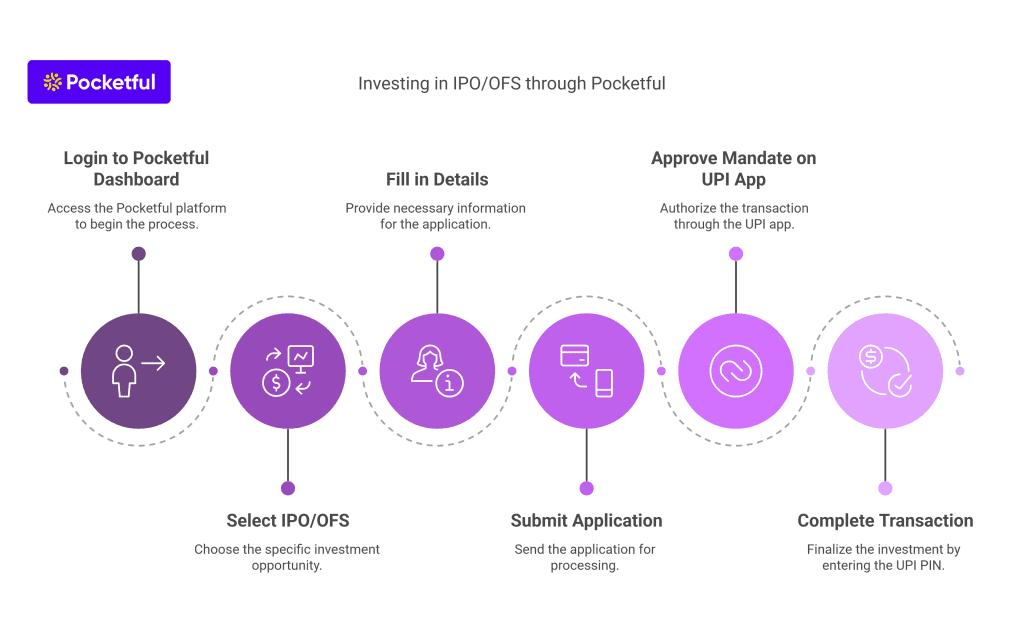
In today’s time, if you want to invest in the stock market, then you need to understand how companies bring their shares to the public. There are two main ways of doing this: IPO (Initial Public Offering) and OFS (Offer for Sale). An IPO is when a company sells its shares to the public for the first time, through which the company raises new capital. On the other hand, in OFS, the promoters or big investors of an already listed company sell their share of shares; in this, the company does not get any new funds. That is, the company gets money from the IPO, whereas only the shareholders get money from OFS. As an investor, it is important to know what the difference is between OFS and IPO.
What is an IPO?
IPO, or initial public offering, is a process in which a private company brings its shares to the market for sale to the general public for the first time. Its main purpose is to raise capital for the company so that it can expand its business, repay debt, or invest in new projects.
Process of IPO
Submitting Draft Red Herring Prospectus (DRHP): First, the company files a DRHP with SEBI (Securities and Exchange Board of India), which contains complete information about the company, financial position, future plans, and risk factors. This document gives investors complete information about the company.
Determination of price band : After this, the company and its underwriters together decide on a price band. This is the price range at which investors can buy shares.
Book-building process : After this, the company receives bids (applications) from investors. Investors can bid for shares at any price within the fixed price band. The book-building process helps the company determine what the value of the share should be.
Allotment of shares : After receiving the bids, the company allocates shares. In this process, it is seen who should get how many shares.
Listing on Stock Exchange : Finally, the company’s shares get listed on the stock exchange (like NSE or BSE), and then common people and investors can buy and sell the shares in the open market.
An IPO is a good opportunity for investors to be an early part of a company’s growth. If the right company is chosen, there is a possibility of getting good returns from the IPO.
The full form of OFS is Offer for Sale, and it is a process in which existing promoters or large shareholders sell their share of shares to the public. In this process, the company does not raise new capital, but the already issued shares are sold. The main purpose of OFS is to give the promoters an opportunity to reduce their stake or exit.
Process of OFS
Determination of floor price : First, the promoters of the company decide the floor price, i.e., the minimum price at which the shares will be sold. This price is usually kept slightly lower than the current market price so as to attract investors.
Starting the bidding process : Once the floor price is decided, the bidding process begins on the stock exchange. Investors participate in this process and place their bids within the stipulated time frame.
Allotment of shares : After the bidding, shares are allotted to those investors who placed the highest bids. If the number of bids is high, the allotment is done on a pro rata basis.
No fresh capital is raised : Since the company does not issue new shares in OFS, it is not considered a means of raising funds. It is just an exit route for shareholders.
Listing in the market : Finally, the shares sold from OFS get listed on the stock exchange, and investors can buy or sell them in the open market.
The main purpose of OFS is to provide an exit route for promoters, while for investors it is a safe way to buy shares of listed companies.
Aspect
IPO (Initial Public Offering)
OFS (Offer for Sale)
Purpose
The company issues new shares to raise capital.
Promoters or large shareholders sell their stake.
Type of Shares
New shares are issued.
Existing shares are sold.
Process Complexity
More complex involves strict SEBI scrutiny and approval.
Simpler process conducted via stock exchange bidding.
Time Frame
Lengthy process may take several weeks or months.
Quick process can be completed in 1–2 days.
Pricing Mechanism
Price band is set (book-building process).
A floor price is set, and bids are invited.
Investor Access
Open to all investors both institutional and retail.
Mostly accessible to institutional investors some portion for retail.
Dilution Impact
Increases total number of shares, leading to dilution of existing shareholding.
No new shares issued; only ownership changes hands.
Regulatory Requirements
Requires detailed SEBI approval and documentation.
Fewer regulatory steps; managed primarily through stock exchange platforms.
It is clear from this comparison that the purpose of both OFS vs IPO is different, and both the risks and opportunities for applicants are also different. IPO gives new exposure to the company, while in OFS the promoters keep their stake in the stock.
Both IPO (Initial Public Offering) and OFS (Offer for Sale) are important modes of investment in the stock market. While these can be good investment options, it is important to understand the benefits and limitations associated with them so that investors can make informed and strategic decisions.
Benefits of IPO :
Investors get an opportunity to be a part of the company’s initial growth journey.
If the company’s performance remains strong, the share price is likely to increase significantly.
There is a possibility of better returns for long-term investments.
Limitations of IPO :
There is limited information about new companies, which increases the risk.
There is a possibility of the share price falling immediately after listing.
IPO and OFS are both important ways of investment, but their purpose and process are different. In IPO, the company raises new capital, while in OFS, the promoters sell their stake. If you want to invest in new growth companies, then an IPO is better. On the other hand, if you want to invest in stable and listed companies with low risk, then OFS is the right option. Before investing, take a decision keeping in mind the company’s condition and your financial goals, so that your investments can be safe and profitable.
Frequently Asked Questions (FAQs)
What is the full form of IPO and OFS?
IPO means Initial Public Offering, and OFS means Offer for Sale.
Is new capital raised in OFS?
No, in OFS the company does not raise fresh capital; the promoters sell their existing shares.
Can retail investors apply in OFS?
Yes, as per SEBI regulations at least 10% of the OFS is reserved for retail investors.
Which is safer – IPO or OFS?
OFS is considered comparatively safe as the company is already listed.
Is IPO allotment guaranteed?
No, in case of oversubscription of IPO, allotment is done on lucky draw or pro rata basis.
Do I need a demat account for IPO or OFS?
Yes, to invest in both you need to have an active demat account.
The Indian four-wheeler auto segment is primarily dominated by two companies: Maruti Suzuki India Limited and Hyundai India Motor Limited. Both of these companies offer a wide range of passenger vehicles, including hatchbacks, sedans, SUVS, etc. Maruti was listed in 2003, whereas Hyundai India was listed on the Indian Stock Exchange in 2024; therefore, the long-term returns of both cannot be compared. However, there are certain other parameters that can be considered while comparing both of them.
In this blog, we will help you find the answer to the question of which stock is better among Hyundai India Motor Limited and Maruti Suzuki India Limited based on various parameters.
Overview of Maruti Suzuki India Limited
Maruti Suzuki India Limited was established in 1981, and initially it was known as Maruti Udyog. It was a joint venture between the Government of India and Japanese automaker Suzuki Motor Corporation and eventually became its subsidiary. Now, it is one of the largest passenger vehicle manufacturers in India. The company holds a prominent position in the Indian passenger vehicle market and holds around 42% market share as of FY 24. Maruti Suzuki has manufacturing units in Gurgaon and Manesar and is planning to commence operations at a new plant in Kharkhoda, Haryana. Maruti Suzuki has invested a huge amount in localising the manufacturing of batteries by signing an MOU worth 150 billion yen with the Government of Gujarat. The company exports its cars to over 100 countries across the globe. The company’s headquarters are situated in New Delhi.
Business Model
Maruti Suzuki India Limited’s core business is manufacturing and selling vehicles. It offers a wide range of cars to every customer segment. The segments covered are entry-level hatchbacks, compact cars, sedans, SUVs and MPVs.
The company distributes their product through two channels: Arena, which sells budget-friendly cars, and NEXA, which caters to the needs of premium customers.
It offers other services like selling pre-owned cars through True Value, insurance broking, financing, driving schools, and selling accessories and spare parts.
Hyundai Motor India Limited is a wholly owned subsidiary of the South Korean company, Hyundai Motor Company. It started its operation in India in 1996 and soon became India’s second-largest car manufacturing company by sales, just behind Maruti Suzuki. The company has two plants situated in the state of Tamil Nadu, with an annual combined capacity of more than 8 lakh units. The company also acquired a plant in Talegaon, which was earlier owned by General Motors India. The company offers a diversified portfolio of passenger vehicles to its customers, which includes hatchbacks, sedans, SUVs, and electric vehicles. It is the largest exporter of cars in India, and it exports its products to over 92 countries. It also set up a Research and Development centre in Hyderabad, which primarily focuses on innovating passenger vehicles. The company launched its IPO in 2024, which was one of the largest IPO of the year. The headquarters of Hyundai Motor India Limited is situated in Gurugram, Haryana.
Business Model
The company’s core revenue source is selling passenger vehicles, and catering to the needs of different customers who wish to have a hatchback, sedans, SUVS, and electric vehicles.
It also has a strong dealer network of more than 1,500 dealers spread across India.
The company also offers maintenance, service, accessories and spare parts through their service centres.
Inference: In the short term, Hyundai Motor India has underperformed as compared to Maruti, which has been a consistent performer in the longer period. However, it would be unfair to compare the price performance of both companies as Hyundai was recently listed.
Income Statement Comparison
Particulars
Maruti Suzuki India Limited
Hyundai Motor India Limited
Sales
1,41,858
69,829
Total Revenue
1,45,951
71,302
Total Expenses
1,28,587
62,904
Profit After Tax
13,234
6,060
(As of March 2024)
Inference: As of March 2024, Maruti Suzuki India Limited has outperformed Hyundai Motor India Limited both in terms of revenue and profit.
Balance Sheet Comparison
Particulars
Maruti Suzuki India Limited
Hyundai Motor India Limited
Current Assets
22,634
16,124
Non-Current Assets
92,717
10,225
Total Shareholder Funds
85,636
10,666
Current Liabilities
25,952
26,349
Non-Current Liabilities
3,763
2,686
(As of March 2024)
Inference: Maruti Suzuki India Limited has more than 4x the assets of Hyundai Motor India Limited and almost equivalent total liabilities.
Cash Flow Statement Comparison
Particulars
Maruti Suzuki India Limited
Hyundai Motor India Limited
Cash Flow from Operating Activities
16,801
9,251
Cash Flow from Investing Activities
-11,864
-10,090
Cash Flow from Financing Activities
-4,062
-15,930
(As of March 2024)
Inference: Maruti Suzuki India Limited has a higher cash flow from operating activities, whereas, Hyundai Motor India Limited has a significantly higher cash outflow from financing activities, when compared to Maruti.
Key Performance Ratios
Particulars
Maruti Suzuki India Limited
Hyundai Motor India Limited
Operating Profit Margin (%)
12.24
12.02
Net Profit Margin (%)
9.32
8.67
ROE (%)
15.75
56.81
ROCE (%)
19.42
62.89
Debt to Equity (x)
0
0.07
(As of March 2024)
Inference: Being a company that is aggressively expanding, Hyundai Motor India Limited has better ROE and ROCE, but the net and operating profit margins of Maruti Suzuki India Limited are higher.
Shareholding Pattern
Particulars
Maruti Suzuki India Limited
Hyundai Motor India Limited
Promoter (%)
58.28
82.50
FII (%)
14.96
7.17
DII (%)
23.64
7.01
Public (%)
2.62
3
(As of March 2025)
Inference: Hyundai Motor India Limited has higher promoter holdings. But FIIS holds only a 7% stake in it, whereas they hold around 15% stake in Maruti Suzuki India Limited.
Maruti Suzuki India Limited focuses on reliability and affordability, whereas Hyundai Motor India Limited focuses on modern design and advanced features. However, in terms of revenue and profit, Maruti Suzuki is ahead of Hyundai by a long way. However, in terms of ROE and ROCE, Hyundai Motor is ahead of Maruti Suzuki India Limited. On the other hand, Hyundai Motor India Limited has already launched its electric vehicles, and announced its plans to manufacture them in India. Maruti Suzuki India Limited is focusing on the affordable passenger vehicle segment and dominates the segment. However, it is advisable to consider the risks which the automobile sectors have, such as cyclical business, production cost, government regulations, etc. Choosing the best stock depends on the investor’s risk profile. An aggressive investor can go for Hyundai Motor India Limited, and Maruti Suzuki India Limited is suitable for conservative investors. It is advised to consult a financial advisor before investing.
Conclusion
On a concluding note, Maruti Suzuki India Limited offers stability to your portfolio during market downturns and has the potential to deliver moderate returns. Hyundai Motor India Limited can be considered an aggressive investment option as it presents high risks in the form of higher debt to equity ratio, which can result in high volatility. However, it is always best to consult your investment advisor before making any investment decision.
One can easily invest in both the shares using the Pocketful mobile application, where you can buy them without paying any brokerage on delivery. So open a free demat account with Pocketful now.
S.NO.
Check Out These Interesting Posts You Might Enjoy!
Who is the current CEO of Maruti Suzuki India Limited?
The current managing director and CEO of Maruti Suzuki India Limited is Hisashi Takeuchi, he was reappointed for an additional three-year term from 1st April 2025.
Among Maruti Suzuki India Limited and Hyundai Motor India Limited, which stock is suitable for long-term investment?
Both companies belong to a large-cap category, but Maruti Suzuki is considered more stable when we compare the returns of the last year. Also, Maruti Suzuki India Limited has a higher market capitalisation when compared with Hyundai Motor India Limited.
Which is the best company between Maurit Limited and Hyundai Motor India Limited?
Both companies can be suitable for different types of investors as Hyundai Motor India Limited is primarily focusing on growth through its EV plans, whereas Maruti Suzuki India Limited is focusing on providing more stable returns and giving regular dividends.
Which company has the higher FIIS holding among Maruti Suzuki India Limited or Hyundai Motor India Limited?
As of 31st March 2025, FIIs hold a 14.96% stake in Maruti Suzuki India Limited, whereas their stake in Hyundai Motor India Limited is only 7.17%, which indicates that FIIs has a higher holding in Maruti Suzuki India Limited.
Is Hyundai Motor India Limited a large-cap company?
As of 12th May 2025, Hyundai Motor India has a total market capitalisation of 1,42,661 crores, and belongs to the large cap category.
Ever wondered, what is day trading or how to start day trading? As the name goes, day trading refers to buying and selling financial assets, such as shares, commodities, etc., on the same day with the hopes of gaining profit from the trading activities. However, knowing the concepts before trading with real money is important, especially for beginners.
In this blog, we will discuss what day trading is, its key features, and how to get started.
What is Day Trading?
Day trading is a trading approach in which an individual buys and sells financial assets during the same day without holding any trading position overnight. It is known to have high risks because of leverage, but also gives higher returns. The different types of financial assets include stocks, commodities, currencies, and even derivatives. The trades are always executed on the same day, allowing the holder to not only get rid of unwanted overnight risk but also take advantage of immediate trading opportunities as needed. In this, traders close their open positions at the end of a trading day. This helps traders avoid the possibility of being affected by overnight announcements, events, news, etc.
The method is known best for its speed. In the fast-paced global economy that we live in today, every trader invests a considerable amount of time and effort to learn strategies and algorithms designed for evaluating different market conditions. They also require self-control, which enables them to act only after thorough deliberation. Day trading is more time-consuming compared to swing or positional trading, where traders keep their positions open for days, weeks, or months.
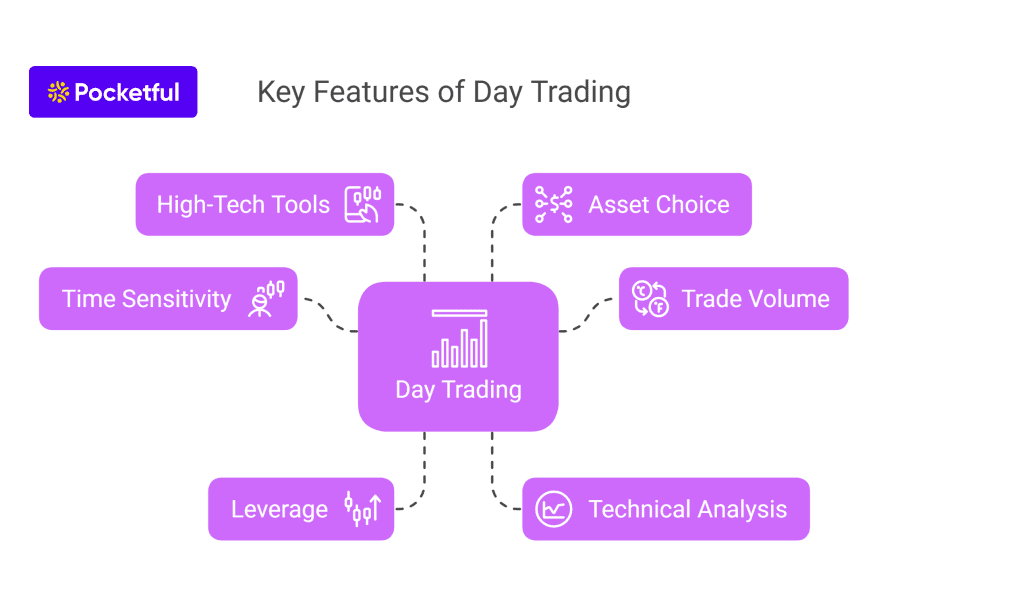
Important Features of Day Trading
Some of the important features of day trading are:
Highly Time Sensitive: Trades can last anywhere between just a few seconds to a couple of hours but never overnight. It is intended to take advantage of small price fluctuations within the market that occur throughout the day.
High Volume of Trades: A day trader can have many open trades on a single financial asset throughout the day, depending on how the prices fluctuate. This means that they can trade the same security along with its associated derivatives multiple times in a single day.
Use of Leverage: Margin accounts and leverage provided by brokers are often used by day traders. Leverage enables a day trader to trade with higher capital than the actual capital, which significantly increases the size of the positions taken and can magnify profits. However, it also increases your potential losses.
Technical Analysis Only: Chart patterns and price data along with technical indicators such as moving averages, RSI, MACD, Bollinger Bands, and many others indicators helps traders make decisions for day trading. Unlike long-term investors, day traders focus on technical analysis rather than analyzing a company’s financials or earnings reports.
Use of High Tech Tools: Day trading requires advanced technological tools such as new age trading platforms with real-time data feeds and updates, automated trading via APIs, advanced charting, etc., making it easier for traders to identify their entry and exits and act on trades swiftly.
Optimal Asset Choice: In day trading, most of the traders generally pick securities with high liquidity. In the case of Nifty 50 stocks or even the most traded currency pairs, large volumes are easily available which allows seamless trading.
If you are planning to do trading for the long-term, then a basic knowledge of key trading concepts is essential. An outline with all the details is given below :
1. Getting Started
Workshops and Webinars: Attend trading workshops and webinars to learn about practical trading concepts. Learning in a community also encourages the sharing of ideas and will make you a better trader.
Online Resources: Take online courses or read about trading concepts structured for beginners on platforms such as Investopedia and Coursera.
Keep an Eye on Current Events: Following the stocks you are considering buying or selling will give you a better context of the market.
2. Find a Reliable broker
Low Commission Charges: Frequent trading incurs increased transaction costs and amateurs can lose more in brokerages than they earn.
Dependable Platform: Check if the broker offers a reliable trading platform. Furthermore, the platform should be widely-used and have positive user reviews.
Customer Service: Quick response to issues can be critical during volatile market conditions.
3. Create a Trade Plan
Return Expectations: Write down the precise details about your return expectations.
Maximum Risk: Compute the maximum risk associated with trading strategies by considering different market scenarios.
Capital Required: Determine the total capital required and the amount of capital allotted to each trade.
4. Define Strategy, Backtest and Paper Trading
Develop Strategies: Create a well-defined trading strategy with a proper entry, exit, and stop-loss levels.
Backtesting: Test your strategy extensively using past price data. Incorporate insights gained from backtesting your strategy to increase the strategy’s profitability.
Paper Trading: Practicing with virtual money gives you more confidence and lets you experience the market conditions in real time.
5. Start with a small amount
Risk Reduction: Starting with a smaller capital reduces the amount of losses incurred.
Learn through Practical Experiences: Monitor your trading performance and compare it with the theoretical performance previously calculated and make the changes to your original strategy if required.
Increase Capital: Increase your trading capital as your confidence increases and you become consistently profitable.
Not everyone can take part in day trading, and it does require a great deal of planning, commitment, and learning. To begin day trading, here are a few undersold factors to focus on:
1. Maintain Sufficient Capital
Absorb Unexpected Losses: Losses are part of a successful trader’s life and your capital should be able to absorb them.
Meets Margin Expectations: Brokers require a minimum margin to be deposited if you use leverage. Make sure the losses don’t exceed the margin amount to avoid getting your positions liquidated.
Helps in Diversification: Undue concentration in one stock or asset can cause huge losses.
Volatility Control: A larger capital gives you the opportunity to take more controlled and calculative risks.
2. Time Commitment
Monitor Markets Continuously: Day trading requires intense and intricate focus, especially when it comes to volatile market conditions as a small lapse in concentration can cause huge losses.
Act Immediately: Complete concentration as well as the ability to act in mere seconds is required during day trading.
Strategy Reviews: Evaluate your trading performance and ensure that it meets your expectations. If not, identify the reasons and make the required changes.
Analyze before the Market Opens: Get ready for the session by assessing trends and news regarding the market.
Evaluate Trades: Review your trades and determine whether the trades were based on your strategy or not.
3. Emotional Discipline
Focus on a Plan: Resisting the need to alter tested strategies is crucial, regardless of the situation arising from fear or greed.
Loss Acceptance: Losses should be embraced as learning opportunities and dealt without emotional biases.
Situational Calmness: One must remain calm when volatility increases due to global events.
Overtrading: Do not take drastic actions or overtrade in a desperate effort to cancel out losses.
Avoid FOMO (Fear of Missing Out): Do not enter trades simply because they seem a profitable opportunity. Stick to your trading plan.
4. Technical Knowledge
Indicators and Chart Patterns: Knowledge about technical indicators such as moving averages, RSI, MACD, and Bollinger bands should be used with technical chart patterns forming on price charts to increase profitability.
Get Familiar with Trading Systems: Having prior knowledge concerning types of orders and trading terminals ensures a smooth trading experience.
5. Risk Management
Set Stop-Loss Orders: Control losses before it gets out of hand and wipe your trading capital.
Position Sizing: Determine in advance how much financial risk per trade you’re willing to take and determine the quantity accordingly (e.g.1-2% of capital).
Restrict Losses: Avoid trading multiple positions at the same time to maintain focus.
6. Awareness of legal and tax issues
Make sure your trading activities do not breach Indian laws concerning insider trading, market manipulation, etc.
Understand the taxes applicable on profits from intraday trading.
Keep proper records of your trades and gains for tax purposes.
7. Education and Training
Learn Before You Leap: Listen to market experts, read books and undertake courses available online before trading with real capital.
Use of Mock Account: Initially, start with virtual money using a stock market simulator and avoid trading using real money until you are confident enough.
Get into Trading Communities: Engage in forums and group discussions to learn from expert traders.
Stay Up-to-Date: Following the market is vital to learn new things and evolve.
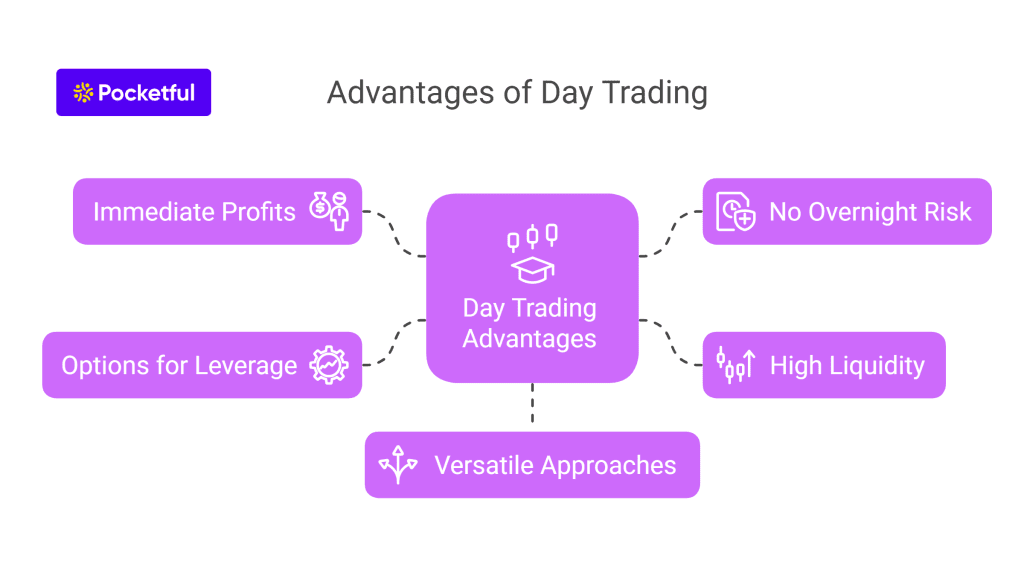
Advantages of Day Trading
Various advantages of day trading are:
Immediate Profits: Profits can be realized much more quickly than with traditional investing because day traders close out all trades within a single day.
No Overnight Risk: As all positions are closed before the stock market shuts down, the trader is protected from risks associated with the unexpected news announcements and changes in the global markets after trading hours.
High Liquidity: Traders concentrate on liquid assets, which facilitates faster execution of trades on both sides of the market.
Options for Leverage: Traders can make use of high leverage and earn much more profits. Most of the brokers such as Pocketful offer up to 5X margin on Equity Intraday trades. However, also read about the associated risks with the high leverage before trading.
Versatile Approaches: Based on the trader’s individual preferences, techniques such as scalping, momentum trading, or even news-based trading can be incorporated in the trading strategy.
Significant Risks: A loss in a highly leveraged trade can have severe consequences and may wipe out the capital.
Emotional Burnout: Making multiple decisions and constantly monitoring metrics while managing risk can contribute to stress, anxiety, and fatigue.
High Transaction Costs: Buying and selling frequently can result in high brokerage fees and taxes.
Steep Learning Curve: Day trading doesn’t guarantee success as it may take several months or years to become consistently profitable.
High Taxes: Taxation of speculative income is significantly more than the long term capital gains, which makes staying profitable even more difficult.
Conclusion
Understanding the basics of day trading, along with how to start, is only the first step since success in day trading cannot be guaranteed without discipline and continuous effort. Day trading if done right can generate huge returns, but at the same time can cause a complete capital wipeout. Hence, it is required to consult a financial advisor before starting day trading. Following this path requires consistent practice and consistency, so start by learning to build a solid trading startegy.
S.NO.
Check Out These Interesting Posts You Might Enjoy!
Can day trading be done by someone new to stock markets?
Day trading is risky in nature and is not easy. A sound trading strategy and risk management plan needs to be in place first. Consistent learning along with paper trading initially will be important before one can safely use real capital.
How much capital is required to start day trading?
Working with a few thousand rupees initially will be fine, but serious traders often have a capital of at least ₹10 lakhs. However, the capital required depends on your trading strategy and return expectations and it is best to consult a financial advisor before trading.
Is day trading allowed in India?
Yes, day trading is allowed and overseen by SEBI (Securities and Exchange Board of India). You only require a trading account with a broker who has a SEBI registration.
Which stocks are best suited for day trading?
Volatile stocks with a high average daily trading volume are preferred for day trading.
Is it possible to become a full-time day trader?
This is possible, however, emotional discipline along with experience and a solid strategy is required. Most traders take years to be consistently profitable. Just like any other business, it is not a reliable method to make instant cash.
In today’s digital age, participation in the stock market has become extremely important for companies looking to increase their overall profitability. However, for a company to begin investing, a corporate demat account is a must.
Corporate demat account refers to an account in the name of the company where shares and securities are kept in electronic form. At the same time, companies can buy and sell shares through a corporate trading account.
In this blog, we will understand in detail what is a corporate demat account, what are its benefits, who can open it, what are the necessary documents and what is the process of opening it.
What is a Corporate Demat Account?
A Demat Account, or “dematerialized account”, is an account where your shares and other securities are kept in electronic form. Just like a Demat account is opened in the name of an individual, when a company opens an account to keep its investments and shares in digital form, it is called a corporate Demat account.
This account is specifically for registered companies such as Private Limited (Pvt. Ltd.) Companies, Public Limited Companies, LLPs (Limited Liability Partnerships), Trusts, etc.
The major difference between an individual Demat account and a company Demat account is that a company account can have multiple authorized signatories and it is opened in the name of the company, not in the name of any individual.
The main purpose of this account is to keep all the shares, bonds, mutual fund units and other securities of the company safely and systematically on a single digital platform.
Differences Between Individual Demat Account and Corporate Demat Account
Particulars
Individual Demat Account
Corporate (Company) Demat Account
Account Holder
An individual person
A registered company or institution
Purpose
For personal investments
For company investments, ESOPs, IPO participation, etc.
Authorized Signatory
Single person (account holder)
One or more authorized signatories as per board resolution
Document Requirements
Basic KYC documents
Statutory company documents + KYC + Board Resolution
Control & Management
Managed by the individual
Managed by company representatives
Nomination Facility
Available
Limited or controlled via board decision
Processing Time
Fast and simple process
Detailed verification, may take more time
Features of a Corporate Demat Account
A corporate demat account is a digital account for companies to store their shares, debentures, mutual funds, and other securities in electronic form. This account is designed not just to store investments but also to manage them smartly.
Digital Holding: All securities in this account are held in electronic form, eliminating the need for paperwork and physical storage.
Multiple Authorized Signatories: Companies can nominate multiple authorized signatories through their board resolutions who can operate this account.
Nomination and Power of Attorney: A nominee or power of attorney holder can also be appointed if required, making account operations more flexible.
Link to Corporate Trading Account: This account is directly linked to the corporate trading account, allowing companies to buy and sell shares easily.
Accessible Platforms: The account can be easily accessed from the Depository Participant (DP) website or mobile apps.
Corporate Demat Account Benefits
In today’s times, when companies engage in activities like investments, IPOs, and stock options, a corporate demat account helps them manage all these operations in a smart and secure manner.
Improved transparency and accountability: All investment activities are recorded through a demat account, making internal audits and regulatory auditing easier. It enhances the financial transparency of the company.
Faster settlement: Transfer of shares happens digitally, making the trading and settlement process faster and more convenient.
Investment security: Holding shares and other securities in electronic form eliminates the risk of theft, loss, or fraud.
Helpful for IPO, ESOP, and M&A: When a company launches an IPO, or offers ESOPs to employees, or acquires another company, a demat account makes the entire process simple and efficient.
Scalable solution for large transactions: Corporate Demat Accounts can easily handle large volumes of securities.
Advantages Over Individual Demat Accounts
When a company has to make substantial investments, a corporate demat account becomes a better option, especially when compared to an individual demat account.
Centralized Investment Management: All the investments of the company are managed on a single platform, making reporting, tracking, and analysis easier.
Professional and Regulatory Compliance: Companies need to ensure that their investments are compliant with the rules and regulatory guidelines (SEBI, ROC, etc.). A corporate account supports this.
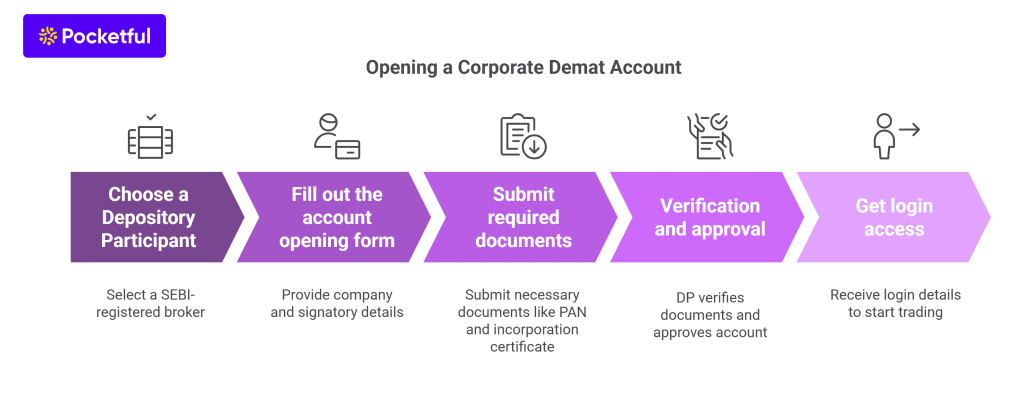
How to Open a Corporate Demat Account?
If your company wants to participate in investment or stock market-related activities, opening a corporate demat account is the first step. The process of opening it is easy; just follow a few important steps:
Choose a Depository Participant (DP): Choose a SEBI-registered broker, such as Pocketful.
Fill out the account opening form. Fill the form with the company details and authorized signatory information.
Submit the required documents: Company PAN, Certificate of Incorporation, board resolution, etc. (the full list is in the next section).
Verification and approval: After verification of documents by the DP, the account will be approved.
Get login access: After approval, login details are sent to you, through which you can start trading.
To open a corporate demat account, a company needs to submit certain documents. These documents reflect the legal identity of the company, permission to operate and validity of authorized signatories. Below is the list of required documents:
Board Resolution: An official resolution issued on the company’s letterhead, allowing the opening of a corporate demat account.
List of Authorized Signatories: Complete list of all authorized signatories on the company’s letterhead.
Directors’ Details: List of all Directors on the company’s letterhead.
Financial Records: Copies of the balance sheets of the last two financial years, Memorandum of Association (MOA), and Articles of Association (AOA).
Identity Proof: Self-attested copies of PAN and Aadhaar cards of authorized directors and signatories.
Bank Details: A valid cancelled cheque from the company’s bank account.
Registration Documents: Company’s registration certificate and other required registration documents.
Corporate Demat Account Eligibility
A corporate demat account can only be opened by entities that fulfil certain eligibility criteria:
Must be a registered company: The account can only be opened by private limited companies, public limited companies, LLPs, trusts or other registered entities.
Valid PAN Card: It is mandatory to have a valid PAN in the name of the company.
Bank Account: It is mandatory to have a current bank account in the name of the company.
Regulatory Compliance: The company must be registered and compliant with the Companies Act 2013 and SEBI (Securities and Exchange Board of India) rules.
Board Resolution: A resolution passed by the board of the company authorising the person to open and operate a demat account.
In today’s fast-changing business environment, a corporate demat account has become an extremely important financial tool. It not only allows to digitally track and manage company investments but also facilitates smooth conduct of corporate actions such as IPOs, bonuses, share transfers and ESOPs. If you run a private limited, public limited or registered entity, now is the time to start investing through a corporate demat account.
We, Pocketful, as a registered stockbroker, help you open a corporate demat account with a fast, transparent and cost-effective process. Contact us today and take your investing game to new heights!
Frequently Asked Questions (FAQs)
Who can open a Corporate Demat Account?
Any registered company or organization like Pvt Ltd, LLP, Trust etc. can open a corporate demat account.
What documents are required to open a Corporate Demat Account?
PAN, MOA, AOA, Board Resolution, Directors details, Bank details and Address Proof.
Can a company have multiple Corporate Demat Accounts?
Yes, a company can have multiple Demat accounts with different Depository Participants (DPs).
Is it mandatory to have a Corporate Demat Account for a company?
If the company wants to invest in shares or IPO, then yes.
Are there any charges associated with a Corporate Demat Account?
Yes, like account opening fees, AMC and transaction fees.
Can a foreign company open a Corporate Demat Account in India?
Yes, they can open a corporate demat account after fulfilling all the requirements.
A nation’s strength lies in its shield—its defense sector, guarding against threats and ensuring peace. India’s resolute “Operation Sindoor” on May 7, 2025, showcased this might, turning investor eyes towards the defense sector stocks. As the defense needs of the country increase, investors actively search for defense companies for investment.
After the Balakot airstrike in 2019, share prices of numerous defense companies increased considerably in the following days. Could a similar surge in defense stock prices follow Operation Sindoor? In this blog, we will discover which Indian defense companies are offering an opportunity to invest.
What is Operation Sindoor?
Operation Sindoor is the codename of missile strikes carried out by the Indian Armed Forces on 7 May 2025, targeting terrorist bases in Pakistan and Pakistan-Occupied Kashmir (PoK). The operation was carried out in response to the terrorist attack in Pahalgam, Jammu and Kashmir on 22 April, in which 26 tourists were killed. It not only had an impact from a strategic point of view, but also renewed investors’ interest in the Indian defense industry.
History has shown us time and again that whenever India has taken a tough stand on the military front, defense stocks have surged. For instance, after the 2016 surgical strike and the 2019 Balakot airstrike, stocks of companies like Bharat Electronics (BEL), HAL, and BDL saw a good surge after both the incidents.
At a time when national security becomes a priority, the government increases the defense budget and approves new deals. This leads to new orders for defense sector companies and improves their profitability.
The Indian Defence Sector: 2026 Outlook
Currently, India’s defence sector is undergoing a significant transformation, driven by the ‘Make in India‘ initiative and the goal of self-reliance.
Budget Allocation: The Defence Ministry has been allocated a record budget of ₹6.81 lakh crore for FY 2025-26, an increase of 9.53% over the previous year. It constitutes 13.45% of the total Union Budget, which is the highest among all ministries.
Local production and exports: Under the ‘Make in India‘ initiative, India’s defence production has reached ₹1.27 lakh crore in FY 2023-24, while defence exports have reached an all-time high of ₹23,622 crore.
Private sector participation: The government has encouraged private companies to participate in defence production, leading to increased participation from companies such as Larsen & Toubro, Adani Group and Tata Sons.
Through these initiatives, India is not only moving towards meeting its own defence requirements but also becoming a significant player in the global defence market.
Top Defence Stocks to Watch After Operation Sindoor
Some of the Indian Defense stocks to watch out for after Operation Sindoor are mentioned below:
Hindustan Aeronautics Limited (HAL): India’s leading aerospace and defense manufacturer, HAL has recently received an order worth ₹13,500 crore for 12 Sukhoi fighter jets. Moreover, on 1 April, HAL bagged a ₹62,700 crore order for the manufacturing of 156 light combat helicopters.
Bharat Electronics Limited (BEL): A leader in manufacturing of defence electronics systems, BEL recently won a ₹2,200 crore contract from the Indian Air Force for supplying advanced Electronic Warfare (EW) suite for their helicopters.
Bharat Dynamics Limited (BDL): Headquartered in Hyderabad, Bharat Dynamics Limited (BDL) is a Public Sector Undertaking under India’s Ministry of Defence, established on July 16, 1970. BDL manufactures guided missile systems and allied equipment for the Indian Armed Forces, collaborating with DRDO and foreign OEMs.
Mazagon Dock Shipbuilders Limited (Mazagon Dock): A global leader in the construction of submarines and warships, the company has a market capitalisation of ₹1.20 lakh crore. Taken over by the Government in 1960, The company has built 805 vessels, including 30 warships and 8 submarines, serving both the Indian Navy and global clients with advanced shipbuilding expertise.
Data Patterns: Specialist in manufacturing of defence electronic systems such as radars, avionic systems and other electronic warfare systems, the company plays a key role in enhancing India’s defense capabilities. According to experts, this company is a rising star in the defence sector.
Top Defence Stocks
Company Name
Key Highlights
1 Month Performance
HAL (Hindustan Aeronautics Ltd.)
Sukhoi jet order worth ₹13,500 crore, strong Q3 results
11.06%
BEL (Bharat Electronics Ltd.)
60% market share, key electronics supplier
10.66%
BDL (Bharat Dynamics Ltd.)
Missile systems manufacturer, strong order book
14.74%
Mazagon Dock
Submarines and warships manufacturer
22.09%
Data Patterns
Defence tech and software, emerging company
35.30%
(Data as of 8 May 2025)
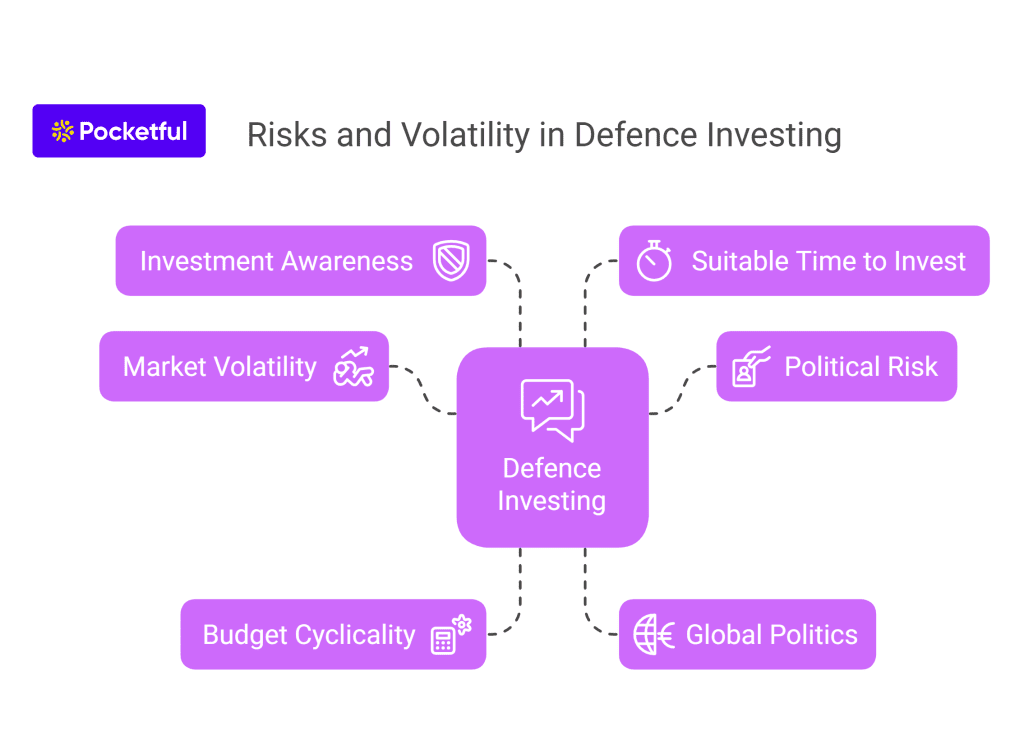
Risks & Volatility in Defence Investing
While investing in the defence sector, it is important to understand some key risks and fluctuations.
Market volatility : Defence stocks experience volatility due to global events and political tensions. There was volatility in the Indian stock market after Operation Sindoor, which led to a decline in the shares of defence companies. The market may fall during war or conflict, while there may also be gains during peace. At such times, investors should remain cautious and pay attention to the market conditions.
Political risk and delay in supply : The defence sector is affected by government policies and political decisions. Issues such as delay in supply of defence equipment, quality issues also pose risks to investors. Sometimes disputes in defence contracts or not completing production within the deadline lead to supply disruptions, causing uncertainty.
Cyclicality in budget allocation : The defence budget fluctuates every year. Sometimes there is an underallocation, which can hinder the growth of defence companies. The defense budget has been increased for 2025-26, but despite this, further increase in capital expenditure may be required for this sector.
Global politics and regional tensions : Geopolitical issues and regional tensions can also increase risks associated with investment in the defense sector. If tensions with neighboring countries increase, it will affect India’s defense sector as important supply chains of raw materials required by these companies may be hampered. Moreover, the global security situation may change after incidents like Operation Sindoor, resulting in losses to investors.
Investment awareness : Before investing in the defense sector, investors need to understand its policies, budget, and global defense industry. Investing with a long-term perspective and taking decisions based on the right information can reduce risks.
Suitable time to invest : After a fall in defense stocks, investing at the right time can yield benefits. Investors should plan their investments carefully, understanding the recent developments and constantly monitor their investments.
Keeping these risks in mind, investors should take a long-term view. The Indian defense sector has good growth potential, making it an attractive investment option.
Is It the Right Time to Invest?
The Indian defense sector has undergone significant changes, which have impacted investment in the sector. Favorable government policies and increased defense spending are expected to benefit the sector, but at the same time the market remains volatile.
Long-term outlook : Defense production in India is getting a boost under the “Make in India” initiative. 193 defense contracts were signed in FY24-25, with a total value of over ₹2.1 trillion, the largest figure ever.
Risks and volatility : While the long-term outlook for the defense sector is positive, the market witnessed volatility after Operation Sindoor. On May 7, the Sensex fell by 704 points, while the Nifty 50 fell by 169 points. This reflects market volatility, which poses risks for investors.
The defence sector has long-term growth potential, but given market volatility and external events, it is important to assess risks before investing in this sector.
Investing in the defense sector can be an attractive opportunity given India’s growing global presence. The government’s “Make in India” initiative and rising defense budgets have strengthened the long-term growth prospects for the sector. Events like Operation Sindoor give a new twist to the sector, but investors should also understand the risks involved, such as market volatility and political uncertainties.
The sector certainly has growth potential, but it is important to understand government policies, defense contracts and the global security situation before investing. Adopting a balanced approach, where both opportunities and risks are properly evaluated, will be key to succeeding in the stock market. Moreover, it is advised to consult a financial advisor before investing.
Frequently Asked Questions (FAQs)
What is Operation Sindoor?
Operation Sindoor was a strategic attack launched by India on 7 May 2025, aimed at taking quick and effective action against terrorists.
Which are the top defence stocks to consider after Operation Sindoor?
Key defense stocks include BEL (Bharat Electronics Ltd.), HAL (Hindustan Aeronautics Ltd.), and BDL (Bharat Dynamics Ltd.). These companies have long-term growth potential.
Is it a good time to invest in defence stocks?
The defence sector has good growth potential due to record number of defence contracts in the past one year, but due to market volatility and external events, it is important for investors to assess the risk or consult a financial advisor before investing.
What factors should be considered before investing in defence stocks?
Before investing you should understand the company’s financial position, government policies, defense budget, and global security scenario.
Can defence stocks outperform other sectors in India?
The defense sector has growth potential, but it may be riskier than other sectors, especially during unstable global conditions.
What is the role of “Make in India” in the growth of defence stocks?
The “Make in India” initiative is promoting domestic defence production, which supports long-term growth for Indian defence companies.
Selection Methodology and Important Disclaimer
The stocks included in this list are selected primarily on the basis of their market capitalisation, which represents the total market value of a company’s outstanding shares. The companies are arranged in descending order of market capitalisation, with larger companies appearing first, followed by relatively smaller companies. This methodology is intended to provide a structured approach for identifying companies based on their market size and overall presence within a sector.
However, market capitalisation should not be considered the sole factor while evaluating investment opportunities, as it does not guarantee future performance, profitability, or returns. Investors should also assess other important factors such as financial health, business fundamentals, management quality, valuation metrics, industry outlook, and market conditions before making investment decisions.
The information provided is for educational and informational purposes only and should not be construed as investment advice, recommendation, solicitation, or an offer to buy or sell any securities by Pocketful Fintech Capital Private Limited.
If you are looking for YouTube channels offering valuable trading knowledge, then you are in the right place. Learning the art of trading from the best can provide you with all the insights you need in one place. YouTube has established itself as a valuable resource in the modern world, offering numerous trading channels.
In this blog, we’ll help you discover the best YouTube trading channels in India. Trading YouTube channels in India are helpful in learning not only basic concepts and trading psychology, but also advanced technical tools and concepts.
What is Trading YouTube Channels?
The best trading channels on YouTube cater to both beginners and experienced traders, allowing content to be consumed free of cost. However, there is an abundance of creators, making it a challenge for one to select a trading Youtube channel that is credible enough. These channels, along with many others, have managed to capture the attention of their audience by teaching valuable trading concepts, helpful for beginners and seasoned traders alike.
In the following table, you’ll find an overview of the best trading channels, their unique selling points, popular videos, and the ideal audience they cater to. Whether you’re interested in intraday trading, swing trading, or simply improving your market knowledge, these channels provide valuable resources to help you sharpen your trading skills.
Rank
Channel Name
Subscribers
USP (Unique Selling Point)
Popular Video
Ideal For
1
Pushkar Raj Thakur
15.2M
Practical financial knowledge focused on stock market strategies
How to be Rich? Step – 1: 40 days Financial Transformation
Aspiring traders, Intraday traders, Beginners
2
Pranjal Kamra
6.5M
A combination of investing + technical trading
Stock Market For Beginners
How can Beginners Start Investing in Share Market
3
CA Rachana Phadke Ranade
5.4M
Trading concepts explained in an easy-to-understand manner
Basics of Stock Market for Beginners
Those who are new to stock trading
4
Neeraj Joshi
5.15M
His video commentary on real-time trading makes his teaching unique
Individuals looking to improve trading psychology and beginners
6
Power Of Stocks
2.14M
Guides in option trading—shares real trades, profits & losses.
5 EMA The only Trading Strategy you Need
Experienced, yet beginner-friendly for new traders.
7
Ghanshyam Tech
1.5M
Real time market evaluation and trade setups
Bank Nifty Forms Dragonfly Doji Pattern – Bank Nifty 15 min chart analysis
Hindi speakers with an interest in stock market
8
IITian Trader
1.21M
Trading concepts explained with a focus on crypto markets
Options Trading – How to Start Options Trading Journey
Traders looking to learn more about crypto trading
9
Nitin Bhatia
991K
Technical analysis, swing trading, personal finance
Best Intraday Trend Indicator
F&O strategists, traders, early starters
10
Traders Paradise Live
918K
Daily live trading sessions during market time.
How to Trade Breakouts|Eye Opener Strategy.
People who actively pay attention to the market
Overview of the top 10 Trading YouTube channels in India is given below:
1. Pushkar Raj Thakur: Stock Market Educator
Pushkar Raj is a leading trading YouTube channel in India with a subscriber base of 15 Mn. This channel gives us complete information about Stock market trading, investment strategies, and managing personal finances. Pushkar Raj, a Guinness World Record holder, is known for his motivational speaking and business coaching simultaneously focusing on empowering individuals in the finance domain.
USP: Practical financial knowledge focused on stock market strategies.
Popular Video: How to be Rich? Step – 1: 40 days Financial Transformation.
Ideal For: Aspiring traders, Intraday traders and beginners.
2. Finology with Pranjal
More of a long-term investor, but Pranjal does provide valuable trading insights and explains technical trading jargon with ease. His videos take a case-study approach making it easier to be understood by new aspiring traders. As of 7 May 2025, Finology has 6.49 Mn subscribers
USP: A combination of investing + technical trading.
Popular Video: Stock Market For Beginners | How can Beginners Start Investing in Share Market
Ideal For: Investors trying to learn trading.
3. CA Rachana Phadke Ranade
Through her YouTube channel, CA Rachna Phadke Ranade offers a range of content aimed at both beginners and seasoned investors, covering topics such as technical and fundamental analysis, options trading, and market trends. Her teaching style is characterized by clarity and practicality, making complex financial topics accessible to a broad audience. This is counted amongst the best youtube channels in India with 5.38 Mn subscribers.
USP: Trading concepts are explained in an easy-to -understand manner.
Popular Video: Basics of Stock Market for Beginners
Who Is This Video Suited For: Those who are new to stock trading.
4. Neeraj Joshi
Neeraj Joshi offers a clear knowledge about the stock market investing and exceptional trading strategies, transforming complicated concepts into simple lessons making it available for a broader audience. This channel has a subscriber base of 4.91 Mn.
USP : His Video Commentary On Real Time Trading Makes His Teaching Unique.
Popular Video: Share Market basics for Beginners Crash Course.
Who Is This Video Suited For: Day traders, swing traders, etc.
5. Booming Bulls
Motivational and educational trading content has earned Anish Singh Thakur a massive follower base of 3.5 Mn. His live webinars and organized lessons make it one of the best trading YouTube channels for students.
Ideal For: Individuals looking to improve trading psychology and beginners.
6. Power of Stocks
This channel, led by Vivek Singh, focuses on price action trading, option buying and selling strategies, and in-depth technical analysis. The channel helps viewers understand real market movements with practical trading psychology and chart analysis. It caters to both beginners and experienced traders and has a subscriber base of around 2.11 million.
USP: Teaches real-time price action setups with transparency on profits and losses.
Popular Video: Best Price Action Strategy for Bank Nifty – Live Market Trade Explained
Optimal For: Traders who want to learn price action and option trading in Hindi.
7. Ghanshyam Tech
This channel educates its subscribers on stock market trading, trade setups and market conditions that primarily focuses on Bank Nifty & Nifty options trading strategies. This channel focuses on offering knowledge to both newbies and advanced traders and has a subscriber base of 1.51 Mn.
USP: Real time market evaluation and trade setups.
Popular Video: Bank Nifty Forms Dragonfly Doji Pattern – Bank Nifty 15 min chart analysis
Optimal For: Hindi speakers with an interest in the stock market.
8. IITian Trader
IITian Trader, run by Saurabh Maurya, an IIT-BHU graduate, is a YouTube channel offering practical lessons on trading, covering options, intraday strategies, and technical analysis for beginners and experienced traders alike. The YouTube channel has a subscriber base of 1.21 Mn.
USP: Trading concepts are explained with a focus on crypto markets.
Popular Video: Options Trading – How to Start Options Trading Journey
Who Is This Video Suited For: Traders looking to learn more about crypto trading.
9. Nitin Bhatia
Nitin Bhatia’s channel contains a blend of information related to market psychology, derivatives, and various trading setups, giving you in-depth knowledge on core trading concepts. The channel has a large subscriber base of 996k.
USP: Information related to technical analysis, swing trading, and personal finance.
Popular Video: Best Intraday Trend Indicator.
Optimal For: F&O strategists, traders and early starters.
10. Traders Paradise Live
Sagar Darji, focuses on option trading strategies, live market analysis, and intraday setups. The channel helps viewers learn how to identify profitable trades, manage risk, and build confidence in live market conditions. It has a growing community of over 113k subscribers.
USP: Daily live trading during market hours with clear profit and loss visibility.
Popular Video: Best Bank Nifty Option Buying Strategy – Live Market Profit ₹50,000+
Optimal For: Beginners and intermediate traders looking to learn practical trading in Hindi.
Factors To Keep In Mind Before Watching
Before subscribing, following, or taking suggestions from these trading YouTube channels, make sure you consider the following factors :
Consistency: Are they posting videos related to trading regularly?
Honesty: Do they show genuine trades and openly discuss losing trades, too?
Experience: Check their background, credentials, and professional profiles.
Community Feedback: Analyze comments and community discussion around the video.
Separating Paid and Free Content: Are they genuinely providing information free of cost or teaching basic concepts for selling paid courses or services?
Content Depth: Are the concepts explained in a simple and straightforward manner with detailed step-by-step explanations or not?
Advantages & Disadvantages of Trading YouTube Channels
Advantages
Choosing to trade on your own can be a stressful task, especially if you are a beginner. However, YouTube is an excellent source of information. Let us look at the major advantages of trading YouTube channels in India.
1. No Charges For Quality Education : You can understand how the market functions without spending thousands on a course. Channels like CA Rachana Ranade and Booming Bulls teach the fundamentals of candlestick patterns, price action, and intraday setups to beginners, free of cost.
Great flexibility and convenience for students and working professionals
Perfect for individuals looking for free resources
Trainers are SEBI-registered professionals and genuine traders
2. Learning As Per Your Schedule : Through YouTube, you can acquire knowledge at your convenience. Whether it’s during lunch break, at night, or during any breaks, you can always have the right things to study.
Replay until you get it right
Remove the stress that comes from following a live batch or fixed schedule
Have the freedom to customize your learning path through a selection of videos
3. Exposure to Diverse Trading Styles : Each trader has a different strategy. While some focus on intraday trading, others may focus on mastering swing trading. Best trading YouTube channels have something for each type of trader.
Helps you identify which strategy best aligns with your trading style
Both discretionary and systematic trading are taught
Learn what works during different market scenarios
4. Real-Time Market Examples : Many creators stream their screens and explain live trades. Watching setups unfold in real markets provides much more value compared to textbook learning.
Learn how traders respond to varying volatility
Position sizing and stop-loss placement along with trading strategies are taught
Understand the decision-making process in fast-paced markets
5. Community Interaction and Engagement : These channels have comment sections, live Q&As, and related telegram groups. In these communities, you can ask doubts or share your findings, and enhance your trading knowledge.
Communities help in collective learning.
Live Q&A’s help the audience connect with the educator promptly and resolve their doubts immediately.
Support from other traders keeps you motivated.
Disadvantages
Youtube is a great platform but it does have its’ cons. Here are some practical drawbacks you should consider before exclusively depending on learning trading through YouTube trading channels:
1. Content Overload : With thousands of videos available, one can easily fall into the trap of just consuming content without actually implementing anything strategically.
Unstructured information creates disorientation and stagnation in following the content.
Beginners may be exposed to contrasting strategies that are executed in conflicting ways by different educators.
2. Absence of Personal Guiding and Mentoring : You get no feedback on your trades, negative trades can hamper mindset and give rise to doubts.
No feedback leads to no improvement.
Repeatedly executing trades based on flawed trading approach and strategy.
Difficult to navigate content designed around individual’s trading preference
3. Not All Creators Are Certified And Experienced: While popular creators are reliable, there are a lot of content creators on YouTue that don’t have the required knowledge or expertise to teach complex stock market concepts.
There is a minimal regulatory oversight on the content creators with a smaller subscriber base.
There are no frameworks guaranteeing the authenticity of claims.
Many creators only show successful trades, which gives aspiring traders an unrealistic expectation.
4. Aggressive Sales Tactics : Some channels prioritize selling over educating, pushing their courses and tools for purchase in every video while offering little educational value through their “free” content.
More focus on selling their paid course.
Guidance offered without genuine marketing intent is hard to identify for a new trader.
Purchasing expensive courses impulsively can result in financial losses.
5. Market Dependency : Strategies for a bullish market might fail miserably in a sideways or bearish market. Trending YouTube videos can omit disclaimers like these.
Implementation of specific strategy without regard to changing market conditions is a common mistake that can cause significant losses.
Trading on market information already factored in can hamper your trading results.
YouTube has proven to be a great tool for individuals looking to learn about trading concepts from India’s top educators. Each of the top 10 trading YouTube channels has something different and unique to offer. Finding the right mentor comes down to identifying the individual whose approach aligns with your learning preferences and trading style. Don’t just learn; put your skills to the test, and your trading performance will enhance over time. If you are into intraday trading, swing trading, or positional trading, there is a mentor for you waiting on YouTube.
Take note: Learning is free, but exercising self-discipline requires sustained effort. Make your choices wisely and trade smart.
S.NO.
Check Out These Interesting Posts You Might Enjoy!
Fast food has become a huge part of our daily lives, whether it’s a quick lunch at KFC, a pizza party at Pizza Hut with friends, or a cheeky Taco Bell run. But have you ever wondered who runs all these popular chains in India?
That’s where Devyani International and Sapphire Foods come in. These two companies are the powerhouses behind your favourite quick-service restaurants, operating hundreds of outlets across India and even overseas.
In this blog, we’ll break down who they are, how they got started, and how they stack up against each other financially. Think of it as a behind-the-scenes look at the business of burgers, pizzas, and beyond!
Devyani International – An Overview
Devyani International Ltd. (DIL) is one of the biggest names in India’s quick service restaurant (QSR) space. If you’ve ever grabbed a bite from KFC, Pizza Hut, or Taco Bell in India, chances are it was operated by them! They’re one of the largest franchisees of Yum! Brands in the country and also run some homegrown food brands like Vaango, The Food Street, and Masala Twist.
A Quick Look at Their Journey
Started in 1991, Devyani International is part of the RJ Corp Group, headed by Ravi Jaipuria, a major player in the food and beverages industry.
They teamed up with Yum! Brands early on, bringing Pizza Hut and later KFC to Indian diners.
In 2011, they launched Vaango, their own South Indian vegetarian restaurant chain.
Over the years, they expanded outside India too, you’ll find their outlets in Nepal and Nigeria.
Currently, the company operates 941 KFC restaurants, 572 Pizza Hut outlets and 179 Costa Coffee stores in India.
In 2021, they went public with a highly successful IPO, and their shares were listed on the NSE and BSE.
Since then, they’ve been growing fast, opening new outlets in big cities and small towns alike, and putting a lot of focus on online orders and delivery.
Sapphire Foods – Overview
Sapphire Foods is one of the big names behind some of your favourite quick-service restaurants in India and nearby countries. They run a large number of KFC, Pizza Hut, and Taco Bell outlets across India, Sri Lanka, and the Maldives. So, if you’ve ever enjoyed a crispy bucket of chicken or a cheesy slice of pizza, there’s a good chance Sapphire Foods was behind it.
A Quick Look at Their Journey
The company was initially incorporated as Samarjit Advisors Pvt. Ltd in 2009, but was later renamed as Sapphire Foods in 2015.
In 2015, the company made a big move by acquiring over 270 KFC and Pizza Hut stores in India and Sri Lanka.
Since then, they’ve grown fast, opening restaurants in more than 106 cities and spreading to places like Sri Lanka and the Maldives too.
Currently, the company operates 429 KFC restaurants and 319 Pizza Hut outlets in India.
In 2021, they went public, and their shares were listed on the Indian stock markets.
Comparative Study: Devyani International vs. Sapphire Foods
Particulars
Devyani International
Sapphire Foods
Current Price
₹177
₹316
Market Capitalization (₹ Crores)
21,351
10,167
52-Week High
₹223
₹401
52-Week Low
₹130
₹242
FII Holdings as of March 2025
10.46%
30.42%
DII Holdings (as of March 2025)
16.87%
38.51%
Book Value
₹9.66
₹42.4
PE Ratio
1,592
413
(Data as of 6 May 2025)
Financial Statements Comparison of Devyani International and Sapphire Foods
Income Statement
Particulars
Devyani International
Sapphire Foods
Total Income
3,588
2,627
Total Expenditure
3,398
2,456
EBIT
190
170
Net Profit
-9
51
(All the values are in INR crores unless stated otherwise)
Balance Sheet
Particulars
Devyani International
Sapphire Foods
Current Liabilities
911
444
Non-Current Liabilities
2,673
1,056
Current Assets
486
363
Non-Current Assets
4,446
2,477
Equity Share Capital
120
64
Reserves & Surplus
910
1,275
(All the values are in INR crores unless stated otherwise)
Cash Flow Statements
Particulars
Devyani International
Sapphire Foods
Cash Flow from Operating Activities
592
448
Cash Flow from Investing Activities
-1,550
-186
Cash Flow from Financing Activities
889
-212
(All the values are in INR crores unless stated otherwise)
Key Performance Indicators (KPIs)
Particulars
Devyani International
Sapphire Foods
Basic EPS (₹)
0.39
8.30
Operating Profit Margin (%)
8.27
6.58
Net Profit Margin (%)
-0.27
2
Return on Equity (%)
4.48
3.94
Return on Capital Employed (%)
7.31
7.13
Debt-to-Equity (x)
0.86
0.02
Devyani International vs Sapphire Foods: Which Company is Better?
Honestly, it depends on what you’re looking at.
If we’re talking size and revenues, Devyani International definitely has the edge. It runs more outlets, makes more money, and has a few extra brands under its belt. It’s also been in the game longer, which shows in its wider reach and stronger numbers. However, the business reported a net loss in March 2024.
But Sapphire Foods isn’t far behind. It’s growing steadily, runs high-performing outlets, and has a solid presence in international markets like Sri Lanka and the Maldives. It seems to focus more on quality over quantity and is playing the long game.
So, is one better than the other?
Devyani is winning on scale and operating margins, and Sapphire has a significantly higher EPS. It is hard to pick one as both companies have long-term potential if you’re betting on India’s growing appetite for fast food.
Inference:
Devyani operates more outlets across countries, which reflects in its higher revenue.
Sapphire is more focused on efficiency and operates stores in select international markets like Sri Lanka and the Maldives.
Devyani International posted a net loss of ₹9 crores in March 2024, in contrast to a net profit of ₹51 crores for Sapphire Foods.
Both companies are strong franchise operators for Yum! Brands, but Devyani also operates some in-house brands, which gives the company more diversification.
Based on the above information, deciding between the two companies for investment can be a tough decision and it is advised to consult a financial advisor before investing.
Both Devyani International and Sapphire Foods are doing a great job serving millions of customers across India and beyond. While Devyani is ahead in terms of revenues and number of outlets, Sapphire is playing it smart with a focus on growth and efficient operations.
At the end of the day, whether you’re grabbing a crispy KFC bucket or biting into a cheesy Pizza Hut slice, you’re enjoying the results of two well-run companies working hard behind the scenes. So next time you’re at one of these places, you’ll know a bit more about the business that’s serving you. When it comes to selecting between the two, it can be a tricky decision and it is advised to consult a financial advisor before investing.
Frequently Asked Questions (FAQs)
Who owns Devyani International?
It’s part of the RJ Corp group, which is headed by Ravi Jaipuria, a well-known name in the food and beverage world.
Devyani International vs Sapphire Foods: Which company is bigger?
Devyani International is ahead right now since it has more outlets, more revenue, and a higher market capitalization.
Do Devyani International and Sapphire Foods operate outside India too?
Yes! Devyani has a presence in Nepal and Nigeria, while Sapphire is active in Sri Lanka and the Maldives.
Who has more stores in India?
Devyani International, by a good margin. They are operating over 1,600 outlets, while Sapphire has around 700 outlets.
How can I invest in Devyani International and Sapphire Foods?
Both companies are listed and available for retail investors to invest if you’re interested in the food and QSR space. But do not forget to consult your financial expert before making any investment decision.
Open Free Demat Account
Join Pocketful Now
You have successfully subscribed to the newsletter
There was an error while trying to send your request. Please try again.