Blog

  • Top 10 Copper Stocks in India 2026

    Top 10 Copper Stocks in India 2026

    Copper is an important metal used in industries in power transmission, electrical equipment, construction, electronics, renewable energy and also electric vehicles. As India keeps expanding its power infrastructure, ramps up manufacturing capacity, and increases clean-energy investment, firms that sit inside the copper supply chain, like copper mining, smelting, refining, manufacturing and recycling, could see stronger demand, more or less.

    But, not every company that has copper exposure is automatically a “pure play” copper stock. Some do copper mining or copper refining, and others are more like copper wires, rods, tubes , and recycled product types. so it depends.

    Quick answer: If you’re hunting for the best copper stocks in India, you should judge the list using direct copper exposure, business scale, financial strength , profitability, debt levels and stated growth plans, not just share price as a single measure. Hindustan Copper, Hindalco Industries, Vedanta, and Adani Enterprises have meaningful ties to the copper value chain. Meanwhile companies like Precision Wires India, plus a handful of smaller manufacturers, can give a bit more specialised exposure.

    The table below gives a quick copper share list for investors who want to compare names before going deeper.

    Top 10 Copper Stocks India: Quick Comparison

    CompanyCopper ExposureCurrent Price (₹)Market Cap (₹ Cr)52-Week High (₹)52-Week Low (₹)
    Adani Enterprises Ltd.Copper smelting and refining2,859.103,87,0433,245.001,753.00
    Hindalco Industries Ltd.Copper smelting, refining and rods1,014.002,27,9361,179.00697.00
    Vedanta Ltd.Copper refining and processing278.201,08,787795.00249.70
    Hindustan Copper Ltd.Copper mining and production527.0050,909760.05228.10
    Precision Wires India Ltd.Copper winding wires495.009,048524.90170.61
    Bhagyanagar India Ltd.Copper rods, wires, pipes and strips381.001,275438.0086.00
    Rajputana Industries Ltd.Copper wires, rods and sheets65.0014795.0060.00
    Parmeshwar Metal Ltd.Copper recycling and products296.90454327.9064.71
    Madhav Copper Ltd.Copper wires, rods and strips57.6615993.2042.00
    Cubex Tubings Ltd.Copper alloy tubes and pipes77.27111143.6973.10
    (Data as of 01 September 2026)

    Note: This list is for learning comparisons and it isn’t a ranking of what returns you should expect. The companies show up here because of how much copper mining, refining, processing, product-making, or recycling they’re tied to. Market capitalisation can be one quick screening factor but don’t treat it like a true measure of investment quality.

    Overview of Top 10 Copper Stocks India

    The companies below offer exposure to different parts of India’s copper industry. The list is broadly arranged based on business scale and their relevance to the copper value chain. Being higher on the list does not mean a stock is expected to deliver better returns.

    1. Adani Enterprises Ltd.

    Adani Enterprises has entered the copper industry through its wholly owned subsidiary, Kutch Copper. The company is developing a large copper smelting and refining facility at Mundra in Gujarat.

    A key development came in July 2026, when Kutch Copper’s Grade-A cathodes received London Metal Exchange (LME) brand registration. This allows the company’s copper to be used for delivery against LME copper futures contracts.

    For Adani Enterprises, the project provides a direct entry into copper production at a time when India’s demand for the metal is rising. It also fits into the country’s push to reduce its dependence on imported refined copper.

    Why it matters:

    • Copper plant at Mundra
    • 0.5 MTPA initial capacity
    • Capacity planned to reach 1 MTPA
    • Benefits from rising domestic copper demand

    Key risk: Kutch Copper is still a new business for Adani Enterprises. The company will need to successfully ramp up production while managing the large capital investment required for the project. Investors should also consider the performance of Adani Enterprises’ other businesses before evaluating the stock.

    2. Hindalco Industries Ltd.

    Hindalco Industries is an Aditya Birla Group company with a strong presence in both aluminium and copper. Its copper business is run under the Birla Copper brand.

    The company’s main copper facility is located at Dahej in Gujarat. The site has smelters, refineries, copper rod plants, captive power units and other supporting facilities. Hindalco has a copper smelting capacity of 500,000 tonnes a year at Dahej. Its Asoj plant has a capacity to produce 225,000 tonnes of continuous-cast copper rods.

    Hindalco is also planning to increase its copper production. It has announced a 300,000-tonne expansion at Dahej. Once completed, the expansion is expected to take the company’s refined copper capacity to 721,000 tonnes a year. The project is expected to be commissioned by FY2028-29.

    With an existing copper business and more capacity in the pipeline, Hindalco is one of the bigger listed names in India’s copper space.

    Why it matters:

    • Established copper business
    • 500,000-tonne smelting capacity at Dahej
    • 225,000-tonne copper rod capacity at Asoj
    • 300,000-tonne expansion planned

    Key risk: Hindalco is not a pure-play copper company. Aluminium remains a major part of its business, while the performance of Novelis also has a significant impact on the company’s overall results.

    3. Vedanta Ltd.

    Vedanta is a natural-resources firm. It works across metals, mining, oil and gas, and other resource areas.

    In copper, the firm points to assets in Tamil Nadu and at Silvassa. At Tuticorin, there is a smelter and a refinery. However, the Tuticorin site is not running right now. Vedanta says the Tuticorin smelter can make 400 KTPA. It also says the Silvassa refinery has a capacity of 216 KTPA.

    So, Vedanta’s copper setup can still give investors a view of the copper supply chain. Still, the actual operating state of these plants matters a lot for judging the business.

    Why this is important:

    • There is major copper infrastructure already in place  
    • There is also refining capacity on the downstream side  
    • The company is not tied to just one type of resource  
    • Results may swing with global metal prices  

    Key risk: The current status of the Tuticorin smelter. You should also factor in Vedanta’s wider debt load and its exposure to commodity swings when you assess the company.

    4. Hindustan Copper Ltd.

    Hindustan Copper Ltd. is a state-run company that makes copper. It can be a straightforward way to hold listed equity linked to copper mining in India.

    The firm runs mines and plants in several places. These include Malanjkhand in Madhya Pradesh, Khetri in Rajasthan, and the Indian Copper Complex in Jharkhand. Its work covers exploration, mining, beneficiation, smelting, and refining.

    HCL is also growing its capacity. The Malanjkhand site is set to move from 2.5 MTPA to 5 MTPA for ore production. At the same time, the company plans to raise output by expanding existing mines, bringing back closed mines, and starting new ones.

    Why this stands out:

    • Copper-mining link through an equity listing
    • Government ownership
    • Growth at Malanjkhand
    • More chances from mine development

    Key risk: Mining projects can run into issues tied to operations, rules, geology, and project delivery. The stock can also react to changes in copper prices.

    5. Precision Wires India Ltd.

    Precision Wires India is a downstream copper manufacturer that produces products such as enamelled copper wires, paper-covered wires and continuously transposed conductors.

    Its products are used in motors, transformers and other electrical equipment. This means its business is linked not only to copper prices but also to demand from power, electrical equipment, automotive and industrial applications.

    Unlike a copper miner, a downstream manufacturer can be affected by the spread between the price at which it purchases copper and the price at which it sells its finished products.

    Why it matters:

    • Strong exposure to copper-based electrical products
    • Demand linked to power and electrical equipment
    • Downstream rather than mining exposure
    • Potential benefit from electrification and grid investment

    Key risk: Margins and working-capital requirements can be affected by changes in copper prices and demand conditions.

    6. Bhagyanagar India Ltd.

    Bhagyanagar India makes copper items such as rods, wires, strips, and pipes. It also has business interests beyond its main copper work.

    Its copper goods are used in areas like electrical equipment, power, building work, and HVAC. Because of that, the firm can benefit from copper needs even if it does not run mining.

    For people looking at Bhagyanagar, the main things to watch are sales demand, plant use, profit levels, cash tied up in daily operations, and how the copper line is doing.

    Why this stands out:

    • Work that sits downstream in copper
    • Ties to power and building demand
    • Several product types in copper
    • A smaller firm with linkages to the copper chain

    Key risk: Compared with big listed metal firms, smaller companies may see larger swings in earnings and may face funding or liquidity stress.

    7. Rajputana Industries Ltd.

    Rajputana Industries makes and sells metal items and the list includes copper wire, copper rods, and copper sheets.  

    Compared with mining or making primary copper, the firm leans more on the market for copper products that come next. So results may track what industrial buyers want. It can also swing with how much the company ships. Input prices and profit margins can matter too.  Because it is not very large, the share price can move more than the stock of bigger copper firms.  

    Why this is relevant:  

    – Making copper products  

    – Tied to industrial buying  

    – A smaller-company angle in the copper supply chain  

    Key risk: Smaller size can raise the chances of swings in business results, liquidity, and earnings.

    8. Parmeshwar Metal Ltd.

    Parmeshwar Metal works with metal recycling. It handles copper and copper-alloy items. The firm turns scrap into usable goods. These include copper rods and billets. Manufacturers can buy these products from them.

    Copper recycling can help with metal supply. It can also cut the need for fresh raw materials. Still, the results depend on several factors. Scrap must be available in steady amounts. Costs to buy scrap matter a lot. Plant efficiency also plays a role. Final sale prices for the products affect the outcome.

    Why this stands out:

    • Work tied to copper recycling
    • A business built on scrap inputs
    • More attention on circular use and better resource use

    Key risk: Higher procurement costs, limited scrap access, and weaker margins can reduce profits.

    9. Madhav Copper Ltd.

    Madhav Copper makes enamelled copper wires, copper rods, copper strips, and paper-covered wires. These items are sold to firms that work in power generation, transformer units, motors, and other electrical gear. So the company’s results tie to how fast India’s power and factory build-out moves.

    For investors, it helps to tell this type of copper play apart from copper mining. With end products, factors like plant use and profit margins can matter as much as the copper price.

    Why it is relevant:

    • Copper-linked electrical products  
    • Links to power and transformer spending  
    • A manufacturing-driven way to get copper exposure  

    Key risk: Smaller company scale and swings in commodity pricing can raise both earnings swings and stock price volatility.

    10. Cubex Tubings Ltd.

    Cubex Tubings makes copper and copper alloy tubing. It also makes pipes and coils. These items are used in refrigeration and air conditioning. They show up in heat exchangers too. They are also used in power systems and other industrial equipment.

    The product range is focused and niche. That gives investors a look at another step in the copper supply chain. This is different from firms that mainly mine copper or process it in smelters.

    How well the company does can shift over time. Export sales matter. Industrial activity matters as well. The price of raw materials can move results. So can how much production capacity is used.

    Why this is important:

    • Copper tubes and pipes with a specific focus
    • Demand tied to industry and HVAC work
    • Business that leans on exports

    Key risk: The company is smaller in scale. It also relies on industrial buyers and export demand. This setup can lead to wider swings in results.

    Key Copper Projects and Expansion Plans in India

    CompanyProject/ExpansionCapacity/ScaleStatus
    Adani EnterprisesKutch Copper, Mundra0.5 MTPA initial capacity; planned 1 MTPAOperational and ramping up
    Hindalco IndustriesDahej copper smelter expansion+300 KTPA; refined output targeted at 721 KTPATargeted for FY2028-29
    Hindustan CopperMalanjkhand expansionOre capacity from 2.5 MTPA to 5 MTPAUnder expansion
    Hindustan CopperWider mine expansionLong-term production capacity expansionMultiple projects underway

    Adani’s Kutch copper unit has begun work. It is now being increased in stages. The firm says the full setup is meant to reach 1 MTPA.

    Hindalco’s Dahej upgrade is set to bring in an extra 300,000 tonnes. It should lift refined copper output to 721,000 tonnes. The company plans to begin it in FY2028-29.

    Hindustan Copper is also growing its mining side. The Malanjkhand plan is meant to move ore output from 2.5 MTPA up to 5 MTPA. Other mine projects are planned to raise total production as well.

    Timelines and capacity figures can shift. Investors should review the newest company filings and investor decks before acting on these project details.

    Key Performance Indicators for Copper Stocks

    Here is the updated performance matrix for the requested copper and non-ferrous metal stocks in India, using the latest available financial year (FY26) and trailing-twelve-month (TTM) data.

    CompanyNet Profit Margin (%)ROE (%)ROCE (%)Debt-to-Equity
    Adani Enterprises Ltd.6.55%14.23%24.62%1.41
    Hindalco Industries Ltd.4.87%9.80%12.51%0.71
    Vedanta Ltd.31.99%35.02%21.58%0.54
    Hindustan Copper Ltd.25.79%32.90%42.40%0.03
    Precision Wires India Ltd.2.87%20.10%29.50%0.38
    Bhagyanagar India Ltd.2.11%19.48%19.86%1.01
    Rajputana Industries Ltd.1.81%16.00%18.08%0.83
    Parmeshwar Metal Ltd.1.65%43.50%50.08%0.23
    Madhav Copper Ltd. (M Tek)1.69%10.81%8.63%0.56
    Cubex Tubings Ltd.1.98%9.36%11.50%0.22

    Data period: Latest available financial year or trailing-twelve-month data, as specified at the time of publication.

    What do these numbers mean?

    • Net profit margin: It is how much profit remains after costs, compared with the money earned from sales. A bigger value can point to better profit quality. Still, margins can shift a lot based on where the firm sits in the copper supply chain.
    • ROE, or return on equity: This looks at how much profit comes from the money owned by shareholders. Put simply, it asks how well the company turns that equity base into returns.
    • ROCE, or return on capital employed: This focuses on operating profit. It tries to show how effectively the company uses the capital it has tied up in day to day work.
    • Debt to equity: This compares company debt with shareholder equity. Lower leverage often suggests less strain from borrowing. However, the “right” level varies by sector and by the way the business is run.
    • Final point: Don’t lean on one metric only. A firm can score well on ROE but carry heavy debt. Or it may look strong while the valuation is high.

    Factors to Consider Before Investing in Copper Stocks

    Before you start investing in copper stocks, it’s worth pausing for a minute consider the following factors:

    1. Copper prices: Copper prices are shaped by global supply, demand, stockpiles, industrial activity, mining disruptions, and broader economic conditions. If copper prices swing suddenly it can ripple through the entire value chain, though the effect is not the same for every business model, some companies feel it faster than others.
    2. Revenue and profit growth: Check whether the company’s revenue and earnings are increasing in a steady way. If it’s a manufacturer, don’t just look at the headline numbers, try to understand whether the increase is coming from higher volumes, or if it’s mostly tied to higher copper prices.
    3. Profit margins: Profit margins are a useful signal for how efficiently a company turns sales into profit. For downstream manufacturers, pay attention to whether those rising input costs for raw material copper are being transferred to customers, or if the margins are quietly shrinking.
    4. Debt levels: Debt can raise the financial risk, especially when commodity prices weaken, or when financing costs start to climb. It helps to compare debt-to-equity, and also look at interest coverage, plus cash flows, because strong cash generation can soften the impact.
    5. ROE and ROCE: ROE and ROCE help you judge how effectively the business uses shareholder capital and operating capital. In other words, how well they put working resources to work, rather than just growing on paper.
    6. Capacity and Expansion Plans: Fresh mines, smelters, refineries and manufacturing sites can absolutely boost future output. But investors probably should weigh project cost, the funding requirements, execution risk, and the time needed for commissioning, not just the headline capacity, if you know what I mean.  
    7. Valuation: A solid business is not, by default, a solid investment at any given price. It’s smarter to check valuation measures like P/E and EV/EBITDA against the company’s own historical levels, and also compare it with close peers.  
    8. Commodity and Economic Cycles: Copper behaves like a cyclical item. So, demand may soften during economic slowdowns, while supply disruptions could whip prices upward, sometimes quite sharply.

    Which Copper Stock is Right for You?

    Not all copper stocks in India give you the exact same kind of benefit. Your pick might hinge on where a company is placed along the copper value trail.

    If you are aiming for…Look at…
    Direct exposure to copper miningHindustan Copper
    Big, broad metals style exposure  Hindalco Industries
    Copper smelting and refining exposureAdani Enterprises, Hindalco, Vedanta
    Copper wire production  Precision Wires India, Madhav Copper
    Copper products and downstream manufacturingBhagyanagar India, Cubex Tubings
    Copper recyclingParmeshwar Metal
    Higher-risk small-cap exposureSmaller copper manufacturers

    This sort of split matters, because the profits of a copper miner might swing in a different manner with copper prices than a downstream maker that turns copper into wires, rods or tubes, like a more processing focused pathway. 

    What Are Copper Stocks in India?

    Copper stocks in India are basically shares in listed companies that have exposure to one or more sections of the copper value chain, like extraction and mining, ore processing or beneficiation, smelting, refining and copper rods, wires, tubes, alloys, and recycling too. The whole spectrum depends on the company.

    For instance, Hindustan Copper has direct exposure to copper mining and output. Meanwhile Hindalco runs a more integrated copper setup through Birla Copper. Then there are firms like Precision Wires India which lean more downstream, with a business model centered on copper based electrical products.

    So, investors shouldn’t automatically think that every copper stock will behave in the exact same manner as copper price itself. Because a company’s stock can be swayed by revenue streams, profit margins, production quantities, input costs, debt load, the valuation picture, and even management decisions.

    In short, copper exposure matters, but it’s not the only thing in the mix, and that’s usually the tricky part.

    Read Also: Best Metal Stocks in India

    Why is Copper Important for India?

    Copper, why it matters in India is pretty straight forward. It is tightly linked to economic activity, because copper shows up everywhere, like in electricity networks, electrical hardware, buildings, transit systems, electronics, and the whole renewable-energy buildup. So when the economy is moving, copper usually moves with it, even if people do not notice.  

    India’s growing push in power transmission, manufacturing, city infrastructure, and renewable energy capacity can help keep long-term demand strong for copper and copper products. And, copper is a big deal for the energy-transition economy too. Things like electric vehicles, charging infrastructure, power grids, solar setups, wind projects, even data-centres, all rely on electrical systems where copper is widely used.  

    But here is the catch, higher demand does not always mean better returns for every company. Copper producers and related firms can get hit by commodity-price volatility, changes in input costs, global economic conditions, foreign-exchange shifts, and other company-specific worries.  

    So if investors are trying to sort out the best copper stocks India, they should look at the copper outlook and the company’s financial strength too, not just one of them.

    Copper Price in India Today

    The MCX copper contract is used as a guide for copper rates in India. On 24 August 2026, the August contract was near ₹1,380 per kg during the morning session. Earlier, the market had closed at ₹1,385.35 per kg. So the opening level came in a bit lower. Copper prices do not stay still. They can swing more than once in a single trading day.

    Still, MCX copper should not be treated like the share price of a copper company. A firm’s earnings depend on seve

    How to invest in copper stocks in India  

    If you are thinking about investing in copper stocks in India, the process is similar to buying other listed equities. 

    Step 1: Get a Demat and trading account  

    You’ll need a demat account and a trading account with a stockbroker that is properly registered. That’s how you can buy shares that are listed.  

    Step 2: Know about the company

    Don’t just pick a company because copper prices are climbing. Still, look at its financial statements, how it makes money, its debt level, the valuation, any real copper exposure, and what it plans to do next.  

    Step 3: Compare copper stocks side by side  

    Try using a stock screener, and then compare firms by things like market capitalization, revenue growth, ROE, ROCE, debt-to-equity, plus valuation.  

    Step 4: Choose your game plan  

    Figure out if you want a long term investment, or if you’re more into trading because of short term price moves. Both ways can work, but risks are not same.  

    Step 5: Place the order  

    After you finish your homework, you can place a buy order using your broker’s trading app or platform.  

    Remember: Buying shares of a copper related company is not the same as directly trading copper futures. Equity investors are taking exposure to the company’s business and results, not only tracking the commodity price like a direct contract.

    Advantages and Disadvantages of Copper Stocks

    Advantages  

    • Copper keeps popping up in all sorts of industrial stuff, like power lines, electrical gear, infrastructure electronics, and even in renewable-energy rollouts too.  
    • As power grids expand, electric mobility moves forward, and renewables keep scaling, copper demand usually stays more or less supported for the long haul.  
    • You can look at copper miners, metal-integrated companies, downstream manufacturers, or recycling operators for investing depending on what you’re after.  
    • Copper-linked firms can add a mix of industrial exposure plus commodity-tied behavior inside an equity basket, which sounds neat in theory, anyway.  

    Disadvantages  

    • There are huge commodity swings. Copper prices can jump around fast, mostly because global supply-demand changes happen quickly.  
    • Copper related businesses can feel earnings pressure during economic slowdowns, and when factories cool off and dial back on industrial buys.  
    • Big mining projects, smelting expansions, or new capacity plans can run into trouble, timeline slips, costs going higher, or regulatory roadblocks, that kind of thing.  
    • There can be company-level weak spots. Leverage, managerial decisions, operating expenses, and even the valuation playbook assumptions can matter a lot to how the stock actually performs.  
    • Copper exposure isn’t identical for everyone: Some companies have copper as only a minor piece of what they do, so their shares might not track copper prices 1:1, even if the story sounds similar.

    Conclusion

    Copper in India is used for electrification, infrastructure development, power transmission, manufacturing and renewable energy. This creates a long-term demand story for the metal and for companies operating across the copper value chain.

    However, there is no single best copper stock in India for every investor. Hindustan Copper offers more direct mining exposure, Hindalco combines copper with a large aluminium business, while Adani Enterprises is building a large-scale copper smelting business. Downstream companies such as Precision Wires India and other manufacturers provide exposure to copper products rather than mining.

    Therefore, before choosing from a copper share list, compare the company’s copper exposure, financial performance, debt, valuation, expansion plans and risks rather than relying only on share price or market capitalisation.

    S.NO.Check Out These Interesting Posts You Might Enjoy!
    1List Of Best Healthcare Stocks in India
    2List of Best Telecom Stocks in India
    3List Of Best Footwear Stocks in India
    4List Of Best Logistics Stocks in India
    5List of Best Liquor Stocks in India
    6Best Air Purifier Stocks in India

    Frequently Asked Questions (FAQs

    1. Which are the top 10 copper stocks in India ?

      The top copper-related companies discussed here are Adani Enterprises, Hindalco Industries, Vedanta, Hindustan Copper, Precision Wires India, Bhagyanagar India, Rajputana Industries, Parmeshwar Metal, Madhav Copper, and Cubex Tubings.

    2. Which copper share is best in India?

      There’s not really a single “best” copper stock that works for every type of investor. Hindustan Copper gives direct exposure to copper mining, while Hindalco and Adani Enterprises give exposure to large-scale copper processing and refining. Smaller firms, on the other hand, can give downstream exposure too but they might come with higher business risk and liquidity risk.

    3. Is Hindalco Industries a copper stock ?

      Yes, Hindalco does have copper in a big way. It runs a major copper business under the Birla Copper division, and its Dahej plant in Gujarat has copper smelting and refining going on, plus the downstream side like copper rod capacity. At the same time Hindalco is also a major aluminium company, so it feels more like a mixed metals story than a pure play copper stock, investors should keep that in mind.

    4. What is driving copper demand in India ?

      Copper demand is mainly pushed by power transmission and electrical gear, construction activities, manufacturing needs, renewable energy work, electric vehicles, plus general infrastructure use cases. India keeps expanding its electricity setup and industrial buildout, which can support demand over the long haul, but actual consumption will still depend on economic growth, how projects roll out, and how commodity prices behave.

    5. Are copper stocks good for long-term investment?

      Copper stocks can look like they have long term growth potential, since copper is that key industrial metal people keep needing. But yeah they can be cyclical, and also a bit volatile in practice. Before putting money in, investors really should check copper prices, look at company fundamentals, debt levels, valuation, production capacity, and any business specific hazards.

    6. Are copper stocks risky?

      Copper stocks can be riskier than some defensive areas, mostly because profits may get pulled around by commodity booms and busts. Mining firms also deal with regulatory issues and day to day operational problems. Meanwhile smaller manufacturers might have extra liquidity constraints, plus their own kind of business risks, so it can all get a bit uneven

    7. Do copper stocks move with copper prices?

      Not always. Copper prices matter but stock movement also follows other signals like production volumes, profit margins, debt situation, valuation, management choices, and even broader market mood. A downstream copper manufacturer might react differently to a copper price shift, compared with a copper miner.

Selection Methodology and Important Disclaimer

The stocks included in this list are selected primarily on the basis of their market capitalisation, which represents the total market value of a company’s outstanding shares. The companies are arranged in descending order of market capitalisation, with larger companies appearing first, followed by relatively smaller companies. This methodology is intended to provide a structured approach for identifying companies based on their market size and overall presence within a sector.

However, market capitalisation should not be considered the sole factor while evaluating investment opportunities, as it does not guarantee future performance, profitability, or returns. Investors should also assess other important factors such as financial health, business fundamentals, management quality, valuation metrics, industry outlook, and market conditions before making investment decisions.

The information provided is for educational and informational purposes only and should not be construed as investment advice, recommendation, solicitation, or an offer to buy or sell any securities by Pocketful Fintech Capital Private Limited.
  • Top 10 Blue Chip Stocks at 52-week low

    Top 10 Blue Chip Stocks at 52-week low

    In the Indian stock market, blue chip stocks refers to shares of well-established and financially healthy companies which have performed well in the long term. These companies are considered the backbone of the economy as they operate in well-established and indispensable sectors.

    They are like the “Tendulkars and Dhonis” of the stock market – trusted by millions and have maintained a consistent performance throughout. In this blog, we will give you an overview of the top 10 Blue Chip stocks trading at 52-Week low, along with their key features, advantages and disadvantages.

    What Are Blue Chip Stocks at 52 Week Lows?

    A blue chip stock is a share of a reputable company that performs consistently and has sound financials. Blue chip stocks trading at 52 week lows suggests that the stock is trading around its 1 year low (52 weeks), which can be a good opportunity to purchase these shares at a lower price than it was in the past year. This can happen simply due to market-wide corrections, issues pertaining to that specific sector, or company-specific news.

    Top 10 Blue Chip Stocks at 52-Week Lows on NSE

    Based on recent data, here are ten blue chip stocks on the National Stock Exchange (NSE) that are trading near their 52-week lows:​

    S.NO.Company NameCurrent price (₹)Market Cap (₹ Crores)52-Week High (₹)52-week Low (₹)Sector 
    1.Reliance Industries Ltd1,39318,85,614 1,612 1,115Conglomerate
    2.TATA Consultancy Services3,10811,24,520 4,191 2,867Information Technology
    3.State Bank of India1,0379,57,354 1,051 680Banking
    4.Infosys Limited1,6586,72,143 1,924 1,307Information Technology
    5.Hindustan Unilever2,3775,58,4272,660 2,044FMCG
    6.ITC Limited3264,08,954 472 326FMCG
    7.Adani Ports & SEZ1,3693,15,389 1,549 1,011Infrastructure 
    8.Nestlé India1,2952,49,688 1,333 1,055FMCG
    9.TATA Motors4321,59,206 451 306Automotive
    10.Bajaj Auto9,1762,56,481 9,888 7,088Automotive
    (Data as of 20 January 2026)

    Read Also: 10 Best Copper Stocks in India

    Overview of the 52 Week Low Blue Chip Stocks Companies 

    An overview of the Blue Chip companies mentioned in the table above is given below:

    1. Reliance Industries Ltd (RIL)

    RIL with its businesses in energy, petrochemicals, retail and telecommunications is the largest private sector enterprise in India with operations across the oil and gas value chain. Founded in 1973, RIL became the fastest company in the world to reach a market value of 100 billion dollars in 2007. 

    The company’s future prospects are further augmented by its focus on increasing value-added services through Jio Platforms and the initiative towards more sustainable energy solutions. 

    Know the Returns:

    1Y Return (%)3Y Return (%)5Y Return (%)
    5.81%12.52%37.77%
    (Data as of 20 January 2026)

    2. Tata Consultancy Services (TCS)

    As one of the first institutions in the field of consultancy and IT, TCS was founded in 1968. Today, as a global leader in IT services and business solutions, TCS works with some of the biggest players in the market. TCS is a result of constant innovations and a strong presence worldwide. As they intend to increase investments in emerging technologies, TCS will further advance towards global leadership in digital transformation. 

    Know the Returns:

    1Y Return (%)3Y Return (%)5Y Return (%)
    -25.12%-7.75%5.07%
    (Data as of 20 January 2026)

    3. State Bank of India (SBI)

    Over 200 years of deep-rooted heritage makes SBI through its subsidiaries making it the biggest commercial bank in India alongside a wide array of banking services. Among its various applications, SBI has demonstrated resilience and recorded substantial growth. 

    Economic growth of India as a whole enables the bank to enrich its regions along the lines of economic & technological advancement alongside SBI’s own enhancement. Together, these factors contribute to a milestone increase in deposits and advances. 

    Know the Returns:

    1Y Return (%)3Y Return (%)5Y Return (%)
    34.43%74.10%245.98%
    (Data as of 20 January 2026)

    4. Infosys Ltd

    Founded in 1981, Infosys is a global leader in next-generation digital services and consulting, enabling clients in over 55 countries to navigate their digital transformation.

    Infosys has shown constant progress financially, because of how innovative and client-centric the company is. The purpose for this organization is to augment human abilities and create further opportunities and benefits for individuals, businesses, and society.

    Know the Returns:

    1Y Return (%)3Y Return (%)5Y Return (%)
    -9.25%7.57%25.28%
    (Data as of 20 January 2026)

    5. Hindustan Unilever Limited (HUL)

    Hindustan Unilever Ltd. has maintained a strong presence in the Indian market for over 90 years, the longest for any fast-moving consumer goods company. With more than 50 brands offered under its portfolio, HUL aims to drive incremental growth through digital transformation and increased personalization.

    Know the Returns:

    1Y Return (%)3Y Return (%)5Y Return (%)
    1.06%-6.59%1.06%
    (Data as of 20 January 2026)

    6. ITC Limited

    Formed in 1910, ITC also has various diversified businesses like FMCG, hotels, paperboards and packaging, agri-business, and information technology.  

    The company has accomplished remarkable achievements financially. As part of ITC’s future strategy, they plan on bolstering their catalog of fast moving consumer goods and further launching sustainable initiatives.

    Know the Returns:

    1Y Return (%)3Y Return (%)5Y Return (%)
    -25.71%1.76%49.27%
    (Data as of 20 January 2026)

    7. Adani Ports & Special Economic Zone (APSEZ)

    Currently sitting as the largest commercial ports operator in India, APSEZ is responsible for nearly one-fourth of the country’s cargo movement, operating a network of ports scattered in seven maritime states.

    From a financial standpoint, the company has performed strongly and plans to improve its positioning in the market by expanding its port infrastructure and logistics capabilities.

    Know the Returns:

    1Y Return (%)3Y Return (%)5Y Return (%)
    17.37%77.27%160.04%
    (Data as of 20 January 2026)

    8. Nestle India

    Operating since 1912, Nestle India is a subsidiary of Nestlé S.A. and handles brands like NESCAFÉ, MAGGI, and MILKYBAR. Demonstrating steady growth, the company focuses on long-term sustainable growth and shareholder satisfaction. As part of its growth strategy, Nestlé India will continue expanding its product portfolio and enhancing its manufacturing capabilities. 

    Know the Returns:

    1Y Return (%)3Y Return (%)5Y Return (%)
    16.85%31.90%45.96%
    (Data as of 20 January 2026)

    9. Tata Motors

    As part of the Tata Group, Tata Motors is a leading global automobile manufacturer selling cars, utility vehicles, buses, trucks, and even defense vehicles.

    The firm has a strong international footprint and is working toward providing safer, smarter, and greener mobility solutions. Tata Motors intends to spearhead innovation in electric vehicles and increase its share in the domestic and international markets.

    Know the Returns:

    1Y Return (%)3Y Return (%)5Y Return (%)
    27.76%27.76%27.76%
    (Data as of 20 January 2026)

    10. Bajaj Auto

    Bajaj Auto is one of the leading producers of motorcycles, three wheelers, and quadricycles, with operations in more than 70 countries.

    The firm achieved record revenue and profit on the back of strong retail sales domestically and internationally. Bajaj Auto intends to maintain its emphasis on new developments and furthering its presence around the world. 

    These companies are among the most well-known blue chip stocks in India, all having sound policies and visions for long-term growth and value creation.

    Know the Returns:

    1Y Return (%)3Y Return (%)5Y Return (%)
    6.70%156.11%125.10%
    (Data as of 20 January 2026)

    Read Also: List of Top 10 Blue Chip Stocks in India with Price

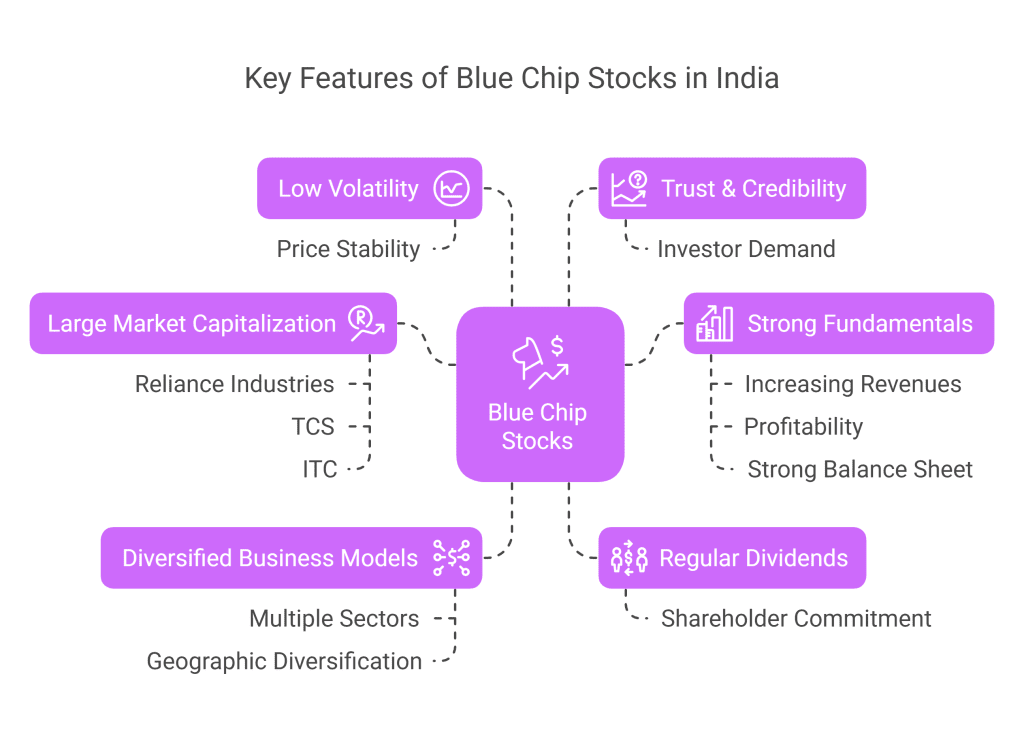
    Key Features of Blue Chip Stocks in India

    Some of the key features of Blue Chip stocks in India are:

    1. Large Market Capitalization: These companies have a market capitalization running into lakhs of crores. Example: Reliance Industries, TCS, ITC, etc. 
    2. Strong Fundamentals: Increasing revenues, profitability and a strong balance sheet are common characteristics among these companies. 
    3. Regular Dividends: A majority of blue chip companies pay dividends to shareholders, reflecting their commitment towards their shareholders. 
    4. Low Volatility: While all financial instruments carry some measure of risk, blue chip stocks are the least prone to severe fluctuations in pricing. 
    5. Trust & Credibility: These stocks are highly credible and are therefore in high demand by the majority of investors across India. 
    6. Diversified Business Models: Reduces risks due to operations in multiple sectors or geographies.
    Key Features of Blue Chip Stocks in India

    Buying blue chip stocks during their 52-week lows can enable investors to take advantage of well-established companies for much lower than the actual price. A well-known company might experience a price slump due to several factors. In this article, we will discuss the blue chip stocks which are trading around their 52-week low level.

    Factors to Consider Before Investing in Blue Chip Stock at a 52-Week Low

    If you are investing in the blue chip stock at 52 week low, ensure you analyze company-specific terms as well as industry-specific terms. Some of the key factors 

    • Check Fundamentals: Before investing, you should consider whether the fall in share price is related to short term factors or long term issues. Positive signs include strong fundamentals like consistent dividends, stable earnings, and low debt. 
    • Macroeconomic Environment: Broader economic issues like inflation, interest, and geopolitical conflicts tend to negatively impact stock prices. Understand how these macro factors influence the sector.
    • Industry Specific Matters: A blue chip stock can be impacted by sector specific regulations or a decline in demand. For example, IT stocks may fall if there are signs of recession in the USA as the majority of their revenues are from the USA. 
    • Management Quality: Look into recent investor presentations, earnings calls, or governance reports. Having capable and transparent leadership can help the company recover faster. 
    • Valuation Metrics: Using the Pocketful app, check the valuation ratios P/E, EV/EBITDA, and Price-to-Book to analyze if the stock is truly undervalued or if the decline in price makes sense. 
    • Dividend History: Check the dividend yield of the company, if even in challenging times, a blue chip company is paying dividends, then it is a positive sign. 
    • Volume and Liquidity: Although very rare, blue chip stocks with lower trading volumes can be difficult to buy or sell. Invest in blue chip stocks which are high in liquidity. 

    Thorough research before investing in Blue Chip stocks at 52 week low levels will help avoid common mistakes while confidently capturing long-term opportunities.

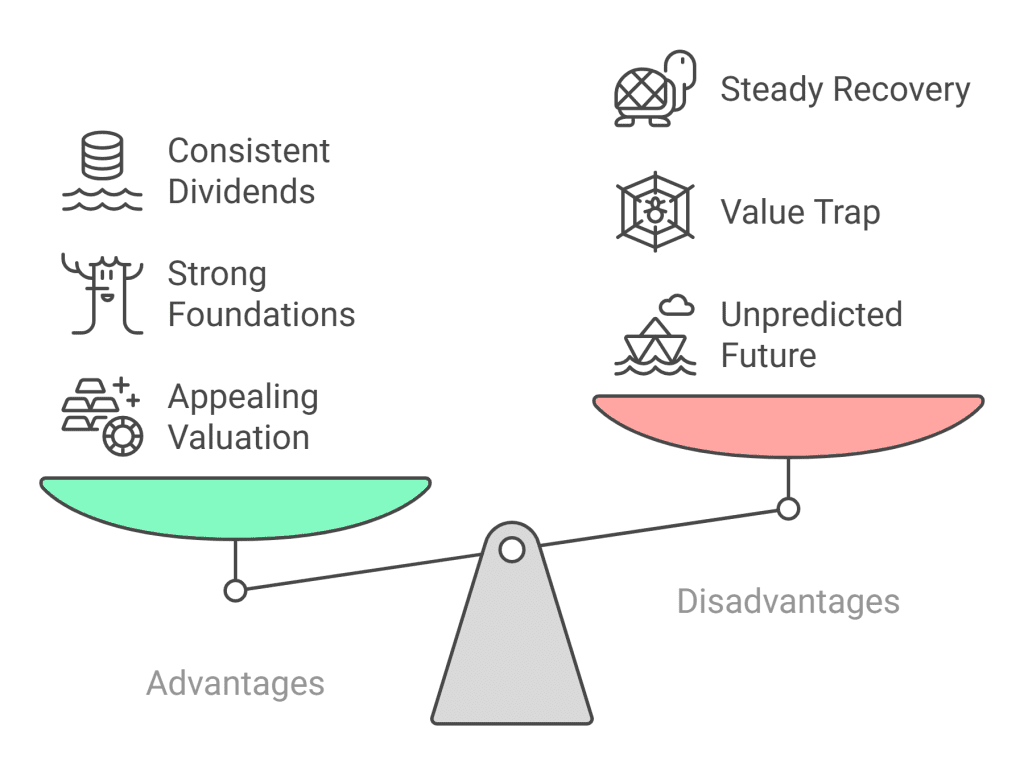
    Advantages of Investing in Blue Chip Stocks

    Advantages of investing in Blue Chip stocks are:

    • Appealing Valuation: Buying a stock at its 52-week low refers to a situation where you can buy a blue chip company’s stock at a discounted price. 
    • Strong Foundations: Companies like Infosys, TATA consultancy services have strong business models making them more reliable to invest.
    • Consistent Dividends: Blue chip companies stocks pay regular and steady dividends offering investors passive income even during downturns.
    • Future Potential: Short term lows can be a significant entry point for  long-term wealth generation. 

    Disadvantages of Investing in Blue Chip Stocks

    Disadvantages of investing in Blue Chip stocks are:

    • Unpredicted future: Stocks near their 52-week low is not an indication that stock price will not fall any further; it can still fall due major sector specific reasons.
    • Value Trap: Blue chip stocks valuation may be low for reasons such as strict regulations, high competition, etc. making their value stagnant for a period of time.
    • Steady Recovery: Even fundamentally strong companies can take time to recover, especially if the world economy faces major issues.
    Advantages and Disadvantages of Investing in Blue Chip Stocks

    Read Also: Penny Stocks vs. Blue-chip Stocks – What’s the Difference?

    Conclusion

    Investing in quality blue-chip companies at low prices is all about getting value, but great investors ensure that they verify the fundamentals before making any investments. They always look at more than just the number, i.e. 52 week low, rather they also examine the financials, the business model, the overall market sentiment, and other relevant factors.

    With apps that provide real-time stock information such as Pocketful, data as well as stock charts and other research tools are readily available. You can track blue chip stocks at NSE 52-week low and filter using different valuation and performance evaluation metrics.

    If you are a beginner or an experienced trader, Pocketful is the best broker. You can explore, evaluate, and execute, all from the same platform. Remember, even the most renowned blue-chip stocks have their bad days. What is important is if they have the potential to recover. And that is where you gain an advantage as an investor.

    Also, buying blue-chip stocks when everyone is rushing to sell does not mean those stocks will appreciate immediately. Exercise patience. Regularly monitor the KPIs as well as sector trends that could influence performance. Don’t invest your entire investment capital into one or two securities regardless of how appealing they might seem and diversify.

    S.NO.Check Out These Interesting Posts You Might Enjoy!
    1List Of Best Healthcare Stocks in India
    2List of Best Telecom Stocks in India
    3List Of Best Footwear Stocks in India
    4List Of Best Logistics Stocks in India
    5List of Best Liquor Stocks in India

    Frequently Asked Questions (FAQs)

    1. What are blue chip stocks?

      Stocks considered blue chip are shares of large and well-established companies that are financially sound, portray steady growth, and pay regular dividends. Examples of blue-chip stocks in India are Reliance, TCS, and ITC.

    2. Is it wise to purchase blue-chip stocks at their 52-week low?

      You can opt for a blue chip stock at a 52-week low if a stock’s fundamentals are solid and the reason for a decline is macroeconomic factors alongside temporary negative sentiment in the market, and not problems with the company in the long term. It often presents a chance to acquire something that is undervalued. 

    3. How do I distinguish if a 52-week low is an alert or an opportunity for a purchase?

      A deep dive into a company’s earnings, its debt, growth prospects, and the rationale for the price drop alongside the price itself is essential. Use a blend of fundamentals and technicals like relative strength index for better decisions. 

    4. Will blue-chip stocks always recover from the 52 week low?

      Not all the time. Most blue chip stocks recover over time, while others may face prolonged struggles. It is essential to look at the specific factors of the company and its industry trends before making investment decisions. 

    5. What is the optimal investment period for purchasing blue-chip companies at a bargain? 

      In general, investing for 3-5 years or even more is recommended, particularly when making purchases during market dips. To withstand sudden market shifts and harness compounding advantages, remaining invested is critical.

    Selection Methodology and Important Disclaimer

    The stocks included in this list are selected primarily on the basis of their market capitalisation, which represents the total market value of a company’s outstanding shares. The companies are arranged in descending order of market capitalisation, with larger companies appearing first, followed by relatively smaller companies. This methodology is intended to provide a structured approach for identifying companies based on their market size and overall presence within a sector.

    However, market capitalisation should not be considered the sole factor while evaluating investment opportunities, as it does not guarantee future performance, profitability, or returns. Investors should also assess other important factors such as financial health, business fundamentals, management quality, valuation metrics, industry outlook, and market conditions before making investment decisions.

    The information provided is for educational and informational purposes only and should not be construed as investment advice, recommendation, solicitation, or an offer to buy or sell any securities by Pocketful Fintech Capital Private Limited.
  • Top 10 Steel Penny Stocks in India

    Top 10 Steel Penny Stocks in India

    Investing in the steel sector, which is important for India’s industrial development, comes with unique investment opportunities like steel penny stocks. 

    For those who wish to invest in India’s steel story, steel penny stocks could be an interesting option. Usually priced below ₹100, these stocks enable investors to take part in the emerging steel industry.

    In this article, we will explore the top 10 steel penny stocks in India to help you make better investment decisions.

    What Are Penny Stocks?

    Penny stocks are equity shares which generally belong to under-performing companies that trade in the range of ₹10 or ₹100 in India. These stocks generally belong to micro-cap companies which do not generate much revenue, operate at low capacity, and go largely ignored by analysts and institutional investors. However, there are some companies with penny stocks that have the potential to perform exceedingly well in the future. As one of the riskiest investment strategies, penny stocks are often high-reward, providing multifold returns or causing significant loss.

    Let’s say a stock like XYZ Ltd. is trading at, say, ₹3 per share. When you buy 1,000 shares, you pay ₹3,000. If the stock rises to ₹6, you’ve doubled your money. But, if it crashes to ₹1, your investment is only worth ₹1,000. There is great potential to profit here, but the risks are equally great.

    Introduction to Steel Penny Stocks 

    Steel penny stocks refer to the shares of micro cap companies which are trading at very low prices in the steel industry, often below ₹50 per share. These companies may operate in specialized areas like re-rolling, regional distribution, scrap processing, etc. Compared to industry giants like Tata Steel or JSW Steel, these companies do not have the brand value or scale. However, they might offer better growth potential if the company is able to increase its capacity, get new contracts, or if steel prices go up.

    Like all forms of investment, steel penny stocks come with their fair share of risks and require careful consideration. If you are not conducting the appropriate amount of research and analysis, then it could result in significant losses due to illiquidity, lack of transparency, and volatility.

    Investors looking to steal a bargain and get a foot in the door are often looking for long term investment in the steel industry. The industry, like all other sectors, is affected by India’s infrastructure demand.

    If you are new to investing, there are multiple tools available on the Pocketful app, for research and analysis and buy stocks, providing you fundamental and technical analysis in detail.

    Read Also: 10 Best Copper Stocks in India

    Top 10 Steel Penny Stocks in India

    Here’s a list of the top 10 steel penny stocks in India, along with key details:

    Company NameCurrent Market Price (₹)Market Capitalization (₹ Cr.)52 Week High (₹)52 Week Low (₹)
    NMDC Steel Ltd42.012,30049.632.9
    Jayaswal Neco Industries Ltd81.07,86594.3 30.2
    JTL Industries Ltd64.42,45986.040.2
    Welspun Specialty Solutions Ltd35.82,36943.226.5
    Salasar Techno Engineering Ltd7.211,26011.55.59
    Rama Steel Tubes Ltd.5.4689314.9 3.43
    Rhetan TMT Ltd25.22,01027.714.5
    Mukand Ltd1301,881162 92.2
    MSP Steel & Power Ltd35.52,01241.2 23.6
    BMW Industries Ltd38.687059.826.1
    (Data as of 10 April 2026)

    Read Also: Top 5 PSU Penny Stocks List in India

    Overview Of the Top Ten Steel Penny Stocks in India

    1. NMDC Steel Limited

    NMDC Steel Ltd is a public sector company and a subsidiary of NMDC Limited. It has developed an integrated steel plant at Nagarnar, located in Chhattisgarh. The plant commenced operations in 2023 and has a production capacity of 3 million tonnes per annum.

    The company is focused on producing high-quality hot rolled coils to support the automobile, infrastructure, and manufacturing industries.

    Know the Returns:

    1Y Return (%)3Y Return (%)5Y Return (%)
    22.89%26.41%39.07%
    (Data as of 10 April 2026)

    2. Jayaswal Neco Industries Limited 

    Jayaswal Neco Industries Ltd is one of the oldest companies in India, incorporated in 1972. The company deals in diverse steel products segments, including production, castings, and infrastructure materials

    With facilities in Chhattisgarh and Maharashtra, It produces billets, ductile iron pipes, alloy steels and different types of castings. These products find use in automotive, railways, power, and engineering sectors. The company’s enduring presence in the Indian market coupled with its diversified portfolio makes it a vital company in the Indian industrial landscape.

    Know the Returns:

    1Y Return (%)3Y Return (%)5Y Return (%)
    164.32%282.58%480.00%
    (Data as of 10 April 2026)

    3. JTL Industries Limited

    JTL Industries Limited, previously JTL Infra, has grown to become one of the largest producers of electric resistance welded (ERW) steel tubes and pipes in India. 

    Founded in 1991, the company has earned accolades for supplying structural steel products for solar power projects and green buildings along with water transmission and other essential services.

    Know the Returns:

    1Y Return (%)3Y Return (%)5Y Return (%)
    -11.78%23.04%7.80%
    (Data as of 10 April 2026)

    4. Welspun Specialty Solutions Limited 

    Welspun Specialty Solutions Ltd is part of the well-diversified Welspun Group. The company specializes in the production of stainless steel and alloy steel products including seamless pipes, billets, bars, and ingots. 

    With a modern manufacturing plant located in Gujarat, it caters to industries such as oil & gas, defense, energy, and infrastructure. Known for its quality and technical expertise, the company also supplies to major global markets. 

    Know the Returns:

    1Y Return (%)3Y Return (%)5Y Return (%)
    30.88%94.90%134.29%
    (Data as of 10 April 2026)

    5. Salasar Techno Engineering Ltd

    Salasar Techno Engineering Ltd is an infrastructure solutions company that services the telecom, power, railways, and solar sectors starting in 2006. The enterprise specializes in custom steel fabrication and turnkey engineering projects which include the construction of telecom towers, transmission lines, smart city infrastructure, and solar mounting structures. 

    Its EPC services (Engineering, Procurement, and Construction) encompass design, fabrication, and execution. Moreover, the enterprise has a longstanding reputation for completing major infrastructure projects within India and internationally.

    Know the Returns:

    1Y Return (%)3Y Return (%)5Y Return (%)
    -23.35%-12.32%60.89%
    (Data as of 10 April 2026)

    6. Rama Steel Tubes Ltd 

    This company has established a broad distribution network that includes clients from other countries. Their drive towards finding new and better steel tube manufacturing processes has placed them among the top fastest growing brands in the country.

    Rama Steel Tubes Ltd has been a formidable force in the steel tube manufacturing industry ever since it began operating in 1974. The company manufactures a wide variety of steel tubing and piping products including ERW galvanized steel pipes, black pipes, scaffolding pipes, and structural hollow sections.These products serve industries such as construction, furniture, industrial piping, and agriculture.

    The company has expanded its reach internationally, particularly in Africa and Middle Eastern countries, due to domestic and export market opportunities. It is well-known for having a robust distribution network as well as placing a strong focus on the quality of their products.

    Know the Returns:

    1Y Return (%)3Y Return (%)5Y Return (%)
    -43.92%-50.93%442.55%
    (Data as of 10 April 2026)

    7. Rhetan TMT Ltd 

    Rhetan TMT Ltd, a manufacturer of TMT (Thermo-Mechanically Treated) bars and round bars, is based in Gujarat and was incorporated in 1984. The company specializes in TMT manufacturing and has become widely renowned since their products are mainly used in residential, commercial, and industrial construction. 

    Rhetan TMT boasts advanced technologies which enable them to elevate the industry standards of producing steel products, particularly frameworks for heavy infrastructure work such as bridges, dams, or skyscrapers.

    Know the Returns:

    1Y Return (%)3Y Return (%)5Y Return (%)
    18.78%18.78%18.78%
    (Data as of 10 April 2026)

    8. Mukand Ltd 

    From 1937, Mukand Ltd, a Bajaj Group affiliate, is one of the foremost manufacturers of specialty steel long products and heavy machinery in India. 

    The firm offers alloy, stainless steel, engineering billets, blooms, wires, rods, bars, and sections for the automotive industry. In addition, it was the first Indian steel producer to adopt continuous casting of billets and stainless steel production.

    Know the Returns:

    1Y Return (%)3Y Return (%)5Y Return (%)
    41.58%-7.24%42.12%
    (Data as of 10 April 2026)

    9. MSP Steel & Power Ltd 

    A pioneer in sponge iron production, MSP Steel & Power Ltd began operating in 1968 and is recognized as a fully integrated steel manufacturer located in Raigarh, Chhattisgarh. The company also produces billets, TMT bars, Structural Steel, pellets, and ferroalloys alongside their self-generating power capacity. 

    From construction and infrastructure to manufacturing, the company supplies its products to a plethora of industries.The company also places importance on the utilization of value added resources. 

    Know the Returns:

    1Y Return (%)3Y Return (%)5Y Return (%)
    29.89%310.81%231.74%
    (Data as of 10 April 2026)

    10. BMW Industries Ltd 

    BMW Industries Ltd is a diversified steel processing company with branches in Eastern India and was established in 1981. 

    This company manufactures hot rolled and cold rolled coils, galvanized sheets, ERW pipes, and TMT bars. The company serves diverse industry sectors like power, construction, automotive and infrastructure. It is scaling up its production to accommodate the growing call for supply domestically. The company has a good reputation for operational productivity and product custom tailoring.

    Know the Returns:

    1Y Return (%)3Y Return (%)5Y Return (%)
    -20.02%13.48%31.12%
    (Data as of 10 April 2026)

    Key Performance Indicators (KPIs)

    Company NameOperating ProfitMargin (%)ROE(%)ROCE(%)Debt to Equity Ratio
    NMDC Steel Ltd-61.34-10.07-8.400.43
    Jayaswal Neco Industries Ltd13.139.3014.551.42
    JTL Industries Ltd7.6114.5819.940.03
    Welspun Specialty Solutions Ltd8.87112.9027.674.35
    Salasar Techno Engineering Ltd9.5711.7523.030.77
    Rama Steel Tubes Ltd.5.548.6915.410.43
    Rhetan TMT Ltd10.464.377.420.18
    Mukand Ltd4.9911.1410.731.62
    MSP Steel & Power Ltd3.774.8310.202.63
    BMW Industries Ltd17.739.6413.560.13
    (All of the above information is of the year ended March 2025)

    Read Also: 10 Fastest Growing Penny Stocks in India

    Penny Stocks: The Advantages And Disadvantages 

    Advantages 

    • Potential for High Returns : Investors can make a bet on the growth of some low-priced steel penny stocks and make significant returns. Some of the companies listed above are unlike other low-priced stocks which experience price volatility over longer periods of time. These stocks belong to emerging steel companies and investing in them can be rewarding with high returns on a relatively smaller investment.
    • Low Initial Investment : The ability to start investing with a lower initial capital outlay for these steel penny stocks is an advantage. Investing even a small sum of money gives you the opportunity to acquire large volumes of these low priced stocks. This increases their appeal to small investors with little capital, providing exposure to the steel industry without substantial financial risks.
    • Opportunities for Growth in Steel Industry : Investing in steel penny stocks and other domestic steel companies will become beneficial due to infrastructure development, urbanization, and government schemes like ’Make in India.’ Increase in steel demand will result in these small companies becoming larger, and their stock value to rise in the long term.
    • Diversification opportunity : Steel penny stocks could assist in diversification for those investors that solely invest in large cap stocks. Investing in small cap steel companies provides exposure to high growth companies. Further, investment diversification can mitigate heightened risk for the investment portfolio, which in this case, is the portion invested in small-cap steel companies.

    Disadvantages 

    • Volatile Nature : It should be noted that steel penny stocks are highly volatile and much riskier than investing into blue-chip companies or debt securities. These companies tend to experience sudden market shocks and other abrupt price-setting events, such as new product announcements or exogenous shifts in customer sentiments.
    • Insufficient Market Activity : Steel stocks, like other penny stocks, have a small market capitalization and low trading activity. This phenomenon can lead to problems with buying and selling shares at the desired price. When market demand for a stock is low, trading can result in larger bid-ask spreads and increased slippage. This can be harmful to investors wanting to sell their positions during price declines.
    • Poor Financial Disclosure : Smaller and less established companies often tend to release limited financial disclosure that the larger publicly traded steel companies. This can make it difficult for investors to gain access to precise, timely information resulting in poor investment decisions and unanticipated losses. Inadequate reporting and disclosure increases risk.
    • Prone to Manipulation : Due to their low stock prices and market capitalization, steel penny stocks become more susceptible to market manipulation. Some investors might target these stocks for “pump and dump” schemes where they allegedly try to create demand and sell their positions at a much higher price. This leads to temporary price surges followed by significant declines. Such an action can result in unsuspecting investors losing money when they purchase during artificially inflated price windows.

    Read Also: 10 Best High Volume Penny Stocks In India

    Conclusion 

    While steel penny stocks fall on the lower end in terms of price, there is a great deal of potential growth value in them if analyzed and selected for investment wisely.

    As with any investment, conducting a fundamental analysis and understanding the key performance metrics, as well as weighing the potential risks and rewards, is important. With that said, these stocks which we discussed are not suitable for all investors, but for those who dedicate their time and do their due diligence, the rewards could be life-changing. 

    For anyone just starting their investment journey or looking to delve into steel penny stocks, the Pocketful app is a great platform to monitor market movements, conduct stock research, and invest effortlessly. It provides curated pockets and insightful blogs, which makes it easy for beginners while still being a great platform for seasoned investors. 

    So if you are looking to invest in steel penny stocks or wish to add some high-risk, high-reward investments to your portfolio, remain cautious, stay informed, and consult a financial advisor before investing.

    S.NO.Check Out These Interesting Posts You Might Enjoy!
    110 Best Bank Penny Stocks List
    2Top 10 Highest Dividend Paying Penny Stocks in India
    35 Top Artificial Intelligence Penny Stocks in India
    4Top 10 IT Software Penny Stocks in India
    55 Top EV Penny Stocks in India
    6Best Indian Isobutanol Stocks

    Frequently Asked Questions (FAQs)

    1. Do steel penny stocks pay dividends?

      Steel penny stocks don’t pay dividends usually as they tend to reinvest their profits back into the business. Bigger, more stable companies like Tata or JSW Steel are more likely to offer dividends. 

    2. Where can I find information on steel penny stocks in India? 

      Information regarding steel penny stocks can be found on stock market applications such as Pocketful, Moneycontrol, Screener.in, NSE/BSE Websites, etc. 

    3. Is there  risk involved in investing in steel penny stocks?

      For beginner investors, investing in steel penny stocks can be risky due to illiquidity, market volatility, etc.

    4. Can steel penny stocks give high returns?

      It is possible, but steel penny stocks can be highly risky. They can rise dramatically if the company becomes profitable or if there is greater demand for steel. However, they are equally at risk of decline if things take a turn for the worse.

    5. Are steel penny stocks good for long-term investment?

      Some steel penny stocks have the potential to provide significant returns in the future. However, to identify these companies for investment, it requires thorough fundamental and technical analysis. 

    Selection Methodology and Important Disclaimer

    The stocks included in this list are selected primarily on the basis of their market capitalisation, which represents the total market value of a company’s outstanding shares. The companies are arranged in descending order of market capitalisation, with larger companies appearing first, followed by relatively smaller companies. This methodology is intended to provide a structured approach for identifying companies based on their market size and overall presence within a sector.

    However, market capitalisation should not be considered the sole factor while evaluating investment opportunities, as it does not guarantee future performance, profitability, or returns. Investors should also assess other important factors such as financial health, business fundamentals, management quality, valuation metrics, industry outlook, and market conditions before making investment decisions.

    The information provided is for educational and informational purposes only and should not be construed as investment advice, recommendation, solicitation, or an offer to buy or sell any securities by Pocketful Fintech Capital Private Limited.
  • Best Share Market Learning Apps in India: Top 5 Picks for 2026

    Best Share Market Learning Apps in India: Top 5 Picks for 2026

    Are you curious about the stock market and want to learn about stock trading without risking your money? Make it happen with a share market learning app that will build a solid foundation for your trading and investing journey.

    Share market learning apps help in grasping essential concepts such as reading stock charts, portfolio management, etc. Several apps also provide live data feeds and news so that you remain informed about changing market trends. Whether you’re a student, working professional, or simply interested in investing, you can easily learn with these stock market learning apps. It is a smart and simple method to learn about the stock markets without making expensive mistakes.

    We will discuss the top 5 learning apps in this blog. These apps or websites provide a beginner with easy to understand lessons, interactive quizzes, and practice trading scenarios to learn about market behavior.

    What Is a Share Market Learning App?

    A share market learning app is basically an educational tool that helps an individual to learn how the stock market functions. It converts complex financial topics and breaks them down into simple and easy to follow lessons. Commonly these apps use interactive content to keep things engaging, which makes learning a lot less intimidating.

    These apps work on the motto that learning to trade does not need to be complicated. With the right app, you can, in a stepwise manner, gradually turn into a self-assured investor and trader.

    Best 5 Share Market Learning Apps in India

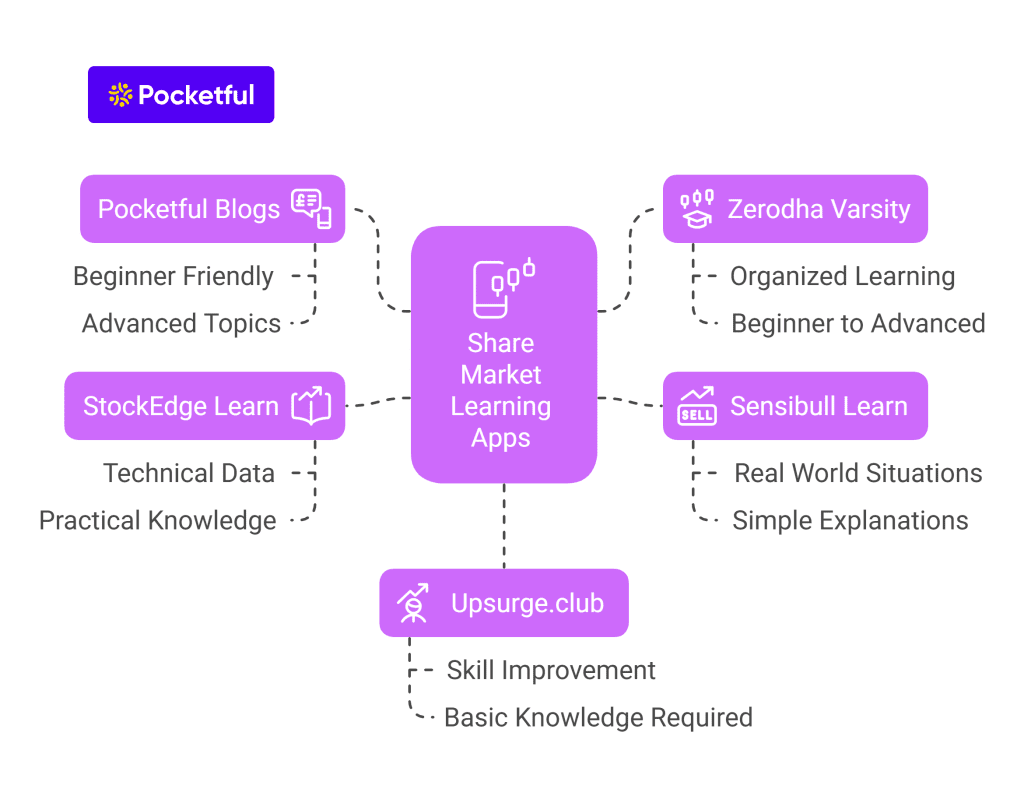
    The top 5 share market learning apps in India are:

    • Zerodha Varsity – Super popular! Great for learning everything from beginner to advanced trading concepts in an organized manner.
    • Pocketful Blogs – Ideal for beginners as well as advanced market participants! They provide easy to understand blogs on complex topics to demystify investing and trading.
    • Sensibull Learn – Best for those who want to explore options trading. Uses real world situations and simple explanations.
    • StockEdge Learn – Learn the more technical aspects with actual market data. Ideal for those who want more than theoretical knowledge.
    • Upsurge.club – This platform is best-suited for those traders who understand the basics and want to improve their trading skills.

    Now, let’s look at each of these share market learning apps in detail.

    1. Zerodha Varsity

    The Zerodha Varsity app is often mentioned as one of the finest share market learning apps in India and for a good reason. Created by Zerodha, which is one of India’s biggest stock-broker by volume, this app provides:

    • In depth investing and trading modules
    • More than 15 structured learning modules
    • Content available in both Hindi and English
    • Chapters are followed up by quizzes, enabling users to test their educational progress.

    Courses offered on Zerodha Varsity are free of cost and do not require a Zerodha account. The structured, text-based content on the app is ideal for serious learners who wish to start their stock market journey. 

    2. Pocketful Blogs

    Pocketful is a new age discount brokerage platform, most popularly known for being a go to stock broker for traders. Pocketful also has blog sections with information on a wide range of topics, such as investing, commodities, mutual funds, personal finance, etc., making it one of the simplest free resources to start your stock market journey.

    • Easy to understand blogs with clear explanations of technical terms to explain both basic and advanced stock market topics.
    • They have 8 categories of blogs – Case Studies, Commodities, Demat Account, Investing, IPO, Trading, Personal Finance, and Mutual Funds.
    • Each article contains clear and concise explanations in a consistent format.
    • Perfectly suited for beginners as well as pro level traders/investors.

    For people who fear being bombarded with complex stock market jargons, Pocketful uses a beginner-friendly approach to make everything as simple as possible.

    3. Sensibull Learn

    India’s first focus-driven options trading platform, Sensibull, is gaining traction with its trading learning app as the options segment is still new to the market. Their learning section, now featured on the app, is simpler with:

    • Webinars, blogs, and other content are updated on a regular basis.
    • Clubs real world trading scenarios with derivative strategies. 
    • Professional traders offer bite-size video lessons.

    This trading learning app caters to new users who wish to immerse themselves into the complex world of options trading. While some lessons are free, others are subscription based.

    4. StockEdge Learn

    StockEdge is one of the best analytical apps in India with a robust educational module alongside stock analysis articles. It’s perfect for users who want to learn and apply stock market concepts along with real world data.

    • Provides free and paid tutorials on technical indicators, candlestick patterns, and tools for charting.
    • Mentorship workshops for premium users.
    • Stock data by sectors and themes.
    • Real time stock data filtering and scanning.

    With the tools provided, one can learn many strategies and execute simulations in real time.

    5. Upsurge.club

    If you are interested in developing trading strategies, trading psychology and want to be mentored by the experts, then this platform can be a good fit for you. However, learning modules on this platform are paid. 

    • Offers in-depth modules on intraday trading as well as futures and options trading, along with portfolio creation.
    • Conduct extensive real-world case studies to ensure theory is put into practice.
    • Conduct weekly webinars and doubt-clearing classes.
    • Focus on developing trading psychology, mindset, and discipline.

    This app is best suited for stock market learners who understand the fundamentals, but wish to polish their skills and become more disciplined traders.

    Which is the go-to Share Market Learning App?

    If you are confused about which app is best-suited for me, then consider the following factors to find the best stock market trading app in India:

    • Content Quality: Is the information latest and actionable?
    • User-Friendly Features: Is the app user-friendly, particularly for beginners?
    • Language Inclusivity: Is the content available in English and local languages?
    • Practical Application: Is there a mock trading system and is the data updated in real-time?
    • Webinars and Forums: Does the platform provide access to webinars by industry experts or forums for users?
    • User Testimonials: Is the platform or app highly rated based on ratings on Google Play Store, user testimonials, etc.

    Read Also: 10 Best Stock Market Simulators for Beginners – Platforms and Apps

    Key Features of Share Market Learning Apps

    Key Features of Share Market Learning Apps

    The key features of share market learning apps are as follows:

    • Digital Lessons: Most of these apps include clear, easy to understand videos with voiceovers and visuals that explain key concepts of the share market.
    • Structured Courses: Lessons are usually divided into levels: beginner, intermediate, and advanced, so you can learn trading step by step at your own speed.
    • Practice Trading: Learning apps offer trading lessons and doubt clearing sessions, which let the users test their trading strategies without taking financial risks.
    • Live Market Data: Some learning apps offer the facility of tracking stock prices in real time, providing you valuable insight into the workings of the market.
    • Interactive Tools: Quizzes, flashcards, and other activities aid in retaining what you have learned.
    • Certificates: Completing a course or module allows you to earn a course completion certificate as a reward for your achievement.
    • Community Support: Most platforms provide forums or chat facilities where you can post questions and learn from more experienced users.

    Read Also: Lowest MTF Interest Rate Brokers in India | Top 10 MTF Trading Apps

    Advantages & Disadvantages of Stock Market Learning App

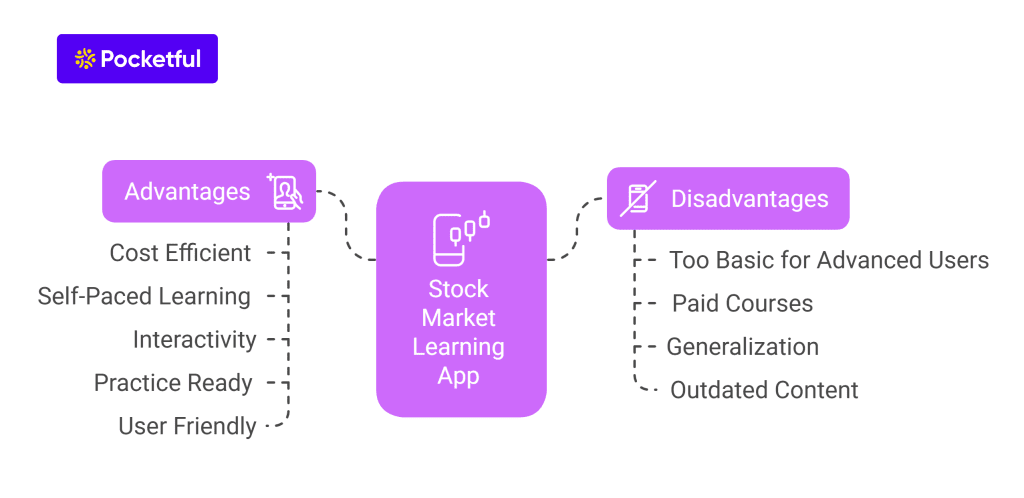
    The advantages and disadvantages of stock market learning app are:

    Advantages

    1. Cost Efficient: A majority of the applications and platforms provide learning material for free or charge a minimal fee.
    2. Self-Paced Learning: Students can learn about the stock market from any place at any time.
    3. Interactivity: Greater engagement is a result of videos, quizzes, and gamification.
    4. Practice Ready: Some applications come with features that allow mock trades or utilize live data to test trading strategies.
    5. User Friendly: Content is structured to build up in complexity as the learning module progresses, making it easy for beginners.

    Disadvantages

    1. Too Basic for Advanced Investors and Traders: The majority of apps and learning platforms focus solely on basics and therefore do not cater to expert investors and traders.
    2. Paid Courses: Subscriptions may be necessary in order to access certain premium features or course materials.
    3. Generalization: Some users may find some stock market concepts too generic, which may not represent the reality of the domestic financial markets.
    4. Outdated Content: Not all apps and platforms refresh their content routinely.

    Read Also: Best Commodity Trading Platforms in India: Top 10 Picks for Traders

    Conclusion

    The wide variety of platforms provides options to all users, and the best stock market learning app in India will depend on the individual user’s learning objectives. From text-based lessons to video tutorials and even webinars, there is a share market learning app for everyone.

    They not only teach you how to trade and invest, but also how to be financially disciplined, develop strategies, and gain confidence. It is important to start with basics and gradually move on to more advanced concepts. Through consistent effort, transforming from a novice into an informed trader is achievable.

    Which app will you choose? Regardless of the choice -Pocketful, Zerodha Varsity, or  Sensibull – one thing should always be remembered: knowledge is the best investment.

    S.NO.Check Out These Interesting Posts You Might Enjoy!
    1Highest Rated Trading Apps in India
    2Best Brokers Offering Free Trading APIs in India
    3Best Trading Apps in India
    410 Free Apps for Stock Investments in India
    5Best Algo Trading Platform in India
    6Best Stock Alert App in India
    7Top Discount Brokers in India
    8Best Fundamental Analysis App in India
    910 Best Paper Trading Apps in India
    10Best Fast Order Execution Broker Platforms in India
    11Best SIP Apps in India for Investment
    12Best Apps & Tools for Option Chain Analysis in India
    13Best Apps for IPO Investment in India
    14Best UPI Apps in India

    Frequently Asked Questions (FAQs)

    1. What are share market learning apps?

      Learning apps for the share market are mobile applications that help beginners learn the stock market along with trading strategies, investing principles, and more through videos, articles, mock trading, quizzes, and tutorials.

    2. Are these apps free to use?

      Many applications provide free educational content but some may charge for premium plans or certifications. However, platforms such as Pocketful have blogs with information related to investing, trading, commodities, etc. for free.

    3. Am I allowed to make use of these apps for trading or investment purposes?

      Certain apps like Pocketful are primarily stock brokers where investing and trading in stocks, ETFs, etc. can be done. You can open a demat account with Pocketful in a couple of minutes.

    4. Are these apps safe and trustworthy?

      Yes, these apps are safe to use as they follow strict data security protocols. Stick to popular highly-rated apps and platforms.

    5. Is it possible to learn and apply those concepts in live markets simultaneously?

      Yes, most educational apps and platforms feature real-time stock prices, charts, and screening tools, which allows you to immediately implement what you have learned.

    6. Is Pocketful the best platform to start my stock market journey?

      If you are a beginner, Pocketful is the best as it has blogs on recent stock market events, case studies of companies, trading and investing concepts. It is the best as everything can be done through a single platform – learning, analysis, and trade execution.

  • 10 Best Stock Market Simulators for Beginners – Platforms and Apps

    10 Best Stock Market Simulators for Beginners – Platforms and Apps

    Are you a newbie trader and searching for the ideal stock market simulator that lets you practice trading without compromising real money? Then you are in the right place. No matter if you are an intraday trader or swing trader, utilizing a stock market simulator app will help you learn the functioning of the market. 

    In this blog, we will give you an overview of the 10 best stock market simulators to help you practice trading safely without risking real money. Moreover, we will also discuss factors to consider before using stock market simulators, their advantages and disadvantages.

    What is a Stock Market Simulator?

    Stock Market Simulator apps let traders experiment with their strategies, understand the basics of trading, and learn how to invest in the market. Further, these simulators serve as a digital platform that mirrors real world market scenarios, resulting in better understanding and clarity without using the actual money. 

    These simulators emulate real-life stock market conditions, including pricing trends, changes caused by news events, and delays in trades. Numerous platforms have begun offering engaging and educational features, such as paper trading options, leaderboards, and analytics. 

    Top 10 Best Stock Market Simulators for Beginners

    Before going into detail, let’s discuss the top 10 stock market simulators briefly:

    1. Investopedia Simulator – Offers $100,000 virtual cash to students and beginners and provides them with explainer content, making it one of the most loved simulators across the web. 
    2. Trading View – TradingView’s paper trading feature is a great choice for technical traders who want to try out their strategies in real time, using powerful charting tools – without risking any actual money.
    3. Thinkorswim PaperMoney (TD Ameritrade) – Perfect for traders who are seasoned and wish to try their hand at trading derivatives such as options, futures, etc.
    4. Webull Paper Trading – Perfect for new traders due to its easy-to-use interface and real-time data features. 
    5. MarketWatch Virtual Stock Exchange – MarketWatch’s Virtual Stock Exchange is perfect for students, educators, or traders looking to learn and compete in a simulated trading environment, all based on real market data.
    6. NSE Paathshala – This simulator focuses on the Indian market, making it essential for Indian retail investor students.
    7. HowTheMarketWorks – Great for classroom training, it provides free virtual trading, quizzes, and games with real-time data.
    8. Wall Street Survivor – Interactive programs with tutorials, quizzes, and challenges to help users learn the art of trading.
    9. Moomoo Paper Trading – Provides commission-free paper trades for most international markets.
    10. Stock Trainer Virtual Trading (Android) – An Android simulator for novice traders with over 20 supported exchanges.
    Top 10 Stock Market Simulators 

    Read Also: Best Stock Market Movies & Web Series to Watch

    Overview of the Top 10 Stock Market Simulators

    A detailed overview of the top 10 stock market simulators is given below:

    1. Investopedia Simulator

    Investopedia Stock Simulator is perfect for the traders and investors. It offers $100,000 in virtual currency along with real-time market-based trading. It is education-centric with a textbook style structure with integrated tutorials, trading contests, and group play features. Instructors use it in classrooms to teach the fundamentals of trading to pupils.

    2. TradingView Paper Trading

    TradingView is widely used by chartists and technical analysts because of its premium level-charting tools which integrates seamlessly with TradingView’s paper trading feature. With this, users can do simulated trading on interactive charts. Indicators and trading strategies can be tested as alerts are issued in real-time. Features in this are ideal for those traders wanting to develop advanced trading strategies using virtual money.

    3. Thinkorswim PaperMoney (TD Ameritrade)

    Thinkorswim by TD Ameritrade undoubtedly delivers the most professional-grade trading simulator. This tool lets you trade stocks, options, and futures in a simulated environment, making it ideal for traders who are trying to grasp an understanding of advanced tools and charts without taking real risk. Paper trading setup on this platform requires a TD Ameritrade account, but it’s free to operate. 

    4. Webull Paper Trading

    Both advanced and novice traders can enjoy Webull’s clean and user-friendly interface for paper trading. The platform provides real-time market data and allows for the risk-free trading of stocks and options. Technical indicators and charting features are also included in Webull Paper Trading platform, allowing you to execute practice trades. 

    5. MarketWatch Virtual Stock Exchange

    MarketWatch’s simulator is one of the most popular simulators in academic circles. It allows people to join public games as well as create private ones for group learning. The interface is convenient, and the simulator has the capacity for real-time pricing. This platform is well-suited for traders who want to gamify concepts of investment for their students. 

    6. NSE Paathshala

    Indian investors can use this simulator developed by the National Stock Exchange (NSE), one of the prominent stock exchanges in India. It features trading of equity and derivatives on the actual NSE trading platform. 

    NSE Paathshala is completely free, making it a perfect fit for Indian students or retail traders who want to gain understanding of the domestic financial markets.

     7. HowTheMarketWorks

    This platform is aimed at students, offering simulated trading alongside prebuilt lessons, quizzes, and challenges. It enables educators to create contests or quizzes for learning and supports real-time data while gamifying structures that encourage active learning. Students can also use the platform with ease due to its simplistic design.

    8. Wall Street Survivor

    This platform revolutionizes the concept of trading simulation. It provides game elements which are more engaging and captivating. This platform offers virtual trading alongside badges, rewards, and elaborate tutorials. 

    One can also enjoy pursuing quizzes and challenges that test the knowledge on specific areas. In summary, it’s an excellent platform to cater for those looking to develop their trading skills. 

    9. Moomoo Paper Trader

    Moomoo Paper Trader offers users an experience of the international markets including the US, Hong Kong, and China. Its paper trading system allows users to test their prowess on different asset classes with zero-commission simulated trades, advanced charting tools, and in-depth market analysis. This makes it a go-to platform for beginners and experienced traders alike.

    10. Stock Trainer: Virtual Trading (Android)

    This app is exclusive to Android users and provides realistic global market simulations. It supports over 20 stock exchanges worldwide. While less sophisticated than some other options, the interface of this simulator makes it much easier for total beginners to start paper stock trading. It has a user-friendly mobile application for those interested in learning trading on a global level. 

    Read Also: Best YouTube Channels for Stock Market in India

    Factors to Consider Before Using a Stock Market Simulator

    In India, here are some of the factors to keep in mind when selecting a stock market simulator:

    1. Simulators make use of live data streams to emulate market activities and conditions for trading. This enables one to hone their skills while learning how market changes impact trades.
    2. Beginners should look for a sophisticated but simple to navigate platform because novice traders require user-friendly simulators while professional traders would need advanced features.
    3. The simulator should assist you with informative video and article content on how to create effective trading plans, conduct technical analysis, follow the markets, and other relevant tips.
    4. If you are looking for trading on the go, a robust mobile version of the trading simulator will facilitate easy paper trading during travel without compromising on functionality.
    5. Select stock market simulators that present you with the ability to tailor and customize your portfolio, alter particular risks, and create scenarios according to your specific needs.
    6. Community engagement on trading platforms can help one learn from other fellow traders. The latest market information discussed in these communities can be used to create better trading strategies.

    Read Also: 10 Best Copper Stocks in India

    Advantages and Disadvantages of Stock Market Simulators

    Advantages and Disadvantages of Stock Market Simulators

    The advantages and disadvantages of stock market simulators are given below:

    Advantages 

    • Practice with zero financial risk: Simulators permit users to practice trading with fake a.k.a. virtual money, thus enabling them to acquire experience in real markets without risking real money.
    • Learn about market orders: Users can understand the mechanism of entering various orders (market, limit, stop-loss, etc.) and observe how they get executed under different market conditions.
    • Compare different strategies: These websites allow users to try out various trading approaches and compare results without losing funds.
    • Learn portfolio management: Simulators instruct users to create a balanced and diversified portfolio, monitor performance, and control risk successfully.
    • Ideal for learning: Suitable for students and new traders, these tools offer hands-on learning in line with classroom theory, enhancing financial education through practical experience. Further, pro level traders can also use these platforms if they are testing new strategies or venturing into new asset segments such as commodity derivatives.

    Disadvantages 

    • No emotional aspect involved (actual loss/gain): As there is no real money involved, users do not feel the emotional tension or self-control needed in real trading.
    • No realistic slippage/brokerage fees: Most simulators fail to include actual trading expenses such as broker fees, local taxes such as STT or order slippage, resulting in unrealistic performance expectations.
    • Performance might be different from actual situations: Simulated trades typically execute at perfect prices that are not representative of the uncertainty and latency of real-world markets.
    • Overconfidence builds on virtual success: Repeated success in simulations can lead to overconfidence bias and overestimation of one’s abilities, and thus increases risky behavior when dealing with real money.

    Read Also: Best Commodity Trading Platforms in India: Top 10 Picks for Traders

    Conclusion

    No matter if you are looking at trading for the very first time or trying out complex trading strategies, paper trading with the stock market simulator provides you the liberty to explore trading risk-free as no real money is involved. From smartphone apps to top-of-the-line platforms, you can find one that suits you the best.

    So, are you ready to dive into the universe of stock market simulators? Select a stock trading simulator application that aligns with your learning goals and begin your trading journey today.

    However, remember that practice does not make you perfect in trading – but it definitely takes you closer and refine your trading game. All the best

    Read Also: Top 10 Option Trading Books in India

    Frequently Asked Questions (FAQs)

    1. What is a Stock Market Simulator?

      A stock market simulator enables you to trade assets like stocks, bonds, and options with virtual cash. It provides a controlled environment that replicates genuine trading conditions, making it a safe space to learn trading and test decision-making strategies without any financial risk.

    2. What are the Benefits of Using a Stock Market Simulator?

      Using a simulator eliminates financial risk, lets you test strategies in real market conditions, and builds confidence, skills, and better judgment—preparing you to make smarter decisions when trading with real money.

    3. Do Stock Market Simulators Help Beginners?

      Stock market simulators help beginners by allowing them to experience real market conditions without a risk of losing cash. More specifically, you are able to grasp on how the market works, its fluctuations and prices change. 

    4. Can I Make Real Money with a Stock Market Simulator?

      A stock market simulator cannot be used to make real money as these simulators work with virtual money to create a risk-free environment to practice trading. 

    5. Is Real-Time Data Used in Stock Market Simulators?

      Yes, several stock market simulators such as TradingView Paper Trading or Investopedia Simulator offer real-time market data. This allows users to simulate trading with situations in real-time, similar to how it’s done in the actual stock market. 

    6. Are Stock Market Simulators Free to Use?

      Most stock market simulators do offer a free version of the simulator. However, accessing certain more advanced features, premium tools, or in-depth market data may require subscription fees. 

    7. How Reliable Are Stock Market Simulators?

      Generally, stock market simulators provide accurate information, especially those that incorporate real-time market feeds. However, as you are trading with virtual money, certain aspects of emotional decision-making may be absent. 

  • MCX Trading: What is it? MCX Meaning, Features & More 

    MCX Trading: What is it? MCX Meaning, Features & More 

    MCX is essentially India’s principal commodities trading exchange in terms of volume and efficiency. The MCX full form is Multi Commodity Exchange. It is the largest commodity exchange in the country, offering futures and options contracts for a wide variety of commodities. 

    MCX serves as a crucial bridge between buyers and sellers of a commodity, enabling market participants to capitalize on market fluctuations and hedge against adverse price movements. In this blog, we will discuss the process of trading on MCX through a registered broker and its features and advantages.

    What is MCX?

    Multi Commodity Exchange, or MCX, is the leading commodity exchange in India. It was established in 2003 and is regulated by the Securities and Exchange Board of India (SEBI). MCX offers a platform for trading futures and options contracts of metals, energy, etc.  

    What is MCX Trading

    Derivative contracts available on MCX let traders speculate on price swings and hedge against the risks associated with commodity price fluctuations. For companies reliant on commodities as raw materials—such as manufacturing or an FMCG company—hedging using futures contracts can help them fix the costs of raw materials. 

    Features Of MCX Trading 

    The features of trading on MCX are:

    1. Wide Range Of Commodities 

    MCX offers derivative contracts on industrial metals, precious metals, energy, etc., helping traders capture more trading opportunities in multiple commodities simultaneously and reducing the risk associated with a specific commodity. 

    2. Futures Trading

    Futures contracts are standardized contracts with underlying assets of a specified quality and quantity. Individuals involved in commodity trading don’t need to worry about the quality of assets getting delivered at expiration as the underlying asset is stored at authorized storage facilities.

    3. Regulated By SEBI

    MCX is regulated by the Securities Exchange Board of India (SEBI) to ensure security and transparency. Strict laws boost the trust of market participants and help protect market integrity. It also ensures that every transaction is under observation, therefore establishing a fair trading environment. 

    4. Electronic Trading Platform

    Effective price discovery and quick order execution are features of the electronic trading system, helping traders focus on developing their strategies and other aspects instead of order execution. 

    5. High Liquidity

    High liquidity lets traders create and exit positions quickly, helping them modify their positions in response to changing market conditions. It also reduces the bid-ask spread, therefore enhancing cost-effectiveness.

    6. Leverage 

    Leverage enables traders to create a much larger position using much capital. It raises profit potential but also increases risks. When used judiciously, this feature lets traders increase their returns even with limited capital. 

    The table below shows the most traded commodities on the exchange: 

    CategoryCommodities
    MetalsGold, Silver, Copper, Zinc, Lead
    EnergyCrude Oil, Natural Gas
    AgricultureCotton, Mentha Oil 

    Given their cultural significance, gold and silver remain amongst the most traded commodities. Natural gas and crude oil are crucial for the energy industry, and their prices are based on world supply and demand. Derivative contracts on agricultural goods like cotton and mentha oil give traders an opportunity to speculate based on future price movements. 

    Read Also: MCX Exchange Case Study:

    Advantages Of Trading on MCX 

    The advantages of trading on MCX are:

    1. Hedging: Futures contracts can be used for hedging, allowing businesses to reduce their input costs and producers to fix the selling price of their commodities. This helps businesses to maintain their profit margins against unanticipated market price fluctuations. 
    1. Leverage Trading: Leverage allows traders to take larger positions with a smaller initial capital outlay. Leverage has advantages as well as risks, as both your returns and losses will increase. 
    1. High Liquidity: High liquidity reduces price volatility, enabling smooth and quick trade execution. Liquidity reduces the bid-ask spread, therefore lowering transaction costs. 
    1. Price Discovery Mechanism: The price discovery mechanism helps businesses determine the prices of raw materials based on market supply and demand. With a centralized exchange, every market participant knows the fair price at which the commodity is traded, helping them avoid overpaying for a commodity in the spot market.

    How To Start MCX Trading? 

    Follow the below steps for MCX trading: 

    • Open up a trading and demat account with a SEBI-registered broker, offering the facility to trade on MCX. 
    • Do thorough market research related to the demand and supply factors of a specific commodity. 
    • Analyze market trends using charts, indicators, and other technical analysis tools. 
    • Transfer funds to your trading account and place orders using the mobile application provided by your broker. 
    • Track your position and exit once the target or stop-loss is hit. 

    Success in MCX trading calls for both a focused strategy and knowledge of market trends. Staying updated about market trends and continuous education is essential to long-term success.

    Risks Of MCX Trading 

    Trading on Multi Commodity Exchange also has risks. Some of the prominent risks involved in trading commodities are mentioned below:

    1. Price volatility: The commodity prices are significantly influenced by geopolitical tensions, supply-demand imbalances, and world economic events. Market risks develop when unexpected events alter the cost of goods, therefore generating probable losses for companies using commodities as raw materials. 
    1. Leverage: Leverage allows traders to create a much larger position with limited capital, raising the possibility of both gains and losses. To avoid high risks, traders should use leverage carefully. 

    Conclusion

    Using SEBI-registered brokers allowing trading on MCX gives traders a great opportunity to participate in the commodities market. Making smart trading decisions requires a well-defined trading strategy and awareness of the features and risks associated with MCX trading.

    The wide selection of commodities helps market participants hedge and speculate on future price movements. However, it is important to consult a financial advisor before trading in commodities.

    Frequently Asked Questions (FAQs)

    1. What is MCX trading?

      MCX trading involves buying and selling standardized commodity derivatives like futures and options on the Multi Commodity Exchange, enabling traders to speculate or hedge against price fluctuations.

    2. How can I start trading on MCX?

      To begin MCX trading, open a trading and demat account with a SEBI-registered broker, fund your account, analyze markets, and place orders via the broker’s platform.

    3. What commodities are traded on MCX?

      MCX offers derivative contracts on metals like gold and copper, energy commodities like crude oil and natural gas, and agricultural products such as cotton and mentha oil.

    4. Is MCX regulated and safe to trade on?

      Yes, MCX is regulated by SEBI, ensuring a transparent, secure trading environment with strict compliance to protect investors and maintain market integrity.

    5. What are the risks of MCX trading?

      Risks include price volatility due to global events and leverage-related losses. Traders must use risk management and stay informed to exit risky trading positions and avoid significant losses.

  • Top Major Commodity Exchanges in India

    Top Major Commodity Exchanges in India

    Commodity exchanges in India allow people to trade commodities such as gold, oil, and agricultural products conveniently and in an organized manner. These exchanges ensure transparency in commodity prices and promote fair trade practices. 

    Among the major commodity exchanges of India, the Multi Commodity Exchange (MCX) is the largest one as it deals with the majority of trades in the commodity segment. But did you know there are other exchanges that facilitate trading in commodities as well? In this blog, we will discuss the major commodity exchanges in India and the factors to consider before trading in commodities.

    What is a Commodity Exchange?

    A commodity exchange is a marketplace where standardized derivative contracts of various commodities are traded. These include oil, gold, and agricultural products, etc. These derivative contracts enable manufacturers, farmers, etc., to hedge their exposure, and speculative traders to take advantage of future price movements. 

    Physical delivery of the commodity occurs only after the contract has expired, and trading primarily involves commodity derivative contracts. The market value of global commodities is enormous and is projected to grow at a CAGR of 2.70%, reaching $163.21 billion by 2030. 

    Traders trade futures and options contracts on major commodity exchanges instead of physical commodities. Futures contracts are legally binding agreements between two parties to buy and sell the underlying at a predetermined date and price. Futures contracts for crude oil, natural gas, gold, etc., account for most transactions.

    Major Commodity Exchanges in India

    Some of the most common major commodity exchanges in India include:

    1. Multi Commodity Exchange of India (MCX)

    MCX is one of India’s largest commodity exchanges with a huge trading volume. It came into existence in 2003. Metals such as gold, silver, and copper can be traded as futures and options contracts. They can also be used to trade crude oil and natural gas, as well as agricultural commodities like cotton. 

    Its high-tech trading platform enables price discovery with full transparency, enabling effective risk management. Traders can access the MCX platform through a huge network of brokers associated with it.

    Read Also: MCX Exchange Case Study: Evolution, Products, And Financials

    2. National Commodity and Derivatives Exchange (NCDEX)

    NCDEX was established in 2003, and it primarily deals with agricultural commodities. It enables farmers and traders to hedge items such as wheat, barley, spices, and oilseeds. 

    This commodity exchange enables stakeholders such as farmers and FMCG companies to hedge against price variations and obtain a stable income or control the costs of raw materials. Moreover, NCDEX also offers traders an opportunity to speculate on the price movement of commodities to generate profits.

    3. National Multi Commodity Exchange (NMCE)

    NMCE began as the first online commodities exchange in India in 2002. It offered trading in coffee, rubber, oil seeds, and spices through futures contracts. It merged with ICEX in 2017, and as a result, it became the third-largest commodities exchange in India. The merger enhanced market liquidity, ensuring seamless and transparent transactions. 

    Did you know?

    Some of the other commodity exchanges in India in the past were:

    1. Indian Commodity Exchange Ltd. (ICEX): In 2024, SEBI revoked ICEX recognition, allowing it to exit the commodity markets.
    2. ACE Derivatives and Commodity Exchange Ltd.: In 2019, SEBI allowed ACE Derivatives and Commodity Exchange to shut operations after the exchange failed to come up with a strategy to increase trading volumes. This decision was made after there was nearly a two-year trading suspension on the exchange.
    3. Universal Commodity Exchange (UCX): The exchange came into existence in 2012, but due to low trading volumes, SEBI allowed it to shut operations in 2014.

    Different Types of Commodity Trading

    Commodity trading can be done using futures, options, spot, spread, and derivative trading. Usually, such trades are conducted through commodity trading platforms. An overview of the different types of commodity trading are:

    1. Futures Trading: Futures trading features futures contracts of a commodity. The buyer of the futures contract agrees to purchase the underlying commodity at a specific date for a pre-determined price. Futures contracts are used by traders to generate profits by predicting price changes and by farmers and manufacturers to manage risks associated with changing commodities prices.
    1. Spot Trading: Spot trading involves purchasing or selling physical commodities immediately. Here, delivery takes place immediately after the purchase; without having to wait for future delivery dates, traders can swiftly close deals. This way, they can obtain commodities at a faster pace.
    1. Options Trading: Options trading involves options contracts, i.e. calls and puts. An option grants the holder the right but not an obligation to buy or sell the underlying commodity at a predetermined price on a specific date. These contracts allow traders to manage risks and profit from market changes. 
    1. Other Derivative Contracts: Other derivative contracts include financial instruments such as swaps and forward contracts. These derivative instruments are different from other derivative instruments as these can be customized according to the specific requirements of the parties involved. The payoff structure can be modified after mutual agreement between the parties.

    Check OutSearch and Filter Commodities

    Things To Consider Before Trading in Commodities 

    An individual should consider the below-mentioned factors before trading in commodities:

    • Regulation: Ensure that the commodity exchange you use is SEBI-regulated for a secure and transparent trading experience. This safeguards your assets and allows you to trade in a well-regulated environment with strict regulations in place. 
    • Broker Selection: Choose a reliable broker with low brokerage fees, excellent customer service, and a strong track record in commodity trading. A trustworthy broker streamlines the trading process, provides insightful analysis, and assists you in making wise judgments. 
    • Liquidity: When trading, choose commodities with high liquidity to facilitate quick buying and selling. Good liquidity facilitates quick transactions and lowers price impact, enabling you to initiate or exit trades with minimal delays or losses. 
    • Costs: Before you begin trading, be aware of the brokerage costs. Being aware of these costs upfront helps in efficient budgeting, profit maximization, and the avoidance of unforeseen charges that may affect your total returns. 

    Read Also: Pros and Cons of Commodity Trading

    Conclusion

    Major commodity exchanges, like MCX and NCDEX, support trading in a wide range of commodities. These primarily include metals, energy, agriculture, etc. These commodity trading platforms allow farmers, manufacturers, and FMCG companies to protect themselves from price fluctuations and contribute to India’s economic growth. These commodity exchanges have high trading volumes along with strict risk management systems in place, ensuring market stability. However, it is important to consult a financial advisor before trading in commodities.

    Gold Rate in Top Cities of IndiaSilver Rate in Top Cities of India
    Gold rate in AhmedabadSilver rate in Ahmedabad
    Gold rate in AyodhyaSilver rate in Ayodhya
    Gold rate in BangaloreSilver rate in Bangalore
    Gold rate in BhubaneswarSilver rate in Bhubaneswar
    Gold rate in ChandigarhSilver rate in Chandigarh
    Gold rate in ChennaiSilver rate in Chennai
    Gold rate in CoimbatoreSilver rate in Coimbatore
    Gold rate in DelhiSilver rate in Delhi
    Gold rate in HyderabadSilver rate in Hyderabad
    Gold rate in JaipurSilver rate in Jaipur

    Frequently Asked Questions (FAQs)

    1. What is a commodity exchange?

      A commodity exchange is a marketplace where traders buy and sell commodity derivative contracts, such as futures and options, for hedging and speculation.

    2. Which are the major commodity exchanges in India?

      The major commodity exchanges in India include the Multi Commodity Exchange (MCX), National Commodity and Derivatives Exchange (NCDEX), and National Multi Commodity Exchange (NMCE).

    3. What is the role of commodity exchanges in India?

      Commodity exchanges facilitate transparent and organized trading of commodity derivative contracts, providing platforms for price discovery, risk management, and hedging for manufacturers, farmers, and traders.

    4. What are futures contracts in commodity trading?

      Futures contracts are legally binding agreements between two parties to purchase or sell the underlying asset at a predetermined price and date. These are used for risk management and speculation.

    5. What factors should be considered before trading in commodities?

      Before trading in commodities, consider factors like regulation, broker reliability, liquidity, and costs. These ensure a secure and efficient trading experience.

  • 5 Best Road and Highway Stocks in India

    5 Best Road and Highway Stocks in India

    Roads and highways are an integral part of a country’s infrastructure, connecting cities, towns, and businesses. This sector has good opportunities for investors who want to capitalize on infrastructure development as governments worldwide continue to invest heavily into both road and highway network expansion, as well as their maintenance. Companies in this sector are vital for economic growth, and investing in their road and highway stocks can be a great way to diversify your investment portfolio.

    In this blog, we will discuss the best road and highway stocks in India, along with the benefits and risks of investing in them.

    What are Road & Highway Stocks?

    Road & highway stocks are shares of companies that build, maintain, and operate roads and related infrastructure. These companies usually manage large infrastructure projects funded by the governments or through public-private partnerships. Road and highway companies generate revenue mainly through toll fees, long-term lease agreements, and government contracts. Investors who select road and highway stocks can enter the infrastructure market because its stable growth results from rising urban development and transportation needs.

    List of the Best Road & Highway Stocks

    • Larsen & Toubro Ltd.
    • GMR Airports Ltd.
    • IRB Infrastructure Developers Ltd.
    • Engineers India Ltd.
    • H.G. Infra Engineering Ltd.

    Market Information 

    CompanyCurrent Market Price (In ₹)Market Capitalization (In ₹ Crores)52-Week High (In ₹)52-Week Low (In ₹)
    Larsen & Toubro Ltd.3,8025,22,996 4,195 2,965
    GMR Airports Ltd.95.81,01,102 110 67.8
    IRB Infrastructure Developers Ltd.40.324,355 60.9 40.2
    Engineers India Ltd.18010,134 255 142
    H.G. Infra Engineering Ltd.6714,370 1,390 652
    (Data as of 20 January 2026)

    Read Also: List of Best Infrastructure Stocks in India

    Overview of the Top 5 Road & Highway Companies 

    An overview of the top 5 Road & Highway companies is given below:

    1. Larsen & Toubro Ltd.

    Larsen & Toubro (L&T) operates as a prominent Indian multinational corporation that demonstrates excellence across engineering, construction, manufacturing, and technology domains. L&T began operations in 1938 and has developed an established brand identity across infrastructure, power generation, defense operations, hydrocarbon exploration and production, and financial services areas. The company has experienced significant growth since its establishment in 1938, and it continues to develop multiple industries while boosting national development. L&T undertakes challenging highway projects and develops metro systems and power plants, establishing its reputation for creating advanced world-class infrastructure solutions. The organization operates in over 50 countries, supporting both infrastructure expansion and industrial progress.

    Know the Returns:

    1Y Return (%)3Y Return (%)5Y Return (%)
    6.52%66.84%178.16%
    (Data as of 20 January 2026)

    2. GMR Airports Ltd.

    GMR Airports Limited operates as a global airport developer and operator that belongs to the GMR Group. The company operates essential Indian airports, including Indira Gandhi International Airport in Delhi and Rajiv Gandhi International Airport in Hyderabad. GMR Airports Limited maintains its operations across international markets, which include the Philippines, Indonesia, and Greece. The company constructs airport infrastructure equipped with world-class facilities and delivers exceptional maintenance services while maintaining superior operational standards. GMR Highways Ltd. is a subsidiary of GMR Airports, which has completed 3 highway projects featuring 888 km of road infrastructure.

    Know the Returns:

    1Y Return (%)3Y Return (%)5Y Return (%)
    -26.92%138.14%253.48%
    (Data as of 20 January 2026)

    3. IRB Infrastructure Developers Ltd.

    IRB Infrastructure Developers Limited operates as a leading infrastructure development company throughout India, specializing in road and highway development and management. IRB Infra was established in 1998 to enhance the country’s transportation system through public-private partnerships (PPP). IRB Infrastructure Developers Limited operates on the Build-Operate-Transfer (BOT) business model. The company focuses on innovation and sustainability alongside infrastructure expansion throughout India. The infrastructure sector recognizes the company for its strong capabilities in project execution, along with financial management and operational excellence. 

    Know the Returns:

    1Y Return (%)3Y Return (%)5Y Return (%)
    -26.91%31.38%241.82%
    (Data as of 20 January 2026)

    4. Engineers India Ltd.

    EIL is India’s leading public sector engineering company, providing engineering procurement construction (EPC) services across oil, gas, petrochemicals and infrastructure segments.  EIL was established in 1965 to provide complete project-related services from initial idea through commissioning and execution. The company has been involved in the design and supervision of two and four-lane road projects and bridges. Moreover, the company has been responsible for quality audits of 71 projects of NHAI. Through its commitment to innovation along with sustainability and quality, EIL boosts Indian economic development through infrastructure growth. 

    Know the Returns:

    1Y Return (%)3Y Return (%)5Y Return (%)
    0.61%113.50%129.83%
    (Data as of 20 January 2026)

    5. H.G. Infra Engineering Ltd.

    H.G. Infra Engineering operates as a major Indian construction and infrastructure development enterprise that specializes in civil engineering services. The company was established in 1989 as a developer of highway networks, road and bridge systems and other urban development projects. Quick and smooth delivery of high-quality construction along with project management excellence represent the competitive advantage for H.G. Infra Engineering. The company operates in India’s leading market by carrying out projects for the National Highways Authority of India (NHAI), Delhi Metro Rail Corporation (DMRC), Adani Group, Tata Group, etc. The company’s corporate office is in Jaipur.

    Know the Returns:

    1Y Return (%)3Y Return (%)5Y Return (%)
    -52.08%-4.35%191.32%
    (Data as of 20 January 2026)

    Key Performance Indicators

    CompanyOperating Margin (%)Net Profit Margin (%)ROE (in %)ROCE (in %)Debt-to-Equity
    Larsen & Toubro Ltd.10.847.0415.1214.71.32
    GMR Airports Ltd.22.30-12.0204.74-16.3
    IRB Infrastructure Developers Ltd.42.2412.424.47.631.36
    Engineers India Ltd.14.6610.9719.7420.910
    H.G. Infra Engineering Ltd.17.451021.9325.550.61

    Benefits of Investing in Roads & Highways Stocks 

    Investing in road & highway stocks offers several benefits, including:

    • Stable Revenue: Toll-operated roads and highways can be an effective mechanism for generating consistent revenue streams, effectively ensuring a cash flow for the companies involved in their operation and maintenance.
    • Government Support: Infrastructure development has become a top priority for governments, which eventually results in beneficial policies and subsidies along with increased funding.
    • Public-Private Partnerships: The government works together with private companies through Public-Private Partnerships to obtain funding and decrease project risks for large-scale ventures.
    • Dividend Income: Investors who seek passive income through dividend payments should consider investing in infrastructure companies since these companies frequently offer dividends. Investors who receive these dividends often use them to reinvest for additional returns over time.
    • Portfolio Diversification: Portfolio diversification is an essential investment strategy, especially in today’s fluctuating market conditions. Infrastructure stocks play an important role in this approach as they provide a degree of stability that can reduce overall portfolio volatility, which can ultimately
    • help create a more resilient portfolio in the long term. 

    Read Also: List Of Best Logistics Stocks in India

    Risks of Investing in Road & Highway Stocks 

    Investing in road & highway stocks can give high returns but pose some risks that investors should take into consideration before making any investment decision. Some of these risks are:

    • Regulatory Changes: The profits and timeline of the projects can be impacted by unexpected events, such as changes in government policies, toll regulations, and legal disputes. Therefore, it is suggested that the investors must carefully analyze the company’s ability to adjust to evolving conditions.  
    • High Capital Expenditure: Road & highway projects require large initial capital spending, which can lead to significant debt and financial strain on the company.
    • Traffic Volume Uncertainty: This impacts the income from the toll road, as the number of vehicles using the road on a daily basis can fluctuate because of economic downturns, rises in fuel prices, or alternate routes.  
    • Construction Delays: Construction delays triggered by bad weather, together with the shortage of labor and supply chain problems, lead to unnecessary increases in project costs.
    • Maintenance and Operational Costs: Timely renovation is essential to ensure that the road remains safe and functional. Additionally, highway projects take years to become operational and give returns, which makes them unsuitable for short-term investors. 

    Conclusion 

    Road and highway stock investments can give investors decent returns because of favorable government policies. These companies have stable revenues from toll operations and public-private partnerships. Investing in Road and Highway stocks can also be risky, even though they offer profitable opportunities. The investors must examine the project timelines, financial health, and operational history of the company before making any investment decision. Highway stocks provide capital appreciation in the long term and diversification to investment portfolios. However, it is essential to consult your financial advisor before investing. 

    S.NO.Check Out These Interesting Posts You Might Enjoy!
    1List of Best Chemical Stocks in India
    2List of Best Monopoly Stocks in India
    3List Of Best Textile Stocks in India
    410 Best Consumption Stocks in India
    510 Most Undervalued Stocks in India

    Frequently Asked Questions (FAQs)

    1. Why should I invest in road and highway stocks?

      Investing in these stocks can help you diversify your investment portfolio and deliver significant returns over the long run. 

    2. Do road stocks offer long-term growth?

      Yes, road stocks can give long-term growth, especially in developing countries with expanding infrastructure needs. 

    3. What is the Build-Operate-transfer (BOT) model?

      It is a model where a company builds an infrastructure project, operates it for some time, and then transfers it to the government. 

    4. Do road and highway companies pay dividends? 

      Some companies pay dividends, but they can vary depending on the company’s profitability and cash flow.

    5. How can I invest in road and highway stocks?

      You can invest in road and highway stocks by opening a free Demat account with Pocketful.

    Selection Methodology and Important Disclaimer

    The stocks included in this list are selected primarily on the basis of their market capitalisation, which represents the total market value of a company’s outstanding shares. The companies are arranged in descending order of market capitalisation, with larger companies appearing first, followed by relatively smaller companies. This methodology is intended to provide a structured approach for identifying companies based on their market size and overall presence within a sector.

    However, market capitalisation should not be considered the sole factor while evaluating investment opportunities, as it does not guarantee future performance, profitability, or returns. Investors should also assess other important factors such as financial health, business fundamentals, management quality, valuation metrics, industry outlook, and market conditions before making investment decisions.

    The information provided is for educational and informational purposes only and should not be construed as investment advice, recommendation, solicitation, or an offer to buy or sell any securities by Pocketful Fintech Capital Private Limited.
  • Top Wheat and Rice Companies Stocks in India

    Top Wheat and Rice Companies Stocks in India

    India is dependent on rice and wheat and they make a huge business environment. Investors can get exposure to this vital food market through a number of listed companies, from rice exporters to packaged atta brands. 

    India started 2026 with record rice stocks and a healthy inventory position in wheat, also putting the sector under focus. Government data showed rice stocks at record levels while wheat inventories were at five-year highs, providing the government more freedom to regulate domestic supplies, prices and exports. This has brought rice stocks in India, as well as companies with exposure to wheat and food staples, into focus.

    In this blog, we look at what wheat and rice stocks are, the major listed companies in the segment, factors that can influence their performance and how investors can identify them through Pocketful.

    What Are Wheat & Rice Stocks?

    Wheat and rice stocks are stocks of listed companies involved in processing, packaging, branding, selling or exporting wheat, rice and related food products. Regarding rice stocks, many companies have a direct exposure to rice milling, basmati and non-basmati rice, packaged rice and exports in India. 

    Wheat stocks are less in India as wheat is usually part of a larger food or FMCG business through products such as atta and flour. Investors looking for rice stocks India will need to consider commodity prices, government policies, export demand, margins and consumer demand, which can impact company performance.

    Why Are Rice & Wheat Stocks in Focus?

    India’s grain inventory position has become an important development for the agricultural and food-processing industry.

    According to data reported in June 2026, India’s government-held rice stocks reached a record high, while wheat inventories reached their highest level in five years. Rice and wheat production for the 2025/26 crop year also reached record levels of 154.02 million tonnes and 120.66 million tonnes, respectively.

    The strong stock position gives the government greater flexibility to manage domestic food supplies.

    For rice, higher inventories can support exports because India has sufficient domestic supplies. India accounts for around 40% of global rice exports, making its inventory and export policies important for the global rice market.

    For wheat, higher government stocks can help authorities release additional supplies into the market if prices rise sharply.

    This creates both opportunities and challenges for companies operating in the segment.

    List of Wheat & Rice Stocks in India

    Here are some leading listed companies investors can research:

    CompanyMajor Exposure
    KRBL LtdBasmati & non-basmati rice
    LT Foods LtdBasmati rice & packaged foods
    Chaman Lal Setia Exports LtdBasmati rice
    GRM Overseas LtdRice processing & exports
    Kohinoor Foods LtdRice & food products
    Sarveshwar Foods LtdRice & food products
    AWL Agri Business LtdRice, atta, edible oils & food products
    ITC LtdAtta, wheat-based foods & FMCG

    The first group gives relatively direct exposure to rice, while Adani Wilmar and ITC are diversified businesses with indirect exposure to wheat and rice.

    Overview of Wheat & Rice Stocks in India

    1. KRBL Ltd.

    KRBL is one of the most prominent names among rice stocks in India. The company is best known for its India Gate brand and operates across rice processing, milling, branding and exports. Its exposure to both basmati and non-basmati rice gives it a presence across different segments of the rice market.

    For investors researching its Performance, KRBL made a 5.59% YoY revenue decline to ₹1,495.86 crore in Q1 FY27, while net profit jumped 73.16% to ₹260.74 crore. Its EBITDA grew 65% YoY, supported by strong domestic demand, lower costs and significant margin expansion. 

    Its branded business is also important because branded products can potentially offer better pricing power than purely commodity-focused businesses.

    2. LT Foods Ltd

    LT Foods is another major name in the Indian rice industry and is known for brands such as Daawat.

    The company has a strong exposure in basmati rice and works across branded and non-branded food products. Its international availability also gives it exposure to overseas consumer demand and export markets.

    For investors looking at rice stocks India, LT Foods is Valuable research because its reported 27.92% YoY revenue growth to ₹3,151.83 crore in Q1 FY27, while net profit rose 8.87% to ₹183.45 crore. Growth was driven by strong demand across its Basmati and Specialty Rice segments, particularly in North America. 

    The company’s diversified food portfolio also means that its performance does not depend entirely on the price of rice.

    3. Chaman Lal Setia Exports Ltd

    Chaman Lal Setia Exports is focused on the processing and export of basmati rice. The company provides relatively direct exposure to the rice-export market and is therefore relevant for investors searching for rice stocks.

    Chaman Lal Setia is small compared to other listed peers, reporting 12.58% YoY revenue growth to ₹345.92 crore in Q1 FY27, while net profit jumped 47.78% to ₹31.99 crore. EBITDA grew 48% YoY, supported by stronger export realisations and significant margin expansion. 

    Investors should also evaluate its profitability, debt, working capital and cash flows before considering the stock.

    4. GRM Overseas Ltd

    GRM Overseas operates in rice processing and exports and is another listed name investors may consider when researching rice stocks in India. The company has exposure to basmati rice and packaged food products.

    GRM Overseas reported 30.5% YoY revenue growth to ₹426.51 crore in Q1 FY27, while net profit rose 10.2% to ₹21.04 crore. EBITDA increased to ₹35.5 crore, with margins expanding to 8.33%, supported by strong growth in its core Food segment. 

    Because it is smaller than some of the major companies in the sector, investors should pay close attention to financial stability, working capital and earnings volatility.

    5. Kohinoor Foods Ltd

    Kohinoor Foods is associated with the Kohinoor brand and has exposure to rice and food products. Kohinoor Foods Ltd reported a net profit of ₹2.10 crore in Q1 FY27, supported by total revenue of ₹29.60 crore for the quarter ended June 2026. 

    However, investors should not select a stock only because it operates in an attractive industry. The company’s latest financial performance, debt position, cash flows, valuation and business outlook should also be examined.

    6. Sarveshwar Foods Ltd

    Sarveshwar Foods operates in the food-processing business and has exposure to rice and related food products.

    The company is another smaller listed option for investors researching rice stock in India.

    Its performance can be affected by raw-material prices, domestic and export demand, working capital and government policies.

    7. AWL Agri Business Ltd

    AWL Agri Business Ltd is a diversified food and FMCG company with a presence across several food categories. Its portfolio includes products such as basmati rice, atta, edible oils and other packaged food staples, giving investors indirect exposure to the rice and wheat value chains.

    However, it should not be viewed as a pure-play wheat stock in India, as its business is across multiple food and consumer segments. Its performance can therefore be influenced by commodity prices, consumer demand, input costs and broader FMCG trends.

    AWL Agri Business reported 18% YoY sales growth to ₹20,048 crore, while net profit jumped 48% to ₹350 crore in Q1 FY27. Its rice business delivered double-digit volume growth, supported by stronger demand and improved operating performance. 

    8. ITC Ltd

    ITC is one of the largest diversified consumer businesses in India and provides indirect exposure to wheat through products such as Aashirvaad atta and other packaged foods.

    So, for investors looking for wheat stocks in India, ITC can be looked at as a broader FMCG and food play rather than a pure wheat company.

    The upside of this business model is it diversifies. Fluctuations in the price of wheat are only one component that influences the company’s total earnings.

    Read Also: Best Monopoly Stocks in India

    Impact of India’s Record Rice & Wheat Stocks on Investors

    India’s high grain inventories are an important factor for investors to understand.

    The latest data showed government rice stocks at a record level and wheat inventories at a five-year high. Higher procurement and record production have contributed to the comfortable supply position.

    1. Positive for Rice Exports

    High rice inventories can allow India to maintain strong export availability without compromising domestic food security.

    This can potentially benefit companies involved in rice exports if international demand remains strong.

    2. Potential Pressure on Commodity Prices

    At the same time, abundant supply can put pressure on commodity prices.

    For processors and exporters, lower raw-material prices can sometimes support margins, but the benefit depends on how quickly selling prices adjust and how effectively companies manage inventory.

    3. Stronger Wheat Availability

    Higher wheat inventories provide the government with greater flexibility to release stocks into the market and control potential price increases.

    This can benefit food processors by improving raw-material availability, although the effect on individual companies will depend on their procurement and pricing structures.

    4. El Niño Risk

    Weather remains an important factor for the agricultural sector. India’s large inventory provides a cushion against potential weather-related disruptions, but investors should continue to monitor monsoon conditions, crop acreage and production forecasts.

    Factors That Affect Rice & Wheat Stocks

    Before investing in rice stocks or wheat-related companies, investors should monitor several factors.

    • Commodity Prices: Changes in paddy and wheat prices directly influence the cost structure of processors.
    • Government Policies: Export restrictions, procurement policies, minimum support prices and open-market sales can significantly affect the sector.
    • Export Demand: For rice exporters, international demand is a major earnings driver. India is one of the world’s largest rice exporters, making global trade conditions particularly important.
    • Weather Conditions: Monsoon rainfall, droughts and other weather events can affect crop production and raw-material availability.
    • Currency Movements: Export-oriented companies can be affected by movements in the Indian rupee against global currencies.
    • Branding: Companies with strong consumer brands may have greater pricing power than businesses operating only in commodity markets.
    • Working Capital: Rice businesses can require substantial inventory and working capital. Investors should therefore examine cash flows and inventory levels alongside reported profits.

    How to Invest in Rice & Wheat Stocks with Pocketful?

    After researching rice stocks in India or companies with wheat exposure, investors need a demat and trading account to purchase listed shares.

    The process is straightforward:

    Step 1: Open a Pocketful Account

    Open a demat and trading account through Pocketful and complete the required KYC process with Aadhar Card, Pan Card and Bank Statement.

    Step 2: Search for the Stock

    Use the stock Screener tool to find companies like Rice & Wheat Stocks or other listed rice and food companies.

    Step 3: Research the Company

    Before investing, review the company’s revenue growth, profitability, debt, cash flows, valuation, margins and business outlook.

    Step 4: Decide Your Investment Amount

    Determine your allocation based on your financial objectives and risk tolerance. Avoid concentrating your portfolio in a single company or commodity.

    Step 5: Place the Order

    After completing your research, select the stock, enter the quantity and place a buy order through the Pocketful platform.

    Step 6: Track the Investment

    Once purchased, monitor the company’s quarterly results, commodity prices, government policies, export demand and broader industry developments.

    Read Also: Best Recycling Stocks in India

    Are Rice & Wheat Stocks a Good Investment?

    Rice and wheat are essential food commodities, giving companies operating in the segment exposure to long-term consumption demand. India’s strong production and inventory position can also support food security and provide flexibility for exports.

    However, rice stocks are not automatically good investments simply because rice demand is strong.

    Investors should evaluate the individual company’s financial health, valuation, competitive position, export exposure, margins, debt and cash flows.

    The impact of high grain inventories can also differ from company to company. A rice exporter could benefit from greater export availability, while excessive supply could put pressure on commodity prices and selling prices.

    Therefore, investors should focus on company fundamentals rather than only the commodity story.

    Conclusion

    India’s wheat and rice sector continues to be a backbone of the food economy, underpinned by strong production and high inventories. If you are an investor looking at rice stocks in India, you might want to study names like KRBL, LT Foods, Chaman Lal Setia Exports, GRM Overseas, Kohinoor Foods and Sarveshwar Foods. In India, where wheat stock is less and available mostly through diversified food companies like AWL Agri Business and ITC. However, before investing, investors should watch commodity prices and exports, government policies, weather and company fundamentals.

    S.NO.Check Out These Interesting Posts You Might Enjoy!
    1List Of Best Healthcare Stocks in India
    2List of Best Telecom Stocks in India
    3List Of Best Footwear Stocks in India
    4List Of Best Logistics Stocks in India
    5List of Best Liquor Stocks in India
    6Best Copper Stocks in India
    7List Of Best Textile Stocks in India 
    8Top 10 Most Expensive Stocks in India
    9Best Drone Stocks in India
    10List Of Best PSU Stocks in India

    Frequently Asked Questions (FAQs)

    1. What are top Stocks in Rice & Wheat Industry

      Leading among the rice-related companies in India are KRBL, LT Foods, Chaman Lal Setia Exports, GRM Overseas, Kohinoor Foods and Sarveshwar Foods. In the case of wheat, however, the number of listed companies is more restricted, the only ones being AWL Agri Business and ITC, which provide exposure via their wider food portfolios.

    2. What are some of the top rice and wheat stocks in India?

      The top rice and wheat stocks in India are Adani Wilmar Limited, LT Foods Limited, Kaveri Seeds Limited, KRBL Limited, etc., according to market capitalization.

    3. What are the major factors which can affect the performance of rice and wheat stocks?

      The significant factors that can affect the performance of companies engaged in the production and distribution of rice and wheat are the policies of the government, weather conditions, demand and supply, cost of production, etc.

    4. Are wheat and rice stocks defensive investments?

      Yes, investment in wheat and rice stocks is considered a defensive investment because the demand for these products remains constant even during the phases of economic downturn.

    5. How does Monsoon effect Rice & Wheat Stocks

      Weather change can have all sorts of impacts on agriculture, whether it be crop production, availability of raw materials, or commodity prices. Crop yields can be increased, thereby promoting development of rural areas thanks to rainfall, but when rainfall levels are low, crops may either produce little output or even fail, in which case costs of inputs go up.

    6. How to Invest in rice & wheat Stocks

      It is just like investing in other listed companies to invest in stocks of rice and wheat. Using Pocketful, investors are able to open a demat and trading account, carry out research into a company’s financial position, understand the company’s exposure to commodities and exports, and then purchase shares in accordance with their own goals and level of risk tolerance.

    Selection Methodology and Important Disclaimer

    The stocks included in this list are selected primarily on the basis of their market capitalisation, which represents the total market value of a company’s outstanding shares. The companies are arranged in descending order of market capitalisation, with larger companies appearing first, followed by relatively smaller companies. This methodology is intended to provide a structured approach for identifying companies based on their market size and overall presence within a sector.

    However, market capitalisation should not be considered the sole factor while evaluating investment opportunities, as it does not guarantee future performance, profitability, or returns. Investors should also assess other important factors such as financial health, business fundamentals, management quality, valuation metrics, industry outlook, and market conditions before making investment decisions.

    The information provided is for educational and informational purposes only and should not be construed as investment advice, recommendation, solicitation, or an offer to buy or sell any securities by Pocketful Fintech Capital Private Limited.
  • Top Lithium Mining Stocks to Watch in India for 2026

    Top Lithium Mining Stocks to Watch in India for 2026

    Lithium has become a precious resource in today’s world due to its crucial role in powering electric vehicles, smartphones, and renewable energy storage systems. The demand for clean energy solutions is increasing, thereby increasing the demand for lithium. This is when the lithium mining stocks come into the picture. As the world shifts toward cleaner energy and electric vehicles, these stocks have become an attractive option for investors looking to capitalize on the growing lithium market. However, like any other investment, it carries its risks and rewards. 

    In this blog, we will discuss some of the top lithium mining stocks and why they have become a fascinating investment option these days.

    What are Lithium Mining Stocks?

    Lithium mining stocks are companies involved in exploring, extracting, and processing lithium and other key metals for batteries used in electric vehicles, renewable energy, storage, and consumer electronics. Investors are buying these stocks because they see a good investment opportunity in the growing need for lithium as the world shifts to clean energy and EVs. However, it is important to note that the stock performance of these companies depends on several factors, such as mining regulations, competition in the mining industry, global price fluctuations of lithium in the commodity market, etc.

    List of Top Lithium Mining Stocks Based on the Market Cap 

    S.NO.CompanyCurrent Market Price (In ₹)Market Capitalization (In ₹ Crores)52-Week High (In ₹)52-Week Low (In ₹)
    1Adani Enterprises2,2792,63,084 2,613 1,965
    2Vedanta6142,40,293 620 362
    3Shree Cement27,48299,158 32,508 24,811
    4NMDC84.574,291 85.2 59.5
    5NALCO33160,719 334 138
    6Hindustan Copper56754,830 568 184
    7Amar Raja Energy & Mobility Ltd.93617,134 1,198 805
    (Data as of 05 January 2026)

    An overview of the lithium mining stocks is as follows:

    1. Adani Enterprises 

    Adani Enterprises Limited is the main company in the Adani Group, one of India’s largest conglomerates. Established in 1988, Adani Enterprises operates in energy infrastructure, logistics, agricultural business, and aerospace. It has played an important role in expanding the group’s presence in renewable energy, airport management, data centers and mining. Currently, the company is exploring opportunities in green hydrogen, electric mobility, and lithium-ion battery production. Adani Enterprises is committed to pursuing sustainable growth and making sure that its operations align with environmentally friendly practices. 

    In 2022, Adani announced a $70 billion investment in clean energy by 2030, a part of which can be used by the company to set up lithium-ion battery manufacturing plants in India.

    Know the Returns:

    1Y Return (%)3Y Return (%)5Y Return (%)
    21.30%13.12%37.52%
    (Data as of 05 January 2026)

    Read Also: Top Aluminium Stocks in India to Add to Your Portfolio

    2. Vedanta 

    Founded by Anil Agarwal in 2003, the company is located in Mumbai, India. Vedanta is an Indian multinational company that specializes in technology and natural resources. The company’s product line is vast and includes a range of natural resources, which shows its commitment to offering various options to meet different customer needs. They specialize in semiconductors, power, metals, oil and gas, etc. 

    It focuses on a ‘triple bottom line approach’, which takes into account things like social impact in environmental sustainability, along with generating revenue. The Vedanta group also consists of various associated businesses and subsidiaries. 

    In 2024, the top management of Vedanta was exploring lithium mining opportunities in Zambia and the Democratic Republic of Congo.

    Know the Returns:

    1Y Return (%)3Y Return (%)5Y Return (%)
    34.32%98.68%265.64%
    (Data as of 05 January 2026)

    3. Shree Cement 

    Shree Cement Limited is recognized as one of the leading cement producers in India, having established a strong reputation and a market presence that reflects its strength and reliability within the country’s highly competitive cement sector. Founded in 1979, the business has grown significantly and become an important player in the building and materials industry. The company’s products for construction and infrastructure projects include clinker and cement. It is based in Kolkata, operates multiple cement plants in India and has expanded to the Asia-Pacific region. One of the most ecologically conscious cement manufacturers in the industry, the company has established a strong reputation for its commitment to sustainability. It is well known not only for its innovative and energy-efficient manufacturing methods but also for its efforts to minimize environmental impact throughout the production process. 

    While Shree Cement is not currently a lithium miner, it has expressed interest in entering the sector by bidding on newly discovered lithium blocks discovered in Jammu & Kashmir. 

    Know the Returns:

    1Y Return (%)3Y Return (%)5Y Return (%)
    5.24%14.11%13.83%
    (Data as of 05 January 2026)

    4. NMDC 

    The Ministry of Steel, the Government of India, owns the National Mineral Development Corporation, the largest iron ore producer in the country, and a Navratna public sector company. NMDC, founded in 1958, focuses on exploring and producing iron ore, as well as other minerals like limestone, magnesite, and diamond. NMDC is a Hyderabad-based company that operates major iron ore mines in Karnataka and Chhattisgarh. The company uses eco-friendly technologies in its operations so that it can stay committed to its objective of sustainable mining. NMDC contributes to India’s steel production by supplying high-quality iron ore to local steel manufacturers. 

    As of 2024, the company is actively pursuing the strategic acquisition of lithium blocks in Australia and Africa.

    Know the Returns:

    1Y Return (%)3Y Return (%)5Y Return (%)
    24.50%106.28%107.24%
    (Data as of 05 January 2026)

    5. NALCO 

    National Aluminium Company Limited is a major public sector company under the Ministry of Mines, Government of India. Founded in 1981, Nalco has evolved and grown to become one of Asia’s leading integrated aluminium producers, showing its commitment to innovation and excellence in the industry. Over the decades, the company has expanded its operations and capabilities. The company is involved in bauxite mining, alumina refining, aluminium smelting, and power generation. NALCO aspires to become a key player in the aluminium industry, aiming for commercial success that will make a meaningful impact on sustainable development and contribute to national growth. Its mission is to increase shareholder value through innovation, operational efficiency, and responsible resource management.

    NALCO has been a key partner in India’s KABIL (Khanij Bidesh India Ltd.), a joint venture with Hindustan Copper and Mineral Exploration and Consultancy Ltd. (MECL). KABIL recently signed a landmark deal with CAMYEN SE for the exploration and mining of lithium in Argentina.

    Know the Returns:

    1Y Return (%)3Y Return (%)5Y Return (%)
    59.93%306.64%606.08%
    (Data as of 05 January 2026)

    6. Hindustan Copper 

    Hindustan Copper Limited is a public sector company owned by the government of India. Its main office is in Kolkata, and its five major facilities are located in Jharkhand, Madhya Pradesh, Rajasthan, and Maharashtra. Founded in 1967, Hindustan Copper Ltd is India’s only fully integrated copper producer, which handles everything from mining and processing to smelting, refining and casting copper products. The company is doing important work in India by providing copper for defence, phones, and power infrastructure, helping Indian industries grow and perform well. 

    Hindustan Copper is a member of the KABIL, a joint venture with NALCO and MECL, which recently signed a historic agreement with an Argentine company for the exploration and mining of lithium.

    Know the Returns:

    1Y Return (%)3Y Return (%)5Y Return (%)
    127.48%393.30%821.80%
    (Data as of 05 January 2026)

    7. Amar Raja Energy & Mobility 

    Amar Raja Energy & Mobility Ltd. is a leading manufacturer of lead acid batteries in India, fulfilling the means of automotive, industrial, and energy storage sectors.

    Founded in 1985 and initially based in Andhra Pradesh, the company has grown significantly over the years, earning a strong reputation in the market. It is well-known for its brand, Amaron, which has become synonymous with quality and reliability in the battery market. The company is venturing into lithium-ion battery production and exploring renewable energy storage solutions. The company invests in research and development to promote sustainability and innovation, aiding India’s transition to clean energy and electric mobility. 

    Recently, the company signed a strategic agreement with Ather Energy to develop LFP (Lithium Iron Phosphate), Lithium Ion, and other advanced batteries for Ather’s gigafactory in Telangana.

    Know the Returns:

    1Y Return (%)3Y Return (%)5Y Return (%)
    -21.12%62.70%-3.04%
    (Data as of 05 January 2026)

    Read Also: List of Best Metal Stocks in India

    Key Performance Indicators 

    CompanyOperating Margin (%)Net Profit Margin (%)ROE (%)ROCE (%)Debt-to-Equity
    Adani Enterprises10.573.419.188.781.42
    Vedanta18.805.2413.7924.092.34
    Shree Cement15.6711.6711.5714.740.07
    NMDC39.0126.1421.7330.490.13
    NALCO18.0515.6613.8214.780
    Hindustan Copper24.8617.2212.9215.740.1
    Amar Raja Energy & Mobility 10.977.9813.7417.710.01
    (Data as of March 2024)

    Benefits of Investing in Lithium Mining Stocks 

    Investing in lithium mining stocks is beneficial due to the rising global demand for lithium. Some of the important benefits are mentioned below;

    • Growing demand for Lithium: Lithium is crucial for vehicle batteries, renewable energy storage, and consumer electronics. The increasing shift towards clean energy is driving up the demand for lithium. 
    • Long-term Growth Potential: Government policies supporting EV adoption and sustainable energy will boost growth for lithium mining companies in the long run. This push towards renewable energy sources will not only help in the evolution of the lithium market but also encourage further investments in the mining industry and technology innovations. 
    • Diversification: Investing in lithium stocks can add variety to your portfolio, especially if you want to benefit from the clean energy shift.
    • Possibility for High Returns: Investing early in companies looking to diversify their operations into lithium mining can give significant returns in the future.

    Read Also: Best Copper Stocks in India 

    Risks of Investing in Lithium Mining Stocks 

    Investing in lithium mining stocks carries risks that investors should keep in mind beforehand. Some of the major risks are mentioned below;

    • Price Volatility: Supply & demand, inflation, currency fluctuations, and overall market trends play an important role in determining the price of lithium in the global market.
    • Operational & Production Risks: Mining operations frequently experience delays due to strict regulations. Companies often face issues like resource depletion, geological challenges, and bad weather.
    • Demand for EVs and Electronics: Lithium demand is generally linked to electric vehicles and battery storage markets. Any sort of slowdown in the adoption of EVs can impact the profitability of the company.

    Conclusion 

    To sum up, lithium mining stocks would be a good investment because of the move towards green energy. However, investors should do their research before investing. Reduce risk by analyzing the company’s financial performance and market position. Diversifying investments across various sectors can help reduce risks that are generally associated with fluctuations in lithium prices and demand. It is advised to consult a financial advisor before investing.

    S.NO.Check Out These Interesting Posts You Might Enjoy!
    1List Of Best Healthcare Stocks in India
    2List of Best Telecom Stocks in India
    3List Of Best Footwear Stocks in India
    4List Of Best Logistics Stocks in India
    5List of Best Liquor Stocks in India

    Frequently Asked Questions 

    1. How do government regulations impact lithium mining?

      Yes, strict environmental laws and difficulty in getting mining licences can delay or pause ongoing projects. 

    2. What role do geopolitical factors play in lithium mining? 

      Lithium reserves are concentrated in politically sensitive regions, which increases supply chain risks. 

    3. Are small lithium mining companies riskier than large ones? 

      Yes, small companies often face funding challenges and operational difficulties, which makes them riskier investment options. 

    4. Why are lithium stocks closely linked to the EV market?

      The majority of lithium companies’ demand comes from electric vehicle batteries, making stocks vulnerable to EV market trends. 

    5. Why are lithium mining stocks considered risky?

      Lithium prices are volatile, and mining operations face environmental, regulatory, and geopolitical risks.

    Selection Methodology and Important Disclaimer

    The stocks included in this list are selected primarily on the basis of their market capitalisation, which represents the total market value of a company’s outstanding shares. The companies are arranged in descending order of market capitalisation, with larger companies appearing first, followed by relatively smaller companies. This methodology is intended to provide a structured approach for identifying companies based on their market size and overall presence within a sector.

    However, market capitalisation should not be considered the sole factor while evaluating investment opportunities, as it does not guarantee future performance, profitability, or returns. Investors should also assess other important factors such as financial health, business fundamentals, management quality, valuation metrics, industry outlook, and market conditions before making investment decisions.

    The information provided is for educational and informational purposes only and should not be construed as investment advice, recommendation, solicitation, or an offer to buy or sell any securities by Pocketful Fintech Capital Private Limited.
  • Open Free Demat Account

    Join Pocketful Now

    You have successfully subscribed to the newsletter

    There was an error while trying to send your request. Please try again.

    Pocketful blog will use the information you provide on this form to be in touch with you and to provide updates and marketing.