Blog

  • What are Mergers and Acquisitions (M&A)? Advantages, Disadvantages, and Classifications

    What are Mergers and Acquisitions (M&A)? Advantages, Disadvantages, and Classifications

    Reading newspaper articles about larger companies acquiring smaller ones for strategic purposes is common nowadays. However, have you ever wondered why companies spend millions (or even billions) on acquisitions? 

    Today’s blog aims to explain mergers and acquisitions to you.

    Mergers and Acquisitions Overview

    Although generally used interchangeably, mergers and acquisitions have distinctly different meanings.

    A merger is the process by which two or more companies come together to form a single new company. The combined entity, led by personnel from both organizations, often adopts a new name. Ultimately, the newly formed organization is stronger as both companies decide to merge.

    The term ‘acquisition’ refers to the process of one company acquiring over 51% of another company and becoming its parent. Acquisitions are generally processed as a common decision from both parties, but the output can also be achieved via Hostile takeovers, which are done without the acquiree company’s management approval.

    Advantages

    1. Helps the company in expanding its performance and reach.
    2. The newly formed company will help eliminate market competition.
    3. Since a subsidiary firm’s profit and loss get consolidated at the parent level, mergers and acquisitions can occasionally enable a corporation to receive tax benefits. 
    4. M&A activities help companies diversify their business.
    Benefits of M&A

    Disadvantages

    1. Many firms find it difficult to conduct M&A due to the high cost. Failure to draw out the intended value from the M&A can prove fatal for the company in the long run. 
    2. Acquiree companies may have to experience mass layoffs in order to generate long term efficiency. 
    3. Achieving the intended M&A goals may be challenging if the two merging organizations have different working cultures, which causes coordination issues. 
    4. Financial risk can arise during an M&A because target companies are often overpaid and thus experience difficulties in achieving the intended outcomes. 

    Reasons

    There are various reasons for mergers and acquisitions, a few of which are mentioned below-

    1. Growth – This is the primary driver behind corporate mergers and acquisitions, as increasing client base and market share is the main goal of operations. 
    2. Expertise – In most cases, established companies acquire innovative startups with cutting-edge technology to incorporate into their own products.  
    3. Tax Benefit – M&A between two different companies could potentially help in saving taxes.
    4. Diversification – In order to reduce business risk, companies can diversify their business through mergers.
    5. Competitive Advantage – Businesses engaged in similar types of activities may combine to create a monopoly and drive out competitors. 

    Read Also: Why Tata Motors Share Price is Falling? | Latest Analysis & Market Trends

    Classifications of Mergers

    1. Horizontal Merger – In this type of merger, the businesses belong to the same sector and use a similar supply chain.
    2. Vertical Merger – This kind of merger involves businesses operating at different levels within the same industry. 
    3. Conglomerate Merger – Conglomerate mergers occur when two unconnected businesses unite. An example would be the merger of a software company and a shoe company. 
    4. Congeneric Merger – Two businesses with different customer bases in the same industry merge in a congeneric merger. As an illustration, a congeneric merger occurs when a car manufacturer joins up with a tire manufacturer. 
    5. Statutory Merger – Acquiring firms gain control over the target company, which they manage but operate independently.
    Eliminating competition after M&A

    Classifications of Acquisitions

    1. Asset Acquisition – Instead of purchasing the target company’s shares, the acquiring company purchases its assets, such as buildings, machinery, and intellectual property. 
    2. Share Acquisition – Acquiring firms gain control over the target company, which is managed by them but operates independently.

    Process of M&A

    The process of merger and acquisition in India are as follows-

    1. The corporation must first determine whether or not its Memorandum of Association permits it to do so. If not, the MoA must be amended. 

    2. Listed companies must then notify the stock market of their plans by orders, notices, and resolutions. 

    3. The company must then develop a document for this purpose, and both companies’ boards of directors must ratify it. 

    4. Subsequently, an organization must apply to the National Company Law Tribunal to obtain approval for the merger and acquisition record. 

    5. Following the approval, all shareholders must receive information about the merger and acquisition process within 21 days.

    6. The next step in the process would be to take over the assets of the acquiring company or merge the assets and liabilities of both companies.  

    7. The new company will issue its shares to its shareholders after the M&A activity is completed.

    Read Also: The Risks and Rewards of Investing in Penny Stocks

    Conclusion

    The process of mergers and acquisitions encompasses much more than buying or selling a company; it is complex and multifaceted. While M&A can be a beneficial strategy for some businesses, some find it costly and ineffective. 

    Gaining a deeper comprehension of the idea will help you understand the world of M&A. 

    Frequently Asked Questions (FAQs)

    1. What are the famous mergers and acquisitions in India?

      A few well-known merger and acquisition deals in India include Walmart’s 2018 acquisition of Flipkart, Reliance Industries’ 2020 acquisition of Future Group, and Tata Steel’s 2018 acquisition of Bhushan Steel. 

    2. What will happen to shareholders in case of M&A?

      In the case of M&A, the updated quantity authorized by the ratio will be distributed to the shareholders along with the shares of the new organization. 

    3. Are mergers and acquisitions good for shareholders?

      Yes, if the M&A is successful, the company’s growth will accelerate, which will ultimately raise the share price. 

    4. How long will it take to complete the process of M&A?

      The duration of the M&A process typically ranges from six months to a year, depending on the deal’s complexity. 

    5. What are the major steps involved in an M&A deal?

      The M&A process has a lot of steps including identifying the target company, conducting due diligence, negotiating with the company, obtaining regulatory clearance, and integration with the new parent. 

  • What is T+0 Settlement : Overview And Benefits

    What is T+0 Settlement : Overview And Benefits

    In the evolving world of financial markets, every second counts. From traders seeking to capitalise on fleeting opportunities to investors aiming to swiftly reallocate their portfolio. Efficiency in transaction execution is crucial. This demand has fuelled the evolution of settlement systems in India and the much-awaited T+0 settlement is here, revolutionising the Indian trading landscape with lightning-fast transactions. But is it all sunshine and rainbows?

    In this blog, we will explore its benefits for investors along with some important considerations before you jump in.

    Overview

    T+0 settlement refers to a system where trades in shares are settled on the same day they occur. In simpler terms, when you buy a stock, the shares are transferred to the buyer, i.e., your demat account and the seller receives the money immediately.

    SEBI is launching T+0 in a beta version. This allows brokers to offer it optionally alongside the existing T+1 system in India.

    Did you know?

    As of April 2024, China is the only country with T+0 trade settlement cycle.

    If we look back at history, the settlement cycle in the Indian stock market was shortened from T+5 to T+3 in 2002 and then further to T+2 in 2003. In 2021, Sebi introduced the T+1 settlement cycle in a phased manner, which was fully implemented from January 2023.

    Currently, India operates on a T+1 settlement cycle, where trades are settled on the next business day.

    With the introduction of the T+0 settlement, sellers will receive their money right away, and buyers get the shares they purchase on the same day. This allows for greater liquidity, flexibility, and faster settlement; allowing traders to react to the market movements more quickly.

    It is a pilot program, launched on March 28, 2024, and applies to 25 stocks initially.

    T+0 Settlement will happen in two phases:

    1. In the first phase, an optional T+0 settlement cycle for trades till 1:30 pm is envisaged, with the settlement of funds and securities to be completed on the same day by 4:30 pm.
    2. In the second phase, an optional immediate trade-by-trade settlement will be carried out for trades till 3.30 pm.

    According to SEBI, a shorter settlement cycle can improve efficiency and transparency for investors, while strengthening the risk management for clearing corporations and the entire stock market system.

    Operational Guidelines for T+0 Settlement

    Overview of T+0

    1. Eligible Investors

      All investors can participate if they meet the requirements fixed by the Market Infrastructure Institutions (MIIs) like depositories and exchanges. These requirements could involve factors like risk management capabilities and transaction timelines.

      2. Trade Timings

        Currently, T+0 trading happens in a single session from 9:15 am to 1:30 pm.

        3. Price Band

          To manage volatility, T+0 trades occur within a price range of +/- 100 basis points compared to the T+1 market price for the same security. This range will be adjusted whenever the T+1 market price moves by 50 basis points.

          4. Index Calculation and Settlement Price Computation

            Trades happening within the T+0 settlement won’t influence index calculations or final settlement prices. Additionally, there won’t be a separate closing price specifically for T+0 trades.

            Furthermore, the only method of early payment for T+0 sell obligations will be through the use of a locking mechanism. T+0 will not accept early payment via pool or regular pay-in instructions.

            5. Fees/ Charges

              All the charges/fees like Transaction Charges, STT, and Regulatory Turnover Fees that are applicable for T+1 settled securities will be applicable for T+0 settled securities.

              Other key Points

              • T+0 trades are separate from T+1 trades. There is no netting of obligations between the two cycles.
              • T+0 trade prices will not be reflected in market indices or settlement price calculations, and separate closing prices won’t be determined based solely on T+0 trades.
              • There won’t be any Trading in T+0 settled securities on the following days:
              1. On the Ex-date of any corporate action in the corresponding T+1 settled securities (including the scheme of arrangement).
              2. On the day of the index rebalancing of the corresponding T+1 settled securities.
              3. On the settlement holiday.

              List of Stocks

              As of April 2024, there are a total of 25 stocks available in T+0 settlement cycle:

              Name of the Company
              Ambuja Cements LimitedLIC Housing Finance Limited
              Ashok Leyland LimitedMRF Limited
              Bajaj Auto LimitedNestle India Limited
              Bank of BarodaNmdc Limited
              Bharat Petroleum Corporation LimitedOil & Natural Gas Corporation Limited
              Birlasoft LimitedPetronet Lng Limited
              Cipla LimitedState Bank of India
              Coforge LimitedTata Communications Limited
              Divi’s Laboratories LimitedTrent Limited
              Hindalco Industries LimitedUnion Bank of India
              The Indian Hotels Company LimitedVedanta Limited
              Jsw Steel LimitedLtimindtree Limited
              Samvardhana Motherson International Limited

              Read Also: What is Zero Days to Expiration (0DTE) Options and How Do They Work?

              Benefits for Investors

              Benefits of T+0
              1. With immediate access to funds, investors can react more quickly to market fluctuations. They can sell a stock and use the proceeds to buy another one right away, potentially capturing short-term gains.
              2. The increased ease and speed of transactions under T+0 could lead to higher trading volumes, benefitting investors who enjoy active trading.

              Let us understand the T+0 settlement with the help of an example:

              Consider a scenario where an investor buys 100 shares of company named “Pocket” through an online brokerage platform. With T+0 settlement, the transaction is processed immediately, and the investor’s trading account is debited for the buy amount + transaction charges while the shares are simultaneously credited to the buyer’s demat account.

              Similarly, the seller’s trading account is credited with the proceeds from the sale instantly upon execution, and the shares are debited from the demat account.

              Conclusion

              To sum it up, T+0 settlement offers investors a faster and more dynamic trading experience, particularly those focused on short-term strategies. The quicker access to funds and reduced settlement risk can be beneficial for navigating the volatile markets and capitalising on fleeting opportunities.

              However, investors should also be aware of the potential drawbacks, such as the possibility of increased volatility and the need for stricter discipline to avoid impulsive trades. It is also important to keep in mind that T+0 is a relatively new concept and there may be some unforeseen challenges. Investors should carefully consider the risks before actively trading in a T+0 environment.

              Read Also: What are T2T (Trade to trade) stocks?

              Frequently Asked Questions (FAQs)

              1. Is T+0 suitable for all investors?

                While beneficial for day traders and short-term investors, it might not suit everyone because of higher volatility.

              2. What are some drawbacks of T+0 settlement?

                Some drawbacks are that higher transaction volume might result in increased volatility, and pressure to make decisions more quickly, which can result in impulsive trades and possible technical issues from clearing houses.

              3. How many securities are available for T+0 settlement in the Beta phase?

                A total of 25 securities are available in T+0 settlement as of April 2024.

              4. Who can trade in the T+0 settlement?

                All members eligible to trade in the Capital Market Segment shall be able to trade in T+0 settled securities.

              5. I have traded in T+0; can I change the settlement type?

                No. Orders for T+0 and T+1 settled securities are executed in separate series.

              Disclaimer: The securities, funds, and strategies mentioned in this blog are purely for informational purposes and are not recommendations.

            1. Grasim Industries Case Study: Subsidiaries, Products, Financials, and SWOT Analysis

              Grasim Industries Case Study: Subsidiaries, Products, Financials, and SWOT Analysis

              Grasim Industries Limited is a flagship company of the global conglomerate Aditya Birla Group. The company started as a textiles manufacturer in India in 1947 and evolved into a leading diversified player with a strong presence across many sectors. Grasim Industries products include viscose staple fiber, filament yarn, cement (via UltraTech), chemicals like caustic soda and epoxy, textiles, insulators, fertilizers, and financial services. Today’s blog will dive into the company overview, business segments, market data, financial highlights, and SWOT analysis.

              Grasim Industries Overview

              Recognised as ET Sustainable Organization 2023, Grasim Industries has evolved into the true essence of the phrase “World first.” The company draws revenue from its three broad segments: Viscose Fibre and Yarn, Chemicals, and Others. 

              Of the 3 segments, Grasim Industries generates most of the revenue from the Viscose Fiber and Yarn segment. 

              Company Public
              Founded at1947
              HeadquartersMumbai, Maharashtra
              Area servedWorldwide
              Parent Aditya Birla Group

              Recognition & Achievements

              • 2018 – Forbes ranks Grasim Industries as a Growth Champion 2018.
              • 2021 – Attains the 7th position on the Responsible Business Ranking.
              • 2023 – Work Institute certified Grasim’s Domestic Textile Business.

              Subsidiaries

              • UltraTech Cement

              UltraTech Cement holds an iconic position as a major cement manufacturer with an annual production capacity exceeding 100 million tonnes. It has expertise in ready-to-mix concrete, grey cement, and white cement. The business extended its geographical boundaries and expanded its operations to UAE, Bahrain, Bangladesh, and Sri Lanka, making it a global cement manufacturer. 

              • Aditya Birla Capital

              Aditya Birla Capital is a financing and advisory solutions provider and has served more than 3.8 million customers. It provides the services of home loans, personal loans, securities against stocks, and much more. It has become an essential player as over 60% of its lending portfolio caters to SME customers and retailers. Aditya Birla ranks among the nation’s top five private life insurance providers.

              Major Products

              • Linen Yarn and Fabrics

              The company has a strong brand reputation in linen yarn and fabrics for its elegance, quality, and comfort. The business is renowned for its sophisticated standards of clothing.

              • Paints

              The company is aiming to become the biggest player in the fast-growing decorative paints industry. It provides a variety of decorative and industrial paints known for their durability, quality, and eco-friendly attributes.

              • Chlor-alkali and Epoxy Products

              The company has created a strong footprint and brand reputation in the industry. In addition to offering caustic soda, it also produces chlorine derivatives and epoxy products and has become a market leader in the chlor-alkali industry. These products are essential in different sectors, meeting quality standards and demonstrating versatility.

              • Birla Pivot

              Birla Pivot is a thriving e-commerce platform that penetrates the country’s building materials segment. It is a B2B platform and is Grasim’s flagship. The business is expected to undergo rapid growth in the coming years and aims to overcome hurdles while providing seamless integration with other projects. This platform boasts consumer-friendly features and a complete track-and-trace system for every order.

              • Viscose Staple Fiber (VSF)

              VSF is a biodegradable and versatile fiber and is used for home textiles, dress materials, manufacturing apparel, knitted wear, and non-woven applications. Grasim has become the global leader in this industry by providing quality and sustainability.

              Read Also: Ultratech Cement Case Study – Financials Statements, & Swot Analysis

              Market Data

              Market Cap ₹ 1,50,936 Cr.
              TTM P/E 26.84
              ROCE 12.63 % 
              Book Value per share₹ 1,267.63
              ROE 8.67 % 
              Dividend Yield 0.44 % 
              Face Value ₹ 2.00
              (As on 19th April 2024)

              Grasim Industries Financial Highlights

              Income Statement

              ParticularsMar-23Mar-22Mar-21Mar-20
              Operating Revenue 1,17,627.0895,701.1376,404.2975,269.48
              Total Income 1,21,239.1396,522.4777,462.0976,238.29
              Total Expenditure 96,038.0375,269.7657,768.9558,008.38
              Profit before Tax 14,726.7112,626.869,771.436,491.54
              Profit after Tax 11,078.2010,690.556,749.246,575.86
              Consolidated Profit 6,827.267,549.784,304.824,411.74
              (All values are in Crores)
              IS of Grasim

              Operating revenue has seen massive growth over the past years, fueled by a corresponding increase in total expenditure. The income jump, however, did not translate to a similar increase in net profit. 

              Balance Sheet

              ParticularsMar-23Mar-22Mar-21Mar-20
              Non-Current Liabilities 1,44,376.961,15,089.611,12,279.371,06,625.41
              Current Liabilities 69,532.9957,884.4751,921.8446,379.50
              Non-Current Assets 2,69,300.412,32,381.102,07,073.531,92,128.52
              Current Assets 67,504.3456,758.1657,956.4351,445.38
              (All values are in Crores)
              BS of Grasim

              The Balance Sheet saw a massive but continuous increase in non-current assets while maintaining a much lower level of non-current liabilities. Such a consistent increase shows a positive trend for the company. 

              Cash Flow Statement

              ParticularsMar-23Mar-22Mar-21Mar-20
              Cash From Operating Activities-12,685.147,037.6515,075.0816,803.43
              Cash Flow from Investing Activities -13,686.71-3,543.18-9,229.49-11,547.64
              Cash from Financing Activities 26,469.13-6,733.13-8,003.45-3,417.93
              CFS of Grasim

              The Cash Flow Statement signifies a grim state. Operations have consistently declined inflows, with the latest FY witnessing a drastic dive. The investing and financing activities also show a lot of turbulence.  

              Profitability Ratios

              ParticularsMar-23Mar-22Mar-21Mar-20
              ROCE (%)12.6311.9310.979.48
              ROE (%)14.4115.2111.1011.52
              ROA (%) 3.543.842.642.71
              EBIT Margin (%)14.4817.0019.1117.61
              Net Margin (%) 9.1411.088.718.63
              Cash Profit Margin (%) 12.3514.3512.9312.87

              The company’s profitability signifies a healthy state with ROCE seeing a consistent but slow increase in the past 4 years. The company has consistently been able to net a margin of around 9%. 

              Grasim Industries SWOT Analysis

              SWOT of Grasim

              Strengths

              • Grasim enjoys an extensive dealer network that helps the company grow globally and deliver efficient services to its customers. 
              • The company enjoys the benefits of a stable brand value in the construction segment as it has a history of 75 years.
              • The company is currently the largest producer of VSF in the country and is thus able to command significant control over the pricing. 

              Weaknesses

              • Grasim industries operates in a cyclical industry and thus experiences volatility in downturns. 
              • The capex heavy business model can lead to increased leverage in the coming years. 

              Opportunities

              • Grasim industries has forayed into the paints segment and plans to make a foothold in the industry.  
              • The Indian textile industry is estimated to continue growing in the coming years, and the Grasim industries can benefit heavily from this development. 

              Threats

              • The VSF segment generates the majority of the revenue, and demand for this segment is expected to decline in the future. 
              • There is a growing number of global players interested in entering the Indian subcontinent and failure to keep them at bay can result in decreased margins.

              Read Also: Asian Paints Case Study: Business Segments, KPIs, Financials, and SWOT Analysis

              Conclusion

              In the past few decades, Grasim Industries has become a major player in the Indian market. In addition to extensive dealer networks, the company has skilled employees, contributing to its growth and efficiency. Despite this, seasonality in the industry presents challenges.

              S.NO.Check Out These Interesting Posts You Might Enjoy!
              1Sun Pharma Case Study: Business Model And SWOT Analysis
              2LTIMindtree Case Study: Products, Services, Financials, KPIs, and SWOT Analysis
              3Ola Electric Case Study: Business Model, Financials, and SWOT Analysis
              4Varun Beverages Case Study: Business Model, Financials, and SWOT Analysis
              5Hero MotoCorp Case Study: Business Model and SWOT Analysis

              FAQs

              1. What is the full form of GRASIM?

                The full form of GRASIM is Gwalior Rayon Silk Manufacturing (Weaving) Company Limited.

              2. What does Grasim Industries Ltd do?

                The company started as a textile manufacturer in 1947 but is now involved in various business segments, such as the production of Fabrics, Viscose, Diversified Chemicals, and Linen Yarn.

              3. What are the Grasim industry’s products?

                They offer a wide variety of products, such as viscose staple fiber, yarn, pulp, grey cement, white cement, caustic soda, allied chemicals, epoxy, linen, and wool.

              4. What are the major risks faced by Grasim industries?

                The company faces issues due to the capex heavy business and high level of seasonality.

              5. When was the Grasim Industries established?

                The company was established in 1947, in Mumbai, Maharashtra.

              6. What are the products of GRASIM?

                Grasim Industries produces viscose staple fiber, filament yarn, chemicals (caustic soda, epoxy), cement (via UltraTech), and textiles. It also operates in financial services, fertilizers, and power insulators.

            2. HCL Technologies Case Study: Financials, KPIs, And SWOT Analysis

              HCL Technologies Case Study: Financials, KPIs, And SWOT Analysis

              Did you know there is an Indian listed company which is in the list of 2025 World’s Most Ethical Companies?

              We are talking about HCL Technologies Limited, an Indian multinational technology company headquartered in Noida, India, and established by Shiv Nadar in 1991. In this blog, we will cover the company’s overview, market data, financials, balance sheet, and SWOT analysis.

              Overview of HCL Tech

              HCL Technologies is a pioneer company in IT services, powered by a global and diverse team of 224,700+ employees across the globe, providing services in 60+ countries. This company comes under the HCL Enterprise.

              Further, as of April 2024, HCL Tech has 210+ delivery centres and 60+ innovation labs. The company has cumulatively served more than 10,000 clients.

              There are three main business units:

              1. Products & Platforms (P&P)

              2. IT and Business Services (ITBS)

              3. Engineering and R&D Services (ER&D)

              FormerlyHindustan Computers Private Limited
              CompanyPublic
              FounderShiv Nadar
              HeadquartersNoida, Uttar Pradesh, India
              Area servedWorldwide
              Parent CompanyHCL Group

              Did you know?

              As of January 2024, Shiv Nadar, the founder of HCL Tech, is the 9th richest person in Asia.

              HCL Technologies Business Model

              HCL provides a broad array of business lines, products, and services. The company engages in different segments:

              Application Services

              The company provides the services industrialized delivery model sets and brings exceptional value to its customers. It includes:

              •  Oracle Services
              •  Quality Assurance & Testing Services
              •  SAP Services
              •  Microsoft Services.

              Business Process Services

              HCL understands the business priorities and is helping organizations transition from operational excellence.

              • Automated Product Support
              • Cognitive Automation
              • Finance & Accounting
              • Supply Chain Management
              • Digital and Content

              Engineering & R&D Services

              HCL partners with a majority of the global top research and development corporations. The services offered in this segment are:

              •  Mechanical Engineering
              •  Experience in Design and Engineering (EDGE)
              •  VLSI Design Services
              •  Product Lifecycle Management
              •  Product Testing and Verification
              •  DevOps
              • Systems & Hardware Engineering
              •  Embedded Engineering
              •  Digital Engineering
              •  Software Engineering

              IT Infrastructure Management Services

              •  Cloud-Native Services
              •  Cyber Security Services & GRC Services
              •  Service Integration & Management
              •  Application Operations
              • Next-Generation Data Center Services
              •  Digital Workplace services
              •  Next Generation Network Services

              DRYiCE

              HCL Technologies is also focusing on establishing AI-powered products and platforms for the digital world. It is simplifying and transforming enterprise IT and business operations. The company enables enterprises to operate in a faster, and cost-efficient manner while ensuring superior business outcomes.

              Key Performance Indicators (As of April 2024)

              Market Cap₹ 4,00,890 Cr.
              Stock P/E25.7
              ROCE28.3 %
              Current Price₹ 1,477
              Book Value  ₹ 242
              ROE23.0 %
              Dividend Yield3.52 %

              Financial Statement Analysis

              Let’s analyse the financial statement, key ratios and peer analysis of HCL Tech.

              Income Statement

              Particulars (INR Cr)Mar-23Mar-22Mar-21Mar-20
              Operating Revenue1,01,45685,65175,37970,676
              Operating Expenditure78,83265,12555,35453,390
              Profit before Tax19,48816,95115,85313,980
              Net Profit14,85113,49911,14511,057

              Balance Sheet

              Particulars (INR Cr)Mar-23Mar-22Mar-21Mar-20
              Non-Current Liabilities5,3307,0767,5485,438
              Current Liabilities21,43118,77517,38323,730
              Non-Current Assets38,58239,81641,96242,169
              Current Assets53,57748,04143,05138,420

              Cash Flow

              Particulars (INR Cr)Mar-23Mar-22Mar-21Mar-20
              Cash From Operating Activities18,00916,90019,61813,359
              Cash Flow from Investing Activities-3,9311,477-5,730-12,374
              Cash from Financing Activities-15,881-14,508-11,192-3,168

              Financials Ratios

              ParticularsMar-23Mar-22Mar-21Mar-20
              ROCE (%)29.7126.6327.2328.42
              ROE (%)23.4122.2220.0923.87
              ROA (%)16.4915.6513.4916.18
              EBIT Margin (%)18.2118.9120.4519.62
              Net Margin (%)14.4415.5914.6315.51
              Cash Profit Margin (%)18.7220.8420.9320.48

              Peer Comparison (As of March 2023)

              ParticularsHCL TechnologiesTata Consultancy ServicesInfosysWiproLTIMindtree
              Market Cap (As of April 24 in ₹ Cr)4,14,67514,04,7596,15,6572,51,4341,45,139
              Revenue (₹ Cr)1,08,0202,38,8181,53,18990,74235,315
              Net Profit (₹ Cr)15,69645,03324,40711,3504,598
              Net Margin (%)14.3318.5115.6612.1612.82
              RoE (%)23.9547.7031.2415.3426.52

              Read Also: Mahindra & Mahindra Case Study: Products, Financials, KPIs, and SWOT Analysis

              HCL Technologies SWOT Analysis

              SWOT analysis of HCL Tech

              Strengths

              • HCL Technologies enjoys a high-grade research team to understand the market and create innovative products.
              • The company is the third-largest listed Indian technology service provider in terms of revenue.
              • The company has a global presence and offers a diverse set of IT services.

              Weakness

              • The multinational corporation in IT space such as Wipro, Infosys, and Tata Consultancy have direct competition with HCL Tech, and the company has to maintain the brand value for the upcoming stakes in the future.
              • HCL is facing issues in retaining customers because the company is unable to assist in providing cross services to the customers.

              Opportunities

              • The company can focus on eliminating the overutilization of subcontractors, which will improve the cutting out expenses and eventually improving the profitability.
              • The company has a great Research & Development department that can take the business to the next level.
              • The company develops end-to-end customer segment strategies, further development in this area will improve in revenue generation.

              Threats

              • HCL Technology has a global presence and generates a healthy part of the revenue outside India. Any kind of depreciation in domestic currency, i.e., INR can significantly affect the revenue of the company.
              • The company engages with high-risk investments and intense competition from its peers such as Wipro, Infosys, TCS, and global players such as Accenture, IBM, and many more.

              Read Also: LTIMindtree Case Study: Products, Services, Financials, KPIs, and SWOT Analysis

              Conclusion

              In summation, HCL Technologies, with its robust research & development capabilities, is a leading IT services company with a global presence and a diverse range of products and services.

              The company’s recent growth and cost optimization contribute to its market success, which may further help the company to experience momentum in revenue and market growth in the coming years.

              Frequently Asked Questions

              1. Who is the founder of HCL Technologies?

                Shiv Nadar laid the foundation of the HCL Tech in 1991.

              2. Who is the CEO of HCL?

                As of April 2024, Mr. C Vijay Kumar holds the CEO position in HCL.

              3. What is the business operation of HCL Technologies?

                HCL Technologies with clients across multiple verticals, offers solutions for Technology and Services, Telecom and Media, Retail and CPG, Public Services, Financial Services, etc.

              4. Where is the headquarters of HCL?

                HCL has its headquarters in Noida, Uttar Pradesh.

              5. What is the full form of HCL?

                The full form of HCL is Hindustan Computers Limited.

            3. What is IEPF? Introduction, Reasons for Transfer, and Process of Claiming Explained

              What is IEPF? Introduction, Reasons for Transfer, and Process of Claiming Explained

              Shares are often bought, but many are never claimed or forgotten about. Money in these situations remains unclaimed for a long time. The Investor Education and Protection Fund (IEPF) was established by the Ministry of Corporate Affairs (MCA) to ensure that these unclaimed shares are transferred to and received by the appropriate individuals.

              The purpose of this blog post is to explain why shares are transferred to the IEPF and how they can be claimed.

              Introduction

              The Investor Education and Protection Fund, or IEPF, was created on January 13, 2016, by the Central Government under Section 125 of the Companies Act 2013 to protect and educate investors. Contributions to the IEPF come from various sources, including unclaimed dividends, matured deposits, and other business assets. These funds are then used to support investors who have lost money due to dishonest business practices. 

              Why are shares transferred to IEPF?

              Many businesses that turn a profit pay dividends to their owners. Shares that have not been claimed by the holder for seven years get transferred to the IEPF. Owing to this inactivity, the company’s legislation requires it to transfer the shares to the IEPF, along with any outstanding interest. 

              This transfer protects their interests by preventing the investor from losing shares due to inactivity in their account. The shareholder has full right to reclaim their share from the authorities.

              Reasons why the holder may not claim dividends

              1.  It is not possible for you to receive the dividend if you misplace the shares you own or forget the details of your ownership. 

              2.  Legal hires cannot claim assets in the event of a holder’s death if the nominees are unaware of them. 

              3.  You will not be entitled to the dividend the firm declares if your investment records are incomplete. 

              4.  The company will not be able to transfer the dividend to the shareholder if the shareholder’s registered bank account has changed over time and has not been updated with the firm.

              Who can claim shares from IEPF?

              Any shareholder whose unclaimed dividends and shares have been transferred to IEPF can claim their shares from IEPF. There is a limit of one consolidated claim per corporation per fiscal year. Before filing the claim with IEPF, the claimant must make sure the company has completed the share transmission procedure and issued an entitlement letter.

              Amounts credited to IEPF

              1.  If not claimed by the holder, the unpaid dividend amount is transferred to IEPF.

              2.  The interest and other income received from investments are transferred to IEPF.

              3.  The redemption amount received from the preference shares remained unclaimed for more than 7 years.

              4.  The proceeds received by the IEPF from fractional shares sold as part of bonuses, mergers, and acquisitions.

              Utilization of IEPF Amount

              The IEPF authority can only utilize the amount lying with them for the below-mentioned purposes.

              1.  The fund can be utilized towards promoting investor awareness programs.

              2.  Making refunds regarding matured deposits, debentures, and unclaimed dividends to their holders.

              3.  The National Company Law Tribunal has sanctioned the reimbursement of legal expenses incurred in suits against debenture holders, members, or depositors.

              4.  Any other purpose incidental to the purpose mentioned above.

              Read Also: KYC Regulations Update: Comprehensive Guide

              Process to get shares from IEPF

              The process to claim the shares from IEPF authorities is as follows:

              1.  Online Application – First, you must fill out an online application form known as IEPF 5, which is available on the company’s official website, www.iepf.gov.in, under the head claimants. The form will ask you for your information, company details, etc.

              2.  After completing and submitting the form, you will receive acknowledgement slips and the reference number.

              3.  Physical Submission—Submit the acknowledgement slips along with essential documents such as the Indemnity Bond, Advance Stamped receipt, original shares, debt certificate, proof of entitlement, and Aadhaar card to the relevant authorities.

              4.  Send all the documents to the Nodal Officer of the company at their registered office.

              5.  The nodal officer will then verify your claim and send a verification report to IEPF within 15 days.

              6.  Your claim will be processed once IEPF receives the verification report.

              7.  After the company processes the claim, the stock will be transferred to the holder’s Demat account.

              Conclusion

              The Investor Education and Protection Fund (IEPF) is crucial for advancing financial literacy in India and protecting investors’ interests. In addition to distributing shares and unclaimed dividends to investor education and safety initiatives, the fund fosters a more transparent and accountable environment. 

              S.NO.Check Out These Interesting Posts You Might Enjoy!
              1What is ONDC? Is it the Future of E-Commerce in India?
              2Tata Motors vs Maruti Suzuki? Analysis of Auto Stocks
              3Flair Vs DOMS: Unveiling The Best In Stationery Industry
              4What exactly happened to Paytm Payments Bank & why has the RBI banned it?
              5Tech Titans of India: A Comprehensive Guide to India’s Top IT Stocks

              Frequently Asked Questions (FAQs)

              1. Why are shares transferred to IEPF?

                Shares are transferred to IEPF because the shareholder failed to claim the company’s income and shares.

              2. How can I check if I have any unclaimed dividends or shares lying with the IEPF?

                You can search for unclaimed sums on the IEPF website by entering your name and PAN card information. 

              3. How long does it take to get the shares back from IEPF?

                It generally takes 30 to 60 days after completing the verification claim.

              4. What does IEPF stand for?

                IEPF stands for “Investor Education and Protection Fund”.

              5. Which form needs to be filled to claim shares from IEPF?

                To claim shares from IEPF, you must first fill out the IEPF 5 form. Once completed, print the acknowledgement receipt and send it to the company’s nodal officer. 

            4. What is PSU Index? Performance, Comparison, Benefits, and Risks Explained

              What is PSU Index? Performance, Comparison, Benefits, and Risks Explained

              The Indian stock market boasts a diverse range of indices, each catering to specific investor preferences. PSU index is one such index.

              This index tracks the performance of some of India’s most reliable and established PSU companies. The index consists of giants like Coal India, NTPC, and SBI.

              The PSU index is known to hold the capability to generate decent returns as PSU firms come with a sense of security because of government backing.

              In today’s blog, we will be exploring the benefits, risks and performance of the PSU funds.

              PSU Index Background

              Before we dig deeper into the PSU Index, let us have a quick overview of what PSUs are.

              PSUs stand for Public Sector Undertakings that are owned and operated by the government of India, either at the central or state level. PSUs play a major role in the Indian economy, contributing to multiple sectors and can be established through various means such as nationalisation, special enactments, mergers, and acquisitions.

              Types of PSUs

              • CPSEs (Central Public Sector Enterprises) – Companies where the direct holding of the Central Government or other CPSEs is 51% or more
              • PSBs (Public Sector Banks) – Banks where the direct holding of the Central/State Government or other PSBs is 51% or more
              • SLPEs (State Level Public Enterprises) – Companies where the direct holding of the State Government or other SLPEs is 51% or more

              Public sector enterprise offers a wide range of products which include steel, heavy machinery, fertilisers, drugs and pharmaceuticals, petrochemicals, textiles, cement etc.

              PSU companies types

              Overview

              The PSU Index was launched on February 1, 1999, and tracks the performance of the Public Sector Undertakings (PSUs) listed on the Bombay Stock Exchange (BSE) in India. It measures the combined performance of some of the companies classified as PSUs by the BSE and serves as a benchmark for funds and portfolios focusing on PSUs.

              The S&P BSE PSU is calculated using the float-adjusted, market-cap-weighted methodology. PSUs are recognised for their dividend payouts and offer a source of regular income for investors. Additionally, the PSU Index can be a relevant investment option for investors seeking exposure to the Indian public sector.

              Did You Know?

              The first disinvestment by way of public offer took place in 1995-96. Since then, Rs. 2,90,489.62 crore has been raised through PSU disinvestments from capital markets.

              Top 10 Constituents

              State Bank of India, NTPC, Power Grid Corp, Coal India, Bharat Electronics, Indian Oil Corp, Power Finance Corp, Bharat Petroleum Corp, and Hindustan Aeronautics Ltd.

              S&P BSE PSU vs. S&P BSE 500

              The table below shows a comparison between the annualised returns of S&P BSE PSU and S&P BSE 500.

              202320222021
              S&P BSE PSU61.48%28.3%47.95%
              S&P BSE 50026.55%4.77%31.63%

              While S&P BSE PSU has demonstrated an unexpected return of 61% and 47% during the shorter periods of one year and three years, respectively, S&P BSE 500 has stayed somewhat consistent over the longer term. This indicates that thematic investing brings a lot of risk due to lack of diversification. 

              Read Also: List Of Best PSU Stocks in India

              Categories

              PSU Funds can be categorized into two main types, Equity PSU Funds and Debt PSU Funds,

              Equity PSU Funds primarily invest in the equity shares of PSUs and debt PSU Funds invest in the bonds issued by the PSU.

              Equity PSU Funds

              Fund Name2023202220212020
              SBI PSU Fund Reg Gr54.0329.0132.41-9.98
              Invesco India PSU Equity Gr54.4820.5431.056.07
              ABSL PSU Equity Reg Gr59.2828.5537.1
              NIFTY 100 TRI21.244.9426.4516.08

              The table above showcases some of the top-performing Equity PSU Funds and their returns relative to the benchmark, Nifty 100.

              Inferences that can be drawn from the above data are as follows,

              PSU funds have been on a roll for a past few years due to several factors and PSU stocks witnessed a significant surge in the year 2023 which lead to exceptional returns for these funds. Funds like Aditya Birla Sunlife PSU and SBI PSU Equity funds delivered blockbuster returns of more than 50% 

              While 2023 stands out, PSU funds have not offered consistently higher returns every year. The performance of these funds can vary depending on the market conditions and the specific PSU stocks they hold. 

              Debt PSU Funds

              Fund Name2023202220212020
              Axis Banking & PSU Debt Reg Gr6.533.753.399.59
              Tata Banking & PSU Debt Reg Gr6.62.93.4210.75
              ABSL Banking & PSU Debt Reg Gr6.863.653.5910.91
              Franklin India Banking & PSU Debt Gr6.843.273.699.13
              SBI Banking & PSU Fund Reg Gr6.562.872.5810.47
              Kotak Banking and PSU Debt Gr6.773.63.9110.51
              Nippon India Banking & PSU Debt Gr 6.83.173.8610.93

              The table above shows the returns of multiple debt PSU Funds over the past few years.

              Year-wise returns of debt PSU funds are likely to be less volatile when compared to equity PSU funds. They show a gradual increase over time, with some fluctuations. 

              Over the past three years, the average return for the Banking and PSU Debt Funds hover around 5.5%. However, specific fund performance can vary. 

              Therefore, debt PSU funds are suitable for investors seeking relatively stable returns with lower risk and want regular income through coupon payments.

              Should I Invest in PSU Funds?

              Investing in PSU funds is a personal decision that should be taken after considering all of the risks. Hence, the benefits and risks stated below might help you in making an informed decision.

              Benefits of Investing in PSU Funds

              1. PSU Funds primarily offer capital preservation and regular income with moderate growth potential.
              2. These funds are considered low-risk compared to other investment options since they invest in PSUs. This provides a degree of safety and security to your investment.
              3. Many consider investing in PSUs because of government backing to the companies. 

              Risks of Investing in PSU Funds

              1. PSUs are backed by the government, which makes them susceptible to government policies and decisions. These policies can impact their performance, profitability and growth prospects and expose investors to uncertain risks.
              2. The government uses OFS to divest its stake in PSUs. This increased supply of shares can put downward pressure on the prices, leading to losses for investors.
              3. While some PSUs perform well, others might struggle with bureaucratic inefficiencies and slower growth compared to private companies. This can hinder the overall performance of the PSU index.
              4. The PSU index is concentrated in specific sectors like energy, banking etc. This lack of diversification across different sectors can expose investors to greater risk.
              PSU Index Benefits

              Read Also: Why Are PSU Stocks Falling? Key Insights and Considerations

              Conclusion

              Investors need to keep in mind that though short-term returns of PSU funds have outperformed the Sensex, the risk of investing in PSU funds still exists. Therefore, it is important to perform your own analysis before investing in PSU Funds.

              Frequently Asked Questions (FAQs)

              1. What is the PSU Index?

                Think of the PSU Index as a shopping cart filled with public sector undertakings of the country.

              2. Are there any downsides in investing in PSU Index Funds?

                Investment is not risk-free and the PSU index might not be as high-flying as some other options. Also, these companies are sensitive to interest rate changes by the government and thus affect their stock returns.

              3. How can I invest in the PSU Index?

                You cannot invest directly in the PSU Index. However, you can invest through PSU mutual funds and individual PSU stocks.

              4. What are the benefits of investing in PSU funds?

                PSU funds offer a lot of benefits to the investors such as regular income and low-risk.

              5. Do all PSU funds give dividends?

                While several PSU funds offer consistent dividends, many don’t. 

            5. Varun Beverages Case Study: Business Model, Financials, and SWOT Analysis

              Varun Beverages Case Study: Business Model, Financials, and SWOT Analysis

              Summer is knocking on the door, and the scorching heat is followed by the never-ending craving for soft drinks like Mountain Dew, 7up, Tropicana, etc.

              While these brands belong to Pepsi, only some know their manufacturer, Varun Beverages. Today, we will explore VBL’s case study and analyze its business model and SWOT analysis.

              Varun Beverages Company Overview

              Varun Beverages Limited was established in 1995 by Ravi Jaipuria, the chairman of RJ Corp. The company primarily makes and distributes beverage bottles. The corporation was the first to set up bottling facilities in India for PepsiCo products. Outside of the United States, VBL is the second-biggest PepsiCo beverage bottling company globally. In 2016, the company conducted its initial public offering (IPO).

              Business Model of Varun Beverages

              The company’s primary activities include bottle manufacture and distribution of PepsiCo’s product line, which includes bottled water, juices, and other non-carbonated drinks in addition to carbonated soft drinks like Pepsi and Mountain Dew. The company and PepsiCo have a franchisee agreement that grants them the authority to manufacture and market PepsiCo beverages within their designated regions.

              Based on PepsiCo’s stated framework, the company has limited flexibility in terms of marketing techniques and product advancements.

              Revenue Model

              VBL’s revenue strategy is pretty concentrated because it primarily makes money through a franchisee relationship with PepsiCo, for which it pays royalties and franchise fees. They supply wholesalers, distributors, and retailers with their final goods. In addition, it provides distribution services to PepsiCo and other beverage businesses, charging fees for shipping, warehousing, and logistics. 

              The company also earns a small portion of revenue from sponsorships, promotions, and advertisements. 

              Business Model of Varun Beverages

              Market Details of Varun Beverages

              Book ValueINR 49.94
              52 Week HighINR 1561.95
              52 Week LowINR 687.5
              Face ValueINR 5
              TTM PE 88.75
              Market Capitalization182,429 Crores
              (As of 16th April 2024)

              Read Also: Amul Case Study, Business Model, And Marketing Strategy

              Financial Highlights of Varun Beverages

              Balance Sheet

              Particulars31st Dec 202331st Dec 202231st Dec 2021
              Non-Current Asset10951.5538214.2137035.777
              Current Asset4235.6303404.0302546.113
              Total Asset15187.18311618.2439581.890
              Equity7084.6535215.4874196.697
              Long Term Liability3949.3182434.0022364.947
              Current Liability4153.2123968.7543020.246
              (In INR Crores)

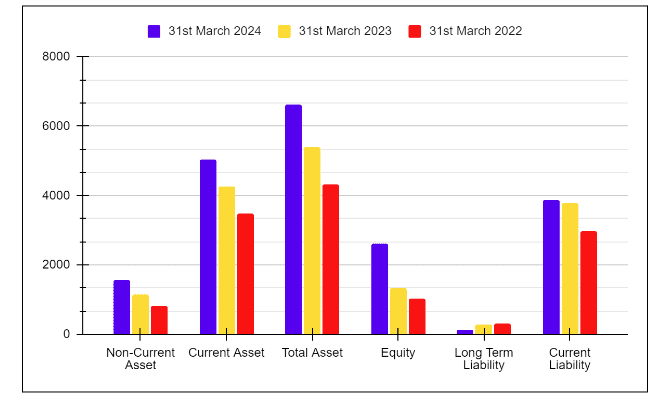
              According to the data in the above table, the company’s long-term and short-term assets are growing year over year, but its long-term liabilities have also risen from 2,434 Crores in FY2022 to 3,949.32 Crores in FY2023.

              Income Statement

              Particulars31st Dec 202331st Dec 202231st Dec 2021
              Revenue from operations16321.06313390.5588958.291
              Total Income16400.42213429.4079026.216
              Total Expenses13660.58311405.7648019.608
              Profit before tax2739.3602023.6371006.68
              Profit after tax2101.8131550.114746.052
              (In INR Crores)

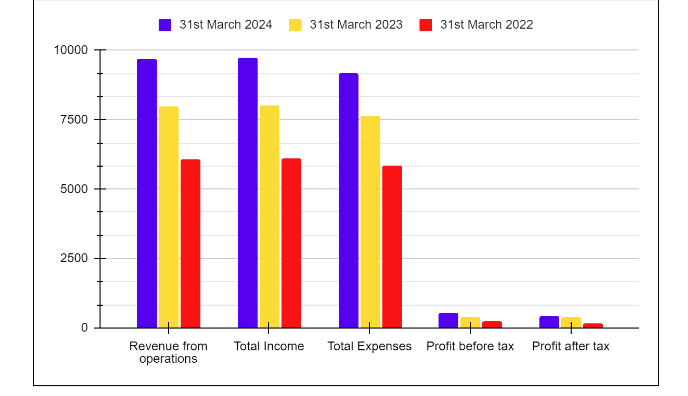
              The preceding table clearly shows that the company’s earnings and revenue are growing steadily. The company’s net profit has also increased by 35% year over year.

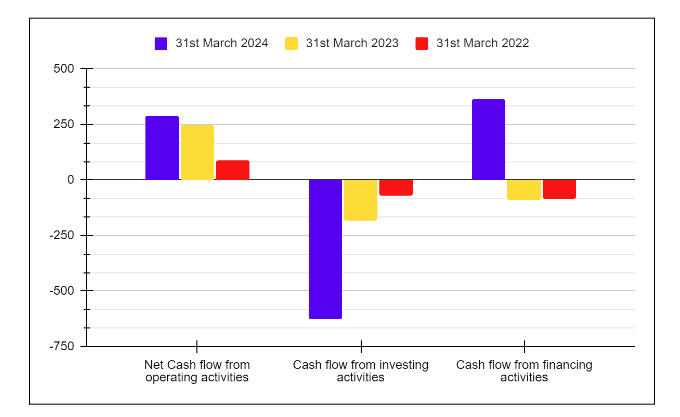
              Cash Flow Statement

              Particulars31st Dec 202331st Dec 202231st Dec 2021
              Cash flow from operating activities2390.7781790.0291231.422
              Cash flow from investing activities(3289.867)(1704.598)(1010.639)
              Cash flow from financing activities984.9(17.942)(177.682)
              (In INR Crores)

              The cash flow from financing activities exhibits massive growth, with inflows posting a positive figure of 984.9 Crores for FY 2023, whereas the cash flow from operating activities shows a steady rise.

              KPIs

              Particulars31st March 202331st March 202231st March 2021
              Operating Profit Margin (%)18.7416.7713.5
              Net Profit Margin (%)13.1011.768.45
              Return on Capital Employed (%)27.2628.8818.15
              Inventory Turnover3.393.733.09
              Current Ratio1.020.860.84
              Debt to Equity Ratio0.750.720.60

              We can infer from the aforementioned KPIs that the company’s operational profit margins are increasing year over year, while their ROCE indicates steady growth. Additionally, their current ratio, a liquidity indicator, indicates a significant jump in liquidity when compared to FY 2022.  

              Read Also: Coca-Cola Case Study and Marketing Strategy

              SWOT Analysis of Varun Beverages

              SWOT Analysis of Varun Beverages

              Strengths

              • They have an advantage over other market competitors because they are licensed to manufacture, distribute, and market well-known brands of PepsiCo.
              • Due to its extensive geographic reach, they are less vulnerable to the economic fluctuations of any one region.
              • They offer cost-effective products and have competitive pricing strategies because their management properly manages the production costs.

              Weaknesses

              • Since the business depends on PepsiCo for its products, any modifications to the agreement between the two will raise concerns for the business. 
              • PepsiCo’s product portfolio is restricted to carbonated drinks, which will raise their business risk. As a result, they must diversify their offerings.
              • VBL’s beverages are a seasonal product, with summertime demand being the peak, which causes uneven revenue for the business in winters.

              Opportunities

              • The company can expand its business internationally by asking for new geographical licenses.
              • The business must attract new customers by asking PepsiCo to change or modify their packaging of products.
              • Companies can use the faster-growing e-commerce market to expand their online sales channel.

              Threats

              • The beverage industry is extremely competitive, with several well-known competitors like Coca-Cola and others.
              • The organization must adapt to the changing consumer preference for healthy products and adjust its business strategies accordingly.
              • The cost of raw materials, including sugar and plastics, is highly variable, and any change in pricing could have a detrimental effect on their profit margins.
              • VBL’s product sales are entirely dependent on its supply chain and distribution network; any interruptions to these will result in a decline in sales.

              Read Also: Zepto Case Study: Business Model, Financials, and SWOT Analysis

              Conclusion

              With its stronghold in the beverage business, Varun Beverages has made a name for itself. The company is positioned for long-term success thanks to its dedication to innovation, strategic growth, and customer satisfaction. Our never-ending desire for refreshing beverages will continue to be satiated because Varun Beverages regularly explores new product categories.

              In addition, the business has increased its profits year over year and reported profits for the previous three years in a row. However, it is advisable to check your risk profile with your investment advisor and seek advice before making any investment decisions.

              S.NO.Check Out These Interesting Posts You Might Enjoy!
              1Sun Pharma Case Study: Business Model And SWOT Analysis
              2LTIMindtree Case Study: Products, Services, Financials, KPIs, and SWOT Analysis
              3Grasim Industries Case Study: Subsidiaries, Products, Financials, and SWOT Analysis
              4Ola Electric Case Study: Business Model, Financials, and SWOT Analysis
              5Hero MotoCorp Case Study: Business Model and SWOT Analysis
              6Kalyan Jewellers Case Study: Business Model, Marketing Strategy & SWOT

              Frequently Asked Questions (FAQs)

              1. How is Varun Beverages affiliated with PepsiCo?

                PepsiCo has partnered with Varun Beverages to sell and distribute its products in the Indian Market.

              2. How many Varun Beverages plants are there in India?

                VBL has 31 manufacturing plants in India and 6 within international boundaries.

              3. What famous products do Varun Beverages include?

                VBL produces brands like Pepsi, Pepsi Black, Mountain Dew, Sting, 7-Up, Mirinda, etc.

              4. Who owns Varun Beverages?

                RJ Corp Limited owns Varun Beverages.

              5. Who is Varun Beverages’ CEO?

                Kapil Agarwal is the current CEO of Varun Beverages.

            6. What is Insurance? Features, Terms, Benefits, Types, and Metrics Explained

              What is Insurance? Features, Terms, Benefits, Types, and Metrics Explained

              There are always surprises in life. Some surprises are great, but some are nasty and will hurt your pocket. Imagine yourself driving on a highway when, all of a sudden, there is an accident and your vehicle breaks down. In such a situation, it is natural to be concerned about how to resolve the issue. This is where insurance comes in; if you have coverage for your vehicle, you can get repairs done without having to pay for them. 

              The blog will guide you through the world of insurance, helping you pick the best coverage for your needs and grasp the fundamentals. 

              Overview on Insurance

              An insurance policy is a financial contract that shields you against unforeseen financial losses between two parties.

              The insurance provider charges a premium to cover a person or entity against certain risks, such as mortality, accidents, medical emergencies, etc. This ensures that the insured party can avail of the provider’s insurance benefits in the case of a loss. 

              For example – Mr. A is driving to work, and en route, he gets into an accident that damages his vehicle. If Mr. A had auto insurance, he would be entitled to a claim for the total amount of compensation from the insurance provider. In order to get this amount, Mr. A would have needed to pay a premium at the start of the policy’s term or length. 

              Read Also: Prize Indemnity Insurance

              Features of Insurance

              1.  Having an insurance policy allows you to mitigate the risk.

              2.  You can transfer the financial losses to the provider by paying a small amount as a premium.

              3.  You can live a calm life and feel at ease knowing that you will be compensated in the event of an accident. 

              4.  There are certain things, like cars, for which you are required to have insurance as it is made mandatory by authorities.

              Life Insurance

              Terms of Insurance

              1.  Policy – The written agreement between the policyholder and insurer.

              2.  Insurer – The insurance company that will be covering your risks.

              3.  Policy Holder – The person who took the policy from the insurance company.

              4.  Premium – The amount that you are required to pay to the company to keep the policy effective.

              5.  Policy Term – This will be referred to as the effective period, expressed in terms of the number of years for which the insurance provider will offer coverage. 

              6.  Sum Assured – The highest sum of money that you will receive in the event of unanticipated events. 

              7.  Claim – This is regarded as a formal request for reimbursement/payment for expenses incurred after the event. 

              How does Insurance work?

              The insurance firm takes premiums from several clients, covers them for particular risks, and divides the risk among them. 

              Let’s use home insurance as an example. In a given area, there are 100 houses with a value of 1 lakh each, of which 2 burn down every year. All of the homeowners obtained insurance from a company and had their homes covered; therefore, the insurance company collected a total of about 10 lakhs in premiums. Should two of the approximately 2 lakhs worth of houses burn down in a given year, the company would pay the homeowners 4 lakh and make a profit of 6 lakhs. 

              In a similar vein, the policyholder would have the assurance that should their home burn down; they would receive a settlement of two lakh rupees for a premium of just 10,000 INR. 

              Benefits of Insurance

              There are lots of benefits to buying insurance, some of which are mentioned below-

              1.  Insurance shields you from life’s uncertainties and guards against financial losses brought on by many unforeseen circumstances. 
              2.  Few insurance policies offer both life insurance and investment rewards, giving you the chance to achieve your most important life goals in addition to receiving insurance coverage. 

              3.   Unpredictable events could result in large losses that you would have to pay out of pocket, which could negatively affect your financial situation. But insurance allows you to cushion yourself. 

              4.  You can feel more at ease knowing that your insurance provider will provide support in the form of compensation in the event of a loss. 

              5.  Insurance plans also come with tax benefits, as you can take a deduction for life insurance u/s 80(C) and for health insurance, you can claim a deduction u/s 80(D).

              Types of Insurance

              In India, insurance is divided into 2 different categories.

              1.  Life Insurance

              2.  General Insurance

              Life Insurance 

              This kind of insurance safeguards your loved ones by providing either one-time or periodic payments after the event of your death. This insurance helps your family survive after your passing. 

              There are several types of life insurance. Some of them are:

              1.  Term Life Insurance – This insurance ensures that in the event of your death, the designated beneficiary receives an agreed-upon amount from the insurer. 

              2.  Whole Life Insurance – The insurance covers an individual’s life to the age of 100 and is sometimes referred to as a standard life insurance coverage. 

              3.  ULIP Plans – The Unit Linked Insurance Plan, or ULIP, offers both investing and insurance benefits. A portion of your contribution is used to cover your life insurance, while the remaining amount is invested in securities linked to the market. 

              General Insurance 

              All other forms of insurance, excluding life insurance, are categorized as general insurance since they shield your finances from losses brought on by events that involve home, car, health, or other property. They also go by the name of non-life insurance policies. 

              There are several types of general insurance. Some of them are:

              1.  Health Insurance – When a person purchases health insurance, the insurance company pays for their medical expenses up to the sum assured, which is determined at the time the policy is taken out. 

              2.  Motor Insurance – This type of insurance offers cash support if your vehicle — a car, bike, etc.— is stolen or damaged.

              3.  Home Insurance – As the name implies, home insurance protects your home’s infrastructure and possessions from harm and devastation, including natural and man-made calamities.

              4.  Travel Insurance – If you have travel insurance, you will be protected against any mishaps that happen during your travel, like misplaced bags, cancelled flights, etc. 

              General Insurance

              How to Choose an Insurance Provider?

              1.  The most important factors to consider when choosing an insurance company are the features and benefits that they are offering.

              2.  You must obtain estimates from multiple insurance providers and evaluate them; nevertheless, you shouldn’t choose the least expensive option without also considering the value proposition. 

              3.  Customer service is another crucial component to take into account. When filing a claim, you should pay close attention to how quickly and responsively their team responds to your inquiry. 

              4.  Before purchasing any insurance policy, you should research the company’s past claim settlement ratio; the greater the ratio, the more likely the insurer will pay the claim without being denied. 

              5.  Although negative reviews or complaints filed to the insurance business are often disregarded, they may provide insight into which firms are worth considering. 

              6.  When purchasing insurance policies, it is important to consider an insurance company’s size and financial standing. In the event of a larger claim, a company with weaker financial standing may be unable to reimburse the amount due. 

              Read Also: Concurrent Insurance

              Key Comparison Metrics of Insurance Providers

              1.  Gross Written Premium – It shows the entire amount of the premium that the insurer wrote before commissions and reinsurance costs are subtracted. 

              2.  Claim Settlement Ratio – This displays the percentage of claims that the insurance company has settled relative to the total number of claims that it has received. 

              3.  Policy Renewal Rate – This indicates the percentage of policyholders who choose to renew their insurance with the same insurance company. 

              4.  Average Time to Settle a Claim – The shorter the time taken to process the claim, the more advantageous it is to the insured. 

              Conclusion

              One of the most essential advantages of insurance is that it protects your money after an unforeseen event in exchange for a nominal premium. However, you must take into account several aspects when choosing an insurance provider, including the claim process, customer service, and policy features. 

              Frequently Asked Questions (FAQs)

              1. What is the purpose of insurance?

                The primary goal of insurance is to lessen the burden of monetary loss in exchange for a minimal premium payment.

              2. What are the types of insurance?

                There are two primary categories of insurance: general insurance and life insurance.

              3. Which organization manages the workings of the insurance industry?

                The Insurance Regulatory and Development Authority of India, or IRDAI, is responsible for overseeing the general operations of the insurance sector.

              4. What is IMF in Insurance?

                IMF stands for Insurance Marketing Firm, which is a distribution channel established by IRDAI.

              5. Is there any tax benefit available in insurance?

                Yes, insurance plans offer several tax benefits. For example, you can deduct your life insurance payments under Section 80(C) and your health insurance premiums under Section 80(D). 

            7. What is FIRE in Finance? Full Form, Features, Types, and Formula Explained

              What is FIRE in Finance? Full Form, Features, Types, and Formula Explained

              Are you tired of your daily grind? Feeling trapped by your income? You are not alone. Millions crave financial freedom and the chance to break free from the traditional 9-5 job. But is early retirement possible?

              This blog will dive deep into the world of FIRE and explore the sacrifices needed to achieve financial independence and early retirement.

              Overview

              FIRE stands for “Financial Independence Retire Early”. According to this theory, saving a bigger percentage of income and making prudent purchases throughout one’s earning years are the best ways for someone to retire early—typically in their 30s or 40s. 

              A person is typically expected to retire at age 60, but recently, people have a longing to retire early. The idea inspires many to save money to retire early and live a longer life. 

              Features

              The major features of FIRE are as follows –

              1.  The concept focuses on retirement earlier than traditional retirement age.

              2.  Individuals should save a significant percentage of their income—more than 50%, on average.

              3.  It is recommended that savings are invested aggressively in high-yielding asset classes like bonds and stocks. 

              4.  Implementation of the idea requires a minimalistic lifestyle, which means an individual is required to spend less and find cheaper alternatives to their habits.

              5.  Proper financial planning is required to achieve early retirement.

              6.  Discipline in saving funds is of paramount importance

              Types of FIRE

              Types of ‘FIRE’

              The 3 major types of FIRE approaches are explained below-

              1.  Lean FIRE 

              Lean FIRE assumes a low spending rate after retirement. This means that you’ll have to sacrifice many of your aspirations and live within your means. If you’re willing to make those sacrifices, then Lean FIRE might be the right option for you because it is the fastest way to achieve your goals. 

              2.  Fat FIRE

              If you dream of international travel, lavish vacations, and shopping, Fat FIRE is the way for you. It allows users to save aggressively during their careers to have above-average retirement funds. 

              3.  Barista FIRE 

              Individuals who follow the FIRE method are not interested in working a 9–5 job in the long term; instead, they engage in part-time work and live a modest lifestyle after retirement. To enjoy the freedom of work and the financial security of retiring early, many attempt to locate a less stressful job or work part-time after retirement. 

              Read Also: Military Wealth Management

              How does ‘FIRE’ work?

              If you intend to retire early, you must determine how much money you will need to continue living the way you do when you are retired. This will assist you in deciding when you can retire. 

              For example, a person with an annual income of 7 lakhs who intends to retire at 45 must have a different FIRE plan than someone with an annual income of 12 lakhs who wants to retire at 40. 

              FIRE strategy requires a unique approach, which typically includes cost-cutting and aggressive investing. One way to save costs is to purchase second-hand goods rather than brand-new ones or to spend on necessities only rather than wants. Individuals must set aside between 50 and 70 percent of their income for savings and use those funds to invest in various higher-yielding asset types, including bonds and stocks. 

              In addition to these two things, you must review your tax strategies to reduce the amount you pay for tax on your income.

              To learn about your required retirement corpus, explore our Retirement Planning Calculator here.

              Method of Calculating ‘FIRE’

              1.  To calculate FIRE, you need to determine your in-hand annual income first.

              2.  Next, you must determine your FIRE number using the widely accepted 4% thumb rule, which states that to maintain a 4% withdrawal rate, you must amass assets equal to 25 times your yearly expenses. For example – If your annual expenses are 5,00,000 INR, then your FIRE number would be 1,25,00,000, which is 25 times your annual expenses.

              3.  Then, you must adjust the FIRE number to include the impact of inflation.

              4.  The next step is to figure out how long it will take you to reach FIRE by factoring in your current savings rate, expenses, and investment return. 

              5.  The next stage would be to decide which asset class to invest in. 

              6.  Your portfolio must be periodically examined to assess investment performance and determine whether your FIRE objective is on track.

              Fire Calculation

              Advantages

              FIRE offers several advantages to those who use it for their retirement planning, a few of which are mentioned below.

              1.  It gives someone the ability to feel adaptable and free to pursue the kind of life they desire

              2.  An individual can have more time to follow their passions and hobbies when they retire early. 

              3.  Individuals who are financially independent and have a solid financial plan lead stress-free lives free from financial uncertainty. 

              4.  A person can leave a concentrated legacy through FIRE. Early retirement also enables one to spend more time with one’s loved ones. 

              Disadvantages

              1.  FIRE is vulnerable to uncertain and erratic returns on your investments; if the actual returns do not align with your retirement plan, you may not be able to secure enough money to retire. 

              2.  It focuses heavily on giving up short-term needs in favor of early retirement and long-term financial security, which can cause mental dissatisfaction among users. 

              3.  The growing cost of healthcare is not considered while accounting for retirement. This exposes the user to vulnerability during periods of a health crisis.

              4.  Inflation can erode purchasing power and reduce the value of your retirement savings. Hence, it is important to regularly modify the FIRE number in accordance with updated inflation figures. 

              Read Also: 10 Essential Financial Planning Tips for Military Members

              Conclusion

              The FIRE technique is a valuable strategy for early retirement and post-retirement financial independence. If you want to retire in your 40s, you should plan your retirement based on your lifestyle and income. You can apply any of the FIRE types to plan your financial future for yourself and your family. Furthermore, since retirement is a very personal choice, there is no one correct way to plan it; hence, you should do what is practical for you. 

              Frequently Asked Questions (FAQs)

              1. What does FIRE stand for in financial terms?

                FIRE refers to “Financial Independence Retire Early”. 

              2. What is the FIRE method?

                It’s the process of making significant investments and savings during your formative years so that you can retire early. 

              3. How do you calculate your FIRE number?

                To calculate your FIRE number, you must calculate your current annual expenses and multiply them by 25. This FIRE formula is derived using the 4% rule as a basis.

              4. How can I plan my retirement by FIRE?

                With the FIRE strategy, you can reduce your spending, save more money, and invest in high-yielding asset classes to prepare for retirement.  

              5. Is FIRE achievable for everyone?

                Most people can achieve it because it just takes discipline, dedication, and smart financial planning. Your ability to achieve FIRE depends on your income level, your spending habits, and your ability to generate higher returns.

              Disclaimer: The securities, funds, and strategies mentioned in this blog are purely for informational purposes and are not recommendations.

            8. Explainer on Private Equity vs Venture Capital: Differences, Process, and Famous Firms

              Explainer on Private Equity vs Venture Capital: Differences, Process, and Famous Firms

              Did you ever wonder what the terms ‘venture capital’ and ‘private equity’ meant? This blog will explain these two investment powerhouses and their key differences.

              So, whether you are a curious entrepreneur or an aspiring investor, this guide will shed light on the fascinating worlds of venture capital and private equity.

              Overview of Private Equity vs Venture Capital

              Private Equity 

              Private Equity refers to investments made in companies that are not publicly traded on stock exchanges. These firms raise capital from investors like pension funds, insurance companies, and high-net-worth individuals. The capital is then used to buy stakes in private companies, to improve their operations and profitability before selling them at a profit.

              Process

              The investment process of private equity firms is as follows,

              1. PE firms raise money from investors by creating a private equity fund. This fund has a specific investment strategy and a finite lifespan, generally 6-7 years.
              2. Once the fund is capitalised, the PE firm starts looking for investment opportunities. They look for companies with strong growth potential, sustainable competitive strength and a good management team.
              3. If a business is thought to be worth investing in, the PE firm will conduct thorough due diligence to analyse the company’s financial health, business model and market position.
              4. If the due diligence is satisfactory, the PE firm will negotiate the terms of investment with the company’s owners which involves acquiring a controlling stake in the company and providing growth capital.
              5. Once the investment is made, the PE firm will work with the company’s management team to improve its operations and profitability. This may involve implementing new strategies, restructuring the business, or making acquisitions.
              6. The PE firm’s ultimate goal is to exit the investment within the firm’s lifespan, which can be done through an IPO, a sale to another private equity firm, or a strategic sale to a trade buyer.
              Venture Capital Firms Investing

              Venture Capital

              Venture capital is a type of AIF (Alternative Investment Fund) that provides funding for startups and young companies with high growth potential. Unlike private equity, which focuses on established businesses, VC Firms essentially bet on ideas and innovation.

              VC firms invest in startups at several stages, 

              1. Seed Stage – The earliest stage of funding, often providing capital to help develop a prototype or test a new concept.
              2. Early stage – VCs fund startups that are validating their product-market fit and starting to gain traction.
              3. Growth Stage – Investing in companies that are looking to expand their operations.

              Process

              The investment process of Venture capital is as follows

              – VC Funds raise money from limited partners (LPs) such as pension funds, insurance companies, and HNIs. These funds are used to invest in multiple startups while spreading out the risk.

              – VC investments are generally smaller than PE deals. These firms receive equity ownership in the startup. This means that they share the profits of the company if successful.

              – VC firms have a long investment horizon, i.e. 5 to 10 years, and look for an exit through either acquisition or IPO.

              Private Equity vs Venture Capital

              1. Private Equity targets established, mid-stage or mature companies with existing revenue and profits and looks for businesses with turnaround potential. At the same time, venture capital often backs early-stage startups with high growth potential before they even have a proven product or market.
              2. Private Equity invests in more considerable sums and takes the majority stake in the companies they target. On the contrary, VC makes smaller investments spread across multiple startups to diversify risk. Since they are funding unproven ventures, these investments carry a higher risk of failure but are also eligible for high returns.
              3. While VC provides guidance and mentorship to young companies but generally does not take an operational role, PE firms are actively involved in managing the companies and bring in operational expertise to help restructure, streamline operations and improve the bottom line.
              VC Investing after analysis

              Read Also: SIP in Stocks vs SIP in Mutual funds?

              Famous Firms 

              Below is a list of some of the famous Venture Capital and Private Equity firms in India.

              Venture Capital Firms

              1. Sequoia Capital  – is one of the most prominent VC firms globally. It has been instrumental in funding over 400 Indian startups, including Zomato, Ola, Oyo Rooms, BYJU’s, etc.
              2. Accel Partners – is another leading VC firm that has backed Indian startups like Flipkart, Myntra, and Swiggy at the seed, early, and growth stages. It has offices in California and San Francisco, and it has additional operating funds in London, India, and China. Accel was founded in 1983 by Arthur Patterson and James R. Swartz.
              3. Matrix Partners – is focused on early-growth stage companies. Matrix Partners has funded successful startups like Delhivery, Ola, etc. The firm was established in 2006.
              4. Kalaari Capital – it is an early-stage venture capital firm established in the year 2006 by Vani Kola and has been behind the success stories of several Indian startups like Snapdeal.

              Private Equity Firms

              1. Blackstone India – A global PE giant, Blackstone invests across multiple sectors in India, including real estate, healthcare and consumer goods. In 1985, Peter G. Peterson and Stephen A. Schwarzman established Blackstone.
              2. Warburg Pincus – a private equity firm that has been investing in India since the 1990s. Some of Warburg’s investments include Ecom Express, Havells, Bharti Airtel, etc.
              3. Bain Capital – another private equity giant that has been investing in companies since 1984. It provides capital solutions to entrepreneurs, companies, and asset owners. It supports innovative businesses and accelerates growth.
              4. Carlyle Group – is a global PE major. The group focuses on mid-market and buyout investments in India. The firm was founded in Washington DC in 1987 by Bill Conway and David Rubenstein and has 28 offices across four continents.

              Read Also: XIRR Vs CAGR: Investment Return Metrics

              Conclusion

              Private Equity and Venture Capital are both essential parts of the financial ecosystem. However, they serve distinct purposes. PE firms help existing businesses thrive, while VC firms nurture the next generation of industry leaders. PE firms act like business doctors, stepping in to improve and unlock the growth potential of established companies, while VC firms are startup champions, fuelling innovation by investing in companies at a nascent stage with disruptive ideas.

              Frequently Asked Questions (FAQs)

              1. What is the difference between Private Equity and Venture Capital?

                PE invests in established firms for operational improvement, while VC backs early-stage startups.

              2. Which is riskier, private equity or venture capital?

                Venture capital is generally riskier as startups have fewer track records. Private Equity targets companies with a proven track record that is less risky.

              3. How involved are PE and VC firms in the businesses they invest in?

                PE firms are actively involved in managing the companies they own. VC firms provide guidance but do not participate in operational roles.

              4. How long do VC and PE investments generally last?

                Venture Capital investments last 5-10 years, and private equity investments last 3-5 years.

              5. How can my startup become eligible for VC funding?

                A strong team, a scalable business model, and a massive market opportunity are all vital in raising funds from VC firms.

            9. Open Free Demat Account

              Join Pocketful Now

              You have successfully subscribed to the newsletter

              There was an error while trying to send your request. Please try again.

              Pocketful blog will use the information you provide on this form to be in touch with you and to provide updates and marketing.