Blog

  • Ola Electric Case Study: Business Model, Financials, and SWOT Analysis

    Ola Electric Case Study: Business Model, Financials, and SWOT Analysis

    India is witnessing a silent revolution on its streets. Electric two-wheelers (E2Ws) are zooming past conventional scooters, driven by a surge in eco-consciousness and government incentives. At the forefront of this change is Ola Electric, a young company with a bold vision.

    In today’s blog, we will dive deep into the story of Ola Electric and explore the company’s business model, challenges, strengths, etc.

    Buckle up and read how Ola Electric is paving the way for a greener tomorrow.

    Ola Overview

    Ola is a ride-hailing company that connects customers with drivers and vehicles. It is India’s largest mobility platform and serves over 250 cities across India, Australia, and New Zealand. Ola was founded in 2010 by IIT graduates Bhavish Aggarwal and Ankit Bhati. They both previously started an online trip-planning company called Olatrip.com. They aimed to bridge the gap between cab owners and commuters and make hailing cabs a smooth experience. In January 2011, recognising the growing demand for cab services, Ola was launched as a taxi aggregation firm. Initially, bookings were made via phone calls. However, in 2012, Ola introduced its mobile app, making it even more convenient for users to book rides. 

    Currently, the company has the biggest market share in the Indian ride-hailing space. Over the years, Ola has expanded its services beyond car booking. Today, Ola has also ventured into the electric vehicle market with Ola Electric, a subsidiary focused on sustainable transportation solutions.

    Ola Electric

    The products offered by Ola Electric include Ola S1 scooter models—Ola S1 Pro, Ola S1 Air, Ola S1 X+, Ola S1 X (2 kWh), and Ola S1 X (3 kWh), which are built on the current EV scooter Generation 3 platform. Compared to the Generation 2 platform, the Generation 3 platform improves several important aspects of the EV scooters, including motor power, battery performance, range, acceleration, and speed. 

    The current line of third-generation EV scooters includes, 

    1. Ola S1 Pro+ – flagship premium EV scooter offers an extended driving range of up to 320 km, a top speed of 141 km/h.
    2. Ola S1 Air – second premium EV scooter offering a driving range of 151 km with a 6 kW peak motor power.
    3. Ola S1 X+ – sold at a lower price than the Ola S1 Pro+, the Ola S1 X+ features a driving range of 242 km and a top speed of 125 km/h. 

    The company also intends to apply the same platform strategy to its recently unveiled motorbike lineup, which consists of Roadster X+, Roadster X and Roadster. Moreover, the company plans to launch new bikes based on Diamondhead, Adventure, and Cruiser models in 2025 and 2026. 

    Furthermore, with the help of the Ola Electric website and the company’s digitally enabled pan-Indian sales and service network, the products are sold through a D2C omnichannel strategy. Consumers have two options for buying the Ola EV scooters – they can order them via the Ola Electric website or visit one of the nearest centres, where staff members will let them view and test drive the EV scooters before placing an order. The company guarantees a seamless ownership and post-purchase servicing experience through the widespread network.

    Read Also: Ather Energy Case Study: Business Model, Financials, and SWOT Analysis

    Business Model of Ola Electric

    The Ola Electric Business Model is based on three key scalable platforms:

    • Research & Development and Technology Platform – This encompasses Ola Electric’s in-house development of core technologies like software (MoveOS), electronics, motors, batteries and even manufacturing techniques. This gives them greater control over the entire process, including products and costs, which eventually helps develop different EV models.
    • Adaptable manufacturing and supply chain platform – This comprises flexible assembly lines, a robust and shared supply chain emphasising co-location and localisation, and a vertically integrated manufacturing ecosystem across fundamental EV components, including battery packs, motors, and vehicle chassis. This platform also helps the company reduce costs, maximize capital expenditure on developing its EVs, and increase its manufacturing capacity. 
    • D2C omnichannel distribution platform – consists of an online shopping platform, a charging network, and an integrated company-owned sales and service network. All of the company’s current EV models—the Ola S1 Pro, S1 Air, and S1 X+—are distributed, sold, and serviced on the same platform, and they can all be charged on the same network of charging stations.

    The company’s model is vertically integrated across R&D and technology, manufacturing, supply chain, sales and service, and charging facilities.

    Market Information of Ola Electric Mobility Ltd.

    Current Market Price ₹56
    Market Capitalization (in ₹ Crores)24,701
    52 Week High ₹158
    52 Week Low₹46.3
    ROCE (%)-32.1%
    Face Value₹10

    Read Also: Vedanta Case Study: Business Model, Financial Statement, SWOT Analysis

    SWOT Analysis of Ola Electric

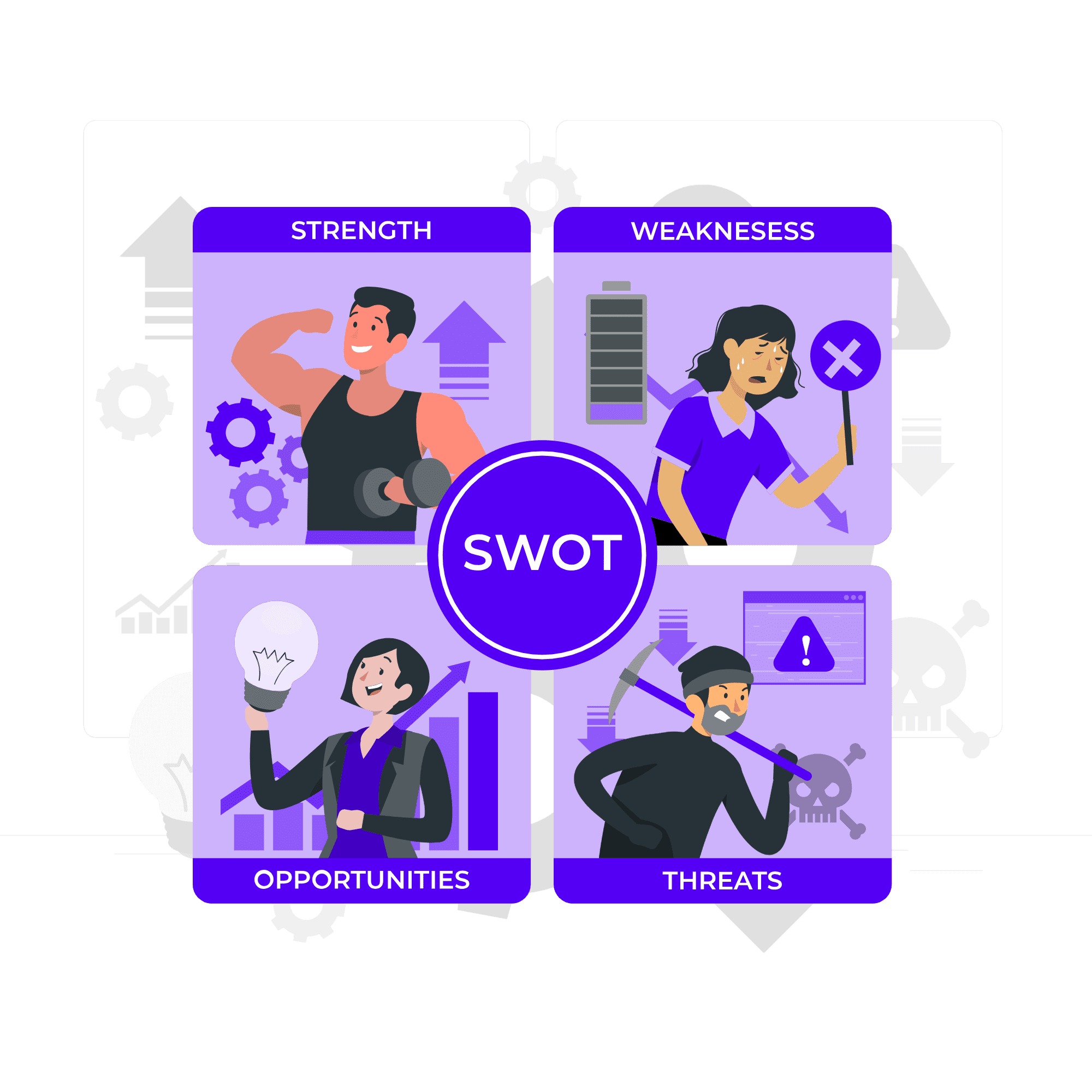
    The Ola Electric SWOT Analysis reveals the company’s strengths in innovation and manufacturing, while highlighting weaknesses like limited product range and potential service challenges.

    SWOT Analysis of Ola Electric

    Strengths

    1. Ola is leading the rapidly expanding electric two-wheeler market in India; Ola Electric is a pure EV player and a major force in the country’s electric vehicle landscape.
    2. Driven by a visionary founder, the company benefits from a team of seasoned leaders and has received several accolades, such as India 30 under 30 from Forbes India in 2014 and Entrepreneur of the Year from the Economic Times in 2017
    3. The company’s emphasis on R&D drives its internal capacity to create EV technology. Ola also conducts research and development (R&D) in the US, the UK, and India to develop innovative EV goods and essential EV parts, including motors, battery packs, and vehicle chassis.
    4. Ola has the biggest integrated and automated E2W manufacturing plant in India in terms of production capacity, and most of its EV components give them enhanced control of the supply chain.

    Weaknesses

    1. Currently, Ola Electric offers just a few scooter models, which might limit their appeal to a broader customer base with diverse needs.
    2. Building a robust service and after-sales network across India can take time and resources.
    3. Some initial batches of Ola scooters faced quality concerns. If not addressed effectively, this can damage the brand reputation and customer trust.

    Opportunities

    1. The Indian electric two-wheeler market is projected to grow significantly in the coming years. This presents a big opportunity for the company to capture a large market share.
    2. Ola Electric can explore expanding its product range to cater to different segments, like high-performance electric scooters or motorcycles.
    3. It can also explore opportunities for vertical integration, such as setting up battery manufacturing facilities, to control costs and ensure supply chain resilience.

    Threats

    Failure to capture and retain a loyal customer base could severely impact the business in all aspects.

    The company is in the early stages of development. It lacks the extensive track record of more established players in the market. Adding fuel to fire, its operations have resulted in accumulated losses and a negative cash flow.

    Read Also: Asian Paints Case Study: Business Segments, KPIs, Financials, and SWOT Analysis

    Financial Highlights of Ola Electric

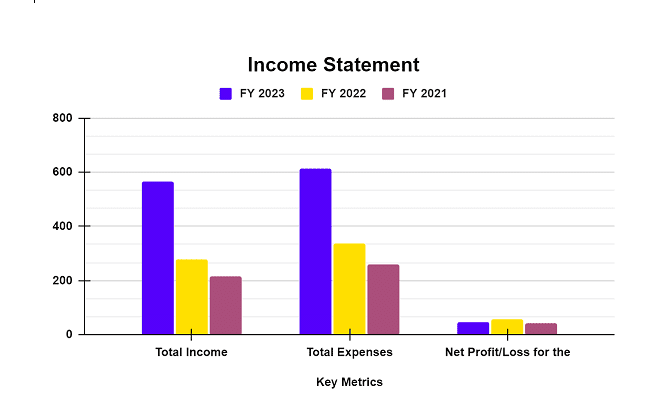
    Income Statement

    Key MetricsFY 2024FY 2023FY 2022
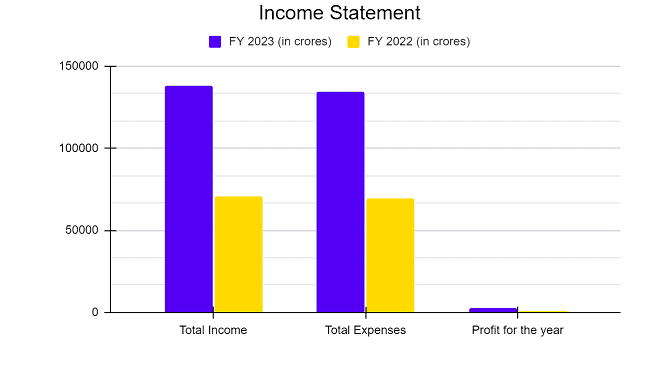
    Total Income5,2432,782456
    Total expenses6,6414,1461,222
    EBIT-1,397-1,364-766
    Net Profit -1,584-1,472-784

    (Above mentioned figures are in INR Crores unless stated otherwise)

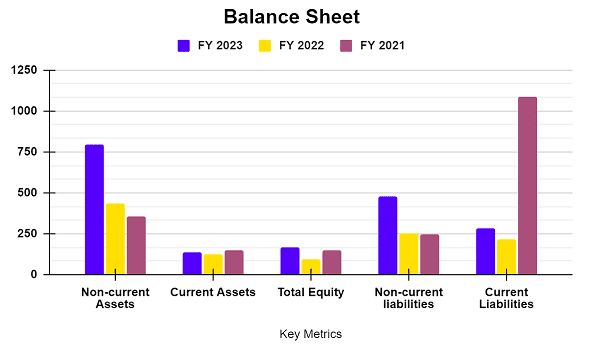
    Balance Sheet

    Key MetricsFY 2024FY 2023FY 2022
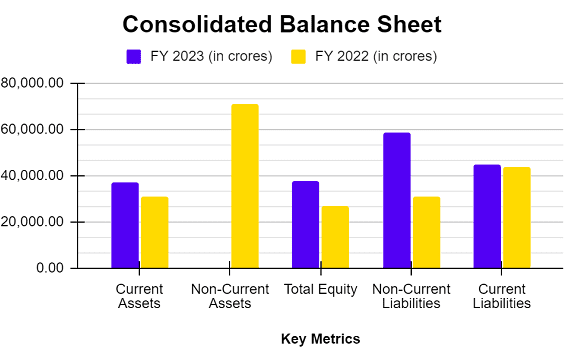
    Current Assets4,0473,4504,064
    Non-Current Assets3,6892,1241,332
    Current Liabilities 4,0082,3511,157
    Non-Current Liabilities1,708866578

    (Above mentioned figures are in INR Crores unless stated otherwise)

    Cash Flow Statement

    Key MetricsFY 2024FY 2023FY 2022
    Cash Flow from Operating Activities-633-1,507-884
    Cash Flow from Investing Activities-1,136-318-1,321
    Cash Flow from Financing Activities1,5896583,084

    (Above mentioned figures are in INR Crores unless stated otherwise)

    Inferences that can be drawn from the above statements are as follows 

    1. Revenue of the company significantly increased by 88% to ₹5,243 crores compared to ₹2,782 crores in FY 2023. 
    2. Net Loss also increased from about ₹1,472 crores in FY 2023 to ₹1,584 crores in FY 2024 . 
    3. Since the company is burning cash heavily, they are relying on capital financing to cover operational costs. 

    Future Outlook

    Ola Electric is poised for significant growth as India’s electric vehicle (EV) market expands. With a strong focus on innovation, vertical integration, and a robust manufacturing ecosystem, the company is well-positioned to capture a larger share of the two-wheeler market. As demand for eco-friendly mobility solutions increases, Ola Electric’s expansion into electric motorcycles and further product diversification could fuel its success. However, the company must address challenges related to quality control, service infrastructure, and competition from established automobile giants. By overcoming these hurdles, Ola Electric can lead India’s transition to sustainable transportation, driving long-term growth and profitability.

    Conclusion

    Ola has emerged as a significant player in the Indian ride-hailing and electric two-wheeler market. The company is well-positioned to capitalize on the future growth in both these sectors. However, they face challenges like limited product range, a nascent service network, and intense competition from competitors. 

    Addressing these weaknesses alongside navigating external threats like price moderation, battery technology, and charging infrastructure will be important for the company’s long-term success. Their strategic decisions and ability to adapt to market dynamics will determine their ultimate performance. 

    S.NO.Check Out These Interesting Posts You Might Enjoy!
    1Yes Bank Case Study: Business Model, Financial Statement, SWOT Analysis
    2Bandhan Bank Case Study: Business Model, Financial Statement, SWOT Analysis
    3Bikaji Foods Case Study – Product Portfolio, Financial Statements, & Swot Analysis
    4Bajaj Housing Finance IPO Case Study: Products, Financials, And SWOT Analysis
    5Voltas Case Study: Business Model And Key Insights

    Frequently Asked Questions (FAQs)

    1. What is Ola known for?

      Ola is known across India as a ride-hailing service and a leading manufacturer of electric two-wheeler scooters.

    2. When was Ola Electric listed?

      Ola Electric was listed on 9 August 2024.

    3. Which companies are Ola’s competitors?

      Ola faces tough competition in ride-hailing services from companies like Rapido, InDrive, and Uber. It also faces competition from established automobile companies like Bajaj, Hero Motocorp, Honda, etc in the automobile sector.

    4. Is Ola-Electric a new company?

      While Ola Cabs has been around since 2010, Ola Electric, its electric vehicle subsidiary, is a relatively new player.

    5. Who is the founder of Ola?

      The founders of Ola are Bhavish Aggarwal and Ankit Bhati.

  • Explainer on UPI Scams: Latest Scams, Economic Data, Government Actions, and Prevention Tactics

    Explainer on UPI Scams: Latest Scams, Economic Data, Government Actions, and Prevention Tactics

    Have you ever received a suspicious call about your UPI account? Or a message claiming an undelivered package requiring an urgent payment? If so, you are not alone. UPI scams are on the rise in India, and it is important to know the tricks scammers use to steal your hard-earned money.

    Today’s blog will explore the latest UPI scams and provide essential tips for protecting yourself.

    UPI Scams Overview

    UPI scams are deceptive tactics that exploit the Unified Payments Interface (UPI) system to steal money from users. These scams can trick you into revealing sensitive information or initiating unauthorized transactions.

    Scammers use several methods to manipulate you. They might pose as a trusted source like your bank, a seller, or even a friend. Their ultimate goal is to get your UPI PIN or OTP (one-time password). Once they get this, they can transfer funds from your account without your permission.

    Types of UPI Scams

    Latest Scams

    Below are some of the latest tactics used by scammers:

    Fake Customer Care Scams

    This scam involves impersonation. Scammers pretend to be customer service representatives from your bank or a popular online retailer. They might call you, claiming suspicious activity on your account or undelivered products. The goal is to pressure you to share your UPI PIN or OTP.

    QR Code Scams

    Malicious QR codes can be placed strategically to trick you. These codes could be on posters, websites, or even physical receipts. Scanning such a code could lead you to a fake UPI payment page or download malware that can steal your credentials.

    Fake Investment Schemes

    Fraudulent investments offering promising high returns are a common trap. Scammers might reach out through social media or messaging apps. They can be very convincing, so be wary of unsolicited investment advice and always research thoroughly before transferring any funds.

    SIM Cloning

    While not entirely new, SIM cloning is a growing concern. Scammers can get a duplicate SIM card with your phone number. This could allow them to intercept UPI notifications and verification codes, enabling unauthorised transactions.

    Fake Delivery OTP Scam

    This is a common tactic used by fraudsters to steal money through UPI. In this scam, you will receive a call from the fraudster impersonating a delivery agent. They would then create a sense of urgency by stating a delivery attempt was unsuccessful due to your absence or an incorrect address. The scammer will then ask for the OTP to reschedule the delivery or verify your information. The OTP that you will receive is actually for a UPI transaction.

    Phishing

    It is an attempt to steal sensitive information, generally usernames and passwords, credit card details, or any other personal data, by pretending to be a legitimate source. Phishing scams can target you through various channels, including email, text messages, phone calls and even social media. This could be an email that looks like an email from your bank or even a fake website designed to mimic a popular online service.

    UPI Scams Economic Data

    In 2022-23, 95,000 cases of UPI fraud were reported, up from 84,000 in 2021-22.

    55% of digital payment frauds in India are related to UPI transactions, and almost half of cybercrime cases since 2020 have been linked to UPI.

    While UPI boasts built-in security features, a few users unfortunately fall victim to social engineering scams.

    YearCount of casesFraud-to-Sales Ratio (value terms)
    2020-2177,2990.0017%
    2021-2284,2740.0016%
    2022-2395,4020.0015%

    Note – The fraud-to-sales ratio is a metric used to measure the percentage of fraudulent transactions compared to the total volume of transactions in a given period.

    Even though the number of UPI fraud cases has increased, the fraud-to-sales ratio remains very low, indicating that most UPI transactions are safe. However, this does not eliminate the importance of being aware of scammers’ social engineering tactics.

    UPI Scams Government Actions

    The Indian government is aware of the rising problem of UPI scams and is taking steps to combat them. Let us have an overview:

    1. The RBI issues guidelines and regulations for UPI transactions to strengthen security measures and improve fraud detection.
    2. The government has formed an Inter-Ministerial Committee on phone frauds, which brings together various stakeholders like the Ministry of Electronics and Information Technology, the Department of Financial Services, and law enforcement agencies to work collaboratively on preventing online financial frauds, including UPI scams.
    3. RBI and NPCI run public awareness campaigns to educate users about UPI scams. These campaigns include informative videos, posters and social media messages.
    4. The Central Government has also launched the National Cyber Crime Reporting Portal, www.cybercrime.gov.in, to enable victims to report complaints about all cybercrimes, including net and online frauds.

    To sum it up, the government is consistently addressing UPI scams, but it is a continuous battle. So, you need to be vigilant and follow safe UPI practices.

    How to prevent UPI Scams

    Prevention Tactics

    1. Treat your UPI PIN and OTP with the same care you would for your ATM PIN. Never, ever share them with anyone. Banks and legitimate businesses will never ask for this information.
    2. Before approving any UPI transaction, meticulously analyse the recipient’s details. Verify the name and UPI ID; do not rely solely on nicknames or familiar-sounding names.
    3. Scammers often impersonate customer service representatives or sellers. If you receive a call or message requesting urgent UPI payments or claiming suspicious activity on your account, verify the sender’s identity directly with the bank or the company they claim to represent.
    4. Some messages often contain links that lead to fake websites designed to steal your money through UPI credentials. Therefore, do not click on links from unknown senders.
    5. Only download UPI apps from trusted sources like Google Play store or Apple App Store. Avoid downloading apps from untrusted websites or clicking on ads that promote them.
    6. Enable strong passwords or PINs for your phone as well as the UPI app. Consider two-factor authentication for additional security.
    7. Regularly monitor your UPI transaction history, look for any unauthorized transactions and report them to the bank immediately.

    Read Also: Explainer on Imitation Investing

    Conclusion

    In today’s digital world, staying safe from UPI scams requires constant vigilance. Remember, knowledge is power; you can keep yourself safe by educating yourself and following safe practices. Do not hesitate to report suspicious activity to your bank and the authorities. Together, we can create a safer digital payment environment for everyone.

    Frequently Asked Questions (FAQs)

    1. What are UPI Scams?

      UPI Scams are deceptive tricks that exploit UPI to steal money from users through fake transactions or extracting sensitive information.

    2. What are some common UPI Scams?

      Phishing messages, fake money requests, and unauthorized transactions are all common scams.

    3. How can I protect myself from a UPI Scam?

      Be cautious of unknown messages, double-check the recipient details, and download apps carefully to protect yourself.

    4. Is using UPI safe?

      UPI has built-in security features, but user awareness is important. Following safe practices minimise your risk.

    5. What should I do if I suspect a UPI scam?

      Do not respond to the scammer; immediately report the incident to your bank and change your UPI PIN if needed. 

  • Asian Paints Case Study: Business Segments, KPIs, Financials, and SWOT Analysis

    Asian Paints Case Study: Business Segments, KPIs, Financials, and SWOT Analysis

    Asian Paints was established in 1942 and is currently the leading paint company in the country. Many of us will be able to recall the brand’s famous tagline, “Har Ghar Kuch Kehta,” but very few know about its success story. So, today’s blog will cover all the essential aspects of the company, like business segments, KPIs, financials, and SWOT analysis.

    Asian Paints Overview

    This company is a Mumbai-based Indian multinational paint company and one of the key global players in the paint industry. The company is well known for its expertise in developing a wide range of paints for both decorative and industrial purposes. Asian Paints manufactures and distributes paints, home-related products, wall coverings, waterproofing solutions, adhesives, and painting equipment. The company has a large footprint, reaching over 1,60,000 contact points nationwide. Here is the overview of the company:

    Company TypePublic
    IndustryChemicals and Paint Industry
    Founded1942
    HeadquartersMumbai, Maharashtra, India
    Area servedWorldwide

    Mission

    Asian Paints aspires to become one of the top five global companies in the paint industry by expanding its abilities to emerging economies. Some of its core missions are:

    • The company’s mission is to offer paints to satisfy market demand while ensuring the desired level and quality of customer satisfaction.
    • The company ensures environmental compliance and sustainability by focusing on waste minimization and water conservation across India.

    Competitors

    The company has many competitors in different markets from an array of domestic and international players:

    • Kansai Nerolac Paints
    • Sherwin-Williams
    • Nippon Paint
    • PPG Industries

    Asian Paints Products and Services

    Products

    The company assists its customers with end-to-end home decor solutions that help strategically expand into the home décor industry. It helps transform their customers’ homes into lovely spaces. Their products are:

    • Paints
    • Adhesives
    • Wall Coverings
    • Modular Kitchens
    • Wardrobes
    • Textures
    • Painting Aid
    • Bath fittings
    • Waterproofing
    • Wall Stickers
    • Door Systems
    • Mechanised Tools
    Asian Paints Paint

    Services

    • The ‘Beautiful Homes Service’ is an exclusive, end-to-end solution that offers customers a personalized interior design service, complete with professional execution, to assist them in creating their dream homes.
    • The company offers its customers a ‘Safe Painting’ service that guarantees hassle-free and reliable painting solutions with the highest safety standards.

    Read Also: List Of Best Paint Stocks in India

    Asian Paints Market Data

    Here are some essential market data of Asian Paints Ltd:

    Market Cap ₹ 2,74,901 Cr. 
    TTM P/E 50.52
    ROCE 36.98 % 
    Book Value₹ 166.73
    ROE28.19 % 
    52 Week High / Low ₹ 3,568 / 2,708
    Dividend Yield 0.90 % 
    Face Value ₹ 1.00
    (As of 3rd April 2024)

    Read Also: Ola Electric Case Study: Business Model, Financials, and SWOT Analysis

    Asian Paints Financial Highlights

    Balance Sheet

    ParticularsMar-23Mar-22Mar-21Mar-20
    Non-current Assets9,244.177,806.108,328.748,557.86
    Current Assets16,535.1615,144.2012,013.117,566.25
    Non-current Liabilities1,437.511,188.351,200.331,223.90
    Current Liabilities7,895.937,570.995,925.864,380.38
    (In Crores)
    BS of Asian Paints

    The balance sheet shows an increasing trend in total assets, which is driven primarily by current assets. This increase in current assets is financed mainly with current liabilities, which indicates a healthy financial position. 

    Income Statement

    ParticularsMar-23Mar-22Mar-21Mar-20
    Operating Revenue 34,488.5929,101.2821,712.7920,211.25
    Total Income 34,875.0729,481.2922,015.8420,515.56
    EBITDA 6,259.844,803.614,855.604,161.77
    EBIT 5,401.823,987.254,064.333,381.27
    Profit before Tax 5,688.834,187.724,304.353,633.99
    Consolidated Profit 4,106.453,030.573,139.292,705.17
    (In Crores)
    IS of Asian Paints

    The graph above indicates a healthy trend in the income statement as revenue grew continuously, which translated to higher profitability each year. 

    Cash Flow Statement

    ParticularsMar-23Mar-22Mar-21Mar-20
    Cash From Operating Activities 4,193.43986.493,683.353,038.15
    Cash Flow from Investing Activities -1,274.64-321.69-547.79-521.42
    Cash from Financing Activities -2,140.05-1,807.61-650.40-2,871.46
    (In Crores)
    CFS of Asian Paints

    The company’s cash flow situation is somewhat consistent as cash from operations has majorly seen an uptrend, except for FY22. The investing and financing activities have been negative for the past few years. This indicates a steady trend of modifying capital structure.

    Probability Ratios

    Particulars  Mar-23Mar-22Mar-21Mar-20
    ROCE (%) 36.9830.8837.1936.31
    ROE (%) 8.1923.1927.9628.36
    ROA (%)17.2214.2417.5717.16
    EBIT Margin (%) 15.6613.7018.7216.73
    Net Margin (%) 12.0310.4614.5713.55
    Cash Profit Margin (%)12.3011.3515.7115.27

    The company’s profitability ratios majorly signify consistent margins, which is considered to be a healthy sign for the company’s financial health. 

    Read Also: Tata Steel vs. JSW Steel: A Comparative Analysis Of Two Steel Giants

    Asian Paints SWOT Analysis

    SWOT of Asian Paints

    Strengths

    • Asian Paint has captured a large market share in the paint industry. The company has over 59% of the market share in the sector, far greater than any other paint manufacturer in the country.
    • The company has maintained a steady growth in the market share. 
    • It has a wide presence as it operates in 15 countries and has 27 manufacturing units. 

    Weaknesses

    • The company has performed below average in some overseas countries, except for Bangladesh, Nepal, and the UAE.
    • The industry is heavily reliant on economic cycles, and the looming threat of recession can substantially impact its bottom line figures. 

    Opportunities

    • As per the current scenario, Asian Paints has an immense opportunity to boost its market share in both the Industrial and the Auto Paint sectors, as the industry category requires high-class technology that the company can easily afford.
    • Asian Paints can achieve greater success by focusing on emerging markets and economies. The company’s brand positioning will help to give it an edge in the market competition.

    Threats

    • The paint industry is volume-based, which signifies that companies have to update to sustain themselves in the market regularly.
    • Any economic slowdown will negatively influence the construction industry and simultaneously affect the paint industry.

    Read Also: Zepto Case Study: Business Model, Financials, and SWOT Analysis

    Conclusion

    Asian Paint Ltd. became the leading company in the paint industry and also has strong financial performance. The company stands out as a dominant force in the paint industry, boasting a significant market share and a robust global presence. However, it is necessary to perform your analysis before investing your hard-earned money. 

    S.NO.Check Out These Interesting Posts You Might Enjoy!
    1Sun Pharma Case Study: Business Model And SWOT Analysis
    2LTIMindtree Case Study: Products, Services, Financials, KPIs, and SWOT Analysis
    3Grasim Industries Case Study: Subsidiaries, Products, Financials, and SWOT Analysis
    4Varun Beverages Case Study: Business Model, Financials, and SWOT Analysis
    5Hero MotoCorp Case Study: Business Model and SWOT Analysis

    Frequently Asked Questions (FAQs)

    1. When did Asian Paints start?

      Asian Paints began its operations in 1942 as a partnership firm.

    2. What is the market share of Asian Paints?

      Asian Paints currently holds 59% of the market and emerges as a market leader.

    3. What makes Asian Paints unique?

      Asian Paints is unique because it offers a variety of products and services such as Paints, Adhesives, Wall Coverings, Modular Kitchens, Wardrobes, Textures, and Painting Aids.

    4. What is Asian Paints’ competitive advantage?

      Asian Paints’ competitive advantage is its distribution strength.

    5. What is the market cap of Asian Paints?

      As of 3rd April 2024, the market cap of Asian Paint Ltd. is ₹ 2,74,901 Cr. 

    Disclaimer: The securities, funds, and strategies mentioned in this blog are purely for informational purposes and are not recommendations.

  • Britannia Industries Ltd Case Study: Business Segments, KPIs, Financials, and SWOT Analysis

    Britannia Industries Ltd Case Study: Business Segments, KPIs, Financials, and SWOT Analysis

    We all have experienced the brilliance of Britannia, but very few know its story. So today, we will explore Britannia’s success story. We’ll start with the company’s overview.

    Britannia Industries Ltd Overview

    Established in 1892, Britannia Industries Ltd. is one of India’s oldest food product companies and holds a significant position in the country’s biscuit industry. It is Kolkata-based and a part of the WADIA Group.

    It is an iconic brand and reaches over 50% of Indian homes. Britannia has been in this business for over a century, building a loyal consumer base with strong and deep emotional connections. The company’s R&D team plays a vital role in maintaining and innovating a vast portfolio, ensuring it aligns with consumer preferences while prioritizing quality.  

    Company TypePublic
    Industry TypeFood 
    Founded1892
    HeadquartersKolkata
    Area servedWorldwide
    ParentWadia Group

    Awards and Recognition

    • 2011 – The Indian Merchants’ Chamber.
    • 2012 – The Golden Peacock National Quality Award.
    • 2014 – 100 Most Trusted Brands of India list.
    • 2016 – Renewable Energy India Awards.
    • 2019 – Brand Equity’s Most Trusted Brands.
    • 2022 – Ranked 4th in the list of India’s most chosen FMCG brands.

    Segments of Britannia Industries Ltd

    Britannia Industries has served many finger-licking products. Such as:

    • Biscuits: Britannia is one of the leading biscuit manufacturers in India, with popular brands such as NutriChoice, Milk Bikis, Bourbon, Good Day, 50-50, Marie Gold, Nice Time, and Little Hearts. Britannia biscuits are available in various segments, such as cookies, crackers, cream, health, and treats.
    • Rusk: Britannia Rusk is a crispy and crunchy snack made from wheat flour, sugar, and butter and comes with various flavours of elaichi, milk, and suji toast
    • Cakes: Britannia cakes include fruit cake, nut & raisin cake, chocolate cake, muffins, cupcakes, and brownies.
    • Snacks: Britannia snacks are tasty and ideal for enjoyment anytime, anywhere. Britannia snacks include wafers, salted snacks, and nuts.
    • Bread: Britannia Breads offers wheat bread, multigrain bread, fruit bread, sandwich bread, pav, bun, and kulcha. They are made from high-quality ingredients and are enriched with essential nutrients.
    Segments of Britannia

    5 competitors of britannia biscuits

    The company faces tough competition from the following players:

    • Nestle 
    • Mother dairy
    • TATA 
    • Parle
    • Amul 

    Market Data

    Market Cap ₹ 1,18,024 Cr. 
    TTM P/E 54.64
    ROCE 55.5 % 
    Book Value₹ 146.73
    ROE 76.04 % 
    52 Week High / Low ₹ 5,386 / 4,222
    Dividend Yield1.47 % 
    Face Value₹ 1.00
    (As of 2nd April 2024)

    Read Also: Zepto Case Study: Business Model, Financials, and SWOT Analysis

    Financial Highlights of Britannia Industries Ltd

    Income Statement

    ParticularsMar-23Mar-22Mar-21Mar-20
    Operating Revenue 16,300.5514,136.2613,136.1411,599.55
    Total Income 16,516.4114,359.0913,449.0111,878.95
    Total Expenditure 13,469.6411,934.7510,626.859,756.37
    Profit before Tax 3,032.772,078.332,513.611,844.30
    Consolidated Profit 2,321.771,524.821,863.901,402.63
    IS of Britannia

    The graph indicates a growing trend in both Operating income and Net Profit. This shows a healthy state of the business.

    Balance Sheet:

    ParticularsMar-23Mar-22Mar-21Mar-20
    Non-Current Liabilities 1,596.57743.00806.22805.73
    Current Liabilities 4,134.404,147.143,608.902,578.46
    Non-Current Assets 4,549.243,493.443,579.664,147.70
    Current Assets 4,746.233,982.304,419.463,674.97
    (All values are in Crores)
    BS of Britannia

    The company has seen a consistent level of current liabilities but an increase in current assets. They have also witnessed an increase in non-current assets, which are primarily fueled by growing non-current liabilities. 

    Cash Flow Statement

    ParticularsMar-23Mar-22Mar-21Mar-20
    Cash From Operating Activities 2,526.211,299.521,875.521,484.53
    Cash Flow from Investing Activities -1,517.06910.89435.62-1,531.62
    Cash from Financing Activities -1,028.37-2,245.84-2,242.5057.94
    (All values are in Crores)
    CFS of Britannia

    The Cash Flow situation indicates a strong operating position but a weak investing position. This means that the company invests heavily in the long run, which is financed by financing activities. 

    Profitability Ratios

    ParticularsMar-23Mar-22Mar-21Mar-20
    ROCE (%) 55.5041.6445.2837.13
    ROE (%) 76.0449.8946.9232.40
    ROA (%) 27.6219.5923.3919.84
    EBIT Margin (%) 15.9814.1517.6014.30
    Net Margin (%) 14.0210.5613.7611.73
    Cash Profit Margin (%) 14.9011.6314.8912.90

    Peer Comparison

    ParticularsBritanniaMrs. BectorsDhunseri VenturesBambino AgroAnjani Foods
    Market cap (₹ Cr)1,18,3376,5541,13126884
    Revenue (₹ Cr)16,7231,56428032850
    Net Profit (₹ Cr)2,150.57134.3439.689.831.12
    Net Margin (%)12.708.5011.182.982.24
    RoE (%)67.7623.367.1211.229.12

    Read Also: Nestle India Case Study: Business Model, Financial Statement, SWOT Analysis

    SWOT Analysis of Britannia Industries Ltd

    This SWOT analysis of Britannia Company highlights its strong brand identity, extensive market presence, and effective 80:20 growth strategy driving significant revenue.

    SWOT Analysis of Britannia

    Strengths

    • Britannia has been in the industry for more than 100 years. The company has created its space in every Indian household and a strong brand identity.
    • The company used an 80:20 growth strategy where it focused on 20% of the brands like Marie Gold, Good Day, Milk Bikis & Nutri Choice, which contribute 80% of the company revenue. This process of putting some products on a priority list enabled the company to increase the efficiency of the production line.
    • The company is working on new market innovations, which means adjusting the market according to consumer tastes and preferences. It helps to explore new flavours while leveraging current and new technologies. 

    Weaknesses

    • Britannia is not able to maintain a proper overseas presence because of tough competition in the international market. 
    • The competitors in the Food Processing industry can easily imitate the business model.

    Opportunities

    • Accelerating technological innovation can lead to an increase in industrial productivity, allowing the company to capture greater market share.
    • The company can choose to acquire other companies in the dairy industry to increase its market share. 

    Threats

    • An increase in the price of the raw material will eventually increase the cost of the product, leading to a slowdown in sales. 
    • Changing political environments can impact the industry’s growth both in the local and international markets.

    Read Also: Coal India Case Study: Products, Subsidiaries, Financials, KPIs, and SWOT Analysis

    Conclusion

    Britannia Industries Ltd has established itself as a prominent player in the Indian food industry with a strong brand identity and loyal consumer base. The company’s focus on key brands, innovation, and market adaptation presents growth opportunities, while challenges such as international competition and raw material price fluctuations pose threats to its continued success. Over the next five years, the company expects to increase the contribution of its non-biscuit portfolio to approximately 35% of total revenue, up from the current 23%. Additionally, there is an ambition to scale the dairy sector to ₹2,000 crore within the same time. 

    However, it is important to know that investing before conducting prior research can expose you to undue risks. 

    S.NO.Check Out These Interesting Posts You Might Enjoy!
    1IRFC Case Study: Business Model, KPIs, Financials, and SWOT Analysis
    2Dr. Reddy’s Laboratories Case Study: Business Model, Financials, KPIs, and SWOT Analysis
    3Larsen & Toubro Ltd Case Study: Business Model, Financials, KPIs, and SWOT Analysis
    4Mahindra & Mahindra Case Study: Products, Financials, KPIs, and SWOT Analysis
    5Ullu Digital Case Study: Business Model, Financials, and SWOT Analysis

    Frequently Asked Questions (FAQs)

    1. What are the problems faced by Britannia?

      The problems faced by Britannia are rising interest rates, high commodity prices, and geopolitical conflicts disrupting supply chains.

    2. Who is the CEO of Britannia?

      Rajneet Singh Kohli is the CEO of Britannia.

    3. What is the market cap of Britannia Industries Ltd.?

      As of 2nd April 24, the market cap of the company is ₹1,18,024 Cr. 

    4. What are the main segments of Britannia?

      The company’s key segments are Biscuits, Rusk, Cakes, Snacks, and Bread. 

    5. What is the parent company of Britannia?

      Wadia Group is the parent company of Britannia Industries Ltd.

  • IRFC Case Study: Business Model, KPIs, Financials,  and SWOT Analysis

    IRFC Case Study: Business Model, KPIs, Financials, and SWOT Analysis

    Indian Railway Finance Corporation (IRFC) was established on December 12, 1986, as the dedicated financing arm of the Indian Railways for mobilizing funds from domestic and overseas Capital Markets. Today’s blog will cover the business model, KPIs, financials, and SWOT analysis of IRFC. 

    IRFC Overview

    Indian Railways (IR), with its 4th largest network in the world, has been the backbone of the transportation sector in India. It carries millions of passengers and cargo from one part of the country to the other. IRFC has played a strategic role in supporting the Indian Railways Infrastructure Development Plan. 

    IRFC was established on December 12, 1986. It mainly focuses on funding the acquisition of rolling stock assets, leasing of railway infrastructure assets and national projects of the Government of India, and financing other firms under the Ministry of Railways (MOR).

    Vision

    The vision of the company is to be an important and premier Financial Services Company for the growth of the Rail Transport Sector while maintaining a balanced relationship with the Ministry of Railways (MOR).

    Objectives

    The company’s primary objectives are as follows:

    • To drive resources via market borrowings from domestic as well as Overseas Capital Markets at the most competitive rates & terms.
    • To examine the possibility of funding CPSEs and other institutions for the development of rail infrastructure to ensure future growth and profitability.
    • To ensure optimum utilization of resources.
    • To make prudent use of derivatives and other acquiring products for risk mitigation at the right moment and cost.
    Indian Railways financing arm

    Business Model

    The company operates a low-risk, cost-plus business model, which helped them to record 0 GNPA (Gross Non-Performing Assets). It recorded low overheads, administrative costs, and high operational efficiency during the recent quarter. Furthermore, the Indian Railway Finance Corporation enjoys 0 tax liability as it is exempted from the RBI’s asset classification norms, provisioning norms, and exposure norms to the extent of direct access to the Ministry of Railways (MoR).

    Outlook

    In the future, the strategy initiatives of the company will revolve around diversifying its lending portfolio to broaden its horizons, venture further into financing the railway ecosystem, and maintain competitive borrowing costs. IRFC’s monopoly as the sole financier for the Indian Railways’ capital expenditure needs places it in a unique position to benefit from the sector’s growth. The Indian government’s ambitious plans for railway modernization and expansion, including dedicated freight corridors, high-speed rail projects, and station reconstruction, are likely to impact its growth substantially.

    Market Details

    Market Cap ₹ 189,885 Cr. 
    TTM P/E 31.45
    ROCE 5.32 % 
    Current Price ₹ 145
    Book Value ₹ 34.79
    ROE14.7 % 
    52 Week High / Low ₹ 192.8 / 26.7
    Dividend Yield 1.03 % 
    Face Value ₹ 10.0
    (As of 2nd April 2024)

    Read Also: IRCTC Case Study: Business Model, Financials, and SWOT Analysis

    Financial Highlights of IRFC

    Income Statement

    ParticularsMar-23Mar-22Mar-21Mar-20
    Operating Income 23,891.8320,299.2615,770.4713,421.02
    Total Income 23,932.6320,301.6015,770.8613,421.09
    Profit before Tax 6,337.016,090.164,416.133,192.10
    Profit after Tax 6,337.016,089.844,416.133,192.10
    Consolidated Profit6,337.626,090.404,416.133,192.06
    (In Crores)
    IS of IRFC

    The graph indicates a substantial growth in operating income, which translated into a growing trend of consolidated profit. 

    Balance Sheet

    ParticularsMar-23Mar-22Mar-21Mar-20
    Non-Current Liabilities4,18,940.023,88,428.383,20,222.342,30,522.99
    Current Liabilities26,736.4120,567.9724,994.5617,229.13
    Non-Current Assets7,455.421,373.1702.31,828.8
    Current Assets4,83,691.334,48,619.563,80,427.982,76,223.08
    (In Crores)

    The table indicates the concentration of assets in current assets and the concentration of liabilities in non-current liabilities. This could bring substantial issues in the long run. 

    Cash Flow Statement

    ParticularsMar-23Mar-22Mar-21Mar-20
    Cash From Operating Activities-28,583.83-64,412.28-89,906.65-62,700.61
    Cash Flow from Investing Activities0.09-4.720.421.47
    Cash from Financing Activities28,643.2864,266.3090,202.0462,696.81
    Net Cash Inflow / Outflow59.54-150.7295.81-2.33
    (In Crores)

    The table above indicates a very dire situation for the organization. The company seems to be borrowing very heavily to meet its operational needs. This can lead to significant issues in the long run. 

    Profitability Ratio

    ParticularsMar-23Mar-22Mar-21Mar-20
    ROCE (%) 5.325.125.025.76
    ROE (%) 14.6615.8413.3411.54
    ROA (%) 1.351.471.341.31
    Net Margin (%) 26.4830.0028.0023.78
    Cash Profit Margin (%) 26.5830.0728.0323.79

    The company’s profitability situation has been consistent for the past 4 years. This can be seen from its consistent ROCE, Net Margin, and ROE. 

    Read Also: CAMS Case Study: Business Model, KPIs, and SWOT Analysis

    SWOT Analysis of IRFC

    SWOT analysis of IRFC

    Strengths

    • The company has seen massive funding requests from Indian Railways, resulting in consistent revenue growth.
    • IRFC’s low-cost business model helps the business to maintain effective operational efficiency.

    Weaknesses 

    • The higher interest payment for borrowings can be concerning in coming years.
    • The company’s cash flow situation is pretty dire as the majority of the inflow comes from financing activities, which is not a long-term source of funds. 

    Opportunities

    • The company’s income potential is primarily reliant on the expanding infrastructure of Indian Railways.
    • The current government’s policies for the sector’s growth may generate a strengthened business position in the upcoming time.

    Threats

    • The company’s debt position exposes it to the risk of financial burden. This can lead to stress on bottom line figures during periods of losses. 

    Conclusion

    Indian Railway Finance Corporation (IRFC) is the dedicated financing arm of the Indian Railways (IR) for mobilizing funds. The company enjoys a healthy position on the outlook front as the current government encourages the sector. With a strong business model and government support, IRFC is well-positioned for growth and success in the future. However, its financials do not portray a healthy picture of the company. 

    Therefore, it is advised that you perform your analysis before investing your hard-earned money. 

    Frequently Asked Questions (FAQs)

    1. What is the role of IRFC in the railway?

      IRFC (Indian Railway Finance Corporation) is the dedicated funding arm of Indian Railways. The company was incorporated to mobilize funds from domestic and overseas markets to meet the extra budgetary resources requirement of Indian Railways.

    2. What is the source of IRFC’s funds?

      IRFC utilizes various sources, including taxable and tax-free bond issuances, capital gain bonds, term loans from banks/financial institutions, external commercial borrowings, internal accruals, asset securitization, and lease financing, to fulfil funding needs.

    3. Is IRFC tax-free?

      IRFC enjoys 0 tax liability as it is exempted from the RBI’s asset classification norms, provisioning norms, and exposure norms to the extent of direct access to the Ministry of Railways (MoR).

    4. Is IRFC government-owned?

      IRFC was incorporated as a public limited company on 12th December 1986 by the Ministry of Railways as a wholly owned government public financial institution to raise resources and funds to meet the development areas of the Indian Railways.

    5. Who is the MD and CEO of IRFC?

      Uma Ranade is the Chairman and Managing Director (Additional Charge) of IRFC.

  • Boat Case Study: Business Model, Product Portfolio, Financials, and SWOT Analysis

    Boat Case Study: Business Model, Product Portfolio, Financials, and SWOT Analysis

    boAt has become a household name in less than a decade of operations, but very few know about its story. Today, we’ll be covering a very unique company called “boAt.” We’ll understand its business model, financials, and SWOT Analysis.

    Boat Company Overview

    boAt’s adventure began in 2014 when Sameer Mehta and Aman Gupta, the brand’s co-founders, decided to provide consumers with stylish, designer audio products at a fair price. The company saw a gap in the Indian wearable and audio markets and thus chose its target market as the youth of the nation.

    Business Model of Boat

    The boAt’s primary business is manufacturing and retailing audio gear. boAt offers a variety of products, such as wearable technology, speakers, headphones, earphones, cables, and chargers. The company designs its products while keeping in mind the tastes of the youth. The management appeals to customers who are on a tight budget by positioning itself as a value-for-money product in the market. In order to widen its distribution channel, the company sells its products on well-known e-commerce sites, including Amazon and Flipkart. 

    Product Portfolio of Boat

    boAt provides customers with a large selection of products. Some of them are:

    • Headphones and Earphones – The company manufactures both wired and wireless headphones and earphones.
    • Speakers – Boat offers a range of speakers, from portable Bluetooth speakers to home theatres, sound bars, and party speakers.
    • Wearable Devices – The company also offers smartwatches and fitness wearables, which offer facilities like heart rate monitoring, steps counter, and smartphone connectivity.
    • Chargers – They offer a wide range of charging cables, adapters, power banks, and other types of electronic devices.
    Product Portfolio of Boat

    Read Also: Boat Case Study: Business Model, Product Portfolio, Financials, and SWOT Analysis

    Marketing Strategy of BoAt

    1. Targeting the Millennial & Gen Z Audience

    • boAt designs products with a focus on millennial and Gen Z customers.
    • Its marketing is focused on selling its products to music, fitness, and gaming enthusiasts, making its products aspirational.

    2. Influencer & Celebrity Endorsements

    • boAt collaborates with Bollywood actors, musicians, and sports personalities (e.g., Hardik Pandya, Kartik Aaryan, Kiara Advani), helping its products gain popularity.
    • Strong partnerships with social media influencers and content creators help drive brand awareness.

    3. Sports & Event Sponsorships

    • Official audio partner for IPL teams, ensuring high visibility among cricket fans.
    • Sponsored esports tournaments, tapping into India’s growing gaming market.

    4. Digital-First Marketing Approach

    • boAt primarily operates on a D2C (Direct-to-Consumer) business model, leveraging Amazon, Flipkart, and its official website.
    • Innovative marketing campaigns on Instagram and YouTube that attract new customers.

    5. Affordable Pricing & Premium Aesthetic

    • Provides premium-looking products at budget-friendly prices.
    • Focuses on design innovation, making products stylish and trendy.

    6. Community Building & Engagement

    • Uses the term “boAtheads” to create a community-driven brand experience.
    • Encourages customers to share their experiences online, enhancing brand loyalty.

    Awards and Achievements

    1. As of 3Q23, boAt has become the 2nd largest wearable brand in the world and has surpassed tech giants such as Xiaomi and Samsung. 

    2. The company was growing at 76.6% on an annual basis in 2Q22, which was the fastest among the top 5

    3. In 2024, boAt unveiled “Nirvana Eutopia,” India’s first headphones with head-tracking 3D audio and spatial sound features. It alters the audio with the movement of your head, enhancing the overall audio experience.

    4. It served as an official audio partner for six Indian Premier League teams in 2021.

    5. In Q3 of FY 21, it became the Number 1 brand for truly wireless and earwear in India.

    6. Aman Gupta, the chief marketing officer and co-founder of boAt, was named the D2C Tycoon of the year 2023.

    7. Founder Aman Gupta received the Businessworld Young Entrepreneur Award in 2019.

    Read Also: Zaggle Case Study: Business Model, Financials, and SWOT Analysis

    Financial Highlights

    Balance Sheet

    Particulars31st March 202431st March 202331st March 2022
    Non-Current Assets4,951.304,455.422,801.54
    Current Assets12,103.0616,579.0315,940.47
    Total Assets17,054.3621,034.4518,742.01
    Equity4,715.475,129.786,101.50
    Non-Current Liabilities5,248.045,157.80100.64
    Current Liabilities7,090.8510,746.8712,539.87
    (Above mentioned figures are in ₹ million unless stated otherwise)

    As can be seen from the above table, the company’s non-current assets increased significantly in 2023 and increased further in 2024. It was ₹2,801.54 million in FY 2022 and increased to ₹4,951.30 million in 2024. In addition, the company’s current liabilities decreased year over year, indicating a strong financial position. 

    Income Statement

    Particulars31st March 202431st March 202331st March 2022
    Revenue from operations31,037.7832,584.0428,729.01
    Total Income31,216.0432,847.6228,864.08
    Total Expenses31,924.0434,206.4427,773.66
    Profit before tax(708)(1,358.82)1,090.42
    Profit after tax(535.93)(1,010.46)788.20
    (Above mentioned figures are in ₹ million unless stated otherwise)

    Revenue for the company has climbed by about 8% between 2022 and 2024, while profit—both before and after taxes—has sharply declined. The company recorded a total net loss of ₹535.93 million, compared to a profit of ₹788.20 million for FY 2022. 

    Cash Flow Statement

    Particulars31st March 202431st March 202331st March 2022
    Cash flow from operating activities3,999(76.82)(6,097.69)
    Cash flow from investing activities(397.97)(1,181.69)(3,983.53)
    Cash flow from financing activities(4,460.66)2,348.568,939.51
    (Above mentioned figures are in million INR unless stated otherwise)

    boAt cash flow from operating activities has improved drastically between FY 2022 and FY 2024. However, cash flow from investing activities has decreased from ₹3,983.53 million to ₹397.97 million between FY 2022 and FY 2024, showing a declining trend over the years.

    Read Also: CAMS Case Study: Business Model, KPIs, and SWOT Analysis

    SWOT Analysis of boAt Company

    This boAt SWOT analysis highlights the company’s strengths, weaknesses, opportunities, and threats, offering valuable insights into its market position and growth potential.

    swot analysis of boat company

    Strengths

    • When compared to other brands in the business, the items from boAt are comparatively less expensive, making them more affordable for consumers. 
    • Customers in the electronic markets have significant brand awareness for the corporation, particularly in the audio sector.
    • The company sells a variety of products, such as speakers, earbuds, headphones, and more. 
    • Their after-sales service brings consumer loyalty towards their brand, as they provide on-time service and have centers across the country.

    Weaknesses

    • boAt has captured the Indian market, but they were not able to expand its reach in other countries, which could be a hindrance to its growth potential.
    • boAt depends heavily on outside parties to supply the components needed to make their goods. 
    • The corporation is diversifying into more market categories, which could dilute its brand identity and confuse customers. 
    • The boAt does not have control over its relationships with customers because it sells its products on well-known platforms.

    Opportunities

    • The company’s growth may be aided by its overseas market expansion. 
    • boAt has recently ventured into the smart wearable industry, which has the potential to grow its revenue in the long run, given how popular wearables are right now. In addition, they can investigate various tech accessories. 
    • E-commerce platforms are becoming more and more popular, which presents a chance to expand their audience.
    • The company can sell its products by collaborating with well-known influencers and celebrities, which will raise awareness of the brand.  

    Threats

    • boAt may lose market share if they don’t pay attention to their pricing and business strategy in the face of competition from several new companies. 
    • There are many different fake goods in the market; they must cease as soon as possible since this will damage the brand’s reputation and reduce its income. 
    • Any economic crisis may affect consumers’ purchasing habits, which will reduce the market for electronic goods.

    Read Also: Best Trading Apps in India

    Future Outlook

    boAt’s future looks promising, driven by wearable tech expansion, global market entry, and product innovation. The brand is strengthening its D2C sales, offline presence, and premium audio segment to compete with global giants like JBL and Apple. Future products may feature AI integration, IoT connectivity, and eco-friendly materials. boAt also plans to launch an IPO for financial growth and expand beyond India into Southeast Asia and Europe. With a focus on affordability, technology, and marketing, boAt is well-positioned for sustained growth in the consumer electronics industry.

    Read Also: TCS Case Study: Business Model, Financial Statement, SWOT Analysis

    Conclusion

    In just eight years, boAt has become a leading brand in India and has taken control of the electronic audio gadget market. Their product quality, marketing tactics, and post-purchase assistance are all excellent. Due to their aggressive pricing, other industry titans like JBL and Bose are forced to cut their prices to make the products more accessible to consumers. 

    Given the dynamic nature of the consumer electronics market, the company ought to prioritize product innovation, international expansion, and distribution network optimization to sustain its growth pace. 

    S.NO.Check Out These Interesting Posts You Might Enjoy!
    1HDFC Bank Case Study: Business Model, Financial Highlights, and SWOT Analysis
    2Vedanta Case Study: Business Model, Financial Statement, SWOT Analysis
    3Nestle India Case Study: Business Model, Financial Statement, SWOT Analysis
    4BPCL Case Study: Business Model, Product Portfolio and SWOT Analysis
    5Apollo Hospitals Case Study : Business Model, Financial Statements, And SWOT Analysis

    Frequently Asked Questions (FAQs)

    1. What is the boAt’s parent company’s name?

      Imagine Marketing Ltd. is the parent company of the boAt.

    2. Is the boAt operating in losses?

      Despite reporting a profit in FY 22, the company recorded a net loss in FY 2023 and FY 2024.

    3. What is the valuation of boAt?

      As of December 2024, the valuation of boAt was around 10,500 crores.

    4. Is boAt listed on the stock exchange?

      boAt is not yet listed on any Indian exchange, although an initial public offering (IPO) is anticipated shortly.

    5. Where is the headquarters of boAt ?

      boAt has its headquarters in Mumbai, India.

  • BAT Stake Sale in ITC: Overview, Reasons, and Impact on Shareholders Explained

    BAT Stake Sale in ITC: Overview, Reasons, and Impact on Shareholders Explained

    Introduction

    British American Tobacco (BAT) is a major shareholder in ITC. But, recently, BAT released a statement indicating a major stake sale. Do you wonder what the future holds for BAT’s remaining stake in ITC?

    Buckle up! In today’s blog, we will dive deep into the recent sale of a portion of BAT’s stake in ITC and the reasons behind it.

    BAT – An Overview

    BAT stands for British American Tobacco, a multinational tobacco company and a leading consumer goods business. It was founded in the year 1902 by James Buchanan Duke and is now the world’s largest tobacco company by net sales. The company currently operates in 180 countries, and its brands include Dunhill, Kent, Lucy Strike, Pall Mall, and Rothmans. It is a listed company, and its ordinary shares are listed on the NYSE (New York Stock Exchange) in the form of American Depositary Shares (ADR). Additionally, the company also has a secondary listing on the Johannesburg Stock Exchange.  

    The company’s corporate purpose includes providing adult consumers with a range of enjoyable and less risky products and encouraging smokers to switch to scientifically-substantiated, reduced-risk alternatives.

    BAT overview

    ITC – An Overview

    ITC Limited is an Indian conglomerate headquartered in Kolkata, India. The company has a diversified presence across several industries such as FMCG, hotels, information technology, packaging, paperboards, and agribusiness. The company is a major player in the Indian economy and exports its products to over 90 countries.

    ITC holds a rich history that traces back to 1910 as the Imperial Tobacco Company of India Limited. The company initially focused on tobacco products and established its first cigarette factory in Bangalore in 1913. The name was later changed to India Tobacco Company in the year 1970. The company continues to innovate and expand its FMCG portfolio while focusing on sustainability initiatives.

    Read Also: ITC Case Study: Business Model, Financials, and SWOT Analysis

    Holding Pattern

    BAT currently owns 29% of ITC, the Indian Tobacco Company. On March 13, 2024, BAT sold 43.7 crore shares of ITC at INR 404 per share for a total of INR 17,491 crore, trimming its holding to 25.5%. The company plans to use the net proceeds of the block trades to buy back its shares over the period ending December 2025, starting with INR 7430 crore in 2024.

    BAT has said that a 25% stake in ITC should be sufficient to retain strategic influence, including veto rights. The stake sale was completed through a block deal. Block deals involve selling a large number of shares all at once, usually at a discounted price. This method ensures a quick and efficient sale of significant stakes without significantly impacting the overall market price.

    ITC Manufacturing tobacco

    Reasons for Stake Sale

    There are two main reasons why British American Tobacco (BAT) decided to sell a portion of its stake in ITC.

    1. Returning Cash to Shareholders

      BAT faced pressure from investors to receive a bigger share of the company’s profits. Selling a part of their ITC stake provided BAT with a significant amount of cash that they could use for stock buybacks and dividends.

      2. Strategic Shift

        The global cigarette industry is declining due to falling smoking rates and increasing government regulations. By selling some of its ITC holdings, BAT might be freeing up capital to invest in other areas or emerging technologies, which could include smokeless alternatives like vapes, heated tobacco products, or even exploring new ventures.

        Impact on Shareholders of ITC

        1. With BAT selling a portion of its stake, more ITC shares become available for trading in the open market. This increased liquidity can attract new investors and make it easier for existing shareholders to buy or sell their holdings.
        2. The initial announcement of the stake sale caused a temporary dip in the ITC’s share price. However, it quickly recovered and was up around 4%.
        3. Also, BAT’s long association with ITC might have provided strategic benefits in terms of knowledge sharing or market access. Reduced ownership can weaken this partnership and the investor’s interest as well. 
        4. Large block deals can cause temporary fluctuations in the share price, which can distract shareholders.
        5. The use of the proceeds is still uncertain. If they do not reinvest the funds strategically, it could raise concerns about BAT’s future direction, potentially impacting investor sentiment towards ITC.
        ITC Manufacturing line

        Future Outlook

        Predicting the future outlook of ITC is complex and depends on several internal and external factors. Some of these factors are listed below,

        1. With reduced foreign influence, ITC might get greater freedom to explore new business avenues beyond cigarettes. This will lead to diversification and higher growth in non-cigarette segments like FMCG.
        2. A more independent ITC can attract new investors seeking exposure to a broader portfolio.
        3. Also, the transition to a more independent structure could lead to a period of uncertainty for investors.

        Overall, the future outlook of the ITC stake sale is ambiguous. While the short-term impact might involve price fluctuations, the long-term directions hinge on market forces and BAT’s internal strategies. Even though a complete exit from ITC is less likely soon, it cannot be entirely ruled out in the long term.

        Successfully diversifying ITC’s product portfolio and navigating the regulatory environment will be important for long-term success.

        Read Also: What is a Bonus Issue? Meaning, Process, Key Dates, and Impact Explained

        Conclusion

        On a parting note, the sale in ITC marks a turning point for the Indian tobacco giant. While the future remains uncertain, there is a mix of benefits and challenges on the horizon. On the positive side, ITC gains greater autonomy to explore new ventures. Eventually, the company’s success will depend on its ability to adapt.

        Frequently Asked Questions (FAQs)

        1. Will BAT sell its entire stake in ITC eventually?

          This is uncertain; BAT has not indicated further stake sales, but the long-term strategy could change.

        2. Does this stake sale mean the end of cigarettes in India?

          No, but the cigarette market is declining, and ITC might need a strong non-cigarette strategy to survive in the long run.

        3. Why did BAT sell its stake in ITC?

          BAT had two broad reasons for its stake sale, which are returning cash to shareholders and a strategic shift.

        4. What is the overall outlook for ITC?

          The company’s future outlook is uncertain, but if they diversify effectively, the future can be promising.

        5. Will the stake sale impact ITC stock price?

          The stake sale may result in short-term uncertainty. However, the long-term impact depends on ITC’s future performance.

        Disclaimer: The securities, funds, and strategies mentioned in this blog are purely for informational purposes and are not recommendations.

      1. Punjab National Bank (PNB) Case Study: Overview, Financials, and SWOT Analysis

        Punjab National Bank (PNB) Case Study: Overview, Financials, and SWOT Analysis

        Do you also consider PSU banks to be safer than private banks? Most of India thinks along these lines, but very few perform extensive research before investing their hard-earned money in them. Therefore, today’s blog will focus on a popular PSU bank, PNB, and understand its KPIs, business segments, and financials.  

        Overview

        Punjab National Bank was established in New Delhi, India. The company’s offerings include retail and commercial banking, agricultural and international banking, and other services. Its retail and commercial banking portfolio provides debit and credit cards, corporate cash management,  retail loans, deposit services, and trade finance. Its international banking portfolio includes foreign currency accounts, money transfers, letters of guarantee, world travel cards, and solutions for non-resident Indians.

        Punjab National Bank also provides merchant banking services, mutual funds, depository services, insurance, and other services through the Internet. The bank is based in India but also operates in the United Kingdom, Bhutan, Myanmar, Bangladesh, Nepal, and the United Arab Emirates.

        Company TypePublic
        IndustryBanking and Financial services
        Founded1894
        Managing DirectorAtul Kumar Goel
        PNB deposit

        Awards and Recognition

        • 2016: Innovative Practices in Women’s Empowerment
        • 2020: Most Innovative Project using Technology for ‘PNBOne’ 
        • 2023: Iconic Brands of India by the Economic Times
        • 2023: Employee Happiness Award
        • 2023: Best CSR/Social Development Campaign for Rural India by Eggfirst Chalo 
        • 2023: CEO of the Year by Great Indian BFSI Awards 2023

        Products and Services

        1. Loans: Punjab National Bank offers various types of loans for retail customers, including students. They offer personal, home, car, and gold loans. 
        2. Credit Cards: The bank offers different types of credit cards designed to cater to the needs of its customers across categories such as traveling, dining, shopping, etc. 
        3. Debit cards: The bank offers debit cards to allow its customers access to instant and cashless transactions. 
        4. Insurance: The bank partners with leading insurance companies to provide a variety of insurance products, including life insurance, health insurance, and travel insurance, to its customers.
        5. Foreign exchange services: It offers foreign exchange services, including currency, remittances, exchange, and travel cards, to its customers who need to transact in foreign currencies.
        6. Digital banking:  It provides various digital banking services, including Internet banking, mobile banking, and UPI, to make it easier for its customers to access and manage their accounts and financial transactions.
        7. Investment Product: It provides various investment products, such as mutual funds, government securities, and fixed deposits, to assist its customers in growing their wealth.
        8. Account: The bank provides two different accounts, i.e. Savings and Current Accounts.
        • Saving Account: A basic savings account can be opened by any individual with an initial deposit of Rs 500. It also provides an ATM cum Debit Card and other advantages like free transfer of funds and free Internet banking.
        • Current Account: This account is suitable for customers who perform frequent banking transactions.

        Key Highlights of FY23-24

        • Savings deposits increased to ₹ 4,78,880 Crore as of December’23, from ₹ 4,51,945 Crore as of December’22, registering a growth of 6.0% on a YoY basis.
        • CASA ratio stands at 42.47% as of December’23.
        • Net Profit for Q3 FY’24 was at ₹ 2,223 Crore, increasing by 253.4% on a YoY basis.

        Market Data

        Let’s have a look at some essential market data of the company:

        Market Cap ₹ 136,977 Cr. 
        TTM P/E 17.95
        ROCE 5.86 % 
        Book Value 82.65
        ROE 3.32 % 
        High / Low 133 / 44.4
        Dividend Yield0.53 % 
        Face Value ₹ 2.00
        (As of 30th March 2024)

        Read Also: Hero MotoCorp Case Study: Business Model and SWOT Analysis

        Financial Highlights

        Income Statement

        ParticularsMar-23Mar-22Mar-21Mar-20
        Interest Earned 86,845.2976,241.8381,935.0354,918.48
        Other Income 12,239.5912,097.6612,234.919,387.65
        Total Income 99,084.8888,339.4994,169.9464,306.13
        Profit Before Tax 4,861.424,594.463,782.35827.00
        Consolidated Profit 3,348.453,860.742,561.97438.45
        (In Crores)

        Cash Flow Statement

        ParticularsMar-23Mar-22Mar-21Mar-20
        Cash From Operating Activities 22,592.0920,032.331,239.53-12,793.04
        Cash Flow from Investing Activities -732.47-1,204.38-786.84-338.33
        Cash from Financing Activities 1,274.982,031.505,415.1713,591.15
        Net Cash Inflow / Outflow 23,134.6020,859.455,867.86459.78
        (In Crores)
        CFS of PNB

        Financial Ratios

        ParticularsMar-23Mar-22Mar-21Mar-20
        Adjusted EPS (₹) 3.043.512.450.65
        Cash EPS (₹)3.614.152.991.45
        Adjusted Book Value (₹) 85.7682.2281.4487.74
        Dividend per Share (₹) 0.650.640.170.05
        Cash Flow per Share (₹) 20.5218.191.18-18.99
        Free Cash Flow per Share (₹) -0.791.06-21.62-39.80

        KPIs

        ParticularsMar-23Mar-22Mar-21Mar-20
        NIM (%) 2.482.342.602.22
        ROE (%) 3.324.182.980.72
        ROA (%) 0.220.280.200.04
        KPIs of PNB

        Shareholding Pattern

        ParticularsDec-23Sep-23Jun-23Mar-23Dec-22
        Indian Promoter73.1573.1573.1573.1573.15
        DIIs13.7413.8013.4513.5212.98
        FIIs3.102.651.821.711.71
        Others10.0110.4011.5811.6212.16
        (In %)
        Shareholding Pattern of PNB

        The graph indicates a stagnancy in the shareholding pattern. This shows the trust of institutional investors. 

        Peer Comparison

        ParticularsPunjab National BankHDFC BankICICI BankState Bank Of IndiaKotak Mahindra Bank
        Market cap (₹ Cr)1,36,92211,00,1857,69,5446,71,6663,55,003
        Interest Income (₹ Cr)1,04,6882,51,7641,51,3484,19,80253,062
        Net Interest Income (₹ Cr)39,669.811,18,710.6883,184.211,77,258.8132,477.35
        RoA (%)0.473.092.101.062.79
        Price to Earnings17.8018.4617.9810.3720.15
        Price-To-Book1.362.493.191.752.82

        SWOT Analysis

        SWOT Analysis of PNB

        Strengths

        • It offers a wide range of banking services, catering to both urban and rural customers and international clients. The bank serves a diverse customer base and effectively meets their banking needs and requirements.
        • The bank has a long history of providing services of utmost quality
        • The bank has created a positive reputation that distinguishes it from its competitors.

        Weaknesses

        • Punjab National Bank exists in a highly competitive environment, with numerous players vying for market share. 
        • The bank must invest in advanced technological infrastructure and offer convenient and secure online banking services to meet changing customer requirements and expectations.

        Opportunities

        • Punjab National Bank must display an increase in net profit margin and favorable NIM (Net Interest Margin).
        • The bank should continuously monitor and evaluate its performance against established benchmarks and adjust its strategies as needed.

        Threats

        • In 2018, Punjab National Bank suffered from controversies such as the Nirav Modi scam, where fraudulent transactions worth $2 billion were conducted through PNB’s Mumbai branch without detection for a long time, tarnishing the bank’s reputation significantly.
        • New entrants can give tough competition to the Punjab National Bank. It can impact the bank’s profitability and financial stability.

        Read Also: LIC Case Study: Business Model and SWOT Analysis

        Conclusion

        Punjab National Bank is a public sector undertaking in India that offers a wide range of banking and financial services. It has a strong presence in various segments, including retail and commercial banking, international banking, and digital banking. The bank has experienced growth in its financial metrics and is expected to continue growing. Overall, Punjab National Bank is a reputable institution with a diverse customer base and a positive outlook.

        However, it is advised that you perform your own analysis before investing your hard-earned money. 

        S.NO.Check Out These Interesting Posts You Might Enjoy!
        1Gopal Snacks IPO: Segments, Financials, Key Details, Strengths, and Weaknesses
        2JG Chemicals IPO: Overview, Key Details, Financials, KPIs, Strengths, and Weaknesses
        3RK Swamy IPO: Business Model, Key Details, Financials, KPIs, Strengths, and Weaknesses
        4Krystal Integrated Services: IPO, Business Model and SWOT Analysis
        5Popular Vehicle and Services IPO: Key Details, Financials, Strengths, and Weaknesses

        Frequently Asked Questions (FAQs)

        1. Is PNB a private or government bank?

          Punjab National Bank is a government entity public sector bank.

        2. Who established the Punjab National Bank?

          Punjab National Bank is an Indian Public sector bank, established on 19th May 1894 by Sardar Dyal Singh Majithia.

        3. What is the book value of Punjab National Bank?

          As of 25th March 2024, the per share book value of PNB is ₹ 82.65.

        4. Who is the CEO of PNB?

          Atul Kumar Goel is the current Managing Director and Chief Executive Officer of Punjab National Bank.

        5. Which banks merged with PNB in 2020?

          The Oriental Bank of Commerce and the United Bank of India (UBI) merged with PNB in 2020.

      2. Patanjali Foods Case Study: Business Model, Financials, KPIs, and SWOT Analysis

        Patanjali Foods Case Study: Business Model, Financials, KPIs, and SWOT Analysis

        Patanjali, the name itself, evokes a sense of tradition and well-being. Over time, it has become a household name in India. Patanjali is a modern consumer goods company that provides everything from herbal remedies to healthy staples in India, and is known for its Ayurvedic and natural products. 

        In today’s blog, we will delve deeper into Patanjali Foods, a brand synonymous with a back-to-nature approach, and explore the company’s financials, SWOT analysis, and business model.

        Patanjali Overview

        Baba Ramdev and Acharya Balkrishna established Patanjali Ayurveda Limited in Haridwar in 2006. Patanjali Foods was initially founded as Ruchi Soya Industries Limited. The company initially concentrated on manufacturing herbal formulations and ayurvedic medications. They started producing food, household goods, and personal care items later in 2010 after entering the fast-moving consumer goods (FMCG) industry. 

        Ruchi Soya Industries declared bankruptcy in the year 2019 as a result of heavy debt. In June 2022, Ruchi Soya Industries Limited formally changed its name to Patanjali Foods Limited after Patanjali Foods purchased the bankrupt company in 2019. The company produces bakery fats, soy products, edible oil, and Vanaspati Ghee.

        The company grew tremendously between 2015 and 2017 due to aggressive marketing efforts and strong brand recall. 

        Patanjali Maggi

        Patanjali Business Model

        The business model of Patanjali Foods is built around a number of essential components

        1.  The company targets customers who like natural products and concentrates primarily on Ayurveda and natural ingredients in its products.

        2.  The company maintains standards and quality because it has direct control over many areas of the production process, including the supply chain and raw material purchases.

        3.  The company draws customers who are sensitive to price changes because they offer their items at very reasonable costs.

        4.  The company’s extensive distribution network, which consists of franchise stores, supermarkets, and its own retail locations, makes its products easily accessible to consumers.

        Market Details

        Current Market PriceINR 1372
        Book ValueINR 272
        52 Week HighINR 1713
        52 Week LowINR 864
        Face ValueINR 2
        PE Ratio59.51
        Market Capitalization49,587 Crores
        (As of 21st March 2024)

        Read Also: Colgate Palmolive India Case Study: Business Model, Product Portfolio, And SWOT Anlaysis

        Patanjali Financial Highlights

        Balance Sheet

        Particulars31st March 202331st March 202231st March 2021
        Non-Current Asset5415.13765124.77685320.7144
        Current Asset7824.77246351.35873688.1054
        Total Asset13243.585611480.21119008.8198
        Equity9846.56676170.84044062.4128
        Long Term Liability193.36533054.02673215.1662
        Current Liability3201.92362253.61401731.2408
        (In Crores)

        From the above table and graph, it is evident that the company’s total assets have increased over time. It was 11480 crore in the year 2022 and increased to 13243 crores in FY 2023. Still, their non-current assets remain constant, and their long-term liability has decreased drastically in FY 2023. It was 3054 crore in FY 2022 and decreased to 193 crores in FY 2023.

        Income Statement

        Particulars31st March 202331st March 202231st March 2021
        Revenue from operations31524.656024205.375116318.6330
        Total Income31821.454824284.382216382.9771
        Total Expenses30642.493523210.000715868.5769
        Profit before tax1178.96131074.3815514.4002
        Profit after tax886.4411806.3089680.7718
        (In Crores)

        The table above indicates that the business is growing, with operating revenue rising at an approximate rate of 35% CAGR and profit rising at an approximate rate of 10% YoY.

        Cash Flow Statement

        Particulars31st March 202331st March 202231st March 2021
        Net Cash flow from operating activities(339.3398)724.2141247.2654
        Cash flow from investing activities526.1229(1,384.47)(43.9808)
        Cash flow from financing activities241.3590988.94(310.8140)
        (In Crores)

        The above table indicates that the company’s primary source of earnings are its investing and financing activities, which have been erratic in the past. Given that a stable company’s primary source of earnings should come from operating activities, this could be cause for concern.

        KPIs

        Particulars31st March 202331st March 202231st March 2021
        Operating Profit Margin (%)4.495.905.42
        Net Profit Margin (%)2.813.334.17
        Return on Capital Employed (%)14.1215.4912.16
        Inventory Turnover7.197.367.53
        Current Ratio2.442.822.13
        Return on Net Worth (%)916.5116.75

        The company’s major performance metrics show that its net profit margin dropped to 2.81% in FY 2023 from 3.33% in 2022. 

        Patanjali SWOT Analysis

        The SWOT analysis of Patanjali reveals key strengths, weaknesses, opportunities, and threats shaping the company’s growth strategy:

        SWOT analysis of Patanjali Foods

        Strengths

        1.  The company incorporates natural ingredients in its products, which helps it gain the trust of its clients and establish a strong brand identity. 

        2.  To meet the demands of various clients, the company offers a varied product range spanning food, wellness, personal care, and other categories. 

        3.  The products of Patanjali are affordable for every segment of customers, through which they can position themselves easily in the market.

        4.  The company can reach every corner of the nation, whether in an urban or rural setting, thanks to its wide distribution network. 

        Weaknesses

        1.  The company has occasionally received complaints about the quality of its products. This can be a cause for concern since a persistent pattern of complaints will negatively impact the company’s reputation with customers. 

        2.  The company’s minimal exposure to the global market raises questions about how the firm can expand. 

        3.  Since the company only sells ayurvedic items, its target market is only health-conscious individuals; as a result, it might not be able to meet the needs of a larger customer base. 

        Opportunities

        1.  To satisfy the demands of changing consumers, the corporation must concentrate on diversifying its product line to include ready-to-eat meals, FMCG, functional beverages, etc. 

        2.  The company has yet to explore the foreign market, but doing so will help it grow as it will present new opportunities. 

        3.  They can access a larger spectrum of customers thanks to the rise of e-commerce platforms. 

        4.  The research and development team should concentrate on creating new items that will meet consumer wants, giving them an advantage over competitors. 

        Threats

        1.  Due to intense competition from both domestic and foreign brands, the company’s profitability will be severely damaged by any poor judgments the management makes regarding the quality of the product, price, and other concerns.  

        2.  Any interruption to the supply chain, a scarcity of raw materials, or a problem with transportation could have a detrimental effect on the company’s earnings. 

        3.  Nowadays, customer needs are changing quickly; as a result, businesses that are unable to adjust will likely experience a decline in sales. 

        4.  Any change in a regulation made by the government regarding food safety and labeling standards could adversely impact the margins of the company.

        Read Also: Gillette India Case Study: Business Model, SWOT Analysis, and Financial Overview

        Conclusion 

        Owing to its ayurvedic products, Patanjali has established a reputation as the Swadesi Company and has always been in the spotlight. The company is still surviving and is regarded as the fastest-growing FMCG company in India despite having suffered several problems in the past with the quality of its products. 

        If the organization cannot meet the evolving needs of its customers, it still has a long way to go. As we usually advise, think about your risk tolerance before making any investing decisions.

        S.NO.Check Out These Interesting Posts You Might Enjoy!
        1Hindustan Unilever Case Study
        2Elcid Investments – India’s Costliest Stock
        3Reliance Power Case Study
        4Burger King Case Study
        5Zara Case Study

        FAQs

        1. What is Patanjali Foods’ primary business? 

          The company processes oil seeds and refines oils for culinary use in India. It also works in the FMCG sector, producing cow ghee, spices, and herbal goods, among other things. 

        2. What does the company’s cash flow situation say?

          The company’s CFS indicates a very turbulent picture, where the majority of the net cash flow came from investing and financing activities.

        3. Is PATANJALI in FMCG company?

          Yes, Patanjali Ayurved Limited is an FMCG (Fast-Moving Consumer Goods) company. It offers a wide range of products, including food items, beverages, personal care products, and Ayurvedic medicines.

        4. Are Patanjali Foods and Ruchi Soya the same company?

          Yes, Patanjali Foods Limited is the new name of the company following Patanjali Ayurved’s acquisition of Ruchi Soya.

        5. Do Foreign Institutional Investors hold any stake in Patanjali Foods?

          As of December 2023, FII holds around 10.93% stake in Patanjali Foods.

        6. Who was the CEO of Patanjali?

          As of the latest information, the CEO of Patanjali Ayurved Limited is Acharya Balkrishna. He is a close associate of Baba Ramdev and has been instrumental in the company’s growth.

      3. SBI Cards and Payment Services Case Study: Products, Financials, and SWOT Analysis

        SBI Cards and Payment Services Case Study: Products, Financials, and SWOT Analysis

        1998 SBI entered the Indian credit card market with its Cards and Payment services arm. At the time, the industry was still picking up so SBI Cards had a lot of scope for growth. But a lot of time has passed, so let’s delve into the SBI Cards Case Study to understand their market, business segments, financials, and SWOT analysis.

        Overview of SBI Cards and Payment Services

        State Bank of India Cards was launched in 1998 by SBI and GE Capital as a Joint Venture. The company is headquartered in Gurugram, India. The company aims to offer Indian consumers access to a wide range of world-class, value-added payment products and services and, in doing so, simplify the lives of the customers.  

        In December 2017, the State Bank of India and The Carlyle Group acquired GE Capital’s stake in SBI Card. The company officially changed its name to SBI Cards and Payments Services Limited in August 2019. SBI Card then became the first pure-play credit card company to list on the stock exchanges in India in March 2020.

        With more than 1.68 crore cards issued as of March 31, 2023, SBI Cards and Payments Services Ltd. is the largest pure-play credit card issuer and the second-largest credit card player in the nation. The company also has the second-largest market share in credit cards with an 18.2% share as of March 31, 2023. Let’s have a quick summary of the company:

        IndustryPayment processing industry
        HeadquartersGurugram, India
        ProductsCredit cards
        Services Payments processing

        Products and Services Offered

        SBI Cards have different cards for the various needs of their customers. Some of the cards issued by the company are:

        SBI Card Elite

        SBI Card Elite is an all-rounder premium card that offers benefits across multiple categories, such as travel, movies, dining, and rewards. The cardholders can earn decent rewards on their everyday spending along with substantial milestone benefits. This card is suitable for high spenders.

        Features

        • Welcome e-Gift Voucher worth Rs. 5,000 
        • Get free movie tickets worth Rs. 6,000 every year
        • Earn up to 50,000 Bonus Reward Points worth Rs.12,500 per year
        • Complimentary membership is available to the members of Club Vistara and the Trident Privilege program.

        SBI Card Pulse

        SBI Card Pulse is a credit card specially tailored for people who are health-conscious and have an active lifestyle. The card offers several complimentary health memberships and benefits to the cardholders’ well-being.

        Features

        • Free Noise ColorFit Pulse 2 Max Smartwatch worth Rs. 5,999 on payment of joining fees
        • 12 Month Membership for FITPASS and Netmeds First Pass at the time of joining and card activation.  
        • 5X Reward Points on Chemist, Pharmacy, Dining, and Movie Spends.
        • 8 complimentary (2 per Quarter) domestic lounge access in a calendar year.
        SBI Cards

        Doctor’s SBI Card in Association with IMA

        This credit card is associated with the prestigious Indian Medical Association. The card is specially tailored to keep a doctor’s lifestyle in mind.

        Features

        • Professional Indemnity Insurance cover of Rs. 20 Lakhs.
        • E-Gift Voucher worth Rs. 1,500 on joining.
        • Users will receive 5X Reward Points on Medical Supplies, Travel Bookings, International Spends, and Doctors’ Day.
        • The e-Gift voucher is worth Rs. 5,000 in annual spending of Rs. 5 lakhs.
        • 35% off on Avis Car Rentals bookings.

        SBI Card ELITE Advantage

        This card is suitable for people who travel internationally. It offers one of the lowest foreign currency markup fees, travel benefits, along with lounge access. 

        Features

        • Welcome e-Gift Voucher worth Rs. 5,000 on joining.
        • Get free movie tickets worth Rs. 6,000 every year.
        • Earn up to 50,000 Bonus Reward Points worth Rs. 12,500 per year.
        • Complimentary membership is available to members or users of Club Vistara and the Trident Privilege program.
        • The age of salaried customers must be between 21 to 70 years.

        Awards and Recognitions

        • 2023 – Gold and Silvers Stevie Awards for Sales and Customer Services.
        • 2022 – Recognized as the Best Brand award by The Economic Times.
        • 2022 – Recognized as Reader’s Digest Trusted Brand.
        • 2023 – SBI Card won the Golden Peacock National Training Award for Excellence in Training and Development in the Financial Sector.

        Read Also: SBI Case Study: India’s Leading Public Sector Bank

        Market Data of SBI Cards and Payment Services

        Let’s have a look at the essential data of the company:

        Market Cap ₹ 64,908 Cr. 
        TTM P/E 27.71
        ROCE 14.83 % 
        Book Value ₹ 103.42
        ROE 25.8 % 
        52 Week High / Low ₹ 933 / 679
        Dividend Yield 0.36 % 
        Face Value ₹ 10.0
        (As on 28th March 2024)

        Financial Highlights of SBI Cards and Payment Services

        Income Statement

        ParticularsMar-23Mar-22Mar-21Mar-20
        Operating Income 13,666.6410,677.279,296.469,276.40
        Total Income 14,285.6711,857.779,713.589,752.29
        Operating Expenses 8,807.258,033.716,866.496,230.34
        Profit before Tax 3,030.572,172.161,323.731,729.64
        Consolidated Profit 2,258.471,616.14984.521,244.82
        (Figures in Crores)

        The company is able to grow the consolidated profit at a continuously increasing rate. This growth is driven primarily by growing total income while maintaining a steady but lower expense growth rate.  

        Cash Flow Statement

        ParticularsMar-23Mar-22Mar-21Mar-20
        Cash From Operating Activities -6,670.51-4,391.46692.32-4,062.93
        Cash Flow from Investing Activities -921.44-538.12-996.78-77.17
        Cash from Financing Activities 7,823.585,044.54431.753,922.51
        Net Cash Inflow / Outflow 231.63114.96127.29-217.59
        (Figures in Crores)
        CFS Of SBI Cards

        The company’s operating activities have produced negative figures for the past few years now. This can be considered as a major issue as it may come across as a reduction in operational capability of the management. 

        Shareholding Pattern

        Shareholder TypeDec-23Sep-23Jun-23Mar-23Dec-22
        Indian Promoter68.7568.9468.9669.0269.05
        DIIs16.2817.3017.1817.4716.72
        FIIs9.359.089.488.459.13
        Others5.624.684.385.065.10

        Peer Comparison

        ParticularsSBI Cards And  Payment ServicesBajaj FinservMuthoot FinanceAditya Birla CapitalL&T Finance Holdings
        Market cap (₹ Cr)64,9082,52,30353,19344,22636,612
        Revenue (₹ Cr)5,1601,01,9664,82218,2854,484
        Net Profit (₹ Cr)2,341.8414,838.954,294.582,561.572,181.04
        Net Margin (%)41.0714.5587.1013.9642.32
        RoE (%)25.816.0318.1411.9710.37
        Price to Earnings27.7132.3512.7916.3916.15
        Price-To-Book5.694.592.211.741.60
        (As of 28th March 2024)

        Read Also: Shriram Finance Case Study: Business Model, Financials, and SWOT Analysis

        SWOT Analysis of SBI Cards and Payment Services

        The SBI Cards and Payment Services SWOT Analysis highlights its strengths, weaknesses, opportunities, and threats, showcasing its market position and growth potential.

        SWOT Analysis of SBI Cards

        Strengths

        1. The company’s book value has improved over the last 2 years. Thus, reflecting a steady operational growth. 
        2. An increasing total income is a wonderful sign as it indicates high customer trust.
        3. Annual net profit has improved over the last 2 years. An increasing net profit reflects high management capability. 
        4. The company has a diversified product portfolio catering to different consumer segments.
        5. The company focusses on strong parentage and backing from State Bank of India, India’s largest commercial bank.

        Weaknesses

        1. The stock price has underperformed the industry growth. This reflects lower investor confidence. 
        2. The company’s revenue base is concentrated in India. This has led to an increased dependency on the Indian market for revenue generation.
        3. The company is vulnerable to economic downturns and fluctuations in interest rates.

        Opportunities

        1. The company must expand into new financial products and services in the marketplace. 
        2. The credit card industry has a lot of growth potential because of the increasing middle-income class. 

        Threats

        1. The company faces intense competition from domestic and international credit card issuers.
        2. The industry has witnessed substantial cybersecurity risks in the past year. These risks significantly impact customer loyalty. 

        Conclusion

        SBI Cards and Payment Services Ltd is the largest pure-play credit card issuer in India, offering a wide range of credit cards tailored to different customer needs, with a strong focus on providing value-added payment products and services. The company has experienced growth in Revenue and net profit. It has opportunities for expansion in new financial products and services. However, it faces competition from domestic and international credit card issuers and potential threats from economic downturns and cybersecurity risks. Therefore, it is advised that you perform a thorough analysis before making any investment decisions. 

        S.NO.Check Out These Interesting Posts You Might Enjoy!
        1ICICI Bank Case Study: Financials, KPIs, Growth Strategies, and SWOT Analysis
        2Vedanta Case Study: Business Model, Financial Statement, SWOT Analysis
        3Nestle India Case Study: Business Model, Financial Statement, SWOT Analysis
        4BPCL Case Study: Business Model, Product Portfolio and SWOT Analysis
        5Apollo Hospitals Case Study : Business Model, Financial Statements, And SWOT Analysis

        Frequently Asked Questions (FAQs)

        1. Is SBI Cards a joint venture company?

          It is a joint venture between the State Bank of India and GE Capital. 

        2. Who is the CEO of SBI Cards?

          MR. Abhijit Chakravorty is the current MD and CEO of SBI Cards.

        3. What is the Market Cap of SBI Cards?

          As of 19th March 2024, the market cap. of the company is 64,908 Cr. 

        4. What is one of the weaknesses of SBI Cards?

          The company’s operating activities have produced negative figures for the past few years now. This can be considered as one of the major weaknesses of SBI Cards. 

        5. Who are SBI cards’ major competitors?

          SBI Cards faces tough competition from established players like Bajaj Finserv, Muthoot Finance, and Aditya Birla Capital.

      4. Open Free Demat Account

        Join Pocketful Now

        You have successfully subscribed to the newsletter

        There was an error while trying to send your request. Please try again.

        Pocketful blog will use the information you provide on this form to be in touch with you and to provide updates and marketing.