Options trading in India is growing rapidly, and in 2026, retail trader participation has reached an all-time high. However, the reality according to recent data from SEBI is that over 90% of traders are incurring losses in the F&O segment, with total losses exceeding ₹1.8 lakh crore. Most people attribute these losses to their trading strategies, whereas the true culprit is emotional trading, specifically FOMO (Fear of Missing Out). In this blog, we will explore in detail how FOMO can jeopardize trading accounts in the options market and examine the effective strategies for keeping it under control.
What is FOMO in Options Trading?
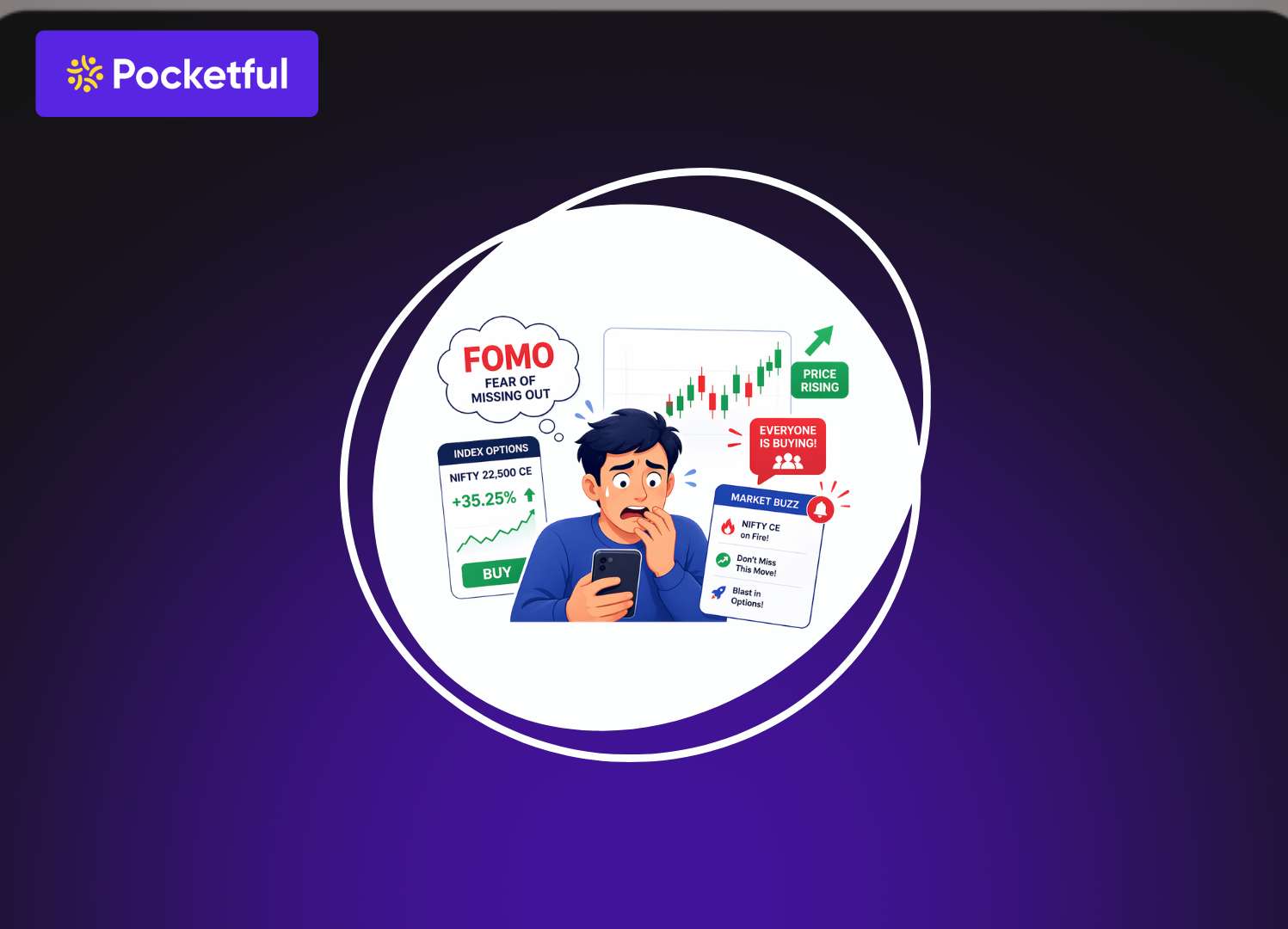
In options trading, FOMO (Fear of Missing Out) refers to a situation where a trader, observing a rapid price movement in the market, enters a trade without proper analysis or planning. Such decisions are not based on logic or strategy, but rather on an urgency to generate quick profits.
How FOMO Works in Options Trading
FOMO typically manifests when a trader misses an upward move that has already taken place and subsequently makes a late entry. At this stage, the option premium is already elevated, which significantly increases the associated risk.
Example : Suppose the Nifty suddenly executes a breakout of 150-200 points. A disciplined trader would enter the trade according to a pre-established plan; however, a FOMO-driven trader enters after the breakout has occurred at a point when the option premium has already surged.
If the market pauses or reverses even slightly, the premium plummets rapidly, resulting in an immediate loss for the FOMO trader.
Why FOMO is More Dangerous in Options Trading
In options trading, the nature of risk differs from that of stocks, as timing, premiums, and the time factor play a crucial role. Consequently, executing a trade driven by FOMO significantly heightens the likelihood of incurring a loss.
- The Direct Cost of Poor Timing : Driven by FOMO, traders often enter the market after the price move has already occurred. This significantly increases risk and, even if the market moves in the correct direction, results in diminished profits.
- Entering at Elevated Premiums : Following a rapid price surge, option premiums tend to inflate significantly. Consequently, entering out of FOMO means buying at a high price, which substantially increases the downside risk.
- The Impact of Time Decay (Theta) : In options trading, the value of a premium erodes over time. If you enter late, you may begin to incur gradual losses even if the underlying market remains stable.
- The Effect of Declining Volatility : Option premiums are typically higher during periods of high volatility. Once an event has passed and volatility subsides, premiums can plummet rapidly, potentially leading to losses.
- Major Impact from Minor Reversals : Option premiums react swiftly even to small price movements in the underlying asset. Even a slight reversal in the market direction can rapidly accelerate losses.
- Limited Time Due to Expiry : Options come with a fixed expiration date, leaving little to no time for recovery. If an entry proves to be ill-timed, the premium can rapidly spiral toward zero.
Read Also: Difference Between Options and Futures
Data Reality: Why Most Indian Traders Lose Money ?
Options trading is growing rapidly in India; however, data indicates that most retail traders are unable to generate consistent profits. The primary reasons behind this are poor decision-making and emotional trading behavior.
- Most Traders Are Incurring Losses in F&O : According to a recent study by the Securities and Exchange Board of India (SEBI), approximately 90-93% of retail traders incur losses in the F&O segment. This indicates that the majority of traders are unable to generate consistent profits.
- The Average Loss Is Substantial : According to the data, the average loss incurred by a retail trader ranges between ₹1 lakh and ₹2 lakhs. This suggests that these losses are not trivial; rather, they significantly deplete one’s capital over the long term.
- Very Few People Earn Consistent Profits : According to SEBI’s analysis, only about 1% of traders manage to earn consistent profits. This implies that the success rate in the market is extremely low, while the level of competition is quite high.
- Trading Continues Even After Incurring Losses : Reports also indicate that 70-75% of traders continue trading even after suffering losses. The primary reasons for this are emotional decision-making and a mindset focused on recovering previous losses.
- Higher Trading Volume Higher Costs : Frequent buying and selling activities lead to increased expenses in the form of brokerage fees, taxes, and other charges. Due to this high churn rate, the net financial outcome often turns negative even in instances where individual trades may have generated a profit.
The FOMO Cycle
FOMO operates as a process in which a trader repeatedly makes emotional decisions, leading to a gradual accumulation of losses. It is crucial to understand this cycle so that it can be broken in a timely manner.
- A Sudden Market Move Occurs : The market experiences a sudden, sharp movement such as a decisive breakout in the Nifty or Bank Nifty. At this moment, traders perceive that a major opportunity is unfolding.
- The Influence of Social Media and Trading Tips : Screenshots of profits begin to surface across Telegram channels, WhatsApp groups, and various social media platforms. This leads the trader to believe that everyone else is making money.
- The Emotional Trigger (Fear of Missing Out) : This is precisely where FOMO (Fear of Missing Out) kicks in; the trader feels that if they do not enter the market immediately, the opportunity will slip away. Decisions are driven by emotion rather than logic.
- Late Entry at High Premiums : The trader enters the market after the initial move has already taken place, by which time the option premium has already appreciated significantly. This stage carries the highest level of risk.
- The Market Slows Down or Reverses : Shortly after the entry, the market often stalls or undergoes a slight reversal. Consequently, the option premium begins to decline, and the trade immediately shifts into a loss-making position.
- Frustration Mounts Following a Loss : After incurring an initial loss, the trader reacts emotionally. Fueled by frustration and mounting pressure, making sound, rational decisions becomes increasingly difficult.
- Revenge Trading Begins : In an attempt to recover the incurred losses, the trader initiates new trades impulsively without any prior plan or strategy. This cycle repeats itself continuously, leading to an escalation in losses.
Read Also: Commodity Futures vs Options in India: Key Differences
Expiry Day FOMO – The Biggest Trap in India
On expiry days, both market speed and volatility increase, prompting traders to make quick decisions. It is in this environment that FOMO becomes most active, thereby increasing the likelihood of making erroneous trades.
- Trading Volume is Extremely High on Expiry Day : In India, the Nifty and Bank Nifty witness their highest trading activity on the day of their weekly expiry. Due to this high volume, price movements become extremely rapid and volatile.
- It Creates an Illusion of Quick Profits : Witnessing examples of traders generating massive returns from small capital, others begin to believe that making money in this market is easy. Consequently, trades are often entered into without a proper plan.
- Time Decay Works at Its Fastest Pace : On the day of expiry, the premiums of options contracts erode very rapidly. If a trade is not entered at the precise moment, the premium value can plummet significantly within a matter of just a few minutes.
- Price Movements Are Unpredictable : On this particular day, market movements are often driven by sudden, abrupt shifts rather than by logical market fundamentals. Even minor price reversals can quickly escalate into substantial financial losses.
- Risk is High, While Control is Low : Due to the rapid pace of price movements, it becomes challenging to effectively manage stop-losses and ensure precise trade execution. Trades initiated out of FOMO (Fear of Missing Out) can very quickly turn into losing positions.
Why Even Smart People Fall for FOMO
FOMO is not limited solely to beginners; even traders who possess the right knowledge often make wrong decisions due to their emotions.
- Trading Volume is Extremely High on Expiry Day : In India, the Nifty and Bank Nifty witness their highest trading activity on the day of their weekly expiry. Due to this high volume, price movements become extremely rapid and volatile.
- It Creates an Illusion of Quick Profits : Witnessing examples of traders generating massive returns from small capital, others begin to believe that making money in this market is easy. Consequently, trades are often entered into without a proper plan.
- Time Decay Works at Its Fastest Pace : On the day of expiry, the premiums of options contracts erode very rapidly. If a trade is not entered at the precise moment, the premium value can plummet significantly within a matter of just a few minutes.
- Price Movements Are Unpredictable : On this particular day, market movements are often driven by sudden, abrupt shifts rather than by logical market fundamentals. Even minor price reversals can quickly escalate into substantial financial losses.
- Risk is High, While Control is Low : Due to the rapid pace of price movements, it becomes challenging to effectively manage stop-losses and ensure precise trade execution. Trades initiated out of FOMO (Fear of Missing Out) can very quickly turn into losing positions.
How to Control FOMO in Options Trading
Completely eliminating FOMO is not easy, but by adopting the right rules and a disciplined approach, it can be controlled to a significant extent.
- Adopt a Rule-Based Trading System : For every trade, the entry, exit, and risk parameters should be defined in advance. A trade executed without a plan is often driven by emotion, which is precisely what fuels FOMO.
- Adopt the Mindset: “No Trade Is Also a Trade” : It is not necessary to capture every market move. Often, the best decision is to refrain from trading altogether and keep your capital safe.
- Maintain a Trading Journal : Document every trade you execute, especially those where your decisions were driven by emotion. This allows you to identify your mistakes and make necessary improvements in the future.
- Pay Attention to Position Sizing : Risking an excessive amount of capital on a single trade heightens FOMO. Always trade with limited risk (e.g , 1-2% of your capital) to ensure that potential losses remain under control.
- Minimize Screen Time and Market Noise : Constantly checking charts, trading tips, and social media feeds leads to confusion and exacerbates FOMO. With less noise, your decisions become clearer and more logical.
Professional Trader Mindset vs FOMO Trader
| Factor | FOMO Trader | Professional Trader |
|---|---|---|
| Entry Approach | He enters the market in haste after observing its movement. | It enters only based on a pre-determined setup and confirmation. |
| Risk Management | He often overlooks risks or takes on excessive risk. | Every trade carries a limited and fixed risk. |
| The Goal of Trading | Focus on earning quick and substantial profits. | Focus on generating consistent and stable returns |
| The Method of Decision-Making | Driven by emotions and external influence | Based on data, strategy, and system |
| Reaction to the Loss | Panicked, he immediately places the next trade (revenge trading). | Accepts loss and waits for the next valid setup |
| Discipline and Control | Breaks the rules and becomes impulsive. | Strictly follows rules and maintains discipline |
Conclusion
In options trading, success depends more on discipline than on strategy. Controlling FOMO is the single most important key to long-term survival and consistency.Only the trader who masters patience is able to endure in the market. Download Pocketful – Move Away from FOMO, Trade Like a Pro with Zero Brokerage on Delivery & Flat Trading Charges.
Frequently Asked Questions (FAQs)
What is FOMO in options trading?
FOMO refers to entering a trade solely because you see others making a profit, without having a proper plan.
Why do most traders lose money in options trading?
Most traders incur losses due to emotional decisions, overtrading, and FOMO.
Is expiry day trading safe for beginners?
No, both volatility and risk are significantly higher on expiry days, making it risky for beginners.
How can I avoid FOMO while trading?
It is essential to adhere to fixed rules, practice proper risk management, and maintain patience.
Does timing matter in options trading?
Yes, precise timing is crucial, as a late entry often results in a loss.