Nearly every industry today intersects with a small group of companies that dominate global markets. Several of the applications on your phone, the chip powering your laptop, and the cloud servers storing your data likely trace back to one of the richest companies in the world. These firms are not distant, abstract corporations, they are deeply embedded in everyday technology and infrastructure. Many people searching for the world richest company name are simply trying to identify which single company sits at the very top of this list.
This ranking is based on market capitalization, using current 2026 data. The following sections outline the top 10 companies, the factors behind their positions, and considerations to keep in mind before assuming today’s leaders will remain unchallenged.
What Actually Decides Who’s “Richest”?
Quick clarification before we get into it. When people type in world’s richest company, they usually mean market cap, not revenue, and definitely not profit, even though folks mix those up all the time.
Market cap itself isn’t some complex formula. Share price times shares outstanding. Done. It’s basically the market placing a bet on what a company is worth today, nothing more permanent than that.
Compare that to:
- Revenue: everything a company sells, before a single expense gets subtracted
- Net profit: what actually remains once bills, taxes, and overhead are paid
- Assets: the cash, buildings, and equipment a company owns outright
A supermarket chain can move enormous volumes of revenue and still land well below a tech company selling a fraction of that. Feels counterintuitive, sure. But it’s exactly why chipmakers and cloud businesses have taken over this ranking.
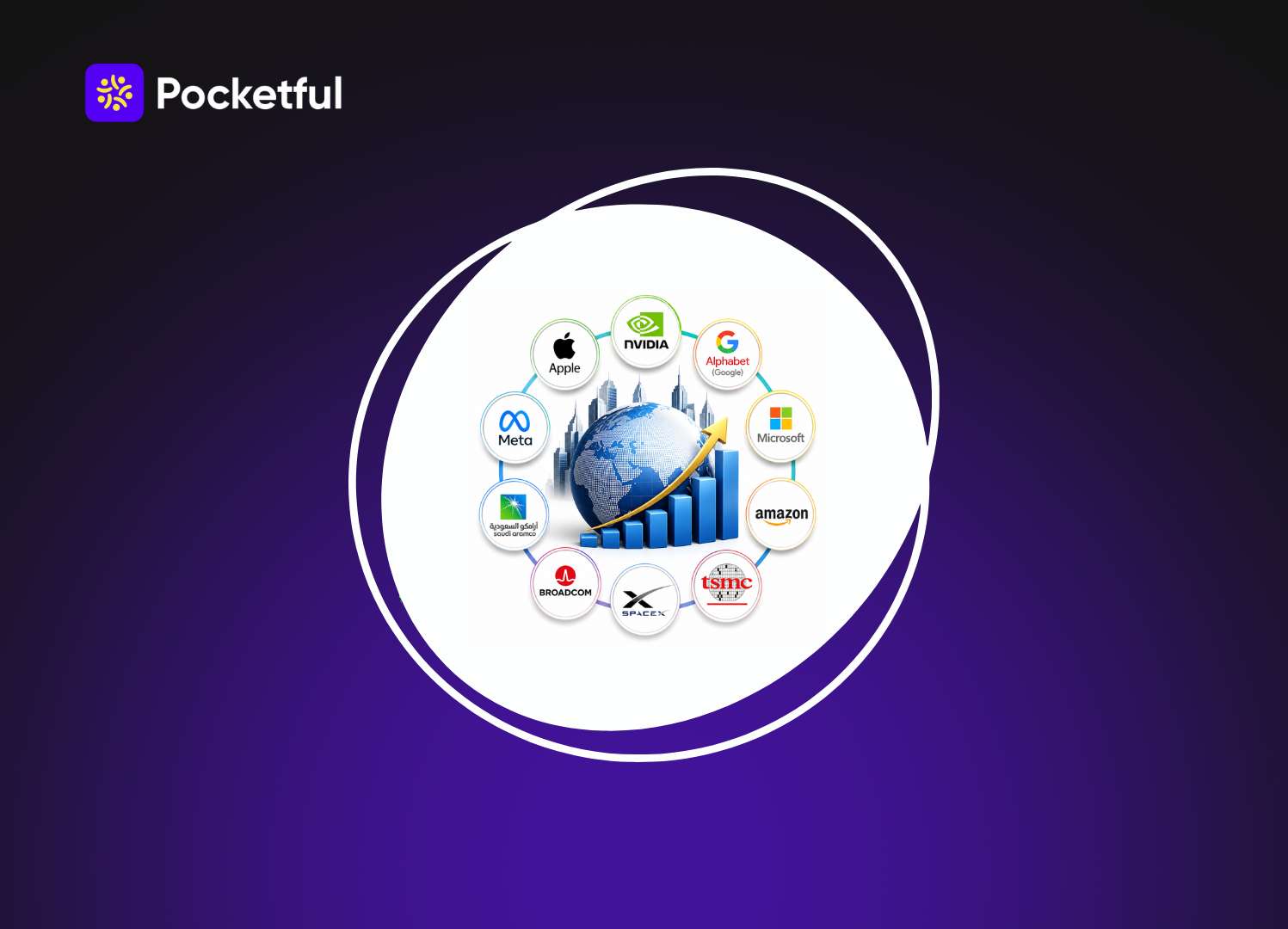
Top 10 Richest Companies in the World
| Rank | Company | Sector | Approx. Market Cap | Headquarters |
|---|---|---|---|---|
| 1 | NVIDIA | Semiconductors / AI | $4.8 Trillion | USA |
| 2 | Apple | Consumer Tech | $4.3 Trillion | USA |
| 3 | Alphabet (Google) | Internet / AI | $4.2 Trillion | USA |
| 4 | Microsoft | Cloud / Software | $2.8 Trillion | USA |
| 5 | Amazon | E-commerce / Cloud | $2.5 Trillion | USA |
| 6 | TSMC | Chip Manufacturing | $2.3 Trillion | Taiwan |
| 7 | SpaceX | Aerospace | $2.1 Trillion | USA |
| 8 | Broadcom | Semiconductors | $1.8 Trillion | USA |
| 9 | Saudi Aramco | Oil & Energy | $1.7 Trillion | Saudi Arabia |
| 10 | Meta Platforms | Social Media / AI | $1.4 Trillion | USA |
These figures move around constantly, so don’t treat them as fixed. This is a mid-2026 snapshot. Apple and Alphabet, for instance, have swapped the number two spot back and forth more than once already this year.
Overview of Top 10 Richest Companies in the World
1. NVIDIA – The World No 1 Company by Market Cap
Rewind three or four years and NVIDIA wasn’t even close to this list. Watching it climb this fast caught plenty of longtime market watchers off guard, honestly.
What happened is simple to explain, harder to overstate. NVIDIA built its chips for gaming graphics originally. Turns out those same GPUs are almost perfectly suited for training AI models. Every cloud provider worth naming, every serious AI lab, leans on this hardware. That kind of demand doesn’t come cheap, and it’s dragged the valuation up near $4.8 trillion.
2. Apple – Keeps Doing What It’s Always Done
You’ve probably got an Apple product within reach as you’re reading this. That’s no accident. It’s decades of building things people genuinely don’t want to give up.
Hardware only tells half the story though. Services – App Store fees, iCloud subscriptions, Apple Music bring in steady, high-margin cash every single quarter, phone upgrade cycle or not. Loyal customers paired with recurring income is tough to beat, and that combination keeps Apple firmly among the richest companies in the world.
3. Alphabet – Rides the Search Engine and the AI Wave Together
Google, YouTube, Android, Google Cloud all one company under the hood. Search ads remain the quiet moneymaker here, generating serious profit without much noise around it.
Lately, AI is the bigger story. Alphabet has thrown real money behind Gemini and DeepMind, and that bet has clearly paid off through 2026. There have been stretches this year where Alphabet actually pulled ahead of Apple for second place.
4. Microsoft – Blends Old Reliable With New Money
Windows, Office, Xbox you’ve probably paid Microsoft at some point without giving it a second thought. Then there’s Azure, slugging it out with Amazon and Google for enterprise cloud deals.
Its tie-up with OpenAI hasn’t hurt matters either. Between the cloud side and the AI angle, Microsoft’s valuation has pushed well past $2.5 trillion.
5. Amazon – Grew Way Beyond Selling Books
Easy to forget Amazon started as an online bookstore and nothing else. These days it’s practically the go-to example of a world best business company figuring out how to diversify the right way.
E-commerce still grabs most of the attention, sure. But the real money comes from AWS, Amazon’s cloud division, which quietly runs a massive share of the internet’s backend that most people never think twice about.
6. TSMC – Builds the Chips You Never Actually Buy
You’ll never walk into a store and buy something branded “TSMC.” That’s kind of the point. Taiwan Semiconductor Manufacturing builds the chips inside NVIDIA’s GPUs, Apple’s processors, and a long list of devices you use daily.
Pull TSMC out of the picture and a huge chunk of the tech industry grinds to a halt almost overnight. Not an exaggeration, chip manufacturing has gotten that concentrated. The company has also committed roughly $250 billion toward expanding its plants in the US.
7. SpaceX – Just Went Public, and It Wasn’t Subtle
SpaceX finally listed shares in mid-2026, and the debut made noise. Shares jumped fast enough that the valuation crossed $2 trillion within days of trading opening.
What makes SpaceX different from everything else on this list is who it’s up against. It’s not just competing with other private companies anymore, it’s competing with national space programs and government satellite operations, and it now controls somewhere around 80% of the commercial launch market.
8. Broadcom – Doesn’t Make Headlines, But It Makes AI Work
Broadcom isn’t the company people bring up at dinner parties the way they do NVIDIA. Still, it’s become essential to how AI infrastructure actually gets built — custom chips for cloud providers, networking hardware, data center components.
That slower, steadier climb landed it in the trillion-dollar club anyway, and it’s been rising faster than most people give it credit for.
9. Saudi Aramco – Is the Odd One Out
Scroll through this list and one company clearly doesn’t belong with the rest. Everyone else is tech. Saudi Aramco has held its spot near the top for years running on one thing: crude oil.
Being state-owned, its cash flow from production and exports is massive. But unlike the tech names above, its valuation swings more with oil prices and regional politics than with typical stock market sentiment and this year’s conflicts in the region haven’t made that any calmer.
10. Meta – Keeps Betting on What Comes After Social Media
Facebook, Instagram, WhatsApp together they reach a genuinely staggering share of everyone online. Advertising across those apps still drives most of the money, and that part hasn’t shifted much.
What has shifted is the AI push. Llama models, smart glasses, wearables Meta is clearly trying to get ahead of whatever’s next instead of just riding on social media alone.
Read Also: Top Assets by Market Cap Worldwide
What’s Actually Driving These Companies to the Top?
A few patterns keep showing up once you look past the individual companies:
- AI investment – the single biggest growth driver on this whole list, hands down
- Cloud computing – still printing reliable, high-margin revenue year after year
- Global reach – selling in nearly every market cushions against local slowdowns
- Brand loyalty – customers who don’t need much convincing to stick around
- Cash flow – deep enough to fund continuous expansion without blinking
- Constant reinvestment – staying ahead instead of coasting on past wins
Eight out of ten companies here are tech firms. That says a lot about where investors are putting their confidence right now. Worth remembering, though, that sector dominance has flipped before more than once and nothing says it can’t happen again.
How To Do Investing Through Pocketful
If you want to start investing in International mutual funds or ETF the right way, Pocketful makes the entire process simple and structured. Here’s how you can get started:
Step 1: Create Your Account
The first step is to download the Pocketful app and sign up. The registration process is quick and takes only a few minutes.
- Enter your mobile number and verify with OTP
- Set your login credentials
- Access your personal dashboard
Step 2: Complete Your KYC
KYC is mandatory before you can invest in any International mutual fund or ETF in India. On Pocketful, the entire KYC process is online and paperless.
- Add your PAN and Aadhaar details
- Enter your bank account information
- Complete the verification process
Step 3: Select a Mutual Fund
Once your account is ready, you can browse International mutual funds or ETF based on your goal, risk appetite, and investment horizon. Pocketful lists funds across all major categories.
- Choose from equity, debt, hybrid, or index funds
- Filter by AMC, fund rating, or past performance
- Compare expense ratios before finalising
Step 4: Start Your SIP or Lump Sum Investment
Decide how you want to invest through a monthly SIP or a one-time lump sum. SIPs can be started with as little as ₹100 per month.
- Set your SIP amount and date
- Choose the fund and confirm your investment
- Track your SIP performance directly from the dashboard
Pocketful gives you access to International mutual fund plans with zero commission.
Read Also: Top 10 Richest People in the World
Conclusion
This ranking is a snapshot of just how much the global markets have been turned on their head by the likes of AI, cloud computing & digital platforms over the last few years. It’s taken nvidia years to build that stronghold on chip dominance , Amazon has been steadily pushing the boundaries with its cloud infrastructure and it’s taken Apple a long time to amass that loyal following of customers – and we all know that none of this is ever set in stone,it can all be taken away from them just as quick as it was built.
Anyone delving into the top companies in the world for research, work or investment should look at this list as a one off snapshot, take it for what its worth on the day, rather than getting too hung up on some fixed pecking order – the truth is none of todays big shots were leading the pack 5 years ago & history proves that this list of the worlds most valuable companys is going to be in a state of flux in the years to come.
Frequently Asked Questions (FAQs)
Which is the world’s richest company right now?
As of mid-2026, that’s NVIDIA, sitting above $4.8 trillion in market cap and still climbing on AI chip demand. If you’re looking up the world richest company name, NVIDIA is currently the answer, though the world richest company title has changed hands before and can shift again.
Is market cap the only way to measure a company’s wealth?
Not really. Revenue, profit, assets, and cash flow each tell a different piece of the story, and depending on which one you lean on, the rankings can shift quite a bit.
How often do Top 10 richest company rankings actually change?
More than most people would guess. Market cap tracks share prices day to day, so a company can gain or lose several spots in just a few weeks.
Why are so many of the richest companies in the world based in the US?
Deep capital markets are a big part of it. US exchanges pull in investors from everywhere, and American tech firms tend to have enormous global customer bases. That mix pushes valuations higher than a lot of overseas competitors can reach, even with similar revenue numbers.
Could a non-tech company break back into the top 10?
Sure, it’s happened before. Energy and banking giants have topped these lists in the past, and a shift in oil prices, interest rates, or regulation could move things fast. Saudi Aramco’s spot here proves tech doesn’t own a permanent monopoly on the top.