Invested in Nifty 50 or Sensex-linked funds so far? Then you are missing out on a big chunk of the world’s wealth creation.
If Apple, Microsoft, Nvidia, Amazon, Alphabet, none of these companies exist in your portfolio, and trading in Indian markets which is somewhat range-bound this year while US tech names keep hitting new highs, more and more retail investors are asking the same question: how do I actually get exposure to global markets from India?
The answer, for most people, is global ETFs. They are simple, relatively low-cost, and do not require you to become an expert in picking individual foreign stocks.
Let us break down what they are, which ones are worth considering, and how you can actually go about investing in them.
What are Global ETFs?
A global (or international) ETF is basically a fund that holds a basket of stocks from outside India. They could be US tech companies, European blue chips, Chinese giants like Alibaba and Tencent, or a broad mix across multiple countries. Instead of buying 500 individual US stocks to replicate the S&P 500, you just buy one ETF unit and get proportional exposure to all of them.
Ways to Invest in Global ETFs in India
Route 1: NSE-Listed International ETFs
These are Indian mutual fund houses that have structured ETFs to track foreign indices, then listed them on our own exchanges. You buy and sell them in rupees, through your regular demat account.
Route 2: Direct Investing via LRS
You can invest using the RBI’s Liberalised Remittance Scheme, which currently allows Indian residents to remit up to USD 250,000 per financial year for approved purposes, including investing.
It works in a way that you open an account with a platform that gives you access to US or global exchanges, complete your KYC, and then transfer money from your Indian bank account under LRS
List & Key Details to Invest in Global ETFs
| Funds | Base Expense Ratio (%) | Launch Date | Net Assets (Cr) | Latest NAV | 52-Week High NAV | 52-Week Low NAV | Fund Manager (Tenure) |
|---|---|---|---|---|---|---|---|
| Motilal Oswal NASDAQ 100 ETF | 0.5 | 2011-03-29 | 14,112 | 273.38 | 285.46 | 191.8 | Swapnil P Mayekar (0.8), Dishant Mehta (0.8) |
| Mirae Asset NYSE FANG+ ETF | 0.6 | 2021-05-06 | 3,882 | 163.68 | 173.65 | 123.03 | Siddharth Srivastava (5.2) |
| Mirae Asset S&P 500 Top 50 ETF | 0.56 | 2021-09-20 | 1,096 | 65.85 | 68.99 | 50.72 | Siddharth Srivastava (4.9) |
| Nippon India ETF Hang Seng BeES | 0.79 | 2010-03-09 | 964 | 438 | 481.65 | 385.37 | Kinjal Desai (8.1), Amber Singhania (0.3), Vikash Agarwal (1.3) |
| Mirae Asset Hang Seng TECH ETF | 0.53 | 2021-12-06 | 351 | 19.16 | 25.31 | 17.79 | Siddharth Srivastava (4.7) |
| Motilal Oswal Nasdaq Q50 ETF | 0.4 | 2021-12-23 | 180 | 118.93 | 122.7 | 74.44 | Rakesh Shetty (3.6), Swapnil P Mayekar (0.8), Dishant Mehta (0.8) |
Returns of Global ETFs
| Funds | 1 Yr Ret (%) | 3 Mth Ret (%) | 6 Mth Ret (%) |
|---|---|---|---|
| Mirae Asset Hang Seng TECH ETF | -0.33 | -0.52 | -15.64 |
| Mirae Asset NYSE FANG+ ETF | 30.5 | 17.69 | 16.57 |
| Mirae Asset S&P 500 Top 50 ETF | 29.98 | 9.43 | 9.31 |
| Motilal Oswal NASDAQ 100 ETF | 42.98 | 18.21 | 20.7 |
| Motilal Oswal Nasdaq Q50 ETF | 60 | 17.69 | 29.93 |
| Nippon India ETF Hang Seng BeES | 14.1 | -2.17 | -3.44 |
Read Also: Best IT ETFs in India
Overview of Best Global ETFs to Invest in India
1. Motilal Oswal NASDAQ 100 ETF
- Category: Equity, Global US Technology
- AUM stood at around ₹14,112 Cr as of June 30, 2026
- This one tracks the top 100 non-financial companies on the Nasdaq, so you are basically getting a slice of America’s biggest tech and growth names
- Nvidia, Apple, and Microsoft make up a good chunk of the top holdings
- There is also decent exposure to communication services and consumer discretionary.
- You can start with as little as ₹500
- It is a very high-risk fund, treat it as a satellite holding, not your core portfolio
2. Mirae Asset NYSE FANG+ ETF
- Category: Equity, Global – Thematic Tech
- AUM was around ₹3,382 Cr as of June 30th, 2026
- Fairly concentrated fund with just 10 stocks, almost equally weighted, all big US tech and internet names
- Meta, Nvidia, Tesla, Amazon and Netflix are among the top names here
- Minimum investment amount is ₹5,000
- Risk here is very high given how concentrated it is, works better as a small, high-conviction addition than a core holding
3. Mirae Asset S&P 500 Top 50 ETF
- Category: Equity, Global – US Large Cap
- AUM came in at roughly ₹1,096 Cr as of June 30, 2026
- Unlike the two above, this spreads across the 50 largest S&P 500 companies, so it is not just tech-heavy
- Apple, Microsoft, Nvidia and Amazon still show up among the top holdings, but you also get financials, healthcare, and consumer names in the mix
- Minimum investment is ₹5,000
- Still high risk being an equity fund, but comparatively more diversified than its tech-focused peers
4. Nippon India ETF Hang Seng BeES
- Category: Equity, Global, Hong Kong/China
- AUM is ₹964 Cr
- It tracks the Hang Seng Index, giving you exposure to Hong Kong-listed companies
- Tencent, HSBC Holdings, and AIA Group feature among the top holdings
- Finance and retail trade dominate the portfolio, along with a bit of tech
- Minimum Investment amount is ₹10,000
- Carries very high risk, and there’s the added layer of China-related regulatory unpredictability to keep in mind
5. Mirae Asset Hang Seng TECH ETF
- Category: Equity, Global, China Tech Thematic
- AUM was ₹351 Cr as of June 30, 2026
- This tracks the top 30 tech-themed companies listed in Hong Kong
- Alibaba, Meituan, and Xiaomi are among its top holdings
- Minimum investment starts at ₹5,000
- Very high risk since it is concentrated and can react sharply to Chinese regulatory news
6. Motilal Oswal Nasdaq Q50 ETF
- Category: Equity, Global, US Emerging Growth
- AUM stood at around ₹180 Cr as of June 30, 2026
- Top Holdings here tend to be earlier-stage, faster-growing names that have not yet reached large-cap status
- Beyond pure tech, there is also a mix of newer consumer and growth-stage businesses too
- You can start investing with just ₹500
- Very high risk, and it is also less liquid than the other funds on this list
How to Invest in Global ETFs through Pocketful
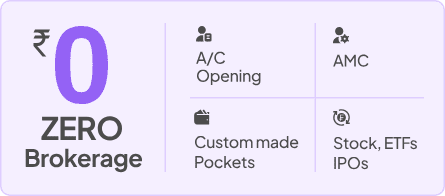
- Open your Account: If you do not have an account on Pocketful, you will need to open a demat account, which is free and has zero account opening charges and zero AMC. The KYC takes maybe 5-10 minutes: PAN, Aadhaar, bank details, and a quick video verification.
- Search for the ETF: Once you log in to the app, there is a search bar at the top. Enter the name of the ETF you want to invest in.
- Click on the Name: You will be redirected to a page where the key details like the current price, day performance, and technical overview of the selected ETF are mentioned
- Select Buy Option: Once you click the buy option, you need to choose what suits you best: long-term investing, intraday trading, or buy now pay later. The choice is yours.
Read Also: Best ETFs in India to Invest
Conclusion
In the end, we suggest you not put your entire portfolio into global ETFs just because US markets have been on a tear lately.
A reasonable allocation for most Indian investors is usually somewhere between 10-20% of their overall equity portfolio, depending on age, goals, and how much currency risk you are comfortable carrying.
Global diversification is not about abandoning India as an investment destination. Indian markets have their own long-term growth story, and global ETFs simply let you participate in the world’s other growth stories at the same time.
| S.NO. | Check Out These Interesting Posts You Might Enjoy! |
|---|---|
| 1 | Small-Cap ETFs to Invest in India |
| 2 | Best Energy ETFs in India |
| 3 | Best Silver ETFs in India |
| 4 | List of Best Gold ETFs in India |
| 5 | Best Debt ETFs to Invest in India |
Frequently Asked Questions (FAQs)
Can I invest in global ETFs without opening a foreign account?
Yes. You can buy NSE-listed international ETFs from your regular Indian demat account, in rupees.
Do I have to pay TCS every time I invest in a global ETF?
If you are sending money abroad directly. TCS of around 20% kicks in on the amount above ₹10 lakh in a financial year, and you can claim it back when filing your ITR.
How much of my portfolio should go into global ETFs?
There is no fixed rule, but many advisors suggest somewhere between 10-20% of your equity allocation, just for diversification
Are global ETFs risky?
They carry the usual market risk and currency risk. It is not high risk in the way a single stock is, but it is not risk-free either.
Is there a limit to how much I can invest abroad?
Under RBI’s LRS rules, you can remit up to USD 250,000 per financial year for investments.