Category: Investing

  • Mukesh Ambani Penny Stocks List 2026

    Mukesh Ambani Penny Stocks List 2026

    As an investor always looking for investment opportunities in the market, you must balance risks with investment returns. Penny stocks can generate extraordinary returns, but most penny stocks in the stock market are highly risky. What if we tell you there are two companies listed on the stock market with a low stock price and are also linked to Mukesh Ambani? 

    In this blog, we will give you an overview of the Mukesh Ambani group’s penny stocks and their benefits.

    What is Mukesh Ambani Group Penny Stock?

    The term ‘Mukesh Ambani group penny stock’ refers to the penny stocks of companies linked with Mr Mukesh Ambani, a well-known Indian industrialist, but have a low market price and a small market capitalization. Investors considering investing in these companies must be aware of the extreme market volatility associated with these penny stocks. 

    Due to the lack of readily available information and the unreliability of their operations, investors avoid investing in penny stocks, however, because the companies mentioned below are controlled by Reliance Industries Ltd., which makes them more reliable than a normal penny stock.

    Read Also: Mukesh Ambani Companies List

    Best Mukesh Ambani Penny Stock List 2026

    The list of penny stocks Under ₹100 associated with Mukesh Ambani are:

    S.No.Stock NameStock Price
    1.Hathway Cable and Datacom Limited₹ 16.99
    2.Den Network₹ 44.93
    (all the above data is of 27 November 2024)

    Overview of Best Mukesh Ambani Penny Stock

    1. Hathway Cable and Datacom Limited

    Hathway Cable & Datacom Limited was founded in 1959 and was initially known as Chics Display Services Private Limited. The company focuses on providing cable TV services and broadband services. The company changed its name to Hathway Cable & Datacom Private Limited in 1999. The company launched an initial public offering (IPO) in 2009 and was listed on the stock exchange in 2010. It provides high-speed internet access in over 16 cities, making it one of the first companies to offer broadband over cable TV networks in the country. In 2018, it was acquired by Reliance Industries. Its headquarters are in Mumbai.

    Know the Returns:

    1Y Return (%)3Y Return (%)5Y Return (%)
    -14.98%-16.40%-11.52%
    (As of 18 December 2024) 

    2. Den Network

    In 2007, Den Network was founded as a public limited company and has grown over the years to become one of India’s leading cable TV service providers. Its market share has expanded significantly due to strategic partnerships with local cable companies, enhancing its customer base. The company operates in 17 states and over 433 cities nationwide. In 2018, Reliance Industries purchased a 66% stake in DEN Networks. The company’s headquarters is located in New Delhi.

    Know the Returns:

    1Y Return (%)3Y Return (%)5Y Return (%)
    -22.04%6.66%10.68%
    (As of 18 December 2024) 

    What is the difference Between Normal Penny Stocks and Mukesh Ambani Penny Stocks?

    The following are the main distinctions between Mukesh Ambani penny stocks and regular penny stocks: 

    ParticularsNormal Penny StocksMukesh Ambani Penny Stocks
    TrustworthinessA typical penny stock might be issued by a startup or lesser-known business.These stocks are associated with the Ambani Group, one of the biggest business conglomerates in India.
    RiskPenny stocks of other companies carry high risk.The penny stocks of the Ambani group carry comparatively lower risk than other penny stocks.
    IndustryNormal penny stocks can be of companies operating in new industries with an uncertain future.These companies operate in industries with a good track record.
    ManipulationNormal penny stock prices can be manipulated and can be affected by pump-and-dump strategies.Since Ambani Group penny stocks are part of a reputed group and are often in the news, stock price manipulation is less likely.
    Future Possibility of Growth Due to their weak fundamentals, these businesses have lower chances of generating substantial investment returns. As Reliance Group supports them, Ambani Group penny stocks can deliver substantial returns over the long run.
    Availability of Buyers and SellersOther penny stocks are less liquid as they are unpopular, making it challenging for investors to buy or sell such penny stocks.The Ambani Group penny stocks have more liquidity than the other penny stocks.
    Market CapitalizationThe market capitalization of these penny stocks is generally lower.In comparison to other penny stocks, Ambani Group’s penny stock market capitalization is higher.

    Read Also: Reliance Penny Stocks List in India

    Advantages of Investing in Mukesh Ambani Penny Stocks 

    The key advantages of investing in Ambani Group penny stocks are outlined below;

    1. Investors with limited funds can easily buy these penny stocks due to their low prices.  
    2. These are small companies within the Ambani Group that have the potential to deliver substantial returns for investors over the long term.  
    3. Diversification is important, and one way to achieve this is by including Ambani Group penny stocks in your portfolio.  
    4. The Ambani Group’s brand value can positively impact stock performance.   

    Future of Mukesh Ambani Stocks

    Reliance Group is one of the biggest business conglomerates in the world. The group’s businesses are focused on sustainability and innovation, and the organization offers a broad range of products. The companies are diversifying into new industries that can eventually lead to superior investment returns in the long run. Currently, Reliance Industries is regarded as a market leader in several industries, including telecom and petrochemicals. As a result of the company’s continued efforts to diversify into the renewable energy sector and financial services, we can say that Ambani Stocks has a bright future. 

    How to Invest in Mukesh Ambani Penny Stocks?
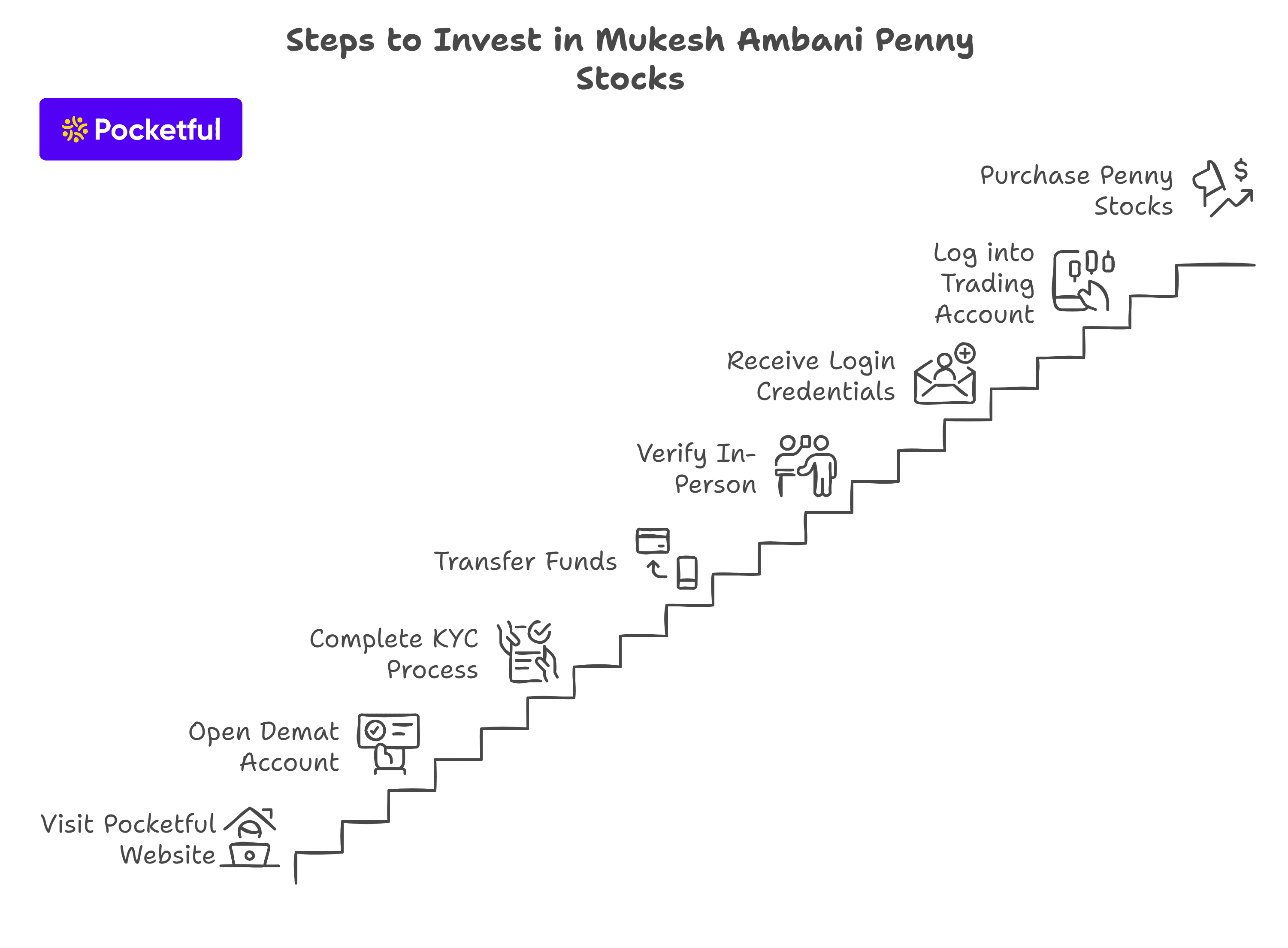
    How to Invest in Mukesh Ambani Penny Stocks

    The steps listed below must be followed if you want to invest in Mukesh Ambani penny stocks: 

    1.  Go to the Pocketful website.

    2.  Click on the “Open Demat Account” Tab.

    3.  Fill out your KYC and provide the pocketful team with all the necessary information. Submit scanned copies of Pan card, identity proof, address proof, etc.

    4.  To transfer money from your bank account to your trading account, enter your bank account information. 

    5.  Complete the In-Person Verification (IPV) and e-sign the Demat account opening form. After successful verification of the documents and information provided, your Demat account will be opened.

    6.  The login credentials will be sent to your registered email address and mobile number.

    7.  Go back to the website and select the Home Page’s Login Section. 

    8.  Search and buy Mukesh Ambani penny stocks after logging into your trading account.

    Read Also: Adani Penny Stock and List of Lowest-Priced Adani Shares

    Conclusion

    In conclusion, penny stocks of the Mukesh Ambani group give you the chance to invest in penny stocks that are more reliable than normal penny stocks. However, investing in penny stocks carries several risks, including a lack of liquidity and a lack of public information. You should only think about investing in penny stocks like these if you are willing to take these risks. However, because Reliance Industries has a significant stake in the Mukesh Ambani Group’s penny stocks, they are more dependable than other penny stocks. You must speak with your investment advisor before making any investment decisions. 

    S.NO.Check Out These Interesting Posts You Might Enjoy!
    1Best Pharma Penny Stocks List Under ₹50
    2Top 5 PSU Penny Stocks List in India
    310 Best FMCG Penny Stocks in India
    4Top 10 Highest Dividend Paying Penny Stocks in India
    5Top 10 Cement Penny Stocks in India

    Frequently Asked Questions (FAQs)

    1. Is it safe to invest in Mukesh Ambani stocks?

      It is relatively safe to invest in Mukesh Ambani stocks compared to other penny stocks because these companies are acquired by Reliance Industries. However, it is advised to conduct thorough research before investing.

    2. Which are the best penny stocks of Mukesh Ambani?

      Mukesh Ambani’s top two penny stocks are Den Networks and Hathway Cable & Datacom Limited.

    3. Which Mukesh Ambani share is under INR 100?

      Mukesh Ambani’s two shares that are under INR 100 are Hathway Cable and Datacom Limited and Den Network Limited.

    4. Who is the current chairman of Reliance Industries?

      Reliance Industries’ current chairman and managing director is Mukesh Dhirubhai Ambani.

    5. Who is the owner of Den Networks?

      Den Networks was founded by Sameer Manchanda, but Reliance Industries purchased the majority of the business in 2018.

  • Top 10 Highest Dividend Paying Penny Stocks in India

    Top 10 Highest Dividend Paying Penny Stocks in India

    The Indian stock market has witnessed a record rise in the number of market participants in the past few years. Many new investors enter the stock market in search of quick returns, but there are few investors who wish to hold stocks for the long term and earn a dividend income along the way. The annual returns increase substantially if the stock is a penny stock, as these stocks can deliver multi-bagger returns. 

    In this blog, we will give you an overview of the top dividend-paying penny stocks, their benefits, and disadvantages.

    What are the High Dividend Penny Stocks?

    Stocks with extremely low prices and high dividend yields are referred to as high-dividend penny stocks. These stocks offer high dividends with the potential to deliver multi-bagger returns in the near future. However, these stocks are highly risky, and investors must ensure whether or not high dividends are supported by strong financial performance. Investors who are thinking about purchasing high-dividend penny stocks should be aware that doing so could result in losses because the shares of these companies are less liquid and have higher volatility than other equities. 

    List of Penny Stocks That Pay Highest Dividends in 2026

    S.No.Penny StocksDividend Yield (%)Stock Price(₹)
    1Taparia Tools Limited435.269.19
    2Gujarat Toolroom Limited7.5413.9
    3Gothi Plascon Limited5.2138.4
    4Ujjivan Small Finance Bank Limited4.5633.6
    5Saven Technologies Limited3.5157.4
    6Radiant Cash Management Limited3.3876
    7Vibrant Global Capital Limited3.0165.5
    8Yug Decor Limited2.935
    9Advani Hotels and Resorts (India) Limited2.7366.63
    10Poojawestern Metaliks Limited2.4939.4
    (all the above data is of 26 November 2024)

    Read Also: Top 5 Highest Dividend Paying Stocks in India

    Highest Dividend Paying Penny Stocks – An Overview

    An overview of the Highest Dividend Paying penny stocks is given below:

    1. Taparia Tools Limited

    In 1969, the company was founded to produce hand tools for the Indian market. The company was the result of a technical collaboration with Bahco, a Swedish company. The company’s ISO 9001 certification guarantees the company’s commitment to superior production quality. To ensure a consistent supply of goods, the corporation has a wide network of dealers around the nation. By offering almost a thousand different kinds of hand tools, the company can meet the demands of a wide range of industries. The company’s main office is located in Mumbai. 

    2. Gujarat Toolroom Limited

    Gujarat Toolroom Limited was founded in 1983 under the name Pirnmatic Engineering Private Limited to produce alternatives to imported textile machines. The slump in the Indian textile sector from 1984 to 1986 caused the company to change its focus from textile machines to the plastic industry. In 1990, the company amalgamated with Kunal Fabricators Private Limited. In 1991, it became a public limited company and changed its name to Gujarat Toolroom Limited. The face value of the company’s equity dropped from INR 10 to INR 1 during a 10:1 stock split. The company’s head office is located in Ahmedabad, Gujarat. 

    3. Gothi Plascon Limited

    In 1994, the business was established as Gothi Plascon (India) Ltd., a public limited company. Initially, the company’s primary focus was on producing disposable plastic goods. In response to the shifting market dynamics, the company strategically shifted its focus to the real estate sector. Its primary source of income comes from renting out buildings. Gothi Plascon (India) Limited’s main office is located in Puducherry. 

    4. Ujjivan Small Finance Bank Limited

    The bank was established in 2016 as a subsidiary of the microfinance firm Ujjivan Financial Services Limited, later becoming a prominent small finance bank in India. The Reserve Bank of India granted it a license to operate as a small finance bank in 2017, and later, in 2019, the bank was listed on the Indian Stock Exchange. The bank primarily caters to the underserved segment while also providing services to the retail market. The bank has been focusing on enhancing its digital banking services to better serve its customers. The company’s main office is located in Bengaluru. 

    5. Saven Technologies Limited

    The company was founded in 1993 and specializes in technology services, including the design, development, and implementation of technology-based solutions. It has a strong service delivery record. The company has branches in the United States and the United Kingdom. Its employees are highly qualified and proficient in offering innovative solutions. The company’s headquarters are located in Hyderabad.

    6. Radiant Cash Management Limited

    The company is an integrated cash logistics service provider with a focus on retail cash management. It was founded in 2005 by Colonel David Devasahayam. It offers a range of services, including cash pickup and delivery, ATM management, cash van rental, and network currency management. The company went public with its initial public offering (IPO) in December 2022. Operating a fleet of over 750 vehicles and more than 5,000 locations, it processes more than INR 500 crore of cash daily. The company’s headquarters are located in Chennai.

    7. Vibrant Global Capital Limited

    The company was founded in 1995 and was then known as Raisoni Finance Pvt. Ltd. It was a non-banking financial organization that was involved in lending, manufacturing of iodized salt, and trading in steel products and polyester films, among other things. The business changed its name to Vibrant Global Capital Limited in 2010 to better reflect its diverse operations. The head office of the organization is located in Mumbai. 

    8. Yug Decor Limited

    Yug Decor Limited was founded in 2003 and produces adhesives under the YUG-COL brand. Among their many products are resin adhesives, natural rubber adhesives, synthetic binders, etc. In 2017, the business made its initial public offering (IPO) under the Small and Medium-sized Enterprises (SME) category. Chandresh S. Saraswat, the company’s chairman, has over 33 years of experience in the plywood and adhesive industry. Clients of Yug Décor are present throughout Asia, Europe, Africa, Bangladesh, Dubai, and other places. Its main office is located in Ahmedabad. 

    9. Advani Hotels & Resorts (India) Limited

    When the company was founded in 1987 by Haresh G. Advani and Sunder G. Advani, it was called Ramada Hotels (India) Limited. The company launched its IPO in 1989, and later, in 1999, it changed its name to Advani Hotels and Resorts (India) Limited. The corporation owns and operates Caravela Beach Resort in Goa. The company’s headquarters are located in Mumbai. 

    10. Poojawestern Metaliks Limited

    The firm was established in 1991 and started manufacturing, importing, and exporting brass products. The company imports a variety of items, including brass ingots, plumbing sanitary fittings, etc. The company can produce 5000 kg of brass hollow bars and solids daily. The company has clients in the Gulf and America. The company was listed on the Indian Stock Exchange in 2017. The company’s headquarters is located in Jamnagar, Gujarat.

    Read Also: Top 10 Penny Stocks in Indian Real Estate

    Key Performance Indicators (KPIs)

    CompanyOperating Margin (%)Net Profit Margin (%)ROCE (%)Current Ratio
    Taparia Tools Limited16.1312.0441.774.29
    Gujarat Toolroom14.0413.1697.941.19
    Gothi Plascon Limited47.3735.0414.6511.06
    Ujjivan Small Finance Bank Limited8.7122.574.88
    Saven Technologies Limited25.2218.9317.9911.61
    Radiant Cash Management Limited16.0411.5023.894.60
    Vibrant Global Capital Limited23.2219.7334.903.98
    Yug Decor Limited7.364.6221.672.3
    Advani Hotels and Resorts (India) Limited31.8823.6742.752.56
    Poojawestern Metaliks Limited6.232.8425.241.30
    (all the above data is of the year ended March 2024)

    Benefits of Investing in High-Dividend Penny Stocks

    There are numerous benefits of investing in high-dividend penny stocks, a few of which are mentioned below-

    1. Affordability – Penny stocks have lower share prices, which allows an investor with limited funds to invest.

    2. Potential High Returns – The penny stock companies have higher growth potential, which can provide higher investment returns.

    3. Diversification – Investors can easily diversify their portfolio by investing in penny stocks; however, one should consider their risk profile before investing.

    4. Possibility of Acquisition– Generally, small companies are an acquisition target of more established companies in that sector. When these small companies are acquired, the shares of the target company increase in value.

    5. Dividend – These penny stocks or companies have historically paid high dividends apart from capital appreciation.

    Read Also: Top 10 Steel Penny Stocks in India

    Disadvantages of Penny Stocks That Pay Dividends

    The significant risks related to investing in penny stocks, which pay dividends, are as follows-

    1. Financial Instability – The financial performance of smaller companies may not be strong, which means they may not be able to distribute dividends in the long run.

    2. Volatility – Penny stocks are considered more volatile as these stocks can be particularly targeted by speculators.

    3. Lack of Liquidity – Generally, penny stocks lack liquidity and have low trading volume, which makes it difficult for investors to buy and sell shares.

    4. Lack of Information – Most penny stocks have limited publicly available information, which makes the process of analyzing them more difficult.

    5. Frauds – Penny stocks are generally manipulated by the promoters or other big investors. They can be a part of a pump-and-dump scheme. 

    How to Invest in High-Dividend Penny Stocks?

    One can easily invest in high-dividend penny stock companies by following the steps mentioned below-

    • Visit the website of Pocketful.
    • Click on the “Open Demat Account” Tab.
    • Complete your KYC and fill in all the relevant details, such as name, e-mail ID, and mobile number. Enter the OTP received to verify the information provided.
    • Submit the bank details and upload the scanned copies of documents, including PAN card, identity proof, address proof, income proof, etc.
    • Next, you will be asked to complete the in-person verification process using a webcam or smartphone. E-sign the demat account opening form to complete the application process.
    • After successful verification, you will receive the login credentials on your registered mail ID.
    • Revisit the website and click on the Login Section on the Home Page.
    • Log into your demat account and begin investing.

    Read Also: 10 Best FMCG Penny Stocks in India

    Conclusion

    On a concluding note, investment in dividend-paying penny stocks can be an investment option for investors who are looking for income in the form of dividends. However, there are certain risks involved while investing in penny stocks, such as lack of public information about the companies, illiquidity, etc. It is always suggested that you must consult a financial advisor before investing in penny stocks.

    S.NO.Check Out These Interesting Posts You Might Enjoy!
    1Reliance Penny Stocks List in India
    2Best Semiconductor Penny Stocks in India
    3Best Solar Penny Stocks in India
    4Best EV Penny Stocks India​
    5Best Pharma Penny Stocks in India

    Frequently Asked Questions (FAQs)

    1. Which penny stock pays the highest dividend?

      Taparia Tools Ltd. has the highest dividend yield of 435.26% as of 25 November 2024.

    2. Which penny stocks are profitable?

      Some of the profitable penny stocks are Taparia Tools, Gujarat Toolroom, Saven Technologies Limited, etc.

    3. Which stocks pay monthly dividends in India?

      There are no stocks in the stock market that offer dividends every month.

    4. What are the risks associated with investing in penny stocks?

      Investing in penny stocks can be extremely risky as these companies usually have limited publicly available information and are usually illiquid. Due to their low prices, these shares are targeted by speculators and can experience wide price fluctuations.

    5. What are the benefits of investing in dividend-paying penny stocks?

      The major benefit of investing in dividend-paying stocks is that these stocks provide a dividend income along with the potential for high investment returns.

    6. Is Taparia Tools Limited a profitable company?

      Taparia Tools Ltd. is a profitable company with a positive net profit margin of 12.04%.

  • Tata Penny Stocks List – Benefits, and How to Invest?

    Tata Penny Stocks List – Benefits, and How to Invest?

    Suppose you are an investor who continuously searches for new investment opportunities in the stock market. In that case, you must be looking for a few reliable companies with a low share price that have the potential to provide multi-bagger returns over the next few years. There are many penny stocks in the Indian stock markets, but they may not present a reliable investing opportunity. But what if I told you that you could invest in the penny stocks of one of India’s most famous corporate groups?

    In this blog, we will give you an overview of the Tata penny stocks, the benefits of investing in them and how they differ from other penny stocks.

    What is Tata Group Penny Stock?

    Those companies owned by the Tata Group, which have a lower market price and lesser market capitalization than the flagship companies under the Tata Group, are referred to as Tata Group penny stocks. Investors looking to buy these stocks should be aware of the extreme volatility in the share prices of penny stocks. Due to the lack of sufficient information and the unreliability of their operations, investors avoid penny stocks. However, Tata penny stocks are not the same as they have the brand name of the Tata Group, which signifies reliability and ethics.

    Tata Penny Stock List With Price

    The two Tata Group penny stocks under ₹100 are as follows-

    S.No.Stock NameStock Industry
    1.Tayo Rolls LtdCastings, Forgings & Fastners
    2.Tata Teleservices (Maharashtra) LtdTelecomm-Service

    1. Tata Teleservices (Maharashtra) Limited

    The primary goal of Tata Teleservices (Maharashtra) Limited, often known as TTML, is to provide internet and IT services in India. The firm was first established in 1995 as Hughes Ispat Limited. Tata Teleservices (Maharashtra) Limited was the new name for the company after the Tata Group bought the majority of its shares in 2003. The company became the first private telecommunications operator to offer 3G services in 2010. However, intense competition, large losses and huge debts forced the organization to sell its consumer mobile business to Airtel in 2017. Currently, TTML offers broadband, cloud & SaaS, cyber security services, etc. The company’s head office is situated in Mumbai.

    Know the Returns:

    1Y Return (%)3Y Return (%)5Y Return (%)
    -30.55%-45.83%332.56%
    (As of 14 January 2026) 

    2. Tayo Rolls

    As a joint venture between Tata Steel, Nissho Iwai Corporation and Yodogawa Steel Works, Tata-Yodogawa Limited was established in 1968. The company’s main business was to manufacture cast iron and cast steel rolls for metallurgical industries. Its other products include forged rolls, engineering forgings and ingots. The business launched its IPO in 1969 to raise funds from the general public. The funds were used to increase its capacity to meet the demands of customers worldwide. The business expanded its product line later in 1995 and began producing special castings for power plants. The company’s name was changed to Tayo Rolls in 2003. The company began experiencing financial difficulties and decided to close its operations in 2016. The headquarters of Tayo Rolls is situated in Jamshedpur.

    Know the Returns:

    1Y Return (%)3Y Return (%)5Y Return (%)
    19.28%19.28%56.84%
    (As of 14 January 2026) 

    Caution: Tayo Rolls closed its operations in 2016, but its share continues to trade on the stock market. After Covid, the stock increased from INR 19 to INR 200, which caught the attention of most new investors. This increase in share price was not due to strong financial performance but largely due to speculative activities. Many market experts termed trading activities in this stock as a part of the pump and dump scheme. Investors should remain cautious and consult a financial advisor before investing in any security mentioned in this blog.

    Read Also: Best Adani Penny Stocks

    What is the Difference Between Normal Penny Stock and Tata Group Penny Stock?

    The following are the primary distinctions between normal penny stocks and Tata penny stocks:-

    ParticularsNormal Penny StocksTata Penny Stocks
    CredibilityA typical penny stock is of a lesser-known company.These shares are issued by companies that are owned by the Tata Group.
    BusinessNormal penny stocks may have an unproven track record.Tata Group penny stocks have a proven track record.
    ManipulationNormal penny stocks can face high levels of manipulation.Tata Group penny stocks usually face lower manipulation.
    Growth PotentialThese companies typically have lower growth potential as they don’t have strong fundamentals.Tata Group penny stocks have long-term growth potential as they are supported by Tata Group.
    LiquidityNormal penny stocks may have lower liquidity.The liquidity in Tata Group stocks is better than other penny stocks.
    Market CapitalizationThese penny stocks generally have lower market capitalization.The Tata Group penny stocks have higher market capitalization than other penny stocks.
    What is the Difference Between Normal Penny Stock and Tata Group Penny Stock

    Benefits of Investing in Tata Group Penny Stock

    The advantages of investing in Tata Group Penny stocks are listed below-

    1. Low Cost – Because of their low prices, Tata penny stocks are accessible to investors with small investment amounts.

    2. High Returns – These companies can grow their businesses considerably in the future, which can result in substantial returns for investors.

    3. Portfolio Diversification –  Investing in penny stocks of the Tata Group can help investors diversify their portfolios.

    4. Brand Value –  The brand name of Tata Group can positively impact stock performance as investors have faith in them.

    5. Long-Term –  The fact that Tata Group companies are engaged with almost all sectors puts them in a powerful position for long-term growth.

    6. Merger Possibility Tata Group could merge these companies with its other well-established companies.

    7. Dividend – The Tata Group companies consistently pay dividends along with capital appreciation.

    Future of the Tata Group

    The companies included in the Tata Group are one of the largest business corporations in India and the world. Its companies operate in various industries and offer a wide range of products. These companies are committed to sustainability and innovation. The ongoing transition from fossil fuel to renewable energy supports long-term growth prospects for the Tata Group as its companies are already market leaders in electric vehicles and renewable energy. Some of the major companies of the Tata Group are Tata Consultancy Services (TCS), Tata Steel, Tata Motors, Tata Power, etc. TCS has been focussing on artificial intelligence and cutting-edge technology. Tata Motors is a well-known EV manufacturer, and Tata Power has been working on renewable energy initiatives. In conclusion, the Tata Group has a bright future. 

    Read Also: Best Mukesh Ambani Penny Stocks

    How to Invest in the Tata Group Penny Stock

    If you are looking to invest in Tata Group Penny Stocks, then you must follow the below-mentioned steps –

    • Visit the website of Pocketful.
    • Click on the “Open Demat Account” Tab.
    • Complete the Know Your Customer (KYC) process and enter all the relevant information for opening a Demat account. Verify your contact details using an OTP.
    • Enter the Bank Account details of the bank account you want to link with your trading account. You can transfer funds from this bank account to your trading account to buy or sell securities. After the successful execution of trades, the shares are either credited or debited from the Demat account.
    • Submit scanned copies of documents such as PAN card, Aadhaar card, income proofs, etc.
    • Complete the in-person verification using a webcam or smartphone and E-sign the Demat account opening form.
    • After verification of the information and documents provided, your demat account will be opened with us.
    • The login credentials will be sent to your registered mail ID.
    • Visit the website again and click on the Login Section on the Home Page. You can also download our mobile application to trade and invest.
    • Log into your account and search the stocks you want to invest in and purchase them.

    Read Also: Best Trading Apps in India

    Conclusion

    To sum up, investing in Tata penny stocks gives you the chance to make money over the long term. However, penny stocks also pose several dangers, including a lack of liquidity and weak financial performance. You should only consider investing in penny stocks if you are willing to take these risks. However, because the Tata Group backs the stocks mentioned in the blog above, these penny stocks are more trustworthy than others. Additionally, it would help if you spoke with your investment advisor before making an investment decision. 

    S.NO.Check Out These Interesting Posts You Might Enjoy!
    15 Top EV Penny Stocks in India
    2Reliance Penny Stocks List in India
    3Best Alcohol Penny Stocks in India
    4Mukesh Ambani Penny Stocks List
    5Rakesh Jhunjhunwala Penny Stocks
    6Best Air Purifier Stocks in India

    Frequently Asked Questions (FAQs)

    1. In which company Tata Group has invested?

      Apart from its well-established businesses in various sectors, the Tata Group has made investments in numerous businesses, such as Zivame, Paytm, and Ola. 

    2. How many stocks are there in Tata Group?

      There are 26 publicly listed Tata Group companies spanning various industries. 

    3. Which company is a Tata Group penny stock?

      TTML or Tata Teleservices (Maharashtra) Limited and Tayo Rolls can be considered penny stocks as both of them have a share price below INR 100.

    4. Which is the most valuable Tata Group company listed on the stock market?

      Among all the Tata Group’s listed corporations, TCS, or Tata Consultancy Services, is considered the most valuable. It offers consulting services in the IT sector and has a large market capitalization. 

    5. Who is the current chairman of Tata Group?

      The chairman of the Tata Group is Natarajan Chandrasekaran, as of 25 November 2024.

    6. Which Tata share is under INR 100?

      TTML or Tata Teleservices Limited and Tayo Rolls’ share price is below INR 100.

    S.NO.Check Out These Interesting Posts You Might Enjoy!
    1Best Reliance Penny Stocks in India
    2Best Highest Dividend Paying Penny Stocks
    3Best PSU Penny Stocks in India
    4Best Semiconductor Penny Stocks in India
    5Best Solar Penny Stocks in India
  • List of Best Monopoly Stocks in India

    List of Best Monopoly Stocks in India

    Monopoly stocks are the shares of the companies that have control over the industry or sector in which they operate as there is little or no competition, giving them an edge in the mаrket. In India, some businesses have significant market share, making them good choices for long-term investment options.

    In this blog, we will tell you about the top monopoly stocks in India, as it focuses on the companies that are industry leaders. These companies have gained a strong advantage in their respective sectors due to high barriers to entry, less competition and brand loyalty. For investors looking for steady returns and strong companies, these monopoly stocks provide a good opportunity to invest in the Indian stock market. 

    What are Monopoly Stocks?

    A monopoly is a market condition in which a single market participant exerts significant influence in a particular industry. Monopoly stocks are the shares of the company which has such an influential position in an industry. These corporations are able to fix the prices and control the output, owing to very high barriers to entry, brand loyalty, regulations etc. Having such a position in the market reduces competition, enabling them to earn good returns continuously, thus making them a good choice for investment.

    There are many companies in India that can be thought of as monopolies. For example, Coal India, being the largest producer of coal in the country, has no major competitors in India. Furthermore, it is tough for new companies to get regulatory approval for mining coal, which further strengthens the monopoly position of Coal India. 

    In India, investors are constantly searching for monopoly shares due to their excellent growth prospects and stability over a long-term period. Investors can invest in monopoly companies as they have little to no competition and are also not greatly affected significantly by economic downturns because they can control production and hike the prices of their products. For example, these companies possess the choice of pricing their products differently for different consumers, enabling them to achieve superior profit margins and returns for shareholders.

    Top Monopoly Stocks in India Based on Market Capitalization

    Serial NumberMonopoly Stocks
    1Hindustan Aeronautics Limited
    2Coal India Limited
    3Hindustan Zinc Limited
    4Pidilite Industries Limited
    5IRCTC
    Company nameMarket Capitalization (in INR crores)Current Market Price (in INR)52- Week High (in INR)52- Week Low (in INR)
    Hindustan Aeronautics Limited2,78,765 4,1685,166 3,046
    Coal India Limited2,65,521 431462 349
    Hindustan Zinc Limited2,60,660 617733 378
    Pidilite Industries Limited1,49,930 1,4731,575 1,310
    IRCTC50,848 636820 596
    (Data as of 10 February 2026)

    Read Also: List of Best Tata Group Small Cap Stocks

    Best Monopoly Stocks in India Based on Market Capitalization – An Overview

    1. Hindustan Aeronautics Ltd.

    Hindustan Aeronautics Limited (HAL) is established in 1940 and headquartered in Bangalore, India. It is a leading aerospace and defense company owned by the Government of India. HAL plays a major role in India’s defense and aviation sectors, specializing in designing, manufacturing, and servicing aircraft, helicopters, engines, and avionics for military use. Known for its significant contributions to indigenous defense production, HAL supports various Indian Armed Forces programs and partners in research and development. 

    Know the Returns:

    1Y Return (%)3Y Return (%)5Y Return (%)
    9.19%250.14%719.15%
    (Data as of 10 February 2026)

    2. Coal India Ltd.

    Coal India Limited (CIL) was founded in 1975, and it is a Maharatna Public Sector Undertaking under the Government of India. It is headquartered in Kolkata, and it is one of the largest coal-producing companies globally, accounting for over 82% of India’s domestic coal production. CIL operates through its subsidiaries across eight Indian states, specializing in coal mining, production and distribution. They provide coal to various industries, including power generation, steel production and cement manufacturing. CIL is committed to sustainable mining practices and plays a vital role in ensuring India’s energy security and industrial growth while also focusing on environmental conservation and community welfare. 

    Know the Returns:

    1Y Return (%)3Y Return (%)5Y Return (%)
    14.50%101.71%208.54%
    (Data as of 10 February 2026)

    3. Hindustan Zinc Ltd.

    Hindustan Zinc Limited (HZL) was founded in 1966 and headquartered in Udaipur, Rajasthan, and it is India’s largest and world’s second-largest integrated producer of zinc, lead and silver and a key player globally. HZL is a subsidiary of Vedanta Limited. HZL specializes in zinc, lead and silver mining, smelting and supplying the finished products to infrastructure, automotive and electronics industries. The company is based in Rajasthan and has a 75% share in the domestic zinc market.

    Know the Returns:

    1Y Return (%)3Y Return (%)5Y Return (%)
    39.72%88.45%107.35%
    (Data as of 10 February 2026)

    4. Pidilite Industries Ltd.

    Pidilite Industries Limited was founded in 1959 and headquartered in Mumbai, India, and it is a leading manufacturer of adhesives, sealants and construction chemicals. Known for its flagship brand, Fevicol, Pidilite serves both consumer and industrial sectors, offering products for industries such as crafts, furniture, automotive, etc.

    Know the Returns:

    1Y Return (%)3Y Return (%)5Y Return (%)
    3.58%26.59%66.96%
    (Data as of 10 February 2026)

    5. Indian Railway Catering and Tourism Corporation 

    The Indian Railway Catering and Tourism Corporation (IRCTC) was founded in 1999 and is under the administrative control of the Indian Railways. Headquartered in New Delhi, The IRCTC provides online ticketing, catering and tourism services. It also offers package tours, hotel bookings and onboard catering services, enhancing the travel experience. 

    Know the Returns:

    1Y Return (%)3Y Return (%)5Y Return (%)
    -17.53%-2.80%92.64%
    (Data as of 10 February 2026)

    Top Monopoly Stocks Based on 1-year Return

    The Top Monopoly Stocks in India are:

    Serial numberMonopoly stocks
    1.MCX
    2. CDSL
    3.Coal India
    4Tata Elxsi

    The Monopoly Stocks have been listed in the Descending order based on their 1-Year return in the table below:

    Company1-Year Return
    MCX189.01%
    CDSL116.25%
    Coal India41.07%
    (Data as of 10 February 2026)

    Best Monopoly Stocks Based on 1 Year Return – An Overview

    • The Multi Commodity Exchange of India (MCX) was founded in 2003, and it is headquartered in Mumbai. It is India’s premier commodity derivatives exchange. It offers a platform for trading in various commodities like metals, energy and agricultural products, enabling price discovery and risk management. MCX invests in research and development to increase transparency and efficiency in the markets. 
    • Central Depository Services Limited (CDSL) was founded in 1999 and is headquartered in Mumbai. It facilitates the dematerialization of physical certificates and stores them digitally. It has more than 13.7 crore Demat accounts, making it the largest depository in India. With its extensive network of depository participants, CDSL plays an important role in the financial markets in India. CDSL was listed on the Indian stock market in 2017.

    An overview of the remaining companies has been given above.

    Key Performance Indicators (KPIs)

    CompanyROE (%)ROCE (%)Debt-to-equityP/EP/B
    Hindustan Aeronautics Limited26.1524.49033.669.53
    Coal India Limited45.2127.890.087.443.30
    Hindustan Zinc Limited51.0648.850.5625.4714.65
    Pidilite Industries Limited20.5726.930.0287.9719.15
    IRCTC34.4045.47055.3620.34
    MCX3.844.66096.4815.51
    CDSL28.6436.14064.6521.19
    (All the above data is of the year ended March 2025)

    Read Also: List of Best Recycling Stocks in India

    Benefits of Investing in Monopoly Stocks

    Monopoly stocks offer several key benefits, making them an attractive option for investors seeking stability and long-term growth. Monopoly companies in India dominate their sectors, often benefiting from limited competition and strong pricing power. This allows them to control pricing, supply, and demand, leading to consistent revenue generation. Let us understand these benefits in more detail.

    1. Less Competition: These businesses usually operate in sectors with high entry barriers, such as utilities, transportation, or natural resources. It is extremely difficult for a new company to gather the resources and the regulatory approvals required to establish operations, which makes the already established businesses less vulnerable to competition. For example, monopoly companies in India, such as MCX or CDSL, showcase how to sustain profits even during challenging economic conditions.
    1. Strong Pricing Power: These companies also enjoy strong pricing power, allowing them to maintain high-profit margins. This advantage results in consistent dividends and capital appreciation over time. Additionally, the long-term growth potential of a monopoly company is often higher, as these companies can reinvest profits into expansion, technology, and innovation.

    In summary, investing in monopoly businesses in India offers a reliable strategy for investors looking for stable returns and long-term wealth creation.

    Factors to Consider before investing in Monopoly Stocksy Stocks

    Invеsting in Monopoly Stocks

    Before investing in monopoly stocks in India, it is important to consider several key factors to make informed decisions. Monopoly companies in India dominate their respective industries, but not all monopoly businesses guarantee similar returns. An individual should consider the following factors before investing in Monopoly stocks:

    • Industry Outlook: The performance of monopoly companies in India largely depends on the industries they operate in. For instance, sectors like energy, utilities, and transportation often experience stable demand, making them safer investments. Evaluating the long-term outlook of the industries these companies operate will help identify the best monopoly stocks that offer sustained growth opportunities.
    • Regulatory Environment: Many monopoly businesses in India are subject to government regulation, especially those in sectors like oil, gas, or infrastructure. While government support can benefit these companies, sudden policy changes may negatively impact their performance. Before investing in monopoly shares in India, it is vital to assess the regulatory landscape that governs these businesses.
    • Barriers to Entry: A strong monopoly company is usually supported by high barriers to entry, which prevent new competitors. Look for companies that have long-term contracts, exclusive rights, or access to scarce resources. This can ensure the longevity of their dominance.

    Future of the Monopoly Stocks 

    The future of the monopoly stocks in India looks promising as technological advancements, regulatory changes, and economic factors continue to shape the mаrket. Monopoly companies in India have traditionally enjoyed dominance due to their stronghold over critical industries such as energy, infrastructure, and telecommunications. However, as industries evolve, these monopoly businesses in India must adapt to remain competitive and maintain their market leadership.

    Technological disruption must be kept in mind when evaluating the long-term prospects of a company. With the rise of digital platforms, automation, renewable energy, etc., the companies operating in sectors like utilities or telecommunications may face increased competition from tech driven startups. Investors must evaluate whether the monopoly companies are investing in research and development or not.

    In summary, the monopoly companies in India will continue to offer excellent investment opportunities, but companies must innovate, adapt to regulatory changes and strengthen their market positions to stay ahead in an increasingly competitive landscape. 

    Read Also: Listed AC Manufacturing Companies in India

    Conclusion

    In conclusion, the monopoly industry in India will remain a strong investment option, but its future depends on how well companies adapt to technological advancements and regulatory changes. While traditional monopoly businesses in India, like utilities and telecommunications, will continue to play a crucial role in the economy, embracing innovation and new technologies is key to maintaining their dominant position. As the mаrket evolves, monopoly companies that can adapt will offer the sustainable long-term returns in an increasingly competitive landscape. 

    S.NO.Check Out These Interesting Posts You Might Enjoy!
    1Best Logistics Stocks in India
    2List of Aviation Stocks in India
    3Best Midcap IT Stocks List
    4Best Shipping Stocks in India
    5Top 10 Most Expensive Stocks in India
    6List of Best Chemical Stocks in India
    7List of Best Cement Stocks in India
    810 Best Agro Chemicals Sector Stocks
    9List of Best Railway Stocks in India
    10List Of Best Footwear Stocks in India

    Frequently Asked Questions (FAQs). 

    1. What are monopoly stocks?

      Monopoly stocks are the shares of the companies that dominate their respective industries due to their large market share with minimal or no competition, allowing them to influence prices and maintain steady profits.

    2. Why should I invest in monopoly stocks in India?

       Investing in the monopoly stocks in India offers stable long-term growth potential, These companies have strong market positions, pricing power, and аre less affected by competition, making them attractive for the investors looking for the consistent returns.

    3. Which are the best monopoly stocks in India for 2024? 

      Some of the best monopoly stocks in India include companies like Coal India, IRCTC, and Hindustan Zinc. These companies have significant market share and limited competition in their respective sectors.

    4. What factors should I consider for investing in monopoly stocks? 

      An investor should consider the industry outlook, regulatory environment, financial health and barriers to entry for these monopoly companies in India. Also, ensure the company is adapting to market changes and innovation.

    5. Are monopoly stocks safe for long term investment? 

      Monopoly shares in India are generally considered safe for long-term investment due to their dominant market positions and consistent profits. However, investors should also monitor industry trends and potential regulatory changes that could impact their performance. 

  • Equity Shares: Definition, Advantages, and Disadvantages

    Equity Shares: Definition, Advantages, and Disadvantages

    Financial freedom is a crucial aspect of life as it helps individuals lead a comfortable retirement life, ensuring family security and stability. Wealth creation at a rate higher than inflation is important to achieve financial freedom. There are many investment options in today’s financial markets, but investing in equity shares is one of the most popular and effective ways of creating wealth. It offers investors the opportunity to earn substantial profits on their investments. At the same time, equity investments have their drawbacks that you should consider beforehand. 

    In this blog, we will discuss equity shares. We will go through the definition, advantages and disadvantages of equity shares and their various types.

    What are Equity Shares?

    In the simplest terms, equity shares refer to partial ownership of a company. You buy some shares of a company from the stock market, which gives you a part shareholding in that firm. As the firm performs well, your investment automatically grows. Besides this, you get investment returns through dividends, too. In addition to this, you can also participate in important events like voting in annual general meetings.

    You can buy or sell the stocks through the stock market exchange. To do this, you will require a trading account. Depending on the market behavior and recent performance, the investors choose the company to invest in and expect capital appreciation over their investment period. When the company you have invested in is performing well, its share prices rise, and you make a profit.

    Read Also : Equity Mutual Funds: Meaning, Types & Features

    Types of Equity Shares

    Equity shares are primarily of two types, as given below:

    1. Ordinary Shares: These are the most popular ones that offer shareholder voting rights. Additionally, they are eligible for dividends. At the same time, you should be aware of the fact that dividends are not guaranteed and can fluctuate depending on the performance of the company.
    1. Preference Shares: Unlike ordinary shares, it offers a preferred dividend. It means preference shareholders get a fixed dividend before it is given to ordinary shareholders. However, they do not usually get voting rights.

    However, there are some other types of shares that can be considered sub-types of ordinary shares. The sub-types of ordinary shares are mentioned below:

    • Bonus Shares: Sometimes, companies may issue bonus shares instead of dividends. It is a strategic move where the company issues shares to reward the existing shareholders and reinvests the retained earnings back into the business.
    • Rights Issue: A rights issue is when a company offers its ordinary shares to its existing shareholders at a discounted price. It helps the company raise capital while giving current holders the advantage of purchasing additional shares at a lower cost.
    • Sweat Equity Shares: These are shares issued to employees or directors of a company as a reward for their hard work and commitment. It’s a way of compensating employees without immediately impacting the company’s cash reserves.
    • Voting and Non-Voting Shares: As the name suggests, voting shares give shareholders the right to vote during important meetings and participate in decision-making processes. On the other hand, non-voting shares do not offer such rights.

    Advantages of Equity Shares

    Equity investments are a steady and smart way to create wealth and help you secure your future financially. If you begin investing at a young age or as soon as you start earning, it can do wonders in the long term. The advantages of equity shares are:

    • Capital Appreciation: Considering the increasing cost of living and more ambitious lifestyle, having substantial capital with you becomes crucial. One of the most attractive features of equity shares is the potential for capital appreciation. As the company performs well, share prices go up, which results in investment growth. Thus, you can create good wealth over time without much stress.
    • Dividend Income: Companies provide a portion of the profit to their shareholders in the form of dividends. However, it is not a guaranteed income, and the decision depends on the management. But, if you strategically invest in dividend-paying companies, it can give you some additional income.
    • Liquidity: Equity shares of well-known companies with a good performance history are usually highly liquid. Unlike assets like gold or property, you can buy or sell them easily and quickly and can start with a small amount. It allows you to enter or exit the market at your convenience.
    • Voting Rights: It is another advantage you get for investing in equity shares of a company. You can participate in important events like voting for the election of the board directors.
    • Inflation Hedge: Over time, the value of money tends to decrease due to inflation. However, equities have the potential to grow your investments in value over the long term, often outpacing inflation. This makes equity shares an attractive option for those looking to preserve and grow their wealth.
    • Diversification: Through equity share investment, you can invest your money across different companies and industries. It gives you a diversified portfolio and helps you protect your capital from any sector-specific risk.

    Disadvantages of Equity Shares

    We know the numerous benefits equity shares bring, but we should also consider the potential drawbacks. Investments in equities are subject to market risk; therefore, it is important to understand the nuances well and make a strategy beforehand. Here are some points that you should consider:

    • Market Volatility: Share prices can fluctuate dramatically depending on market conditions. It is important to understand this aspect of equity investments before you make any investment.
    • Risk of Capital Loss: It is one of the major disadvantages of equity shares. If the company you have invested in starts performing poorly, the stock price decreases, resulting in the loss of capital.
    • Time-Consuming: Searching for a good investment opportunity requires time and hard work. Keeping an eye on important news (domestic or global) becomes important if you want to identify these opportunities.
    • Limited Control: Although you can vote during important events, it usually doesn’t have much impact on the final decision.

    Considering these factors, it is important that you gather significant knowledge about equity investments. Investors must learn about the business they are investing in and then make an informed investment decision.

    Read Also: Types of Investment in the Stock Market

    Why Should You Invest in Equity Shares?

    Despite posing a risk of capital loss and other potential cons, equity share investment is still one of the most effective and lucrative ways of wealth creation. For young investors with a higher risk tolerance, equity investments are crucial to achieve financial freedom as early as possible. You can open a demat account online and start trading. Over time, compounding growth can lead to substantial returns.

    Conclusion

    Equity shares are a powerful investment tool, offering the potential for significant growth and a sense of ownership in the companies that drive the economy. It is important to secure your future financially, and the best way to ensure it is to start your investing journey early. Over time, you can accumulate substantial funds. With adequate knowledge and smart strategies, equity share investment can be a great way to grow your wealth.

    Frequently Asked Questions (FAQs)

    1. What are equity shares, and how do they differ from other investment options?

      Equity shares represent partial ownership in a company. When you purchase shares, you own a portion of that company. Unlike other investments like bonds, they offer the potential for capital appreciation and dividend income, although they carry more risk due to market volatility.

    2. What are the primary advantages of investing in equity shares?

      The advantages of equity shares include capital appreciation, dividend income, high liquidity, voting rights, inflation hedging, and the opportunity for portfolio diversification. These benefits make equity shares a flexible and potentially lucrative investment option.

    3. Are there risks involved in investing in equity shares?

      Yes, investing in equity shares involves risks, such as market volatility, potential capital loss, and limited control over company decisions. It’s essential to understand these risks and create a sound investment strategy.

    4. Why should one consider equity shares for long-term investment?

      Equity shares offer high growth potential over the long term, often outpacing inflation. For young investors or those with a higher risk tolerance, the ability to benefit from compounding returns can lead to substantial wealth accumulation.

    5. How can I start investing in equity shares?

      To invest in equity shares, you need to open a trading and demat account. After the accounts are activated, you can begin investing in equity shares.

  • Difference Between Intraday Trading and Delivery Trading

    Difference Between Intraday Trading and Delivery Trading

    Intraday trading and delivery trading are the two popular approaches in the stock market. Intraday trading involves buying and selling stocks or assets within the same trading day, where the positions must be closed before the mаrket closes. It focuses on short-term gains through market fluctuations. Delivery trading, on the other hand, involves holding stocks or assets for a longer period, where the investor takes the delivery of the asset and holds them for days or months. 

    Understanding the differences between these strategies is essential for choosing the right approach based on your financial goals. 

    What are Intraday Trades?

    Intraday trades refers to buying and selling transactions of the financial instruments such as the stocks within the same trading day. In this form of trading, all the positions are closed before the trading session ends, and no actual ownership of the shares is transferred to the trader. 

    Intraday and delivery trading differ from each other on the basis of time frame. In intraday trading, profits are made by capitalizing on the short-term price fluctuations, while in delivery trading, the focus is on slightly long-term gains. 

    To engage in delivery trading, investors need both a Trading Account and a Demat account. A trading account allows for the buying and selling of shares, while a Demat account is where the shares аre stored. However, in intraday trading, the Demat account is not utilized as these shares are not held overnight.

    When considering the delivery vs intraday topic, intraday trading involves higher risks due to the need for precise timing and quick decision-making. Meanwhile, in delivery trading, the shares are held in the Demat account, allowing traders to navigate the market fluctuations with ease and focus on the price movement over the next few days or weeks. 

    What are Delivery Trades?

    Delivery trades refers to buying stocks or financial instruments with the intention of holding them for a longer period. It must not be confused with long-term investing as in delivery trading, we are just focusing on technicals and want to capture the price movement over the next few days or weeks. Whereas in long-term investing, the investor conducts a thorough financial analysis and invests based on strong fundamentals. Delivery trading is not like intraday trading, where positions are squared off within the same day, whereas delivery trading allows investors to take possession of the shares in their Demat account. This approach is favored by long-term investors who aim to benefit from price appreciation over time, dividends, and other corporate actions.

    The main difference between intraday and delivery trading lies in the ownership and time horizon. In delivery trading, you can own the stocks you buy and can keep them for days or months, while in intraday trading, no ownership is taken, as the positions must be closed by the end оf the trading session. This intraday vs delivery debate makes delivery trading more suitable for those who aim to capture big price fluctuations without the pressure of daily market movements.

    To participate in delivery trading, investors need a Trading Account and a Demat account. The trading account is used to execute buy and sell orders while the Demat account stores the shares once purchased. The shares remain in the Demat account until the investor decides to sell. This gives the investor the flexibility to wait for market conditions to improve and sell at an appropriate time.

    What is the importance of Trading Margins?

    A trading margin refers to the amount of money that a trader needs to deposit with a broker to buy or sell securities with a portion of the investment required. The traders use the margin facility to create leveraged positions. This means the traders can create larger positions with a smaller initial investment enhancing their profit potential but also increasing the risks.

    As per intraday vs delivery trading, margins are especially important in intraday trading. Since intraday traders aim to profit from small prices within a single trading day, brokers may offer the margin trading to amplify their buying power. This can significantly increase the returns but also the risks if the market moves against the trader’s position. In contrast, delivery trading does not rely on the margin as much as investors purchase shares and pay the full price to hold them for long-term.

    Difference Between Intraday and Delivery Trading

    CriteriaIntraday TradingDelivery Trading
    DefinitionIntraday trading involves the buying and selling of stocks within the same day. Delivery trading involves buying the stocks to hold for a longer period ranging from days, weeks to months. 
    OwnershipNo actual ownership of shares is transferred as the trades are squared off within the same day. Full ownership of the shares is transferred to the investor’s Demat account online
    Time HorizonShort-term, where all the trades must be closed before the market closes. Long-term, where shares can be held indefinitely for capital appreciation or dividends. 
    Risk LevelHigher risk due to market volatility.Lower risk compared to intraday trading as the investors can hold their investments despite market fluctuations. 
    Trading Account RequirementRequires an online Trading Account to execute buy and sell orders. Requires both a Trading Account and a Demat account for buying and holding the shares. 

    Advantages and Disadvantages of Intraday Trading and Delivery Trading

    Intraday Trading

    The advantages of Intraday Trading are:

    • Quick Returns: In intraday trading, the traders book the profits within a single trading day. This is ideal for those seeking short-term gains and quick returns.
    • Low Capital Requirement: Since stocks are bought and sold within the same day,  there’s no need for a large upfront investment as compared to delivery trading.
    • Volatility Profits: Traders can take the advantage of market fluctuations to maximize profits.

    The disadvantages of Intraday Trading are:

    • High Risk: Intraday trading is highly speculative and risky as the market volatility can result in significant losses if the positions are not managed well.
    • Time Consuming: Traders need to monitor the market continuously throughout the day, making it unsuitable for those with time constraints.
    • Brokerage Fees: Higher transaction volume results in increased brokerage, which reduces profits.
    • Stressful: Rapid decision-making under high pressure can lead to emotional trading decisions and poor judgments.

    Delivery Trading

    The advantages of Delivery Trading are:

    • Lower Risk: Delivery trading involves buying and holding of the stocks for the long term, thereby reducing the risk of short-term market volatility.
    • Ownership: Investors become the shareholders of the company and enjoy benefits like dividends, voting rights, etc.
    • Less Time Consuming: Once the stocks are bought, then there’s no need for daily monitoring, making it a less stressful option.
    • Capital Gains: Delivery trading offers the long-term capital appreciation potential.

    The disadvantages of Delivery Trading are:

    • Higher Capital Requirement: The investors needs significant capital to buy and hold stocks, which makes it less accessible for small traders.
    • No Short Term Gains: Delivery trading is not suitable for those looking for quick returns.
    • Risk of Losses: The stock prices can decrease during the holding period, due to which the investors might incur losses. 

    Read Also: Understanding Intraday Trading Timings

    Which is the Right Approach for You – Long-Term, Delivery, or Intraday Trading?

    Choosing between long-term investing, delivery trading, or intraday trading depends on your financial goals, risk tolerance, time commitment, and market experience.

    Long-term Investing is ideal for those who want to invest in fundamentally strong companies and have the patience to wait for gradual capital appreciation. This strategy involves buying and holding the stocks for years, sometimes decades, and allowing you to benefit from compounding returns, dividends and the overall market growth.

    It requires minimum day-to-day involvement and is perfect for individuals focused on wealth accumulation over time. However, long-term investors must be willing to go through market downturns without reacting impulsively, making this approach suitable for those with a strong belief in the fundamental value of their investments.

    Delivery trading refers to purchasing shares and holding them for short to medium terms. It is a good balance between long-term investing and intraday trading. You own the stocks and enjoy the ownership benefits lіke dividends and can sell at any time if the market moves in your favor. 

    This approach is well suited for the moderate risk investors who do not need immediate liquidity and prefer to observe the market trends over weeks or months before making decisions. 

    Intraday trading suits individuals with high-risk tolerance and the ability to devote full attention to the markets throughout the day. This strategy is focused on taking advantage of short-term price fluctuations to make quick profits. While potential returns can be substantial, the risks are equally high, and it demands deep market knowledge, quick decision making, and emotional discipline.

    Ultimately, the best approach depends on your financial goals, investment knowledge, and risk appetite. Long term investing or delivery trading suits passive investors, while intraday trading is better for active and experienced traders looking for short-term profits. 

    Read Also: Intraday Trading Rules and New SEBI Regulations

    Conclusion

    In summary, both intraday and delivery trading offer unique advantages and disadvantages. Intraday trading is ideal for those seeking quick profits and willing to take on higher risks, while delivery trading suits traders looking to capture price movements over the next few days or weeks. A trader can incur losses in both intraday and delivery trading, but the losses in intraday trading are magnified due to leverage. The decision to choose between intraday and delivery trading depends on your trading strategy and risk management approach. 

    Frequently Asked Questions (FAQs)

    1. What is the primary difference between intraday trading and delivery trading?

      The primary difference is in the holding period. Intraday trading involves the buying and selling of the stocks within the same trading day, while the delivery trading comprises of purchasing the stocks to hold for a longer period, often days, weeks, or months.

    2. Which trading method is less risky?

      Delivery trading is generally considered less risky than intraday trading because they can hold the stocks through market fluctuations, whereas the intraday traders are exposed to daily market volatility and leveraged positions can lead to higher losses.

    3. Do I need a Demat account for intraday trading?

      No, a Demat account is not required for intraday trading as the traders do not take actual ownership of the shares. However, a Trading Account is necessary to execute buy and sell orders.

    4. Can I use leverage in delivery trading?

       Normally, delivery trading does not utilize leverage, as the investors need to pay the full price of the shares upfront. In contrast, intraday trading often involves margin trading, which allows the traders to create large positions with less capital.

    5. Which trading approach is better for beginners?

      Delivery trading may be better for beginners as it is a more stable investment approach without the stress of observing daily market fluctuations. Intraday trading requires a good understanding of the market trends and quick decision-making, which can be challenging for new investors. 

  • What are the Advantages and Disadvantages of FDI?

    What are the Advantages and Disadvantages of FDI?

    Several factors, including investments from international companies, support a nation’s growing economy. The phrase Foreign Direct Investment (FDI) refers to investments made by individuals and companies in assets and businesses of other countries. India’s growth in recent years has presented foreign investors with attractive investment opportunities. However, these kinds of investments are governed by Indian government regulations. 

    In this blog, we’ll discuss Foreign Direct Investment (FDI), its benefits and drawbacks, and the industries in India where FDI is prohibited.

    What is Foreign Direct Investment?

    Foreign Direct Investment (FDI) refers to financial contributions made to the enterprises of a country by various organizations, individuals, and firms of another nation. Foreign Direct Investment (FDI) allows foreign corporations to acquire ownership stakes in enterprises in other countries. For instance, a US-based company investing in an Indian IT company and gaining control over the company is an example of FDI. In India, there are several areas where 100% foreign direct investment is permitted, as well as several sectors where FDI is prohibited. The recent examples of Foreign Direct Investment in India-

    1.  Flipkart, an Indian e-commerce company, was acquired by Walmart, a US-based company, for 16 billion dollars.

    2.  In 2020, Google announced a $4.5 billion investment in Jio, a subsidiary company of Reliance Industries.

    Advantages of Foreign Direct Investment

    The various advantages of Foreign Direct Investment are as follows-

    • Increase in Job – The rise in foreign investment in India leads to the expansion of firms, and as a result, employment statistics also improve. 
    • Increase in Export – As foreign investors invest in Indian companies, it provides them additional resources. Indian companies use these resources to increase their production capacity and explore other business opportunities.
    • Increase in Foreign Reserve – Foreign investment in India helps the country create substantial foreign exchange reserves due to the inflow of foreign currency.
    • Higher Standards – As the foreign players invest in a domestic company, they also transfer knowledge and expertise making them more productive. Due to the increase in productivity, the competition among the other domestic players increases, which makes them raise the standard of services.
    • Improving Balance of Payment – With the increase in imports and exports of the country, the balance of payment will improve over time.
    • Sectoral Growth – There are various sectors in which 100% FDI is allowed by the government, such as capital goods, chemicals, air transport services, etc., which benefits the domestic economy.

    Disadvantages of Foreign Direct Investment

    Along with the advantages of FDI, there are several disadvantages, a few of which are mentioned below-

    • Threat to Local Players – FDI leads to international giants entering the country’s market, which leads to a rise in competition among the companies. This increases competition in the market, which may cause the local firms to struggle financially.
    • Exploitation of Labor – The foreign inventors may sometimes prefer profit over labor welfare, hence leading to poor working conditions, low wages, etc.
    • Loss of Decision-Making Power– An increase in FDI can lead to a loss of sovereignty of the host country, as foreign companies can influence policy decisions related to strategic industries, natural resources, etc.
    • Economic Dependency – Excessive FDI investment can lead the country to be overly dependent on another country, which can lead to more economic fluctuations.
    • Profit Withdrawals – Foreign investors typically take the profit on their investments back to their home country, which can reduce the financial resources of the host country.

    Foreign Direct Investment Policy in India

    The FDI policies in India have been altered from time to time according to the changing economic environment. The Ministry of Commerce and Industry issued the updated FDI policies on October 15, 2020. The government sets the sector cap and limitations based on the sector’s sensitivity and importance. An FDI can invest in India through three different channels, the specifics of which are outlined below: 

    1. Automatic Route – Under this category, foreign companies are not required to get prior approval from the government before making any investment in Indian companies.

    2. Government Route – Through this route, foreign companies can invest in Indian entities after approval from government authorities. This can be done through the Foreign Investment Facilitation Portal (FFPI), provided by the government which offers single-window clearance. After receiving the application, they forward it to the concerned ministry or department for review.

    As per the latest FDI policy, any company incorporated in a country that shares the land boundary with India or is a beneficial owner of investment into India is situated in or is a citizen of any such country can invest only through the government route. 

    Sectors in which FDI is Prohibited in India

    In India, the government allows 100% foreign direct investment in several areas but also restricts foreign investment in certain sectors. A few of these industries are listed below: 

    1. Real Estate Companies – The FDI cannot be used for the construction and development of townships, residential projects, and commercial projects.

    2. Atomic Energy – It is a sector owned and regulated by the government of India, and no foreign interference is allowed by the government.

    3. Tobacco Products – The FDI investments are not allowed in the manufacturing of tobacco, cigarettes, and other related products.

    4. Nidhi Companies – These companies are a type of non-banking financial companies that lend and borrow among themselves. FDI is prohibited as these Nidhi companies are formed for the welfare of the members.

    5. Chit Fund – FDI is not permitted to invest in chit fund businesses, as it offers rotating savings and credit services among its members.

    6. Gambling, Lottery and Betting Businesses – All types of gambling and lottery activities, including online and offline casinos, horse betting and all types of speculative activities, are restricted for FDI activities.

    7. Railways – In India, FDI is not allowed in railway operations, but the activities related to developing infrastructure and their maintenance, train projects etc., are open for FDI.

    8. Transferable Development Rights – The FDI is not allowed to be used in trading transferable development rights, which includes urban planning and zoning regulations.

    Read Also: FII vs FDI vs FPI: What Is the Difference Between FDI, FII, & FPI

    Conclusion

    The Indian economy has grown considerably in the last few years, and FDI has played a big role in it. Attractive investment opportunities have made India a favored destination for foreign direct investment. In response to the constantly changing global economic conditions, the government has altered its FDI regulations and permitted 100% investment in some sectors. This has increased competition among domestic firms, which ultimately benefits the consumer. Going forward, the government might give some relaxation in other sectors also. FDI can be viewed as a positive sign for an economy if the nation doesn’t depend excessively on it.

    Frequently Asked Questions (FAQs)

    1. What is the full form of FDI?

      FDI refers to Foreign Direct Investment.

    2. Has the Indian Government imposed any cap on FDI across different sectors?

      The Indian government has imposed regulations and caps on FDI across different sectors.

    3. Can foreign entities repatriate profits earned from their Indian Investments?

      Foreign entities can repatriate profits earned from their Indian investments to their own country through normal banking channels. However, they are required to obtain necessary approvals from the concerned authorities.

    4. What are the sectors or industries in which FDI is not allowed?

      The sectors or industries in which FDI is not allowed are atomic energy, railways, lotteries, gambling, and betting.

    5. What is the importance of FDI in the Indian economy?

      FDI is of significant importance in the Indian economy as it is a source of capital for Indian firms, which they use for expansion. Moreover, FDI increases the foreign exchange reserves, which improves the sovereign credit rating.  

  • Fastest Growing Industries in India in 2026

    Fastest Growing Industries in India in 2026

    In recent years, the world has witnessed the rise of India. The Indian economy has grown tremendously due to technological advancements, increasing Foreign Direct Investments (FDI), and a young population. However, many might think that the investment opportunities after a bull run in the stock market may be few, but they may be wrong.

    There are still some sectors that are growing at a tremendous pace. If you want to put your funds into the stock market but aren’t sure where to start or are confused about which industry has the most significant potential for long-term growth? Then, this blog is for you. In this blog, we will provide an overview and future potential of the 7 fastest-growing industries in India.

    List of 7 Fastest Growing Industries in India

    The list of 7 fastest growing industries in India is given below:

    1. Electric Vehicle Industry
    2. Drone Industry
    3. Renewable Energy Sector
    4. Semiconductor Industry
    5. Metal Sector
    6. Infrastructure Sector
    7. Artificial Intelligence Sector

    Read Also: Top 10 Sectors in the Indian Stock Market

    Overview of the 7 Fastest Growing Industries in India 

    An overview of the seven fastest-growing industries in India is given below:

    1. Electric Vehicle Industry

    Of all the countries, India ranks third in the global vehicle market. However, due to growing environmental concerns, the Indian government is advocating for the use of electric vehicles (EVs) to reduce pollution and improve air quality. Electric cars have certain requirements, such as an electric motor powered by an externally charged battery. Due to the rising demand for electric vehicles, investors are keeping a careful eye on the manufacturers of these vehicles and the companies that supply their spare parts. Electric cars are employed in various sectors and are not just for personal transportation. EVs feature two-wheelers, commercial vehicles, and public transportation. Several companies now sell electric tractors as well.  

    Future in India: The government of India is supporting the electric car industry through subsidiaries and other efforts, which bodes well for the sector. India’s need for electric cars (EVs) will grow due to the country’s increasing disposable income and steadily rising petrol prices. The government aims for thirty percent of total vehicles to be electric vehicles by 2030.

    Top 5 EV Stocks as per Market Capitalisation

    S.No.EV Stocks
    1.Tata Motors
    2.Maruti Suzuki India
    3.Bajaj Auto
    4.Mahindra & Mahindra
    5.TVS Motor Company

    2. Drone Industry

    Unmanned Aerial Vehicles, or UAVs, is another name for drones. They are either operated remotely or function as autonomous aircraft. Numerous firms in India are involved in manufacturing drones and their components. Given the advancement in artificial intelligence and machine learning, the drone market is predicted to expand in the near future. Drones are employed for various tasks, including logistics, hobbies, precision farming, and military surveillance. 

    Future in India: The drone business has a bright future with the potential to revolutionize several sectors, including infrastructure, agriculture, logistics, etc. Additionally, since the government is providing production-linked incentives to the drone industry, the demand for drones for the defense industry is expected to rise. The global drone market is currently valued at $30 billion in 2023 and is predicted to be worth $58 billion in 2030. 

    Top 5 Drone Stocks as per Market Capitalisation

    S.No.Drone Stocks
    1Hindustan Aeronautics Ltd (HAL)
    2Bharat Forge Ltd
    3Zen Technologies Ltd
    4RattanIndia Enterprises
    5Paras Defense & Space Technologies Ltd

    3. Renewable Energy Sector

    Businesses that generate power using renewable energy sources, such as biomass, hydropower, solar energy, and wind energy, are included in the renewable energy sector. Nations around the world are making changes to combat climate change and reduce carbon emissions by using renewable energy sources because these sources offer clean, sustainable energy.

    Renewable energy is used in both residential and commercial settings. The renewable energy sector manufactures products such as biofuel stoves, water heaters, solar panels, solar cookers, etc. Numerous renewable energy products—such as hydrogen fuel cells, geothermal power plants, and wind and solar farms—are employed for commercial purposes. 

    Future in India: India’s renewable energy sector has a promising future because of technological advancements and the government’s emphasis on renewable energy sources. India can be seen as a pioneer in the shift to renewable energy due to its abundant energy resources. In addition, the government is concentrating on offering a range of incentives to support this industry. Despite several obstacles, this industry is helping India reduce its carbon footprint.

    Top 5 Renewable Energy Stocks as per 1Y Return

    NameSub-SectorMarket Cap (Rs. in cr.)1Y Return (%)
    Ujaas Energy LtdRenewable Energy5,198.7223,982.93
    Websol Energy System LtdRenewable Energy Equipment & Services4,026.27721.31
    Tarini International LtdRenewable Energy50.69550
    Zodiac Energy LtdRenewable Energy Equipment & Services964.49416.7
    SRM Energy LtdRenewable Energy18.54337.18
    Note: The data is as of 27th August 2024.

    4. Semiconductor Industry

    Semiconductors are the brains behind everything, from the sophisticated artificial intelligence reshaping several sectors to the cell phones in our pockets. Semiconductors are essential for many products, such as computers, cell phones, electric vehicles, etc. There are companies in India that develop, produce, and sell chips or semiconductors. Given India’s growing importance in the world semiconductor market, investors should keep a close watch on this sector. 

    The products manufactured by the semiconductor industry are used in different sectors as they are used in the automotive sector for Engine Control Units (ECU) and Automatic Braking Systems (ABS). They are also used in consumer electronics.

    Future in India: It is anticipated that the need for semiconductors in AI and ML applications will rise significantly. In the upcoming years, chips designed specifically for AI processing—such as GPUs and specialized AI accelerators—will gain popularity. India aims to become a global leader in the semiconductor industry, and by 2026, it expects its domestic semiconductor market to grow to over $80 billion. With the “Make in India” campaign, the Indian government hopes to stimulate the semiconductor industry. Plans to build semiconductor fabrication facilities in the nation have also been revealed. In addition, the India Semiconductor Mission (ISM) was launched in 2021 by the government of Prime Minister Narendra Modi. Amounts totalling INR 76,000 crore have been set aside to support semiconductor design, packaging, and manufacturing. 

    Top 5 Semiconductor Stocks as per Market Capitalisation

    S.No.Semiconductor Stocks
    1.HCL Technologies
    2.Bharat Electronics Limited
    3.ABB India Limited 
    4.Havells India Limited 
    5.Vedanta

    5. Metal Industry

    India is a mineral-rich country because of the presence of minerals, including iron ore, manganese, and other elements in abundance. Metal and mining corporations are the firms that engage in mineral extraction. They extract minerals from the earth, process them, and supply them to various industries, such as the building and automotive sectors. The metal industry contributes to GDP, creates jobs, and increases the country’s foreign exchange reserves through exporting its goods. Metals are widely used in many sectors, including electronics, aerospace, medical, defense, automobile and infrastructure sectors. 

    Future in India: Since the metal industry provides raw materials to other industries, India’s economy heavily depends on it. The government is also employing several strategies to raise the output of the manufacturing sector, including launching the Make in India project. The Indian metal industry is expected to increase from its $20.89 billion valuation in 2023 to $25 billion by 2029.  

    Top 5 Metal Stocks as per Market Capitalisation

    S.No.Metal Stocks
    1Hindustan Zinc Limited
    2JSW Steel Limited
    3Tata Steel Limited
    4Vedanta Limited
    5Hindalco Industries Limited

    6. Infrastructure Industry

    Every country needs a robust infrastructure to grow. A robust network of buildings, flyovers, railroads, roadways, etc., helps manufacturing firms deliver products on time and also helps other businesses as well. The Indian infrastructure sector is considered one of the most dynamic economic sectors of the country due to its role in creating significant job opportunities and supporting economic development. Infrastructure development is the foundation of many sectors, including transportation, energy, telecommunication, etc.  

    Future in India: India’s progress depends on the infrastructure sector because it is the cornerstone of its economic growth. Furthermore, to encourage urbanization, the government is offering incentives to this industry. Growing private sector participation in this industry and support from government entities create new investment opportunities in this sector. The Indian infrastructure market is expected to be worth more than $1.4 trillion by 2025.    

    Top 5 Infrastructure Stocks as per Market Capitalisation

    S.No.Infrastructure stocks
    1Larsen & Toubro Ltd.
    2Rail Vikas Nigam Ltd.
    3GMR Airport Infrastructure Ltd.
    4IRB Infrastructure Developers Ltd.
    5NBCC (India) Ltd.

    7. Artificial Intelligence (AI) Industry

    Artificial intelligence (AI) is a rapidly evolving field that is transforming a wide range of industries. AI is the development of computer systems that mimic human intellect through features like speech recognition, visual perception, decision-making, etc. These machines can also comprehend human languages and react appropriately, and their real-world applications include chatbots and virtual assistants. With their growing use in fintech, e-commerce, tech, and healthcare and a sharp increase in organizational investment in cloud computing and information technology, the AI industry is expected to grow rapidly. Artificial Intelligence has various applications, such as self-driven cars, robots, the healthcare industry, the financial industry etc.

    Future in India: Over the next five years, the AI market is predicted to grow at the second-fastest rate among large economies, at 20%. India’s economy could benefit substantially from AI, and estimates suggest it may be worth $1 trillion by 2035. When it comes to implementing AI, data security and privacy are crucial, and India needs strict laws to guarantee the ethical development of AI. 

    Top 5 Artificial Intelligence (AI) Stocks as per Market Capitalisation

    S.No.AI Stocks
    1Tata Consultancy Services (TCS)
    2Infosys
    3HCL Technologies
    4Wipro
    5Tech Mahindra

    Which Sector Has the Most Growth Potential?

    The sectors above have enormous growth potential, but over time, the infrastructure and electric vehicle sectors offer the most significant potential for expansion. People are turning to alternate options, i.e., electric automobiles, due to the increase in fuel prices. Furthermore, the infrastructure industry will inevitably expand over time due to the government’s emphasis on building the nation’s infrastructure through various initiatives. 

    Read Also: 10 Fastest Growing Penny Stocks in India

    Conclusion

    The Indian economy is a mix of established industries and new-age industries. Many sectors of the Indian economy have rallied in the past few years. However, a few sectors, such as AI, EV, and infrastructure, still offer excellent investment opportunities. India’s economy is expanding, and the industries mentioned above will keep fostering that growth. You can diversify your portfolio and lower sector-specific risks by distributing your investments across several industries. However, make sure you conduct in-depth research and speak with your investment advisor before making any investments. 

    Frequently Asked Questions (FAQs)

    1. Which sectors are the fastest-growing sectors of the Indian economy?

      The Indian economy’s most promising sectors are semiconductors, infrastructure, artificial intelligence, and electric vehicles. 

    2. Which semiconductor companies are listed on the stock market in India?

      The Indian firms involved in the semiconductor industry are Tata Elxsi Limited, Dixon Technology Limited, and SPEL Semiconductor Limited. 

    3. What are the uses of drones?

      Drones are used for various tasks, including deliveries, military operations, aerial photography, and precision farming. 

    4. What are the renewable sources of energy?

      The renewable sources of energy are solar, wind, biogas etc.

    5. Is it safe to invest in growing sectors of the Indian economy?

      If you’re a long-term investor, you should consider investing in these sectors, but before making any decisions, assess your risk tolerance and speak with an investment advisor.

  • How Many Companies Are Listed on NSE & BSE?

    How Many Companies Are Listed on NSE & BSE?

    The Indian Stock Market has seen a lot of new investors in the past few years. However, the Indian stock market has not only attracted new investors, but many companies have also turned to financial markets to raise capital. If you’re new to the financial markets and want to know how many companies are listed on the Indian stock exchange or want to learn about the procedure a company follows to get listed on the Indian stock exchange, then this blog is for you.

    In this blog, we will tell you how many companies are listed on NSE and BSE, compare NSE and BSE, and discuss the process a company must follow to get listed on the Indian stock market.

    Overview of NSE

    The National Stock Exchange, or NSE, is one of the top stock exchanges in India and handles a significant daily trading volume, which is among the highest across the world. It was established in 1992, and in 1994, it introduced electronic trading facilities. It became the first exchange in India to provide derivatives trading and today has become the world’s largest derivative exchange. The business debuted the Nifty 50 index in 1996, which follows the movement of the top 50 stocks listed on the National Stocks Exchange according to market capitalization. The NSE is owned and run by various financial organizations such as banks, insurance companies, and other businesses. The Securities and Exchange Board of India (SEBI) oversees its operations. NSE’s corporate headquarters is in Mumbai. 

    Overview of BSE

    Bombay Stock Exchange, or BSE, is Asia’s biggest and most efficient stock exchange. Premchand Roychand established the company in 1875 and was then named as “Native Share and Stock Brokers Association.” The Securities Contract Regulation Act was introduced in 1956, and the Government of India officially made it the official stock exchange. The exchange unveiled the first index, the BSE Sensex, in 1986 as the benchmark of the top 30 listed businesses according to free-float market capitalization. They raised funds from the general public to continue their expansion, and in 2017, they got listed on the Indian stock exchange. The Indian Clearing Corporation Limited (ICCL) is a subsidiary of BSE and provides clearing, settlement and risk management to BSE. The organization’s corporate office is in Mumbai. 

    How Many Companies are Listed on NSE and BSE in 2026?

    In recent times, many companies have launched IPOs and have added to the total number of firms listed on the NSE and BSE. The total number of firms listed on NSE and BSE are:

    • NSE: A total of 2,379 firms, comprising all three market capitalizations—large cap, mid-size, and small-cap—are listed on the NSE in India, according to statistics released by the National Stock Exchange on 31 March 2024. A total of 124 companies are listed on the exchange which are not available for trading. All listed companies on the NSE have a combined market capitalization of INR 454.64 lakh crores as of 21 August 2024. 
    • BSE: As of 18 October 2024, the market capitalization of all 5,511 listed businesses on the Bombay Stock Exchange is INR 459.41 lakh crores. The 5,511 companies don’t include Exchange Traded Funds, Real Estate Investment Trusts, Infrastructure Investment Trusts, and Differential Voting Right Shares. 

    Read Also: A Comparative Study on NSE v/s BSE: Differences, Similarities, and Popularity

    Comparison Between NSE and BSE

    We have provided you with the comparison between the NSE and BSE below-mentioned table-

    ParticularNSEBSE
    FoundationNSE was founded in 1992.However, BSE was established in the year 1875.
    Listed CompaniesThere are 2,379 companies listed on NSE.BSE has 5,511 listed companies.
    IndexNifty 50 is the major index of NSE, tracking the top 50 companies. It also has sector indexes.SENSEX is the flagship index of BSE, tracking the top 30 companies.
    Trading VolumeNSE has a higher trading volume than BSE.BSE has more listed companies but its trading volume is lower than NSE.
    Market CapitalizationNSE has a lower market capitalization than BSE.BSE has a higher market capitalization than NSE.
    Technological AdvancementNSE uses more advanced technology; it was the first exchange in India to introduce an electronic trading system.Initially, BSE was engaged in providing floor base trading, but they are also providing online trading platforms, but they are still behind in terms of the latest technology implementation.
    Derivative SegmentIt focuses more on the derivative segment.BSE focuses on the equity cash segment.

    Listing Process in the India Stock Market

    The company that decides to go public launches an initial public offering (IPO) and can pick between NSE and BSE, or it can list on both stock exchanges. The following are the steps one must take to get listed: 

    • Eligibility Criteria – The initial step towards getting listed on the Indian stock market is to meet the eligibility criteria set out by the Securities and Exchange Board of India related to financial statements, corporate governance, etc. 
    • Appointment of Merchant Banker – The next step towards the listing process is the appointment of a merchant banker or lead manager, who will be responsible for handling all the procedures related to the IPO. 
    • Filing of Regulatory Documents – The Merchant Banker prepares the documents related to the IPO and files the Draft Red Herring Prospectus (DRHP) with the SEBI and the exchange.
    • Approval from SEBI – SEBI and the exchange verify and approve the application if all the required criteria are met.
    • Issuance of RHP – The merchant banker files the Red Herring Prospectus with ROC, which states the details related to the IPO.
    • Issuance of IPO – The IPO will be opened for subscription, and investors can place their bids through ASBA (Application Supported by Blocked Amount) to subscribe to the IPO.
    • Allotment of Shares – The shares get allotted to the investors who had subscribed to the IPO in case of an undersubscribed IPO. If the IPO is oversubscribed, the registrar conducts a lottery to allot shares.
    • Listing – This is the last step, where the company gets itself listed on the stock exchange, and its shares begin to trade.

    The Future Outlook for NSE and BSE

    The National Stock Exchange and the Bombay Stock Exchange have significant growth potential as they are the major exchanges in the Indian financial system. Additionally, the expansion of NSE and BSE will continue due to the rise in the number of investors and economic growth. Also, due to the higher long-term return on equity investments, people are becoming more aware of their advantages. Additionally, foreign investors are drawn to Indian equity because they have the chance to participate in India’s growth narrative by investing in Indian equities through the NSE and BSE. 

    Read Also: List of Stock Exchanges in India

    Conclusion

    The National Stock Exchange and the Bombay Stock Exchange play a significant part in the country’s economic development. They give investors and companies a platform to invest and raise capital respectively in the Indian Capital Market. These platforms have a large number of listed businesses that seek to grow by raising money from the general population. The NSE and BSE will experience significant growth in the near future due to rising investor participation, economic growth, and the growth of novel financial products. 

    Frequently Asked Questions (FAQs)

    1. Who regulates the process of IPO in India?

      In India, the IPO process is regulated by the Securities and Exchange Board of India.

    2. How many companies are listed on the BSE and NSE?

      There are 2,379 companies listed on the NSE as of January 2024 and 5,511 companies listed on the BSE as of October 2024.

    3. What is Nifty 50?

      Nifty 50 is a prominent index of the National Stock Exchange, which reflects the performance of the top 50 shares based on market capitalization listed in NSE.

    4. Where is the headquarters of NSE located?

      The headquarters of NSE is located in Mumbai.

    5. Who is the owner of NSE?

      NSE is owned by banks, insurance companies and different financial entities.

  • List of Government Bank Stocks/Share in India 2026

    List of Government Bank Stocks/Share in India 2026

    When the question of safety arises, everyone chooses to store their hard-earned money in a government bank. The banking sector of any nation is crucial in its economic development, and in 1969, the Indian government decided to nationalize fourteen private banks and assume control of their operations.

    In this blog, we’ll provide an overview of India’s leading government banks.

    Overview of Government Banks

    The foundation of the Indian economy is Public Sector Banks, commonly referred to as Government Banks. The Indian government owns a majority stake in these banks, which is why government officials monitor them closely. The main goals of these banks are to put the government’s economic policies into practice and work for the public welfare. 

    The Government of India realized the strategic importance of the banking sector and decided to enter the banking business in 1969. It started with the nationalization of the Imperial Bank of India, which was renamed the State Bank of India. The government further nationalized 14 banks in India to expand its market share in the banking industry. As of 2024, the public sector holds around 59% of the public deposits and operates 63% of ATMs across the country.

    List of Top 10 Government Banks Stocks in India based on Market Capitalization

    The list of top 10 Government Bank stocks are:

    S.No.Government Bank Stocks
    1State Bank of India
    2Bank of Baroda
    3Punjab National Bank
    4Indian Overseas Bank
    5Canara Bank
    6Union Bank of India
    7Indian Bank
    8UCO Bank
    9Bank of India
    10Bank of Maharashtra
    (Data as of 9 October 2024)

    Market Information of the Top 10 Government Bank Stocks 

    The market information of the top 10 government bank stocks is given below:

    CompanyMarket Capitalization (In INR crores)Share Prices (In INR)52 Week High Price (In INR)52-Week Low Price (In INR)
    State Bank of India7,11,292797912543
    Bank of Baroda1,27,267246300188
    Punjab National Bank1,19,46910414367.3
    Indian Overseas Bank1,03,77454.983.836.6
    Canara Bank94,69810412968.4
    Union Bank of India87,74811517291.2
    Indian Bank71,059528633391
    UCO Bank54,74645.870.734.7
    Bank of India47,98510515886.4
    Bank of Maharashtra38,79954.873.538.6
     (As of 16 February 2025)

    Read Also: Why Do We Pay Taxes to the Government?

    Best Government Banks in India Based on Market Capitalization – An Overview

    A brief overview of the best government banks in India is given below:

    1. State Bank of India

    SBI is the largest public sector bank in India and a titan of the nation’s banking sector, with the largest market share. SBI was founded more than 200 years ago, and its main office is in Mumbai.

    SBI’s history dates back to when the Bank of Calcutta, the first joint stock bank in British India, was established in 1806. Three separate presidential banks (the Bank of Bengal, the Bank of Bombay, and the Bank of Madras) were established in a short while in British India. The Imperial Bank of India was founded in 1921 after the three presidential banks merged. 

    In 1955, the Indian government nationalized the Imperial Bank of India and renamed it the State Bank of India. In 2017, the State Bank of Bikaner, State Bank of Jaipur, State Bank of Hyderabad, State Bank of Mysore, State Bank of Patiala, State Bank of Travancore, and Bhartiya Mahila Bank, the six affiliate banks of SBI, merged with the State Bank of India. As a result, the banks operated more efficiently, and it was clear how much SBI has contributed to the growth of financial services in rural areas. At present, SBI has a strong distribution network consisting of 22,405 branches and 65,627 ATMs. 

    1Y Return (%)3Y Return (%)5Y Return (%)
    -3.42%43.85%125.00%
     (As of 16 February 2025)

    2. Bank of Baroda

    The ruler of Baroda, Maharaja Sayajirao Gaekwad III, established the bank in 1908. He established the bank to promote the growth of the regional economy. Later, in 1969, the Indian government nationalized the bank and other commercial banks. The bank expanded its operations between 1970 and 1990. The bank opened branches in many cities across the US during this period, as well as in London, Dubai, Hong Kong, New York, and other places. Dena Bank and Vijaya Bank merged with Bank of Baroda in 2019, which led to its becoming the third-largest public sector bank in India, increasing its market share in terms of assets and customers. The organization is currently operating in more than 17 nations, with more than 11,000 ATMs and 8,243 branches. Apart from offering retail banking services, the bank extends wealth management services. The bank’s headquarters are in Vadodara, Gujarat.  

    1Y Return (%)3Y Return (%)5Y Return (%)
    -23.99%92.46%140.52%
     (As of 16 February 2025)

    3. Punjab National Bank

    In 1894, Lala Lajpat Rai, the Indian liberation hero, founded the bank in Lahore, Pakistan. It was the country’s first Swadeshi bank. After obtaining independence, the bank moved its headquarters to New Delhi. Later, in 1969, it was nationalized along with thirteen other banks. In 2003, it acquired Nedungadi Bank, and in 2020, it merged with the United Bank of India and Oriental Bank of Commerce. These mergers made it the second-largest sector bank in the country. The bank has a network of more than 10,000 branches and 13,000 ATMs across India and has operations in the UK, Hong Kong, and Dubai.

    1Y Return (%)3Y Return (%)5Y Return (%)
    -26.14%146.66%70.52%
     (As of 16 February 2025)

    4. Indian Overseas Bank

    This bank was founded in 1937 by Mr. Chidambaram Chettyar, who was a famous businessman and a former Indian banker. The bank’s objective was to establish overseas banking and FOREX services. Along with other banks, Indian Overseas Bank was also nationalized in 1969. In 2000, the bank was listed on the Indian stock exchange. The bank has branches in different countries like Singapore, Hong Kong, and Thailand. The bank’s headquarters is situated in Chennai, Tamil Nadu.

    1Y Return (%)3Y Return (%)5Y Return (%)
    -30.84%141.35%406.30%
     (As of 16 February 2025)

    5. Canara Bank

    Canara Bank was initially named as the Canara Hindu Permanent Fund when it was founded in 1906 by well-known philanthropist Ammembal Subba Rao Pai. The bank’s primary goal is to promote saving behaviors among its clientele. In 1910, the bank was renamed as Canara Bank. The Government of India nationalized the bank in 1969. Banks introduced digital banking systems in the early 1980s. The Government of India announced the merger of Syndicate Bank and Canara Bank in 2020, which made Canara Bank one of the country’s biggest banks in terms of branches and personnel. The bank also opened branches in other locations, including Hong Kong and London. The organization’s headquarters is in Bengaluru. 

    1Y Return (%)3Y Return (%)5Y Return (%)
    -24.77%82.02%136.78%
     (As of 16 February 2025)

    6. Union Bank of India

    The Union Bank of India has historical significance because it was founded in 1919 by an Indian businessman named Seth Sitaram Poddar, and its corporate office was inaugurated by Mahatma Gandhi. The bank’s initial clientele consisted of small enterprises and farmers. The bank and other well-known Indian banks were nationalized in 1969. The Corporation Bank and Andhra Bank were amalgamated into Union Bank of India in 2020 as a result of the government’s efforts to unify the Indian banking sector. In addition to its numerous offices in other nations like Hong Kong, Sydney, Dubai, and so on, the bank has over 8,400 branches throughout India. The bank’s main office is located in Mumbai.

    1Y Return (%)3Y Return (%)5Y Return (%)
    -22.27%153.63%129.19%
     (As of 16 February 2025)

    7. Indian Bank

    Indian bank was established in 1907 during the height of the Swadeshi Movement. A businessman named Mr Ramaswami Chettiar founded the bank to give Indian businessmen access to financial services. The Indian government nationalized Indian Bank in 1969, along with thirteen other banks. Following this, the bank rapidly expanded and has overseas branches in Singapore and Sri Lanka. The Indian government announced the merger of Allahabad Bank and Indian Bank in April 2020 to improve the bank’s operational efficiency. The bank is now concentrating on offering its clients digital banking options. The company’s main office is in Chennai, Tamil Nadu. 

    1Y Return (%)3Y Return (%)5Y Return (%)
    -3.53%243.55%498.53%
     (As of 16 February 2025)

    8. UCO Bank

    Ghyanshyam Das Birla, a well-known Indian industrialist, established the UCO Bank in 1943. The bank was previously known as United Commercial Bank. The bank became the first Indian bank to open a branch outside India and opened its first overseas branch in London in 1946. The bank was nationalized in 1969. In 1985, the bank rebranded itself as UCO Bank, and today, it operates over 3000 branches throughout India in addition to a few overseas branches. Its main office is located in Kolkata. 

    1Y Return (%)3Y Return (%)5Y Return (%)
    -33.87%211.51%176.41%
     (As of 16 February 2025)

    9. Bank of India

    The bank was founded in 1906 by a group of Mumbai businessmen and was held privately before being nationalized in 1969. Following the nationalization of the Bank of India in 1969, the corporation concentrated on growing and opening branches throughout India as well as abroad in places like New York, Tokyo, and London. The bank was crucial to the growth of the economy after it was liberalized in 1991. Bank of India is the founding member of the SWIFT (Society for Worldwide InterBank Financial Telecommunications). The bank’s headquarters is in Mumbai. 

    1Y Return (%)3Y Return (%)5Y Return (%)
    -27.44%90.05%57.49%
     (As of 16 February 2025)

    10. Bank of Maharashtra

    V.G. Kale and D.K. Sathe founded the bank in 1935 to offer banking services to the local population. By 1940, the bank had spread throughout the state of Maharashtra and offered banking services to the state’s small business owners and farmers. After being nationalized in 1969, the bank expanded operations throughout India. The bank also implemented several government initiatives, including the Pradhan Mantri Jan Dhan Yojana, to give the nation’s rural residents access to basic financial services. The bank’s headquarters is in  Pune, Maharashtra. 

    1Y Return (%)3Y Return (%)5Y Return (%)
    -20.98%148.59%296.10%
     (As of 16 February 2025)

    Read Also: How has Budget 2025 impacted Bank Nifty?

    Key Performance Indicators (KPIs)

    CompanyNet Profit Margin (%)ROE (%)Return of Asset (%)P/E (x) P/B (x)
    State Bank of India15.5117.310.9910.301.84
    Bank of Baroda15.5515.671.136.691.07
    Punjab National Bank7.638.920.5610.161.18
    Indian Overseas Bank11.0710.730.7536.854.18
    Canara Bank13.3718.400.996.051.03
    Union Bank of India13.6515.020.986.190.9
    Indian Bank14.6015.511.058.121.36
    UCO Bank7.566.900.5114.532.27
    Bank of India10.4510.300.716.960.76
    Bank of Maharashtra19.7822.091.328.642.11
    (All the above data is of the year ended March 2024) 

    Benefit of Investing in Government Bank Stocks

    There are various benefits of investing in Government bank stocks, a few of which are mentioned below-

    • Dividend Income – For investors looking for dividends, government bank stocks are a good investment option, as most of them provide dividends. 
    • Diversification Benefit – You can lower the risk in your portfolio by investing in government bank stocks, as they are backed by the government.
    • Economic Growth – Investing in public sector banks allows you to contribute to the nation’s long-term development.  

    Factors to be considered before Investing in Government Bank Stocks

    Factors to be considered before Investing in Government Bank Stocks

    Before making any investment in the government bank stocks, there are various factors to be taken into consideration-

    • Non-Performing Assets – Before investing in PSBs, one should analyze the bank’s profitability and NPA ratio.
    • RBI Policies – If someone is considering a short-term investment in PSBs, they should take the RBI’s monetary policies into consideration as they have the potential to affect the bank’s profitability. 
    • Company’s Financial – One should carefully review the company’s financial data, particularly its income statement and balance sheet, before investing in any government banking stock.  

    Future of Government Bank Sector in India

    India’s banking sector has a bright future since these banks are backed by the Government of India, which ensures that public deposits with these banks remain safe. Government banks hold the majority of public deposits, which makes them a major player in the Indian banking sector. They are subject to the guidelines established by the RBI. Given its role in the nation’s banking sector, government banks are seen as an essential component of the Indian economy.  

    Read Also: Top 10 Sectors in the Indian Stock Market

    Conclusion

    To sum up, government banks provide an attractive investment opportunity because their expansion will automatically translate into the expansion of the Indian economy. Even though they face challenges due to non-performing assets and fierce competition from private banks, government banks are doing remarkably well because of government assistance. If you’re interested in investing in these banks, be sure to talk to your investment advisor and take your risk tolerance into account. 

    S.NO.Check Out These Interesting Posts You Might Enjoy!
    1Best Logistics Stocks in India
    2List of Aviation Stocks in India
    3Best Midcap IT Stocks List
    4Best Shipping Stocks in India
    5Top 10 Most Expensive Stocks in India
    6List of Best Chemical Stocks in India
    7List of Best Cement Stocks in India
    810 Best Agro Chemicals Sector Stocks
    9List of Best Railway Stocks in India
    10List Of Best Footwear Stocks in India


    Frequently Asked Questions (FAQs)

    1. Which Government Bank Stocks are the biggest in terms of market capitalization in India?

      State Bank of India, Bank of Baroda, Punjab National Bank, Indian Overseas Bank, and Canara Bank are India’s top 5 government bank stocks based on market capitalization. 

    2. How can I identify the best government bank stocks to invest in?

      An investor can analyze a bank’s financial statements, which include its non-performing assets, profit margin, etc., to determine which government banking is the best from an investment standpoint. 

    3. Is it worth investing in government bank stocks?

      Yes, one can invest in government bank stocks due to their bright growth prospects, but only after considering their risk tolerance. 

    4. Who is the current chairman of SBI?

      Mr Challa Sreenivasulu Setty is the chairman of SBI as of 9 October 2024.

    5. What are the major risks associated with investing in government bank stocks?

      RBI policies and non-performing assets are the main risks associated with government bank stocks.  


  • Open Free Demat Account

    Join Pocketful Now

    You have successfully subscribed to the newsletter

    There was an error while trying to send your request. Please try again.

    Pocketful blog will use the information you provide on this form to be in touch with you and to provide updates and marketing.