Category: Investing

  • Top 10 Best Summer Stocks in India

    Top 10 Best Summer Stocks in India

    With the rising heat and scorching sun, a different kind of buzz begins to form in the Indian stock market, the buzz around summer stocks. As our bodies acclimatize to warmer temperatures, there are certain companies that experience an increased demand for their products and services. Now that we know why the mid-year period sparks growth, we can focus on the companies that you should consider investing in during summers. 

    In this blog, we will discuss the top 10 summer stocks in India, their overview along with benefits and disadvantages of investing in them.

    What is Summer Stock?

    Summer stocks, or stocks for summer season refer to the shares of the companies which experience a boost in their sales during summers. The reason for this increase in sales is the fact that people spend money on the products that help them beat the scorching sun.

    Just think about the hot scorching sun. While standing outside under the glaring heat the first thing that the majority of people think of is:

    • Cooling Appliances: During summers, appliances such as air conditioners, refrigerators, and air coolers literally become lifesavers and are bought by many. As a result of an increase in demand, companies that manufacture such appliances witness a rise in their revenues.
    • Beverages: During summers, juices and cold drinks are consumed much more than compared to any other season. Want to cool off with something refreshing? Each sip of juice on a hot day helps people stay cool, not to mention that they even taste amazing.
    • Power & Utilities: The use of electricity generally increases with the increased usage of refrigerators, air conditioners, etc., hiking the revenues of the power & utilities sector as well.

    Firms in these sectors tend to enjoy a boom in revenues and profits during this time, which in turn can be beneficial for their stock prices. 

    Top 10 Summer stocks to keep an eye on!!

    Company NameCurrent Price (₹) Market Cap (₹ Cr )52 Week High (₹)52 Week Low(₹)
    Varun Beverages Ltd5221,76,410544381
    Havells India Ltd1,27279,8121,6331,142
    Dabur India Ltd45079,825577 401
    United Breweries Ltd1,48439,2392,2451,401
    Voltas Ltd1,50649,8311,5821,186
    Blue Star Ltd1,89038,8662,0501,450
    Amber Enterprises India Ltd8,13428,6258,6265,400
    Whirlpool of India Ltd1,00312,7261,474756
    Bosch Home Comfort India Ltd1,4253,876 1,8541,021
    Epack Durable Ltd2972,856415196
    (Data as of 28 April 2026)

    Read Also: Best Air Conditioners Stocks in India

    Overview of Best Summer Stocks in India

    An overview of the best summer stocks in India is given below:

    1. Varun Beverages Ltd

    One of the world’s largest franchisees of PepsiCo is Varun Beverages Ltd. which manufactures, distributes and sells carbonated soft drinks, juices and even packaged drinking water. During summer they perform better because everyone associates the summer season with higher consumption of refreshing beverages. VBL sells beverages under some of the leading brands such as Pepsi, Mountain Dew, 7UP, Slice, and Aquafina which significantly bolsters their revenues and profitability.

    Know the Returns:

    1Y Return (%)3Y Return (%)5Y Return (%)
    0.17%77.81%532.57%
    (Data as of 28 April 2026)

    2. Havells India Ltd

    Havells India is a company in the electrical equipment sector and they manufacture switchgear, cables and wires, electric motors, fans, home appliances, and even air conditioners which are sold under Lloyd brand. Havells benefits from the summer season primarily through increase in sales of fans and air conditioners (Lloyd brand). The temperature rise translates directly into a rise in demand for cooling fans and air conditioners. Furthermore, other electronic products offer sustained demand due to infrastructure spending and consumer spending on homes.

    Know the Returns:

    1Y Return (%)3Y Return (%)5Y Return (%)
    -20.64%3.96%22.06%
    (Data as of 28 April 2026)

    3. Dabur India Ltd

    Dabur India is one of the oldest and leading Ayurvedic and natural healthcare brands in India. Its range of products include health care, personal care, and food items. During hot seasons certain items from Dabur’s vast product portfolio witness a rise in demand. Beverages such as fruit juices, glucose based drinks, etc. experience heightened demand as people try to beat the heat. It was founded by S.K. Burman in 1884 and has its headquarters in Ghaziabad.

    Know the Returns:

    1Y Return (%)3Y Return (%)5Y Return (%)
    -6.94%-15.35%-17.07%
    (Data as of 28 April 2026)

    4. United Breweries Ltd

    It is one of the largest manufacturers and sellers of beer in India. It is a subsidiary company of Heineken. They are well known for their Kingfisher brand and other alcoholic beverages. Reasons for increase in revenues during summers is due to the hot weather which typically leads to increased consumption of alcoholic drinks. Social gatherings and outdoor events tend to increase sales volume for UBL which, in turn, helps boost their revenues. 

    Know the Returns:

    1Y Return (%)3Y Return (%)5Y Return (%)
    -30.24%1.87%25.05%
    (Data as of 28 April 2026)

    5. Voltas Ltd

    It is part of the Tata group and has one of the highest market share in the air conditioning segment. They are known for a variety of room air conditioners, commercial refrigeration equipment, refrigerators, etc. During summers Voltas’ stocks performs well as it has dominant market share in India for AC’s. The rise in summer heat increases the demand for air conditioners. The company’s extensive distribution network and strong brand presence make them a consistent favorite among summer stocks. 

    Know the Returns:

    1Y Return (%)3Y Return (%)5Y Return (%)
    22.98%85.89%52.28%
    (Data as of 28 April 2026)

    6. Blue Star Ltd

    It is one of the leading Indian multinational companies engaged in the design, manufacture and distribution of air conditioning systems and commercial refrigeration systems. They have a product line that includes room air conditioners and central air conditioners, water coolers, and water purifiers. 

    Blue Star enjoys higher revenue volumes during periods of increased temperatures as their main source of revenues is by selling cooling products and services. The onset of summer is accompanied by higher demand for ACs, refrigerators, and water coolers from both the commercial and residential sectors, which translates to significantly higher revenues.

    Know the Returns:

    1Y Return (%)3Y Return (%)5Y Return (%)
    6.89%156.86%334.77%
    (Data as of 28 April 2026)

    7. Amber Enterprises India Ltd

    It is a well-known manufacturer of air conditioners and its related components (OEM or ODM) for various brands in India. They are also engaged in manufacturing of other consumer durable components also. Amber Enterprises works as an OEM (original equipment manufacturer) for some of the major air conditioning companies and thus stands to gain from the overall surge in sales. During peak summer season, their clients witness an increase in demand for ACs and related components, which translates to increased sales and profits for Amber Enterprises. This role qualifies them as a strong summer player due to their strategic position in the air conditioning value chain.

    Know the Returns:

    1Y Return (%)3Y Return (%)5Y Return (%)
    27.32%342.24%151.38%
    (Data as of 28 April 2026)

    8. Whirlpool of India Ltd 

    Whirlpool of India Ltd is a subsidiary company of Whirlpool Corporation, which is one of the top companies in the home appliances sector. The company deals in various domestic appliances like refrigerators, washing machines, microwaves, and air conditioners. Their stock generally rises during summers as the company deals in air conditioners and fridges that are primary revenue drivers in the summer season. 

    Know the Returns:

    1Y Return (%)3Y Return (%)5Y Return (%)
    -13.25%-24.13%-54.47%
    (Data as of 28 April 2026)

    9. Bosch Home Comfort India Ltd

    Bosch Home Comfort India Limited manufactures air conditioners, chillers, VRF systems, and refrigeration products for residential and commercial use. The company focuses on energy-efficient cooling solutions backed by strong Bosch technology. With growing demand for climate solutions in India, it offers steady potential, making it a noteworthy stock to watch.
    Its expanding product portfolio and brand strength further support long-term growth opportunities in the Indian cooling market.

    Know the Returns:

    1Y Return (%)3Y Return (%)5Y Return (%)
    -20.19%25.19%-41.21%
    (Data as of 28 April 2026)

    10. Epack Durable Ltd

    It is one of India’s leading Original Design Manufacturers (ODM) and Original Equipment Manufacturers (OEM) of room air conditioners and small home appliances. They also provide component manufacturing services for these appliances. Like many other businesses, EPACK Durable forms an integral segment of the AC manufacturing ecosystem. The small appliances under their diversified product range also offer some protection from seasonality.

    Know the Returns:

    1Y Return (%)3Y Return (%)5Y Return (%)
    -17.57%34.32%33.54%
    (Data as of 28 April 2026)

    Taking advantage of summer stocks can be a unique strategy to profit during the peak summer season. Regardless, it is wise to conduct a thorough fundamental analysis on the company and consult a financial advisor before investing. 

    Key Performance Indicators (KPIs)

    Company NameNet Profit Margin (%)ROE (%)ROCE (%)Debt to Equity Ratio
    Varun Beverages 13.1715.6220.860.14
    Havells India6.7517.6822.510
    Dabur India13.8416.3620.310.07
    United Breweries 4.9610.1214.490.13
    Voltas6.2312.9119.290.13
    Blue Star4.9519.2824.820.07
    Amber Enterprises India2.8110.6515.720.85
    Whirlpool of India4.589.0811.470
    Johnson Controls-Hitachi Air Conditioner India2.139.1712.100
    EPACK Durable Ltd. 2.675.7912.620.39
    (Data as of March 2025)

    Read Also: Best 5G Stocks in India to Invest

    Benefits of Investing in Summer Stocks in India

    Various benefits of investing in summer stocks in India are:

    • Expected Rise in Demand: The surge in demand for specific goods and services during the summer season stands out as the most prominent benefit of investing in these stocks. The makers and sellers of air conditioners, refrigerators, fans, beverages, ice-creams, etc. enjoy a seasonal spike in sales. 
    • Possibility for Short-term Gains: Summer stocks can provide quick returns for those investors looking for short-term profits. Purchasing these stocks during the offseason and selling just after the summer season can lead to quick profits due to stock price appreciation associated with the increased demand.
    • Portfolio Diversification : Integrating a seasonal aspect with your portfolio holdings up to some extent may help in diversification. Inclusion of these summer stocks can reduce the overall volatility of one’s portfolio, if these stocks rise independently of broader market movements. 

    Disadvantages of Investing in Summer Stocks in India

    Some of the disadvantages of investing in Summer stocks in India are:

    • Change in Weather Patterns : If the temperature is on the milder side or if there is unseasonal rain; the demand for these products can plummet, severely impacting sales and profitability. This makes these firms extremely sensitive to weather fluctuations.
    • Increased Competition and Price Wars: The summer season creates a surge in demand for air conditioners, beverages, etc., leading to fierce competition among companies. Heavy discounts, advertising, and attractive offers may lead to increased sales, but prevent the company from operating with their usual profit margins.
    • Inventory Management Challenges: Such companies face inventory management challenges as unexpectedly mild summers can lead to overstocking and holding costs. This can hurt profits and result in poor stock performance.
    • Short-Term Trading Risks: Quick gains are always accompanied by increased risks due to which it is necessary to stay updated about the weather and market conditions.

    Conclusion 

    Summer stocks often present unique prospects for market participants who are willing to invest based on the seasonal increase in demand of a company’s goods and services. The demand for cooling appliances as well as refreshment beverages soars during the summer months. Like any other investment strategy, it is crucial to know the risks. Regardless of competition, buying these shares for short intervals means the trader needs to be smart and have incredible precision about when to buy and when to sell. Although summer stocks can contribute to portfolio diversification, never forget the importance of risk management. It is advised to consult a financial advisor before investing.

    S.NO.Check Out These Interesting Posts You Might Enjoy!
    1List Of Best Healthcare Stocks in India
    27 Top Food Stocks in India
    310 Best Copper Stocks in India
    4Top 7 Lithium Mining Stocks to Watch in India
    5List of Best Liquor Stocks in India

    Frequently Asked Questions

    1. Is investing in summer stocks always profitable?

      No, it is not guaranteed as the performance of summer stocks depends on factors such as weather, competition, and overall market conditions. One should keep an eye on these factors before investing. 

    2. Which companies perform well during summers? 

      Companies that deal in ACs, fans, refrigerators and beverage companies offering juices, soft drinks, beer. 

    3. What is the best time to invest in summer stocks?

      Typically investors prefer buying these stocks around February and sell them as the peak summer season ends around July.  

    4. Do summer stocks have risk attached to them?

      Some of the risks that one should consider are unpredictable weather patterns, intense competition, and challenges in managing inventory.  

    5. Are all summer stocks seasonal in nature? 

      Some of the companies have a product portfolio that only has a seasonal demand during summers such as EPACK Durables; while other companies with a more varied product portfolio may have year round demand such as Havells. 

Selection Methodology and Important Disclaimer

The stocks included in this list are selected primarily on the basis of their market capitalisation, which represents the total market value of a company’s outstanding shares. The companies are arranged in descending order of market capitalisation, with larger companies appearing first, followed by relatively smaller companies. This methodology is intended to provide a structured approach for identifying companies based on their market size and overall presence within a sector.

However, market capitalisation should not be considered the sole factor while evaluating investment opportunities, as it does not guarantee future performance, profitability, or returns. Investors should also assess other important factors such as financial health, business fundamentals, management quality, valuation metrics, industry outlook, and market conditions before making investment decisions.

The information provided is for educational and informational purposes only and should not be construed as investment advice, recommendation, solicitation, or an offer to buy or sell any securities by Pocketful Fintech Capital Private Limited.
  • Best 5G Stocks in India to Invest 2026

    Best 5G Stocks in India to Invest 2026

    You have probably heard the word 5G a lot: faster internet, smarter gadgets, better everything. But here is something you might not have thought about: 5G is not just exciting for technology enthusiasts; it is also opening up some interesting opportunities for investors.

    As more companies jump into building and supporting this new technology, 5G stocks are starting to grab attention. But like any new opportunity, they come with their own mix of potential and risk. In this blog, we will be discussing 5G stocks, why they matter, and what you should know if you are thinking of investing in them.

    What are 5G Stocks? 

    Shares in 5G stocks include companies that build, support or benefit from 5G wireless technology. It is expected that 5G will boost growth in industries like IoT, autonomous vehicles, smart cities, AR/VR and cloud gaming. These companies may be involved in telecom infrastructure, semiconductors and chipmaking, telecom service providers, network equipment manufacturing, software and cloud services supporting 5G applications. Such companies could enjoy high demand for their products in the coming years.

    List of the Best 5G Stocks 

    CompanyStock Price (In ₹)Market Capitalization (In ₹ Crores)52-Week High (In INR)52-Week Low (In INR)
    Reliance Industries1,46219,78,3791,6091,115
    Bharti Airtel1,85911,14,8351,9171,373
    Tech Mahindra1,6291,59,5321,8081,209
    Indus Towers3901,05,049461311
    Vodafone Idea7.0376,16519.26.46
    ITI33031,752593210
    HFCL93.113,42617171.5
    Tejas Networks 71912,6961,495647
    Sterlite Technologies773,75911352.2
    Mahanagar Telephone Nigam54.13,40910237.4
    (Data as of 11 June 2025)

    Read Also: List of Best Telecom Stocks in India

    Overview of the Top 10 5G stocks in India

     An overview of the top 10 5G stocks in India are:

    1. Reliance Industries 

    Reliance Industries began its journey in 1966 with Dhirubhai Ambani’s big dreams as a small textile business. What started as a modest venture has grown into one of India’s most influential companies, with business operations in everything from oil and petrochemicals to retail, telecom, and digital services. Under Mukesh Ambani’s leadership today, Reliance isn’t just about scale; it is about changing how people in India shop, connect, and live. From its humble beginnings to reaching global heights, the story of Reliance is one of ambition, bold thinking, and a vision that keeps growing with the times.

    Know the Returns:

    1Y Return (%)3Y Return (%)5Y Return (%)
    -1.29%9.60%85.19%
    (Data as of 11 June 2025)

    2. Bharti Airtel 

    Bharti Airtel started its journey in 1995 when Sunil Bharti Mittal started making mobile phones something every Indian could access. Back then, it had just a few thousand users in Delhi. Today, it is one of the biggest telecom players in the world. Whether it is mobile services, broadband, DTH, or business solutions, Airtel is now a part of daily life for millions across India and even in parts of Asia and Africa. Known for its reliable network and focus on people, Airtel’s story is one of grit, constant innovation, and growing with the digital times.

    Know the Returns:

    1Y Return (%)3Y Return (%)5Y Return (%)
    30.50%181.99%231.77%
    (Data as of 11 June 2025)

    3. Tech Mahindra 

    Tech Mahindra, part of the Mahindra Group, started in 1986 as a tech outsourcing company and has grown into a global leader in IT and digital services. Initially, the company focused on serving British Telecom, and later it expanded rapidly into software, consulting, and digital transformation across industries. Headquartered in Pune, it now operates in over 90 countries, helping businesses with everything from AI and cloud solutions to cybersecurity and customer experience. Tech Mahindra combines technology and innovation to drive meaningful change in the digital age, while staying connected to its people-first values.

    Know the Returns:

    1Y Return (%)3Y Return (%)5Y Return (%)
    21.25%51.27%176.73%
    (Data as of 11 June 2025)

    4. Indus Towers 

    Indus Towers started operations in 2007 following a joint venture agreement between Bharti Airtel, Vodafone India and Idea Cellular to collaborate on sharing towers. Based in Gurugram, it has become a leading global telecom tower company, operating over 190,000 towers across India today. Towers are essential for supporting mobile networks and making sure that people living in cities or far-reaching areas can always connect. By emphasising sustainability and new technologies, Indus Towers is helping to establish a robust digital network for India, while also supporting the advancement of 4G and 5G.

    Know the Returns:

    1Y Return (%)3Y Return (%)5Y Return (%)
    10.67%90.47%67.18%
    (Data as of 11 June 2025)

    5. Vodafone Idea

    Vodafone Idea, now called Vi, came into existence in 2018 when Vodafone India and Idea Cellular joined hands. The goal was simple and that was to build a stronger, more reliable network across the country. With offices in Mumbai and Gandhinagar, Vi serves millions of people in cities and small towns alike, offering mobile and broadband services. Even though the telecom market is highly competitive and has its challenges, Vi keeps working hard to improve its network and help more people stay connected in today’s digital world.

    Know the Returns:

    1Y Return (%)3Y Return (%)5Y Return (%)
    -56.43%-22.78%-37.21%
    (Data as of 11 June 2025)

    6. ITI

    ITI Limited, short for Indian Telephone Industries, has been operating since 1948, making it India’s first telecom company in the public sector. Earlier, it helped set up the country’s telephone network by making switches and phones when telecom was just starting off. Based in Bengaluru, ITI has come a long way and now works on things like smart cards, secure networks, and even technology for defence. The company had its ups and downs, but ITI is steadily bouncing back by trying to embrace new-age tech and playing a part in India’s digital growth story.

    Know the Returns:

    1Y Return (%)3Y Return (%)5Y Return (%)
    10.59%264.43%280.74%
    (Data as of 11 June 2025)

    7. HFCL

    Himachal Futuristic Communications Limited, known as HFCL, was established in 1987 with the hope of supporting India’s telecom industry. Since its inception, it has grown to play a key role in producing optical fibre cables, telecom equipment and network solutions. HFCL, based in Delhi, has contributed to major projects, among them BharatNet, which is working to ensure fast internet in Indian villages. Now, the company is expanding into areas such as 5G, IoT and smart cities. HFCL’s main goal is to drive innovation and ensure India remains ready for the future.

    Know the Returns:

    1Y Return (%)3Y Return (%)5Y Return (%)
    -7.03%46.02%520.34%
    (Data as of 11 June 2025)

    8. Tejas Networks

    Tejas Networks started back in 2000 in Bengaluru, built by a group of technology enthusiasts who wanted to create top-quality telecom gear in India. Since then, it’s come a long way; its products now power networks in over 75 countries. From optical fibre systems to 4G and 5G solutions, Tejas makes the technology that helps us stay connected, stream videos, and build smart cities. Now part of the Tata Group, the company continues to focus on homegrown innovation while helping expand digital access across India and beyond. 

    Know the Returns:

    1Y Return (%)3Y Return (%)5Y Return (%)
    -44.72%61.81%1,194.94%
    (Data as of 11 June 2025)

    9. Sterlite Technologies 

    In 1988, Sterlite Technologies Limited (STL) was launched under Sterlite Industries and focused on manufacturing telecom cables. In 2000, the company became independent and in 2007, the name was officially changed to Sterlite Technologies Limited.  The headquarters of the company are in Pune, and thanks to its optical and digital products, it has expanded to operate in more than 150 countries. The company manufactures fibre-optic cables and handles network services and software. STL has participated in important projects like BharatNet, which aims to improve digital access in rural parts of India. STL’s emphasis on new ideas and sustainability helps drive India’s progress in the digital world.

    Know the Returns:

    1Y Return (%)3Y Return (%)5Y Return (%)
    -41.73%-53.45%-28.27%
    (Data as of 11 June 2025)

    10. Mahanagar Telephone Nigam 

    In 1882, Bombay got its first telephone exchange, and in 1986, the government founded MTNL to upgrade telecom services in Mumbai and Delhi. Ever since, MTNL has constantly introduced new ideas such as 3G, broadband and IPTV, leaving many others behind. Even though MTNL has faced various challenges due to new competition and advances in technology, it remains a major provider of landlines, telephones and internet access. Recently, it has collaborated with BSNL and made fibre networks a priority, thus keeping itself relevant in India’s developing telecom industry.

    Know the Returns:

    1Y Return (%)3Y Return (%)5Y Return (%)
    40.92%159.52%479.78%
    (Data as of 11 June 2025)

    Read Also: Best Small Cap Semiconductor Stocks in India

    Key Performance Indicators (KPIs)

    CompanyNet Profit Margin (in %)ROE (in %)ROCE (in %)
    Reliance Industries8.378.258.70.41
    Bharti Airtel19.5229.5214.721.3
    Tech Mahindra8.0115.5318.740.02
    Indus Towers32.9730.5627.70.07
    Vodafone Idea-62.850-1.98-2.79
    ITI-6.44-13.22-2.30.91
    HFCL4.254.38.610.33
    Tejas Networks 511.622.440.85
    Sterlite Technologies-3.07-6.184.50.91
    Mahanagar Telephone Nigam-476.99014.88-1.2
    (Data as of March 2025)

    Benefits of Investing in the Best 5G Stocks

    The benefits of investing in the best 5G stocks are: 

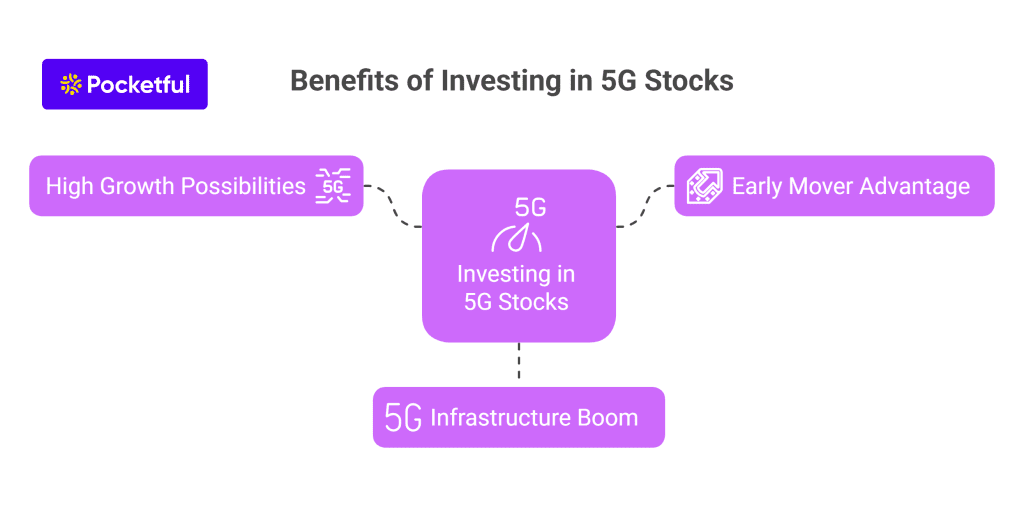
    • High Growth Possibilities: 5G is expected to play a crucial part in achieving initiatives such as smart homes and self-driving cars to virtual reality and remote healthcare. Companies building or supporting 5G could see huge growth in the years to come.
    • Early Mover Advantage: We’re still in the early days of 5 G. Investing now means you could benefit as the technology rolls out more widely across cities, towns, and even rural areas.
    • Infrastructure Boom: Rolling out 5G takes a lot of equipment, towers, fibre cables, and data centres. Companies that are involved in this sector are seeing a rise in revenues, which is great for investors.

    Risks of Investing in the Best 5G Stocks 

    The risks of investing in the best 5G stocks are: 

    • Mass Rollout will take Time: 5G rollout isn’t happening overnight. It’s a gradual process that depends on present infrastructure, regulation, and market readiness. This means returns might be slower than expected.
    • High Capital Costs: Building 5G networks is expensive and companies investing heavily in 5G tech may take on a lot of debt, which can hurt profits in the short term if things don’t go as planned.
    • Intense Competition: The telecom and technology sectors are highly competitive. Even strong 5G players face pressure on pricing, market share, and margins, especially from global companies.

    Conclusion 

    5G is not just about faster downloads, it is about big changes in the way we live and connect. From smarter cities to connected cars, the possibilities are exciting, and so are the opportunities for investors. However, it is not a guaranteed win as like any investment, 5G stocks come with their share of advantages and disadvantages. But if you are someone who likes being part of something that might revolutionize the future, 5G could be a smart space to explore. Take your time analyzing these companies and see if it fits in your portfolio. It is advised to consult a financial advisor before investing.

    S.NO.Check Out These Interesting Posts You Might Enjoy!
    1List Of Best Healthcare Stocks in India
    27 Top Food Stocks in India
    310 Best Copper Stocks in India
    4List Of Best Logistics Stocks in India
    5List of Best Liquor Stocks in India

    Frequently Asked Questions

    1. Is it a good time to invest in 5G?

      If you’re looking to invest for the long term then you should definitely consider investing in 5G stocks. Consult a financial advisor before investing.

    2. Are 5G stocks risky?

      Like investing in any other stock, there are some risks involved due to which thorough analysis is necessary before investing.

    3. How do these companies make money?

      Companies involved in 5G technologies make money by providing telecom services, building network infrastructure, manufacturing hardware, or powering the tech behind 5G.

    4. Are there 5G mutual funds or ETFs?

      Globally, yes. In India, options are still limited, but you can build your own portfolio by considering the stocks mentioned above.

    5. Why should I consider 5G stocks for investment?

      Because 5G is shaping the future, and being part of that shift can be both exciting and rewarding.

    Selection Methodology and Important Disclaimer

    The stocks included in this list are selected primarily on the basis of their market capitalisation, which represents the total market value of a company’s outstanding shares. The companies are arranged in descending order of market capitalisation, with larger companies appearing first, followed by relatively smaller companies. This methodology is intended to provide a structured approach for identifying companies based on their market size and overall presence within a sector.

    However, market capitalisation should not be considered the sole factor while evaluating investment opportunities, as it does not guarantee future performance, profitability, or returns. Investors should also assess other important factors such as financial health, business fundamentals, management quality, valuation metrics, industry outlook, and market conditions before making investment decisions.

    The information provided is for educational and informational purposes only and should not be construed as investment advice, recommendation, solicitation, or an offer to buy or sell any securities by Pocketful Fintech Capital Private Limited.
  • Features and Benefits of ETF (Exchange Traded Funds)

    Features and Benefits of ETF (Exchange Traded Funds)

    Exchange Traded Funds (ETFs) are becoming increasingly popular in today’s time. These investment instruments trade like stocks but offer the diversification and transparency of mutual funds by tracking stock market indices. In 2025, the global ETF market attracted $2 trillion of new capital, which shows their credibility and demand.

    In this blog, the features and benefits of ETFs are explained in a simple and detailed manner. Moreover, a comparison between ETF and other investment options is shown to better understand them.

    What are Exchange Traded Funds (ETFs)?

    ETFs or Exchange Traded Funds are an investment option that follows a stock market index such as Nifty 50 or Sensex. The most special thing about these funds is that they can be bought and sold in the market throughout the day just like shares. That is, unlike mutual funds, ETFs can be bought and sold throughout the trading day at real-time prices, without waiting for end-of-day NAV pricing.

    What do ETFs invest in?

    ETFs invest not just in stocks but also in many other asset classes, such as:

    • Equity:  Stocks included in the index 
    • Bonds: Government or corporate bonds
    • Commodities:Such as gold, silver, etc.
    • International: ETFs that invest in companies of foreign countries
    • Sector-focused:  Such as technology, pharma, banking, etc.

    Some special features of ETFs (ETF Features)

    • Liquidity:  Buy and sell whenever you want, like shares.
    • Transparency:  ETFs provide their holding information and tracking error on a regular basis.
    • Low Cost:  Fees are much lower than mutual funds.
    • Tax Efficiency:  Better for tax planning.

    Due to all these features, ETFs are becoming a smart, accessible and affordable option for investors these days. Be it a new investor or an experienced one, ETFs are proving to be useful for every investor profile.

    Know More: Calculate returns on ETF investments.

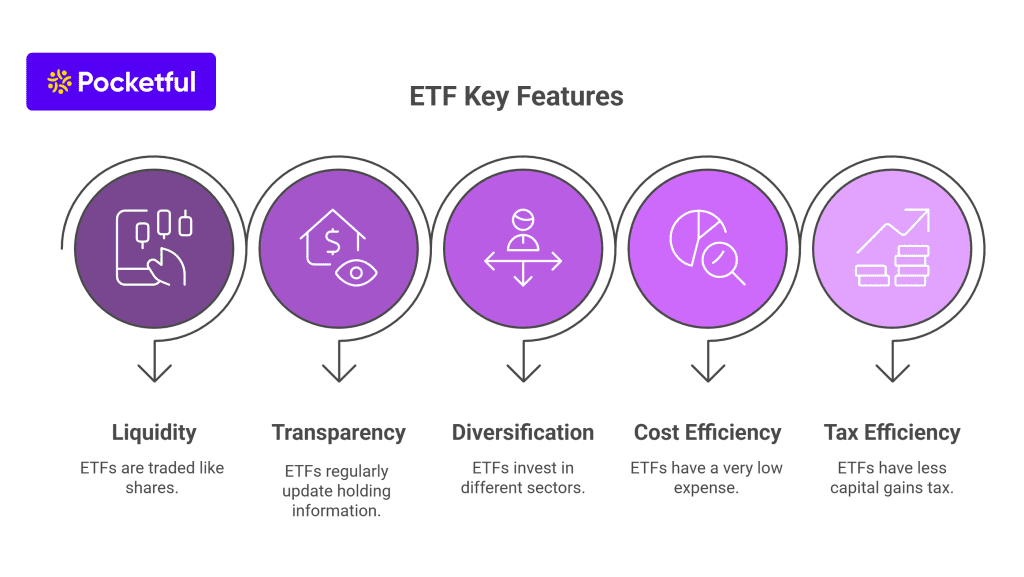
    Key Features of Exchange Traded Funds

    Exchange Traded Funds (ETFs) are easy to understand, but they have some special features that make them different from other investment options.

    • Liquidity: ETFs can be bought or sold like shares throughout the trading hours. This means that when the market is open, investment or withdrawal in an ETF can be done at any time, that too at real-time price. This facility is not available in mutual funds.
    • Transparency: Most ETFs update their holding information on a regular basis. This helps the investor to know in which companies or assets his money has been invested.
    • Diversification : Investment can be made in different sectors, companies or asset classes through a single ETF. This distributes the risk and diversifies the portfolio.
    • Cost Efficiency: ETFs usually have a very low expense ratio because they passively follow the index, which results in reduced cost to the investor.
    • Tax Efficiency: ETFs are structured in such a way that the impact of capital gains tax is less. Especially when invested for a long time, the benefit of tax saving increases even more.

    Benefits of Investing in ETFs 

    Exchange Traded Funds (ETFs) provide investors with an option that balances risk and also provides returns. Here are some reasons why ETFs are considered a smart investment choice today:

    • Flexibility: ETFs are traded just like stocks, which allows them to be used for intraday trading. This allows active investors to adopt multiple trading strategies.
    • Low Investment Threshold: Most ETFs do not require a large amount to start investing, which allows new and small investors to enter the market.
    • Variety of Choices : Today, there are sector-based, theme-based, international and bond-based ETFs, providing options for any investment goal.
    • Performance Tracking: The specialty of these funds is that they track the index or sector very closely, making the returns easily comparable.
    • Real-time pricing: The price of ETFs keeps changing throughout the trading hours, allowing for timely entry and exit.
    • Automatic risk diversification: An ETF invests in many stocks or assets, reducing the impact of a single company’s decline on the entire portfolio.
    • No entry or exit load: There are no entry or exit loads when investing in ETFs, making the investment process cost-efficient.
    • Better control and transparency: Since ETFs are listed on the stock exchange, investors are better informed about their holdings and market movements.

    Read Also: How to Invest in Gold ETF – Benefits, Risks and Charges

    ETFs vs other Investment options: Which is better and when?

    Exchange Traded Funds (ETFs) are often compared with mutual funds or other investment options. But each option has its own strengths and limitations. The table below gives a quick overview of their key features:

    Feature/AspectETFsMutual FundsFixed Deposits 
    Trading FlexibilityTrades like stocks throughout the dayTransact at end of day at NAV onlyLock-in and invested for a Fixed Period
    Cost / FeesVery low expense ratioRelatively higher feesNo fund management charges
    TransparencyInvestors have a better idea of where their money has been invested as holdings information is published daily.Holdings are published quarterly, which makes them less transparent.Limited information is available as the bank lends your deposited amount.
    LiquidityHigh – can be bought/sold at any timeModerate – redemption takes timeLow – Early withdrawal penalty
    Market ExposureDiversified index, sector, commodities, etc.Based on the investment strategy mentioned in the fund documentsNo direct link to the market

    Considerations Before Investing in ETFs 

    Although ETFs have many benefits, it is important to understand a few key points before investing.

    • Effect of market volatility: ETFs are directly linked to the stock market, so their prices can also go down rapidly when the market falls.
    • Possibility of tracking error: Sometimes the return of an ETF does not match the index it is following. This is called tracking error.
    • Understand the investment strategy: Before investing, it is important to know in which assets or sectors the ETF is investing.
    • Research and clarity are important: Before investing in an ETF, conduct your own research to select the best fund for your portfolio.

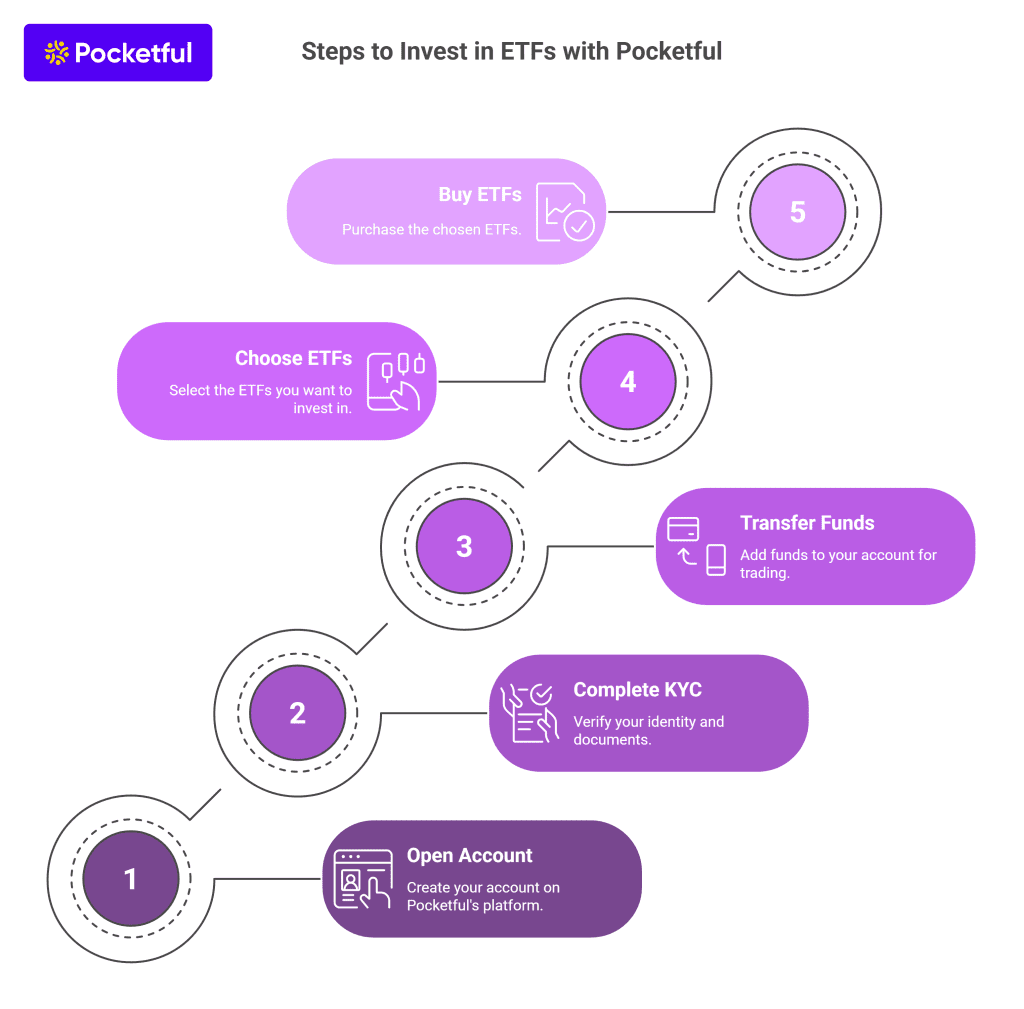
    How to Invest in ETFs Step-by-Step with Pocketful?

    You can easily invest in ETFs with Pocketful by following the steps mentioned below:

    • Open an account on Pocketful:  First, create your account by visiting Pocketful’s website or app.
    • Complete KYC and verification: Your account will be activated after your documents and other information are verified.
    • Transfer funds to your account So that you can trade in the stock market.
    • Choose and buy ETFs : Select the fund of your choice from the ETFs available on the Pocketful platform and buy.
    • 0 Charges on Delivery Investment: ​​There is no charge for delivery of ETF units on Pocketful, making investing even more affordable.

    Pocketful’s user-friendly platform and low cost makes investing easy.

    Read Also: Best ETFs in India to Invest

    Conclusion 

    ETFs are an easy, flexible and affordable option for investment. They are traded in the stock market, allowing real-time buying and selling. ETFs have low cost and offer transparency and diversification, which helps in reducing risk. For any investor, whether new or experienced, adding ETFs to their portfolio can be a wise move. For a better decision, one should include ETFs in their investment portfolio after consulting an expert or doing thorough research on their own.

    S.NO.Check Out These Interesting Posts You Might Enjoy!
    1Mutual Fund vs ETF. Are They Same Or Different?
    2What are ETFs? Are ETFs good for beginner investors?
    3ETF vs Index Fund: Key Differences You Must Know
    4How to Invest in ETFs in India – A Beginner’s Guide
    5What is Nifty BeES ETF? Features, Benefits & How to Invest?

    Frequently Asked Questions (FAQs)

    1. How are ETFs different from mutual funds?

      ETFs trade like stocks throughout the day, whereas mutual funds are bought or sold only at the end of the day at NAV.

    2. Are ETFs cheaper than mutual funds?

      Yes, ETFs generally have lower expenses than mutual funds.

    3. Can I buy and sell ETFs anytime?

      Yes, ETFs can be bought or sold at any time during trading hours.

    4. What are the main benefits of investing in ETFs?

      Investing in ETFs reduces costs and provides diversification.

    5. Do ETFs carry risk?

      Yes, ETFs are also linked to the stock market, hence they are also affected by market fluctuations.

  • Best ETFs in India to Invest in 2026

    Best ETFs in India to Invest in 2026

    In the world of financial markets, there are various investment options available. If an investor is looking to diversify their portfolio and has a limited amount of capital, they can consider investing in ETFs or Exchange Traded Funds. They are passively managed funds offered by various AMCs. But do you know which ETFs have been top performers in recent years?

    In this blog, we will give you an overview of the top 10 ETFs in India, along with the factors to consider before investing in them.

    What is an ETF?

    An ETF or Exchange Traded Fund is a passive investment tool that predominantly invests the capital in a basket of stocks, commodities, etc. ETFs are generally traded on the stock exchange like any other ordinary stock; therefore, to buy and sell ETFs, you are required to have a demat and trading account. 

    List of Best ETFs in India

    The following are the best ETF to invest in 2026:

    ETF NameSymbol5-Year Return
    Kotak NV 20 ETFKOTAKNV20203.26%
    Kotak Nifty Bank ETFBANKNIFTY1196.54%
    SBI NIFTY NEXT 50 ETFSETFNN50186.79%
    Nippon India ETF Junior BeESJUNIORBEES184.70%
    Bandhan NIFTY ETFIDFNIFTYET181.53%
    Quantum Nifty ETFQNIFTY180%
    Motilal Oswal M50 ETFMOM50175.04%
    Invesco India NIFTY ETFIVZINNIFTY171.90%
    SBI NIFTY 50 ETFSETFNIF50167.28%
    Invesco India Gold ETFIVZINGOLD95.16%
    (Data as of 15th May 2025)

    Overview of the Best ETFs in India

    An overview of the top ETFs in India is as follows:

    1. Kotak NV 20 ETF

    This ETF invests in Nifty 50 Value 20 index stocks. These stocks represent companies with strong fundamentals and attractive valuations. It primarily tracks share prices of 20 companies with low PE, low PB and high dividend yield. It is managed by Kotak AMC.

    2. Kotak Nifty Bank ETF

    This ETF, launched by Kotak Mutual Fund, tracks the Bank Nifty index and provides investors with an exposure to the top 12 banking stocks. Investors who wish to make a tactical allocation in the banking industry can opt to invest in Kotak Nifty Bank ETF.

    3. SBI Nifty Next 50 ETF

    The SBI Nifty Next 50 ETF was launched by SBI Mutual Fund and tracks the Nifty Next 50 Index. It is also a good investment option for investors who want to participate in the growth of the next 50 companies.

    4. Nippon India ETF Junior BeES

    This ETF primarily invests in the Nifty Next 50 Index, or the next 50 companies after Nifty 50 companies by market capitalisation. The stocks in which this ETF invests belong to the large and mid-cap segments. They are managed and operated by Nippon AMC and are suitable for investors seeking growth.

    5. Bandhan Nifty ETF

    The Bandhan Nifty ETF also invests in Nifty 50 stocks. Earlier, it was launched by IDFC mutual fund, which was later taken over by Bandhan AMC. Therefore it is known as Bandhan Nifty ETF.

    6. Quantum Nifty ETF

    This ETF, launched by Quantum AMC, tracks the Nifty 50 Index and offers similar exposure to large-cap stocks of India as specified by the Nifty 50 index. It is another ETF that invests in the Nifty 50 index that has generated substantial returns in the recent past.

    7. Motilal Oswal M50 ETF

    For investors who wish to invest in the Nifty 50 index ETF, Motilal Oswal M50 is another option as it offers exposure to the top 50 companies of India. This ETF has also given tremendous returns over the past 5 years.

    8. Invesco India Nifty ETF

    This ETF is managed by Invesco India Asset Management Company. It primarily invests in the top 50 companies listed on the National Stock Exchange based on market capitalisation. Those 50 companies have exhibited strong performance over many years.

    9. SBI Nifty 50 ETF

    As the name indicates SBI Nifty 50 ETF tracks the Nifty 50 Index and is managed by SBI. It is highly liquid in nature and is often used as an investment option by EPFO and other institutional investors.

    10. Invesco India Gold ETF:

    This ETF tracks the domestic price of Gold and allows the investor exposure to Gold digitally. It is also known as commodity ETF, and can be used as a hedge against inflation and currency fluctuations.

    Read Also: How to Invest in Gold ETF – Benefits, Risks and Charges

    Factors to Consider before Investing in an ETF

    Factors to Consider before Investing in an ETF

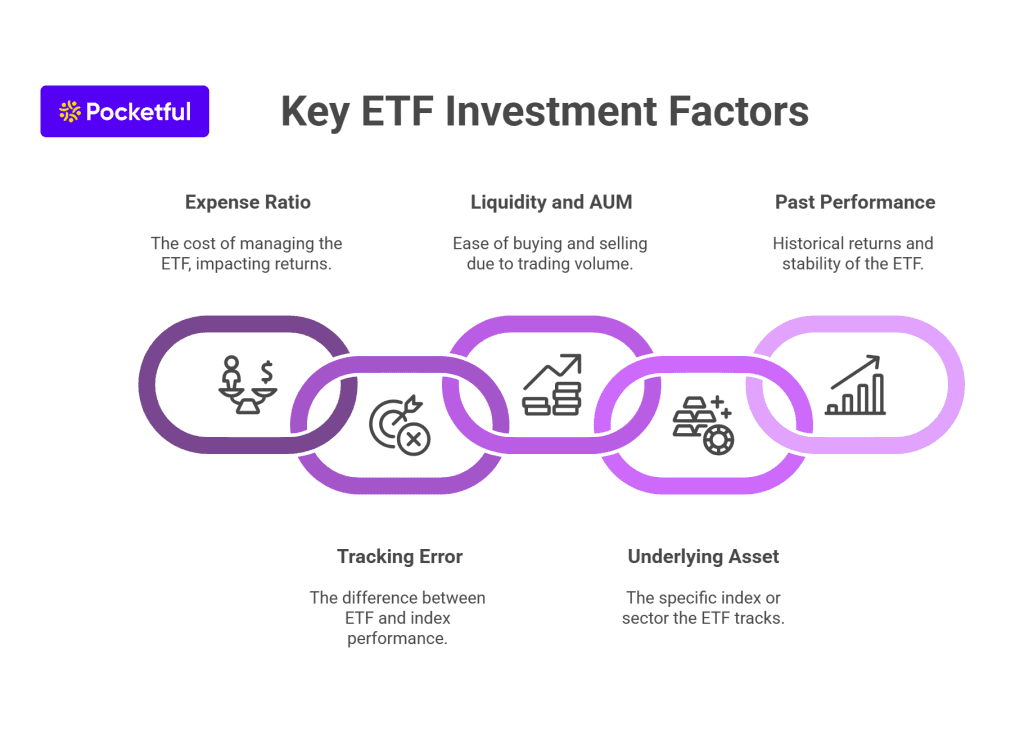
    The key factors which an investor should consider before investing in an ETF are as follows:

    1. Expense Ratio: The expense ratio plays a major role when choosing an ETF for investment; the lower the expense ratio, the higher the returns.
    2. Tracking Error: A tracking error defines the difference between the performance of an ETF and the index which it replicates; the lower the tracking error, the better the returns.
    3. Liquidity and AUM: Check the trading volume and the assets under management (AUM) of the ETF. A high trading volume and larger AUM generally indicate better liquidity, which makes it easier to buy and sell an ETF. 
    4. Underlying Asset: There are various ETFs available in the market tracking the different indices; therefore an investor should choose the ETF based on their investment objective.
    5. Past Performance: This is one of the key factors to be considered before choosing an ETF for investment. ETFs which have posted consistently higher returns with low tracking errors should be considered for investment.

    Know More: Calculate returns on ETF investments.

    Which ETF is suitable for you?

    The amount to be invested in the ETF depends on various factors such as your existing financial conditions, debt level, your investment objective, and your risk tolerance. If you are an aggressive investor and want to invest in a specific sector for a higher return, then you can opt for sectoral ETFs. However, if you are a conservative investor, then you can opt for investing in equity-oriented ETFs, which primarily invest in the top 50 or 100 companies. Alternatively, if you are looking to diversify your portfolio and wish to invest in Gold and other commodities, then you can invest in commodity ETFs.

    Read Also: What is Gold ETF? Meaning & How to Invest Guide

    Conclusion

    On a concluding note, there are various categories of ETFs available in India, and if someone is looking to invest passively, ETFs are a good option. However, ETFs generally have a slight tracking error, due to which their returns are approximately similar to that of the indices they follow. Hence, an investor must compare the tracking error of the ETFs investing in the same underlying asset to select the best ETF among them before investing. Among the various ETFs available in India, one must consider the ETF which suits their risk profile and always invest in an ETF after consulting with their investment advisor.

    To invest in an ETF one can easily open a lifetime free demat and trading account with Pocketful, as it offers free brokerage on delivery based trades, along with an advanced trading platform.

    S.NO.Check Out These Interesting Posts You Might Enjoy!
    1Mutual Fund vs ETF. Are They Same Or Different?
    2What are ETFs? Are ETFs good for beginner investors?
    3ETF vs Index Fund: Key Differences You Must Know
    4How to Invest in ETFs in India – A Beginner’s Guide
    5What is Nifty BeES ETF? Features, Benefits & How to Invest?
    6List of Best Commodity ETFs in India

    Frequently Asked Questions (FAQS)

    1. Are ETFs active or passive funds?

      ETFs are passively managed funds as they replicate the index that they follow.

    2. What is the minimum amount one can invest in an ETF?

      The minimum amount that an investor can invest depends on the price of the ETF; there are various ETF prices which start from as low as ₹50.

    3. Which type of tax applies to ETFs?

      Capital Gain Tax is applicable on ETFs, depending on whether it is an equity, debt or gold ETF.

    4. How can I buy an ETF in India?

      To purchase an ETF in India, one must have a trading and demat account with a broker. If you have one, you can buy it like any other stock.

    5. What are the risks associated with investing in ETFs?

      ETFs generally carry lower risk than other asset classes. However, there are tracking errors, due to which the returns of ETFs can be lower than the index they follow.

  • Gold BeES vs Silver BeES: Which is the Better Investment?

    Gold BeES vs Silver BeES: Which is the Better Investment?

    Investing in gold or silver today no longer means just buying jewellery as the way to invest in gold and silver has changed. Today, investing in these metals through ETFs like Gold BeES and Silver BeES is not only easy but also very transparent and affordable. Recently, the total trading volume of these ETFs crossed ₹644 crore on Akshaya Tritiya 2025, which is three times more than last year. 

    Gold BeES is considered a symbol of stability and reliability, while Silver BeES has the potential to give better returns. In this blog, both the options are weighed wisely to make the right investment decisions.

    Understanding Gold BeES

    Gold BeES is an exchange-traded fund (ETF) that tracks the domestic price of gold and allows investors to invest in gold digitally. It was launched by Nippon India Mutual Fund.

    Key Features

    • Each unit represents approximately 0.01 grams of 99.5% pure gold, and its value fluctuates with gold prices.
    • It can be bought and sold like shares on NSE or BSE.
    • Investment is possible through Demat accounts.
    • There is no hassle of storage cost, making charges or theft.
    • There is an opportunity to invest in gold even with less capital.
    • Provides stability in long term portfolio and protection from inflation (Inflation Hedge).
    • Gold is traditionally considered a safe haven asset.

    Understanding Silver BeES 

    Silver BeES is an ETF that tracks domestic silver prices and gives investors the option to invest in it digitally without buying physical silver. It has also been launched by Nippon India Mutual Fund.

    Key features:

    • Each unit contains the value of about 1 gram of silver.
    • It can also be traded like a stock in real time on NSE/BSE.
    • Investment can be done with the help of a Demat account.
    • There is no need to store physical silver, which reduces the risk.
    • Silver is also an industrial metal, which is used in electronics, solar and auto sectors.
    • There is a sharp fluctuation in prices, which can lead to high returns in the short term.
    • Risk is slightly higher, but growth opportunities are also better.

    Gold BeES vs Silver BeES: Key Differences 

    PointsGold BeESSilver BeES
    Underlying AssetTracks 99.5% pure physical gold.Tracks domestic silver prices, which depend on both industrial and investment demand.
    Liquidity and AccessibilityLiquidity remains good due to high trading volume.The trading volume is comparatively lower, but still significant.
    Demand in IndustriesMainly used for jewellery and investment purposes, industrial demand is low.There is high demand for silver in industries like electronics, solar panels, automobiles.
    Volatility and RiskPrices remain relatively stable, considered a safe investment option.Prices fluctuate wildly, risk is high but the potential for returns is also high.
    ReturnsGold BeEs give stable returns in the long term and help in protecting against inflation.Potential for higher returns in the short-term, but prices are more volatile.

    Read Also: Gold BeES vs Gold ETF: Meaning, How It Works, Taxation

    Performance Comparison: Gold BeES vs Silver BeES

    Lets compare the performance of Gold BeEs and Silver BeEs:

    1. Historical Returns 

    Gold BeES has given investors an annual compounded annual growth rate (CAGR) of around 20.37% in the past 3 years. This means that long-term investment in gold has been stable and profitable.

    On the other hand, Silver BeES has risen rapidly to achieve a CAGR of around 12.20% between 2022 and 2025. Since silver prices are influenced by industrial demand, its performance has been volatile.

    2. 2024 Annual Performance 

    Gold ETFs delivered an average return of 19.23% in 2024, which was a big positive for investors amid economic uncertainty and inflation concerns. Silver ETFs also achieved a return of around 15.01%, which was possible due to global economic recovery and rising industrial demand.

    • Gold BeES : Gold is traditionally considered a ‘safe haven’. When global economic uncertainty, inflation or geopolitical tensions rise, Gold BeES performs better. It helps investors protect their portfolios.
    • Silver BeES : Silver prices are linked to its demand in the manufacturing industry. Its increasing demand in sectors such as electronics, solar panels, and automobiles can increase Silver BeES prices rapidly. However, its prices are highly volatile, so it can be a bit risky for new investors.

    4. Comparison from Investor Perspective : 

    Both investing in Gold BeES and Silver BeES depends on the investor’s financial goals, risk tolerance and holding period.

    • Gold BeES performance is generally considered stable and suitable for long-term investments.
    • Silver BeES has higher volatility, making it suitable for investors who can tolerate more risk and are focused on faster growth.

    Pros and Cons of Investing in Gold BeES and Silver BeES

    Both Gold BeES and Silver BeES are exchange traded funds (ETFs) that track the prices of gold and silver. While both these metals are considered valuable, the advantages and disadvantages of investing in them can differ:

    1. Pros and Cons of Gold BeES 

    Pros 

    • Stability : Gold is traditionally considered a safe asset, performing stable in economic uncertainty.
    • Inflation Hedge : Gold prices often rise in times of inflation, helping preserve value.
    • High Liquidity : Gold BeES has a high trading volume, making it easy to buy and sell.

    Cons 

    • Lower Short-Term Potential: Returns may be slow in the short term.

    2. Pros and Cons of Silver BeES 

    Pros 

    • Affordable : Low unit price makes it affordable even for small investors.
    • Short-Term Gain Potential : Prices may rise if industrial demand increases.
    • Industrial Support : Sustainable demand comes from electronics and green energy sectors.

    Cons : 

    • High Volatility : Prices can change rapidly, which can increase risk.
    • Industry Cycles Impact : Investment performance may be affected by economic recession or production decline.

    Know More: Calculate returns on ETF investments.

    Which is Better for Your Investment Portfolio?

    Both ETFs Gold BeES and Silver BeES may look similar but their return profiles and market behaviour differ. Every investor has different needs, time horizon and risk appetite, and hence the utility of these options may vary.

    Selection based on investment goals and risk profile 

    1. For those seeking stability – Gold BeES 

    • Investors who prioritize stability and low risk are often attracted to assets that do not fluctuate much.
    • Gold BeES prices remain relatively stable, and it maintains its value even in times of economic uncertainty.
    • It can help balance a portfolio over the long term.

    2. For those seeking growth – Silver BeES

    • Some investors prefer options with higher return potential, even if it comes with a little more risk.
    • Silver BeES is more volatile, but it can provide good returns when industrial demand increases.

    3. Investment Horizon 

    • Gold BeES is generally considered better for the long term as its price increases steadily over time.
    • Silver BeES has the potential to deliver faster returns in the short to medium term, but the risk is higher.

    4. Importance of Diversification 

    • Many investors prefer to create a diversified portfolio that includes both – Gold BeES and Silver BeES.
    • Gold provides protection against inflation and global uncertainty, while silver offers growth potential.
    • Combining the two can create a balanced investment portfolio that balances both risk and return.

    How to Invest in Gold BeES and Silver BeES?

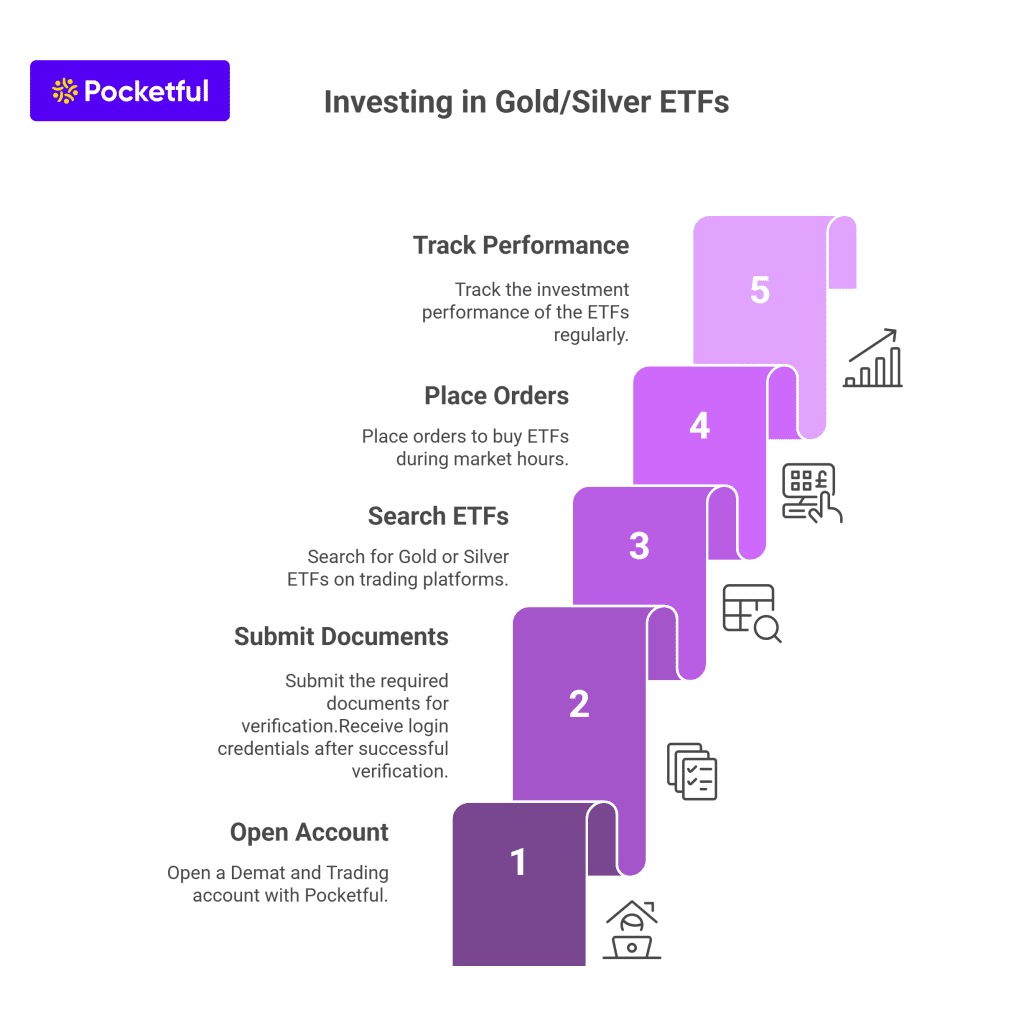
    Investment Process (Step-by-Step Process) : 

    • First, it is necessary to open a Demat and Trading account. You can open one free of cost with Pocketful.
    • Submit the required documents and after successful verification, you will be sent the login credentials, which you can use to log in to your trading account.
    • Investors can search for Gold BeES or Silver BeES on the trading platforms. It is useful to check factors such as expense ratio, fund performance and tracking error before investing.
    • Then, orders can be placed to buy these ETFs during market hours.
    • TRack the investment performance of the ETFs at regular intervals.

    Easy Investing with Pocketful : Pocketful is a registered stock broking platform from where one can invest in Gold BeES and Silver BeES in just a few clicks. Pocketful offers its clients a user-friendly interface, fast order execution and dedicated support team.

    Read Also: How to Invest in Gold ETF – Benefits, Risks and Charges

    Conclusion

    Gold and silver are different in nature; one is a safe haven linked to tradition, the other is a volatile metal driven by industrial demand. Gold BeES and Silver BeES allow investors to invest in these precious metals without having to buy them physically. It is important to understand these ETFs not just from a returns perspective but also economic and market dynamics behind them. It can be useful to keep in mind the objective, time horizon and market trends while deciding their suitability for your investment portfolio. Consult a financial advisor for advice before investing.

    S.NO.Check Out These Interesting Posts You Might Enjoy!
    1Mutual Fund vs ETF. Are They Same Or Different?
    2What are ETFs? Are ETFs good for beginner investors?
    3ETF vs Index Fund: Key Differences You Must Know
    4How to Invest in ETFs in India – A Beginner’s Guide
    5What is Nifty BeES ETF? Features, Benefits & How to Invest?

    FAQs

    1. What is the minimum amount required to invest in Gold BeES or Silver BeES?

      Investment can be started from as low as ₹100 as both ETFs are currently priced below ₹100.

    2. Can I hold Gold BeES or Silver BeES for the long term?

      Yes, both these ETFs are considered suitable for long term holding.

    3. Are Gold BeES and Silver BeES backed by physical gold/silver?

      Yes, these ETFs are usually backed by physical gold or silver.

    4. Is there any tax on profit from Gold BeES or Silver BeES?

      Yes, long term and short term gains are taxed.

    5. Are these ETFs safe to invest in?

      They are regulated and listed on an exchange, but every investment carries some risk.

    6. Can I sell Gold BeES or Silver BeES anytime?

      Yes, you can sell it anytime during market hours, just like you sell any stock.

  • Gold ETF vs Gold Mutual Fund: Differences and Similarities

    Gold ETF vs Gold Mutual Fund: Differences and Similarities

    Equity markets have a history of being highly volatile during periods of adverse geopolitical events, unfavorable economic conditions, etc., due to which every investor prefers to allocate some portion of their portfolio to Gold as it is considered a safe haven. There are various modes through which one can invest in digital Gold. The two most popular options to invest in gold are Gold ETFs and Gold Mutual Funds.

    In this blog, we will give you an overview of both Gold Mutual Fund and Gold ETFs, along with their similarities and differences.

    Key Differences Between Gold Mutual Fund and Gold ETFs

    The major difference between Gold Mutual Fund and Gold ETFs is as follows:

    ParticularGold Mutual FundGold ETF
    ModeIt can be purchased through Asset Management Companies, online platforms, etc.It can be easily bought and sold on the stock exchange.
    Demat AccountA Demat account is not required to invest in the Gold Mutual Fund.It is mandatory to have a demat account for investment in a Gold ETF.
    ExpensesIt generally has a high expense ratio as it includes the charges of both the ETF and mutual fund’s expense ratio.It typically has a lower expense ratio than the Gold Mutual Fund.
    PriceThe price of the Gold Mutual Fund is adjusted at the end of the day and is known as NAV.The prices of Gold ETFs can be tracked in real-time during trading hours.
    Investment TimingInvestment can be made at any time during the day.Investment and redemption can be done during the trading hours only.
    Exit LoadSome Gold Mutual Funds may have an exit load, which is decided by the AMC.There is no exit load applicable in the Gold ETF.

    Similarities Between the Gold Mutual Fund and the Gold ETF

    There are various similarities between Gold Mutual Fund and Gold ETF; a few of such similarities are mentioned below:

    1. Investment in Gold: Both Gold ETF and Gold Mutual Funds invest the amount in physical Gold directly or indirectly through exchange-traded derivatives. Their returns are dependent on how the domestic gold prices have performed.
    2. Zero Risk: Investing in both Gold ETFS and Gold Mutual Funds offers peace of mind as here is no risk of theft or storage costs.
    3. Tax Treatment: Both the Gold Mutual Fund and the Gold ETF are taxed in the same manner.
    4. High Liquidity: Gold ETFs and Gold Mutual Funds are highly liquid and can be converted easily into cash.
    5. Well Regulated: Both investment options are well regulated by the Securities and Exchange Board of India (SEBI).

    What is a Gold Mutual Fund?

    Gold Mutual Fund is a type of mutual fund that collects money from the general public, and the fund managers invest the accumulated amount into gold, gold-related assets, and gold ETFs to generate returns similar to gold. It is a type of open-ended fund in which anyone can invest and withdraw money at any point in time. If investors do not have a demat account, they can invest in the Gold Mutual Fund and can earn returns similar to those of physical gold.

    Features of the Gold Mutual Fund

    The significant features of the Gold Mutual Fund are as follows:

    1. Portfolio Diversification: One can easily diversify their portfolio through gold mutual funds.
    2. No Demat Account: You can invest in Gold mutual funds even if you do not have a demat account.
    3. Net Asset Value: In a Gold mutual fund, you can invest based on their daily NAV, which is updated at the end of each trading day.
    4. SIPs: One can easily invest in Gold mutual funds through monthly SIPs.

    What is a Gold ETF?

    Gold ETF or Gold Exchange Traded Fund is an investment option which allows an investor to invest in ETF units that tracks the domestic price of physical gold. As gold ETF tracks the performance of physical gold, its returns are similar to that of physical gold. Gold ETFs can be easily bought and sold on the stock exchange like any other ordinary share. There is another term which is very famous among investors: Gold BEES, which is one of the oldest and well-known Gold ETFs in India. It was launched on 8 March 2007 and is managed by Nippon India Mutual Fund.

    Features of Gold ETF

    The key features of Gold ETF are:

    1. Physical Gold: The Gold ETF is backed by physical gold; hence ensures that investors get returns similar to that of physical gold.
    2. Exchange Traded: The ETFs are traded on the stock exchange, like any other share, which means you can easily buy and sell the units of the Gold ETF during the trading session.
    3. Low Cost: Investors in gold ETF only incur a nominal expense ratio and do not incur storage costs or risk of theft associated with owning physical gold.
    4. Demat Account: To invest in Gold ETF, you must have a demat and trading account with a stockbroker which facilitates the buying and selling of Gold ETF.

    Read Also: How to Invest in Gold ETF – Benefits, Risks and Charges

    Which one is Better for You?

    If you do not wish to have a demat and trading account, then you can easily invest in a Gold Mutual Fund. It does not require constant monitoring and regular investments can be made using SIP, etc. However, it carries higher expense ratios and exit loads as compared to Gold ETFs. On the other hand, if you want to actively track, buy and sell, then you can easily invest in a Gold ETF. To invest in Gold ETF, you are required to open a trading and demat account where you can hold Gold ETFs. Both of the options are equally good for all types of investors; choosing among them depends on individuals’ preferences and choices.

    Read Also: Gold BeES vs Gold ETF: Meaning, How It Works, Taxation

    Conclusion

    On a concluding note, Gold ETFs and Gold Mutual Funds are suitable for investors who wish to invest in digital Gold. Those who prefer to invest in Gold through a Demat account can opt for investing in a Gold ETF, and those who don’t have a Demat account can invest in a Gold Mutual Fund. Both of these are backed by physical Gold and their returns depend on the domestic price of Gold. It is advisable to consult your investment advisor before making any investment in Gold.

    S.NO.Check Out These Interesting Posts You Might Enjoy!
    1Mutual Fund vs ETF. Are They Same Or Different?
    2What are ETFs? Are ETFs good for beginner investors?
    3ETF vs Index Fund: Key Differences You Must Know
    4How to Invest in ETFs in India – A Beginner’s Guide
    5What is Nifty BeES ETF? Features, Benefits & How to Invest?

    Frequently Asked Questions (FAQS)

    1. Which has a lower expense ratio between the Gold ETF and the Gold Mutual Fund?

      Gold ETFs generally have a lower expense ratio when compared to Gold Mutual Funds, as it has additional costs such as fund management fees along with the charges of its underlying Gold ETFs.

    2. Is a demat account required to invest in the Gold Mutual Fund?

      No, a demat account is not required to invest in the Gold Mutual Fund, however, it is mandatory to have a demat and trading account if you wish to invest in Gold ETF.

    3. Are the returns of both the Gold Mutual Fund and the Gold ETF similar to the returns of physical Gold?

      The returns of both the Gold Mutual Fund and the Gold ETF may vary slightly from the return of physical gold because of tracking error.

    4. Is it safe to invest in a Gold ETF and a Gold Mutual Fund?

      Yes, investment in Gold ETF and Gold Mutual Fund can be considered safe, as both of them are regulated by the Securities and Exchange Board of India (SEBI).

    5. What is the major difference between a Gold ETF and a Gold Mutual Fund?

      A Gold ETF can be traded on the stock exchange and requires a Demat account to invest, whereas investing in Gold mutual funds can be done through asset management companies.

  • How to Invest in Gold ETF – Benefits, Risks and Charges

    How to Invest in Gold ETF – Benefits, Risks and Charges

    For centuries, Gold has been considered an auspicious metal in India; whereas, in other countries of the world, it is primarily viewed as an investment option. In India, typically, people invest in physical Gold and purchase jewellery. But do you know, there are other investment options such as Gold ETF, which is a digital form of Gold that you can also hold in electronic form and is backed by physical gold.

    In this blog, we will explain to you how to invest in Gold Exchange Traded Fund, along with the features and benefits.

    What is a Gold ETF?

    Gold ETF, also known as Gold Exchange Traded Fund, is a type of investment tool that tracks the price of physical Gold in the domestic market. It is a passive investment option whose performance depends on the Gold prices. By investing in Gold ETFs, an investor can have ownership in the physical Gold. They are traded like any other stock on a real-time basis. Gold ETFs are held in a dematerialised form in the demat account of the investor.

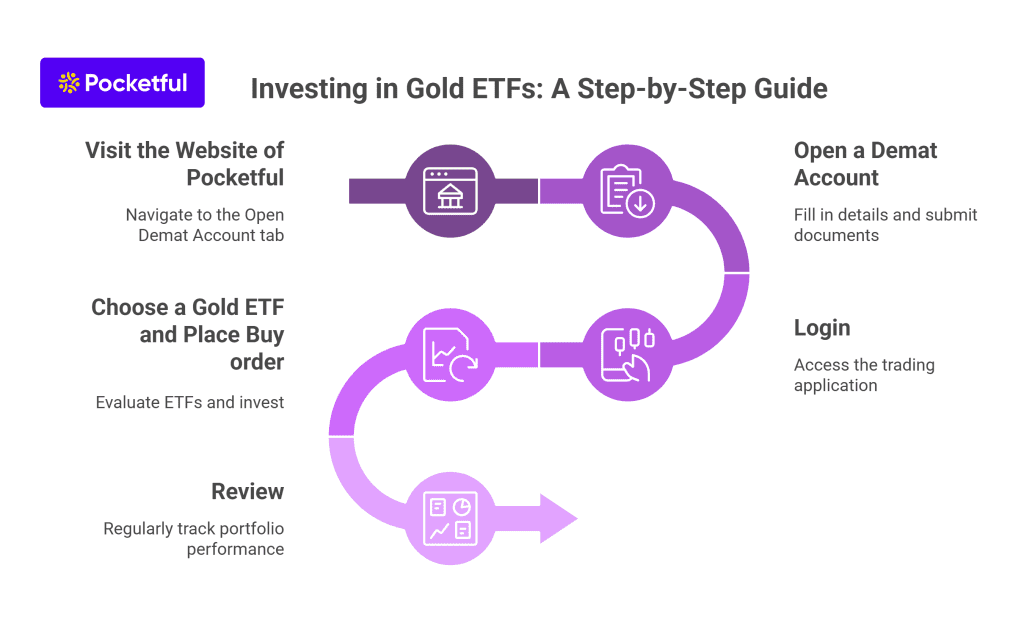
    How to Buy Gold ETF in India

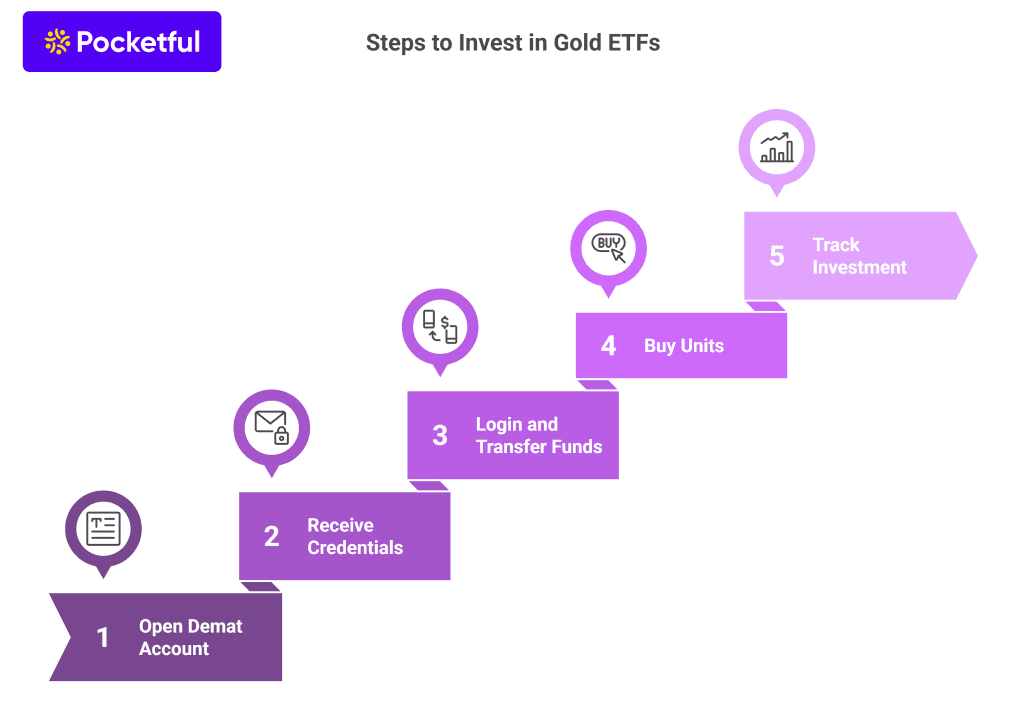
    Investing in a Gold ETF is very easy nowadays. An investor is required to follow the steps mentioned below:

    1. Visit the Website of Pocketful: An investor is required to visit the website of Pocketful and click on the Open Demat Account tab.
    2. Open a Demat Account: On the page, you are required to fill in your details and submit all the required documents. 
    3. Login: Once your demat and trading account is opened successfully, you are required to log in to the trading application provided by Pocketful and transfer funds needed to purchase Gold ETFs
    4. Choose a Gold ETF and Place Buy order: There are multiple Gold ETFs offered by various fund houses. Evaluate all the ETFs on various parameters such as tracking error, expense ratio, etc. After choosing the Gold ETF of your choice you can place a buy order with the number of units depending upon investment amount.
    5. Review: Regular tracking of your portfolio is required to monitor the performance of your Gold ETF.

    Features of Gold ETF

    The key features of Gold ETFs are as follows:

    1. Physical Gold: The Gold ETFs are backed by physical Gold, which causes their performance to match with returns of physical gold.
    2. Real-Time Trade: The ETFs are traded in real time, hence, an investor can buy and sell the ETFs during the trading hours. 
    3. No Physical Storage: In the case of physical Gold, there is a storage cost, and in an ETF there is no need for physical storage and thus no risk of theft.
    4. Transparency: ETF reflects the real-time prices of physical Gold; hence, it is easy for an investor to track the movement of the ETF.

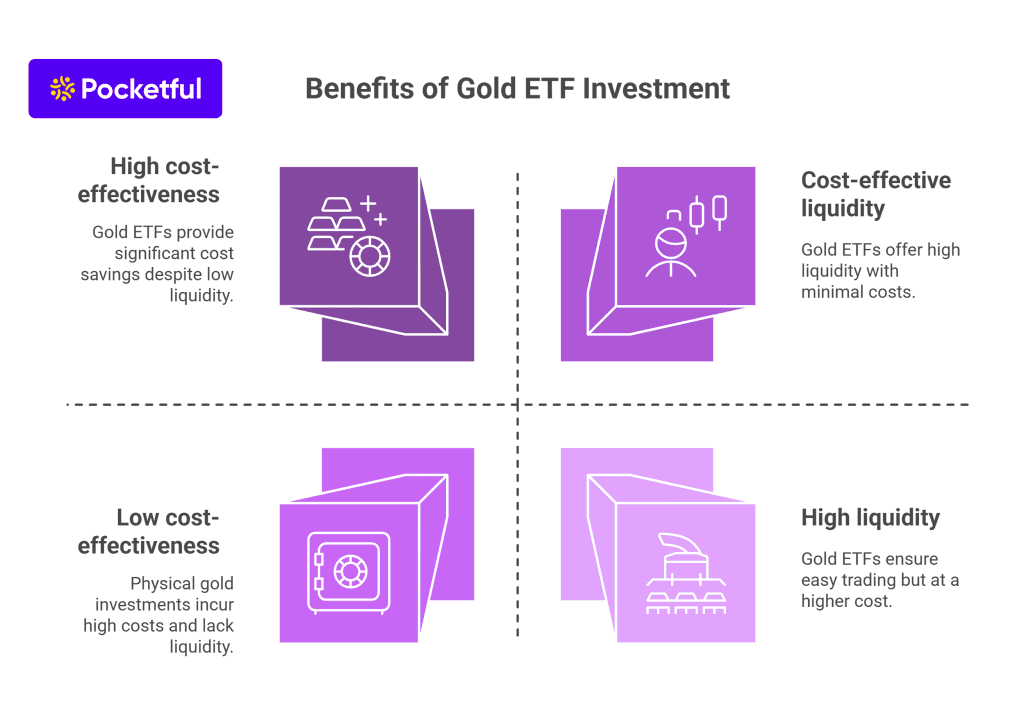
    Benefits of Investing in Gold ETF

    The significant benefits of investing in Gold ETFs are as follows:

    1. Liquidity: Gold ETFs can be bought and sold on the stock exchange anytime during the trading hours; therefore, they provide higher liquidity than physical Gold.
    2. Cost Effective: If you wish to invest in physical Gold, there will be various charges, including GST, etc. However, in the case of the Gold ETF, there are no such charges and investors must only pay a nominal expense ratio.
    3. Safety: If you are investing in a Gold ETF, there will be no risk of theft and physical storage costs, as you can hold it in electronic form.
    4. Purity: Investment in Gold ETFs are backed by physical Gold having a purity of 99.5%; therefore investors are assured that they are investing in high-quality Gold.

    Risk of Investing in Gold ETF

    There are several risks associated with investing in Gold ETFs, which are as follows:

    1. Volatility: The prices of Gold ETFs fluctuate very rapidly based on the market price of physical Gold, which are influenced by various factors such as economic conditions, foreign currency fluctuations and geopolitical events.
    2. Tracking Error: Because of expenses, operational inefficiencies, etc., the returns of Gold ETFs can slightly vary from those of physical Gold.
    3. Demat Charges: The Demat Account, which is mandatory to invest in Gold ETF, involves annual maintenance charges which are to be borne by the investor.
    4. Intangible: The Gold ETFs are intangible in nature, therefore it does not provide mental peace of owning physical Gold.

    Gold ETF vs Physical Gold

    The difference between Gold ETF and Physical Gold is as follows:

    ParticularsGold ETFPhysical Gold
    HoldingGold ETFs are held in electronic form in your demat account.They are held in physical or tangible form.
    SafetyThey are comparatively safer than physical Gold as they are held in electronic form.There is always a risk of theft, or damage to physical Gold.
    LiquidityThey are highly liquid as they can be sold at any time during trading hours on the stock exchange.The liquidity of physical Gold depends on the availability of buyers and sellers.
    ChargesInvesting in Gold ETFs requires investors to pay fees known as expense ratio.Buying physical Gold attracts GST and other making charges in the case of jewelry.
    Storage CostIt requires no storage cost.Physical Gold is usually stored in bank lockers, which attract additional charges.

    Conclusion

    On a concluding note, if you wish to invest in Gold, there are various options available; however, people prefer to invest in physical Gold because Gold ETFs are not very popular among investors. There are significant benefits of investing in Gold ETFs when compared to investment in physical Gold, such as it requires no storage cost, there is no risk of theft, etc., but for Gold ETF, you are required to have a demat account. It is advisable to consult your investment advisor before making any investment in Gold.

    S.NO.Check Out These Interesting Posts You Might Enjoy!
    1Mutual Fund vs ETF. Are They Same Or Different?
    2What are ETFs? Are ETFs good for beginner investors?
    3ETF vs Index Fund: Key Differences You Must Know
    4How to Invest in ETFs in India – A Beginner’s Guide
    5What is Nifty BeES ETF? Features, Benefits & How to Invest?

    Frequently Asked Questions (FAQS)

    1. Is it mandatory to have a demat account to invest in Gold ETFs?

      Yes, having a demat and trading account is mandatory to invest in a Gold ETF.

    2. Can I convert my Gold ETF units into physical Gold?

      No, it is not possible to convert your Gold ETF units into physical Gold. For this, you can sell your Gold ETF and purchase the physical Gold from any jewellery shop.

    3. How can I start investing in a Gold ETF?

      Open a demat account with Pocketful and then search for the gold ETF you want to invest in. Enter quantity and price and click on buy.

    4. Where does the Gold ETF invest my money?

      Gold ETF invests your money in physical Gold having 99.9% purity.

    5. What is the full form of Gold ETF?

      The full form of Gold ETF is Gold Exchange Traded Fund. 

  • Gold BeES vs Gold ETF: Meaning, How It Works, Taxation

    Gold BeES vs Gold ETF: Meaning, How It Works, Taxation

    Investing in gold has moved beyond buying jewellery or coins. Today, digital gold options are offering better choices to investors. Options like Gold BeES and Gold ETFs offer a smart, secure, and cost-effective way to invest in gold through the stock market. 

    So, if you are an investor looking to invest in gold, then you have just landed at the right place. This financial guide will share everything about Gold BeES vs Gold ETF in detail here. 

    Gold ETFs and Gold BeES: A Quick Comparison

    Now that you have explored all the basic details linked to both the investment options, let us now explore a brief comparison of Gold BeES vs Gold ETFs here:

    AspectGold BeESGold ETFs
    CategoryGold BeES is a specific gold exchange-traded fund offered by Nippon India Mutual Fund.Gold ETFs refer to the broader category of gold-based exchange-traded funds offered by multiple fund houses.
    Fund HouseManaged only by Nippon India Mutual Fund.Offered by various AMCs like HDFC, ICICI, Axis, Kotak, and more.
    Unit SizeEach unit represents approximately 0.01 gram of gold with 99.5% purity.Varies as it depends on the price of the ETF.
    LiquidityHighly liquid with a large daily traded volume.Liquidity depends on the specific fund and its trading activity.
    Expense RatioFixed at 0.80%.Varies between 0.32% to 0.78% depending on the AMC.
    Tracking ErrorTracks domestic gold prices closely with low tracking error.May show higher tracking error in some funds due to operational inefficiencies.
    TaxationShort-term gains (held for 12 months or less) are taxed as per income tax slab. Long-term gains (held for more than 12 months) are taxed at 12.5% without indexation.The same tax rules apply – STCG as per income slab, LTCG at 12.5% without indexation.

    Understanding Gold BeES

    Gold BeES is an Exchange-Traded fund (ETF) that tracks the domestic price of gold by investing primarily in physical gold of 99.5% purity. They offer investors a way to gain exposure to gold price movements in a digital and secure format. 

    This means you can invest in gold without the need to buy or store physical gold. Gold BeES is an open-ended scheme, which does not have a maturity or lock-in period. It is listed and traded on stock exchanges like any other share. 

    So when you buy Gold BeES, you are investing in approximately 0.01 grams of gold, as it trades around ₹80 and the price of 10 gm of actual gold is around ₹90,000. This allows investors to start investing in gold with a small initial capital.

    In India, Gold BeES is managed and offered by Nippon India Mutual Fund. It is the country’s first and most traded Gold ETF. The fund has been managed by Vikram Dhawan since 2022. The fund aims to provide returns that closely correspond to the domestic price of gold, before expenses. It is benchmarked against the domestic price of gold. 

    The further details of the Gold BeES that you should be aware of are as follows:

    Date of Listing8-Mar-2007
    AUM (₹ Cr.)20,783.15
    Price ₹79.51
    Expense Ratio0.80%
    (Details as on 28-May-2025)

    Now that you know what Gold BeES means, let’s quickly understand its working here.

    How Gold BeES Works?

    When you invest in any asset, the first thing that you must understand properly is how it works and generates returns. By knowing this, you can ensure that your investment is not just done in the right direction, but also that you gain from your investments. So, here is the working of the Gold BeES:

    • Every unit of Gold BeES is approximately equal to 0.01 grams of physical gold with a 99.5% purity. The fund manager invests in physical gold and other exchange traded gold derivatives, tracking price movements and ensuring good returns.
    • ETFs offer their units to investors, which are then traded on the NSE or BSE to ensure transparency. You need a demat and a trading account for this.
    • The BeES tracks the price of gold quite closely and ensures alignment with price movements consistently, resulting in low tracking error.
    • Since there is no physical gold involved, the investor is freed from the worry of storing it.
    • With a price of around ₹80, Gold BeEs allows new investors to invest in gold without much capital.

    Here is a quick table comparing the returns of the Gold BeES to those of physical gold to better check its performance.

    1 Year Return (%)3 Years Return (%)5 Years Return (%)Since Inception Return (%)
    Nippon India ETF Gold BeES29.7320.3713.8212.37
    Price of Gold31.3121.6514.9513.47
    (Details as on 28-May-2025)

    So, the Gold BeES matches or tracks the movement of gold prices with returns equivalent to what the physical gold investment might offer you. This makes the scheme perfect for investors seeking to diversify their portfolio with gold.

    Risks Associated with Gold BeES

    Gold BeES faces the risk of gold price volatility. This means its value can fluctuate sharply based on various factors, including:

    • Global gold prices
    • Currency movements
    • Economic or political events. 

    Though this is a liquid asset, there might be chances that the liquidity will be negatively impacted during extreme market conditions. This will make it harder to buy or sell at your desired price. Tracking error can increase during volatile market conditions, causing the fund’s returns to deviate from actual gold returns due to fund expenses and operational inefficiencies. 

    There’s also fund manager risk, as the ETF’s performance depends on the AMC’s efficiency. Changes in tax laws or regulations could impact returns in the future.

    Understanding Gold ETFs

    To understand Gold ETFs vs. Gold BeES, you must first know what each stands for. So, now that you know the meaning of Gold BeES, let us explore the Gold ETFs here.

    Gold ETFs are the exchange traded funds for the purpose of investment in gold. These are traded on stock exchanges and aim to track the price of physical gold. The primary features of these funds are as follows:

    • These are listed on stock exchanges like the NSE and the BSE for trading.
    • These are held electronically, so there is no hassle of storage.
    • The funds track the price of physical gold.
    • Gold ETFs are liquid in nature. This means you can easily buy or sell them on stock exchanges without any hassle.
    • The Gold EFTs involve no additional charges like making charges or storage costs, which makes them cost-efficient.
    • These are good from the taxation point of view when held for a long duration.
    • Investors can start with a small investment amount compared to investing in physical gold.
    • Many financial institutions accept Gold ETFs as collateral for loans.
    • There are no entry or exit load charges, making transactions cost-effective.
    • Statutory auditors regularly audit the holdings and purity of gold held by Gold ETFs to ensure transparency and trust.

    How Gold ETFs Work?

    Before you invest in Gold ETFs, you must understand how they work as well. So, the fund works in a very simple manner with the aim of offering returns to the investors. Here are the details of working:

    • These are traded on the stock exchanges during the trading hours. You can either buy or sell Gold ETF units based on your financial goals.
    • Each unit represents a specific quantity of physical gold that the ETF holds either physically or through exchange traded derivatives.
    • When you sell a unit, you get the cash amount equal to the physical gold value of that unit credited to your account.
    • You would need to pay taxes on the amount that you earn based on certain conditions. 

    Though there are various Gold ETFs available in India, it is important to know the top ones. So, here are the top-performing funds that you can invest in:

    Fund NameInception YearAUM (₹ Cr.)Price (₹)1 Year Return (%)3 Year Return (%)5 Year Return (%)Expense Ratio (%)
    Axis Gold ETF20101,660.7780.2728.2022.1614.10.56
    Birla Sun Life Gold ETF20111184.6384.5727.8522.0613.920.47
    HDFC Gold ETF20109562.9082.1527.9722.0413.960.59
    ICICI Prudential Gold Exchange Traded Fund20107294.7582.0627.9122.1414.020.50
    Invesco India Gold Exchange Traded Fund Ltd.2010277.778380.9528.2722.3114.170.55
    Kotak Gold Exchange Traded Fund20077416.1480.2527.8222.0714.000.55
    Quantum Gold Fund 2008312.5679.3727.9522.0713.890.78
    UTI Gold Exchange Traded Fund Ltd.20071983.1180.9028.8922.5514.030.46
    (Details as on 28-May-2025)

    To further understand GoldBeES vs Gold ETF properly, let us now consider the taxation part.

    Taxation of Gold ETFs and Gold BeES in India (2025)

    When you invest in any asset, you must know the taxation part as well. This will ensure that you are managing your fund in the best manner and gaining the optimum outcome as well. So, when it comes to Gold BeES vs Gold ETF, the following will give you an idea of how the taxation works:

    TypeShort-Term Capital Gains (≤12 months)Long-Term Capital Gains (>12 months)IndexationOther Taxes
    Gold BeESAs per the income tax slab12.5% flatNoNo wealth tax, STT, VAT, or sales tax
    Gold ETFs (all AMCs)As per the income tax slab12.5% flatNoNo wealth tax, STT, VAT, or sales tax

    Risks Associated with Gold ETFs

    Gold ETFs in India share similar risks to those of Gold BeES. They are highly sensitive to gold price volatility and macroeconomic factors. Liquidity risk can be higher in ETFs with lower trading volumes, making it difficult to exit at favorable prices. 

    Tracking error may be more pronounced in ETFs with higher expense ratios or less efficient fund management. The reputation and operational strength of the AMC matter; less established fund houses may carry higher risk. Like Gold BeES, all gold ETFs are subject to regulatory and taxation changes, which could affect their attractiveness or returns over time.

    Who Should Invest in Gold BeES or Gold ETFs?

    If you are looking to diversify your portfolio and want exposure to gold without dealing with physical storage or making charges, these options are ideal. Gold BeES and Gold ETFs are best suited for:

    • Long-term investors looking for a safe hedge against inflation or currency fluctuations.
    • Beginners who want to start small as Gold ETFs have low market prices, which allows even small investors to invest in gold.
    • People who want the flexibility to buy or sell gold easily and quickly through their trading account.

    How to Invest in Gold BeES or Gold ETF Using Pocketful?

    You can invest in Gold BeEs or Gold ETF using Pocketful by following the steps mentioned below:

    1. Visit the Pocketful website, click on ‘Open Demat Account’ and complete your KYC with PAN, Aadhaar, and bank details.
    2. After successful verification, your account will be opened and you will get login credentials on email.
    3. Login into Pocketful’s mobile application, transfer funds and search for the Gold ETFs or Gold BeES that you wish to invest in.
    4. Enter the number of units you want to buy click on buy.
    5. Track your investment regularly on the Pocketful’s user-friendly mobile application under your portfolio section.

    Conclusion

    Gold BeES vs Gold ETFs offers you a comparison between two investment tools for anyone looking to invest in gold digitally. While Gold BeES is a specific ETF offered by Nippon India, Gold ETFs represent a broader range of ETFs offered by multiple AMCs

    Your choice among the two depends on your investment size, fund preference, and low tracking error. ETF platforms like Pocketful, investing in gold has never been easier or more accessible. Take your first step toward building a balanced portfolio by adding digital gold the smart way. However, it is advised to consult a financial advisor before investing.

    S.NO.Check Out These Interesting Posts You Might Enjoy!
    1Mutual Fund vs ETF. Are They Same Or Different?
    2What are ETFs? Are ETFs good for beginner investors?
    3ETF vs Index Fund: Key Differences You Must Know
    4How to Invest in ETFs in India – A Beginner’s Guide
    5What is Nifty BeES ETF? Features, Benefits & How to Invest?

    Frequently Asked Questions (FAQs)

    1. Is Gold BeES the same as Gold ETF?

      Gold BeES is similar to other Gold ETFs with one major difference that Gold BeEs is only offered by Nippon India Mutual Fund, whereas Gold ETFs are a broader category and are offered by various AMCs with different expense ratios.

    2. Can I invest in Gold BeES without a demat account?

      No. You need both a demat and a trading account to invest in Gold BeES or any Gold ETF, as these are traded on stock exchanges.

    3. Which is better for beginners – Gold BeES or Gold ETFs?

      Gold BeES is better for beginners due to its low price and low tracking error.

    4. Are Gold ETFs and Gold BeES backed by physical gold?

      Both invest in 99.5% pure physical gold and track domestic gold prices. Their value moves closely with the market price of gold.

    5. How is tax calculated on Gold BeES and Gold ETFs?

      If held for 12 months or less, gains are taxed as per your income tax slab. If held for more than 12 months, a flat 12.5% long-term capital gains tax applies.

  • ETF vs Stock – Which One is the Better Investment Option?

    ETF vs Stock – Which One is the Better Investment Option?

    Investment decisions today require more thought than ever before. There are many options in the market, but the right choice depends on investment goals, risk tolerance, and current economic conditions. Recently, due to volatile market conditions, investors have been interested in building safe and diversified investment portfolios. In such an environment, it has become important to know which option, ETF or  stock can prove to be better in the current times.

    In this blog, we will compare ETF and stocks as investment options and decide on which one is best, along with their advantages and disadvantages.

    What is an ETF?

    ETFs or exchange-traded funds are investment instruments that represent a mix of shares of several companies, bonds or other assets. They can be bought and sold on the stock exchange like a common share. The biggest advantage of investing in an ETF is that it is diversified – that is, investments are made in several companies or sectors simultaneously, which reduces the risk. Apart from this, it is easier to trade as they can be bought and sold throughout the day in the stock market at market prices.

    Know More: Calculate returns on ETF investments.

    There are several types of ETFs, such as:

    • Equity ETF: which invests in stocks of several companies.
    • Debt ETF: which invests in government or corporate bonds.
    • Gold ETF: which tracks the price of gold
    • Sectoral/Thematic ETF: which invests in a specific sector (e.g. IT, banks)
    • International ETF:  which tracks foreign markets.

    ETFs can be a better option for long-term investors, especially when low risk and stable returns are preferred.

    Read Also: How to Invest in ETFs in India – A Beginner’s Guide

    What is Stock?

    Stocks are a part of the investment world that gives investors an opportunity to directly take a stake in a company. When an investor buys shares of a company, he becomes a small owner of that company. This ownership makes him a partner in the company’s profits, losses and other important decisions.

    Investing in stocks has the potential to deliver good returns, but it also carries a higher risk, as a company’s financial performance can have a direct impact on the share price and thus your investment. Market movements, economic conditions and the company’s internal strategy can affect stock prices.

    There are many types of stocks, such as:

    • Blue-Chip Stocks: Large, stable, and reliable companies
    • Mid-Cap and Small-Cap Stocks: Fast-growing but relatively more risky companies
    • Growth Stocks: Companies which have the potential for rapid expansion
    • Dividend Stocks: Companies which regularly distribute a share of profits with its shareholders.

    With all these options, it is important to start wisely in the stock market.

    ETF vs Stock: Key Differences

    When it comes to ETFs vs Stocks, there are fundamental differences between the two investment options and selecting between the two is impacted by the investor’s experience, goals, and risk appetite. Here are some key differences between the two that can help you make a better decision:

    ParameterExchange traded Fund (ETF)Stocks
    DiversificationThe investment is divided among many companies, so ETFs are well-diversified.Your investment performance  is dependent on a single company’s financial performance, which keeps the risk more concentrated.
    Risk and VolatilityETFs are less volatile, especially index-based ETFs.Depends on the performance of the company, hence volatility is high.
    ManagementMost ETFs are passive, which do not require much monitoring.Research and tracking are important while investing in individual stocks.
    LiquidityETFs have high liquidity.Some Stocks are directly affected by the performance of the individual company.
    OwnershipBuying an ETF gives you ownership of units of ETF, not of a specific company.Buying stock gives you a direct stake in the company concerned.
    Expenses and FeesIt has a small expense ratio and brokerages and transaction charges apply.Brokerage and transaction fees are charged.
    Voting RightsETF holders generally do not have voting rights in companies.Stockholders have the right to vote on company decisions.

    It is clear from this comparison that both stocks and ETFs have their own strengths and limitations. While ETFs are about instant diversification, stocks offer the potential for higher returns.

    Pros and Cons of Investing in ETFs

    Pros of ETFCons of ETF
    Having multiple stocks in a single ETF provides diversification, which reduces risk.The potential for high returns is limited.
    Low expense ratios, making them especially beneficial for passive investors.The investor does not have complete control to decide which stocks to include.
    A good option for the long term as there is no need for constant buying, selling and research.Some thematic or sector ETFs may be more volatile.
    Easy way to invest in international markets, gold, bonds etc.Less popular ETFs may have higher buy-sell spreads, which increases costs.

    Pros and Cons of Investing in Stocks

    Pros of StockCons of Stock
    Investing in the right company can provide good returns in the long term.Poor performance of the company may result in a sharp decline in the value of the investment.
    Shareholders get ownership and voting rights in the company.The risk is higher compared to ETFs because there is less diversification.
    There is a possibility of getting returns from both dividends and capital gains.Company reports, market and sector information have to be constantly monitored.
    You have complete control over your investments in stocks, buy or sell whenever you want.Price volatility is high, which may cause stress or confusion among new investors.

    Stocks or ETFs: Which is Better?

    Which is better between ETFs vs Stocks depends entirely on the investor’s preferences and strategy. If your investment goal is stable growth and low risk over the long term, ETFs are the preferred investment option. They offer instant diversification at low cost, which is beneficial for beginner investors.

    On the other hand, if an investor understands the market movements, has the time to do research, and wants the higher returns, then investing in individual stocks is a better option. However, investing in individual stocks can be risky and one has to face higher volatility.

    Common Mistakes to Avoid While Choosing Between Stock and ETF

    Common mistakes made while investing in stocks and ETFs are mentioned below:

    • Making decisions based only on short-term returns: Many investors invest only by considering the recent performance or chart patterns and ignore long-term potential and risk. Whether it is a stock or an ETF, it is important to pay attention to future growth along with the tracking error in the ETF and past financial performances for stocks.
    • Ignoring expense ratio and fee structure: Investing in ETFs incurs fees known as expense ratio, which can affect returns over time. At the same time, frequent trading in stocks can increase brokerage charges.
    • Overlapping in portfolio: Investing in both ETFs and stocks is good, but at times investors invest in the same company through ETFs as well purchase their shares, which reduces diversity and increases risk.
    • Investing on Unverified Investment Tips: Investing on the advice of a friend, social media or an influencer without understanding your financial situation and goals can be risky. Conduct your own research or speak to a financial advisor before investing in ETFs and stocks.

    Conclusion

    Both ETFs and stocks have their own advantages and risks. While ETFs come with lower risk, diversification, and less effort, stocks offer more control with the potential for higher returns.

    Deciding which option is better depends on the investor’s risk appetite, financial goals, and availability of time. It is important to evaluate your financial position and goals before investing. With the right strategy and information, good returns can be obtained from both the options.

    S.NO.Check Out These Interesting Posts You Might Enjoy!
    1Mutual Fund vs ETF. Are They Same Or Different?
    2Best ETFs in India to Invest
    3ETF vs Stock – Which One is the Better Investment Option?
    4Gold ETF vs Gold Mutual Fund: Differences and Similarities
    5ETF vs Index Fund: Key Differences You Must Know

    Frequently Asked Questions (FAQs)

    1. Which is safer: an ETF or Stock?

      ETF is considered more safe because it invests in many companies, which reduces the risk.

    2. Can beginners start with ETFs?

      Yes, ETFs are a good option for beginners as they require less research and provide diversification.

    3. Is it possible to have both an ETF and stocks in a portfolio?

      Absolutely, balancing the portfolio by investing in both is a wise move.

    4. Are ETFs suitable for long-term investment?

      Yes, ETFs are stable and low-risk investment options for the long term.

    5. Can I trade ETFs like regular stocks?

      Yes, ETFs can be traded on an exchange just like stocks.

  • What Are Corporate Bonds?

    What Are Corporate Bonds?

    In today’s dynamic investment landscape, investors have access to a wide range of opportunities, from equities to cryptocurrencies. However, these investments are not the most ideal for investors who want as little volatility in their portfolio as possible. Therefore, for such investors, corporate bonds are becoming a popular investment choice, as they have a moderate risk-return profile.

    In this blog, we will explain all the concepts related to corporate bonds, including their types, advantages, risks, etc.

    What is a Corporate Bond?

    A Corporate Bond is a debt instrument that is issued by firms to raise funds. Investors can buy bonds from the firm and can lend money to the firm for a particular purpose. In exchange, the company will give periodic interest payments or coupon payments, and at the end of the period, the company returns the bond’s principal. 

    In other words, we can also say that whenever you buy a bond, it means you are lending money to the company, and in return for this, the company will repay you regular interest at a pre-determined interval along with return of principal at the end of the loan tenure. Moreover, corporate bonds yield a higher interest rate compared to government bonds.

    Read Also: What are Bond Yields?

    Features of Corporate Bonds

    The key features of corporate bonds are as follows:

    1. Higher Returns: Corporate bonds generally offer higher returns when compared to government bonds.
    2. Liquidity: Corporate bonds are listed on the stock exchange but may have low liquidity.
    3. Interest: Corporate bonds offer a fixed interest rate, which can be a regular source of income for investors.
    4. Risk: Corporate bonds generally carry credit risk, which means the company may delay or default on interest and principal payments.
    5. Maturity: The duration of corporate bonds ranges from short-term to long-term. 

    Types of Corporate Bonds

    There are various types of corporate bonds available in the market; a few of these types are mentioned below:

    1. Secured Bonds

    These bonds are backed by certain assets which are kept as collateral. If the issuing company defaults, the assets can be claimed by the investors.

    2. Unsecured Bonds

    These are bonds that are not secured against any form of collateral. Hence, they are riskier than the secured bonds, as they are dependent on the issuer’s creditworthiness.

    3. Fixed Interest Rate

    These bonds offer a fixed interest rate and pay a fixed amount of interest throughout the term.

    4. Floating Interest Rate Bonds

    The interest rates of these bonds fluctuate with the market rates and are reset periodically.

    5. Convertible Bonds

    The bonds which can be converted into the equity shares of the company after a defined period are known as convertible bonds.

    6. Non-Convertible Bonds

    The bonds which cannot be converted into equity shares are known as non-convertible bonds.

    7. Callable Bonds

    In this kind of bond, the company has the privilege to redeem the bonds before maturity. This facility is usually availed by companies when the overall interest rates declines.

    9. Putable Bonds

    These bonds provide investors the right to sell the bond back to the issuer before maturity.

    10. Zero Coupon Bond

    These bonds do not pay periodic interest; they are issued at a discount to their face value and redeemed at face value at maturity

    Benefits of Investing in Corporate Bonds

    The significant benefits of investing in corporate bonds are as follows:

    1. High Returns: Corporate bonds generally offer higher interest rates than any other government bond, compensating for the higher credit risk. Hence, investors who are willing to take risks in order to get the extra returns can opt for investing in such bonds.
    2. Passive Income: The issuer pays interest payments in the form of coupons to the investors at regular intervals, usually semi-annually to annually. It can be a good source of passive income for investors.
    3. Capital Protection: Investing in corporate bonds is usually safer than investing in equity as in the event of liquidation bondholders have a higher claim on assets than equity shareholders. 

    Risk of Investing in Corporate Bonds

    There are several risks involved while investing in corporate bonds, a few of which are mentioned below:

    1. Credit Risk: This is the most prominent risk when investing in a corporate bond as the issuer might fail to make the interest or principal payment because of any financial trouble.
    2. Liquidity Risk: Most of the corporate bonds have extremely low liquidity, which makes it difficult for buyers and sellers to execute their trade in the secondary market.
    3. Inflation Risk: If inflation rises over time then the coupon payments based on lower interest rate offered by your corporate bond will not be able to beat inflation.
    4. Reinvestment Risk: When the corporate bond matures, you will get the redemption amount, including the principal and interest. Reinvestment risk refers to the possibility that proceeds from a maturing bond may have to be reinvested at a lower interest rate. This generally happens when the interest rates have dropped. 

    Read Also: Detailed Guide on Bond Investing

    Factors Influencing the Price of Corporate Bonds

    There are various factors which significantly impact the prices of corporate bonds; a few of such factors are as follows:

    1. Credit Rating: There are various credit rating agencies which regularly monitor the creditworthiness of the issuer; hence, if they downgrade their rating because of any financial trouble in the company, the prices of the corporate bond will fall.
    2. Interest Rate: The market interest rates play a major role in determining the price of a corporate bond. If the interest rate rises, the prices of the existing bonds will decrease.
    3. Inflation: An increased inflation rate can decrease the real return of the bonds, thereby making them less desirable to invest in; thus ultimately resulting in a decline in prices of such corporate bonds.

    How to Invest in Corporate Bonds?

    How to Invest in Corporate Bonds

    There are various ways through which one can invest in corporate bonds; a few of such ways are mentioned below:

    1. Primary Market: Bonds are issued for the first time in the primary market, hence, an investor can purchase them directly from the issuer.
    2. Secondary Market: You can sell your corporate bonds in the secondary market through brokers, financial institutions or online platforms. Some of the corporate bonds are listed on the stock exchange by the issuing company to provide liquidity to the investors. However, due to low liquidity it may be difficult to purchase them easily. 
    3. Mutual Funds: Debt mutual funds invest in corporate bonds and are known as corporate bond funds. One can easily invest in these funds through SIP and Lumpsum.

    Read Also: Stocks vs Bonds: Difference Between Bonds and Stocks

    Conclusion

    On a final note, corporate bonds are suitable for investors who want less volatility in their portfolios and want regular income. However, the corporate bonds are not completely safe. There are factors such as interest rates, credit ratings, and economic conditions which may have an impact on the returns of corporate bonds. Hence, before making any investment decision, one should consult his/her financial advisor, investment horizon, as well as risk profile.

    S.NO.Check Out These Interesting Posts You Might Enjoy!
    1Electoral Bonds Explained: What Are They and Why Did Supreme Court Ban It?
    2CAT Bonds: An Easy Explainer
    3Explainer on Green Bonds: History, Process, Pros, Cons, and Future Outlook
    4What Is Bowie Bond (Music Bonds) : History, Features, Advantages & Disadvantages
    5Benefits of Investing in Bonds

    Frequently Asked Questions (FAQS)

    1. Who is allowed to invest in corporate bonds?

      Anyone can invest in corporate bonds; however, investment in corporate bonds is appropriate for risk-averse investors who are looking for a steady source of income.

    2. What risks are involved with corporate bond investment?

      Investment in corporate bonds involves several risks, like liquidity risk, credit risk, inflation risk, etc.

    3. How can I sell a corporate bond before maturity?

      Some of the corporate bonds are listed on the Indian Stock Exchange but have low liquidity. You can sell your corporate bonds in the secondary markets through brokers, financial institutions and other online platforms.

    4. Which is the safest corporate bond based on credit ratings?

      Based on the credit ratings, AAA-rated bonds are generally considered safest, followed by AA, A, etc.

  • Open Free Demat Account

    Join Pocketful Now

    You have successfully subscribed to the newsletter

    There was an error while trying to send your request. Please try again.

    Pocketful blog will use the information you provide on this form to be in touch with you and to provide updates and marketing.