Category: Investing

  • What Is The Difference Between Large Cap, Mid Cap, And Small Cap Funds?

    What Is The Difference Between Large Cap, Mid Cap, And Small Cap Funds?

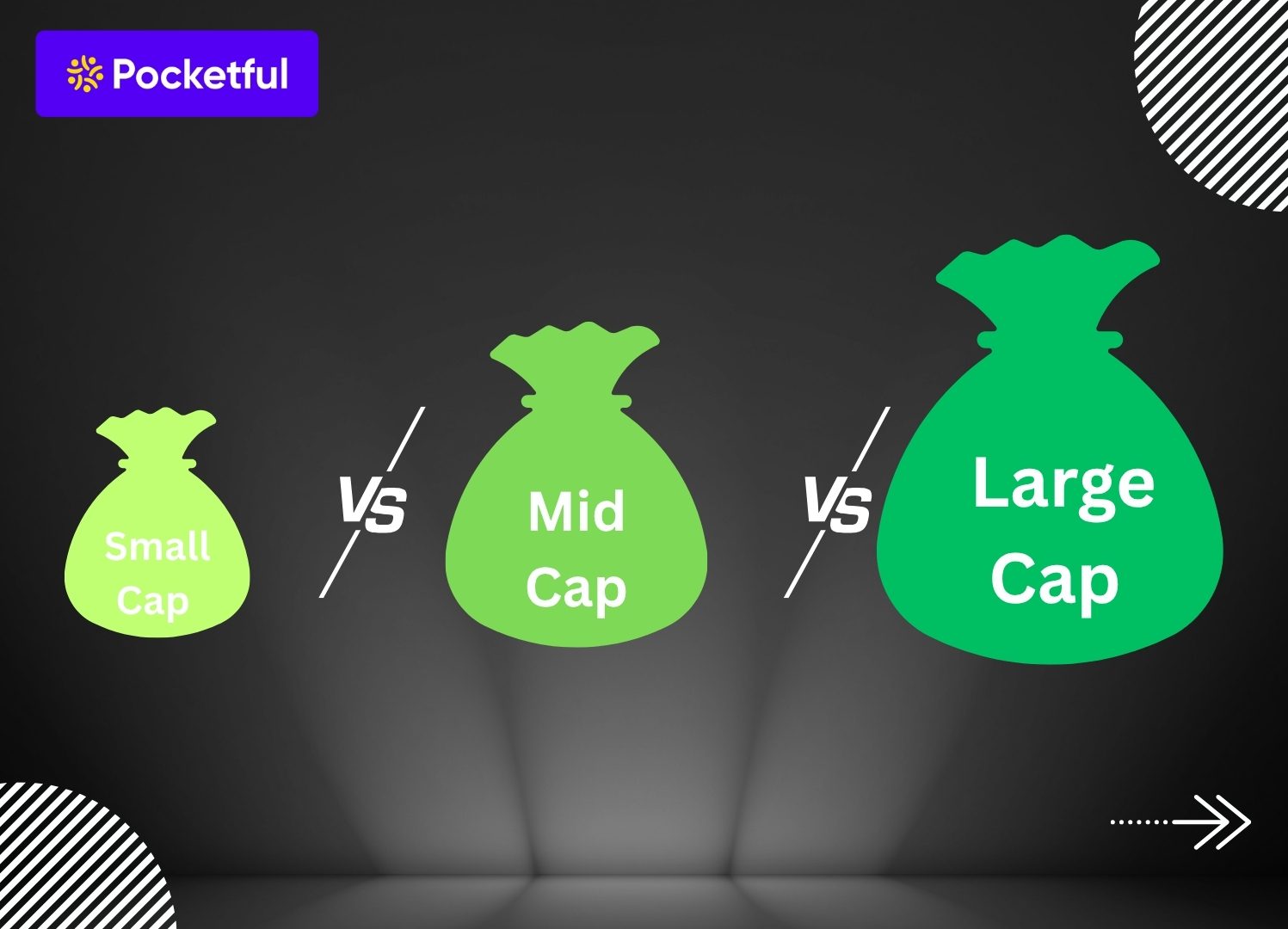
    Before investing in the stock market, it is important to understand what large-cap, mid-cap and small-cap funds are. Every fund has a different risk and return profile, and it is beneficial to choose the right category based on your investment goals. According to SEBI, companies are classified into three categories based on their market capitalisation: large cap, mid cap, and small cap. Mutual funds invest in shares of these companies and based on their investment portfolios, these mutual funds are also categorized as large, mid and small cap funds.

    In this blog, we will understand in simple language what the difference is between small cap, mid cap and large cap funds and which one may be better for you.

    What is Market Capitalization?

    When assessing the size of a company, the first thing that comes to mind is its market capitalization. This actually shows the total market value of that company – that is, how much the company is worth today.

    The formula is:

    Market Capitalization = Current share price × Total number of outstanding shares

    SEBI Classification of Large Cap, Mid Cap, and Small Cap

    When it comes to understanding the market size and risk associated with a company, SEBI (Securities and Exchange Board of India) market cap ranking is the most relevant guide. SEBI updates the ranking of companies every six months and divides them into three groups based on their size:

    • Large Cap: Companies that fall in the top 1 to 100 ranks based on market cap are considered as such. These are usually well-known, strong and stable companies like Reliance Industries, TCS, HDFC Bank, etc.
    • Mid Cap: These include companies ranked 101 to 250, which are in the growth stage and have the potential to become large caps in the future. Example: Trent, Cummins India, AU Small Finance Bank, etc.
    • Small Cap: Companies that are ranked lower than 251 can be considered as small cap companies. These have the potential to grow rapidly but also have a higher risk associated with them. Example: IndiaMART, RBL Bank, Happiest Minds, etc.

    If we understand the concept of small cap, mid cap and large cap, then it can help investors decide mutual funds to invest in and get a better understanding in which type of companies their money is being invested in.

    What Are Large Cap Funds?

    Large cap funds are mutual funds that invest in companies with a large market capitalization i.e., companies with ranking between top 1 and 100. These companies are known for their strong business models, stable revenues and long track record. Hence, these funds offer the most stability to investors.

    Large cap companies usually have established their name and credibility in the market, making their stocks less volatile. This is why these funds have a lower risk and are suitable for investors who want stable and reliable returns over a long period of time.

    Advantages:

    • Lower price fluctuations
    • Stable returns with low risk
    • Suitable for long term investors

    Disadvantages:

    • Lower returns than mid and small cap mutual funds.

    What Are Mid Cap Funds?

    Mid-cap funds are mutual funds that invest in companies with a market ranking between 101 and 250. These companies are neither too big nor too small, that is, their size is between large and small cap. This is why these funds offer investors a balanced option with a mix of higher returns and safety.

    Mid-cap companies are usually in the growth stage, with the potential to become large caps in the future. Hence, their growth prospects are good, but at the same time they are also more volatile.

    Advantages:

    • Possibility of better returns than large caps
    • Lower risk than small caps
    • Helpful in maintaining balance in the portfolio

    Disadvantages:

    • Higher volatility than large caps
    • Impact on returns during recessions

    What Are Small Cap Funds?

    Small cap funds are mutual funds that invest in companies that rank 251 and below in the market cap rankings. These companies are relatively new, small and have the potential to grow rapidly. Hence, this fund category attracts investors who are willing to take a little more risk to earn higher returns.

    Small cap funds are considered to be the most volatile among all the mutual fund categories, but they also have the highest potential to become multibaggers in the long term.

    Advantages:

    • High growth potential
    • Possibility of great returns in the long term
    • Opportunity to earn big returns with small investments

    Disadvantages:

    • High risk and high volatility
    • First to be affected in a recession or market downturn

    Read Also: 10 Best Small Cap Electric Vehicle Stocks

    Small Cap vs Mid Cap vs Large Cap Funds – Key Differences

    FeatureLarge Cap FundsMid Cap FundsSmall Cap Funds
    Risk LevelLow risk, more stabilityModerate risk with some volatilityHigh risk, highly volatile
    Return PotentialStable but relatively limited returnsHigher return potential than large capsHighest return potential, but comes with greater risk
    Investment HorizonLong-term (5+ years), suitable for retirement or safetyMedium to long-term (5–7 years)Long-term (7–10 years), requires patience and risk tolerance
    Investor TypeConservative investors seeking steady growthInvestors willing to take moderate risksAggressive investors aiming for high growth
    Impact of Market MovementsLeast affected during market downturnsModerate fluctuations during market changesMost affected during market volatility

    Which fund is right for whom?

    When it comes to comparing small cap vs mid cap vs large cap, the simple answer depends on the investor’s needs and risk profile:

    • If one wants stability and does not want to take too much risk, then large cap funds are better.
    • If you can tolerate a little higher return and a little risk, then mid cap is a balanced option.
    • And if you are ready for long term growth and are not afraid of short term volatility and higher risks, then small cap funds may be for you.

    Read Also: List of 10 Top Smallcap Stocks in India on NSE

    Which One Should You Choose?

    When deciding between large, mid and small cap funds, you should consider the following factors:

    • Understand the risk appetite : Every investor has a different risk appetite. Some investors are willing to take more risk, while some want safe and stable returns. If you want a safe investment, then large cap funds are a better option. On the other hand, mid cap and small cap funds offer more risk along with higher returns.
    • Pay attention to the investment horizon : If the investment period is short (3–5 years), then large cap funds are most suitable as they provide stability. On the other hand, better returns can be obtained by investing in mid and small cap funds for a long period (5–10 years or more).
    • Decide your financial goals : What is your goal? Buying a house, children’s education, retirement planning or wealth creation? If your goal is to keep the capital safe, then a large cap fund is a good option. If your focus is on growth and wealth creation, then mid and small caps can be better options.
    • Avoid Concentration in One Category : It is not wise to invest all the money in just one fund category. Diversification is important and it is advised to divide the investment in a balanced manner in all three categories (Large, Mid, Small). This not only reduces the risk, but also offers better risk-adjusted returns in different market situations.
    • Think Long-Term & Be Patient : Mutual fund returns are affected by ups and downs in the market, but there is a possibility of good growth in the long term – especially in mid cap and small cap if you are patient and disciplined.

    Read Also: Best Small Cap Semiconductor Stocks in India

    Conclusion

    While investing in the stock market, it is very important to know how large cap, mid cap and small cap funds work and what is the difference between them. Each fund category has its own features – some offer stability, while others offer the opportunity for rapid growth.

    If the categories of these funds and their risk profile are understood properly, then investment decisions can be taken more strategically. This understanding not only balances the risk but also gives better returns in the long run. Every investment made with the right information and strategy can bring you one step closer to your financial goal. It is advised to consult a financial advisor before investing.

    S.NO.Check Out These Interesting Posts You Might Enjoy!
    1Best Long-Term Mutual Funds to Invest in India
    210+ Best Investment Plan for Monthly Income in India
    3Best Gilt Mutual Funds in India
    4Best Precious Metal Mutual Funds to Invest in India
    5Best SWP for Monthly Income in India
    6Best Mid-Cap Mutual Funds in India
    7Best Target Maturity Mutual Funds in India
    8Best Infrastructure Mutual Funds in India
    9How Interest Rates Impact Mutual Funds in India
    10Best SIP Mutual Funds in India

    Frequently Asked Questions (FAQs)

    1. What is the main difference between large cap, mid cap, and small cap funds?

      The main difference between different types of funds is the size of companies they invest in. Large cap funds invest in established companies, mid cap funds include medium-sized companies, and small cap funds include small companies.

    2. Which type of fund is safer for beginners?

      Large cap funds are considered safer for beginner investors as they have greater stability.

    3. Can I invest in all three fund types together?

      Yes, investing in all three together keeps the portfolio diversified and the risk is also balanced.

    4. Do small cap funds give better returns than large cap?

      Small cap funds can give higher returns in the long term, but they also have higher risk.

    5. How do I decide which fund is right for me?

      This depends on your age, risk taking ability and investment period.
  • Government Bonds India – Types, Advantages, and Disadvantages of Government Bonds

    Government Bonds India – Types, Advantages, and Disadvantages of Government Bonds

    For conservative investors looking for stable returns, investing in government bonds can be a viable investment option as they offer predictable returns. These financial instruments are issued by the Central and State Governments and they provide a secure way to invest and contribute toward the nation’s development. 

    In this blog, we will discuss the various types of Government bonds in India and discuss its benefits and drawbacks. Moreover, we will highlight key factors an investor should consider before purchasing them.

    Types of Government Bonds in India

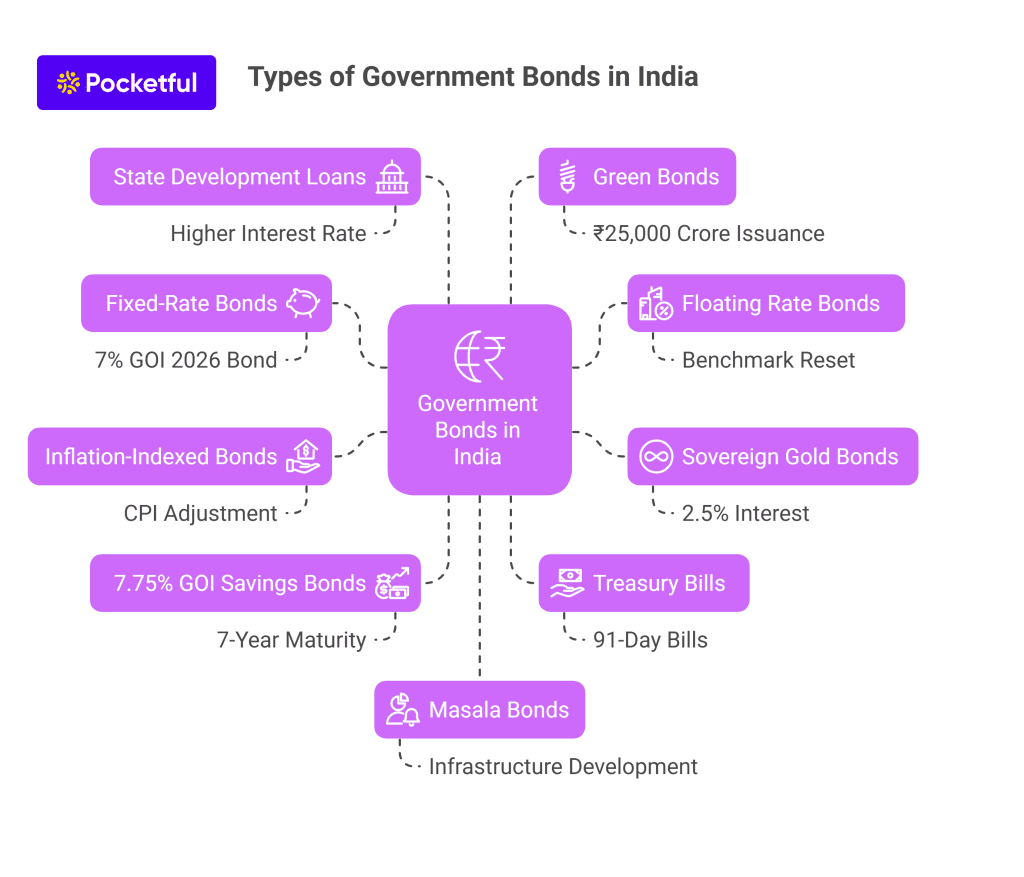
    The Indian government offers a diverse range of bonds tailored to meet distinct investment objectives, such as:

    1. Fixed-Rate Bonds

    These bonds guarantee a set interest rate for the duration of the bond’s life. For example, a 7% GOI 2026 bond will continue to pay 7% annually until maturity. Such bonds are beneficial for conservative investors focusing on earning a steady income stream.

    2. Floating Rate Bonds (FRBs)

    FRBs offer variable interest payments as its interest rate is reset according to a specific benchmark at specified time intervals, usually every six months. These types of bonds are beneficial in situations in which the investors are anticipating an interest rate rise.

    3. Sovereign Gold Bonds (SGBs)

    SGBs offer investors an opportunity to invest in gold without possessing the physical asset itself. Additionally, SGBs give a 2.5% interest per year and are linked to market gold prices. They have a maturity period of 8 years with an exit option available after 5 years. As of 2025, the scheme has been stopped but existing bonds can still be bought in the secondary markets.

    4. Inflation-Indexed Bonds (IIBs)

    These bonds are structured in a way where they protect the investment from inflation by adjusting the principal amount and interest payments, here inflation is measured by the Consumer Price Index (CPI). They assist investors by offering returns that are above inflation in order to sustain purchasing power.

    5. 7.75% GOI Savings Bonds

    These Bonds were introduced in 2018, they come with a 7.75% annual interest rate and a maturity period of 7 years. They are ideal for a medium-term investment strategy.

    6. Treasury Bills (T-Bills)

    Treasury Bills are for short-term periods of 91,182, or 364 days. They are bought at a discount and redeemed at their full value. Designed for investors with a short-term focus, Treasury Bills are often seen as a reliable investment option.

    7. State Development Loans (SDLs)

    Issued by State Governments, SDLs are very similar to G-Secs, but these have a bit higher interest rate because of additional risk. They are borrowed to fund the state’s fiscal deficit and utilized to finance state level projects and other expenditures. Recent innovations like the introduction of bond forwards are expected to increase the demand for SDLs and thus lower the borrowing costs for Indian states.

    8. Green Bonds

    These bonds are usually issued to finance projects that are environmentally eco-friendly. The Government of India is paying more attention to green bonds or other assets that fund environmentally friendly projects that help in mitigation of climate change. For example, there are plans to issue green bonds worth ₹25,000 crore in the financial year 2025. 

    9. Masala Bonds

    Masala bonds are those which are issued outside India and denominated in Indian Rupees. Hence Indian entities can raise capital from foreign investors without currency risk. The term Masala was initiated by the International Finance Corporation and these bonds have been issued to fund infrastructure development.

    Read Also: Detailed Guide on Bond Investing

    Factors to Consider Before Investing in Government Bonds

    Investing in government bonds might give the impression that it is relatively simple, however, making the correct investment requires some understanding of the following elements. Before investing your money in govt bonds, consider the following questions:

    1. Investment Horizon

    The duration of your investment is extremely important. In India, government bonds are available in different tenures, some are short term (like Treasury Bills) while others, including the 7.75% GOI Savings Bonds, can take 7 years or more. If your goals are short-term (like purchasing a laptop or paying for a class), then short-duration bonds will be more useful. For long-term goals (like financing a college education, or saving for a business), opt for long-term duration bonds.

    2. Interest Rate Environment

    As is the case with all financial instruments, bonds are also affected by interest rate changes. If the economy is going through a period of rising interest rates, it means that new bonds pay a higher coupon rate. The older bonds with lower rates will become less popular, causing their prices to dip in the secondary market.  On the contrary, when interest rates drop, older bonds become more valuable. If you are expecting a rise in interest rates, avoid long-term fixed-rate bonds. Instead, opt for Floating Rate Bonds or short-term instruments.

    3. Inflation

    Returns are affected by the rising inflation. Suppose you have invested in a fixed-rate bond with an interest return of 6% per annum while inflation is at 7%, your real return will be negative 1%. In the long term, this can adversely affect your financial position.

    Inflation-Indexed Bonds (IIBs) counteract this problem. They are designed to adjust the income yield to inflation so the purchasing power is maintained.

    4. Liquidity

    Not all government bonds have the same ease of sale. Some bonds ( for example, G-Secs) can be sold in the secondary market, while others (for example, 7.75% GOI Bonds) restrict the bond holder until maturity or payment of penalties for early surrender.

    Should you find yourself in need of accessing the funds prior to the bonds’ set maturity date, make sure to select bonds with more favorable secondary market liquidity or consider bond mutual funds and ETFs which have more straightforward exit strategies.

    5. Tax Consequences 

    Like all other gains realized on financial assets, the interest payment you receive from government bonds will be added to your taxable income and taxed accordingly. If your income falls in the higher income tax slab then your net earnings may be greatly reduced.

    Read Also: Sources of Revenue and Expenditures of the Government of India

    Advantages and Disadvantages of Government Bonds in India

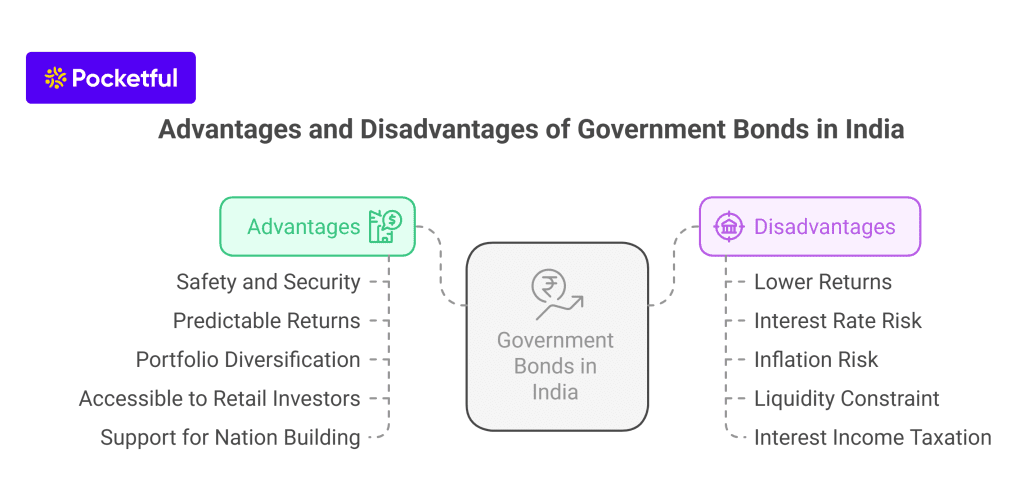
    Like any other investment, government bonds in India have their own set of advantages and disadvantages. Let’s dig deeper into each one:

    Advantages

    1. Safety and Security: Government bonds are one of the safest investment options. They carry full government guarantee, which means the Reserve Bank of India (RBI), and the Central/State Government back these, thus significantly reducing the chances of default. 

    2. Predictable Returns: Fixed-rate bonds make certain returns readily available over the bonds period of maturity. This means that you will have a clear understanding on how much you are earning on an annual basis, which aids in making better financial decisions.

    Example: Market fluctuations have no impact on a person who invests ₹1 lakh on a 7% fixed rate GOI bond, as the amount will remain the same at ₹7,000 every year till maturity.

    3. Portfolio Diversification: Including government bonds in an investment portfolio diversifies the risk. Equities and mutual funds do yield stronger returns, but their unpredictability is off the charts. Consequently, bonds do help in lowering the overall portfolio risk along with providing consistent returns.

    4. Accessible to Retail Investors: In the past, bonds issued by the government were primarily targeted at institutional investors. Now, through direct platforms such as RBI Retail Direct, individuals can easily purchase and sell bonds online without the use of brokers. The low minimum investment makes it more attractive starting at ₹1,000.

    Investors are able to gain exposure to government bonds through mutual funds or ETFs that exclusively invest in G-Secs.

    5. Support for Nation Building: Purchasing government bonds serves as a ticket for indirect participation in public projects such as constructions, educational institutions, and health care systems. Hence, it becomes an appropriate investment which comes with a sense of responsibility.

    Disadvantages 

    1. Lower Returns: If you want the security of government bonds, you will receive less of a reward in the form of returns when compared to corporate bonds or equities. Equity mutual fund investments may deliver returns of 12% annually while governmental bonds yield approximately 6% to 7%

    2. Interest Rate Risk: When interest rates change, bond prices fluctuate. This means that long term bonds are much riskier due to this capital loss if you are planning to sell before the bond matures. 

    3. Inflation Risk: Certain bonds don’t change their value based on inflation. As we know, inflation is a detrimental result of an economy overheating and down the road, inflation may drastically diminish the value and purchasing power of money in terms of goods and services.

    4. Liquidity Constraint: Unlike other bonds, a subset of government bonds cannot be easily traded on secondary markets and certain bonds cannot even be sold due to penalties. Bonds that are tradeable may have low liquidity in the secondary market which may lead to delays, price drops, or even diminished demand completely.

    5. Interest Income Taxation: Most government bonds with interest attached to them suffer the consequence of being fully taxable. This is particularly true if you are in a higher tax bracket, as it lowers the effective return you receive.

    Read Also: Electoral Bonds Explained

    Conclusion

    The government bonds in India are reliable investment options as they guarantee predictable returns making them suitable for more conservative investors. It is important to know the different types of bonds, their characteristics, and the risks that come with them in order to invest appropriately and achieve your financial objectives. However, it is advised to consult a financial advisor before investing. 

    S.NO.Check Out These Interesting Posts You Might Enjoy!
    1Benefits of Investing in Bonds
    2Stocks vs Bonds: Difference Between Bonds and Stocks
    3What Is Bowie Bond (Music Bonds) : History, Features, Advantages & Disadvantages
    4CAT Bonds: An Easy Explainer
    5What is Coupon Bond?

    Frequently Asked Questions (FAQs)

    1. What is the minimum amount one can invest in government bonds in India?

      The minimum investment amount differs from one type of bond to another. 

    2. Are government bonds subject to tax?

      Interest earned from government bonds comes under tax liabilities, but some bonds like the Sovereign Gold Bonds give tax relief on capital gains if claimed after a certain period of time.

    3. In what ways am I able to procure government bonds in India?

      Bonds are available for purchase through the RBI Retail Direct, NSE, BSE, or through licensed banking and financial institutions.

    4. Are Non-Resident Indians (NRIs) permitted to invest in bonds issued by the government of India?

      NRIs can invest in Government bonds but they must comply with certain rules and eligibility parameters defined by the Reserve bank of India.

    5. What is the effect of selling a government bond before its maturity date?

      Selling a bond prior to its maturity date in the secondary market can lead to profits or losses depending on the market price in the secondary market.

  • 10 Best Consumption Stocks in India

    10 Best Consumption Stocks in India

    With a population exceeding 140 crores and a steadily rising middle class, India is one of the fastest-growing consumer markets in the world. Higher disposable incomes, urbanization, and changing lifestyles are fueling demand across sectors like FMCG, retail, and consumer durables. As a result, companies in the consumption space are becoming key drivers of the country’s economic growth.

    In this blog, we will give you an overview of the top consumption companies in India along with the benefits of investing in them and the factors which one should consider before investing in any consumption stocks.

    What are Consumption Stocks?

    Consumption stocks refer to those companies that primarily engage in the manufacturing and distribution of goods and services that households consume on a daily basis. Some companies focus on producing everyday essentials, while others specialize in crafting luxury items. These companies are directly linked to the country’s growth.

    Top 10 Consumption Stocks in India 

    Top 10 consumption stocks in India based on market capitalization are mentioned below:

    1. Titan Limited
    2. Polycab India Limited
    3. Hindustan Unilever Limited
    4. ITC Limited
    5. Nestle India Limited
    6. Britannia Industries Limited
    7. Dabur India Limited
    8. Marico Limited
    9. Godrej Consumer Products Limited
    10. Colgate Palmolive India Limited

    Read Also: Top 10 Best Summer Stocks in India

    Market Information of Top 10 Consumption Stocks

    CompanyCurrent Market Price (in ₹)Market Capitalisation (in ₹ crores)52-Week High (in ₹)52-Week Low (in ₹)
    Hindustan Unilever Limited2,3905,61,766 2,660 2,044
    ITC Limited3254,07,137 472 321
    Titan Company Limited4,0193,56,696 4,312 2,925
    Nestle India Limited1,3062,51,956 1,333 1,055
    Britannia Industries Limited5,9401,43,141 6,337 4,506
    Godrej Consumer Products Limited1,2461,27,465 1,309 980
    Marico Limited75297,649 780 578
    Polycab India Limited6,9991,05,397 7,948 4,555
    Dabur India Limited52593,093 577 420
    Colgate Palmolive (India) Limited2,18059,300 2,975 2,032
    (Data as of 22 January 2026)

    Best Consumption Stocks in India – An Overview

    A brief overview of the best consumption stocks in India is given below:

    1. Hindustan Unilever Limited

    The company was founded in the late 1980s by the Lever Brothers. They launched their first product in India as a sunlight soap. The first company launched by Unilever in India was Hindustan Vanaspati Manufacturing Company in 1931. Later in 2007, the company changed its name to Hindustan Unilever Limited to match the name of its parent company. The company’s headquarters are in Mumbai.

    Read Also: Hindustan Unilever Case Study

    2. ITC Limited

    ITC was originally known as Imperial Tobacco Company of India. It was founded in 1910. The company changed its name to Indian Tobacco Company in 1970, and later in 1974, it changed it to ITC Limited. The company is operating in various sectors, including FMCG, hospitality, packaging, etc. The company’s headquarters are located in Kolkata.

    Read Also: ITC Case Study

    3. Titan Company Limited

    Titan Limited was founded in 1984 as a part of the Tata Group. It was incorporated as a result of a joint venture between the Tata Group and the Tamil Nadu Industrial Development Corporation (TIDCO). The company offers various products like jewellery, watches, eyewear, fragrance, etc. The company has performed exceptionally well in the past and is carrying the legacy of the Tata Group. The company’s headquarters are situated in Bengaluru.

    Read Also: Titan Case Study

    4. Nestle India Limited

    Nestle India Ltd, the world’s biggest food and beverage company, has a long and illustrious history that began in the 1860s. The narrative begins with the formation of the Anglo-Swiss Condensed Milk Company in 1866, which produced ground-breaking milk products. Simultaneously, a German pharmacist, Henri Nestle, invented “Farine Lactee” to lower the newborn death rates. These businesses were successful because of their creative milk products, which catered to urban consumers with shifting lifestyles. The two businesses merged in 1905 to form Nestle. The headquarters of the company are situated in Gurgaon.

    Read Also: Nestle India Case Study

    5. Britannia Industries Limited

    Britannia Industries LtdThe company was founded in 1892 by British entrepreneurs and was initially known as Britannia Biscuit Company Limited. Later in 1979, its name was changed to Britannia Industries Limited. Bombay Burmah Trading Corporation, which is a part of the Wadia Group, owns a majority stake in this company. In 1986, the company launched the Good Day biscuit brand and became a household name. It was the first company to introduce sliced, wrapped breads in India. The company has its headquarters situated in Kolkata.

    Read Also: Britannia Industries Ltd Case Study

    6. Godrej Consumer Products Limited

    Godrej Consumer Products Ltd The company was established in 2001 as a result of a demerger from Godrej Soaps Limited. Being a part of the renowned Godrej Group and due to their popular products like Godrej Soap, hair colours like Godrej Expert, etc., it soon became a household name in India. The company has aggressively expanded globally and has a strong presence in Asian and African countries. The company’s headquarters are situated in Mumbai.

    7. Marico Limited

    The company was founded in 1988 and started manufacturing hair oil and edible oil named Parachute and Saffola. Initially, the company was named Marico Foods Limited, and later in 1989, it changed its name to Marico Industries Limited. It has established a manufacturing plant in Kerala to produce coconut oil. To expand its operations, the company raised capital through an IPO in 1996 and became a publicly listed company. The company’s headquarters are situated in Mumbai.

    Know the Returns:

    8. Polycab India Limited

    Polycab India Ltd was founded in 1964 as Sind Electric Store, a dealer of electrical products. Later, in 1996, it was incorporated as Polycab Wires Private Limited. Today, the company has a market share of around 25% in the Indian electrical market and offers products like fans, LED lighting, switches, switchgear, solar products, etc. It has its headquarters in Mumbai.

    1Y Return (%)3Y Return (%)5Y Return (%)
    -18.59%175.64%660.96%
    (Data as of 22 January 2026)

    Read Also: Polycab Case Study

    9. Dabur India Limited

    Dabur India Limited was founded in 1884 by Dr. S.K. Burman. The company established its first production unit in Garhia. The company launched the digestive tablet Hajmola, which became very popular among Indian households. Later in 1997, the company entered into the fruit juice business and in 2003, the company demerged its pharma business into a separate entity. The product portfolio consists of health supplements, digestives, oral hygiene, skin care products, etc. The company’s headquarters are situated in Ghaziabad.

    Read Also: Dabur Case Study

    10.Colgate Palmolive (India) Limited

    Colgate Palmolive Limited was founded as a unit of the international FMCG brand. In 1954, the company opened its first manufacturing unit in Mumbai and launched its first product called Colgate. Later in 1970, the company expanded its product portfolio and launched various other products such as oral care and home care items. It has expanded its distribution network over time. The headquarters of the company is situated in Mumbai.

    Read Also: Colgate Palmolive India Case Study

    Key Performance Indicators (KPIs)

    CompanyOperating Profit Margin (%)Net Profit Margin (%)ROE (%)ROCE (%)Debt to Equity
    Hindustan Unilever Limited22.9916.9121.5522.910
    ITC Limited35.6646.3849.6136.410
    Titan Company Limited9.075.5128.7036.930.88
    Nestle India Limited21.2415.9979.9857.170.19
    Britannia Industries Limited17.2812.1950.0159.400.28
    Godrej Consumer Products Limited21.4712.8915.4324.210.32
    Marico Limited20.0215.3040.9936.900.10
    Polycab India Limited12.809.1220.5527.960.01
    Dabur India Limited19.2613.8416.3620.310.07
    Colgate Palmolive (India) Limited32.0223.7886.32111.060
    (Data as of March 2025)

    Read Also: Top 10 Sectors in the Indian Stock Market

    Benefits of Investing in Consumption Stocks

    There are significant benefits of investing in consumption stocks, a few of which are as follows:

    • Stable Demand: The products manufactured by consumption companies generally have a stable demand even during economic slowdowns.
    • Growth Potential: The company, which primarily operates in the consumption sector, tends to have a strong growth potential due to rising income levels.
    • Diversification: One can easily diversify their portfolio and reduce the risk in it.
    • Low Debts: Consumer companies generally have a strong balance sheet and low debt. They also tend to have stable cash flows.

    Factors to be Considered before Investing in Consumption Stocks

    The key factors which one should consider before investing in consumption stocks are as follows:

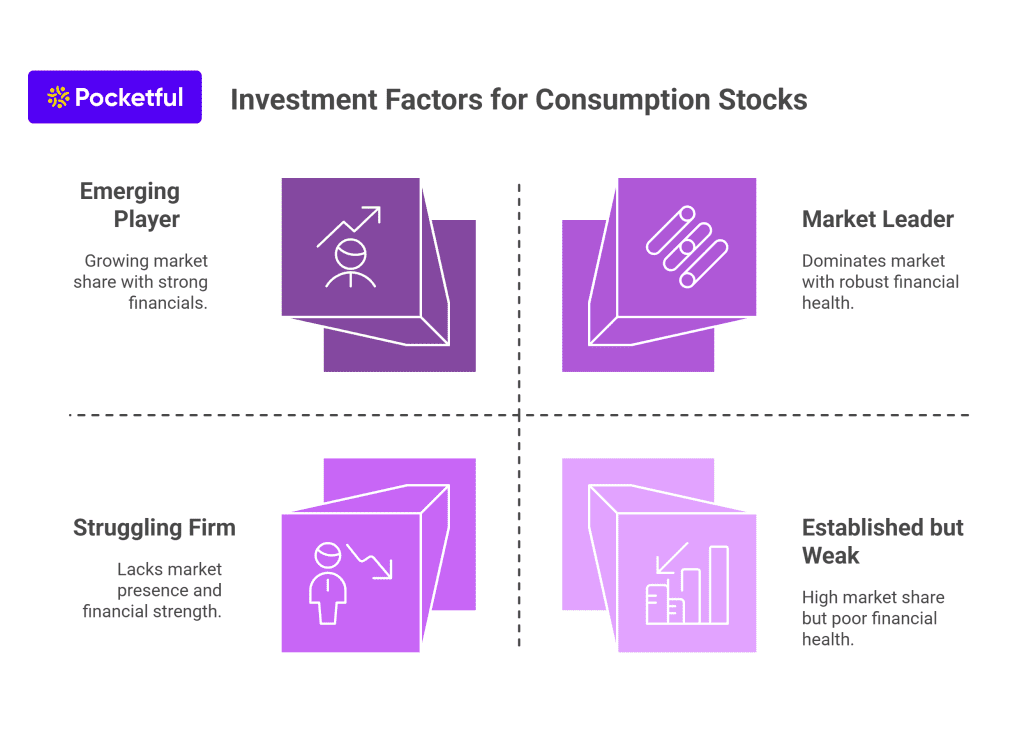
    • Market Share: One should need to consider the market share of the company; companies which have higher market capitalisation tend to have stable growth.
    • Financial Performance: The companies with higher profit margins and net profit, and low debt, are preferred by the investors.
    • Corporate Governance: The company with strong corporate governance policies and capable management team are preferred by investors. 
    • Dividends: Consumption stocks generally declare dividends regularly, which are suitable for investors who want passive income.

    Read Also: 10 Best Copper Stocks in India

    Future of Consumption Stocks

    The Indian consumption sector has a very bright future, which is primarily driven by demographic diversification, urbanisation, etc. With the rise of disposable income, the demand for consumer goods will increase. Also, with the rise of e-commerce platforms and digital transformation, the demand for consumption sector products will increase. However, with the increase in competition, the profit margins of the company will be affected. It is also expected that India’s consumer market will grow by 46% by 2030.

    Conclusion

    On a concluding note, the Indian consumption industry has performed exceptionally well in the recent past because of increasing consumer income, and the consumption is expected to rise further in future. However, there are certain factors that one should keep in mind before investing in consumption stocks. The factors include financial performance, market share, profit ratio, etc. Therefore, it is advisable to consider your risk profile and consult your investment advisor before making any investment decision.

    S.NO.Check Out These Interesting Posts You Might Enjoy!
    1List Of Best Healthcare Stocks in India
    2List of Best Telecom Stocks in India
    3List Of Best Footwear Stocks in India
    4List Of Best Logistics Stocks in India
    5List of Best Liquor Stocks in India

    Frequently Asked Questions (FAQs)

    1. How can I invest in consumption stocks?

      To invest in consumption stocks, one needs to have a demat and a trading account. Now with Pocketful, you can easily open a demat account online without paying any fees.

    2. Which stocks are the top consumption stocks in India?

      The top consumption stocks in India are Titan Limited, Polycab India Limited, Dabur India Limited, Marico Limited, Britannia Industries Limited, Hindustan Unilever Limited, etc.

    3. What are the major factors which can affect the performance of consumption stocks?

      The major factors that can affect the performance of consumption stocks are economic conditions, demand, financial performance, etc.

    4. Are consumption stocks considered a defensive investing option?

      Yes, consumption stocks are considered defensive stocks because the demand for such products is not affected by economic downturns.

    5. Do consumption stocks pay dividends?

      Yes, consumption stocks tend to declare high dividends regularly, which can be a suitable option for investors seeking passive income.

    Selection Methodology and Important Disclaimer

    The stocks included in this list are selected primarily on the basis of their market capitalisation, which represents the total market value of a company’s outstanding shares. The companies are arranged in descending order of market capitalisation, with larger companies appearing first, followed by relatively smaller companies. This methodology is intended to provide a structured approach for identifying companies based on their market size and overall presence within a sector.

    However, market capitalisation should not be considered the sole factor while evaluating investment opportunities, as it does not guarantee future performance, profitability, or returns. Investors should also assess other important factors such as financial health, business fundamentals, management quality, valuation metrics, industry outlook, and market conditions before making investment decisions.

    The information provided is for educational and informational purposes only and should not be construed as investment advice, recommendation, solicitation, or an offer to buy or sell any securities by Pocketful Fintech Capital Private Limited.
  • Types of ETFs in India: Find the Best for Your Investment

    Types of ETFs in India: Find the Best for Your Investment

    In the world of financial markets, ETFs have gained popularity rapidly among investors, who prefer passive investment options with a diversified basket of assets at a low cost. Seasoned investors are aware of the types of ETFs, but there are various new investors who are unaware of the different types of ETFs. 

    In this blog, we will explain the types of ETFs in India and tell you which ETF is best for you. 

    What is an ETF?

    An ETF or Exchange Traded Fund is an investment tool that primarily trades on the stock exchange and invests in a particular index or a mix of securities such as stocks, bonds, or commodities. They are traded like any other stock on the exchange; therefore, to invest in them, one is required to have a demat and trading account. They are passively managed; hence their returns closely resemble the performance of a specific index that it follows.

    Features of ETF

    The key features of ETFs are as follows:

    1. Passive Fund: ETFs passively track the index and try to replicate its performance.
    2. Pool of Securities: ETFs invest in a basket of securities, which helps an investor diversify their portfolio and reduce market risk.
    3. Transparency: ETFs generally disclose their holdings daily, therefore, investors get a clear picture of what they hold in their portfolios.
    4. Demat Account: ETFs are generally traded on the stock exchange. Therefore, it is mandatory to have a demat and trading account to invest in them.
    5. Low Cost: As ETFs are passively managed funds; therefore they have lower fees when compared to actively managed funds, making them a cost-effective investment option.
    6. Liquidity: ETFs are traded on the stock exchange and have higher volume, making it easy for buyers and sellers to execute their trades.

    Read Also: How to Invest in ETFs in India – A Beginner’s Guide

    How does an ETF work?

    Understanding the workings of an ETF is very easy. ETFs are managed by Asset Management Companies, which pool money from various investors who have similar investment objectives and invest the pooled money into a basket of assets. They try to replicate the performance of an underlying asset, such as an index etc. In return, they charge a small fee from the investors. As they are passively managed, therefore, their returns are similar to an index in which it has invested its capital. They are listed on the exchange and provide liquidity to investors. The market price of ETFs changes during trading hours, and one can easily buy and sell them at the current market price.

    Different Types of ETFs

    There are six types of ETFs available in India, details of which are mentioned below:

    1. Equity ETFs

    These ETFs invest primarily in stocks and track the movement of particular equity indices, such as the Nifty 50, Bank Nifty, etc. It particularly invests in the basket of stocks in the same proportion as the particular index consists.

    Example: Kotak Nifty ETF invests in the top 50 companies based on market capitalisation that are part of the Nifty.

    2. Fixed Income ETF

    Fixed Income ETFs are also known as bond ETFs; they invest your money in fixed income securities, and provide you a steady return. They are comparatively less volatile and risky than equity-oriented ETFs.

    Example: Bharat Bond ETF, which primarily invests in AAA-rated bonds and government securities.

    3. Commodity ETF

    The ETFs which invest in commodities such as gold, silver, etc. are known as commodity ETFs. The returns of these ETFs are based on the fluctuations in the underlying commodity prices. Therefore, an investor can easily trade or invest in any commodity with the help of these ETFs. They are highly volatile as the prices of commodities are affected by global factors.

    Example: Kotak Silver ETF has physical silver as underlying asset; therefore, any change in the price of silver will affect the returns of this ETF.

    4. International ETF

    The ETFs which invest their funds in financial markets of foreign countries are known as International ETFs. They provide investors an opportunity to earn profit from the growing economies around the world.

    Example: Motilal Oswal NASDAQ 100 ETF primarily invests in the companies listed on the NASDAQ exchange of the US, and provides an opportunity for an investor to gain exposure in the US market.

    5. Thematic or Sectoral ETF

    The ETFs which invest in a particular sector, such as the IT , financial, etc. or follow a particular theme, such as infrastructure, etc., are known as Sectoral or Thematic ETFs. These ETFs carry high risk and therefore, are suitable for investors seeking high returns.

    Example: ICICI Prudential NIFTY IT ETF, as the name suggests, primarily invests in India’s IT companies.

    6. Smart Beta ETFs

    These ETFs follow certain strategies and invest in a particular market index, which carries low volatility, high momentum, etc. This ETF is ideal for investors who wish to invest in a particular strategy.

    Example: ICICI Prudential Nifty 100 Low Vol 30 ETF, which invests in the top stocks of Nifty having low volatility. 

    Read Also: Best ETFs in India to Invest

    Advantages of Investing in ETFs

    The significant advantages of investing in ETFs are as follows:

    1. Low Cost: The expense ratios of ETFs are comparatively lower than actively managed funds, providing a cost-efficient investment option for investors.
    2. Portfolio Diversification: One can diversify their portfolios by investing in ETFs, as they invest in a basket of stocks.
    3. Transparency: ETFs generally disclose their holding daily, hence it provides clarity to investors about what they are holding in their portfolio.

    Disadvantages of Investing in ETFs

    The significant disadvantages of investing in ETFs are as follows:

    1. Tracking Error: There are various reasons, such as fund expenses, timing of rebalancing the portfolio, etc., due to which an ETF may not be able to match the returns of the index in which it is investing accurately. This deviation in returns is known as tracking error.
    2. Alpha: As ETFs are passively managed funds, they are not able to outperform the benchmark, which we can generally see in the case of an actively managed fund.
    3. Market Risk: ETFs generally invest in a particular index, and their performance depends on how the underlying index has performed. Therefore, any downside movement in the underlying assets causes the losses. 

    Read Also What is Gold ETF? Meaning & How to Invest Guide

    Which ETF is Best for You?

    Before choosing an ETF for investment, one should consider the following factors:

    1. Investment objective: The investor’s investment objective plays an important role in deciding which ETF suits them. 
    2. Risk Appetite: An investor should choose an ETF based on their risk profile. If an investor is conservative, they can opt for fixed income ETFs, whereas an aggressive investor can invest in Equity or Sectoral ETFs.
    3. Tracking Error: It is one of the key factors which one should consider before choosing an ETF for investment. Lower the tracking error higher will be the returns.
    4. Cost: Expense ratio plays an important role in choosing an ETF. An investor should choose the ETF with the lowest expense ratio in that particular category.

    Cofnclusion 

    On a concluding note, there are various types of ETFs available for investment, which can help an investor diversify their portfolio. An ETF offers high liquidity and allows an investor to invest in a variety of assets with limited capital. However, there are certain ETFs that carry high risk. Therefore, one must consider their risk profile and consult an investment advisor before making any investment decision.

    S.NO.Check Out These Interesting Posts You Might Enjoy!
    1Mutual Fund vs ETF. Are They Same Or Different?
    2What is Nifty BeES ETF? Features, Benefits & How to Invest?
    3ETF vs Stock – Which One is the Better Investment Option?
    4Gold ETF vs Gold Mutual Fund: Differences and Similarities
    5ETF vs Index Fund: Key Differences You Must Know
    6List of Best Commodity ETFs in India

    Frequently Asked Questions (FAQs)

    1. What are the different types of ETFs available in India?

      The ETFs can be broadly categorised into six types, such as equity, commodity, fixed income, smart beta, international, thematic or sectoral.

    2. Can I invest in an ETF without a demat account?

      No, you cannot invest in an ETF without a demat account.

    3. Can I invest in international stocks through ETFs?

      Yes, there is a category of ETF known as an international ETF, through which one can take exposure in the international market.

    4. Are ETFs suitable for conservative investors?

      Yes, conservative investors can consider investing in Fixed Income ETFs, such as Bharat Bond ETF, which are less volatile and offer more stable returns compared to equity or sectoral ETFs.

    5. How can I buy or sell an ETF in India?

      To buy or sell an ETF in India, you need to have a demat and trading account with a registered stockbroker. ETFs are traded on stock exchanges like regular stocks, so you can place buy or sell orders during market hours through your broker’s trading platform.

  • Iran–Israel War Impact on Indian Stock Market

    Iran–Israel War Impact on Indian Stock Market

    In the last few days, the relations between Israel and Iran have taken a new turn. On June 13, 2025, Israel carried out airstrikes on Iran’s oil and energy infrastructure, which created an atmosphere of concern around the world. Brent crude prices suddenly rose above $78 per barrel and the Indian rupee fell to ₹86 per USD. 

    The direct impact of this growing uncertainty is visible on the Indian stock market. At such a time, it is very important for investors to understand which sectors may be affected the most to make informed investment decisions.

    How This War Affects Indian Markets?

    The impact of the Iran-Israel war on the Indian markets can be summarized in the following points:

    • Rise in crude oil prices : The growing tension between Israel and Iran has threatened global oil supply. As a result, Brent crude prices instantly crossed the $78 per barrel, more than 10% rise between 12 June and 13 June 2025. It has increased by more than 20% since the beginning of June from $63 to $78 per barrel, which is sure to affect the various economic sectors and crude-importing nations as India.
    • Pressure increased on rupee : The rupee weakened as oil became expensive, and recently fell to the level of around ₹86 against the dollar. RBI had to intervene to handle the situation, but the weakness of the rupee can make imports expensive even further.
    • FII selling, DII buying : Amid global uncertainty, foreign investors i.e. FII has withdrawn more than ₹5,869 crores by 18 June. However, domestic institutional investors (DII) have tried to maintain stability in the market and bought ₹58,138 crores worth of securities.

    What does this mean for investors?

    • Expensive oil = More inflation as Increased costs for companies
    • Weak rupee = IT and export sectors benefit, but adverse impact on FMCG and Auto
    • FIIs withdrawal = more volatility in the market

    Sector-Wise Impact

    Let’s look at the sector wise impact of the Iran-Israel war in more detail:

    • Oil & Gas Sector: Brent crude prices have reached around $78 per barrel, which has directly affected crude oil importing countries like India. Rising crude oil prices are increasing the cost of importing, while oil producing companies benefit from it.
    • Defense & Aerospace: Global tensions are expected to increase defense spending in many countries, including India. Due to this, the market is keeping an eye on domestic companies in the defense sector.
    • IT & Exporters: Rupee has weakened to around ₹86.4 against the dollar, due to which the profit margins of export companies are improving.
    • Precious Metals & Gold : In times of instability, investors turn to traditionally safe instruments due to which there is a surge in prices of gold and silver.
    • Auto & Consumer: Rising fuel prices have led to an increase in transportation costs, which has put pressure on profit margins of the automobile and FMCG sectors.

    Stock Market Sentiment & FII Activity

    Let’s analyze the stock market sentiment and the FII activity:

    • Foreign and domestic investment trends : The surge in crude oil prices due to rising tensions in the Middle East are making foreign investors cautious. Foreign investors (FIIs) have started withdrawing from equities since early June, while domestic institutional investors (DIIs) have been actively buying, providing stability to the market.
    • Currency and RBI’s role : The rupee has been showing continuous weakness, reaching around two-month lows, and the RBI has tried to stop the slide by infusing rupee liquidity through open market operations. This indicates the crucial role of RBI in controlling Indian currency when a geopolitical event causes volatility.
    • Volatility scenario : India VIX remains around 14–15 levels, which indicates that the market is trying to hold ground, but uncertainty persists.

    Global Economic Impact of the War 

    The economic impact of the war on the global level can be understood as follows:

    • Crude oil prices : The war between Iran and Israel has shocked the global energy market. Iran is one of the world’s largest oil producers, and 20% of global oil is transported through the Strait of Hormuz. As tensions in the region increased, concerns about disruption in crude oil supply rose and prices rose sharply. This has caused oil importing countries, such as India, to pay for expensive fuel.
    • Impact on global inflation and commodity markets : Oil inflation directly increases the cost of transport, production and other commodities. At present, global inflation is already at a high level, and the war has made the scenario more severe. Volatility can be seen in the prices of other commodities as well such as metals.
    • Fear among investors : Investors around the world shy away from risk in volatile times, especially if it is due to war. Global equity markets are under pressure due to cautious sentiment shifting of investor capital to safer investment options like gold, bonds, etc.

    Tips for Investors 

    During such times, the investors should avoid taking investment decisions emotionally and always remember the following points:

    • Avoid panic, keep a clear stance : Even though volatility has increased in the market, it is not wise to exit a particular sector in a hurry or sell everything without analysing. Sometimes decisions taken out of fear can be harmful in the long term. At such times, it is important to stay calm and understand the bigger trends.
    • Keep an eye on oil and dollar : Crude oil prices and the movement of the US dollar are the two biggest factors determining the direction of the Indian market at this time. Sharp price changes in these can have a direct impact on sector-wise performance – especially in industries like auto, IT, and manufacturing.
    • Focus on strong companies : In such a situation, the focus should be on those companies whose fundamentals are strong and business model is stable. Such stocks are relatively less affected by market decline.
    • Look at short-term volatility as a long-term opportunity : At a time when the market is under pressure, it can be an opportunity for long-term investors to buy some quality stocks at discounted prices due to panic selling.

    Conclusion

    The impact of the Iran–Israel war is not just confined to political boundaries; its direct impact was felt on the global economy and the Indian stock market as well. At such a time, it is not enough to just look at the index movement. Sector-wise analysis, understanding the fundamental position of individual companies and keeping an eye on global developments is important. Investors should remain alert and keep assessing their portfolios from time to time. It is advised to consult a financial advisor before making any investment decision.

    FAQs

    1. What is the impact of the Iran-Israel war on the Indian stock market?

      The war has increased market volatility, particularly putting pressure on crude oil, currencies and global investment flows.

    2. Which sectors are most affected in India due to this conflict?

      Oil companies, aviation, automobile and FMCG sectors have been affected the most.

    3. Will crude oil prices continue to rise due to the war?

      If the tension continues, further increase in crude oil prices is possible.

    4. Should retail investors worry about market volatility?

      Long-term investors need not panic, but it is important to remain cautious and review your portfolio at regular intervals.

    5. How should investors respond to this geopolitical crisis?

      Investors should adopt a balanced investment approach by doing sector-wise research before taking any investment decision.

  • Difference Between Trading and Investing

    Difference Between Trading and Investing

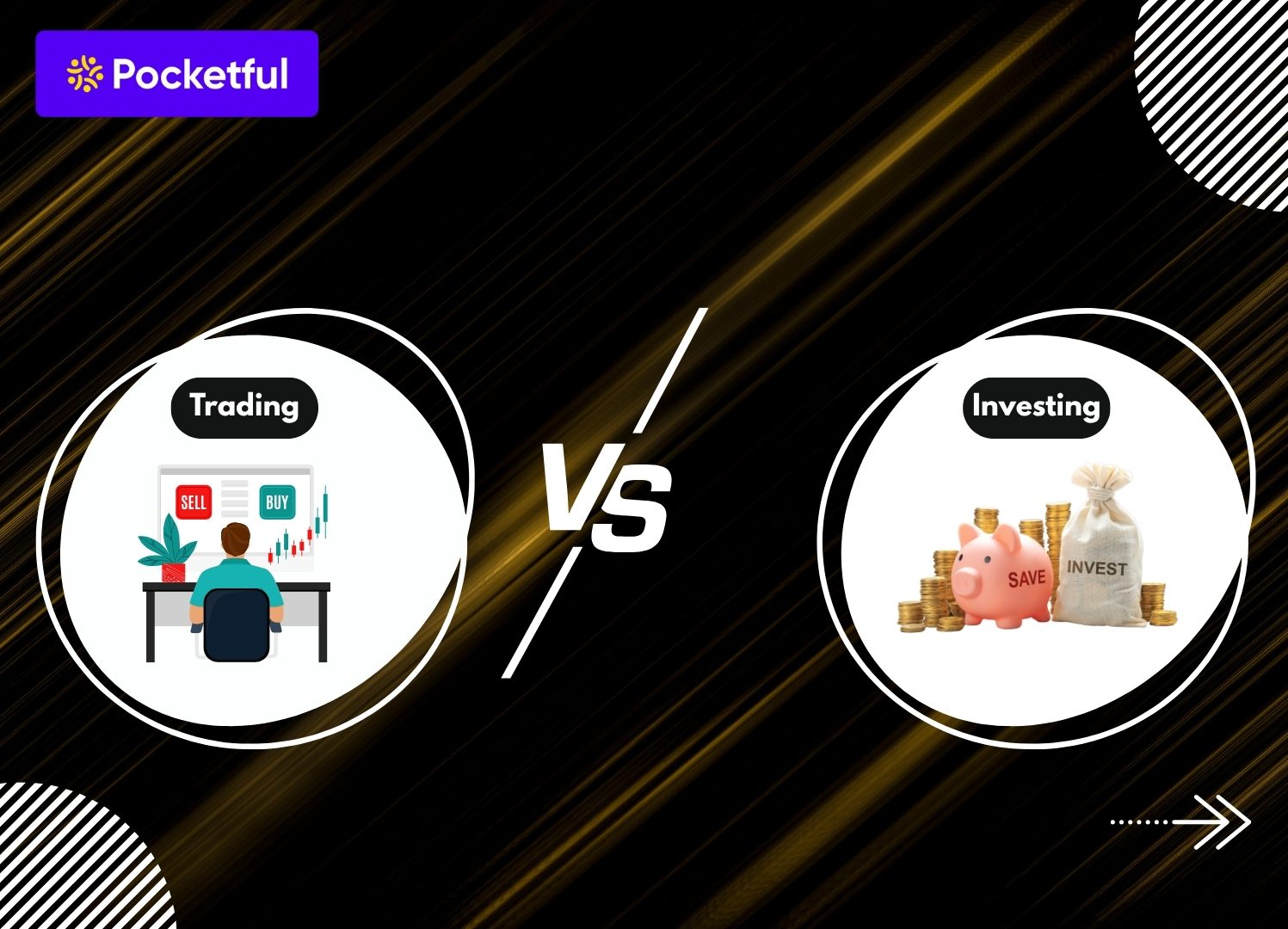
    The stock market is a place where you can invest and trade to achieve your financial goals. However, many of us tend to believe that investing in the stock market is the same as trading. Although both investing and trading involve buying and selling stocks, they are quite different in their approach.

    In this blog, we will explain the difference between investing and trading in detail, along with their features and types.

    What is Investing?

    Investing refers to buying stocks of listed companies for a long period to create wealth through capital appreciation and dividends. Investing is basically buying shares of a company that is supposed to do well in the future; therefore, investors prefer to buy stocks at lower prices and sell them at higher prices. In order to judge the future potential of the company, it is necessary to do the necessary due diligence on the company’s financial statements and other required analysis.

    Features of Investing

    The key features of investing are as follows:

    1. Growth Potential: Through investing, an investor can grow their capital over time.
    2. Diversification: One can reduce the risk of one’s portfolio by diversifying across different sectors.
    3. Tax Benefit: Long-term capital gains are subject to lower tax rate than short-term trading.
    4. Compounding: Investing allows an investor to compound their returns, which can lead to a significant increase in wealth over time.

    Types of Investing

    Investing can be categorised into the following types:

    1. Value Investing: In this type of investing, an investor selects undervalued stocks which are fundamentally strong. Value investors buy such stocks as these stocks are undervalued and significant growth can be expected in future.
    2. Growth Investing: In this, the investor identifies which stocks have a good potential for long-term growth and earnings.
    3. Dividend Investing: There are some companies which regularly pay dividends so investing in such companies provides a regular cash flow in the form of dividends.
    4. Index Investing: This involves creating a diversified portfolio that replicates a market index or investing in index ETFs and mutual funds.

    What is Trading?

    Trading in the stock market involves actively buying and selling stocks within a short term to earn profits from frequent price fluctuations. Basically, the traders use market volatility to their advantage to earn profits. Short-term trading is the art of finding the trend in stock prices, and capitalize on them.

    Features of Trading

    The key features of trading are as follows:

    1. Short Term: Trading generally involves buying and selling stocks over a short period of time typically ranging from a few minutes to a few weeks.
    2. Actively Managed: A trader is required to actively track the price movement of stocks, based on various factors such as news, geopolitical events, economic conditions, etc.
    3. Only High Liquid Assets: Traders generally prefer to trade in only those assets that have high liquidity.
    4. Leveraged Positions: Various traders use leverage to increase their returns by borrowing funds from brokers.

    Read Also: Trading For Beginners: 5 Things Every Trader Should Know

    Types of Trading

    Trading is highly risky as it is dependent on market volatility that can be impacted by factors such as news, economic conditions, inflation, interest rates, etc. Trading in the stock market can be majorly categorised into four types:

    1. Scalping: This involves generating quick profits based on small price movements.
    2. Day Trading: Day Trading In this type of trading, a trader opens a trading position and closes it within the same day. They make decisions based on technical analysis to earn profits from intraday price movements.
    3. Swing Trading: The traders hold the stocks for a few days or weeks in swing trading. 
    4. Momentum Trading: In momentum trading, the traders spot the significant price momentum and take a bet in accordance with that scenario to earn profits. The holding period can be up to a few months.

    Read Also: Types of Traders in the Stock Market: Styles, Strategies & Pros and Cons

    Difference Between Investing and Trading

    There are significant differences between investing and trading, a few of which are as follows:

    ParticularsTrading Investing
    TimeTrading is done on a short-timeframe, i.e. minutes, hours, or daysInvesting is done for years and decades.
    ObjectiveThe primary objective is to earn profit from price fluctuations.The objective of investing is to accumulate wealth through capital appreciation as the company’s revenues and profits grow.
    MonitoringIt requires active monitoring.It only requires periodic reviews.
    AnalysisTrading is based on technical analysis.It generally involves fundamental analysis.
    LeverageTrading is highly leveraged.Investing is usually not leveraged. 
    TaxabilityShort-term profits are subject to higher tax rates.Profits earned from investing are subject to lower tax rates.
    RiskTrading generally carries high risk due to market volatility.It generally has a lower risk level.
    Investor PsychologyIt requires quick decision-making and emotional control.Investing requires patience and discipline.

    Who should Invest and Who should Trade?

    Trading is suitable for investors who wish to take high risks for high returns. Consistent traders have a well-defined strategy and good risk-reward ratio that helps them consistently outperform the benchmarks. However, it is hard to master trading and it is not suitable for conservative market participants who can’t monitor their portfolios regularly and can’t handle market volatility. It is true that high returns can be earned through trading but there is also a high probability of losing significant capital.

    While on the other hand, if you wish to create wealth in the long run and are a risk-averse investor then investing is for you. You must be an expert in conducting fundamental analysis of companies and focus on identifying future growth drivers. Long term investing is best for those who wish to have regular income through dividends as well as capital appreciation.

    Read Also: Top 10 Books for Beginners in Trading & Investing

    Conclusion

    On a concluding note, trading and investing are two opposite approaches to wealth creation. Trading could provide quick returns, but risk is also much higher compared to investing. On the other hand, investing follows the principle of “slow and steady wins the race”. For retail investors it is always suggested to consult your financial advisor before making any decision.

    Pocketful provides you with an opportunity to earn profits from both investing and trading, through its mobile application equipped with advanced trading tools. One can open a lifetime free demat account that does not require paying any brokerage on equity delivery-based trades.

    S.NO.Check Out These Interesting Posts You Might Enjoy!
    1Difference Between Intraday Trading and Delivery Trading
    2Value Investing Vs Intraday Trading: Which Is More Profitable?
    3Mutual Funds vs Direct Investing: Differences, Pros, Cons, and Suitability
    4Swing Trading vs Day Trading: Which Strategy Is Right For You?
    55 Must-Read Best Swing Trading Books for Trader

    Frequently Asked Questions (FAQs)

    1. What carries higher risk among investing and trading?

      There is a higher risk in trading because of short-term market volatility and quick decision-making. On the other hand, investing is less risky as it focuses on future growth prospects of the company.

    2. Which is better for a long-term investor?

      Investing is better for long-term goals as it comes with the benefit of compounding, lower risk, and tax efficiency.

    3. What are the tax rates for short-term traders and long-term investors?

      Traders are required to pay taxes on short-term capital gains at a rate of 20%, while long-term investors pay according to a tax rate of 12.5% with no tax on gains up to ₹1.25 lakh.

    4. What are the goals of trading and investing?

      Trading aims for short-term profits from market price fluctuations. Investing seeks long-term wealth creation and financial security.

    5. Can I do both trading and investing at the same time?

      Yes, you can be a long-term investor while doing short-term trading. However, both require a separate skill set to be done profitably. 

  • What is Coupon Bond?

    What is Coupon Bond?

    Have you ever thought how investors earn steady income from bonds, even before the bond maturity date? Let’s introduce you to the world of coupon bonds where you can invest and grow your wealth for decades. Coupon bonds are a type of debt instrument where the bondholders get regular periodic interest payments known as coupon payments, representing consistent income at regular intervals.

    In this blog, we will discuss coupon bonds, its working, advantages, disadvantages and factors to consider before investing in these bonds.

    Introduction to Bonds

    Bonds are fixed income instruments through which you can lend money to an organisation, like a company or government. In return, they promise to pay you regular interest payments for a specific period (say annually or semi-annually) and at maturity, you get your original investment amount back.   

    In India, there are many institutions that issue bonds, such as PSUs, corporates, RBI on behalf of Govt., etc. to raise money. Bonds can be bought through banks, brokers, or online platforms. They are a safe way to earn passive income but one should always keep in mind that income earned from these bonds are usually taxable, so one should keep all the factors in mind before investing. Now let’s understand Bond coupons in more detail. 

    What is Coupon Bond?

    A coupon bond is a subtype of bond that pays fixed coupon payments at regular intervals over the lifetime of the bond. The bond’s face value or the principal amount is returned at the time of maturity (pre decided maturity date). The term “coupon” is a term that was used back in times when physical bond certificates had detachable coupons, and payments were made after presenting these bonds physically to the issuer.  However, today the interest payments or coupon payments related to the bond are made electronically.

    Read Also: What are Bond Yields?

    Before investing in a coupon bond, it is important to understand its structure. The following terms related to bonds are explained in detail:

    1. Face Value (Par Value or Principal)

    The amount of money the bondholder will receive back at the time of bond maturity.

    Let’s look at the bond with ₹1,000 par value and a coupon rate of 7%. The bondholder will receive ₹70 annually until maturity and then receive the principal amount.

    Importance: The face value of a bond is fixed while the market price of the bond tends to change due to interest rate fluctuations as well as credit reassessment.

    2. Coupon Rate

    The coupon rate is the annual interest rate stated on a bond, expressed as a percentage of the bond’s face value.

    If the coupon rate is set at 6% per year and the face value of the bond is ₹10,000, then the annual coupon payment will be ₹600, these payments are usually made semi-annually, annually, or even quarterly.

    3. Coupon Payment

    This represents the bond’s interest payment and is the actual amount that is paid to the holder of the bond at pre designated intervals (annual, semiannual or quarterly) based on the coupon rate and the bond’s face value.

    Coupon Payment = Face Value x Coupon Rate ÷ Number of Payments per Year

    A ₹1,000 bond with a coupon 6% paid out semi annually will yield ₹30 every 6 months. Payments are usually made directly into the investor’s registered bank account.

    4. Maturity Date

    The particular point in time when the bond will mature and the issuer pays the bond holder the face value of the bond.

    Maturity Range: This could be short-term, medium term or long-term. In general, short term is less than 1 year, medium term is 1-10 years and long term is 10-30 years or longer.

    The time to maturity of a particular bond determines its exposure to interest rate risk, i.e., when bonds with longer maturity experience greater fluctuation due to changes in interest rates. Knowledge about the maturity dates also facilitates financial planning as certain bonds maturing 5, 10, or 20 years down the line can assist in planning for education or retirement funding.

    5. Fixed vs Floating Coupon Bonds

    In a fixed-rate bond, the interest rate is pre-determined and it remains the same due to its fixed nature till the maturity of the bond.

    A floating-rate bond’s coupon payment changes according to some benchmark, such as RBI repo rate.

    Read Also: What Are Corporate Bonds?

    How Coupon Bonds Work?

    When you purchase a coupon bond:

    • You’re giving your investment amount to the issuer, which can be a government, municipality, or corporation.
    • The issuer pays you interest or coupon payments at a specified rate and frequency, usually semi-annually or annually.
    • You receive the principal amount after the bond maturity.

    Advantages of Coupon Bonds

    Advantages of investing in coupon bonds are: 

    • Stable & Predictable Income : Interest payments on coupon bonds are made during specified periods making them perfect for pensioners or people dependent on passive income streams. Compared to stocks, bonds are less volatile.
    • Lower Risk than Equities : Though subject to price volatility, regular interest payments and principal value is received at maturity (unless there’s a default). This statement is most applicable to sovereign or AAA-rated bonds.
    • Capital Preservation : Bonds that are held to maturity pay back the full principal amount. It enables capital preservation while maintaining a regular income stream.
    • Portfolio Diversification : Bonds are crucial in compensating for unpredictable equity markets. They have a low correlation to stocks, which mitigates overall portfolio risk. 
    • Secondary Market Options : Bonds are also available for buying or selling on the secondary market, i.e. brokers, banks and digital platforms. The liquidity, however, is subject to change based on the availability of buyers and sellers in the market.

    Disadvantages of Coupon Bonds

    It is important to know the associated risks and limitations of coupon bonds as well:

    • Change in Interest Rate Risk : If interest rates go up, the bond prices will fall. This may lead to loss if the bond is sold before maturity. Bonds with longer durations are more sensitive to these interest rate changes.
    • Inflation Risk : Inflation may diminish the real value of the fixed coupon payments, reducing the purchasing power over time. With rising inflation the interest income may be less valuable as the general price level of goods and services across the economy rises.
    • Default Risk : Investors could incur losses if the issuer refuses to pay interest or principal amount owed. Credit default risk in government bonds is very low as they are backed by sovereign guarantee while corporate bonds carry higher default risk. 
    • Liquidity Risk : Certain bonds are not actively traded on secondary markets. Hence, selling them at a fair price within a short period becomes difficult. So, sudden exit can lead to potential losses in illiquid markets.
    • Call Risk : An issuer tends to call a bond before its maturity date when interest rates decrease. They do this to issue further bonds at a reduced coupon rate.

    Read Also: What Is Bowie Bond (Music Bonds)

    Factors to Consider Before Investing in Coupon Bonds

    Various factors to consider before investing in coupon bonds are:

    • Interest Rate Environment : Bonds values are negatively affected by an increase in interest rates, so check analyze economic conditions and RBI guidelines.
    • Issuer’s Creditworthiness : Check CRISIL, ICRA, Moody’s or S&P rating of the bond issued and evaluate the issuer’s financial position.
    • Time Horizon : Align your financial objectives with the bond maturity date. Long-dated bonds have greater price volatility due to changes in interest rates.
    • Yield to Maturity (YTM) : An indicator which estimates the total return on investment if the bond is held till maturity. 
    • Inflation Outlook : Real returns = Nominal returns – Inflation. Invest in bonds that have an inflation protection clause attached.
    • Callability : Verify if the bond is callable, if yes determine what call provisions may be attached. Early redemption of a callable bond adversely impacts returns.
    • Liquidity : Ponder on the considerations of how simply the bond can be sold before the maturity date if the need arises.
    • Reinvestment Options : Contemplate the possibilities where you intend to allocate the periodic coupon payments ahead of time.
    • Bond Ratings : Bonds that are rated investment grade (BBB or above) are less risky, while those graded junk (BB or below) carry higher risk, but yield higher returns.

    Read Also: Benefits of Investing in Bonds

    Conclusion

    Coupon Bonds are integral to the fixed income market as they provide a reliable income stream, preservation of capital, and diversification benefits. Though they are deemed safer than equities, one must appreciate the many factors and risks associated with these types of investments, such as, coupon rate, inflation, and credit risk of the issuer.

    Assessing your financial objectives, income tax bracket, risk appetite, and the prevailing market conditions determine if coupon bonds are suitable for your investment portfolio or not. It is also important to consult a financial advisor before investing.

    S.NO.Check Out These Interesting Posts You Might Enjoy!
    1Detailed Guide on Bond Investing: Characteristics, Types, and Factors Explained
    2Electoral Bonds Explained: What Are They and Why Did Supreme Court Ban It?
    3Stocks vs Bonds: Difference Between Bonds and Stocks
    4CAT Bonds: An Easy Explainer
    5What is Debt Mutual Funds: Invest in the Best Debt Funds in India

    Frequently Asked Questions (FAQs)

    1. How are coupon payments made?

      Payments are transferred directly into the bank account of the investor on predetermined days.

    2. Do coupon bonds give guaranteed returns?

      If kept till maturity, coupon bonds offer regular interest payments and issuers also return principal back at maturity, given that the issuer doesn’t default.

    3. Can coupon bonds be sold prior to maturity?

      Sure, they can be sold in the secondary market, but their prices depend on prevailing economic conditions.

    4. Are coupon bonds better than FDs?

      Usually they provide better returns than FDs; however, they entail more risk than conventional fixed deposits.

  • What Happens If a Stockbroker Shuts Down?

    What Happens If a Stockbroker Shuts Down?

    Imagine if one morning you come to know that your stockbroker has shut down, then the first thought that comes to mind is: What will happen to money and shares? Will all of them be lost? Something similar happened in the Karvy Stock Broking case in 2019, where shares of thousands of investors were wrongly pledged. In such a situation, fear is bound to arise in the minds of every investor. Is our money really safe?

    In this blog, we will know what happens when a stockbroker shuts down, how safe is your money and shares and what you should do. 

    Why Stockbrokers Might Shut Down?

    Stockbrokers in India are fully regulated by SEBI (Securities and Exchange Board of India). Despite this, the past years have seen many brokerage firms shut down, usually due to the following reasons:

    • Regulatory violations (SEBI Rules Violation) : If a broker violates the rules set by SEBI such as client fund segregation, reporting or audit rules, etc. then it can be banned or restricted.
    • Financial insolvency : Sometimes brokers misuse clients’ funds or securities to cover their own losses. When the dues mount and they fail to settle, the exchanges and SEBI take action.
    • Fraud/Misappropriation : For example, in 2019, Karvy Stock Broking pledged the shares of clients without their permission, leading to a scam worth crores.

    Key examples (as per SEBI Action) :

    Brokerage FirmReason for closureSEBI / Exchange ActionYear
    Karvy Stock BrokingMisuse of client securitiesBanned by NSE & BSE, SEBI action2019
    BMA Wealth CreatorsNon-compliance with the regulatory provisionsSuspended2020
    Anugrah Stock BrokingShortfall of client funds and securities, improper records, etc.Suspended2020

    In these cases, it has been observed that brokers misuse the shares or cash present in the accounts of investors for their own benefit. When SEBI comes to know of such irregularities, it takes immediate action and tries to protect the investors.

    So always trade with a registered and trusted broker and keep an eye on your account.

    What Happens When a Broker Shuts Down?

    When a stockbroker suddenly shuts down or faces legal proceedings by SEBI and the exchange, the entire process is as per the rules and in a phased manner. It does impact investors, but there are various investor protection rules in place. The process is mentioned below:

    • Trading gets suspended : First of all, NSE or BSE shuts down the trading facilities of that broker so that no further transactions can take place.
    • SEBI and the exchange freeze the operations : All transactions, fund transfers and back-office work are stopped. The purpose of this is to prevent any more misappropriation.
    • Client funds may be temporarily blocked : Your money with the broker may be stuck for some time until the situation becomes clear.
    • Demat holdings are safe : If your shares are held in demat form with CDSL or NSDL, they are held in your name and are not impacted by the closure of the broker (we will discuss this in detail in the next section).

    Read Also: How to Become a Sub Broker in India

    Are Your Shares & Mutual Funds Safe?

    When a stockbroker suddenly shuts down, the first question that comes to mind is “What will happen to my shares and funds?”

    The truth is that if you have regularly cross-verified your transactions with the email received from the depository stating transactions in your demat account, then your shares are safe with CDSL or NSDL and there is no need to panic. These shares are registered with the depository in your name, not the broker’s. The broker just facilitates transactions and doesn’t keep custody of your shares meaning, even if any prominent broker shuts down, your shares are still safe.

    Mutual funds are also safe : The record of mutual funds units held by you is available to both the AMC i.e. Asset Management Company and their RTA like CAMS or KFintech. The broker just offers you the facility of buying and selling assets. So even if the broker shuts down, there is no effect on your mutual funds units.

    How to track?

    • CDSL’s ‘Easi’ and ‘eDIS’ portals give you complete information about your shares, which shares you have, how many you have, and transaction history.
    • NSDL’s IDeAS platform also gives you the same data if you have a demat account under NSDL.

    Keeping yourself updated about your Demat account holdings is the easiest way to track and keep your investments safe. SEBI has created a system that puts investor safety at the forefront. Even if the broker fails, your investments will not be affected.

    Investor Protection Fund (IPF): Your Safety Net

    If, for some reason, your stockbroker closes down and you have some funds in the trading account or your shareholdings are stuck, then you have another option – Investor Protection Fund (IPF).

    This fund has been created by NSE and BSE to protect investors. If an investor suffers financial loss due to the broker and the broker is unable to compensate for that loss, then IPF compensates your loss to some extent.

    How much can I claim?

    ExchangeIPF Limit / Investor / BrokerClaim Time Limit
    NSEUp to ₹35 lakhWithin 3 years from the date of occurrence of default
    BSEUp to ₹15 lakhWithin 3 years from the date of occurrence of default

    How to claim IPF?

    • File a complaint : On SEBI’s SCORES portal or directly on the NSE/BSE website.
    • Investigation process begins : The exchange or SEBI checks whether the defaulting broker has caused a loss and other details.
    • Claim processing : If found correct, you are awarded compensation under IPF up to ₹35 lakh in NSE and ₹15 lakh in BSE.
    • Documentation is important : Documents like contract notes, demat account statements and proof of loss must be with you.
    • Time limit to keep in mind : Claim deadline is within 3 years of the default event.

    Why is it important for you 

    • NSE’s IPF is backed by a massive corpus of ₹2,534 crore as of May 2025, which shows its commitment to protect investors.
    • This fund is exclusively for retail investors, so even if the broker commits fraud, you do not have to suffer huge losses.
    • The audit and utilization of IPF is done in a transparent manner as per SEBI and exchange regulations.

    Read Also: How to Close Your Demat Account Online?

    Tips to Stay Protected as an Investor

    As an investor, it is important to keep the following points in mind:

    • Always choose SEBI registered brokers : Before opening an account with any broker, check if it is SEBI-registered or not.
    • Prefer well-known or regulated brokers : Reputed brokers like Pocketful , Zerodha,  Angel One, etc. are trustworthy.
    • Do not leave large amounts of money in the trading account : Keeping a large amount of funds idle in your trading account increases risk. If not needed, transfer funds back to your bank account.
    • Check Demat account holdings regularly : Check shareholdings and transaction reports from your depository login once a month.
    • TPIN based transactions: The transactions are authorized by TPIN (like CDSL TPIN), which further increases security, so that no one can transfer your shares without your permission.

    Conclusion

    If your stockbroker suddenly shuts down, there is no need to panic but rather act sensibly. In India, institutions like SEBI, NSE and BSE have come up with stringent regulations and provisions like Investor Protection Fund to protect investors. Your shares and other assets are safe with the depository (CDSL/NSDL) and there is no need to panic. It is just important that you take the right steps at the right time and be cautious about your investments.

    Frequently Asked Questions (FAQS)

    1. What happens to my shares if my broker shuts down?

      Your investments remain safe even if the broker shuts down as your shares are held by depositories such as CDSL or NSDL

    2. Can I transfer my shares to another broker?

      Yes, you can easily transfer shares to a demat account opened with a new broker.

    3. What is an Investor Protection Fund (IPF)?

      This is a protection fund which compensates for the losses incurred by investors due to the defaulting of the broker.

    4. How much compensation can I get from IPF?

      Compensation up to ₹35 lakh can be received in NSE and up to ₹15 lakh in BSE.

    5. Where can I file a complaint against the broker?

      You can lodge an official complaint online on SEBI’s SCORES portal.

  • 5+ Best VFX Stocks in India 2026

    5+ Best VFX Stocks in India 2026

    In the changing world of visual content, VFX plays an important role. Earlier, the quality of content was not up to the mark and was less immersive due to lack of technology. However, over time, the VFX industry has emerged as a key component in bringing creative visualizations to reality. The demand for VFX in OTT content, games, movies, etc., acts as a catalyst for this industry.

    In this blog, we will give you an overview of the VFX industry along with an overview of top stocks related to this sector. Moreover, we will discuss the benefits of investing in these stocks and factors that can directly impact their performance.

    What are VFX Stocks?

    VFX, short for visual effects, is used to create and enhance the visuals used in TV shows, video games, commercials, and movies. Companies that are primarily engaged in providing and enhancing these visual effects are called VFX companies. The global VFx market is expected to grow at a  CAGR of 10.7% from $15 billion in 2023 to $30 billion in 2030. Various listed companies in India are engaged in making animations and visual effects for television shows, video games, movies, etc. However, there are a few companies that are listed on the stock market, which are discussed below.

    Top VFX Stocks Based on Market Capitalisation

    CompanyCurrent Market Price (in ₹)Market Capitalisation (in ₹ crores)52-Week High (in ₹)52-Week Low (in ₹)
    Prime Focus Limited23117,916 250 85.0
    Basilic Fly Studio Limited261659 510 223
    Phantom Digital Effects Limited213339 328 165
    Digikore Studios Limited65.082.3 128 62.6
    Picturepost Studios Limited9.4527.7 42.0 8.80
    Identical Brains Studios Limited17.624.8 56.7 17.0
    (Data as of 22 January 2026)

    Read Also: Top 10 Best Summer Stocks in India

    Best VFX Stocks in India Based on Market Capitalisation – An Overview

    A brief overview of the best VFX Stocks in India is given below:

    1. Prime Focus Limited

    Prime Focus Limited was founded in 1997 as an integrated media service provider providing visual effects, post-production and cloud-based media solutions, etc. The company launched its IPO in 2006 and became a publicly traded company. In 2014, the company merged with a UK-based VFX company named Double Negative (DNEG) and Reliance Media Works to enhance its global VFX capabilities and expand its reach. The company has its headquarters in Maharashtra.

    Know the Returns:

    1Y Return (%)3Y Return (%)5Y Return (%)
    86.85%218.33%391.38%
    (Data as of 22 January 2026)

    2. Basilic Fly Studio Limited

    Basilic Fly Studio Limited was founded in 2012 and is a Chennai-based VFX company providing specialised, high-end VFX to cater to different clients’ needs, including Hollywood studios and streaming platforms. The company’s clients include Netflix, Disney, Sony, Amazon, etc. The company launched its IPO in 2023, and its headquarters are situated in Chennai.

    Know the Returns:

    1Y Return (%)3Y Return (%)5Y Return (%)
    -13.10%-3.80-3.80
    (Data as of 22 January 2026)

    3. Phantom Digital Effects Limited

    The company was founded in 2011 by Bejoy Arputharaj. The various services offered by the company include visual effects, animation, concept art, VFX supervision, etc. The company has recently secured a contract of ₹72 crores to provide VFX services to one of its clients.  The company launched its IPO in 2022 and became a publicly limited company. The company’s headquarters are situated in Chennai.

    Know the Returns:

    1Y Return (%)3Y Return (%)5Y Return (%)
    5.03%-5.75%-29.00%
    (Data as of 22 January 2026)

    4. Digikore Studios Limited

    The company was founded in 2000, and initially, it was known as Digikore Studios Pvt Ltd. This is a global company providing services such as rotoscopy, green screen composting, set extension, etc. The company has provided VFX services in movies like Deadpool, Jumanji, Titanic 3D, etc. The company’s headquarters are situated in Maharashtra.

    Know the Returns:

    1Y Return (%)3Y Return (%)5Y Return (%)
    -49.06%-51.89-51.89
    (Data as of 22 January 2026)

    5. Picture Post Studios Limited

    Picture Post Studio is a Mumbai-based creative studio specializing in high-end post-production services. They offer a range of services, including VFX, animation, color grading, editing, sound design, mastering, and quality check, delivering top-notch creative solutions for films, OTT content, commercials, and more. The company has its headquarters situated in Maharashtra. 

    Know the Returns:

    1Y Return (%)3Y Return (%)5Y Return (%)
    -75.89%-68.50%-68.50%
    (Data as of 22 January 2026)

    6. Identical Brains Studios Limited

    This company was founded in 2019, and initially, it was a private limited company, founded by Mr. Raghvendra Rai, an entrepreneur of Lucknow. It offers comprehensive VFX solutions such as colour grading, rotoscoping, distribution services, etc. It has provided VFX solutions to various films, web series, TV series, etc. The company has launched its IPO in 2024. Its headquarters are situated in Maharashtra. 

    Know the Returns:

    1Y Return (%)3Y Return (%)5Y Return (%)
    -70.58%-81.42%-81.42%
    (Data as of 22 January 2026)

    Key Performance Indicators (KPIS)

    CompanyNet Profit Margin (%)ROE (%)ROCE (%)Debt to Equity
    Prime Focus Limited-12.73-49.6814.435.39
    Basilic Fly Studio Limited35.5829.6540.210.02
    Phantom Digital Effects Limited19.7712.2417.990.25
    Digikore Studios Limited20.1822.7027.720.21
    Picture Post Studios Limited13.5217.7623.960.11
    Identical Brains Studios Limited15.5011.5915.890.00
    (The data mentioned above is as of March 2025, except Basilic Fly Studio and Digikore Studios)

    Read Also: List of Best Media and Entertainment Stocks in India

    Benefits of Investing in VFX Stocks

    The significant benefits of investing in VFX stocks are as follows:

    • Growth Potential: The rise in OTT platforms in the past few years has provided VFX companies an opportunity to expand their business operations as the demand for online content increased.
    • Global Player: In recent times, India has become a hub for the global VFX industry. The companies discussed above have played a key role in prominent Hollywood projects.
    • High Profit Margins: Various VFX studios in India lease the equipment rather than purchasing it, resulting in lower spending on acquiring assets, resulting in higher profit margins.
    • Innovative Technology: The Indian VFX industry has some innovative companies, which continuously adopt new technologies, which helps them in providing better quality content. 
    • Skilled Workforce: India has a skilled workforce, helping companies execute difficult and innovative projects.

    Risks of Investing in VFX Stocks

    Key risks associated with investing in VFX stocks are:

    • Financial Performance Volatility: The financial performance of VFX companies can fluctuate, impacting their profitability and stock value. Poor financial performance can result from project delays, new competitors, or unexpected costs.
    • Dependence on Technology and Innovation: The VFX industry relies heavily on adopting new technologies. Companies that fail to keep up with technological advancements may lose their competitive edge, affecting their market position and growth potential.
    • Project Delay Risks: Delays in completing major projects or unforeseen challenges in delivering high-quality content can impact a VFX company’s revenue and reputation, which could, in turn, affect stock performance.

    Factors to be Considered before Investing in VFX stocks

    The key factors which one should consider before investing in VFX stocks are as follows:

    • Financial Performance: The company’s past financial performance plays an important role in its future growth. Hence, it is advised to consider the financial performance as a key parameter before making any investment in VFX stocks.
    • Market Positioning: The company’s market share indicates its strength among the competitors; therefore, one should invest in the company with higher market share.
    • Global Exposure: The companies having higher global exposure must be considered for investment because they do not rely on the domestic market for all their revenues.

    Future of VFX Stocks

    The VFX stocks seem to have a bright future because the use of visual effects has increased significantly over the past few years. In 2023, the market size of the Indian VFX industry was around $1.38 billion and with a projected growth rate of 17.7% CAGR, it is assumed to reach around $2.2 billion by 2026. The Indian VFX industry plays an important role in gaming, movie, and OTT industry as the demand for immersive experiences is increasing. 

    Conclusion

    On a concluding note, with the increasing demand of high quality content, OTT platforms, and gaming the VFX industry is expected to grow at a significant rate. The growth of such companies depends upon the technology they use, clients, and their projects. However, there are certain risks associated while investing in VFX companies such as their volatile financial performance, high competition, project delays, etc. Therefore, it is advised to consult your investment advisor before making any investment decision.

    S.NO.Check Out These Interesting Posts You Might Enjoy!
    1Investing in Water-Related Stocks in India
    2Top 10 Cement Penny Stocks in India
    35 Top Artificial Intelligence Penny Stocks in India
    4Best 5G Stocks in India to Invest
    55 Top EV Penny Stocks in India

    Frequently Asked Questions (FAQS)

    1. What are the top VFX stocks in India?

      The top VFX stocks in India are Prime Focus Limited, Basilic Fly Studio Limited, Phantom Digital Effects Limited, Digikore Studios Limited, Picture Post Studios Limited and Identical Brains Studios Limited.

    2. What are the major factors which can affect the performance of VFX stocks?

      The major factors which can affect the performance of VFX stocks are financial performance, market share, technological capabilities and clients of the company.

    3. How to purchase VFX stock in India?

      To purchase a VFX stock, one is required to have a demat and trading account. Now, one can easily open a lifetime free demat account with Pocketful and purchase the VFX stocks easily.

    4. What is the future of the VFX industry?

      The future of the VFX industry is very promising because of the increasing popularity of OTT content, games, movies, etc.

    Selection Methodology and Important Disclaimer

    The stocks included in this list are selected primarily on the basis of their market capitalisation, which represents the total market value of a company’s outstanding shares. The companies are arranged in descending order of market capitalisation, with larger companies appearing first, followed by relatively smaller companies. This methodology is intended to provide a structured approach for identifying companies based on their market size and overall presence within a sector.

    However, market capitalisation should not be considered the sole factor while evaluating investment opportunities, as it does not guarantee future performance, profitability, or returns. Investors should also assess other important factors such as financial health, business fundamentals, management quality, valuation metrics, industry outlook, and market conditions before making investment decisions.

    The information provided is for educational and informational purposes only and should not be construed as investment advice, recommendation, solicitation, or an offer to buy or sell any securities by Pocketful Fintech Capital Private Limited.
  • Best Penny Stocks with High FII Holding

    Best Penny Stocks with High FII Holding

    Penny stocks with strong FII backing offer significant growth potential. These low-priced shares, supported by foreign institutional investors, have the power to soar as they gain liquidity and investor confidence. With thorough research, these stocks can deliver impressive returns.

    In May 2025, FIIs have invested ₹18,082 crore in the Indian equity market, which reflects their positive sentiment towards the market. In this blog, we will present a list of top penny stocks in which FIIs have a high stake. This information will help retail investors make informed decisions and identify stocks with potential high returns.

    How to Identify FII Interest in Penny Stocks?

    Foreign institutional investors are sophisticated investors that usually invest in reputed companies with strong fundamentals. However, there are some penny stocks with high FII holdings. There are usually some solid reasons behind this—such as improvement in the company’s financial performance, launch of a new project, or major positive changes related to the industry. FIIs do in-depth research before investing and only then increase their stake in a penny stock.

    Signs of such interest are often clearly visible in the market. Some major signs can be as follows:

    • Continuous increase in FII’s stake in the shareholding pattern
    • Unusual increase in trading volume
    • Entry of institutional investors after release of quarterly results
    • Stable and consistent rise in share price 

    These signs indicate that FIIs are gradually building their position in the penny stock. However, not every rise means that the stock is fundamentally strong. Sometimes such movement is also seen due to mere speculative activities.

    Read Also: 10 Best Paper Trading Apps in India

    Top Penny Stocks with High FII Holding

    CompanyCurrent Market Price (in ₹)Market Capitalisation (in INR crore)52-Week High (in ₹)52-Week Low (in ₹)
    Iconik Sports and Events 
    37.9
    12891.017.5
    Leading Leasing Finance & Investment Company1.5084.57.441.25
    Standard Industries14.694.022.811.7
    Mercury Trade Links5.237.1222.94.17
    Yes Bank 19.159,81024.317.1
    Suzlon Energy45.061,20674.338.2
    Celebrity Fashions Ltd7.5848.915.45.41
    Zee Media Corporation7.9049416.56.65
    Dish TV India Ltd3.055626.551.82
    Vodafone Idea Ltd9.251,00,21712.86.12
    (As of 10 April 2026)

    Also Read: Top 10 Highest Dividend Paying Penny Stocks in India

    Overview of the Top Penny Stock with High FII Holding

    An overview of the top penny stocks with high FII holding is given below:

    1. Iconik Sports and Events Ltd

    Iconik Sports and Events provides information technology and business consultancy services. The company has shown strong progress in fundamentals, including improvement in both revenue and profit. The increase in FII holdings shows that investors believe in its future prospects.

    Know the Returns:

    1Y Return (%)3Y Return (%)5Y Return (%)
    116.94%127.76%139.12%
    (As of 10 April 2026)

    2. Leading Leasing Finance & Investment Company Ltd

    Leading Leasing Finance & Investment Company Ltd company is active in financial services, such as leasing and financing projects. The company provides financial services to small and medium businesses. Its strong customer base and good collection rate make it financially stable. The company’s debt management is fine and the capital structure is strong. Foreign investors have expressed confidence in the company, which shows the possibilities of expansion in the future.

    Know the Returns:

    1Y Return (%)3Y Return (%)5Y Return (%)
    -71.83%-27.92%61.77%
    (As of 10 April 2026)

    3. Standard Industries Ltd

    Standard Industries Ltd works in textiles and real estate. The company manufactures school uniforms and other clothes, which have good demand in the market. The company also has property in the Deonar area of ​​​​Mumbai, which the company is managing effectively and taking the business forward. The financial position of the company is strong and the debt is low. Foreign investors have shown confidence in this company, which is a positive sign for its future growth.

    Know the Returns:

    1Y Return (%)3Y Return (%)5Y Return (%)
    -26.73%-53.38%30.29%
    (As of 10 April 2026)

    Mercury Trade Links is involved in trading and import-export business activities. It works especially in the field of electronics and technology products. The company has strengthened its marketing and supply chain in recent years. In terms of fundamentals, the company has low debt and positive cash flow, which gives it good growth prospects in the future. FII investors have a significant stake in the company, which makes it worth considering.

    Know the Returns:

    1Y Return (%)3Y Return (%)5Y Return (%)
    -75.14%133.11%133.11%
    (As of 10 April 2026)

    5. Yes Bank Ltd

    Yes Bank is a large private sector bank in India, started in 2004. The bank has expanded into many financial services such as retail banking, corporate banking, and investment services. In recent years, the bank has paid special attention to improving its financial position. Foreign investors’ confidence has also increased, especially due to the bank’s corrective measures. The bank aims to increase the number of customers through better service and digitalization.

    Know the Returns:

    1Y Return (%)3Y Return (%)5Y Return (%)
    8.97%23.50%25.46%
    (As of 10 April 2026)

    6. Suzlon Energy Ltd

    Suzlon is a leading renewable energy company that manufactures and installs wind energy turbines. As a leading wind energy sector company in India, Suzlon has improved the quality of its products and services in recent years. The company has adopted several strategies to reduce its debt. Foreign investors continue to have confidence in it, which leads it towards stability and growth in the future.

    Know the Returns:

    1Y Return (%)3Y Return (%)5Y Return (%)
    -16.75%447.56%888.30%
    (As of 10 April 2026)

    7. Celebrity Fashions Ltd

    Celebrity Fashions is a leading fashion and apparel manufacturing company in India. It produces and distributes branded clothing and accessories. The company has gained a good foothold in the market by improving the quality and design of its products. Financially the company is healthy and has low debt. The stake of foreign investors raises hopes of stability and growth in the company.

    Know the Returns:

    1Y Return (%)3Y Return (%)5Y Return (%)
    -31.13%-50.23%33.16%
    (As of 10 April 2026)

    8. Zee Media Corporation Ltd

    Zee Media is a leading media house that offers TV news channels and digital content. The company has also made rapid strides in digital media. Its channels are popular across the country and advertising revenue has also seen an increase. The company’s focus is on increasing content quality and reaching new audiences. The stake of FII investors makes it attractive for investors. 

    Know the Returns:

    1Y Return (%)3Y Return (%)5Y Return (%)
    -41.46%-15.59%24.60%
    (As of 10 April 2026)

    9. Dish TV India Ltd

    Dish TV is one of India’s largest DTH service providers. It offers digital TV channels and is focusing on providing better service to its customers by adopting new technological changes. The company’s revenue is stable and operational costs are under control. FII investors are expressing confidence in the growth of the company by investing in it.

    Know the Returns:

    1Y Return (%)3Y Return (%)5Y Return (%)
    -44.83%-77.14%-68.50%
    (As of 10 April 2026)

    10. Vodafone Idea

    Vi, is a well-known telecom company of India which was formed in 2018 by the merger of Vodafone and Idea. Initially, the aim of the company was to provide a better mobile network across the country and especially to provide 4G services to rural areas.

    Know the Returns:

    1Y Return (%)3Y Return (%)5Y Return (%)
    27.24%48.16%0.43%
    (As of 10 April 2026)

    In the last few years, the company has faced many challenges – especially due to lack of funds and increasing competition. But now the company has started preparing afresh. Recently it has raised huge funds, so that the network can be improved. The special thing about Vi is that its focus is now more on service quality and user experience than profit. The company also wants to strengthen its hold in small cities and towns and is trying to become a new age digital telecom company.

    Also Read: Best Bank Penny Stocks List

    Key Performance Indicators (KPIs)

    CompanyNet Profit Margin (%)ROE (%)ROCE (%)Debt to Equity Ratio
    Iconik Sports and Events 20.477.038.350
    Leading Leasing Finance & Investment Company133.854.234.97
    Standard Industries-48.38-11.30-8.280.10
    Mercury Trade Links8.229.9412.260.00
    Yes Bank 7.915.111.06NA
    Suzlon Energy19.0233.9224.150.05
    Celebrity Fashions Ltd-11.04-88.85-41.342.84
    Zee Media Corporation-19.20-54.10-33.390.36
    Dish TV India Ltd-31.100.00-3.610.00
    Vodafone Idea Ltd-62.850.00-1.98-2.79
    (Data mentioned above is of March 2025)

    Advantages of Investing in Penny Stocks with High FII Holding

    FII holdings in penny stocks can offer certain benefits, but it’s essential to consider the factors behind such investments. Here are the main advantages:

    • Increased Liquidity: High FII holdings in penny stocks typically increase the liquidity of these stocks, making it easier for investors to buy and sell shares without causing significant price fluctuations. This helps in smoother entry and exit strategies for retail investors.
    • Investor Confidence: When FIIs invest in penny stocks, it often indicates strong confidence in the company’s growth potential. Since FIIs do thorough research before making an investment, their backing of a stock usually points to solid fundamentals or positive future prospects, attracting additional investors.
    • Potential for High Returns: Penny stocks with high FII holdings are often seen as having significant growth potential. FIIs invest in stocks that show promise for substantial returns. These stocks, being low-priced, can experience sharp upward movement as the company’s financials improve or gain more attention.
    • Better Governance and Management: Companies with high FII involvement tend to adhere to better corporate governance practices. FIIs typically push for greater transparency and improved management practices, which results in better operational efficiency and financial stability for the company.

    Read Also: Top 10 Option Trading Books in India

    Risks of Investing in Penny Stocks with High FII Holding

    FII holdings in penny stocks may raise hopes, but investing in them without proper information can result in losses. The main risks that come with investing in such stocks are mentioned below:

    • Lack of Liquidity : The biggest risk associated with penny stocks is that the number of buyers and sellers are very low. If the FIIs sell their stake, there may be no buyer present, making it difficult for retail investors to sell them when needed.
    • High Volatility : The shares of these companies can fluctuate very quickly due to market manipulation. Even a small news can cause significant price fluctuations.
    • Weak Fundamentals : Often the financial metrics of these penny stocks is not strong. Their revenue, profit or business model is not clear, which makes it difficult to trust them in the long term. 

    Factors to Consider Before Investing in Penny Stocks with High FII Holding 

    Investors should consider the following factors before investing in penny stocks:

    • Need for research : Before investing in such stocks, analyze the company thoroughly, including the background of the management team, industry trends, and the reason behind increase in FII’s stake.
    • Know your risk profile : Every investor has a different risk profile. If you are a beginner, do your research and start with a small amount.
    • Diversification is important :  Always diversify your portfolio when investing in penny stocks. This will ensure that if investment in one stock declines in value, the other stocks can balance it out.

    Conclusion

    The increasing share of FIIs in penny stocks is definitely a positive sign, but it is only one side. It is important to understand each company’s business model, financial health and future prospects.

    Penny stocks carry risks such as low liquidity, high volatility and weak fundamentals. In such a situation, just following the crowd or news without research can prove to be harmful.  If you want to invest in them, analyze these companies thoroughly, start with a small amount, keep the portfolio diversified and move ahead with a long-term vision. Also, stay updated about the recent news about the company.

    S.NO.Check Out These Interesting Posts You Might Enjoy!
    1Best PSU Penny Stocks in India
    2Best Semiconductor Penny Stocks in India
    3Best Solar Penny Stocks in India
    4Best EV Penny Stocks India​
    5Best Pharma Penny Stocks in India
    6Best Air Purifier Stocks in India

    Frequently Asked Questions (FAQS)

    1. What are penny stocks with high FII holding?

      Penny stocks in which foreign institutional investors (FIIs) hold a significant stake are called penny stocks with high FII holding.

    2. Is it safe to invest in penny stocks with high FII holding?

      It is not safe to invest just by looking at FII holdings and must be done after thorough analysis.

    3. Why do FIIs invest in penny stocks?

      FIIs sometimes invest in penny stocks because of growth prospects, cheap valuations or turnaround stories.

    4. How to identify fundamentally strong penny stocks?

      To identify such stocks, one should look at the company’s financials, ROE, ROCE, EPS, and management quality.

    5. Can retail investors follow FII moves?

      Yes, but it would not be wise to invest just based on FII’s holdings and without doing any research.

    Selection Methodology and Important Disclaimer

    The stocks included in this list are selected primarily on the basis of their market capitalisation, which represents the total market value of a company’s outstanding shares. The companies are arranged in descending order of market capitalisation, with larger companies appearing first, followed by relatively smaller companies. This methodology is intended to provide a structured approach for identifying companies based on their market size and overall presence within a sector.

    However, market capitalisation should not be considered the sole factor while evaluating investment opportunities, as it does not guarantee future performance, profitability, or returns. Investors should also assess other important factors such as financial health, business fundamentals, management quality, valuation metrics, industry outlook, and market conditions before making investment decisions.

    The information provided is for educational and informational purposes only and should not be construed as investment advice, recommendation, solicitation, or an offer to buy or sell any securities by Pocketful Fintech Capital Private Limited.
  • Open Free Demat Account

    Join Pocketful Now

    You have successfully subscribed to the newsletter

    There was an error while trying to send your request. Please try again.

    Pocketful blog will use the information you provide on this form to be in touch with you and to provide updates and marketing.