Water is indispensable for human survival and essential for sustaining economic growth. Rising industrial activities and changing weather patterns have made efficient water management now more important than ever. But have you heard about listed companies that are involved in wastewater management and associated processes?
Water-related stocks are gaining growing attention from investors who are not only seeking strong returns but also aiming to make a meaningful environmental impact. In this blog, we will analyze the top 10 water-related companies in India and their performance so as to effectively guide your investment decisions.
What are Water Stocks?
Water-related stocks represent the companies that are involved in various activities concerning water, such as:
Water treatment
Construction of water distribution systems (such as pipes and water storage, dams, and reservoirs).
Pumps, valves and other water control mechanisms.
Managing wastewater.
Desalination.
Investing in these shares can offer substantial long-term returns while supporting water availability and quality, aligning both economic and ecological interests.
Top 10 Water-Related Stocks to Buy for the Long Term
Here’s a curated list of the top 10 water-related stocks in India for 2026 based on market capitalization:
Overview of the Top 10 Water-Related Stocks in India
An overview of the top 10 water-related stocks in India is:
1. Thermax Ltd
Thermax is headquartered in Pune; their services include water treatment, wastewater recycling, liquid waste elimination (zero liquid discharge), and desalination through their plants, which are equipped with the latest technologies. This company also designs, builds and commissions large boilers for steam and power generation, turnkey power plants and waste heat recovery systems. This company sets itself apart in the market through innovation and overcoming challenges related to the sustainability of clean water sources, resulting in an increased demand for its services.
2. Welspun Corp Ltd
As a primary supplier of large diameter pipes, The Welspun Group is engaged in water transportation projects within the country and abroad. The company’s product lines include SAWL, SAWH, HFW pipes, and ductile iron pipes, which are used in the oil & gas and water industries. Through its excellent quality and innovative products, Welspun ensures dependable infrastructure for the water distribution systems.
3. Shakti Pumps (India) Ltd
Shakti Pumps is a well-known manufacturer of energy-efficient pumps specializing in solar-powered and electric pumps. The company also provides submersible, solar, and pressure booster pump systems for agricultural, industrial, and domestic use. Shakti Pumps’ renewable energy initiatives further support India’s sustainable water management goals.
4. Praj Industries Ltd
From its outset, Praj Industries has been involved in bioenergy generation and water treatment, specializing in wastewater treatment and zero liquid discharge (ZLD) systems. The company designs ZLD systems utilizing multiple methods, including recycling, reuse, evaporation, and crystallization. Praj’s emphasis on sustainable water management practices corresponds with the growing concern for the environment and the efficient treatment of wastewater.
5. Va Tech Wabag Ltd
Va Tech Wabag is one of the few companies worldwide with expertise in transforming seawater into condensed reusable water via treatment plants. This company has operations in more than 63 countries with over 6,500 projects spanning across the globe, serving over 88 million people.
Wabag focuses on municipal and industrial water treatment using energy-neutral wastewater treatment plants and advanced desalination technologies. Their commitment to sustainable water management strengthens their position in the global context.
6. Ion Exchange (India) Ltd
Ion Exchange is a pioneer in the water treatment industry, providing services that include water purification as well as wastewater treatment. The company has an impressive international presence and has provided services for numerous sectors for more than 60 years. Ion Exchange is known for its focus on technological innovations as well as environmentally sustainable practices. Their sharp focus ensures effective and eco-friendly water management.
7. Jash Engineering Ltd
Jash Engineering focuses on manufacturing of water control gates and valves for water treatment plants, irrigation systems, and hydropower plants. The company has five modernized manufacturing plants that produce penstocks, flap gates, and knife gate valves. Jash Engineering has clients in over 45 countries due to their constant quality services and products and innovative engineering.
8. EMS Ltd
EMS Ltd initially focused on providing wastewater treatment, which broadened to sewage treatment and solid waste management. The company designs and constructs water supply and sewerage systems including construction of pressure pipeline networks, water treatment plants, and reservoirs. EMS’s innovative solutions effectively balances the growing need of urban infrastructure needs with sustainability.
9. Indian Hume Pipe Company Ltd
Indian Hume Pipe Company (IHPL) has specialized in manufacturing and supply of pipelines for water supply and irrigation since 1926. IHPL has contributed significantly in the water sector by completing numerous water and sewerage projects all over India, and has played an integral role in facilitating efficient water supply systems throughout the nation. They are widely regarded as the one of the most dependable companies in India manufacturing reliable infrastructure and maintaining quality standards.
10. Felix Industries Ltd
Focusing on wastewater recycling, Felix Industries offers complete wastewater solutions inclusive of effluent treatment and recycling. The company has undertaken more than 100 sustainable development projects in India and the UAE, which have helped in conservation of the environment. Industrial wastewater recycling by Felix Industries is attuned to the strategies to sustain freshwater resources.
Key Performance Indicators (KPI)
Company Name
Diluted EPS (₹)
Operating Margin (%)
ROE (%)
ROCE (%)
Thermax Ltd
57.28
9.45
14.53
16.24
Welspun Corp Ltd
42.32
8.39
19.83
18.49
Shakti Pumps (India) Ltd
76.91
15.27
18.75
27.35
Praj Industries Ltd
15.42
11.17
22.23
26.96
Va Tech Wabag Ltd.
39.49
14.37
13.50
16.97
Ion Exchange (India) Ltd
165.34
11.90
19.25
23.47
Jash Engineering Ltd
54.55
18.30
19.01
25.32
EMS Ltd
29.38
26.85
19.10
25.18
Indian Hume Pipe Company Ltd
15.00
12.05
9.36
18.36
Felix Industries Ltd
5.77
20.02
7.60
10.61
Considerations Before Investing in Water-Related Stocks in India
Before you invest in water-related stocks in India, there are a few factors you must consider for making an informed investment decision:
Government Policies on Infrastructure Development: The Government of India has put in place favorable policies like the Jal Jeevan Mission, Namami Gange, and Smart City initiatives that benefit companies through developing water infrastructure projects. Not only do these policies cater to the long-term water requirements, but they also ensure project funding.
The Core Business of the Company and Diversification Level: Companies only involved in niche operations stand to gain high returns if the sector expands, but have more sector-specific risks. On the other hand, profits of diversified companies, with multiple business segments, experience low volatility during economic slowdowns, but also deliver slow returns.
Order Book and Revenue Pipeline: The completion of the order book for Indian Hume Pipe and Jash Engineering is strongly dependent on their future earnings and funding from government and private sectors. Tracking timelines is equally critical as an unanticipated cancellation of the project or execution delays can impact profitability.
Technological Edge and Innovation: More R&D spending in water treatment and recycling technologies such as smarter pumping and zero-liquid discharge systems is required for better scalability & margin growth.
Export Capabilities and Global Presence: An Increase in exports operations provides more shield against domestic slowdowns which in turn adds stability. Additionally, contracts from other countries are often more profitable if the foreign currency appreciates.
Environment, Social, and Governance (ESG) Focus: Some investors believe in impact investing and constantly search for companies with operations addressing ESG issues. Companies focused on the areas of wastewater recycling, industrial effluent treatment, and green energy solutions will likely benefit from ESG portfolio shifts.
Financial Ratios and Balance Sheet Strength: Evaluating a firm’s health before investing is prudent. One should assess the
Debt-to-equity ratio – lower is better,
Profit margins, Return on Equity (RoE),
Revenue growth consistency over a period of 3 to 5 years.
Advantages and Disadvantages of Investing in Water-Related Companies
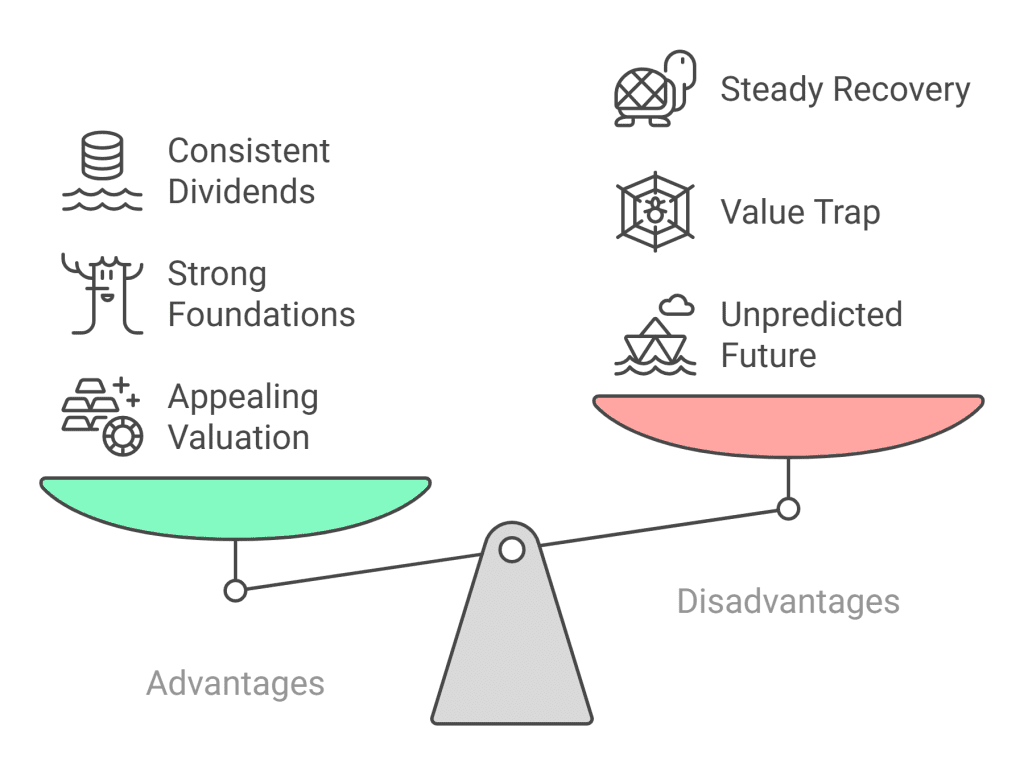
Advantages
Water Related Stocks have a Good Growth Potential: Water is a critical resource, especially in metropolitan and urban regions, where the demand for the resource is expected to rise substantially in the years to come. Companies such as Va Tech Wabag and Ion Exchange are strategically positioned to meet this long-term demand, showing potential growth opportunities.
Government Funding of Water Projects: Initiatives such as Jal Jeevan Mission and Smart Cities Program are positively working toward funding the water industry.
Sustainability Focus: With the rapid growth in ESG investing, companies related to water naturally fit within ESG frameworks making them sustainable for the future.
Export Opportunities: Several of these companies, such as Ion Exchange and Thermax, have an international presence which lessens reliance on domestic markets. A diversified clientele provides additional strength during periods of economic slowdowns.
Disadvantages
High Capital Expenditure: Establishing pumping stations or water treatment plants incurs high capital costs, which might affect cash flows of smaller companies like Felix Industries during slow-growth phases.
Regulatory Hurdles: Strict regulations often create operational challenges due to compliance concerns and impact project timelines.
Market Volatility: Some water-related stocks are very volatile, especially small-cap companies like EMS Ltd or Jash Engineering. Conservative investors may consider it risky to have their portfolios tied up in equities that have higher price fluctuations than established blue-chip stocks.
Technology Obsolescence: Failure to invest in the latest solutions can erode a company’s competitive edge. Without innovation in a fast-changing industry, profitability and investor confidence wanes over time.
Conclusion
In India’s infrastructure and sustainable development narrative, water emerges as the next key area of focus. In light of growing environmental concerns and public spending, water equities in India become more pertinent than ever in 2026.
For those willing to invest in water-related stocks in India, the Pocketful offers you the facility to buy these shares through their easy to use stock market mobile application.
Frequently Asked Questions (FAQs)
What companies constitute water-related stocks, and what is the reason for their prominence in 2025?
Water-related stocks refer to companies that deal with the treatment, distribution, storage, or management of water resources. In 2025, these stocks are gaining prominence due to the private sector’s growing involvement and concern about water scarcity, along with government initiatives like Jal Jeevan Mission.
Which sectors fall under the water investment theme in India?
Core sectors comprise water infrastructure (pipelines, pumps, valves), water treatment (purification, extraction, secondary wastewater treatment), utilities (urban water supply), and industrial services (EPC firms executing water projects).
Identify the most prominent companies in India that deal with water?
Prominent companies are VA Tech Wabag (wastewater treatment and desalination), Ion Exchange (India) Ltd. (water treatment solutions), Engineers India Ltd. (EPC services in water projects), Thermax Ltd. (water and wastewater treatment), Tata Projects / L&T (water infra through EPC contracts).
What initiatives by the government are augmenting growth in this field?
Jal Jeevan Mission, Namami Gange, Smart Cities Mission, and similar flagship schemes are launched by the Government to expand water infrastructure and support water treatment companies.
What are the challenges related to investing in water-related stocks?
Some challenges are project delays because of regulations, too much dependence on government contracts, decreasing profit margins on EPC projects, and scalability limitations in specialized areas.
Selection Methodology and Important Disclaimer
The stocks included in this list are selected primarily on the basis of their market capitalisation, which represents the total market value of a company’s outstanding shares. The companies are arranged in descending order of market capitalisation, with larger companies appearing first, followed by relatively smaller companies. This methodology is intended to provide a structured approach for identifying companies based on their market size and overall presence within a sector.
However, market capitalisation should not be considered the sole factor while evaluating investment opportunities, as it does not guarantee future performance, profitability, or returns. Investors should also assess other important factors such as financial health, business fundamentals, management quality, valuation metrics, industry outlook, and market conditions before making investment decisions.
The information provided is for educational and informational purposes only and should not be construed as investment advice, recommendation, solicitation, or an offer to buy or sell any securities by Pocketful Fintech Capital Private Limited.
The real estate sector is a critical component of any economy, driving growth through residential, commercial, and industrial developments. Companies operating in this sector are essential for shaping urban landscapes, creating jobs, and fostering economic activity. Their contributions to infrastructure, housing, and investment markets make them key players in national economic development and wealth generation.
As the real estate sector continues to evolve with urban expansion and infrastructure development, penny stocks in real estate provide a chance to invest in emerging players that could deliver significant returns. Penny stocks are inexpensive shares of small cap companies, typically trading for less than ₹20. They represent companies with small market capitalizations and have a reputation for being highly risky and volatile while offering the chance for exponential growth.
In this blog, we will give you an overview of the top 10 real estate penny stocks in India, their advantages and disadvantages, factors to consider before investing in them and their Key Performance Indicators (KPIs).
What are Real Estate Penny Stocks?
Real estate penny stocks refer to shares of smaller real estate companies that trade at a market price of less than ₹20. Due to their low prices, investors have the opportunity to purchase shares of these companies at a low price and make significant gains if the company successfully expands its operations and increases its profitability. These stocks are especially attractive because of the infrastructure boom in India.
An overview of the top 10 real estate companies in India is given below:
1. Unitech Ltd
Unitech Ltd is known for developing large-scale residential, commercial, and retail properties. It was once one of the leading giants in India’s real estate market. The company had run into some financial and legal issues a few years ago, but it is still undergoing restructuring processes. Despite this, the firm owns key land parcels in major cities which makes it a valuable penny stock.
Its investors believe in the turnaround story of Unitech, provided the real estate market remains steady. Unitech’s focus on project completion and resolving its legal issues has kept the company on the watchlist of high-risk, high-reward investors.
Know the Returns:
1Y Return (%)
3Y Return (%)
5Y Return (%)
-17.46%
271.11%
203.64%
(Data as of 08 April 2026)
2. Nila Spaces Ltd
This real estate company specializes in designing and developing urban infrastructure and affordable housing projects with a focus on Gujarat. They captured this market due to their emphasis on value purchasers and government-subsidized housing programs. The firm’s strong business model and consistent execution has kept it afloat in the penny stock segment.
Nila Spaces is also notable for its involvement in Public Private Partnership (PPP) programs which has a social impact alongside growth. Most investors looking to capitalize on the affordable housing boom can find Nila Spaces as an appealing choice.
Know the Returns:
1Y Return (%)
3Y Return (%)
5Y Return (%)
20.30%
360.33%
763.13%
(Data as of 08 April 2026)
3. Nila Infrastructures Ltd
Nila Infrastructures Ltd has diversified operations in the real estate and civic infrastructure sectors. They have also completed some of the publicly funded works like bus terminals, affordable housing, and roads. The company has a strong foothold in Gujarat and Rajasthan. Because of its reputation for timely delivery and consistently securing project contracts, Nila is regarded as a stable penny stock in the real estate sector that is appreciating. The company also has a strong public sector clientele which provides a level of income certainty that is atypical in this sector.
Know the Returns:
1Y Return (%)
3Y Return (%)
5Y Return (%)
-7.11%
62.52%
64.12%
(Data as of 08 April 2026)
4. Dharan Infra-EPC Ltd
Dharan Infra-EPC Ltd has its head office located in Nashik, Maharashtra and deals with the development of residential and commercial properties. The company focuses on creating affordable housing for the value conscious middle income segment. With decades of experience in real estate, Dharan has over 25 projects under its belt. It aims to pursue projects in Tier-2 and Tier-3 cities experiencing a sustained increase in urban housing demand. The company’s growth path positions it favorably among low-priced real estate stocks.
Know the Returns:
1Y Return (%)
3Y Return (%)
5Y Return (%)
-65.96%
-65.96%
-65.96%
(Data as of 08 April 2026)
5. Housing Development & Infrastructure Ltd (HDIL)
Historically, HDIL was one of the major beneficiaries of real estate development in Mumbai with their slum rehousing and affordable housing schemes. However, in the last few years, operational and legal challenges affected the company, but they continue to have a significant land bank in the Mumbai Metropolitan region (MMR). Previously, they had a track record of constructing more than 100 million sq. ft. of residential and commercial spaces. If these issues are resolved, HDIL can potentially be a strong candidate for a turnaround story. In India’s real estate space, it’s still one of the most high-risk, high-reward, penny stocks.
Know the Returns:
1Y Return (%)
3Y Return (%)
5Y Return (%)
-35.16%
-31.86%
-60.20%
(Data as of 08 April 2026)
6. Newtime Infrastructure Ltd
Newtime Infrastructure Ltd is focused on urban real estate development and construction. Although not particularly renowned, it focuses on niche residential and mixed-use infrastructure developments in emerging cities. The company is actively working to strengthen its presence in Northern India. The investors have a keen interest in this stock due to the growth potential in underserved real estate markets. Newtime Infrastructure is a speculative play but one with longer-term growth potential.
Know the Returns:
1Y Return (%)
3Y Return (%)
5Y Return (%)
-40.77%
-50.46%
-82.02%
(Data as of 08 April 2026)
7. Vipul Ltd
Vipul Ltd operates in the residential, commercial, and retail sectors in Gurgaon, Bhubaneswar, and Ludhiana. The company’s business approach features design aesthetics coupled with a customer-first approach, striving to offer smart living spaces.
Vipul Ltd has launched several mid-range to premium housing projects, actively seeking to expand its footprint in commercial real estate. Real estate penny stocks stand out due to Vipul Ltd’s diversified portfolio and long-standing experience. The company’s reputation has been greatly bolstered by positive and constructive customer feedback regarding its projects.
Know the Returns:
1Y Return (%)
3Y Return (%)
5Y Return (%)
-1.70%
-18.43%
-65.73%
(Data as of 08 April 2026)
8. Sanmit Infra Ltd
Sanmit Infra Limited is concentrating on the development of infrastructure and selected real estate projects focusing on the western part of India. Their vision coincides with urban modernization and sustainable growth. The company undertakes projects like residential colonies, roads, and drainage systems which aids in long-term city planning. The company’s growing interests in real estate and public infrastructure construction are balanced. Sanmit Infra is a company that is poised to attract those interested in progressive infrastructure and real estate investments.
Know the Returns:
1Y Return (%)
3Y Return (%)
5Y Return (%)
-29.76%
-91.86%
-28.03%
(Data as of 08 April 2026)
9. LA Tim Metal & Industries Ltd
LA Tim Metal & Industries Ltd is still maintaining its core operations in the metals and alloys space, but has made a foray into real estate to diversify its income streams. This move makes sense due to India’s ever-growing urban population and housing demand. With the company’s industrial pedigree, investors hope the company will experience the same success in delivering quality real estate infrastructure. Such a diversification plan may stimulate new investor interest as well as create new revenue streams. The company is still early in its real estate journey, and thus represents a penny stock of a company with diversified operations.
Know the Returns:
1Y Return (%)
3Y Return (%)
5Y Return (%)
6.00%
41.11%
152.84%
(Data as of 08 April 2026)
10. Future Market Networks Ltd
Future Market Networks Ltd (FMNL) is a business at the crossroads of real estate and retail infrastructure. It specializes in the development and management of commercial properties such as shopping malls, logistics parks, and retail centers. The consumption of the Indian population has been steadily growing, thus, the demand for modern retail space is also increasing, which strategically favors FMNL. The company’s vision of creating infrastructure projects that are futuristic tends to align with urban growth patterns in the long term. Here is a company with a penny stock that offers exposure to two highly lucrative sectors, retail infrastructure featuring mall and shopping centres as well as infralogistics markets featuring large-scale warehousing facilities.
Factors to Consider Before Buying Indian Top Real Estate Penny Stocks
In investment considerations for penny stocks in real estate, take note of the following:
Financial Health: Evaluate the financial health of the business by analyzing financial statements.
Market Position: Determine the factors influencing the real estate industry and the market competition the company faces.
Growth Potential: Consider the business expansion strategies and operational growth capabilities of the company.
Management: Experienced management can take key strategic decisions timely, which can raise the company’s performance.
Regulatory Environment: Policies changes related to the real estate industry by the government authorities must be closely monitored.
Advantages and Disadvantages of Investing in Real Estate Penny Stocks
Advantages
Low Investment Required: At such low prices, these shares can be easily bought by small-scale investors. With a small investment, diversification can be achieved as all have share prices below ₹20. This stimulates interest from retail investors, particularly in the Tier 2 and Tier 3 cities where property development is on the rise.
High Growth Potential: The penny stocks of these companies can deliver significant price appreciation if it performs excellently because these businesses usually are in the growth phases of their life cycle or work in developing regions. Even minor improvements in project execution or the level of demand can result in drastic increases in share prices. Completing a project successfully can greatly enhance the reputation of the company.
Benefit from the Infrastructure Boom: Increased infrastructure development in India can create expansion opportunities for the real estate companies. Due to the immense focus by the government on housing, smart cities, and urban infrastructure, real estate companies can capitalize on new housing and infrastructure projects. Moreover, the price appreciation of real estate will increase the asset base of these companies, which will increase stock value.
Early Market Advantage: Identifying the right company for investment during its formative stages can lead to substantial profits. Being an early stage investor in an undervalued real estate company gives you a head start before institutional money comes rushing in. If the firm lands high-profile projects or secures funding, your investment will multiply over time.
Disadvantages
Extremely Volatile: The stock prices of the real estate company have a tendency to fluctuate greatly. This results in extreme volatility due to low market capitalization and highly speculative interest. These stocks can react sharply to news, rumors, or overall market sentiment, making them a bad choice for short-term positions and large allocations.
Lack of Information: Public information and coverage about penny stock companies is scarce. These companies are usually overlooked by investors and analysts due to which there is limited information about them available on the internet, which inhibits investors from determining the company’s actual financial standing, project pipeline, or management credibility.
Low Trading Activity: Lower trading volumes can make it difficult to buy or sell shares. This lack of liquidity means you may not be able to exit at your desired time or price which means you could be locking in capital unnecessarily due to market corrections.
Lack of Governance: Numerous penny stock real estate companies have weak corporate governance standards. Concerns regarding the transparency, misuse of funds, and communication with shareholders can raise the risk of fraudulent activities, related party transactions, or misrepresentation of projects that damages shareholder trust.
Undefined Timelines for Projects: Many projects fall behind schedule due to extended waiting periods on permit approval, funding, or logistical issues. Prolonged slowdown directly affects revenue inflow, cash flow, decline in profit margins and overall profitability. For underfunded real estate companies, extensive delays means putting the project on hold and accruing debt.
These are lesser-known real estate industry stocks operating in India that exhibit great profit potential even if they don’t seem like a worthwhile investment currently. Real estate penny stocks, while volatile, offer a great entry opportunity to diversify your investment portfolio and the chance for substantial profit in the long term.
Prior to making an investment, it is crucial to conduct thorough research, study the industry trends, and the fundamentals that govern each company. For those seeking an effortless method to track, analyze, and even invest in penny stocks, the Pocketful app will be a perfect fit. Pocketful presents data that is helpful for making informed decisions.
Should real estate penny stocks be considered by the investors in India?
Yes, investors shall consider real estate penny stocks in India because of their low entry cost and future growth potential due to the increasing population and booming real estate industry. With government schemes like Pradhan Mantri Awas Yojana (PMAY) many of these companies can benefit in coming years.
Are real estate penny stocks risky?
Investing in real estate penny stocks can be risky due to limited financial information, low liquidity & high volatility. Their performance is also vulnerable to real estate cycles and changes in regulatory policies.
How can one find the best real estate penny stock?
You can find the best real estate penny stock by conducting a thorough fundamental and technical analysis. Moreover, it is advised to consult a financial advisor before investing.
Can long-term investment be done in real estate penny stocks?
These stocks can be part of a high-risk, high-reward strategy which suits long-term investors who have a high risk tolerance. However, diversification and smart stock selection are essential for success.
Selection Methodology and Important Disclaimer
The stocks included in this list are selected primarily on the basis of their market capitalisation, which represents the total market value of a company’s outstanding shares. The companies are arranged in descending order of market capitalisation, with larger companies appearing first, followed by relatively smaller companies. This methodology is intended to provide a structured approach for identifying companies based on their market size and overall presence within a sector.
However, market capitalisation should not be considered the sole factor while evaluating investment opportunities, as it does not guarantee future performance, profitability, or returns. Investors should also assess other important factors such as financial health, business fundamentals, management quality, valuation metrics, industry outlook, and market conditions before making investment decisions.
The information provided is for educational and informational purposes only and should not be construed as investment advice, recommendation, solicitation, or an offer to buy or sell any securities by Pocketful Fintech Capital Private Limited.
The cement industry is vital to India’s economy, contributing significantly to GDP through infrastructure development, housing, and employment. As the world’s second-largest producer, it supports key sectors like construction and manufacturing. Due to the critical nature of the cement sector, the companies operating in this sector are often considered by investors for investment.
If you are looking for penny cement stocks to add to your stock portfolio, then you have landed at the right place. This guide covers the top 10 cement penny stocks in India that are generally priced below ₹50. Such low-priced shares offer small investors a ticket into India’s blooming infrastructure space.
What are Cement Penny Stocks in India?
What are Cement Penny Stocks? Cement penny stocks are shares of small cement manufacturing firms that have their shares trading below ₹50, usually. These stocks provide investors with a means of investing in the cement sector without too much capital investment. These stocks can be extremely appealing due to the ongoing infrastructure development in India.
Top 10 Cement Penny Stocks in India (2026)
Company
Current Market Price (₹)
Market Capitalization (₹ Crores)
52 Week High (₹)
52 Week Low (₹)
Sanghi Industries Ltd
49.9
1,289
71.8
47.0
Udaipur Cement Works Ltd
36.2
2,031
38.0
26.2
Shree Digvijay Cement Co. Ltd
70.8
1,047
108
53.9
Shiva Cement Ltd
18.7
552
42.7
12.0
Andhra Cements Ltd
57.4
529
110
40.4
Navkar Urbanstructure Ltd
0.84
94.3
3.59
0.70
Barak Valley Cements Ltd
42.0
93.1
70.0
30.8
BIL Vyapar Ltd
6.47
20.3
23.6
4.77
Burnpur Cement Ltd
6.60
56.8
6.95
5.73
Sri Chakra Cement Ltd
56.5
50.8
99.3
15.8
(As of 10 April 2026)
Overview of Top 10 Cement Penny Stocks Companies in India
An overview of the top 10 cement penny stock companies in India is given below:
1. Sanghi Industries Ltd.
Sanghi Industries Ltd, a company that is part of Ambuja Cements Ltd as well as the diverse Adani Group, is among the leading Indian companies in the cement sector. This company has a clinker production capacity of 6.6 MMTPA (million tons per annum) and 6.1 MMTPA cement production capacity. In Kutch, Gujarat, the company has one of the largest single-location cement production plants in India. This is a fully integrated cement plant that has a thermal power plant, an all-season port, sea terminals located at Gujarat & Mumbai, and its own vessels to cater to its product demand.
Superior quality of mineral reserves and advanced manufacturing technology help the company manufacture high-grade cement while maintaining a low cost of production. The company is known for its world-class practices in environmental management and corporate management, resulting inan excellent company reputation.
2. Udaipur Cement Works Ltd
Udaipur Cement Works Limited (UCWL), an incorporated company that became a public limited company on March 15, 1993, is based in Udaipur, Rajasthan. It functions as a subsidiary of JK Lakshmi Cement Limited, which has been an institution in the Indian cement industry for over 40 years. UCWL belongs to the reputed JK Organisation, which has a glorious business legacy of over 135 years. UCWL, which makes and sells cement and related materials, operates only in India and has its shares listed on BSE. Its products are sold under the brand names of “Platinum Heavy Duty Cement” and “Platinum Supremo Cement” for individual house builders, masons, and other business associates.
3. Shree Digvijay Cement Co. Ltd
Established on November 6th, 1944, Shree Digvijay Cement Company Limited is one of the initial companies to start cement production in India. This company has a manufacturing plant located at Sikka in Jamnagar District of Gujarat. The company has been producing blocks of cement branded as “KAMAL” since 1949. Shree Digvijay Cement specializes in blended cements such as Ordinary Portland Cement (OPC), Portland Pozzolana Cement, among others.
4. Shiva Cement Ltd
Shiva Cement Limited, established in 1985, is an India-based company involved in the production and sale of cement and its allied products. The company serves domestic markets and produces Portland Slag Cement (PSC), Portland Pozzolana Cement (PPC), clinker, and limestone chips. This company is a strategic investment made by JSW Cement as it is a key player in eastern India with a stronghold through consistent demand. It has facilities at strategic locations to tap huge raw material availability to cater to markets in Odisha, West Bengal, Jharkhand, and Bihar.
5. Andhra Cements Ltd
Andhra Cements Ltd was established in December 1936, located in Andhra Pradesh with two of its biggest plants situated in Palnadu district known as Durga Cement Works (DCW), and also at Visakhapatnam, also known as Visakha Cement Works (VCW). The DCW plant consists of cement grinding machines with both OPC and PPC grade cement manufacturing, along with good rail, road, and sea transportation, making the business operations smooth with an opportunity to expand its operations easily in the future.
6. Navkar Urbanstructure Ltd
Navkar Urbanstructure Limited, which was formerly known as Navkar Builders Limited, is a Gujarat-based BSE-listed firm incorporated on June 2, 1992. The company holds more than 27 years of multidisciplinary experience in designing and executing challenging projects, from working on large sewage treatment plants to pumping stations and transmission pipelines. Apart from developing infrastructure pipes, the company also engages in the supplying of Reinforced Cement Concrete (RCC) pipes and Ready Mix Concrete (RMC) to construction sites. The company is also exploring the opportunities to expand in the cement industry globally. Navkar Urbanstructure’s technological prowess in structural design, project management, and budget procurement has been instrumental in the realisation of high standards in infrastructure projects.
7. Barak Valley Cements Ltd
Barak Valley Cements Limited, incorporated in 1999, is an India-based company involved in the manufacture and sale of cement of various grades. It sells its products under the brand name “Valley Strong Cement” in the North Eastern Region of India. The company offers a wide range of products including both Ordinary Portland Cement (OPC) and Portland Pozzolana Cement (PPC). The company is based in Karimganj, India.
8. BIL Vyapar Ltd
Founded in 1872, BIL Vyapar Ltd is an Indian based company with a diversified business portfolio. Its main areas of interest include manufacturing of cement, zinc, glass-fiber, and downstream composite products. Starting from trading in metal utensils, the company has a rich history as it established units like BIL Vyapar Ltd Metal Works in 1941. They are part of the BIL Vyapar Ltd, a well-diversified industrial house with a rich 136-year history.
9. Burnpur Cement Ltd
Burnpur Cement Limited is one of the oldest and most reputable fully integrated cement companies in the eastern region of India, commencing operations in 1986. Headquartered in Burnpur, West Bengal, the company has two plants, one in Asansol, West Bengal and the other in Patratu, Jharkhand. Burnpur Cement specializes in manufacturing Portland Slag Cement (PSC) and is recognized for its commitment to quality and innovation. The company’s Patratu plant uses sophisticated dry process technology to manufacture clinker and cement efficiently.
10. Sri Chakra Cement Ltd
Sri Chakra Cement Ltd is an India cement manufacturer as well as other construction material manufacturers. The firm mainly manufactures Ordinary Portland Cement (OPC) grades 53 and 43 along with Portland Pozzolana Cement (PPC). The company also installed captive solar power generation for all of its operations, moving towards a greener future.
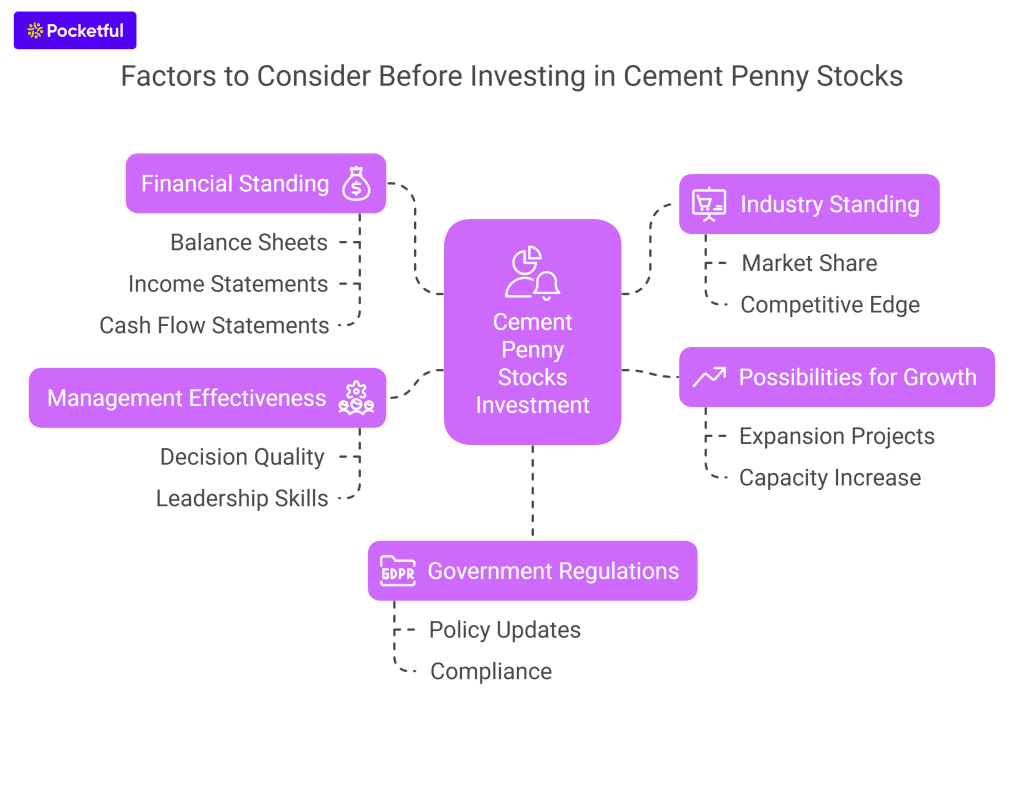
Factors to Consider Before Investing in Cement Penny Stocks in India
While considering the cement ‘penny stocks for investment, you must keep the following factors in mind:
Financial Standing: It is crucial to evaluate the company’s balance sheets, income and cash flow statements.
Industry Standing: Determine the market share of the company and its edge over the competition.
Possibilities for Growth: Conduct research to identify future potential, expansion projects and plans for increasing capacity.
Management Effectiveness: The performance of a company depends on the decisions of the management.
Government Regulations: Be updated with the policy changes regarding the legislations relevant to the cement industry.
Positive Aspects of Investing in Cement Penny Stocks in India
Some of the advantages of investing in cement penny stocks are listed below:
Affordable: Cement ‘penny’ stocks are generally priced less than ₹100 or even ₹50 which lets even small investors to purchase these stocks. There is no substantial investment amount required to begin investing in these stocks.
Growth Opportunities: As these businesses are of a smaller size as compared to other established companies, they have greater potential than the established players. If the company grows or optimizes its operations, the increase in stock price could be significant.
Risk Diversification: Investing in cement penny stocks diversifies your portfolio, especially if your holdings only include large publicly traded companies. This aids in diversifying risk across different sectors and company sizes.
Riding the Infrastructure Boom: Increasing infrastructure development in India should lead to higher demand for cement. If these smaller companies are able to capitalize on this opportunity, they can substantially increase their revenue and market capitalization over time.
First Mover Benefit: Because these stocks are not regularly tracked by analysts, spotting a solid company early could allow you to reap substantial gains later as they mature and gain market attention.
Some of the disadvantages of investing in cement penny stocks are listed below:
Unpredictability: Due to low liquidity and speculative trading, cement penny stocks face sharp price swings. Due to low volume or stock related news, prices can rise or fall drastically.
Limited Information: Small companies usually do not publish detailed reports on their business activities or financial statements like big firms do. Because of this, investors cannot have a very easy time assessing the company’s performance and making investment decisions.
Liquidity Issues: Due to lower trading volumes of these stocks, it is not easy to buy or sell in large quantities without affecting the stock price. Also, getting out of a position may take longer than expected if one wants to do so at a specific price.
Risks Related to Corporate Governance: Lack of strong corporate governance practices makes penny stock companies prone to mismanagement, legal problems, or other issues. This brings greater risk for retail investors.
Uncertain Financial Stability: Thin profit margins or heavy reliance on debt are common with most of these companies. If the market takes a downturn or if poor management decisions are made, it can quickly lead to poor financial performance, eroding investor capital, or both.
In India, cement penny stocks present a remarkable investment opportunity for retail investors who want to capitalize on the country’s booming infrastructure and construction sectors without investing significant capital. Most of the cement penny stocks trade below ₹50, and if selected intelligently, these stocks may deliver robust profits in the future. But as we have seen, they come with risks of their own such as extreme price fluctuation, limited trading activity, and scant financial information made available to the public.
That’s why these investors need to analyze the company based on the latest financial metrics, company news, relevant sector information, and perform thorough due diligence before investing. Staying updated with the metrics like EPS, PE ratio, and return on equity would help make wiser decisions.
To make this easier, the Pocketful app allows users to track stock performance by setting alerts or perusing fundamental data concerning cement penny stocks listed on the Indian stock exchanges. The application comes with a user-friendly interface, making it suitable for novice as well as pro investors.
Regardless of your experience level, Pocketful simplifies stock investing and trading. So if you are thinking of entering the stock market and investing in cement penny stocks, let Pocketful guide you through every step of the way.
S.NO.
Check Out These Interesting Posts You Might Enjoy!
What are cement penny stocks and what is the hype surrounding them in the market?
Cement penny stocks are shares of smaller, lesser-known cement companies that trade at a market price lower than ₹100. These stocks are sought out by investors for their potential high returns while needing relatively lower initial investment. If purchased at the right time, these stocks can turn out to be extremely profitable multi baggers in the future.
Is it safe to invest in cement penny stocks?
Cement penny stocks have the possibility of delivering higher returns, but could also come with greater risk due to illiquidity and inconsistent financial track record. It is crucial to assess the fundamentals such as market demand and trends of the industry for each company individually.
How to analyze and invest in cement penny stocks in India?
Use financial portals, company reports, or read blogs that may contain the information you need regarding cement penny stocks for analysis. To streamline the investment process, check out Pocketful, which allows users to search for cement penny stocks, monitor their real time performance, and purchase them via easy-to-use mobile application.
What are the growth prospects of cement penny stock companies in India?
The infrastructure and real estate boom in India will result in strong cement demand which will enable even smaller cement companies to expand. Initiatives from the government such as PM Awas Yojana and the Smart Cities Mission may further enhance the market prospects of these companies.
Can I invest in these cement penny stocks through the Pocketful platform?
Investing in a wide array of stocks, including those of cement penny stocks, is made easy by Pocketful. Pocketful’s intuitive interface coupled with its research tools and stock screener makes it the perfect stock broker.
Selection Methodology and Important Disclaimer
The stocks included in this list are selected primarily on the basis of their market capitalisation, which represents the total market value of a company’s outstanding shares. The companies are arranged in descending order of market capitalisation, with larger companies appearing first, followed by relatively smaller companies. This methodology is intended to provide a structured approach for identifying companies based on their market size and overall presence within a sector.
However, market capitalisation should not be considered the sole factor while evaluating investment opportunities, as it does not guarantee future performance, profitability, or returns. Investors should also assess other important factors such as financial health, business fundamentals, management quality, valuation metrics, industry outlook, and market conditions before making investment decisions.
The information provided is for educational and informational purposes only and should not be construed as investment advice, recommendation, solicitation, or an offer to buy or sell any securities by Pocketful Fintech Capital Private Limited.
The FMCG sector forms the backbone of the Indian economy as the products manufactured by companies in this sector are used by almost everybody. Are you interested in investing in penny stocks of the FMCG sector? If yes, then you are in the right place. In this blog, we will look at the top 10 penny stocks in India’s FMCG industry, their overviews, KPIs, and key points that every investor should consider before investing.
These stocks are some of the best performing FMCG penny stocks in India for anyone looking to begin investing with small capital in the stock market. The Pocketful app and website make it simple to search, analyze and invest in these penny stocks.
What is an FMCG penny Stock?
FMCG penny stocks refers to shares of companies in the Fast Moving Consumer Goods (FMCG) sector which are low-priced, usually below ₹20. These companies sell products of everyday use, which includes food, drinks, toiletries, etc. Their low trading price makes them a go-to option for investors searching for significant growth prospects with low capital.
Top 10 FMCG Penny Stocks List With Price
Here’s a list of top FMCG penny stocks under ₹10 & ₹20:
Specializing in the meat processing and exports since 2008, HMA Agro Industries Ltd is involved in the frozen meat industry. The company deals with frozen buffalo meat, vegetables, fish and other agro products, vegetables and cereals.
HMA Agro exports their produced goods under the brand name Black gold, Kamil, HMA, Fresh Gold, and Green Gold to around 50 different countries. The company is recognized as a three star export house and is valued for versatile export products.
2. BCL Industries Ltd
BCL Industries Ltd, incorporated in 1976, is located in Punjab and undertakes edible oil refining, distillery activities, and real estate. The firm is a leading manufacturer of mustard, soybean, and rice bran oils and sells them under several brands.
Additionally, the company runs one of the largest grain-based distilleries in India, producing ENA and ethanol. BCL also focuses on sustainability and has zero-liquid discharge distilleries. The company diversified into real estate by constructing residential and commercial buildings in Punjab.
3. AVT Natural Products Ltd
AVT Natural Products Ltd is one of the most prominent producers of food, beverage and livestock nutrition as well as nutraceuticals plant extracts and natural ingredient solutions. Capitalizing on over 25 years of experience, the firm manufactures and sells oleoresins, value-added animal nutrition products, and tea.
The company operates within one segment, which is solvent-extracted products, and earns most of its revenue from the international markets such as the USA, UK, and UAE. The company seeks to offer goods that are sustainable and natural.
4. Sarveshwar Foods Ltd
Holding over 130 years of experience, Sarveshwar Foods Ltd is into the processing and trading of basmati rice. The company provides a complete assortment of traditional Indian basmati rice, including Basmati Rice, Pusa Basmati Rice, and Sharbati Rice.
Sarveshwar Foods has both domestic and international operations with a large share of revenue coming from domestic sales. The company blends age-old values and traditional farming with modern manufacturing techniques and advanced quality systems.
5. Mishtann Foods Ltd
Mishtann Foods Ltd is among the leaders in agro-products, as the company was started back in 1981 and still stands strong with its headquarters in Ahmedabad. The company manufactures basmati rice, wheat, dal, salt and other food grains, and also deals in the processing and trading of these products. Their portfolio also boasts premium brands of basmati rice such as Snowflake and Pristino, alongside midrange Jasper and Rozana, value-for-money brands.
The company is devoted to integrating flavour, nutrition, and customer satisfaction while working towards becoming a dependable Indian brand in agro products across the globe.
6. MK Proteins Ltd
MK Proteins Ltd undertakes the refining and trading of vegetable oils and oil by-products. Their factory at Ambala, Haryana is capable of oil refining up to 250 tons per day.
The company handles the refining of rice bran, sunflower, cottonseed, soybean, palm, and canola oils. Further, the company also undertakes high quality edible oil production by maintaining cleaning, storage and monitoring systems.
7. JHS Svendgaard Laboratories Ltd
An established company in the field of Fast Moving Consumer Goods, JHS Svendgaard Laboratories Ltd has specialized in the development of innovative oral care products. Its manufacturing units in Himachal Pradesh make a variety of personal care items that include toothbrushes, toothpaste, mouthwash, and talcum powder.
The company operates domestically and abroad with a strong presence in the UAE, Italy, Nepal, Russia, and the USA. JHS Svendgaard prides itself in the innovative manufacturing solutions offered in the high quality personal care products industry.
8. Tasty Dairy Specialities Ltd
Tasty Dairy Specialities Ltd is a dairy processing company that started operations in 1992 and is located in Kanpur, India. The company’s product line includes liquefied ghee, butter, cream, pasteurized milk, milk powder, paneer, and other dairy products, in addition to Indian sweets like gulab jamun mix and peda.
The company sells products under UJJWAL, SHIKHAR, VERIFRESH, CIMA, and MITHAI MASTER brands.
9. Future Consumer Ltd
Future Consumer Ltd is an FMCG 2.0 driven data and technology company. It specializes in the sourcing, manufacturing, branding, marketing, and distribution of fast-moving consumer goods, including food and processed food products, and health and personal-care products. Some of the brands under Future Consumer are Golden Harvest, Tasty Treat, Karmiq, Desi Atta Company, Mother Earth, Voom, Cleanmate, and Caremate. The company uses real time customer data to improve efficiency and scale in its operations.
10. ANS Industries Ltd
ANS Industries Ltd was established in 1994 and is involved in the business of frozen fruits and vegetables. The company has an installed capacity of 8,000 tonnes per annum and utilizes Individual Quick Freezing (IQF) technology.
ANS Industries products include Cauliflower, French beans, sweet corn, spinach, mangoes, red cherries, mushrooms, and papaya. The company has a processing and packaging facility situated at Karnal, Haryana and its head office is located in New Delhi.
Key Points for Investors While Investing in FMCG Penny Stocks
Investing in FMCG penny stocks can be a high risk, high reward opportunity. These FMCG penny stocks are generally priced under ₹20. However, one should be aware that the low price point and small market cap of these stocks demand careful consideration.
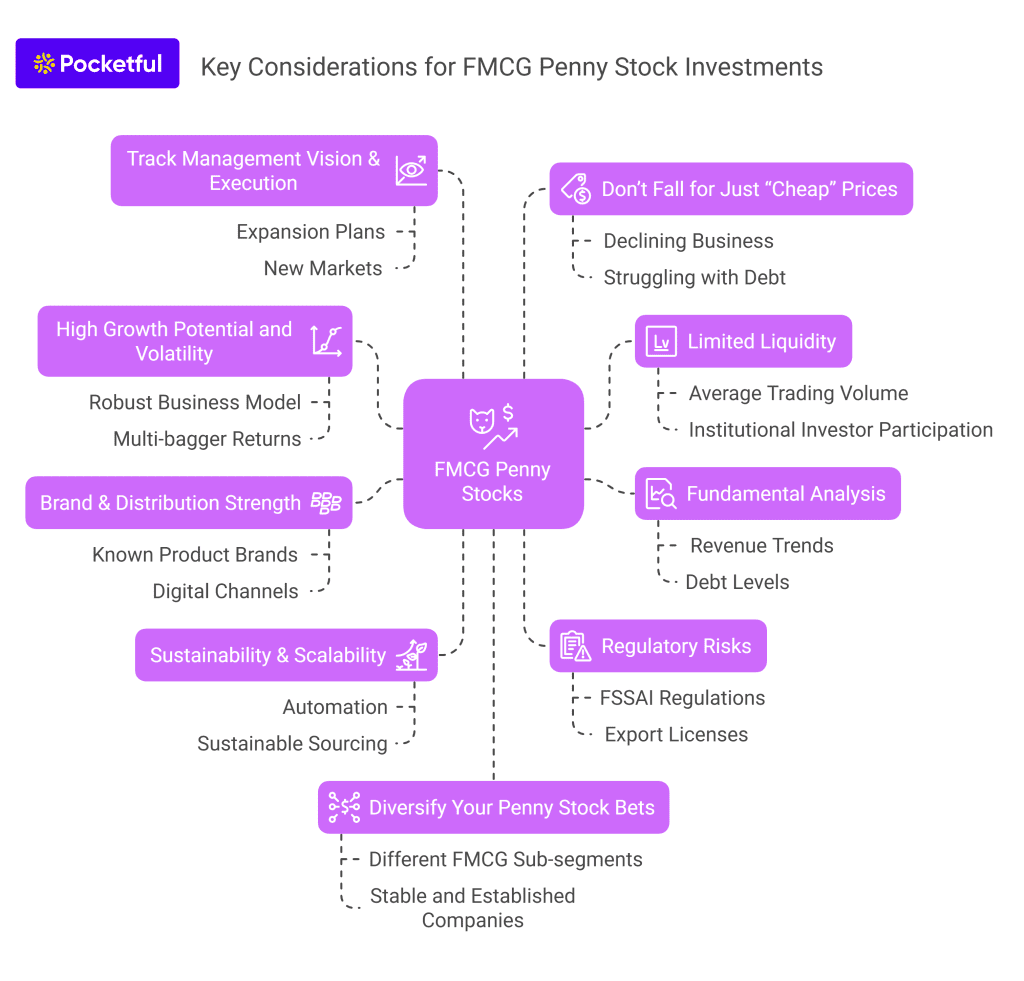
Here are the key takeaways every investor should keep in mind before investing in FMCG Penny Stocks:
1. High Growth Potential and Volatility
If you buy penny stocks in the FMCG sector, they will typically be companies in their initial years of operations or an established company in the past now on a comeback trail. They can have:
a) Relatively low current revenues, but a very robust business model. b) Branding or export plans. If they stabilize the business and demand grows, they can offer multi-bagger returns.
Warning: There is a high level of volatility that may lead to wide price movements driven by the market events.
2. Limited Liquidity
Most of the penny stocks in FMCG have trading volume that is significantly lower than average FMCG stock. Purchasing or selling large quantities may be difficult in a short time period. Further, due to the lack of participation from institutional investors, sharp (up or down) movements are frequent.
Tip: Determine the average trading volume per day and avoid stocks that are too hard to sell.
3. Fundamental Analysis
Due diligence is a must in FMCG Penny Stocks. Look at:
Revenue trends and margins.
Debt levels.
Promoter holding and past records.
Audit quality and governance standards.
Tip: It is a red flag if a company frequently changes auditors or delays release of financial reports.
4. Brand & Distribution Strength
In FMCG, brand recognition and presence is everything. Ask:
Does the company have any known product brands?
Is it present in modern retail chains or exports?
Is it leveraging digital and D2C channels?
A recognizable brand, even in niche segments (like herbal extracts or dairy), can be a big plus for a company.
5. Sustainability & Scalability
Many FMCG penny stocks work in traditional sectors like dairy, rice, edible oils, or processed foods. You should ask:
Is their business model scalable?
Are they adopting automation or sustainable sourcing of raw materials?
These factors improve long-term growth prospects and investor appeal.
6. Regulatory Risks
FMCG companies, especially in food, agro, and meat exports, face high compliance standards, which include:
FSSAI regulations, packaging norms, and export licenses are key.
Any failure here can severely impact operations and investor trust.
Investors should keep an eye on legal disclosures and regulatory updates.
7. Track Management Vision & Execution
Management’s vision is crucial in the financial performance of small FMCG firms. Ask:
Are there expansion or product diversification plans?
Are they entering new markets (e.g., Middle East, Africa, or e-commerce)?
Does the management deliver what it promised in earlier investor communications?
A competent, transparent leadership team can make all the difference.
8. Don’t Fall for Just “Cheap” Prices
A stock priced around ₹20 isn’t necessarily undervalued, the company may be:
Facing a declining business
Struggling with debt
Or burning cash quarter after quarter.
Focus on value, not price. Even a ₹90 penny stock can be more valuable than a ₹10 one, depending on the business model of the company.
9. Diversify Your Penny Stock Bets
Don’t put all your money into one or two penny stocks. Instead:
Pick 4-5 with different FMCG sub-segments (e.g., dairy, oral care, meat exports).
Invest in stable and established FMCG companies along with high-potential emerging ones.
This spreads your risk and increases chances of catching a potential winner.
10. Stay Patient, Think Long-Term
Small FMCG companies take time to grow. If the fundamentals are intact, give your investment:
Time to compound and overcome short term price declines
Trust in your vision
Penny stocks are not for making a quick profit, rather they reward the patient investors.
FMCG penny stocks in India present a unique opportunity for investors looking to enter the fast moving consumer goods space at a lower price point. With consistent demand across urban and rural markets, the FMCG sector holds strong growth potential. However, when dealing with penny stocks, the promise of high returns comes with equally high risk.
The companies that we have discussed in this blog operate across diverse sectors such as rice, dairy, personal care, oils, and meat exports. Each one has its own growth story and challenges. Some are well established in regional markets, while others are actively expanding their operations globally.
As an investor, it’s essential to look beyond the stock price and focus on business fundamentals, management integrity, and scalability. A diversified approach, combined with thorough research can turn these small cap opportunities into significant wealth creators.
S.NO.
Check Out These Interesting Posts You Might Enjoy!
While FMCG as a sector is known for stability, penny stocks carry higher risk due to lower liquidity, limited financial track records, and smaller market capitalization. Investing in them requires thorough research and a long term view.
How do I evaluate a good FMCG penny stock?
There are certain checks that one needs to look for, such as consistent revenue growth, low debt levels, transparent management, increasing institutional investor interest, etc.
Can FMCG penny stocks become multibagger?
The short answer is Yes, some FMCG penny stocks can deliver multifold returns if the company successfully scales its operations and maintains profitability. However, this is rare and requires patience.
How much should I invest in penny stocks?
It’s advisable to limit your exposure to penny stocks to a small percentage of your overall portfolio, generally no more than 5-10%. One should diversify across sectors and avoid investing everything in a single stock or sector.
Selection Methodology and Important Disclaimer
The stocks included in this list are selected primarily on the basis of their market capitalisation, which represents the total market value of a company’s outstanding shares. The companies are arranged in descending order of market capitalisation, with larger companies appearing first, followed by relatively smaller companies. This methodology is intended to provide a structured approach for identifying companies based on their market size and overall presence within a sector.
However, market capitalisation should not be considered the sole factor while evaluating investment opportunities, as it does not guarantee future performance, profitability, or returns. Investors should also assess other important factors such as financial health, business fundamentals, management quality, valuation metrics, industry outlook, and market conditions before making investment decisions.
The information provided is for educational and informational purposes only and should not be construed as investment advice, recommendation, solicitation, or an offer to buy or sell any securities by Pocketful Fintech Capital Private Limited.
Copper is an important metal used in industries in power transmission, electrical equipment, construction, electronics, renewable energy and also electric vehicles. As India keeps expanding its power infrastructure, ramps up manufacturing capacity, and increases clean-energy investment, firms that sit inside the copper supply chain, like copper mining, smelting, refining, manufacturing and recycling, could see stronger demand, more or less.
But, not every company that has copper exposure is automatically a “pure play” copper stock. Some do copper mining or copper refining, and others are more like copper wires, rods, tubes , and recycled product types. so it depends.
Quick answer: If you’re hunting for the best copper stocks in India, you should judge the list using direct copper exposure, business scale, financial strength , profitability, debt levels and stated growth plans, not just share price as a single measure. Hindustan Copper, Hindalco Industries, Vedanta, and Adani Enterprises have meaningful ties to the copper value chain. Meanwhile companies like Precision Wires India, plus a handful of smaller manufacturers, can give a bit more specialised exposure.
The table below gives a quick copper share list for investors who want to compare names before going deeper.
Top 10 Copper Stocks India: Quick Comparison
Company
Copper Exposure
Current Price (₹)
Market Cap (₹ Cr)
52-Week High (₹)
52-Week Low (₹)
Adani Enterprises Ltd.
Copper smelting and refining
2,859.10
3,87,043
3,245.00
1,753.00
Hindalco Industries Ltd.
Copper smelting, refining and rods
1,014.00
2,27,936
1,179.00
697.00
Vedanta Ltd.
Copper refining and processing
278.20
1,08,787
795.00
249.70
Hindustan Copper Ltd.
Copper mining and production
527.00
50,909
760.05
228.10
Precision Wires India Ltd.
Copper winding wires
495.00
9,048
524.90
170.61
Bhagyanagar India Ltd.
Copper rods, wires, pipes and strips
381.00
1,275
438.00
86.00
Rajputana Industries Ltd.
Copper wires, rods and sheets
65.00
147
95.00
60.00
Parmeshwar Metal Ltd.
Copper recycling and products
296.90
454
327.90
64.71
Madhav Copper Ltd.
Copper wires, rods and strips
57.66
159
93.20
42.00
Cubex Tubings Ltd.
Copper alloy tubes and pipes
77.27
111
143.69
73.10
(Data as of 01 September 2026)
Note: This list is for learning comparisons and it isn’t a ranking of what returns you should expect. The companies show up here because of how much copper mining, refining, processing, product-making, or recycling they’re tied to. Market capitalisation can be one quick screening factor but don’t treat it like a true measure of investment quality.
Overview of Top 10 Copper Stocks India
The companies below offer exposure to different parts of India’s copper industry. The list is broadly arranged based on business scale and their relevance to the copper value chain. Being higher on the list does not mean a stock is expected to deliver better returns.
1. Adani Enterprises Ltd.
Adani Enterprises has entered the copper industry through its wholly owned subsidiary, Kutch Copper. The company is developing a large copper smelting and refining facility at Mundra in Gujarat.
A key development came in July 2026, when Kutch Copper’s Grade-A cathodes received London Metal Exchange (LME) brand registration. This allows the company’s copper to be used for delivery against LME copper futures contracts.
For Adani Enterprises, the project provides a direct entry into copper production at a time when India’s demand for the metal is rising. It also fits into the country’s push to reduce its dependence on imported refined copper.
Why it matters:
Copper plant at Mundra
0.5 MTPA initial capacity
Capacity planned to reach 1 MTPA
Benefits from rising domestic copper demand
Key risk: Kutch Copper is still a new business for Adani Enterprises. The company will need to successfully ramp up production while managing the large capital investment required for the project. Investors should also consider the performance of Adani Enterprises’ other businesses before evaluating the stock.
2. Hindalco Industries Ltd.
Hindalco Industries is an Aditya Birla Group company with a strong presence in both aluminium and copper. Its copper business is run under the Birla Copper brand.
The company’s main copper facility is located at Dahej in Gujarat. The site has smelters, refineries, copper rod plants, captive power units and other supporting facilities. Hindalco has a copper smelting capacity of 500,000 tonnes a year at Dahej. Its Asoj plant has a capacity to produce 225,000 tonnes of continuous-cast copper rods.
Hindalco is also planning to increase its copper production. It has announced a 300,000-tonne expansion at Dahej. Once completed, the expansion is expected to take the company’s refined copper capacity to 721,000 tonnes a year. The project is expected to be commissioned by FY2028-29.
With an existing copper business and more capacity in the pipeline, Hindalco is one of the bigger listed names in India’s copper space.
Why it matters:
Established copper business
500,000-tonne smelting capacity at Dahej
225,000-tonne copper rod capacity at Asoj
300,000-tonne expansion planned
Key risk: Hindalco is not a pure-play copper company. Aluminium remains a major part of its business, while the performance of Novelis also has a significant impact on the company’s overall results.
3. Vedanta Ltd.
Vedanta is a natural-resources firm. It works across metals, mining, oil and gas, and other resource areas.
In copper, the firm points to assets in Tamil Nadu and at Silvassa. At Tuticorin, there is a smelter and a refinery. However, the Tuticorin site is not running right now. Vedanta says the Tuticorin smelter can make 400 KTPA. It also says the Silvassa refinery has a capacity of 216 KTPA.
So, Vedanta’s copper setup can still give investors a view of the copper supply chain. Still, the actual operating state of these plants matters a lot for judging the business.
Why this is important:
There is major copper infrastructure already in place
There is also refining capacity on the downstream side
The company is not tied to just one type of resource
Results may swing with global metal prices
Key risk: The current status of the Tuticorin smelter. You should also factor in Vedanta’s wider debt load and its exposure to commodity swings when you assess the company.
4. Hindustan Copper Ltd.
Hindustan Copper Ltd. is a state-run company that makes copper. It can be a straightforward way to hold listed equity linked to copper mining in India.
The firm runs mines and plants in several places. These include Malanjkhand in Madhya Pradesh, Khetri in Rajasthan, and the Indian Copper Complex in Jharkhand. Its work covers exploration, mining, beneficiation, smelting, and refining.
HCL is also growing its capacity. The Malanjkhand site is set to move from 2.5 MTPA to 5 MTPA for ore production. At the same time, the company plans to raise output by expanding existing mines, bringing back closed mines, and starting new ones.
Why this stands out:
Copper-mining link through an equity listing
Government ownership
Growth at Malanjkhand
More chances from mine development
Key risk: Mining projects can run into issues tied to operations, rules, geology, and project delivery. The stock can also react to changes in copper prices.
5. Precision Wires India Ltd.
Precision Wires India is a downstream copper manufacturer that produces products such as enamelled copper wires, paper-covered wires and continuously transposed conductors.
Its products are used in motors, transformers and other electrical equipment. This means its business is linked not only to copper prices but also to demand from power, electrical equipment, automotive and industrial applications.
Unlike a copper miner, a downstream manufacturer can be affected by the spread between the price at which it purchases copper and the price at which it sells its finished products.
Why it matters:
Strong exposure to copper-based electrical products
Demand linked to power and electrical equipment
Downstream rather than mining exposure
Potential benefit from electrification and grid investment
Key risk: Margins and working-capital requirements can be affected by changes in copper prices and demand conditions.
6. Bhagyanagar India Ltd.
Bhagyanagar India makes copper items such as rods, wires, strips, and pipes. It also has business interests beyond its main copper work.
Its copper goods are used in areas like electrical equipment, power, building work, and HVAC. Because of that, the firm can benefit from copper needs even if it does not run mining.
For people looking at Bhagyanagar, the main things to watch are sales demand, plant use, profit levels, cash tied up in daily operations, and how the copper line is doing.
Why this stands out:
Work that sits downstream in copper
Ties to power and building demand
Several product types in copper
A smaller firm with linkages to the copper chain
Key risk: Compared with big listed metal firms, smaller companies may see larger swings in earnings and may face funding or liquidity stress.
7. Rajputana Industries Ltd.
Rajputana Industries makes and sells metal items and the list includes copper wire, copper rods, and copper sheets.
Compared with mining or making primary copper, the firm leans more on the market for copper products that come next. So results may track what industrial buyers want. It can also swing with how much the company ships. Input prices and profit margins can matter too. Because it is not very large, the share price can move more than the stock of bigger copper firms.
Why this is relevant:
– Making copper products
– Tied to industrial buying
– A smaller-company angle in the copper supply chain
Key risk: Smaller size can raise the chances of swings in business results, liquidity, and earnings.
8. Parmeshwar Metal Ltd.
Parmeshwar Metal works with metal recycling. It handles copper and copper-alloy items. The firm turns scrap into usable goods. These include copper rods and billets. Manufacturers can buy these products from them.
Copper recycling can help with metal supply. It can also cut the need for fresh raw materials. Still, the results depend on several factors. Scrap must be available in steady amounts. Costs to buy scrap matter a lot. Plant efficiency also plays a role. Final sale prices for the products affect the outcome.
Why this stands out:
Work tied to copper recycling
A business built on scrap inputs
More attention on circular use and better resource use
Key risk: Higher procurement costs, limited scrap access, and weaker margins can reduce profits.
9. Madhav Copper Ltd.
Madhav Copper makes enamelled copper wires, copper rods, copper strips, and paper-covered wires. These items are sold to firms that work in power generation, transformer units, motors, and other electrical gear. So the company’s results tie to how fast India’s power and factory build-out moves.
For investors, it helps to tell this type of copper play apart from copper mining. With end products, factors like plant use and profit margins can matter as much as the copper price.
Why it is relevant:
Copper-linked electrical products
Links to power and transformer spending
A manufacturing-driven way to get copper exposure
Key risk: Smaller company scale and swings in commodity pricing can raise both earnings swings and stock price volatility.
10. Cubex Tubings Ltd.
Cubex Tubings makes copper and copper alloy tubing. It also makes pipes and coils. These items are used in refrigeration and air conditioning. They show up in heat exchangers too. They are also used in power systems and other industrial equipment.
The product range is focused and niche. That gives investors a look at another step in the copper supply chain. This is different from firms that mainly mine copper or process it in smelters.
How well the company does can shift over time. Export sales matter. Industrial activity matters as well. The price of raw materials can move results. So can how much production capacity is used.
Why this is important:
Copper tubes and pipes with a specific focus
Demand tied to industry and HVAC work
Business that leans on exports
Key risk: The company is smaller in scale. It also relies on industrial buyers and export demand. This setup can lead to wider swings in results.
Key Copper Projects and Expansion Plans in India
Company
Project/Expansion
Capacity/Scale
Status
Adani Enterprises
Kutch Copper, Mundra
0.5 MTPA initial capacity; planned 1 MTPA
Operational and ramping up
Hindalco Industries
Dahej copper smelter expansion
+300 KTPA; refined output targeted at 721 KTPA
Targeted for FY2028-29
Hindustan Copper
Malanjkhand expansion
Ore capacity from 2.5 MTPA to 5 MTPA
Under expansion
Hindustan Copper
Wider mine expansion
Long-term production capacity expansion
Multiple projects underway
Adani’s Kutch copper unit has begun work. It is now being increased in stages. The firm says the full setup is meant to reach 1 MTPA.
Hindalco’s Dahej upgrade is set to bring in an extra 300,000 tonnes. It should lift refined copper output to 721,000 tonnes. The company plans to begin it in FY2028-29.
Hindustan Copper is also growing its mining side. The Malanjkhand plan is meant to move ore output from 2.5 MTPA up to 5 MTPA. Other mine projects are planned to raise total production as well.
Timelines and capacity figures can shift. Investors should review the newest company filings and investor decks before acting on these project details.
Key Performance Indicators for Copper Stocks
Here is the updated performance matrix for the requested copper and non-ferrous metal stocks in India, using the latest available financial year (FY26) and trailing-twelve-month (TTM) data.
Company
Net Profit Margin (%)
ROE (%)
ROCE (%)
Debt-to-Equity
Adani Enterprises Ltd.
6.55%
14.23%
24.62%
1.41
Hindalco Industries Ltd.
4.87%
9.80%
12.51%
0.71
Vedanta Ltd.
31.99%
35.02%
21.58%
0.54
Hindustan Copper Ltd.
25.79%
32.90%
42.40%
0.03
Precision Wires India Ltd.
2.87%
20.10%
29.50%
0.38
Bhagyanagar India Ltd.
2.11%
19.48%
19.86%
1.01
Rajputana Industries Ltd.
1.81%
16.00%
18.08%
0.83
Parmeshwar Metal Ltd.
1.65%
43.50%
50.08%
0.23
Madhav Copper Ltd. (M Tek)
1.69%
10.81%
8.63%
0.56
Cubex Tubings Ltd.
1.98%
9.36%
11.50%
0.22
Data period: Latest available financial year or trailing-twelve-month data, as specified at the time of publication.
What do these numbers mean?
Net profit margin: It is how much profit remains after costs, compared with the money earned from sales. A bigger value can point to better profit quality. Still, margins can shift a lot based on where the firm sits in the copper supply chain.
ROE, or return on equity: This looks at how much profit comes from the money owned by shareholders. Put simply, it asks how well the company turns that equity base into returns.
ROCE, or return on capital employed: This focuses on operating profit. It tries to show how effectively the company uses the capital it has tied up in day to day work.
Debt to equity: This compares company debt with shareholder equity. Lower leverage often suggests less strain from borrowing. However, the “right” level varies by sector and by the way the business is run.
Final point: Don’t lean on one metric only. A firm can score well on ROE but carry heavy debt. Or it may look strong while the valuation is high.
Factors to Consider Before Investing in Copper Stocks
Before you start investing in copper stocks, it’s worth pausing for a minute consider the following factors:
Copper prices: Copper prices are shaped by global supply, demand, stockpiles, industrial activity, mining disruptions, and broader economic conditions. If copper prices swing suddenly it can ripple through the entire value chain, though the effect is not the same for every business model, some companies feel it faster than others.
Revenue and profit growth: Check whether the company’s revenue and earnings are increasing in a steady way. If it’s a manufacturer, don’t just look at the headline numbers, try to understand whether the increase is coming from higher volumes, or if it’s mostly tied to higher copper prices.
Profit margins: Profit margins are a useful signal for how efficiently a company turns sales into profit. For downstream manufacturers, pay attention to whether those rising input costs for raw material copper are being transferred to customers, or if the margins are quietly shrinking.
Debt levels: Debt can raise the financial risk, especially when commodity prices weaken, or when financing costs start to climb. It helps to compare debt-to-equity, and also look at interest coverage, plus cash flows, because strong cash generation can soften the impact.
ROE and ROCE: ROE and ROCE help you judge how effectively the business uses shareholder capital and operating capital. In other words, how well they put working resources to work, rather than just growing on paper.
Capacity and Expansion Plans: Fresh mines, smelters, refineries and manufacturing sites can absolutely boost future output. But investors probably should weigh project cost, the funding requirements, execution risk, and the time needed for commissioning, not just the headline capacity, if you know what I mean.
Valuation: A solid business is not, by default, a solid investment at any given price. It’s smarter to check valuation measures like P/E and EV/EBITDA against the company’s own historical levels, and also compare it with close peers.
Commodity and Economic Cycles: Copper behaves like a cyclical item. So, demand may soften during economic slowdowns, while supply disruptions could whip prices upward, sometimes quite sharply.
Which Copper Stock is Right for You?
Not all copper stocks in India give you the exact same kind of benefit. Your pick might hinge on where a company is placed along the copper value trail.
If you are aiming for…
Look at…
Direct exposure to copper mining
Hindustan Copper
Big, broad metals style exposure
Hindalco Industries
Copper smelting and refining exposure
Adani Enterprises, Hindalco, Vedanta
Copper wire production
Precision Wires India, Madhav Copper
Copper products and downstream manufacturing
Bhagyanagar India, Cubex Tubings
Copper recycling
Parmeshwar Metal
Higher-risk small-cap exposure
Smaller copper manufacturers
This sort of split matters, because the profits of a copper miner might swing in a different manner with copper prices than a downstream maker that turns copper into wires, rods or tubes, like a more processing focused pathway.
What Are Copper Stocks in India?
Copper stocks in India are basically shares in listed companies that have exposure to one or more sections of the copper value chain, like extraction and mining, ore processing or beneficiation, smelting, refining and copper rods, wires, tubes, alloys, and recycling too. The whole spectrum depends on the company.
For instance, Hindustan Copper has direct exposure to copper mining and output. Meanwhile Hindalco runs a more integrated copper setup through Birla Copper. Then there are firms like Precision Wires India which lean more downstream, with a business model centered on copper based electrical products.
So, investors shouldn’t automatically think that every copper stock will behave in the exact same manner as copper price itself. Because a company’s stock can be swayed by revenue streams, profit margins, production quantities, input costs, debt load, the valuation picture, and even management decisions.
In short, copper exposure matters, but it’s not the only thing in the mix, and that’s usually the tricky part.
Copper, why it matters in India is pretty straight forward. It is tightly linked to economic activity, because copper shows up everywhere, like in electricity networks, electrical hardware, buildings, transit systems, electronics, and the whole renewable-energy buildup. So when the economy is moving, copper usually moves with it, even if people do not notice.
India’s growing push in power transmission, manufacturing, city infrastructure, and renewable energy capacity can help keep long-term demand strong for copper and copper products. And, copper is a big deal for the energy-transition economy too. Things like electric vehicles, charging infrastructure, power grids, solar setups, wind projects, even data-centres, all rely on electrical systems where copper is widely used.
But here is the catch, higher demand does not always mean better returns for every company. Copper producers and related firms can get hit by commodity-price volatility, changes in input costs, global economic conditions, foreign-exchange shifts, and other company-specific worries.
So if investors are trying to sort out the best copper stocks India, they should look at the copper outlook and the company’s financial strength too, not just one of them.
Copper Price in India Today
The MCX copper contract is used as a guide for copper rates in India. On 24 August 2026, the August contract was near ₹1,380 per kg during the morning session. Earlier, the market had closed at ₹1,385.35 per kg. So the opening level came in a bit lower. Copper prices do not stay still. They can swing more than once in a single trading day.
Still, MCX copper should not be treated like the share price of a copper company. A firm’s earnings depend on seve
How to invest in copper stocks in India
If you are thinking about investing in copper stocks in India, the process is similar to buying other listed equities.
Step 1: Get a Demat and trading account
You’ll need a demat account and a trading account with a stockbroker that is properly registered. That’s how you can buy shares that are listed.
Step 2: Know about the company
Don’t just pick a company because copper prices are climbing. Still, look at its financial statements, how it makes money, its debt level, the valuation, any real copper exposure, and what it plans to do next.
Step 3: Compare copper stocks side by side
Try using a stock screener, and then compare firms by things like market capitalization, revenue growth, ROE, ROCE, debt-to-equity, plus valuation.
Step 4: Choose your game plan
Figure out if you want a long term investment, or if you’re more into trading because of short term price moves. Both ways can work, but risks are not same.
Step 5: Place the order
After you finish your homework, you can place a buy order using your broker’s trading app or platform.
Remember: Buying shares of a copper related company is not the same as directly trading copper futures. Equity investors are taking exposure to the company’s business and results, not only tracking the commodity price like a direct contract.
Advantages and Disadvantages of Copper Stocks
Advantages
Copper keeps popping up in all sorts of industrial stuff, like power lines, electrical gear, infrastructure electronics, and even in renewable-energy rollouts too.
As power grids expand, electric mobility moves forward, and renewables keep scaling, copper demand usually stays more or less supported for the long haul.
You can look at copper miners, metal-integrated companies, downstream manufacturers, or recycling operators for investing depending on what you’re after.
Copper-linked firms can add a mix of industrial exposure plus commodity-tied behavior inside an equity basket, which sounds neat in theory, anyway.
Disadvantages
There are huge commodity swings. Copper prices can jump around fast, mostly because global supply-demand changes happen quickly.
Copper related businesses can feel earnings pressure during economic slowdowns, and when factories cool off and dial back on industrial buys.
Big mining projects, smelting expansions, or new capacity plans can run into trouble, timeline slips, costs going higher, or regulatory roadblocks, that kind of thing.
There can be company-level weak spots. Leverage, managerial decisions, operating expenses, and even the valuation playbook assumptions can matter a lot to how the stock actually performs.
Copper exposure isn’t identical for everyone: Some companies have copper as only a minor piece of what they do, so their shares might not track copper prices 1:1, even if the story sounds similar.
Conclusion
Copper in India is used for electrification, infrastructure development, power transmission, manufacturing and renewable energy. This creates a long-term demand story for the metal and for companies operating across the copper value chain.
However, there is no single best copper stock in India for every investor. Hindustan Copper offers more direct mining exposure, Hindalco combines copper with a large aluminium business, while Adani Enterprises is building a large-scale copper smelting business. Downstream companies such as Precision Wires India and other manufacturers provide exposure to copper products rather than mining.
Therefore, before choosing from a copper share list, compare the company’s copper exposure, financial performance, debt, valuation, expansion plans and risks rather than relying only on share price or market capitalisation.
S.NO.
Check Out These Interesting Posts You Might Enjoy!
The top copper-related companies discussed here are Adani Enterprises, Hindalco Industries, Vedanta, Hindustan Copper, Precision Wires India, Bhagyanagar India, Rajputana Industries, Parmeshwar Metal, Madhav Copper, and Cubex Tubings.
Which copper share is best in India?
There’s not really a single “best” copper stock that works for every type of investor. Hindustan Copper gives direct exposure to copper mining, while Hindalco and Adani Enterprises give exposure to large-scale copper processing and refining. Smaller firms, on the other hand, can give downstream exposure too but they might come with higher business risk and liquidity risk.
Is Hindalco Industries a copper stock ?
Yes, Hindalco does have copper in a big way. It runs a major copper business under the Birla Copper division, and its Dahej plant in Gujarat has copper smelting and refining going on, plus the downstream side like copper rod capacity. At the same time Hindalco is also a major aluminium company, so it feels more like a mixed metals story than a pure play copper stock, investors should keep that in mind.
What is driving copper demand in India ?
Copper demand is mainly pushed by power transmission and electrical gear, construction activities, manufacturing needs, renewable energy work, electric vehicles, plus general infrastructure use cases. India keeps expanding its electricity setup and industrial buildout, which can support demand over the long haul, but actual consumption will still depend on economic growth, how projects roll out, and how commodity prices behave.
Are copper stocks good for long-term investment?
Copper stocks can look like they have long term growth potential, since copper is that key industrial metal people keep needing. But yeah they can be cyclical, and also a bit volatile in practice. Before putting money in, investors really should check copper prices, look at company fundamentals, debt levels, valuation, production capacity, and any business specific hazards.
Are copper stocks risky?
Copper stocks can be riskier than some defensive areas, mostly because profits may get pulled around by commodity booms and busts. Mining firms also deal with regulatory issues and day to day operational problems. Meanwhile smaller manufacturers might have extra liquidity constraints, plus their own kind of business risks, so it can all get a bit uneven
Do copper stocks move with copper prices?
Not always. Copper prices matter but stock movement also follows other signals like production volumes, profit margins, debt situation, valuation, management choices, and even broader market mood. A downstream copper manufacturer might react differently to a copper price shift, compared with a copper miner.
Selection Methodology and Important Disclaimer
The stocks included in this list are selected primarily on the basis of their market capitalisation, which represents the total market value of a company’s outstanding shares. The companies are arranged in descending order of market capitalisation, with larger companies appearing first, followed by relatively smaller companies. This methodology is intended to provide a structured approach for identifying companies based on their market size and overall presence within a sector.
However, market capitalisation should not be considered the sole factor while evaluating investment opportunities, as it does not guarantee future performance, profitability, or returns. Investors should also assess other important factors such as financial health, business fundamentals, management quality, valuation metrics, industry outlook, and market conditions before making investment decisions.
The information provided is for educational and informational purposes only and should not be construed as investment advice, recommendation, solicitation, or an offer to buy or sell any securities by Pocketful Fintech Capital Private Limited.
In the Indian stock market, blue chip stocks refers to shares of well-established and financially healthy companies which have performed well in the long term. These companies are considered the backbone of the economy as they operate in well-established and indispensable sectors.
They are like the “Tendulkars and Dhonis” of the stock market – trusted by millions and have maintained a consistent performance throughout. In this blog, we will give you an overview of the top 10 Blue Chip stocks trading at 52-Week low, along with their key features, advantages and disadvantages.
What Are Blue Chip Stocks at 52 Week Lows?
A blue chip stock is a share of a reputable company that performs consistently and has sound financials. Blue chip stocks trading at 52 week lows suggests that the stock is trading around its 1 year low (52 weeks), which can be a good opportunity to purchase these shares at a lower price than it was in the past year. This can happen simply due to market-wide corrections, issues pertaining to that specific sector, or company-specific news.
Top 10 Blue Chip Stocks at 52-Week Lows on NSE
Based on recent data, here are ten blue chip stocks on the National Stock Exchange (NSE) that are trading near their 52-week lows:
Overview of the 52 Week Low Blue Chip Stocks Companies
An overview of the Blue Chip companies mentioned in the table above is given below:
1. Reliance Industries Ltd (RIL)
RIL with its businesses in energy, petrochemicals, retail and telecommunications is the largest private sector enterprise in India with operations across the oil and gas value chain. Founded in 1973, RIL became the fastest company in the world to reach a market value of 100 billion dollars in 2007.
The company’s future prospects are further augmented by its focus on increasing value-added services through Jio Platforms and the initiative towards more sustainable energy solutions.
Know the Returns:
1Y Return (%)
3Y Return (%)
5Y Return (%)
5.81%
12.52%
37.77%
(Data as of 20 January 2026)
2. Tata Consultancy Services (TCS)
As one of the first institutions in the field of consultancy and IT, TCS was founded in 1968. Today, as a global leader in IT services and business solutions, TCS works with some of the biggest players in the market. TCS is a result of constant innovations and a strong presence worldwide. As they intend to increase investments in emerging technologies, TCS will further advance towards global leadership in digital transformation.
Know the Returns:
1Y Return (%)
3Y Return (%)
5Y Return (%)
-25.12%
-7.75%
5.07%
(Data as of 20 January 2026)
3. State Bank of India (SBI)
Over 200 years of deep-rooted heritage makes SBI through its subsidiaries making it the biggest commercial bank in India alongside a wide array of banking services. Among its various applications, SBI has demonstrated resilience and recorded substantial growth.
Economic growth of India as a whole enables the bank to enrich its regions along the lines of economic & technological advancement alongside SBI’s own enhancement. Together, these factors contribute to a milestone increase in deposits and advances.
Know the Returns:
1Y Return (%)
3Y Return (%)
5Y Return (%)
34.43%
74.10%
245.98%
(Data as of 20 January 2026)
4. Infosys Ltd
Founded in 1981, Infosys is a global leader in next-generation digital services and consulting, enabling clients in over 55 countries to navigate their digital transformation.
Infosys has shown constant progress financially, because of how innovative and client-centric the company is. The purpose for this organization is to augment human abilities and create further opportunities and benefits for individuals, businesses, and society.
Know the Returns:
1Y Return (%)
3Y Return (%)
5Y Return (%)
-9.25%
7.57%
25.28%
(Data as of 20 January 2026)
5. Hindustan Unilever Limited (HUL)
Hindustan Unilever Ltd. has maintained a strong presence in the Indian market for over 90 years, the longest for any fast-moving consumer goods company. With more than 50 brands offered under its portfolio, HUL aims to drive incremental growth through digital transformation and increased personalization.
Know the Returns:
1Y Return (%)
3Y Return (%)
5Y Return (%)
1.06%
-6.59%
1.06%
(Data as of 20 January 2026)
6. ITC Limited
Formed in 1910, ITC also has various diversified businesses like FMCG, hotels, paperboards and packaging, agri-business, and information technology.
The company has accomplished remarkable achievements financially. As part of ITC’s future strategy, they plan on bolstering their catalog of fast moving consumer goods and further launching sustainable initiatives.
Know the Returns:
1Y Return (%)
3Y Return (%)
5Y Return (%)
-25.71%
1.76%
49.27%
(Data as of 20 January 2026)
7. Adani Ports & Special Economic Zone (APSEZ)
Currently sitting as the largest commercial ports operator in India, APSEZ is responsible for nearly one-fourth of the country’s cargo movement, operating a network of ports scattered in seven maritime states.
From a financial standpoint, the company has performed strongly and plans to improve its positioning in the market by expanding its port infrastructure and logistics capabilities.
Know the Returns:
1Y Return (%)
3Y Return (%)
5Y Return (%)
17.37%
77.27%
160.04%
(Data as of 20 January 2026)
8. Nestle India
Operating since 1912, Nestle India is a subsidiary of Nestlé S.A. and handles brands like NESCAFÉ, MAGGI, and MILKYBAR. Demonstrating steady growth, the company focuses on long-term sustainable growth and shareholder satisfaction. As part of its growth strategy, Nestlé India will continue expanding its product portfolio and enhancing its manufacturing capabilities.
Know the Returns:
1Y Return (%)
3Y Return (%)
5Y Return (%)
16.85%
31.90%
45.96%
(Data as of 20 January 2026)
9. Tata Motors
As part of the Tata Group, Tata Motors is a leading global automobile manufacturer selling cars, utility vehicles, buses, trucks, and even defense vehicles.
The firm has a strong international footprint and is working toward providing safer, smarter, and greener mobility solutions. Tata Motors intends to spearhead innovation in electric vehicles and increase its share in the domestic and international markets.
Know the Returns:
1Y Return (%)
3Y Return (%)
5Y Return (%)
27.76%
27.76%
27.76%
(Data as of 20 January 2026)
10. Bajaj Auto
Bajaj Auto is one of the leading producers of motorcycles, three wheelers, and quadricycles, with operations in more than 70 countries.
The firm achieved record revenue and profit on the back of strong retail sales domestically and internationally. Bajaj Auto intends to maintain its emphasis on new developments and furthering its presence around the world.
These companies are among the most well-known blue chip stocks in India, all having sound policies and visions for long-term growth and value creation.
Some of the key features of Blue Chip stocks in India are:
Large Market Capitalization: These companies have a market capitalization running into lakhs of crores. Example: Reliance Industries, TCS, ITC, etc.
Strong Fundamentals: Increasing revenues, profitability and a strong balance sheet are common characteristics among these companies.
Regular Dividends: A majority of blue chip companies pay dividends to shareholders, reflecting their commitment towards their shareholders.
Low Volatility: While all financial instruments carry some measure of risk, blue chip stocks are the least prone to severe fluctuations in pricing.
Trust & Credibility: These stocks are highly credible and are therefore in high demand by the majority of investors across India.
Diversified Business Models: Reduces risks due to operations in multiple sectors or geographies.
Buying blue chip stocks during their 52-week lows can enable investors to take advantage of well-established companies for much lower than the actual price. A well-known company might experience a price slump due to several factors. In this article, we will discuss the blue chip stocks which are trading around their 52-week low level.
Factors to Consider Before Investing in Blue Chip Stock at a 52-Week Low
If you are investing in the blue chip stock at 52 week low, ensure you analyze company-specific terms as well as industry-specific terms. Some of the key factors
Check Fundamentals: Before investing, you should consider whether the fall in share price is related to short term factors or long term issues. Positive signs include strong fundamentals like consistent dividends, stable earnings, and low debt.
Macroeconomic Environment: Broader economic issues like inflation, interest, and geopolitical conflicts tend to negatively impact stock prices. Understand how these macro factors influence the sector.
Industry Specific Matters: A blue chip stock can be impacted by sector specific regulations or a decline in demand. For example, IT stocks may fall if there are signs of recession in the USA as the majority of their revenues are from the USA.
Management Quality: Look into recent investor presentations, earnings calls, or governance reports. Having capable and transparent leadership can help the company recover faster.
Valuation Metrics: Using the Pocketful app, check the valuation ratios P/E, EV/EBITDA, and Price-to-Book to analyze if the stock is truly undervalued or if the decline in price makes sense.
Dividend History: Check the dividend yield of the company, if even in challenging times, a blue chip company is paying dividends, then it is a positive sign.
Volume and Liquidity: Although very rare, blue chip stocks with lower trading volumes can be difficult to buy or sell. Invest in blue chip stocks which are high in liquidity.
Thorough research before investing in Blue Chip stocks at 52 week low levels will help avoid common mistakes while confidently capturing long-term opportunities.
Advantages of Investing in Blue Chip Stocks
Advantages of investing in Blue Chip stocks are:
Appealing Valuation: Buying a stock at its 52-week low refers to a situation where you can buy a blue chip company’s stock at a discounted price.
Strong Foundations: Companies like Infosys, TATA consultancy services have strong business models making them more reliable to invest.
Consistent Dividends: Blue chip companies stocks pay regular and steady dividends offering investors passive income even during downturns.
Future Potential: Short term lows can be a significant entry point for long-term wealth generation.
Disadvantages of Investing in Blue Chip Stocks
Disadvantages of investing in Blue Chip stocks are:
Unpredicted future: Stocks near their 52-week low is not an indication that stock price will not fall any further; it can still fall due major sector specific reasons.
Value Trap: Blue chip stocks valuation may be low for reasons such as strict regulations, high competition, etc. making their value stagnant for a period of time.
Steady Recovery: Even fundamentally strong companies can take time to recover, especially if the world economy faces major issues.
Investing in quality blue-chip companies at low prices is all about getting value, but great investors ensure that they verify the fundamentals before making any investments. They always look at more than just the number, i.e. 52 week low, rather they also examine the financials, the business model, the overall market sentiment, and other relevant factors.
With apps that provide real-time stock information such as Pocketful, data as well as stock charts and other research tools are readily available. You can track blue chip stocks at NSE 52-week low and filter using different valuation and performance evaluation metrics.
If you are a beginner or an experienced trader, Pocketful is the best broker. You can explore, evaluate, and execute, all from the same platform. Remember, even the most renowned blue-chip stocks have their bad days. What is important is if they have the potential to recover. And that is where you gain an advantage as an investor.
Also, buying blue-chip stocks when everyone is rushing to sell does not mean those stocks will appreciate immediately. Exercise patience. Regularly monitor the KPIs as well as sector trends that could influence performance. Don’t invest your entire investment capital into one or two securities regardless of how appealing they might seem and diversify.
S.NO.
Check Out These Interesting Posts You Might Enjoy!
Stocks considered blue chip are shares of large and well-established companies that are financially sound, portray steady growth, and pay regular dividends. Examples of blue-chip stocks in India are Reliance, TCS, and ITC.
Is it wise to purchase blue-chip stocks at their 52-week low?
You can opt for a blue chip stock at a 52-week low if a stock’s fundamentals are solid and the reason for a decline is macroeconomic factors alongside temporary negative sentiment in the market, and not problems with the company in the long term. It often presents a chance to acquire something that is undervalued.
How do I distinguish if a 52-week low is an alert or an opportunity for a purchase?
A deep dive into a company’s earnings, its debt, growth prospects, and the rationale for the price drop alongside the price itself is essential. Use a blend of fundamentals and technicals like relative strength index for better decisions.
Will blue-chip stocks always recover from the 52 week low?
Not all the time. Most blue chip stocks recover over time, while others may face prolonged struggles. It is essential to look at the specific factors of the company and its industry trends before making investment decisions.
What is the optimal investment period for purchasing blue-chip companies at a bargain?
In general, investing for 3-5 years or even more is recommended, particularly when making purchases during market dips. To withstand sudden market shifts and harness compounding advantages, remaining invested is critical.
Selection Methodology and Important Disclaimer
The stocks included in this list are selected primarily on the basis of their market capitalisation, which represents the total market value of a company’s outstanding shares. The companies are arranged in descending order of market capitalisation, with larger companies appearing first, followed by relatively smaller companies. This methodology is intended to provide a structured approach for identifying companies based on their market size and overall presence within a sector.
However, market capitalisation should not be considered the sole factor while evaluating investment opportunities, as it does not guarantee future performance, profitability, or returns. Investors should also assess other important factors such as financial health, business fundamentals, management quality, valuation metrics, industry outlook, and market conditions before making investment decisions.
The information provided is for educational and informational purposes only and should not be construed as investment advice, recommendation, solicitation, or an offer to buy or sell any securities by Pocketful Fintech Capital Private Limited.
Investing in the steel sector, which is important for India’s industrial development, comes with unique investment opportunities like steel penny stocks.
For those who wish to invest in India’s steel story, steel penny stocks could be an interesting option. Usually priced below ₹100, these stocks enable investors to take part in the emerging steel industry.
In this article, we will explore the top 10 steel penny stocks in India to help you make better investment decisions.
What Are Penny Stocks?
Penny stocks are equity shares which generally belong to under-performing companies that trade in the range of ₹10 or ₹100 in India. These stocks generally belong to micro-cap companies which do not generate much revenue, operate at low capacity, and go largely ignored by analysts and institutional investors. However, there are some companies with penny stocks that have the potential to perform exceedingly well in the future. As one of the riskiest investment strategies, penny stocks are often high-reward, providing multifold returns or causing significant loss.
Let’s say a stock like XYZ Ltd. is trading at, say, ₹3 per share. When you buy 1,000 shares, you pay ₹3,000. If the stock rises to ₹6, you’ve doubled your money. But, if it crashes to ₹1, your investment is only worth ₹1,000. There is great potential to profit here, but the risks are equally great.
Introduction to Steel Penny Stocks
Steel penny stocks refer to the shares of micro cap companies which are trading at very low prices in the steel industry, often below ₹50 per share. These companies may operate in specialized areas like re-rolling, regional distribution, scrap processing, etc. Compared to industry giants like Tata Steel or JSW Steel, these companies do not have the brand value or scale. However, they might offer better growth potential if the company is able to increase its capacity, get new contracts, or if steel prices go up.
Like all forms of investment, steel penny stocks come with their fair share of risks and require careful consideration. If you are not conducting the appropriate amount of research and analysis, then it could result in significant losses due to illiquidity, lack of transparency, and volatility.
Investors looking to steal a bargain and get a foot in the door are often looking for long term investment in the steel industry. The industry, like all other sectors, is affected by India’s infrastructure demand.
If you are new to investing, there are multiple tools available on the Pocketful app, for research and analysis and buy stocks, providing you fundamental and technical analysis in detail.
Overview Of the Top Ten Steel Penny Stocks in India
1. NMDC Steel Limited
NMDC Steel Ltd is a public sector company and a subsidiary of NMDC Limited. It has developed an integrated steel plant at Nagarnar, located in Chhattisgarh. The plant commenced operations in 2023 and has a production capacity of 3 million tonnes per annum.
The company is focused on producing high-quality hot rolled coils to support the automobile, infrastructure, and manufacturing industries.
Know the Returns:
1Y Return (%)
3Y Return (%)
5Y Return (%)
22.89%
26.41%
39.07%
(Data as of 10 April 2026)
2. Jayaswal Neco Industries Limited
Jayaswal Neco Industries Ltd is one of the oldest companies in India, incorporated in 1972. The company deals in diverse steel products segments, including production, castings, and infrastructure materials
With facilities in Chhattisgarh and Maharashtra, It produces billets, ductile iron pipes, alloy steels and different types of castings. These products find use in automotive, railways, power, and engineering sectors. The company’s enduring presence in the Indian market coupled with its diversified portfolio makes it a vital company in the Indian industrial landscape.
Know the Returns:
1Y Return (%)
3Y Return (%)
5Y Return (%)
164.32%
282.58%
480.00%
(Data as of 10 April 2026)
3. JTL Industries Limited
JTL Industries Limited, previously JTL Infra, has grown to become one of the largest producers of electric resistance welded (ERW) steel tubes and pipes in India.
Founded in 1991, the company has earned accolades for supplying structural steel products for solar power projects and green buildings along with water transmission and other essential services.
Know the Returns:
1Y Return (%)
3Y Return (%)
5Y Return (%)
-11.78%
23.04%
7.80%
(Data as of 10 April 2026)
4. Welspun Specialty Solutions Limited
Welspun Specialty Solutions Ltd is part of the well-diversified Welspun Group. The company specializes in the production of stainless steel and alloy steel products including seamless pipes, billets, bars, and ingots.
With a modern manufacturing plant located in Gujarat, it caters to industries such as oil & gas, defense, energy, and infrastructure. Known for its quality and technical expertise, the company also supplies to major global markets.
Know the Returns:
1Y Return (%)
3Y Return (%)
5Y Return (%)
30.88%
94.90%
134.29%
(Data as of 10 April 2026)
5. Salasar Techno Engineering Ltd
Salasar Techno Engineering Ltd is an infrastructure solutions company that services the telecom, power, railways, and solar sectors starting in 2006. The enterprise specializes in custom steel fabrication and turnkey engineering projects which include the construction of telecom towers, transmission lines, smart city infrastructure, and solar mounting structures.
Its EPC services (Engineering, Procurement, and Construction) encompass design, fabrication, and execution. Moreover, the enterprise has a longstanding reputation for completing major infrastructure projects within India and internationally.
Know the Returns:
1Y Return (%)
3Y Return (%)
5Y Return (%)
-23.35%
-12.32%
60.89%
(Data as of 10 April 2026)
6. Rama Steel Tubes Ltd
This company has established a broad distribution network that includes clients from other countries. Their drive towards finding new and better steel tube manufacturing processes has placed them among the top fastest growing brands in the country.
Rama Steel Tubes Ltd has been a formidable force in the steel tube manufacturing industry ever since it began operating in 1974. The company manufactures a wide variety of steel tubing and piping products including ERW galvanized steel pipes, black pipes, scaffolding pipes, and structural hollow sections.These products serve industries such as construction, furniture, industrial piping, and agriculture.
The company has expanded its reach internationally, particularly in Africa and Middle Eastern countries, due to domestic and export market opportunities. It is well-known for having a robust distribution network as well as placing a strong focus on the quality of their products.
Know the Returns:
1Y Return (%)
3Y Return (%)
5Y Return (%)
-43.92%
-50.93%
442.55%
(Data as of 10 April 2026)
7. Rhetan TMT Ltd
Rhetan TMT Ltd, a manufacturer of TMT (Thermo-Mechanically Treated) bars and round bars, is based in Gujarat and was incorporated in 1984. The company specializes in TMT manufacturing and has become widely renowned since their products are mainly used in residential, commercial, and industrial construction.
Rhetan TMT boasts advanced technologies which enable them to elevate the industry standards of producing steel products, particularly frameworks for heavy infrastructure work such as bridges, dams, or skyscrapers.
Know the Returns:
1Y Return (%)
3Y Return (%)
5Y Return (%)
18.78%
18.78%
18.78%
(Data as of 10 April 2026)
8. Mukand Ltd
From 1937, Mukand Ltd, a Bajaj Group affiliate, is one of the foremost manufacturers of specialty steel long products and heavy machinery in India.
The firm offers alloy, stainless steel, engineering billets, blooms, wires, rods, bars, and sections for the automotive industry. In addition, it was the first Indian steel producer to adopt continuous casting of billets and stainless steel production.
Know the Returns:
1Y Return (%)
3Y Return (%)
5Y Return (%)
41.58%
-7.24%
42.12%
(Data as of 10 April 2026)
9. MSP Steel & Power Ltd
A pioneer in sponge iron production, MSP Steel & Power Ltd began operating in 1968 and is recognized as a fully integrated steel manufacturer located in Raigarh, Chhattisgarh. The company also produces billets, TMT bars, Structural Steel, pellets, and ferroalloys alongside their self-generating power capacity.
From construction and infrastructure to manufacturing, the company supplies its products to a plethora of industries.The company also places importance on the utilization of value added resources.
Know the Returns:
1Y Return (%)
3Y Return (%)
5Y Return (%)
29.89%
310.81%
231.74%
(Data as of 10 April 2026)
10. BMW Industries Ltd
BMW Industries Ltd is a diversified steel processing company with branches in Eastern India and was established in 1981.
This company manufactures hot rolled and cold rolled coils, galvanized sheets, ERW pipes, and TMT bars. The company serves diverse industry sectors like power, construction, automotive and infrastructure. It is scaling up its production to accommodate the growing call for supply domestically. The company has a good reputation for operational productivity and product custom tailoring.
Know the Returns:
1Y Return (%)
3Y Return (%)
5Y Return (%)
-20.02%
13.48%
31.12%
(Data as of 10 April 2026)
Key Performance Indicators (KPIs)
Company Name
Operating ProfitMargin (%)
ROE(%)
ROCE(%)
Debt to Equity Ratio
NMDC Steel Ltd
-61.34
-10.07
-8.40
0.43
Jayaswal Neco Industries Ltd
13.13
9.30
14.55
1.42
JTL Industries Ltd
7.61
14.58
19.94
0.03
Welspun Specialty Solutions Ltd
8.87
112.90
27.67
4.35
Salasar Techno Engineering Ltd
9.57
11.75
23.03
0.77
Rama Steel Tubes Ltd.
5.54
8.69
15.41
0.43
Rhetan TMT Ltd
10.46
4.37
7.42
0.18
Mukand Ltd
4.99
11.14
10.73
1.62
MSP Steel & Power Ltd
3.77
4.83
10.20
2.63
BMW Industries Ltd
17.73
9.64
13.56
0.13
(All of the above information is of the year ended March 2025)
Potential for High Returns : Investors can make a bet on the growth of some low-priced steel penny stocks and make significant returns. Some of the companies listed above are unlike other low-priced stocks which experience price volatility over longer periods of time. These stocks belong to emerging steel companies and investing in them can be rewarding with high returns on a relatively smaller investment.
Low Initial Investment : The ability to start investing with a lower initial capital outlay for these steel penny stocks is an advantage. Investing even a small sum of money gives you the opportunity to acquire large volumes of these low priced stocks. This increases their appeal to small investors with little capital, providing exposure to the steel industry without substantial financial risks.
Opportunities for Growth in Steel Industry : Investing in steel penny stocks and other domestic steel companies will become beneficial due to infrastructure development, urbanization, and government schemes like ’Make in India.’ Increase in steel demand will result in these small companies becoming larger, and their stock value to rise in the long term.
Diversification opportunity : Steel penny stocks could assist in diversification for those investors that solely invest in large cap stocks. Investing in small cap steel companies provides exposure to high growth companies. Further, investment diversification can mitigate heightened risk for the investment portfolio, which in this case, is the portion invested in small-cap steel companies.
Disadvantages
Volatile Nature : It should be noted that steel penny stocks are highly volatile and much riskier than investing into blue-chip companies or debt securities. These companies tend to experience sudden market shocks and other abrupt price-setting events, such as new product announcements or exogenous shifts in customer sentiments.
Insufficient Market Activity : Steel stocks, like other penny stocks, have a small market capitalization and low trading activity. This phenomenon can lead to problems with buying and selling shares at the desired price. When market demand for a stock is low, trading can result in larger bid-ask spreads and increased slippage. This can be harmful to investors wanting to sell their positions during price declines.
Poor Financial Disclosure : Smaller and less established companies often tend to release limited financial disclosure that the larger publicly traded steel companies. This can make it difficult for investors to gain access to precise, timely information resulting in poor investment decisions and unanticipated losses. Inadequate reporting and disclosure increases risk.
Prone to Manipulation : Due to their low stock prices and market capitalization, steel penny stocks become more susceptible to market manipulation. Some investors might target these stocks for “pump and dump” schemes where they allegedly try to create demand and sell their positions at a much higher price. This leads to temporary price surges followed by significant declines. Such an action can result in unsuspecting investors losing money when they purchase during artificially inflated price windows.
While steel penny stocks fall on the lower end in terms of price, there is a great deal of potential growth value in them if analyzed and selected for investment wisely.
As with any investment, conducting a fundamental analysis and understanding the key performance metrics, as well as weighing the potential risks and rewards, is important. With that said, these stocks which we discussed are not suitable for all investors, but for those who dedicate their time and do their due diligence, the rewards could be life-changing.
For anyone just starting their investment journey or looking to delve into steel penny stocks, the Pocketful app is a great platform to monitor market movements, conduct stock research, and invest effortlessly. It provides curated pockets and insightful blogs, which makes it easy for beginners while still being a great platform for seasoned investors.
So if you are looking to invest in steel penny stocks or wish to add some high-risk, high-reward investments to your portfolio, remain cautious, stay informed, and consult a financial advisor before investing.
S.NO.
Check Out These Interesting Posts You Might Enjoy!
Steel penny stocks don’t pay dividends usually as they tend to reinvest their profits back into the business. Bigger, more stable companies like Tata or JSW Steel are more likely to offer dividends.
Where can I find information on steel penny stocks in India?
Information regardingsteel penny stocks can be found on stock market applications such as Pocketful, Moneycontrol, Screener.in, NSE/BSE Websites, etc.
Is there risk involved in investing in steel penny stocks?
For beginner investors, investing in steel penny stocks can be risky due to illiquidity, market volatility, etc.
Can steel penny stocks give high returns?
It is possible, but steel penny stocks can be highly risky. They can rise dramatically if the company becomes profitable or if there is greater demand for steel. However, they are equally at risk of decline if things take a turn for the worse.
Are steel penny stocks good for long-term investment?
Some steel penny stocks have the potential to provide significant returns in the future. However, to identify these companies for investment, it requires thorough fundamental and technical analysis.
Selection Methodology and Important Disclaimer
The stocks included in this list are selected primarily on the basis of their market capitalisation, which represents the total market value of a company’s outstanding shares. The companies are arranged in descending order of market capitalisation, with larger companies appearing first, followed by relatively smaller companies. This methodology is intended to provide a structured approach for identifying companies based on their market size and overall presence within a sector.
However, market capitalisation should not be considered the sole factor while evaluating investment opportunities, as it does not guarantee future performance, profitability, or returns. Investors should also assess other important factors such as financial health, business fundamentals, management quality, valuation metrics, industry outlook, and market conditions before making investment decisions.
The information provided is for educational and informational purposes only and should not be construed as investment advice, recommendation, solicitation, or an offer to buy or sell any securities by Pocketful Fintech Capital Private Limited.
Are you curious about the stock market and want to learn about stock trading without risking your money? Make it happen with a share market learning app that will build a solid foundation for your trading and investing journey.
Share market learning apps help in grasping essential concepts such as reading stock charts, portfolio management, etc. Several apps also provide live data feeds and news so that you remain informed about changing market trends. Whether you’re a student, working professional, or simply interested in investing, you can easily learn with these stock market learning apps. It is a smart and simple method to learn about the stock markets without making expensive mistakes.
We will discuss the top 5 learning apps in this blog. These apps or websites provide a beginner with easy to understand lessons, interactive quizzes, and practice trading scenarios to learn about market behavior.
What Is a Share Market Learning App?
A share market learning app is basically an educational tool that helps an individual to learn how the stock market functions. It converts complex financial topics and breaks them down into simple and easy to follow lessons. Commonly these apps use interactive content to keep things engaging, which makes learning a lot less intimidating.
These apps work on the motto that learning to trade does not need to be complicated. With the right app, you can, in a stepwise manner, gradually turn into a self-assured investor and trader.
Best 5 Share Market Learning Apps in India
The top 5 share market learning apps in India are:
Zerodha Varsity – Super popular! Great for learning everything from beginner to advanced trading concepts in an organized manner.
Pocketful Blogs – Ideal for beginners as well as advanced market participants! They provide easy to understand blogs on complex topics to demystify investing and trading.
Sensibull Learn – Best for those who want to explore options trading. Uses real world situations and simple explanations.
StockEdge Learn – Learn the more technical aspects with actual market data. Ideal for those who want more than theoretical knowledge.
Upsurge.club – This platform is best-suited for those traders who understand the basics and want to improve their trading skills.
Now, let’s look at each of these share market learning apps in detail.
1. Zerodha Varsity
The Zerodha Varsity app is often mentioned as one of the finest share market learning apps in India and for a good reason. Created by Zerodha, which is one of India’s biggest stock-broker by volume, this app provides:
In depth investing and trading modules
More than 15 structured learning modules
Content available in both Hindi and English
Chapters are followed up by quizzes, enabling users to test their educational progress.
Courses offered on Zerodha Varsity are free of cost and do not require a Zerodha account. The structured, text-based content on the app is ideal for serious learners who wish to start their stock market journey.
2. Pocketful Blogs
Pocketful is a new age discount brokerage platform, most popularly known for being a go to stock broker for traders. Pocketful also has blog sections with information on a wide range of topics, such as investing, commodities, mutual funds, personal finance, etc., making it one of the simplest free resources to start your stock market journey.
Easy to understand blogs with clear explanations of technical terms to explain both basic and advanced stock market topics.
They have 8 categories of blogs – Case Studies, Commodities, Demat Account, Investing, IPO, Trading, Personal Finance, and Mutual Funds.
Each article contains clear and concise explanations in a consistent format.
Perfectly suited for beginners as well as pro level traders/investors.
For people who fear being bombarded with complex stock market jargons, Pocketful uses a beginner-friendly approach to make everything as simple as possible.
3. Sensibull Learn
India’s first focus-driven options trading platform, Sensibull, is gaining traction with its trading learning app as the options segment is still new to the market. Their learning section, now featured on the app, is simpler with:
Webinars, blogs, and other content are updated on a regular basis.
Clubs real world trading scenarios with derivative strategies.
Professional traders offer bite-size video lessons.
This trading learning app caters to new users who wish to immerse themselves into the complex world of options trading. While some lessons are free, others are subscription based.
4. StockEdge Learn
StockEdge is one of the best analytical apps in India with a robust educational module alongside stock analysis articles. It’s perfect for users who want to learn and apply stock market concepts along with real world data.
Provides free and paid tutorials on technical indicators, candlestick patterns, and tools for charting.
Mentorship workshops for premium users.
Stock data by sectors and themes.
Real time stock data filtering and scanning.
With the tools provided, one can learn many strategies and execute simulations in real time.
5. Upsurge.club
If you are interested in developing trading strategies, trading psychology and want to be mentored by the experts, then this platform can be a good fit for you. However, learning modules on this platform are paid.
Offers in-depth modules on intraday trading as well as futures and options trading, along with portfolio creation.
Conduct extensive real-world case studies to ensure theory is put into practice.
Conduct weekly webinars and doubt-clearing classes.
Focus on developing trading psychology, mindset, and discipline.
This app is best suited for stock market learners who understand the fundamentals, but wish to polish their skills and become more disciplined traders.
Which is the go-to Share Market Learning App?
If you are confused about which app is best-suited for me, then consider the following factors to find the best stock market trading app in India:
Content Quality: Is the information latest and actionable?
User-Friendly Features: Is the app user-friendly, particularly for beginners?
Language Inclusivity: Is the content available in English and local languages?
Practical Application: Is there a mock trading system and is the data updated in real-time?
Webinars and Forums: Does the platform provide access to webinars by industry experts or forums for users?
User Testimonials: Is the platform or app highly rated based on ratings on Google Play Store, user testimonials, etc.
The key features of share market learning apps are as follows:
Digital Lessons: Most of these apps include clear, easy to understand videos with voiceovers and visuals that explain key concepts of the share market.
Structured Courses: Lessons are usually divided into levels: beginner, intermediate, and advanced, so you can learn trading step by step at your own speed.
Practice Trading: Learning apps offer trading lessons and doubt clearing sessions, which let the users test their trading strategies without taking financial risks.
Live Market Data: Some learning apps offer the facility of tracking stock prices in real time, providing you valuable insight into the workings of the market.
Interactive Tools: Quizzes, flashcards, and other activities aid in retaining what you have learned.
Certificates: Completing a course or module allows you to earn a course completion certificate as a reward for your achievement.
Community Support: Most platforms provide forums or chat facilities where you can post questions and learn from more experienced users.
Advantages & Disadvantages of Stock Market Learning App
The advantages and disadvantages of stock market learning app are:
Advantages
Cost Efficient: A majority of the applications and platforms provide learning material for free or charge a minimal fee.
Self-Paced Learning: Students can learn about the stock market from any place at any time.
Interactivity: Greater engagement is a result of videos, quizzes, and gamification.
Practice Ready: Some applications come with features that allow mock trades or utilize live data to test trading strategies.
User Friendly: Content is structured to build up in complexity as the learning module progresses, making it easy for beginners.
Disadvantages
Too Basic for Advanced Investors and Traders: The majority of apps and learning platforms focus solely on basics and therefore do not cater to expert investors and traders.
Paid Courses: Subscriptions may be necessary in order to access certain premium features or course materials.
Generalization: Some users may find some stock market concepts too generic, which may not represent the reality of the domestic financial markets.
Outdated Content: Not all apps and platforms refresh their content routinely.
The wide variety of platforms provides options to all users, and the best stock market learning app in India will depend on the individual user’s learning objectives. From text-based lessons to video tutorials and even webinars, there is a share market learning app for everyone.
They not only teach you how to trade and invest, but also how to be financially disciplined, develop strategies, and gain confidence. It is important to start with basics and gradually move on to more advanced concepts. Through consistent effort, transforming from a novice into an informed trader is achievable.
Which app will you choose? Regardless of the choice -Pocketful, Zerodha Varsity, or Sensibull – one thing should always be remembered: knowledge is the best investment.
S.NO.
Check Out These Interesting Posts You Might Enjoy!
Learning apps for the share market are mobile applications that help beginners learn the stock market along with trading strategies, investing principles, and more through videos, articles, mock trading, quizzes, and tutorials.
Are these apps free to use?
Many applications provide free educational content but some may charge for premium plans or certifications. However, platforms such as Pocketful have blogs with information related to investing, trading, commodities, etc. for free.
Am I allowed to make use of these apps for trading or investment purposes?
Certain apps like Pocketful are primarily stock brokers where investing and trading in stocks, ETFs, etc. can be done. You can open a demat account with Pocketful in a couple of minutes.
Are these apps safe and trustworthy?
Yes, these apps are safe to use as they follow strict data security protocols. Stick to popular highly-rated apps and platforms.
Is it possible to learn and apply those concepts in live markets simultaneously?
Yes, most educational apps and platforms feature real-time stock prices, charts, and screening tools, which allows you to immediately implement what you have learned.
Is Pocketful the best platform to start my stock market journey?
If you are a beginner, Pocketful is the best as it has blogs on recent stock market events, case studies of companies, trading and investing concepts. It is the best as everything can be done through a single platform – learning, analysis, and trade execution.
Are you a newbie trader and searching for the ideal stock market simulator that lets you practice trading without compromising real money? Then you are in the right place. No matter if you are an intraday trader or swing trader, utilizing a stock market simulator app will help you learn the functioning of the market.
In this blog, we will give you an overview of the 10 best stock market simulators to help you practice trading safely without risking real money. Moreover, we will also discuss factors to consider before using stock market simulators, their advantages and disadvantages.
What is a Stock Market Simulator?
Stock Market Simulator apps let traders experiment with their strategies, understand the basics of trading, and learn how to invest in the market. Further, these simulators serve as a digital platform that mirrors real world market scenarios, resulting in better understanding and clarity without using the actual money.
These simulators emulate real-life stock market conditions, including pricing trends, changes caused by news events, and delays in trades. Numerous platforms have begun offering engaging and educational features, such as paper trading options, leaderboards, and analytics.
Top 10 Best Stock Market Simulators for Beginners
Before going into detail, let’s discuss the top 10 stock market simulators briefly:
Investopedia Simulator – Offers $100,000 virtual cash to students and beginners and provides them with explainer content, making it one of the most loved simulators across the web.
Trading View – TradingView’s paper trading feature is a great choice for technical traders who want to try out their strategies in real time, using powerful charting tools – without risking any actual money.
Thinkorswim PaperMoney (TD Ameritrade) – Perfect for traders who are seasoned and wish to try their hand at trading derivatives such as options, futures, etc.
Webull Paper Trading – Perfect for new traders due to its easy-to-use interface and real-time data features.
MarketWatch Virtual Stock Exchange – MarketWatch’s Virtual Stock Exchange is perfect for students, educators, or traders looking to learn and compete in a simulated trading environment, all based on real market data.
NSE Paathshala – This simulator focuses on the Indian market, making it essential for Indian retail investor students.
HowTheMarketWorks – Great for classroom training, it provides free virtual trading, quizzes, and games with real-time data.
Wall Street Survivor – Interactive programs with tutorials, quizzes, and challenges to help users learn the art of trading.
Moomoo Paper Trading – Provides commission-free paper trades for most international markets.
Stock Trainer Virtual Trading (Android) – An Android simulator for novice traders with over 20 supported exchanges.
A detailed overview of the top 10 stock market simulators is given below:
1. Investopedia Simulator
Investopedia Stock Simulator is perfect for the traders and investors. It offers $100,000 in virtual currency along with real-time market-based trading. It is education-centric with a textbook style structure with integrated tutorials, trading contests, and group play features. Instructors use it in classrooms to teach the fundamentals of trading to pupils.
2. TradingView Paper Trading
TradingView is widely used by chartists and technical analysts because of its premium level-charting tools which integrates seamlessly with TradingView’s paper trading feature. With this, users can do simulated trading on interactive charts. Indicators and trading strategies can be tested as alerts are issued in real-time. Features in this are ideal for those traders wanting to develop advanced trading strategies using virtual money.
3. Thinkorswim PaperMoney (TD Ameritrade)
Thinkorswim by TD Ameritrade undoubtedly delivers the most professional-grade trading simulator. This tool lets you trade stocks, options, and futures in a simulated environment, making it ideal for traders who are trying to grasp an understanding of advanced tools and charts without taking real risk. Paper trading setup on this platform requires a TD Ameritrade account, but it’s free to operate.
4. Webull Paper Trading
Both advanced and novice traders can enjoy Webull’s clean and user-friendly interface for paper trading. The platform provides real-time market data and allows for the risk-free trading of stocks and options. Technical indicators and charting features are also included in Webull Paper Trading platform, allowing you to execute practice trades.
5. MarketWatch Virtual Stock Exchange
MarketWatch’s simulator is one of the most popular simulators in academic circles. It allows people to join public games as well as create private ones for group learning. The interface is convenient, and the simulator has the capacity for real-time pricing. This platform is well-suited for traders who want to gamify concepts of investment for their students.
6. NSE Paathshala
Indian investors can use this simulator developed by the National Stock Exchange (NSE), one of the prominent stock exchanges in India. It features trading of equity and derivatives on the actual NSE trading platform.
NSE Paathshala is completely free, making it a perfect fit for Indian students or retail traders who want to gain understanding of the domestic financial markets.
7. HowTheMarketWorks
This platform is aimed at students, offering simulated trading alongside prebuilt lessons, quizzes, and challenges. It enables educators to create contests or quizzes for learning and supports real-time data while gamifying structures that encourage active learning. Students can also use the platform with ease due to its simplistic design.
8. Wall Street Survivor
This platform revolutionizes the concept of trading simulation. It provides game elements which are more engaging and captivating. This platform offers virtual trading alongside badges, rewards, and elaborate tutorials.
One can also enjoy pursuing quizzes and challenges that test the knowledge on specific areas. In summary, it’s an excellent platform to cater for those looking to develop their trading skills.
9. Moomoo Paper Trader
Moomoo Paper Trader offers users an experience of the international markets including the US, Hong Kong, and China. Its paper trading system allows users to test their prowess on different asset classes with zero-commission simulated trades, advanced charting tools, and in-depth market analysis. This makes it a go-to platform for beginners and experienced traders alike.
10. Stock Trainer: Virtual Trading (Android)
This app is exclusive to Android users and provides realistic global market simulations. It supports over 20 stock exchanges worldwide. While less sophisticated than some other options, the interface of this simulator makes it much easier for total beginners to start paper stock trading. It has a user-friendly mobile application for those interested in learning trading on a global level.
Factors to Consider Before Using a Stock Market Simulator
In India, here are some of the factors to keep in mind when selecting a stock market simulator:
Simulators make use of live data streams to emulate market activities and conditions for trading. This enables one to hone their skills while learning how market changes impact trades.
Beginners should look for a sophisticated but simple to navigate platform because novice traders require user-friendly simulators while professional traders would need advanced features.
The simulator should assist you with informative video and article content on how to create effective trading plans, conduct technical analysis, follow the markets, and other relevant tips.
If you are looking for trading on the go, a robust mobile version of the trading simulator will facilitate easy paper trading during travel without compromising on functionality.
Select stock market simulators that present you with the ability to tailor and customize your portfolio, alter particular risks, and create scenarios according to your specific needs.
Community engagement on trading platforms can help one learn from other fellow traders. The latest market information discussed in these communities can be used to create better trading strategies.
Advantages and Disadvantages of Stock Market Simulators
The advantages and disadvantages of stock market simulators are given below:
Advantages
Practice with zero financial risk: Simulators permit users to practice trading with fake a.k.a. virtual money, thus enabling them to acquire experience in real markets without risking real money.
Learn about market orders: Users can understand the mechanism of entering various orders (market, limit, stop-loss, etc.) and observe how they get executed under different market conditions.
Compare different strategies: These websites allow users to try out various trading approaches and compare results without losing funds.
Learn portfolio management: Simulators instruct users to create a balanced and diversified portfolio, monitor performance, and control risk successfully.
Ideal for learning: Suitable for students and new traders, these tools offer hands-on learning in line with classroom theory, enhancing financial education through practical experience. Further, pro level traders can also use these platforms if they are testing new strategies or venturing into new asset segments such as commodity derivatives.
Disadvantages
No emotional aspect involved (actual loss/gain): As there is no real money involved, users do not feel the emotional tension or self-control needed in real trading.
No realistic slippage/brokerage fees: Most simulators fail to include actual trading expenses such as broker fees, local taxes such as STT or order slippage, resulting in unrealistic performance expectations.
Performance might be different from actual situations: Simulated trades typically execute at perfect prices that are not representative of the uncertainty and latency of real-world markets.
Overconfidence builds on virtual success: Repeated success in simulations can lead to overconfidence bias and overestimation of one’s abilities, and thus increases risky behavior when dealing with real money.
No matter if you are looking at trading for the very first time or trying out complex trading strategies, paper trading with the stock market simulator provides you the liberty to explore trading risk-free as no real money is involved. From smartphone apps to top-of-the-line platforms, you can find one that suits you the best.
So, are you ready to dive into the universe of stock market simulators? Select a stock trading simulator application that aligns with your learning goals and begin your trading journey today.
However, remember that practice does not make you perfect in trading – but it definitely takes you closer and refine your trading game. All the best
A stock market simulator enables you to trade assets like stocks, bonds, and options with virtual cash. It provides a controlled environment that replicates genuine trading conditions, making it a safe space to learn trading and test decision-making strategies without any financial risk.
What are the Benefits of Using a Stock Market Simulator?
Using a simulator eliminates financial risk, lets you test strategies in real market conditions, and builds confidence, skills, and better judgment—preparing you to make smarter decisions when trading with real money.
Do Stock Market Simulators Help Beginners?
Stock market simulators help beginners by allowing them to experience real market conditions without a risk of losing cash. More specifically, you are able to grasp on how the market works, its fluctuations and prices change.
Can I Make Real Money with a Stock Market Simulator?
A stock market simulator cannot be used to make real money as these simulators work with virtual money to create a risk-free environment to practice trading.
Is Real-Time Data Used in Stock Market Simulators?
Yes, several stock market simulators such as TradingView Paper Trading or Investopedia Simulator offer real-time market data. This allows users to simulate trading with situations in real-time, similar to how it’s done in the actual stock market.
Are Stock Market Simulators Free to Use?
Most stock market simulators do offer a free version of the simulator. However, accessing certain more advanced features, premium tools, or in-depth market data may require subscription fees.
How Reliable Are Stock Market Simulators?
Generally, stock market simulators provide accurate information, especially those that incorporate real-time market feeds. However, as you are trading with virtual money, certain aspects of emotional decision-making may be absent.
Roads and highways are an integral part of a country’s infrastructure, connecting cities, towns, and businesses. This sector has good opportunities for investors who want to capitalize on infrastructure development as governments worldwide continue to invest heavily into both road and highway network expansion, as well as their maintenance. Companies in this sector are vital for economic growth, and investing in their road and highway stocks can be a great way to diversify your investment portfolio.
In this blog, we will discuss the best road and highway stocks in India, along with the benefits and risks of investing in them.
What are Road & Highway Stocks?
Road & highway stocks are shares of companies that build, maintain, and operate roads and related infrastructure. These companies usually manage large infrastructure projects funded by the governments or through public-private partnerships. Road and highway companies generate revenue mainly through toll fees, long-term lease agreements, and government contracts. Investors who select road and highway stocks can enter the infrastructure market because its stable growth results from rising urban development and transportation needs.
An overview of the top 5 Road & Highway companies is given below:
1. Larsen & Toubro Ltd.
Larsen & Toubro (L&T) operates as a prominent Indian multinational corporation that demonstrates excellence across engineering, construction, manufacturing, and technology domains. L&T began operations in 1938 and has developed an established brand identity across infrastructure, power generation, defense operations, hydrocarbon exploration and production, and financial services areas. The company has experienced significant growth since its establishment in 1938, and it continues to develop multiple industries while boosting national development. L&T undertakes challenging highway projects and develops metro systems and power plants, establishing its reputation for creating advanced world-class infrastructure solutions. The organization operates in over 50 countries, supporting both infrastructure expansion and industrial progress.
Know the Returns:
1Y Return (%)
3Y Return (%)
5Y Return (%)
6.52%
66.84%
178.16%
(Data as of 20 January 2026)
2. GMR Airports Ltd.
GMR Airports Limited operates as a global airport developer and operator that belongs to the GMR Group. The company operates essential Indian airports, including Indira Gandhi International Airport in Delhi and Rajiv Gandhi International Airport in Hyderabad. GMR Airports Limited maintains its operations across international markets, which include the Philippines, Indonesia, and Greece. The company constructs airport infrastructure equipped with world-class facilities and delivers exceptional maintenance services while maintaining superior operational standards. GMR Highways Ltd. is a subsidiary of GMR Airports, which has completed 3 highway projects featuring 888 km of road infrastructure.
Know the Returns:
1Y Return (%)
3Y Return (%)
5Y Return (%)
-26.92%
138.14%
253.48%
(Data as of 20 January 2026)
3. IRB Infrastructure Developers Ltd.
IRB Infrastructure Developers Limited operates as a leading infrastructure development company throughout India, specializing in road and highway development and management. IRB Infra was established in 1998 to enhance the country’s transportation system through public-private partnerships (PPP). IRB Infrastructure Developers Limited operates on the Build-Operate-Transfer (BOT) business model. The company focuses on innovation and sustainability alongside infrastructure expansion throughout India. The infrastructure sector recognizes the company for its strong capabilities in project execution, along with financial management and operational excellence.
Know the Returns:
1Y Return (%)
3Y Return (%)
5Y Return (%)
-26.91%
31.38%
241.82%
(Data as of 20 January 2026)
4. Engineers India Ltd.
EIL is India’s leading public sector engineering company, providing engineering procurement construction (EPC) services across oil, gas, petrochemicals and infrastructure segments. EIL was established in 1965 to provide complete project-related services from initial idea through commissioning and execution. The company has been involved in the design and supervision of two and four-lane road projects and bridges. Moreover, the company has been responsible for quality audits of 71 projects of NHAI. Through its commitment to innovation along with sustainability and quality, EIL boosts Indian economic development through infrastructure growth.
Know the Returns:
1Y Return (%)
3Y Return (%)
5Y Return (%)
0.61%
113.50%
129.83%
(Data as of 20 January 2026)
5. H.G. Infra Engineering Ltd.
H.G. Infra Engineering operates as a major Indian construction and infrastructure development enterprise that specializes in civil engineering services. The company was established in 1989 as a developer of highway networks, road and bridge systems and other urban development projects. Quick and smooth delivery of high-quality construction along with project management excellence represent the competitive advantage for H.G. Infra Engineering. The company operates in India’s leading market by carrying out projects for the National Highways Authority of India (NHAI), Delhi Metro Rail Corporation (DMRC), Adani Group, Tata Group, etc. The company’s corporate office is in Jaipur.
Know the Returns:
1Y Return (%)
3Y Return (%)
5Y Return (%)
-52.08%
-4.35%
191.32%
(Data as of 20 January 2026)
Key Performance Indicators
Company
Operating Margin (%)
Net Profit Margin (%)
ROE (in %)
ROCE (in %)
Debt-to-Equity
Larsen & Toubro Ltd.
10.84
7.04
15.12
14.7
1.32
GMR Airports Ltd.
22.30
-12.02
0
4.74
-16.3
IRB Infrastructure Developers Ltd.
42.24
12.42
4.4
7.63
1.36
Engineers India Ltd.
14.66
10.97
19.74
20.91
0
H.G. Infra Engineering Ltd.
17.45
10
21.93
25.55
0.61
Benefits of Investing in Roads & Highways Stocks
Investing in road & highway stocks offers several benefits, including:
Stable Revenue: Toll-operated roads and highways can be an effective mechanism for generating consistent revenue streams, effectively ensuring a cash flow for the companies involved in their operation and maintenance.
Government Support: Infrastructure development has become a top priority for governments, which eventually results in beneficial policies and subsidies along with increased funding.
Public-Private Partnerships: The government works together with private companies through Public-Private Partnerships to obtain funding and decrease project risks for large-scale ventures.
Dividend Income: Investors who seek passive income through dividend payments should consider investing in infrastructure companies since these companies frequently offer dividends. Investors who receive these dividends often use them to reinvest for additional returns over time.
Portfolio Diversification: Portfolio diversification is an essential investment strategy, especially in today’s fluctuating market conditions. Infrastructure stocks play an important role in this approach as they provide a degree of stability that can reduce overall portfolio volatility, which can ultimately
help create a more resilient portfolio in the long term.
Investing in road & highway stocks can give high returns but pose some risks that investors should take into consideration before making any investment decision. Some of these risks are:
Regulatory Changes: The profits and timeline of the projects can be impacted by unexpected events, such as changes in government policies, toll regulations, and legal disputes. Therefore, it is suggested that the investors must carefully analyze the company’s ability to adjust to evolving conditions.
High Capital Expenditure: Road & highway projects require large initial capital spending, which can lead to significant debt and financial strain on the company.
Traffic Volume Uncertainty: This impacts the income from the toll road, as the number of vehicles using the road on a daily basis can fluctuate because of economic downturns, rises in fuel prices, or alternate routes.
Construction Delays: Construction delays triggered by bad weather, together with the shortage of labor and supply chain problems, lead to unnecessary increases in project costs.
Maintenance and Operational Costs: Timely renovation is essential to ensure that the road remains safe and functional. Additionally, highway projects take years to become operational and give returns, which makes them unsuitable for short-term investors.
Conclusion
Road and highway stock investments can give investors decent returns because of favorable government policies. These companies have stable revenues from toll operations and public-private partnerships. Investing in Road and Highway stocks can also be risky, even though they offer profitable opportunities. The investors must examine the project timelines, financial health, and operational history of the company before making any investment decision. Highway stocks provide capital appreciation in the long term and diversification to investment portfolios. However, it is essential to consult your financial advisor before investing.
S.NO.
Check Out These Interesting Posts You Might Enjoy!
Investing in these stocks can help you diversify your investment portfolio and deliver significant returns over the long run.
Do road stocks offer long-term growth?
Yes, road stocks can give long-term growth, especially in developing countries with expanding infrastructure needs.
What is the Build-Operate-transfer (BOT) model?
It is a model where a company builds an infrastructure project, operates it for some time, and then transfers it to the government.
Do road and highway companies pay dividends?
Some companies pay dividends, but they can vary depending on the company’s profitability and cash flow.
How can I invest in road and highway stocks?
You can invest in road and highway stocks by opening a free Demat account with Pocketful.
Selection Methodology and Important Disclaimer
The stocks included in this list are selected primarily on the basis of their market capitalisation, which represents the total market value of a company’s outstanding shares. The companies are arranged in descending order of market capitalisation, with larger companies appearing first, followed by relatively smaller companies. This methodology is intended to provide a structured approach for identifying companies based on their market size and overall presence within a sector.
However, market capitalisation should not be considered the sole factor while evaluating investment opportunities, as it does not guarantee future performance, profitability, or returns. Investors should also assess other important factors such as financial health, business fundamentals, management quality, valuation metrics, industry outlook, and market conditions before making investment decisions.
The information provided is for educational and informational purposes only and should not be construed as investment advice, recommendation, solicitation, or an offer to buy or sell any securities by Pocketful Fintech Capital Private Limited.
Open Free Demat Account
Join Pocketful Now
You have successfully subscribed to the newsletter
There was an error while trying to send your request. Please try again.

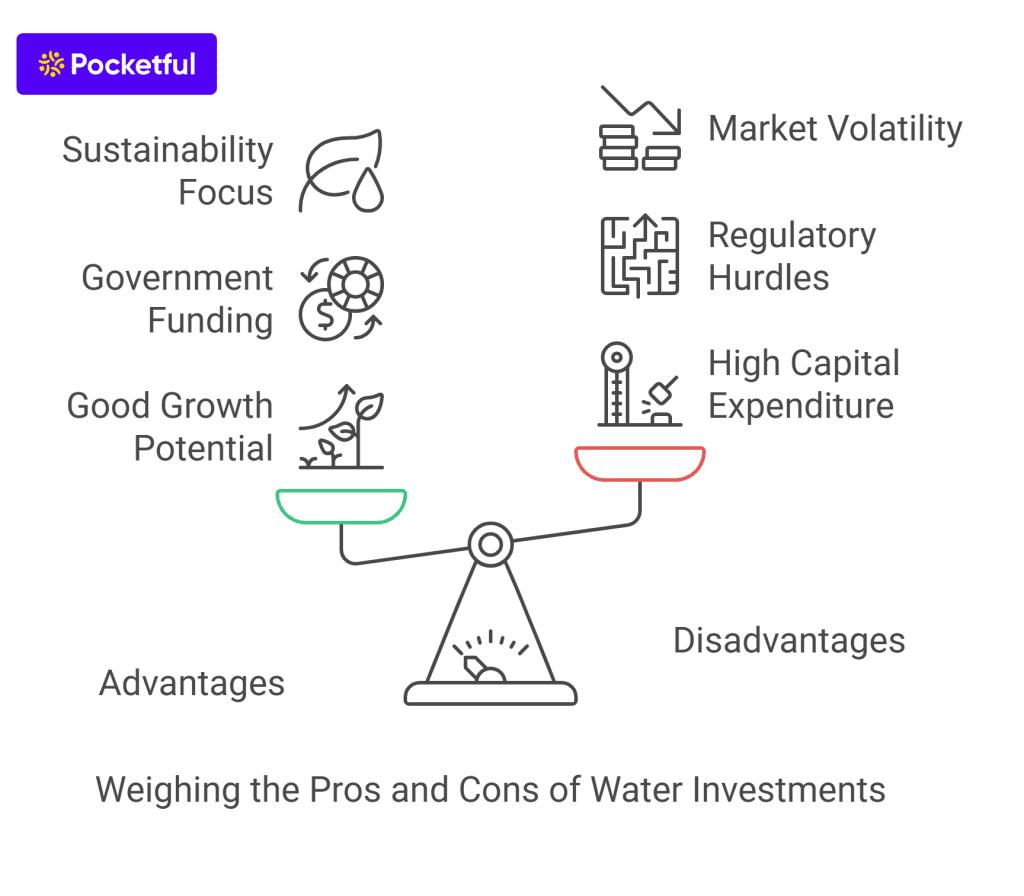

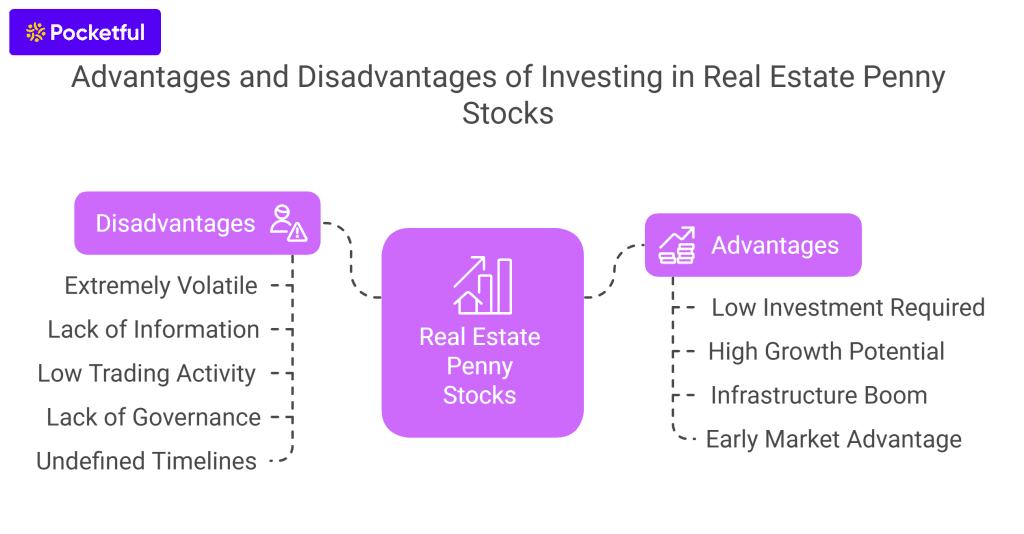
![Top 10 Cement Penny Stocks in India Below ₹50 [2026 List]](https://cms-resources.pocketful.in/blog/wp-content/uploads/2025/04/cement-penny-stocks-in-india.jpg)